PART 2: She Waited Under the Burning Sun for Her Missing Puppies—Then I Found the Man Who Had Left Her Behind
PART 2
I stayed with her until nearly midnight.
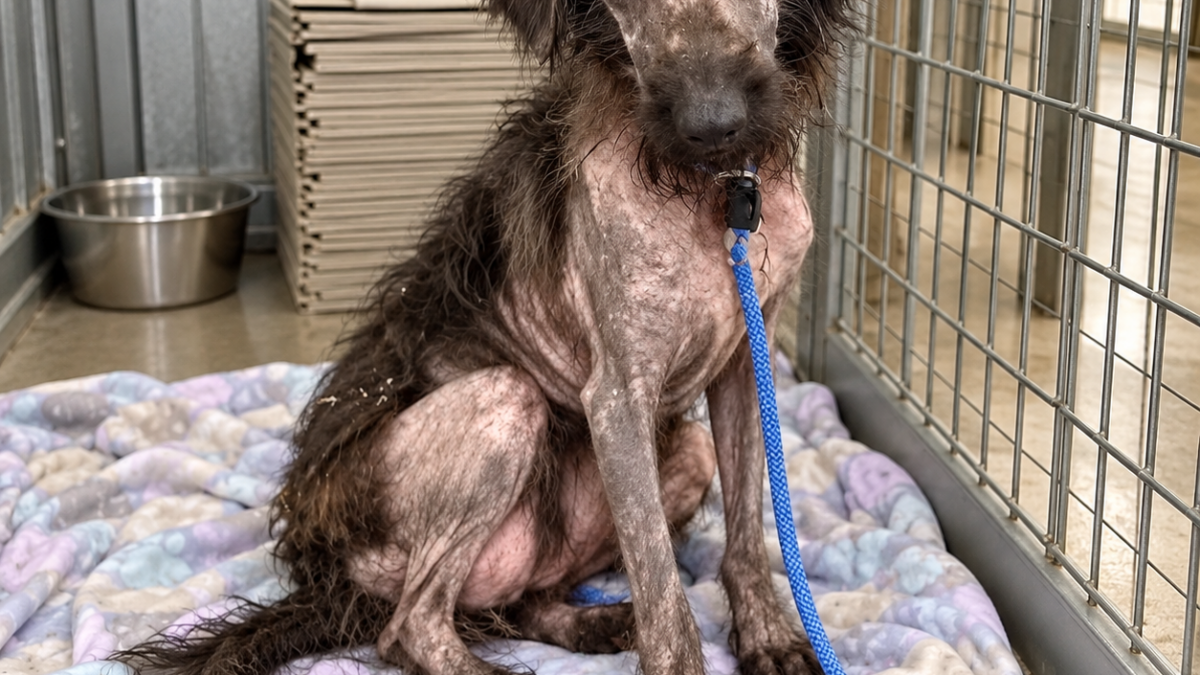
Dr. Warren wanted to keep her overnight because of the inflammation across her chest, dehydration and the condition of her skin. She had patches where the fur had thinned almost to nothing. Fleas had irritated some areas raw. There were old calluses along her elbows and small scars on her legs that told stories none of us could read with certainty.
Her body had been surviving for a long time.
But her mind was still on that road.
We offered her chicken.
She turned away.
We offered canned food warmed enough to make the smell stronger.
Nothing.
Dr. Warren sat on the edge of the counter and sighed.
“She needs calories.”
“I know.”
“She also needs rest.”
“I know.”
He looked through the kennel door.
Lilian was standing again.
Not pacing exactly.
She would walk three steps toward the kennel gate, stop, listen, and then walk back.
Three steps.
Stop.
Listen.
Back again.
“She’s waiting for something,” he said.
“Her puppies.”
“Probably.”
That word bothered me.
Probably.
In rescue work, certainty is rare.
A scar might mean abuse.
Or it might mean an accident.
Fear might mean someone hurt a dog.
Or it might simply mean the dog was never socialized.
We learn quickly not to turn assumptions into facts.
But some things are harder to dismiss.
Lilian was producing milk.
She had been found searching one narrow stretch of road.
She reacted violently to certain vehicles.
And she was willing to run from rescuers only to come straight back to the place where she believed her babies had disappeared.
Something had happened there.
I crouched beside her kennel.
“Did somebody leave you there?”
Her ears twitched.
“Did they take your babies?”
She rested her chin on the floor.
I hated myself for asking questions she could never answer.
I stayed another hour.
At 12:17 a.m., Lilian finally lay down.
I went home.
I did not sleep.
Every time I closed my eyes, I saw her chasing that pickup.
At 5:30 the next morning, I was back at the clinic.
Dr. Warren’s technician, Marissa, met me in the hall.
“She ate.”
I stopped.
“How much?”
“Not enough. Maybe a quarter of the bowl.”
I smiled anyway.
“Good girl.”
“She only started after I sat beside her.”
That sounded like Lilian.
She didn’t want food.
She wanted someone not to leave.
When I entered the treatment area, she lifted her head.
For the first time since I had met her, her tail moved.
Once.
Barely two inches across the blanket.
But I saw it.
“So you do know me,” I whispered.
I opened the kennel and sat on the floor.
Lilian came forward slowly.
She sniffed my shirt, my hands, my knees.
Then she walked past me.
Straight toward the exit.
I laughed despite myself.
“Okay. I’m not that special.”
Her nose pressed against the crack beneath the door.
She inhaled.
The laugh died.
She still wanted to go back.
For the next three days, we treated her infection and inflamed skin. She received fluids, medication, medicated baths and small meals throughout the day.
Physically, she improved.
Emotionally, she seemed suspended between us and something miles away.
She slept in fragments.
Ten minutes.
Twenty.
Then she would lift her head and listen.
At the sound of an engine in the parking lot, she stood.
At the click of keys, she stood.
At the opening of the clinic door, she stood.
Every time.
On the third afternoon, Dr. Warren called me into his office.
“You’re thinking about taking her back there.”
It wasn’t a question.
“Yes.”
He leaned back.
“Medically, I’d rather have another couple days.”
“She’s going crazy in here.”
“She’s not going crazy.”
“You know what I mean.”
“I do.”
I rubbed my forehead.
“What if we missed something? What if there’s a trail she can follow now that she has more strength?”
He was silent.
“That dog knows where she wants to go,” I continued. “Maybe she knows something we don’t.”
He looked through the glass wall toward the treatment area.
Lilian was sitting near the door.
“Two hours,” he said finally.
“Three.”
“Two.”
“Two and a half.”
He sighed.
“Fine.”
When we pulled into the roadside turnout that afternoon, Lilian was on her feet before the van stopped.
Her entire body changed.
The dog who had moved carefully through the clinic suddenly strained forward with desperate strength.
“Easy.”
I clipped a long line to her harness.
The door opened.
Lilian jumped down.
Her nose hit the dirt immediately.
Then she ran.
I followed.
The first fifty yards were the same ground we had already searched.
She checked the weeds.
The ditch.
A rusted drainage pipe.
Then she crossed behind the abandoned tire shop.
“Lilian.”
She pulled harder.
I signaled to Jenna, another rescuer, to follow us.
Lilian moved into waist-high grass behind the building.
For ten minutes, she zigzagged.
Then she stopped.
Her nose hovered over a patch of flattened weeds.
She sniffed.
Turned in a circle.
Sniffed again.
I knelt.
There was nothing obvious.
No puppy.
No collar.
No blood.
No tracks I could recognize.
Just dry grass.
Then Lilian let out a sound I had not heard before.
Not a bark.
Not a whine.
Something low and broken in her throat.
She lay down.
Right there.
I touched the grass.
“What happened here?”
Jenna looked around.
“Could they have been kept here?”
“Maybe.”
An old service road ran behind the tire shop.
A vehicle could pull in without being visible from the highway.
I photographed the area.
Then we continued.
Lilian followed the service road nearly half a mile before the scent—or whatever she had been following—seemed to disappear.
She turned left.
Right.
Back again.
Her movements became frantic.
“Easy,” I said.
She pulled until she coughed.
I shortened the leash.
“No. You’re not hurting yourself.”
She looked up at me.
There are moments when people who work with animals become too comfortable interpreting expressions.
We have to be careful.
Dogs do not think exactly as we do.
They do not tell stories to themselves in human language.
But they know absence.
They know attachment.
They know when something that belonged beside them is suddenly gone.
And I knew what I saw in Lilian’s face.
She had reached the end of something.
A scent.
A memory.
A trail.
Whatever it was, it stopped there.
We searched another two hours.
Again, nothing.
At one house, an elderly man shook his head.
“No puppies.”
“Did you see the dog before?”
“Couple times.”
“When?”
He squinted toward the road.
“Maybe Thursday. Maybe Friday.”
“Was she alone?”
“Think so.”
“Any vehicles stopping around here?”
He shrugged.
“People pull off all the time.”
“Anything unusual?”
“No.”
We walked away with nothing.
At another property, a woman told us she had heard dogs barking at night but couldn’t say from where.
A teenager remembered seeing “some guy with a truck” near the old tire shop.
“What kind of truck?” I asked.
He stared at the ground.
“White, maybe.”
“What day?”
“I don’t know.”
“What did the guy look like?”
“Didn’t see him.”
It was barely information.
Still, I wrote it down.
When the sun began dropping, Lilian’s energy disappeared as quickly as it had arrived.
She sat beside the road again.
Same place.
Same direction.
Watching traffic.
I crouched beside her.
“We have to go.”
She didn’t move.
“I’m sorry.”
Nothing.
I swallowed.
“I really am.”
Jenna turned away.
Neither of us wanted to be the person who pulled Lilian from that road a second time.
But darkness was coming.
She needed medication.
She needed food.
And whatever she was waiting for had not returned.
I slid one arm beneath her chest.
This time, she resisted.
Not aggressively.
She simply planted her feet.
“Lilian.”
She pulled toward the shoulder.
A car passed.
Her head followed it.
Then another.
And another.
Finally I whispered, “They’re not in those cars, sweetheart.”
My voice broke.
I lifted her.
She trembled in my arms.
When the van door closed, she immediately went to the rear window.
That night, she refused dinner again.
I sat outside her kennel until she finally ate from my hand.
One bite at a time.
Over the next week, Lilian’s physical recovery continued.
Her fever disappeared.
The swelling eased.
Her skin began healing.
But she became quiet.
Too quiet.
The frantic searching stopped because she no longer had the road in front of her.
Instead, she spent hours lying with her head between her paws.
Visitors passed.
Dogs barked.
Kennel doors opened and closed.
Lilian barely reacted.
I brought her into my office when I could.
The first day, she curled beneath my desk.
The second day, she moved closer to my chair.
On the fourth day, I felt something warm against my fingers.
I looked down.
Lilian had placed her muzzle in my open hand.
I didn’t move.
Neither did she.
For almost a minute, we sat that way.
It was the first time she had asked me for anything.
Not food.
Not freedom.
Just contact.
“I’m here,” I whispered.
Her eyes closed.
That should have been enough for me.
My job was to save the dog in front of me.
Not solve every mystery behind her.
But I could not stop thinking about the flattened grass behind the tire shop.
Or the teenager’s vague memory of a white truck.
Or the way Lilian had chased that first pickup.
So after my shift the following Monday, I drove back alone.
The old tire shop had been closed for nearly two years.
A faded FOR LEASE banner hung crookedly across the front.
Behind it was the service road Lilian had followed.
I parked and walked.
The grass had already begun standing upright again.
I photographed everything from different angles.
Then I noticed a small building across the highway.
I had seen it during our earlier searches but assumed it was an empty warehouse.
A sign on the side read MARTIN FARM SUPPLY.
There was a camera above the loading door.
I crossed the road.
A man in his sixties was stacking bags of feed inside.
“Can I ask you something?”
He looked at me.
“You with the dog people?”
Apparently word had traveled.
“Yes.”
“The skinny mama?”
“Yes.”
He frowned.
“Poor thing.”
I pointed toward the camera.
“How long do you keep footage?”
“Depends.”
My pulse jumped.
“How long?”
“Couple weeks unless the system overwrites.”
“What day was that dog first seen?”
I gave him the date.
He scratched his jaw.
“Maybe.”
“Could we look?”
He hesitated.
“I’m not supposed to just give recordings away.”
“I understand. I don’t need a copy unless you’re comfortable. I just want to know whether a vehicle stopped near that old shop.”
He studied me.
Then he called toward the back.
“Luis, cover the register.”
Twenty minutes later, we were in a cramped office behind the store.
The camera angle was terrible.
It showed the front parking lot, part of the highway and, far in the background, the entrance to the old service road.
We advanced through hours of footage.
Cars.
Trucks.
Delivery vans.
More cars.
At 3:42 in the afternoon, Martin leaned toward the monitor.
“Wait.”
A white pickup slowed.
It crossed the center line.
Turned.
Disappeared behind the tire shop.
My heart began hammering.
“Can you zoom?”
“Not much.”
The image pixelated.
White pickup.
Extended cab.
Dark toolbox behind the cab.
No readable plate.
“How long is it there?”
We watched.
Five minutes.
Ten.
Twenty.
At 4:09, the truck reappeared.
It paused before entering the highway.
Something moved in the bed.
I leaned so close to the monitor my breath fogged the screen.
“Go back.”
Martin reversed it.
The truck paused again.
There.
A shape behind the side panel.
Then another.
Too small to identify.
“Could be anything,” Martin said.
“I know.”
And it could.
Feed bags.
Tools.
Dogs.
Wishful thinking is dangerous when you want an answer badly enough.
Then the truck pulled onto the highway.
Four minutes later, another figure entered the camera frame.
A dog.
Thin.
Tan.
Running from the direction of the service road.
Lilian.
She ran into the road, forcing a car to brake.
Then she turned in the direction the white truck had gone.
I stopped breathing.
Martin removed his glasses.
“Oh, hell.”
We watched Lilian disappear from view.
The timestamp glowed in the corner.
4:13 p.m.
I wrote it down.
The next morning, I called county animal control.
Officer Dana Reyes had worked with our rescue on several neglect cases. She was methodical, skeptical and almost impossible to rush.
Exactly the person I needed.
I showed her the footage.
She watched twice.
Then she folded her arms.
“It proves someone stopped.”
“And Lilian came out four minutes after that truck.”
“It proves that too.”
“It may have puppies in the back.”
“May.”
I clenched my jaw.
Dana looked at me.
“You know how this works.”
“I do.”
“Then don’t make me be the bad guy for saying it.”
“I’m not.”
“You are a little.”
I sat back.
She softened.
“I believe you found something important. But I can’t identify a driver from that video. I can’t tell what’s in the truck. I can’t even prove Lilian was with him.”
“What can we do?”
“Ask around.”
“We already did.”
“Ask differently.”
She tapped the still image of the pickup.
“You weren’t looking for a truck before.”
That afternoon, I printed the clearest frame we had.
No public accusations.
No names.
Just a photograph and a question.
Had anyone seen this vehicle near the service road?
The mechanic remembered it.
Not clearly.
But enough.
“Yeah,” he said. “I think I’ve seen that truck.”
“When?”
“A few times.”
“Driver?”
He rubbed grease from his fingers.
“Big guy. Beard.”
“Name?”
“No idea.”
At the fruit stand, the woman shook her head.
At the nearby feed store, Martin studied the photograph again.
Then Luis, the employee who had covered the register, walked past.
He stopped.
“That looks like Cole’s truck.”
I turned.
“Who’s Cole?”
Luis immediately looked uncomfortable.
“Nobody.”
“Luis.”
Martin frowned at him.
“You mean Cole Bannon?”
Luis exhaled.
“Yeah.”
Dana, who had come with me, stepped closer.
“Where does he live?”
Luis looked from her uniform to me.
“Why?”
“We’re checking a vehicle.”
He hesitated.
“Old ranch off County Twelve.”
“Does he have dogs?”
Luis laughed without humor.
“Always.”
“What kind?”
“Whatever he can sell.”
The room changed.
Dana’s expression hardened.
“Explain.”
Luis shrugged, but he was no longer casual.
“He breeds them. Or used to. Shepherd mixes, heelers, pits. Whatever people buy.”
“Licensed?”
“Don’t know.”
“Have you been to the property?”
“Once.”
“When?”
“Last year.”
“How many dogs?”
“Maybe twelve.”
Dana began taking notes.
“Conditions?”
Luis looked toward the door.
“Not good.”
That was not proof Cole Bannon had anything to do with Lilian.
Dana reminded me of that three times on the drive back.
I knew.
But for the first time, we had a name.
Animal control records gave us more.
There had been two previous complaints involving Bannon’s property.
One for barking.
One anonymous welfare complaint that had been closed after an officer was unable to verify neglect from the road.
No seizure.
No charges.
No confirmed violations.
Still, Dana drove out there the next morning.
I was not allowed to go with her.
She called me afterward.
“He answered.”
“And?”
“Four adult dogs visible.”
“Lilian?”
“No.”
“Puppies?”
“No.”
“Did you ask about her?”
“Yes.”
My grip tightened around the phone.
“What did he say?”
“He’s never seen her.”
I was silent.
Dana continued.
“I asked about the truck.”
“And?”
“He owns a white Ford.”
My heart kicked.
“Toolbox?”
“Yes.”
“That’s him.”
“No. That means he owns a truck that resembles the one in the video.”
“Dana—”
“I know.”
She paused.
“Something else.”
“What?”
“When I mentioned the tire shop, his story changed.”
I stood.
“How?”
“First he said he hadn’t been down that road in months. Then he said he might’ve driven through because he buys feed nearby.”
“Did he say why he stopped behind the shop?”
“He said he didn’t.”
“But the truck—”
“Still can’t prove it’s his.”
I wanted to throw my phone.
Instead, I asked, “What now?”
“We keep building facts.”
The next fact came from the most unexpected place.
A woman named Tessa called our rescue three days later.
She had seen one of the notices asking about the white truck.
“I think I know that dog,” she said.
I sat upright.
“Lilian?”
“If that’s what you call her now.”
“What did you know her as?”
Silence.
“Ma’am?”
“Daisy.”
I closed my eyes.
“Where did you know Daisy from?”
“My brother bought a puppy from a man named Cole Bannon last year. That female was there.”
I grabbed a pen.
“You’re sure?”
“She was chained beside a shed.”
The pen stopped.
“Chained?”
“Yes.”
“Did she have puppies then?”
“No. She looked pregnant.”
My stomach turned.
“Do you have any photographs?”
“I might.”
Twenty minutes later, three images arrived.
The first showed Tessa’s brother holding a puppy.
In the background, blurred but unmistakable, stood a thin tan female dog.
White chest.
Dark muzzle.
Small notch on the edge of the left ear.
I enlarged it.
Lilian had the same notch.
The second photograph showed the side of a weathered shed.
The third showed part of a white pickup.
Dark toolbox behind the cab.
I forwarded everything to Dana.
She called immediately.
“That helps.”
“How much?”
“A lot.”
“Enough?”
“Not yet.”
I hated those words.
But she was right.
Tessa agreed to provide a statement.
Her brother did too.
He had paid cash for a puppy.
No paperwork.
According to him, Bannon had bragged that his females “paid their own feed bill.”
That sentence stayed with me.
That evening, I sat with Lilian in the small fenced yard behind the rescue.
She had gained six pounds.
The redness across her chest had faded.
Fine new fur covered several bare patches.
She followed me now.
Not constantly.
Not anxiously.
But when I changed direction, she noticed.
When I sat, she came closer.
I held the old photograph beside her.
The dog in the picture looked exhausted even from twenty feet away.
A chain disappeared from her collar toward the shed.
I lowered the phone.
“Was that you?”
Lilian leaned against my leg.
I felt anger rise through me so fast it frightened me.
I had spent years learning that anger can ruin animal cases.
People want immediate justice.
They want to storm properties.
Confront owners.
Break locks.
Take animals.
I understood that impulse.
But doing those things without legal authority can destroy the case and, sometimes, force animals right back into the hands of the person you were trying to stop.
So I did the hardest thing.
I waited.
But I did not stop.
Dana obtained sales records from several people who had bought puppies from Bannon.
Not official sales records.
Texts.
Screenshots.
Payment histories.
Photographs.
Dates.
The pattern stretched back years.
Female dogs appeared in one litter after another, then disappeared.
One buyer remembered Lilian specifically.
“She was the mother,” he told Dana.
“When?”
He gave a date from eight months earlier.
“Did Bannon tell you her name?”
“Daisy.”
Another person remembered her too.
That established history.
It still did not establish what happened to the missing litter.
Then Martin Farm Supply called.
The owner had found something while checking older invoices.
Cole Bannon had bought puppy formula two days before Lilian was found on the road.
Six cans.
He had also purchased a small bottle-feeding kit.
That mattered.
If Lilian was nursing normally, why would he need formula?
There were innocent explanations.
Maybe another dog had a litter.
Maybe a puppy needed supplemental feeding.
But Dana added it to the file.
Then Tessa sent one more photograph.
She had been scrolling through old social media screenshots her brother had saved when he was searching for a puppy.
One advertisement had been posted eleven days before we found Lilian.
Six puppies.
Five tan and black.
One mostly brown.
The mother was barely visible at the edge of the photograph.
But the notch in her ear was there.
Lilian.
My hands began shaking.
The caption said the puppies would be “ready soon.”
Ready soon.
Not ready now.
Yet less than two weeks later, Lilian had been separated from them while still producing milk heavily enough that Dr. Warren had immediately noticed.
Dana stared at the screenshot.
“This is the first thing that directly connects him to a recent litter from her.”
“So now?”
“Now I talk to the county attorney.”
Two days later, animal control returned to Bannon’s property with a warrant related to welfare concerns and records connected to the breeding operation.
I was not there when they entered.
I learned what happened from Dana afterward.
There were nine dogs on the property.
Four outside.
Five inside an old barn.
Two had untreated skin infections.
One was severely underweight.
Three females showed signs of repeated breeding.
No puppies matching Lilian’s litter were found.
No puppies at all.
Bannon was furious.
He insisted everyone was lying.
He said animal rescuers were “stealing his livelihood.”
He denied Lilian had ever belonged to him.
Then Dana showed him the photograph.
He changed his answer.
He said she had once been his dog but had “run away months ago.”
Dana showed him the advertisement from eleven days before Lilian was found.
His story changed again.
He claimed somebody else had used an old photograph.
Then Dana showed him message records from a buyer who had contacted him about that exact litter.
Silence.
“What happened to the puppies?” Dana asked.
“I sold them.”
“When?”
“Don’t remember.”
“They were still nursing.”
“They were eating.”
“Where is the mother?”
“I told you, she ran.”
“Before or after you sold the litter?”
He refused to answer.
Dana asked about the old tire shop.
He said nothing.
Then she showed him the surveillance still.
According to Dana, that was the first time he looked afraid.
Not remorseful.
Afraid.
“What happened behind that shop?” she asked.
Bannon demanded an attorney.
The interview ended.
When Dana told me, I felt no triumph.
Only nausea.
“Do we know where the puppies are?”
“Not yet.”
“Can we find the buyers?”
“We’re trying.”
“What if he dumped them?”
“We don’t know that.”
“What if—”
“Stop.”
I looked at her.
Dana rarely raised her voice.
“Do not fill empty spaces with the worst thing you can imagine,” she said. “Not for your sake. Not for hers.”
I looked through the glass into the yard where Lilian was sleeping in the shade.
“I just want to know.”
“I know.”
“What if we never do?”
Dana’s expression softened.
“Then we make sure what we can prove still matters.”
The seized dogs were evaluated.
Several required treatment.
Temporary custody hearings followed.
Bannon hired an attorney and fought every step.
He insisted the dogs were property.
He accused the county of harassment.
He claimed the photographs had been taken out of context.
He said people were targeting him because they disliked breeders.
But the case was not about whether someone liked breeding dogs.
It was about veterinary care.
Living conditions.
Records.
The physical condition of the animals.
And inconsistencies in his own statements.
A month after Lilian arrived, Dana called.
“We found two buyers.”
I stood so quickly my chair rolled backward.
“The puppies?”
“Two from the litter.”
“Alive?”
“Yes.”
I covered my mouth.
“Are they okay?”
“One appears healthy. I haven’t seen the other yet, but the buyer says yes.”
“Can Lilian see them?”
There was a pause.
“No.”
The answer felt like a punch.
“Why?”
“They’ve been separated for weeks. They’re in homes. They’re being evaluated. And we don’t have authority to take healthy puppies from people who apparently bought them without knowing anything was wrong.”
“But they were taken too young.”
“We’re documenting that.”
“She searched for them for days.”
“I know.”
“She almost died on that road.”
“I know.”
My voice cracked.
“That’s not fair.”
“No,” Dana said quietly. “It isn’t.”
One buyer agreed to speak with us.
Her name was Rachel.
She had purchased a female puppy from Bannon four days before we found Lilian.
The puppy was approximately six weeks old.
Too young to be separated under ideal circumstances.
Rachel had been told the mother “had stopped nursing.”
That was clearly false.
Lilian had still been producing enough milk to suffer painful engorgement and inflammation.
Rachel showed us a photograph taken when she picked up the puppy.
Bannon was holding the puppy beside his white truck.
The dark toolbox was visible.
“Was the mother there?” I asked.
Rachel thought.
“No.”
“Any other puppies?”
“Several. In carriers.”
“Did he say where he was taking them?”
“He said he had deliveries.”
My skin went cold.
“What day?”
She checked the timestamp.
It was the same day Lilian appeared on the highway.
The timeline became brutally simple.
Bannon had separated Lilian from her litter.
Loaded puppies into carriers.
Driven away to deliver them to buyers.
Somewhere along that route, Lilian had ended up behind the abandoned tire shop.
Whether he deliberately left her there or she escaped during a stop was the question investigators still had to prove.
But when Dana interviewed Rachel formally, another detail emerged.
Rachel remembered asking Bannon why he wasn’t keeping the mother with the puppies longer.
His answer had been casual.
“Don’t need her anymore.”
Four words.
That was all.
Don’t need her anymore.
When Dana told me, I walked outside because I could not breathe properly.
Lilian was lying beneath a tree.
She saw me.
Stood.
Walked over.
By then she had started doing something new.
Whenever she reached me, she pushed the top of her head gently against my thigh.
I knelt.
She leaned harder.
I wrapped my arms around her.
“You mattered,” I whispered into her neck.
She licked my chin.
“You mattered when you were nursing them. You mattered after. You mattered every second.”
She had no idea what I was saying.
But she stayed.
A week later, Bannon’s attorney offered an explanation for the tire shop.
Lilian had escaped from the truck while Bannon stopped to check a loose strap.
He claimed he searched for her.
He said she ran into the brush and he could not catch her.
Then he continued delivering puppies.
I read that statement three times.
“He left.”
Dana nodded.
“He says he returned later.”
“Did he?”
“No evidence.”
“Did he report her missing?”
“No.”
“Call animal control?”
“No.”
“Post anything?”
“Not that we found.”
“Drive back the next morning?”
“He says he did.”
“Camera?”
“No footage available from that period except Martin’s angle.”
I stared at the statement.
“He drove away with her babies while she ran after him.”
“That appears consistent with the video.”
My hands curled into fists.
For weeks I had imagined someone stealing Lilian’s puppies from her.
The truth was somehow colder.
The man who had controlled her life had taken the puppies because they had monetary value.
Then, when she became inconvenient, he left without her.
Maybe she escaped.
Maybe he put her out.
Legally, that distinction mattered.
To Lilian, it probably didn’t.
She watched the truck carrying her puppies disappear.
And she waited for it to return.
That was why every vehicle mattered.
That was why she would not leave.
That was why she chased pickups until her weakened legs gave out.
She was not confused.
She was loyal to a promise no one had made.
I wanted revenge.
For one ugly hour, I genuinely did.
Not court hearings.
Not paperwork.
Not fines.
I wanted Bannon to sit beneath that same sun with no water and watch everything he loved disappear down the highway.
Then Lilian walked into my office and put her head in my hand.
And the anger changed shape.
Revenge would not heal her.
Consequences might protect the next dog.
So that became the goal.
Bannon contested the seizure of the nine dogs.
The hearing took place six weeks after we found Lilian.
I attended because Dr. Warren and I had both provided documentation.
Bannon sat across the room in a clean button-down shirt.
I had never seen him in person.
He looked ordinary.
That disturbed me more than anything.
People expect cruelty to have a recognizable face.
It doesn’t.
Sometimes it looks like a man checking his phone while a veterinarian describes an underweight dog.
Sometimes it looks bored.
Sometimes annoyed.
Sometimes convinced it is the victim.
Dr. Warren testified about Lilian’s condition.
He explained that her lactation indicated recent nursing.
He described the inflammation.
The dehydration.
The skin disease.
Her weight.
Bannon’s attorney asked whether those things proved his client had neglected her.
“No,” Dr. Warren said.
“So they could have occurred after she ran away.”
“Some could have worsened afterward.”
“Then you cannot say Mr. Bannon caused them.”
“I can say the dog had been lactating very recently and was found in poor condition.”
The attorney nodded as if he had won something.
Then Dana testified.
She laid out the timeline.
The puppy advertisement.
The buyer messages.
The feed-store purchase.
Rachel’s pickup date.
The surveillance footage.
Bannon’s changing statements.
His final claim that Lilian escaped behind the tire shop.
The county attorney asked, “After this nursing female allegedly escaped, did Mr. Bannon contact animal control?”
“No.”
“Local shelters?”
“No record.”
“Veterinary clinics?”
“No record.”
“Did he post a lost-dog notice?”
“We found none.”
“Did he tell the puppy buyers that the mother was missing?”
“Not according to the buyers we interviewed.”
Bannon stared at the table.
Then came the photographs of the dogs seized from his property.
I had seen them before.
They still hurt.
A female hound with ribs visible.
A shepherd mix with untreated dermatitis.
Two dogs living in an enclosure layered with waste.
The county was not seeking to punish him for being unpopular.
It was asking the judge to recognize a pattern supported by evidence.
The judge ordered the seized dogs to remain in protective custody pending the criminal and civil proceedings.
It was not the final victory.
But nine animals did not go back that afternoon.
For me, that mattered.
For Lilian, life continued far away from court.
She did not know a case existed.
She did not know her old photograph had been projected onto a courtroom screen.
She did not know strangers were arguing over whether what happened to her legally qualified as neglect or abandonment.
She cared about breakfast.
Shade.
Soft blankets.
The sound of my footsteps.
And increasingly, other dogs.
The first dog she chose as a friend was a ridiculous senior beagle named Winston.
Winston was twelve, overweight and completely convinced every pocket contained food.
Lilian had ignored most dogs since arriving.
Winston ignored her right back.
Perhaps that was why she liked him.
One afternoon, I found them lying together beneath the picnic table.
Winston was snoring.
Lilian’s head rested across his back.
I stopped at the gate.
Jenna came up behind me.
“Don’t move.”
“I’m not moving.”
“If you cry, I’m telling everyone.”
“I’m not crying.”
“You’re absolutely crying.”
“I have allergies.”
“In August?”
“Severe August allergies.”
Lilian opened one eye.
Then closed it again.
That was the first photograph I took of her that did not look sad.
It was also the first time I believed she might truly be coming back to us.
Her appetite improved.
She gained weight.
Her coat changed from brittle and patchy to soft.
The bare places filled in.
She learned that leashes did not always lead away from something she loved.
Sometimes they led to grass.
Sometimes to the creek.
Sometimes to the front office where Marissa kept cheese in the refrigerator.
She learned the sound of my truck.
She learned Winston’s bark.
She learned that when kennel lights dimmed at night, people returned in the morning.
That last lesson took the longest.
For weeks, Lilian resisted entering her kennel after evening walks.
She would stand in the hallway and look toward the exit.
I began sitting inside the kennel with her for five minutes before leaving.
Then three.
Then one.
Eventually, she walked inside on her own.
Trust rarely arrives as one dramatic moment.
It arrives as repetition.
A bowl placed down.
A door opened.
A person returning when they said they would.
Nothing spectacular.
Everything important.
Meanwhile, investigators located four of Lilian’s six puppies.
All four were alive.
All had been sold.
Two had minor health problems that their new owners were treating.
None of the buyers appeared to have known how young the puppies were or what had happened to Lilian.
The remaining two could not be traced.
Bannon claimed he had sold them for cash to people whose names he did not remember.
We never learned whether that was true.
I struggled with that.
Part of me wanted every blank filled.
Every puppy accounted for.
Every question answered.
Rescue work rarely gives you that.
Sometimes the ending has missing pages.
What mattered was that the four puppies we found were safe.
Their families sent photographs.
I kept them in a folder on my phone.
I never showed Lilian.
That might sound strange.
People often asked whether she could be reunited with them.
But by then weeks had passed.
The puppies were weaned, settled and bonding with their homes.
Lilian had stopped producing milk.
Dragging everyone back through a reunion designed primarily for human emotions did not necessarily serve the dogs.
So I kept the photographs for myself.
One showed a puppy asleep upside down on a sofa.
Another showed one carrying a shoe twice the size of her head.
A third was sitting beside a blue food bowl.
The fourth had enormous ears and a crooked smile.
They were alive.
They were loved.
When the guilt became too heavy, that was what I held onto.
At the two-month mark, we officially listed Lilian for adoption.
I hated it.
I also knew it was time.
“You could foster her,” Jenna said.
“That’s how people end up with seventeen dogs.”
“You have one.”
“Exactly. I’m showing discipline.”
“You’ve spent two months rearranging your schedule around her.”
“That’s professional dedication.”
“You bought her a bed for your office.”
“Ergonomic necessity.”
“You embroidered her name on it.”
I glared at her.
She smiled.
“Just admit you love her.”
“I love all of them.”
“Not like this.”
She was right.
That was the problem.
I had thought about adopting Lilian.
More than once.
But my home already served as an emergency foster space. I worked long, unpredictable hours. Lilian had finally reached a point where she deserved stability rather than another temporary arrangement built around rescue chaos.
Loving a dog does not always mean keeping her.
Sometimes it means finding the place where she no longer needs you.
We received twelve applications.
I rejected the first one because the family planned to keep her outdoors most of the day.
The second had two unaltered dogs and no veterinary records.
The third wanted a “calm dog for security.”
No.
The fourth sounded promising until they asked whether she could have puppies “just once.”
I ended the call.
By application seven, Jenna took the folder away from me.
“You are sabotaging this.”
“I am screening.”
“You asked one couple what their emergency evacuation plan was.”
“They live in wildfire country.”
“They live twenty minutes from downtown.”
“Fire travels.”
She stared at me.
“You cannot interrogate adopters like you’re hiring someone to protect the president.”
“I absolutely can.”
Then application nine arrived.
Elena and Marcus Hale.
Both in their fifties.
A fenced backyard.
No children at home.
One dog, an eight-year-old mixed-breed named Archie.
Veterinary records stretching back eleven years across their current and previous pets.
They had lost a fourteen-year-old dog the year before.
Under the question, “Why are you interested in Lilian?” Elena had written:
Because she looks like a dog who needs someone patient enough not to ask her to forget where she came from.
I read that sentence twice.
Then once more.
They visited on Saturday.
I met them in the yard with Lilian.
Elena did something immediately right.
Nothing.
She didn’t rush toward Lilian.
Didn’t crouch and squeal.
Didn’t reach over her head.
She sat on the bench and talked to me.
Marcus did the same.
Lilian sniffed around the yard.
Ten minutes passed.
Then she approached Elena.
Elena kept her hand relaxed beside her leg.
Lilian sniffed it.
Walked away.
Returned.
Sniffed again.
Then sat three feet from her.
Marcus smiled but said nothing.
After half an hour, we brought Archie out.
He was a large, shaggy mutt with a white beard and the energy of a retired accountant.
He sniffed Lilian.
She sniffed him.
He found a patch of shade and lay down.
Lilian followed.
Jenna whispered behind me, “That’s good.”
“I know.”
“You look sick.”
“I’m fine.”
“You look like you’re giving away your firstborn.”
“Go away.”
The Hales visited three more times.
No pressure.
No promises.
On the third visit, Lilian greeted Elena at the gate.
Tail moving.
Not one little uncertain sweep.
A real wag.
Elena looked at me.
I looked away.
“Oh,” she whispered.
That single sound nearly destroyed me.
The night before the adoption, I stayed late.
Lilian lay on the bed in my office.
The embroidered one Jenna never stopped making fun of.
I sat beside her.
“You know what tomorrow is?”
She yawned.
“You’re leaving me.”
Her head lifted.
“That sounded terrible.”
I scratched behind her ears.
“You’re going home.”
She rested her muzzle on my knee.
“I need you to understand something.”
Of course she didn’t understand the words.
I said them anyway.
“That road wasn’t where your story ended.”
Her eyes watched me.
“You waited long enough.”
I thought about the day we found her.
The heat.
The dust.
The cars.
Her body turning toward every engine.
“I’m sorry I couldn’t bring them back to you.”
My throat closed.
“All of them.”
Lilian moved closer.
I pressed my forehead against hers.
“But four are safe. I know that much.”
She licked my nose.
I laughed.
“You always do that when I’m trying to be dramatic.”
Her tail tapped the bed.
The next morning, Elena and Marcus arrived with Archie.
They brought a new harness.
A bed.
A bag of the exact food Lilian ate.
And, because Elena had apparently listened to every word I ever said, a container of small cheese cubes.
“Bribery,” I said.
“Relationship building,” she corrected.
We completed the paperwork.
I explained her medications even though she had almost finished them.
I explained her feeding schedule.
Her fear of being left outdoors alone.
Her habit of checking windows when trucks passed.
Her love of cheese.
Her dislike of thunderstorms.
Her tendency to hide socks but never chew them.
Elena listened to everything.
Then the moment came.
The leash changed hands.
Lilian looked at me.
I had witnessed hundreds of adoptions.
Usually I loved that moment.
That day, it hurt.
“Go on,” I whispered.
Elena opened the car door.
Archie climbed into the back seat.
Lilian put her front paws up.
Stopped.
Turned.
Then came back to me.
I knelt.
She pressed her head against my chest.
For several seconds, I could not speak.
Finally I whispered, “You’re okay.”
She stayed.
“You don’t have to wait for me.”
My tears landed in her fur.
“Go home, Lilian.”
She licked my cheek.
Then she walked to Elena.
Climbed into the car.
And lay beside Archie.
As the car moved away, I stood in the parking lot and watched until it disappeared.
Jenna came beside me.
“You okay?”
“No.”
“Good adoption?”
“The best.”
“That’s why it hurts.”
I nodded.
Then something happened I did not expect.
For months, the image that had haunted me was Lilian standing beside the highway watching a vehicle carry away everything she loved.
Now I was the one standing still while a vehicle carried Lilian away.
But this time she was not being abandoned.
She was going home.
Three weeks later, the county case against Bannon reached its conclusion.
He accepted a plea agreement rather than take the primary animal-welfare charges to trial.
The court imposed fines, restitution for veterinary and boarding costs, probation and restrictions that prevented him from operating the breeding business that had produced litter after litter without adequate care.
Custody of the seized dogs was surrendered.
They became legally available for placement.
It was not the cinematic punishment anger had once made me imagine.
No dramatic handcuffs.
No crowd cheering.
No judge pounding a gavel and delivering a speech.
Real justice is often paperwork.
Conditions.
Inspections.
Signatures.
Deadlines.
Boring things that can mean an animal never goes back to a filthy kennel.
The most important line in the agreement, to me, was the one restricting Bannon’s possession and breeding of dogs during the probation period.
He had once bragged that his females paid their own feed bills.
Now those females were gone from his property.
Several eventually entered foster homes through partner rescues.
The skinny hound went to a retired teacher.
The shepherd mix with dermatitis recovered and was adopted by a veterinary technician.
A small black dog nobody could touch during the seizure eventually learned to sleep on a couch beside an elderly man who called him Sam.
That was the revenge I came to understand.
Not suffering returned for suffering.
The cycle stopped.
At least there.
At least for those dogs.
As for Lilian’s puppies, four remained with the families who had unknowingly purchased them.
All four were eventually spayed or neutered.
All four were healthy.
We never located the final two.
I wish I could write otherwise.
I wish every rescue story ended with every missing animal found and every unanswered question solved.
That would be easier to live with.
It would also be a lie.
For a long time, I carried those two puppies around in my mind.
I imagined terrible things.
Then Dana reminded me of what she had told me from the beginning.
Do not fill empty spaces with the worst thing you can imagine.
So I stopped.
Not completely.
But enough.
Three months after Lilian first stood beneath that brutal summer sun, Elena invited me to visit.
Their house sat at the end of a quiet street shaded by enormous oak trees.
I had barely closed my truck door when I heard barking.
Archie appeared behind the front window.
Then another face rose beside his.
Lilian.
Her ears lifted.
For half a second, she stared.
Then she vanished from the window.
The front door opened.
Elena barely had time to say hello.
Lilian ran past her.
She crossed the yard so fast I instinctively crouched.
She hit me in the chest.
Not hard.
Just enough to knock me backward onto one hand.
Her tail whipped from side to side.
She licked my face.
My ears.
My chin.
“Okay! Okay!”
I started laughing.
“You remember me!”
Elena laughed from the porch.
“Oh, she remembers you.”
Lilian ran one circle around me, then pressed her head into my chest.
The same gesture.
Only now her body felt different beneath my hands.
Strong.
Healthy.
The ribs that had once stood out sharply were covered.
Her coat shone.
The raw patches were gone.
She smelled faintly of grass.
I held her face.
“Look at you.”
She sneezed directly on me.
Elena laughed harder.
“Still elegant.”
We went inside.
There were dog beds in three rooms.
Archie occupied whichever one Lilian wanted until Lilian approached, at which point he surrendered it with the weary dignity of an older brother.
A basket beside the sofa contained toys.
Lilian selected a stuffed duck.
She carried it to Marcus, dropped it at his feet and waited.
He threw it.
She ran.
I stared.
“What?”
Elena smiled.
“She learned fetch.”
“She wouldn’t even pick up toys with us.”
“She does now.”
Lilian returned with the duck.
Marcus threw it again.
She chased it.
There was something almost unbearable about watching a dog who once refused food because grief consumed everything now race across a living room over a ridiculous yellow duck.
“Does she still watch trucks?” I asked.
Elena’s smile softened.
“Sometimes.”
My heart dipped.
“She’ll go to the front window if one stops outside. But she doesn’t panic.”
“Does she try to run?”
“No.”
“Search?”
“No.”
Elena looked toward Lilian.
“She checks. Then she comes back.”
That sentence stayed with me.
She checks.
Then she comes back.
Later, we sat on the back porch.
Lilian lay between Archie and my chair.
Birds moved through the oak branches.
A lawn mower hummed somewhere down the street.
Nothing dramatic happened.
That was exactly what made it beautiful.
Lilian slept.
Not the restless ten-minute fragments from the clinic.
Deep sleep.
Her paws twitched once.
Her breathing remained slow.
She did not wake when a truck passed in front of the house.
I did.
She didn’t.
I looked toward the street.
Then back at her.
Elena noticed.
“She’s okay,” she said.
I nodded.
“I know.”
And for the first time, I actually believed it.
Before leaving, I took one final photograph.
Lilian was lying on her side in the grass.
Archie was beside her.
The late-afternoon sun fell across her coat.
Her eyes were half closed.
Her mouth hung slightly open in the relaxed expression people call a smile.
I compared it later with the first photograph I had taken.
In that first image, Lilian sat beside a scorching highway with her body angled toward traffic.
Every part of her looked as though it were waiting.
In the new photograph, she was facing nothing.
Searching for nothing.
Waiting for no one.
She was simply home.
I still think about the road sometimes.
I think about the hundreds of cars that passed while Lilian searched.
I think about the driver who separated a mother from puppies that were still young enough to need her because money mattered more than the bond between them.
I think about four puppies growing up in homes that never knew their mother had run beneath the burning sun looking for them.
And I think about two puppies whose stories I will probably never know.
But when those thoughts begin pulling me backward, I remember something else.
Lilian did not spend the rest of her life beside that road.
The man who treated dogs like inventory lost the operation that allowed him to keep repeating the cycle.
Nine dogs walked off his property and never returned.
Four of Lilian’s puppies were confirmed safe.
And the mother he believed he no longer needed became precious to people who would never measure her value by the puppies she could produce.
Months later, Elena sent me a photograph just before midnight.
Lilian was asleep beneath a blanket.
Only her nose was visible.
Archie was pressed against her back.
The message beneath the picture said:
“She heard a truck tonight. Lifted her head for a second, then went back to sleep.”
I sat on the edge of my bed staring at those words.
That was the ending I had wanted without knowing how to describe it.
Not forgetting.
Not magically erasing what happened.
Peace.
The ability to hear the sound that once meant loss and understand that this time, nobody was leaving.
The next morning, I printed the photograph.
I taped it above my desk at the rescue.
Under it, I placed the first picture of Lilian beside the highway.
People occasionally ask why I keep both.
Why not throw away the painful one?
Because recovery means more when you remember the distance traveled.
In one picture, she is waiting beneath a merciless sun for a truck that will never come back.
In the other, she is sleeping so deeply that a passing engine cannot make her afraid.
Between those two photographs are veterinary bills, sleepless nights, unanswered questions, an investigation, court filings, nine seized dogs, four located puppies, dozens of quiet meals, one ridiculous beagle and two people patient enough to give a grieving mother a home without demanding that she become happy overnight.
But more than anything, there is Lilian.
She survived the road.
She survived being used.
She survived losing the babies she tried desperately to find.
And somehow, when a human hand reached toward her again, she eventually chose not to run.
She placed her head inside it.
That may have been the bravest thing she ever did.
The following summer, almost one year after I first found her, Elena brought Lilian back to the clinic for her annual examination.
Dr. Warren came into the lobby carrying a chart.
He stopped.
“Is that really her?”
Lilian wagged.
He crouched.
She walked straight to him.
He ran both hands through the thick fur across her chest.
“No redness.”
“No inflammation,” Elena said.
“Perfect weight.”
“I told you she was spoiled.”
Dr. Warren smiled.
“Professionally speaking, I recommend continued spoiling.”
Lilian leaned against him.
He looked up at me.
“Remember when she wouldn’t eat?”
I nodded.
“Remember how she kept staring at that door?”
“I remember everything.”
Elena rubbed Lilian’s shoulder.
“She stares at our refrigerator now.”
Dr. Warren laughed.
“Excellent prognosis.”
After the examination, I walked them outside.
A white pickup was parked three spaces away.
I noticed it immediately.
So did Lilian.
She stopped.
For one second, every muscle in my body tightened.
Her ears lifted.
She stared at the truck.
I saw the highway again.
The heat.
The dust.
Her thin body chasing a disappearing vehicle.
Then Lilian sniffed once.
Turned away.
Walked toward Elena’s car.
I stood perfectly still.
Elena opened the back door.
Archie was waiting inside.
Lilian jumped in beside him without looking back at the pickup.
Before Elena closed the door, Lilian turned toward me.
Her tail thumped against the seat.
I reached in and kissed the top of her head.
“Good girl.”
Elena smiled.
“See you soon.”
They drove away.
Lilian looked through the window.
But she wasn’t staring backward at something she had lost.
She was sitting beside Archie, facing forward.
And this time, when the car disappeared at the end of the street, I smiled.
Because Lilian was no longer the mother waiting beside a road for someone to bring her family back.
She had a family riding beside her.
She had a soft bed waiting at home.
She had people who knew her history and never used it as a reason to love her less.
And somewhere between the day I carried her away from that burning highway and the day she calmly turned her back on a white pickup, Lilian had learned the lesson I had wanted so desperately to teach her from the beginning:
Some vehicles disappear because someone is abandoning you.
Others drive away because they are taking you home.
Lilian finally knew the difference.
And she never had to wait beside that road again.








