PART 2: She Waited 11 Months for a Family—Then They Returned Her After Just One Night
PART 2
The man’s name was Walter Bennett.
He was sixty-nine years old, though at first glance I would have guessed older. His shoulders curved slightly forward beneath a faded denim jacket, and the hand holding the old leather leash shook just enough for me to notice.
The leash itself looked as though it had been used for years.
The brown leather was soft and dark around the handle from countless walks.
I glanced at it.
Then at him.
“You heard about Luna?”
Walter nodded.
“My neighbor volunteers here on Thursdays. Ruth Patterson.”
I knew Ruth.
Everybody at the shelter knew Ruth.
She was seventy-three, wore bright floral sneakers no matter the season, and had an uncanny ability to get frightened dogs to eat simply by sitting near them and reading mystery novels aloud.
“She told me Luna got returned.”
My chest tightened.
“Yes.”
Walter looked past me toward the kennel hallway.
“Because she cried?”
“That’s what they said.”
He was quiet for several seconds.
Then he asked something no potential adopter had ever asked me before.
“What did she cry about?”
I stared at him.
“I’m sorry?”
“Everybody asks what a dog did wrong.” He folded the leash carefully through his fingers. “I want to know what happened to her that made her afraid.”
That sentence changed the way I looked at Walter.
I pulled out a chair.
“Would you like to sit down?”
He nodded.
For the next twenty minutes, I told him Luna’s story.
Not just the adoption.
Everything.
Her first owner.
The eleven months.
The way she waited by the kennel door whenever someone entered.
The way she had slowly stopped expecting anything.
Then the family had come.
The tail wag.
The ride away.
The phone call the next morning.
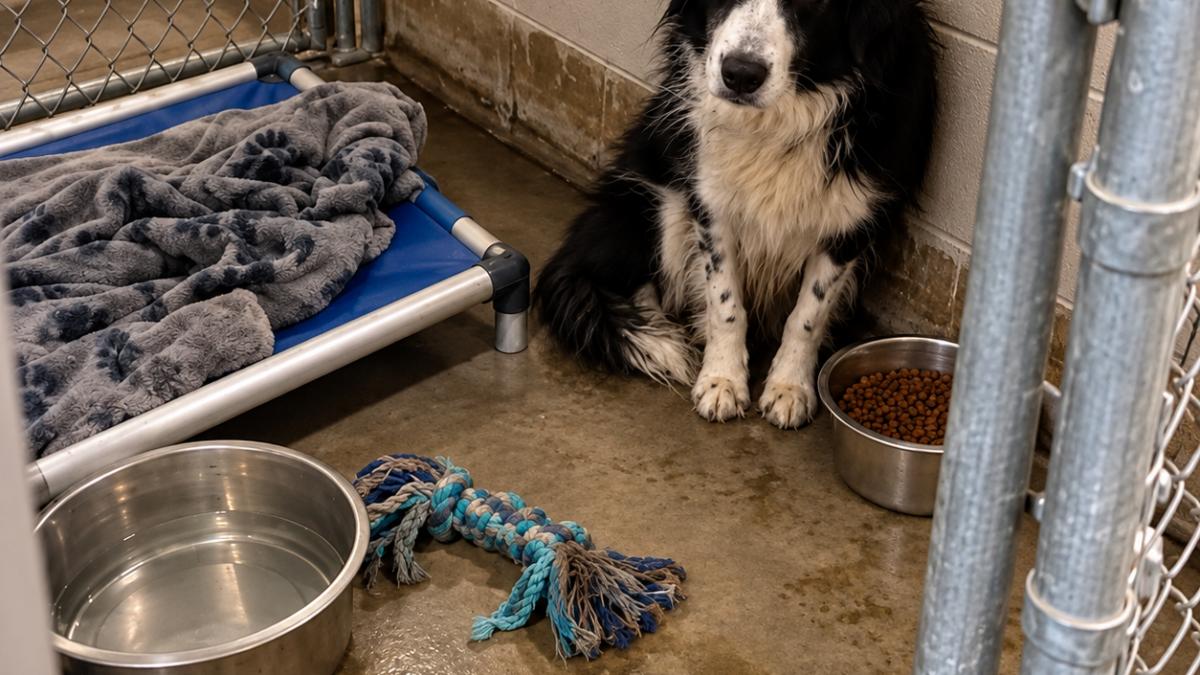
And finally, the way Luna now spent most of her time curled against the back wall.
Walter listened without interrupting.
When I finished, he looked down at the leather leash.
“I had a Border Collie once.”
I waited.
“Her name was Maggie.”
His voice changed when he said the name.
Softer.
Careful.
Like it belonged to something fragile.
“She lived sixteen years.”
He smiled faintly.
“Smartest creature I ever knew. Smarter than half the men I worked with at the railroad.”
Despite myself, I smiled.
Walter continued.
“My wife used to say Maggie could read my mind. She knew when I was going fishing before I picked up the tackle box. Knew when thunderstorms were coming. Knew when my back hurt.”
His thumb rubbed the worn leather.
“This was her leash.”
I understood then.
“How long ago?”
“Three years.”
“I’m sorry.”
He nodded.
“Cancer.”
There was another silence.
Then he added, “My wife died eight months later.”
I did not know what to say.
Walter saved me the trouble.
“I haven’t had a dog since.”
“Why now?”
He looked toward the kennel hallway.
“Because Ruth told me about Luna.”
That alone was not enough for me.
I had become protective.
Probably too protective.
After what had happened, everybody at the shelter had.
“You understand she has separation anxiety.”
“Yes.”
“She may cry.”
“Yes.”
“She may pace.”
“I pace too.”
I almost laughed.
Walter did not.
“She could damage something if she panics.”
“My furniture has survived forty years. If she kills a chair, I’ll hold a funeral.”
That time I did laugh.
So did Walter.
But I quickly became serious again.
“She may need weeks before she trusts you.”
“Then she gets weeks.”
“Months.”
“She gets months.”
“What if she never becomes the dog you’re hoping for?”
Walter looked directly at me.
“I’m not hoping she becomes anything.”
That silenced me.
“I’m asking whether I can meet the dog she already is.”
I stood.
“Come with me.”
We walked down the kennel corridor.
The noise rose around us.
A shepherd barked.
A hound jumped against his gate.
Two puppies spun in circles.
Walter looked at every dog as we passed, but he did not stop.
When we reached kennel 27, I pointed.
“That’s Luna.”
She was exactly where she had been that morning.
Back corner.
Head down.
Eyes half closed.
Walter did not crouch at the gate.
He did not whistle.
He did not call her name.
He looked at me.
“Can I sit here?”
“Of course.”
There was a plastic chair against the wall.
I brought it over.
Walter sat down.
Then he did absolutely nothing.
Five minutes passed.
Ten.
Luna did not move.
At fifteen minutes, I needed to return to the desk.
“I’ll be right up front.”
Walter nodded.
An hour later, I realized he was still there.
I went back.
Same chair.
Same man.
Same dog.
Except Luna’s eyes were open.
She was watching him.
Walter still had not spoken to her.
“What are you doing?” I whispered.
“Waiting.”
“For what?”
“For her to decide whether I’m worth looking at.”
So I left him alone.
Another hour passed.
At lunchtime, Ruth arrived.
She found me near the medication cabinet.
“You met Walter.”
“I did.”
“Good man.”
“You knew he was coming?”
“I suggested it.”
“You could’ve warned me.”
Ruth smiled.
“You would’ve worried.”
“I am worried.”
“You always worry.”
“That’s because people return dogs after one night.”
Ruth’s smile disappeared.
“Yes.”
We walked toward Luna’s kennel.
Walter was still sitting there.
This time, Luna was no longer in the back corner.
She had moved perhaps three feet forward.
To most people, that would have meant nothing.
To me, it felt enormous.
Walter returned the next day.
And the next.
He never brought treats without asking.
Never forced contact.
Never reached through the kennel bars.
On his fourth visit, he sat on the floor instead of the chair.
Luna remained six feet away.
Walter pulled a paperback from his jacket.
He began reading.
Not to her exactly.
Just aloud.
It was a Western.
His voice was quiet and gravelly.
After twenty minutes, Luna lay down.
After forty, she rested her chin on her paws.
After an hour, she fell asleep.
That was the first time I had seen her sleep deeply since the failed adoption.
Over the following week, something began changing.
Tiny things.
Luna started eating while Walter was present.
Then she accepted a piece of chicken that he placed several feet away.
Then one afternoon she walked close enough to smell his shoe.
Walter froze.
I watched from the end of the hallway.
Luna sniffed his pant leg.
Then she backed away.
Walter did not follow.
“Good girl,” he whispered.
Her ears lifted.
The next day he brought Maggie’s old leash.
He placed it beside his chair.
Luna stared at it.
Walter read his book.
Twenty minutes later, she walked over.
Sniffed the leash.
Then sniffed his hand.
I had to turn away because my eyes were filling.
It was not dramatic.
There was no music.
No miraculous transformation.
It was simply a frightened dog deciding, for one second, not to be afraid.
And sometimes that is what healing looks like.
One second.
Then another.
Then another.
Two weeks after Walter first arrived, we took Luna into the outdoor meet-and-greet yard.
I warned him again.
“No expectations.”
Walter nodded.
Luna walked the fence line.
Walter sat on the bench.
After several minutes, she came near him.
He kept his hands resting on his knees.
She sniffed his jacket.
Then stepped away.
Then came back.
Walter breathed slowly.
Luna moved closer.
Her shoulder touched his knee.
Walter’s face changed.
His eyes closed briefly.
He did not pet her.
He let her decide.
Luna pressed harder.
Finally, Walter lifted one hand.
“Okay?”
Of course she did not understand the word.
But she understood the question.
She remained there.
Walter placed his palm gently against her shoulder.
Luna did not flinch.
His hand moved once down her back.
Then stopped.
Luna turned her head.
For several seconds, man and dog looked at each other.
Walter whispered, “I’m not going anywhere.”
Luna leaned against him.
I walked inside before either of them saw me cry.
But I still was not ready to approve the adoption.
Not yet.
Walter lived alone.
That concerned me.
Luna’s previous return had been specifically because she panicked when left alone.
I asked whether Walter understood that his life might need to change.
“I’m retired,” he said.
“That helps, but you’ll still have appointments. Groceries. Things happen.”
“My daughter lives ten minutes away.”
“Does she support this?”
“She thinks I’m stubborn.”
“That wasn’t my question.”
He smiled.
“She supports it.”
We scheduled a home visit.
Walter lived twelve miles outside town in a small white farmhouse surrounded by four acres of fenced pasture.
The place was modest.
Clean.
Quiet.
There was a covered porch with two rocking chairs and a maple tree that shaded half the yard.
Inside, he had already moved a dog bed into the living room.
Then another beside his bedroom.
“You bought two?”
“I didn’t know where she’d prefer to sleep.”
In the kitchen sat stainless-steel bowls.
A bag of the same food we used at the shelter was sealed in the pantry.
On the refrigerator was a printed sheet titled:
LUNA — FIRST TWO WEEKS.
Walter had written a schedule beneath it.
7:00 — outside.
7:30 — breakfast.
8:00 — quiet walk.
No visitors first three days.
No leaving alone first week.
Practice short separations gradually.
Call shelter behaviorist if panic begins.
I read it twice.
“You made this?”
“Ruth helped.”
Walter opened a kitchen drawer.
Inside was a small camera.
“Video monitor.”
I looked at him.
“For when we start practicing me stepping outside.”
I realized Walter had prepared more for this dog than some people prepared for children.
Still, I asked the hardest question.
“If she cries all night?”
Walter leaned against the counter.
“Then I won’t sleep.”
“And the next night?”
“I probably won’t sleep.”
“And after a week?”
He shrugged.
“I worked railroad maintenance thirty-seven years. I can survive being tired.”
“What if she follows you everywhere?”
“Then I’ll have company.”
“What if she scratches your bedroom door?”
“I won’t close it.”
I studied his face.
“Why are you so certain?”
He took a long breath.
“Because when my wife died, people kept telling me I needed to move on.”
I remained silent.
“They meant well. But grief isn’t a room you walk out of. Some mornings I still make two cups of coffee.”
His voice cracked slightly.
“I know what it’s like when everyone thinks enough time has passed and you should be normal again.”
He looked through the window toward the empty yard.
“Maybe Luna and I can be abnormal together.”
That was the moment I knew.
We approved a foster-to-adopt placement.
Not a final adoption.
Not yet.
We wanted Luna to have a safety net.
Walter agreed immediately.
Three days later, we loaded Luna into his truck.
This time, I felt none of the uncomplicated happiness I had felt the first time.
I was terrified.
I put her blanket in the back seat.
Then the blue elephant.
Walter climbed behind the wheel.
Luna stood with her front paws on the console.
Before closing the door, I held Walter’s gaze.
“If there’s a problem—”
“I call you.”
“Day or night.”
“I know.”
“And if she panics—”
“I don’t bring her back.”
I stopped.
Walter shook his head.
“I call for help. I change the plan. I give her time. But I don’t punish her for being scared.”
Luna looked out the window.
For the second time in less than a month, I watched her leave our parking lot.
This time I did not say finally.
I barely breathed.
That evening, Walter called.
My heart jumped.
“Is everything okay?”
“Yep.”
“What happened?”
“She ate dinner.”
“That’s good.”
“Thought you’d want to know.”
I laughed.
“I did.”
“She’s sleeping by the kitchen table.”
“Any crying?”
“No.”
“Following you?”
“Everywhere.”
“That’s expected.”
“I went to the bathroom and apparently committed an act of betrayal.”
I laughed harder.
Walter lowered his voice.
“She’s outside the door right now.”
Then I heard him.
“Still here, girl.”
The next morning he sent Ruth a photograph, which she showed me.
Luna was lying on the porch.
Walter’s boot was visible beside her.
Nothing more.
But her body was relaxed.
That mattered.
The third night was harder.
At 11:40 p.m., Walter called.
Luna was pacing.
She had begun whining after hearing a car on the road.
He was worried she thought someone was coming to take her away.
“Don’t restrain her,” I said. “Let her move.”
“I am.”
“Keep the lights low.”
“Okay.”
“Sit somewhere she can see you.”
“I’m in the living room.”
“Don’t keep telling her it’s okay. Sometimes too much attention confirms that something is wrong.”
Walter was silent.
Then he said, “She’s looking at me.”
“Good.”
“What now?”
“Do something normal.”
“Like what?”
“Read.”
So at midnight, Walter Bennett sat in his living room and read a Western novel aloud while Luna paced from the hallway to the front door and back.
Forty minutes later, she lay down.
At 1:15, she slept.
Walter slept on the couch beside her.
The next week, we began separation exercises.
Ten seconds.
Walter stepped onto the porch.
Returned before Luna panicked.
Thirty seconds.
One minute.
Three minutes.
Five.
At first she followed him to the door.
Then she waited several feet away.
Eventually she stayed on the rug.
The progress was slow.
Sometimes they moved backward.
One afternoon Walter left for seven minutes.
Luna scratched the frame.
He called our behaviorist.
Not to return her.
To ask what he had done wrong.
“Nothing,” Melissa told him. “You just went too fast.”
So they went backward.
Three minutes.
Two.
One.
Walter never complained.
A month passed.
Luna began riding with him to his daughter’s house.
His daughter, Rebecca, had a twelve-year-old Labrador named Toby who regarded Luna with the exhausted patience of an older brother.
They became friends.
Then Walter started bringing Luna to the hardware store because dogs were allowed inside.
The first time a stranger tried to pet her, Luna hid behind Walter.
He told the man, “Give her space.”
The man did.
The second visit, Luna stayed beside Walter.
The third, she sniffed the cashier’s hand.
At six weeks, Walter brought her back to the shelter for a checkup.
I heard Ruth yelling from the lobby.
“Come see who’s here!”
I rushed out.
Luna stood beside Walter.
Her coat looked shinier.
She had gained four pounds.
Her ears were up.
I crouched.
“Luna?”
She stared at me.
For one terrible second, I wondered whether coming back had frightened her.
Then her tail moved.
Once.
Twice.
Then her whole body began wagging.
She ran toward me.
I dropped to my knees.
She pushed her face against my chest.
I held her.
“Oh, sweetheart.”
Walter stood nearby smiling.
“She remembers you.”
I kissed the top of her head.
“I remember her too.”
She stayed near me for maybe thirty seconds.
Then something happened that mattered even more.
She turned around.
Looked for Walter.
The second she saw him, she walked back and pressed against his leg.
Home.
That was what I saw.
Not ownership.
Not obedience.
Home.
We finalized the adoption that afternoon.
Walter signed the paperwork at the same desk where Luna’s first owner had surrendered her almost a year earlier.
His hand shook slightly as he wrote.
When he finished, I stamped the form.
“That’s it.”
Walter looked at Luna.
“That’s what?”
“She’s officially yours.”
He shook his head.
“No.”
I thought he was joking.
Then he looked at me.
“We’re officially each other’s.”
I had to blink several times before I could answer.
We took a photograph outside.
Walter stood beside the shelter sign.
Luna sat against his boot.
He held Maggie’s old leather leash.
I posted the photograph on our shelter page with a short update.
I did not mention the family who had returned Luna.
I did not criticize anyone.
I simply wrote that after nearly a year in the shelter and one unsuccessful placement, Luna had found a patient adopter willing to give her the time she needed.
The post spread farther than anything we had published before.
People shared it.
Local news called.
Walter refused an interview.
“I didn’t adopt her for television.”
But he allowed us to keep the photograph online because it helped older dogs receive attention.
Within two weeks, three senior dogs were adopted.
That should have been the end.
It was not.
Almost two months after Luna’s adoption became final, I was working the front desk when Denise walked through the door.
I recognized her immediately.
The woman who had returned Luna after one night.
She looked uncomfortable.
Mark was with her.
Their daughter was not.
“Can we talk?” Denise asked.
My stomach tightened.
“About what?”
“Luna.”
I kept my voice professional.
“What about her?”
Denise looked at Mark.
Then back at me.
“We saw the posts.”
I waited.
“She looks… different.”
“She’s doing very well.”
Denise nodded.
“We were wondering if maybe we made a mistake.”
I felt something cold move through me.
“A mistake?”
Mark stepped forward.
“We weren’t prepared.”
“That’s correct.”
“We’ve talked about it.”
I stared at him.
Denise said, “We think we’d like another chance.”
I honestly thought I had misunderstood.
“With Luna?”
“Yes.”
“She has been adopted.”
“We know.”
“Then there is nothing to discuss.”
Denise’s expression tightened.
“We were her first adopters.”
“For one night.”
“That’s unfair.”
I almost laughed.
Instead, I folded my hands on the counter.
“You signed a return form surrendering any claim to her.”
“We understand legally—”
“This isn’t only legal.”
Mark sighed.
“Look, we panicked.”
“Yes.”
“She cried all night.”
“Yes.”
“We didn’t know what to do.”
“You called us at nine the next morning.”
“That doesn’t mean we didn’t care.”
I stared at them.
“I believe you cared.”
Denise seemed surprised.
I continued.
“But caring is not the same thing as being ready.”
She looked away.
“We’ve learned.”
“I hope you have.”
“So could you talk to the man?”
“No.”
“Just ask him.”
“No.”
“You don’t even know what he’ll say.”
“I know what I’ll say.”
Mark’s jaw tightened.
“This feels personal.”
Now I did laugh, but there was no humor in it.
“It is personal.”
He stared at me.
“I carried that dog back into kennel 27 while she shook so hard her teeth clicked.”
Neither of them spoke.
“I sat outside her kennel while she stared at a wall.”
Denise’s eyes filled.
“I know.”
“No. You saw a social media post. I saw what happened after the car left.”
“We said we were sorry.”
“I believe you were.”
I softened my voice.
“But apologies do not always restore what was lost.”
Denise wiped her cheek.
“We loved her.”
“Then be happy she is loved now.”
They stood there for a moment.
Then Mark asked, “Could we at least see her?”
“No.”
That answer surprised even me.
But I knew why.
Luna had spent enough of her life reopening doors people had closed.
She did not owe anyone closure.
Denise nodded slowly.
Then she did something unexpected.
“Do you have another dog like her?”
I studied her carefully.
“Like Luna?”
“An older dog.”
Mark turned toward her.
“Denise—”
She ignored him.
“Maybe one that needs… patience.”
I could have refused.
Part of me wanted to.
That would have felt like revenge.
But working in rescue teaches you something about revenge.
It often satisfies the person delivering it while helping nobody else.
So I said, “We have a ten-year-old spaniel named Pepper.”
Denise looked toward the kennels.
“What happened to him?”
“Owner died.”
“Does he have problems?”
“He hates thunderstorms. Needs medication during severe weather. Sometimes has accidents. He’s partially deaf.”
Mark exhaled.
“That sounds like a lot.”
Denise looked at him.
“So did Luna.”
There was a silence.
Then she asked me, “Can we meet Pepper?”
I did not say yes immediately.
“I’m going to be very clear.”
They waited.
“If you adopt another dog from us, there will be a longer process. Several visits. Behavior counseling. A foster period. No overnight decision.”
Denise nodded.
“Fair.”
“And if you decide it’s too much, you tell us before taking the dog.”
“Fair.”
Mark looked less certain.
But he stayed.
They met Pepper.
Pepper did not rush to greet them.
He lifted his head from his bed, blinked once, then put his chin back down.
Denise sat on the floor outside his kennel.
Mark remained standing.
For the first fifteen minutes, nobody spoke.
Then Pepper slowly stood.
He walked toward the gate.
He sniffed Denise’s fingers.
She did not move.
His tail gave one small wag.
Mark crouched.
“Hey, buddy.”
Pepper looked at him, unimpressed.
I almost smiled.
They stayed for forty minutes.
They did not adopt him that day.
That mattered to me.
They returned three days later.
Then again.
On the fourth visit, Pepper climbed into Denise’s lap.
On the fifth, Mark brought an old blanket from home so Pepper could smell the house before ever entering it.
On the sixth, they took him home under a foster agreement.
I expected another phone call the next morning.
None came.
The second morning, still nothing.
On the third afternoon, an email arrived.
Pepper had urinated on the rug twice.
He had barked at the vacuum cleaner.
He had refused breakfast.
He had kept them awake during a thunderstorm by pacing between the bedroom and hallway.
Denise ended the message with one sentence.
We’re exhausted, but he’s still here.
I read those words twice.
Then I printed the email and pinned it above my desk.
Not because I believed they had erased what happened with Luna.
They had not.
But because sometimes people fail the first test they are given.
What matters afterward is whether they learn anything from the failure.
Three months later, Denise and Mark finalized Pepper’s adoption.
That surprised me.
But the bigger surprise came in December.
Our shelter held a winter donation drive every year.
People brought blankets, food, towels, toys, cleaning supplies—anything we could use through the coldest months.
Walter arrived just after ten in the morning.
Luna walked beside him wearing a red bandanna.
The moment she entered the lobby, several staff members stopped what they were doing.
Not because she looked dramatic.
Because she looked ordinary.
Healthy.
Relaxed.
Safe.
For a shelter dog, ordinary can be the most beautiful transformation in the world.
Walter carried a large cardboard box.
“Rebecca’s church collected blankets.”
I looked inside.
There had to be thirty.
“You didn’t have to do this.”
“I know.”
Luna leaned against my leg.
I scratched behind her ears.
“You look good, girl.”
Her tail swept the floor.
Then the front door opened.
Pepper entered first.
Behind him came Denise.
Mark carried two bags of senior-dog food.
I froze.
Denise froze too.
Then she saw Luna.
For a few seconds, nobody moved.
Luna stared across the lobby.
Denise lowered one hand slowly.
“Hi, girl.”
My stomach tightened.
I watched Luna carefully.
Her ears shifted.
Her nose moved.
Recognition flickered there.
I was certain of it.
She knew them.
Dogs remember scents better than faces.
They remember rooms, hands, fear, comfort, car rides, doors.
Luna looked at Denise.
Then at Mark.
And then she simply turned around.
She walked back to Walter.
Sat against his boot.
And looked up at him.
Denise covered her mouth.
Walter glanced at me, confused.
He had never met them.
I stepped closer.
“Walter, this is Denise and Mark.”
His expression changed.
He understood immediately.
Denise’s eyes filled.
“We’re the people who returned her.”
Walter did not say anything for several seconds.
Then he looked down at Luna.
“So I gathered.”
“I’m sorry.”
He nodded once.
“Okay.”
She seemed surprised.
“You’re not angry?”
Walter rubbed Luna’s head.
“I wasn’t there.”
“I hurt her.”
“Yes.”
Denise lowered her eyes.
Walter continued.
“But she isn’t hurting right now.”
That was all.
No lecture.
No humiliation.
No revenge speech.
Denise looked toward Pepper.
The old spaniel stood pressed against her leg.
Walter noticed.
“You kept that one?”
She nodded.
“Three months now.”
“How’s it going?”
Denise laughed weakly through tears.
“He snores.”
Walter’s mouth twitched.
“Good sign.”
“He hates storms.”
“Also normal.”
“He destroyed one bathroom rug.”
“Rug had it coming.”
Denise laughed.
Even Mark smiled.
Walter crouched slowly beside Pepper.
He did not touch him until Pepper came closer.
Then Pepper sniffed his hand.
Walter scratched his chest once.
“Looks like you found yourself some people.”
Denise looked at Luna again.
“I wish we had done better with her.”
Walter nodded.
“Then do better now.”
That sentence stayed with me.
Do better now.
Not undo the past.
Not pretend it did not happen.
Not demand forgiveness.
Do better now.
That was the closest thing to justice I had ever seen inside our shelter.
Later that afternoon, after Walter and Luna left, Denise came to my desk.
“I know you probably still hate us.”
“I don’t hate you.”
She looked skeptical.
“I was angry.”
“You had a right.”
“I was angry because Luna paid for your panic.”
Denise swallowed.
“I know.”
“But Pepper isn’t paying for it.”
She glanced toward him.
He was asleep beneath a donated blanket.
“No.”
“That matters.”
Denise nodded.
“I keep thinking about that first night.”
“With Luna?”
“Yes.”
“What about it?”
“She followed me everywhere. I thought it meant she was too dependent.”
“It meant she was terrified.”
“I know that now.”
She rubbed her hands together.
“When I went upstairs, she cried. I closed the door because I thought she needed to learn boundaries.”
I said nothing.
“She scratched at it for hours.”
“You told us.”
“I was angry at her.”
Her voice broke.
“I thought, We just gave you a home. Why can’t you be grateful?”
I leaned back.
“That’s a human way to think.”
“Yes.”
“She did not know what adoption papers were.”
Denise wiped her face.
“I know.”
“All she knew was she had been moved again.”
Denise nodded.
“And I punished her for being scared.”
I did not soften the truth.
“Yes.”
She took a breath.
“Pepper peed in the hallway last week.”
I waited.
“I almost yelled.”
“But you didn’t.”
“No.”
“What did you do?”
“I cleaned it.”
“That’s a start.”
For the first time, Denise smiled.
A real smile.
“Do you think Luna forgave us?”
I looked across the room toward the doors Walter had walked through.
“I don’t know if dogs think about forgiveness the way we do.”
“What do you think she felt today?”
I considered that carefully.
“Safe.”
Denise started crying again.
This time, I let her.
Sometimes the hardest consequence is not punishment.
It is seeing the life someone built after you failed them.
And understanding they no longer need anything from you.
By spring, Pepper had become one of our shelter’s unofficial ambassadors.
Denise brought him to senior-dog adoption events.
Mark built a set of low wooden ramps for dogs with arthritis.
Their daughter, Claire, who had barely spoken during Luna’s failed adoption, began volunteering on Saturdays.
At first I worried it was guilt.
Eventually I understood it was more complicated.
Claire had been sixteen when they adopted Luna.
Later she told me what happened that night.
Her parents had argued.
Mark had an early work meeting.
Denise had spent hours trying to calm Luna.
Claire wanted Luna to sleep in her room, but her parents worried the dog might damage something or have an accident.
By two in the morning, everybody was exhausted.
At six, Mark said, “This isn’t working.”
Claire begged them to wait.
They did not.
When I asked why she never told me that, she looked ashamed.
“I thought you’d hate my parents.”
“I was angry with them.”
“You should’ve been.”
“Maybe.”
Claire shook her head.
“I was angry too.”
“Still?”
“Not anymore.”
“What changed?”
She looked toward kennel 18, where a frightened hound had finally begun eating from her hand.
“They changed.”
That was true.
Not quickly.
Not perfectly.
But genuinely.
Still, Luna’s story remained centered somewhere else.
With Walter.
He sent us photographs often.
Luna lying beneath the kitchen table.
Luna riding in the truck.
Luna asleep in the grass.
Luna standing at the edge of Walter’s pond watching ducks with the seriousness of a border patrol agent.
One photograph became my favorite.
Walter sat on the porch in his rocking chair.
Luna lay beside him.
The old leather leash rested across his knee.
The porch light glowed behind them.
The message beneath the photo read:
She waits for me now.
Four words.
I stared at them until my throat hurt.
Because I understood.
For eleven months Luna had waited for someone who had left.
Now she waited for someone who returned.
Every time.
That difference sounds small until you have watched an abandoned dog learn it.
Dogs do not understand promises the way humans do.
They understand patterns.
A person leaves.
A person comes back.
A hand lifts.
A hand hurts or comforts.
A bowl appears.
A door opens.
A voice means danger or safety.
Trust is repetition.
So is betrayal.
Walter understood that instinctively.
His entire relationship with Luna became a series of small repetitions.
Breakfast at the same time.
Walk after coffee.
Truck rides on Tuesdays.
Rebecca’s house on Sundays.
The blue elephant on the living-room rug.
The porch light at dusk.
Walter never disappeared without creating a routine around it.
When he went grocery shopping, Rebecca sat with Luna at first.
Then Walter began practicing ten-minute departures.
Fifteen.
Twenty.
Thirty.
He installed a camera, not because he wanted to spy on her, but because he needed to know exactly when anxiety began.
He learned Luna could tolerate forty-five minutes before pacing.
Then an hour.
Then two.
Eventually, she could stay alone for three hours comfortably.
Walter refused to push beyond that unless necessary.
“Why make her prove something?” he asked Melissa.
That sentence ended up in one of our training guides.
Why make her prove something?
We ask frightened animals to prove their gratitude too often.
Prove you are house-trained.
Prove you can be left alone.
Prove you love children.
Prove you will not bark.
Prove you deserve a home.
Walter did not make Luna prove she deserved anything.
He simply built a life she could understand.
Months later, something unexpected happened.
Luna began changing Walter too.
Rebecca told me about it.
Before Luna, Walter had become isolated after losing his wife, Margaret.
He still attended church occasionally.
Still drove into town.
Still answered his phone.
But he no longer visited friends much.
He stopped fishing.
Stopped attending railroad retiree breakfasts.
Stopped using one side of the dining table because that had been Margaret’s place.
Then Luna came.
Dogs require participation.
They do not care whether grief makes Tuesday feel pointless.
They still need breakfast Tuesday morning.
They need the back door opened.
They need walking.
Water.
Medication.
Company.
Walter began waking earlier.
Then walking farther.
Neighbors started seeing him on the road again.
People stopped to talk.
He took Luna to the hardware store.
Then the farmer’s market.
Then a small lakeside trail where he and Margaret used to walk.
The first time he took Luna there, he almost turned around.
He later told me why.
There was a bench near the lake with a brass plate carrying Margaret’s name.
Rebecca had donated it after her mother died.
Walter had not sat there since the memorial.
He reached the trail.
Saw the bench.
Stopped.
Luna pulled gently toward it.
Walter said, “Not today.”
Luna kept looking at the bench.
He laughed bitterly.
“You don’t know when to quit, do you?”
She sat.
Walter eventually walked over.
He sat down.
Luna placed her head on his knee.
He stayed for forty-seven minutes.
The next week he returned.
Then again.
That became their Saturday routine.
I learned about it when Rebecca showed me a photograph.
Walter on Margaret’s bench.
Luna beside him.
The lake behind them.
“He says Mom sent her,” Rebecca said.
“You believe that?”
Rebecca smiled.
“I think Dad needs to.”
Fair enough.
Almost a year after Luna’s adoption, Walter asked me to visit his house.
I worried immediately.
“Is she okay?”
“She’s fine.”
“Then why are you being mysterious?”
“Just come Saturday.”
Ruth came with me.
When we turned into Walter’s driveway, six cars were parked beside the barn.
Rebecca stood near the porch.
Two men from Walter’s old railroad crew were carrying lumber.
A newly built structure sat beside the fenced pasture.
Above the door hung a wooden sign.
MAGGIE & LUNA’S HOUSE.
I looked at Walter.
“What did you do?”
“Made a little space.”
“For what?”
“Come see.”
Inside were three dog beds.
Two large crates.
Food storage containers.
A small wash station.
Cabinets with medications and cleaning supplies.
There was even a narrow interior room designed for a frightened dog to decompress away from noise.
“You built a foster room.”
Walter shrugged.
“Rebecca helped.”
“You’re going to foster?”
“One at a time.”
Ruth laughed.
“That means two.”
Walter ignored her.
I walked around the room.
Everything had been carefully designed.
Rubber flooring.
Low thresholds for elderly dogs.
No slick surfaces.
A ramp instead of steps.
A gate system so one dog could be separated safely from another.
“You planned this.”
“Been planning it for months.”
“Why?”
Walter looked through the window toward Luna, who was sleeping beneath the maple tree.
“Because somebody sat with her when she had nowhere else to go.”
“You sat with her.”
“Eventually.”
“No, Walter.”
I pointed toward myself.
“Shelter staff.”
Ruth.
Melissa.
Volunteers.
“Those eleven months mattered.”
Walter nodded.
“I know.”
“So now?”
“Now maybe Luna and I sit with somebody else.”
His first foster arrived the following Thursday.
Hank was twelve.
A shepherd mix with weak hips and a gray muzzle.
His owner had entered a nursing facility after a stroke.
Hank had never lived anywhere else.
The first night at Walter’s house, Hank refused to leave the corner.
Walter did what he had done with Luna.
He sat.
No touching.
No coaxing.
No pressure.
Luna watched from across the room.
For two days, she gave Hank space.
On the third morning, Walter entered the kitchen and found the two dogs sleeping beside each other.
Luna’s back pressed against Hank’s.
Walter sent us the photo.
Melissa printed it.
We hung it in the staff room.
Hank stayed seventeen days.
A retired teacher adopted him.
Then came Rosie.
Fourteen years old.
Tiny terrier.
Cataracts.
Rosie screamed the first time Walter tried to clip on a leash.
So he stopped.
He let her drag a lightweight lead inside for three days.
Luna walked beside her.
By day five, Rosie followed Luna into the yard.
A widow named Martha adopted her.
Then came Duke.
Eleven-year-old Lab.
Obese.
Arthritic.
Terrified of men because of something in his history we never fully learned.
Duke avoided Walter.
Luna did not.
Every evening she lay beside Walter’s chair.
Duke watched.
One evening he finally crossed the room.
Walter kept reading.
Duke sniffed his boot.
Then lay down six feet away.
A week later, three feet.
Two weeks later, Duke slept beside his chair.
I began to understand something extraordinary.
Luna had become a bridge.
Not through training.
Not because she was a therapy dog.
Because fearful dogs watched her trust Walter.
And sometimes borrowed her courage.
Over the next two years, Walter fostered twenty-three senior dogs.
Some stayed only days.
Some months.
Several had medical problems.
One was deaf.
Two were nearly blind.
One, a beagle named Norman, howled every night for a week.
Walter called me at midnight on the fourth night.
“He’s singing again.”
I could hear Norman through the phone.
A long mournful howl.
“What are you doing?”
“Reading.”
“Western?”
“What else?”
“What’s Luna doing?”
“Sleeping.”
“Then follow her example.”
Walter laughed.
Norman eventually stopped howling.
He was adopted by an older couple who told us their house had felt too quiet.
Not every foster ended happily.
Charlie did not.
Charlie was a thirteen-year-old mixed-breed dog with terminal cancer.
We knew he probably had weeks.
Maybe less.
Nobody wanted to adopt him.
Walter said, “Bring him here.”
Charlie spent twenty-six days at the farmhouse.
He slept in the sun.
Ate hamburger.
Walked slowly around the maple tree.
Luna often lay beside him.
Then one morning Charlie could not stand.
Walter called.
His voice sounded different.
“I think it’s time.”
The vet came to the house.
Charlie died on Walter’s couch.
Walter held him.
Luna lay under the coffee table.
That night Walter called me again.
“I thought fostering was supposed to help.”
“It does.”
“Doesn’t feel like helping.”
“No.”
He was silent.
“I’m tired of losing them.”
“I know.”
“Maybe I can’t do this.”
“You don’t have to.”
“I mean it.”
“I know.”
“What would you do?”
I thought carefully.
“I’d take a break.”
Walter breathed.
“That’s allowed?”
“Yes.”
He laughed once.
“Funny.”
“What?”
“I tell every dog they don’t have to earn rest.”
“And?”
“Apparently I thought I did.”
So Walter stopped fostering.
For almost three months.
He and Luna spent the summer quietly.
They went to the lake.
Visited Rebecca.
Sat on the porch.
Then in August, a thirteen-year-old shepherd named Gus arrived at our shelter after his owner died.
Gus stopped eating.
He pressed himself against the back wall.
I watched him for two days.
Then I called Walter.
“I’m not asking you to foster.”
“Okay.”
“I just thought you should know.”
There was a pause.
“What kennel?”
“Fourteen.”
Walter arrived forty minutes later with his Western novel.
Gus went home with him three days afterward.
So much for retirement.
Years moved quietly.
Luna became gray around the muzzle.
Then around the eyes.
She slowed on walks.
Walter adjusted.
Shorter routes.
Softer bedding.
Joint supplements.
Carpet runners through the house.
A ramp beside the porch.
Another for the truck.
When Luna’s hearing began fading, Walter learned to stomp gently on the floor before approaching from behind so vibrations would alert her.
When she started waking confused at night, he left a light on in the hallway.
When she developed urinary accidents, he placed washable pads near the door.
He never complained.
Once Rebecca teased him.
“You know, Dad, you used to lose your mind if Mom moved one coaster.”
Walter looked down at Luna sleeping beside his shoe.
“Your mother would be enjoying this entirely too much.”
Rebecca laughed.
“She absolutely would.”
Luna was twelve when we first noticed the weight loss.
Not dramatic.
Two pounds.
Then three.
Walter brought her in.
Blood work.
Ultrasound.
Then the diagnosis.
A large abdominal tumor.
The veterinarian explained the options.
Surgery was technically possible.
But risky.
Recovery would be hard.
There was no guarantee the cancer had not spread.
Walter asked every question.
“What would you do if she were yours?”
The veterinarian looked at Luna.
Then at Walter.
“I’d make her comfortable.”
Walter nodded.
That became the plan.
Medication.
Good food.
Short walks.
Pain management.
No heroics.
For several weeks, Luna did well.
She ate chicken.
Then steak.
Walter joked she had discovered his weakness.
“Fourteen years eating dog food and now she’s running a restaurant scam.”
But eventually the good days became fewer.
One morning Walter called me.
“Can you come?”
I heard everything in his voice.
“Yes.”
Ruth came too.
Rebecca was already there.
Luna lay on a thick blanket on the porch.
The maple leaves were just beginning to turn.
Walter sat on the floor beside her.
Maggie’s leather leash rested near his chair.
I crouched.
“Hey, sweetheart.”
Luna opened her eyes.
Her tail moved once.
Weakly.
But it moved.
I touched her shoulder.
Walter stared across the yard.
“She had bacon.”
“Good choice.”
“Wouldn’t eat anything else.”
“She earned it.”
Walter smiled.
Then his face folded.
“I don’t know how to do this again.”
I sat beside him.
“You don’t have to know.”
“She trusts me.”
“Yes.”
“How do I decide this for her?”
“You decide what she would choose if she could understand everything.”
Walter looked at Luna.
“She’d stay with me forever.”
“Yes.”
“Even hurting.”
“Probably.”
He swallowed.
“That’s the problem.”
The veterinarian arrived around noon.
No one rushed.
Walter carried Luna inside.
For years she had followed him everywhere.
That day, he carried her.
He placed her on her favorite rug.
The blue elephant still sat nearby, faded almost gray after years of washing.
Rebecca knelt on one side.
Walter lay beside Luna.
I sat a few feet away.
The first injection made her sleepy.
Walter stroked her face.
“You remember what I told you?”
Luna breathed slowly.
“I said I wasn’t going anywhere.”
His voice shook.
“I kept that promise.”
Rebecca started crying.
So did I.
Walter pressed his forehead against Luna’s.
“You kept yours too.”
The veterinarian gave the final medication.
Walter whispered, “Good girl.”
Luna’s breathing slowed.
One breath.
Then another.
Then a long quiet exhale.
Walter did not move.
Neither did anybody else.
Finally, he said something so softly I almost missed it.
“You don’t have to wait anymore.”
Luna died with her head against his chest.
Not in kennel 27.
Not facing a shelter door.
Not watching people leave.
Home.
That was the difference.
Afterward, Walter stayed on the floor for almost an hour.
Nobody told him to get up.
Nobody needed to.
Grief deserves room.
He buried Luna beneath the maple tree.
Beside Maggie.
Rebecca ordered a small stone.
LUNA
SHE LEARNED TO TRUST AGAIN
AND TAUGHT US HOW
Walter hated the wording at first.
“Too sentimental.”
Rebecca ignored him.
He never changed it.
The farmhouse became quiet.
Too quiet.
Walter stopped fostering.
This time, nobody pressured him.
Weeks passed.
Then two months.
I called occasionally.
He always answered.
“I’m fine.”
I knew that usually meant he was not.
One Monday morning, Walter walked into the shelter carrying Maggie’s old leather leash.
He placed it on my desk.
“I thought you could use this.”
I pushed it back.
“No.”
“Why not?”
“It belongs with you.”
“No dog.”
“Today.”
Walter narrowed his eyes.
“That sounded suspicious.”
I shrugged.
“There’s coffee.”
“Terrible coffee.”
“You drink it anyway.”
He poured a cup.
We talked about ordinary things.
Weather.
Rebecca.
Roof repairs.
Railroad pensions.
He avoided looking toward the kennels.
Then a deep howl came from the old-dog room.
Walter closed his eyes.
“No.”
I said nothing.
Another howl.
Walter sighed.
“What is that?”
“Dog.”
“I figured that part.”
“Black Lab mix.”
“How old?”
“Eleven.”
“What happened?”
“Owner died.”
Walter looked at me.
“How long?”
“Four months.”
“Any interest?”
“Some.”
“That means no.”
“Mostly.”
Walter took a slow drink of coffee.
“What’s his name?”
“Jasper.”
“I’m only looking.”
“I didn’t say anything.”
“You were thinking loudly.”
We walked toward kennel 14.
Jasper lay near the back.
Black coat.
Gray muzzle.
Large brown eyes.
When Walter stopped outside, Jasper lifted his head.
Then looked away.
Walter stood there for a while.
“He always like that?”
“Mostly.”
“Food?”
“Eats.”
“Walks?”
“Short.”
“Other dogs?”
“Fine if they’re calm.”
Walter nodded.
Then turned around.
I thought he was leaving.
Instead, he dragged a plastic chair over.
Sat.
Pulled a paperback from his jacket.
I stared.
“You still carry those?”
“Always.”
“A Western?”
“What else?”
Walter opened the book.
Jasper did not move.
Walter began reading aloud.
Same quiet gravelly voice.
Same patience.
Twenty minutes passed.
Jasper lifted his head.
Thirty minutes.
He shifted forward.
Walter kept reading.
At forty-five minutes, Jasper stood.
He took three slow steps.
Then another.
He stopped just beyond Walter’s reach.
Walter never lifted his hand.
Jasper sniffed the old leather leash lying beside the chair.
Then he sat down.
I walked away before Walter could see my face.
History does not repeat perfectly.
That is a lie people tell because patterns are easier to understand than change.
What happened with Jasper was not Luna happening again.
Luna was gone.
Nothing replaced her.
That mattered.
Jasper became his own story.
But Walter had changed because of Luna.
And that changed what happened next.
He fostered Jasper first.
Then adopted him five weeks later.
Pepper lived another two years with Denise and Mark.
When he died, Denise called me.
She cried so hard I could barely understand her.
“He was on the couch.”
“I’m glad.”
“I wasn’t ready.”
“You never are.”
She was quiet.
Then she said, “We kept him.”
“Yes.”
“All the way.”
“Yes, you did.”
“That’s because of Luna.”
“Partly.”
“I wish I could tell her.”
I looked out my office window.
A volunteer was walking an old shepherd across the yard.
“You did.”
“What?”
“Every night you didn’t return Pepper, you did.”
A month later, Denise and Mark donated enough money to cover senior-dog adoption fees for an entire year.
They refused to put their names on the program.
They asked us to call it the Second Night Fund.
I understood immediately.
The first night with a traumatized dog can be terrible.
The second may be worse.
People panic.
They think behavior is permanent.
They mistake fear for personality.
So the Second Night Fund paid for behavior support, temporary crates, baby gates, calming tools, training sessions, and emergency foster help.
Anything that might keep a difficult first week from becoming another return.
We used the fund constantly.
One year later, our return rate for senior dogs had fallen by nearly half.
Was that all because of Luna?
No.
Real change rarely comes from one story alone.
But she was part of it.
Walter remained involved too.
He and Jasper visited our shelter every month.
He still sat with frightened dogs.
Still read Westerns.
Still refused interviews.
Still complained about our coffee.
Claire eventually became a veterinary technician.
Ruth kept volunteering until her knees forced her to stop walking dogs, then she switched to laundry and reading aloud to kennel dogs.
Melissa expanded our behavior program.
Emily became shelter manager.
And I stayed where I had always been.
At the front.
Watching doors.
Watching people come in.
Watching animals leave.
Some came back.
That never completely stopped.
But after Luna, I changed the way I spoke to adopters.
I stopped saying, “Give them time.”
Too vague.
Instead, I said:
“The dog you take home today may not be the dog you meet three months from now.”
I explained shutdown behavior.
Decompression.
Separation anxiety.
Fear.
House-training regression.
Sleep disruption.
Hypervigilance.
I told them the first seventy-two hours could be ugly.
I made them promise to call before returning.
Not because returns are always wrong.
Sometimes they are necessary.
Sometimes a home is genuinely unsafe.
Sometimes the match is bad.
Sometimes circumstances collapse.
But panic should never be mistaken for certainty.
Years later, a young couple came in looking for a dog.
They wanted a puppy.
They left with a ten-year-old cattle dog named Sam.
Before they signed, the woman asked, “What if he cries the first night?”
I looked toward the wall behind my desk.
There was a photograph there.
Walter on the porch.
Luna at his feet.
I said, “Then you stay through the second night.”
She smiled.
“And if he cries the second?”
“Stay through the third.”
“What if it takes longer?”
“Then call us. We help you.”
Her husband nodded.
“That sounds manageable.”
It was.
Sam stayed with them until he died four years later.
That is what Luna left behind.
Not a viral post.
Not one emotional adoption.
A different question.
Instead of:
What is wrong with this dog?
People began asking:
What happened to this dog?
And then:
What does this dog need from me now?
Those questions save lives.
I still think about the day Luna came back.
The back seat.
The flattened ears.
The way she refused to jump out.
The look in her eyes.
At the time, I believed that was the worst moment of her life.
Maybe it was.
But now I see something else inside that memory.
The return was not the end.
It only felt like one.
That distinction matters.
Animals do not know the future.
Neither do we.
Pain convinces us a moment will last forever because while we are inside it, we cannot see the door beyond it.
Luna could not know Walter would walk through ours six days later carrying an old leather leash.
She could not know he would sit beside her without asking anything.
She could not know he would read Westerns aloud at midnight.
She could not know there was a white farmhouse waiting.
A porch.
A maple tree.
A blue elephant on a rug.
A man who would sleep on the couch because she was afraid.
A man who would build ramps when her legs weakened.
A man who would carry her when she could no longer follow.
A man who would keep his promise to the end.
She knew none of that.
She only knew she had been returned.
That is what breaks my heart most.
And what gives me hope.
Sometimes the worst day arrives before the person who changes everything.
Sometimes trust dies before it is rebuilt correctly.
Sometimes a life can look abandoned when it is actually waiting for its real beginning.
Years after Luna died, Walter came to our shelter on a rainy Tuesday.
Same kind of rain as the morning Luna had first arrived.
He was older now.
His shoulders more bent.
Jasper walked slowly beside him.
Walter carried a small cardboard box.
“What’s that?”
“Found it cleaning the closet.”
He opened it.
Inside was Luna’s blue elephant.
Faded.
Flattened.
One ear half torn.
I touched it carefully.
“You kept this?”
“Couldn’t throw it out.”
“You want me to?”
“No.”
He looked embarrassed.
“Thought maybe we could put it somewhere.”
We had recently created a small quiet room beside the kennel wing.
Volunteers used it for frightened dogs.
Soft lighting.
Rugs.
Armchair.
No metal echo.
No barking directly beside it.
I brought the elephant there.
Placed it on a shelf.
Walter stood in the doorway.
“Looks silly.”
“It looks right.”
Jasper walked inside.
Sniffed the elephant.
Then lay down beneath the shelf.
Walter laughed quietly.
“Guess he approves.”
For years afterward, frightened dogs passed through that room.
Some noticed the toy.
Most did not.
It was only an old stuffed elephant.
But every time I saw it, I remembered Luna.
And every time somebody asked me what her story meant, I gave them the simplest answer I knew.
Luna did not need a perfect family.
She needed someone who understood that love is not proven on the easy day.
It is proven the morning after the difficult night.
It is proven when the floor is scratched.
When sleep is lost.
When fear looks ugly.
When progress disappears.
When the animal you chose cannot yet trust that you chose them.
That is when love becomes a verb.
Walter showed us that.
Denise eventually learned it.
Pepper benefited from it.
Dozens of shelter dogs benefited from it.
And Luna, finally, lived it.
She spent eleven months waiting for a door to open.
Then one family opened it and closed it again.
For a few days, she stopped believing in doors altogether.
Then an old man sat beside her.
He did not promise she would never be afraid again.
He did not promise she would become easy.
He did not promise either of them would stop grieving.
He simply stayed.
One hour.
Then another.
One night.
Then another.
One year.
Then another.
Until the frightened Border Collie who once pressed herself into the corner of kennel 27 became the dog sleeping peacefully beneath a maple tree while a man she trusted sat nearby.
And when her life finally ended, she did not look toward a door.
She looked at Walter.
Because by then, she had learned the one thing she had spent so long waiting to understand.
Home was never the building.
Home was the person who stayed.








