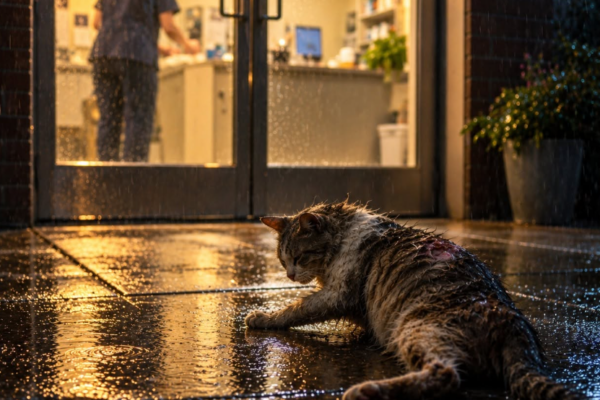
PART 2: She Tore Her Way Out of a Sealed Box—Then Sat in the Freezing Dark Because Her Four Kittens Were Still Inside
At 5:40 in the morning, my headlights caught a torn cardboard box on the frozen shoulder of a rural road, and beside it sat a tiny cat who should have run the moment my truck stopped.
Her front paws were bleeding, every claw was broken or torn, and a strip of packing tape was still stuck to the fur around her neck, but she refused to move more than a few inches away from that box.
Then I shined my flashlight through the ragged hole she had clawed open from the inside, and I finally understood why she had escaped but had chosen not to leave.
My name is Michael Turner, and in late November 2023, I was hauling freight through western Pennsylvania on a route I had driven more times than I could count.
It was one of those bitter mornings when the road looked black and hard beneath the headlights and every breath outside became a cloud.
A little before six, I felt a vibration through the steering wheel.
Probably a tire.
I pulled onto a wide gravel shoulder and climbed down with my flashlight.
That tiny decision changed my life.
I checked the trailer first.
Everything looked fine.
Then, as I turned toward the cab, my headlights illuminated something about thirty feet ahead.
A cardboard box.
At first, I ignored it.
People dump trash beside highways all the time.
Then something beside it moved.
Two eyes reflected the light.
A cat.
She was small, maybe six pounds, with a gray-and-white coat soaked by frost and road moisture.
She sat pressed against the box.
Not hiding behind it.
Against it.
“Hey there.”
She didn’t run.
That worried me immediately.
Healthy stray cats usually keep their distance from a stranger walking toward them in the dark.
This one stayed.
I approached slowly.
Then I saw the box.
Heavy packing tape wrapped completely around it three times.
Not loosely.
Carefully.
Someone had wanted that box closed.
But one side had been ripped open.
A jagged hole about five inches across.
The cardboard around it was shredded into damp fibers.
Deep claw marks surrounded the opening.
I crouched.
The cat’s paws made my stomach turn.
Several claws were split.
Others looked torn away.
Her pads were raw and bleeding.
There was dried blood around her mouth.
Then I heard it.
A tiny sound from inside the box.
I moved my flashlight toward the hole.
Four kittens.
They were so small their eyes were still closed.
Maybe eight or nine days old.
They were pressed together on top of a crumpled grocery bag, their bodies barely moving beneath one another.
“Oh, no.”
I looked back at their mother.
She stared directly toward the box.
That was when the whole scene made sense.
She had been sealed inside with them.
She had clawed and chewed her way through layers of cardboard and packing tape.
She had gotten herself out.
She could have run.
Instead, she stayed beside the box in below-freezing darkness because her babies were still trapped inside.
I checked my watch.
5:43 a.m.
There was no way to know when they had been dumped, but based on the cold and the condition of her paws, I guessed she had been there for hours.
Every passing vehicle could have killed her.
A truck drifting slightly onto the shoulder.
A predator.
The cold.
Yet she remained.
I carefully lifted the box.
The mother stood immediately.
“Easy, Mama.”
She followed me toward the truck.
I put the kittens on the passenger-side floor where the heater could reach them.
Then I turned back.
The mother cat was still sitting where the box had been.
For one second, she looked lost.
I walked toward her.
“You’re coming too.”
I expected scratching.
Hissing.
Anything.
Instead, when I slid my hands beneath her, her entire body relaxed.
Not weakness.
Relief.
She pressed her face against my jacket and stopped fighting the cold for the first time all night.
Twenty miles later, I carried five cats into an emergency veterinary clinic.
From the parking lot, I called my wife.
She answered sleepily.
“What happened?”
I looked through the clinic window as the staff rushed around the mother and her kittens.
Then I said the only thing I could think of.
“Honey, we have five cats.”
There was a pause.
Then my wife gave me the answer that changed what happened next.
“Bring them home.”
I thought that was going to be the end of the story.
I had no idea someone had left enough evidence on that cardboard box to lead investigators back toward the person who sealed it.
PART 2
The veterinarian’s name was Dr. Caroline Hayes, and she looked at me differently after I told her where the cats had come from.
Not skeptical.
Just very still.
“You’re saying the box was taped shut?”
“Three times around.”
“All the way around?”
“Yes.”
“And the hole?”
“She made it herself.”
Caroline looked toward the treatment room.
The mother cat was lying on a heated pad while a technician examined her paws.
The four kittens had been placed together in a warmed incubator.
“I need you not to throw the box away.”
“I wasn’t planning to.”
“Good.”
“Why?”
“Because this was deliberate.”
I already knew that.
But hearing a veterinarian say it made everything colder.
Caroline examined the mother first.
Weight: five pounds, four ounces.
Far too little.
Her ribs could be felt immediately beneath her coat.
She had an upper respiratory infection, likely something she had been carrying before that night.
Her gums were injured from chewing packing tape.
Her front paw pads were shredded.
Every front claw had been damaged.
Two were torn badly enough that the remaining fragments had to be removed.
Yet despite all of that, she kept turning her head toward the incubator.
“Can she hear them?” I asked.
“Yes.”
One kitten squeaked.
The mother tried to stand.
Caroline placed a hand gently over her shoulders.
“Easy.”
The cat strained toward the sound.
That was when I realized something.
She didn’t care about herself.
Not yet.
Everything she had done during the night had been for those kittens.
Even escaping.
I had originally assumed an animal trapped inside a box would tear its way out because of panic.
But once she was outside, panic should have sent her running.
Instead, she remained beside it.
She had gotten free only so she could protect what was still trapped.
Caroline let her see the kittens once they were warm enough.
The moment the mother reached them, she began licking each tiny head.
One.
Two.
Three.
Four.
Counting in the only language she knew.
All there.
All alive.
Then she curled her body around them.
For the first time since I found her, she closed her eyes completely.
I stood near the doorway longer than I intended.
One of the technicians smiled.
“You can go home, you know.”
I looked at the clock.
7:15.
My delivery schedule was destroyed.
My dispatcher had already called twice.
“I should.”
But I didn’t move.
“What are you going to name her?” the technician asked.
“Me?”
“You brought her in.”
“That doesn’t make her mine.”
The technician looked at me in a way I would become very familiar with over the next few weeks.
“What?”
“Nothing.”
“I’m a truck driver.”
“Cats don’t care.”
“I’m on the road half the week.”
“Still don’t care.”
“I didn’t come here looking for a cat.”
“Most people don’t.”
One of the kittens squeaked again.
The mother tightened herself around them.
I sighed.
“Let’s just get them healthy.”
The technician smiled as if she had already won an argument I didn’t know we were having.
I called my wife from the parking lot.
Her name is Karen.
We had been married twenty-two years.
In that time, she had learned that when I began a phone call with “Don’t get upset,” she should immediately prepare to get upset.
“This isn’t one cat,” I said.
“I understood that when you said five.”
“Four are newborns.”
“How newborn?”
“Eyes closed.”
“Oh.”
That one word changed her voice.
“And the mother?”
“Beat up.”
“From what?”
I told her.
The box.
The tape.
The broken claws.
The blood.
Karen went completely silent.
“Someone did that on purpose?”
“Yes.”
Another pause.
Then:
“Bring them home.”
“We should find a rescue.”
“Bring them home first.”
“I’m gone three or four nights some weeks.”
“I work from home.”
“We already have furniture.”
“Mighty generous of the furniture to allow us to live there.”
“Karen.”
“Michael.”
That was the end of the discussion.
Before leaving, Caroline gave me another surprise.
She had called county animal control.
Officer Daniel Morris arrived just before eight.
He photographed the box without touching it unnecessarily.
The shredded hole.
The tape.
The dried blood.
The flattened grocery bag inside.
He asked exactly where I found it.
I showed him on my route app.
“Any houses nearby?”
“Not close.”
“Businesses?”
“Gas station about a mile east. Truck stop farther west.”
“Cameras?”
“I don’t know.”
He nodded.
“We’ll check.”
I looked at him.
“Does this actually go anywhere?”
“What do you mean?”
“People dump animals constantly.”
His jaw tightened slightly.
“Yes.”
“So what are the chances you find whoever did this?”
“I don’t know.”
Not the answer I wanted.
Then he tapped the box gently with one gloved finger.
“But whoever sealed this wasn’t subtle.”
“What do you see?”
“Shipping label residue.”
I looked closer.
A rectangular patch on one side of the box had been partly peeled away.
“You can read that?”
“Not yet.”
He pointed toward another area.
“And there may be fingerprints on the tape.”
“Seriously?”
“Maybe.”
Hope rose too fast.
Daniel stopped me.
“Packing tape is difficult. Cardboard is worse. Weather complicates everything. Don’t turn this into television.”
I nodded.
“But you’re keeping it?”
“Yes.”
That bothered me more than I expected.
The box suddenly felt important.
Proof.
Not only of cruelty.
Of what the mother had done.
“Can I get it back eventually?”
Daniel looked surprised.
“You want it?”
“Yes.”
“Why?”
I thought about those claw marks.
“Because nobody’s going to believe me.”
He stared at me.
Then nodded.
“If the case closes and it’s released, we’ll call.”
At nine thirty, I finally left the clinic.
Without the cats.
They needed observation.
Caroline wanted the mother hydrated, warmed, and monitored before discharge.
The kittens needed regular checks because they had been cold for too long.
She told me to come back the next afternoon.
I returned home after lunch.
Karen was waiting by the door.
“Well?”
“Still alive.”
“All five?”
“All five.”
Her shoulders dropped.
“Good.”
Then she saw the blood on my jacket where the mother had pressed against me.
Her face changed.
“She bled on you.”
“Paws.”
Karen touched the stained fabric.
“What kind of person puts a mother and babies in a box?”
I had been asking myself the same thing for seven hours.
“I don’t know.”
Our daughter, Emily, was away at college but home for Thanksgiving break.
She walked downstairs while we were talking.
“What box?”
Karen looked at me.
I looked at Karen.
Five minutes later, Emily was crying.
“Can we keep them?”
“No.”
“Yes,” Karen said simultaneously.
I turned.
“We haven’t even brought them home.”
“That seems temporary.”
“We are not becoming cat people overnight.”
Emily wiped her face.
“Dad, you stopped your eighteen-wheeler for a cardboard box.”
“It was a tire check.”
“You carried a bleeding mother cat into an emergency clinic.”
“That is what normal people do.”
“Normal people don’t keep arguing this hard unless they’re already attached.”
I went upstairs.
Both women laughed.
That afternoon, Daniel Morris called.
“We found video.”
I stopped halfway through removing my work boots.
“What?”
“Gas station camera.”
My stomach tightened.
“Shows the box?”
“Maybe.”
“Maybe?”
“Camera points toward the road. At 3:06 a.m., a vehicle slows near the location you gave us.”
“What vehicle?”
“Dark SUV.”
“Plate?”
“Not readable from that camera.”
“So nothing.”
“I didn’t say that.”
I sat on the stairs.
“What else?”
“Another camera at an agricultural supply business farther east caught what appears to be the same SUV about seven minutes earlier.”
“Plate there?”
“Partial.”
My heart started beating harder.
“How partial?”
“We’re working on it.”
“Can you see the driver?”
“No.”
“The box?”
“No.”
“So how do you know?”
“We don’t.”
He was careful.
Frustratingly careful.
“We establish one thing at a time.”
“What do you need from me?”
“Nothing right now.”
I hated that answer.
The following day, I picked up the cats.
The mother had already changed.
Not dramatically.
But enough.
Her face looked less tense.
Her breathing was easier after antibiotics and fluids.
The bandages on her front paws made her look as if she were wearing tiny white mittens.
Karen saw her and immediately covered her mouth.
“Oh, sweetheart.”
The mother froze at the unfamiliar voice.
I placed the carrier on our living-room floor.
“Give her time.”
Karen sat ten feet away.
Didn’t approach.
Emily sat on the stairs.
We opened the carrier.
The mother remained inside.
Her four kittens were in a small insulated nesting crate beside her.
One minute.
Two.
Five.
Eventually she stepped out.
Bandaged paws against carpet.
She looked around.
Then immediately returned to the kittens.
Karen whispered, “She thinks we’re taking them.”
“Probably.”
“So we don’t.”
That became our first house rule.
Nobody moved the kittens without letting the mother see what was happening.
We set up one spare bedroom.
Door open whenever safe.
No closed carriers unless necessary.
No boxes.
That last one became obvious the first evening.
Emily placed an empty cardboard shipping box near the closet after unpacking something.
The mother saw it.
Her entire body changed.
She flattened herself.
Backed toward the kittens.
Ears down.
I removed the box immediately.
She remained tense for ten minutes afterward.
Karen said, “No more boxes.”
“Agreed.”
We named the mother Hope.
Not because we wanted something dramatic.
Because Emily suggested it while sitting beside her on the floor.
“She stayed because she hoped someone would come.”
I didn’t correct her.
Maybe Hope wasn’t expecting anyone.
Maybe she simply refused to leave.
Either way, the name stayed.
The kittens received temporary names.
Bean.
Poppy.
Finn.
And Dot, because she had a tiny gray spot over one ear.
“Temporary,” I reminded everybody.
Karen nodded.
“Of course.”
Emily nodded.
“Absolutely.”
Hope looked at me.
Even the cat appeared unconvinced.
The first week at home revolved around feeding and healing.
Hope produced milk, but malnutrition had reduced her reserves.
We supplemented when necessary under Caroline’s guidance.
Every few hours, someone checked the kittens.
Karen handled nights because I had to return to work.
When I was home, I took early morning.
Hope slowly learned our sounds.
My work boots.
Karen’s softer steps.
Emily coming down the stairs too fast.
The refrigerator.
The food bag.
Especially the food bag.
The first time Hope ran toward it, I laughed.
“Where was that speed when I found you?”
She meowed.
“You had perfectly good legs.”
Karen leaned around the doorway.
“She was guarding babies.”
Hope meowed again.
“See?”
“You two are becoming impossible.”
Her paws healed slowly.
Two damaged claw remnants had been removed.
Several other claws eventually began growing normally.
But every dressing change reminded us what she had done.
When Caroline removed the bandages for inspection, I saw the raw pink pads.
Four paws should never tell that kind of story.
“How long would it take to tear through a box like that?” I asked.
Caroline shook her head.
“Impossible to know.”
“Hours?”
“Potentially.”
“She did all of this herself.”
“Yes.”
“With newborn kittens inside?”
“Yes.”
I stared.
There were bite abrasions along Hope’s gums too.
Tape adhesive had pulled fur from her neck.
She had attacked the enclosure with everything she possessed.
Teeth.
Claws.
Body weight.
Again and again.
When pain should have stopped her, it didn’t.
I touched her head carefully.
“You’re insane.”
Hope leaned into my fingers.
Caroline smiled.
“She’s a mother.”
The investigation moved quietly during those weeks.
Daniel called every few days.
The partial license plate narrowed the list.
Dark SUV.
Specific state registration sequence.
Camera timestamps.
Direction of travel.
They compared vehicles registered within a reasonable radius.
Then something unexpected happened.
The box itself gave them another clue.
The partially removed shipping label had not been completely destroyed.
Under alternate lighting, investigators could recover fragments of an address.
Not enough for me to know.
Enough for them.
Daniel refused to tell me details at first.
“I don’t want you going anywhere.”
“Why does everyone assume I’m reckless?”
“Because your first response to almost every update is ‘Where?’”
“That’s curiosity.”
“That’s pre-confrontation curiosity.”
“Fine.”
Three days later, he called again.
“We identified the original recipient of the box.”
I put down my coffee.
“And?”
“A woman named Rebecca Shaw.”
“Did she dump them?”
“We’re interviewing.”
“Does she own Hope?”
“We found veterinary records for a cat matching Hope’s description at that address.”
My hand tightened around the mug.
“So yes.”
“Likely.”
“Does Hope have a microchip?”
“No.”
“What do the records say?”
“Female domestic shorthair. Gray and white. Approximately two years old.”
“Pregnant?”
“Last visit was before the kittens were born.”
“What did Rebecca say?”
Silence.
“Daniel.”
“She says the cat was hers.”
I closed my eyes.
“And the kittens?”
“She admits Hope gave birth in her garage.”
My stomach turned.
“She taped them into a box.”
“We’re still establishing who physically sealed it.”
“That is a very lawyer answer.”
“It’s an investigator answer.”
“Fine.”
I walked toward the spare bedroom.
Hope was nursing.
All four kittens had started opening their eyes.
Tiny faces.
Tiny paws kneading against her belly.
“She wanted them gone.”
“That appears to be part of the motive.”
“Why not take them to a shelter?”
“That’s one of the questions.”
I hated that there could be any answer.
A shelter.
A rescue.
A social media post.
A neighbor.
A veterinarian.
Instead, someone chose packing tape.
The case became stronger when investigators checked Rebecca’s phone records and neighborhood cameras.
A camera across the street showed Rebecca’s SUV leaving her home shortly before 2:40 a.m.
The same vehicle returned before four.
The gas station camera placed a matching SUV near the dumping location at 3:06.
The shipping box came from a package delivered to Rebecca’s address two weeks earlier.
None of those facts alone proved who placed the cats inside.
Together, they became difficult to explain.
Rebecca eventually changed her statement.
At first, she claimed the box had been left outside her house and someone else must have used it.
Then she said a friend had agreed to take the cats.
Then, faced with the video timeline, she admitted driving them away.
I learned the details later through the case.
She said Hope had given birth unexpectedly.
She already had financial problems.
Her landlord had complained about animals.
The kittens cried at night.
She felt trapped.
So around three in the morning, she put Hope and the babies inside the shipping box.
She taped it closed.
Placed it in the back of her SUV.
Drove toward a rural area.
Left it beside the road.
Her explanation included a sentence I could not stop thinking about.
“I thought somebody would find them in the morning.”
Somebody.
Not a specific person.
Not a shelter worker expecting them.
Not a rescue.
Somebody.
The same invisible person people imagine whenever they abandon responsibility.
I asked Daniel, “Did she leave a note?”
“No.”
“Food?”
“No.”
“Water?”
“No.”
“Holes?”
He paused.
“No ventilation holes were intentionally made.”
That broke something in me.
I had assumed perhaps the box had gaps.
Maybe a careless attempt at abandonment.
No.
Tape wrapped three full times.
A mother.
Four kittens.
No deliberate ventilation.
The hole Hope ripped open may not only have allowed her to escape.
It may have allowed air into the box.
I sat down.
“So if she hadn’t torn through it…”
Daniel did not finish the thought.
Neither did I.
Hope had not merely waited beside her kittens.
She may have saved them before I ever arrived.
The investigation eventually became public when charges were filed.
Animal cruelty.
Abandonment.
Additional counts related to the kittens.
The exact legal wording mattered less to me than the fact that someone had taken the case seriously.
But publicity brought ugliness.
Rebecca’s name spread online.
People posted threats.
Someone shared what they believed was her address.
A stranger messaged me asking whether I wanted to “teach her what a sealed box feels like.”
I stared at the message for a long time.
Then deleted it.
When a reporter called, I agreed to speak only about Hope.
Not Rebecca’s location.
Not revenge fantasies.
The reporter asked, “Are you angry?”
“Yes.”
“What punishment do you want?”
“I want her never to do this again.”
“That’s all?”
“No.”
I looked toward Hope.
Her paws had mostly healed.
She was lying on our couch while four kittens climbed across her.
“I want people to understand there were twenty easier choices than taping five living animals into a box.”
The reporter paused.
“Do you forgive her?”
“No.”
Karen, listening from the kitchen, looked toward me.
I continued.
“But Hope’s story isn’t going to become about hatred.”
That surprised me when I said it.
Because for weeks, I had imagined seeing Rebecca.
I wanted her to look at Hope’s paws.
The missing claws.
The scars.
I wanted her to understand that every shred of cardboard represented a moment when that cat refused to die.
But then I realized something.
Hope didn’t know Rebecca’s name mattered anymore.
Her life had moved somewhere else.
By Christmas, the kittens were chaos.
Four tiny animals turned our quiet house into a demolition project.
Bean climbed curtains.
Poppy discovered the Christmas tree.
Finn slept inside my work boots.
Dot stole Karen’s hair ties and hid them beneath the couch.
Hope watched all of it with the exhausted expression of a mother who had reconsidered every life choice.
I came home from a three-day route and found the tree tilted.
“What happened?”
Karen pointed at Bean.
Bean attacked the tree skirt.
“Why is this still standing?”
“Optimism.”
“Poor strategy.”
Hope walked toward me.
Her claws had grown back enough that her steps no longer seemed tender.
She rubbed against my leg.
“You’re responsible for those criminals.”
Meow.
“I found you beside a highway and this is how you repay me.”
Karen smiled.
“She missed you.”
Hope stood on her hind legs and put both front paws against my jeans.
I picked her up.
A month earlier, she had collapsed in my hands from exhaustion.
Now she weighed almost seven pounds.
Her coat was brighter.
Her respiratory infection had cleared.
Her gums healed.
Two claws remained shorter than the others and always would.
I rubbed her head.
“You look pretty good.”
Hope purred.
That sound got me.
The first time she purred in our house, Karen had cried.
Now she did it constantly.
On laps.
On blankets.
While nursing.
While stealing my side of the couch.
She had gone from fighting cardboard in darkness to having opinions about furniture.
That was healing.
Hope’s fear of enclosed spaces remained.
Carriers were difficult.
We worked carefully with Caroline.
Carrier always open.
Treats inside.
Never forced unless medically necessary.
Soft-sided carrier with large mesh panels.
Short exposures.
Hope improved but never loved it.
Boxes were worse.
If a shipping box entered the house, we broke it down immediately.
Emily once forgot after an online order.
Hope entered the room, saw the box, and froze.
Emily’s face collapsed.
“I’m sorry.”
She removed it at once.
Hope did not approach that part of the room for an hour.
Trauma does not disappear simply because circumstances improve.
Safety can grow around it.
That became enough.
When the kittens reached adoption age, we had another argument.
“They need homes,” I said.
Karen nodded.
Emily stared.
Nobody moved.
“Four kittens,” I repeated.
“Yes,” Karen said.
“That means litter boxes.”
“Yes.”
“Veterinary bills.”
“Yes.”
“Food.”
“Yes.”
“Furniture destruction.”
Bean climbed the curtain as if demonstrating.
Karen looked up.
“Yes.”
I crossed my arms.
“We cannot keep five cats.”
Hope jumped onto the couch beside Karen.
Dot curled against Hope.
Finn climbed into my lap.
Poppy attacked my sock.
Bean remained on the curtain.
Emily smiled.
“We can keep four kittens and their mother.”
“That is five cats.”
“Different phrasing.”
We compromised.
Or, more accurately, my family waited until I surrendered.
The kittens stayed.
All four.
When I told Caroline, she laughed.
“You’re officially cat people.”
“No.”
“How many cats live in your house?”
“Five.”
“Cat people.”
“I own a truck.”
“I don’t see how that helps your argument.”
We kept them because separating Hope from every kitten after what she had done felt wrong to us.
Was that objectively necessary?
Probably not.
She would likely have adapted if they went to good homes.
But we had the space.
We could afford them.
And by then, they had become ours.
The court case happened the following spring.
I was asked to testify about finding the box.
I hated court before I ever entered.
Everything felt sterile.
Controlled.
Too clean for the story we were discussing.
Rebecca sat with her attorney.
She looked younger than I had imagined.
Mid-thirties.
Hair pulled back.
Plain clothes.
Nervous.
Human.
I wanted a monster.
The courtroom gave me a tired woman.
That did not excuse anything.
But it forced me to confront the difference between a person and an act.
The prosecutor asked me to describe the morning.
The road.
Temperature.
Time.
Box.
Tape.
Hole.
Cats.
Then Hope’s paws.
I kept my voice steady until that part.
“What condition were her front claws in?”
I swallowed.
“Every one was damaged.”
“Can you be more specific?”
“Some split.”
I paused.
“Some torn down to the tissue.”
“Was there blood?”
“Yes.”
“Where?”
“Paws. Mouth. Cardboard.”
The prosecutor displayed photographs.
I had not seen some of them since the morning.
The inside of the box.
Blood smears.
Scratches.
Tape chewed from the inside.
I looked toward Rebecca.
She was crying.
I did not feel better.
The prosecutor asked, “What did the cat do after she escaped?”
“She stayed.”
“Could she have left?”
“Yes.”
“Was she restrained outside the box?”
“No.”
“Then why do you believe she remained?”
The defense objected.
Speculation.
Sustained.
The question was withdrawn.
I almost laughed.
Because legally, perhaps we could not say.
But everyone in the room knew.
Her four babies were inside.
When Rebecca later addressed the court, she apologized.
She said she panicked.
Money was tight.
She feared eviction.
She did not know where to take newborn kittens.
She had convinced herself someone would find the box quickly.
Then came the sentence that made Karen, sitting behind me, grip my hand.
“I didn’t think the mother would fight that hard.”
I turned toward her.
For the first time, our eyes met.
Rebecca immediately looked away.
I had prepared a statement.
It was angry.
I had rewritten it six times.
When my turn came, I left the pages folded in my pocket.
I stood before the court.
“My name is Michael Turner.”
My voice sounded strangely calm.
“I’m the truck driver who found them.”
I looked at Rebecca.
“You said you didn’t think Hope would fight that hard.”
Her shoulders shook.
“That is the part I want you to remember.”
The courtroom became quiet.
“The box was sealed with enough tape that I had trouble cutting what remained when I found it.”
I held my hands apart.
“Hope is an eight-pound cat.”
“She didn’t have scissors.”
“She didn’t have a knife.”
“She had claws and teeth.”
I swallowed.
“She used them until they broke.”
Rebecca covered her mouth.
“She could have stopped when it hurt.”
I looked toward the judge, then back.
“She didn’t.”
“She could have left after she got out.”
My voice broke.
“She didn’t.”
I paused.
“Not because she understood the road.”
“Not because she understood freezing temperatures.”
“Not because she knew a truck driver would stop.”
“She stayed because four kittens were still inside.”
Rebecca cried openly now.
I felt no victory.
Only exhaustion.
“I am not asking this court to make you suffer the way she suffered.”
I breathed slowly.
“I’m asking you to understand that being overwhelmed does not erase your responsibility to choose something other than cruelty.”
I listed them.
Shelter.
Vet clinic.
Police station.
Neighbor.
Rescue.
Animal control.
Even leaving the box open outside a staffed building would have been better than what happened.
“There were choices.”
I looked at Hope’s photograph on the evidence screen.
“You chose the one she had to tear apart with her body.”
That was all.
I sat down.
The final court outcome included a conviction on animal-cruelty and abandonment charges, probation, fines, restitution for veterinary costs, community-service requirements, and restrictions on animal ownership for a period defined by the court.
Some people online celebrated.
I didn’t.
I drove home.
When I opened the door, chaos greeted me.
Finn ran across the hallway.
Poppy chased him.
Dot jumped from the couch.
Bean knocked something over in the kitchen.
Then Hope appeared.
She walked toward me.
No bandages.
Healthy weight.
Tail high.
I crouched.
“Court’s done.”
Hope rubbed her face against my hand.
“You don’t care.”
Purr.
“Good.”
Karen stood behind me.
“How was it?”
“Sad.”
“Was justice done?”
I looked at Hope.
“I think accountability was.”
“That isn’t what I asked.”
“I know.”
Then I understood.
Justice was never going to feel like balancing a scale.
Nothing could give Hope back those hours inside the box.
Nothing could erase the terror.
Nothing could regrow the two claws normally.
Nothing could explain to four newborn kittens how close they came to dying.
Punishment could only prevent, deter, acknowledge.
The rest belonged to life.
Hope handled that part beautifully.
By summer, she weighed eight pounds.
Exactly where Caroline wanted her.
Her coat became thick.
The kittens became adolescents.
Then adults.
Bean remained a climbing criminal.
Poppy became affectionate with everyone.
Finn grew enormous and still tried to fit inside my work boots.
Dot followed Hope everywhere.
The five cats developed sleeping arrangements that changed nightly.
Sometimes all together.
Sometimes scattered around the house.
Hope preferred open spaces.
Couch.
Window ledge.
Center of the rug.
Never tucked deeply beneath furniture.
Never inside covered cat beds.
We stopped buying them.
Doors bothered her if closed.
Especially the spare bedroom door.
If Karen closed it while cleaning, Hope sat outside and scratched.
So we left doors open whenever possible.
Always open.
That became one of the unspoken rules of our home.
Years later, guests sometimes ask why most interior doors remain open.
I tell them:
“One of our cats likes it.”
That is technically true.
The deeper answer belongs to her.
Hope needed exits.
Choice.
Space.
After a box where every direction had been cardboard and tape, an open doorway was not architecture.
It was safety.
Daniel eventually returned the original box.
He called first.
“The case is closed.”
“Can I have it?”
“You still want that thing?”
“Yes.”
“Why?”
I thought about it.
“Because someday the details will sound exaggerated.”
He laughed softly.
“They already do.”
I drove to the evidence facility.
The box came sealed inside a clear protective bag.
It looked smaller than I remembered.
That shocked me.
How had five cats fit inside?
The hole Hope tore was still there.
Ragged.
Dark stains remained around the edges.
Tape hung loose from the sides.
Scratch marks everywhere.
I stood there staring.
Daniel said, “You okay?”
“Yeah.”
“Sure?”
I touched the outside of the evidence bag.
“She did this.”
“Yes.”
“Every mark.”
“Most likely.”
I took the box home.
Karen did not want it inside.
Neither did Hope.
So it went to the garage.
High shelf.
Protected.
The first time Emily brought a friend home from college, she told the story.
Her friend looked skeptical.
“No way a cat tore through three layers of tape.”
I didn’t argue.
I walked into the garage.
Brought down the box.
Put it on the workbench.
The young man stared.
The shredded hole.
The claw grooves.
The stained tape.
He stopped talking.
That became a pattern.
People hear stories.
They imagine embellishment.
Then they see evidence.
The box did not make Hope heroic.
She didn’t know anyone would tell her story.
Nobody was filming.
No rescue worker was encouraging her.
There was no reward waiting outside.
She simply had babies.
They were trapped.
So she fought.
That simplicity made it more powerful.
The years passed.
My trucking routes changed.
I spent fewer nights away as I got older.
Karen joked that Hope was responsible because I started refusing longer runs.
“Coincidence.”
“You rejected a five-day route because Dot had a dental cleaning.”
“That was scheduling.”
“Cat person.”
“No.”
We had five cats.
I had lost that argument years earlier.
Hope aged.
Her muzzle became lighter.
Her two damaged claws remained shorter.
She developed arthritis in one front paw earlier than Caroline expected, possibly because of the old injuries.
We managed it.
Medication.
Soft surfaces.
Low furniture.
She remained active.
The kittens grew into adult cats who still behaved like kittens around her.
Even at five years old, Finn occasionally tried to knead against Hope as if he still expected milk.
She would slap him.
He deserved it.
Her relationship with the box never changed.
Anything resembling a sealed carton made her uncomfortable.
So packages were unpacked outside the living areas whenever possible.
It became routine.
No drama.
No need to prove she was “over it.”
Healing does not require liking the thing associated with your worst night.
One winter evening, years after the rescue, our furnace stopped working for about three hours.
The house cooled quickly.
Karen and I set up space heaters.
Hope gathered all four grown kittens onto the couch.
Not because they needed her.
They were enormous.
But they clustered together.
I watched from the doorway.
For one instant, the image looked like the box.
Five bodies.
Mother around the others.
I almost had to leave the room.
Instead, Hope lifted her head.
Saw me.
Then relaxed.
No tape.
No cardboard.
No roadside.
Home.
That distinction mattered.
Later that night, Karen sat beside me.
“You still think about it?”
“Sometimes.”
“Me too.”
“What part?”
“That she stayed.”
I knew exactly what she meant.
If Hope had escaped and run, nobody could blame her.
She had already done more than any animal should be required to do.
She was freezing.
Bleeding.
Terrified.
Free.
The rational choice was movement.
Find shelter.
Find food.
Save herself.
She did not.
Sometimes people ask whether animals understand sacrifice.
I don’t know.
I’m a truck driver, not a philosopher.
I know what I saw.
Four kittens could not leave.
Their mother could.
She stayed.
Everything else is language we put around it.
When Hope was about eight, she developed kidney disease.
Early.
Manageable.
Caroline had retired by then, but a younger veterinarian named Dr. Singh took over.
He knew Hope’s story.
Everybody at the clinic did.
The first time he examined her, he said, “So this is the famous box cat.”
I frowned.
“She’s Hope.”
He immediately understood.
“Right.”
I appreciated him after that.
The box was something she survived.
Not her identity.
Her kidney disease progressed slowly.
Diet.
Medication.
Blood tests.
Fluids later.
Hope hated the carrier but tolerated it if the door stayed open until the last possible second.
I always told her where we were going.
She probably did not understand the words.
Ritual mattered anyway.
“Vet.”
She glared.
“Coming home afterward.”
That part mattered to me.
Always coming home.
The four kittens—no longer kittens at all—aged alongside her.
Bean developed diabetes.
Poppy remained absurdly healthy.
Finn reached sixteen pounds despite every diet.
Dot slept beside Hope every night.
Years after the roadside, they still had her.
That fact made me emotional in ways I rarely admitted.
The biggest victory was not that all five survived the morning.
They got years.
Ordinary years.
Christmas trees.
Sunbeams.
Vet appointments.
Arguments over food.
Scratched furniture.
Morning routines.
Years are what abandonment tried to steal.
Years are what they got back.
Hope’s final winter came almost ten years after I found her.
By then, my hair was grayer.
I had reduced my trucking schedule.
Emily was married.
She had a little boy who called Hope “Grandma Cat.”
Hope tolerated him with surprising patience.
One Sunday, he sat beside her with a picture book.
Hope could not understand a word.
He read anyway.
She slept with one paw against his leg.
I photographed them.
That became one of my favorite pictures.
Not because it was dramatic.
Because nothing about it was.
A cat who once had to claw herself out of a death trap had lived long enough to nap beside the next generation of my family.
That is what survival should become.
Boring.
Safe.
Ordinary.
Hope’s kidneys worsened the following February.
She stopped eating as much.
Dr. Singh adjusted medication.
For a while, she rallied.
Then one morning, she refused breakfast.
Hope never refused breakfast.
Karen looked at me.
We both knew.
The tests were worse.
“How long?” I asked.
Dr. Singh was honest.
“Could be days. Maybe weeks.”
“Can we keep her comfortable?”
“Yes.”
That became the only question.
Hope came home.
Doors open.
Always.
We placed beds in her favorite open spaces.
No confinement.
No unnecessary carrier.
The adult kittens stayed close.
Especially Dot.
Hope slept more.
Some days she ate chicken.
Some days only a little wet food.
Sometimes nothing.
We did not force her beyond what made sense.
One warm afternoon, unusual for February, Hope walked onto the enclosed porch.
Sunlight reached the floor.
She lay down.
Dot settled beside her.
Then Finn.
Then Poppy.
Even Bean, slower with age, joined.
Four grown cats around their mother.
I sat nearby.
Karen came out carrying coffee.
“Look at them.”
“I am.”
We stayed there for hours.
That evening, Hope came to me.
Slowly.
She placed both front paws on my leg.
The old claws.
Most had grown normally after the roadside.
Two remained short.
Always.
I picked her up.
She weighed less again.
Not like that first morning.
But enough to remind me.
“Hey, Mama.”
She rested her head against my chest.
I could feel her purr.
Weak.
Still there.
That night, she struggled to settle.
By morning, we knew.
Dr. Singh came to the house.
I was grateful for that.
No box.
No carrier.
No closed doors.
Hope lay on an open blanket in the living room.
Her kittens—her old, ridiculous, grown kittens—were nearby.
We let them approach if they wanted.
Dot lay against her.
Finn sniffed her and sat several feet away.
Bean climbed onto the couch.
Poppy stayed beside Karen.
I sat on the floor.
Hope’s head rested on my hand.
Dr. Singh examined her.
Then looked at us.
“It’s time.”
Karen started crying.
I had imagined this moment before.
For years.
Every time Hope got sick.
Every veterinary visit.
Every gray hair.
I thought knowing it was coming would make it easier.
It did not.
I stroked her head.
“You remember the truck?”
Her ear moved.
“I almost drove away.”
Karen shook her head.
“No, you didn’t.”
“I almost did.”
That truth mattered.
If the tire had not felt wrong.
If I had stopped a mile later.
If I had looked at the box and decided trash was not my problem.
So many tiny decisions separated Hope’s life from another ending.
I touched one of her short claws.
“You did the hard part.”
Her eyes stayed half closed.
“You got out.”
I swallowed.
“And then you did the crazy part.”
Karen smiled through tears.
“You stayed.”
Hope’s purr vibrated faintly against my palm.
I leaned closer.
“You don’t have to stay this time.”
That sentence broke me.
Because staying had defined her.
Beside the box.
Beside the kittens.
Beside our family for almost ten years.
She had stayed enough.
Dr. Singh gave the first medication.
Hope relaxed.
No fear.
No fight.
I held her.
Karen’s hand rested on her back.
Emily had come by then and knelt beside us.
Her son stayed in another room.
The second medication went in.
Hope’s breathing slowed.
Then stopped.
Her head remained against my hand.
Nobody spoke for a long time.
Eventually Dot approached.
She sniffed Hope.
Then curled beside her.
That nearly destroyed me.
We had Hope cremated.
Some of her ashes are buried beneath a maple tree behind our house.
The rest are in a small wooden box on a shelf.
I appreciate the irony.
But this box has no tape.
Its lid lifts freely.
Beside it is a photograph of Hope with her four kittens as adults.
Not the roadside.
Not blood.
Not broken claws.
Family.
The original cardboard box remains in my garage.
Still ripped.
Still ugly.
The tape curls from the sides.
Claw marks circle the hole.
People still ask why I keep it.
I tell them there are things memory makes unbelievable.
The box makes them real.
But over the years, what it proves changed for me.
At first, I thought it proved cruelty.
Someone taped living animals inside.
That mattered.
Then I thought it proved survival.
Hope clawed out.
Also true.
Now, when I look at it, I think it proves choice.
There was a hole.
Big enough for Hope.
Freedom on one side.
Four helpless kittens on the other.
She made her choice.
And every good thing that followed began because she stayed long enough for my headlights to find her.
Rebecca served her sentence and eventually completed the restrictions the court placed on her.
I never contacted her.
She once sent a letter through the rescue.
I did not read it for almost a year.
When I finally did, it was an apology.
No excuses.
She said she had undergone counseling.
She said she understood now that panic had made her treat living animals like a problem that could be sealed away.
She had volunteered as part of her sentence at a community food-distribution program, not with animals.
She wrote:
“I know I don’t deserve forgiveness. I just want you to know I think about that cat every winter.”
I folded the letter.
Karen asked what I felt.
“Nothing useful.”
That was honest.
“Do you forgive her?”
“I don’t know.”
“Does it matter?”
I looked toward Hope sleeping by the open doorway.
“No.”
That answer surprised me.
For years, I thought a satisfying ending required deciding whether the person who caused the suffering deserved forgiveness.
It didn’t.
Hope’s life did not depend on my emotional verdict about Rebecca.
Hope had already moved on without permission from either of us.
Her revenge was never Rebecca’s punishment.
It was ten years of open doors.
Four kittens growing old beside her.
Claws growing back.
Weight returning.
Sunlight.
Warm rooms.
A truck driver becoming a cat person despite years of denial.
That was enough.
Today, only two of Hope’s kittens are still alive.
They are old.
Slow.
Very spoiled.
Finn is gone.
Bean too.
Poppy sleeps on Karen’s side of the bed.
Dot still prefers the room where Hope used to nap.
I am retired from trucking now.
Sometimes I wake before dawn out of habit.
The house is quiet.
At 5:40, I occasionally think about that morning.
Frozen gravel.
Headlights.
The box.
Hope sitting upright beside it.
People often ask me why she didn’t leave.
I cannot answer scientifically.
Maybe maternal instinct.
Maybe sound.
Maybe scent.
Maybe she knew her kittens’ cries meant they were helpless.
All I know is what happened.
She tore herself free.
She had every opportunity to disappear.
She stayed.
Nobody praised her.
Nobody was filming.
Nobody offered food.
No one had promised rescue.
She stayed while her paws bled.
She stayed while temperatures dropped below freezing.
She stayed while trucks passed.
She stayed because four tiny lives remained inside something she had escaped.
And perhaps that is why, after all these years, I still keep the box.
Not to remember the person who sealed it.
To remember the one who opened it.
With nothing but her own claws.
Then refused to walk away.