PART 2: She Still Wagged Her Tail After Humans Nearly Starved Her to Death—Then We Learned Who Had Left Nola That Way
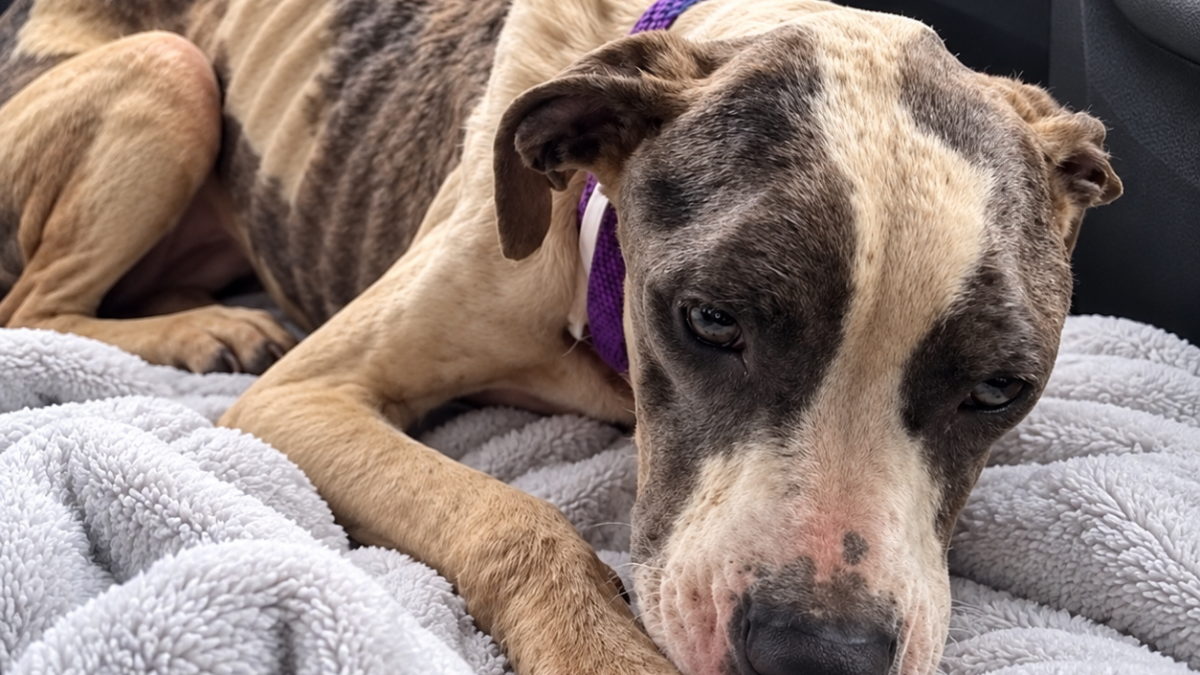
PART 2
I stepped into the hallway before answering.
“What did they find?”
There was a pause on the other end.
The kind of pause people use when they are deciding how much truth another person can handle at once.
“Another enclosure,” the rescue coordinator, Megan, said. “And evidence there were other dogs.”
My eyes went back toward the living room.
Nola had followed me from the kennel but stopped several feet away. She did that constantly during those first days. She wanted to be near people, but she still seemed unsure whether she was allowed to ask for closeness.
“What kind of evidence?”
“Old bowls. Chains. Veterinary records with gaps. Bags of cheap feed, most of them empty. And there’s a shed behind the house.”
I closed my eyes.
“Megan.”
“I know.”
“Were there dogs inside?”
“Not when officers entered.”
Not when they entered.
Those four words stayed with me.
“What does that mean?”
“We don’t know yet.”
Behind me, I heard the faint sound of Nola’s nails on the hardwood floor.
She had moved closer.
I turned.
She stood in the doorway wearing her tiny pajamas, her narrow chest rising and falling.
Her tail gave one cautious wag.
I knelt.
She came forward immediately.
That trust felt unbearable now.
I rested my hand against the side of her face.
“I’m here,” I whispered.
Megan continued talking.
Animal control had received information linking Nola to a man named Raymond Keller. He lived about forty minutes outside town on a small rural property where neighbors had occasionally heard barking from behind a privacy fence.
Nobody had known how many dogs were there.
Or perhaps nobody had wanted to know badly enough.
Nola had not been found wandering miles away.
She had been discovered less than half a mile from Keller’s property.
That changed everything.
The investigators photographed the enclosure.
A plastic kennel.
A rusted gate.
No bedding.
No clean water.
Stains on the concrete.
The smell of accumulated waste.
When Megan described it, I looked down at Nola.
The stains in her fur.
Her confusion around beds.
Her desperate fixation on food.
The way she crouched whenever someone moved too quickly.
None of it had appeared from nowhere.
Her past had a physical location now.
And possibly a name.
“What happens next?” I asked.
“Evidence goes to the county investigator. We document her medical condition. The vet will provide records.”
“Is Keller being charged?”
“Claire, we’re not there yet.”
My jaw tightened.
“He almost killed her.”
“I know.”
“She’s eating her own feces because she thinks there might not be another meal.”
“I know.”
“He left her living in urine.”
“Claire.”
I stopped.
Megan wasn’t defending him.
She was trying to keep me from running emotionally ahead of the evidence.
“We need this done correctly,” she said. “If we want accountability, we need facts that survive a courtroom.”
That sentence changed the way I thought about revenge.
I had been angry before.
Now I became patient.
Because rage burns fast.
Evidence lasts.
The veterinarian photographed Nola’s body from every angle.
Her ribs.
Her hips.
The staining.
Her gums.
The sores between her toes.
He documented her weight, anemia, infection and nutritional condition.
Every blood test became more than a medical update.
It became part of a timeline.
The first week was still about survival.
Nola slept more than she was awake.
At first she slept curled tightly, nose pressed against her stomach.
Never stretched out.
Never belly-up.
Never careless.
Even while sleeping, she seemed prepared to protect herself.
I began leaving her bed near the couch every evening while my husband, Mark, and I watched television.
Our eight-year-old son, Ethan, had been told that Nola was sick and needed quiet.
He took the responsibility more seriously than I expected.
He never rushed toward her.
He sat on the floor and read books.
Sometimes he didn’t even look at her.
That turned out to be exactly what Nola needed.
On the third evening, Ethan was reading aloud from a book about horses when Nola lifted her head.
He kept reading.
Her ears moved.
Then she stood.
I watched from the kitchen without saying anything.
Nola walked toward him.
One step.
Then another.
Ethan kept his eyes on the page.
She stopped beside his leg.
He slowly lowered one hand.
Nola sniffed his fingers.
Then she lay down.
Not touching him.
But close.
Ethan looked at me.
His eyes widened.
I put one finger against my lips.
He smiled and kept reading.
That became their routine.
Every afternoon after school, Ethan sat somewhere near her and talked.
Not baby talk.
Not commands.
He told her about math class.
Lunch.
A kid who traded him chocolate milk for crackers.
The frog they had found near the soccer field.
Nola listened to all of it.
Soon she began waiting near the entryway before his bus arrived.
One afternoon, I heard Ethan yell from the porch.
“Mom! She knows me!”
Nola was wagging so hard that her entire hind end moved.
It was the first time I had seen joy overpower exhaustion in her body.
Her medical progress came more slowly.
The infection responded to medication, but the anemia frightened us.
Every blood draw felt like a verdict.
Her numbers improved.
Then stalled.
Then improved again.
The veterinarian reminded me not to expect a straight line.
“Healing isn’t a staircase,” he said. “Some days it’s going to look like she’s going backward.”
I learned that lesson quickly.
Nola had a good day and walked around the yard for nearly ten minutes.
The next morning she barely wanted to stand.
I panicked.
I called the clinic.
They checked her again.
Nothing catastrophic had happened.
She was simply exhausted.
Her body had been running on emergency reserves for too long.
Even happiness tired her out.
Food was another complicated battle.
We fed her small meals on a strict schedule because giving a severely malnourished animal too much too quickly can create its own medical dangers.
Nola disagreed with the concept of small meals.
The moment she finished, she searched.
Under the bowl.
Around the mat.
Behind our chairs.
Beneath the table.
She inspected corners where no food had ever existed.
If Mark opened a cabinet, she appeared beside him.
If Ethan crinkled a wrapper, she woke from a dead sleep.
One evening I dropped a piece of cooked carrot.
Nola lunged for it so fast that she slipped.
She grabbed the carrot, raced three feet away and swallowed without chewing.
Then she froze.
She stared at me.
Waiting.
For what?
For me to take it?
For punishment?
I sat down on the floor.
“Nola.”
Her ears flattened.
“There’s more.”
I picked another tiny piece from my plate and set it several feet in front of me.
She crept forward.
Ate it.
Then looked at me again.
“There will always be more food tomorrow,” I said.
Of course she couldn’t understand the sentence.
But I kept saying it.
Every day.
There will always be breakfast.
There will always be dinner.
Nobody is taking the bowl away forever.
You don’t have to eat like this is the last meal of your life.
Weeks passed before she stopped following every crumb with frantic eyes.
Longer before she left food unfinished.
The first time it happened, Mark called me from the kitchen as though we had won the lottery.
“Claire.”
“What?”
“Come here.”
I hurried in.
Nola’s bowl sat on the floor.
Three pieces of kibble remained.
I stared at them.
Mark pointed.
“She walked away.”
I almost laughed.
Instead, tears came.
Three forgotten pieces of kibble.
That was healing.
At the ranch, she changed faster.
My sister owned several acres outside town and fostered animals as well. Once Nola was medically strong enough, we brought her there.
The first visit, she stood near the car and stared across the open field.
Grass moved in the breeze.
Two rescued dogs wandered near the fence.
A horse snorted from the adjacent pasture.
Nola looked overwhelmed.
I unclipped her leash inside the secure yard.
She stayed beside my knee.
“You can go.”
She looked up.
I walked several steps away.
She followed.
One of the other dogs, a chunky black Lab named Rosie, approached slowly.
Nola stiffened.
Rosie stopped.
Sniffed.
Turned sideways.
Then trotted away.
Nola watched her.
A minute later Rosie ran past again carrying a tennis ball.
Nola’s head turned.
That was the first time I saw curiosity on her face.
Not fear.
Not hunger.
Curiosity.
Rosie dropped the ball.
Picked it up.
Dropped it again.
Nola stepped closer.
Rosie bounced backward.
And then something happened that made every adult standing in that yard stop talking.
Nola play-bowed.
It was awkward.
Her front legs stretched forward while her rear end remained too high.
She looked like she had discovered the movement by accident.
Rosie understood immediately.
She bounced forward.
Nola jumped sideways.
For ten seconds, maybe fifteen, they played.
Then Nola became tired and came back to me.
But the dog who returned wasn’t exactly the one I had brought there.
Something had opened.
That evening she slept stretched on her side.
Her legs weren’t tucked beneath her.
Her chin wasn’t protecting her belly.
For the first time, she slept like a dog who believed morning was guaranteed.
Meanwhile, the investigation into Raymond Keller continued.
I tried not to obsess over it.
I failed.
Megan called whenever there was a meaningful update.
The property records showed Keller had lived there for almost eleven years.
Neighbors remembered dogs coming and going.
One woman told investigators she had seen advertisements for puppies online several years earlier.
Different breeds.
Different litters.
Same phone number.
Another neighbor remembered seeing crates loaded into a van.
The county began searching archived listings.
That was when the case grew.
Keller hadn’t simply neglected one dog.
Investigators believed he had bred dogs for money.
For years.
And when certain dogs became sick, old or unprofitable, they seemed to disappear.
Not every disappearance meant something terrible.
Some dogs may have been sold.
Some may have gone to other homes.
Investigators were careful about what they claimed.
But enough records existed to raise questions.
Nola’s past became clearer when an old advertisement surfaced.
The photograph showed a younger white dog standing beside a wooden fence.
Her coat was clean.
Her body was fuller.
The markings near her ears were unmistakable.
My stomach turned when I saw it.
The caption described her as a “proven female.”
I hated those words.
Not because responsible breeding automatically meant cruelty.
It didn’t.
But in Nola’s case, those words reduced the dog sleeping beside my son into a tool.
A production animal.
Something measured by what she could provide.
The veterinary investigator estimated that Nola had likely produced multiple litters.
She had also suffered untreated health problems for some time.
Suddenly another piece fell into place.
She had probably once been valuable to Keller.
Until she wasn’t.
I sat beside her that night.
Nola rested her head on my thigh.
“You were never useless,” I said.
Her eyes closed.
The county filed initial animal neglect charges several weeks later.
Keller denied intentionally harming her.
His attorney argued that Nola had escaped before he realized how sick she had become.
That explanation angered me almost more than silence would have.
Escaped?
She had barely been able to stand.
How far was a dog in her condition supposed to have run?
More importantly, severe anemia and starvation did not appear in an afternoon.
The veterinarian’s timeline mattered.
The bloodwork mattered.
The photographs mattered.
The staining mattered.
The sores mattered.
Facts.
Megan had been right.
Rage burns fast.
Evidence lasts.
Keller was ordered not to possess additional animals while the case was pending.
Animal control returned to inspect his property.
By then, two more dogs had been located through information provided by former buyers.
They weren’t in Nola’s condition.
But their medical records helped establish a pattern of poor veterinary care.
One had chronic untreated skin disease.
Another had severe dental problems and an old injury that had healed badly.
People began coming forward.
Not because we launched a campaign.
Not because we posted his address.
The rescue deliberately avoided that.
Public fury could easily damage the prosecution.
Instead, investigators followed records.
Receipts.
Messages.
Advertisements.
Veterinary histories.
Former customers.
One person at a time.
Keller’s story became harder to maintain.
Nola knew none of this.
Her revenge was happening without her understanding it.
And perhaps that was best.
She had already spent too much of her life shaped by him.
I didn’t want the next chapter to be about Keller.
I wanted it to be about Nola.
By the second month, her coat began changing.
The deep yellow stains faded slowly.
Some had to grow out rather than wash away.
When the veterinarian finally cleared her for a proper bath, Ethan treated the event like a national holiday.
“Can I help?”
“You can hand me towels.”
“I can wash.”
“You can hand me towels.”
He sighed dramatically.
“Fine.”
We filled the tub with warm water.
Nola stood beside me while I tested the temperature.
For a moment, when I lifted her, she panicked.
Her legs stiffened.
“It’s okay.”
She tried to scramble backward.
I stopped.
No forcing.
We sat beside the tub for several minutes.
I dipped my hand into the water.
Let her sniff it.
Touched her shoulder.
Waited.
Then tried again.
This time she allowed me to lower her slowly.
Her eyes remained huge.
Ethan stood nearby holding an absurd stack of towels.
“You’re doing good, Nola,” he whispered.
I wet her coat carefully.
Dirty water ran toward the drain.
I wanted to imagine we were washing her old life away.
But trauma doesn’t disappear that easily.
What we were actually washing away was dirt.
The rest required repetition.
Safety repeated.
Food repeated.
Gentleness repeated.
Ordinary days repeated until ordinary became believable.
Afterward, Ethan wrapped her in a towel.
Her head poked out.
She looked offended.
Mark laughed.
“Oh, now she has opinions.”
That became another milestone.
Nola developed opinions about everything.
She hated rain.
Loved sunshine.
Preferred scrambled egg to chicken.
Refused to walk across one particular metal grate near the veterinarian’s office.
Barked exactly once at the vacuum cleaner, then fled behind the couch.
She became obsessed with one green stuffed turtle.
For weeks she had ignored toys.
Then one afternoon I squeezed the turtle accidentally.
It squeaked.
Nola spun around.
I squeezed it again.
She approached.
I tossed it two feet.
She stared at where it landed.
Then looked at me.
I picked it up and tossed it again.
Rosie happened to be visiting.
Rosie grabbed the turtle.
Nola followed.
Rosie dropped it.
Nola picked it up.
I nearly screamed.
Instead I whispered, “Mark.”
He looked over.
Nola had the toy in her mouth.
He smiled.
“She finally figured it out.”
Not exactly.
What she had figured out was that life contained things with no survival purpose whatsoever.
A toy did not provide food.
It did not protect her from weather.
It did not open a kennel.
It did not cure disease.
It existed for joy.
Nola was learning joy.
From that afternoon forward, the green turtle became hers.
She carried it from room to room.
Sometimes she slept with her chin on it.
Ethan began calling it Mr. Turtle.
Nola didn’t care what we called it.
She only cared that no one took it away.
About three months after she came to us, I attended a preliminary court hearing.
Nola stayed home.
I didn’t want her anywhere near Keller.
I didn’t even know whether she would recognize him.
I didn’t want to find out.
The courtroom was smaller than I expected.
No dramatic jury.
No shouting attorneys.
Just wooden benches, fluorescent lights and people speaking in careful language.
Keller looked ordinary.
That unsettled me.
I had imagined a monster.
Monsters are easier when they look like monsters.
He looked like someone you might stand behind at a hardware store.
Gray work jacket.
Work boots.
Thinning hair.
Hands folded in front of him.
His attorney challenged parts of the county’s evidence.
That was his job.
They questioned whether anyone could prove exactly when Nola’s condition had deteriorated.
They questioned whether Keller knowingly withheld care.
They questioned how long she had been away from his property.
Then the county veterinarian testified.
He didn’t raise his voice.
He didn’t call Keller cruel.
He didn’t need adjectives.
He described Nola’s condition.
Her body weight.
Her muscle loss.
Her infection.
Her anemia.
The extent of the staining.
The sores.
The length of time certain conditions would reasonably take to develop.
Then the prosecutor displayed photographs.
I had seen them before.
Still, seeing them enlarged made me grip the bench.
That was our Nola.
Before pajamas.
Before sunshine.
Before Ethan’s books.
Before Mr. Turtle.
A dog whose body looked like it was vanishing.
Keller stared straight ahead.
Then the prosecutor asked about the recovered breeding advertisement.
The veterinarian couldn’t establish ownership history from the advertisement alone, but investigators could.
The phone number belonged to Keller.
Metadata and archived account information tied the listing to him.
Then a former buyer testified.
She had purchased a puppy from Keller years earlier.
She remembered Nola.
“She was the mother,” the woman said.
The prosecutor asked how she knew.
“Mr. Keller showed her to us.”
“Did she appear healthy?”
“At that time? Yes.”
That mattered.
Nola had not always been a starving stray who accidentally wandered near Keller’s property.
She had been his dog.
He had used her in his breeding operation.
She had once been healthy.
Then something happened.
She became sick.
She stopped being profitable.
And somehow, by the time rescuers found her, she was almost dead.
The judge allowed the case to proceed.
Outside the courthouse, Megan stood beside me.
I expected satisfaction.
Instead I felt tired.
“That’s it?” I asked.
“For today.”
“He just walks out?”
“For today.”
I watched Keller leave through another door.
My hands clenched.
Megan noticed.
“This is what accountability looks like sometimes.”
“It feels slow.”
“It is slow.”
“He gets to go home.”
“And Nola gets to go home too.”
That sentence landed differently.
Nola’s home.
Our house had become that without anyone formally saying it.
At first, I told everyone she was a foster.
Then I said she was “still a foster.”
Then “technically a foster.”
Mark noticed before I did.
One night Nola was stretched across the couch with her head in Ethan’s lap.
Mr. Turtle was wedged under one paw.
Mark looked at me.
“So.”
I knew that tone.
“So what?”
“When are we going to stop lying?”
“I’m not lying.”
“You call her our dog.”
“No, I don’t.”
“You did yesterday.”
“When?”
“You told the delivery driver, ‘Don’t worry, our dog is friendly.’”
“That was conversational convenience.”
He laughed.
“Conversational convenience?”
“Yes.”
Ethan looked up.
“Can we keep her?”
I pretended to study him.
“That’s not how fostering works.”
“It can be.”
“Sometimes.”
“It can this time.”
Nola rolled onto her back.
Her belly was finally beginning to fill out.
Her paws curled against her chest.
The dog who once slept like danger might arrive at any second was exposing the most vulnerable part of her body in the middle of our living room.
Ethan rubbed her chest.
“She already thinks she lives here.”
I looked at Mark.
He raised an eyebrow.
Traitor.
The truth was, I had known for weeks.
I was afraid to say it because adoption felt like the final acknowledgment that I could never be objective about her again.
But perhaps I hadn’t been objective from the moment she wagged her tail in that hospital.
I sat beside her.
“Nola.”
Her eyes opened.
“You want to stay?”
Her tail hit the couch.
Once.
Twice.
Ethan gasped.
“That’s yes.”
“That is definitely yes,” Mark said.
We signed the adoption paperwork the following week.
Her official adoption photograph showed a dog I almost didn’t recognize.
Still thin.
Still healing.
But standing upright.
Clean coat.
Bright eyes.
Pink collar.
And beside her, Ethan, trying desperately not to cry because he thought nine-year-olds were too old for that.
He failed.
So did I.
The legal case continued.
More evidence surfaced.
Investigators located financial records connected to repeated puppy sales.
There were veterinary gaps covering years.
One former employee gave a statement describing sick animals being separated from the dogs Keller intended to sell.
Another witness remembered Nola confined for extended periods after she stopped producing healthy litters.
Not every allegation could be independently proven.
The county used what it could prove.
That distinction mattered.
I wanted every horrible possibility punished.
The prosecutor wanted a case that would hold.
Eventually Keller agreed to a plea.
He admitted to animal neglect.
As part of the judgment, he received probation, financial penalties and court-ordered restrictions preventing him from operating a breeding business or owning animals during the prohibited period imposed by the court.
The rescue recovered part of Nola’s veterinary expenses through restitution.
I had imagined that moment differently.
I thought I would feel victorious.
Instead, when Megan called, I was standing at the kitchen sink.
Nola was outside in a patch of sunlight.
Ethan was tossing Mr. Turtle across the yard.
Nola chased it.
Not fast.
She would never be the fastest dog.
But she ran.
She grabbed the toy.
Ethan ran the other direction.
She followed.
Megan finished explaining the court order.
“You okay?” she asked.
I watched Nola.
“Yeah.”
“You don’t sound excited.”
“I thought I would.”
“Accountability isn’t always satisfying.”
“No.”
“But he can’t keep doing what he was doing.”
That mattered.
For months, I had imagined revenge as something loud.
A courtroom revelation.
A guilty man losing everything.
Some perfect moment where suffering was balanced against punishment and the universe became even.
Life doesn’t work that way.
Nothing anyone did to Keller could return the months or years Nola lost.
No fine could teach her that toys should have been part of puppyhood.
No court order could erase the first morning I found her searching her own waste for food.
No sentence could give her back the nights she had spent cold.
Justice could stop something.
It could establish responsibility.
It could protect another dog.
But revenge?
Nola found a better version.
She lived.
Not merely survived.
Lived.
By spring, she had gained enough weight that the pajamas she once needed no longer fit.
Ethan tried putting the first pair on her one final time.
They barely reached around her chest.
“She got fat,” he announced.
“She got healthy.”
“She’s kind of fat.”
“She is not fat.”
Nola sneezed.
Mark pointed at her.
“She agrees with Claire.”
We kept the pajamas.
They sit in a box with her first collar and copies of the original medical reports.
Sometimes I look at them.
They are impossibly small.
I don’t know how that fragile body carried her.
I don’t know how she had enough strength left to wag her tail.
Her coat eventually became white again.
Not perfectly.
There were areas where the fur grew differently, and a faint stain lingered longer than the others near one leg.
I stopped caring.
She wasn’t a before-and-after photograph.
She was Nola.
She became a ranch dog on weekends.
The first dog at the kitchen whenever eggs cooked.
The official supervisor of Ethan’s homework.
The mortal enemy of the vacuum cleaner.
The owner of approximately eleven toys, despite playing with only three.
She learned couches belonged to her.
Almost too well.
One night Mark walked into the living room and found her stretched across his entire spot.
“Nola.”
She opened one eye.
“That’s my seat.”
She closed it.
Mark looked at me.
“You see this?”
“I see a dog who understands property rights.”
“She has six beds.”
“Apparently this is bed number seven.”
He sat somewhere else.
That was the moment I realized how completely she had changed.
The first time I invited her onto that couch, she stayed three seconds before jumping down as though comfort was forbidden.
Now a grown man was negotiating seating rights with her.
Months later, we returned to the clinic for routine bloodwork.
Nola trotted through the front door wearing a red harness.
The receptionist recognized her.
“Is that Nola?”
I smiled.
“It is.”
She came around the counter.
“Oh my goodness.”
Nola wagged.
The receptionist crouched.
“You look amazing.”
Nola leaned against her.
The veterinarian entered and stared for a second.
“Well,” he said, “someone has been eating.”
Nola immediately looked toward his pocket.
He laughed.
“Yes. Apparently someone has learned exactly where treats come from.”
Her bloodwork came back normal.
I read the result twice.
Normal.
Such an ordinary word.
It felt enormous.
Normal meant her body was finally doing what healthy bodies do without crisis.
Normal meant no emergency plan.
No constant fear over her red blood cell count.
No staring at her gums every morning.
No wondering whether she had enough strength left for another week.
I drove home with one hand on the steering wheel and the other occasionally reaching back to touch her.
At a red light, I looked in the mirror.
Nola was sitting upright in the back seat.
Sunlight hit her face.
For a second I saw the first version of her again.
The stained coat.
The hollow sides.
The tiny tail tapping the hospital table.
Then the light changed.
I drove on.
The following summer, the rescue held an adoption event at my sister’s ranch.
Nola came with us.
Dozens of dogs moved through the fenced areas with volunteers and potential families.
Nola had become surprisingly good with frightened dogs.
She didn’t overwhelm them.
She seemed to understand distance.
At one point, a newly rescued hound crouched beneath a picnic table refusing to come out.
People had tried treats.
Soft voices.
Sitting nearby.
Nothing worked.
Nola wandered over.
She sniffed beneath the table.
Then she lay down about six feet away.
No pressure.
No staring.
Just presence.
Twenty minutes later, the hound crawled out.
He moved toward Nola.
They touched noses.
Megan saw it happen.
“You realize what she’s doing?”
“Nothing.”
“Exactly.”
We both smiled.
Nola had once needed someone to sit near her without demanding anything.
Now she was offering another dog the same gift.
That afternoon a woman approached me.
She had been following Nola’s recovery through the rescue’s updates.
She crouched and scratched under Nola’s chin.
“I remember the first picture.”
“So do I.”
“I couldn’t believe that dog was alive.”
Nola leaned against her knee.
The woman’s eyes filled with tears.
“Does she remember?”
I knew what she meant.
Does she remember being hungry?
Does she remember Keller?
Does she remember the enclosure?
Does she remember lying in urine?
I looked at Nola.
“I don’t know.”
Dogs remember more than we sometimes realize.
Smells.
Places.
Patterns.
Fear.
Nola still had moments.
If someone raised their voice unexpectedly, she left the room.
She disliked being confined for too long.
Certain metallic sounds made her freeze.
She sometimes swallowed food too quickly when stressed.
Healing had not deleted history.
It had made history less powerful.
“I hope she forgot,” the woman said.
I shook my head gently.
“I don’t think forgetting is the goal.”
“What is?”
I watched Nola trot toward Ethan.
He held Mr. Turtle over his head.
She jumped for it.
He laughed.
“I think the goal is giving her enough good days that the bad ones stop being the whole story.”
That evening, after everyone left, we stayed at the ranch until sunset.
The sky turned orange behind the pasture.
Nola lay in the grass.
Her white coat glowed in the low light.
Ethan dropped beside her.
She rolled against him.
I sat several yards away and watched them.
Mark came beside me.
“You’re doing the thing.”
“What thing?”
“The crying thing.”
“I’m not crying.”
“You absolutely are.”
I wiped my cheek.
“Dust.”
“Sure.”
We sat in silence.
Across the yard, Ethan whispered something into Nola’s ear.
Her tail thumped.
I thought about the day she arrived.
Nobody had kept her clean.
Nobody had fed her enough.
Nobody had taught her that humans could be safe.
Yet somehow, when rescuers approached, Nola wagged her tail.
For a long time I thought that was the saddest thing about her.
Now I think it may have been the strongest.
She had not surrendered the part of herself capable of trusting.
Someone had starved her body.
They had not managed to starve that.
Keller’s punishment was recorded in county documents.
Nola’s victory was harder to summarize.
It was written in ordinary things.
A clean coat.
A full bowl she no longer feared would disappear.
A couch she believed belonged to her.
A child whose school bus she waited for every afternoon.
A ridiculous green turtle she carried through the house.
A body warm enough that pajamas became unnecessary.
A sunny patch of grass where she could sleep without keeping one eye open.
And perhaps the greatest victory came one cold evening almost a year after her rescue.
I was cooking dinner when I realized the house was unusually quiet.
“Nola?”
Nothing.
I checked the couch.
Empty.
Her beds.
Empty.
Ethan’s room.
Empty.
For half a second, old foster-parent panic shot through me.
Then I noticed our bedroom door was partly open.
I pushed it wider.
Nola was on our bed.
Not at the foot.
Not curled cautiously near the edge.
Right in the center.
On her back.
All four legs loose in the air.
Completely asleep.
Vulnerable.
Unconcerned.
Safe.
I stood there longer than I needed to.
She woke eventually and looked at me.
For one moment, neither of us moved.
Then her tail struck the comforter.
Thump.
Thump.
Thump.
The same little gesture she had given us when she had almost nothing else left.
I climbed onto the bed beside her.
She rolled toward me and rested her head against my chest.
“You know what?” I whispered.
“You won.”
Not because another person lost.
Not because a judge signed an order.
Not because somebody finally paid for what had been done.
Nola won because the life intended for her had failed to become the life she kept.
Hunger had taught her to search the floor for scraps.
Now she sometimes left food in her bowl.
Fear had taught her comfort was forbidden.
Now she stole our pillows.
Neglect had taught her toys were meaningless.
Now Mr. Turtle traveled everywhere.
Cold had once made pajamas medically necessary.
Now she stretched in warm sunlight until her white belly turned pink.
And the people who had once treated her as though she had no value no longer got to decide what her story meant.
The final word belonged to Nola.
It looked like a clean white coat.
It sounded like Ethan laughing in the yard.
It felt like a warm body sleeping without fear beside people who loved her.
And every evening, when I filled her bowl, Nola still followed me into the kitchen.
But she no longer stared at my hands as though tomorrow might never come.
She ate.
She drank.
She carried Mr. Turtle into the living room.
Then she climbed onto the couch without asking permission.
Exactly where she belonged.
And for me, that was the ending she deserved.
That should have been the end of Nola’s story.
For a while, I believed it was.
Keller had been convicted.
The court had restricted him from owning or breeding animals during the period ordered by the judge.
Nola was healthy.
She was ours.
She had her couch, her boy, her ridiculous green turtle and a kitchen where food appeared every morning without fail.
What else could I possibly want?
Then, eleven months after Nola came home with us, Megan called me on a Tuesday afternoon.
I was standing in the backyard hanging blankets over the porch railing when my phone buzzed in my pocket.
Nola was asleep in a square of sunlight near the steps.
Her body looked completely different now.
Her ribs no longer showed.
Her white coat had grown thick enough that I sometimes had to brush loose fur off my jeans.
When I answered, Megan didn’t say hello.
“Claire, you need to hear this from me before it reaches social media.”
My stomach tightened.
I looked at Nola.
“What happened?”
“Keller filed paperwork.”
“For what?”
“He wants the court to modify the animal ownership restriction.”
I thought I had misunderstood.
“What?”
“He’s asking permission to keep dogs again.”
For several seconds, the only sound I heard was wind moving through the maple tree.
“He can’t.”
“He can petition.”
“He nearly starved Nola to death.”
“I know.”
“He ran dogs like inventory.”
“I know.”
“There were witnesses.”
“I know, Claire.”
My hands began shaking.
Nola lifted her head.
Even after everything she had survived, she still noticed when my voice changed.
I walked farther from her.
“Why would the court even consider it?”
“Because he completed the required programs. Paid the restitution. No new violations have been documented. His attorney is arguing that the original restriction was punitive beyond what’s currently necessary.”
I laughed once.
There was nothing funny in it.
“So he behaved while legally prohibited from owning animals, and that proves he should own animals?”
“That’s essentially part of their argument.”
I paced across the porch.
“What does the prosecutor say?”
“They’re opposing it.”
“Good.”
“But they asked whether you would be willing to submit a victim-impact statement relating specifically to Nola’s long-term recovery.”
I stopped walking.
“They want me to speak?”
“They’re leaving that choice to you.”
My first instinct was yes.
Absolutely.
I wanted to stand six feet from Keller and tell the judge about everything.
About the urine embedded in Nola’s fur.
About her blood values.
About the morning I found her eating her own waste because starvation had rewritten her instincts.
About the way she jumped off our couch because comfort frightened her.
About tiny pajamas worn not for cuteness, but because she did not have enough body fat to stay warm.
About every ordinary thing we had needed months to teach her.
Then I looked toward the sunlight.
Nola had risen.
She walked to the edge of the porch and stared at me.
Her tail moved slowly.
That was when another thought hit me.
Did I really want to make her recovery about him again?
That evening, I told Mark everything.
He listened without interrupting.
When I finished, he leaned against the kitchen counter.
“What do you want to do?”
“I don’t know.”
“That’s not true.”
I looked at him.
“I want to speak.”
“Then speak.”
“I’m afraid I’ll make it about anger.”
“Then don’t talk about him.”
“How am I supposed to testify against him without talking about him?”
Mark looked toward the living room.
Nola was stretched beside Ethan on the rug.
Mr. Turtle rested under her chin.
“Talk about her.”
It was such a simple answer that I almost missed its power.
Talk about her.
Not Keller.
Not revenge.
Not what I wanted done to him.
Nola.
I wrote the statement over the next three nights.
The first version was furious.
I deleted most of it.
The second version was clinical.
Weights.
Blood counts.
Medication schedules.
Dates.
Accurate, but lifeless.
I deleted that too.
The third version began with one sentence.
When Nola first came to our home, she did not know that food would come twice.
I stared at it for a long time.
Then I kept writing.
The hearing was held on a Thursday morning.
I wore a dark blue blouse and carried no photographs.
The prosecutor already had the medical evidence.
I didn’t want to shock anyone.
I wanted them to understand.
Keller sat at the opposite table.
He looked older than I remembered.
His lawyer argued first.
He spoke calmly about compliance.
Restitution paid.
Classes completed.
No subsequent offenses.
Stable housing.
He said Keller acknowledged that “mistakes had been made.”
That phrase bothered me.
Mistakes.
Leaving milk out overnight is a mistake.
Forgetting an appointment is a mistake.
A dog becoming emaciated over time is not one moment of poor judgment.
But I stayed quiet.
When my turn came, I stood.
The judge looked at me.
“Ms. Ellis, you may proceed.”
My paper trembled slightly in my hands.
I looked down.
Then I saw Nola in my mind.
Not as she had been found.
As she had been the previous evening.
Sleeping on Ethan’s feet while he studied spelling words.
So I began.
“When Nola first came to our home, she did not know that food would come twice.”
The room became still.
“She ate as though every meal might disappear forever. She searched underneath empty bowls. She followed wrappers. She swallowed things without chewing. On one morning, I found her eating her own waste.”
I paused.
Keller looked down.
I continued.
“She wasn’t disobedient. She wasn’t dirty. Her body had learned a lesson that no domestic animal should ever need to learn: if you find something that might contain calories, eat it, because you may not get another chance.”
The judge watched me carefully.
I talked about the couch.
How Nola climbed up and immediately jumped down.
The toys she didn’t understand.
The dog bed she wouldn’t use.
The way she slept curled so tightly that even unconscious she seemed prepared to protect herself.
Then I told them about Ethan.
“He was eight when she arrived. He sat near her and read aloud because he understood before many adults do that frightened animals don’t always need to be touched. Sometimes they just need someone to remain.”
My voice broke there.
I stopped.
Breathed.
Continued.
“She eventually began sleeping beside him. She eventually learned toys. She eventually learned that a couch was not forbidden. She eventually learned there would be breakfast tomorrow.”
I looked directly at the judge.
“The word eventually is important.”
My hands had stopped trembling.
“Because starvation can happen over weeks or months, but healing from it can take much longer. The physical injuries improved first. The behavioral ones stayed.”
Keller shifted in his chair.
I did not look at him.
“Nola is healthy now. But health does not make what happened temporary. Her recovery required veterinary care, foster care, medication, structured feeding, behavioral patience and a family willing to repeat safety until she believed it.”
The judge asked quietly, “How long before she appeared behaviorally comfortable in your home?”
“Months.”
“And today?”
“She’s wonderful.”
A small smile crossed my face before I could stop it.
“She steals pillows.”
A few people in the courtroom smiled.
Even the judge did.
“She loves scrambled eggs. She hates the vacuum. She owns more toys than she needs and uses the same three. She waits for my son’s school bus.”
Then I folded the paper.
I no longer needed it.
“I’m not asking the court for revenge.”
That sentence surprised even me.
I had once wanted exactly that.
“I’m asking the court to remember what animal neglect actually looks like after the photographs are gone. It doesn’t end when the dog gains weight. The consequences live in behavior. They live in fear. They live in habits built during hunger.”
I finally looked toward Keller.
He didn’t look back.
“If someone asks whether enough time has passed, my answer is that time alone did not repair Nola. People did. Medicine did. Patience did. Consistency did.”
I turned back toward the judge.
“Whatever decision the court makes, I hope it weighs the risk to the next animal as heavily as it weighs the inconvenience to the person asking for the restriction to be removed.”
Then I sat down.
My knees felt weak.
Mark squeezed my hand.
Keller’s attorney did not cross-examine me.
The judge recessed for twenty minutes.
It felt like two hours.
When everyone returned, he spoke slowly.
The court was not permanently expanding Keller’s punishment.
But neither was it persuaded that early modification was appropriate.
The petition was denied.
The existing restriction would remain in place.
I expected some huge emotional release.
Instead, I closed my eyes.
Exhaled.
That was all.
Outside the courthouse, reporters waited near the steps because the local animal welfare case had attracted attention again.
I didn’t stop.
Neither did Megan.
We crossed the parking lot together.
She glanced at me.
“You did good.”
“I almost lost it when I talked about the waste.”
“But you didn’t.”
“I wanted to look at him.”
“You did once.”
“I wanted to say much worse.”
She smiled faintly.
“That’s why the statement worked.”
When I got home, Ethan was already there.
“Did you win?”
Kids have a way of reducing complicated legal procedures to the simplest possible question.
I set my purse down.
“The judge said the rule stays.”
“So he can’t get dogs?”
“Not while the restriction is in effect.”
Ethan nodded as though a major constitutional issue had just been correctly settled.
“Good.”
Then he looked toward the hallway.
“Nola stole your pillow again.”
I laughed.
“Of course she did.”
I found her exactly where he said.
Middle of our bed.
My pillow under her head.
Mr. Turtle wedged beside her.
“You know,” I told her, “I spent my entire morning defending your right to have a safe home.”
Her tail moved.
“And this is how you repay me?”
Thump.
“You steal my pillow?”
Thump.
I sat beside her.
Nola rolled onto her back.
I rubbed her chest.
She closed her eyes.
The court decision mattered.
But this mattered more.
A few weeks later, something happened that none of us expected.
Megan called again.
This time her voice sounded completely different.
“Before you panic, this is good.”
“I’m already panicking.”
She laughed.
“We got a call from a woman in Ohio.”
“Okay.”
“She adopted a dog about six years ago from someone who bought her from Keller.”
I sat down.
“What does that have to do with Nola?”
“The dog’s age matches one of Nola’s litters.”
My chest tightened.
“You think it’s her puppy?”
“We think there’s a strong possibility.”
For the first time since we learned about Keller’s breeding history, I realized something.
Nola might have children still alive.
Not puppies anymore.
Adult dogs.
Living in families somewhere.
“What’s the dog’s name?”
“Daisy.”
Megan sent me a photograph.
I opened it.
A cream-colored dog stood on a wooden deck with one ear tilted sideways.
I stared at her face.
There was something familiar around the eyes.
Maybe I was imagining it.
Maybe I wanted to see Nola in her.
But even Mark looked twice.
“That face.”
“I know.”
“Same eyes.”
DNA testing later supported that Daisy was indeed closely related to Nola and consistent with being one of her offspring.
The woman who owned Daisy, Rachel, asked if we would ever want the dogs to meet.
I didn’t know.
Human beings love reunions.
Dogs do not necessarily understand biological family the way we do.
I didn’t want to create a sentimental moment for ourselves and stress Nola in the process.
We talked with the veterinarian and a behavior specialist.
They said a controlled introduction would be fine if both dogs were comfortable.
So several weeks later, Rachel drove down.
We met at my sister’s ranch.
I watched a silver SUV pull into the gravel lot.
Nola stood beside me.
Daisy jumped from the back seat.
For a few seconds, nothing happened.
No music.
No magical recognition.
No dogs running into each other’s paws.
Daisy sniffed the grass.
Nola watched her.
Rachel and I laughed nervously.
“Maybe we expected too much,” she said.
“Probably.”
We walked them parallel at first.
Then gradually closer.
Daisy approached.
Nola sniffed her face.
Daisy sniffed Nola’s shoulder.
They circled.
Then both wandered toward the same patch of grass.
That might have been the whole reunion.
And honestly, that would have been enough.
But ten minutes later, Daisy picked up a tennis ball.
She ran past Nola.
Nola followed.
Daisy turned.
Nola bounced sideways.
Suddenly they were running.
Not because they understood pedigrees.
Not because they knew their relationship.
Because two healthy dogs felt safe enough to play.
Rachel began crying.
I did too.
We stood near the fence watching them race in wide circles.
Daisy was faster.
Nola cheated by cutting corners.
At one point they collided lightly, rolled in the grass and sprang back up.
Ethan shouted, “Nola! Get her!”
Nola tried.
Failed.
Tried again.
Afterward, both dogs collapsed beneath an oak tree.
Their sides rose and fell.
Daisy rested a paw across Nola’s front leg.
Rachel sat beside me.
“When I bought Daisy from the woman who had her before us, I didn’t know where she originally came from.”
“I’m glad she found you.”
“She’s had a good life.”
Those words hit me harder than I expected.
A good life.
Something of Nola had escaped Keller’s property years before Nola did.
Some small piece of her had been sleeping on couches, eating regular meals, chasing balls and being loved while Nola herself was still surviving.
It didn’t erase anything.
But it gave me comfort.
Rachel looked at Nola.
“Do you think she knows?”
“No.”
I smiled.
“And that’s okay.”
Rachel nodded.
We let the dogs sleep.
That meeting led investigators and rescue volunteers to locate two more dogs believed to be connected to Nola’s earlier litters.
One had died of old age the previous year after living twelve years with the same family.
The other lived in Tennessee and had apparently spent most of his adult life obsessed with swimming pools.
Every family sent photographs.
Nola’s descendants sleeping in children’s beds.
Running on beaches.
Wearing embarrassing Christmas sweaters.
Waiting beside birthday cakes made for dogs.
I saved every picture.
One night I printed several.
Ethan found me spreading them across the kitchen table.
“Who are all these?”
“Dogs related to Nola.”
He studied them.
“This one looks like her.”
“I think so too.”
He picked up a photograph of Daisy.
“Does that mean she’s a grandma?”
I laughed.
“Possibly.”
He looked toward Nola.
She was chewing Mr. Turtle’s ear.
“Nola, you’re old.”
Nola ignored him.
“Don’t insult your grandmother,” Mark said.
That became the family joke.
Grandma Nola.
The dog who still sprinted across the ranch when she heard a treat bag.
The dog who barked at delivery trucks and then hid when drivers approached.
The dog whose age we couldn’t determine exactly because her records were incomplete.
Life became wonderfully boring.
That was one of the greatest gifts.
No emergencies.
No court calls.
No medication alarms.
Just normal problems.
Muddy paws.
Dog hair.
A shredded roll of paper towels.
The day Nola discovered she could steal food from the kitchen counter.
She had spent so long believing food was scarce that the first time she became confident enough to misbehave around it, I almost celebrated.
Almost.
I had left a turkey sandwich near the sink.
When I returned, only the plate remained.
Nola was sitting beneath the table licking mayonnaise from her nose.
“Nola.”
She froze.
Her ears dropped.
And for one second I saw the old fear.
I immediately softened my voice.
“You’re not in trouble like that.”
She watched me.
I pointed toward the empty plate.
“But that was my lunch.”
Her tail moved cautiously.
Mark walked in.
“What happened?”
“Your daughter stole my sandwich.”
“She’s a dog.”
“She knows what she did.”
Nola’s tail wagged faster.
Mark looked at her.
“Was there cheese?”
“Yes.”
He nodded seriously.
“Then the court finds the defendant justified.”
I threw a dish towel at him.
Ethan nearly fell over laughing.
A year earlier, nobody would have joked after Nola took food.
The possibility of triggering her fear would have stopped us.
Now she stole a sandwich and stayed in the kitchen.
That mattered.
She had learned the difference between disapproval and danger.
Maybe that was one of her greatest achievements.
Trust wasn’t believing people would never say no.
Trust was believing that no did not mean pain.
On the second anniversary of her rescue, the clinic asked if we would bring Nola by.
Several staff members who treated her still worked there.
We agreed.
When we walked through the doors, one technician covered her mouth.
“That cannot be the same dog.”
Nola wagged.
The woman crouched and hugged her carefully.
“I remember carrying you because you couldn’t walk the hallway.”
Nola licked her chin.
The veterinarian came from the back.
He looked at Nola.
Then at me.
“She’s gotten chunky.”
“She is not chunky.”
He ran his hands along her sides.
“All right. Healthy.”
“Thank you.”
Nola immediately checked his pocket.
He produced a biscuit.
“Still food motivated.”
“Extremely.”
After the exam, we stood in the same room where I first saw her.
I remembered the smell.
The stained fur.
Her pale gums.
The little tail moving despite everything.
Now she stood with her front paws against the veterinarian’s leg begging shamelessly for a second biscuit.
I laughed.
“She has no dignity.”
“She earned the right to have none.”
That sentence stayed with me.
Outside, I sat in the car without starting the engine.
Nola climbed into the passenger seat before I could stop her.
“You’re supposed to be in back.”
She turned in a circle.
Sat down.
Looked through the windshield.
I let her stay.
We drove home slowly.
Months later, Keller’s name surfaced one final time.
Not because he had violated the order.
He hadn’t.
His restriction period was approaching its legal review point.
This time, however, he did not petition to resume breeding.
Instead, county records showed that he had sold the property.
The old kennel structures were removed by the new owners.
Megan sent me a photograph.
The shed was gone.
The concrete run was gone.
The rusted fence was gone.
Only grass remained.
I stared at the image for a long time.
I had imagined wanting to see that place destroyed.
But there was no triumph.
Only relief.
Nothing living would sleep there again.
That was enough.
“Should we show Nola?” Mark asked.
“No.”
He understood immediately.
The photograph was for us.
Nola had no reason to return there, even through a screen.
Her world had moved on.
Years passed.
Ethan grew taller.
His voice changed.
Mr. Turtle lost one eye and most of his stuffing.
Nola’s face slowly became whiter around the muzzle, which was difficult to notice because she was already a white dog.
She still waited for the school bus.
Even after Ethan entered high school.
Teenagers have complicated relationships with affection.
Dogs do not care.
Every afternoon, the bus stopped.
Ethan stepped down.
Nola exploded toward the door.
He always pretended to be embarrassed.
“Mom, she’s ridiculous.”
Then he knelt and hugged her.
Every time.
One afternoon, I watched from the kitchen window.
Ethan sat on the porch steps with Nola beside him.
He was talking to her.
Exactly as he had when he was eight.
I couldn’t hear the words.
I didn’t need to.
Nola leaned against his shoulder.
He rested his hand over hers.
People sometimes asked why we had kept her.
Why not rehabilitate her and let another family adopt her?
There were many good families.
Someone would have loved her.
The answer was simple.
At some point during her recovery, we stopped being the bridge between her old life and her future home.
We became the future home.
There was no dramatic moment.
No announcement.
Just thousands of ordinary choices.
Fill the bowl.
Give the medicine.
Wash the blanket.
Sit on the floor.
Wait.
Try again tomorrow.
Love works like that more often than people admit.
Not as lightning.
As repetition.
When Nola became older, her hips started bothering her.
The veterinarian recommended supplements first, then medication when she needed it.
We added rugs across slippery floors.
Mark built a small ramp beside the porch steps.
The first time Nola saw it, she refused to use it.
“She thinks it’s suspicious,” Ethan said.
“She thinks everything new is suspicious.”
We placed treats along the ramp.
Suddenly it became much less suspicious.
By the third day, she used it automatically.
Her walks became shorter.
Her naps became longer.
But she remained herself.
She still carried Mr. Turtle, though gently now.
She still appeared whenever eggs cracked into a pan.
She still claimed my pillow.
And she still wagged her tail when someone entered the room.
That tail.
The first thing that told me who she was.
Before medical reports.
Before court hearings.
Before clean fur.
Before adoption paperwork.
The tail of a dog who had every reason to expect cruelty and still hoped for kindness.
One autumn evening, I sat beside her on the porch.
Leaves moved across the lawn.
Ethan was away visiting colleges.
The house felt too quiet.
Nola rested her head on my foot.
“You miss him.”
Her ear moved.
“I do too.”
I scratched beneath her chin.
“You know he’s going to leave eventually.”
Tail thump.
“Traitor. You’re supposed to be sad.”
She sighed.
I looked across the yard.
There had been a time when I feared she wouldn’t survive a week.
Now I was worrying about her missing a kid headed to college.
That was the scale of the miracle.
Not that suffering never happened.
That life became bigger than suffering.
Ethan chose a college only ninety minutes away.
On moving day, he spent more time saying goodbye to Nola than to us.
He knelt beside her.
“I’ll come home.”
Nola licked his face.
“I mean it.”
She licked him again.
“Take care of Mom.”
I rolled my eyes.
“Excuse me?”
He hugged her.
When the car pulled away, Nola waited at the window.
That afternoon she went to the front door at the usual bus time.
There was no bus anymore.
She stood there anyway.
I sat beside her.
“He’ll visit.”
Her tail tapped once.
And he did.
Two weeks later, when Ethan opened the front door, Nola ran faster than her aging hips should have allowed.
He dropped his backpack.
She crashed into his legs.
He fell to his knees.
For several seconds, neither moved.
Mark stood behind me.
“She remembers.”
“Of course she remembers.”
Nola had always remembered love.
That was never the problem.
The years had taught her something else.
Love also returns.
That may have been the final lesson she needed.
Not food.
Not toys.
Not couches.
Not safety.
Return.
People leave for work.
Children leave for school.
Doors close.
Cars pull away.
But the right people come back.
Eventually, Nola became too old for ranch runs.
Daisy had already slowed too.
Rachel and I remained in contact.
Sometimes we sent photographs.
Two gray-faced dogs sleeping in patches of sunlight hundreds of miles apart.
No dramatic reunion anymore.
Just lives that had been long enough to become old.
That fact alone felt like justice.
Nola had been treated as disposable.
She refused to disappear.
She aged.
She took up space.
She accumulated blankets and veterinary files and Christmas photos.
She lived long enough for Ethan to become an adult.
Long enough for our hair to gray beside hers.
Long enough for the worst chapter of her life to become one chapter instead of the definition of the whole book.
And whenever I thought about Keller, which became less and less often, that was the part I remembered.
He had once controlled almost everything in Nola’s world.
Where she slept.
Whether she ate.
Whether she received care.
How much comfort she had.
Then one day, he lost control of the story.
He never got it back.
Nola’s final revenge was not suffering returned for suffering.
It was irrelevance.
Eventually his name stopped being spoken in our house.
His property belonged to strangers.
His breeding advertisements vanished from old websites.
His court case became paperwork stored somewhere in a county archive.
But Nola remained.
In our photographs.
In Ethan’s childhood memories.
In Daisy and the other dogs connected to her.
In every frightened foster dog that came through our home afterward, because Nola changed the way I cared for them.
Whenever a dog refused the couch, I remembered her.
Whenever a starving rescue guarded a bowl, I remembered her.
Whenever someone asked why an animal behaved “badly,” I asked what that behavior might once have accomplished.
Nola taught me that survival habits often look ugly to people who never needed them.
And she taught me something else.
Healing does not require pretending the past never happened.
It means the past no longer controls what happens next.
One winter night, years after her rescue, snow began falling outside.
Nola hated cold weather now.
Perhaps she always had.
I spread a blanket over her on the couch.
Mark walked past.
“You realize this dog owns more blankets than we do.”
“She needs them.”
“She has fur.”
“She’s elderly.”
“She stole my pillow this morning.”
“That is unrelated.”
He sat beside her.
Nola opened one eye.
Mark scratched her ear.
“You’re lucky you’re cute.”
Her tail thumped beneath the blanket.
I looked at the two of them and smiled.
The tiny pajamas from her first night still sat in the keepsake box upstairs.
I sometimes considered throwing them away.
I never did.
Not because I wanted to remember her suffering.
Because I wanted to remember the distance.
From a dog too thin to stay warm to an elderly queen under three blankets because we spoiled her.
From eating waste to refusing kibble unless we added warm chicken broth.
From jumping off the couch in fear to pushing Mark out of his own seat.
From not understanding toys to owning an entire basket.
From surviving one day at a time to growing old.
That was the ending.
Not the courtroom.
Not the sentence.
Not the restriction.
Not Keller leaving the property.
This.
A warm living room.
Snow outside.
A family arguing affectionately over blankets.
A dog asleep in the middle of it all.
Years earlier, I had whispered something to Nola when she first began trusting us.
There will always be more food tomorrow.
At the time, I meant breakfast.
Now I understood I had been promising something much larger.
Another meal.
Another morning.
Another chance to play.
Another bus arriving.
Another person coming home.
Another sunny afternoon.
Another year.
Tomorrow.
For a dog whose entire life had once been reduced to survival, tomorrow became the greatest gift we could give her.
And Nola lived to believe in it.
Completely.
Without hesitation.
Without looking over her shoulder.
The last time I saw her standing in the yard under a bright morning sun, she was gray-faced and slow.
Ethan had come home for the weekend.
He stood near the porch holding what remained of Mr. Turtle.
Nola saw him.
Her ears lifted.
He tossed the battered toy only a few feet.
She trotted after it.
Picked it up.
Turned around.
And came back toward us.
Not quickly.
Not like the younger dog who once chased Daisy across the ranch.
But proudly.
Her tail moved from side to side.
Ethan crouched.
“Good girl, Nola.”
She reached him.
He wrapped his arms around her.
I watched from the doorway.
For one second, I saw every version of her at once.
The starving dog.
The dog in pink pajamas.
The frightened dog stepping off the couch.
The dog learning toys.
The dog running in grass.
The dog sleeping on her back.
The dog waiting for a school bus.
The old dog carrying a torn green turtle home.
And I realized Keller had failed in the most complete way possible.
He had treated Nola as though her worth ended when her usefulness to him ended.
Instead, that was where her real life began.
He had believed she was disposable.
She became unforgettable.
He had reduced her world to hunger and fear.
She spent the rest of her life surrounded by more love than she knew what to do with.
And when Nola finally dropped Mr. Turtle at Ethan’s feet that morning, she didn’t look toward me for permission.
She didn’t wait for someone to tell her she belonged.
She already knew.
She knew the yard.
She knew the boy.
She knew the house.
She knew the couch.
She knew the people.
Most importantly, she knew that tomorrow was coming.
And that there would always be someone waiting there with her.








