PART 2: She Spent Her Whole Life in a Filthy Cage—When I Reached for Her, She Flinched Like Love Was a Threat
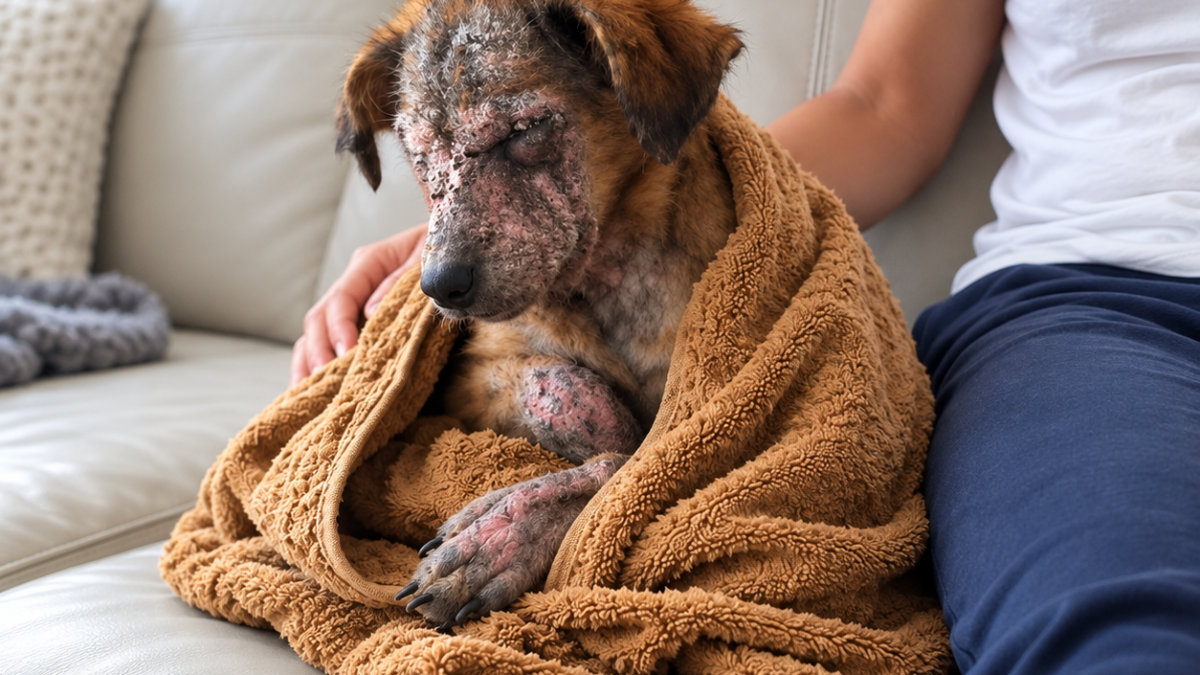
The first time I reached for Gracie, she pressed herself against the wall like my hand was the most dangerous thing in the world.
She was only a puppy, but someone had already taught her that being touched was something to fear.
What I didn’t know yet was that the house responsible for breaking her was only a few yards away—and there was another puppy inside.
I had been told there was a sick dog hiding behind an abandoned stack of boards at the edge of a property.
When I arrived, I almost missed her.
Gracie had made herself as small as possible beneath a sheet of rusted metal. Her ribs showed beneath her damaged skin. Parts of her body were nearly hairless, and the skin underneath was swollen, cracked, and angry red.
Her eyes were so puffy she could barely keep them open.
I crouched several feet away.
“Hey, sweetheart.”
She froze.
Not curious.
Not hopeful.
Frozen.
I slowly extended one hand.
Gracie scrambled backward so quickly that her weak legs slipped beneath her.
That reaction told me more than any explanation ever could.
I stopped moving.
“It’s okay,” I whispered. “I’m not going to hurt you.”
Of course, those words meant nothing to her.
Someone had probably spoken gently to her before doing things that frightened her. Trust wasn’t something Gracie could understand yet.
She had reportedly spent most of her short life confined inside a filthy cage. She had learned the smell of waste, the pressure of wire beneath her paws, hunger, thirst, and loneliness.
She had not learned what a gentle hand felt like.
For two days, people had seen her hiding near that spot.
Some left food.
Most kept their distance because of her skin.
Nobody knew whether what she had was contagious.
But I knew one thing.
If we left her there, she might not survive much longer.
Another rescuer named Rachel came beside me.
“We can’t chase her,” she whispered.
“I know.”
Gracie’s entire body trembled.
So we waited.
Ten minutes.
Twenty.
I placed a little food between us and backed away.
Eventually her nose moved.
One cautious step.
Then another.
She was starving badly enough to approach the very humans she feared.
That broke something in me.
When she finally came close enough, I gently wrapped a towel around her.
Gracie panicked.
She twisted, kicked, and tried desperately to escape.
“Easy, baby. Easy.”
I held her just firmly enough to keep her from falling.
Then something changed.
Her struggling stopped.
She stared up at me with those swollen eyes.
For one terrible second, I realized she wasn’t calming down because she trusted me.
She was surrendering.
She had simply run out of strength.
Inside the rescue vehicle, I made a bed from clean blankets.
Gracie curled into the smallest possible ball.
Within minutes, she was asleep.
Rachel touched my shoulder.
“Look at her.”
I did.
She was exhausted beyond anything a puppy should ever experience.
We had barely pulled away when I noticed a house beside the area where Gracie had been hiding.
A man stood near the doorway.
And beside him was a healthy-looking young puppy.
Something about the scene bothered me.
I rolled down the window.
“Do you know this dog?”
The man looked toward the bundle sleeping behind us.
His expression changed immediately.
“That ugly one?”
My stomach tightened.
Rachel turned toward him.
“She belongs to you?”
He shrugged.
“Used to.”
I climbed out.
“What do you mean, used to?”
He glanced at Gracie, then at the puppy near his feet.
“She got sick. I couldn’t do anything with her.”
“You took her to a veterinarian?”
He didn’t answer.
“Did you?”
His jaw tightened.
“I tried what I could.”
Behind me, Gracie slept beneath a clean blanket for perhaps the first time in her life.
I looked at the new puppy.
Then at the filthy cage visible through the partially open side gate.
And suddenly Gracie’s fear of my hands made horrifying sense.
Rachel quietly pulled out her phone.
I looked back at the man.
“You’re going to want to explain this very carefully.”
Because at that moment, rescuing Gracie was no longer the only thing we needed to do.
PART 2
The man’s expression changed the second he noticed Rachel holding her phone.
“What are you doing?”
“Documenting what we found,” she said.
“You can’t film my property.”
“We’re standing on the roadside.”
He took one step toward us.
The new puppy retreated behind his leg.
That tiny movement caught my attention.
The puppy wasn’t emaciated like Gracie.
His coat looked better.
His eyes were open and clear.
But his body language bothered me.
His tail had disappeared between his legs, and when the man moved his foot, the puppy flinched.
I had seen that reaction too many times.
I stepped between them without thinking.
“What’s his name?”
The man frowned.
“What?”
“The puppy.”
“Rocky.”
“How old?”
“Why does it matter?”
It mattered enormously.
Rachel lowered her phone slightly.
“Sir, we’re trying to understand what happened to Gracie.”
“Nothing happened to her. She got sick.”
“And then?”
“And then she ran off.”
I looked toward the rusted cage visible beyond the gate.
There was dried waste underneath it.
A metal food bowl lay upside down in one corner.
The enclosure was hardly large enough for a dog to turn around comfortably.
Gracie’s damaged paws, infected skin, and terrified reaction to human touch suddenly had context.
“She ran away from that cage?” I asked.
His eyes followed mine.
“It wasn’t always like that.”
I heard Rachel inhale beside me.
The man realized his mistake immediately.
“I mean, she wasn’t always in there.”
“But she was kept there.”
“Sometimes.”
“How often?”
He folded his arms.
“I don’t have to answer you.”
He was right about one thing.
He didn’t have to answer us.
But he would eventually have to answer someone.
I walked back toward the rescue vehicle.
“We’re leaving.”
Rachel followed.
The man laughed behind us.
“Good. Take her. I don’t want her.”
I stopped.
There are sentences you hear in rescue work that follow you home.
That was one of them.
I turned around.
Gracie was asleep less than twenty feet from the person who had once been responsible for feeding her, sheltering her, and getting her medical care.
He wasn’t asking whether she would live.
He wasn’t asking where we were taking her.
He wasn’t even looking toward the vehicle.
“You really don’t want to know if she’s going to survive?” I asked.
He shrugged.
“She’s your problem now.”
I stared at him.
Then I looked at Rocky.
“No,” I said quietly. “She’s not a problem.”
He rolled his eyes.
I got into the vehicle.
Rachel shut the passenger door.
Neither of us spoke for almost a mile.
Then she said, “We have to go back for that other puppy.”
“I know.”
“But we can’t just take him.”
“I know.”
She looked down at her phone.
“I got the cage. I got part of what he said. I got Gracie’s condition before we moved her.”
“Send everything to animal control.”
“Already doing it.”
I looked in the rearview mirror.
Gracie hadn’t moved.
The blanket rose and fell faintly with each breath.
“First we keep this one alive.”
The veterinary clinic was expecting us.
Still, when we carried Gracie through the door, the waiting room became quiet.
A veterinary technician named Emily met us with a stretcher.
“How long has she been like this?”
“We don’t know.”
Emily leaned closer.
“Oh, sweetheart.”
Gracie opened one swollen eye.
When Emily reached toward her, Gracie tried to pull away.
“Easy,” Emily whispered.
The veterinarian, Dr. Sarah Coleman, examined her immediately.
Gracie weighed far less than a puppy of her size should have.
Her gums were pale.
She was severely dehydrated.
Her skin was hot and inflamed.
There were open lesions beneath crusted patches along her neck, legs, chest, and belly.
Dr. Coleman gently lifted one of her paws.
Gracie whimpered.
“She’s painful everywhere.”
“Can she recover?” I asked.
Sarah didn’t answer immediately.
I hated that pause.
“We need bloodwork. Skin scrapings. Cultures. Fluids. Nutrition very carefully, because I don’t want to overload her system.”
“But can she recover?”
Sarah looked at me.
“I think she has a chance.”
A chance.
In rescue work, you learn to live inside words like that.
Not promises.
Not guarantees.
Chances.
We signed the paperwork.
Gracie was placed on intravenous fluids.
The technicians cleaned what they safely could without causing more pain.
They warmed her.
They gave medication for discomfort.
And then we waited for the first results.
The bloodwork confirmed severe malnutrition and dehydration.
Her immune system was depleted.
Her skin infection was far worse than we initially understood.
Dr. Coleman called me into a consultation room that evening.
She had photographs and laboratory results open on a computer.
“I’ve treated neglect cases,” she said. “I’ve treated severe skin infections. This is unusually advanced.”
“What caused it?”
“Probably several things working together. Poor hygiene. Prolonged confinement. Malnutrition. Untreated irritation. Secondary infection. We need additional testing before I’m comfortable naming the exact organism.”
I stared at Gracie’s photograph on the screen.
“Could the cage have caused this?”
“It could absolutely have contributed to it.”
My phone buzzed.
Rachel.
ANIMAL CONTROL IS GOING TO THE PROPERTY.
I showed Sarah.
She nodded.
“Good.”
Then another message appeared.
THEY WANT OUR PHOTOS AND VET REPORT.
Sarah turned back toward the computer.
“They’ll have them.”
For the next several hours, Gracie slept.
Every time someone entered the treatment area, she woke abruptly.
She would raise her head, watch the approaching hands, and stiffen.
Emily discovered that if she sat beside Gracie without touching her, Gracie eventually relaxed.
So that was what we did.
We stopped insisting that affection happen on our schedule.
We sat.
We talked softly.
We let her smell our fingers.
If she moved away, we allowed her to move away.
That first night, I sat on the floor beside her kennel while the clinic staff prepared to close.
“You don’t know me,” I told her.
Her eyes remained half shut.
“And you have absolutely no reason to trust me.”
One ear twitched.
“But nobody gets to throw you away again.”
I don’t know whether dogs understand promises.
Maybe they understand tone.
Maybe warmth.
Maybe consistency.
Gracie lowered her head and slept.
At 8:16 the next morning, Rachel called me.
“They got Rocky.”
I stood so quickly that my chair scraped backward.
“What?”
“Animal control removed him last night.”
“Is he okay?”
“He’s at the county facility being examined.”
I closed my eyes.
“Thank God.”
“There’s more.”
Her voice sounded strange.
“What?”
“They found records.”
“What kind of records?”
“I don’t know yet. But apparently the owner told the officer Gracie was never his dog.”
I almost laughed from disbelief.
“He called her his yesterday.”
“I know.”
“We have it recorded.”
“I know.”
“He said she used to be his.”
“I know.”
I sat back down.
Rachel continued.
“The officer also photographed the cage.”
“Good.”
“They’re opening a formal cruelty and neglect investigation.”
That word—investigation—didn’t heal Gracie.
It didn’t put weight back on her ribs.
It didn’t erase whatever had happened inside that cage.
But it mattered.
Because for once, someone was going to ask questions on her behalf.
Two days passed.
Gracie remained hospitalized.
She ate tiny meals.
At first she would only eat if we moved several feet away.
If a hand came too close to the bowl, she stopped.
By the third day, she allowed Emily to place the dish beside her without retreating.
“That’s progress,” Emily said.
It seemed absurd to celebrate something so small.
We celebrated anyway.
Then the culture results came back.
Sarah called Rachel and me into the same consultation room.
“The infection is treatable,” she said.
Relief surged through me.
Then I saw her expression.
“But?”
“The medication I want is difficult to obtain here. I’ve contacted a supplier. We may need to order it internationally.”
“How long?”
“Hopefully several days.”
“And until then?”
“We support her. Keep her hydrated. Keep her clean. Control secondary infection. Feed her carefully. Protect the damaged skin.”
“How much will it cost?”
Sarah looked at us.
Rachel asked, “How much?”
Sarah gave us the number.
Rachel blew out a breath.
I stared at the floor.
Our rescue operated on donations, foster homes, and people who regularly spent money they did not have because an animal needed something immediately.
“We’ll find it,” I said.
Sarah nodded.
“I knew you were going to say that.”
That afternoon I held Gracie for the first time without restraining her.
I didn’t plan to.
Emily was changing the blanket beneath her when Gracie became frightened.
She scrambled toward the edge of the examination table.
I instinctively placed my arms around her to prevent her from falling.
Her entire body stiffened.
I expected her to fight.
Instead, she froze against my chest.
I could feel her heart racing.
“It’s okay.”
She stared at my face.
My arms were loose.
She could move if she wanted.
Ten seconds passed.
Twenty.
Then Gracie slowly lowered her chin onto my forearm.
I didn’t breathe.
Emily stood across from me with tears in her eyes.
“Did she just—”
“I think so.”
Gracie stayed there for almost a minute.
Then she pulled away.
I let her.
That was the beginning.
Not some magical moment where all her fear vanished.
Healing doesn’t work like that.
The next morning she flinched again.
That afternoon she hid from a towel.
Two days later, a stainless-steel bowl falling in the treatment room frightened her so badly that she trembled for twenty minutes.
Trauma did not leave in a straight line.
But neither did we.
When her medication finally arrived, Sarah started treatment immediately.
Within a week, we saw the first subtle changes.
The swelling around Gracie’s eyes decreased.
She began opening them fully.
For the first time, I realized they were brown.
Warm, enormous brown eyes.
Her skin was still terrible.
She was still thin.
But now, when Rachel entered the room, Gracie’s tail moved once against the blanket.
Rachel stopped in the doorway.
“Did you see that?”
“I saw it.”
“Do it again, Gracie.”
Gracie stared at her.
Rachel took another step.
The tail moved again.
Rachel put both hands over her mouth.
“We have a tail wag.”
I laughed.
It sounds ridiculous until you’ve met an animal who has forgotten she is allowed to be happy.
Then a tail wag feels like a miracle.
Rocky remained in county custody.
His veterinary examination showed he was in better physical condition than Gracie, but animal control would not return him while the investigation continued.
A foster family connected with another rescue agreed to take him once he was released.
That mattered to me almost as much as Gracie’s progress.
Because the first night after seeing him beside that cage, I had dreamed that we were too late.
We weren’t.
A week later, the investigating officer, Maria Hernandez, visited our rescue.
She carried a folder.
“I need statements from both of you.”
Rachel and I sat with her for nearly two hours.
We described where Gracie had been found.
Her physical condition.
The conversation with the owner.
The cage.
Rocky.
The exact words we remembered.
Maria listened without reacting.
Then Rachel played the recording.
The man’s voice came through clearly.
“That ugly one?”
Then:
“Used to.”
And later:
“She got sick. I couldn’t do anything with her.”
Maria stopped the recording.
“He told me she was a stray.”
I stared at her.
“You’re serious?”
“He said he had occasionally fed her but never owned her.”
Rachel leaned back.
“Well, that’s going to be difficult for him.”
Maria looked at the phone.
“Very.”
She opened the folder.
“We also found photographs on an older phone surrendered during the investigation.”
My stomach tightened.
“What photographs?”
“Gracie in the cage.”
I didn’t want to see them.
Then I did.
I needed to.
Maria slid copies across the table.
The first showed Gracie months younger.
Her coat was fuller.
She was standing behind wire.
The second photograph had been taken later.
Her skin was already deteriorating.
The third showed the same cage positioned exactly where we had seen it.
There was a date stamp.
Weeks before Gracie was found.
“She was sick for a long time,” Rachel whispered.
Maria nodded.
“Long enough that it would have been obvious.”
“What did he say?”
“That he tried home treatments.”
“Did he take her to a vet?”
“We have not found evidence that he did.”
I looked at the photographs again.
In one, Gracie was staring directly at the camera.
Someone had stood in front of that cage, lifted a phone, taken a picture, and walked away.
No veterinarian.
No medicine.
No clean bedding.
Just a photograph.
Something hot moved through my chest.
Not rage exactly.
Rage burns fast.
This was colder.
“What happens now?”
Maria closed the folder.
“That depends on the prosecutor and the evidence. I can’t promise an outcome.”
“But there will be a case?”
“Yes.”
“Against him?”
“Yes.”
Rachel asked, “And Rocky?”
“Rocky will not be returned while the case is pending.”
I nodded.
Maria gathered the photographs.
Before leaving, she looked through the glass window into the recovery room.
Gracie was asleep on a folded blanket.
“That’s her?”
“That’s her.”
Maria watched for several seconds.
“She looks different from the intake photo.”
“She’s getting there.”
“I hope she keeps going.”
“So do I.”
By the second week of treatment, Gracie was well enough to leave the clinic and come into foster care.
I volunteered before anyone else could.
Rachel laughed.
“You’ve already decided, haven’t you?”
“I have a spare room.”
“You said that about the last three fosters.”
“They got adopted.”
“One slept in your bed for six months.”
“That is irrelevant.”
Rachel smiled.
“You’re taking Gracie home.”
“Yes.”
The first thing Gracie did when she entered my house was freeze.
The living room was too big.
That was something I had never considered.
We think of open space as freedom.
To Gracie, it was unfamiliar.
Her whole world had once been measured in inches of wire.
Now there were doorways in three directions.
A hallway.
Windows.
A couch.
A rug.
A kitchen.
She stood with all four paws planted near the front door.
I sat on the floor.
“You don’t have to explore.”
She looked at me.
My older rescue dog, Ben, watched from behind a baby gate.
Ben was twelve, gray around the muzzle, and profoundly unimpressed by almost everything.
He sniffed once.
Gracie sniffed back.
Then she took one step.
I didn’t react.
Another.
She reached the rug.
Stopped.
Sniffed it.
Then backed up.
For the first night, I kept her world small.
A clean room.
Soft blankets.
Water.
Food.
A crate with the door permanently tied open so she would never feel trapped by it.
I put a mattress on the floor several feet away.
At midnight, I woke to a faint sound.
Gracie was standing over me.
I stayed still.
She sniffed my hair.
My ear.
My hand.
Then she hurried back to her bed.
I smiled into the darkness.
At three in the morning she did it again.
At five, she came close enough for her nose to touch my cheek.
She retreated instantly.
By sunrise, I understood what she had been doing.
She was studying me while I was harmless.
While I was asleep.
While my hands weren’t reaching for her.
She was learning what kind of human I was.
The hardest part was bathing her.
Her skin required medicated washes.
The first time I carried her toward the bathroom, she smelled the water and panicked.
Her claws scraped against the floor.
She twisted in my arms.
I immediately put her down.
“All right. Not like that.”
I called Sarah.
“She’s terrified.”
“I expected she might be.”
“How do I do this without making everything worse?”
“Slowly. Make the bathroom boring first.”
So for two days, we didn’t bathe her.
We simply visited the bathroom.
I scattered treats on the floor.
Ben wandered in, drank water, wandered out.
I sat beside the empty bathtub and read emails.
Gracie watched.
The next day, I put an inch of lukewarm water in the tub while she remained in the hallway.
Then turned it off.
No bath.
No grabbing.
Nothing happened.
On the third day, she stepped into the bathroom voluntarily.
On the fourth, she let me wet one paw.
On the fifth, we managed the first full treatment.
She shook the entire time.
I kept one hand beneath her chest.
“I know,” I whispered. “I know you hate this.”
She looked at me.
“But I’m not leaving you in here. And I’m not hurting you.”
Afterward, I wrapped her in the biggest towel I owned.
For several seconds she stayed rigid.
Then she leaned into me.
That became our routine.
Fear.
Patience.
Treatment.
Towel.
Trust.
Her skin improved steadily.
Tiny patches of new fur appeared along her shoulders.
She gained weight.
Her appetite became almost comical.
The puppy who once approached food as though someone might snatch it away began waiting in the kitchen at exactly 6:30 each morning.
If breakfast was late, she stared at me with unmistakable disappointment.
“You have become demanding,” I told her one morning.
Her tail wagged.
Ben looked at me as though this had clearly been my fault.
A friend from the rescue named Janet heard that Gracie still slept on folded blankets because every enclosed bed made her nervous.
Three days later, Janet arrived carrying a large rectangular dog bed.
Nothing fancy.
Thick padding.
Soft fabric.
Low edges.
“What is that?” I asked.
“Gracie’s first real bed.”
“We have blankets.”
“That child has never owned anything.”
The word stopped me.
Owned.
It was true.
Gracie had never had a thing that belonged only to her.
No toy.
No blanket.
No collar chosen with love.
No bed.
Janet placed it in the living room.
Gracie approached cautiously.
She sniffed one corner.
Then another.
Put one paw onto the cushion.
Pulled it back.
Ben walked over, stepped directly onto the bed, turned twice, and sat.
“Benjamin,” I said.
Gracie stared at him.
Ben yawned.
Then he climbed off.
Gracie tried again.
One paw.
Two.
All four.
The cushion compressed beneath her.
Her eyes widened.
She walked in a tiny circle.
Then another.
And suddenly, as if something inside her exploded, she began bouncing.
She jumped onto the bed.
Off.
Back on.
She attacked one corner with her front paws.
Rolled onto her back.
Kicked all four legs in the air.
Janet started laughing.
I was laughing too.
Gracie grabbed the edge, dragged the entire bed two feet across the floor, leaped into it again, and rolled.
“This might be the happiest anyone has ever been about upholstery,” Janet said.
Then Gracie stopped.
She settled into the middle.
Placed her chin on the raised edge.
And looked at us.
The room became quiet.
Janet wiped her eyes.
“She knows.”
I sat beside the bed.
“Yeah.”
Gracie reached one paw toward me.
I placed my hand beside it.
She didn’t pull away.
“She knows.”
The court case moved more slowly than her recovery.
That was difficult.
Every week, I wanted something decisive to happen.
Every week, Maria reminded me that evidence had to be collected properly.
Veterinary records.
Photographs.
Statements.
Ownership documentation.
Witness interviews.
The recording.
The condition of the cage.
The timeline.
The defense attorney eventually claimed the man had tried to care for Gracie but lacked money for specialized treatment.
That argument made me furious because there were pieces of truth inside it.
Gracie’s medication had been expensive.
Specialized veterinary treatment can be financially devastating.
I knew that.
Our rescue knew that.
Sarah knew that.
But lack of money did not explain leaving her untreated in filth.
It did not explain severe dehydration.
It did not explain malnutrition.
It did not explain failing to surrender her to a rescue, shelter, veterinarian, or animal control agency.
It certainly did not explain replacing her with another puppy while she hid sick and starving beside the property.
When Maria told me about the defense, I said exactly that.
She nodded.
“So did the prosecutor.”
Three months after Gracie came home with me, a hearing was scheduled.
By then she looked like a different dog.
Her fur had returned across most of her body.
She had gained healthy weight.
The swelling around her eyes was gone.
She played.
Actually played.
Her favorite toy was a ridiculous yellow stuffed duck Janet had bought her.
The first time it squeaked, Gracie jumped backward.
The second time, she stared at it.
By the tenth time, she had decided the duck was her sworn enemy.
She carried it from room to room.
She slept beside it.
She shook it violently whenever dinner was late.
The night before the hearing, I sat on my living-room floor with court documents around me.
Gracie dropped the duck on top of them.
“Not now.”
She picked it up.
Dropped it again.
“Gracie.”
She wagged.
I looked at her.
There was fur where infected skin had once cracked open.
There was weight on the body I had once been afraid to hold too tightly.
Most importantly, there was expectation in her eyes.
She expected me to throw the duck.
That simple assumption—that a human might do something fun—felt enormous.
I picked it up.
“One throw.”
I tossed it down the hallway.
Gracie flew after it.
Ben lifted his head from the couch and watched her race back.
I threw it again.
And again.
The paperwork could wait five minutes.
The hearing could wait until morning.
Gracie had spent enough of her life waiting.
The courthouse was smaller than I expected.
Animal neglect cases rarely look dramatic from the outside.
No television cameras.
No huge crowd.
No grand courtroom speeches.
Just fluorescent hallways, hard benches, lawyers carrying folders, and people waiting for their names to be called.
Rachel sat beside me.
Maria was farther down the hall.
Sarah had provided a veterinary statement and photographs.
The prosecutor came over before the hearing.
“He may enter an agreement today.”
“What kind?”
“I can’t discuss final terms until they’re placed on the record.”
“Will he get Gracie back?”
“No.”
“Rocky?”
“No.”
Those two answers were enough to let me breathe.
The man arrived ten minutes later.
I hadn’t seen him since the day we found Gracie.
He recognized me immediately.
His expression hardened.
I said nothing.
Neither did he.
His attorney leaned toward him and whispered something.
For the first time, I noticed how ordinary he looked.
That disturbed me more than if he had looked monstrous.
Cruelty doesn’t always arrive wearing a recognizable face.
Sometimes it looks like somebody you pass at a grocery store.
Sometimes it says it was busy.
Or broke.
Or didn’t know.
Sometimes it simply decides suffering is inconvenient.
When the hearing began, I listened as the prosecutor summarized the evidence.
Severe malnutrition.
Dehydration.
Advanced untreated dermatological infection.
Unsanitary confinement.
Failure to obtain necessary care.
The photographs.
The cage.
The recorded statements.
The second puppy.
Then the defense spoke.
Financial hardship.
Attempted home treatment.
Lack of intent.
The man’s attorney said his client had not meant for Gracie to suffer.
I stared at the table.
Intent.
I thought of Gracie crawling backward from my hand.
Maybe nobody had woken up one morning and consciously decided to teach her terror.
Maybe suffering had simply been allowed to continue day after day because stopping it required effort.
Was that supposed to make it better?
Then the judge addressed him directly.
“You acquired another puppy while this dog required medical treatment?”
Silence.
His attorney whispered.
“Yes, Your Honor.”
“And you did not surrender the first animal to a shelter or rescue?”
“No.”
“Did you contact animal control?”
“No.”
“A veterinarian?”
“I called somewhere.”
“Do you have records of that call?”
“No.”
The judge looked down at the file.
“The veterinary evidence indicates this condition developed over a substantial period.”
The man shifted.
“I tried creams.”
“Were they prescribed?”
“No.”
“Did you continue to confine the dog while her condition worsened?”
His attorney stood.
“Your Honor—”
The judge raised a hand.
“I asked the defendant.”
A pause.
“Yes.”
Rachel’s fingers closed around mine.
The word settled through the courtroom.
Yes.
It wasn’t revenge.
Not in the way movies show it.
There was no dramatic shout.
No sudden confession.
No perfect punishment capable of returning Gracie’s lost months.
There was only the truth becoming part of the official record.
And somehow that mattered more.
Under the agreement accepted by the court, Gracie and Rocky were permanently surrendered.
The man lost any claim to either animal.
He was ordered to pay restitution toward veterinary and care costs, received penalties under the applicable animal cruelty and neglect provisions, and was prohibited from keeping dogs for a period determined by the court.
Animal control would be permitted to enforce those restrictions.
There were additional conditions.
Compliance.
Inspections where legally permitted.
Court supervision.
The exact language sounded dry when the clerk read it.
But I heard something else.
No more cage for Gracie.
No return for Rocky.
No pretending nothing had happened.
After the hearing, the man passed me in the hallway.
For a moment, I thought he would keep walking.
Instead, he stopped.
“You got what you wanted.”
I looked at him.
“No.”
His face tightened.
“You people wanted to punish me.”
“I wanted Gracie to be safe.”
“She was just a dog.”
Rachel turned sharply.
I touched her arm.
Then I looked at him.
“She was your dog.”
He said nothing.
“She was hungry while you had food. She was sick while you had a phone. She was trapped while help existed ten minutes away. And when she became inconvenient, you replaced her.”
His jaw moved.
“I told you, I couldn’t afford all that treatment.”
“Then you surrender her.”
He looked away.
“You ask for help. You call a shelter. You call a rescue. You walk into a clinic and explain that you cannot pay. You do anything except leave a sick puppy to disappear beside your house.”
He stared at me.
I thought I would feel triumph.
I didn’t.
I felt tired.
“You called her ugly,” I said.
He didn’t answer.
“You should see her now.”
Then I walked away.
That was all the revenge I needed.
Not because Gracie had become beautiful.
She had always mattered, even when she was hairless, swollen, frightened, and sick.
But because the puppy he discarded had survived long enough for the world to disagree with him.
Rocky went to foster care that same week.
I visited him once.
He was living with a couple named Denise and Aaron, who had a fenced backyard and a black Labrador named Moose.
Rocky ran toward me carrying a red rubber ball.
“You remember me?” I asked.
Probably not.
That was fine.
Some memories deserve to fade.
Denise told me he slept beside Moose every night.
He had learned stairs.
He stole socks.
He was terrified of the vacuum cleaner.
He adored cheese.
Normal puppy things.
Beautifully ordinary things.
“What happens now?” I asked.
Denise smiled.
“We’re adopting him.”
I laughed.
“You were supposed to foster.”
“So were you.”
I had no response to that.
Gracie’s adoption status was becoming the elephant in every room.
Technically, she was still my foster.
Technically.
Rachel reminded me constantly.
“You know she needs an adoption profile.”
“I’m working on it.”
“For three weeks?”
“She has special requirements.”
“What requirements?”
“Patience.”
“All rescue dogs need patience.”
“She needs a quiet house.”
“You have a quiet house.”
“No small children rushing at her.”
“You don’t have children.”
“A calm older dog might help.”
Rachel stared at me.
Ben was sleeping under my desk.
“You’re ridiculous.”
“I am being responsible.”
“You bought her a pink collar with her name embroidered on it.”
“That was medically necessary.”
Rachel laughed so loudly Gracie came running from the next room.
I knelt and Gracie immediately pressed her head beneath my hand.
That was new.
She asked for affection now.
Not constantly.
Not from everyone.
But from me.
Sometimes I would be washing dishes and feel her nose under my fingers.
Sometimes she climbed beside me on the couch and leaned against my hip.
The same puppy who once treated human hands like weapons now nudged them when they stopped petting her.
I had waited months for that.
Then the adoption application arrived.
Not mine.
A woman named Claire had seen Gracie through our rescue’s page and asked to meet her.
I hated Claire immediately.
That wasn’t fair.
I knew it wasn’t fair.
Her application was excellent.
She owned her home.
Had a fenced yard.
Worked partly from home.
Had veterinary references.
No young children.
One older, gentle dog.
She had previously adopted a fearful rescue and had experience with medical rehabilitation.
Perfect.
I disliked her more with every line.
Rachel read the application across from me.
“This is a fantastic home.”
“I suppose.”
“You suppose?”
“She lives forty minutes away.”
“So?”
“That’s far.”
Rachel stared at me.
“Forty minutes.”
“Traffic can make it an hour.”
“Do you hear yourself?”
I took the papers.
“I’m just saying we should be cautious.”
“We will be.”
Gracie slept at my feet.
I looked down.
Fostering has one cruel rule.
If you do it right, goodbye is success.
You take a broken animal into your home.
You teach them that the world can be safe.
You watch them become part of your routine.
Then someone wonderful appears.
And you hand them over.
Every successful adoption leaves an empty space.
I knew that when I brought Gracie home.
Knowing didn’t make it easier.
Claire arrived the following Saturday.
Gracie hid behind me.
Good, I thought.
Then immediately felt guilty.
Claire did everything right.
She didn’t reach.
Didn’t stare.
Didn’t crouch over Gracie.
She sat sideways on the floor and talked to me.
For twenty minutes, she ignored Gracie completely.
Eventually Gracie approached.
Sniffed Claire’s shoe.
Retreated.
Returned.
Claire kept talking.
“She doesn’t like strangers pushing into her space,” I said.
“I wouldn’t either.”
Gracie sniffed her hand.
Claire still didn’t move.
Then Gracie touched her nose to Claire’s fingers.
My chest tightened.
Traitor.
Claire smiled but kept her hand still.
“Hi, Gracie.”
Gracie stayed.
We introduced Claire’s dog, Maggie, outside.
Maggie was nine years old and moved with the calm confidence of a dog who had never had much reason to fear anything.
Gracie circled.
Maggie sniffed grass.
Gracie approached.
Maggie sniffed Gracie.
Then walked away.
Perfect.
By the end of the visit, Gracie was following Claire into the kitchen.
That night I sat on my couch while Gracie slept against my leg.
The application rested on the coffee table.
Everything told me Claire was right for her.
That should have made me happy.
Instead, I cried.
Quietly at first.
Then not quietly.
Ben lifted his head.
Gracie woke.
She stared at me.
“Sorry.”
She stood.
Turned once.
Then climbed partially into my lap.
She had never done that.
Her body was larger now, heavier, healthy.
She rested her head against my chest.
I wrapped my arms around her.
She did not flinch.
That nearly destroyed me.
“Do you know what you’re doing?”
Her tail tapped once.
“You’re making this impossible.”
She sighed.
I remembered the first time I held her.
The rigid body.
The racing heart.
The surrender.
Now she was asleep in my arms because she had chosen to be there.
I sat with her for nearly an hour.
Then I looked at Claire’s application again.
I knew what I had to do.
The next morning, I called Rachel.
“I made a decision.”
“I know.”
“You do not.”
“You’re adopting her.”
I paused.
“How did you know?”
“You changed her microchip contact information yesterday.”
“That was administrative.”
“You ordered a tag that says ‘If found, call Mom.’”
I looked toward Gracie.
“That proves nothing.”
Rachel laughed.
Then her voice softened.
“Are you sure?”
I looked around my house.
At the yellow duck beside the sofa.
The bed Janet had given her.
The medicated shampoo in the bathroom.
The tiny scratches near the hallway where she once slipped while learning to run on hardwood.
At Ben, who now allowed Gracie to sleep with one paw draped over his back.
Then at Gracie.
“Yes.”
“What about Claire?”
“She deserves the truth.”
Claire answered on the second ring.
I felt terrible.
“I need to apologize.”
“Oh no.”
“What?”
“You’re keeping her.”
I blinked.
“How does everyone know?”
Claire laughed.
“Because I watched you watch her.”
“I’m sorry.”
“Don’t be.”
“You would have given her an incredible home.”
“I know.”
I laughed despite myself.
“You’re very modest.”
“I also knew within ten minutes she already had one.”
That stopped me.
Claire continued.
“I didn’t apply because I needed that exact dog. I applied because I had space for a dog who needed me.”
“We have others.”
“I was hoping you’d say that.”
Three weeks later, Claire adopted another dog from our rescue.
A terrified two-year-old hound mix named Rosie who had spent four months being overlooked.
Sometimes a door closing for one animal opens for another.
Gracie became mine officially on a Tuesday afternoon.
There was no ceremony.
Just paperwork.
Signatures.
A microchip update.
Rachel took a photograph of me kneeling beside Gracie.
“What should I put as her adoption date?”
I looked at the calendar.
“Today.”
Rachel wrote it down.
I looked at Gracie.
“No.”
“What?”
“Put the day we found her.”
“That wasn’t technically her adoption.”
“I know.”
Rachel smiled.
She understood.
Because in my heart, the moment I wrapped that towel around Gracie’s frightened body and promised nobody would throw her away again, some part of me had already chosen her.
But there was one thing Gracie still had never done.
Walked through the world.
Not really.
She had been outside before, of course.
But surviving beside a road was not the same as exploring.
For months we had kept her outings controlled because of her health.
Backyard.
Veterinary clinic.
Short quiet paths.
Once her skin had healed completely and Sarah gave us clearance, I bought Gracie a proper harness.
Bright red.
Ben came too.
Our first real walk was at a quiet park just after sunrise.
Gracie stepped out of the car and froze.
I remembered the first day in my living room.
Too much space.
The sky seemed enormous.
Birds moved through the trees.
A bicycle passed far away.
Leaves rustled.
Someone jogged along another path.
Gracie’s nose worked furiously.
I waited.
Ben walked forward three feet.
Looked back.
Gracie followed him.
One step.
Then another.
She sniffed grass.
Not the small patch behind my house.
An entire field.
Her tail rose.
We reached a tree.
She smelled the trunk for nearly a minute.
“Important information?” I asked.
Ben had already moved on.
Gracie hurried after him.
The leash loosened.
Then she saw a butterfly.
She jumped backward.
The butterfly moved.
Gracie followed it.
I started laughing.
She bounced through the grass like she had only just discovered her legs.
The butterfly escaped.
Gracie stood staring after it.
Then looked at me.
Her mouth was open.
Her tongue hung sideways.
Her eyes were bright.
She looked happy.
Not merely safe.
Happy.
There is a difference.
Safety is the absence of danger.
Happiness is wanting to stay.
We walked almost half a mile that morning.
Gracie investigated every tree.
Every bench.
Every strange smell.
When a man approached from the opposite direction, she moved close to my leg.
I shortened the leash.
“You’re okay.”
The man noticed her uncertainty and gave us space.
Gracie watched him pass.
Then continued walking.
That was healing too.
Not never being afraid.
Learning that fear no longer controlled what happened next.
A month later, Gracie encountered the duck.
Not her stuffed duck.
A real one.
It happened at home.
My backyard bordered a drainage pond, and occasionally ducks wandered through the fence opening near the far corner.
I was drinking coffee on the patio when Gracie suddenly froze.
Her yellow stuffed duck was lying beside her.
Twenty feet away stood an actual mallard.
Gracie looked at the mallard.
Then at the stuffed duck.
Then back at the mallard.
I could practically see the confusion.
The mallard quacked.
Gracie jumped.
The duck waddled away.
Gracie followed.
“Gracie.”
She increased speed.
“Gracie.”
The duck started running.
So did Gracie.
I abandoned my coffee.
“GRACIE.”
The mallard flapped across the yard.
Gracie bounced behind it, tail spinning like a helicopter.
No aggression.
Pure astonished excitement.
The duck lifted over the fence and landed safely at the pond.
Gracie skidded to a stop.
She stared after it.
Then ran back toward me.
Her expression seemed personally offended by the laws of flight.
“You cannot chase wildlife.”
She wagged.
“That was not permission.”
She picked up her stuffed duck.
I laughed so hard I had to sit down.
That afternoon, Rachel came over.
I told her what happened.
She looked at Gracie.
“So the former cage prisoner is terrorizing local waterfowl now.”
“Apparently.”
“Recovery confirmed.”
Gracie dropped the stuffed duck at her feet.
Rachel threw it.
Gracie raced away.
There were still difficult moments.
Healing did not erase everything.
Unexpected shouting frightened her.
Metal clanging against metal could send her running toward her bed.
For almost a year, she refused to enter any wire crate even when the door was open.
We never forced her.
Why would we?
She had already spent enough time proving she could survive confinement.
She didn’t need to prove it again.
One evening, about eleven months after her rescue, a thunderstorm rolled through.
Gracie hated thunderstorms.
The first crack of thunder sent her beneath the dining table.
I sat on the floor nearby.
“You want company?”
She watched me.
Another boom rattled the windows.
Gracie crawled out.
She came directly into my arms.
I held her.
Her body trembled.
But she stayed.
That was the moment I finally understood how far she had traveled.
The puppy I met beneath rusted metal believed human hands predicted pain.
The dog in my arms now ran toward those same hands when the world became frightening.
You cannot demand trust like that.
You earn it in thousands of ordinary moments.
By putting down the food and not taking it away.
By touching gently.
By stopping when fear says stop.
By coming back tomorrow.
By keeping promises nobody else kept.
By being predictable long enough for an animal to realize kindness is not a trick.
A few weeks before the first anniversary of Gracie’s rescue, Maria called me.
I hadn’t spoken to her in months.
“How’s our girl?”
I smiled.
“Currently asleep upside down on my couch.”
“That sounds serious.”
“Terrible condition.”
Maria laughed.
Then she told me the final compliance review in the former owner’s case had been completed.
The court restrictions remained in effect.
Rocky’s adoption was permanent.
There had been no attempt to reclaim either dog.
The required payments were being enforced through the court process.
“And there’s one more thing,” Maria said.
“What?”
“Someone reported that he was trying to acquire another puppy through a local seller.”
My stomach dropped.
“Did he?”
“No.”
“What happened?”
“The seller checked his information after hearing about the court restriction and called us.”
I closed my eyes.
“Good.”
“He was reminded of the order.”
“So no puppy.”
“No puppy.”
I looked toward Gracie.
She was stretched across two couch cushions, her head hanging upside down, one ear folded backward.
A ridiculous, safe, deeply loved creature.
Maria continued.
“That’s why documentation matters.”
“I know.”
“The case didn’t only affect Gracie.”
I thought about Rocky.
Then about a puppy that had never entered that house because someone asked one extra question.
“You’re right.”
After we hung up, I sat beside Gracie.
She opened one eye.
“You did that.”
Her tail thumped.
“You and Rocky.”
Another thump.
“You made somebody pay attention.”
Gracie rolled over and put one paw on my leg.
The anniversary arrived on a warm Saturday.
Rachel wanted a party.
I said that was excessive.
Rachel ignored me.
By noon, my backyard contained six rescue volunteers, Sarah from the veterinary clinic, Emily, Janet, Maria, Claire and Rosie, Denise and Aaron with Rocky, plus enough dog treats to feed a small army.
When Rocky entered the yard, Gracie stared at him.
They had not seen each other since their rescue.
I wondered whether they would remember.
Rocky approached slowly.
Gracie sniffed his face.
Rocky sniffed hers.
For several seconds nothing happened.
Then Gracie bowed.
Front legs down.
Rear end up.
Tail flying.
Rocky exploded into motion.
They ran.
Around the table.
Past the chairs.
Across the grass.
Ben, now thirteen and much too dignified for such nonsense, watched from his bed on the patio.
Everyone laughed.
I didn’t.
I couldn’t.
I was crying too hard.
Sarah stood beside me.
“Look at them.”
“I know.”
“When she came into the clinic, I wasn’t sure we’d get this.”
“Neither was I.”
Gracie raced past us.
Her coat shone in the sunlight.
No open wounds.
No swollen eyes.
No bones visible beneath infected skin.
Rocky chased her.
They disappeared around the corner of the house.
A second later, Gracie returned carrying her yellow duck.
Of course.
Rachel raised her glass.
“I prepared a speech.”
“No.”
“Yes.”
“Absolutely not.”
Everyone became quiet anyway.
Rachel smiled at me.
“Fine. One sentence.”
“That is already too many.”
She looked toward Gracie.
“Here’s to the puppy nobody wanted becoming the dog none of us can imagine losing.”
Nobody spoke for a moment.
Then Janet sniffed loudly.
“I hate all of you.”
We laughed.
I crouched.
“Gracie.”
She came running.
No hesitation.
No fear.
Straight toward me.
She dropped the duck.
I picked it up.
For one second I saw both versions of her.
The puppy beneath the rusted metal.
And the dog standing before me.
I remembered the first time my hand moved toward her.
How desperately she tried to escape.
Now she shoved her nose beneath that same hand.
Impatient.
Confident.
Loved.
I scratched behind her ears.
“You ready?”
Her entire body wiggled.
I threw the duck across the yard.
She raced after it.
Rocky followed.
The people who had helped save her cheered.
And watching her run, I realized the ending I once wanted for Gracie had been too small.
At first, I only wanted her to survive.
Then I wanted her healthy.
Then safe.
Then adopted.
But Gracie had gone further than survival.
She had become mischievous.
Demanding.
Affectionate.
Curious.
She stole Ben’s bed even though she had her own.
She barked at delivery boxes.
She chased butterflies.
She carried her stuffed duck everywhere.
She woke me at six-thirty every morning because breakfast was apparently a constitutional right.
She had opinions now.
Preferences.
Expectations.
She had a life.
That was the victory.
Not that the man who neglected her faced consequences.
Those consequences mattered.
They protected Rocky.
They helped protect another puppy who never crossed his doorway.
They put the truth into a record he could no longer erase.
But punishment was never the most important part of Gracie’s story.
Her life afterward was.
Because the greatest answer to someone who treated her as worthless was not anger.
It was giving her everything his cruelty had tried to convince her she did not deserve.
Medical care.
A clean bed.
Food every morning.
A yard to run through.
Toys scattered across the floor.
A brother who tolerated her stealing his sleeping spot.
Friends who celebrated the smallest pieces of progress.
A veterinarian who fought for her.
Rescuers who refused to give up.
And a home where nobody cared whether her fur was perfect.
That night, after everyone left, I found Gracie asleep in the bed Janet had given her during those first weeks.
She had grown since then, so she barely fit anymore.
Her yellow duck was tucked beneath her chin.
I sat on the floor beside her.
Gracie opened her eyes.
For a few seconds we simply looked at each other.
“You know something?”
Her tail moved once.
“The first time I saw you, I thought I was rescuing you.”
She blinked sleepily.
I smiled.
“I didn’t know you were going to change my whole house.”
Another tail thump.
“My schedule.”
Thump.
“My furniture.”
Nothing.
“Especially my furniture.”
Her eyes closed.
I rested my hand on her side.
Under my palm was warm fur.
Healthy skin.
A strong heartbeat.
There had been a time when touching her made her shake.
Now my hand rested there while she slept.
No fear.
No waiting for kindness to become pain.
No cage waiting when she woke.
Just home.
And maybe that is the part of Gracie’s story I will remember longest.
Not the terrible condition she was in when we found her.
Not the man who called her ugly.
Not the courtroom.
Not even the moment she finally learned how to play.
I will remember an ordinary night in an ordinary living room, one year after a frightened puppy tried desperately to escape my hands.
I will remember sitting beside her bed while she slept so deeply that her paws twitched as she dreamed.
I will remember realizing that somewhere between the veterinary treatments, the medicated baths, the sleepless nights, the court hearings, the first tail wag, the first toy, the first walk, and the first time she chose to climb into my arms, Gracie had stopped expecting the world to hurt her.
She finally believed she was staying.
She finally believed the food would still be there tomorrow.
She finally believed a raised hand might hold a toy instead of bringing fear.
She finally believed a human could reach toward her simply because they loved her.
And the puppy who had once spent her whole life trapped behind filthy wire now had an entire world waiting outside the door.
Every morning, Gracie ran into it.
And every night, she came home.
The morning after Gracie’s rescue anniversary, I woke up before the alarm.
For once, she didn’t.
Sunlight was just beginning to creep through the curtains when I rolled over and saw her stretched across the rug beside my bed, completely upside down, all four paws pointing toward the ceiling.
Her yellow duck was trapped beneath one front leg.
I stayed there for a moment and watched her breathe.
There had been a time when I used to watch her breathe because I was afraid she might stop.
Now I watched because I still couldn’t believe how peaceful she looked.
“Gracie.”
One eye opened.
“Breakfast.”
Both eyes opened.
Her head shot up.
I laughed.
“So that’s the magic word.”
She scrambled to her feet and raced toward the kitchen.
Ben was already waiting.
At thirteen, he moved slower now, but food remained one of the few things that could convince him urgency still had value.
Gracie bounced around him in impatient circles.
“Give the old man some dignity.”
She ignored me.
I prepared their bowls.
Gracie sat when I asked, although her entire body shook with anticipation.
“Wait.”
She stared at the bowl.
“Wait.”
A little string of drool appeared at the corner of her mouth.
Ben looked at her with what I can only describe as elderly disgust.
“Okay.”
Gracie attacked breakfast as though she hadn’t eaten in three weeks.
Some habits stayed with her.
She no longer guarded her food.
She no longer looked over her shoulder between bites.
But meals still mattered deeply.
Perhaps part of her would always remember hunger.
That was all right.
Healing didn’t require forgetting.
After breakfast, I opened the back door.
Gracie shot outside.
The morning was cool and bright.
She ran down the steps, crossed the yard, checked beneath the fence for ducks, then sprinted back toward me carrying a stick almost twice her length.
“You know we own toys.”
She presented the stick proudly.
“I spent actual money on those toys.”
Her tail wagged.
I threw the stick.
She raced after it.
That had become our life.
Ordinary.
Wonderful.
Loud.
Messy.
Full of dog hair.
Exactly the kind of life I once wasn’t sure Gracie would live long enough to experience.
A few weeks after the anniversary party, I received an envelope from the county.
My stomach tightened when I saw the return address.
Even after everything had been settled, anything connected to the case could still pull me instantly back to that roadside.
I opened it at the kitchen table.
It wasn’t bad news.
It was confirmation that the court-ordered restitution portion connected to Gracie’s care had been processed.
It would never cover everything.
Not even close.
Her hospitalization, specialty medication, repeated examinations, testing, food, skin treatments, foster care, follow-up appointments—it had all cost far more than what the court could realistically recover.
But the amount wasn’t what mattered.
The document represented accountability.
Someone had officially written down that what happened to Gracie had consequences.
I placed the letter in the folder with her adoption paperwork.
Then I stared at the cabinet.
Inside that folder were two completely different versions of one dog.
The first was her veterinary intake photograph.
Nearly hairless.
Swollen.
Malnourished.
Eyes barely open.
The second had been taken at the anniversary party.
Gracie was running across the grass with Rocky behind her, mouth open, ears flying, sunlight catching the healthy fur along her back.
I took both photographs out.
The difference was almost impossible to process.
Rachel came over that afternoon.
I handed her the court letter.
She read it quietly.
“So it’s really finished.”
“I think so.”
She looked at me.
“How does that feel?”
I considered the question.
For months, I thought the end of the legal case would feel like victory.
Instead, I mostly felt relief.
“It feels like I don’t have to think about him anymore.”
Rachel smiled.
“That might be the best part.”
She was right.
For a long time, the man who had neglected Gracie still occupied space in our lives.
Phone calls.
Statements.
Court dates.
Evidence.
Updates.
Questions.
Anger.
Even after Gracie was physically free, part of the story still revolved around what he had done to her.
I didn’t want that anymore.
He had already taken enough.
Gracie’s future would not belong to him.
That evening, I removed the court documents from the kitchen counter.
I put them away.
Then I took Gracie for a walk.
We chose the longer trail.
She had become brave enough to enjoy it.
The path curved through a quiet wooded area before opening beside the pond.
Gracie walked ahead with her nose close to the ground.
Every twenty feet she found something apparently worthy of an investigation.
A feather.
A leaf.
Someone else’s footprint.
One particularly suspicious pinecone.
I let her take her time.
Near the pond, she suddenly stopped.
A woman and a little girl were walking toward us.
Gracie moved close to my leg.
Not panicked.
Just uncertain.
The girl saw her.
“Can I pet your dog?”
Her mother immediately said, “Ask from there, sweetheart.”
I appreciated that more than she knew.
I crouched beside Gracie.
“You don’t have to.”
The little girl stayed several feet away.
Gracie watched her.
The girl didn’t reach.
She simply said, “She’s pretty.”
Pretty.
I smiled.
If only Gracie could understand the weight of that word.
“She is.”
The girl waved.
Then she and her mother continued down the trail.
Gracie watched them go.
A second later, she resumed sniffing.
No trembling.
No retreat.
Just another ordinary encounter with a human who respected her space.
That was progress too.
Months earlier, I might have spent the rest of the walk thinking about how Gracie once feared everyone.
Now I found myself thinking about something completely different.
I needed coffee.
Normal life had finally become stronger than the past.
That winter, Ben began slowing down.
Age had been catching him for years, but now it became impossible to ignore.
His back legs weakened.
He slept more.
Stairs became difficult.
Gracie noticed before I wanted to admit it.
She stopped trying to wrestle with him.
She walked more slowly beside him in the yard.
When he rested, she rested nearby.
One evening I found her lying with her head across his front paws.
Ben tolerated this invasion with surprising patience.
“You two figured it out, huh?”
Neither moved.
Gracie had spent most of her life learning what humans could be.
Ben taught her what another dog could be.
Calm.
Predictable.
Patient.
He never forced her to play.
Never challenged her around food.
Never cared that she was frightened of strange things.
He simply existed beside her until his presence became part of what home meant.
When his health declined sharply the following spring, I was terrified of what losing him might do to her.
Sarah examined him and gave me the answer I already knew.
His heart was tired.
His joints hurt.
His body was asking for rest.
I drove home with one hand on the steering wheel and the other resting against his shoulder.
Gracie met us at the door.
She sniffed him.
Then looked at me.
Animals know more than we give them credit for.
For his final days, Gracie barely left his side.
I moved one of the dog beds beside mine.
Ben slept there.
Gracie curled beside him.
On his final morning, the sunlight fell across the floor in exactly the same warm shape I remembered from the day Gracie first learned to sleep without fear.
Sarah came to the house.
Ben was surrounded by his people.
Rachel came too.
I knelt beside him.
Gracie lay several feet away watching.
I kept one hand on Ben’s chest until I could no longer feel his heartbeat.
Then the room became unbearably quiet.
Gracie stood.
She approached slowly.
She sniffed his face.
His paws.
His blanket.
Then she lay down beside him.
No one moved her.
We gave her time.
That night, Gracie searched the house.
Kitchen.
Hallway.
Living room.
Back door.
His bed.
She returned to me.
Then searched again.
I sat on the floor.
“He’s not coming back, baby.”
She stood in front of me.
I opened my arms.
For a second, she hesitated.
Then she climbed into my lap.
I held her while we both learned what the house felt like without Ben.
For several weeks, she seemed quieter.
But grief, like fear, didn’t destroy her.
It became something we carried together.
Eventually the yellow duck returned to my lap.
Then the stick.
Then the morning demands for breakfast.
One afternoon she barked furiously at a cardboard package left on the porch, and I laughed for the first time in days.
“There you are.”
Her tail wagged.
Losing Ben changed something in me too.
I had always known rescue meant opening your heart to eventual pain.
But Ben reminded me that a life does not become less valuable because it ends.
Neither does love.
A year later, Gracie and I began fostering again.
At first, I worried it might unsettle her.
Instead, she surprised me.
The first foster was a little terrier named Olive.
Olive had been found behind a convenience store and was terrified of doorways.
The first evening, she hid beneath my kitchen table.
I sat several feet away.
I knew better now.
No reaching.
No pressure.
No demands.
Gracie walked into the room.
She looked at Olive.
Then at me.
Then she did something extraordinary.
She lay down several feet from the table.
Not too close.
Not facing Olive directly.
Just there.
For almost an hour, neither dog moved.
Eventually Olive crawled out.
She sniffed Gracie’s tail.
Gracie stayed still.
By bedtime, Olive followed her into the living room.
I stood in the doorway watching.
The frightened puppy who once had to learn from Ben was now teaching another frightened dog.
I had to turn away for a moment because my eyes filled with tears.
The pattern continued.
Every foster learned something from Gracie.
One learned stairs.
Another learned toys.
One terrified shepherd learned that the vacuum cleaner was loud but not fatal.
A senior beagle learned where the sunniest patch of carpet appeared each afternoon.
Gracie never became fearless.
She didn’t need to.
She became brave.
There is a difference.
Fearless means nothing frightens you.
Brave means you have learned that fear is not the end of the story.
By the third anniversary of Gracie’s rescue, she had helped eleven foster dogs adjust to life inside a home.
Eleven.
Rachel printed their photographs and arranged them across a poster board at our rescue fundraiser.
Gracie sat beside it wearing a blue bandana.
People stopped to meet her.
Some knew her story.
Most didn’t.
That was another thing I came to love.
Strangers could look at Gracie and see only the dog standing in front of them.
They didn’t have to see a cruelty case.
A medical emergency.
A victim.
They saw a healthy dog with a slightly ridiculous obsession with stuffed ducks.
That felt like freedom.
A woman at the fundraiser knelt several feet from Gracie.
“She’s beautiful.”
“Thank you.”
“How long have you had her?”
I smiled.
“Feels like forever.”
Gracie leaned against my leg.
The woman never knew where she came from.
She didn’t need to.
Not every person who met Gracie needed the worst chapter first.
She was allowed to be more than what happened to her.
That evening, after the fundraiser, we drove home with the windows cracked.
Gracie sat in the back seat, nose lifted toward the moving air.
At a red light, I looked at her in the mirror.
Gray had begun appearing around her muzzle.
Only a little.
Enough to remind me that time had kept moving.
I hated it.
And loved it.
Because every gray hair meant she had lived long enough to earn one.
The light changed.
We drove home.
Dinner.
Backyard.
Yellow duck.
Bed.
Years passed in exactly that way.
Not dramatically.
Beautifully.
Gracie eventually became the older dog who moved more slowly.
She stopped chasing ducks.
Mostly.
She preferred watching them from the patio with the expression of a retired detective who still knew they were guilty of something.
Her walks became shorter.
Her naps longer.
The yellow duck had been replaced several times, although I kept the original one in a drawer after it finally fell apart beyond repair.
One day I found her sleeping in the same bed Janet had given her during her recovery.
It was old now.
The fabric was worn.
I had purchased newer beds.
Better beds.
More expensive beds.
Gracie still returned to that one.
I sat beside her.
“You remember this?”
She opened one eye.
I placed my hand on the edge.
“The first thing that was ever yours.”
Her tail tapped softly.
I wondered whether she truly remembered.
Maybe not the way I did.
Maybe dogs are wiser than we are about that.
Perhaps they don’t replay the past constantly.
Perhaps they simply know where they are safe.
I rested my hand against her side.
Her heartbeat was slower now.
Still strong.
Still there.
I thought about the promise I had made on the first night.
Nobody gets to throw you away again.
It had sounded enormous then.
Over the years, that promise became very simple.
Breakfast.
Medicine when she needed it.
Walks.
Vet appointments.
Warm beds.
Patience.
Goodbyes when people she loved grew old.
New friends when frightened dogs entered the house.
A hand resting beside her without asking anything in return.
Love, I discovered, was mostly repetition.
You say you care.
Then you prove it tomorrow.
And the day after that.
And again the next morning.
One rainy evening, many years after I first found her, I sat by the front window with Gracie asleep beside me.
Rain struck the glass.
The house smelled like coffee.
A young foster dog was chewing something in the hallway that I strongly suspected was not a toy.
I should have gotten up.
I didn’t.
I looked at Gracie.
Her muzzle was almost completely white now.
Her eyes were softer.
Her body carried the years.
But when I touched her shoulder, she leaned into my hand exactly the way she had learned to do so long ago.
I thought about that first terrified puppy backing away from me.
If I could have spoken to her then in words she understood, I would have told her everything.
I would have told her that the cage would not be the whole world.
That her skin would heal.
That food would arrive every morning.
That somebody would buy her a bed and she would react as though she had been handed a palace.
That she would chase ducks.
That she would have a brother named Ben.
That she would lose him and survive that too.
That other frightened dogs would one day watch her to learn whether a human home was safe.
That people who had never heard of the cage would call her beautiful.
That she would grow old.
What a gift those last three words were.
She would grow old.
Once, I had begged for one more night.
Then one more week.
Then one more month.
And somehow those months became years.
Gracie shifted in her sleep.
Her paw touched my foot.
I smiled.
“You did it, girl.”
She didn’t open her eyes.
Outside, the rain continued.
Inside, the little foster finally appeared in the doorway carrying one of my shoes.
I sighed.
Gracie’s tail moved once without waking.
And I laughed.
Because this was what winning looked like.
Not revenge.
Not punishment.
Not making someone suffer because Gracie once had.
Winning was this house.
This noise.
This old dog asleep beside me.
This young frightened foster learning what safety looked like.
Winning was every ordinary morning Gracie got after someone had decided she wasn’t worth saving.
Years earlier, a man had looked at her sick, damaged body and called her ugly.
He had been wrong in every possible way.
Gracie’s beauty had never been in perfect fur.
It was in the fact that she trusted again after being given every reason not to.
It was in the way she welcomed frightened dogs.
The way she leaned against my leg.
The way she carried that ridiculous yellow duck.
The way she taught me patience without ever saying a word.
One day, the house would eventually have to exist without Gracie too.
I knew that.
But I no longer allowed that future grief to steal the present.
So I stayed beside her.
My hand rested on her warm fur.
And when she woke a few minutes later, she looked toward the kitchen.
Of course she did.
“Dinner?”
Her ears lifted.
I stood.
Gracie rose slowly beside me.
Together, we walked toward the kitchen.
No cage.
No fear.
No one deciding whether she was worth the cost.
Just an old dog walking through the home that had belonged to her for almost her entire life.
And as I filled her bowl, I realized something that made me smile.
Gracie had spent her first months waiting for kindness to become pain.
She spent the rest of her life learning that sometimes kindness simply stays.
Sometimes the hand keeps feeding you.
Sometimes the door keeps opening for you.
Sometimes the bed remains yours tomorrow.
Sometimes the people you love keep choosing you, day after day, year after year.
Gracie looked up at me.
Her tail moved slowly.
I placed the bowl on the floor.
“There you go, sweetheart.”
She ate.
I sat beside her.
And that is where I choose to end her story.
Not beside the filthy cage where we found her.
Not inside the clinic where we fought to save her.
Not in the courtroom where the person responsible was finally forced to face what he had done.
I choose the kitchen.
A warm kitchen.
An old dog eating dinner.
A safe home around her.
A human sitting close enough to touch.
Because after everything Gracie survived, she deserved an ending that didn’t feel like an ending at all.
She deserved an ordinary evening.
And thousands of ordinary evenings had become the extraordinary life someone once nearly took away from her.








