PART 2: She Spent 12 Years in a Rusted Cage—When I Opened the Door, Her First Step Broke Us All
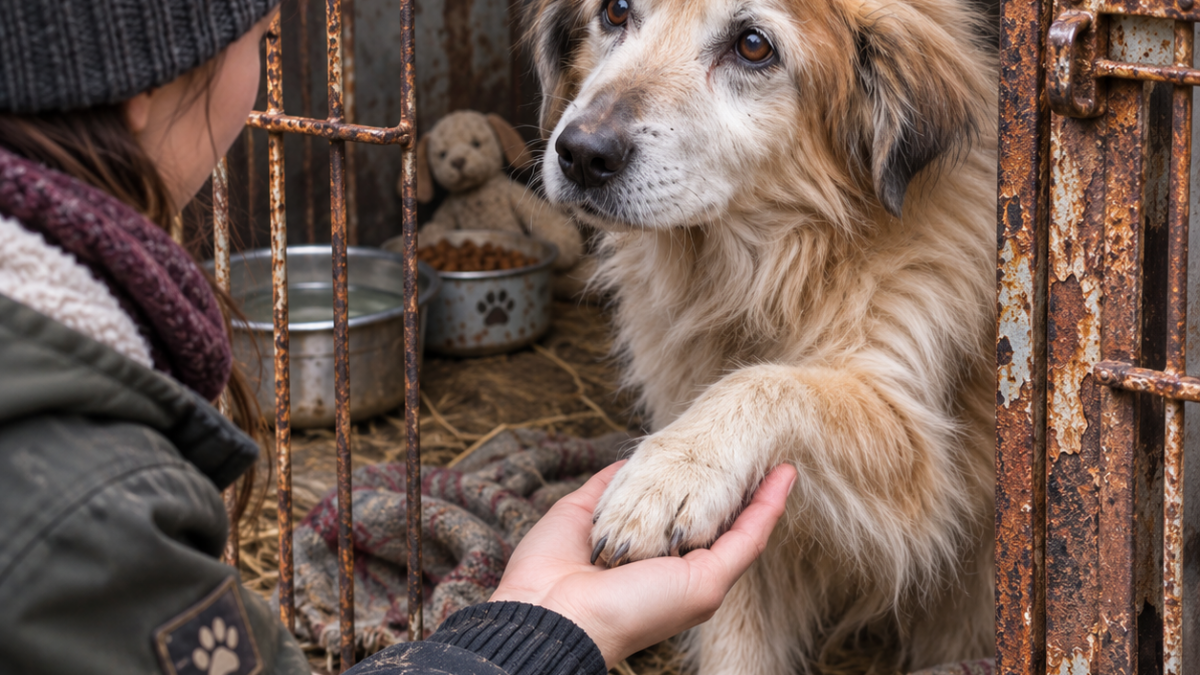
For twelve years, she watched the world through rusted bars until she seemed to forget that a life beyond them even existed.
When I finally unlocked the cage, I expected fear, panic, maybe even a desperate attempt to run—but what she did instead brought three experienced rescuers to tears.
And none of us knew that opening that door would only be the beginning of a fight that would force an entire town to decide what kind of cruelty it was willing to ignore.
I first heard about her on a cold November afternoon.
I was finishing paperwork at our small rescue center when my phone rang. The man on the other end introduced himself as Ethan Walker. He had recently moved to a rural community about forty minutes outside town and had noticed something behind an old shed on a neighboring property.
At first, he thought it was abandoned farm equipment.
Then something moved.
“I think there’s a dog in there,” he told me.
There was something in his voice I had learned not to dismiss.
Not excitement.
Not exaggeration.
Guilt.
The kind people feel when they realize they have walked past suffering without recognizing it.
“How bad?” I asked.
There was silence.
“I don’t know how to explain it,” he finally said. “She looks old. Really old. And I don’t think she gets out.”
Twenty minutes later, two other volunteers and I were loading blankets, gloves, food, a catch pole we hoped we wouldn’t need, and a large transport crate into our van.
The sky was already darkening when we reached the property.
The house sat near the road, but Ethan led us around the side toward an old wooden shed leaning slightly beneath the weight of years.
That was when I saw the cage.
It was barely visible behind tall weeds.
Rust covered almost every inch of the metal. Several sections had been reinforced with wire. The roof was patched with pieces of corrugated sheet metal, but there were holes large enough for rain to fall through. Beneath it, the ground had been churned into a mixture of mud, waste, and dead leaves.
And in the farthest corner sat a dog.
She was smaller than I expected.
Her body was folded into itself as though she had spent years trying to occupy as little space as possible.
Gray had spread across her muzzle. Thick mats hung from her coat. Her nails had grown so long that several curved sideways. A deep, hairless groove circled her neck where an old collar had rubbed against her skin for years.
She didn’t bark when she saw us.
She didn’t growl.
She simply lowered her head.
I crouched outside the cage.
“Hey, sweetheart.”
Her eyes moved toward me.
Just her eyes.
Nothing else.
I had worked in rescue for nearly eleven years. I had been bitten, scratched, screamed at, threatened, and called to scenes I still dreamed about.
But there was something different about this dog.
Fearful animals usually watched for escape routes.
She didn’t.
She watched my hands.
Every time I moved one, she flinched.
A woman from a nearby house had followed us over.
“How long has she been in there?” I asked.
The woman looked uncomfortable.
“Oh, years.”
“How many years?”
She rubbed her arms against the cold.
“I moved here ten years ago, and she was already there.”
I stared at her.
“You’re telling me that dog has been living in this cage for more than ten years?”
She looked toward the ground.
Another neighbor later told us twelve.
Maybe longer.
The dog had apparently arrived as a puppy.
She had grown up behind those bars.
Seasons had changed around her.
Children had grown into adults.
Cars had come and gone.
Families had moved away.
And somehow, she had remained.
A dirty bowl sat near the cage door. There was no clean water I could see.
One of my volunteers, Marcus, turned his face away and whispered a curse under his breath.
I moved closer.
The dog pushed herself against the back wall.
She wasn’t threatening me.
She was surrendering.
That hurt more.
I sat down in the mud outside the cage and made myself smaller.
“It’s okay,” I whispered. “Nobody’s going to hurt you.”
Her eyes closed.
Not peacefully.
Like she was waiting for something.
A blow.
A hand grabbing her.
Pain she already knew.
I stayed there for several minutes without touching her.
Then I reached for the rusted latch.
It barely moved.
Marcus brought bolt cutters.
The metal snapped with a sharp crack.
The dog flinched so violently that her shoulder struck the wall.
“I’m sorry,” I whispered.
We pulled the door open.
For the first time in more than a decade, there was nothing between her and the open world.
But she didn’t move.
She stared through the doorway.
One second passed.
Then five.
Then ten.
I could hear Marcus breathing behind me.
“Come on, baby,” I whispered.
Slowly, the dog leaned forward.
Her nose reached the opening.
Cold air touched her face.
Then, with a movement so careful it looked almost painful, she lifted one trembling front paw and placed it outside the cage.
And froze.
PART 2
For a moment, nobody moved.
Her paw rested on a patch of wet earth only inches beyond the cage, but from the way she stared at it, you would have thought she had stepped onto another planet.
The muscles in her leg trembled.
She looked at me.
Then at the ground.
Then back into the cage.
And she pulled her paw inside.
Marcus exhaled shakily behind me.
“Oh, God.”
I swallowed the pressure building in my throat.
It would have been easy to carry her.
She probably weighed less than forty pounds beneath all that matted fur. We could have wrapped her in a blanket, lifted her into the transport crate, and been back at the clinic before dark.
But something stopped me.
For twelve years, every important decision in that dog’s life had been made for her.
Where she stayed.
When she ate.
When she drank.
How far she could move.
Whether she felt rain.
Whether she felt warmth.
Whether she was touched.
Whether she was ignored.
The first decision of her new life was going to belong to her.
So I sat down again.
“We can wait.”
Marcus glanced at the dark clouds.
“It’s going to rain.”
“Then we get wet.”
He nodded.
Nobody argued.
I took a handful of soft food and placed it just outside the entrance.
She smelled it.
Her nose twitched.
But she didn’t move.
Five minutes passed.
Then ten.
Ethan stood several feet away, silent and pale.
Finally he said, “I should’ve called sooner.”
I looked at him.
“You called when you understood what you were seeing.”
“But everyone else knew.”
His voice cracked.
“That’s what I don’t understand. Everybody knew.”
Neither did I.
Not then.
The dog leaned forward again.
One paw came outside.
Then the other.
She stretched her neck toward the food.
Her back legs remained inside the cage.
“Good girl,” I whispered.
Her ears shifted at the sound.
She took one bite.
Then another.
And when she realized nobody was going to push her, grab her, or shut the door, she moved forward another inch.
That was how she entered freedom.
Not running.
Not jumping.
Not wagging her tail.
One inch at a time.
When her back paws finally crossed the threshold, she stood completely still.
I had imagined that moment many times during rescues.
Animals often exploded with energy when released from confinement. Some ran in circles. Some buried themselves against our legs. Others tried to escape because fear was still stronger than trust.
She did none of those things.
She lifted her head.
For the first time, there were no bars above her.
The clouds had broken slightly, and one thin strip of late-afternoon sunlight passed between them.
It touched her face.
She blinked.
Then raised her nose toward the sky.
And closed her eyes.
Marcus turned away.
Ethan covered his mouth.
The volunteer beside me, Leah, began crying openly.
I had seen animals experience grass for the first time.
I had seen dogs discover beds, toys, air-conditioning, clean water.
But I had never seen a dog stand beneath an open sky as if she had forgotten such a thing existed.
A tear slipped down my face before I could stop it.
“You’re out,” I whispered.
Her eyes opened.
“You’re really out.”
### The Collar
Getting her into the van took another forty minutes.
She didn’t understand the leash.
The moment I clipped one to her collar, she flattened against the ground.
So we removed it.
Instead, Marcus and I held a blanket loosely on either side of her, creating a soft corridor toward the transport crate.
She took six steps.
Stopped.
Seven more.
Stopped again.
Every new surface frightened her.
Gravel.
Grass.
A wooden board.
The rubber mat inside the van.
By the time we finally closed the transport crate, darkness had settled across the property.
That was when a man’s voice came from behind us.
“What the hell are you doing?”
We turned.
A man in his late fifties or early sixties was walking quickly toward us from the house.
He wore muddy work boots and an old canvas jacket.
His face was red.
Ethan quietly said, “That’s the owner.”
The man stopped beside the van.
“You taking my dog?”
I stood between him and the vehicle.
“We received a report about an animal living in unsafe conditions.”
“She’s fine.”
I looked back at the cage.
Rain had begun falling through the holes in its roof.
“Sir, she is not fine.”
He pointed toward the van.
“That dog belongs to me.”
Behind me, I heard Lucy—although I didn’t yet know her name—scratching weakly at the bottom of the crate.
“We contacted animal control before entering the property,” I said. “They’re on their way.”
His expression changed.
Only slightly.
But I saw it.
Until that moment, he had believed we were simply volunteers.
People he could intimidate.
People who would apologize and leave.
He stepped closer.
“I fed her.”
I said nothing.
“She had shelter.”
I looked again at the cage.
“That is not shelter.”
His jaw tightened.
“She’s an outside dog.”
“For twelve years?”
He shrugged.
That shrug did something to me.
Twelve years of rain.
Twelve summers of heat.
Twelve winters.
Twelve years of loneliness reduced to a shrug.
I wanted to scream.
Instead, I pulled out my phone and began taking photographs.
The cage.
The dirty bowl.
The mud.
The rusted latch.
The waste.
The holes in the roof.
The chain tangled around one corner.
The man noticed.
“What are you doing?”
“Documenting.”
That word frightened him more than anger would have.
He stepped toward me.
“Put that damn phone away.”
Marcus moved between us.
“Back up.”
For the first time, the man seemed to realize this was not ending the way he expected.
Animal control arrived eight minutes later, followed by a sheriff’s deputy.
The officer inspected the cage.
Then he looked inside our van.
Then he looked at the owner.
There was a long conversation.
I photographed everything I was allowed to photograph.
The dog was placed under emergency protective custody pending veterinary evaluation.
The owner protested.
He threatened to sue.
He accused Ethan of trespassing.
He accused us of stealing.
Then, while the officer was writing his report, he said something I would remember for years.
“It’s just a dog.”
The deputy stopped writing.
I looked at the man.
Inside the van, the dog was curled into the smallest possible shape.
I thought about twelve years.
“It may be just a dog to you,” I said quietly. “But to her, that cage was her entire life.”
He laughed once.
Not because anything was funny.
Because he didn’t care.
That was the moment my sadness turned into something else.
Not rage.
Not exactly.
A promise.
I didn’t know yet what justice would look like.
But I knew one thing.
He was not getting her back.
### The Examination
The emergency veterinary clinic had already been warned we were coming.
Dr. Elaine Foster met us at the back entrance.
She took one look into the transport crate and stopped smiling.
“How old?”
“Neighbors estimate twelve to thirteen.”
“How long confined?”
“At least ten years. Probably twelve.”
Dr. Foster closed her eyes for half a second.
“Let’s get her inside.”
The dog refused to leave the crate.
Not aggressively.
She simply folded herself into the back.
So Dr. Foster crawled onto the floor.
A veterinarian with twenty years of experience, still wearing her white coat, sat cross-legged in front of a frightened dog and waited.
No one rushed her.
Eventually, the dog leaned forward enough for Dr. Foster to touch her nose.
Then her cheek.
Then her neck.
The examination took nearly two hours.
Her nails were severely overgrown.
She had old pressure sores on her elbows and hips.
Her teeth were worn and several were infected.
She was underweight.
Her coat was packed with dirt and feces.
Arthritis had developed in her back legs.
The groove around her neck was scar tissue.
Her ears were infected.
She had parasites.
Blood tests suggested chronic dehydration and poor nutrition, though somehow her major organs were functioning better than any of us expected.
“She’s tough,” Dr. Foster said.
I stood beside the examination table.
“Can she recover?”
Dr. Foster looked at me.
“Physically? We can help a lot.”
“And mentally?”
She looked toward the dog.
“That will depend on what happens from now on.”
While Leah was carefully cutting away mats from her neck, her scissors struck something metal.
A small tag.
Almost completely buried beneath dirty fur.
We cleaned it.
There was one word engraved on the front.
LUCY.
I stared at it.
“She had a name.”
Dr. Foster touched the old tag.
“She still does.”
I knelt beside the table.
“Lucy?”
The dog’s ear moved.
Every person in the room went silent.
I tried again.
“Lucy.”
Her eyes turned toward me.
Maybe it was coincidence.
Maybe she remembered.
Maybe somewhere beneath twelve years of neglect, there was still a puppy who had once responded when someone called that name.
I touched her cheek.
“Okay, Lucy.”
Her eyes stayed on mine.
“We found you.”
### Her First Night
We placed Lucy in the quietest recovery room at the rescue.
No kennel bars.
No chain-link door.
Just a small room with cream-colored walls, soft lighting, a washable rug, bowls of water and food, and a large orthopedic bed.
The bed terrified her.
She walked around it as if it were an obstacle.
Then she chose the floor.
I sat with her until nearly midnight.
At first, she watched the doorway.
Then the ceiling.
Then the heater vent.
Every unfamiliar sound made her twitch.
When the building settled, she jumped.
When a dog barked two rooms away, she pressed herself against the wall.
I wondered what silence had meant to her for twelve years.
Maybe danger.
Maybe loneliness.
Maybe both.
Around eleven thirty, she approached the water bowl.
She stared at it.
Then drank.
And drank.
And drank.
I finally moved the bowl away because Dr. Foster had warned us not to let her consume too much at once.
Lucy looked at me.
For the first time, I saw something besides fear.
Confusion.
“There’ll be more,” I told her.
She didn’t understand the words.
But I wanted her to hear them.
“There will always be more.”
Food.
Water.
Warmth.
Tomorrow.
That was what we needed to teach her.
Not tricks.
Not commands.
Tomorrow.
When I finally stood to leave, Lucy raised her head.
I took two steps toward the door.
Her body tensed.
I stopped.
Something about her expression made me sit down again.
I slept on the floor beside her that night.
At four in the morning, I woke with a pain shooting through my shoulder.
Lucy was still awake.
But she was closer.
Not much.
Maybe two feet.
For her, it felt like a mile.
### The Sun
The following morning was clear and cold.
I opened the outside door that connected Lucy’s room to a small fenced rehabilitation yard.
She immediately backed away.
Sunlight spilled across the floor.
Lucy stared at the bright rectangle as though it were something alive.
I sat beside the doorway.
“Remember this?”
Her ears tilted.
Outside, frost glittered across the grass.
A sparrow landed on the fence.
Lucy’s eyes widened.
The bird hopped twice.
Lucy looked at me.
Then back at the bird.
I smiled.
“Yes. They do that.”
For twenty minutes, she stayed inside.
Then she approached the threshold.
One paw.
Pause.
Another.
The sunlight touched her back.
Lucy froze.
Then something happened that made me cover my mouth.
Her eyes closed.
She lifted her face toward the sun.
Exactly as she had the evening before.
Except this time, she stayed.
For almost three full minutes, Lucy stood there doing nothing except feeling warmth.
Then she lowered her head and sniffed the grass.
She had probably smelled grass through the cage.
Maybe touched the weeds growing through the floor.
But this was different.
This grass continued in every direction.
Lucy stepped onto it.
Then another step.
Then another.
Halfway across the yard, she stopped and looked behind her.
The door was still open.
Nobody was closing it.
She walked farther.
Ten feet.
Twenty.
At the end of the yard, she found a patch of sunlight against the fence.
She lowered herself slowly.
And lay down.
That became her spot.
For the next several weeks, whenever the weather was good, Lucy chose that same patch of sunlight.
Sometimes she slept.
Sometimes she watched birds.
Sometimes she simply stared at the sky.
### The Owner Came Back
Four days after the rescue, I walked into the lobby and found the man from the property standing at the front desk.
His name was Russell Hale.
He was shouting at our receptionist.
“That animal is mine.”
I stepped between them.
“Mr. Hale.”
He pointed at me.
“You.”
There was no greeting.
No question about Lucy’s health.
No concern about whether she had survived the night.
His first words were:
“You stole my property.”
I felt something inside me turn cold.
“Lucy is under protective custody.”
His face changed when I used her name.
“What?”
“Lucy.”
He stared at me.
“That’s not her name.”
I reached into my pocket and pulled out a photograph of the old tag.
“Yes, it is.”
For the first time, he looked uncertain.
I watched his face.
“You forgot, didn’t you?”
He said nothing.
“You forgot her name.”
“Doesn’t matter.”
“It matters to her.”
He leaned toward me.
“I want my dog.”
I had been hoping, stupidly perhaps, that seeing photographs of her condition might produce some kind of shame.
There was none.
So I showed him anyway.
Her infected ears.
The scar around her neck.
The pressure sores.
Her curved nails.
The dental infection.
The parasites.
The matted fur.
He barely looked.
“She’s old.”
“That is not what caused this.”
“Dogs get dirty.”
“That is not what caused this.”
“She ate.”
“Not enough.”
“She had water.”
“Not clean water.”
“She had a roof.”
“Part of one.”
His voice rose.
“You people think animals are humans now.”
“No,” I said.
I stepped closer.
“I think they feel pain.”
The lobby became silent.
“You had twelve years to do the minimum.”
His eyes narrowed.
“You don’t know anything about me.”
“You’re right. I know about her.”
For a second, I thought he might hit me.
Instead, he smiled.
It was worse.
“My lawyer will shut this place down.”
Then he left.
Our receptionist looked at me.
“Is he serious?”
“Probably.”
“Can he take her back?”
I looked toward the hallway leading to Lucy’s room.
“Not if I have anything to say about it.”
But rescue work teaches you an ugly truth.
Love does not decide custody.
Evidence does.
So we started building a case.
### Twelve Years of Silence
Ethan helped first.
He returned to the neighbors.
This time, he asked questions.
Not everyone wanted to speak.
Some were embarrassed.
Some were afraid Russell would retaliate.
Some insisted it was none of their business.
That phrase stayed with me.
None of their business.
A dog lives in a cage for twelve years.
None of their business.
A dog cries during winter nights.
None of their business.
A bowl freezes solid.
None of their business.
A living creature disappears behind rust and mud while people mow lawns, celebrate birthdays, raise children, barbecue on weekends, and drive past every morning.
None of their business.
But slowly, people started talking.
One woman had photographs from seven years earlier.
Lucy was visible in the background.
Same cage.
Same location.
Another neighbor remembered bringing her water during a heat wave when Russell had been gone for two days.
A former delivery driver remembered seeing Lucy when she was young.
A retired teacher said she had once confronted Russell.
He told her to stay off his property.
Then a man named Frank gave us the most important evidence of all.
Frank had lived three houses away for nearly twenty years.
He arrived at the rescue carrying a grocery bag filled with old notebooks.
“I write everything down,” he explained.
His wife rolled her eyes gently.
“He means everything.”
Frank had kept weather notes for years.
Dates.
Temperatures.
Storms.
Power outages.
He also wrote observations from the neighborhood.
And over more than a decade, Lucy appeared again and again.
“Dog behind Hale shed barking all night.”
“Snow blowing into dog cage.”
“Put water near fence for Hale dog.”
“Heat 101. Dog still outside.”
“Asked Russell about dog. Told me to mind my own business.”
There were dozens.
Frank looked at me across the table.
“I should have done more.”
I had heard that sentence many times that week.
“I should have called.”
“I should have checked.”
“I thought someone else would handle it.”
“I didn’t want trouble.”
“I didn’t know it was that bad.”
Regret is strange.
It always becomes loud after suffering is discovered.
While suffering is happening, it can be almost silent.
### Learning to Sleep
Lucy’s recovery moved in tiny victories.
The first time she stepped onto her orthopedic bed, we celebrated quietly so we wouldn’t frighten her.
The first time she slept deeply enough to dream, I cried.
Her paws twitched.
A soft sound escaped her throat.
Then she woke suddenly and scrambled upright.
I was sitting nearby.
“You’re okay.”
Lucy stared at me.
Then slowly lowered herself again.
Two weeks after her rescue, she accepted a treat directly from my hand.
Three weeks after that, she allowed me to brush one side of her body without retreating.
The first tail wag happened on a Tuesday morning.
I remember because I nearly dropped my coffee.
I entered her room carrying breakfast.
“Good morning, Lucy.”
Her tail moved.
Once.
A tiny sweep against the blanket.
I froze.
Lucy froze too.
Then her tail moved again.
I began laughing and crying at the same time.
Leah ran in.
“What happened?”
I pointed.
“Do it again.”
Lucy looked between us.
Leah crouched.
“Hi, beautiful girl.”
Nothing.
I whispered, “Good morning, Lucy.”
Her tail tapped the floor.
Leah screamed.
Lucy jumped.
We both immediately apologized.
That became one of my favorite memories.
The day two adult women frightened a rescued dog because we were too excited about a tail wag.
### The Toy
Lucy did not understand toys.
Tennis balls meant nothing.
Ropes meant nothing.
Squeaky animals terrified her.
Then someone donated a small stuffed yellow duck.
I left it near her bed.
For three days, she ignored it.
On the fourth morning, I found the duck beneath her chin.
Lucy was asleep with one paw resting over it.
I sat outside the room for several minutes because I was afraid walking in would ruin the moment.
Twelve years.
I kept thinking about that.
What had she owned during those years?
A bowl?
A collar?
A few feet of dirt?
Now she had a stuffed duck.
And she guarded it like treasure.
I named the duck Henry.
Lucy seemed to approve.
### Russell Fights Back
The first legal hearing happened six weeks after the rescue.
Russell’s attorney argued that Lucy had adequate food, water, and shelter.
He described the case as an overreaction by “animal activists.”
That phrase was intended as an insult.
Our attorney placed photographs on the table.
Dr. Foster presented her report.
She spoke calmly.
The dog’s condition, she explained, was consistent with prolonged neglect.
Not days.
Not weeks.
Years.
Russell stared straight ahead.
Then his attorney produced photographs.
Lucy’s cage.
Except in these photographs, a clean tarp covered the roof.
There were two bowls.
Fresh straw covered the ground.
For one horrifying second, I wondered whether they could create enough doubt to get her returned.
Then Ethan leaned toward me.
“That tarp wasn’t there.”
“I know.”
“Neither was the straw.”
“I know.”
The photographs had been taken after we removed Lucy.
The timestamp proved it.
Russell had cleaned the cage after she was gone and tried to present it as evidence of how she had lived.
The judge noticed.
“So your client is presenting photographs taken after the animal was removed?”
Russell’s attorney hesitated.
“Yes, Your Honor, but they demonstrate—”
“They demonstrate the condition of an empty enclosure after someone cleaned it.”
Silence.
I looked at Russell.
For the first time, he looked worried.
Our attorney presented the original photographs.
Mud.
Waste.
Rust.
The damaged roof.
Then Frank’s notebooks.
Then the older photographs.
Then Dr. Foster’s medical records.
One picture showed the scar around Lucy’s neck after her fur had been shaved.
A red groove circled her skin.
I couldn’t look at it.
The judge could.
Russell’s request to have Lucy returned immediately was denied.
I walked out of the courthouse shaking.
Ethan caught up with me.
“Is it over?”
“No.”
“But she’s safe?”
“For now.”
That was rescue too.
Not just pulling a dog from a cage.
Sometimes rescue meant months of paperwork so nobody could put her back.
### The Night Everything Changed
That winter, we had the worst ice storm the region had seen in years.
Power lines came down.
Roads froze.
Our rescue lost electricity just after midnight.
The backup generator started, then failed.
I drove in before dawn.
Lucy was in a foster room by then, but I had been spending so much time with her that she had begun following me.
Not closely.
Never closely.
But enough.
We moved dogs into the warmest part of the building.
Volunteers brought blankets.
A local hardware store donated portable heaters.
By afternoon, the roads were still dangerous.
I was exhausted.
I sat on the floor beside Lucy’s bed.
Outside, freezing rain hit the windows.
Lucy began shaking.
At first, I thought she was cold.
Then thunder rolled.
She crawled backward.
Straight into the corner.
Her eyes became distant.
And suddenly I understood.
Storms.
How many storms had she survived alone inside that cage?
How many nights had rain fallen through holes in the roof while lightning split the sky?
I sat several feet away.
“Lucy.”
She shook harder.
Another crack of thunder.
I wanted to hold her.
But Lucy had taught me that wanting to comfort an animal and knowing how to comfort her were different things.
So I waited.
And then something happened.
Lucy came to me.
Not because I called.
Not because I had food.
She crossed the room on shaking legs and pressed the side of her body against my knee.
I stopped breathing.
Then I lowered my hand slowly.
She didn’t flinch.
I touched her back.
She leaned closer.
That was the first time Lucy chose human contact.
I cried into her fur.
Not loudly.
Just enough that she turned and looked at me.
“I’m sorry,” I whispered. “I know this is supposed to be about you.”
Her tail moved once.
The storm continued outside.
Lucy stayed beside me until it ended.
### The Second Cage
Three months after Lucy’s rescue, Ethan called.
Again.
“Rachel, you need to come out here.”
My stomach dropped.
“What happened?”
“I found something.”
We met near Russell’s property.
The legal case was still active, so we had strict instructions not to trespass.
Ethan led me to his side of the property line.
Behind a line of brush, farther back from the original cage, stood another enclosure.
Smaller.
Old.
Empty.
Inside were two chains.
One still had a collar attached.
My skin went cold.
“How long has that been there?”
“I don’t know.”
Frank joined us twenty minutes later.
When he saw it, his face changed.
“Oh.”
“What?”
He stared at the enclosure.
“There was another dog.”
My heart sank.
“When?”
“Years ago.”
“What happened to it?”
Frank shook his head.
“I don’t know.”
“What was its name?”
“I don’t know.”
That somehow made it worse.
Animal control was notified.
They documented the second enclosure.
There was no animal inside and no way to establish exactly what had happened years earlier.
But the discovery changed the way investigators looked at Lucy’s case.
This was no temporary failure.
No short period during which an overwhelmed owner had fallen behind.
It suggested a pattern.
Russell heard that we had found the second enclosure.
Two days later, someone smashed the rear window of Ethan’s truck.
There was no camera footage.
No witness.
No proof.
The sheriff told Ethan not to accuse anyone publicly.
Russell denied involvement.
But he smiled when Ethan passed him at the gas station.
That was enough to make Ethan install cameras around his house.
A week later, one of them recorded Russell standing near Ethan’s property line after midnight.
He didn’t cross.
He didn’t damage anything.
He simply stood there.
Watching the house.
Ethan showed me the footage.
“He wants me scared.”
“Are you?”
“Yes.”
I appreciated the answer.
Bravery isn’t the absence of fear.
It is knowing fear has arrived and refusing to hand it the steering wheel.
“What are you going to do?”
Ethan looked toward Russell’s property.
“Testify.”
### The Hearing
The final custody hearing came in early spring.
Lucy had been free for almost five months.
Her coat had grown back soft and clean.
She had gained weight.
Her ears no longer hurt.
Her nails were normal.
She could walk farther each week, though arthritis would always limit her.
She slept on beds now.
She ate slowly because she had finally learned food would not disappear.
She still feared raised voices.
She still disliked closed doors.
And every morning, she sat in sunlight.
Our attorney asked me whether I wanted to attend the hearing.
“Yes.”
“Lucy doesn’t need to be there.”
“I know.”
I would never have taken her into that room.
The fight belonged to us now.
She had fought enough.
Russell testified.
That was his mistake.
His attorney probably advised him against it.
But Russell wanted to speak.
People like him often do.
They believe if they can talk long enough, confidence will replace truth.
He said Lucy had always been cared for.
He said she preferred living outside.
He said she became nervous indoors.
He said the cage protected her.
Our attorney stood.
“How often did Lucy leave that enclosure?”
Russell hesitated.
“She got out.”
“How often?”
“I don’t know.”
“Once a day?”
No answer.
“Once a week?”
Silence.
“Once a month?”
Russell shifted.
“She didn’t like going out.”
My hands tightened beneath the table.
Our attorney continued.
“You’re saying the dog voluntarily chose to remain in a small metal enclosure for more than a decade?”
“She was used to it.”
The courtroom became very still.
Used to it.
There it was.
The entire tragedy in three words.
Our attorney walked toward the evidence table.
“She was used to it because it was all she knew.”
Russell’s lawyer objected.
The judge allowed the question to continue.
“Did you ever take Lucy to a veterinarian?”
“I don’t remember.”
“In twelve years?”
“She didn’t need one.”
“Did you ever treat her ear infections?”
“I didn’t know she had them.”
“Her dental infections?”
“No.”
“Parasites?”
“No.”
“Arthritis?”
“No.”
“Pressure sores?”
“No.”
“The wound around her neck?”
“That wasn’t a wound.”
A photograph appeared on the screen.
Even Russell looked away.
Our attorney stopped.
“You did not know she had any of those medical problems?”
“No.”
“Because you weren’t caring for her closely enough to notice them?”
Russell’s face hardened.
“That dog had food.”
Our attorney paused.
Then said quietly:
“Survival is not the same thing as care.”
I will remember that sentence for the rest of my life.
### What Justice Looked Like
The judge permanently removed Lucy from Russell’s custody.
He was prohibited from reclaiming her while the criminal neglect case proceeded.
Months later, prosecutors reached a resolution that included a guilty plea on animal cruelty and neglect charges supported by the veterinary evidence and witness testimony.
Russell was ordered to pay restitution toward Lucy’s veterinary care.
He was barred from owning or keeping animals for years under the terms of the court order.
He received a combination of jail time, supervised release, fines, and mandatory compliance inspections.
Some people were disappointed.
They wanted something more dramatic.
They wanted Russell to suffer exactly as Lucy had suffered.
Twelve years in a cage for twelve years in a cage.
I understood that anger.
There had been nights when I imagined standing in front of him and telling him exactly what I thought of him.
But revenge has a problem.
It can become another cage.
I didn’t want Lucy’s new life built around Russell.
I wanted something different.
I wanted him to wake up knowing that the animal he treated as worthless had become the reason dozens of people stood up in court.
I wanted every photograph he tried to hide behind to become evidence against him.
I wanted the neighbors who had once remained silent to testify.
I wanted the man who had said “It’s just a dog” to sit in a courtroom while a judge explained that the law did not agree.
And most of all, I wanted him to lose the one thing he believed he owned completely.
Control.
Lucy would never belong to him again.
That was enough.
Almost.
### The Real Revenge
The story spread through the county.
Not because we tried to make Lucy famous.
Because people were angry.
Donations arrived.
At first, they were for Lucy’s medical bills.
Then there were too many.
We used the extra funds to create an emergency program for outdoor and chained dogs in surrounding rural communities.
We called it Lucy’s Light.
The name came from the way she raised her face toward the sun.
With permission, Frank’s notebooks became part of an educational program we gave to local community groups.
The message was simple:
If you see something, report it.
You do not need to investigate.
You do not need to confront anyone.
You do not need to trespass.
But you do need to stop assuming someone else will act.
Within a year, Lucy’s Light helped dozens of animals.
Some situations were simple.
An elderly owner needed help repairing a fence.
A family needed an insulated shelter.
Someone needed affordable veterinary care.
Others were worse.
Chains embedded in necks.
Dogs without water.
Animals living in filth.
Each time we responded, I thought of Lucy.
Russell had spent twelve years trying to make one dog invisible.
Instead, she became the reason dozens of others were seen.
That was the revenge he never expected.
### The Adoption Question
By summer, Lucy was legally free to be adopted.
I should have been happy.
Instead, I felt sick.
Leah noticed.
“You’ve been staring at that application for twenty minutes.”
“I’m reading.”
“You’re holding it upside down.”
I looked.
She was right.
“I’m tired.”
“You’re terrified.”
“No.”
“Rachel.”
I sighed.
We had received several adoption applications.
Good ones.
A retired couple with a fenced yard.
A woman who worked from home.
A family with an older, calm dog.
Lucy deserved a home.
That had always been the goal.
I had told myself that every day.
Rescue.
Rehabilitate.
Release.
But somewhere between sleeping beside her on that first night and watching her learn to trust my hands, something had changed.
Leah leaned against the desk.
“You know you’re allowed to keep her.”
“I foster animals.”
“You fostered Lucy.”
“I can’t adopt every dog I love.”
“No. But you can adopt one.”
I looked through the glass toward the rehabilitation yard.
Lucy was lying in her patch of sun.
Henry the stuffed duck rested between her paws.
“What if I’m keeping her because I need her?”
Leah smiled.
“Maybe ask whether she needs you too.”
That evening, I brought Lucy home.
Just for a trial overnight.
That was the lie I told myself.
### Home
My house was quiet.
No children.
No other dogs at the time.
A small fenced backyard.
A porch that caught afternoon sunlight.
Lucy entered through the front door and immediately stopped.
She studied the hallway.
Then she looked behind her.
The door was open.
I left it open.
She stepped forward.
My hardwood floor frightened her.
So I laid towels across it.
She followed the towels.
Room by room, we explored.
Kitchen.
Living room.
Bedroom.
Back door.
Porch.
Yard.
When she reached the backyard, Lucy lifted her nose.
A breeze moved through the trees.
She walked to the center of the grass.
Then she looked at me.
Something inside my chest hurt.
“Yeah,” I said. “It’s all yours.”
She didn’t know what that meant.
But I did.
That night, I placed her bed beside mine.
At two in the morning, I woke and found her standing near the bedroom doorway.
I sat up.
“What’s wrong?”
Lucy stared down the hallway.
I wondered whether she needed to go outside.
I stood.
She turned.
Walked into the living room.
And climbed onto the couch.
I nearly laughed.
“Seriously?”
She circled three times.
Lay down.
Then looked at me.
I slept on the other end of the couch.
In the morning, one of her paws was touching my leg.
The adoption paperwork was signed that afternoon.
### The Gate
For months, Lucy refused to walk through narrow gates unless I went first.
She hated anything that resembled the entrance to her old cage.
At the rescue, we had a metal gate between the main building and the rehabilitation yard.
Lucy would stop several feet away.
I would walk through.
Turn.
Wait.
Eventually, she followed.
One morning, nearly a year after her rescue, I was carrying supplies and accidentally walked through without thinking.
When I turned around, Lucy was already beside me.
I stared at her.
She looked back as if nothing unusual had happened.
I laughed.
“What was that?”
Her tail wagged.
“You just walked through.”
Another wag.
“You didn’t even stop.”
She sniffed my pocket for treats.
I sat on the ground and hugged her.
This time, she let me.
### One Year
On the anniversary of her rescue, Ethan came to visit.
So did Marcus.
Leah.
Dr. Foster.
Frank and his wife.
We didn’t throw a loud party.
Lucy would have hated that.
We gathered in my backyard with coffee and cake for the humans and small pieces of chicken for Lucy.
Frank brought a gift.
A wooden plaque.
He had carved a sentence into it.
THE DOOR IS OPEN.
I couldn’t speak for a moment.
We hung it beside my back door.
Ethan sat in the grass.
Lucy approached him.
She had always remembered him differently from the rest of us.
Perhaps because he had been the first person to stop.
She sniffed his hand.
Then leaned against his shoulder.
Ethan closed his eyes.
“I’m sorry I didn’t see you sooner,” he whispered.
Lucy licked his cheek.
He laughed.
Then cried.
Frank watched them.
“We all should’ve seen her.”
I looked around the yard.
“No.”
Everyone turned toward me.
“We should have acted sooner. That’s different.”
I had learned something during Lucy’s case.
Guilt can paralyze people just as effectively as indifference.
If everyone spent the rest of their lives feeling guilty, Lucy’s suffering would accomplish nothing.
If they changed how they acted the next time, then something good could grow from it.
Frank nodded slowly.
“I reported a dog last month.”
I smiled.
“I heard.”
“Turned out the owner needed help.”
“I heard that too.”
“We built him a new shelter.”
“I know.”
Frank looked at Lucy.
“Better late than never, I guess.”
Lucy rolled onto her side in the grass.
For her, there was no yesterday.
Not in the way humans carried it.
There was sun.
There was chicken.
There were people she trusted.
There was now.
### The Man at the Grocery Store
I saw Russell once after the case ended.
It happened unexpectedly.
I was leaving a grocery store when I noticed him loading bags into an old pickup.
For a second, every emotion returned.
The cage.
The scar.
The storms.
The courtroom.
The way he had shrugged.
He saw me too.
We stood twenty feet apart.
I could have walked away.
Instead, I stopped.
Russell shut the truck door.
“I hear that dog’s still alive.”
“That dog has a name.”
His mouth tightened.
“Lucy.”
He looked surprised that I answered.
“How is she?”
I studied his face, searching for something.
Regret.
Shame.
Maybe curiosity.
I couldn’t tell.
“She’s happy.”
He looked toward the store.
“Always was stubborn.”
I almost laughed.
Not because it was funny.
Because the statement was so absurd.
“You don’t know her.”
His eyes came back to mine.
“I owned her twelve years.”
“No.”
I shook my head.
“You kept her twelve years.”
There is a difference.
I walked away.
He didn’t follow.
That was the last conversation we ever had.
### Lucy’s Second Spring
By Lucy’s second spring of freedom, she had become a different dog.
Not young.
Time cannot be reversed.
Her arthritis worsened gradually.
Some mornings, she needed medication before she wanted to walk.
Her muzzle became whiter.
She slept more.
But she lived.
Really lived.
She discovered that she loved watermelon.
She hated the vacuum cleaner.
She liked women with quiet voices.
She tolerated men after meeting them several times.
She adored Ethan.
She followed Dr. Foster whenever she visited because she had learned that the veterinarian carried cheese.
She slept with Henry every night.
And she became obsessed with sunlight.
If a rectangle of sun appeared on the carpet, Lucy found it.
I once moved her bed three times in one afternoon because the sunlight shifted across the room.
Leah called me ridiculous.
She was right.
I did it anyway.
Lucy had spent too many years without choices.
If she wanted the bed moved, the bed moved.
### Her First Run
Technically, it was not a run.
Dr. Foster would later describe it as “an enthusiastic arthritic trot.”
But I knew what I saw.
It happened in early May.
Lucy and I were in the backyard when a rabbit appeared near the fence.
Lucy saw it.
The rabbit saw Lucy.
For three seconds, neither moved.
Then the rabbit bolted.
And Lucy ran.
Not fast.
Not far.
Maybe fifteen feet.
But all four of her paws moved with sudden, joyful urgency.
Her ears lifted.
Her mouth opened.
For one brief moment, she looked five years old instead of fourteen.
Then she stopped.
The rabbit disappeared.
Lucy turned toward me.
I threw both hands in the air.
“You ran!”
She wagged her tail.
“You actually ran!”
My neighbor looked over the fence to see why I was shouting.
Lucy walked back toward me with a proud expression.
I knelt.
She pressed her head against my chest.
I thought about the dog who had once been afraid to place one paw outside a cage.
And I cried.
Again.
Lucy spent a lot of her freedom watching humans cry.
### The Photograph
There was one photograph of Lucy I kept on my desk.
Not the rescue photographs.
I hated those.
This one had been taken almost eighteen months after we found her.
Lucy was lying in my backyard beneath a maple tree.
Her gray muzzle rested in the grass.
Henry was beside her.
Sunlight covered half her body.
Her eyes were closed.
No collar.
No leash.
No fence visible in the frame.
Just Lucy and sunlight.
A local photographer who volunteered with our rescue had taken it.
When she sent me the photograph, she included a message:
“This is what freedom looks like when it finally feels safe.”
I printed it.
Then I printed another copy.
That one went into Lucy’s court file at the rescue.
Not because the court needed it.
Because I did.
We had so many photographs documenting what had been done to her.
I wanted one documenting what happened afterward.
### The Last Winter
Lucy was with me for almost three years.
Not enough.
Nothing would have been enough.
By her final winter, she was slowing down dramatically.
The arthritis in her hips had progressed.
Her heart had weakened.
Dr. Foster adjusted medication.
We installed ramps.
I covered every slippery floor with rugs.
Lucy still insisted on going outside every morning.
Even when it was cold.
She would stand on the porch, smell the air, then decide whether the weather deserved her approval.
On sunny days, she stayed out longer.
On cloudy days, she returned inside and looked at me as though I had personally arranged the sky incorrectly.
One January morning, snow began falling.
I expected Lucy to turn around.
Instead, she walked into the yard.
Snowflakes landed on her coat.
She looked upward.
I watched from the porch.
For a second, fear tightened my chest.
Snow had once meant cold.
Exposure.
A wet cage.
No escape.
But Lucy wasn’t afraid.
She stood there.
Then lowered her nose to the snow.
Sneezed.
Looked offended.
I laughed so hard I had to sit down.
Lucy returned to the porch and stared at me.
“Sorry.”
She stepped inside.
I dried her with a warm towel.
That night, she slept beside the fireplace with Henry beneath her chin.
### The Morning I Knew
Spring came again.
Lucy turned fifteen, as best as we could estimate.
One morning in April, she did not get up when I called.
I sat beside her.
“Hey, sunshine.”
Her eyes opened.
Her tail moved once.
That tail.
The same tiny movement that had made Leah scream years earlier.
Lucy tried to stand.
Her legs failed.
I helped her.
She leaned against me.
Something in my heart already knew.
Dr. Foster came to the house.
She examined Lucy quietly.
Then she looked at me.
That look.
Anyone who has loved an old animal knows it.
I shook my head before she spoke.
“No.”
Dr. Foster sat beside me.
“Rachel.”
“No.”
Lucy rested her head on my leg.
“Her heart is struggling.”
“We can change the medication.”
“We can try.”
“Then try.”
“We can.”
Dr. Foster touched my arm.
“But I need you to think about what you’re asking her to stay for.”
That sentence broke me.
Because I knew.
For twelve years, Lucy had endured life because she had no choice.
I would not make her endure death for the same reason.
I cried into her fur.
“I’m not ready.”
Lucy breathed slowly against my hand.
Dr. Foster waited.
After a while, I whispered, “Can she have one more sunny day?”
Dr. Foster looked toward the window.
Sunlight was beginning to spread across the yard.
“Yes.”
### One More Day
I carried Lucy outside.
She weighed more than when we rescued her, but somehow she felt lighter.
I placed her bed in her favorite spot beneath the maple tree.
Then I brought Henry.
Ethan came.
Leah.
Marcus.
Frank.
Dr. Foster stayed nearby.
Nobody spoke loudly.
Nobody made speeches.
Lucy ate small pieces of chicken.
Ethan sat beside her.
“You remember me?”
Her tail moved.
He laughed through tears.
“Yeah. I remember you too.”
Frank knelt carefully.
“I’m sorry, girl.”
Lucy sniffed his hand.
Then closed her eyes.
The sun moved.
At noon, I moved her bed.
At one thirty, I moved it again.
Leah smiled through tears.
“You’re still chasing sunlight for her.”
“Always.”
By late afternoon, Lucy was tired.
Everyone left except Dr. Foster.
I lay in the grass beside her.
The sky was clear.
I thought about that first day.
The rusted cage.
The mud.
The open door.
One paw.
Pause.
Another paw.
I had believed I was rescuing her.
But that wasn’t the whole truth.
Lucy changed the way I understood rescue.
Before her, I thought saving an animal meant removing it from danger.
After Lucy, I understood that freedom was not simply an open door.
Freedom was learning the door would stay open.
Freedom was sleeping without fear.
Eating without desperation.
Choosing whether to be touched.
Walking away.
Coming back.
Trusting tomorrow.
Lucy opened her eyes.
I touched her face.
“You did it.”
Her breathing was shallow.
“You got out.”
The words were almost impossible to say.
“You’re never going back.”
Her eyes remained on mine.
Dr. Foster sat beside us.
I nodded.
Lucy’s final moments were warm.
No metal beneath her.
No chain.
No rain falling through a broken roof.
Her head rested in my lap.
Henry lay against her front paws.
Sunlight touched her face.
I whispered her name until her breathing stopped.
Then I stayed there.
For a long time.
### What We Buried
We buried Lucy’s ashes beneath the maple tree.
Ethan brought a stone.
Frank brought flowers.
Marcus dug the hole because I couldn’t.
Leah stood beside me.
On the stone were four words:
SHE DIED IN FREEDOM.
Below them were two dates.
The first was not her birth date.
We never knew that.
It was the day we opened the cage.
Beside it was the day she died.
People might look at those dates and think Lucy lived only three years.
They would be wrong.
She existed for twelve years.
Then she lived for three.
There is a difference.
### Years Later
Lucy’s Light still exists.
The original wooden plaque—THE DOOR IS OPEN—hangs inside our rescue center now.
Beneath it is her photograph in the grass.
New volunteers sometimes ask about her.
I tell them the truth.
Not the shortened version.
Not the comfortable version.
I tell them about the cage.
I tell them about the neighbors who knew.
I tell them about Ethan stopping.
I tell them about Russell saying she was “just a dog.”
I tell them about the court case.
I tell them about the stuffed yellow duck.
I tell them about her first tail wag.
Her first storm indoors.
Her first run.
Her obsession with sunlight.
And I always tell them about the first step.
Because that is the part I never want to forget.
When we opened the cage, I thought Lucy would understand immediately that she was free.
She didn’t.
Why would she?
A door being open meant nothing to an animal who had spent twelve years learning that every boundary was permanent.
She had to discover freedom one step at a time.
Maybe people are like that too.
Maybe after enough fear, we stop believing an open door is real.
Maybe we stand at the threshold waiting for someone to slam it shut again.
Lucy taught me that freedom is not proved when somebody opens a door.
It is proved every day afterward when nobody closes it.
### The Final Victory
People sometimes ask whether I believe Russell was punished enough.
I used to struggle with that question.
Part of me wanted a punishment as long as Lucy’s suffering.
Twelve years for twelve years.
That kind of arithmetic feels satisfying when you are angry.
But now, when I think of revenge, I remember something else.
Russell wanted Lucy forgotten.
He had placed her behind a shed where almost nobody could see her.
He had reduced her life to a cage, a dirty bowl, and a few feet of mud.
He believed nobody would care.
He was wrong.
A stranger cared.
Then three rescuers cared.
Then a veterinarian.
Then neighbors who finally found the courage to speak.
Then investigators.
Then a judge.
Then hundreds of people who donated to help animals they had never met.
And eventually, dozens of dogs who never knew Lucy existed escaped chains and cages because her story changed what people were willing to ignore.
That was her revenge.
Russell tried to make her invisible.
Lucy became impossible to forget.
He tried to control every inch of her world.
She died beneath an open sky.
He believed she belonged to him.
In the end, the only thing that truly belonged to Lucy was the thing he had denied her for twelve years.
Her life.
And she finally got to live it.
Sometimes, on warm afternoons, I still sit beneath the maple tree.
The rescue is louder now.
Bigger.
Busier.
There are always animals waiting.
Always another call.
Always another person saying, “I found a dog.”
Lucy’s stone sits where the sunlight reaches it in the afternoon.
Henry is inside my house now.
His yellow fabric has faded.
One ear is nearly torn off.
I could never throw him away.
Every so often, I hold him and remember the frightened old dog who had no idea what a toy was.
Then I remember her asleep with one paw wrapped around it.
And I smile.
The sadness never completely disappears.
But neither does the gratitude.
I was there when Lucy walked out of that cage.
I watched her discover grass.
Sunlight.
Warm beds.
Toys.
Trust.
Home.
I watched a dog who once closed her eyes whenever a hand approached eventually rest her head willingly in my lap.
I watched her learn that food returned every morning.
That storms ended.
That doors opened.
That people could leave and come back.
That tomorrow could be trusted.
And if I could return to that first afternoon—to the mud, the rust, the cold air, and the trembling dog staring through an open doorway—I know exactly what I would tell her.
Take your time, Lucy.
You don’t have to understand freedom yet.
Just give me one paw.
Then another.
The rest of your life is waiting outside.








