PART 2: She Spent 11 Days Chained Inside a Dark Livestock Trailer—Then She Lifted Her Face to the Sun and Changed Everything
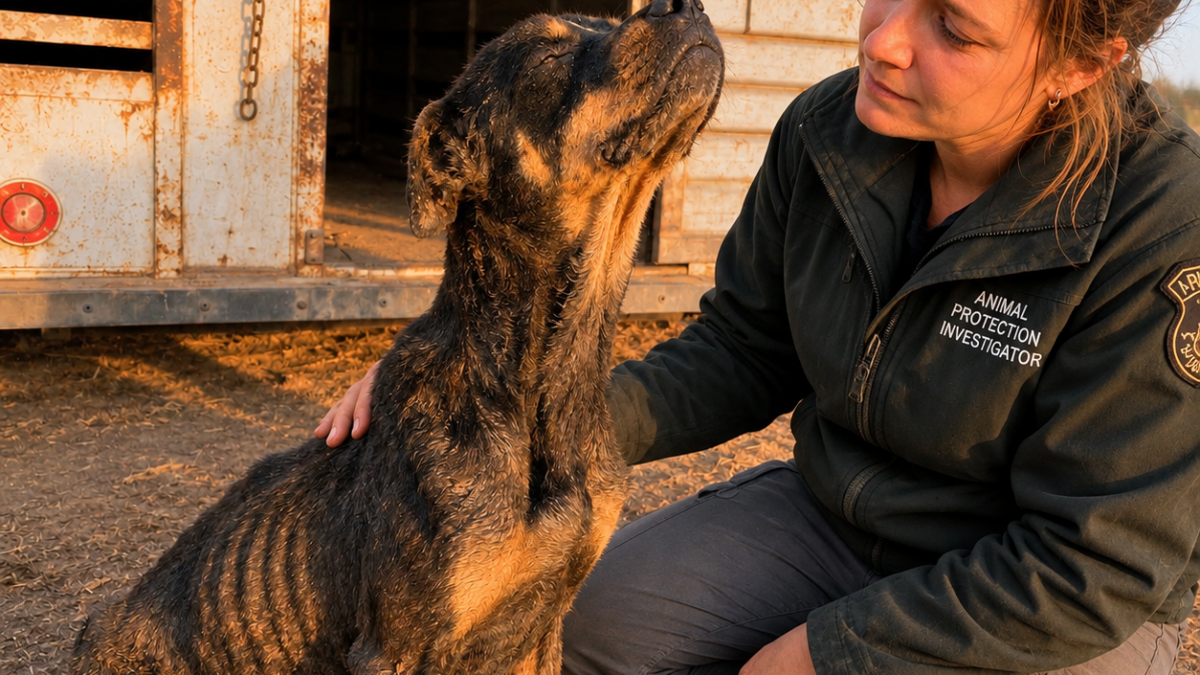
PART 2
The emergency clinic was forty-six minutes away.
I made it in thirty-eight.
That is not a confession.
It is an explanation.
Luz lay across the back seat wrapped in my jacket, her head resting on a folded blanket.
Every few minutes I looked at her in the rearview mirror.
“Stay with me.”
Her eyes opened.
Then closed.
“Don’t do that.”
They opened again.
“I know you’re tired.”
I had been trained not to attach meaning to every movement.
Not every blink is communication.
Not every tail wag means happiness.
Not every frightened animal is asking to be rescued.
But that night, I talked anyway.
I told her where we were going.
That a doctor was waiting.
That nobody would lock her inside anything again.
That the sun would still be there tomorrow.
I named her somewhere around mile twenty.
Luz.
Spanish for light.
It came into my head because of the way she had lifted her face outside the trailer.
At the clinic, Dr. Ava Reynolds met us at the emergency entrance with two technicians.
The moment she saw Luz, her face hardened.
“How long?”
“Possibly eleven days.”
“With no food?”
“Unknown.”
“Water?”
“Empty bucket.”
“Let’s move.”
They carried her in.
Fluids first.
Bloodwork.
Temperature.
Glucose.
Kidney values.
Liver enzymes.
Heart.
Lungs.
Dr. Reynolds kept calling numbers.
The technicians moved quickly.
I stood against the wall trying not to interfere.
At one point Luz’s eyes found mine.
I stepped closer.
“I’m here.”
Dr. Reynolds looked at me.
“Stay where she can see you.”
I moved beside the table.
Luz’s breathing was rapid.
Her gums pale.
One technician shaved a section of her leg.
Another hung another fluid bag.
“How bad?”
Dr. Reynolds didn’t look up.
“Bad.”
“Will she live?”
“I don’t know yet.”
I hated that answer.
Everyone hates that answer.
But in rescue work, anyone who promises survival too early is lying.
Luz weighed forty-six pounds.
A healthy female Rottweiler her size should have been considerably heavier.
She was severely dehydrated.
Her kidneys were stressed.
Her electrolyte levels were dangerous.
She had sores along her hips from lying on the metal floor.
Her nails were worn and cracked.
There were abrasions around her nose and front paws.
“From what?” I asked.
Dr. Reynolds examined them.
“Possibly scratching at the trailer.”
My stomach tightened.
“How long would she have tried?”
“No way to know.”
There were bruises around one shoulder.
Old enough that we couldn’t determine exactly when they happened.
No fractures.
No internal bleeding.
That was the first good news.
Then came the bad.
“She can’t eat normally yet,” Dr. Reynolds told me.
“Why?”
“Refeeding syndrome.”
I knew the term.
Hearing it applied to Luz made it different.
After prolonged starvation, suddenly feeding too much can cause dangerous shifts in electrolytes and overwhelm organs.
“So tiny meals?”
“Controlled nutrition. Close monitoring.”
“How long before we know?”
“Twenty-four hours will tell us something.”
“Forty-eight?”
“More.”
“Seventy-two?”
“Emily.”
I stopped.
Dr. Reynolds softened.
“She survived eleven days in that trailer.”
I looked toward Luz.
“Let’s give her the next hour first.”
That became our unit of time.
One hour.
Then another.
Law enforcement arrived at the abandoned property after I had already left.
Officer Daniel Ruiz called me around nine that night.
“You cut the lock?”
“Yes.”
“You know I have to document that?”
“Yes.”
“Good.”
“What did you find?”
“Trailer registered?”
“Still checking.”
“Property owner?”
“Bank owns the land now.”
“So whoever locked her inside didn’t own the farm?”
“Maybe.”
“What else?”
“We found tire tracks.”
“Recent?”
“Looks that way.”
“Anything inside?”
“Food bag?”
“No.”
“Water containers?”
“Only the bucket you photographed.”
“Collar?”
“No.”
“Chip?”
“Clinic hasn’t scanned yet.”
“I’ll call them.”
“Emily.”
“What?”
“Don’t get ahead.”
I closed my eyes.
Every good investigator has been told that by another investigator.
Usually because we were absolutely getting ahead.
“I know.”
“No, you don’t.”
He was right.
I called the clinic anyway.
Luz had a microchip.
That changed everything.
The chip was registered to a man named Aaron Pike.
Thirty-four.
Address about ninety miles from the abandoned farm.
The phone number was active.
I called Officer Ruiz.
“Got an owner.”
“Registered owner.”
“Same thing until proven otherwise.”
“Emily.”
“I’m sending you the information.”
He contacted Aaron.
No answer.
Voicemail.
Second attempt.
Nothing.
Third.
Nothing.
Then, at 11:14 p.m., Aaron called law enforcement back.
Ruiz called me immediately afterward.
“He says he doesn’t own the dog anymore.”
I sat up.
I had been half asleep in a plastic chair outside Luz’s treatment area.
“What?”
“He says he gave her away.”
“To who?”
“Doesn’t remember the last name.”
“You’re joking.”
“No.”
“First name?”
“Travis.”
“Address?”
“Somewhere near the county line.”
“Phone?”
“Says he changed phones.”
“When did he give her away?”
“Three months ago.”
I looked through the treatment-room glass.
Luz lay beneath warming blankets.
“Convenient.”
“Maybe true.”
“You believe him?”
“My job isn’t belief.”
I hated that sentence because I used it myself.
“What did he say her name was?”
There was a pause.
“Sadie.”
I looked at the dog.
Sadie.
For eleven days, maybe she had been waiting to hear that name.
“Did he ask if she was alive?”
Ruiz didn’t answer.
“Daniel.”
“No.”
That told me more than I wanted.
He had asked where she was found.
Whether he could get in trouble.
Whether the chip still legally tied her to him.
He had not asked whether the dog had survived.
I wrote that down.
The next morning, Luz’s condition worsened.
Her phosphorus dropped.
Heart rhythm became unstable.
Dr. Reynolds moved her into intensive monitoring.
I stood in the hallway feeling useless.
That is the hardest part of animal protection work.
People imagine the hardest thing is seeing cruelty.
It isn’t.
The worst part is sometimes handing an animal over to medicine and realizing your authority ends at the treatment-room door.
I could investigate.
Photograph.
Interview.
Write reports.
Recommend charges.
I could not make Luz’s kidneys work.
I could not force her body to accept nutrition.
I could not bargain with eleven days.
At noon, Dr. Reynolds found me.
“She’s struggling.”
My stomach dropped.
“How much?”
“We’re correcting the electrolyte imbalance.”
“Is she crashing?”
“She could.”
I stared.
“What do you need?”
“Nothing from you.”
“I hate that.”
“I know.”
“Can I sit with her?”
“When we stabilize the rhythm.”
I nodded.
Two hours later, they let me in.
Luz lay on her side.
An IV line in one leg.
Monitor leads attached.
She looked even smaller than the night before.
I sat on the floor beside her.
“Hey, Light.”
One eye opened.
I had accidentally started calling her Light instead of Luz when we were alone.
Her tail didn’t move.
That scared me.
I placed my hand on the blanket.
Not touching her.
“You don’t owe me anything.”
Her breathing continued.
“You don’t have to wag.”
I started crying.
“I know.”
I wiped my face angrily.
“You don’t even know me.”
Luz moved one front paw.
It touched the edge of my hand.
Not intentional perhaps.
I decided not to care.
I closed my fingers lightly around her paw.
“You saw the sun yesterday.”
Her eye remained open.
“Remember?”
Another breath.
“There’s more.”
I didn’t promise she would live.
I had learned better.
I promised only what I could control.
“If you stay, nobody puts you in the dark again.”
That afternoon, her numbers began improving.
Slowly.
By evening, Dr. Reynolds smiled for the first time.
Not a big smile.
A careful one.
“I like this trend.”
“Meaning?”
“Meaning don’t celebrate yet.”
“I hate you too.”
“Get in line.”
The second night passed without another cardiac episode.
On the third morning, Luz ate two teaspoons of a recovery mixture.
Two teaspoons.
I took a picture of the empty spoon.
Dr. Reynolds looked at me.
“Please don’t become one of those people who documents every bowel movement.”
“No promises.”
By day four, Luz could lift her head.
Day five, she stood for seven seconds.
I know because I counted.
She pushed herself up.
Legs shaking.
Looked at me.
Then collapsed onto the blanket.
I cried.
A technician named Brooke laughed.
“You cry a lot for an investigator.”
“I have allergies.”
“To recovery?”
“Severe.”
Law enforcement meanwhile found Aaron Pike.
Not physically.
Digitally.
He had social-media photographs with Luz—Sadie then—from the previous year.
Christmas.
Backyard.
A lake.
A couch.
She had been healthy.
Heavy.
Shiny.
Wearing a purple collar.
One picture showed Aaron holding her face between his hands.
Caption:
My girl.
That made me angrier than a photograph of obvious cruelty would have.
Love in a caption means nothing if it disappears when responsibility becomes inconvenient.
Aaron eventually came in for an interview.
I watched from the adjoining room.
Ruiz handled it because the criminal portion belonged to law enforcement.
Aaron wore work boots and a clean jacket.
He looked ordinary.
Cruelty often does.
“You owned Sadie?” Ruiz asked.
“Used to.”
“When did you transfer ownership?”
“June.”
“To Travis?”
“Yeah.”
“Full name?”
“I told you. I don’t remember.”
“You gave your Rottweiler to someone whose last name you don’t remember?”
“He was a friend of a friend.”
“Which friend?”
Aaron hesitated.
“Mike.”
“Mike what?”
“Donovan.”
“Number?”
Aaron provided it.
We checked.
Mike Donovan existed.
He denied arranging any dog transfer.
Aaron changed the story.
Maybe it had been someone else.
Ruiz remained calm.
I would not have.
“Why did you give Sadie away?”
“My girlfriend moved in.”
“And?”
“She had a baby.”
“Was Sadie aggressive?”
“No.”
“Bite history?”
“No.”
“Then?”
Aaron shrugged.
“She didn’t want a big dog around the baby.”
There it was.
Convenience again.
Ruiz asked:
“Did you attempt rescue placement?”
“I posted online.”
“Can you show us?”
Aaron looked at his phone.
The post was gone.
“Did anyone respond?”
“A few people.”
“Names?”
“Don’t remember.”
“Do you remember anything?”
Aaron looked annoyed.
That was when he made his first real mistake.
“Look, I didn’t put the dog in that trailer.”
Ruiz had not accused him of doing so.
Not yet.
He leaned forward.
“No one said you did.”
Aaron’s face changed.
Small.
Fast.
But visible.
I wrote it down.
Ruiz continued.
“How do you know she was in a trailer?”
Aaron swallowed.
“You told me.”
“No.”
Silence.
The interview shifted.
Aaron asked for a lawyer.
Correct decision.
Interview ended.
I walked outside into the parking lot and stood there breathing cold air.
Ruiz joined me ten minutes later.
“He knew.”
“Yes.”
“Doesn’t prove he put her there.”
“I know.”
“Say it.”
“Doesn’t prove he put her there.”
“Good.”
“I still hate you.”
“Also good.”
We obtained a warrant for phone records.
That took time.
Meanwhile, the trailer itself gave us something.
A fingerprint.
Not useful alone.
Then a partial shoe print in dried mud.
Still not enough.
The biggest break came from the anonymous caller.
He called again.
This time, I convinced him to meet.
His name was Luis Herrera.
He worked at a feed store thirty miles away.
“Why anonymous?”
He looked ashamed.
“Because Aaron is my cousin.”
My pulse increased.
“Tell me everything.”
Luis rubbed his hands together.
“Eleven days before you found her, Aaron asked to borrow my dad’s trailer.”
“The livestock trailer?”
“Yes.”
“What did he say?”
“Moving equipment.”
“Did you help?”
“No.”
“Did he return it?”
“No.”
Luis swallowed.
“My dad told me the old trailer was still at the abandoned Carter farm. We used to lease part of that land years ago.”
“Why did you go?”
“To get it.”
“And?”
“I heard something.”
Luz.
My chest tightened.
“Did you open it?”
“No.”
“Why?”
“The chain.”
“You could have cut it.”
He looked at the floor.
“I know.”
“How long before you called?”
“Two days.”
I stared.
He understood my anger.
“I know.”
“Why two days?”
“I called Aaron first.”
“What did he say?”
Luis’s eyes filled.
“He told me to leave it alone.”
Silence.
“What exactly?”
“‘Don’t get involved. It’s not your problem.’”
I felt cold.
“Did you know Sadie was inside?”
“I thought maybe.”
“Maybe.”
He flinched.
“Yes.”
I remembered the word that got me into my car.
Maybe.
“What changed?”
“I heard her again.”
His voice broke.
“Quieter.”
That was why he called.
Not because he suddenly became brave.
Because Luz became quieter.
He realized silence might come next.
I knew that fear.
Luis handed us text messages.
Aaron asking to borrow the trailer.
Luis asking:
What did you leave out there?
Aaron:
Nothing you need to worry about.
Later:
Is that your dog?
Aaron:
Leave it alone, man.
Then:
She’s fine.
There.
She’s.
Aaron knew.
The warrant on his phone records showed his location near the abandoned farm the evening Luz disappeared from his registered address.
His vehicle had passed a traffic camera hauling the livestock trailer.
We had video.
Grainy.
But clear enough.
Pickup.
Trailer.
Date.
Time.
The case changed overnight.
Aaron surrendered through his attorney two days later.
He did not confess.
Not exactly.
He agreed to an interview with counsel present and claimed he had driven Sadie to meet a prospective adopter at the farm.
The adopter never arrived.
According to Aaron, the dog was placed in the trailer “temporarily” because she kept jumping from the truck.
Then his pickup developed a mechanical problem.
He got a ride home.
He said he intended to return.
“Eleven days?” Ruiz asked.
Aaron looked toward his lawyer.
“I had problems.”
“Food?”
“I left some.”
There had been none.
“Water?”
“Bucket.”
“One bucket for eleven days?”
“I thought I’d be back.”
“Why chain the door?”
“So she couldn’t get out.”
The answer was so simple it made me sick.
“Why didn’t you ask anyone to retrieve her?” Ruiz continued.
“I panicked.”
“Why did you tell Luis not to get involved?”
No answer.
“Why didn’t you tell us where she was when we first contacted you?”
No answer.
His attorney ended the interview.
The prosecutor accepted the case.
Animal neglect.
Abandonment.
Cruelty charges based on prolonged confinement and deprivation.
The exact counts were less dramatic than the internet would later want.
Real cases are like that.
Statutes.
Evidence.
Intent.
Definitions.
But the evidence was strong.
Aaron’s attorney tried to negotiate.
They wanted Luz released to a relative while the case was pending.
I objected.
Hard.
“She is not evidence to be passed around.”
The prosecutor agreed.
Luz remained under protective custody.
By then, she had been hospitalized eleven days.
Eleven days in darkness.
Eleven days in medical care.
Symmetry can be cruel.
On the morning of her twelfth day at the clinic, Dr. Reynolds called me outside.
“Bring the leash.”
My heart jumped.
“Why?”
“Just bring it.”
Luz walked out through the side door.
Walked.
Slowly.
Thin legs.
Harness loose around her chest.
But walking.
The sun was bright.
Luz stopped.
Lifted her face.
Exactly like the first day.
Eyes closed.
Sunlight across her muzzle.
I cried immediately.
Brooke handed me tissues without comment.
Luz stood there for almost a full minute.
Then she opened her eyes.
Looked at me.
Tail wag.
Not faint.
Real.
“Hi.”
I crouched.
She walked toward me.
Pressed her forehead into my chest.
Dr. Reynolds smiled.
“You can foster her.”
I stared.
“What?”
“If you want.”
“I investigate her case.”
“You’re not handling prosecutorial decisions now.”
“Conflict?”
“Talk to your supervisor.”
I already had.
I had talked to her at 6:00 that morning.
I was cleared for emergency foster with documentation and case separation.
I pretended I hadn’t planned this.
Dr. Reynolds saw through me.
“You bought a dog bed, didn’t you?”
“Two.”
“Emily.”
“One is orthopedic.”
“She is two.”
“Trauma doesn’t check age.”
She rolled her eyes.
Luz came home with me that afternoon.
My apartment was small.
Third floor.
No yard.
Temporary, I told myself.
I was an investigator.
I knew better than to emotionally adopt every animal I rescued.
Luz walked inside.
Sniffed the couch.
Kitchen.
Bedroom.
Then stopped in front of the hallway closet.
Closed door.
Her body froze.
I saw it immediately.
Tail down.
Breathing faster.
I opened it.
Empty except coats.
She backed away.
I closed it again.
Luz left the hallway.
That night, she refused the crate.
No surprise.
We removed it.
No enclosed spaces.
No dark rooms.
I left lamps on.
Even in the kitchen.
Even in the bathroom.
My electricity bill became absurd.
Worth it.
Luz slept beside the balcony door where moonlight came through.
The first week, she woke screaming twice.
Not barking.
A sudden panicked sound.
I turned lights on.
Sat several feet away.
Didn’t touch until she approached.
Eventually she’d press against me.
Heart racing.
Then sleep again.
The first time I accidentally closed the bathroom door while she was inside with me, Luz panicked.
She clawed at it.
I opened it immediately.
Her nails scraped the floor as she ran.
She hid behind the couch for an hour.
I felt terrible.
My friend Maya, a behavior specialist, reminded me:
“You can’t create a life with no closed doors.”
“I know.”
“You teach her closed doors open again.”
I hated how similar behavioral rehabilitation sounded to therapy.
“How?”
“Repetition.”
So we practiced.
Door closes one inch.
Treat.
Open.
Two inches.
Treat.
Open.
Halfway.
Open.
Eventually full closure for one second.
Then three.
Five.
Ten.
Luz learned.
Not fast.
But she learned.
Darkness was harder.
For weeks, she would not enter a room if the lights were off.
So I stopped trying to make darkness normal.
We let safety come first.
Then one evening the power went out.
Storm.
Whole building dark.
Luz panicked instantly.
I heard her nails hit the floor.
“Luz!”
Lightning flashed.
She ran into the kitchen.
Then back.
No place was bright.
I found my phone.
Turned on the flashlight.
Luz saw it.
Ran toward me.
I sat on the floor with the light pointed toward the ceiling.
“Here.”
She pressed her whole body against mine.
For two hours, we sat there.
The building was dark.
But she was not alone inside it.
That distinction mattered.
When the electricity returned, Luz looked toward the ceiling lights.
Then at me.
She walked to her bed.
Lay down.
No panic.
Maya said later:
“That was probably more useful than a month of training.”
“I suffered too.”
“Of course you did.”
“Important part of the story.”
Luz’s personality emerged as her body healed.
She was ridiculous.
Absolutely ridiculous.
The first month, she seemed serious because she was exhausted.
By month three, I realized she was a clown.
She stole socks.
Not shoes.
Only socks.
She would carry them around the apartment proudly.
If I tried to take one, she’d prance away.
The dog who had nearly died in a locked trailer became a criminal specializing in cotton.
She loved strawberries.
Hated bananas.
Barked at the printer.
Was terrified of an inflatable Halloween pumpkin.
She loved children.
Distrusted men in baseball caps.
The last one mattered.
Aaron often wore one in his photographs.
We didn’t know whether that association was real or coincidence.
We didn’t force it.
Luz could dislike hats if she wanted.
She had earned preferences.
Three months after rescue, the preliminary hearing took place.
I testified.
I hated court.
Court requires you to reduce suffering into facts.
Date.
Time.
Observation.
Condition.
Photograph.
Chain.
Bolt cutters.
Weight.
Water.
You cannot say:
I carried a dog into sunlight and felt her body understand warmth.
You say:
Animal was recumbent, non-ambulatory, visibly emaciated, and severely dehydrated.
Both are true.
Only one belongs in evidence.
Aaron sat across the room.
He looked at me once.
Then away.
His attorney challenged the timeline.
Maybe Luz had already been underweight.
Maybe she had refused food.
Maybe Aaron intended to return sooner.
Maybe someone else had chained the trailer afterward.
Maybe.
That word again.
The prosecutor showed the traffic-camera footage.
Then Luis’s messages.
Then veterinary records.
Dr. Reynolds testified.
Aaron’s attorney asked:
“Can you state that the dog would have died if left another twenty-four hours?”
“No.”
“Forty-eight?”
“No.”
“So when Ms. Carter entered the trailer, the animal was alive.”
Dr. Reynolds stared at him.
“Yes.”
“Therefore we cannot say death was imminent.”
Dr. Reynolds’ expression changed.
“I can say the dog was in critical condition and without intervention was at substantial risk of death.”
“But not when.”
“No.”
“Could she have survived another week?”
The courtroom became very quiet.
Dr. Reynolds answered:
“Possibly.”
The attorney smiled slightly.
Then she continued.
“People can also survive being shot.”
The smile disappeared.
“Survival does not make the condition acceptable.”
I nearly applauded.
I didn’t.
Professionalism.
Barely.
The case moved forward.
Aaron eventually accepted a plea rather than trial.
He pleaded guilty to felony-level animal cruelty under the applicable count, plus abandonment-related violations.
The agreement included probation.
Jail time, though not as much as some wanted.
Mandatory counseling.
Animal-ownership restrictions.
Restitution for veterinary care.
Community-service requirements not involving direct animal handling.
And surrender of any legal claim to Luz.
That final line mattered most to me.
Aaron’s lawyer asked whether I would submit an impact statement.
I wrote one sentence.
The most important consequence is that Luz will never again depend on the person who left her in darkness.
The judge read it aloud.
Aaron stared at the table.
I felt no victory.
People expect revenge to feel like fire.
Mine felt like an unlocked door.
After court, reporters waited.
I walked past them.
One asked:
“Do you think the sentence was enough?”
I stopped.
“Nothing gives Luz eleven days back.”
The reporter lowered her microphone slightly.
“But she’s alive.”
“Yes.”
“Is that justice?”
I thought.
“No.”
She looked surprised.
“Then what is?”
“Making sure what happened to her becomes harder to repeat.”
That answer eventually became bigger than I expected.
The abandoned trailer case revealed a gap in local procedures.
The farm had changed ownership multiple times.
The trailer itself belonged to Luis’s father.
Nobody was regularly checking the property.
It was an ideal place for someone to hide an animal.
After meetings with the county, sheriff’s office, animal control, rural property owners and farm organizations, we developed a reporting protocol for abandoned agricultural structures.
Simple.
If land was vacant and trailers, sheds or outbuildings remained, inspectors and property managers checked for signs of animals before sealing or transferring control.
Scratches.
Waste.
Bowls.
Chains.
Sound.
Nothing revolutionary.
But procedures don’t need to be dramatic.
They need to happen.
We called it the Open Door Protocol.
I objected to the name.
Everyone ignored me.
The first year, it found four animals.
Two barn cats trapped in an old machine shed.
A hound locked in a kennel after tenants disappeared.
And a goat.
The goat was perfectly fine.
He simply objected to strangers.
Still counted.
The hound was not fine.
He had been without water at least two days.
A property inspector heard scratching because the protocol told him to stop and listen.
That sentence became part of training.
Stop and listen.
I thought of the anonymous call.
A sound almost mistaken for wind.
Luz survived because someone stopped and listened.
Then called.
Luis carried guilt for waiting two days.
I didn’t let him disappear.
He testified.
Cooperated.
Helped investigators.
Months after the case ended, he asked to meet Luz.
I agreed.
He sat in the rescue courtyard.
No hat.
No reaching.
Luz entered with me.
She saw him.
Stopped.
Luis began crying immediately.
“I’m sorry.”
Luz didn’t know what the apology meant.
She sniffed the air.
Took two steps.
Stopped.
Luis kept his hands on his knees.
“I heard you.”
His voice broke.
“And I waited.”
That sentence sounded familiar.
So many people wait because they hope responsibility will become someone else’s.
“I should have opened it.”
Luz approached.
Sniffed his shoe.
Then his hand.
Luis didn’t move.
She licked his fingers once.
He cried harder.
“That doesn’t mean she forgives you,” I said gently.
“I know.”
“It means you have chicken on your hand.”
He laughed through tears.
Good.
Guilt doesn’t always need ceremony.
Sometimes it needs accuracy.
Luis later volunteered with rural animal transport.
Not because Luz forgave him.
Because he understood what delay cost.
That mattered.
Six months after the rescue, Luz was officially mine.
I had spent months telling everyone she was a foster.
My coworkers stopped pretending to believe me around week two.
At the adoption desk, my supervisor Karen slid the papers over.
“Name?”
“Luz.”
“Keeping it?”
“Yes.”
“Birthday?”
“Unknown.”
We chose the rescue date.
The day she saw sunlight.
Karen looked at me.
“You realize this is emotionally manipulative.”
“I learned from professionals.”
“You’re the professional.”
“Exactly.”
I signed.
Luz sat beside my chair.
Healthy now.
Seventy-one pounds.
Shiny coat.
Muscular.
Alive.
The technician took an adoption photo.
Luz looked away at the last second.
Perfect.
Our first anniversary was sunny.
I drove her back toward the old farm.
Not onto the property.
Just nearby.
I wasn’t sure why.
Maybe I wanted to know whether she remembered.
Maya warned me not to expect movie behavior.
“I know.”
“You keep saying that.”
“I know.”
I parked far from the trailer site.
Luz stepped out.
Sniffed.
Walked.
Her body remained relaxed.
Then the wind shifted.
She froze.
Nose lifted.
Her tail lowered.
I felt panic.
“Luz.”
She looked toward the distant field.
The trailer was gone.
Removed as evidence, then eventually scrapped.
Nothing remained except flattened grass and tire ruts.
Luz stared.
Maybe remembered.
Maybe smelled cattle.
Maybe nothing.
I didn’t force meaning.
I crouched.
“Want to go?”
She looked at me.
Then walked toward the car.
That was enough.
We left.
I never took her back again.
She didn’t owe that place closure.
The place owed her nothing but distance.
Years passed.
Luz became part of my work in an unexpected way.
Not as an official therapy dog.
Not as an investigator.
She simply came to selected training events.
New officers saw her photograph from the rescue.
Then saw her in person.
Healthy.
Friendly.
Bossy.
It made the lesson concrete.
I would show the image of Luz in the trailer.
Then let her enter the room.
People always reacted.
I hated the phrase “before and after” because it made healing look simple.
So I explained:
“This is not after.”
They looked confused.
“This is years later.”
Healing is not a photograph.
It’s thousands of meals.
Thousands of mornings.
Doors opened again and again.
Medical care.
Training.
Setbacks.
Routine.
The picture of the healthy dog does not erase the frightened dog.
Both exist.
One officer asked:
“Does she still have trauma?”
I looked at Luz.
She was trying to steal a sandwich from another officer’s bag.
“Yes.”
The room laughed.
I continued.
“She still struggles with enclosed darkness.”
Another officer asked:
“So she’s not fully recovered?”
I hated that phrasing.
“What’s fully recovered?”
Silence.
“If she avoids a dark storage room but sleeps peacefully in my home, plays, eats, loves people, and enjoys her life, what exactly are we demanding she become?”
No answer.
“Recovery is not becoming the dog who was never hurt.”
I looked at Luz.
“It’s becoming a dog whose life is bigger than what hurt her.”
That became one of the lines people remembered.
Luz’s life got very big.
Beach trips.
She hated waves.
Loved sand.
Camping.
She liked tents during the day but refused to sleep inside them at night.
Understandable.
Hotels.
She preferred beds with windows nearby.
My sister’s children.
Luz became obsessed with my niece Ava.
If Ava visited, I ceased to exist.
Betrayal.
One Christmas, Ava gave Luz a stuffed sun toy.
Yellow.
Round.
Terrible smiling face.
Luz carried it everywhere.
She slept with it.
Eventually tore one ray off.
Then another.
We called it the sun corpse.
At age five, Luz became an unexpectedly excellent foster sister.
I agreed to foster a young Doberman named Theo who had been seized from a neglect case.
He was terrified of food bowls.
If a person placed one down, he backed away.
We suspected punishment around feeding.
Luz solved the problem before we did.
She ate from her bowl.
Walked away.
Theo watched.
Luz returned.
Ate.
Walked away.
Theo crept toward his bowl.
Within days, he ate normally if Luz was nearby.
She didn’t know she was doing anything therapeutic.
She wanted his leftovers.
Still worked.
Theo was adopted.
Then came Maisie.
A senior beagle.
Then Coco.
Then an underweight mastiff puppy who tried sleeping on Luz despite weighing almost as much as she did.
Luz tolerated everyone.
Within limits.
If puppies became annoying, she walked away.
Excellent boundaries.
I learned from her.
Aaron Pike disappeared from my daily thoughts.
That was another kind of healing.
At first, I imagined him often.
Anger creates repetition.
Court.
Trailer.
Messages.
His face.
Eventually, Luz replaced him in the story.
That was how it should be.
He became the person who made one terrible decision.
She became the dog who had an entire life afterward.
Then, seven years after the case, I received a letter.
Forwarded through the prosecutor’s office.
Aaron.
I almost threw it away.
I read it.
Emily,
I don’t know if you will ever see this.
I finished probation years ago. The dog restriction is still part of my record, and that is probably right.
I want to tell you something without asking for forgiveness.
The worst thing about prison wasn’t being locked in.
I know that sounds dramatic after what I did to Sadie, but I kept thinking about the trailer.
I knew people would open my cell door.
She didn’t.
I thought I understood what I had done before sentencing.
I didn’t.
Not really.
There was more.
He wrote that he had entered substance-abuse treatment after his arrest.
He said he had been using pills heavily during the period when Luz was abandoned.
He had been evicted.
Lost work.
The girlfriend with the baby had left.
He spiraled.
None of that changed the chain.
None changed the empty bucket.
To his credit, Aaron said so.
Addiction explains why my thinking was destroyed. It does not make what I did to her okay.
I kept reading.
He had seen an online photograph of Luz at a training event.
Healthy.
Standing in sunlight.
He wrote:
I did not know she survived until my lawyer showed me the veterinary photos. Later I saw the new photos. I am glad she did not become what I did to her.
That line stopped me.
Not because it was eloquent.
Because it was true.
Luz did not become what he did to her.
Aaron ended with:
Please don’t tell me she forgives me. I don’t need that. Just tell me she is still alive, if she is.
I considered not responding.
Then I wrote one sentence through the prosecutor.
She is alive, safe, and very loved.
No more.
He never contacted me again.
That was enough.
People sometimes ask whether I forgive Aaron.
I don’t find the question useful.
I was not the one locked in the trailer.
Forgiveness belonged to no human court.
And Luz did not need to carry a moral obligation toward him.
The case had consequences.
He served them.
He apparently changed parts of his life.
Good.
None of that required us to reopen her door to him.
Accountability without endless cruelty.
Distance without denial.
That was enough.
Luz turned eight.
Then nine.
Rottweilers don’t get enough years.
Everyone who loves one knows that.
At nine, Dr. Reynolds found early arthritis.
At ten, a small heart murmur.
At eleven, her muzzle turned gray.
She still stole socks.
Age does not improve character.
She became slower on stairs.
I moved into a ground-floor house partly because of her.
I told people it was because I wanted a yard.
Lies.
It was Luz.
The first time she lay in actual grass outside a home that belonged to us, she rolled onto her back.
Sunlight across her stomach.
Legs in the air.
I stood by the door and remembered the trailer.
Dark metal.
Heat.
Waste.
Then this.
Grass.
Open sky.
A dog sleeping so deeply I had to check whether she was breathing.
That was revenge.
Not Aaron in court.
Not his sentence.
Not his record.
Luz sleeping with her belly exposed beneath an enormous sky.
The darkness didn’t win.
At twelve, Luz developed cancer.
Hemangiosarcoma.
I knew before Dr. Reynolds finished speaking.
I’d investigated enough cases.
Loved enough animals.
Seen enough veterinary faces.
“How long?”
“I hate that question.”
“So do I.”
Dr. Reynolds was older.
So was I.
We had gone from twenty-nine-year-old investigator and emergency vet to two women with gray beginning in our hair and a dog who had survived longer than anyone expected that first night.
“Surgery?”
“Possible.”
“Would it cure?”
“No.”
“Buy time?”
“Maybe.”
“How much?”
“Weeks to months.”
I looked toward Luz.
She was lying on the floor.
Sunlight from the exam-room window across her front paws.
“What would you do?”
Dr. Reynolds exhaled.
“Look at the dog.”
I did.
Luz was eating.
Walking.
Interested.
Still stealing socks.
Still barking at delivery drivers.
We chose surgery.
It gave us eight months.
Eight beautiful, terrible, ordinary months.
I stopped wasting them by counting.
We went to the beach.
Luz still hated waves.
Ava, grown now, came with us.
She brought a replacement sun toy.
Luz destroyed it in three days.
We drove through farmland.
Slept with windows open.
Visited Dr. Reynolds too often.
Spent mornings in the yard.
Luz loved morning sun best.
Always had.
Sometimes she would stand still, muzzle raised, eyes closed.
Every time, I was back at the trailer.
But now her body was strong.
Then older.
Then weaker.
Still choosing light.
The last month was difficult.
Appetite declined.
Sleep increased.
One evening, she refused strawberries.
That frightened me more than any blood test.
I called Dr. Reynolds.
“She doesn’t want strawberries.”
Silence.
“I know how that sounds.”
“No.”
Her voice softened.
“I understand.”
We adjusted medication.
Two better days.
Then a bad one.
Then another good one.
That is how endings trick you.
They give something back just long enough to make you wonder whether you imagined the decline.
Then the body reminds you.
One Sunday morning, Luz could not stand.
She tried.
Her back legs folded.
I helped.
She stood three seconds.
Collapsed.
I sat beside her.
“No.”
Luz looked at me.
Her tail moved.
One weak beat.
Exactly like the trailer.
That destroyed me.
I called Dr. Reynolds.
She came to the house.
Ava arrived.
My sister.
Maya.
Nobody crowded Luz.
We sat in the yard.
Sunlight.
Of course.
I carried Luz outside on a blanket.
She was heavy now.
Not the almost-weightless body I’d lifted from the trailer.
That mattered.
Even sick.
Even dying.
She had lived enough years to become heavy with life.
We placed her in the grass.
Luz lifted her muzzle.
Eyes closed.
Sun.
Ava sobbed.
Maya put an arm around her.
I touched Luz’s neck.
“Still your favorite.”
Her eyes opened.
Dr. Reynolds examined her.
We both knew.
“You can take her to the clinic.”
“No.”
“Okay.”
“Can she stay here?”
“Yes.”
That was the only answer I needed.
I sat behind Luz so she could lean against me.
Ava placed the old stuffed sun beside her.
Only three rays remained.
Luz sniffed it.
Her tail moved once.
I laughed while crying.
“You ridiculous dog.”
Dr. Reynolds prepared the first medication.
Before she gave it, I said:
“Wait.”
I put my hand beneath Luz’s muzzle.
She rested her head in my palm.
Thirteen years disappeared.
The trailer.
My bolt cutters.
Her body in my arms.
Sunlight.
That first tail wag.
“You know what I promised?”
Luz breathed slowly.
“I said you were never going back in the dark.”
Her eyes stayed on me.
“I kept that one.”
My voice broke.
“I kept it.”
The sedative went in.
Luz relaxed.
I continued talking.
“You got a yard.”
Another breath.
“Two houses.”
Another.
“Seven foster dogs.”
Ava whispered:
“Eight.”
“Eight.”
I smiled.
“You stole approximately four thousand socks.”
Another breath.
“You hated bananas for no reason.”
Her eyes became heavier.
“You barked at printers.”
Maya laughed through tears.
“You survived an inflatable pumpkin.”
Luz’s head grew heavier in my hand.
Then I said what mattered.
“You became bigger than eleven days.”
Dr. Reynolds looked away.
I stroked Luz’s gray muzzle.
“That’s what I want you to know.”
Another breath.
“You were not the dog in the trailer.”
My chest tightened.
“You were Luz.”
The final medication was ready.
I nodded.
Ava touched Luz’s paw.
Maya touched her shoulder.
Dr. Reynolds placed one hand against her side.
I kept her head in my palm.
“Go toward the light, baby.”
Her breathing slowed.
One breath.
Then another.
Then a long exhale.
The wind moved through the yard.
Sunlight covered her face.
Luz died exactly the opposite way she had nearly died.
Not locked away.
Not alone.
Not thirsty.
Not unseen.
Outside.
Warm.
Surrounded.
Loved.
For several minutes, I couldn’t move.
Then I noticed something absurd.
A sock lay near the patio door.
One Luz had stolen earlier that week.
I started laughing.
Everyone looked at me.
I pointed.
Ava laughed too.
Then we all cried harder.
That was Luz.
Even death did not clean up after her.
Her ashes were divided.
Most stayed with me.
Some went to the beach.
Some beneath the tree where she slept.
One small portion went somewhere I had resisted.
The old farm.
The trailer was long gone.
The property had been sold.
The new owner knew the story.
He invited me.
I stood near the place where I had found her.
Nothing looked the same.
Grass covered the old tire marks.
A new fence ran along the field.
The ruined barn had been removed.
Sunlight everywhere.
I opened the small container.
Maya stood beside me.
“You sure?”
“No.”
Good enough.
I scattered the ashes.
They disappeared into the grass.
Not darkness.
Never darkness.
I whispered:
“You get the last word.”
Then left.
The Open Door Protocol expanded over the years.
Other counties adopted versions.
Not because Luz was famous forever.
Most people forgot the case.
That’s normal.
But procedures stayed.
Vacant-property inspections.
Trailer checks.
Animal welfare contacts.
Training modules.
Stop and listen.
Her photograph remained in one training presentation.
The image of her standing in sunlight after rescue.
Underneath:
SURVIVAL IS NOT PROOF THE DELAY WAS HARMLESS.
New investigators still see it.
Some don’t know who she was.
Good.
The lesson matters more than the name.
Luis continued working in rescue transport.
He eventually became the person people called when animals needed emergency movement across rural counties.
Once, years later, he sent me a photograph.
A calf trapped in an abandoned stock trailer.
Alive.
His message:
Didn’t wait this time.
I replied:
Good.
That’s accountability too.
Not guilt forever.
Changed behavior.
Aaron never owned another dog as far as I know.
His ownership restriction expired eventually.
The law allowed it.
He apparently chose not to.
I respect that more than I expected.
Years after Luz died, I heard from someone who had been in a recovery program with him.
Aaron used to tell the story.
Not to excuse himself.
As a warning.
He would say:
“I thought being overwhelmed meant I had no choices. It only meant I stopped looking for better ones.”
Maybe that helped somebody.
I hope so.
Luz didn’t need him to suffer forever.
She needed the next dog not to end up in a trailer.
That’s what revenge became for me.
For a long time, I wanted Aaron to understand fear.
Confinement.
Darkness.
Thirst.
I imagined punishments that matched what Luz experienced.
Anger does that.
Then Luz got better.
As her life expanded, my revenge fantasy became smaller.
Eventually I realized the most devastating answer to what Aaron did was Luz herself.
He shut her in darkness.
She spent the next thirteen years seeking sunlight.
He reduced her to a problem.
She became a friend, foster sister, training example, family member.
He left her to disappear.
Her story changed policy.
He gave her eleven days of darkness.
He did not get the next thirteen years.
I did.
Ava did.
Maya did.
Theo did.
Maisie did.
Every investigator who learned to stop and listen did.
That was enough.
More than enough.
I am older now.
Not old, exactly.
Although young investigators disagree.
I supervise more cases than I personally work.
My knees appreciate this.
I still carry bolt cutters.
People joke about it.
“Emily never met a chain she trusted.”
Correct.
I also still keep one photograph on my desk.
Not Luz in the trailer.
I refused to frame suffering.
It’s Luz in my backyard.
Maybe age ten.
Gray around the muzzle.
Eyes closed.
Nose pointed toward the sun.
No leash.
No chain.
No wall.
Open sky.
When new investigators ask me what the most important skill in animal protection is, they expect answers like evidence preservation.
Interview technique.
Statute knowledge.
Veterinary documentation.
Those matter.
But I tell them:
“Learn to notice when everybody is waiting for certainty.”
They look confused.
I explain.
The anonymous caller wasn’t sure.
Luis wasn’t sure.
I wasn’t sure before I heard the whimper.
Cruelty survives inside uncertainty because decent people are afraid of being wrong.
Sometimes that caution is appropriate.
Sometimes it kills.
You don’t need to break every lock because you heard a noise.
You do need to check.
Ask.
Call.
Listen again.
Follow through.
“Maybe” should begin an investigation, not end one.
Luz almost became nothing more than a sound inside a rusted trailer.
That thought still wakes me occasionally.
What if the caller had driven past one more time?
What if I had said the property was too far?
What if dispatch delays made me wait for someone with a key?
What if the chain held another ten minutes?
There are too many what-ifs in this work.
I try not to live in them.
Instead, I remember the moment outside.
I carried her through those doors.
The sunlight touched her.
Luz lifted her face.
Closed her eyes.
And breathed.
That was her first act of freedom.
Not running.
Not barking.
Not eating.
Feeling warmth.
Years later, it was also her last.
Same sun.
Same lifted muzzle.
Different dog.
Different life.
That’s why I named her Luz.
Not because I saved her from darkness.
Because after everything darkness had done to her, she still turned toward light when she saw it.
That was her choice.
Her gift.
Her story.
People sometimes tell me:
“She was lucky you found her.”
Maybe.
But I was lucky she survived long enough to show me what survival actually means.
It isn’t simply continuing to breathe.
It’s allowing your life to become larger than the place that almost ended it.
It’s sleeping in sunlight after fearing closed rooms.
It’s stealing socks.
It’s trusting a door will open.
It’s helping another frightened dog approach a food bowl.
It’s growing gray.
It’s getting cancer because you lived long enough for old age and disease to become your problems instead of starvation.
It’s dying in someone’s arms after spending years knowing exactly where home is.
That is survival.
Not a heartbeat.
A life.
And Luz had one.
A huge one.
Bigger than the trailer.
Bigger than Aaron Pike.
Bigger than the courtroom.
Bigger than eleven days.
Sometimes, when the afternoon sun crosses my office floor, I still imagine her walking into that patch of light.
Turning once.
Dropping down.
Closing her eyes.
Safe enough to sleep.
Then my phone rings.
Another complaint.
Another animal.
Another “maybe.”
And I answer.
Because eleven days in darkness taught me something I will carry until I stop doing this work:
You may not always know what is behind the locked door.
But when something inside is still trying to be heard, you keep listening until somebody opens it.








