PART 2: She Refused Water for Three Days—Then an 11-Year-Old Lab Did Something No Human Could
PART 2
For a second, I honestly didn’t understand what I was seeing.
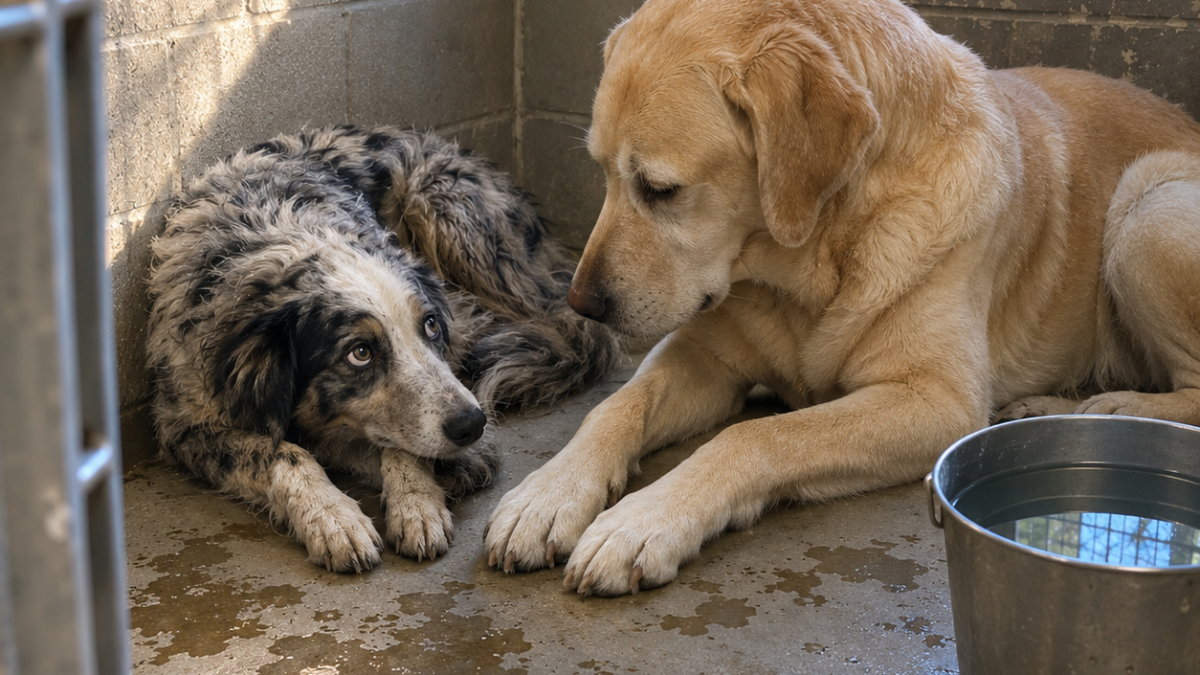
The bucket was almost full.
It was heavy enough that I used both hands when I carried it.
Sam was eleven years old. His hips bothered him in cold weather, and some mornings he needed several seconds just to stand.
But he pulled.
The bucket scraped across the concrete.
Luna flinched at the sound.
Sam stopped immediately.
He looked at her.
Then he waited.
That was the part that stayed with me.
He didn’t force the bucket closer.
He didn’t keep dragging it while she panicked.
He waited until her breathing slowed.
Then he pulled again.
Scrape.
Pause.
Scrape.
Pause.
Water sloshed over the rim and darkened the floor.
Sam’s legs trembled with the effort.
“Sam,” I whispered.
He ignored me.
He dragged the bucket another six inches.
Then another.
By the time he reached Luna, almost a quarter of the water had spilled out.
His breathing was heavy.
He released the handle.
The bucket landed directly in front of Luna.
Close enough that she could reach it without standing.
Sam backed away.
He didn’t drink.
He didn’t sniff her.
He simply lowered himself onto the floor about three feet away and looked at her.
Luna stared at the bucket.
Then she stared at Sam.
Nothing happened.
Thirty seconds passed.
Then a minute.
I stayed completely still.
“Come on,” I whispered so softly that I could barely hear myself.
Luna lowered her head.
Then she jerked it back.
Sam didn’t move.
She tried again.
Her nose reached the edge of the bucket.
She froze.
I could see her nostrils moving.
Then her tongue touched the water.
One lick.
She pulled away.
My hands flew to my mouth.
Sam’s tail thumped once against the floor.
Luna looked at him.
Then she drank again.
Two laps.
Three.
Then suddenly it was as if her body remembered how thirsty it was.
She began drinking.
Not frantically.
Not enough to make herself sick.
But steadily.
Carefully.
Her tongue moved through the water while Sam lay beside her.
I had been trying not to cry for three days.
I lost that battle right there.
I sat on the floor outside kennel seven with tears running down my face while an eleven-year-old Labrador watched a frightened Australian Shepherd drink water.
There was no miracle music.
No applause.
No dramatic rescue team rushing into the room.
Just an old dog, a dented metal bucket, and a terrified animal taking one small step back toward life.
When Luna finished, she lifted her head.
Water dripped from her muzzle.
She looked at Sam.
Sam slowly lowered his head back onto his paws.
His job, apparently, was done.
I called our veterinarian.
“She drank.”
There was silence on the other end.
“On her own?”
“Mostly.”
“Mostly?”
I looked through the kennel door at Sam.
“She had help.”
The veterinarian came by later that morning and gave Luna another examination. Her gums still showed dehydration, so we continued supportive care, but voluntary drinking changed everything.
It meant she hadn’t completely given up.
That afternoon, she ate a small amount of boiled chicken.
Sam ate first.
Luna watched him.
I placed her bowl several feet away from me and stepped back.
She didn’t touch it.
Sam finished his meal, walked toward Luna’s bowl, then stopped before reaching it.
He looked at her.
The message seemed almost ridiculous to describe.
But I swear it was there.
Your turn.
Luna stretched her neck forward.
She took one piece of chicken.
Then another.
By evening, half the bowl was gone.
That was how their friendship began.
Not with playing.
Not with licking faces.
Not with sleeping curled together.
It started with permission.
Sam seemed to understand something the rest of us didn’t.
Luna didn’t need to be shown that food and water existed.
She needed someone to show her that she was allowed to have them.
Over the next week, I watched him teach her things I had spent years trying to teach frightened dogs.
The first was how to walk through a doorway.
Luna hated doors.
The moment one opened, she froze.
She would lower herself toward the ground and stop moving.
We didn’t know why.
Maybe someone had dragged her through one.
Maybe she had spent years behind one.
Maybe the sound of a latch meant something terrible in the place she came from.
We stopped trying to guess.
Guessing didn’t help her.
Patience did.
Every morning, Sam walked through the kennel door first.
Slowly.
Casually.
No one touched Luna.
No one pulled her leash.
We simply waited.
The first morning, she didn’t follow.
The second morning, she moved one paw beyond the threshold.
On the third, two.
By the sixth day, she followed Sam into the exercise yard.
The sun hit her face.
She stopped.
For a moment I thought she was going to retreat.
Then Sam lowered himself into the grass.
He rolled onto his side.
The old fool actually groaned with pleasure.
Luna stared at him.
Then she looked at the sky.
I will never forget the way she lifted her nose.
It was such a small thing.
She smelled the air.
That was all.
But dogs who are truly terrified don’t explore the world.
They survive it.
That morning, Luna explored.
She smelled grass.
She watched a bird land on the fence.
She stared at a leaf blowing across the yard.
And when Sam stood up and slowly walked toward the shade, she followed.
Two weeks after Luna arrived, she allowed me to touch her for the first time.
I wasn’t trying to.
That mattered.
I was sitting on the floor changing Sam’s bedding.
Luna had started spending more time near him. She still kept several feet between herself and people, but she didn’t immediately retreat anymore.
Sam came over and pushed his broad head beneath my hand.
“Oh, now you want attention?” I said.
His tail moved.
I scratched behind his ears.
Luna watched.
Sam leaned harder against me.
“You’re shameless.”
He looked pleased with himself.
Then I felt something touch my elbow.
I froze.
Luna’s nose.
She had stretched forward far enough to smell my sleeve.
I didn’t turn around.
I didn’t reach for her.
For almost a minute, I pretended nothing was happening.
Then her nose touched my arm again.
I lowered my hand to the floor, palm down.
Luna smelled my fingers.
Sam was watching both of us.
Slowly, Luna moved her head beneath my hand.
I touched the top of her head.
Her entire body went rigid.
I immediately removed my hand.
“It’s okay.”
She stepped away.
I thought I had ruined it.
But thirty seconds later, she came back.
This time, when I touched her, she stayed.
I cried again.
I was doing a lot of crying around kennel seven.
The breakthrough made me hopeful.
Maybe too hopeful.
Because healing is rarely a straight line.
Three days later, Luna had her first major setback.
One of our maintenance workers dropped a metal shovel outside the kennel room.
The crash echoed through the building.
Luna screamed.
I don’t mean she barked.
I mean she made a sound I had heard only a few times in my entire career.
Pure terror.
She threw herself against the back wall, scrambling desperately for somewhere to escape.
“Luna!”
I rushed toward her.
That made it worse.
She snapped at the air.
Not at me.
At everything.
She was gone.
Not physically.
Mentally.
Whatever she was seeing wasn’t the shelter.
I stopped moving.
“Everybody out,” I said.
The volunteers backed away.
Sam stood in the middle of the kennel.
Luna was panting so hard that strings of saliva hung from her mouth.
Sam walked toward her.
She snarled.
He stopped.
He didn’t retreat.
He simply lowered himself to the floor.
Luna kept trembling.
Sam placed his head on his paws.
Five minutes passed.
Then ten.
Luna’s breathing slowly changed.
She looked around.
Her eyes found Sam.
Eventually she crawled toward him.
She didn’t touch him.
She lay down beside him with perhaps six inches between them.
And she slept.
That night, I sat in my car after my shift and wondered what had been done to her.
I hated whoever had taught that dog to react to a sound like that.
I hated the idea of someone standing over her while she cowered.
But hatred was useless unless it helped Luna.
I made myself a promise.
If we ever discovered where she came from, I wouldn’t look for revenge.
I would look for accountability.
There is a difference.
One is about making someone hurt.
The other is about making sure they don’t get the opportunity to hurt another animal.
We didn’t have to wait long.
The man who had found Luna returned to the shelter four days later.
His name was Marcus.
He carried a plastic grocery bag.
“I don’t know if this matters,” he said. “But I went back.”
“Back where?”
“Where I found her.”
He placed the bag on the counter.
Inside was a section of broken nylon rope.
A rusty snap hook was still attached to one end.
My stomach tightened.
Marcus continued.
“There was an old plastic doghouse about fifty yards from the road. Couldn’t see it at night. There’s a vacant property back there.”
“Was she tied there?”
“I don’t know.”
He hesitated.
“But there was another piece of this rope attached to a post.”
We contacted county animal control.
An officer named Hernandez met us at the property the following afternoon.
What we found wasn’t enough to reconstruct Luna’s entire life.
But it explained some of it.
There was an old shed.
A damaged doghouse.
A food bowl containing leaves and dirt.
A blue plastic bucket turned on its side.
And a short chain attached to a post.
Officer Hernandez photographed everything.
“Property records show someone rented this place until last month,” he said.
“Do you have a name?”
He nodded.
I won’t use that man’s real name.
I’ll call him Travis.
Hernandez contacted him.
At first, Travis claimed he had never owned an Australian Shepherd.
Then animal control found veterinary records.
Luna had been taken to a low-cost vaccination clinic twice as a puppy.
Her name in those records wasn’t Luna.
It was Blue.
The records listed Travis as her owner.
When confronted with that, his story changed.
He said she had run away.
Then Marcus told the officer exactly where he had found Luna.
Less than fifty yards from the property.
Travis changed his story again.
He said he had given the dog away.
He couldn’t remember the name of the person.
He didn’t have a phone number.
He didn’t have a message.
He didn’t have a bill of sale.
Nothing.
For Luna’s sake, I wish that was the end of it.
It wasn’t.
Travis came to the shelter.
I was cleaning kennels when I heard a man arguing at the front desk.
“That’s my dog.”
My body went cold.
I walked into the lobby.
He was probably in his mid-thirties, wearing work boots and a dark jacket.
“I’ve already told you,” our receptionist said, “animal control placed a hold on the dog while the case is being reviewed.”
“I don’t care about your hold. She’s mine.”
I stepped behind the desk.
“Are you Travis?”
His eyes narrowed.
“Who are you?”
“I’m the shelter manager.”
“Then get my dog.”
“Animal control has instructed us not to release her.”
He slapped one hand on the counter.
“She’s a stupid dog. She gets scared of everything. Nobody else is going to want her.”
I felt something harden inside me.
Not rage.
Something colder.
“Then why are you here?”
His mouth opened.
Nothing came out.
I had seen this before.
For certain people, ownership had nothing to do with love.
It was control.
The idea that Luna had escaped his control mattered more to him than Luna herself.
He pointed toward the kennel hallway.
“Bring her out.”
“No.”
“She’s property.”
“Not while she’s under a legal hold.”
He leaned closer.
“I paid for that dog.”
“And right now, that doesn’t change anything.”
He started shouting.
Our receptionist reached for the phone.
Then a sound came from behind me.
A growl.
Low.
Deep.
I turned.
Sam was standing in the hallway.
One of our volunteers had been moving him toward the exercise yard.
He had stopped when he heard the argument.
Luna was behind him.
The instant Travis saw her, he pointed.
“Blue!”
Luna collapsed.
Her legs simply folded beneath her.
Every doubt I had disappeared.
Travis took a step forward.
Sam moved between them.
I had never heard Sam growl before.
Not once.
His body was old.
His muzzle was gray.
His hips were stiff.
But at that moment, he looked enormous.
Travis stopped.
“Control your dog.”
I moved in front of Sam.
“Leave.”
“That’s mine.”
“Leave now.”
Officer Hernandez arrived several minutes later.
He had already been on his way after our receptionist called.
Travis left without Luna.
The investigation continued.
I won’t pretend he went to prison for years or that some judge handed down a dramatic sentence.
Real life doesn’t always give you that kind of ending.
But he did face consequences.
The county documented the abandonment and neglect.
He was fined.
He surrendered any claim to Luna.
And, most importantly to me, restrictions were placed on his ability to legally keep another dog while the case remained active.
It didn’t feel like enough.
People asked me later whether I wanted something worse to happen to him.
Part of me did.
The part of me that had watched Luna flatten herself against a wall because a shovel fell.
The part of me that had watched her go three days without water even though it was sitting directly in front of her.
But then I would look at kennel seven.
Luna was alive.
She was drinking.
She was eating.
She was learning to run.
She was beginning to understand hands could touch without hurting.
And the man who had taught her fear no longer controlled a single minute of her day.
That became enough.
It became better than revenge.
Three months after Luna arrived, she had gained eighteen pounds.
Her coat had changed.
That surprised me.
When she first came in, it was dull and coarse.
Now the black sections shone.
The white fur around her chest had become thick and soft.
Her blue eyes still carried caution, but they were no longer empty.
She played.
Not often at first.
The first time happened when Sam found a tennis ball.
Sam had never been a particularly enthusiastic retriever, which was ironic considering his breed.
He picked up the ball, carried it halfway across the yard, and dropped it.
Luna stared.
I picked it up.
I rolled it gently.
Sam watched it pass.
“Excellent effort,” I told him.
He looked at me as if retrieving things was beneath him.
Luna took three steps after the ball.
Then stopped.
The next day, she chased it all the way to the fence.
A week later, she brought it back.
I threw it again.
She ran.
I had never seen her run for joy.
Her entire body changed.
Her ears went back.
Her tail streamed behind her.
Her paws barely seemed to touch the grass.
She grabbed the ball, spun around, and raced toward us.
Sam stood waiting.
Luna overshot him, skidded, turned, and barked.
Sam barked back.
Then the two of them ran.
Well, Luna ran.
Sam moved at something between a trot and a determined shuffle.
It was still the fastest I had seen him move in months.
I laughed so hard that one of the volunteers came outside to see what was happening.
“What?”
I pointed.
“Look.”
She watched Luna bounce around Sam.
“Is that the same dog?”
“Yep.”
She smiled.
“No way.”
Exactly.
No way.
Yet there she was.
That should have been the easy part of the story.
Luna was healthier.
The legal case was settled.
She was officially available for adoption.
Now someone simply had to take her home.
Except there was a problem.
Sam.
By then, Luna’s attachment to him had become obvious.
If Sam went outside, she followed.
If he slept, she slept nearby.
If a stranger approached, Luna checked Sam’s reaction before deciding what to do.
When he was calm, she could be brave.
When he wasn’t there, some of her old behaviors returned.
That became painfully clear when Sam had to spend a day at the veterinary clinic for bloodwork.
He left at eight in the morning.
By nine, Luna had stopped eating.
By ten, she was pacing.
At noon, she was pressed against the kennel door, staring toward the hallway.
When I sat with her, she leaned against me, which was progress.
But she never stopped watching the entrance.
At four-thirty, I heard the clinic van.
Luna heard it before I did.
She stood.
Her ears lifted.
Sam walked through the door wearing a ridiculous blue bandage on one leg.
Luna lost her mind.
She barked.
She jumped.
She spun in circles.
She ran toward him, stopped herself, ran away, came back, and finally pressed her face against his neck.
Sam looked exhausted.
He licked one of her ears.
Then he walked toward the water bucket.
Luna followed.
That evening I updated their adoption files.
Under Luna’s profile, I added one sentence:
Strong preference for placement with Sam.
The next morning, our director read it.
“You know what that does to their chances.”
“I know.”
“People don’t usually walk into a shelter looking for two dogs. Especially one senior and one with trauma.”
“I know.”
“Sam is eleven.”
“I know.”
She sighed.
“You really think separating them is wrong?”
I looked through the window.
Luna was asleep.
Her head was resting against Sam’s side.
“Yes.”
My director stared for a long time.
Then she nodded.
“Okay.”
Weeks passed.
People came.
They loved Luna’s photographs.
Australian Shepherds are beautiful dogs.
Visitors saw the blue eyes, the coat, the graceful body.
Then we explained.
She needed patience.
She could shut down around loud noises.
She didn’t do well when pushed.
And we wanted her adopted with an eleven-year-old Labrador who had arthritis.
Interest disappeared.
One couple spent nearly an hour with Luna.
She did well.
They knelt in the yard.
She approached.
She even accepted a treat from the woman’s hand.
Then they met Sam.
“He’s sweet,” the husband said.
“He is.”
“But we’re really looking for one dog.”
“I understand.”
“Could Luna adjust without him?”
The answer that would have made adoption easier was yes.
I couldn’t say it.
“Eventually, maybe.”
The wife looked hopeful.
“But?”
“But Sam taught her how to drink water.”
They both went quiet.
I told them the story.
When I finished, the woman wiped her eyes.
“We can’t take two.”
“I understand.”
They left without Luna.
That night, I wondered whether I had made a mistake.
Shelters exist to place animals in homes.
Had I become too emotional?
Was I asking for an impossible adoption because I couldn’t tolerate separating two dogs?
I sat inside kennel seven after closing.
“You two are making my job difficult.”
Sam slept.
Luna placed one paw on my shoe.
“That’s not an apology.”
Her tail moved.
I scratched her chest.
“Fine.”
Two more weeks passed.
Then Margaret called.
Sam’s former owner.
I had never spoken to her directly.
Her granddaughter had handled his surrender because Margaret’s health had been poor.
Her voice on the phone was thin but clear.
“Is he still there?”
I looked at Sam.
“Yes, ma’am.”
“Nobody’s taken him?”
“Not yet.”
There was a long silence.
Then she said, “Is he unhappy?”
That question hurt.
“No.”
“Don’t protect me.”
“I’m not.”
“Does he still wait by doors?”
Sometimes.
I couldn’t tell her that.
Instead I said, “He’s made a friend.”
“A person?”
“A dog.”
I told her about Luna.
I told her about the water.
I told her about the doorways.
The grass.
The tennis ball.
Margaret didn’t speak for so long that I thought the call had disconnected.
Then I heard her crying.
“He always did that.”
“Did what?”
“Take care of things.”
I smiled.
“You’ll have to explain.”
“When my husband was dying, Sam was only three. Robert couldn’t get out of bed near the end. Sam carried his slippers into the bedroom every morning.”
I closed my eyes.
“He brought them even when Robert couldn’t wear them anymore.”
She gave a small, broken laugh.
“After Robert died, Sam brought them to me.”
I looked through the glass.
Sam was sleeping beside Luna.
“He didn’t know how to fix things,” Margaret said. “So he carried whatever he thought might help.”
I had to turn away from the front desk.
“Apparently he hasn’t changed.”
“Would you do something for me?”
“Anything I can.”
“Don’t separate them.”
My throat tightened.
“I wasn’t planning to.”
“Promise me.”
“I promise.”
“And if you find someone who can love them both, don’t keep him here because of me.”
“I won’t.”
“I had eleven years.”
She paused.
“That little girl sounds like she needs whatever time he has left.”
I cried after we hung up.
Again.
Kennel seven was destroying my reputation.
The call also changed something else.
Margaret’s granddaughter, Emily, asked whether she could visit Sam.
She came that Saturday.
When Sam saw her, he stood so quickly that his rear paws slipped.
Emily dropped to her knees.
“Hey, old man.”
Sam crossed the room.
She wrapped both arms around him.
He buried his face against her shoulder.
Luna stood ten feet away, uncertain.
Emily noticed.
“That’s her?”
“That’s Luna.”
“The water dog.”
I smiled.
“That’s one way to put it.”
Emily sat on the floor with Sam for almost an hour.
Eventually Luna approached.
She sniffed Emily’s hair.
Emily didn’t move.
Then Luna sat beside Sam.
“I understand now,” Emily whispered.
“What?”
“Why Grandma said they stay together.”
She looked at me.
“She wants to see him.”
The nursing facility still didn’t allow resident pets.
But they did allow scheduled animal visits in an outdoor courtyard.
The following Tuesday, we loaded Sam into the shelter van.
Luna climbed in behind him.
Technically, the visit had been arranged for Sam.
I brought Luna anyway.
I wasn’t leaving her behind.
Margaret was waiting in a wheelchair beneath a maple tree.
She looked smaller than I expected.
A blanket covered her legs.
Her hands trembled.
Sam spotted her from thirty feet away.
He stopped.
For one second, nobody moved.
“Sammy,” Margaret said.
The old Labrador ran.
Actually ran.
His leash slipped through my hand.
“Sam!”
He crossed the courtyard, reached Margaret’s wheelchair, and pushed his head into her lap so hard that she laughed.
Then she cried.
Then everyone cried.
Even the nurse.
Margaret held his face between her hands.
“You got old.”
Sam licked her chin.
“So did I.”
Luna stood beside me.
She watched.
Margaret looked over.
“Bring her.”
I walked closer.
Luna hesitated.
Sam returned to her.
He touched his nose to her shoulder.
Luna moved forward.
Margaret extended one hand.
Luna stopped.
“That’s all right,” Margaret said. “Nobody’s going to make you do anything anymore.”
I looked at her.
She had never met Luna.
But somehow, she understood.
Luna took one step.
Then another.
She smelled Margaret’s fingers.
Margaret didn’t touch her.
She simply left her hand there.
Luna moved closer.
Finally, she lowered her head into Margaret’s palm.
Margaret’s eyes filled with tears.
“Oh, Sam.”
Her fingers moved gently through Luna’s fur.
“You found somebody else who needed you.”
Sam sat beside the wheelchair.
Margaret looked at me.
“Now you find somebody who deserves both of them.”
I promised I would.
Three weeks later, a man named Daniel Foster walked into the shelter.
He was sixty-two.
Recently retired.
Recently widowed.
He lived alone on several fenced acres outside town.
He wasn’t looking for an Australian Shepherd.
He wasn’t looking for a Labrador.
Actually, he claimed he wasn’t sure he was looking for a dog at all.
“My daughter thinks this is a good idea,” he said.
“Do you?”
“I haven’t decided.”
I liked him immediately.
People who arrived saying, “I need a dog today,” sometimes worried me.
Daniel asked questions.
How long had the dogs been here?
Which dogs struggled most?
Which ones were being overlooked?
Then he asked the question that changed everything.
“Do you have any that shouldn’t be separated?”
I stared at him.
“What?”
“Bonded dogs.”
“Why?”
Daniel shrugged.
“I’ve got space.”
I took him to kennel seven.
Sam came to the front.
Luna stayed back.
Daniel crouched.
“Who’s who?”
“Sam’s the Lab.”
“I figured.”
“And Luna is the Australian Shepherd.”
“She’s scared.”
“Not as much as she used to be.”
Daniel watched her.
He didn’t call her.
Didn’t whistle.
Didn’t reach.
He sat down.
Sam walked over.
Daniel scratched his chest.
“You’re old.”
Sam wagged.
“So am I.”
Luna watched.
Ten minutes passed.
Daniel talked to Sam.
Not Luna.
That was exactly right.
Eventually Luna approached.
She smelled his shoe.
Then his knee.
Then his hand.
Daniel kept talking to Sam.
“You know, I had a Lab once. Ate half a couch.”
Sam yawned.
“You’re judging me.”
Luna came closer.
Daniel finally looked at her.
“Hello.”
Luna backed away.
Daniel immediately looked back at Sam.
No pressure.
No disappointment.
Nothing.
I felt hope rising inside me, and I tried to kill it before it got too large.
Daniel stayed for almost two hours.
Before he left, he asked, “What’s the catch?”
I smiled.
“There are several.”
“Good.”
I explained Luna’s fear.
Her history.
The noise sensitivity.
The possibility of setbacks.
Then Sam’s arthritis.
His age.
The fact that adopting an eleven-year-old dog meant accepting that your time might be measured differently.
Daniel’s expression changed.
“I understand that part.”
His wife had died seven months earlier.
Cancer.
He didn’t say much more.
He didn’t have to.
Before he left, he looked through the kennel door.
“If I do this, I take both.”
“Yes.”
“No negotiation?”
“No.”
“Good.”
He returned the next day.
Then again.
On his fourth visit, Luna placed her head on his knee.
Daniel looked at me.
“Does that mean what I think it means?”
“It means don’t move.”
He laughed.
Luna stayed there for almost five minutes.
The adoption took another week.
We did a home visit.
Daniel’s property was quiet.
Large fenced yard.
No neighboring dogs screaming through fences.
No young children.
His house had wide doorways and rugs over the hardwood floors so Sam wouldn’t slip.
He had already bought two beds.
“You haven’t even been approved yet,” I said.
“I kept the receipt.”
We approved him.
Adoption morning felt wrong.
After months with them, I thought I would be happy.
I was.
But happiness can hurt.
I packed Sam’s blanket.
Luna’s favorite rope toy.
Medication.
Food.
Veterinary records.
And the dented metal water bucket.
Daniel picked it up.
“This going too?”
“Definitely.”
He turned it over in his hands.
“This is the bucket?”
“That’s the one.”
He looked at Luna.
She was standing beside Sam.
“I guess this belongs in the family.”
When it was time to leave, Sam walked toward the van.
Old habit.
I redirected him toward Daniel’s truck.
“No, buddy.”
He looked at me.
“You’re going home.”
I crouched.
Sam came over.
I buried both hands in the thick fur around his neck.
“Take care of her.”
His tail moved.
Luna stood behind him.
I opened my arms.
Months earlier, that would have sent her running.
Now she walked into them.
I held her.
For maybe three seconds.
Then five.
She smelled like shampoo and grass.
“You never needed permission to be alive,” I whispered into her fur.
“I wish somebody had told you sooner.”
She pulled away.
Then she licked my chin.
It was the first time she had ever done that.
Daniel pretended not to notice me crying.
I appreciated him for it.
Sam climbed into the truck with help.
Luna jumped in behind him.
Daniel closed the door.
Then he rolled down the window.
“I’ll send pictures.”
“You better.”
The truck pulled away.
Luna stood with her front paws on the back seat.
Sam sat beside her.
I watched until the truck disappeared.
Kennel seven was empty.
For the first time in months, I couldn’t stand being inside it.
The first photograph arrived forty-three minutes later.
Luna was asleep on Daniel’s couch.
Sam was asleep on the floor below her.
The caption said:
Made it 12 minutes before breaking the no-dogs-on-the-couch rule. I blame her.
The second came that evening.
Two bowls.
Two dogs.
Both eating.
A week later, Daniel sent a video.
Luna was running across his field with a tennis ball.
Sam was standing beneath a tree.
She raced past him.
Turned.
Came back.
Dropped the ball at his feet.
Sam picked it up.
Then walked away with it.
Luna looked offended.
I watched that video six times.
There were setbacks.
Of course there were.
A thunderstorm sent Luna hiding in the bathroom.
Daniel sat outside the doorway for two hours.
A neighbor fired a nail gun one afternoon, and Luna refused to go outside until evening.
Sam stayed with her.
Daniel never dragged her.
Never forced her.
Never said, “She should be over this by now.”
That sentence destroys more progress than people realize.
Trauma doesn’t care how much time has passed.
Healing isn’t forgetting.
Healing is learning that what happened before doesn’t have to happen again.
Six months after the adoption, Daniel brought them back to visit.
Luna walked through the front door of the shelter.
I expected hesitation.
She paused.
Looked down the hallway.
Then walked inside.
Sam followed.
I knelt.
“Luna.”
She saw me.
Her entire body began moving.
Not just her tail.
Her body.
She ran toward me.
She hit me hard enough to push me backward onto the floor.
I laughed while she licked my face.
“This is extremely undignified.”
She disagreed.
Sam arrived several seconds later.
“Don’t think I forgot you.”
I hugged him.
He felt thinner.
Older.
“How’s he doing?” I asked Daniel.
“Good. Slower.”
I looked at Sam.
The white around his muzzle had spread.
His eyes were still bright.
Daniel had started him on additional arthritis medication.
He was comfortable.
But time was doing what time does.
Luna knew it too.
She waited for him more now.
On walks, she would run ahead and then turn back.
If he stopped, she stopped.
If he slept, she stayed nearby.
The dog who once depended on him had become his shadow.
Nearly a year after Luna first came to us, Daniel called me.
His voice was strange.
Not panicked.
Emotional.
“You need to see something.”
“What happened?”
“Nothing bad.”
Those are wonderful words when you work with animals.
He sent me a video.
It was summer.
Hot.
Sam was lying on the porch.
Daniel had placed several water bowls around the property, but apparently Sam had decided not to get up.
Luna walked to the yard.
She drank.
Then she looked back at Sam.
She looked at the bowl.
Then Sam.
I already knew what was coming.
“No,” I whispered.
Luna bent down.
The water wasn’t in the old metal bucket anymore.
Daniel had switched to a lightweight plastic bowl.
Luna caught the rim between her teeth.
She lifted.
Water spilled down her chest.
She dropped it.
Tried again.
The bowl scraped across the porch.
Sam raised his head.
Luna dragged it closer.
A few inches.
Stopped.
Adjusted her grip.
Dragged again.
By the time she reached Sam, half the water was gone.
She dropped the bowl in front of him.
Then she stepped back.
Sam looked at her.
Luna sat down.
For several seconds, he did nothing.
Then he drank.
I watched the video again.
And again.
And again.
Daniel called me after sending it.
“Did you teach her that?”
“No.”
“Did Sam?”
I looked at the frozen image on my phone.
Luna sitting beside an old Labrador drinking from a bowl she had brought him.
“Maybe.”
Daniel grew quiet.
“Or maybe she remembered.”
That was the answer.
She remembered.
Not every memory had to be terrible.
That was the part of Luna’s story I had almost forgotten.
Trauma leaves memories.
But so does love.
Someone had once taught Luna that water could be something she was afraid to approach.
Sam replaced that memory.
Someone had taught her that hands were dangerous.
We replaced that memory too.
Someone had taught her that doors led somewhere frightening.
Daniel taught her doors could lead into a home.
And eventually, Luna had enough good memories to begin giving them back.
She never became a fearless dog.
I want to be clear about that.
Real rescue stories don’t always end with broken animals becoming perfect.
Luna still disliked sudden metal noises.
She still watched strangers carefully.
She still sometimes left the room when men with deep voices entered.
But she also chased tennis balls.
She slept upside down on Daniel’s couch.
She barked at squirrels.
She stole toast.
She learned the sound of Daniel’s truck.
She visited Margaret twice with Sam before Margaret’s health deteriorated.
On their final visit, Margaret sat beneath the same maple tree.
Sam rested his head in her lap.
Luna lay across her feet.
Margaret looked at me.
“Remember when you told me she wouldn’t drink?”
“Yes.”
She smiled.
“Look at her now.”
Luna was asleep.
Completely asleep.
Belly exposed.
Paws twitching.
Vulnerable.
Safe.
“She finally believes she’s staying,” Margaret said.
I think that was the moment I understood what Sam had really done.
He hadn’t just moved a bucket.
He had challenged the single belief that controlled Luna’s entire world.
That she was alone.
That no one would help.
That she wasn’t worth helping.
Sam didn’t know anything about behavioral rehabilitation.
He didn’t understand neglect laws.
He didn’t know what trauma meant.
He didn’t know Luna’s history.
He simply saw another dog who could not reach what she needed.
So he brought it closer.
Maybe love is sometimes that simple.
Not fixing everything.
Not demanding trust.
Not asking someone to become brave before they’re ready.
Just moving the water a little closer.
Sam turned thirteen the following spring.
Daniel sent us a photograph of him wearing a ridiculous birthday hat.
Luna was beside him.
She had apparently stolen half of his dog-safe birthday cake.
Her expression suggested no remorse.
Sam’s hips had become weaker.
He slept more.
Daniel had built a ramp off the porch.
Luna no longer sprinted far ahead on walks.
She matched his pace.
One step.
One step.
One step.
The young dog who once had to be taught how to walk through a doorway now slowed herself so the old dog who taught her could keep up.
That was justice.
Not the fine Travis paid.
Not the investigation.
Not the fact that he lost his claim to her.
Those things mattered.
Accountability matters.
But when people asked me whether I ever wished I could have made the person who hurt Luna understand exactly what he had done, I thought about that porch.
I thought about Luna dragging water toward Sam.
And I realized the most complete revenge wasn’t suffering.
It was irrelevance.
Travis had once controlled Luna’s food.
Her water.
Her movement.
Her fear.
Now he controlled nothing.
He didn’t decide where she slept.
He didn’t decide whether she ate.
He didn’t decide whether she could walk through a door.
He didn’t decide whether she could be loved.
He had disappeared from her story.
Sam hadn’t.
Daniel hadn’t.
Margaret hadn’t.
Neither had I.
The people who hurt Luna became a shrinking chapter.
The ones who loved her became the rest of the book.
Two years after the day Sam dragged that bucket across kennel seven, I visited Daniel’s house.
Sam was fourteen.
Very old for a Labrador.
He was lying in the shade beside the porch.
Luna saw my car and raced toward the gate.
She jumped against it.
“Hey, trouble.”
Daniel opened the gate.
Luna pressed against my legs.
Then she ran back toward Sam.
She stopped beside him.
Waited.
Sam slowly stood.
Every movement took effort.
But when he saw me, his tail moved.
Once.
Twice.
That was enough.
I sat in the grass beside him.
He placed his head on my lap.
Luna lay on his other side.
Daniel brought lemonade.
We sat beneath the trees while the afternoon passed.
There was no emergency.
No crisis.
No frightened dog.
No angry owner.
No legal case.
Just three people and two dogs in the shade.
Eventually Sam became thirsty.
He lifted his head.
Before he could stand, Luna did.
She walked toward the porch.
The old metal bucket was sitting beside the steps.
Daniel still kept it.
It wasn’t their main water container anymore.
It was too heavy.
Too dented.
Too impractical.
But he kept fresh water in it anyway.
Luna walked over.
She looked at Sam.
Then at the bucket.
Daniel laughed quietly.
“Watch.”
She grabbed the handle.
The bucket scraped across the porch.
Sam’s ears moved.
Luna pulled.
The same horrible metal sound echoed through the yard.
Once, a noise like that might have sent her running.
Now she was the one making it.
She dragged the bucket down the ramp.
Water splashed everywhere.
She reached the grass.
Pulled again.
Finally, she dropped it near Sam.
He drank.
Luna sat beside him.
I couldn’t speak.
Daniel looked at me.
“You okay?”
I nodded.
“No.”
He understood.
We both laughed.
Then I cried.
Of course I did.
Luna looked at me as though humans were exhausting.
Maybe we are.
When Sam finished drinking, Luna leaned down and drank beside him.
Two dogs.
One bucket.
The old Lab who had carried water toward a frightened stranger.
And the dog who had once believed she didn’t deserve a single drop.
There are moments in rescue work that stay with you because they’re terrible.
You remember the animals you couldn’t save.
You remember empty cages.
You remember arriving too late.
But there are other moments that stay for the opposite reason.
They remind you why you kept coming back.
For me, it will always be kennel seven.
An eleven-year-old Labrador.
A frightened Australian Shepherd.
A metal bucket scraping across concrete.
And one old dog deciding that if Luna couldn’t make it to the water, then the water would simply have to come to Luna.
Sam didn’t save her by fighting anyone.
He didn’t save her by barking.
He didn’t save her with strength.
He saved her with patience.
He showed her the water.
Then he backed away.
He waited.
And he allowed her to choose life for herself.
Years later, Luna returned the favor.
Maybe that was the most beautiful part.
Because the first time Sam carried water to her, Luna was a dog who believed she had nothing to give.
The day she carried it back, she proved how wrong that belief had always been.
Someone had tried to teach her that she was worthless.
Sam taught her otherwise.
Someone had taught her fear.
Daniel taught her safety.
And Luna eventually taught all of us something too.
The best revenge against the people who tried to break you isn’t becoming crueler than they were.
It is building a life so full of love that what they did no longer gets to define who you are.
Luna survived.
Then she trusted.
Then she loved.
And finally, she became the one carrying the water.
The first few weeks at Daniel’s house were quieter than any of us expected.
That didn’t mean they were easy.
When people heard that Luna had finally been adopted, they imagined the difficult part was over. I understood why. Rescue stories are usually told that way. A frightened dog enters a shelter, somebody loves her, she finds a home, and the story ends with a photograph of her sleeping on a couch.
But adoption isn’t always the ending.
Sometimes it’s the beginning of the hardest part.
At the shelter, Luna had learned the rhythm of our world. She knew my footsteps. She knew which doors opened at what time. She knew Sam’s bed was three feet from hers. She knew where the water bucket stood.
Daniel’s house was safe, but Luna didn’t know that yet.
To her, it was simply another unfamiliar place.
On the first night, Daniel sent me a message around eleven.
She won’t come inside.
I called immediately.
“What happened?”
“She followed Sam onto the porch, but when I opened the door, she froze.”
“Don’t pull her.”
“I haven’t.”
“Don’t lure her too hard either.”
“So what do I do?”
“Let Sam decide.”
There was a pause.
“You really think he knows?”
I smiled.
“Daniel, Sam knows more about Luna than either of us.”
He left the door open.
Sam had already gone inside and settled on the rug.
Daniel sat in a chair across the room and pretended not to watch.
For nearly forty minutes, Luna stood on the porch.
Then she placed one paw across the threshold.
She pulled it back.
A few minutes later, she tried again.
Daniel didn’t say anything.
Sam didn’t move.
Eventually Luna crossed the doorway.
She walked straight to Sam and lay down beside him.
Daniel closed the door only after she had fallen asleep.
The next morning, he sent me a picture.
The two dogs were sleeping on the same rug.
Luna’s back was pressed against Sam’s side.
I stared at that photograph for a long time.
She had spent so much of her life believing that doors trapped her.
Now she had walked through one by choice.
That mattered.
But there were still things we didn’t understand.
The water problem returned three days after the adoption.
Daniel called around noon.
“She hasn’t touched the bowl since breakfast.”
I felt my stomach tighten.
“Where is it?”
“In the kitchen.”
“Anything happen near it?”
“I dropped a pan this morning.”
There it was.
The connection.
Metal.
Noise.
Water.
Daniel sounded frustrated with himself.
“I scared her.”
“You didn’t know.”
“What do I do?”
“Move the bowl somewhere quieter. Then leave it alone.”
“And Sam?”
“Put another bowl near him.”
An hour later, Daniel sent a short video.
Sam was drinking from a bowl on the porch.
Luna stood behind him.
He finished.
She approached.
And drank.
It was a reminder that healing wasn’t a staircase.
It was more like a trail through a forest.
Sometimes you moved forward.
Sometimes you circled back to the same place.
Sometimes you thought you were lost when really you were seeing an old landmark from a different angle.
Daniel learned quickly.
He stopped thinking of Luna’s reactions as bad behavior.
When she hid, he didn’t drag her out.
When she refused to enter a room, he didn’t force her.
When she barked at a visitor, he didn’t punish her.
He asked a different question.
“What is she afraid will happen?”
That question changed everything.
One afternoon, a delivery driver came to the house carrying a large box.
Luna saw the man through the window.
She began barking.
The driver knocked.
Luna backed away from the door.
When he raised the box to adjust his grip, she dropped to the floor.
Daniel noticed immediately.
He asked the driver to leave the package outside.
Then he waited.
After the truck disappeared, Luna crawled toward Sam.
Daniel called me.
“She was scared of the box.”
“Maybe.”
“You think someone hit her with something?”
“Maybe.”
“I hate not knowing.”
“So do I.”
That was one of the hardest things about Luna.
We would never have every answer.
There was no complete history.
No witness.
No diary explaining what had happened.
Only behavior.
Only scars.
Only fragments.
And fragments can haunt you because your mind wants to fill in the missing pieces.
I learned not to.
Imagining worse things didn’t help Luna.
Building better things did.
Daniel built routines.
Breakfast at seven.
A walk after sunrise.
Quiet afternoons on the porch.
Dinner at six.
No shouting in the house.
No sudden grabbing.
No punishment.
No surprises if he could avoid them.
And gradually, Luna stopped living as if disaster were always seconds away.
The biggest change came when she discovered Daniel’s bedroom.
For almost a month, she refused to go inside.
Sam slept there every night beside the bed.
Luna slept in the hallway.
Daniel never invited her closer.
Then one night, during a thunderstorm, he woke to something pressing against his hand.
He opened his eyes.
Luna was standing beside the bed.
Lightning flashed.
She trembled.
Sam was asleep on the floor.
Daniel lowered his hand.
Luna pushed her head beneath it.
He stroked her gently.
She stayed.
Eventually, she lay down beside Sam.
The next morning, Daniel told me, “I think she came to me because she was scared.”
“That’s a good thing.”
“She was terrified.”
“I know.”
“How is that good?”
“Because being afraid and asking someone for comfort are completely different from being afraid and believing you’re alone.”
He was quiet for a moment.
Then he said, “I hadn’t thought of it that way.”
Neither had I, until Luna.
Several months after the adoption, Officer Hernandez called the shelter.
Travis’s neglect case had finally been resolved.
There were fines.
Restrictions.
A formal surrender of ownership.
He was prohibited from reclaiming Luna and required to comply with local animal-control conditions before owning another dog.
It wasn’t the dramatic punishment some people wanted.
There was no courtroom scene where a judge screamed at him.
No handcuffs.
No life-destroying sentence.
Real accountability is often less theatrical.
But Hernandez told me something I hadn’t expected.
During the investigation, they had located a former neighbor.
The neighbor remembered Luna.
Or Blue, as she had been called then.
“She was always tied behind the shed,” Hernandez said.
My grip tightened around the phone.
“For how long?”
“Neighbor isn’t sure. Months, at least.”
“Did anyone report it?”
“He says he called once. There wasn’t enough evidence when an officer came by.”
I closed my eyes.
“Was she being fed?”
“Sometimes.”
That word made me sick.
Sometimes.
A dog doesn’t need water sometimes.
A dog doesn’t need food sometimes.
A living creature cannot survive on someone else’s mood.
Hernandez continued.
“The neighbor also remembered something else.”
“What?”
“Travis used a metal bucket.”
I stopped breathing.
“He said the dog would panic whenever Travis carried it.”
I thought about Luna refusing water.
About the shovel.
The metal noises.
The bucket.
Suddenly those fragments connected in a way I wished they hadn’t.
“What did he do with it?”
“We don’t know.”
Maybe I was grateful for that.
Some details don’t need to be known.
I thanked Hernandez and hung up.
Then I sat alone in my office for almost an hour.
I was angry.
Not the kind of anger that burns quickly.
The kind that sits heavy beneath your ribs.
I wanted Travis to know what he had done.
I wanted him to see Luna hiding from water.
I wanted him to watch an arthritic old Labrador drag a bucket across concrete because the dog he abandoned was too frightened to approach it herself.
I wanted him to understand that whatever he had done hadn’t disappeared when he walked away.
He had left it inside her.
Then I remembered Daniel.
And Sam.
And Luna running through the grass.
Travis didn’t deserve another minute of Luna’s future.
So I didn’t tell Daniel everything immediately.
Not because I wanted to hide it.
Because I wanted to make sure the information served Luna instead of simply hurting the humans who loved her.
When I finally told him, Daniel listened quietly.
Then he asked, “Does knowing this change what she needs?”
I thought about it.
“No.”
“Then I’m not giving that man more space in this house than he already took.”
That became one of my favorite things Daniel ever said.
He wasn’t forgiving Travis.
He wasn’t excusing him.
He simply refused to let cruelty become the center of Luna’s life.
That was the kind of revenge I could believe in.
Luna became happy.
Not happy for a photograph.
Not happy for five minutes.
Actually happy.
She developed habits.
Bad ones.
Wonderful ones.
She stole Daniel’s socks.
She learned how to open the laundry-room door with her nose.
She became obsessed with squirrels.
She started waking Daniel at 5:45 every morning because apparently retirement meant nothing to her.
The first time she barked at him because breakfast was late, he called me laughing.
“You’ve created a monster.”
“I didn’t create anything.”
“She stared at the clock.”
“She cannot read a clock.”
“You don’t live with her.”
Sam had changed too.
For months at the shelter, he had seemed resigned.
Content, perhaps, but resigned.
At Daniel’s house, he had a purpose again.
He followed Daniel into the garage.
He slept beside his chair.
He waited at the gate whenever Daniel checked the mailbox.
But most of all, he watched Luna.
If she ran too far, his eyes followed her.
If she barked, he lifted his head.
If she disappeared behind the shed, he waited until she returned.
And Luna always returned.
By the following winter, Sam’s arthritis had worsened.
He began struggling with stairs.
Daniel built ramps.
Then Sam stopped jumping into the truck.
Daniel bought a folding step.
When that became difficult, he lifted him.
“I told him he’s becoming high maintenance,” Daniel joked.
Sam looked completely unapologetic.
Luna noticed the changes before any of us talked about them.
She stopped knocking into him during play.
She no longer tried to make him chase her.
When they walked through the field, she ran ahead only a short distance before turning back.
Sometimes she returned and touched her nose to his face.
Then she would continue at his pace.
I watched them once during a visit and felt something painful and beautiful settle in my chest.
Sam had spent months slowing himself down for Luna.
Now Luna was slowing down for him.
The roles had changed without anyone teaching her.
That spring, Margaret’s health declined.
Emily called and told us her grandmother was spending more time in bed.
“She keeps asking about Sam.”
Daniel didn’t hesitate.
“We’ll bring him.”
The nursing facility arranged another courtyard visit.
Sam was moving slowly by then.
Daniel helped him out of the truck.
Luna jumped down and waited.
Margaret was already outside.
The second Sam saw her, his tail began moving.
He couldn’t run this time.
But he walked faster.
Margaret held out both hands.
“There’s my boy.”
Sam pressed his head against her knees.
She leaned over him.
Her shoulders shook.
Luna stood several feet away.
Margaret looked toward her.
“And there’s my other girl.”
Luna approached without hesitation.
That alone would have been impossible a year earlier.
She placed her head in Margaret’s lap beside Sam.
Margaret stroked them both.
For a long time, nobody spoke.
Then Margaret whispered, “I worried I abandoned him.”
Emily covered her mouth.
Daniel looked away.
I knelt beside Margaret.
“You didn’t.”
“I promised him I would always take care of him.”
“You did.”
“I sent him away.”
“You found him somewhere safe when you couldn’t care for him anymore.”
Tears ran down her face.
“It didn’t feel like love.”
“Sometimes love doesn’t feel good.”
She looked at me.
“Sometimes love is choosing what hurts you because it protects them.”
Margaret lowered her head.
Sam licked her hand.
She laughed through her tears.
“You always forgive me.”
Luna shifted closer.
Margaret touched Luna’s face.
“And you.”
Luna’s tail moved.
“You take care of my boy now.”
I remember the way Luna looked at her.
Of course she couldn’t understand the words.
But she understood tone.
She understood hands now.
She understood gentleness.
That was enough.
It was the last time Margaret saw Sam.
She died six weeks later.
Emily called me first.
Then Daniel.
That evening, Daniel sat on his porch with Sam and Luna.
He later told me Sam seemed restless.
He kept walking toward the gate.
Then back to the porch.
Then to the gate again.
Maybe it meant nothing.
Maybe dogs don’t sense loss the way we imagine.
Or maybe after eleven years beside Margaret, some part of him knew the world had changed.
Daniel brought out an old blanket Margaret had given Sam.
He placed it on the porch.
Sam lay down on it.
Luna lay beside him.
They stayed there until dark.
After Margaret died, Sam seemed older.
Not suddenly sick.
Just older.
There is a point with senior dogs when age stops being something you notice gradually.
One day you look at them and realize time has moved faster than you thought.
Sam began sleeping more.
His walks shortened.
Daniel moved a water bowl closer to the porch.
Luna became increasingly attentive.
If Sam stood, she stood.
If he went outside, she followed.
If he struggled with the ramp, she waited at the bottom until he reached her.
One afternoon, Daniel called.
“I think she knows.”
“Knows what?”
“That he’s getting old.”
I didn’t answer immediately.
Dogs understand change.
Whether they understand mortality the way we do, I can’t say.
But Luna knew Sam needed her now.
And she took that responsibility seriously.
Then came the day with the water.
It was hot.
Sam had spent most of the afternoon asleep beneath the porch fan.
Daniel had placed water nearby, but sometime during the afternoon the bowl had been moved toward the yard while he was washing it.
Sam woke and lifted his head.
He looked toward the water.
He didn’t stand.
Luna noticed.
Daniel noticed her noticing.
He pulled out his phone.
Luna walked to the bowl.
She drank.
Then she looked back.
Sam was still lying down.
She returned to him.
Sniffed his face.
Then walked back to the bowl.
Daniel told me later he knew what she was going to do before she did it.
“I thought there was no chance.”
Luna lowered her head and gripped the plastic rim.
The bowl tipped.
Water spilled.
She released it.
Looked at Sam.
Tried again.
This time she caught the edge properly.
She dragged it.
The bowl scraped across the porch.
Water sloshed over her paws.
She stopped.
Adjusted.
Pulled again.
It took her almost a minute to move it six feet.
When she finally dropped it beside Sam, barely half the water remained.
Sam raised his head.
Luna backed away.
Exactly the way he had.
Daniel’s hands shook while filming.
Sam looked at the bowl.
Then at Luna.
He drank.
Luna sat beside him.
When Daniel sent me the video, I watched it standing behind the shelter desk.
By the end, I was crying so hard that one of our newer volunteers thought something terrible had happened.
“What’s wrong?”
I turned the phone toward her.
“Nothing.”
She watched.
Then she started crying too.
Within five minutes, four grown adults were standing around a phone crying over two dogs and a water bowl.
I didn’t care.
That video meant more than people understood.
Luna hadn’t just copied Sam.
She had remembered kindness.
Of all the things that had happened to her, that was what she chose to repeat.
Not the fear.
Not the punishment.
Not abandonment.
Kindness.
A few months later, Sam had a bad morning.
Daniel called before sunrise.
“He can’t get up.”
I was dressed and in my car within ten minutes.
By the time I reached the veterinary clinic, Daniel was already there.
Sam lay on a blanket in an exam room.
Luna was beside him.
The veterinarian examined him.
His arthritis had worsened dramatically overnight, and there were concerns about neurological weakness in his hindquarters.
For the first time, I allowed myself to think the thought I had been avoiding.
We might lose him.
Daniel sat on the floor with one hand on Sam’s chest.
Luna paced.
She walked from Sam to the door.
Back to Sam.
To the water bowl.
Back again.
The veterinarian gave medication.
We waited.
An hour passed.
Then Sam tried to stand.
His legs slipped.
Luna moved beside him.
He tried again.
This time he made it.
Daniel exhaled so sharply it sounded like a sob.
Sam stayed standing for perhaps ten seconds.
Then he lowered himself again.
But it was enough.
The veterinarian believed he had suffered an acute pain flare rather than a catastrophic injury.
His medication was adjusted.
He went home that afternoon.
Nobody pretended he was young again.
We simply accepted that every good day mattered more now.
That evening, I sat with Daniel on the porch.
Luna was lying beside Sam.
“What happens when she loses him?” Daniel asked.
There was no good answer.
“She’ll grieve.”
“Will she fall apart?”
“Maybe for a while.”
He stared into the yard.
“I don’t know if I can watch her go backward.”
“She may.”
“That’s what scares me.”
I looked at Luna.
“She won’t go all the way back.”
“How do you know?”
“Because Sam isn’t the only safe thing in her world anymore.”
Daniel looked at me.
“You are.”
He said nothing.
I continued.
“Your house is. This porch is. Her bed is. Her routine is. Emily is. I am. She has a whole life now.”
Daniel rubbed his face.
“He gave her that.”
“He started it.”
Luna lifted her head.
I smiled.
“But she built the rest.”
Sam lived another fourteen months.
Longer than any of us expected.
His world became smaller.
First the long walks disappeared.
Then the field.
Eventually his favorite place became the shaded section of the porch.
Luna never seemed frustrated.
She adapted.
She brought toys to him.
She slept beside him.
Sometimes she ran through the yard and returned as if reporting what she had seen.
Then, one October morning, Daniel called.
This time, I knew from his voice.
Sam had stopped eating.
He had difficulty breathing.
His eyes were tired.
The veterinarian came to the house.
Daniel wanted him home.
I arrived before noon.
Sam was lying on Margaret’s old blanket.
Luna was beside him.
She kept licking his ear.
Daniel sat with one hand resting on Sam’s shoulder.
Nobody said much.
There are moments when words feel disrespectful.
Sam had spent fourteen years in the world.
Eleven with Margaret.
Months at the shelter.
Years with Daniel.
And almost all of Luna’s second life.
The veterinarian explained everything.
Daniel nodded.
Then he looked at me.
“I’m not ready.”
“I know.”
“Is he?”
I looked at Sam.
He was exhausted.
But calm.
“Yes.”
Daniel broke.
He bent over Sam and cried into his fur.
Luna stood.
She pressed herself against Daniel’s side.
Then she lay back down beside Sam.
When the veterinarian administered the final medication, Sam’s breathing slowed.
Daniel held him.
I held Daniel’s shoulder.
And Luna rested her head across Sam’s paws.
His last breath came quietly.
Luna didn’t move.
For nearly ten minutes, she stayed beside him.
Then she stood.
She sniffed his face.
His ears.
His chest.
She walked around him once.
Then lay down again.
I have never believed we need to invent human thoughts for dogs to respect their grief.
Luna didn’t need to understand death the way we did.
She understood that Sam was gone.
That night, she refused dinner.
The next morning, she waited beside the porch.
For weeks, she slept on his blanket.
But she did not stop drinking.
She did not stop entering rooms.
She did not hide from Daniel.
She grieved.
She did not disappear.
That distinction meant everything.
One month after Sam died, Daniel brought Luna to the shelter.
She walked directly to kennel seven.
The door was open.
She stepped inside.
She smelled the floor.
The wall.
The corner where Sam used to sleep.
Then she looked at the place where the bucket had once stood.
I was crying before I could stop myself.
Luna came toward me.
She pressed her head against my chest.
I wrapped my arms around her.
“You remember, don’t you?”
Of course I didn’t know what she remembered.
But I knew what I did.
I remembered an old Labrador with shaking legs dragging water across concrete.
I remembered Luna taking her first drink.
I remembered the first time she walked through a doorway.
The first time she touched my hand.
The first time she ran.
The first time she dragged water back to Sam.
Daniel stood outside the kennel.
“She saved me after he died too,” he said.
I looked at him.
“How?”
“She made me get up.”
He smiled sadly.
“Breakfast still had to happen at seven.”
Luna wagged her tail.
“She still needed walks. She still stole my socks. Grief didn’t get to cancel the day.”
That sounded exactly right.
Life continued because Luna demanded it.
Several months later, Daniel adopted another dog.
Not because Luna needed a replacement for Sam.
Nobody could replace him.
The new dog was a frightened senior Beagle named Charlie who had been returned twice.
When Charlie first arrived at Daniel’s house, he stayed near the back door.
He refused to approach the water bowl while Daniel was nearby.
Daniel called me laughing and crying at the same time.
“You are never going to believe this.”
Actually, I already knew.
Luna walked toward the water.
She drank.
Then she stepped away.
Charlie watched.
Luna looked at him.
She sat down.
And she waited.
She didn’t need to drag the bowl this time.
Charlie took one step.
Then another.
He drank.
Daniel sent me a photograph afterward.
Luna was lying beside Charlie.
Her blue eyes were calm.
No longer empty.
No longer waiting for permission to exist.
She had become what Sam had once been for her.
A quiet presence.
A safe example.
A dog who didn’t force anyone forward.
She simply showed them that forward was possible.
That was Sam’s legacy.
Not the bucket.
Not the shelter photographs.
Not even the story people told about him.
His legacy was Luna.
And Luna’s legacy would become every frightened animal she helped simply by being herself.
Someone once made her believe that water could be dangerous.
Sam taught her otherwise.
Someone made her believe people could not be trusted.
Daniel patiently proved that some could.
Someone treated her life as if it had no value.
And yet, years later, there she was helping another broken dog discover that a bowl of water could simply be a bowl of water.
That was the ending I wanted for her.
Not a perfect dog.
Not a dog who forgot.
A dog who remembered everything and still chose kindness.
Because Sam’s greatest gift had never been carrying water.
It was showing Luna that pain did not have to be the last thing passed from one life to another.
Cruelty could stop with her.
Fear could stop with her.
And what she carried forward instead could be something different.
Patience.
Trust.
Safety.
Love.
The first time I met Luna, she would not cross three feet of concrete for water.
Years later, I watched her walk willingly through the same shelter door that had once terrified her.
Charlie was beside her.
Daniel followed behind.
Luna entered kennel seven, looked around, then walked to the water bowl.
She drank.
Charlie watched her.
She stepped aside.
He approached.
And as I stood there watching the two of them, I could almost hear the scrape of an old metal bucket across concrete.
Sam was gone.
But somehow, the water was still moving closer.








