PART 2: She Refused to Leave a Filthy Drain Without Her Puppies—Then I Saw What She Was Trying to Show Me
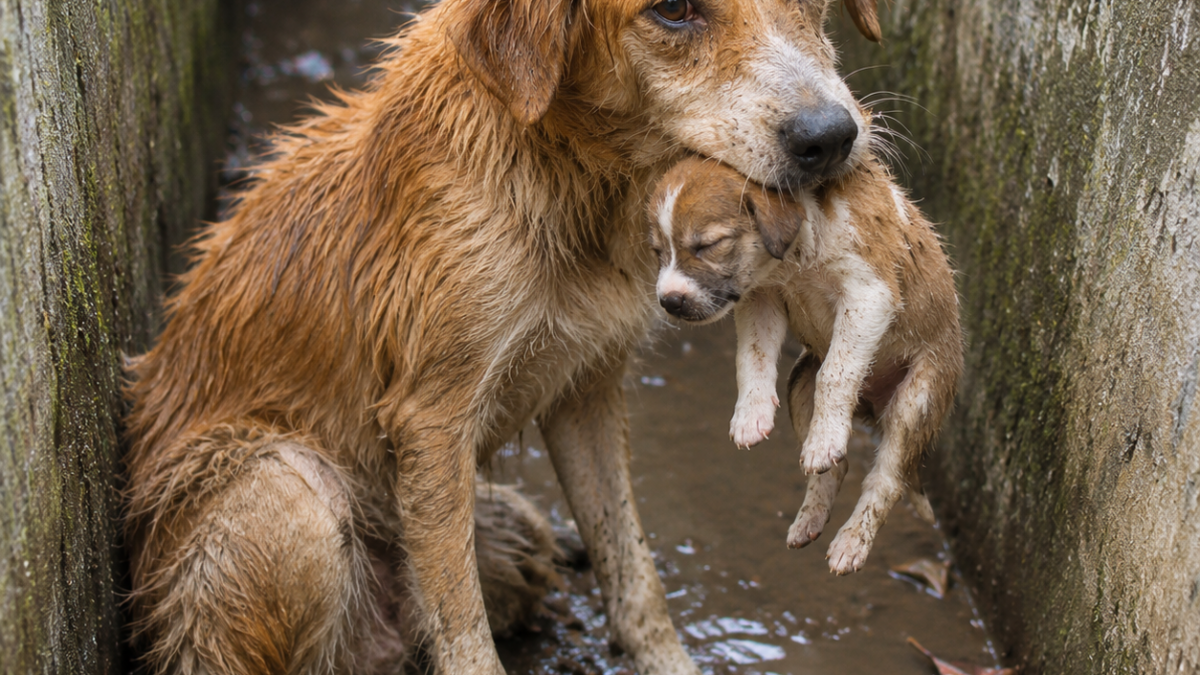
PART 2
The smallest puppy felt wrong in my hands.
Too cold.
Too still.
I slipped two fingers beneath her chest.
For a second, I couldn’t feel anything.
Then there it was.
A heartbeat.
Fast.
Weak.
But present.
“She’s alive!” I shouted.
Daniel leaned over the edge of the ditch.
“Bring her up first.”
I wrapped the puppy inside the driest part of my shirt and held her against my chest.
The mother immediately followed.
I stopped.
“I’m not taking her away.”
Her nose touched the puppy’s head.
She licked once.
Then again.
The puppy made a sound so faint I barely heard it.
The mother’s ears lifted.
I looked at her.
“You heard that.”
Her tail didn’t move.
She was too exhausted.
But something changed in her face.
I handed the puppy upward to Daniel.
“Keep her warm.”
He tucked her inside a blanket.
The mother stood on her back legs, trying to see.
“We’ve got her,” Daniel said.
I don’t know whether she understood his words.
She understood his hands.
He kept the puppy where she could see.
I went back beneath the debris.
The second hidden puppy was stronger.
Cold and wet, but moving.
He squealed the moment I picked him up.
The mother pushed closer.
“That’s good,” I whispered. “Make noise.”
I passed him up.
Then I looked at the mother.
Three puppies.
All accounted for.
I moved toward the ladder.
“Now it’s your turn.”
She stared at me.
Then at the top of the ditch.
She tried to climb the sloped concrete herself.
Her front paws slipped immediately.
She fell onto her chest.
I grabbed her before her head hit the water.
“Enough.”
She tried again.
“No.”
Her legs were done.
I slipped one arm beneath her chest and another beneath her abdomen.
The instant I lifted her, she panicked.
Her body stiffened.
She twisted to look back.
“Your babies are up there.”
She struggled harder.
Daniel understood.
He leaned over the edge holding the first puppy where she could see.
“Mama!”
She froze.
Her eyes locked onto the bundle.
“That’s right,” I said. “We’re going to them.”
She stopped fighting.
The climb was awkward.
Another volunteer held the ladder.
Daniel reached for the mother from above.
Between the three of us, we got her out.
The moment her paws touched dry ground, she staggered toward the blankets.
One puppy.
Then another.
Then the smallest.
She sniffed each one.
Only after she had counted them in whatever way mothers do did she collapse.
Not dramatically.
Her legs simply folded.
She lay on her side beside them.
Her eyes stayed open.
I crouched.
“You can stop now.”
She looked at me.
“You got all of them out.”
Her breathing slowed.
“We’ve got them.”
For the first time, she allowed her head to rest on the blanket.
—
The veterinary clinic was twelve minutes away.
It felt much longer.
Daniel drove.
I sat in the back.
The mother lay beside the puppies inside an open transport crate.
We had put warm towels beneath them.
The strongest puppy crawled directly toward her belly.
The smallest remained wrapped separately against a heating pad.
I kept one hand over her.
The mother watched.
Every few seconds, she raised her head to check.
“You don’t trust me yet.”
Her eyes followed my hand.
“Fair.”
Daniel glanced in the mirror.
“What are we calling her?”
“The mom?”
“Yeah.”
I looked at her.
Mud had dried around her face.
Her eyes were exhausted but alert.
“River.”
Daniel smiled.
“Because of the ditch?”
“No.”
“Then why?”
“Because she kept moving even when everything was against her.”
He nodded.
“River.”
The mother’s ear twitched.
The puppies would get names later.
First, they needed to live.
—
Dr. Hannah Lee met us at the back entrance.
We had called ahead.
The moment she saw the smallest puppy, she took her from me.
“How cold?”
“Very.”
“Responsive?”
“Barely.”
She disappeared into treatment.
River tried to follow.
Her legs failed again.
I caught her.
“Easy.”
Another technician brought a stretcher.
River refused it.
She struggled to stand.
“Her puppies,” I said.
The technician nodded.
“We’ll keep them together as much as possible.”
We carried River inside.
The other two puppies stayed beside her.
The third went into active warming.
I followed until Hannah stopped me.
“Give us ten minutes.”
“Can I stay where she can see me?”
“She needs treatment.”
“I know.”
“Ten minutes.”
I hated it.
But I stepped back.
—
Those ten minutes lasted forever.
I paced.
Daniel sat.
“You’re making me nervous.”
“Then don’t watch.”
“You’ve walked past that vending machine fourteen times.”
“I hate vending-machine coffee.”
“You aren’t buying coffee.”
“Exactly.”
He leaned back.
“She got them out.”
“Barely.”
“But she did.”
“The little one might not make it.”
Daniel looked at me.
“You don’t know that.”
“No.”
“Neither does the vet yet.”
I stopped pacing.
He was right.
Hope and fear both become dangerous when they start pretending to be certainty.
I sat down.
—
Hannah came out twenty-three minutes later.
I stood.
“The mother first,” she said. “She’s severely dehydrated and underweight.”
“How bad?”
“Bad. But treatable.”
I breathed.
“And the puppies?”
“The two larger ones are cold and mildly dehydrated, but I’m reasonably comfortable with them.”
“The smallest?”
Hannah paused.
I hated pauses.
“She’s responding to warming.”
“Meaning?”
“Meaning she’s warmer than when she came in, her blood glucose is low but improving, and she has a heartbeat I like better than I did twenty minutes ago.”
“So she’s going to make it?”
“I didn’t say that.”
I closed my eyes.
“Right.”
“But she’s fighting.”
I looked through the treatment-room window.
River lay on a padded mat.
An IV line ran into one leg.
The two puppies were pressed against her.
She was staring toward the door where the smallest had disappeared.
“She won’t relax until you bring the puppy back.”
“We know.”
Hannah smiled faintly.
“She’s made that very clear.”
—
River’s bloodwork told the rest of the story.
Anemia.
Parasites.
Low protein.
Severe nutritional deficiency.
An infected wound beneath one front leg.
Skin irritation.
Dehydration.
Nothing suggested she had been in good condition before entering the ditch.
“She was already starving,” Hannah said.
I looked at River’s ribs.
“So she didn’t just get trapped last night.”
“No.”
“How long?”
“I can’t date malnutrition precisely.”
“Weeks?”
“At least.”
I felt anger rise.
Someone had allowed this.
Maybe dumped her.
Maybe abandoned her nearby.
Maybe never fed her properly.
We didn’t know.
I wanted a person to blame.
Instead, I had a dog on a treatment mat and three puppies trying to stay alive.
Hannah must have read my face.
“Don’t go hunting for answers before you have facts.”
“I know.”
“Do you?”
“Unfortunately.”
“Good.”
She touched River’s shoulder.
“The useful thing you can do right now is help her trust that these puppies are safe.”
That was harder than being angry.
So I did that.
—
The smallest puppy returned to River two hours later.
Inside a warmed blanket.
She was still weak.
But now she protested when Hannah moved her.
A tiny squeak.
River’s head shot up.
The puppy squeaked again.
River tried to stand.
I put one hand against her shoulder.
“Wait.”
Hannah lowered the bundle.
River stretched her neck forward.
Her nose touched the puppy.
Then she began licking.
Face.
Head.
Back.
Frantic at first.
Then slower.
The puppy squirmed.
River kept licking.
I heard Daniel sniff behind me.
“Are you crying?”
“No.”
“You absolutely are.”
“Shut up.”
River curled her front leg around the puppy.
That was when I knew her name fit.
You could block her.
Starve her.
Flood the ground beneath her.
Bury her babies beneath garbage.
She still found a way toward them.
River.
—
We named the puppies over the next two days.
The first puppy—the one River had been holding—became Milo.
He had a dark muzzle and a small white patch under his chin.
The second, the louder one beneath the cardboard, became Archie.
The smallest became June.
Daniel chose it.
“Why June?”
“Because it sounds warm.”
“She was nearly hypothermic.”
“Exactly.”
I couldn’t argue with that.
June became the center of everyone’s attention.
She needed supplemental feeding every few hours because River’s milk supply was too low.
At first, River hated when we picked her up.
Every muscle in her body tightened.
She would try to follow.
So I began sitting directly beside her.
I’d pick June up.
Show her.
“See?”
River would sniff.
I’d feed June.
Then immediately return her.
Again.
And again.
By the fourth feeding, River stopped trying to stand.
By the sixth, she rested her head while I held June.
By the tenth, she slept.
That was the first time River trusted someone else to keep one of her babies alive while she rested.
It might have been the biggest victory of the entire rescue.
—
The first forty-eight hours were fragile.
June’s temperature dropped once during the night.
Milo developed diarrhea.
Archie refused one feeding.
River vomited after trying to eat too quickly.
Every small problem felt enormous.
At two in the morning, I was sitting on the clinic floor beside River.
Hannah came in holding a chart.
“You should go home.”
“I’ve heard that.”
“You’ve been here eighteen hours.”
“River’s been here longer.”
“River is hospitalized.”
“Exactly.”
Hannah crossed her arms.
“You cannot personally keep her alive by refusing to sleep.”
“I can make her calmer.”
“That part is true.”
River lifted her head and pressed her nose against my hand.
I smiled.
“See?”
“You’re both manipulative.”
“She’s better at it.”
Hannah sighed.
“Two hours. Then home.”
“Deal.”
I stayed four.
—
By day three, River ate without vomiting.
Small meals.
Very small.
She hated that.
The first time I removed her bowl after the prescribed amount, she stared at me.
“You’re done.”
She looked at the bowl.
Then me.
“I know.”
The look became more intense.
“You almost starved to death. I understand why you don’t believe food comes back.”
She licked the empty floor.
My chest hurt.
“It will.”
River kept searching.
I brought the next meal exactly when promised.
Then the next.
And the next.
For weeks afterward, that became one of our quiet promises.
Food always came back.
—
June began gaining weight.
Twelve grams.
Then nineteen.
Then twenty-four.
Her tiny body became warmer and stronger.
She started shoving Archie away from the best nursing position.
Daniel watched.
“She’s evil.”
“She was dying four days ago.”
“Now she’s stealing milk.”
“Progress.”
Milo was the calm one.
Archie screamed about everything.
June was small but ruthless.
River tolerated all three with the tired patience of a mother who had already survived worse.
—
On the fifth day, River walked outside.
Hannah wanted to test her strength.
We used a soft harness.
I expected her to be frightened.
Instead, when the clinic door opened, River stopped.
Sunlight touched her face.
She lifted her nose.
The courtyard had grass.
Real grass.
No sewage.
No broken glass.
No soaked cardboard.
River took one step onto it.
Stopped.
Then another.
Her paws sank slightly into the soft ground.
For nearly a minute, she simply stood there.
Then she lowered her nose.
Sniffed.
And dropped onto her side.
I panicked.
“River!”
Hannah grabbed my arm.
“Wait.”
River rolled onto her back.
Her legs moved weakly in the air.
Then she rolled the other way.
I stared.
“She’s rolling.”
Hannah smiled.
“She’s being a dog.”
River rubbed her shoulders against the grass.
Her tail moved.
Once.
Again.
Then faster.
I had seen that dog stand in sewage because she refused to drop her puppy.
Now she was rolling in clean grass because nothing needed saving for thirty seconds.
That image stayed with me longer than the ditch.
—
The question of how River and her puppies ended up there didn’t disappear.
Three days after the rescue, an animal-control officer named Luis Ortega met Daniel and me at the drainage site.
The rainwater had receded.
The ditch looked even worse in daylight.
Garbage lined the concrete.
A broken plastic crate was wedged farther upstream.
Luis photographed it.
“Was that here before?”
“I don’t know.”
He pulled on gloves.
The crate door was missing.
One side was cracked.
Inside were tufts of brown dog hair.
My stomach tightened.
“Could be hers.”
“Could.”
He bagged several pieces.
Near the ditch entrance, we found part of a cardboard box.
The bottom had dissolved.
One side still had printed lettering from a local farm-supply store.
Luis looked at me.
“Don’t build a story yet.”
“I know.”
“You’re building one.”
“I’m considering possibilities.”
“That’s investigator language for building a story.”
Daniel laughed.
I ignored him.
—
The business district had cameras.
Most pointed toward loading docks and entrances.
One belonged to a recycling company across the road.
The manager agreed to review footage.
Luis called me two days later.
“We found something.”
I sat up.
“What?”
“A vehicle stopped near the drainage channel the night before you found River.”
“What time?”
“2:18 a.m.”
“What vehicle?”
“White cargo van.”
My pulse accelerated.
“Did they dump her?”
“Slow down.”
“What does the footage show?”
“A person exits. Opens the side door. Removes something.”
“What?”
“Looks like a dog crate.”
My hand tightened around the phone.
“And?”
“Video isn’t clear enough to see exactly what happens down in the ditch.”
“Does the person leave with the crate?”
Pause.
“No.”
I closed my eyes.
“Plate?”
“Partial.”
“Can you identify it?”
“We’re working on it.”
“Luis.”
“I know.”
“She didn’t fall into that ditch.”
“I didn’t say that.”
“You didn’t have to.”
—
The next call came three days later.
The van belonged to a man named Curtis Hale.
He ran a small unlicensed breeding operation outside the county line.
The phrase alone made my stomach turn.
Luis warned me immediately.
“Do not contact him.”
“I wasn’t going to.”
“Don’t look him up and drive there.”
“I wasn’t going to.”
“Don’t lie to me.”
“I was thinking about it.”
“Exactly.”
I paced my kitchen.
“What does he say?”
“He says he sold River months ago.”
“To who?”
“He doesn’t remember.”
“Of course.”
“He claims the van was borrowed.”
“By who?”
“He’s working on remembering that too.”
I laughed without humor.
“Convenient memory.”
“Yes.”
“Can you search his property?”
“Not based on irritation.”
“Luis.”
“We’re building probable cause.”
Again.
Evidence.
Patience.
The two things anger hates most.
—
Then River’s microchip gave us something.
It hadn’t been registered to Curtis.
But the chip manufacturer had sales records.
A batch had been sold to a low-cost veterinary clinic that provided vaccinations at rural events.
That clinic had scanned River once eighteen months earlier.
The owner name recorded?
Curtis Hale.
I called Luis the second I heard.
“You have him.”
“We have evidence he owned her then.”
“And now?”
“Let us work.”
I wanted faster.
But River didn’t need fast revenge.
She needed a careful case.
So I waited.
—
While investigators worked, River came home with me.
All four of them.
My house stopped belonging to me within six hours.
We converted the dining room into a puppy area.
Blankets.
Washable pads.
A low barrier.
Water.
Food.
Toys.
River walked through the doorway and stopped.
She had never been there.
New house.
New smells.
My two resident dogs were behind a baby gate upstairs.
No pressure.
River surveyed everything.
Then immediately checked the puppy bed.
One.
Two.
Three.
Only then did she lie down.
“Still counting?”
Her eyes closed.
“Fair.”
—
The first night was rough.
River woke at every sound.
Refrigerator.
Pipes.
A car passing outside.
At 1:30 a.m., I found her standing over the puppies.
Nothing was wrong.
She was simply awake.
Watching.
I sat on the floor.
“You can sleep.”
River looked at me.
“I mean it.”
Nothing.
I lay down beside the puppy pen.
“This is ridiculous.”
River watched.
I closed my eyes.
Ten minutes later, I felt something warm against my shoulder.
River had lain down beside me.
Not asleep.
But close.
By three, she finally rested her head on the floor.
At four, I woke because Archie was screaming.
Motherhood does not respect emotional moments.
—
River’s appetite became enormous.
Understandably.
We still had to control her portions for a while.
She would finish, then search.
Under bowls.
Around cabinets.
Behind chairs.
I began feeding her in the same place at the same times.
Morning.
Midday.
Evening.
Small snacks.
Routine.
After two weeks, she stopped checking beneath the bowl.
After a month, she left one piece of kibble.
I nearly photographed it.
Daniel laughed.
“You’re celebrating uneaten food?”
“Yes.”
“Explain.”
“She believes there’ll be more.”
He looked at River.
Then understood.
“Oh.”
Yes.
Oh.
Safety sometimes looks like knowing you don’t have to eat the last bite.
—
The puppies exploded with personality.
Milo followed River everywhere.
Archie followed trouble.
June followed me.
Every time I entered the room, June toddled toward my feet.
At five weeks, she began climbing my pant leg.
“Absolutely not.”
She continued.
“You were nearly dead in a ditch.”
June bit my shoelace.
“This is how you thank me?”
River watched from her bed.
“Control your daughter.”
River yawned.
Excellent support.
—
The police obtained a warrant for Curtis’s property six weeks after the rescue.
Luis called afterward.
His voice sounded different.
“We found dogs.”
“How many?”
“Eleven.”
I stopped breathing for a second.
“Condition?”
“Mixed. Some acceptable. Some not.”
“Puppies?”
“Yes.”
“How many?”
“Four.”
My anger came back instantly.
“Are they safe?”
“They are now.”
That mattered.
“Was River there before?”
“We found photographs.”
My stomach tightened.
“What kind?”
“Breeding records.”
River had been listed under a number.
Not a name.
Female 7.
Three previous litters.
I stared at the wall.
“She had babies before?”
“Looks like it.”
“What happened to them?”
“Likely sold.”
I looked across the room.
River was asleep while June chewed her tail.
Three previous litters.
How many puppies had she watched disappear?
How many times had humans taken them?
No wonder she had refused to leave the ditch.
Maybe those three puppies weren’t simply babies.
Maybe they were the first litter she’d ever been allowed to keep long enough to protect.
Luis continued.
“We also found messages.”
“To who?”
“A buyer Curtis was trying to sell this litter to.”
My throat tightened.
“What do they say?”
“The buyer backed out.”
I already knew what came next.
Luis read part of the exchange.
Three pups. Mother too thin. Not worth feeding another month.
I sat down.
“That’s what he wrote?”
“Yes.”
“What about the van?”
“Another message mentions cleaning out kennels that same night.”
I closed my eyes.
There it was.
Not proof of every second.
But enough pieces forming the shape.
River had become expensive.
Unprofitable.
Disposable.
So someone had taken a starving mother and newborn puppies to a drainage ditch during heavy rain.
Perhaps the plan was simply to leave them beside it.
Perhaps the crate broke.
Perhaps River tried to move the puppies herself.
We never knew the exact mechanics.
But the camera showed the van.
The records showed ownership.
The messages showed motive.
And the ditch showed the result.
—
I was furious for two days.
Not useful anger.
The kind that follows you from room to room.
At night, I imagined confronting Curtis.
Making him look at River.
Making him explain.
I wanted him to see June.
The puppy who had almost died under soaked cardboard because he decided they weren’t worth feeding.
Then River did something that embarrassed me back into reality.
I was standing in the kitchen, reading another update from Luis.
My jaw was tight.
River approached.
I reached down too quickly.
She flinched.
Not dramatically.
Just one small recoil.
I froze.
“Oh.”
River watched me.
The old fear had come back for one second because my anger changed the way my body moved.
I put the phone down.
Kneeled.
“I’m sorry.”
River sniffed my hand.
Then leaned forward.
Her forehead touched my chest.
That was when I realized something.
If I filled her safe home with rage about the person who hurt her, he was still affecting her life.
No.
He didn’t get that.
I would cooperate.
Testify.
Document.
Push for accountability.
But inside my house?
Curtis Hale didn’t exist.
River did.
—
By eight weeks, the puppies were healthy enough for vaccinations and adoption planning.
June was still smallest.
Not fragile anymore.
Just small.
Hannah examined her.
“Heart sounds good.”
“Lungs?”
“Clear.”
“Weight?”
“Appropriate.”
“Are you sure?”
Hannah looked at me.
“You know you’re going to have to let her grow up without checking every breath?”
“No.”
“She’s healthy.”
“I heard you.”
“You aren’t behaving like you heard me.”
June attacked the stethoscope.
Hannah rescued it.
“She seems comfortable with her prognosis.”
—
The adoption applications started coming.
Milo had a family interested first.
A couple with a fenced yard and an older female dog.
They came for a meeting.
River stayed nearby.
When the couple picked Milo up, River stood.
Not panicked.
Alert.
I watched her.
The woman immediately lowered Milo.
“We can go slower.”
“Thank you.”
She sat on the floor instead.
Milo crawled into her lap by choice.
River approached.
Sniffed the woman’s shoulder.
Then the man’s hand.
She returned to her bed.
That was approval.
Or at least not rejection.
Milo went home two weeks later.
When his new family carried him out, River followed to the door.
My heart broke.
I was ready to intervene.
Then Milo’s adopter crouched.
River sniffed him.
Milo licked his mother’s nose.
River watched the car leave.
For ten minutes afterward, she searched the house.
Then she returned to Archie and June.
I sat beside her.
“This time he wasn’t taken somewhere bad.”
River rested against my leg.
“He has a couch.”
Her ears moved.
“A ridiculous bed.”
Nothing.
“And apparently a pool.”
River looked at me.
“Exactly. Better than us.”
—
Archie went next.
His new owner was a veterinary technician with two other dogs.
Archie immediately stole a toy during the meet-and-greet.
“He’ll fit in,” she said.
River handled that goodbye better.
Maybe because she had learned something impossible to explain.
Humans could take puppies away and still keep them safe.
Not every departure was loss.
—
Then there was June.
We received excellent applications.
I found problems with all of them.
Too far away.
Too many stairs.
One cat.
No cats.
Kids.
No kids.
Large yard.
Small yard.
Daniel finally took the folder from me.
“You’re keeping her.”
“I am not.”
“You’ve rejected a pediatric nurse with a fenced half-acre.”
“She works twelve-hour shifts.”
“Her husband works from home.”
“He has conference calls.”
Daniel stared.
I stared back.
River lay behind us.
June was asleep across her neck.
Daniel pointed.
“You are keeping that dog.”
I looked at them.
“No.”
June woke, crawled toward me, and fell asleep on my shoe.
Daniel smiled.
“Very convincing.”
—
River also received adoption interest.
That should have made me happy.
One family was perfect on paper.
Quiet home.
Experience with adult rescue dogs.
No young children.
Large yard.
They visited twice.
River liked them.
That made everything harder.
On the third visit, they took River for a short walk without me.
She went.
No panic.
No freezing.
She returned twenty minutes later relaxed.
The woman smiled.
“She did wonderfully.”
I smiled too.
It hurt.
This was rescue.
The goal was never to collect every animal.
It was to make them whole enough to leave.
Then River walked past the woman.
Past Daniel.
Past the toys.
She came directly to me.
Sat on my foot.
And leaned her entire body against my legs.
Daniel looked away.
Coward.
The woman noticed.
She knelt.
“I think she already has a home.”
“No.”
“She does.”
“I’m fostering.”
The woman smiled.
“Does she know that?”
River pressed harder against me.
I looked down.
Traitor.
—
The family adopted another dog from our rescue two weeks later.
River stayed.
June stayed.
I signed both adoption papers the same afternoon.
Daniel brought a cake.
It said:
FOSTER FAILURE x2.
“I hate you.”
“Eat cake.”
River got a small dog-safe treat.
June attempted to eat the paper plate.
Family life had begun.
—
Curtis’s case went to court months later.
I attended.
So did Luis.
The prosecution had the camera footage.
Microchip records.
Breeding records.
Messages.
Veterinary evidence about River’s condition.
Photographs of the drainage ditch.
Evidence from the other dogs seized from his property.
Curtis’s attorney tried to argue he had intended to surrender River.
At two in the morning.
Beside a drainage canal.
During a storm.
Without notifying anyone.
The judge did not look impressed.
His attorney said River had been “difficult to maintain after whelping.”
I nearly stood up.
Luis touched my arm.
“Don’t.”
“I know.”
“She doesn’t need you getting removed from court.”
“I know.”
The prosecutor showed the photograph of River on rescue day.
Ribs visible.
Standing in muddy water.
Puppy in her mouth.
Then photographs of June beneath the debris.
The courtroom became very quiet.
—
I gave a statement at sentencing.
I had written four pages.
I used less than one.
“I want to tell the court about the moment River was finally free to leave.”
Curtis looked toward me.
I didn’t look at him for long.
“When we reached her, she was holding one puppy in her mouth. She was exhausted enough that she could barely remain standing.”
I paused.
“We took that puppy.”
The judge listened.
“River could have followed us out.”
I thought about the ditch.
“She didn’t.”
I described her walking deeper into the water.
Scratching at cardboard.
Showing us where Milo and June were trapped.
“She stayed in a place that was cold, filthy, and dangerous because two of her babies were still there.”
My throat tightened.
“Mr. Hale’s defense has spent a great deal of time describing inconvenience.”
Feeding costs.
Breeding problems.
A buyer backing out.
Too many animals.
I continued.
“River was starving. She was weak. She had every reason to save herself.”
Then I finally looked at Curtis.
“She still understood responsibility better than the person who owned her.”
No one moved.
“She did not leave her dependents behind because caring for them became inconvenient.”
I turned back toward the judge.
“I don’t need him to suffer for me.”
That surprised even me.
“I need him prevented from putting another animal in the position River was in.”
I sat down.
Luis whispered:
“That’ll do.”
—
Curtis was convicted on multiple animal-neglect and abandonment-related counts.
The penalties weren’t cinematic.
Real courts rarely satisfy anger the way fiction does.
There were fines.
Restitution.
Probation.
A suspended jail component with strict conditions.
The breeding operation was shut down.
The remaining dogs were surrendered.
And Curtis was prohibited from owning, breeding, selling, or keeping animals for a significant court-ordered period.
Violation could activate additional penalties.
When the judge ordered permanent surrender of all animals involved, that was the moment I cared about most.
Not the fine.
Not Curtis’s face.
The animals.
Free.
Eleven adult dogs.
Four puppies.
River.
June.
Milo.
Archie.
No one was going back.
That was enough.
—
The rescued dogs from Curtis’s property took months to place.
Some were afraid of people.
Some were overly hungry.
One female had been bred repeatedly.
Another had untreated ear infections.
The rescue network worked through them one by one.
Medical care.
Foster homes.
Training.
Adoption.
The old breeding records used numbers.
Female 2.
Male 4.
Female 7.
River.
At the adoption center, every cage had a name.
That mattered to me.
Numbers are useful for inventory.
Names are for individuals.
Curtis had treated them like inventory.
We gave them names.
—
River changed dramatically over the next year.
Not physically alone.
Yes, she gained weight.
Her ribs disappeared beneath healthy muscle.
Her coat became glossy.
Her eyes softened.
But the deeper changes were quieter.
She stopped checking the food bowl after every meal.
She stopped waking at every sound.
She stopped following June from room to room.
One afternoon, June went outside with Daniel.
River remained asleep on the couch.
I stared at her.
“She left.”
River snored.
“Your daughter left the house.”
Nothing.
I laughed.
“You trust us.”
That was freedom too.
Not needing to monitor everyone you love every second.
—
June grew into a ridiculous dog.
There is no elegant way to describe her.
The puppy we once feared might die became energetic, loud, destructive, and obsessed with socks.
She once stole six from a laundry basket and buried four beneath my couch.
River watched.
Did nothing.
“Parent her.”
River closed her eyes.
“Useless.”
June brought me another sock.
I had no authority in my own home.
—
Milo and Archie came back for visits.
The first reunion happened when they were almost a year old.
Milo arrived first.
He was twice the size I expected.
River saw him through the fence.
Stopped.
Milo stopped too.
For one second, nobody moved.
Then his tail exploded.
He ran toward her.
River met him halfway.
They sniffed.
Circled.
Then River began playing.
Not guarding.
Not checking.
Playing.
Archie arrived ten minutes later and immediately crashed into everyone.
June screamed with excitement.
The four dogs ran across the field.
Daniel stood beside me.
“You okay?”
“No.”
“Good.”
I laughed through tears.
River chased her grown puppies.
Strong legs.
Healthy body.
Nothing in her mouth.
Nothing trapped beneath garbage.
Nothing to save.
She was running because she wanted to.
—
I remembered the sentencing statement.
Responsibility.
That’s what the whole story had been about.
Curtis saw responsibility as something to discard when it cost too much.
River treated responsibility as something worth standing in freezing water for.
But River’s healing required learning the other half.
Love didn’t always mean sacrifice.
She didn’t need to starve to prove she loved her puppies.
She didn’t need to stand every second.
She didn’t need to check every door.
She could eat first sometimes.
Sleep.
Play.
Leave food in a bowl.
Run without looking behind her.
That was the life I wanted for her.
—
A year after the rescue, Daniel and I returned to the ditch.
The city had cleaned it.
After publicity around the case, drainage maintenance improved.
Fencing had been added near the steepest section.
Illegal dumping cameras were installed.
The pile of wet cardboard was gone.
So was the broken crate.
Water still ran through the channel.
But it looked ordinary now.
Daniel stood at the edge.
“This smaller than you remember?”
“Yes.”
“Me too.”
Pain makes places large.
We didn’t bring River.
She didn’t need to revisit it for our symbolism.
That place belonged to our memory.
Not her future.
—
The rescue received the broken crate back after the case ended.
They asked what to do with it.
“Throw it away.”
Daniel looked surprised.
“You kept the chain from Hope’s case.”
“Different story.”
“You don’t want a piece?”
“No.”
“Why?”
I thought about River.
“I don’t want to build a museum of what hurt them.”
We photographed the evidence for training records.
Then discarded it.
Some objects deserve preservation.
Others deserve to become trash.
The crate had already taken enough space.
—
Instead, we framed a photograph from the puppies’ reunion.
River in the center.
June on one side.
Milo and Archie mid-run.
All four mouths open.
Grass flying beneath their feet.
No perfect pose.
Just life.
Under it, we put one sentence:
SHE WOULDN’T LEAVE UNTIL EVERYONE WAS SAFE.
That was enough.
—
River later became strangely good with new rescue mothers.
Not every dog.
We introduced carefully.
But when a frightened nursing dog came into foster, River often sat outside the room.
Calm.
No pressure.
One young mother named Penny refused food whenever humans were nearby.
River lay on the other side of the gate and ate her own dinner.
Penny watched.
The next day she ate with me in the room.
Was River responsible?
Maybe.
Maybe not.
I didn’t care.
Healing often travels through examples.
One animal sees another relax.
Maybe the body learns something before the mind does.
—
June remained River’s shadow.
When River slept, June often curled beside her.
As they aged, the arrangement slowly reversed.
River developed arthritis.
Walks became shorter.
June adjusted.
That surprised me more than anything.
The dog who believed hallways existed for sprinting began slowing down for her mother.
If River stopped, June stopped.
If River lay in the grass, June lay beside her.
One afternoon, River struggled with the back step.
Before I could help, June walked back down.
Stood next to her.
Waited.
River tried again.
Made it.
June followed.
I sat on the step afterward and cried.
Not because River was old.
Because the puppy River had once carried through sewage was now waiting for her.
—
People often told me River was heroic.
I understood what they meant.
But I became careful with that word.
Heroic can become another expectation.
River wasn’t required to be brave forever because she’d once saved her babies.
She was allowed to become lazy.
Spoiled.
Stubborn.
She was allowed to refuse walks in rain.
She was allowed to steal chicken.
She was allowed to be afraid of thunderstorms.
She was allowed to grow old.
She didn’t owe the world constant strength just because strength once kept her family alive.
That’s part of rescue too.
Letting survivors become ordinary.
—
Curtis wrote once.
Years later.
Through his attorney.
A short apology connected to a request to demonstrate compliance with probation requirements.
I read it.
He said he regretted his decisions.
He said financial pressure had influenced him.
He said he had underestimated the consequences.
I felt almost nothing.
Daniel asked:
“Do you believe him?”
“Maybe.”
“Do you forgive him?”
“Not relevant.”
He looked at me.
“Really?”
I glanced toward River.
She was asleep upside down on the couch.
June had one paw across her face.
“Yes.”
Curtis’s remorse belonged to Curtis.
River’s life belonged to River.
I had no interest in tying them together again.
—
The real revenge had happened quietly.
Curtis threw River away because feeding her and her puppies cost money.
Years later, people donated to a small emergency fund created from the attention around her case.
The fund paid for food and urgent veterinary care for abandoned mothers and litters.
We named it the River Three Fund.
Not because River had only three puppies in her life.
Because those were the three she refused to leave in the ditch.
The first year, the fund helped seven families.
The second, twelve.
One mother arrived with nine puppies.
I looked at the intake sheet.
“River would’ve resigned.”
Daniel laughed.
“She handled three.”
“Barely.”
River was sleeping in the office.
She opened one eye.
“Don’t worry. We’re not giving you nine.”
Eye closed.
Smart dog.
—
The fund eventually paid for a dog named Hazel.
Hazel had been found beneath an abandoned trailer with four puppies.
Then Luna with six.
Then a small terrier mother with two.
Every time I approved an emergency invoice, I thought about Curtis writing:
Not worth feeding another month.
He had tried to save money by abandoning River.
Instead, her story became the reason strangers paid to feed animals for years.
Life has strange symmetry.
I enjoyed that one.
—
River’s health remained good until she was around eleven.
Then her hips worsened.
Medication helped.
Warm beds.
Short walks.
Swimming therapy once a week.
She hated the pool for exactly two sessions.
Then discovered treats.
Everything became acceptable.
June attended once.
Jumped into the pool without invitation.
Chaos.
The therapist banned her from poolside.
I supported the decision.
—
River’s favorite thing became sleeping outside in spring.
She’d choose a patch of sunlight near the garden fence.
June would usually lie close.
Sometimes I’d sit with them.
No camera.
No rescue story.
No audience.
Those were the moments that meant most.
A mother who had once stood in dirty water for hours now considered sunbathing a serious daily responsibility.
Perfect.
—
When River was twelve, Milo died after a sudden illness.
His family called me.
I cried harder than I expected.
Milo had lived a good life.
Eleven years with the same family.
Vacations.
Birthday treats.
A ridiculous number of toys.
But he had still been the puppy in River’s mouth.
In my head, sometimes he remained that small.
His family brought his collar when they visited River.
I didn’t know whether to show it to her.
Dogs process loss differently.
We let her smell it.
River sniffed for several seconds.
Then looked toward the door.
I couldn’t know what she understood.
I didn’t pretend to.
She slept beside June that night.
So did I, eventually, on the couch.
—
Archie lived another year and a half.
Also loved.
Also safe.
When he died, June became the last of the three puppies.
River was old by then.
So was June.
I often thought about the odds.
Three puppies soaked in a drainage ditch.
One nearly hypothermic.
A starving mother.
Years later, every one had reached old age.
That wasn’t a miracle in the magical sense.
It was veterinary care.
Food.
Homes.
Vaccines.
Luck.
People.
Routine.
Thousands of ordinary acts.
Sometimes miracles are just ordinary things arriving consistently after a period when nothing did.
—
River’s final decline was slow.
She stopped climbing onto the couch.
Then stopped wanting long walks.
Then one morning, she left breakfast untouched.
Food had been central to her recovery.
An untouched bowl always frightened me.
Hannah had retired by then, but our current veterinarian examined River.
Blood tests.
Imaging.
Cancer.
Advanced.
I sat on the floor beside her.
June rested near the door.
“How long?”
The vet answered carefully.
“Could be weeks. Maybe a few months with supportive care.”
“Comfort?”
“Yes.”
“Can we keep her comfortable?”
“For now.”
That became the only goal.
Not time.
Comfort.
River had fought hard enough.
—
We brought her home.
Pain medication.
Favorite foods.
No dietary rules anymore.
Chicken.
Eggs.
Small pieces of steak.
Daniel visited.
River still wagged for him.
“Finally likes me,” he said.
“Only took twelve years.”
“I sat on your floor for that dog.”
“She remembers.”
River took chicken from his hand.
He laughed.
“Worth it.”
—
We organized one quiet afternoon with June.
No reunion crowd.
No emotional spectacle.
Just the two of them in the yard.
River lay beneath the tree.
June placed herself beside her.
For a long time, nothing happened.
That was enough.
I took one photograph.
River’s head on her paws.
June’s body touching hers.
When I later compared it to the rescue photograph, my chest tightened.
In the first, River was standing in water with June hidden beneath garbage.
In the last, both were old.
Dry.
Safe.
Together.
Sometimes the ending doesn’t need more symbolism than that.
—
On River’s final morning, she couldn’t stand without help.
The irony hurt.
The first time I’d seen her, she had forced herself to stand when she should have collapsed.
Now I slid a towel beneath her abdomen.
“Come on.”
We went outside.
Slowly.
June followed.
I laid a blanket in the sun.
River lowered herself.
Her breathing was tired.
The veterinarian was coming to the house later.
I sat beside her.
For a long time, I said nothing.
Then I remembered the ditch.
River holding Milo.
The trembling legs.
The moment she turned away from me.
How confused I’d been.
I had thought she was rejecting rescue.
She was giving instructions.
Not yet.
There are still two.
I touched the side of her face.
“You know what?”
Her eyes opened.
“You don’t have to wait for anyone now.”
June was beside her.
I put my hand on River’s chest.
“Everyone’s safe.”
Her breathing stayed slow.
“Milo was safe.”
My voice broke.
“Archie was safe.”
June lifted her head.
“And June is safe.”
River looked toward her daughter.
“Your job is done.”
I cried then.
Not quietly.
I didn’t care.
“You can rest.”
—
The veterinarian arrived in the afternoon.
River never became frightened.
She was too tired.
Or maybe home changed the meaning of strangers.
June remained beside her.
Daniel sat near the fence.
I held River’s head in my lap.
The vet explained each step.
I nodded.
When the first medication made her sleepy, River’s body relaxed.
Completely.
No trembling.
No fighting to stand.
No puppy in her mouth.
No water around her legs.
Nothing depended on her.
I bent down.
“You got them all out.”
Those were my last words to her.
“You got every one.”
River exhaled.
Then she was gone.
—
June stayed beside her for several minutes.
Sniffing.
Then she lay down.
I let her.
There are moments when grief should not be hurried either.
Eventually June stood.
Walked toward me.
Put her head against my chest.
I held her.
The puppy who had once fit beneath my shirt was now an old dog.
River had carried her through the worst day of her life.
Now June and I carried each other through River’s last.
—
We buried part of River’s ashes beneath the tree where she loved sleeping.
The rest stayed at home.
The rescue wanted a memorial.
I had one condition.
No photograph from the ditch.
They agreed.
We used the reunion image.
River running with all three puppies.
Underneath, the plaque said:
RIVER
SHE COULD HAVE SAVED HERSELF.
SHE WAITED UNTIL EVERYONE WAS SAFE.
Below that, smaller:
THEN SHE FINALLY LEARNED SHE DESERVED SAFETY TOO.
That was the sentence I cared about most.
—
June lived almost another two years.
She slowed.
She became softer.
Less criminal.
Mostly.
At fourteen, she still stole socks occasionally.
I considered that a good sign.
When June died, I placed her ashes beside River’s.
Not because I believed they needed physical proximity.
Because I did.
Some stories become part of a house.
—
Years after the rescue, new volunteers still asked about the framed reunion photograph.
“That’s River?”
“Yes.”
“The drainage dog?”
I always corrected them gently.
“River.”
Not the drainage dog.
Not the starving mother.
Not the abandoned dog.
River.
The ditch was where we met her.
It wasn’t who she was.
—
People sometimes ask what the most heartbreaking part was.
They expect me to say seeing her in the water.
Or finding June beneath the cardboard.
Or learning she had been deliberately abandoned.
Those were terrible.
But the part that still hurts in a quieter way is remembering how ready River was to stay.
She could barely stand.
She was starving.
She had already carried one puppy for who knows how long.
And still, when we tried to take her to safety, she turned around.
Because two babies were missing.
She had no concept of rescue teams.
Veterinary clinics.
Court cases.
Adoption applications.
Emergency funds.
She only understood one thing.
Not everyone is here.
So I’m not leaving.
That was River.
—
And if you want to know about revenge, yes, she had that too.
The man who decided feeding her wasn’t worth the money lost his breeding operation.
He lost legal control over the animals.
The dogs on his property were removed.
His name went into court records connected to neglect and abandonment.
But none of that was the best part.
He treated River like something disposable.
River became the reason abandoned mothers across the county received emergency care.
He decided three puppies weren’t worth feeding.
Those puppies lived long enough to grow gray.
He left River beside a drainage canal.
She spent most of her life sleeping on couches, grass, orthopedic beds, and occasionally my clean laundry.
He thought her story ended when the van drove away.
He wasn’t even close.
That was the revenge.
Not that his life became smaller.
That hers became enormous.
—
I still drive past that road occasionally.
The ditch is cleaner now.
Cameras watch the dumping area.
The industrial buildings have new tenants.
Most people passing have no idea what happened there.
I prefer that.
River doesn’t belong to the ditch anymore.
She belongs to every ordinary thing that came afterward.
The sound of June stealing a sock.
Daniel complaining about sitting on my floor.
Hannah announcing that the smallest puppy gained nineteen grams.
River rolling in grass.
Milo’s first family photograph.
Archie destroying a toy.
The reunion.
The couch.
The tree.
A full food bowl with three pieces left behind.
Those are the memories that won.
—
The first image of River will always remain in my mind.
Filthy water.
Shaking legs.
A tiny puppy in her mouth.
But now another image comes immediately after.
River years later, standing in an open field.
No puppy to carry.
No ditch behind her.
No one telling her where to go.
June running on one side.
Milo and Archie ahead.
River looking at all three.
Then running after them.
That is how I prefer to remember her.
Not trapped.
Not starving.
Not begging anyone for mercy.
Running.
Because for most of her life after that morning, whenever River turned around, it wasn’t because someone was still trapped behind her.
It was simply to make sure the family she loved was coming too.








