PART 2: She Looked Dead in the Roadside Ditch—Then Her Tail Moved Once and This Officer Couldn’t Drive Away
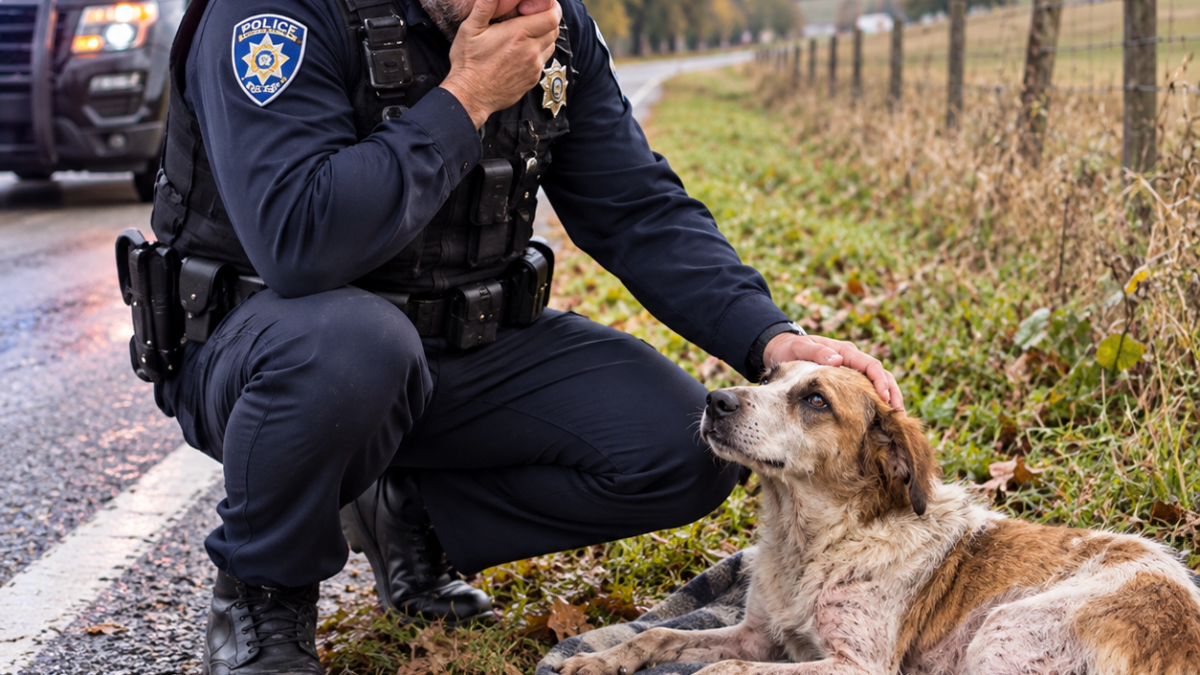
PART 2
They took Hope from my arms before I could ask another question.
The treatment-room doors swung shut.
For several seconds, I remained exactly where they had left me.
Still wearing half a uniform.
No jacket.
Mud on my shoes.
Dog hair stuck to my sleeve.
Julien arrived behind me.
“She’s inside?”
I nodded.
“What did they say?”
“Bad.”
He looked through the doors.
“Specific?”
“No.”
That was all I had.
Bad.
After fifteen years in police work, I hated vague words.
They leave too much room for imagination.
And mine was already doing enough.
Claire arrived ten minutes later.
She was in her mid-forties, sharp-eyed and practical, the kind of animal-protection officer who could comfort a terrified dog while simultaneously collecting evidence from a neglect scene.
She saw my expression.
“Alive?”
“Yes.”
“Treatment?”
“Yes.”
“Then start there.”
I looked at her.
“She was lying beside the road like garbage.”
Claire nodded once.
“I know.”
“Somebody did this.”
“Maybe.”
“Maybe?”
“We know she was neglected. We don’t know yet how she ended up in the ditch.”
I stared.
Claire continued calmly.
“She could have escaped. Been abandoned. Wandered. We document first.”
I knew she was right.
That didn’t make me like it.
The treatment-room door opened.
Isabelle stepped out.
“Marc?”
I stood.
“How is she?”
“Critical.”
There it was.
The word I had been afraid to hear.
She motioned us into a consultation room.
Hope’s body temperature was dangerously low.
Severe malnutrition had left almost no fat or muscle to protect her.
She was dehydrated.
Her blood sugar was low.
Her red blood cell count was concerning.
There were signs of prolonged nutritional deprivation.
Parasites.
Skin irritation.
Old scars.
Nothing suggested a single bad weekend.
This had taken time.
“How much time?” I asked.
“We can’t put an exact number on it. But she did not become this thin in a few days.”
“Was she hit by a car?”
“We don’t see obvious evidence of that.”
“The torn ear?”
“Old injury.”
Her paws?
Worn.
Cracked.
Likely significant walking.
Maybe days.
Maybe longer.
“Can you feed her?”
“Carefully.”
“She needs food.”
“Yes.”
“So give it to her.”
Isabelle didn’t react to my frustration.
“A severely starved animal can become dangerously ill if too much nutrition is reintroduced too quickly.”
I knew just enough about human starvation cases to understand.
Still, it felt wrong.
A starving dog.
Food twenty feet away.
And we had to ration hope by teaspoons.
“What happens now?”
“Fluids carefully. Glucose support. Temperature management. Bloodwork. Parasite treatment when she’s stable enough. Tiny controlled meals.”
“And if she responds?”
“We continue.”
“And if she doesn’t?”
Isabelle looked at me.
“We make decisions based on suffering and medical reality.”
I knew what she meant.
I hated that too.
“Do you think she’s going to die?”
“I think she might.”
Julien looked down.
Claire folded her arms.
I stared at the blank wall.
Then remembered the tail.
One tap against my wrist.
“She wagged.”
Isabelle’s expression softened.
“That means she responded to you.”
“She wanted to live.”
“Maybe.”
I looked at her.
“Maybe?”
“Marc, don’t make the mistake of forcing an animal to become a symbol. She doesn’t need to prove anything. She needs care.”
That sentence stayed with me.
Hope did not owe us a heroic fight.
She was allowed to be tired.
Allowed to fail.
Allowed to survive too.
Our job was not to demand a miracle.
It was to give her a medically reasonable chance.
I nodded.
“Then give her the chance.”
“We already are.”
I called my supervisor.
Explained the situation.
The original traffic-hazard call had become an animal-welfare matter.
Claire began the official documentation.
Photos from the roadside.
Coordinates.
Condition of the area.
Possible tire tracks.
No food containers.
No blanket.
No collar.
No obvious blood.
No nearby house within immediate sight.
We checked recent reports.
Missing dogs.
Stolen dogs.
Found dogs.
Nothing matching Hope.
Claire scanned her for a microchip.
I watched.
The scanner beeped.
We all froze.
“A chip?”
Claire checked again.
“Yes.”
My anger found somewhere to go.
“Good.”
Claire looked at me.
“Not necessarily.”
“Owner.”
“Registered owner, maybe. Old record. Transfer. Outdated information.”
“But it’s something.”
“Yes.”
Finally.
Something.
The registration led to a woman named Amélie Bernard.
An address outside Limoges.
Phone number disconnected.
Claire searched the database.
The chip had been implanted almost five years earlier.
Hope’s original name was not Hope.
It was Lila.
That changed the room for me.
Lila.
A dog had existed before the ditch.
Somebody had named her.
Registered her.
Taken her to a veterinarian at least once.
“What happened to Amélie?” I asked.
Claire was already working.
“We’ll find out.”
Hope remained hospitalized.
I returned to duty.
Physically.
Mentally, part of me stayed in the clinic.
Every call afterward felt unimportant.
Parking dispute.
Minor collision.
Noise complaint.
A man arguing with his brother over a borrowed trailer.
Normal police work.
Yet between each one, I checked my phone.
At noon, Isabelle messaged Claire.
Temperature improving slightly.
At 2:00 p.m., blood sugar more stable.
At 4:30, Hope accepted a tiny amount of food.
I read that message three times.
Ate.
One word.
Huge.
At the end of my shift, I drove back.
Hope was asleep in a heated kennel.
IV line in place.
A light blanket over her.
Without the dirt covering her, I could see her coloring better.
Creamy beige along her back.
White chest.
White stripe on her face.
She looked younger than she had at the roadside.
“Age?” I asked.
“Probably six or seven,” Isabelle said.
“Not old.”
“No.”
Hope’s eyes opened.
She saw me.
Her tail moved.
Once.
Isabelle smiled.
“There.”
I crouched.
“Hey.”
Hope’s nose lifted.
I placed my fingers near the bars.
She sniffed.
Then her eyes closed again.
I stayed twenty minutes.
Said almost nothing.
There are moments when speaking feels selfish.
She needed sleep more than reassurance.
At home that night, my wife Camille knew immediately something had happened.
“Where’s your jacket?”
“At the clinic.”
She raised an eyebrow.
“What clinic?”
I told her.
Our two daughters were at the table.
Lucie was fourteen.
Manon eleven.
By the time I finished, both had stopped eating.
“Is she going to die?” Manon asked.
“I don’t know.”
“Can we see her?”
“Not yet.”
“Who did that?”
Another question I couldn’t answer.
“We’re finding out.”
Lucie said quietly, “You called her Hope?”
“Temporary name.”
Manon shook her head.
“No.”
“What?”
“That’s her name now.”
Camille looked at me.
Apparently the family court had ruled.
Hope.
The next morning, Claire called before my alarm.
“We found Amélie.”
I sat up.
“What happened?”
“She died.”
I was silent.
“When?”
“Three years ago.”
Hope—Lila—had lost her registered owner three years earlier.
That complicated everything.
“Family?”
“One adult son.”
“Name?”
“Thomas Bernard.”
“Address?”
“Working on current one.”
“Did he take the dog?”
“We don’t know yet.”
I felt the investigation opening.
Not solving.
Opening.
By midday, Claire found Thomas.
Thirty-four.
Living roughly forty kilometers away.
He answered his phone.
At first, he sounded confused.
Then Claire said the dog’s chip number.
Silence.
He knew.
“When did you last see Lila?” Claire asked.
I listened from across the office.
Thomas said, “Years ago.”
“How many?”
“Maybe two.”
“What happened to her?”
“My mother’s dog.”
“Your mother died three years ago.”
“Yes.”
“Who cared for Lila after that?”
More silence.
“I did for a while.”
“For how long?”
“I don’t know.”
“Then?”
“I gave her away.”
“To whom?”
“A guy.”
“Name?”
“I don’t remember his last name.”
Claire’s eyes met mine.
“What was his first name?”
“Patrick.”
“Where did Patrick live?”
“Near Saint-Léonard, I think.”
“Phone?”
“Old number. I might have it.”
This was not an answer.
It was a corridor.
We followed it.
Thomas voluntarily sent Claire an old text thread.
There it was.
Patrick Dumas.
A man in his fifties.
Agreed to “take the dog” because Thomas’s rental did not allow animals.
The exchange was brief.
No adoption contract.
No veterinary records transferred.
No follow-up.
Thomas had sent one photo months later.
“Lila okay?”
Patrick replied:
“Fine.”
That was two years ago.
After that, nothing.
“Is Thomas responsible?” I asked Claire.
“Possibly for poor rehoming judgment. But responsibility for Hope’s current condition depends on what happened afterward.”
“Patrick.”
“We need to talk to him.”
Patrick Dumas lived in a small house on the edge of a village.
Claire and I went with another officer.
A thin man opened the door.
Gray beard.
Work clothes.
He recognized Hope’s photograph.
“Lila.”
“When did you last have her?”
He frowned.
“Last year.”
“What happened?”
“She ran away.”
“When?”
“Summer.”
“Which month?”
“July. Maybe August.”
“Did you report her missing?”
“No.”
“Why not?”
He looked at me as though the question annoyed him.
“She was always getting loose.”
“Did you look for her?”
“A little.”
“How long did she live with you?”
“About a year.”
“Was she healthy?”
“Yeah.”
“Veterinary care?”
“Never needed much.”
“Vaccines?”
Shrug.
Claire’s expression stayed neutral.
“Where did she go after she ran away?”
“I just told you. I don’t know.”
I watched the yard.
No fence except an old wire boundary.
A rusted kennel near a shed.
Empty.
A water bucket.
Patrick noticed my attention.
“That wasn’t hers.”
I hadn’t asked.
Interesting.
Claire did not react visibly.
“Do you have other dogs?”
“Not anymore.”
“What happened to them?”
“Gave them away.”
“To whom?”
He stared.
“What’s this about?”
Claire showed Hope’s roadside photograph.
“We found her yesterday.”
Patrick looked.
Then said something I didn’t expect.
“That’s not my fault.”
Nobody had accused him yet.
“When did you say she disappeared?” I asked.
“Last summer.”
“Almost a year ago?”
“Yes.”
Hope’s paws were worn.
Her body profoundly starved.
Could a dog survive wandering for almost a year?
Possible in some circumstances.
Unlikely to explain everything automatically.
We needed records.
Neighbors.
Veterinary history.
Evidence.
Not assumptions.
Claire asked if Patrick would voluntarily allow us to look around.
He refused.
So we left.
Frustrating.
Necessary.
Back at the clinic, Hope improved by millimeters.
Day two.
Temperature stabilized.
Day three.
More alert.
Day four.
She stood with assistance.
When I arrived that evening, Isabelle said, “Don’t get excited.”
“Why would I get excited?”
Hope was standing.
Badly.
Thin legs trembling.
Technician supporting her.
I smiled.
“You’re standing.”
Hope looked toward me.
Tail moved.
I became excited.
Isabelle sighed.
“I specifically told you.”
Hope took one step.
Then another.
Collapsed onto the blanket.
I moved instinctively.
The technician was already there.
Hope was fine.
Exhausted.
But fine.
I crouched.
“Show-off.”
Her tail moved.
The first week became a collection of tiny victories.
A full controlled meal.
A normal temperature.
A better blood value.
A stronger step.
The first time she drank willingly.
The first time she slept on her side instead of curled tightly.
The first time she barked.
That one surprised everyone.
I entered.
Hope saw me.
One soft “woof.”
I froze.
Isabelle said, “Was that for you?”
“Obviously.”
“It might have been because Claire has food.”
Claire walked in carrying chicken.
Hope barked again.
I pointed.
“Still counts.”
Claire laughed.
Hope had opinions now.
Good.
The investigation moved slower.
Neighbors around Patrick’s property gave mixed information.
One remembered Hope.
“She was outside a lot.”
Another said Patrick sometimes chained dogs near the shed.
One claimed Hope had disappeared months earlier than Patrick said.
Another thought she saw Hope there in winter.
Witness memory is messy.
Dates blur.
Seasons replace specifics.
We needed something better.
Then Claire found a veterinary clinic that had treated Hope while she lived with Amélie.
Records showed a healthy adult dog.
Normal weight.
Vaccinated.
Friendly.
After Amélie died, no veterinary visits were documented under Hope’s chip.
Two years of nothing.
That gap mattered.
But it still did not prove who starved her.
Patrick’s property became more relevant when animal protection received a separate complaint.
A caller reported hearing a dog crying behind the shed.
We obtained legal authority for an inspection.
This time, I went.
We found one dog.
Not Hope.
A black mixed breed named Max.
Thin.
Not critical.
Chain tangled around a post.
Dirty water.
Minimal shelter.
Patrick became angry.
“That dog belongs to my cousin.”
The cousin denied it.
Max was removed pending investigation.
Then we found the kennel.
Old hair.
Feces.
Rope.
A food bag several months expired.
And inside the shed, animal medication.
Some labeled for dogs.
Some expired.
One folder contained handwritten notes.
Dates.
Descriptions.
Not full names.
“Brown female.”
“Black male.”
“Pups.”
Amounts beside them.
Euro signs.
Claire read silently.
“You were selling dogs?”
Patrick crossed his arms.
“Helping people find homes.”
“Were you breeding?”
“No.”
“Then why are there litter dates?”
He stopped answering.
Hope’s story grew darker.
Not necessarily because Patrick had bred her.
But his property appeared connected to informal dog transfers.
Cash.
No contracts.
Little care documentation.
One note contained:
“Lila – T.”
Thomas?
Another line months later:
“Lila gone / no use.”
My stomach turned.
No use.
“What does that mean?” Claire asked.
Patrick refused to answer.
Investigators seized the documents under the proper authority.
We left with Max.
The case widened.
Multiple dogs.
Multiple owners.
Some traceable.
Some not.
Hope may have been only one.
I drove home angry.
Camille saw it.
“What happened?”
“More dogs.”
“Alive?”
“One today.”
“Hope?”
“Still safe.”
She put dinner down.
I didn’t eat.
After several minutes, Camille said, “Marc.”
“What?”
“You’re carrying this into the house.”
“I know.”
“You can care without letting Patrick live here too.”
I looked at her.
She pointed toward my head.
“In there.”
She was right.
I hated that everyone kept being right around me.
The next day, I visited Hope.
She walked toward me on her own.
Slow.
But without support.
Five steps.
Six.
Tail moving.
She reached my knees.
Then pressed her head against my hand.
Something inside me loosened.
Patrick became smaller.
Hope became larger.
That shift mattered.
As weeks passed, she entered foster care with Claire.
Not forever.
Temporary.
Claire had a calm older Labrador named Oscar and a fenced yard.
Hope needed somewhere predictable.
No crowds.
No pressure.
The first day, she stood at the open back door for nearly five minutes.
Grass outside.
Sun.
Oscar already lying in the yard.
Hope looked at Claire.
Then at me.
Then stepped out.
One paw.
Second.
Third.
She sniffed.
Oscar lifted his head.
Hope froze.
Oscar yawned and went back to sleep.
Perfect introduction.
Hope explored.
Slowly.
Then found a patch of sunlight.
She lay down.
Not curled.
Stretched.
I remembered the ditch.
Wet grass.
Passing cars.
Same dog.
Different ground.
Claire stood beside me.
“She’s going to make it.”
I looked at Hope.
“Don’t say that.”
“Why?”
“Feels like tempting something.”
Claire smiled.
“You’re superstitious now?”
“Only about dogs.”
Hope did make it.
Physically, faster than emotionally.
Her weight rose steadily.
Muscle returned.
Her coat brightened.
Bloodwork normalized gradually.
Parasites cleared.
Paw pads healed.
But sudden movements still frightened her.
Raised male voices.
Metal clanging.
Closed sheds.
The first time Claire opened a storage shed while Hope was nearby, Hope bolted toward the house.
Claire never forced her back.
“We don’t need to cure every fear,” she said.
I liked that.
Healing is not proving fear wrong through repeated exposure.
Sometimes it is building a life large enough that one fear no longer controls everything.
Hope loved Oscar.
At first, they simply coexisted.
Then she began following him.
Oscar went outside.
Hope followed.
Oscar slept near Claire’s desk.
Hope lay several feet away.
Oscar begged for carrots.
Hope learned immediately.
One evening, Claire sent me a video.
Oscar lying on his bed.
Hope squeezed onto half of it despite there being another empty bed two feet away.
Oscar looked exhausted.
Caption:
SHE HAS DISCOVERED FRIENDSHIP AND BOUNDARY VIOLATIONS.
I laughed in my patrol car.
Julien looked over.
“What?”
“Hope.”
“Of course.”
“Jealous?”
“Deeply.”
The Patrick investigation produced enough evidence to move forward on several animal-welfare violations, including Max’s condition and documentation tied to other dogs.
Hope’s individual case remained more complicated.
Could we prove Patrick had possession close enough to the time she was abandoned?
A witness eventually helped.
An elderly neighbor named Madame Rivière kept a notebook of unusual vehicles because of repeated thefts in the area.
She remembered Hope.
Not by name.
“The cream dog?”
“Yes.”
“She was there in March.”
Patrick had said she disappeared the previous summer.
“March this year?”
“Yes.”
“How sure?”
Madame Rivière walked into her kitchen.
Returned with a calendar.
On March 18, she had written:
Brown van at Patrick’s again. Cream dog loose at gate.
Why?
Because the dog had wandered into her garden that morning.
She had returned her.
“Condition?”
“Thin.”
“How thin?”
She thought.
“Not like your photograph. But too thin.”
“Did you say anything?”
“I told him she needed food.”
“What did he say?”
Madame Rivière’s mouth tightened.
“He said she ate too much already.”
My stomach turned.
That placed Hope at Patrick’s property roughly six weeks before we found her.
Then another witness.
A delivery driver had dashboard footage automatically stored for thirty days.
Too late.
But his company retained route security clips longer after a complaint about a loose dog near the road.
One clip showed a beige-and-white dog near Patrick’s gate three weeks before Hope was found.
Claire and I watched frame by frame.
Torn ear.
White facial stripe.
Likely Hope.
Not absolute from video alone.
Combined with chip records, neighbor identification, and later examination, stronger.
Then came the biggest break.
Patrick’s phone records.
Messages to someone identified as Laurent B.
“Need rid of cream female.”
Reply:
“Bring her?”
Patrick:
“Too thin now. Nobody wants.”
Two days later:
“Might dump near old D road.”
I stared at the message.
My hands went cold.
Julien beside me whispered, “There.”
Not a confession of completed abandonment.
But intent.
A plan.
A location description consistent with where Hope had been found.
More messages followed.
Laurent asked:
“You do it?”
Patrick replied:
“Gone.”
That was the moment the investigation became personal again.
I wanted to drive to Patrick’s house.
Ask him.
How?
How do you take a dog who once had a home, whose owner died, who trusted the next person she was handed to, and reduce her to “gone”?
Claire stopped me before I moved.
“You are not interviewing him angry.”
“I’m fine.”
“You’re visibly shaking.”
“I can do my job.”
“Yes. Tomorrow.”
I hated her.
For an hour.
Then I thanked her.
Tomorrow came.
Formal interview.
Lawyer present.
Patrick denied abandoning Hope.
“Gone” meant she had escaped.
“Might dump” was a joke.
“Too thin now. Nobody wants” referred to something else.
“What?”
He couldn’t explain convincingly.
But our role was not to bully a confession.
Evidence would speak.
I placed Hope’s roadside photograph on the table.
Patrick looked away.
“You recognize her?”
“No.”
I waited.
“You called her Lila before.”
Silence.
“You told us she ran away last summer.”
Silence.
“We have a witness who saw her at your gate in March.”
His lawyer intervened.
We continued appropriately.
Then I showed him the older veterinary photo from Amélie’s records.
Healthy Hope.
Glossy coat.
Full body.
Bright expression.
“This was Lila.”
Patrick’s jaw tightened.
I placed the roadside photo beside it.
“This was her when I found her.”
He looked for perhaps one second.
Then away.
I did not say monster.
Did not say coward.
Did not say what I wanted.
I asked factual questions.
That was harder.
And better.
The case moved to court months later.
By then, Hope no longer resembled the ditch photograph.
That mattered emotionally.
Not legally.
But to me.
I testified.
Roadside.
Condition.
Tail.
Transport.
No collar.
Location.
Everything.
Isabelle testified medically.
Prolonged starvation.
Dehydration.
Parasites.
No acute injury explaining the body condition.
Evidence of chronic neglect.
She was careful.
The defense asked whether Hope might have become thin after running away.
Isabelle answered:
“Some weight loss during roaming is possible.”
“So yes.”
“But the degree of muscle wasting, parasite burden, and chronic body-condition decline was consistent with a longer period of inadequate care.”
The attorney asked if she could prove Patrick had been the one failing to feed Hope.
“No. That is not a medical conclusion.”
Again.
Facts.
Strong because they stayed within boundaries.
Claire presented the ownership timeline.
Thomas.
Transfer.
Patrick.
Witnesses.
Messages.
The handwritten note.
“Lila gone / no use.”
The defense attacked ambiguity.
That was expected.
Then Madame Rivière testified.
Small woman.
White hair.
Unshakable.
“Did you see this dog at Mr. Dumas’s property in March?”
“Yes.”
“How can you be sure?”
“She ate my cat’s food.”
The courtroom almost laughed.
Madame Rivière did not.
“My cat was furious.”
Even the judge smiled slightly.
She continued.
“I brought the dog back myself.”
“What did Mr. Dumas say?”
“I told him she was thin.”
“And?”
“He said she ate too much.”
“Are you sure?”
Madame Rivière looked offended.
“I am old. I am not deaf.”
That may have been the strongest sentence of the day.
The digital messages tied the timeline together.
Patrick still denied intentional abandonment.
But the court did not need my anger.
It had records.
The final ruling found him responsible for animal neglect and abandonment-related violations under the applicable process, alongside findings concerning Max and other documented welfare failures.
He received penalties.
Restrictions on animal ownership for the period ordered.
The remaining animals connected to the case were legally protected from returning to him.
I expected triumph.
Instead, I felt tired.
Claire met me outside.
“You look disappointed.”
“I wanted it to feel bigger.”
“Why?”
“Because Hope almost died.”
Claire nodded.
“And now?”
“She’s alive.”
“There’s your big thing.”
That was the moment revenge began changing meaning.
Patrick had lost legal control.
Good.
But his punishment was not Hope’s healing.
Those were separate things.
Hope did not wake each morning thinking about court.
She thought about breakfast.
Oscar.
Grass.
Carrots.
Whether Claire had left the couch unattended.
Her life was already moving beyond him.
I needed to do the same.
Adoption discussions began.
Hope was healthy enough.
Emotionally stable enough for the right home.
I hated every application.
Not because they were bad.
Because they meant she might leave.
One family seemed excellent.
Middle-aged couple.
Quiet home.
Fenced yard.
No small children.
Dog experience.
They met Hope.
She sniffed them.
Accepted treats.
Allowed touch.
The woman smiled.
“I think she’s perfect.”
My stomach sank.
Claire noticed.
After they left, she asked, “Problem?”
“No.”
“You looked like someone repossessed your car.”
“I’m fine.”
“Marc.”
“What?”
“You know where this is going.”
“No.”
“Yes.”
“I have a job.”
“So do millions of dog owners.”
“Shift work.”
“Camille?”
I looked away.
Claire smiled.
“You haven’t asked your wife.”
I had.
Technically.
Several weeks earlier.
Casually.
“If Hope ever needed somewhere—”
Camille had interrupted.
“Bring her home.”
I had pretended not to hear the enthusiasm.
My daughters were worse.
Manon had already made a bed.
Without permission.
Lucie had researched dog food.
There was a leash in our garage.
I still told myself we were only prepared “just in case.”
Claire crossed her arms.
“Do you want her?”
I looked toward the yard.
Hope and Oscar were lying in sunlight.
She had gained enough weight that her ribs no longer showed.
White chest bright.
One torn ear still there.
Permanent.
Beautiful.
“Yes.”
“Then apply.”
“What about the couple?”
“They’re good adopters. We have other dogs.”
“That feels unfair.”
“To whom?”
I had no answer.
I filled out the application.
Properly.
Home check.
Veterinary planning.
Family agreement.
Schedule.
Budget.
No special treatment because I had found her.
Approved.
The day Hope came home, Manon cried before the dog even entered.
“Please don’t overwhelm her,” I said.
“I’m not.”
“You’re crying in the doorway.”
“Quietly.”
Hope stepped inside.
Stopped.
Sniffed.
Camille remained in the kitchen.
Lucie sat on the floor sideways.
No reaching.
Hope explored.
Hallway.
Living room.
Back to hallway.
She found the bed Manon had prepared.
Sniffed.
Ignored it.
Lay on the tile.
Manon looked devastated.
“She hates my bed.”
“She’s been here six minutes.”
By evening, Hope used the bed.
Manon photographed it as proof.
The first night, Hope slept downstairs.
Second too.
Third, I heard nails on the stairs at 2:00 a.m.
I sat up.
Hope stood in the bedroom doorway.
Camille whispered, “Don’t move.”
“I know.”
Hope took one step.
Then another.
Lay near the door.
Five minutes later, sleep.
That became the pattern.
Doorway.
Then beside the dresser.
Then near my side of the bed.
A month later, she rested her head on my shoe while sleeping.
I barely moved for an hour.
Camille laughed.
“You have legs.”
“Not currently.”
Hope learned family life.
Breakfast at seven.
Walk after.
Girls leave for school.
Camille working at home some days.
Me unpredictable.
Hope hated my night shifts at first.
When I returned at dawn, she waited near the door.
Tail wagging.
Not frantic.
Eventually she learned.
I leave.
I return.
That was one of the deepest wounds in her.
People leaving.
Amélie died.
Thomas rehomed her.
Patrick failed her.
Then, perhaps, abandoned her.
Hope had learned humans vanish.
So I built a boring pattern.
Leave.
Return.
Leave.
Return.
Hundreds of times.
Eventually she stopped waiting at the window.
That was trust.
People often celebrate dogs following us everywhere.
I celebrated the first day Hope stayed asleep when I left for work.
She believed I would come back.
That was better.
Food took longer.
Hope ate quickly.
Too quickly.
We used slow feeders.
Regular schedule.
Nobody disturbed her.
Months passed.
Then one evening, she ate half and walked away.
I stared.
Camille noticed.
“What?”
“She left food.”
“So?”
I looked at her.
She understood.
Hope had once nearly starved.
Food had been survival.
Now she believed another meal would come.
That might have been one of the biggest recovery milestones.
Manon didn’t understand why I cried.
“She didn’t finish dinner.”
“Exactly.”
Teenagers eventually understand.
Children think food left behind is waste.
Adults who have seen starvation know sometimes it means safety.
Hope became playful too.
Slowly.
First, a rope toy.
She sniffed.
Ignored.
Then one afternoon, Lucie dragged it gently.
Hope followed with her eyes.
Pounced once.
Stopped.
Everyone froze.
“Continue,” I whispered.
Lucie moved it.
Hope grabbed.
Tugged.
For three seconds.
Let go.
Walked away.
Our family celebrated as though France had won a championship.
Hope looked embarrassed by us.
Within weeks, she loved tug.
Then balls.
Never obsessed.
But enough.
She preferred stealing socks.
Manon complained.
I said, “You wanted a dog.”
“I wanted a normal dog.”
“She is normal.”
Hope ran past carrying Manon’s sock.
I smiled.
“Very normal.”
Years passed.
That sentence still feels like a miracle.
Years.
Not days.
Not “she survived the night.”
Years.
Hope turned from rescue case into household dictator.
She barked at the mail carrier.
Hated vacuum cleaners.
Loved cheese more than medically reasonable.
Refused rain.
Needed exactly three circles before lying down.
Developed an irrational suspicion of one blue umbrella.
Preferred Camille when sick.
Preferred me when scared.
Preferred Manon when food was available.
Used Lucie for long walks.
She organized us.
The ditch became smaller.
Not erased.
Smaller.
Patrick’s name disappeared from normal conversation.
That was healthy.
I stopped checking whether his restrictions had ended.
Stopped imagining what he thought.
Claire once asked why.
“Because Hope doesn’t care.”
She smiled.
“Good answer.”
The best revenge became irrelevance.
Patrick had once controlled whether Hope ate.
Whether she had shelter.
Whether she was safe.
Then he controlled nothing.
Not breakfast.
Not where she slept.
Not who loved her.
Not what name we used.
Not the years.
Nothing.
His role shrank into one ugly chapter.
Hope became the whole book.
Five years after adoption, we visited Isabelle’s clinic for a routine exam.
Routine.
That word still made me grateful.
Hope walked inside.
Tail wag.
Isabelle came out.
Stopped.
“Oh, look at you.”
Hope approached.
Sniffed her.
Then leaned against her legs.
Isabelle looked at me.
“You remember the first day?”
“Every detail.”
“I wasn’t sure she’d make twelve hours.”
I looked at Hope.
Healthy.
Strong.
A little gray around the muzzle.
“Don’t tell her.”
“She already thinks she’s immortal.”
Hope barked at someone opening a treat jar.
Isabelle laughed.
“Clearly.”
Routine bloodwork.
Vaccines.
Nails.
Weight management.
Nothing dramatic.
I paid the bill happily.
That surprised the receptionist.
“You seem very cheerful about veterinary expenses.”
“She earned ordinary problems.”
As Hope aged, my daughters did too.
Lucie left for university.
Hope slept outside her room the first night she was gone.
Not all night.
Just an hour.
Then came to our bedroom.
When Lucie returned two months later, Hope heard her voice from upstairs.
She ran.
Actually ran.
Down the hallway.
Nearly slipped.
We shouted.
Hope ignored us.
Lucie dropped her bag.
Hope slammed into her legs.
Tail everywhere.
Lucie cried.
“I missed you too.”
I stood back.
Another reunion.
No ditch.
No emergency.
Just love returning.
Manon left three years later.
Hope older then.
Couldn’t run as fast.
She still waited at the door.
Our home became quieter.
Camille and I joked Hope had become our last child.
Then stopped joking because it was true.
Her medical problems arrived gradually.
Arthritis.
Medication.
A small benign lump removed.
Dental care.
Then early kidney changes.
Isabelle became more cautious.
“Nothing urgent.”
I hated the phrase.
It means something exists.
Just not today’s emergency.
We changed food.
Hope protested.
Strongly.
“Medical diet,” I told her.
She looked at me.
Walked away.
Camille added approved chicken.
Hope ate.
“You are undermining science.”
Camille said, “I am supporting compliance.”
Married people can justify anything with terminology.
Hope aged beautifully.
Not because aging itself is beautiful every day.
Some days hurt.
She struggled getting up.
We added rugs.
A ramp.
Orthopedic bed.
Water bowls in more rooms.
Shorter walks.
Her torn ear became framed by white fur.
The eyes stayed.
Same brown eyes from the ditch.
But different expression.
Not exhausted.
Not asking whether humans were safe.
Expecting comfort.
That was better.
One winter morning, Hope slipped on the kitchen tile.
Her legs spread.
She panicked.
I reached.
She froze.
For half a second, old fear flashed.
Then she saw me.
Relaxed.
I helped her up.
“You’re okay.”
Tail wag.
That moment showed me something.
Trauma can remain in the nervous system even after years.
But trust can become faster than fear.
The fear appeared.
Then recognition replaced it.
Marc.
Home.
Safe.
That was healing.
Not forgetting.
Recovering faster.
The investigation came back into my life unexpectedly when a young officer called.
He had a dog-neglect case involving someone associated with Patrick years earlier.
“Can I ask you about the Dumas file?”
My body tightened.
“Why?”
“Similar informal transfers.”
I gave him what I could appropriately provide through official channels.
Nothing more.
The new case was separate.
Different animals.
Different evidence.
But Patrick’s old records helped investigators understand a network of careless rehoming and unregulated breeding.
That bothered me.
How many dogs had moved through those hands?
Some we found.
Some maybe never.
You cannot rescue backward.
That is one of the hardest truths.
You act where evidence exists now.
The young officer later told me two dogs had been removed safely.
Earlier than Hope had been.
Not starving.
Not critical.
That mattered.
Maybe Hope’s case had taught the system to recognize a pattern faster.
That became another kind of justice.
Not punishment.
Prevention.
We began working with local animal groups to encourage proper transfer records.
Microchip updates.
Written ownership changes.
Veterinary records.
Simple things.
Boring things.
Boring saves lives.
Hope’s ownership trail had been chaos because everybody treated rehoming casually.
“Take the dog.”
Done.
No follow-up.
No updated chip.
No contract.
When something went wrong, accountability became difficult.
A few forms cannot create kindness.
They can create traceability.
Sometimes traceability is the difference between disappearing and being found.
Hope’s microchip had survived every failure.
Amélie’s old act of registering her became the thread that helped reconstruct years later.
I thought about Amélie often.
A dead woman who never knew what happened.
Records suggested she had cared for Hope well.
What would she have felt seeing the roadside photograph?
I was glad she never did.
I preferred imagining her seeing Hope in our yard.
Healthy.
Spoiled.
Loved.
Maybe that was sentimental.
I allowed myself some sentiment with age.
Hope reached twelve.
Then maybe thirteen.
Exact ages were guesses.
Isabelle smiled during one exam.
“The dog who almost died beside a road is now overweight by one kilogram.”
I gasped.
“Defamation.”
“It’s on the scale.”
Hope looked unconcerned.
Camille blamed me.
I blamed cheese.
Cheese had no lawyer.
We adjusted portions.
Hope objected.
She stood beside her bowl after finishing.
Stared.
“No.”
Tail wag.
“You ate.”
More stare.
“This is medical.”
One bark.
Camille laughed from the other room.
“Give her a carrot.”
“Stop enabling her.”
Hope got the carrot.
She had earned the right to become annoying about food.
The final year arrived slowly.
Aging had been gradual.
Then something changed.
More sleep.
Less interest in walks.
Kidney values worse.
Appetite inconsistent.
Nausea.
Medication helped.
Good weeks returned.
Then hard ones.
We learned to measure quality of life.
Eating.
Drinking.
Comfort.
Mobility.
Interest.
Connection.
The things Hope still chose.
One morning she surprised me by bringing the old rope toy.
I had not seen her touch it for months.
She placed it near my shoe.
I stared.
“You want this?”
Tail movement.
I picked it up.
Pulled gently.
Hope held the other end.
Two seconds.
Three.
Then let go.
Lay down.
I laughed.
“Retired champion.”
That afternoon I took a photograph.
Old Hope.
White muzzle.
Rope between her paws.
It became my favorite.
Not the young healthy version.
Not the rescue.
Old.
Because old meant she got time.
The dog in the ditch had almost been denied age.
Now age was taking her.
Cruel irony.
Beautiful too.
The final decline became obvious when she stopped caring about cheese.
Camille placed a small piece near her nose.
Hope sniffed.
Turned away.
We looked at each other.
“Isabelle.”
I called.
She came to the house.
Hope lay near the patio door.
Late spring.
Warm breeze.
Isabelle examined her.
Listened.
Touched.
Hope tolerated everything.
Then Isabelle sat with us.
“We’re close.”
I looked at Hope.
“Pain?”
“Controlled today.”
“Can we get more time?”
“Maybe.”
I hated maybe.
Again.
After all those years, medicine still lived inside maybe.
“What would you do?”
Isabelle looked at me.
“I can’t make that decision for you.”
“You saved her.”
“We all did.”
“Please.”
She took a breath.
“I would watch whether the things that make Hope herself are still present.”
Food.
Family.
Yard.
Attention.
Comfort.
Interest.
For another week, enough remained.
Hope ate small meals.
Walked outside with help.
Slept in sunlight.
Put her head on Camille’s lap.
Tail wagged when I returned home.
Then the balance shifted.
Three hard days.
One good morning.
Two hard.
I found myself waiting for one bright hour and using it to erase everything else.
Camille noticed.
“You’re doing it.”
“What?”
“Counting the good moment as the whole day.”
I knew.
Love bargains.
That is what it does near the end.
One more meal.
One more walk.
One more tail wag.
Maybe tomorrow better.
Sometimes tomorrow is better.
Sometimes that delays a decision appropriately.
Sometimes it becomes denial.
Hope stopped eating almost entirely.
Water decreased.
Standing became difficult.
Her eyes still followed us.
That hurt most.
Mind there.
Body tired.
I sat beside her.
“Remember the ditch?”
Camille said softly, “She doesn’t.”
“Good.”
Hope’s tail moved faintly.
Same movement.
Almost exactly.
A tiny sweep against the blanket.
Suddenly I was forty-two again.
Wet roadside.
Gravel.
Tail in grass.
I started crying before I could stop.
Camille sat beside me.
“What?”
“Her tail.”
She understood.
We called Isabelle.
The final day was clear.
We put Hope’s bed outside.
The yard she had ruled for years.
Lucie drove home.
Manon too.
Both adults now.
Both cried like children.
Hope recognized them.
Tail.
Small but there.
Lucie lay beside her.
“Hi, baby.”
Manon brought cheese.
Hope sniffed.
Nothing.
Then, after several seconds, took one tiny piece.
Everyone laughed and cried.
“There she is,” Camille whispered.
Isabelle arrived.
No clinic.
No rushing.
No strangers.
The girls sat on one side.
Camille on the other.
I sat near Hope’s head.
For several minutes, nobody spoke.
Then Manon said, “Tell the story.”
“What?”
“How you found her.”
Hope’s eyes were closed.
I started.
“Possible dead animal near the road.”
Lucie smiled through tears.
“You thought she was dead.”
“Yes.”
“Then?”
“Her tail moved.”
I touched Hope’s side.
“Once.”
Manon asked, “And you named her immediately?”
“Julien asked.”
“Hope.”
“Yes.”
Camille said, “Best decision you ever made.”
“I married you.”
“Second best.”
Even Isabelle laughed.
Hope opened her eyes.
Looked at us.
Family noise.
Normal.
The first medication made her sleepy.
Her muscles relaxed.
No trembling.
No need to brace.
I put my hand beside her nose.
The same gesture as at the red light years earlier.
“You’re not alone.”
This time, the sentence had history behind it.
Hundreds of nights.
Thousands of meals.
School years.
University.
Birthdays.
Vet visits.
Arguments over cheese.
Leave.
Return.
Leave.
Return.
She knew.
Maybe not the words.
The pattern.
I stroked the torn edge of her ear.
“You were never the dog in the ditch.”
My voice broke.
“That was where I met you.”
Hope breathed.
“But it was never who you were.”
Another breath.
“You were Amélie’s dog once.”
I thought of the woman who had loved her first.
“Then somehow you found us.”
Camille squeezed my shoulder.
Lucie whispered, “She did.”
I continued.
“You were Hope.”
Tail did not move now.
Too tired.
“You raised two girls.”
Manon laughed.
“She stole from us.”
“Same thing.”
“You ruined my socks.”
Hope breathed.
“You barked at umbrellas.”
Another.
“You became overweight.”
Camille hit my arm.
“Marc.”
I laughed through tears.
“She did.”
Even Isabelle smiled.
Then I leaned closer.
“You did enough.”
That was the sentence.
Not fight.
Not stay.
Enough.
“You don’t have to wag for me anymore.”
My throat closed.
“You don’t have to tell me you’re still here.”
Hope’s breathing slowed.
“I see you.”
Years earlier, that had been the whole promise.
I see you.
The final medication was given when we were ready.
Hope died with my hand beneath her cheek.
Camille touching her back.
Our daughters beside her.
Sun warming the fur that had once been cold in a ditch.
No roadside traffic.
No hunger.
No uncertainty.
Home.
Afterward, I kept my hand there.
For a long time.
Then Julien arrived.
I had not called him.
Camille had.
He walked into the yard.
Saw Hope.
Stopped.
Gray at the temples had become mostly gray now.
He came over.
Placed one hand on my shoulder.
Neither of us spoke.
Eventually he looked at Hope.
“You remember what you said?”
“What?”
“When I asked what we call her.”
I nodded.
“Hope.”
He swallowed.
“Yeah.”
He knelt.
“Good name.”
That destroyed me.
We buried nothing in the yard because local regulations and practical considerations made cremation the better option.
But the girls planted a small tree.
Not a memorial plaque.
A tree.
Manon chose it.
A flowering cherry.
“Why?”
“She liked lying in the sun.”
“That tree makes shade.”
“Eventually.”
Fair.
We planted it where Hope usually slept.
The first year, it barely grew.
The second, stronger.
By the fifth, pink blossoms covered it every spring.
Hope never saw them.
We did.
That was enough.
The official case file remained archived.
Patrick eventually faded from our lives.
I never checked on him again.
I had once imagined justice requiring me to remember.
It didn’t.
Sometimes forgetting the person who caused harm is the final stage of taking the story back.
Hope deserved more mental space than he did.
So when people asked, “What happened to the man?”
I answered.
Then moved on.
“What happened to Hope?”
That was the better question.
Hope lived.
Really lived.
She became healthy.
Then spoiled.
Then confident.
Then old.
She loved carrots less than cheese.
Hated umbrellas.
Raised our daughters alongside us.
Slept through thunderstorms eventually if Camille was nearby.
Learned to trust men again.
Learned food returned.
Learned people returned.
Learned beds stayed warm.
Learned a hand reaching toward her could mean affection.
Learned she could stop watching every door.
Learned sleep.
That is what happened to Hope.
And if anyone asked about revenge, I told them this:
The person who abandoned her expected the road to finish the job.
It didn’t.
Hunger tried to erase her.
It didn’t.
Fear tried to make her disappear.
It didn’t.
Neglect reduced her body to almost nothing.
Then she rebuilt it.
The ditch was supposed to be an ending.
It became an address we drove away from.
Patrick became a file number.
Hope became family.
That was revenge enough.
Years after her death, I still worked patrol for a while.
The first months were strange.
Every roadside shape made me look twice.
A bag.
Piece of tarp.
Animal.
Shadow.
Julien noticed.
“You slow down for everything now.”
“Yes.”
“That cardboard box was suspicious.”
“It looked like a dog.”
“It said microwave.”
“Could’ve been a very square dog.”
He laughed.
But I did stop more often.
Not recklessly.
Not for every object.
Enough.
One winter, I found an injured fox.
Another time, a lost Labrador.
Once, a cat inside a drainage pipe.
None became Hope.
That was important too.
Not every rescue needs to recreate the first one.
Each animal is itself.
Hope simply taught me to look.
Before her, roadside animals were often hazards to manage.
After her, I remembered each shape might still contain a heartbeat.
That did not make me sentimental in every case.
Sometimes the animal was already dead.
Sometimes help came too late.
Those calls became harder after Hope.
But they also became more respectful.
Move the body carefully.
Check for identification.
Call the right service.
Maybe someone is looking.
Maybe that animal had a name.
Every life had a before.
Hope taught me that too.
She had been Lila before Hope.
Loved by Amélie.
Then lost into a chain of human decisions.
When I found her, I knew none of it.
A body in grass.
But history was still there.
A dog never begins with the moment we notice it.
That idea changed my policing too.
People.
Victims.
Offenders.
Witnesses.
Nobody begins when I arrive.
There is always a before.
Context does not erase accountability.
But it matters.
I became more patient asking questions.
Less certain that first appearances told the whole story.
Hope made me a better officer.
I wish I could claim I learned that from training.
Sometimes the deepest lessons arrive covered in mud beside a road.
Eventually I retired.
Julien retired two years later.
At my retirement gathering, he handed me a box.
Inside was my old service jacket.
Not the exact original—we had replaced uniforms several times.
But attached to the inside was a small embroidered patch Camille had commissioned.
A tiny tail.
One curved line.
I stared.
“What is this?”
Julien shrugged.
“So you remember why you started driving like an eighty-year-old near ditches.”
I laughed.
Then cried.
Hate when friends do that.
The jacket hangs in my study.
Not framed.
Just hanging.
Near the window overlooking Hope’s tree.
Every spring, blossoms.
Every spring, I think of wet grass.
Tail.
Once.
That tiny movement had no idea what it was starting.
A call.
A clinic.
An investigation.
A court case.
An adoption.
Years.
Children growing.
A tree.
Memory.
Hope did not save the world.
I did not either.
That matters to say.
Rescue stories can become too large.
Hero officer.
Miracle dog.
Justice.
Transformation.
Reality was smaller.
I stopped one car.
Carried one dog.
Other people did their jobs.
Hope survived.
My family adopted her.
We loved her.
That is enough.
The world does not require every kindness to become a movement.
Sometimes saving one life is exactly the right size.
Still, Hope’s story did ripple.
Claire later started a community program helping owners update microchip information after moves, deaths, divorces, and rehoming.
Why?
Because Hope’s trail had been unnecessarily difficult.
Amélie’s death.
Thomas’s informal transfer.
Patrick.
No update.
Years.
A registered chip tied to a dead owner.
The program was simple.
Paperwork assistance.
Reminders.
Low-cost clinics.
Boring.
Useful.
Within its first year, several lost dogs were returned quickly because records were current.
One case involved an elderly man hospitalized unexpectedly whose daughter rehomed his dog temporarily.
This time, the chip record was updated.
The dog later returned safely.
No disappearance.
No mystery.
I liked that.
The best legacy of a dramatic rescue is fewer dramatic rescues.
Prevention is less viral.
Better for animals.
Isabelle started teaching younger veterinarians about refeeding severely malnourished dogs.
She used anonymized case examples.
Hope was one.
She told me years later.
“Students always want to feed immediately.”
“So did I.”
“Everyone does.”
“She was starving.”
“Yes.”
“And food can still harm?”
“If done wrong in severe cases, yes.”
I smiled.
“She became very skilled at eating eventually.”
Isabelle laughed.
“I remember.”
Claire fostered dozens more dogs.
Oscar died.
She adopted another.
Then another.
Never kept Hope’s bed.
“She stole Oscar’s anyway.”
True.
My daughters grew into women.
Lucie became a teacher.
Manon entered veterinary nursing.
That one I blamed entirely on Hope.
Manon denied it.
Then chose animal emergency care.
I said, “Sure.”
She eventually admitted.
“The first clinic visit stuck with me.”
“You were not there.”
“I saw the pictures afterward.”
“Still.”
She smiled.
“Maybe.”
One evening years later, Manon called from work.
“Tough case.”
“What?”
“Starved dog.”
I became quiet.
“Alive?”
“Yes.”
“Critical?”
“Yes.”
“You okay?”
“No.”
Honest.
“What do I do?”
I thought about myself at forty-two.
Wanting to feed.
Fix.
Demand.
I said, “Do the next medically correct thing.”
Silence.
“That’s very boring advice.”
“Boring keeps people useful.”
She laughed faintly.
Then I added, “And when you go home, go home.”
Hope had taught that too.
Care without boundaries can swallow you.
We cannot carry every rescued animal forever.
Do your part.
Pass responsibility safely.
Return to your life.
That night, Manon’s patient survived.
Not because of advice.
Because a team did its job.
She sent me a photo weeks later.
Healthy dog.
I looked toward Hope’s tree.
Ripple.
Maybe.
Or maybe just life continuing.
Either way, good.
I am older now than I was when Hope died.
Old enough that getting up from the floor requires planning.
If she were here, we would both struggle.
Sometimes Camille jokes that Hope and I would need the same ramp.
Probably.
On warm mornings, I drink coffee beneath the tree.
The blossoms last only a short time.
Then fall.
Pink petals across the grass.
One landed on my shoe last spring.
I looked down.
For half a second, it resembled movement.
Tail in grass.
Memory can be cruel.
Or kind.
That one was kind.
I thought about the first words I said.
“Easy, girl.”
Then:
“You’re not alone.”
Those promises sounded temporary at first.
Get her to clinic.
Keep her alive.
Eventually they became permanent.
Not alone.
For years.
Until the end.
That is the part of rescue that matters most to me now.
Finding is dramatic.
Staying is the work.
Anyone can feel something for a photograph.
A starving dog.
Injured animal.
Sad eyes.
The harder part begins after emotion cools.
Medicine.
Money.
Training.
Setbacks.
Hair on furniture.
Behavior issues.
Aging.
Final decisions.
Love becomes logistics.
Hope taught us every phase.
We stayed.
So did she.
When my grandchildren ask about the tree, I tell them.
“There was a dog named Hope.”
“Was she yours?”
“Yes.”
“Where did you get her?”
“Beside a road.”
“Why?”
“Someone left her there.”
Their faces change.
Then I stop.
I do not want Patrick to become the exciting part.
“So what happened?”
I smile.
“She came home.”
That is where I put the emphasis.
She came home.
A ditch is not more interesting than a home.
Cruelty should not receive better storytelling than love.
So I tell them Hope learned to steal cheese.
Hope snored.
Hope hated the blue umbrella.
Hope loved their mothers.
Hope slept under the kitchen table during family dinners.
Hope became old.
They laugh.
That is her story.
The abandonment is context.
Not identity.
Sometimes adults could learn from that.
We preserve trauma because it explains.
Then accidentally turn it into definition.
Hope was neglected.
She was not Neglect.
She was abandoned.
She was not Abandonment.
She was starving.
She was not Starvation.
She was Hope.
A dog.
A complicated, funny, stubborn, food-obsessed, cautious, loving dog.
That is why the final photograph I keep on my phone is not the roadside.
Not clinic.
Not adoption day.
It is bad quality.
Hope is lying upside down on our couch.
One hind leg hanging off.
Mouth slightly open.
Completely undignified.
Camille took it.
I remember being angry because Hope wasn’t supposed to be on the couch.
By then nobody enforced the rule.
The picture makes me laugh every time.
That is how I know healing won.
The image that comes first now is not ribs.
It is ridiculous sleep.
Not the ditch.
The couch.
Not fear.
Trust.
Patrick’s worst decisions could not permanently determine what memory became strongest.
Love overwrote the order.
Not history.
The order.
And if that is not revenge, I don’t know what is.
One life taken back.
One name changed by choice.
One frightened dog aging into someone who expected breakfast and complained when it was late.
One police officer slowing down near ditches for the rest of his career.
One family expanded because a tail moved once.
That morning, Hope had almost nothing left.
No collar.
No food.
No known person coming.
No strength to stand.
But she still offered that tiny wag.
People sometimes say she was thanking me.
I don’t believe that.
She did not know me.
I had done nothing yet.
Maybe she was simply responding.
Maybe dogs wag because connection remains instinctive even when everything else fails.
I prefer that explanation.
Because it means the wag was not gratitude.
It was possibility.
Hello.
I see you.
Do you see me?
Yes.
I did.
And once I saw her, I could never look at that roadside—or any roadside—the same way again.
Hope’s revenge was not that someone else’s life became smaller.
It was that hers became enormous.
Big enough for years.
Family.
Sunlight.
Cheese.
Two girls growing up.
A home.
Old age.
A peaceful death.
A flowering tree.
Stories told long after her body was gone.
The ditch received a few hours of her life.
We got the rest.
And in the end, that was more than enough.








