PART 2: She Hadn’t Spoken in 14 Days—Then We Put a 6-Week-Old Kitten in Her Arms and Heard the First Word Leave Her Mouth
PART 2
That afternoon became the story everyone at Meadow Creek told differently.
Melissa swore Vera had smiled before she said Oliver’s name.
Earl insisted the kitten had purred the second Vera touched him.
Mrs. Callahan claimed she had known the experiment would work.
She had absolutely not.
I know because, before we entered Vera’s room, she told me:
“If that kitten scratches her, Rachel, this is your idea.”
My name is Rachel, by the way.
I was thirty-nine then.
Old enough to know better than to believe in miracles.
Young enough to occasionally use the word anyway.
Oliver did not cure Vera.
I want to be clear about that.
The world loves stories where one small animal enters a room and magically fixes everything.
Real caregiving is not like that.
Vera was ninety-seven.
She had grief.
Age.
Physical weakness.
A heart that had endured more funerals than most of us could imagine.
Oliver did not erase any of that.
What he did was give her something to reach toward.
There is a difference.
The next morning, Vera asked where he was.
Those were her first voluntary words to me after the day before.
“Where is Oliver?”
I pretended I didn’t understand.
“Who?”
She glared.
“The cat, Rachel.”
“Oh, Pip?”
“Oliver.”
“Button?”
Her eyes narrowed.
“Bring me my cat.”
I nearly saluted.
“Yes, ma’am.”
Oliver arrived at nine.
He climbed into Vera’s lap and immediately started chewing the corner of her cardigan.
“You have dreadful manners,” she told him.
He continued chewing.
“And poor musical taste, I assume.”
He purred.
“Exactly as I suspected.”
For the first week, Oliver visited her twice a day.
Nine in the morning.
Two in the afternoon.
At night, he slept in a small approved enclosure in the staff room, where someone fed him every few hours.
We created a schedule.
The night staff complained.
Then became obsessed with him.
By day five, Oliver had six blankets, nine toys, three brushes, and a tiny knitted sweater nobody admitted purchasing.
Earl built him a wooden climbing platform.
Mrs. Callahan stared at it.
“This animal is temporary.”
Earl kept sanding.
“Of course.”
“Earl.”
“Temporary platform.”
She walked away.
The most remarkable thing wasn’t how quickly Oliver changed.
Kittens do that.
Eat.
Sleep.
Grow.
Repeat.
The remarkable thing was Vera.
She started asking questions again.
Not broad philosophical questions.
Very Vera questions.
“What time did he eat?”
“How much?”
“Why is his left eye slightly watery?”
“Did anyone weigh him?”
“What sort of person leaves a six-week-old animal in a shoebox?”
That last question none of us could answer.
She hated uncertainty.
“You people work in healthcare. Surely someone investigates.”
“We called animal control.”
“And?”
“No owner.”
“Hmph.”
That “hmph” was one of the happiest sounds I had heard in weeks.
Three days after Oliver arrived, Caroline came for her Sunday visit.
I met her near the front entrance.
“Before you go in…”
Her face changed immediately.
“What happened?”
“Nothing bad.”
“Rachel.”
“Your mother is talking.”
Caroline froze.
“What?”
“She started Thursday.”
Caroline stared at me.
“Why didn’t anyone call me?”
“We did. You didn’t answer.”
She grabbed her phone.
Four missed calls.
“Oh my God.”
Then she started toward Vera’s room.
I caught her arm.
“Wait.”
“What?”
“There’s something else.”
“Is she sick?”
“No.”
“Then what?”
“Your mother has acquired a cat.”
That stopped her.
“My mother has what?”
“Technically the facility has the cat.”
“Why?”
“It’s complicated.”
“Rachel.”
“Go see.”
Caroline walked down the hallway.
Vera wasn’t in her room.
That was the second surprise.
We found her in the common area.
At a table.
Crossword puzzle in front of her.
Pencil in one hand.
Oliver asleep in her lap.
Caroline stopped in the doorway.
I watched her face change.
Shock.
Relief.
Pain.
Joy.
Sometimes human emotions arrive too quickly to separate.
Vera eventually looked up.
“You’re late.”
Caroline laughed and cried at the same time.
“I’m five minutes early.”
Vera looked at the wall clock.
“That clock is slow.”
“It isn’t.”
“It is.”
Caroline walked over.
She stared at Oliver.
“So this is him?”
Vera stroked the kitten.
“He was terribly thin.”
“He looks okay.”
“He was not.”
Oliver stretched.
Vera adjusted him carefully.
“All he needed was someone willing to take the trouble.”
Caroline’s face collapsed.
She sat beside her mother.
For several minutes, she said nothing.
Then she placed one hand over Vera’s.
I looked away.
Caregiving teaches you when to stay.
It also teaches you when a moment no longer belongs to you.
During the second week, Vera asked for crossword puzzles again.
During the third, she joined us for lunch.
Not every meal.
But enough.
She started correcting Earl’s grammar.
She complained that our tea was weak.
She asked me whether I had considered “doing something more respectable with my hair.”
That was when I knew we truly had Vera back.
Oliver, meanwhile, discovered climbing.
Anything.
Curtains.
Chairs.
Cardigans.
People.
One morning, Vera shifted forward to stand.
Oliver sensed movement.
Before she had fully raised herself, he climbed from the floor, up the side of her chair, across her sweater, and into her lap.
Vera stared at him.
“You are shameless.”
Oliver curled up.
“Completely shameless.”
She stroked him.
“Very well.”
The younger nurses began timing him.
Four seconds.
That was roughly how long Oliver needed to reclaim Vera’s lap whenever she tried to move him.
He became a routine.
But routines create attachments.
Attachments create problems when institutions become involved.
And about six weeks after Oliver arrived, that is exactly what happened.
Meadow Creek was privately operated but owned by a larger regional senior-care company called North Valley Living.
For years, headquarters had mostly ignored us.
That was one reason Meadow Creek worked.
We were profitable enough not to attract attention.
Small enough not to create trouble.
Then someone posted a photograph.
I still don’t know who.
Probably a visitor.
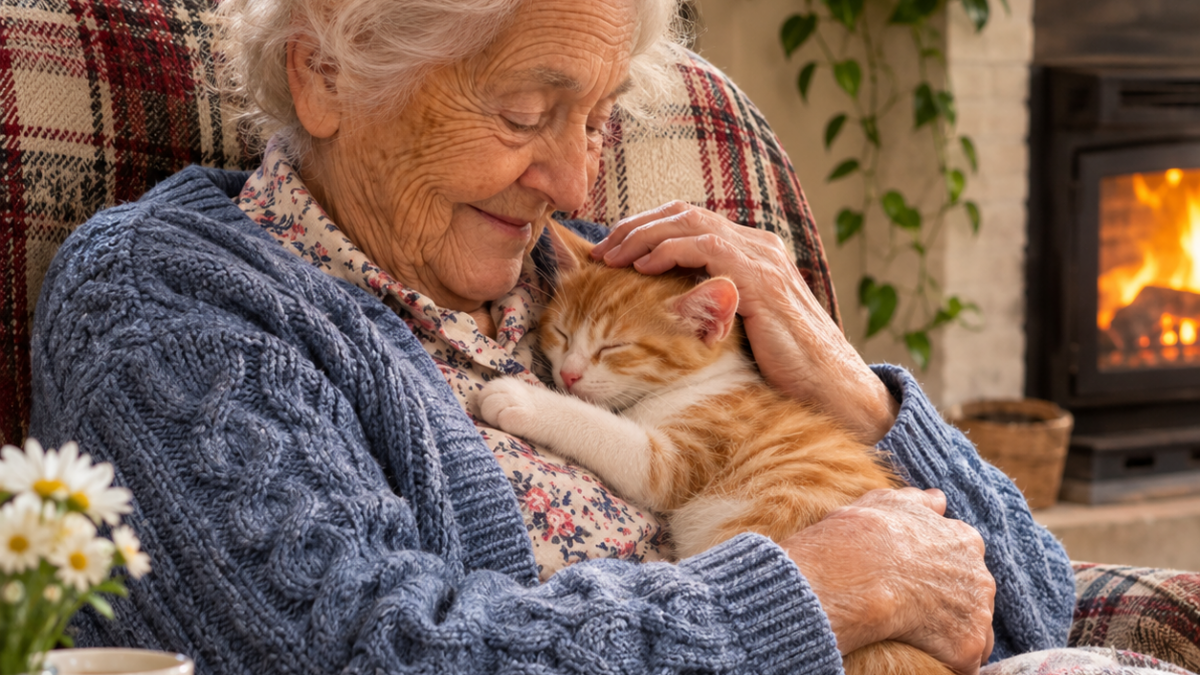
The picture showed Vera in her chair with Oliver asleep under her chin.
The caption read:
**97-year-old resident stops speaking for two weeks. Abandoned kitten brings her voice back.**
It spread.
Not nationally at first.
Locally.
Then regionally.
People called.
A newspaper asked for an interview.
A television station wanted footage.
Mrs. Callahan refused almost everything.
“Vera is not entertainment.”
I respected her for that.
Caroline agreed.
Vera did not.
“What if someone wants to see Oliver?”
She asked.
“They can see a picture.”
“I should choose the picture.”
“You absolutely should.”
She selected one where Oliver looked dignified.
He was licking his own stomach.
“Vera.”
“What?”
“He looks ridiculous.”
“He looks clean.”
The story reached North Valley.
Then the email arrived.
**Unauthorized live animal on residential premises. Immediate compliance review required.**
Mrs. Callahan read it aloud in her office.
I was there.
Melissa.
Earl.
Dr. Foster.
And Vera.
Nobody had invited Vera.
She had invited herself.
“Unauthorized?”
Vera repeated.
Mrs. Callahan looked uncomfortable.
“Technically, Oliver is not yet permanently registered.”
“Then register him.”
“We are trying.”
“What is the problem?”
Mrs. Callahan glanced at me.
I did not rescue her.
“Corporate policy does not normally allow facility-owned animals in residential areas.”
Vera looked down at Oliver.
He was asleep in her lap.
“Then your policy is stupid.”
I coughed to hide a laugh.
Mrs. Callahan closed her eyes.
“Vera.”
“I taught piano to children for forty-one years.”
“I know.”
“Do you know how many foolish rules I encountered?”
“I can imagine.”
“Good. Then we are all experienced.”
The corporate compliance manager arrived four days later.
His name was Kenneth Webb.
Forty-something.
Perfect tie.
Perfect shoes.
The expression of a man who believed binders were a form of moral authority.
He shook Mrs. Callahan’s hand.
Then looked at Oliver.
Oliver looked back.
Webb opened a folder.
“I want to be clear that this review is not punitive.”
Vera, sitting near the window, said:
“That always means something punitive follows.”
Webb looked toward her.
“This is Mrs. Langley?”
“Vera,” she said.
“Mrs. Langley, I understand the cat has provided emotional benefit.”
Oliver jumped onto her lap.
“Oliver.”
“Excuse me?”
“His name is Oliver.”
Webb nodded.
“Oliver has provided emotional benefit.”
“Correct.”
“However, facilities caring for vulnerable adults must follow infection-control standards, allergy precautions, resident safety protocols—”
“I have been vulnerable for ninety-eight years now.”
“You are ninety-seven.”
“Birthday next month.”
Webb paused.
“Congratulations.”
“Thank you.”
Then she looked at his folder.
“Continue.”
He did.
Animals created fall risks.
Scratches.
Allergies.
Liability.
Food-service concerns.
Sanitation issues.
None of those concerns were entirely ridiculous.
That made the conflict harder.
Institutions need rules.
They protect people.
Sometimes.
The problem comes when the rule stops serving the person.
Webb’s recommendation was simple.
Oliver could remain temporarily in a staff-only area while an outside permanent home was found.
Vera’s response was simpler.
“No.”
Webb folded his hands.
“I understand you are attached.”
“No, you don’t.”
“Mrs. Langley—”
“Vera.”
“Vera, the animal cannot become central to your care plan.”
She stared at him.
“Why not?”
“Because reliance on an animal creates continuity concerns.”
“What does that mean in English?”
I looked down.
Webb inhaled.
“If the animal becomes unavailable, your condition could decline.”
Vera nodded slowly.
“So because losing him might hurt me, I should lose him now.”
Nobody spoke.
Webb shifted.
“That is not exactly—”
“That is exactly what you said.”
He looked toward Mrs. Callahan.
She did not help.
Vera leaned back.
“My husband died.”
Webb’s expression changed.
“I’m sorry.”
“So am I.”
She continued.
“Two of my children died.”
“I understand.”
“No.”
Her voice remained calm.
“You do not.”
The room went still.
“The school where I spent most of my life disappeared.”
She looked at Oliver.
“I have lost enough things to understand that loving something does not guarantee it remains.”
Her eyes returned to Webb.
“Your solution appears to be that I should stop caring before life has the opportunity to hurt me.”
Webb said nothing.
“That is a very efficient way to avoid grief.”
She stroked Oliver’s head.
“It is also a very efficient way to avoid living.”
I remember that sentence more clearly than almost anything else.
Webb still issued the compliance notice.
We had ten business days.
Find legal authorization for Oliver—
or remove him.
That night, Vera stopped talking again.
Not completely.
But enough to frighten us.
She ate dinner in her room.
Ignored her crossword.
Held Oliver for almost three hours.
When I came to take him to the staff enclosure, she tightened her arms.
“Five more minutes.”
“Of course.”
Five became ten.
Then twenty.
Finally, Vera handed him over.
She looked smaller.
That scared me.
The next morning, Caroline arrived furious.
Not upset.
Furious.
“I drove here as soon as Mom called.”
I looked at Vera.
“You called her?”
Vera lifted her chin.
“Why do you sound surprised?”
“You hate telephones.”
“I hate unnecessary telephones.”
Caroline carried a folder.
Apparently rage ran in the family.
“What exactly does corporate say?”
Mrs. Callahan explained.
Caroline read the policy.
Then again.
“Where are the state regulations?”
“We’re pulling them.”
“Get me everything.”
“Caroline—”
“My mother nearly stopped participating in life.”
Her voice shook.
“I am not watching some administrator remove the one thing she has voluntarily reached for in months because a policy was written for a completely different situation.”
That started the fight.
Not revenge.
Not yet.
A fight.
We researched.
Mrs. Callahan contacted the state long-term care office.
Dr. Foster wrote a statement describing Oliver’s health status, vaccination schedule and low zoonotic risk with appropriate controls.
Vera’s physician documented behavioral improvement after structured interaction with Oliver.
The social worker documented changes in engagement.
Nutrition documented improved meal participation.
Nursing documented speech.
Sleep.
Socialization.
Everything.
We discovered that the state did not prohibit companion animals.
It required risk assessment and an individualized plan.
North Valley policy was stricter than state law.
That mattered.
We built Oliver a complete care protocol.
Veterinary records.
Vaccinations.
Flea prevention.
Separate feeding area.
Restrictions from food preparation spaces.
Hand hygiene.
Resident allergy screening.
Supervised access.
Night enclosure.
Emergency caregiver assignment.
We thought that would end it.
It did not.
Webb returned.
This time he brought North Valley’s regional vice president, Linda Prescott.
Linda was different.
Older.
Smarter.
Less interested in pretending the issue was purely procedural.
“We appreciate the effort,” she said.
“But a facility resident animal creates branding concerns.”
I looked at Mrs. Callahan.
Branding?
Caroline heard it too.
“What does that mean?”
Linda chose her words carefully.
“Our communities are marketed as safe, professional care environments.”
Caroline stared.
“And a cat makes them look unsafe?”
“That is not what I said.”
“What did you say?”
Linda’s smile tightened.
“Animals can change public perception.”
Vera was sitting nearby.
She looked at Oliver.
Then at Linda.
“People seem to like him.”
Linda smiled.
“The online attention has been significant.”
“Positive?”
“Mostly.”
“Then what perception worries you?”
Linda hesitated.
That hesitation was the beginning of the end for North Valley’s argument.
Caroline leaned forward.
“Is this actually about liability?”
“Yes.”
“Or about losing control of the story?”
Linda’s expression hardened.
“This is about appropriate governance.”
Vera whispered to me:
“That means she doesn’t know.”
I almost choked.
The meeting ended without resolution.
Then something happened none of us expected.
One of our residents, Mr. Jenkins, spoke up.
He was eighty-six.
Former mechanic.
Rarely involved in anything.
He raised his hand.
Linda looked confused.
“Yes?”
“You take that cat, I’m leaving.”
His daughter gasped.
“Dad.”
“I’m serious.”
Another resident, Mrs. Bennett, said:
“So am I.”
Linda looked around.
Mrs. Bennett pointed at Oliver.
“He visits my room every afternoon.”
Another resident said:
“He sits with me after dialysis.”
Another:
“He gets us out of our rooms.”
Suddenly this was no longer Vera’s cat.
Oliver had become part of Meadow Creek.
He knew who dropped food.
Who enjoyed lap visits.
Who had oxygen tubing that made interesting moving targets.
He learned that Mr. Jenkins kept crackers in his drawer.
He learned not to jump near Mrs. Bennett’s walker.
He learned to sleep beside Mrs. Cho during her afternoon anxiety episodes.
We had been so focused on Vera that we had not fully noticed what Oliver had done to everyone else.
The common room was busier.
Residents came out because Oliver might be there.
Families stayed longer.
People talked about him.
Argued about him.
Bought him ridiculous toys.
Someone brought a miniature piano.
Oliver hated it.
Vera loved that.
The residents created a petition.
Eleven signatures.
All residents except Mr. Calloway in Room 3.
Not because he opposed Oliver.
Because he was asleep when they circulated it.
He signed after dinner.
Twelve.
Every resident.
Caroline made copies.
Linda Prescott looked annoyed.
That was when I started worrying.
Companies do not enjoy being publicly cornered.
And North Valley had one advantage.
They owned the building.
A week before our deadline, Mrs. Callahan received another message.
The language had changed.
Now the concern was not only Oliver.
It was her management.
**Failure to implement corporate animal restriction policy.**
**Failure to maintain chain of command.**
**Unauthorized media exposure.**
They were threatening her job.
Mrs. Callahan closed her office door and cried.
I had never seen her cry.
She had run Meadow Creek for sixteen years.
Through tornado warnings.
Deaths.
Staff shortages.
COVID.
Family fights.
Inspections.
Now a kitten might cost her the facility she had built into a home.
“I should send him away,” she said.
“No.”
She looked at me.
“Rachel.”
“No.”
“I have eleven employees who depend on this place.”
“Twelve.”
“What?”
“You forgot yourself.”
She laughed once.
Then covered her face.
“I can’t risk everyone.”
Vera heard about it.
Of course.
Nothing stayed secret in a twelve-room facility.
At four that afternoon, she asked me to wheel her into Mrs. Callahan’s office.
She refused most wheelchair assistance.
That day, she wanted speed.
Mrs. Callahan stood.
“Vera.”
“You are not sending Oliver away to protect your job.”
“I may have to.”
“No.”
“This isn’t your responsibility.”
Vera stared at her.
“Neither was that kitten.”
Silence.
“He appeared at the gate.”
She pointed toward the garden.
“You could have called animal control and had him removed.”
Mrs. Callahan looked down.
“You didn’t.”
“No.”
“Why?”
“Because he needed help.”
Vera nodded.
“So do you.”
Then she said something I didn’t understand until later.
“Call Caroline.”
“Why?”
“Because if these people insist on making this public, we should stop protecting them from publicity.”
That was the revenge.
Not violence.
Not screaming.
Documentation.
Vera had taught school for four decades.
She understood institutions.
More importantly, she understood parents.
“People will tolerate many things,” she told me.
“They do not tolerate someone bullying an old lady and her kitten.”
She was right.
Caroline contacted a local elder-law attorney.
Not to sue.
Not yet.
To review the policy and the threats against Mrs. Callahan.
The attorney, Miriam Shaw, requested everything in writing.
That phrase changed North Valley’s tone immediately.
**Please put that in writing.**
It is remarkable how many confident threats become vague when someone asks for documentation.
Miriam found another problem.
North Valley’s own resident-care philosophy—published publicly—promised individualized, person-centered care designed to support emotional well-being and meaningful engagement.
Their marketing materials featured residents gardening.
Cooking.
Painting.
Interacting with visiting therapy animals.
A photograph on their corporate website showed a resident holding a Labrador.
Miriam printed it.
Vera loved that.
“So dogs are professional?”
She asked.
“Apparently.”
“And cats damage the brand?”
“Apparently.”
“Idiots.”
Miriam smiled.
“I did not say that.”
“You were thinking it.”
Then Caroline found something better.
North Valley had recently launched an advertising campaign called:
**MORE THAN CARE. CONNECTION.**
One advertisement showed an elderly man holding a visiting therapy rabbit.
I nearly fell out of my chair laughing.
Vera did not.
She looked at the photograph.
Then said:
“Use that.”
Caroline contacted the local newspaper.
This time, with Vera’s permission.
The journalist came.
Her name was Allison.
Vera wore her best blue cardigan.
Oliver wore nothing because Vera said clothing on cats was “undignified.”
The article ran two days later.
**97-YEAR-OLD WOMAN FOUND HER VOICE THROUGH A KITTEN. NOW CORPORATE POLICY MAY SEPARATE THEM.**
The story spread immediately.
Much farther than the first photograph.
People did not only see a cute cat.
They saw documents.
The physician’s report.
The state regulation allowing individualized companion-animal plans.
The corporate policy.
The threats against Mrs. Callahan.
And the advertisement showing the therapy rabbit.
That photograph became the internet’s favorite part.
Someone created a side-by-side image.
Oliver on one side.
Corporate rabbit on the other.
Text:
**ONE IS “CONNECTION.”**
**ONE IS “LIABILITY.”**
North Valley’s public-relations department had a terrible week.
Linda called Mrs. Callahan.
I heard only half the conversation.
“No, I did not give the newspaper confidential records.”
Pause.
“Caroline is not an employee.”
Pause.
“No, you cannot order Vera’s daughter not to speak publicly.”
Longer pause.
Mrs. Callahan smiled.
That was new.
“I suggest you discuss that with legal.”
Then she hung up.
I stared.
“Who are you?”
She exhaled.
“I think Vera is contagious.”
The corporate office issued a statement.
It was awful.
They said their priority was resident safety.
They said social media had mischaracterized the situation.
They said no final decision had been made.
Technically true.
Then Vera went on television.
That was not planned.
A reporter interviewed her in the common room.
Oliver sat in her lap.
The reporter asked:
“What would it mean if Oliver had to leave?”
Vera looked down.
She took a long time answering.
Then said:
“I spent fourteen days believing I had nothing left to say.”
The reporter stayed silent.
“This little creature needed something.”
She stroked Oliver’s head.
“He was hungry.”
“Cold.”
“Small.”
“He did not know I was old.”
She looked toward the camera.
“He did not care whether I was useful.”
My throat tightened.
“I picked him up because he needed warmth.”
Oliver purred.
“Then somehow I discovered I still had warmth to give.”
The reporter asked:
“And if they remove him?”
Vera’s eyes hardened.
“Then they are welcome to explain why safety requires taking away the reason I began living outside my room again.”
That interview ended the argument in public.
But North Valley still had legal authority over its own employment policies.
Three days later, Kenneth Webb returned.
Without Linda.
He met with Mrs. Callahan.
The door was closed.
After forty minutes, he left.
Mrs. Callahan walked into the common room holding a letter.
Everyone stared.
Including Vera.
“Well?”
Mr. Jenkins demanded.
Mrs. Callahan smiled.
“Oliver stays.”
The room erupted.
Actual applause.
Residents.
Staff.
Families.
Earl picked Oliver up and lifted him overhead like a trophy.
Oliver scratched him.
“Put him down,” Vera ordered.
Earl obeyed immediately.
The agreement was detailed.
Oliver would be officially registered as Meadow Creek’s resident companion animal.
Vaccinations mandatory.
Quarterly veterinary review.
Staff care schedule.
Restricted food-service access.
Resident consent documentation.
Backup placement if circumstances changed.
Everything we had already proposed.
Caroline looked at Webb’s letter.
“So what changed?”
Mrs. Callahan smiled.
“North Valley discovered individualized care.”
Vera snorted.
“They discovered newspapers.”
Probably both.
But the story did not end there.
Because corporate headquarters had made another mistake.
They had threatened Mrs. Callahan in writing.
The company began an internal review.
Not out of moral awakening.
Because publicity created risk.
Linda Prescott’s decision-making was examined.
Several other small facilities reported similar issues.
Policies applied rigidly.
Resident preferences ignored.
Managers threatened when they requested exceptions.
The board discovered that regional leadership had been rejecting individualized-care requests without proper clinical review.
Not only animals.
Meal accommodations.
Extended family visiting arrangements.
Cultural practices.
Small things individually.
But small things are often the architecture of dignity.
Linda was removed from oversight of clinical operations.
Kenneth Webb was reassigned to a compliance role without direct resident-care authority.
Mrs. Callahan remained.
The animal policy changed.
Not “all cats allowed.”
That would have been foolish.
Instead, each community could consider resident companion animals through clinical risk review.
Reasonable.
Structured.
Human.
Vera called it:
“Finally becoming adults.”
Oliver became official.
He received a tag.
**MEADOW CREEK RESIDENT COMPANION**
Vera thought it was too long.
“I would have written Oliver.”
“Vera, everyone already knows his name.”
“Then why the tag?”
Fair question.
By the time Oliver turned six months old, he owned the building.
Not legally.
Spiritually.
He knew the breakfast schedule.
He knew exactly where sunlight appeared in the hallway at two in the afternoon.
He knew Mrs. Bennett’s daughter brought tuna on Sundays.
He knew Earl’s toolbox was warm enough to sleep on.
He knew the piano belonged to Vera.
That last part became important.
One afternoon, Vera asked to sit at it.
She had not played in nearly a year.
Her hands had arthritis.
Several fingers were stiff.
I wheeled her near the bench.
She frowned.
“I can walk six feet.”
“Yes.”
“Then stop treating me like luggage.”
She stood.
Carefully.
Sat at the piano.
Oliver jumped onto the bench beside her.
“Move.”
He didn’t.
Vera pushed him.
He returned.
Finally, she surrendered.
“Fine.”
Her hands rested above the keys.
For almost a minute, nothing happened.
Then she played.
Not perfectly.
Not the way she once must have.
Slow.
Soft.
A simple melody.
I recognized it.
“Clair de Lune.”
Melissa stood in the doorway.
Mrs. Callahan came from her office.
Residents began appearing.
Nobody said anything.
Oliver sat beside Vera.
His eyes slowly closed.
When the piece ended, Vera kept her hands on the keys.
Then whispered:
“My husband liked that one.”
Caroline happened to arrive ten minutes later.
When we told her, she cried.
Vera rolled her eyes.
“You people cry far too often.”
“Mom.”
“It is medically concerning.”
Oliver started walking across the piano keys.
A violent burst of random notes filled the room.
Vera stared at him.
“And you have no talent.”
That became our first Oliver concert.
There were more.
Vera played short pieces.
Oliver disrupted them.
Residents applauded both.
The months passed.
Vera turned ninety-eight.
We held a small party.
She refused candles equal to her age.
“Ridiculous fire hazard.”
Earl put nine candles on one side and eight on the other.
“Symbolic.”
“That symbolizes poor arithmetic.”
Oliver stole frosting.
Vera pretended not to see.
Her daughter gave her a framed photograph.
Vera holding Oliver on the first day.
I had taken it.
Vera studied the picture.
“I looked terrible.”
“You had not spoken in fourteen days.”
“Still no excuse for my hair.”
Caroline laughed.
Then Vera touched the photograph.
“He was very small.”
“He was.”
“And terribly thin.”
“Not anymore.”
Oliver weighed almost eleven pounds by then.
Vera looked at him.
“He could gain another pound.”
“No.”
“He’s growing.”
“He’s fat.”
Oliver glanced at me.
“Rachel is rude,” Vera told him.
He climbed into her lap.
“Exactly.”
Not everything improved.
Vera still had difficult days.
She got confused sometimes.
Once she accused me of stealing her piano sheet music.
It was under her pillow.
Another time she asked when her husband would arrive.
Caroline left the room crying.
Memory is not a straight road.
Neither is aging.
Oliver did not prevent decline.
But he gave us ways to reach Vera inside it.
When she became agitated, we brought him.
When she refused lunch, Oliver sat beside her tray.
When she woke frightened after dreams she could not explain, Oliver slept near her feet.
Once, during a respiratory infection, Vera had to spend three nights in the hospital.
Oliver stayed at Meadow Creek.
He stopped eating normally.
That surprised us.
I had assumed Vera needed Oliver more than Oliver needed Vera.
Apparently attachment is rarely one-directional.
On the fourth day, Vera returned.
We wheeled her through the front doors.
Oliver came running.
Full speed.
I had never seen him move so fast.
He jumped into her lap before we could stop him.
“Oliver!”
Vera laughed.
Actually laughed.
A full sound.
He pushed his face beneath her chin.
She held him.
“There, there.”
Oliver purred so loudly the nurse beside me heard it.
“You foolish animal.”
Her eyes closed.
“I came back.”
That sentence broke me.
Because I think some part of Vera had been waiting her whole late life to say it to someone.
I came back.
Months later, Mrs. Cho died.
Then Mr. Jenkins.
Life in a care facility is built around arrivals and departures.
People outside imagine we get used to it.
We don’t.
We become functional around it.
That is different.
Oliver responded to death strangely.
When Mr. Jenkins’s room was emptied, Oliver sat outside the closed door.
For almost an hour.
Vera watched him.
“He knows.”
I sat beside her.
“Maybe.”
“Of course he does.”
“How?”
“He is waiting for someone who isn’t coming.”
The sentence hung between us.
Vera stared at the door.
“Animals understand absence.”
I looked at her.
She stroked Oliver.
“They just don’t create elaborate lies about it like we do.”
I laughed softly.
“What lies?”
“That death means love has nowhere to go.”
I stopped.
Vera looked toward me.
“People say that when someone dies, the relationship ends.”
She shook her head.
“Nonsense.”
“Then what happens?”
“It changes address.”
That became something I wrote down.
I had started my own notebook by then.
Not formally.
Just a little black book in my locker.
Things residents said.
Moments I did not want to lose.
A joke.
A final conversation.
A family reunion.
Oliver sleeping on Vera.
I understood the nurse in the original story who kept such a notebook because caregiving is full of moments nobody outside the job will ever know happened.
A ninety-year-old man shaving for the first time in weeks because his wife is visiting.
A woman with dementia remembering every word of a hymn but not her son’s name.
A resident refusing dessert, then stealing half of someone else’s pie.
Ordinary miracles.
Not miracle in the supernatural sense.
Miracle in the sense that human beings remain surprising until the end.
Vera filled pages.
So did Oliver.
About a year after Oliver arrived, North Valley announced that Meadow Creek might close.
That conflict was worse than the cat fight.
Financial.
Staffing.
Building costs.
Twelve-room homes were expensive to operate compared with larger facilities.
Corporate proposed transferring residents to a seventy-bed center thirty-five miles away.
Mrs. Callahan received the notice on a Tuesday.
We had ninety days.
I sat in the office reading it.
“No.”
Mrs. Callahan looked exhausted.
“This is not like Oliver.”
“It is exactly like Oliver.”
“Rachel.”
“They think small means inefficient.”
“It is inefficient.”
“That doesn’t mean disposable.”
She sighed.
“The building needs a new roof.”
“We’ll fix the roof.”
“With what?”
I had no answer.
The residents heard by afternoon.
Vera listened quietly.
Then asked:
“Will Oliver come?”
“Of course.”
I said it too quickly.
I didn’t know.
The larger facility did not have a resident animal program.
Mrs. Callahan knew.
Vera knew from my face.
“No.”
“We’ll work it out.”
“You said that last time.”
“We did.”
“Then do it again.”
I loved her confidence.
I did not share it.
Caroline began organizing families.
North Valley held a meeting.
They explained economics.
Compliance.
Infrastructure.
Staffing.
Some of it was valid.
Again, that made it harder.
Nobody was plotting evil.
The building was old.
The roof leaked.
The boiler needed replacement.
Our staffing ratio was expensive.
But residents were not spreadsheets.
Mr. Jenkins had once told me:
“At my age, moving thirty miles is not relocating. It is losing my world.”
He had died before the issue arose.
But I heard him anyway.
Families pushed back.
The community heard.
The article about Vera and Oliver resurfaced.
People donated.
A local foundation offered matching funds if the facility could transition into a nonprofit partnership.
North Valley initially refused.
Then Caroline found the leverage.
The land had been donated decades earlier by a local family with restrictions in the deed.
If North Valley closed the care operation and used the property for another purpose, ownership could revert to the original charitable trust.
Suddenly the property was less valuable to corporate than expected.
Negotiations began.
This time Vera was ninety-nine.
And meaner.
In the best way.
A North Valley representative came to explain transition options.
Vera listened.
Then said:
“You tried to remove my cat.”
The representative blinked.
“I wasn’t involved.”
“I know.”
She leaned forward.
“Learn from your coworkers.”
The room laughed.
The eventual deal took months.
The regional foundation acquired Meadow Creek’s operations.
North Valley exited.
Staff remained.
Residents remained.
Oliver remained.
Mrs. Callahan became executive director of the independent nonprofit.
Earl repaired the roof with a contractor who gave us half-price labor.
The community raised the rest.
At the reopening celebration, a sign appeared near the entrance:
**MEADOW CREEK COMMUNITY HOME**
Vera stared at it.
“Too many words.”
“What would you call it?”
She looked at Oliver.
“Home.”
Hard to argue with.
Vera reached one hundred.
We held a larger celebration.
She hated that.
“Birthdays after ninety should be confidential.”
Caroline disagreed.
The local newspaper came.
Vera agreed only if they photographed Oliver too.
He was almost three then.
Large.
Healthy.
Absolutely not too thin.
The reporter asked Vera:
“What has Oliver meant to you?”
Vera frowned.
“Terrible question.”
The reporter laughed nervously.
“How would you ask it?”
Vera looked at Oliver.
Then at us.
“I would ask what happens when somebody still needs you.”
The reporter waited.
Vera stroked his back.
“You find out you are not finished.”
That became the quote.
It appeared under her photograph.
People sent letters.
Teachers.
Nurses.
Older adults.
People who had lost spouses.
People who had stopped caring about things.
One woman wrote:
**My mother is in memory care. I stopped bringing her dog because I thought it confused her. After reading about Vera, I tried again. She remembered the dog’s name before she remembered mine. I cried, but I also understood.**
Vera read the letter.
Then said:
“She remembered the right person.”
Caroline laughed.
“Mom.”
“Dogs complain less.”
By one hundred and one, Vera’s body began slowing more sharply.
Her voice remained.
That mattered to all of us more than it should have.
She spent more time in bed.
Crosswords became difficult.
The pencil hurt her fingers.
So I read clues aloud.
She answered.
Still usually faster than I could.
Oliver adjusted too.
He no longer climbed aggressively onto her chest.
He slept beside her hip.
If she moved, he moved.
If nurses repositioned her, he waited at the foot of the bed until we finished.
Once, a new aide tried to remove him during morning care.
Vera opened one eye.
“Put him back.”
The aide froze.
“You’re awake?”
“I was.”
Oliver returned.
The aide learned.
One winter morning, Caroline called to say she would be late because of ice.
Vera nodded.
“She’ll come tomorrow.”
“She’ll probably come this afternoon.”
“She should not drive in ice.”
“I agree.”
Oliver curled near her legs.
Vera looked toward me.
“Rachel?”
“Yes?”
“Do you remember when he came?”
“Of course.”
“He was small.”
“Very.”
“Thin.”
“Vera.”
“He was.”
“Eleven ounces.”
“That’s not much cat.”
“No.”
She closed her eyes.
“I think I knew.”
“Knew what?”
“That I was disappearing.”
I did not answer.
She continued.
“I was tired of speaking.”
Her voice was weak.
“Why?”
“Because everyone I wanted to tell things to kept dying.”
My chest tightened.
“Husband.”
“Children.”
“Friends.”
“Students.”
She looked toward the ceiling.
“You begin to feel foolish continuing a conversation when the audience keeps leaving.”
I sat beside her.
“And Oliver?”
“He needed a new audience.”
I laughed softly.
Vera smiled.
“He did not care how many people died.”
She touched his fur.
“He was hungry.”
“You fed him.”
“He fed me too.”
She looked at me.
“Do not put that in one of your sentimental stories.”
“I would never.”
“You’re lying.”
“Yes.”
A month later, Vera developed pneumonia.
At one hundred and one, pneumonia is not simple.
We treated it.
Antibiotics.
Oxygen.
Fluids.
She improved slightly.
Then worsened.
Caroline stayed.
Day and night.
Oliver rarely left the bed.
Dr. Foster came.
He and Caroline discussed hospitalization.
Vera had previously documented that she did not want aggressive transfer if recovery was unlikely.
She wanted comfort.
Caroline cried.
Then honored it.
That is one of the hardest forms of love.
Not doing everything.
Doing what the person asked when every instinct tells you to keep reaching for more time.
One afternoon, Vera woke clearly.
Caroline sat beside her.
I was near the door.
Oliver slept against her arm.
Vera whispered:
“Is everyone here?”
Caroline leaned forward.
“I’m here.”
Vera frowned.
“I know.”
She looked toward me.
“Rachel?”
“Yes.”
“Mrs. Callahan?”
I went to find her.
Melissa came too.
Earl.
We stood awkwardly around the bed.
Vera looked at us.
“This looks like a funeral.”
Nobody laughed.
She sighed.
“Hopeless.”
Then Oliver lifted his head.
Vera smiled.
“There you are.”
Caroline held her mother’s hand.
Vera looked at Oliver for a long time.
Then whispered:
“I told you to gain weight.”
Caroline laughed through tears.
Oliver was now twelve pounds.
Vera stroked his ear.
“You were terribly thin.”
Her hand stopped.
Then moved again.
“He still is.”
“No, Mom.”
“Caroline.”
“Yes?”
“Do not argue with the dying.”
Caroline covered her face.
We all laughed and cried at once.
Vera looked pleased.
Then she asked:
“What happens to Oliver?”
Mrs. Callahan answered immediately.
“He stays here.”
“Always?”
“As long as Meadow Creek is here.”
Vera looked at Caroline.
“And if it isn’t?”
“I’ll take him.”
Caroline promised.
Vera nodded.
“Good.”
She closed her eyes.
A minute passed.
Then she said:
“Rachel?”
“I’m here.”
“Your hair improved.”
I laughed so hard my chest hurt.
“Thank you.”
“I was lying.”
Of course.
Those were the last words Vera ever said to me.
She died the following morning.
Caroline sat on one side.
Oliver on the other.
The window overlooked the garden.
Vera’s breathing slowed gradually.
No struggle.
No fear we could see.
When it ended, Oliver remained beside her.
He did not move.
Caroline cried silently.
I stepped toward the bed.
Oliver looked at me.
Then placed one paw on Vera’s arm.
I will never forget that.
Not because I believe he understood death exactly as we do.
I do not know.
But he understood stillness.
Absence.
Change.
We gave him time.
Eventually Caroline lifted him.
He resisted.
Then settled against her.
After the funeral home left, the room looked wrong.
Beds remain.
People do not.
The next day, Oliver walked into Vera’s room.
Empty.
He jumped onto the chair beside the window.
Curled in the seat.
Waited.
I sat on the floor.
“She’s not coming back.”
I hated saying it.
Oliver looked toward the door.
I stayed.
An hour.
Then he climbed into my lap.
That became our turn.
For years, Vera had been the person he went to.
Now we had to become enough.
Caroline considered taking him.
She meant the promise.
But Meadow Creek was his home too.
Every resident knew him.
Every staff member cared for him.
Removing him after losing Vera felt wrong.
So Caroline changed the promise.
“If he ever needs me, call.”
We agreed.
Oliver remained.
Vera’s room eventually became someone else’s.
Before the new resident arrived, Caroline took the framed photograph of Vera and Oliver.
She left one copy.
It hangs in the hallway today.
Underneath, a small plaque says:
**VERA LANGLEY, 1922–2024**
**PIANO TEACHER. MOTHER. FRIEND.**
**SHE GAVE A KITTEN A NAME. HE GAVE HER A REASON TO USE HER VOICE AGAIN.**
Oliver became quieter after Vera died.
For weeks, he visited her old door.
Then less.
Eventually he stopped.
Not forgetting.
Adapting.
We all did.
He attached himself next to Mrs. Bennett.
Then to a new resident named George who had lost his wife.
George rarely left his room.
Oliver entered without permission.
Naturally.
George complained.
“Get this cat out.”
We did.
The next day Oliver returned.
“Out.”
Again.
Third day.
Same.
A week later, I found Oliver asleep on George’s bed.
George pretended to be annoyed.
“He sheds.”
“Yes.”
“All over.”
“Yes.”
“Disgusting.”
“Should I move him?”
Long silence.
“No.”
That was how Oliver worked.
Not magic.
Persistence.
He did not heal grief.
He gave grief company.
The story about Vera continued traveling after her death.
People expected us to be sad about that.
We were.
But her story was not sad.
Not entirely.
She had spent fourteen days retreating.
Then lived more than four additional years speaking, arguing, playing piano, solving crosswords, insulting my hair and loving Oliver.
That mattered more than the fact that it ended.
North Valley eventually changed its policies across all remaining communities.
Companion animals could be considered through individualized assessment.
Not guaranteed.
Considered.
A small change.
But hundreds of residents lived in those communities.
A small rule can create many large lives.
Mrs. Callahan received a letter from Kenneth Webb two years after Oliver’s original compliance dispute.
He no longer worked for North Valley.
He wrote:
**I wanted you to know Mrs. Langley’s case changed how I think about compliance. I used to believe consistency was fairness. I now understand that treating everyone exactly the same can sometimes ignore what each person actually needs.**
Mrs. Callahan showed me.
“What do you think?”
I read it again.
“I think Vera would correct his grammar.”
She laughed.
Then became serious.
“Do you forgive him?”
“I wasn’t the one he hurt.”
“Fair.”
She folded the letter.
“He donated to the resident activity fund.”
“That helps.”
“Vera would approve of the money.”
“Absolutely.”
“What about the apology?”
“She’d probably call it late.”
We laughed.
There was our revenge.
Not watching Kenneth fail.
Watching him learn.
Not destroying North Valley.
Forcing the system to become slightly less stupid.
Vera would have preferred that.
She did not believe in wasting anything.
Not food.
Not talent.
Not mistakes.
If a mistake could teach someone something, she would squeeze every last lesson from it.
Years passed.
Oliver turned seven.
Then nine.
He became slower.
Larger.
Still not too thin.
Never too thin.
We told him so daily.
“Vera says you need more food,” Melissa would say.
He believed her.
The staff-room notebook became a tradition.
New nurses added stories.
Residents.
Families.
Deaths.
Recoveries.
One page became ten.
Then fifty.
We called it The Book.
Not official.
Definitely not corporate-approved.
But sacred.
Vera’s story occupied several pages by then.
Not because the moment was dramatic.
Because we kept remembering details.
The first “Oliver.”
The first crossword.
The piano.
The television interview.
The rabbit advertisement.
Her hundredth birthday.
Her last insult about my hair.
One evening, a young nurse named Sophie asked:
“Why do you write these down?”
I looked at Oliver sleeping near the desk.
“Because the chart records what happened medically.”
“And?”
“It doesn’t record what happened humanly.”
She understood.
The medical chart might say:
**Resident verbal after prolonged withdrawal.**
The Book said:
**Vera told a six-week-old kitten he was too skinny and named him Oliver.**
Both were true.
Only one explained why we still remembered.
Oliver reached twelve years old.
Kidney disease.
Manageable at first.
Special food.
Medication.
More frequent veterinary checks.
He hated all of it.
Especially the food.
“You have no authority to complain,” I told him.
“Vera spent years saying you were too thin.”
He looked offended.
By then, Mrs. Callahan had retired.
I had become director of Meadow Creek.
That was not a job I had planned.
Vera would have been unbearable about it.
“Finally respectable employment,” she would probably say.
Oliver spent most afternoons in my office.
Not because he loved me most.
Because the radiator was there.
I understood my rank.
A new corporate consulting company once suggested we remove old framed photographs from the hallway to modernize the space.
I showed them Vera and Oliver.
“No.”
The consultant blinked.
“We could digitize—”
“No.”
“We’re trying to create visual consistency.”
“Then be consistently somewhere else.”
Mrs. Callahan would have been proud.
Vera would have called it “adequate.”
Oliver’s final year was gentle.
Mostly.
He slept more.
Stopped jumping onto tables.
Residents bent down to pet him because he no longer climbed into every lap.
One afternoon, I found him in Vera’s old chair.
The chair had remained in the room after several residents came and went.
Nobody liked it much.
Old upholstery.
Too low.
Oliver loved it.
He slept there for hours.
I sat beside him.
“You remember her?”
His ear moved.
“Probably not the way I do.”
He opened one eye.
“She thought you were thin.”
No response.
“She was wrong.”
He purred.
“Don’t tell her I said that.”
A few months later, Oliver stopped eating.
That frightened me immediately.
He had never refused food.
Ever.
The veterinarian ran tests.
Kidneys worse.
Other complications.
We tried treatment.
Fluids.
Medication.
Appetite stimulants.
He rallied briefly.
Then declined again.
I called Caroline.
She was seventy-four by then.
Her voice changed when I said his name.
“I’m coming.”
She drove down the next morning.
Oliver was lying in my office.
Caroline sat on the floor beside him.
“My goodness.”
She stroked his face.
“You’re old.”
Oliver opened his eyes.
“Do you remember me?”
He sniffed her hand.
Then pushed his face into it.
Caroline started crying.
“That’s enough.”
She looked at me.
“Is he suffering?”
“Some.”
“Can we fix it?”
“Not really.”
She nodded.
The same decision she once made for her mother.
Another kind of love.
We scheduled the veterinarian to come to Meadow Creek the following day.
That evening, we carried Oliver into Vera’s old room.
It was temporarily empty between residents.
Snow fell outside.
Just as it had the month he arrived.
We placed his favorite blanket on Vera’s chair.
Caroline sat beside him.
I sat on the floor.
“Remember when Mom named him?”
“Yes.”
“You cried.”
“Everyone keeps mentioning that.”
“You did.”
“I was emotional.”
“You sobbed.”
“Your mother had not spoken in fourteen days.”
“Fair.”
Oliver shifted.
Caroline touched his paw.
“She said all he needed was somebody willing to take the trouble.”
I nodded.
“Turns out she did too.”
Caroline smiled.
“Yes.”
We stayed until late.
Before leaving, Caroline looked around the room.
“Do you know what I regret?”
“What?”
“I spent years thinking I needed to give Mom reasons to stay.”
I listened.
“I kept bringing photographs.”
“Books.”
“Stories.”
“I kept talking about family.”
She looked at Oliver.
“He didn’t give her a reason to stay.”
“What did he do?”
“He needed her.”
That was different.
I understood.
People often tell older adults:
We need you here.
But sometimes what they hear is pity.
Oliver did not pity Vera.
He wanted warmth.
Food.
Hands.
A lap.
He needed something she could provide.
Not something she used to be able to provide.
Something she still could.
That restored dignity.
Not being loved.
Being useful to someone you love.
The vet came the next morning.
Staff gathered.
Not everyone.
We kept care running.
Life does not stop because one life is ending.
Oliver rested in Vera’s chair.
Caroline held him.
I sat beside them.
The veterinarian explained.
Caroline nodded.
Before the first injection, she whispered:
“Tell Mom she was wrong.”
I looked at her.
Caroline smiled through tears.
“You were never too thin.”
I laughed.
Then cried.
Oliver relaxed.
His breathing slowed.
For one final moment, he pushed his head against Caroline’s chest.
Then he was still.
Thirteen years earlier, someone had placed him in a shoebox and left him at our gate.
Eleven ounces.
Unwanted.
Unnamed.
He entered Meadow Creek with almost nothing.
He left with an entire building mourning him.
We buried his ashes in the garden.
Beside the piano-room window.
Caroline brought a small stone.
It read:
**OLIVER**
**HE NEEDED A HOME.**
**HE GAVE ONE BACK.**
I thought that was perfect.
Afterward, Meadow Creek felt strange.
No cat sleeping in the hallway.
No bowls.
No complaints about litter.
No orange fur on black uniforms.
Several residents kept looking toward the office.
Waiting.
I understood too well.
The question came quickly.
“Will we get another cat?”
I said no.
Immediately.
Too immediately.
The staff did not believe me.
Neither did Caroline.
Three months later, our local shelter called.
“Rachel?”
“No.”
“You don’t even know why I’m calling.”
“Yes, I do.”
“We have an older cat.”
“No.”
“She’s eleven.”
“No.”
“Owner died.”
I closed my eyes.
“No.”
“She’s been here seven weeks.”
I looked toward Oliver’s empty bed.
“What color?”
The woman laughed.
“Gray.”
“Temperament?”
“Bossy.”
That got me.
“What’s her name?”
“Pearl.”
Pearl arrived at Meadow Creek two weeks later.
Not as Oliver’s replacement.
There is no such thing.
She hated laps.
Ignored most residents.
Loved Mrs. Bennett.
Despised Earl.
Earl loved her.
Different animal.
Different relationships.
Exactly as it should be.
The first morning Pearl wandered into Vera’s old room, she jumped onto the window ledge.
Looked into the garden.
Then walked away.
No miracle.
No dramatic connection.
I smiled anyway.
Because Vera had taught us something larger than Oliver.
A care home should not merely keep people alive.
It should contain reasons to participate in being alive.
For one person, that is music.
For another, gardening.
Family.
Prayer.
Work.
Cooking.
An animal.
A crossword clue.
A responsibility.
A ridiculous orange kitten who insists on climbing back into your lap.
The people who tried to remove Oliver thought they were defending policy.
In some ways, they were.
But policy is supposed to protect life.
Not sterilize it.
The lesson was never that every care home needs a cat.
Some residents are allergic.
Some are afraid.
Some animals are unsuitable.
The lesson was simpler.
You have to look at the person in front of you.
Not only the rule.
Not only the diagnosis.
Not only the age.
Vera was ninety-seven.
It would have been easy to describe her decline as inevitable.
Old woman.
Many losses.
Quiet.
Withdrawn.
Maybe near the end.
That explanation would have sounded reasonable.
It would also have missed everything.
Because the day Oliver entered her lap, Vera still had something enormous left to give.
Care.
Attention.
Warmth.
A name.
And once she discovered she could still give those things, she began reaching outward again.
That is why, when nurses ask me what the strangest intervention I have ever seen was, I tell them:
“A kitten.”
They laugh.
Then I explain.
Not therapy exactly.
Not medicine.
Not magic.
Need.
Oliver needed Vera.
And Vera needed to be needed.
Fourteen days of silence ended because a tiny animal made a sound against her sweater.
A tiny sound.
That was all.
She looked down.
Moved her hands.
Held him.
Then began speaking because someone in front of her required words.
Eat.
Grow.
Stay warm.
You’re too thin.
I think about that often.
People imagine meaning must be grand.
A career.
A legacy.
A major purpose.
Maybe sometimes meaning weighs eleven ounces.
Maybe it fits in both hands.
Maybe it sleeps against your collarbone.
Maybe it only needs you until tomorrow.
And tomorrow is enough.
The notebook is still in my office.
The original one.
Its cover is worn now.
Pages added.
Names written.
Some crossed with dates.
Some stories only one line.
Some several pages.
Vera and Oliver still occupy more space than almost anyone else.
On the last page of their section, years ago, I wrote something after Oliver died.
I had forgotten it until Caroline visited recently and asked to see the notebook.
We sat together.
Pearl was asleep beneath my desk.
Caroline read the pages.
Sometimes smiling.
Sometimes crying.
Then she reached the final line.
She read it aloud.
“Vera thought she was finished because everyone she loved kept leaving. Oliver showed her that love was not only something you lose. It is also something new that can still arrive.”
Caroline closed the notebook.
“That sounds like something Mom would criticize.”
“Probably.”
“She’d call it sentimental.”
“Absolutely.”
“She’d correct the grammar.”
“Definitely.”
We laughed.
Then Caroline looked toward the hallway.
“Still true.”
“Yes.”
Still true.
The nurses said they had never witnessed anything quite like it.
Neither had I.
A ninety-seven-year-old woman who had not spoken in fourteen days.
A six-week-old kitten left anonymously in a shoebox.
No grand plan.
No specialist referral.
No clinical protocol.
We simply placed one fragile life into the hands of another.
Vera looked down.
Oliver made a sound.
She held him.
And before speaking to any of us, she gave him a name.
Oliver.
That name changed the room.
Then the day.
Then the months that followed.
Eventually it changed policy.
It changed Meadow Creek.
It changed how I understand my work.
And maybe most importantly, it changed the final chapter of Vera Langley’s life.
Without Oliver, perhaps Vera would have remained silent.
Perhaps not.
We will never know.
I refuse to turn uncertainty into mythology.
But I know what happened after he arrived.
She spoke.
She ate with people.
She solved crosswords.
She played piano.
She fought corporate administrators.
She went on television.
She made us laugh.
She reached one hundred.
Then one hundred and one.
She told her daughter what she wanted.
She faced the end surrounded by people and by the small animal she once chose to hold.
Four years.
Not empty years.
Lived years.
There is a difference.
People sometimes ask whether Oliver saved Vera.
I used to say yes.
Now I think the better answer is that they interrupted each other’s disappearance.
He had been left in a box.
She had withdrawn behind a window.
Both were physically alive.
Neither had much idea what came next.
Then somebody put them together.
He needed warmth.
She still had warmth.
That was enough to begin.
And for the rest of my career, whenever someone tells me a resident is “just declining,” I hear Vera’s voice.
I remember the woman everyone thought had stopped having reasons to speak.
I remember her looking down at eleven ounces of orange-and-white fur.
I remember those still hands moving.
I remember her lifting him.
Holding him close.
Then I hear the first word she chose after fourteen days of silence.
Not goodbye.
Not pain.
Not help.
A beginning.
“Oliver.”








