PART 2: SHE HAD LESS THAN A DAY BEFORE EUTHANASIA—THEN THE OLD SHELTER DOG REALIZED THE LEASH IN MY HAND WAS FOR HER
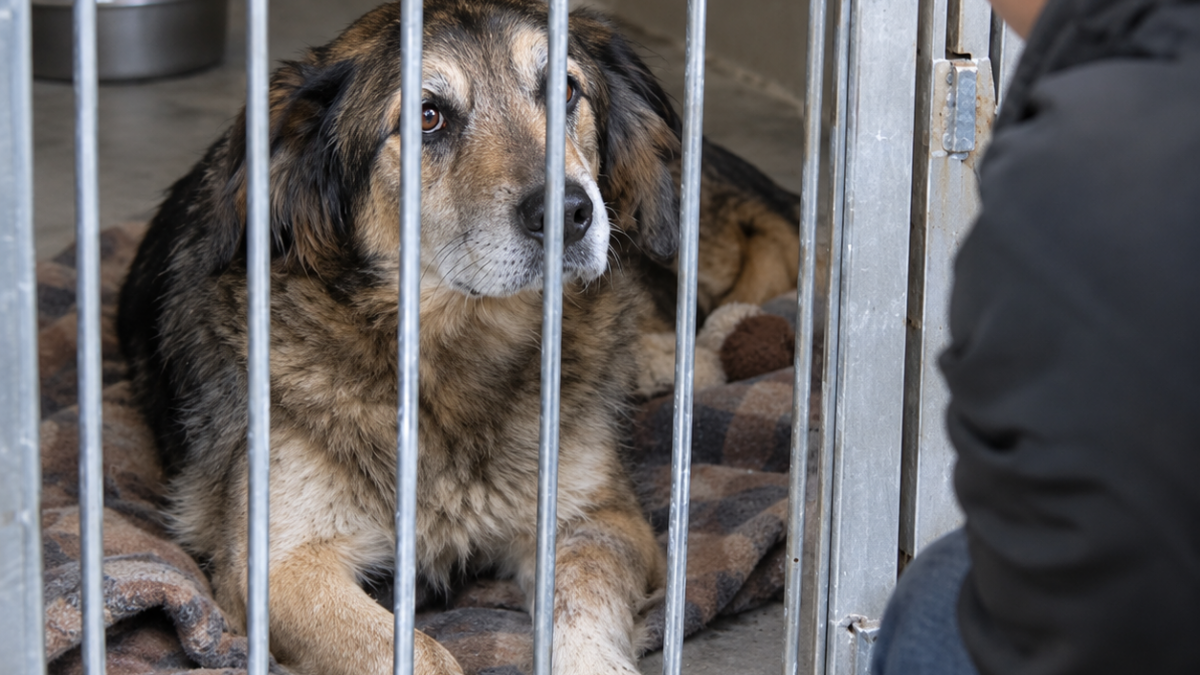
The red note clipped to Lada’s kennel said only two words—LAST DAY—and by four that afternoon, the quiet old dog who had spent three years watching other animals go home would be gone.
She had stopped barking for attention long ago, stopped jumping when families entered the aisle, and seemed to have accepted that every hand reaching through those bars would eventually disappear.
Then, with only a few hours left, a stranger walked into our shelter and asked one question that made me look at Lada differently for the first time in years.
My name is Marina Hayes, and I had volunteered at the county shelter outside Chattanooga, Tennessee, every Tuesday and Thursday for almost five years.
I knew every sound in that building.
The puppies screaming when breakfast carts appeared.
The nervous dogs pacing circles.
The metal bowls sliding across concrete.
Lada almost never contributed to any of it.
She was lying on her old blue blanket when I arrived at 7:12 that morning.
Gray had spread farther across her muzzle since the week before. One front leg carried a thin scar from whatever life she had lived before animal control found her beside a rural highway three years earlier.
She was probably eight or nine now.
Maybe older.
Nobody knew.
When she first arrived, Lada knew how to sit, stay, walk beside a person, and wait politely before eating.
That told us something painful.
She had once belonged somewhere.
Somebody had taught her.
Somebody had put a collar around her neck.
Then somebody had left her beside a road and never returned.
For the first few months, Lada ran to the front of her kennel whenever the outside door opened.
A year later, she still lifted her head.
By the second year, she mostly watched.
By the third, sometimes she did not even do that.
That morning, a white card hung beside her normal information sheet.
Someone had written on it with red marker:
LAST DAY.
4:00 P.M.
I already knew.
I had argued with our director the evening before.
We were nine dogs over capacity.
A neglect seizure had brought in seven more animals.
Every foster home was full.
Every rescue partner we called had waiting lists.
Nobody wanted to make the decision.
But decisions still had to be made.
Lada was older.
She had arthritis.
She had been overlooked for more than three years.
And no adoption applications were pending.
I unlocked her kennel and sat beside her.
“Hey, girl.”
Lada opened her brown eyes.
That was all.
I rubbed between her ears.
“I’m sorry.”
Her chest rose in a slow breath.
“We tried.”
I hated myself the second I said it.
Dogs do not care how hard you tried.
They only know whether you stayed.
I pressed my forehead against hers.
“Please forgive me.”
Lada sighed.
Then she put her chin back on the blanket.
By ten, visitors began arriving.
A family adopted a Beagle puppy.
A college student chose a young shepherd mix.
A couple spent twenty minutes deciding between two terriers.
Nobody stopped at Lada’s kennel for more than a few seconds.
At 11:48, I carried a fresh bowl of water down the aisle.
That was when the front door opened.
A tall man stepped inside.
He looked to be in his late sixties, wearing faded jeans, work boots, and a dark green jacket.
He did not walk toward the puppy room.
He stood at the front desk and spoke quietly to Denise, our shelter director.
I could not hear the first part.
Then I heard Denise ask:
“What kind of dog are you looking for?”
The man looked down the kennel hallway.
“I don’t care about breed.”
“Size?”
“Doesn’t matter.”
“Male or female?”
“Either.”
Denise smiled politely.
“What matters to you?”
The man was quiet for several seconds.
Then he said:
“Show me the dog nobody else is coming back for.”
I stopped walking.
Denise did too.
Slowly, both of us turned toward Kennel 31.
Toward Lada.
The old dog had not lifted her head.
She had no idea that for the first time in three years, someone had entered the building asking specifically for a dog exactly like her.
PART 2
The man’s name was Thomas Bennett.
He was sixty-eight years old, retired from the Tennessee Valley Authority, and lived alone in a small brick house twelve miles outside Chattanooga.
I learned all of that during the next ten minutes.
But the first thing I learned about Thomas was that he did not like being pushed toward a decision.
Denise began explaining Lada before we had even reached her kennel.
“She’s probably between eight and ten. She has arthritis in both hips. She’s very quiet. She’ll need a veterinary workup, and she may need medication long-term.”
Thomas kept walking.
“Does she bite?”
“No.”
“Good with people?”
“Yes. Just withdrawn.”
“Dogs?”
“Usually.”
“House-trained?”
“She was when she arrived. After three years in a shelter environment, we can’t promise anything.”
Thomas nodded.
“That’s fair.”
We reached Kennel 31.
Lada was still lying down.
Thomas stopped outside.
He did not crouch.
Did not whistle.
Did not call her.
He simply looked through the bars.
Lada glanced toward him.
Then away.
Thomas looked at me.
“That her?”
“Yes.”
“How long?”
“Three years and two months.”
He frowned.
“In this cage?”
“We rotate her through outdoor runs.”
“That wasn’t what I asked.”
I felt defensive immediately.
“We do the best we can.”
“I’m sure you do.”
He said it without criticism.
That somehow made it worse.
Thomas looked at the red card.
His face changed.
“What does ‘last day’ mean?”
Nobody answered fast enough.
Thomas looked at Denise.
“Does it mean what I think it means?”
Denise nodded.
“This afternoon.”
“What time?”
“Four.”
Thomas looked at his watch.
11:56.
Then he looked back at Lada.
“Open it.”
Denise hesitated.
“You’d like to meet her?”
“I’d like the door opened.”
I unlocked the kennel.
Lada did not move.
Thomas stepped inside.
That surprised me.
Most visitors wanted us to bring dogs into the meet-and-greet room.
Thomas lowered himself onto the concrete.
His knees clearly hurt.
He leaned his back against the wall opposite Lada.
Then he did nothing.
No baby voice.
No treats.
No reaching.
He sat.
After about a minute, Denise whispered, “Would you like me to bring her over?”
“No.”
“She may not approach.”
“That’s okay.”
Five minutes passed.
Then ten.
Lada raised her head.
Thomas looked toward her but did not call.
She stood.
Her back legs were stiff.
She stretched carefully.
Then she walked to the kennel door.
Not toward Thomas.
Toward me.
She pressed her shoulder against my knee.
I scratched behind her ear.
Thomas smiled.
“She likes you.”
“I’ve known her three years.”
“I imagine that helps.”
Lada looked at him.
He held out one hand.
Low.
Palm down.
She stared.
Then looked away.
Thomas lowered his hand.
“No hurry.”
Something in his voice made me watch him more closely.
There was grief there.
Not the fresh kind.
The exhausted kind.
The kind that had been carried so long it had become part of the person.
I asked, “Have you had dogs before?”
Thomas nodded.
“My wife and I had one for fourteen years.”
“What happened?”
“Cancer.”
“I’m sorry.”
“That was four years ago.”
He paused.
“My wife died last October.”
Now I understood.
“You live alone?”
“Yes.”
“Do you have family nearby?”
“A daughter in Knoxville. Grandkids.”
“Why a dog now?”
Thomas smiled without humor.
“Because my daughter is tired of me pretending the television is company.”
I almost smiled.
He looked at Lada.
“And because my house has gotten too quiet.”
At the word quiet, Lada looked at him again.
Thomas noticed.
“So has she, apparently.”
Lada took one step.
Then another.
Thomas stayed still.
She stopped two feet from him.
Sniffed.
He turned his face slightly away.
I recognized what he was doing.
Reducing pressure.
Letting her choose.
Lada moved closer.
She smelled his boot.
His jeans.
His hand.
Then she walked away.
Thomas nodded as though she had completed an interview.
“Seems sensible.”
Denise laughed softly.
“That’s all you wanted?”
“What?”
“She walked away.”
“She doesn’t know me.”
Most people took rejection personally.
Thomas didn’t.
That mattered.
He stayed another twenty minutes.
Eventually, Lada returned.
This time she sat beside him.
Not touching.
Just close.
Thomas did not pet her.
He looked at me.
“What does adoption involve?”
My chest tightened.
Denise answered.
“Application. ID. Veterinary reference if applicable. Landlord approval if you rent.”
“I own.”
“Home check sometimes.”
“Do it.”
“Today?”
Thomas looked at the red card.
“I’m guessing tomorrow isn’t useful.”
Denise’s expression softened.
“We can place a temporary hold while we process the application.”
“Then place it.”
My throat closed.
I looked at Lada.
She did not know.
That was the strange part.
A decision had just been made that could give her years.
But she was sitting on concrete, staring toward the hallway, exactly as she had every day.
Thomas stood slowly.
Lada immediately moved away.
Again, he did not take it personally.
“I need to go get something.”
My stomach dropped.
“You’re leaving?”
“For an hour.”
Every volunteer has heard that.
I’ll come back.
Let me think.
I need to talk to my husband.
I forgot my wallet.
Sometimes they returned.
Often they didn’t.
I must have looked skeptical.
Thomas noticed.
“I’ll come back.”
I nodded.
He pointed to the red card.
“Take that down.”
Denise said, “Once the adoption hold is entered.”
“How long?”
“Five minutes.”
“I’ll wait.”
He waited.
Denise entered the hold.
Printed a new yellow card.
ADOPTION PENDING.
I pulled down the red one.
LAST DAY.
Lada watched from the kennel.
I held the card in my hand.
Three years.
And two red words had almost become the final summary of her life.
Thomas glanced at it.
“Keep that.”
“Why?”
“Someday you may want to remember how wrong it was.”
Then he left.
At 12:41.
I watched his truck disappear.
By 1:30, he had not returned.
I told myself traffic existed.
At 2:00, still nothing.
Denise said, “Marina.”
“He said he’d come back.”
“I know.”
At 2:15, I called the number on his application.
No answer.
My heart sank.
At 2:34, I called again.
Voicemail.
I looked at Lada.
She was asleep.
I wanted to hate Thomas.
It would have been easier than admitting how much hope I had allowed myself.
At 2:47, Denise came down the hall.
“If he doesn’t complete by closing, we can keep the hold until tomorrow.”
“What about the euthanasia schedule?”
“Canceled while the hold is active.”
I finally breathed.
“So she’s safe tonight.”
“Yes.”
“Even if he doesn’t come?”
Denise hesitated.
“Tonight.”
That one word hurt.
Then, at 3:06, the front door opened.
Thomas walked in carrying a large brown shopping bag.
I stared at him.
“Where were you?”
He looked surprised.
“Getting things.”
“You didn’t answer your phone.”
“Left it in the truck.”
I nearly threw something.
“What things?”
He opened the bag.
A padded orthopedic dog bed.
A stainless-steel bowl.
A red leash.
A wide soft collar.
And a stuffed yellow duck.
I stared at the toy.
Thomas shrugged.
“I didn’t know what she likes.”
Something behind my eyes burned.
“You bought all of that before the adoption was approved?”
“Yes.”
“What if we said no?”
“Then I would’ve donated it.”
Denise came out laughing.
“Your reference checks cleared.”
Thomas nodded.
“Good.”
“We still need your signature on the medical acknowledgment.”
“Give me the paper.”
He signed every page.
Arthritis.
Possible dental work.
Senior-dog monitoring.
No guarantee of lifespan.
Behavior decompression.
Return policy.
He read each one.
At 3:31, Denise stamped the final page.
“Congratulations.”
Thomas looked at her.
“That’s it?”
“That’s it.”
He turned toward Kennel 31.
“Then let’s tell her.”
That was the moment I had not prepared for.
We attached the new red collar to the leash.
Thomas asked me to go first.
“You’re the person she trusts.”
I entered the kennel.
Lada stood slowly.
“Hey, girl.”
Her brown eyes lifted.
I clipped the leash to her collar.
She froze.
For three years, a leash meant one of three things.
Outdoor run.
Veterinary room.
Bath.
She followed me into the hallway without excitement.
Thomas waited near the lobby.
Lada saw him.
Stopped.
Then continued.
The other dogs barked as we passed.
She ignored them.
We reached the front desk.
Denise removed Lada’s old shelter collar.
Thomas knelt.
He fastened the new collar around her neck.
A small silver tag hung from it.
I turned it over.
LADA BENNETT.
THOMAS’S GIRL.
A phone number underneath.
My eyes filled instantly.
“You already had this made?”
“The machine at the pet store takes four minutes.”
Lada sniffed the tag.
Then Thomas.
Still no reaction.
He stood.
“All right.”
He took the leash from me.
“Let’s go home.”
Lada stayed beside my leg.
Thomas walked two steps toward the door.
The leash became gently taut.
Lada resisted.
Thomas stopped.
He did not pull.
I crouched.
“It’s okay.”
She looked at me.
“You can go.”
Nothing.
I stroked her face.
“You’re not coming back to the kennel.”
Her ears moved.
Of course she did not understand the sentence.
But she understood tone.
Thomas opened the lobby door.
Sunlight spread across the floor.
Lada looked outside.
Then back toward the kennel hallway.
She had walked through that lobby hundreds of times with volunteers.
Always returned.
Always back to 31.
She took one step outside.
Then another.
Thomas waited.
We reached the parking lot.
His pickup was parked beside the curb.
The new dog bed was visible through the rear door.
Thomas opened it.
Lada stopped.
She stared into the truck.
Then looked behind her.
At me.
At Denise.
At the shelter door.
Thomas patted the seat.
“Come on, lady.”
Nothing.
He reached into the bag and took out the yellow duck.
The toy squeaked.
Lada’s ears shot upward.
All of us froze.
Thomas squeezed it again.
Squeak.
For the first time in months, Lada’s tail moved.
One inch.
Then another.
Thomas smiled.
“You like that?”
He tossed the duck onto the dog bed.
Lada looked into the truck.
Then at him.
Something changed in her face.
I cannot explain it scientifically.
Maybe it was the new collar.
The open door.
The bed.
The toy.
The absence of anyone turning her back toward the shelter.
Maybe dogs understand more than we think.
Lada stepped onto the running board.
Thomas supported her hips.
She climbed inside.
She sniffed the bed.
The bowl.
The duck.
Then she turned toward the open door.
Thomas leaned in.
“You ready?”
Lada stared at him.
Her tail began moving.
Not slowly.
Hard.
Left.
Right.
Left.
Right.
Her entire back end joined it.
Then she made a sound I had never heard from her.
A high, broken whine.
She pushed forward.
Both front paws landed against Thomas’s chest.
He nearly fell backward.
Lada licked his chin.
His nose.
His cheek.
Again.
Again.
Again.
Thomas laughed.
A real laugh.
The first I had heard from him.
“Oh, okay.”
Lada pawed at his shoulder.
Then at the bed.
Then back at him.
She spun once in the cramped rear seat.
The arthritis did not matter.
Three years of stillness disappeared in seconds.
She grabbed the yellow duck.
Squeaked it.
Dropped it.
Licked Thomas again.
I was crying openly now.
So was Denise.
Thomas put both arms around Lada’s neck.
She pressed her entire body into him.
“She knows,” Denise whispered.
I nodded.
Lada buried her gray muzzle beneath Thomas’s chin.
“Yes.”
Somehow, she knew.
She was leaving.
Not for a walk.
Not for an exam.
Not for an afternoon.
Home.
Thomas closed the door.
Before getting into the driver’s seat, he came around to me.
“You coming by?”
“What?”
“To see her.”
I laughed through tears.
“You’ve owned her for twelve minutes.”
“Exactly. I need someone to explain her.”
“She likes chicken.”
“Useful.”
“She hates thunder.”
“Okay.”
“She’ll pretend she doesn’t hear you if she doesn’t want to move.”
“Sounds familiar.”
“And…”
My voice broke.
Thomas waited.
“She’s had people disappear.”
His expression changed.
“I know.”
“Please don’t promise anything you can’t keep.”
He looked through the window.
Lada was sitting on the new bed with the yellow duck between her paws.
Then he looked at me.
“I won’t promise forever.”
That surprised me.
He continued.
“Neither one of us controls that.”
He put one hand against the truck.
“But I can promise that if I leave the house, I’ll come back as long as I’m able.”
That was enough.
Thomas drove away at 3:49.
Eleven minutes before Lada had been scheduled to die.
I stood in the parking lot until his truck disappeared.
Then I went inside.
Kennel 31 was empty.
The blanket remained.
The water bowl.
A few strands of golden-brown fur.
I stood there and cried harder than I had outside.
Not because she was gone.
Because for three years, every empty kennel beside Lada had meant somebody else got chosen.
Now hers was empty too.
The next morning, Thomas sent me a photograph.
Lada was asleep on his couch.
The yellow duck under her chin.
His message read:
She snores.
I replied:
You adopted her. No refunds.
He sent:
Wasn’t asking.
That was the beginning.
The first week was not easy.
People like simple rescue stories.
Dog leaves shelter.
Dog realizes she is loved.
Everybody lives happily ever after.
Real recovery is messier.
The first night, Lada refused to enter Thomas’s bedroom.
She slept beside the front door.
The second night, same thing.
Every time Thomas walked outside to get the mail, Lada stood at the window until he returned.
If he stayed gone longer than five minutes, she paced.
On the third day, he drove to the grocery store.
When he returned forty minutes later, Lada was lying against the front door.
She had not touched her food.
Thomas called me.
“Did I break her?”
“No.”
“She looks miserable.”
“You left.”
“For forty minutes.”
“She doesn’t understand forty minutes.”
Silence.
Then he said, “What do I do?”
“Come back.”
“I did.”
“Do it again tomorrow.”
“That’s it?”
“Again the next day.”
He was quiet.
“Teach her the pattern.”
“What pattern?”
“You leave.”
I paused.
“You come back.”
So he did.
Five minutes.
Ten.
Twenty.
Every time he returned, he made no huge celebration.
Just opened the door.
“Hey, girl.”
Lada would stand.
Sniff him.
Follow him.
Gradually, the panic lessened.
By the third week, she could sleep while he checked the mailbox.
By the sixth, she ate breakfast even after he left for an appointment.
By the third month, she still watched the driveway.
But she no longer looked like the world ended when his truck disappeared.
The arthritis improved too.
Thomas took her to Dr. Helen Ward, a veterinarian recommended by the shelter.
Medication helped.
So did losing four pounds.
Thomas built a ramp beside his porch steps.
When I visited, I stared at it.
“You built this?”
“Yes.”
“It has railings.”
“She slips when it rains.”
“It’s nicer than my front porch.”
“Then age better.”
Lada appeared behind him.
Her coat had changed.
That was what struck me first.
Shelters do not ruin coats intentionally.
But stress does things to bodies.
Three months in Thomas’s house and her fur had become softer.
Thicker.
The dull brown-gold had brightened.
Her eyes looked different too.
More alert.
She saw me.
Stopped.
Then ran.
Not quickly.
Not gracefully.
But ran.
“Marina!”
Thomas grabbed the porch rail.
“She’s not supposed to do that!”
Lada reached me and pushed her nose into my stomach.
I knelt.
“Oh, look at you.”
Her tail beat against my arm.
Thomas stood behind her.
“She knows your car.”
“She knows me.”
“She knows the car.”
“You’re jealous.”
“Absolutely.”
I looked inside the house.
Her bed sat beside Thomas’s recliner.
Three more toys lay across the floor.
“You bought her more toys.”
“I didn’t.”
I picked up a stuffed raccoon.
“This entered your home independently?”
“My granddaughter bought that.”
“Sure.”
Lada stole it from my hand.
Thomas pointed.
“You see what I deal with?”
I smiled.
For the first time, I believed Lada might actually be okay.
Then Dr. Ward found the microchip.
We had scanned Lada when she entered the shelter three years earlier.
The chip had been registered to a disconnected phone number, and the address was no longer current.
That was common.
What we had never known was that the manufacturer retained an older secondary contact.
Dr. Ward’s newer database search found it.
A name.
Jason Keller.
The man who had registered Lada six years earlier.
Thomas called me.
“Should I care about this?”
Legally, no.
The shelter had completed the required stray hold years earlier.
Ownership had transferred lawfully.
Thomas’s adoption was valid.
Emotionally?
I cared.
A lot.
We searched the old intake report.
Lada had been found beside Highway 58 near a closed gas station.
No collar.
Underweight.
A raw mark around her neck where a collar had recently been.
The officer noted that she stayed near the shoulder of the road and repeatedly looked toward passing vehicles.
Jason Keller had never contacted the shelter.
Never filed a lost-dog report we could find.
Never answered the disconnected number.
I wanted answers.
Thomas didn’t.
“Why?” I asked.
We were sitting on his porch.
Lada slept between our chairs.
“Because she’s here.”
“But don’t you want to know what he did?”
“I know enough.”
“He might have dumped her.”
“Probably.”
“You’re not angry?”
Thomas looked at me.
“Of course I am.”
“Then?”
He scratched Lada’s ear.
“But anger doesn’t feed her.”
That sounded wise.
I hated it.
For almost two months, the subject disappeared.
Then the shelter posted Lada’s adoption anniversary video.
Denise had edited together old footage.
Lada lying silently in Kennel 31.
The red LAST DAY card.
Thomas sitting on the concrete.
Lada climbing into the truck.
Her reaction.
Then new clips.
Lada on the porch.
Lada carrying the yellow duck.
Lada asleep beside Thomas.
The video spread farther than anything our shelter had ever posted.
Within a week, local news stations called.
Senior-dog rescues shared it.
Donations arrived.
People asked to foster older animals.
We adopted eight senior dogs that month.
Then Jason Keller saw the video.
He contacted the shelter first.
“I want my dog back.”
Denise thought it was a prank.
It wasn’t.
Jason said Lada had been stolen from him three years earlier.
He claimed an ex-girlfriend had taken her.
He said he had searched.
He said the shelter never contacted him.
He threatened to sue.
Thomas reacted exactly as I expected.
“No.”
That was his full first response.
I was less calm.
“You abandoned her.”
Jason called me because my name had appeared in the adoption video.
“I never abandoned that dog.”
“Then where were you for three years?”
“I told you. My ex took her.”
“What was her name?”
Silence.
“Your ex.”
“That’s none of your business.”
“It becomes my business when you say she stole the dog.”
He swore.
“You people got no right making money off my dog.”
That sentence mattered.
Money.
Not Lada.
Not “Is she okay?”
Not “I missed her.”
Money.
The video had raised almost twenty-four thousand dollars for the shelter’s senior-dog fund.
Jason apparently believed some belonged to him.
“I’m hanging up now.”
“You tell that old man I’m coming for her.”
My entire body went cold.
“Do not go to Thomas’s house.”
“You can’t tell me—”
I ended the call.
Then I called Thomas.
He listened.
Quietly.
When I finished, he said, “He knows my address?”
“I don’t think so.”
“Good.”
“I’m sorry.”
“For what?”
“The video.”
“Did the video help dogs?”
“Yes.”
“Then stop apologizing.”
“I’m scared he’ll make trouble.”
Thomas looked toward Lada.
“She survived him.”
“You don’t know it was him.”
“No.”
He paused.
“But she survived whoever it was.”
The next development came from a woman named Rebecca Cole.
She sent the shelter an email after seeing Jason’s name mentioned in a public comment thread.
I used to live with Jason Keller. Lada was his dog. Please call me before you believe anything he says.
Denise called.
Rebecca came in the next day.
She was forty-one.
Nervous.
She brought an old phone.
And messages.
Three years earlier, she and Jason had lived together.
Lada belonged to Jason before Rebecca met him.
According to Rebecca, he had loved Lada when she was young.
Took her hiking.
Bought toys.
Posted photographs.
Then his life changed.
Longer work hours.
New girlfriend.
More travel.
Lada developed arthritis after an injury.
She slowed down.
Became inconvenient.
One night, Rebecca asked why Lada was not in the yard.
Jason responded by text:
Dropped her somewhere people will find her.
Rebecca:
What?
Jason:
I’m done dealing with that dog.
Rebecca:
Where is she?
Jason:
Highway pull-off. She’ll be fine.
My hands shook while reading.
Another message:
You abandoned her?
Jason:
Call it whatever you want.
Rebecca had saved screenshots because the argument that followed ended their relationship.
She moved out two weeks later.
“You never reported it?” I asked.
Her face collapsed.
“I should have.”
I hated the answer.
Then I saw how much she hated it too.
“I called two shelters,” she said. “I didn’t know exactly where he left her.”
“Did you call ours?”
“I don’t remember.”
Three years.
She had carried that.
“Why come now?”
Rebecca looked toward Kennel 31.
Empty now.
“I saw the video.”
Her voice broke.
“I recognized her.”
She covered her mouth.
“I thought she died.”
I sat beside her.
“She almost did.”
“I know.”
“But she didn’t.”
Rebecca cried.
“She looked happy in the truck.”
“She is happy.”
“Good.”
She handed me the phone.
“Use everything.”
Animal control reopened what it could.
Three years had passed.
That complicated criminal enforcement.
But Jason’s current behavior created another problem.
He had begun posting online claiming the shelter had “stolen” Lada and profited from her.
He threatened staff.
He showed up once at the shelter.
Denise refused to let him inside the kennel area.
He shouted in the parking lot.
Police issued a trespass warning.
Then he made the mistake that changed everything.
He drove to Thomas’s house.
Thomas called me afterward.
Not during.
That part made me furious.
“You should have called the sheriff.”
“I did.”
“Before calling me?”
“Yes.”
“Good.”
Jason had apparently followed a news van weeks earlier and recognized the area.
He arrived at 6:20 on a Saturday morning.
Thomas was making coffee.
Lada was sleeping beside the kitchen table.
A truck pulled into the driveway.
Lada lifted her head.
Thomas looked through the window.
Jason stepped out.
Before Thomas opened the door, Lada saw him.
Her reaction erased any remaining doubt in Thomas’s mind.
She did not bark.
She did not growl.
She backed away.
Fast.
Her hip struck the cabinet.
She tried to move farther.
Thomas found her pressed against the pantry door.
Shaking.
That was not proof of every detail.
But it was enough for him.
Jason knocked.
Thomas stepped onto the porch and closed the door behind him.
“What do you want?”
“My dog.”
“No.”
“She belongs to me.”
“No.”
“She’s chipped to me.”
“She is legally adopted.”
Jason stepped closer.
Thomas did not move.
“You don’t understand. I had her six years.”
“And then?”
Jason’s jaw tightened.
“That’s private.”
“Then my answer is private too.”
He turned toward the house.
“Lada!”
Inside, Lada began scratching at the kitchen floor.
Thomas’s entire expression changed.
“Don’t call her.”
Jason laughed.
“She remembers.”
“Yes.”
Thomas stepped down from the porch.
“She does.”
Jason apparently mistook that for encouragement.
“Then open the door.”
“No.”
“That’s my dog.”
Thomas looked directly at him.
“You had a dog.”
Jason froze.
Thomas continued.
“You had six years to be the person she trusted.”
His voice remained calm.
“You had three years to look for her.”
Jason swore.
“I told you what happened.”
“I’ve seen the messages.”
That ended the performance.
Jason’s face changed.
“What messages?”
“The ones where you wrote that you left her at a highway pull-off.”
Silence.
Then anger.
“You people went through my private—”
Thomas interrupted.
“Get off my property.”
Jason stepped forward.
The sheriff’s deputy arrived before it went farther.
He issued a formal warning.
Jason left.
Two days later, a judge granted Thomas a temporary protective order after Ellen Shaw—a lawyer who volunteered with our shelter—submitted Jason’s messages, his threats, and evidence of the home visit.
Jason’s claim to Lada went nowhere.
The statutory stray process had ended his ownership years earlier.
The adoption was valid.
But the messages brought another kind of consequence.
Jason owned a small pet-boarding business.
I had not known.
Neither had Thomas.
Apparently, people paid him to care for dogs while they traveled.
When local authorities reviewed the complaint history connected to his name, they found two unresolved reports about poor boarding conditions.
Animal-control inspectors visited.
They found overcrowded runs.
Expired medications.
Inadequate records.
Three dogs without accessible water in an outdoor enclosure on a hot afternoon.
None were in immediate catastrophic condition.
But the violations were serious.
The county suspended his boarding permit pending corrective action and hearings.
That was not something Thomas or I engineered.
Jason’s own decision to publicly challenge Lada’s adoption had placed his animal-care business under scrutiny.
When he called me furious, I did not answer.
He left a voicemail.
“You ruined my business over one dog.”
I saved it.
Not because I wanted revenge.
Because of the phrase.
One dog.
Three years earlier, Lada had been just one dog when he left her beside the highway.
One dog when she waited.
One dog when she entered the shelter.
One dog when visitors passed her.
One dog on a euthanasia list.
Now suddenly one dog mattered.
Not because he loved her.
Because she had consequences.
Thomas listened to the voicemail once.
Then deleted it from his phone.
“You don’t want to keep it?”
“No.”
“Why?”
“Because I don’t want his voice in my house.”
That was Thomas.
Simple.
He cared about what came next.
I was still learning.
Jason’s boarding license was eventually revoked after he failed to meet corrective requirements and additional former clients came forward with complaints.
He paid fines.
He was barred for a period from operating a commercial animal-care facility.
As far as I know, he never faced jail over Lada.
At first, that bothered me.
I wanted a courtroom.
A judge.
A sentence.
I wanted someone official to say what had happened to Lada mattered.
Then Thomas reminded me:
“Look at her.”
We were in his backyard.
Lada was rolling on her back in the grass.
Four paws in the air.
The yellow duck beside her.
“She matters whether a judge says it or not.”
He was right.
Again.
Annoyingly.
Six months after adoption, Lada did something nobody expected.
She barked.
Not at a stranger.
Not at another dog.
At Thomas.
He was in the backyard changing a porch light.
I was visiting.
He stepped onto a short ladder.
Lada watched.
Thomas reached upward.
The ladder shifted.
He fell.
Only about four feet.
But at sixty-nine, four feet was enough.
He landed badly.
His hip fractured.
I was inside making coffee and heard the crash.
Before I reached the door, Lada started barking.
I had heard her bark maybe twice in three years.
This was different.
Sharp.
Repeated.
Urgent.
I ran outside.
Thomas lay beside the ladder.
“Don’t move.”
“I wasn’t planning to.”
Lada stood beside him barking toward the house.
Then ran to me.
Back to Thomas.
Back to me.
“I see him.”
She barked again.
“I see him!”
Thomas grimaced.
“She’s bossy.”
I called 911.
While we waited, Lada lay beside him.
Thomas rested one hand on her shoulder.
“You did good.”
Her ears went back.
“You did real good.”
He spent four days in the hospital.
That was the biggest test of everything Lada had learned.
Thomas disappeared.
Again.
The first night, his daughter Sarah stayed at the house.
Lada sat beside the door.
Would not eat.
Sarah called me.
I went over.
The old pattern had returned.
Headlights.
Window.
Door.
Waiting.
I sat beside her.
“He’s coming back.”
Lada stared toward the driveway.
“I know you’ve heard that before.”
Her ears moved.
“But this time it’s true.”
On day two, I brought her to the hospital parking lot.
Dogs were not allowed inside his unit.
Sarah brought Thomas down in a wheelchair.
The automatic doors opened.
Lada saw him.
Her reaction made the nurses stop walking.
She pulled the leash from my hand.
Not hard enough to escape.
I let go intentionally.
“Go.”
Lada ran.
Straight to Thomas.
He opened his arms.
She put both paws on his knees.
Whined.
Licked his face.
Thomas buried his head against hers.
“I came back.”
Lada cried.
That is the only word I have for the sound.
A long, trembling whine.
“I came back, girl.”
He repeated it.
Again.
Again.
Something about that moment stayed with me more than the adoption.
At the shelter, Lada learned somebody might choose her.
In that hospital parking lot, she learned something harder.
Someone could leave and still return.
Thomas came home two days later.
For the next month, Lada refused to let him use the bathroom alone.
He complained constantly.
“She stares at me.”
“You earned it.”
“I fell once.”
“To her, you disappeared.”
“She saw me at the hospital.”
“She is performing follow-up care.”
Thomas rolled his eyes.
But he never shut the bathroom door.
A year passed.
Then two.
Lada turned, by our best estimate, eleven.
Her muzzle became almost entirely white.
She moved more slowly.
But she was louder.
That always made me smile.
She learned to bark at squirrels.
The mail truck.
Thomas’s neighbor Gary when he wore a large hat.
She developed strong opinions about toast.
Every morning at 7:10, Thomas ate two pieces.
Lada received one small crust.
If breakfast was late, she stood beside the toaster.
Watching.
Thomas claimed she had become spoiled.
I reminded him he cooked her chicken every Sunday.
“That’s meal prep.”
“For a dog.”
“Still prep.”
At Christmas, Sarah bought Lada a sweater.
It said RETIRED.
Thomas hated it.
Lada loved the attention.
We took photographs.
One ended up on the shelter wall.
Beside it, Denise placed the original red card.
LAST DAY.
Under the card was a new label.
ADOPTED 3:49 P.M.
Sometimes visitors stopped and stared.
I heard people say:
“She was really scheduled?”
“Yes.”
“How long had she been here?”
“Three years.”
“Why didn’t anyone want her?”
That question always hurt.
Because there was never one answer.
Old.
Quiet.
Ordinary-looking.
Not a puppy.
Arthritis.
Didn’t perform happiness through kennel bars.
People often choose dogs who make themselves easy to choose.
Lada had stopped trying.
The miracle was not that she suddenly became more lovable.
She had always been lovable.
Somebody finally chose to look long enough.
The shelter’s response to Lada changed too.
The donations from her video created a senior-dog foster fund.
We paid for arthritis medication.
Dental work.
Blood panels.
Short-term foster supplies.
Older dogs who might once have been difficult to place could leave the kennel while waiting for permanent homes.
Denise called it the Second Morning Fund.
Thomas refused to let us name it after Lada.
“She doesn’t know she’s inspirational.”
“That’s why it works.”
“No.”
He won.
Technically.
But everyone called it Lada’s Fund anyway.
Within two years, more than fifty senior dogs passed through it.
Some found permanent homes.
Some entered hospice foster care.
Some died.
But fewer died alone.
That mattered.
Jason Keller disappeared from our lives.
Mostly.
His commercial boarding business closed.
He moved out of county.
Once, about eighteen months after the court order expired, he mailed Thomas a letter.
Thomas did not open it.
He brought it to me.
“What should I do?”
“You don’t want to know?”
“No.”
“Really?”
He looked at Lada sleeping beside the fireplace.
“No.”
I held the envelope.
“What if it’s an apology?”
“Then he can live with having written it.”
“What if he wants forgiveness?”
“That isn’t Lada’s job.”
The sentence hit me.
Not Lada’s job.
She did not owe Jason reconciliation.
Did not owe him proof she remembered.
Did not owe him closure.
She had already paid enough for his decisions.
Thomas shredded the letter.
We never knew what it said.
That was the last time Jason entered the story.
Not because what he had done stopped mattering.
Because he stopped deserving space in Lada’s life.
Three years after adoption, Thomas called me early one morning.
“Something’s wrong.”
My stomach dropped.
“What?”
“She won’t stand.”
I drove over.
Lada lay on her bed.
Her breathing was normal.
Eyes alert.
But when she tried to rise, her back legs failed.
We took her to Dr. Ward.
Arthritis had worsened sharply.
There was also a spinal issue.
Medication.
Physical therapy.
A rear-support harness.
We adapted.
Thomas installed another runner rug through the kitchen.
Added traction pads.
Raised her food bowls.
He slept downstairs again.
“Your bedroom still exists,” I told him.
“So does the couch.”
“Your back hates the couch.”
“My back has had seventy-two years to complain.”
Lada improved enough to walk with support.
For another year, life became slower.
Not smaller.
That distinction mattered.
She still rode in Thomas’s truck.
Still went to the park.
Thomas bought a folding wagon for days when she tired.
The first time he placed her inside, Lada looked humiliated.
“She hates it.”
“She’ll get over it.”
“She thinks people are looking.”
Thomas pushed the wagon.
“Good. She deserves an audience.”
At the park, children asked to pet her.
Lada adored it.
Within twenty minutes, she had accepted the wagon as a throne.
“See?”
Thomas said.
“She’s manipulative.”
“You built a ramp with handrails for her.”
“Structural necessity.”
“Sure.”
At twelve or thirteen, Lada began sleeping deeply.
Sometimes Thomas had to touch her shoulder to wake her because her hearing had nearly disappeared.
The first time that happened, he called me.
“I thought she was dead.”
His voice shook.
“She was sleeping.”
“I know.”
“You okay?”
“No.”
That honesty scared me.
Thomas had always been steady.
But grief has memory.
He had lost his wife.
His first dog.
He knew what endings looked like.
“I don’t know how to do this again,” he said.
“You don’t have to do it today.”
“That’s what Helen says.”
“She’s right.”
“I hate when people say that.”
“So do I.”
We sat on the porch.
Lada asleep between us.
Thomas looked down.
“I thought I adopted her because she needed someone.”
“You did.”
He shook his head.
“That wasn’t all.”
I waited.
“My wife died and everybody kept saying I needed to move on.”
He stared toward the yard.
“I hated that phrase.”
“Me too.”
“Lada never asked me to move on.”
His hand rested on her back.
“She just sat there.”
I swallowed.
“Maybe you did the same for her.”
“Maybe.”
A long silence.
Then he said:
“Two old things nobody knew what to do with.”
I laughed.
“You’re not allowed to call Lada a thing.”
“I was including myself.”
“Still no.”
He smiled.
The final decline came in late spring.
Lada stopped finishing meals.
At first, only breakfast.
Then dinner.
Dr. Ward adjusted medication.
Bloodwork showed kidney disease.
Manageable for a while.
Not forever.
Thomas asked every question.
Fluids?
Diet?
Nausea medication?
Pain?
Quality of life?
He kept a calendar.
Good days.
Mixed days.
Bad days.
For two months, good outnumbered bad.
Then they tied.
Then the bad days began winning.
One evening, Thomas called me.
“Come tomorrow.”
The way he said it told me everything.
I arrived at eight.
Lada was on the porch.
Not inside.
Her favorite place.
The same porch where she had waited for Thomas after work.
The yellow duck lay beside her.
Four years old now.
Faded.
One eye missing.
Still hers.
Thomas sat on the floor despite his hip.
Lada’s head rested on his thigh.
Dr. Ward was coming at ten.
I sat beside them.
Nobody said much.
What do you say after years?
Sorry?
Thank you?
I love you?
All true.
All too small.
Lada lifted her head when I touched her.
Her cloudy brown eyes found my face.
“Hey, girl.”
Her tail moved once.
That almost destroyed me.
“You remember me?”
Another small movement.
Thomas said, “She remembers the car.”
I laughed and cried at the same time.
“You’re still jealous.”
“Absolutely.”
At nine-thirty, Sarah came with her two grown children.
Lada had known them since they were teenagers.
They sat around her.
No drama.
No speeches.
One grandson fed her a tiny piece of bacon.
Thomas objected automatically.
“She’s not supposed to have that.”
Everyone stared at him.
He sighed.
“Give her another.”
Lada ate it.
Her last meal was bacon.
I think she approved.
Dr. Ward arrived at 9:58.
She examined Lada gently.
Then looked at Thomas.
“I agree.”
Thomas nodded.
His face folded for one second.
Then steadied.
“Can she stay here?”
“Yes.”
We spread a blanket on the porch.
Not the old shelter blanket.
Thomas had kept that too, washed and folded in a closet.
This was her home blanket.
Soft green fleece.
Lada lay against him.
I sat near her front paws.
Dr. Ward gave the sedative.
Lada relaxed.
Her breathing slowed.
Thomas bent down.
“You know what?”
Her ears did not move.
He continued anyway.
“The day I met you, they told me I was saving your life.”
His voice broke.
“That wasn’t the whole story.”
Lada’s eyes half closed.
“You gave me somewhere to come home to.”
I turned away.
Sarah was crying.
Thomas pressed his forehead against Lada’s.
“I left sometimes.”
He swallowed.
“But I came back.”
That was the promise.
The only one that had mattered.
“I always came back.”
Lada breathed out.
Dr. Ward gave the final medication.
Thomas held her.
I held one paw.
The same dog who once spent three years watching strangers leave died surrounded by people who stayed.
Her heart stopped at 10:17.
Thomas did not move for a long time.
Neither did we.
Finally, he whispered:
“She knew.”
I knew exactly what he meant.
Not that she was dying.
Not that she had been rescued.
She knew she belonged.
That mattered more.
Lada had been scheduled to die at four in the afternoon four years earlier.
Instead, she got four years.
Four Christmases.
Four summers.
Hundreds of breakfasts beside Thomas.
Hundreds of truck rides.
A hip fracture to supervise.
A yellow duck to destroy.
A porch.
A name tag.
People who knew where she slept.
Someone who noticed when she missed a meal.
Someone who built ramps.
Someone who came back.
Thomas had her cremated.
He kept the ashes beside a photograph of his wife and their first dog.
I thought that was the end.
I was wrong.
Three weeks later, Thomas walked into the shelter.
Alone.
Denise saw him first.
Her face changed.
“Thomas.”
“I’m not adopting.”
She smiled slightly.
“Okay.”
“I mean it.”
“Okay.”
He carried a small wooden frame.
Inside was Lada’s red LAST DAY card.
He had taken it home after the adoption.
I had forgotten.
Below the red words, he had added a second piece of paper.
In black ink:
NOT HER LAST DAY.
HER FIRST DAY HOME.
I cried immediately.
“That’s manipulative.”
“I learned from Lada.”
He hung it beside the senior-dog board.
Then handed Denise an envelope.
“What’s this?”
“Donation.”
She opened it.
Her eyes widened.
“Thomas.”
“Don’t.”
“This is a lot.”
“Sell the fishing boat.”
“You loved that boat.”
“I’m seventy-three with an artificial hip.”
He shrugged.
“The boat and I had reached an agreement.”
The money doubled the Second Morning Fund.
Thomas added one condition.
“No dog gets called hopeless just because it’s old.”
Denise nodded.
“Deal.”
The fund expanded.
More foster homes.
More veterinary care.
Emergency boarding.
Transportation.
Senior adoption fee coverage.
Over the next three years, more than a hundred elderly dogs received help.
Some found families.
Some only got weeks.
But weeks matter when the alternative is zero.
Thomas volunteered too.
Every Thursday.
He did not walk dogs.
His hip objected.
Instead, he sat in kennels.
Especially with the quiet ones.
People would ask:
“What are you doing?”
“Waiting.”
“For what?”
“For them.”
He never pressured.
Never called repeatedly.
Never shook treats.
He simply sat.
Sometimes a dog approached after five minutes.
Sometimes an hour.
Sometimes never.
Thomas did not mind.
One Thursday, I found him inside Kennel 12 with a ten-year-old black Lab named Molly.
She had been surrendered after her owner entered nursing care.
Molly lay in the corner.
Thomas sat opposite.
The resemblance to the first day with Lada hit me so hard I stopped walking.
“You’re doing it again.”
He looked up.
“No.”
“You’re sitting with an old dog nobody wants.”
“Occupational hobby.”
Molly lifted her head.
Thomas looked away.
“No pressure.”
I smiled.
Two weeks later, Molly went home with a retired schoolteacher.
Thomas did not adopt again.
People assumed he would.
He never did.
“Lada was enough,” he told me.
Not because he had no love left.
Because he knew his own age.
That was another kind of responsibility.
He sponsored dogs instead.
Paid for dental surgeries.
Arthritis injections.
One amputation.
A diabetic senior Beagle’s insulin.
He never let us put his name on anything.
Years later, Thomas died at seventy-eight.
His daughter called me.
Heart failure.
At home.
Peaceful.
On his kitchen table she found the yellow duck.
Lada’s toy.
Five years after Lada died, he still had it.
Beside it was a note.
For Marina.
Sarah gave it to me at the funeral.
I opened it alone in my car.
Marina,
You once told me Lada had spent years learning people leave.
I’ve thought about that a lot.
You were wrong about one thing.
She didn’t need someone who never left.
Nobody can promise that.
She needed someone who kept coming back while he still could.
Thank you for letting me be that person.
And thank you for making sure she lived long enough to teach me the same thing.
—Thomas
I sat in my car for nearly an hour.
Then I drove to the shelter.
Kennel 31 no longer existed.
We had renovated.
But the hallway was still there.
The wall beside the senior-dog board still held the frame.
LAST DAY.
Crossed beneath by Thomas’s words.
FIRST DAY HOME.
I stood there.
A young volunteer I did not know walked past.
She noticed me crying.
“You okay?”
“Yes.”
She looked at the frame.
“That was Lada, right?”
“You know her?”
“Everybody knows Lada.”
I laughed softly.
“Really?”
“She’s why we have the senior program.”
I looked at the photographs around the frame.
Old dogs.
Gray muzzles.
Cloudy eyes.
Three-legged dogs.
Deaf dogs.
Dogs sleeping in homes.
Dogs sitting on couches.
One photo showed an ancient Chihuahua inside a pink blanket.
Another showed a twelve-year-old Pit Bull asleep beside a toddler’s empty high chair.
Lives.
Not numbers.
Not kennel space.
Not last days.
I thought about Jason Keller.
For years, people asked whether I was satisfied with what happened to him.
The lost business.
The fines.
The public exposure.
The boarding closure.
I used to say yes.
Eventually I stopped.
Because Jason was not the ending.
His consequences were important.
But making him the ending would still make Lada’s story about the person who abandoned her.
It wasn’t.
Lada’s real revenge was quieter.
The man who left her beside a highway expected her to disappear from his life.
Instead, her story outlived his importance.
She helped change how our shelter treated senior dogs.
She gave Thomas four years he did not know he needed.
She became the reason strangers stopped at cages they once would have passed.
The dog nobody chose became the reason other dogs got chosen.
That was better than revenge.
That was transformation.
I still volunteer.
I am older now.
My knees hurt when I sit on kennel floors.
I do it anyway.
Sometimes new volunteers ask me which dog is hardest to adopt.
I never answer with a breed.
I point toward the quiet ones.
“The ones who stopped asking.”
Because those are the dogs people misunderstand.
A barking dog still believes making noise might change something.
A jumping dog still expects attention.
But sometimes the saddest dog is the one sitting perfectly still.
The one who learned hope costs too much.
Lada taught me that.
On the tenth anniversary of her adoption, we held a small gathering.
Not an event.
Thomas would have hated an event.
Just staff.
Volunteers.
Some families who had adopted senior dogs.
Sarah came.
She brought Thomas’s original photograph of Lada in the truck.
The moment Lada realized.
Front paws against his chest.
Gray muzzle pressed to his face.
Tail blurred from movement.
We hung it beneath the framed LAST DAY card.
Sarah stood beside me.
“Dad loved that picture.”
“So do I.”
“He said that was the second he understood he wasn’t getting a quiet dog.”
I laughed.
“He definitely didn’t.”
Sarah smiled.
Then her eyes filled.
“He was lonely before her.”
“I know.”
“He hid it well.”
“Lada did too.”
Sarah looked at the photograph.
“Maybe that’s why they worked.”
Two quiet creatures.
Both abandoned in different ways by the lives they used to have.
One by a roadside.
One by death.
They did not fix each other.
That is too simple.
They gave each other somewhere safe to continue.
I think that is more honest.
Before everyone left, Denise asked me to say something.
I refused.
Then she handed me a microphone anyway.
I hate Denise.
I stood beside Lada’s photograph.
People waited.
I had prepared nothing.
So I told the truth.
“The first morning I saw the red card on Lada’s kennel, I thought her story was ending.”
My voice shook.
“I apologized to her because I believed we had failed.”
I looked around the room.
“We had failed, in some ways. Three years is a long time for a dog to live in a shelter.”
Nobody moved.
“But at 11:56, a man walked in and asked for the dog nobody else was coming back for.”
Sarah lowered her head.
“And Lada got four more years.”
I looked at the wall.
“People remember the video where she realizes she is going home. That reaction is beautiful.”
I paused.
“But the most important part came afterward.”
Breakfast.
Medicine.
Walks.
Leaving.
Returning.
The same ordinary things.
“Rescue is not only the moment the kennel door opens.”
My throat tightened.
“It is making sure the dog does not have to wonder whether that door will close behind her forever again.”
I stepped away from the microphone.
No dramatic applause.
Thomas would have liked that.
People just stood quietly.
Then someone started crying.
Then everybody did.
That evening, after the shelter emptied, I walked down the kennel hall.
Dogs barked.
Bowls rattled.
The building sounded exactly as it had years before.
I stopped beside an older shepherd mix named Rosie.
She had been there six months.
Nobody had applied.
Rosie lay in the back corner.
I opened the kennel.
Sat on the floor.
Did nothing.
After ten minutes, she lifted her head.
After twenty, she stood.
At twenty-seven, she walked toward me.
She sniffed my shoe.
Then sat beside my leg.
I thought of Thomas.
No hurry.
Rosie leaned against me.
The following Saturday, a woman came looking for a calm older dog.
I showed her Rosie.
Three days later, Rosie went home.
I watched the car leave.
Then I stood in the parking lot.
For one second, I could almost see Thomas’s old truck.
Lada in the back.
Yellow duck beneath her paws.
That impossible tail.
That face changing as she realized nobody was turning her around.
I still have the first photograph I took after they left.
Thomas sent it at 8:03 the next morning.
Lada asleep upside down on his couch.
One leg hanging off.
Mouth slightly open.
The dog who had spent three years curled tightly in the corner of a kennel was taking up an entire cushion.
Under the photograph, Thomas had written:
Apparently she lives here now.
He had no idea how much those five words meant.
She lives here now.
Not:
She is staying temporarily.
Not:
We’ll see.
Not:
Until someone better comes.
She lives here.
That was what Lada had waited for.
Not a hero.
Not a perfect person.
A place where her presence was assumed tomorrow.
People often ask why her reaction at the truck was so strong.
Was she really capable of understanding she had been adopted?
I cannot prove what happened inside her mind.
Maybe she smelled the new things.
Maybe she sensed our emotions.
Maybe Thomas’s posture changed.
Maybe stepping past the shelter door without turning back felt different from every previous walk.
But I know what I saw.
A dog who had been almost motionless all morning suddenly became alive.
Her tail moved.
She whined.
She climbed into Thomas.
She grabbed the toy.
She could not contain her body.
Whatever word we use—relief, excitement, recognition, hope—something changed.
And it stayed changed.
That is the part nobody can argue with.
Four years of photographs prove it.
Lada in the snow.
Lada beside Thomas’s recliner.
Lada wearing the terrible RETIRED sweater.
Lada in her wagon.
Lada at the hospital with both paws on Thomas’s knees.
Lada asleep on the porch.
Lada old enough that standing hurt, still lifting her head when his truck came home.
The dog who stopped believing people returned spent the final years of her life learning the sound of one man returning over and over.
If I could go back to that morning at 7:12, I would sit beside the version of myself crying over the red card.
I would not tell myself everything would be fine.
Because it wasn’t.
There were difficult days.
Legal threats.
Sickness.
Hospital rooms.
Eventually death.
“Fine” is too small a word.
I would say:
Stay with her until noon.
That’s all.
Because sometimes hope does not need three years.
Sometimes it needs four more hours.
Sometimes the difference between a last day and a first day is one person walking through the door and asking to see the dog nobody else wants.
And sometimes the dog who seems to have given up is not empty.
She is saving the last piece of hope she has for someone who finally means it.
Lada waited three years.
Thomas arrived with four hours left.
He opened a truck door.
And when Lada understood that this time nobody was taking her back to Kennel 31, she put both paws against his chest and held on.
Four years later, when her heart stopped on the porch, his arms were still around her.
He had kept the promise.
He left when life required it.
He came back whenever he could.
And when the day finally came that neither of them could come back anymore, Lada was not waiting beside a road.
She was not watching through shelter bars.
She was not marked with a red card.
She was home.
And everybody she loved was already there.








