PART 2: She Escaped Her Cruel Owner Hours Before Giving Birth—We Found Her in the Mountains Guarding Five Tiny Lives
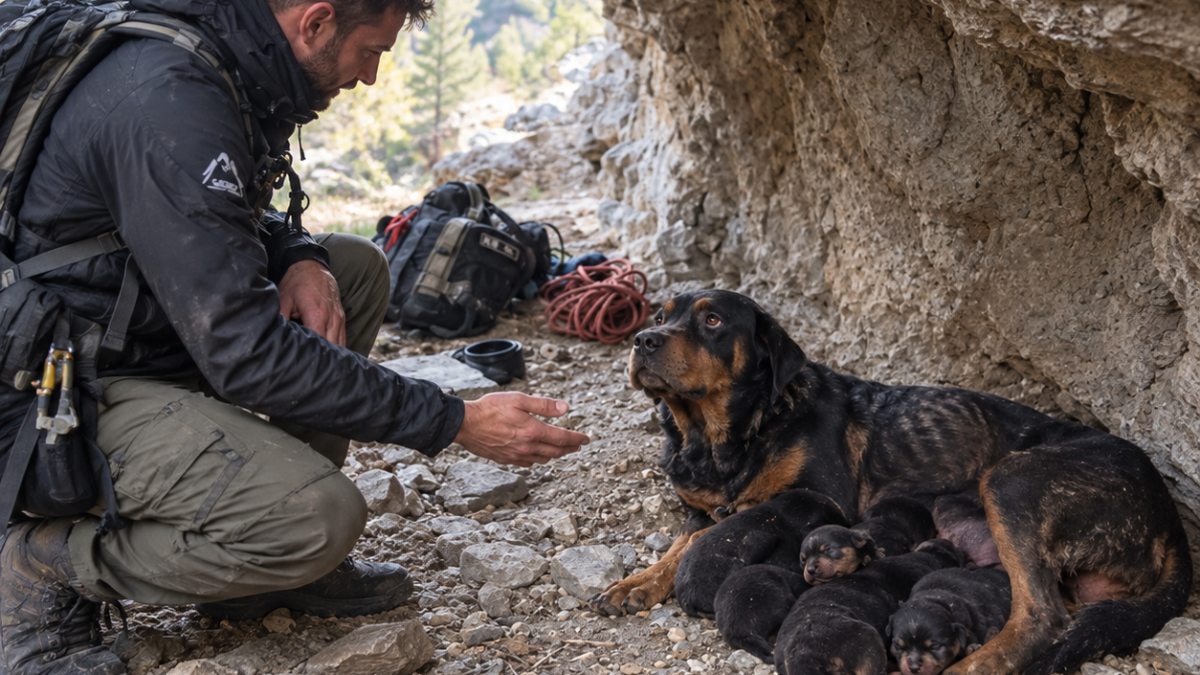
The pregnant dog had spent months watching the mountains from behind a fence she was never supposed to escape.
Then, on the very night her body told her the puppies were coming, she dug beneath that fence and disappeared into the darkness.
By the time a terrified neighbor found the courage to come looking for us, nobody knew whether we were searching for a runaway dog—or a mother who had already made her final sacrifice.
We were used to emergency calls.
In rescue work, they came before sunrise, after midnight, during storms, during holidays, and always when you least expected them.
But that morning, nobody called.
A woman walked into our office instead.
She looked as if she hadn’t slept.
Her hair was pulled back carelessly, her coat was buttoned wrong, and both hands were wrapped around each other so tightly that her knuckles had gone pale.
“I need you to find a dog,” she said.
I stood from my desk.
“What happened?”
Her eyes filled immediately.
“She got out last night.”
“Is she yours?”
The woman shook her head.
“No. She belongs to a man in my neighborhood.”
Something about the way she said belongs made me stop.
“What’s your name?”
“Rebecca.”
“Okay, Rebecca. Start from the beginning.”
She sat down but remained on the edge of the chair.
“There’s a dog behind a property near my house. Brown and white. Medium-sized. Maybe forty pounds before she got pregnant.”
“Pregnant?”
“Very.”
Rebecca looked toward the floor.
“And he’s been hurting her.”
The room went quiet.
My coworker Marcus looked up from across the office.
I pulled another chair closer.
“What do you mean?”
Rebecca swallowed.
“I mean yelling. Kicking the fence. Leaving her outside no matter how cold it got. Sometimes I heard her crying at night.”
“Did you see him strike her?”
She hesitated.
Then nodded.
“More than once.”
I felt anger rise, but I kept my voice level.
“Did you report it?”
Her face crumpled.
“No.”
Marcus and I exchanged a glance.
“I wanted to,” she said quickly. “God, I wanted to. Every day I told myself I would.”
She wiped her face.
“Tomorrow. I kept saying tomorrow.”
I didn’t interrupt.
“Then yesterday evening I saw her standing near the back fence. She kept looking toward the mountains. She looked restless. She was digging at the ground, then lying down, then getting up again.”
Labor.
I knew it immediately.
“What happened next?”
“Around midnight, I heard dogs barking. Then nothing.”
Rebecca’s voice shook.
“I went outside this morning. She was gone.”
“Was the gate open?”
“No.”
“Then how did she get out?”
“I don’t know.”
She leaned toward me.
“But before sunrise, I heard her.”
“Heard what?”
“Her voice.”
“Barking?”
Rebecca shook her head.
“Not exactly. It came from far away. From the mountain.”
She pointed toward the windows as if she could see it from where we sat.
“It sounded like she was calling.”
Marcus stood.
I was already reaching for my gear.
Rebecca looked between us.
“You’ll go?”
“Yes.”
Her shoulders collapsed with relief.
Then she grabbed my arm.
“Please.”
I looked down at her hand.
“I know I should have called sooner,” she whispered. “I know that. You can hate me for it later. Just please tell me she made it.”
Twenty minutes later, Marcus and I stood behind the property.
The fence was high.
Too high for a heavily pregnant dog to jump.
For several minutes we searched the perimeter.
Then Marcus crouched near a row of bushes.
“Caleb.”
I walked over.
Beneath the leaves was a narrow opening.
Fresh dirt was scattered behind it.
Claw marks scarred the ground.
I knelt.
She hadn’t jumped.
She had dug.
An exhausted pregnant dog had clawed through hard earth until there was just enough space to force her body underneath.
Marcus stared toward the mountain ridge.
“She really wanted out.”
“No,” I said quietly.
I looked at the path of disturbed soil leading away from the fence.
“She needed out.”
We released our search dogs, Della and Riley.
They picked up the trail.
The sun had barely cleared the horizon when we started climbing.
Hours later, deep in the cold mountain terrain, Della suddenly froze.
Her head lifted.
Riley turned toward a rocky ravine.
Then both dogs pulled hard in the same direction.
Marcus looked at me.
“They’ve got something.”
We followed them between two walls of stone until I saw a dark opening beneath an overhang.
I heard something move inside.
I stepped closer.
Then stopped.
There, pressed against the cold rock, was the missing dog.
Her body was trembling.
Her eyes locked onto mine.
And beneath her chest, almost completely hidden by her exhausted body, something tiny moved.
Then another.
And another.
I dropped to my knees.
“Oh, sweetheart…”
That was when I realized she hadn’t escaped the night before to save herself.
She had escaped because she was trying to save them.
PART 2
For several seconds, none of us moved.
Even Della and Riley seemed to understand that we had reached something fragile.
Marcus quietly called them back and clipped their leads to a low branch several yards away.
I stayed on my knees.
The mother dog stared at me from inside the rocky shelter.
She was thin.
Much thinner than Rebecca’s description had prepared me for.
Pregnancy should have made her body look fuller, but beneath her dirty coat I could see the shape of her ribs.
Her legs trembled every few seconds.
Her breathing was shallow.
And still, somehow, she had curved her entire body around the tiny shapes beneath her.
Protection before comfort.
Protection before exhaustion.
Protection before herself.
I lowered my voice.
“Easy, girl.”
Her eyes followed me.
I did not move closer.
“We’re not here to take them from you.”
One puppy squeaked.
The mother’s head snapped downward.
She immediately began licking it.
Marcus whispered behind me.
“How many?”
“I can’t tell yet.”
I could see at least three.
Maybe four.
The mother moved slightly, and another tiny body became visible beneath her foreleg.
Five.
I counted again.
One.
Two.
Three.
Four.
Five.
All moving.
All alive.
I looked back at Marcus.
“Five.”
His expression changed instantly.
“All alive?”
“So far.”
I turned back toward her.
“You did it,” I whispered.
The dog’s ears twitched.
“You got all five here.”
She didn’t understand the words.
But maybe she understood the tone.
I reached one hand toward her, stopping well before I touched her.
She stiffened.
Her lips did not curl.
She did not growl.
That worried me almost more.
A frightened mother with newborn puppies normally had every reason to warn us away.
But she seemed too exhausted.
Or perhaps she had learned that warnings did nothing.
I stayed still.
“You don’t have to trust me.”
She sniffed the air.
“Just don’t run.”
As if she had enough strength to run.
That thought hurt.
I moved my hand another inch.
She watched.
Another inch.
Then her nose reached forward.
She smelled my fingers.
Her body trembled.
I waited.
Finally, she closed her eyes.
Not because she had fallen asleep.
It felt more like surrender.
Not defeat.
Permission.
Marcus opened his pack.
“I’ve got blankets.”
“Put one beside me.”
He unfolded a thick fleece blanket onto the stone.
The puppies were so young that they were still blind.
Their ears remained folded close to their heads.
Their movements were awkward little pushes against their mother’s belly.
They should have been born somewhere warm.
Somewhere clean.
Somewhere quiet.
Instead, this dog had given birth surrounded by rock and mountain wind.
I wondered when labor had started.
While she was digging beneath the fence?
While she was climbing?
Had contractions already been coming when she crossed those jagged trails?
Had she stopped in darkness every few minutes because another wave of pain forced her down?
There were questions I would never answer.
But the evidence was in front of us.
She had kept moving.
Until she found this place.
A crack in the mountain.
Protected from the worst of the wind.
Far from the house she had escaped.
Far from the man she feared.
Then she gave birth alone.
I touched the first puppy.
Warm.
That mattered.
I lifted it gently.
The mother raised her head.
“Just moving him right here.”
I placed the puppy on the blanket.
She watched every inch.
Second puppy.
Third.
Fourth.
The fifth was smaller.
I held it near my chest and checked its breathing.
Marcus leaned closer.
“Okay?”
“Breathing.”
I rubbed it gently with the edge of the blanket.
The puppy moved.
“There you go.”
The mother tried to rise.
Her front legs folded.
I immediately lowered the puppy beside her.
“No. No, stay down.”
She struggled again.
Not because she feared us.
Because her baby had made a sound.
Marcus looked away for a second.
I knew why.
You work rescue long enough and you learn ways to keep your emotions functional.
You breathe.
You focus on practical steps.
You save crying for the truck.
Sometimes that works.
Sometimes it doesn’t.
That afternoon, it didn’t.
I wiped my face with my sleeve.
“All five are alive,” I said.
Marcus nodded.
“Yeah.”
“She did all this.”
He stared at the narrow mountain trail behind us.
“Pregnant.”
“Probably already in labor.”
He shook his head.
“That’s impossible.”
I looked at the dog.
“No.”
I slipped my hands beneath her.
“Apparently not.”
She weighed less than she should have.
Far less.
When I lifted her, her body was tense for half a second.
Then her head dropped against my arm.
I felt her exhale.
Marcus gathered the puppies into the padded carrier we had lined with warm blankets.
Every one of them remained close together.
The mother watched.
I carried her near the carrier so she could smell them.
“You’re all staying together.”
Her eyes moved toward the puppies.
“Promise.”
The descent took longer than the climb.
Going up with empty arms had been hard.
Going down carrying an exhausted dog required every step to be deliberate.
Marcus carried the puppies.
Della and Riley moved ahead.
The mountain path was loose beneath our boots.
Several times, stones rolled away under me.
Each time I tightened my grip around the mother.
“I’ve got you.”
At one steep section, my foot slipped.
My knee struck rock.
Pain shot up my leg.
Marcus spun around.
“You good?”
“Yeah.”
“You sure?”
I looked at the dog in my arms.
“Not dropping her.”
Marcus smiled grimly.
“Wasn’t asking that.”
“I’m good.”
We continued.
The mother never fought me.
Sometimes she lifted her head when one of the puppies made noise.
Then she would settle again.
At one point she rested her chin against my forearm.
Her eyes remained open.
Watching.
Always watching.
“You can sleep,” I whispered.
She didn’t.
Not yet.
Maybe she had learned that sleep was dangerous.
Maybe closing your eyes around someone cruel taught you not to do it easily again.
When we finally came down from the mountain, the sun was low.
Rebecca was waiting near the fence.
The instant she saw us, she began running.
Then she saw the dog in my arms.
She stopped so suddenly that gravel scattered beneath her shoes.
Her hands went to her mouth.
“Oh, God.”
I kept walking.
“She’s alive.”
Rebecca started crying.
“And the puppies?”
“Five.”
She stared.
“All five?”
“All five.”
Marcus carefully lowered the carrier where she could see inside.
Rebecca crouched but didn’t touch it.
One puppy stretched.
She sobbed.
“She did it.”
“Yes.”
“I heard her last night.”
“I think you did.”
Rebecca looked at the mother.
“I’m sorry.”
The dog stared at her.
Rebecca’s voice broke.
“I’m so sorry I waited.”
I shifted the mother in my arms.
“Rebecca.”
She looked at me.
“Listen to me carefully. What happened to her is on the person who hurt her.”
“But I knew.”
“You were afraid.”
“I should have been braver.”
“Maybe.”
I wasn’t going to lie to her.
Fear explained silence.
It didn’t erase consequences.
She nodded through tears.
“I know.”
“But you came today.”
“I came too late.”
I looked at the puppies.
“No.”
She followed my eyes.
“You came before tonight.”
The temperature was already dropping.
Rebecca looked toward the mountains.
Her face changed when she understood.
One more night outside with newborn puppies could have ended differently.
“You gave us the direction,” I said. “You gave us the place to start.”
Rebecca wiped her face.
“I’ll tell you everything.”
“About the owner?”
“Yes.”
“Everything you saw?”
“Yes.”
“Even if somebody asks you to make a statement?”
She hesitated.
Only for a moment.
Then she nodded.
“Yes.”
That answer mattered.
Because rescuing the dog was only one part of what needed to happen next.
We loaded everyone into the vehicle.
Rebecca stood beside the door.
“Can I touch her?”
I looked at the mother.
She appeared exhausted but calm.
“Slowly.”
Rebecca extended her hand.
The dog sniffed.
Then Rebecca touched the top of her head.
“I’m sorry,” she whispered again.
This time, the mother closed her eyes.
We drove straight to the clinic.
The veterinarian was waiting.
Dr. Patel had worked with us through dozens of emergency cases.
She had the calm expression of someone who understood that panic wasted time.
“How old are the puppies?”
“Born sometime last night or this morning.”
“Five?”
“Yes.”
“And Mom?”
“Exhausted. Underweight. Possible long-term neglect.”
Dr. Patel’s jaw tightened.
“Bring her in.”
We weighed her first.
Thirty-two pounds.
Rebecca had estimated she had once been closer to forty.
Pregnancy had not hidden the malnutrition.
It had exposed it.
Dr. Patel examined her while one technician checked each puppy.
I stood nearby.
Heart.
Lungs.
Gums.
Temperature.
Hydration.
Skin.
Paws.
Teeth.
Old scars.
Every part told a little story.
Some marks could have come from normal life.
Others worried us.
Dr. Patel pointed toward a healing wound near the dog’s flank.
“How long has that been there?”
“No idea.”
She examined it carefully.
“This doesn’t look new.”
Then she looked at me.
“Photograph everything.”
We did.
Not because we wanted to remember it.
Because evidence matters.
If Rebecca was prepared to speak, there was finally a chance this dog’s former owner might have to answer questions.
Dr. Patel continued the examination.
“She’s dehydrated.”
“How bad?”
“Moderate. She’s exhausted, malnourished, but remarkably stable considering she just delivered five puppies in the mountains.”
“And them?”
The technician smiled.
“That’s the better news.”
I looked over.
“All five have strong heartbeats.”
I exhaled.
“They’re nursing?”
“They should be able to.”
Dr. Patel nodded toward a quiet recovery room.
“Let’s get Mom warmed up, give her fluids carefully, food in small portions, and put the puppies back with her.”
We moved them into the room.
The mother was placed on thick blankets.
Then we returned her puppies.
The transformation was immediate.
She counted them.
I swear she did.
Her nose moved from one to the next.
One.
Two.
Three.
Four.
Five.
Then she circled around them, lowered herself carefully, and allowed them to nurse.
Only after they were settled did her head touch the blanket.
I sat beside her.
“You can sleep now.”
Her eyes stayed open.
I lowered my voice.
“No fence.”
She blinked.
“No mountain.”
Her breathing slowed.
“No one is taking you back.”
Her eyes closed.
Within minutes, she was asleep.
Real sleep.
Deep enough that one paw twitched.
I remained beside her for nearly an hour.
Then my phone rang.
Marcus was standing outside the room.
“It’s animal control.”
I stepped into the hallway.
“What do they want?”
“The property owner says we stole his dog.”
I stared at him.
“He said what?”
Marcus handed me the phone.
A county animal control officer was on the line.
“We received a complaint from the registered owner,” she said.
“She was found several miles away in the mountains after escaping his property.”
“I understand.”
“She had just given birth.”
“I understand that too.”
“She’s under veterinary care.”
“We’re not asking you to move her.”
“Good.”
“But we need documentation.”
“You’ll get it.”
“And Caleb?”
“Yes?”
“Don’t contact the owner yourself.”
I knew exactly why she said that.
“I wasn’t planning to.”
That was not entirely true.
At that moment, there were plenty of things I would have liked to say.
But anger is not evidence.
And if this man truly had abused her, I didn’t want emotion ruining the chance to prove it.
Rebecca came to the clinic the next morning.
She had written everything down.
Dates.
Times.
Descriptions.
She even had several photographs taken through her window.
In one, the dog was chained outside.
In another, her water container appeared overturned.
A third showed her visibly pregnant behind the fence.
Rebecca’s hands shook while she passed me her phone.
“I should have sent these months ago.”
“You’re sending them now.”
She looked toward the recovery room.
“Is she okay?”
“She ate.”
Rebecca smiled weakly.
“And the babies?”
“Still five.”
She covered her face.
For the first time since meeting her, I saw relief rather than guilt.
Animal control arrived an hour later.
Officer Elena Ruiz came with a county investigator.
They photographed the dog.
They spoke with Dr. Patel.
They took copies of her medical notes.
Then Ruiz sat with Rebecca.
I stayed out of the interview.
It lasted almost ninety minutes.
When Rebecca came out, her face was drained.
“You okay?”
She nodded.
“I told them everything.”
“Good.”
“The owner is saying she was always cared for.”
I said nothing.
Rebecca looked toward me.
“He says she was thin because she wouldn’t eat.”
“Let the vet records speak.”
“He says she escaped because she was difficult.”
I almost laughed.
Not because anything was funny.
Because cruelty often came packaged with explanations.
The dog was difficult.
The dog was disobedient.
The dog ran.
The dog made me angry.
The dog caused this.
There was always a reason.
Always something except responsibility.
“Rebecca,” I said, “you did your part. Now let them do theirs.”
“But what if he gets her back?”
That fear had been sitting inside me too.
“He won’t take her from this clinic today.”
“That’s not what I asked.”
I looked through the glass.
The mother was lying beside her puppies.
“I know.”
For the next several days, her legal status remained uncertain.
That was the part of rescue stories people rarely saw.
You can save an animal physically and still spend nights worrying about paperwork.
Ownership.
Evidence.
Hearings.
Medical documentation.
Statements.
The slow machinery of accountability.
We gave the mother a name.
Hope.
Rebecca chose it.
When she suggested it, she immediately looked embarrassed.
“Too obvious?”
I looked at the dog.
“No.”
Hope suited her.
She had dug beneath a fence while heavily pregnant.
She had climbed into the mountains.
She had delivered five puppies alone.
She had kept every one alive.
Hope wasn’t sentimental.
It was factual.
The puppies received names too.
River.
Scout.
Willow.
Bear.
And Daisy.
Within a week, their eyes were still closed, but their bodies had already grown.
Hope’s appetite became enormous.
She ate small meals at first.
Then larger ones.
By the sixth day, she had learned the exact sound of the food-preparation cart.
The first time she stood when she heard it, Marcus laughed.
“There she is.”
Hope looked at him.
“You weren’t this excited to see me yesterday.”
Her tail moved once.
It was the first wag I had seen.
Marcus froze.
“Did you see that?”
“I saw it.”
He crouched.
“Do it again.”
Hope stared at him.
Nothing.
“Come on.”
Nothing.
I laughed.
“She’s not a vending machine.”
Marcus looked offended.
“She likes me.”
Hope turned toward the food cart.
“She likes lunch.”
That tiny tail movement became a milestone.
So did everything after it.
Hope standing without shaking.
Hope walking to the yard.
Hope allowing a technician to touch her paws.
Hope taking food from my hand.
Hope sleeping when people entered the room instead of immediately waking.
Trust came back slowly.
Sometimes so slowly we only noticed it in hindsight.
Then Officer Ruiz called.
“We served a notice on the owner.”
My grip tightened around the phone.
“What kind?”
“The dog will remain in protective custody pending the cruelty investigation.”
I exhaled.
“So he can’t take her?”
“Not while the case is active.”
“Good.”
“There’s more.”
I waited.
“We inspected the property.”
“And?”
Ruiz’s voice hardened.
“There were two other dogs.”
I closed my eyes.
“What condition?”
“Alive. Underweight. Poor shelter conditions.”
“Did you remove them?”
“Yes.”
I sat down.
“Thank God.”
“One of them needs medical care.”
“Bring them here.”
“They’re already headed to another partner clinic.”
For several seconds, neither of us spoke.
Hope’s escape had done more than save five puppies.
It had opened a door onto something hidden behind that fence.
Two other dogs were now out too.
That was the closest thing to revenge I wanted.
Not pain.
Exposure.
A cruel situation dragged into daylight.
The owner had expected Hope to remain where he put her.
Instead, she escaped.
He had expected silence.
Instead, a neighbor finally spoke.
He had expected ownership to protect him.
Instead, it gave investigators an address.
Rebecca cried when I told her.
“There were two more?”
“Yes.”
“I saw one before. I thought it disappeared.”
“It didn’t.”
“Are they okay?”
“They’re getting care.”
She sat beside Hope’s enclosure.
Hope came closer.
Rebecca extended her hand.
This time, Hope didn’t merely sniff.
She rested her chin against Rebecca’s fingers.
Rebecca began crying again.
“I should have helped you sooner.”
Hope licked her wrist.
Rebecca laughed through her tears.
“Okay.”
She wiped her face.
“Okay. I hear you.”
Weeks passed.
The puppies opened their eyes.
There is something absurdly joyful about watching newborn puppies discover that the world exists.
At first they only crawled.
Then they wobbled.
Then suddenly five tiny bodies were moving in five different directions.
Hope became a full-time traffic officer.
Scout climbed over everything.
Willow preferred sleeping.
Bear believed every human hand existed for chewing.
River was the first to bark.
Daisy was the smallest but somehow always reached the food first.
Hope watched them constantly.
But she no longer watched with panic.
That difference mattered.
On the mountain, she had covered them with her body as if danger surrounded every inch.
At the shelter, she began letting them wander.
Not far.
Never too far.
But enough.
One morning, I found her lying on the blanket while all five puppies attacked Marcus’s shoelaces.
He looked at me.
“Help.”
“No.”
“Caleb.”
“You’re the enrichment activity now.”
Bear pulled hard on one lace.
Marcus sighed.
Hope watched.
Then, for the first time, I saw something almost playful in her expression.
“You think this is funny?” Marcus asked her.
Her tail thumped against the floor.
“Oh, she absolutely thinks it’s funny.”
The case against the owner developed slowly.
Rebecca gave a formal statement.
Another neighbor came forward.
Then another.
The second neighbor had heard shouting.
The third had video from months earlier showing Hope chained outside during severe weather.
Dr. Patel documented malnutrition, dehydration, old injuries, and overall condition.
The investigators collected everything.
The owner denied cruelty.
Of course he did.
He said neighbors misunderstood.
He said the dogs were working animals.
He said Hope had always been fed.
He said she ran because she was “stupid.”
When Ruiz told me that, I felt my jaw tighten.
“Stupid?”
“His word.”
I looked at Hope through the glass.
She was cleaning Daisy’s face.
A dog who sensed labor coming, dug beneath a fence, traveled into protective terrain, found shelter from the wind, delivered five puppies and kept every one alive.
“Yeah,” I said.
“Clearly.”
Ruiz almost smiled.
Then her expression became serious.
“Don’t expect some dramatic courtroom ending.”
“I don’t.”
“Cases like this can resolve in different ways.”
“I know.”
“What matters immediately is that he agreed to surrender ownership of Hope and the puppies.”
I stopped.
“What?”
“He signed the surrender.”
“You’re sure?”
“I have the paperwork.”
I stood.
“So she’s free?”
“She’s legally in your organization’s custody now.”
I looked toward the room.
Hope raised her head.
My chest tightened.
“Say that again.”
Ruiz laughed softly.
“She’s yours to place when medically appropriate.”
I hung up and walked into Hope’s room.
Marcus followed.
“What happened?”
I sat on the floor.
Hope approached me.
“He surrendered her.”
Marcus went still.
“All of them?”
“Hope and the puppies.”
His face broke into a grin.
“You’re kidding.”
“No.”
He sat beside me.
Hope stood between us.
I put my hand on her shoulder.
“You did it.”
She looked at me.
“The fence doesn’t own you.”
Her tail moved.
“The man doesn’t own you.”
Another wag.
“You’re free.”
Marcus shook his head.
“She has no idea what you’re saying.”
“I know.”
But I kept saying it anyway.
“You’re free.”
Later, we learned that the cruelty case resulted in penalties and restrictions tied to the condition of the animals removed from the property.
It wasn’t cinematic.
There was no packed courtroom.
No dramatic confession.
No moment where Hope stood beside us while someone begged forgiveness.
Real justice is often paperwork.
Medical records.
Statements.
Photographs.
A signature surrendering ownership.
A county order.
Restrictions preventing an easy return to the same conditions.
It was enough to matter.
More importantly, Hope would never return behind that fence.
Neither would the two other dogs removed during the investigation.
That was enough for me.
The puppies grew rapidly.
By six weeks, the quiet room had become chaos.
There were toys everywhere.
Tiny teeth everywhere.
Puppies wrestling inside water bowls.
Puppies sleeping inside food dishes.
Puppies barking at their own reflections.
Hope seemed to rediscover something while raising them.
Play.
The first time she picked up a toy, everyone stopped.
It was a blue rope.
She sniffed it.
Picked it up.
Dropped it.
Looked around.
Then picked it up again.
Marcus whispered, “No way.”
Hope shook the rope once.
Not hard.
Just enough.
Then Scout charged toward it.
Hope stepped backward.
Scout followed.
She stepped again.
Another puppy joined.
Then another.
Suddenly Hope was moving around the room with three puppies chasing the rope in her mouth.
I laughed.
There she was.
Not the frightened dog behind the fence.
Not the desperate mother on the mountain.
A dog.
Just a dog.
By eight weeks, adoption applications began arriving.
We screened carefully.
Every puppy would need a permanent home.
Hope would too.
That part worried me more.
Puppies attract attention easily.
Adult dogs with complicated histories can wait.
But Hope surprised us.
People had heard her story.
Families wanted to meet her.
Still, we did not want someone who wanted a symbol.
We wanted someone who wanted Hope.
The dog herself.
Quiet.
Watchful.
Gentle.
Protective.
Still occasionally frightened by raised voices.
Still uncomfortable around high fences.
Still learning that a hand moving quickly did not always mean pain.
Then Rebecca arrived one afternoon with an older woman.
“This is my aunt Margaret.”
Margaret was in her late sixties, maybe early seventies.
Silver hair.
Calm eyes.
No dramatic energy.
She walked into Hope’s room and did something I noticed immediately.
She did not walk toward Hope.
She sat down.
Hope watched from beside the puppies.
Margaret placed her hands in her lap.
“Hello, sweetheart.”
That was all.
No reaching.
No kissing noises.
No demand for trust.
Hope eventually stood.
She approached.
Sniffed Margaret’s shoes.
Then her hands.
Margaret remained still.
Hope stepped closer.
Margaret looked at me.
“Can I?”
I nodded.
She touched Hope beneath the chin.
Hope stayed.
Margaret smiled.
Rebecca was watching with tears already gathering.
We talked for an hour.
Margaret lived alone in a small house outside town.
Large fenced yard.
Quiet neighborhood.
No other pets.
She had recently lost her husband.
She had grown up with dogs but hadn’t owned one for several years.
“I keep telling myself the house is peaceful,” she said.
Then she smiled sadly.
“The truth is, it’s lonely.”
Hope had returned to lie beside her puppies.
Margaret watched.
“I’d like to adopt her.”
Rebecca looked at her aunt.
“And one puppy,” Margaret added.
I blinked.
“One?”
“If that’s possible.”
“Which one?”
Margaret laughed.
“I’m not choosing today.”
Good answer.
“You’re willing to take the mother too?”
Margaret looked confused by the question.
“Of course.”
“Most people ask about puppies first.”
“I’m not most people.”
She looked toward Hope.
“That dog climbed a mountain to keep those babies alive.”
Her voice softened.
“She’s earned a garden.”
Something about that sentence stayed with me.
She’s earned a garden.
We began the adoption process.
Margaret visited repeatedly.
So did Rebecca.
Hope grew increasingly comfortable with both women.
Eventually, Hope began greeting Margaret at the door.
The puppy who bonded most strongly with her was Willow.
The quiet one.
Willow often slept against Hope’s side.
When Margaret sat down, Willow climbed into her lap and fell asleep.
The decision almost made itself.
Meanwhile, River went to a young couple with a fenced yard and an older dog.
Scout went to a family with two teenage boys.
Bear went to a retired firefighter who claimed he wanted a calm dog and somehow chose the least calm puppy in the entire litter.
Daisy went to a veterinary technician who had fallen in love with her on day three.
Every adoption hurt.
Every adoption felt right.
Then came Hope and Willow’s day.
The weather was warm.
Sunlight came through the shelter windows.
Margaret arrived carrying two new collars.
One larger.
One tiny.
Hope watched as she approached.
Margaret knelt.
“Ready to go home?”
Hope walked toward her.
Margaret fastened the collar.
Hope stood perfectly still.
Then Willow’s collar.
Rebecca was beside me.
She cried quietly.
“You okay?”
“No.”
“Good answer.”
She laughed through tears.
“I keep thinking about that fence.”
“So do I.”
“I keep thinking about the night she dug out.”
I looked at Hope.
“Maybe she knew.”
“Knew what?”
“That staying was more dangerous than leaving.”
Rebecca shook her head.
“I wish I’d been that brave.”
“You were brave eventually.”
“Eventually.”
“That still counts.”
She looked at me.
“Does it?”
“Yes.”
Then I added, “But remember how this started.”
Rebecca nodded.
Fear had delayed her.
That lesson mattered too.
Compassion without action can arrive too late.
Rebecca never forgot that.
Neither did I.
Hope walked toward me before leaving.
She stopped.
Then pushed her head against my knee.
Exactly as she had done on the mountain when she finally allowed herself to trust my hand.
I crouched.
“You remember me?”
Her tail moved.
I wrapped my arms around her.
“You don’t have to run anymore.”
Willow bounced around Margaret’s feet.
Hope glanced toward her puppy.
Then toward Margaret.
Margaret opened the car door.
Hope walked over.
She hesitated.
For one second, I saw the old fear return.
Car.
Door.
Uncertainty.
Margaret waited.
She didn’t pull.
Didn’t command.
Just waited.
Hope placed one paw inside.
Then another.
Then climbed into the back seat.
Willow followed.
Margaret closed the door gently.
Rebecca stood beside the car.
Hope pressed her nose near the open window.
Rebecca touched her.
“I’m sorry,” she whispered.
Then she smiled.
“And I’m so glad you ran.”
The car disappeared down the road.
I stood outside long after it was gone.
Marcus eventually came beside me.
“You crying?”
“No.”
“You absolutely are.”
“Wind.”
“There is no wind.”
“Go clean something.”
He laughed.
Months passed.
We received photographs.
Hope in Margaret’s garden.
Hope sleeping beside Willow.
Hope stretched across a rug.
Hope sitting at the back door watching birds.
The change was almost difficult to process.
Her body filled out.
Her coat became glossy.
Her eyes softened.
Willow grew from a small puppy into a long-legged young dog who looked more like her mother each week.
Then one morning Margaret called.
“Caleb?”
“Everything okay?”
“Oh, yes.”
She laughed.
“Everything is wonderful.”
I relaxed.
“You scared me.”
“I’m sorry. I wanted to ask if you could visit.”
“When?”
“Whenever you’re free.”
“What’s happening?”
“Nothing.”
I waited.
She added, “That’s why I want you to come.”
I understood later.
Nothing was happening.
No emergency.
No crisis.
No medical problem.
No legal problem.
She wanted me to see what normal looked like.
I drove out on a Saturday afternoon.
Margaret’s house sat behind a low wooden fence surrounded by trees.
Not a high privacy barrier.
Not anything that looked like confinement.
A garden spread behind the house.
Flowers.
Grass.
A large maple tree.
A stone path.
And beneath the tree was a thick outdoor cushion.
Hope was sleeping on it.
Willow was beside her.
For a second, I remained near my truck.
I simply looked.
The last time I had first seen Hope outdoors, she had been pressed against cold stone, trembling over newborn puppies.
Now sunlight covered her coat.
Her body looked strong.
Healthy.
Safe.
Margaret came onto the porch.
“She hasn’t seen you yet.”
I closed the truck door.
Hope’s head lifted.
Her ears moved.
She stared.
Then she stood.
For half a second, neither of us moved.
“Hey, girl.”
Hope started running.
Not walking.
Running.
She crossed the yard so quickly that Willow jumped up and raced after her.
I barely had time to crouch.
Hope hit me with enough enthusiasm to almost knock me backward.
I laughed.
“Okay!”
She licked my face.
Her tail moved violently.
“Okay, I remember you too.”
Willow jumped around us.
Hope pushed her head against my shoulder.
I closed my eyes.
For a moment, the mountain came back.
Cold rock.
Trembling legs.
Five puppies beneath her.
My hand stretched toward her.
Her nose touching my fingers.
Then this.
Sun.
Grass.
Flowers.
A healthy dog leaning into me because she wanted affection, not because she had finally run out of strength.
I held her tighter.
“You really made it.”
Margaret approached.
“She does that every time someone comes.”
“Runs?”
“Everyone is apparently her best friend now.”
I laughed.
“The dog who wouldn’t let me move six inches toward her?”
“That one.”
Hope ran toward the porch.
Willow chased her.
Margaret smiled.
“She’s not afraid of people anymore.”
That sentence was worth every mile of the search.
We sat outside.
Hope settled at my feet.
Margaret told me about their routine.
Every morning, Hope came into her bedroom and placed her head against the side of the mattress.
“If I ignore her, she sighs.”
“Sighs?”
“Very dramatically.”
“What happens if you keep ignoring her?”
“She puts one paw on the bed.”
I laughed.
“She’s trained you.”
“Completely.”
After breakfast, Hope and Willow went into the garden.
Hope liked watching birds.
Willow liked chasing them.
Hope had no interest in fetching balls.
Willow had too much interest.
Hope slept in the sun.
Willow dug illegal holes.
Hope greeted visitors.
Willow barked at delivery drivers and then hid behind her mother.
They were normal dogs.
Beautifully, wonderfully normal.
Rebecca still visited.
Often.
At first, Hope had been cautious.
Now she greeted Rebecca with the same wagging tail.
“She forgave her before Rebecca forgave herself,” Margaret said.
I looked down at Hope.
“Dogs can be better at that.”
Margaret nodded.
“Rebecca reports suspected neglect now.”
I looked at her.
“What?”
“She saw another dog chained behind a house last month.”
My stomach tightened.
“What did she do?”
“Called immediately.”
I smiled.
No tomorrow.
That mattered.
Rebecca could not change the months she had stayed silent.
But she could change what she did next.
Perhaps that was part of Hope’s legacy too.
Later, I walked through the garden.
Hope followed me.
Willow ran ahead.
Near the far side of the property stood the fence.
Hope approached it.
For a second, my body tensed.
I wondered whether fences still frightened her.
She sniffed along the bottom.
Then looked through toward the field beyond.
No panic.
No scratching.
No desperate digging.
She simply turned and walked back toward the house.
I stopped.
There was something quietly powerful about that.
The old fence had been something she needed to defeat.
This one was simply part of the yard.
Because a fence is not cruel by itself.
People make places prisons.
People can also make them homes.
That evening, Rebecca arrived.
Hope heard her car and ran toward the gate.
Rebecca came inside carrying a bag of treats.
“There’s my girl.”
Hope jumped around her.
Rebecca laughed.
I had never seen her look so light.
We sat together beneath the maple tree.
For a while, nobody mentioned the former owner.
Eventually Rebecca did.
“I heard the other two dogs were adopted.”
“They were.”
“Good homes?”
“Yes.”
She nodded.
“That helps.”
“It should.”
She looked toward Hope.
“Sometimes I imagine what would have happened if she hadn’t escaped.”
Nobody answered.
We all knew.
Maybe someone would have called eventually.
Maybe not.
Maybe the puppies would have been born behind that fence.
Maybe some would have survived.
Maybe Hope would have grown weaker.
Maybe cruelty would have continued.
The possibilities were dark enough that I didn’t need to say them aloud.
Rebecca took a slow breath.
“She saved herself.”
I looked at Hope.
“And five puppies.”
“And the other dogs.”
I nodded.
“Yes.”
Her escape had triggered the investigation.
The investigation had exposed the property.
The property inspection had freed two more animals.
One desperate decision in the middle of the night had widened into consequences nobody could have predicted.
Rebecca smiled sadly.
“His fence couldn’t hold her.”
“No.”
“His cruelty couldn’t either.”
Hope lifted her head at the sound of our voices.
Willow climbed over her and collapsed against her side.
Hope licked her daughter’s face.
I thought about the owner then.
Not with rage.
Not anymore.
I thought about what he had lost.
He had tried to control Hope through fear.
Fear failed.
He had confined her.
The fence failed.
He had treated her like property.
The law eventually separated her from him.
He had expected silence from the people around him.
Rebecca broke it.
He had expected the dogs on his property to remain invisible.
Hope’s escape exposed them.
That was justice enough.
Cruelty had tried to shrink Hope’s world to one yard behind one fence.
Now her world contained a garden, a house, a family, sunlight, visitors, walks and the daughter sleeping beside her.
The revenge was not that he suffered.
The revenge was that he became irrelevant.
He no longer had any power over the rest of her life.
Hope’s days belonged to Hope.
That was better.
As the sun began setting, Margaret brought water outside.
Hope stood and stretched.
She looked toward the house.
Then toward us.
Then she walked over and placed her head in my lap.
I stroked her ears.
“You know, the first time you did this, we were sitting inside a hole in a mountain.”
Rebecca smiled.
Margaret looked at me.
“She did what?”
“She put her head into my hand.”
I looked down at Hope.
“Right after I picked up the last puppy.”
Hope closed her eyes.
“Same expression too.”
Margaret laughed.
“She likes you.”
“I think she remembers.”
I don’t know exactly what dogs remember.
Maybe not stories the way we do.
Maybe Hope did not replay that night.
Maybe she did not remember the fence or the cold stones or the climb.
Maybe memory lived inside her differently.
A sound.
A smell.
A feeling.
A hand that approached slowly instead of striking.
A voice that stayed soft.
A blanket.
Warmth.
Safety.
Whatever she remembered, she trusted me.
That was enough.
Before leaving, I stood beside the garden gate.
Hope and Willow remained near Margaret.
Rebecca was helping carry cups into the house.
The scene was so ordinary that anyone passing on the road would have seen nothing remarkable.
Two dogs.
An older woman.
A garden.
Evening light.
But I knew what it had cost Hope to arrive there.
She had escaped on the night her puppies were coming.
She had dug through packed earth.
She had crossed rough terrain while in labor.
She had found shelter.
She had given birth alone.
She had kept five helpless lives warm with her own exhausted body.
Then, when strangers finally found her, she had made one more brave decision.
She trusted us.
That decision changed everything.
I opened the gate.
Margaret called, “Hope, say goodbye.”
Hope ran toward me.
I bent.
She licked my cheek once.
Then she turned.
She ran back toward Margaret and Willow.
No hesitation.
No looking behind her.
She knew exactly where home was.
I watched her go.
That was when I understood the ending of her story.
It was never the mountain.
The mountain was survival.
It was never the investigation.
That was accountability.
It was never even the adoption.
That was opportunity.
The ending was this.
Hope running back toward someone because she knew that person would still be there when she arrived.
A dog who once escaped because home was dangerous had finally found a home she never needed to escape.
Years of rescue work had taught me that people often want justice to look dramatic.
They want bad people punished in spectacular ways.
They want suffering balanced by suffering.
But Hope taught me something different.
Sometimes the most complete victory is simply removing cruelty’s power.
A man once controlled where she slept.
Now she chose between a bed, a couch and a cushion beneath the maple tree.
A man once decided when she ate.
Now Margaret complained that Hope appeared in the kitchen five minutes before every meal.
A man once made her afraid of approaching footsteps.
Now she ran toward visitors.
A man once kept her behind a fence.
Now the garden gate could stand open while Margaret worked nearby, and Hope stayed because she wanted to.
Nobody had to trap her anymore.
Love had given her a reason to remain.
Several months after that visit, Rebecca sent me a picture.
Hope was lying under the tree.
Willow was beside her.
Between them sat a small flower pot that Willow had apparently knocked over.
Dirt covered both dogs.
Margaret stood behind them with her hands on her hips.
Rebecca had written one sentence beneath the photograph.
“They’re in trouble.”
I laughed for a long time.
Trouble.
Normal trouble.
Not survival.
Not cruelty.
Not fear.
A broken flower pot.
That was the life Hope deserved.
Not to spend every day being celebrated as a heroic mother.
Not to spend every day reminding us what she endured.
She deserved to be annoying.
She deserved to steal food.
She deserved to dig holes.
She deserved to roll in mud five minutes after a bath.
She deserved to live so completely that the worst chapter of her life became only one chapter.
The puppies grew into adults.
We received updates from every family.
River loved swimming.
Scout slept in one boy’s bed and waited beside the window for the other to return from school.
Bear became nearly twice Hope’s size and still believed he belonged in his adopter’s lap.
Daisy followed her veterinary technician everywhere and frequently appeared behind the reception desk at the clinic.
Willow remained with Hope.
Five puppies.
Five homes.
Five lives that had begun in a mountain shelter beneath the body of a mother who refused to abandon them.
Whenever I saw their photographs together, I thought about the first time I counted them.
One.
Two.
Three.
Four.
Five.
All breathing.
All alive.
That count still felt like a miracle.
Hope grew older.
Gray appeared around her muzzle.
Her running slowed slightly.
But Margaret said she never stopped greeting visitors at the gate.
Rebecca continued visiting.
Marcus visited too.
I went whenever I could.
Every time, Hope treated me as if no time had passed.
She ran.
Later, she trotted.
Eventually, she walked quickly.
But she always came.
And every time she reached me, she placed her head somewhere against my hand, my knee, or my chest.
I would think of the mountains.
Then I would look around at the garden.
That distance never stopped astonishing me.
One afternoon, years after the rescue, I sat beneath the maple tree while Hope slept beside my chair.
Willow was lying several feet away.
Margaret brought coffee.
Rebecca was due later.
I looked at Hope’s graying face.
“Do you ever think about how close this came to being different?”
Margaret sat down.
“All the time.”
“She shouldn’t have survived that night.”
“But she did.”
“She shouldn’t have been strong enough to reach the mountain.”
“But she was.”
I smiled.
Margaret touched Hope gently.
“She had something to protect.”
Hope’s ear moved.
Five puppies.
That had been enough.
Maybe she did not know what freedom meant in human language.
Maybe she did not understand laws or cruelty investigations or adoption documents.
But she understood one thing before any of us arrived.
Her puppies were coming.
And wherever she had been living was not safe enough for them.
So she left.
No permission.
No guarantee.
No map.
No promise that anything better existed beyond that fence.
She simply chose uncertainty over the certainty of fear.
That may have been the bravest decision I had ever seen an animal make.
Hope opened her eyes.
I held out my hand.
She placed her head beneath it.
Exactly as she had years earlier.
“Yeah,” I whispered.
“I remember too.”
The wind moved through the leaves overhead.
Willow stretched.
Margaret smiled.
And for a few quiet minutes, nothing needed saving.
That may have been the greatest gift of all.
I have responded to hundreds of rescue calls.
Some ended beautifully.
Some did not.
There are animals I still think about late at night.
There are houses I still remember.
There are cases I wish we had reached sooner.
But Hope stayed with me differently.
Not because she suffered more than every other dog.
Pain is not a competition.
She stayed with me because of what she did with the tiny opening she found.
There was a fence.
She found earth beneath it.
There was darkness.
She moved through it.
There were mountains.
She climbed.
There was cold.
She found shelter.
There was labor.
She endured it.
There were five helpless lives.
She covered them with her own body.
Then there were strangers.
And somehow, after everything people had taught her about fear, she found enough courage to trust one more time.
That is what I remember.
Not the cruel man.
Not the fence.
Not even the investigation.
I remember Hope placing her tired head into my palm.
I remember five tiny bodies breathing beneath blankets.
I remember carrying her down the mountain while the sun fell behind us.
I remember Rebecca waiting beside the road, afraid she was about to hear that she had spoken too late.
I remember telling her, “She’s alive.”
I remember the first tail wag.
The first toy.
The first run across Margaret’s garden.
I remember Hope leaving the shelter with Willow beside her.
I remember seeing her turn away from the garden fence because she no longer needed to escape anything.
And I remember the last thing I said before leaving Margaret’s home one evening.
Hope was standing beneath the maple tree.
Willow beside her.
Margaret near the porch.
Rebecca laughing from the doorway.
I looked at the dog who had once climbed a mountain just to give her babies a chance.
“You found it, girl.”
Her tail moved.
I smiled.
“You found home.”
Then Hope turned and ran toward the people waiting for her.
And this time, she wasn’t running away from anything.
She was running toward everything she had fought so hard to keep alive.
She Escaped Her Cruel Owner Hours Before Giving Birth—We Found Her in the Mountains Guarding Five Tiny Lives
[FACEBOOK CAPTION — 700–800 WORDS]
The pregnant dog had spent months watching the mountains from behind a fence she was never supposed to escape.
Then, on the very night her body told her the puppies were coming, she dug beneath that fence and disappeared into the darkness.
By the time a terrified neighbor found the courage to come looking for us, nobody knew whether we were searching for a runaway dog—or a mother who had already made her final sacrifice.
We were used to emergency calls.
In rescue work, they came before sunrise, after midnight, during storms, during holidays, and always when you least expected them.
But that morning, nobody called.
A woman walked into our office instead.
She looked as if she hadn’t slept.
Her hair was pulled back carelessly, her coat was buttoned wrong, and both hands were wrapped around each other so tightly that her knuckles had gone pale.
“I need you to find a dog,” she said.
I stood from my desk.
“What happened?”
Her eyes filled immediately.
“She got out last night.”
“Is she yours?”
The woman shook her head.
“No. She belongs to a man in my neighborhood.”
Something about the way she said belongs made me stop.
“What’s your name?”
“Rebecca.”
“Okay, Rebecca. Start from the beginning.”
She sat down but remained on the edge of the chair.
“There’s a dog behind a property near my house. Brown and white. Medium-sized. Maybe forty pounds before she got pregnant.”
“Pregnant?”
“Very.”
Rebecca looked toward the floor.
“And he’s been hurting her.”
The room went quiet.
My coworker Marcus looked up from across the office.
I pulled another chair closer.
“What do you mean?”
Rebecca swallowed.
“I mean yelling. Kicking the fence. Leaving her outside no matter how cold it got. Sometimes I heard her crying at night.”
“Did you see him strike her?”
She hesitated.
Then nodded.
“More than once.”
I felt anger rise, but I kept my voice level.
“Did you report it?”
Her face crumpled.
“No.”
Marcus and I exchanged a glance.
“I wanted to,” she said quickly. “God, I wanted to. Every day I told myself I would.”
She wiped her face.
“Tomorrow. I kept saying tomorrow.”
I didn’t interrupt.
“Then yesterday evening I saw her standing near the back fence. She kept looking toward the mountains. She looked restless. She was digging at the ground, then lying down, then getting up again.”
Labor.
I knew it immediately.
“What happened next?”
“Around midnight, I heard dogs barking. Then nothing.”
Rebecca’s voice shook.
“I went outside this morning. She was gone.”
“Was the gate open?”
“No.”
“Then how did she get out?”
“I don’t know.”
She leaned toward me.
“But before sunrise, I heard her.”
“Heard what?”
“Her voice.”
“Barking?”
Rebecca shook her head.
“Not exactly. It came from far away. From the mountain.”
She pointed toward the windows as if she could see it from where we sat.
“It sounded like she was calling.”
Marcus stood.
I was already reaching for my gear.
Rebecca looked between us.
“You’ll go?”
“Yes.”
Her shoulders collapsed with relief.
Then she grabbed my arm.
“Please.”
I looked down at her hand.
“I know I should have called sooner,” she whispered. “I know that. You can hate me for it later. Just please tell me she made it.”
Twenty minutes later, Marcus and I stood behind the property.
The fence was high.
Too high for a heavily pregnant dog to jump.
For several minutes we searched the perimeter.
Then Marcus crouched near a row of bushes.
“Caleb.”
I walked over.
Beneath the leaves was a narrow opening.
Fresh dirt was scattered behind it.
Claw marks scarred the ground.
I knelt.
She hadn’t jumped.
She had dug.
An exhausted pregnant dog had clawed through hard earth until there was just enough space to force her body underneath.
Marcus stared toward the mountain ridge.
“She really wanted out.”
“No,” I said quietly.
I looked at the path of disturbed soil leading away from the fence.
“She needed out.”
We released our search dogs, Della and Riley.
They picked up the trail.
The sun had barely cleared the horizon when we started climbing.
Hours later, deep in the cold mountain terrain, Della suddenly froze.
Her head lifted.
Riley turned toward a rocky ravine.
Then both dogs pulled hard in the same direction.
Marcus looked at me.
“They’ve got something.”
We followed them between two walls of stone until I saw a dark opening beneath an overhang.
I heard something move inside.
I stepped closer.
Then stopped.
There, pressed against the cold rock, was the missing dog.
Her body was trembling.
Her eyes locked onto mine.
And beneath her chest, almost completely hidden by her exhausted body, something tiny moved.
Then another.
And another.
I dropped to my knees.
“Oh, sweetheart…”
That was when I realized she hadn’t escaped the night before to save herself.
She had escaped because she was trying to save them.
[END OF FACEBOOK CAPTION]
[FIRST COMMENT / FULL STORY CONTINUATION]
For several seconds, none of us moved.
Even Della and Riley seemed to understand that we had reached something fragile.
Marcus quietly called them back and clipped their leads to a low branch several yards away.
I stayed on my knees.
The mother dog stared at me from inside the rocky shelter.
She was thin.
Much thinner than Rebecca’s description had prepared me for.
Pregnancy should have made her body look fuller, but beneath her dirty coat I could see the shape of her ribs.
Her legs trembled every few seconds.
Her breathing was shallow.
And still, somehow, she had curved her entire body around the tiny shapes beneath her.
Protection before comfort.
Protection before exhaustion.
Protection before herself.
I lowered my voice.
“Easy, girl.”
Her eyes followed me.
I did not move closer.
“We’re not here to take them from you.”
One puppy squeaked.
The mother’s head snapped downward.
She immediately began licking it.
Marcus whispered behind me.
“How many?”
“I can’t tell yet.”
I could see at least three.
Maybe four.
The mother moved slightly, and another tiny body became visible beneath her foreleg.
Five.
I counted again.
One.
Two.
Three.
Four.
Five.
All moving.
All alive.
I looked back at Marcus.
“Five.”
His expression changed instantly.
“All alive?”
“So far.”
I turned back toward her.
“You did it,” I whispered.
The dog’s ears twitched.
“You got all five here.”
She didn’t understand the words.
But maybe she understood the tone.
I reached one hand toward her, stopping well before I touched her.
She stiffened.
Her lips did not curl.
She did not growl.
That worried me almost more.
A frightened mother with newborn puppies normally had every reason to warn us away.
But she seemed too exhausted.
Or perhaps she had learned that warnings did nothing.
I stayed still.
“You don’t have to trust me.”
She sniffed the air.
“Just don’t run.”
As if she had enough strength to run.
That thought hurt.
I moved my hand another inch.
She watched.
Another inch.
Then her nose reached forward.
She smelled my fingers.
Her body trembled.
I waited.
Finally, she closed her eyes.
Not because she had fallen asleep.
It felt more like surrender.
Not defeat.
Permission.
Marcus opened his pack.
“I’ve got blankets.”
“Put one beside me.”
He unfolded a thick fleece blanket onto the stone.
The puppies were so young that they were still blind.
Their ears remained folded close to their heads.
Their movements were awkward little pushes against their mother’s belly.
They should have been born somewhere warm.
Somewhere clean.
Somewhere quiet.
Instead, this dog had given birth surrounded by rock and mountain wind.
I wondered when labor had started.
While she was digging beneath the fence?
While she was climbing?
Had contractions already been coming when she crossed those jagged trails?
Had she stopped in darkness every few minutes because another wave of pain forced her down?
There were questions I would never answer.
But the evidence was in front of us.
She had kept moving.
Until she found this place.
A crack in the mountain.
Protected from the worst of the wind.
Far from the house she had escaped.
Far from the man she feared.
Then she gave birth alone.
I touched the first puppy.
Warm.
That mattered.
I lifted it gently.
The mother raised her head.
“Just moving him right here.”
I placed the puppy on the blanket.
She watched every inch.
Second puppy.
Third.
Fourth.
The fifth was smaller.
I held it near my chest and checked its breathing.
Marcus leaned closer.
“Okay?”
“Breathing.”
I rubbed it gently with the edge of the blanket.
The puppy moved.
“There you go.”
The mother tried to rise.
Her front legs folded.
I immediately lowered the puppy beside her.
“No. No, stay down.”
She struggled again.
Not because she feared us.
Because her baby had made a sound.
Marcus looked away for a second.
I knew why.
You work rescue long enough and you learn ways to keep your emotions functional.
You breathe.
You focus on practical steps.
You save crying for the truck.
Sometimes that works.
Sometimes it doesn’t.
That afternoon, it didn’t.
I wiped my face with my sleeve.
“All five are alive,” I said.
Marcus nodded.
“Yeah.”
“She did all this.”
He stared at the narrow mountain trail behind us.
“Pregnant.”
“Probably already in labor.”
He shook his head.
“That’s impossible.”
I looked at the dog.
“No.”
I slipped my hands beneath her.
“Apparently not.”
She weighed less than she should have.
Far less.
When I lifted her, her body was tense for half a second.
Then her head dropped against my arm.
I felt her exhale.
Marcus gathered the puppies into the padded carrier we had lined with warm blankets.
Every one of them remained close together.
The mother watched.
I carried her near the carrier so she could smell them.
“You’re all staying together.”
Her eyes moved toward the puppies.
“Promise.”
The descent took longer than the climb.
Going up with empty arms had been hard.
Going down carrying an exhausted dog required every step to be deliberate.
Marcus carried the puppies.
Della and Riley moved ahead.
The mountain path was loose beneath our boots.
Several times, stones rolled away under me.
Each time I tightened my grip around the mother.
“I’ve got you.”
At one steep section, my foot slipped.
My knee struck rock.
Pain shot up my leg.
Marcus spun around.
“You good?”
“Yeah.”
“You sure?”
I looked at the dog in my arms.
“Not dropping her.”
Marcus smiled grimly.
“Wasn’t asking that.”
“I’m good.”
We continued.
The mother never fought me.
Sometimes she lifted her head when one of the puppies made noise.
Then she would settle again.
At one point she rested her chin against my forearm.
Her eyes remained open.
Watching.
Always watching.
“You can sleep,” I whispered.
She didn’t.
Not yet.
Maybe she had learned that sleep was dangerous.
Maybe closing your eyes around someone cruel taught you not to do it easily again.
When we finally came down from the mountain, the sun was low.
Rebecca was waiting near the fence.
The instant she saw us, she began running.
Then she saw the dog in my arms.
She stopped so suddenly that gravel scattered beneath her shoes.
Her hands went to her mouth.
“Oh, God.”
I kept walking.
“She’s alive.”
Rebecca started crying.
“And the puppies?”
“Five.”
She stared.
“All five?”
“All five.”
Marcus carefully lowered the carrier where she could see inside.
Rebecca crouched but didn’t touch it.
One puppy stretched.
She sobbed.
“She did it.”
“Yes.”
“I heard her last night.”
“I think you did.”
Rebecca looked at the mother.
“I’m sorry.”
The dog stared at her.
Rebecca’s voice broke.
“I’m so sorry I waited.”
I shifted the mother in my arms.
“Rebecca.”
She looked at me.
“Listen to me carefully. What happened to her is on the person who hurt her.”
“But I knew.”
“You were afraid.”
“I should have been braver.”
“Maybe.”
I wasn’t going to lie to her.
Fear explained silence.
It didn’t erase consequences.
She nodded through tears.
“I know.”
“But you came today.”
“I came too late.”
I looked at the puppies.
“No.”
She followed my eyes.
“You came before tonight.”
The temperature was already dropping.
Rebecca looked toward the mountains.
Her face changed when she understood.
One more night outside with newborn puppies could have ended differently.
“You gave us the direction,” I said. “You gave us the place to start.”
Rebecca wiped her face.
“I’ll tell you everything.”
“About the owner?”
“Yes.”
“Everything you saw?”
“Yes.”
“Even if somebody asks you to make a statement?”
She hesitated.
Only for a moment.
Then she nodded.
“Yes.”
That answer mattered.
Because rescuing the dog was only one part of what needed to happen next.
We loaded everyone into the vehicle.
Rebecca stood beside the door.
“Can I touch her?”
I looked at the mother.
She appeared exhausted but calm.
“Slowly.”
Rebecca extended her hand.
The dog sniffed.
Then Rebecca touched the top of her head.
“I’m sorry,” she whispered again.
This time, the mother closed her eyes.
We drove straight to the clinic.
The veterinarian was waiting.
Dr. Patel had worked with us through dozens of emergency cases.
She had the calm expression of someone who understood that panic wasted time.
“How old are the puppies?”
“Born sometime last night or this morning.”
“Five?”
“Yes.”
“And Mom?”
“Exhausted. Underweight. Possible long-term neglect.”
Dr. Patel’s jaw tightened.
“Bring her in.”
We weighed her first.
Thirty-two pounds.
Rebecca had estimated she had once been closer to forty.
Pregnancy had not hidden the malnutrition.
It had exposed it.
Dr. Patel examined her while one technician checked each puppy.
I stood nearby.
Heart.
Lungs.
Gums.
Temperature.
Hydration.
Skin.
Paws.
Teeth.
Old scars.
Every part told a little story.
Some marks could have come from normal life.
Others worried us.
Dr. Patel pointed toward a healing wound near the dog’s flank.
“How long has that been there?”
“No idea.”
She examined it carefully.
“This doesn’t look new.”
Then she looked at me.
“Photograph everything.”
We did.
Not because we wanted to remember it.
Because evidence matters.
If Rebecca was prepared to speak, there was finally a chance this dog’s former owner might have to answer questions.
Dr. Patel continued the examination.
“She’s dehydrated.”
“How bad?”
“Moderate. She’s exhausted, malnourished, but remarkably stable considering she just delivered five puppies in the mountains.”
“And them?”
The technician smiled.
“That’s the better news.”
I looked over.
“All five have strong heartbeats.”
I exhaled.
“They’re nursing?”
“They should be able to.”
Dr. Patel nodded toward a quiet recovery room.
“Let’s get Mom warmed up, give her fluids carefully, food in small portions, and put the puppies back with her.”
We moved them into the room.
The mother was placed on thick blankets.
Then we returned her puppies.
The transformation was immediate.
She counted them.
I swear she did.
Her nose moved from one to the next.
One.
Two.
Three.
Four.
Five.
Then she circled around them, lowered herself carefully, and allowed them to nurse.
Only after they were settled did her head touch the blanket.
I sat beside her.
“You can sleep now.”
Her eyes stayed open.
I lowered my voice.
“No fence.”
She blinked.
“No mountain.”
Her breathing slowed.
“No one is taking you back.”
Her eyes closed.
Within minutes, she was asleep.
Real sleep.
Deep enough that one paw twitched.
I remained beside her for nearly an hour.
Then my phone rang.
Marcus was standing outside the room.
“It’s animal control.”
I stepped into the hallway.
“What do they want?”
“The property owner says we stole his dog.”
I stared at him.
“He said what?”
Marcus handed me the phone.
A county animal control officer was on the line.
“We received a complaint from the registered owner,” she said.
“She was found several miles away in the mountains after escaping his property.”
“I understand.”
“She had just given birth.”
“I understand that too.”
“She’s under veterinary care.”
“We’re not asking you to move her.”
“Good.”
“But we need documentation.”
“You’ll get it.”
“And Caleb?”
“Yes?”
“Don’t contact the owner yourself.”
I knew exactly why she said that.
“I wasn’t planning to.”
That was not entirely true.
At that moment, there were plenty of things I would have liked to say.
But anger is not evidence.
And if this man truly had abused her, I didn’t want emotion ruining the chance to prove it.
Rebecca came to the clinic the next morning.
She had written everything down.
Dates.
Times.
Descriptions.
She even had several photographs taken through her window.
In one, the dog was chained outside.
In another, her water container appeared overturned.
A third showed her visibly pregnant behind the fence.
Rebecca’s hands shook while she passed me her phone.
“I should have sent these months ago.”
“You’re sending them now.”
She looked toward the recovery room.
“Is she okay?”
“She ate.”
Rebecca smiled weakly.
“And the babies?”
“Still five.”
She covered her face.
For the first time since meeting her, I saw relief rather than guilt.
Animal control arrived an hour later.
Officer Elena Ruiz came with a county investigator.
They photographed the dog.
They spoke with Dr. Patel.
They took copies of her medical notes.
Then Ruiz sat with Rebecca.
I stayed out of the interview.
It lasted almost ninety minutes.
When Rebecca came out, her face was drained.
“You okay?”
She nodded.
“I told them everything.”
“Good.”
“The owner is saying she was always cared for.”
I said nothing.
Rebecca looked toward me.
“He says she was thin because she wouldn’t eat.”
“Let the vet records speak.”
“He says she escaped because she was difficult.”
I almost laughed.
Not because anything was funny.
Because cruelty often came packaged with explanations.
The dog was difficult.
The dog was disobedient.
The dog ran.
The dog made me angry.
The dog caused this.
There was always a reason.
Always something except responsibility.
“Rebecca,” I said, “you did your part. Now let them do theirs.”
“But what if he gets her back?”
That fear had been sitting inside me too.
“He won’t take her from this clinic today.”
“That’s not what I asked.”
I looked through the glass.
The mother was lying beside her puppies.
“I know.”
For the next several days, her legal status remained uncertain.
That was the part of rescue stories people rarely saw.
You can save an animal physically and still spend nights worrying about paperwork.
Ownership.
Evidence.
Hearings.
Medical documentation.
Statements.
The slow machinery of accountability.
We gave the mother a name.
Hope.
Rebecca chose it.
When she suggested it, she immediately looked embarrassed.
“Too obvious?”
I looked at the dog.
“No.”
Hope suited her.
She had dug beneath a fence while heavily pregnant.
She had climbed into the mountains.
She had delivered five puppies alone.
She had kept every one alive.
Hope wasn’t sentimental.
It was factual.
The puppies received names too.
River.
Scout.
Willow.
Bear.
And Daisy.
Within a week, their eyes were still closed, but their bodies had already grown.
Hope’s appetite became enormous.
She ate small meals at first.
Then larger ones.
By the sixth day, she had learned the exact sound of the food-preparation cart.
The first time she stood when she heard it, Marcus laughed.
“There she is.”
Hope looked at him.
“You weren’t this excited to see me yesterday.”
Her tail moved once.
It was the first wag I had seen.
Marcus froze.
“Did you see that?”
“I saw it.”
He crouched.
“Do it again.”
Hope stared at him.
Nothing.
“Come on.”
Nothing.
I laughed.
“She’s not a vending machine.”
Marcus looked offended.
“She likes me.”
Hope turned toward the food cart.
“She likes lunch.”
That tiny tail movement became a milestone.
So did everything after it.
Hope standing without shaking.
Hope walking to the yard.
Hope allowing a technician to touch her paws.
Hope taking food from my hand.
Hope sleeping when people entered the room instead of immediately waking.
Trust came back slowly.
Sometimes so slowly we only noticed it in hindsight.
Then Officer Ruiz called.
“We served a notice on the owner.”
My grip tightened around the phone.
“What kind?”
“The dog will remain in protective custody pending the cruelty investigation.”
I exhaled.
“So he can’t take her?”
“Not while the case is active.”
“Good.”
“There’s more.”
I waited.
“We inspected the property.”
“And?”
Ruiz’s voice hardened.
“There were two other dogs.”
I closed my eyes.
“What condition?”
“Alive. Underweight. Poor shelter conditions.”
“Did you remove them?”
“Yes.”
I sat down.
“Thank God.”
“One of them needs medical care.”
“Bring them here.”
“They’re already headed to another partner clinic.”
For several seconds, neither of us spoke.
Hope’s escape had done more than save five puppies.
It had opened a door onto something hidden behind that fence.
Two other dogs were now out too.
That was the closest thing to revenge I wanted.
Not pain.
Exposure.
A cruel situation dragged into daylight.
The owner had expected Hope to remain where he put her.
Instead, she escaped.
He had expected silence.
Instead, a neighbor finally spoke.
He had expected ownership to protect him.
Instead, it gave investigators an address.
Rebecca cried when I told her.
“There were two more?”
“Yes.”
“I saw one before. I thought it disappeared.”
“It didn’t.”
“Are they okay?”
“They’re getting care.”
She sat beside Hope’s enclosure.
Hope came closer.
Rebecca extended her hand.
This time, Hope didn’t merely sniff.
She rested her chin against Rebecca’s fingers.
Rebecca began crying again.
“I should have helped you sooner.”
Hope licked her wrist.
Rebecca laughed through her tears.
“Okay.”
She wiped her face.
“Okay. I hear you.”
Weeks passed.
The puppies opened their eyes.
There is something absurdly joyful about watching newborn puppies discover that the world exists.
At first they only crawled.
Then they wobbled.
Then suddenly five tiny bodies were moving in five different directions.
Hope became a full-time traffic officer.
Scout climbed over everything.
Willow preferred sleeping.
Bear believed every human hand existed for chewing.
River was the first to bark.
Daisy was the smallest but somehow always reached the food first.
Hope watched them constantly.
But she no longer watched with panic.
That difference mattered.
On the mountain, she had covered them with her body as if danger surrounded every inch.
At the shelter, she began letting them wander.
Not far.
Never too far.
But enough.
One morning, I found her lying on the blanket while all five puppies attacked Marcus’s shoelaces.
He looked at me.
“Help.”
“No.”
“Caleb.”
“You’re the enrichment activity now.”
Bear pulled hard on one lace.
Marcus sighed.
Hope watched.
Then, for the first time, I saw something almost playful in her expression.
“You think this is funny?” Marcus asked her.
Her tail thumped against the floor.
“Oh, she absolutely thinks it’s funny.”
The case against the owner developed slowly.
Rebecca gave a formal statement.
Another neighbor came forward.
Then another.
The second neighbor had heard shouting.
The third had video from months earlier showing Hope chained outside during severe weather.
Dr. Patel documented malnutrition, dehydration, old injuries, and overall condition.
The investigators collected everything.
The owner denied cruelty.
Of course he did.
He said neighbors misunderstood.
He said the dogs were working animals.
He said Hope had always been fed.
He said she ran because she was “stupid.”
When Ruiz told me that, I felt my jaw tighten.
“Stupid?”
“His word.”
I looked at Hope through the glass.
She was cleaning Daisy’s face.
A dog who sensed labor coming, dug beneath a fence, traveled into protective terrain, found shelter from the wind, delivered five puppies and kept every one alive.
“Yeah,” I said.
“Clearly.”
Ruiz almost smiled.
Then her expression became serious.
“Don’t expect some dramatic courtroom ending.”
“I don’t.”
“Cases like this can resolve in different ways.”
“I know.”
“What matters immediately is that he agreed to surrender ownership of Hope and the puppies.”
I stopped.
“What?”
“He signed the surrender.”
“You’re sure?”
“I have the paperwork.”
I stood.
“So she’s free?”
“She’s legally in your organization’s custody now.”
I looked toward the room.
Hope raised her head.
My chest tightened.
“Say that again.”
Ruiz laughed softly.
“She’s yours to place when medically appropriate.”
I hung up and walked into Hope’s room.
Marcus followed.
“What happened?”
I sat on the floor.
Hope approached me.
“He surrendered her.”
Marcus went still.
“All of them?”
“Hope and the puppies.”
His face broke into a grin.
“You’re kidding.”
“No.”
He sat beside me.
Hope stood between us.
I put my hand on her shoulder.
“You did it.”
She looked at me.
“The fence doesn’t own you.”
Her tail moved.
“The man doesn’t own you.”
Another wag.
“You’re free.”
Marcus shook his head.
“She has no idea what you’re saying.”
“I know.”
But I kept saying it anyway.
“You’re free.”
Later, we learned that the cruelty case resulted in penalties and restrictions tied to the condition of the animals removed from the property.
It wasn’t cinematic.
There was no packed courtroom.
No dramatic confession.
No moment where Hope stood beside us while someone begged forgiveness.
Real justice is often paperwork.
Medical records.
Statements.
Photographs.
A signature surrendering ownership.
A county order.
Restrictions preventing an easy return to the same conditions.
It was enough to matter.
More importantly, Hope would never return behind that fence.
Neither would the two other dogs removed during the investigation.
That was enough for me.
The puppies grew rapidly.
By six weeks, the quiet room had become chaos.
There were toys everywhere.
Tiny teeth everywhere.
Puppies wrestling inside water bowls.
Puppies sleeping inside food dishes.
Puppies barking at their own reflections.
Hope seemed to rediscover something while raising them.
Play.
The first time she picked up a toy, everyone stopped.
It was a blue rope.
She sniffed it.
Picked it up.
Dropped it.
Looked around.
Then picked it up again.
Marcus whispered, “No way.”
Hope shook the rope once.
Not hard.
Just enough.
Then Scout charged toward it.
Hope stepped backward.
Scout followed.
She stepped again.
Another puppy joined.
Then another.
Suddenly Hope was moving around the room with three puppies chasing the rope in her mouth.
I laughed.
There she was.
Not the frightened dog behind the fence.
Not the desperate mother on the mountain.
A dog.
Just a dog.
By eight weeks, adoption applications began arriving.
We screened carefully.
Every puppy would need a permanent home.
Hope would too.
That part worried me more.
Puppies attract attention easily.
Adult dogs with complicated histories can wait.
But Hope surprised us.
People had heard her story.
Families wanted to meet her.
Still, we did not want someone who wanted a symbol.
We wanted someone who wanted Hope.
The dog herself.
Quiet.
Watchful.
Gentle.
Protective.
Still occasionally frightened by raised voices.
Still uncomfortable around high fences.
Still learning that a hand moving quickly did not always mean pain.
Then Rebecca arrived one afternoon with an older woman.
“This is my aunt Margaret.”
Margaret was in her late sixties, maybe early seventies.
Silver hair.
Calm eyes.
No dramatic energy.
She walked into Hope’s room and did something I noticed immediately.
She did not walk toward Hope.
She sat down.
Hope watched from beside the puppies.
Margaret placed her hands in her lap.
“Hello, sweetheart.”
That was all.
No reaching.
No kissing noises.
No demand for trust.
Hope eventually stood.
She approached.
Sniffed Margaret’s shoes.
Then her hands.
Margaret remained still.
Hope stepped closer.
Margaret looked at me.
“Can I?”
I nodded.
She touched Hope beneath the chin.
Hope stayed.
Margaret smiled.
Rebecca was watching with tears already gathering.
We talked for an hour.
Margaret lived alone in a small house outside town.
Large fenced yard.
Quiet neighborhood.
No other pets.
She had recently lost her husband.
She had grown up with dogs but hadn’t owned one for several years.
“I keep telling myself the house is peaceful,” she said.
Then she smiled sadly.
“The truth is, it’s lonely.”
Hope had returned to lie beside her puppies.
Margaret watched.
“I’d like to adopt her.”
Rebecca looked at her aunt.
“And one puppy,” Margaret added.
I blinked.
“One?”
“If that’s possible.”
“Which one?”
Margaret laughed.
“I’m not choosing today.”
Good answer.
“You’re willing to take the mother too?”
Margaret looked confused by the question.
“Of course.”
“Most people ask about puppies first.”
“I’m not most people.”
She looked toward Hope.
“That dog climbed a mountain to keep those babies alive.”
Her voice softened.
“She’s earned a garden.”
Something about that sentence stayed with me.
She’s earned a garden.
We began the adoption process.
Margaret visited repeatedly.
So did Rebecca.
Hope grew increasingly comfortable with both women.
Eventually, Hope began greeting Margaret at the door.
The puppy who bonded most strongly with her was Willow.
The quiet one.
Willow often slept against Hope’s side.
When Margaret sat down, Willow climbed into her lap and fell asleep.
The decision almost made itself.
Meanwhile, River went to a young couple with a fenced yard and an older dog.
Scout went to a family with two teenage boys.
Bear went to a retired firefighter who claimed he wanted a calm dog and somehow chose the least calm puppy in the entire litter.
Daisy went to a veterinary technician who had fallen in love with her on day three.
Every adoption hurt.
Every adoption felt right.
Then came Hope and Willow’s day.
The weather was warm.
Sunlight came through the shelter windows.
Margaret arrived carrying two new collars.
One larger.
One tiny.
Hope watched as she approached.
Margaret knelt.
“Ready to go home?”
Hope walked toward her.
Margaret fastened the collar.
Hope stood perfectly still.
Then Willow’s collar.
Rebecca was beside me.
She cried quietly.
“You okay?”
“No.”
“Good answer.”
She laughed through tears.
“I keep thinking about that fence.”
“So do I.”
“I keep thinking about the night she dug out.”
I looked at Hope.
“Maybe she knew.”
“Knew what?”
“That staying was more dangerous than leaving.”
Rebecca shook her head.
“I wish I’d been that brave.”
“You were brave eventually.”
“Eventually.”
“That still counts.”
She looked at me.
“Does it?”
“Yes.”
Then I added, “But remember how this started.”
Rebecca nodded.
Fear had delayed her.
That lesson mattered too.
Compassion without action can arrive too late.
Rebecca never forgot that.
Neither did I.
Hope walked toward me before leaving.
She stopped.
Then pushed her head against my knee.
Exactly as she had done on the mountain when she finally allowed herself to trust my hand.
I crouched.
“You remember me?”
Her tail moved.
I wrapped my arms around her.
“You don’t have to run anymore.”
Willow bounced around Margaret’s feet.
Hope glanced toward her puppy.
Then toward Margaret.
Margaret opened the car door.
Hope walked over.
She hesitated.
For one second, I saw the old fear return.
Car.
Door.
Uncertainty.
Margaret waited.
She didn’t pull.
Didn’t command.
Just waited.
Hope placed one paw inside.
Then another.
Then climbed into the back seat.
Willow followed.
Margaret closed the door gently.
Rebecca stood beside the car.
Hope pressed her nose near the open window.
Rebecca touched her.
“I’m sorry,” she whispered.
Then she smiled.
“And I’m so glad you ran.”
The car disappeared down the road.
I stood outside long after it was gone.
Marcus eventually came beside me.
“You crying?”
“No.”
“You absolutely are.”
“Wind.”
“There is no wind.”
“Go clean something.”
He laughed.
Months passed.
We received photographs.
Hope in Margaret’s garden.
Hope sleeping beside Willow.
Hope stretched across a rug.
Hope sitting at the back door watching birds.
The change was almost difficult to process.
Her body filled out.
Her coat became glossy.
Her eyes softened.
Willow grew from a small puppy into a long-legged young dog who looked more like her mother each week.
Then one morning Margaret called.
“Caleb?”
“Everything okay?”
“Oh, yes.”
She laughed.
“Everything is wonderful.”
I relaxed.
“You scared me.”
“I’m sorry. I wanted to ask if you could visit.”
“When?”
“Whenever you’re free.”
“What’s happening?”
“Nothing.”
I waited.
She added, “That’s why I want you to come.”
I understood later.
Nothing was happening.
No emergency.
No crisis.
No medical problem.
No legal problem.
She wanted me to see what normal looked like.
I drove out on a Saturday afternoon.
Margaret’s house sat behind a low wooden fence surrounded by trees.
Not a high privacy barrier.
Not anything that looked like confinement.
A garden spread behind the house.
Flowers.
Grass.
A large maple tree.
A stone path.
And beneath the tree was a thick outdoor cushion.
Hope was sleeping on it.
Willow was beside her.
For a second, I remained near my truck.
I simply looked.
The last time I had first seen Hope outdoors, she had been pressed against cold stone, trembling over newborn puppies.
Now sunlight covered her coat.
Her body looked strong.
Healthy.
Safe.
Margaret came onto the porch.
“She hasn’t seen you yet.”
I closed the truck door.
Hope’s head lifted.
Her ears moved.
She stared.
Then she stood.
For half a second, neither of us moved.
“Hey, girl.”
Hope started running.
Not walking.
Running.
She crossed the yard so quickly that Willow jumped up and raced after her.
I barely had time to crouch.
Hope hit me with enough enthusiasm to almost knock me backward.
I laughed.
“Okay!”
She licked my face.
Her tail moved violently.
“Okay, I remember you too.”
Willow jumped around us.
Hope pushed her head against my shoulder.
I closed my eyes.
For a moment, the mountain came back.
Cold rock.
Trembling legs.
Five puppies beneath her.
My hand stretched toward her.
Her nose touching my fingers.
Then this.
Sun.
Grass.
Flowers.
A healthy dog leaning into me because she wanted affection, not because she had finally run out of strength.
I held her tighter.
“You really made it.”
Margaret approached.
“She does that every time someone comes.”
“Runs?”
“Everyone is apparently her best friend now.”
I laughed.
“The dog who wouldn’t let me move six inches toward her?”
“That one.”
Hope ran toward the porch.
Willow chased her.
Margaret smiled.
“She’s not afraid of people anymore.”
That sentence was worth every mile of the search.
We sat outside.
Hope settled at my feet.
Margaret told me about their routine.
Every morning, Hope came into her bedroom and placed her head against the side of the mattress.
“If I ignore her, she sighs.”
“Sighs?”
“Very dramatically.”
“What happens if you keep ignoring her?”
“She puts one paw on the bed.”
I laughed.
“She’s trained you.”
“Completely.”
After breakfast, Hope and Willow went into the garden.
Hope liked watching birds.
Willow liked chasing them.
Hope had no interest in fetching balls.
Willow had too much interest.
Hope slept in the sun.
Willow dug illegal holes.
Hope greeted visitors.
Willow barked at delivery drivers and then hid behind her mother.
They were normal dogs.
Beautifully, wonderfully normal.
Rebecca still visited.
Often.
At first, Hope had been cautious.
Now she greeted Rebecca with the same wagging tail.
“She forgave her before Rebecca forgave herself,” Margaret said.
I looked down at Hope.
“Dogs can be better at that.”
Margaret nodded.
“Rebecca reports suspected neglect now.”
I looked at her.
“What?”
“She saw another dog chained behind a house last month.”
My stomach tightened.
“What did she do?”
“Called immediately.”
I smiled.
No tomorrow.
That mattered.
Rebecca could not change the months she had stayed silent.
But she could change what she did next.
Perhaps that was part of Hope’s legacy too.
Later, I walked through the garden.
Hope followed me.
Willow ran ahead.
Near the far side of the property stood the fence.
Hope approached it.
For a second, my body tensed.
I wondered whether fences still frightened her.
She sniffed along the bottom.
Then looked through toward the field beyond.
No panic.
No scratching.
No desperate digging.
She simply turned and walked back toward the house.
I stopped.
There was something quietly powerful about that.
The old fence had been something she needed to defeat.
This one was simply part of the yard.
Because a fence is not cruel by itself.
People make places prisons.
People can also make them homes.
That evening, Rebecca arrived.
Hope heard her car and ran toward the gate.
Rebecca came inside carrying a bag of treats.
“There’s my girl.”
Hope jumped around her.
Rebecca laughed.
I had never seen her look so light.
We sat together beneath the maple tree.
For a while, nobody mentioned the former owner.
Eventually Rebecca did.
“I heard the other two dogs were adopted.”
“They were.”
“Good homes?”
“Yes.”
She nodded.
“That helps.”
“It should.”
She looked toward Hope.
“Sometimes I imagine what would have happened if she hadn’t escaped.”
Nobody answered.
We all knew.
Maybe someone would have called eventually.
Maybe not.
Maybe the puppies would have been born behind that fence.
Maybe some would have survived.
Maybe Hope would have grown weaker.
Maybe cruelty would have continued.
The possibilities were dark enough that I didn’t need to say them aloud.
Rebecca took a slow breath.
“She saved herself.”
I looked at Hope.
“And five puppies.”
“And the other dogs.”
I nodded.
“Yes.”
Her escape had triggered the investigation.
The investigation had exposed the property.
The property inspection had freed two more animals.
One desperate decision in the middle of the night had widened into consequences nobody could have predicted.
Rebecca smiled sadly.
“His fence couldn’t hold her.”
“No.”
“His cruelty couldn’t either.”
Hope lifted her head at the sound of our voices.
Willow climbed over her and collapsed against her side.
Hope licked her daughter’s face.
I thought about the owner then.
Not with rage.
Not anymore.
I thought about what he had lost.
He had tried to control Hope through fear.
Fear failed.
He had confined her.
The fence failed.
He had treated her like property.
The law eventually separated her from him.
He had expected silence from the people around him.
Rebecca broke it.
He had expected the dogs on his property to remain invisible.
Hope’s escape exposed them.
That was justice enough.
Cruelty had tried to shrink Hope’s world to one yard behind one fence.
Now her world contained a garden, a house, a family, sunlight, visitors, walks and the daughter sleeping beside her.
The revenge was not that he suffered.
The revenge was that he became irrelevant.
He no longer had any power over the rest of her life.
Hope’s days belonged to Hope.
That was better.
As the sun began setting, Margaret brought water outside.
Hope stood and stretched.
She looked toward the house.
Then toward us.
Then she walked over and placed her head in my lap.
I stroked her ears.
“You know, the first time you did this, we were sitting inside a hole in a mountain.”
Rebecca smiled.
Margaret looked at me.
“She did what?”
“She put her head into my hand.”
I looked down at Hope.
“Right after I picked up the last puppy.”
Hope closed her eyes.
“Same expression too.”
Margaret laughed.
“She likes you.”
“I think she remembers.”
I don’t know exactly what dogs remember.
Maybe not stories the way we do.
Maybe Hope did not replay that night.
Maybe she did not remember the fence or the cold stones or the climb.
Maybe memory lived inside her differently.
A sound.
A smell.
A feeling.
A hand that approached slowly instead of striking.
A voice that stayed soft.
A blanket.
Warmth.
Safety.
Whatever she remembered, she trusted me.
That was enough.
Before leaving, I stood beside the garden gate.
Hope and Willow remained near Margaret.
Rebecca was helping carry cups into the house.
The scene was so ordinary that anyone passing on the road would have seen nothing remarkable.
Two dogs.
An older woman.
A garden.
Evening light.
But I knew what it had cost Hope to arrive there.
She had escaped on the night her puppies were coming.
She had dug through packed earth.
She had crossed rough terrain while in labor.
She had found shelter.
She had given birth alone.
She had kept five helpless lives warm with her own exhausted body.
Then, when strangers finally found her, she had made one more brave decision.
She trusted us.
That decision changed everything.
I opened the gate.
Margaret called, “Hope, say goodbye.”
Hope ran toward me.
I bent.
She licked my cheek once.
Then she turned.
She ran back toward Margaret and Willow.
No hesitation.
No looking behind her.
She knew exactly where home was.
I watched her go.
That was when I understood the ending of her story.
It was never the mountain.
The mountain was survival.
It was never the investigation.
That was accountability.
It was never even the adoption.
That was opportunity.
The ending was this.
Hope running back toward someone because she knew that person would still be there when she arrived.
A dog who once escaped because home was dangerous had finally found a home she never needed to escape.
Years of rescue work had taught me that people often want justice to look dramatic.
They want bad people punished in spectacular ways.
They want suffering balanced by suffering.
But Hope taught me something different.
Sometimes the most complete victory is simply removing cruelty’s power.
A man once controlled where she slept.
Now she chose between a bed, a couch and a cushion beneath the maple tree.
A man once decided when she ate.
Now Margaret complained that Hope appeared in the kitchen five minutes before every meal.
A man once made her afraid of approaching footsteps.
Now she ran toward visitors.
A man once kept her behind a fence.
Now the garden gate could stand open while Margaret worked nearby, and Hope stayed because she wanted to.
Nobody had to trap her anymore.
Love had given her a reason to remain.
Several months after that visit, Rebecca sent me a picture.
Hope was lying under the tree.
Willow was beside her.
Between them sat a small flower pot that Willow had apparently knocked over.
Dirt covered both dogs.
Margaret stood behind them with her hands on her hips.
Rebecca had written one sentence beneath the photograph.
“They’re in trouble.”
I laughed for a long time.
Trouble.
Normal trouble.
Not survival.
Not cruelty.
Not fear.
A broken flower pot.
That was the life Hope deserved.
Not to spend every day being celebrated as a heroic mother.
Not to spend every day reminding us what she endured.
She deserved to be annoying.
She deserved to steal food.
She deserved to dig holes.
She deserved to roll in mud five minutes after a bath.
She deserved to live so completely that the worst chapter of her life became only one chapter.
The puppies grew into adults.
We received updates from every family.
River loved swimming.
Scout slept in one boy’s bed and waited beside the window for the other to return from school.
Bear became nearly twice Hope’s size and still believed he belonged in his adopter’s lap.
Daisy followed her veterinary technician everywhere and frequently appeared behind the reception desk at the clinic.
Willow remained with Hope.
Five puppies.
Five homes.
Five lives that had begun in a mountain shelter beneath the body of a mother who refused to abandon them.
Whenever I saw their photographs together, I thought about the first time I counted them.
One.
Two.
Three.
Four.
Five.
All breathing.
All alive.
That count still felt like a miracle.
Hope grew older.
Gray appeared around her muzzle.
Her running slowed slightly.
But Margaret said she never stopped greeting visitors at the gate.
Rebecca continued visiting.
Marcus visited too.
I went whenever I could.
Every time, Hope treated me as if no time had passed.
She ran.
Later, she trotted.
Eventually, she walked quickly.
But she always came.
And every time she reached me, she placed her head somewhere against my hand, my knee, or my chest.
I would think of the mountains.
Then I would look around at the garden.
That distance never stopped astonishing me.
One afternoon, years after the rescue, I sat beneath the maple tree while Hope slept beside my chair.
Willow was lying several feet away.
Margaret brought coffee.
Rebecca was due later.
I looked at Hope’s graying face.
“Do you ever think about how close this came to being different?”
Margaret sat down.
“All the time.”
“She shouldn’t have survived that night.”
“But she did.”
“She shouldn’t have been strong enough to reach the mountain.”
“But she was.”
I smiled.
Margaret touched Hope gently.
“She had something to protect.”
Hope’s ear moved.
Five puppies.
That had been enough.
Maybe she did not know what freedom meant in human language.
Maybe she did not understand laws or cruelty investigations or adoption documents.
But she understood one thing before any of us arrived.
Her puppies were coming.
And wherever she had been living was not safe enough for them.
So she left.
No permission.
No guarantee.
No map.
No promise that anything better existed beyond that fence.
She simply chose uncertainty over the certainty of fear.
That may have been the bravest decision I had ever seen an animal make.
Hope opened her eyes.
I held out my hand.
She placed her head beneath it.
Exactly as she had years earlier.
“Yeah,” I whispered.
“I remember too.”
The wind moved through the leaves overhead.
Willow stretched.
Margaret smiled.
And for a few quiet minutes, nothing needed saving.
That may have been the greatest gift of all.
I have responded to hundreds of rescue calls.
Some ended beautifully.
Some did not.
There are animals I still think about late at night.
There are houses I still remember.
There are cases I wish we had reached sooner.
But Hope stayed with me differently.
Not because she suffered more than every other dog.
Pain is not a competition.
She stayed with me because of what she did with the tiny opening she found.
There was a fence.
She found earth beneath it.
There was darkness.
She moved through it.
There were mountains.
She climbed.
There was cold.
She found shelter.
There was labor.
She endured it.
There were five helpless lives.
She covered them with her own body.
Then there were strangers.
And somehow, after everything people had taught her about fear, she found enough courage to trust one more time.
That is what I remember.
Not the cruel man.
Not the fence.
Not even the investigation.
I remember Hope placing her tired head into my palm.
I remember five tiny bodies breathing beneath blankets.
I remember carrying her down the mountain while the sun fell behind us.
I remember Rebecca waiting beside the road, afraid she was about to hear that she had spoken too late.
I remember telling her, “She’s alive.”
I remember the first tail wag.
The first toy.
The first run across Margaret’s garden.
I remember Hope leaving the shelter with Willow beside her.
I remember seeing her turn away from the garden fence because she no longer needed to escape anything.
And I remember the last thing I said before leaving Margaret’s home one evening.
Hope was standing beneath the maple tree.
Willow beside her.
Margaret near the porch.
Rebecca laughing from the doorway.
I looked at the dog who had once climbed a mountain just to give her babies a chance.
“You found it, girl.”
Her tail moved.
I smiled.
“You found home.”
Then Hope turned and ran toward the people waiting for her.
And this time, she wasn’t running away from anything.
She was running toward everything she had fought so hard to keep alive.








