PART 2: She Dared Me to Move Her Tesla—Then 40 Tons of Timber Showed Up at My Driveway
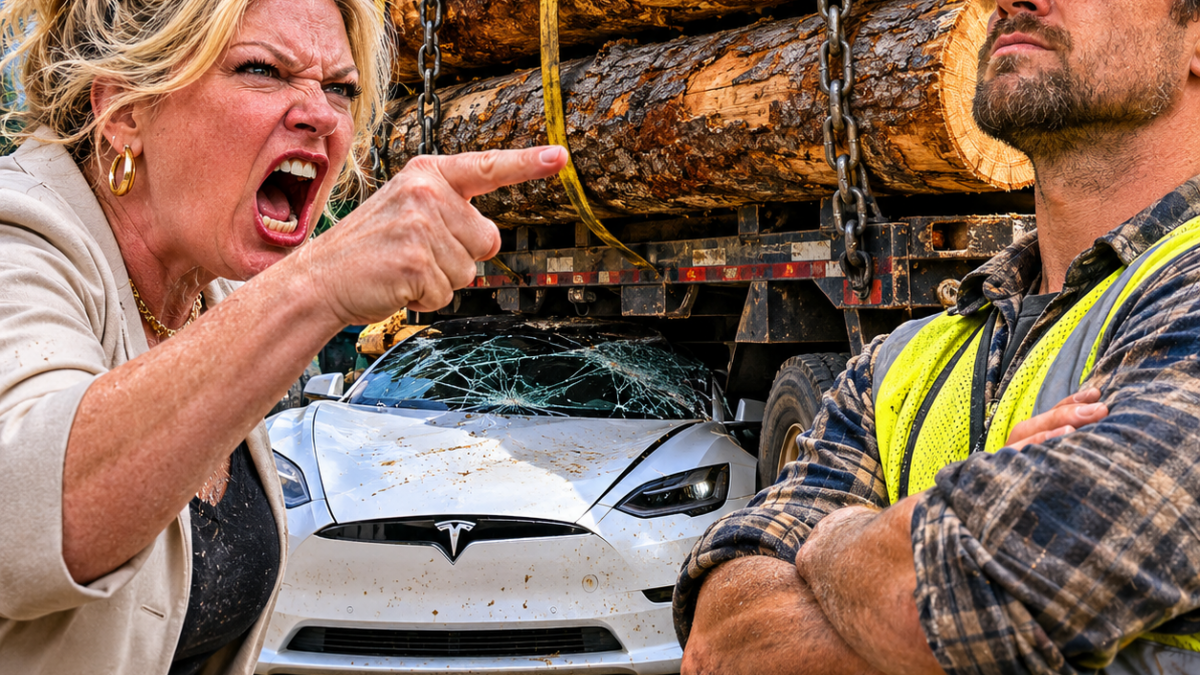
PART 2
The truck moved slowly around the curve, its engine growling beneath the weight of the load.
Even before it reached my property, I could see the driver studying the driveway.
He saw the Tesla.
Then he saw me.
Then he looked at the Tesla again.
I knew that look.
It was the expression of a man who had spent years operating heavy equipment and had developed an instinct for detecting problems before they became expensive.
He stopped in the road, set the brake, and leaned halfway out his window.
“This yours?”
He pointed at the Tesla.
“No.”
“Can it move?”
I looked toward Melissa.
She was still sitting on her porch.
“Yes,” I said. “Technically.”
The driver stared at me.
I walked over.
He climbed down from the cab and looked at the driveway from several angles.
He was probably in his late fifties, weathered face, reflective vest, boots that had seen a thousand muddy construction sites.
He pointed toward the ditch.
“I need to swing the trailer wide here and straighten before I hit your slope. If I come in too sharp, my rear tires get close to that drainage line.”
“I know. That’s why I cleared everything.”
He nodded toward the Tesla.
“Except that.”
“Wasn’t here last night.”
He sighed.
“How long to move it?”
I glanced toward Melissa.
“I’m working on it.”
The driver checked his watch.
“I’ve got one delivery window. If I can’t get into position, dispatch marks it inaccessible.”
I already knew what that meant.
Rescheduling.
Another truck.
Another driver.
Another day.
And another fee.
“How much?”
He gave me a number.
It wasn’t small.
The anger I had been controlling sharpened.
I turned back toward Melissa.
She lifted her coffee cup toward me like we were neighbors enjoying a peaceful morning.
I walked across the gravel.
“Melissa.”
She pretended not to hear me.
“The driver cannot unload while your car is there.”
She looked over the rim of her cup.
“That sounds like your problem.”
“You parked across my driveway.”
“And you created an unreasonable traffic environment.”
“There’s one road.”
“Exactly.”
I stared at her.
There are arguments where both people have a point.
There are arguments caused by misunderstandings.
Then there are arguments where one person has decided that reality itself should rearrange to accommodate them.
This was the third kind.
“Move the car.”
“No.”
“Please move the car.”
“No.”
“The truck leaves if you don’t.”
She shrugged.
“Then reschedule.”
Something inside me became very quiet.
Not explosive.
Not reckless.
Quiet.
That was the moment I stopped trying to convince her.
“Okay.”
She tilted her head.
“Okay what?”
“You told me to move it.”
For the first time that morning, her confidence slipped.
Only slightly.
Her eyebrows rose.
“I was making a point.”
“You said, ‘Move it yourself.’”
“You know what I meant.”
“I know exactly what you said.”
I turned toward the Tesla.
She stood so quickly her chair scraped across the porch.
“Don’t touch my car.”
I stopped.
“You just told me to move it.”
“I did not give you permission to drive it.”
“Then move it yourself.”
“No.”
“Those are your choices.”
She started walking toward me.
“You cannot enter my vehicle.”
I pointed at the driveway beneath it.
“You cannot park your vehicle here and hold my property hostage because you dislike my firewood.”
“That’s not what this is about.”
“What is it about?”
“Respect.”
That almost made me laugh.
“Respect?”
“Yes.”
“You parked your car across my driveway fifteen minutes before a scheduled commercial delivery because you wanted an apology.”
“You’ve been ignoring the concerns of the neighborhood.”
“You mean your concerns.”
“I speak for more people than you realize.”
I looked around.
Curtains moved in two houses.
A garage door across the street was halfway open.
Nobody came out to support her.
“Apparently they’re very shy.”
Her jaw tightened.
I turned toward the Tesla again.
That was when I saw something black lying near the driver’s-side door.
A key fob.
Melissa saw me see it.
Her face changed.
I bent down and picked it up.
The Tesla chirped.
Melissa gasped like I had picked up a loaded weapon.
“Put that down.”
“You dropped it.”
“Give it to me.”
“Absolutely.”
I held it out.
“All you have to do is move your car.”
She walked toward me, stopped, folded her arms again, and refused to take it.
“I am not participating in your intimidation.”
I looked at the key.
Then at her.
Then at the truck.
The driver had both hands on his hips.
I held the fob out one more time.
“Last chance.”
She looked directly at me.
“You wouldn’t dare.”
That sentence made the decision for both of us.
I opened the Tesla.
Melissa screamed.
I wish I could say I felt triumphant.
I didn’t.
Mostly I felt exhausted.
I climbed into the seat and immediately discovered she drove with it positioned so far forward my knees practically touched the steering column.
Behind the glass, Melissa was shouting.
I adjusted the seat.
She slapped the window with the flat of her palm.
“You are stealing my car!”
I lowered the window slightly.
“Your car is ten feet from you.”
“You have no right!”
“You asked me to move it.”
“Not like this!”
“Then tell me what ‘move it yourself’ means.”
She opened her mouth.
Nothing came out.
I raised the window.
The screen in the center of the Tesla glowed like the control panel of a small spaceship.
I had driven plenty of trucks, tractors, trailers, and equipment over the years.
Somehow this silent white car made me more nervous than all of them.
Not because it was difficult.
Because I knew Melissa would treat a speck of dust like evidence at a criminal trial.
I pressed the brake.
Shifted.
The Tesla rolled forward.
Silently.
Melissa followed alongside the car.
“Stop!”
I moved five feet.
“Stop!”
Ten feet.
“Stop!”
I stopped.
The driveway entrance was better, but not clear enough.
The driver walked closer, studied the angle, and shook his head.
“I still can’t get the trailer through.”
Of course.
I looked farther down my driveway.
There was a wider level section near the firewood stacks.
If I moved the Tesla there, the delivery path would be completely clear.
I looked at Melissa.
She was breathing hard.
“Give me the key.”
“Are you going to move it?”
“Yes.”
“Where?”
“Home.”
That meant driving it back across the entrance.
“No.”
She stared at me.
“No?”
“The delivery comes first.”
“You don’t get to decide that.”
“It is literally my driveway.”
Her hands curled into fists.
“Move it back now.”
The driver cleared his throat.
“I really need an answer here.”
I nodded.
“You’ll have it.”
Then I got back into the Tesla.
Melissa stepped in front of it.
I didn’t move.
She stood there, staring through the windshield.
I waited.
She waited.
The driver waited.
Three neighbors were openly watching now.
Finally she stepped aside.
I drove at walking speed.
Ten feet.
Twenty.
Thirty.
I reached the wider section near the stacked wood and parked the Tesla with more care than I had ever used parking my own truck.
Perfectly straight.
Several feet from the lumber.
Clear of the delivery route.
No damage.
No drama.
At least from the car.
I stepped out.
Melissa ran to inspect it.
She looked at the front bumper.
The wheels.
The doors.
The rear quarter panel.
“You almost hit that wood.”
I looked at the gap.
It was wide enough to walk through comfortably.
“No, I didn’t.”
“You could have.”
“I could have been struck by lightning too.”
“That is not funny.”
Behind me, the driver laughed.
Not politely.
A full, sudden laugh.
He tried to disguise it as a cough.
Melissa spun toward him.
“This does not concern you.”
He raised both hands.
“Ma’am, I’m just trying to deliver lumber.”
“Well, your truck is creating a safety hazard.”
He looked at me.
Then at the empty driveway.
Then at her.
“No, ma’am.”
“What?”
“The parked car was the hazard.”
Silence.
For maybe two seconds.
It was wonderful.
Then Melissa started shouting again.
I walked toward the driver.
“You’re clear.”
He nodded.
“Stand back.”
The truck moved.
The engine deepened.
Air brakes hissed.
The driver lined up the trailer, corrected once, then backed into the driveway exactly as planned.
It was almost beautiful.
Years of experience condensed into small movements of a steering wheel.
Trailer left.
Correction.
Straight.
Reverse.
The tires passed the ditch with room to spare.
Melissa stood at the edge of the property looking like she had just watched an invading army cross a border.
Then the unloading began.
Chains rattled.
Hydraulics whined.
Massive bundles of timber shifted from the trailer onto my land.
Forty tons.
I had waited weeks for that material.
I had budgeted for it.
Planned around it.
Organized the next stage of my work around it.
Seeing the first bundle settle safely onto the prepared area brought a wave of relief so strong I almost forgot Melissa was there.
Almost.
“What is all of this?” she shouted.
“Timber.”
“I can see that.”
“Then why’d you ask?”
“This cannot stay here.”
“Yes, it can.”
“This is a residential area.”
“And this is my property.”
“It’s hideous.”
“That’s subjective.”
“It blocks my view.”
“Of what?”
“The street.”
I looked at the street.
“You have windows.”
“You’re being deliberately difficult.”
“No, Melissa. I scheduled a legal delivery to my property. You parked your car across my driveway to interfere with it. Those things are not equivalent.”
She shook her head.
“You always do this.”
“Do what?”
“Make everything sound so reasonable.”
That sentence stayed with me.
Because it told me more than all the yelling had.
She wasn’t angry because I was unreasonable.
She was angry because facts were making it harder for her to control the situation.
The driver finished unloading and handed me the paperwork.
He looked at the timber.
Then at Melissa.
Then back at me.
“Anything else?”
“Hopefully not.”
He grinned.
“Good luck.”
As he climbed into the cab, he leaned down and lowered his voice.
“Does she live here, or does she just haunt the street?”
I laughed before I could stop myself.
Melissa heard.
“What did he say?”
“Have a good morning, Melissa.”
The truck drove away.
For the first time since sunrise, the cul-de-sac became quiet.
Melissa walked toward me.
“Keys.”
I reached into my pocket.
Then stopped.
I don’t know whether that was my smartest moment.
Probably not.
But I was tired of pretending nothing had happened.
“You parked your car across my property and deliberately blocked a commercial delivery.”
“Give me my keys.”
“I will.”
“Now.”
“I want you to understand something first.”
Her eyes widened.
“You are holding my vehicle hostage.”
“Your vehicle is sitting right there.”
“You stole the key.”
“You dropped the key.”
“And took it.”
“After you dared me to move the car.”
Her voice sharpened.
“You cannot keep my property.”
“That part is true.”
I took the fob out.
“But before I hand it over, I want this to be very clear. Do not park across my driveway again.”
“You don’t give me orders.”
“It’s not an order. It’s a boundary.”
She stepped closer.
“Give me the key.”
I held it out.
She snatched it from my hand.
Then she stared at me for a long moment.
“I’m calling the police.”
“Okay.”
She expected something else.
Fear, maybe.
An apology.
Panic.
Instead, I walked over to the lumber and began checking the straps.
Behind me, she pulled out her phone.
And she didn’t simply call the police.
She performed the call.
“My neighbor has taken control of my vehicle without permission.”
Pause.
“Yes, I am afraid.”
Pause.
“Yes, he drove it.”
Pause.
“No, he hasn’t driven away.”
Another pause.
“He kidnapped the car.”
I closed my eyes.
Kidnapped.
The car.
I heard the dispatcher ask something through the speaker.
Melissa answered:
“No, it’s still here.”
Another question.
“No, I don’t think it’s damaged, but that isn’t the point.”
I continued checking the lumber.
About fifteen minutes later, two police vehicles entered the cul-de-sac.
No sirens.
Just lights.
Melissa immediately walked toward them.
The officers barely had their doors open before she began talking.
“He entered my car without consent.”
“He stole my key.”
“He drove it around.”
“He has been intimidating me all morning.”
One officer stayed with her.
The other walked over to me.
He looked at the timber.
Then the Tesla.
Then my driveway.
Then Melissa.
His expression told me this was not the strangest neighbor dispute he had ever seen, but it might qualify for the morning’s top three.
“What happened?”
I told him.
All of it.
I showed him where the Tesla had been parked.
I pointed out the property line.
I explained the scheduled delivery.
The driver’s access requirements.
The rescheduling cost.
Melissa’s refusal.
Her challenge.
The dropped key.
The fact that I had moved the car about thirty feet entirely within my own property.
“Any damage?”
“None.”
“Did you take the vehicle onto the road?”
“No.”
“Did you leave the property?”
“No.”
“Did she see you the whole time?”
“Yes.”
He nodded slowly.
Across the driveway, the second officer was asking Melissa almost the same questions.
“Did he drive the vehicle away from the property?”
“No, but—”
“Did he damage it?”
“That isn’t—”
“Ma’am, did he damage it?”
“No.”
“Did he threaten you?”
“He was intimidating.”
“What did he say?”
“He told me to move my car.”
The officer paused.
“Where was your car?”
Melissa looked toward me.
“In the driveway.”
“Whose driveway?”
Silence.
The officer waited.
“His.”
Even from thirty feet away, I could feel the air change.
The two officers spoke privately for a minute.
Then one approached me.
“No crime here that we can establish.”
Melissa heard him.
“What?”
He turned toward her.
“Your vehicle was moved a short distance from one location on his property to another location on his property. There’s no reported damage. You remained present.”
“He had no permission!”
The officer looked tired.
“I understand.”
“No, you don’t.”
“Ma’am, I’m also going to strongly recommend that you do not park on his property again.”
Her mouth opened.
Closed.
Opened again.
“This is unbelievable.”
The officer nodded toward the Tesla.
“You should move your vehicle back to your property.”
Melissa pointed at me.
“He should apologize.”
The officer looked at me.
I said nothing.
Then he looked back at her.
“Have a good day, ma’am.”
They left.
Melissa stood in the driveway staring after them.
I thought that would be the end.
I was very wrong.
By early afternoon, she returned.
This time she had a folder.
Not a normal folder.
A thick accordion folder bulging with papers, printouts, maps, highlighted sections, photographs, and enough sticky notes to suggest she had spent several hours trying to turn her anger into bureaucracy.
I was measuring a stack when she stopped at the edge of my property.
“You’re in violation.”
I kept measuring.
“Of?”
“Community standards.”
“My property isn’t part of your HOA.”
“That does not mean the HOA is powerless.”
“Yes, Melissa. In relation to my property, that is almost exactly what it means.”
She pulled out a sheet of paper.
“There is a provision concerning aesthetic threats affecting adjacent members.”
“Read it.”
She did.
Slowly.
It referred to conditions on association-controlled common property.
My driveway was not association-controlled common property.
I waited until she finished.
“That doesn’t apply.”
“It establishes a principle.”
“No. It establishes a rule for land your HOA actually controls.”
“You’re twisting the language.”
“I’m reading it.”
She pulled out another page.
“Dangerous debris.”
I looked at forty tons of timber stacked in orderly bundles.
“You think construction lumber is debris?”
“It creates hazards.”
“It’s strapped, blocked, leveled, and stored on gravel.”
“Children could climb on it.”
“Children could climb on your car.”
“That is completely different.”
“Why?”
“Because my vehicle belongs here.”
I stared at her.
The irony landed so perfectly that for a second I thought she had done it intentionally.
She hadn’t.
She started taking photographs.
Wide angles.
Close-ups.
Low shots.
Shots through the fence.
She crouched near the driveway and photographed the gravel under the lumber.
“What are you doing?”
“Documenting.”
“What?”
“Evidence.”
“Of lumber?”
“Of environmental disruption.”
That was the first time she used the phrase.
It wouldn’t be the last.
The next morning, a county inspector arrived.
He was professional, polite, and clearly accustomed to complaints that sounded much more dramatic on paper than they looked in person.
“You the property owner?”
“Yes.”
“We received a concern regarding stored construction materials, access obstruction, and possible grading issues.”
“Come on in.”
I had my paperwork ready.
Permits.
Site information.
Delivery documentation.
He walked the area.
Checked the timber stacks.
Checked setbacks.
Looked at the gravel.
Looked at the drainage.
Asked a few questions.
Then nodded.
“This is organized better than some commercial sites I visit.”
“Thank you.”
That was exactly when Melissa appeared.
Of course it was.
She came out of her house carrying the folder.
“Inspector!”
He turned.
“I’m the person who reported this.”
His expression remained neutral.
“I see.”
She hurried over.
“The photographs don’t capture the full scale.”
“I’ve seen the site.”
“The timber is affecting sunlight.”
He looked toward the sun.
Then toward her house.
“How?”
“It changes the light pattern.”
“Does any material cross your property line?”
“No, but—”
“Does it block access to your property?”
“No.”
“Has there been runoff?”
“I believe the soil has been disturbed.”
The inspector looked down.
At the gravel.
“What disturbance?”
“The weight.”
He crouched.
Touched the surface.
Stood.
“This is an established gravel storage area.”
Melissa looked at me.
“He told you to say that.”
The inspector turned slowly.
“Ma’am, I have never met this man before today.”
“That doesn’t mean—”
“Do you own this parcel?”
“No.”
“Are you an authorized representative of the county?”
“No.”
“Then I need you to let me finish my inspection.”
Melissa’s face tightened.
She stepped back.
The inspector completed his work.
Before leaving, he handed me his card.
“I don’t see a violation.”
“Thank you.”
“If something changes, follow the normal process.”
“I will.”
He lowered his voice slightly.
“This complaint, as presented today, has no substance.”
Melissa heard enough to understand.
As soon as his truck left, she walked toward me.
“You manipulated him.”
“With paperwork?”
“You know people.”
“I don’t know him.”
“You were too prepared.”
I laughed.
That was apparently suspicious now.
“You called an inspector on me. Of course I prepared.”
“You enjoy humiliating me.”
“No.”
I put my measuring tape away.
“I enjoy getting my work done.”
She turned and walked home.
Two hours later, a tow truck arrived.
At first, I thought someone down the street had car trouble.
Then Melissa came outside.
She walked behind the tow truck like a general accompanying armored support.
The driver stepped out.
“Who called?”
“I did.”
Melissa pointed toward my driveway.
“There.”
The driver looked.
At the timber.
At my pickup.
At empty gravel.
“What am I towing?”
“This obstruction.”
He followed her finger.
“The wood?”
“Yes.”
He looked at her.
Then at me.
Then back at her.
“Lady, I tow vehicles.”
“The materials are obstructing safe access.”
“Whose access?”
“The community’s.”
I walked over.
“This is private property.”
The driver looked relieved to hear a normal sentence.
“Is there an illegally parked vehicle?”
“No.”
“Abandoned vehicle?”
“No.”
“Court order?”
“No.”
He turned back to Melissa.
“I can’t help you.”
“You were dispatched.”
“To tow a vehicle.”
“Then tow his truck.”
My truck was legally parked twenty yards away on my land.
The driver frowned.
“Why?”
“It contributes to the obstruction.”
“No.”
She stepped toward him.
“I’m paying.”
“That doesn’t make it legal.”
He climbed back into the tow truck.
Melissa stood in front of the door.
“You cannot just leave.”
He pointed gently toward the side.
“I actually can.”
She moved.
He left.
I should have felt victorious.
Instead, I felt tired.
There is something uniquely draining about conflict with a person who treats every boundary as an invitation to escalate.
A normal disagreement has an end point.
You explain.
They explain.
Maybe nobody changes their mind, but eventually life resumes.
With Melissa, every answer became another opening.
Police disagreed with her?
Then police were incompetent.
The county rejected her complaint?
Then the inspector had been manipulated.
The tow operator refused?
Then the towing company had failed its duty.
Reality kept closing doors.
She kept searching for windows.
That evening I stayed outside later than usual.
The timber needed organizing for the next stages of the project.
I marked pieces.
Checked spacing.
Restacked a few boards.
The repetitive work helped settle my mind.
At one point I glanced toward Melissa’s house.
Her blinds moved.
I saw her face briefly.
Watching.
Not yelling.
Not waving papers.
Just watching.
For some reason, that unsettled me more.
The next morning I found out why.
Engines woke me before my alarm.
Not one engine.
Several.
I pulled on jeans and went outside.
Three trucks were parked near the cul-de-sac.
Two contractors stood beside equipment.
Orange cones had been set out.
There was caution tape.
And in the middle of everything stood Melissa.
She was wearing a reflective safety vest.
It was too large for her.
She had also acquired a whistle.
An actual whistle.
She saw me.
Raised it to her mouth.
Blew.
The sound echoed down the street.
“What is this?” I asked.
She held up a clipboard.
“Emergency community safety operation.”
One contractor looked at the other.
The other looked at me.
“Are you the property owner?”
“Yes.”
Melissa answered at the same time.
“He is the source of the hazard.”
The contractor ignored that.
“Did you authorize site work?”
“No.”
He pointed toward the driveway.
“Is this HOA property?”
“No.”
Melissa interrupted.
“The HOA has community standing.”
The contractor rubbed his forehead.
“Ma’am, you told us we were responding to a dangerous obstruction in a managed common access area.”
“It affects common access.”
“This is his driveway.”
“It affects the visual corridor.”
He stared at her.
“Visual corridor?”
I almost felt sorry for him.
The second contractor began gathering cones.
Melissa noticed.
“What are you doing?”
“We can’t enter private property without authorization.”
“You have my authorization.”
“You don’t own it.”
“I am a neighboring stakeholder.”
“That’s not how this works.”
One by one, the contractors packed up.
Melissa’s face went red.
“You people were hired to resolve a safety concern.”
“We were hired based on information that appears to have been inaccurate.”
“That is insulting.”
“No,” the contractor said. “That is why we’re leaving.”
He drove away.
The other truck followed.
Then the third.
Within minutes, the emergency community safety operation consisted of Melissa, six abandoned cones, a roll of caution tape, and one oversized reflective vest.
I stood near the edge of the driveway.
She stared at me.
“You’re enjoying this.”
“No.”
“You are.”
“I want you to go home.”
“You want to win.”
“There shouldn’t be anything to win.”
“You’ve made me look insane.”
Those words came out lower than the others.
Less angry.
More personal.
I studied her face.
“No, Melissa.”
I chose my next words carefully.
“I haven’t made you look like anything.”
She flinched.
Then anger returned.
She grabbed the caution tape.
“What are you doing?”
“If no one else will protect the neighborhood, I will.”
She marched toward my driveway.
“Melissa.”
She crossed the property line.
“Stop.”
She ignored me.
She wrapped the tape around one post.
Then walked toward the timber.
“Get off my property.”
“This area needs to be marked.”
“No, it doesn’t.”
“You don’t determine safety.”
“On my own project, following the county-approved requirements? Yes. I have more authority than you do.”
She pulled the tape tight.
I walked toward her but stopped several feet away.
I had no intention of touching her.
“Melissa, leave.”
She stepped backward.
Her heel caught the edge of loose gravel.
Her arms flew outward.
For one horrible second, everything slowed.
She stumbled sideways into the nearest timber stack.
A heavy wooden thud cracked through the quiet street.
The stack shifted.
Not much.
Barely an inch.
But forty tons of lumber teaches you to respect inches.
Melissa froze.
So did I.
The tape slipped from her hand.
Neither of us spoke.
Her eyes moved upward.
For the first time since this whole thing began, I saw something genuine on her face.
Fear.
Not outrage pretending to be fear.
Not performance.
Real fear.
The realization of what might have happened.
The timber had been blocked and secured properly.
The stack wasn’t going anywhere.
But she hadn’t known that in the instant she hit it.
For half a second, she had believed it could come down.
She slowly stepped away.
Her hands shook.
I walked to the stack and checked it.
Everything held.
I let out the breath I had been holding.
“You could have been hurt.”
She didn’t answer.
“Do you understand that?”
Her eyes stayed on the timber.
“I was trying to make it safer.”
“No.”
She looked at me.
“No?”
“You were trying to prove you were right.”
Her expression hardened automatically, but only for a moment.
Then it collapsed.
The anger left her face.
Not dramatically.
It simply drained away.
She suddenly looked tired.
Older.
Smaller inside the oversized safety vest.
“I just wanted the neighborhood to stay nice,” she whispered.
I stared at her.
That was the first honest sentence I had heard from her in days.
Maybe since we met.
“I believe you.”
She looked surprised.
I continued.
“But wanting something good doesn’t make everything you do to get it good.”
Her eyes dropped.
“You moved here because you liked the neighborhood,” I said. “I understand that. I like it too.”
“You don’t care what it looks like.”
“That’s not true.”
I pointed toward the timber.
“Do you think I spent hours leveling those stacks because I don’t care? Do you think I measure the drainage, clean the driveway, maintain the fence, keep the site organized because I don’t care?”
She said nothing.
“You decided that because I didn’t want the exact same thing you wanted, I must not care at all.”
She pulled the vest closed around herself.
“The wood is ugly.”
I almost smiled.
“That’s okay.”
Her head lifted.
“What?”
“You can think it’s ugly.”
She stared at me.
“You’re allowed to hate it.”
“I am?”
“Yes. You can hate my lumber. You can hate my truck. You can hate my driveway. You can stand inside your house every morning and give them all dirty looks.”
Despite herself, her mouth twitched.
“But what you can’t do,” I continued, “is park on my property to stop my deliveries. You can’t invent authority you don’t have. You can’t call people out here under false pretenses. And you definitely can’t walk onto an active work area and wrap caution tape around things because you decided you’re in charge.”
Her eyes dropped again.
I pointed to the timber stack she had hit.
“You came closer to creating a safety problem today than anything you’ve complained about.”
That landed.
I saw it.
Her shoulders lowered.
“I didn’t mean to.”
“I know.”
“I could have…”
“Yes.”
She swallowed.
We stood there quietly.
Somewhere down the street, a garage door opened.
A dog barked.
For the first time in days, the neighborhood sounded ordinary.
Melissa looked toward her house.
Then back at me.
“You embarrassed me.”
I nodded.
“I’m sure it felt that way.”
“You laughed.”
“The truck driver made a joke.”
“You laughed.”
“Yes.”
She waited.
I could have apologized.
Part of me wanted to.
Not because I thought I had done something terrible.
Because I was tired.
Because apologizing might make everything disappear.
But then I remembered the Tesla.
The police.
The county inspector.
The tow truck.
The contractors.
The caution tape at my feet.
An apology offered just to end pressure isn’t peace.
Sometimes it’s permission for the same thing to happen again.
“I’m not sorry I protected my property,” I said.
Her jaw tightened.
“But I’m not interested in humiliating you either.”
She looked at me carefully.
“What do you want?”
“Nothing.”
“That’s impossible.”
“No.”
I pointed toward her house.
“I want you to live over there.”
Then I pointed toward mine.
“And I’ll live over here.”
She stared.
“No war. No complaints invented to punish each other. No blocking driveways. No emergency operations.”
Her face flushed slightly.
“That sounds ridiculous when you say it like that.”
“It was ridiculous while it was happening too.”
She almost smiled again.
Almost.
Then her expression changed.
“What about the HOA?”
“What about it?”
“I filed additional complaints.”
I closed my eyes briefly.
“Of course you did.”
“They’re coming this afternoon.”
I looked at her.
“You invited more people?”
“They said they would review the visual impact from the sidewalk.”
I rubbed my forehead.
For several seconds, neither of us spoke.
Then I laughed.
Not at her.
At the sheer absurdity of it.
“What?”
I looked at her.
“Melissa, five minutes ago you nearly fell into forty tons of lumber.”
“I know.”
“And your next sentence is that the HOA is coming to evaluate visual impact.”
Her shoulders slumped.
“When you put it that way…”
“I am begging you to hear how this sounds.”
She glanced toward her house.
“I can cancel.”
“That would be fantastic.”
She hesitated.
“But I already told them it was urgent.”
“Tell them it isn’t.”
“That will make me look foolish.”
There it was.
The center of everything.
Not lumber.
Not property values.
Not safety.
Pride.
I looked at her.
“Maybe being willing to look foolish for five minutes is better than spending another week trying to prove you weren’t.”
She didn’t answer.
Then she walked home.
I watched her go.
I honestly thought the HOA visit might be canceled.
It wasn’t.
At three o’clock, two board members appeared on the sidewalk with Melissa.
She had changed out of the safety vest.
Thank God for small victories.
One board member was an older man named Richard.
The other was a woman holding a clipboard.
Neither looked enthusiastic.
Melissa began speaking before they stopped walking.
“The storage situation has created visual distress throughout the adjacent residential corridor.”
Richard looked toward my property.
The lumber was stacked neatly in the same location it had occupied during the county inspection.
He looked at me.
“Afternoon.”
“Afternoon.”
Melissa pointed.
“You can see how the scale overwhelms the street.”
Richard cleared his throat.
“Melissa, we talked about jurisdiction before coming.”
“I understand jurisdiction.”
I doubted that.
“But community wellbeing transcends jurisdiction.”
The woman with the clipboard looked down very quickly.
I suspected she was hiding a smile.
Richard continued.
“This property is not within the association.”
“It is adjacent.”
“Yes.”
“Therefore visible.”
“Yes.”
“Therefore impactful.”
“Possibly.”
Melissa brightened.
Richard raised a hand.
“But impact does not equal authority.”
Her expression dropped.
He turned toward me.
“From the sidewalk, I don’t see an HOA matter.”
“Thank you.”
Melissa stepped forward.
“What about noise?”
Richard looked around.
There was no noise.
“What noise?”
“The delivery.”
“When?”
“Two days ago.”
“How long?”
She hesitated.
“Maybe forty minutes.”
Richard nodded.
“During daytime hours?”
“Yes.”
“Okay.”
“And psychological discomfort.”
The clipboard woman finally looked up.
“Whose?”
“Mine.”
There was a pause.
Richard rubbed the side of his face.
“Melissa, we cannot issue a violation against a non-member property because you dislike seeing construction material.”
“It affects neighborhood harmony.”
“We have no authority here.”
“You have a responsibility.”
“Our responsibility is to properties governed by the association.”
“You are abandoning the community.”
“No.”
“You’re siding with him.”
“I’m siding with the documents.”
I knew exactly how Richard felt.
Melissa’s voice rose.
“You all keep hiding behind technicalities.”
Richard’s expression changed.
For the first time, he sounded firm.
“Property boundaries are not technicalities.”
Melissa went silent.
He nodded politely to me.
“Sorry for the interruption.”
“No problem.”
The two board members walked away.
Melissa remained on the sidewalk.
She watched them go.
Then she turned toward me.
Something hollow appeared in her expression.
Not rage.
Not even embarrassment.
Defeat.
“You made everyone think I’m crazy.”
I put down the pencil in my hand.
“No.”
“You did.”
“You called them.”
“You could have agreed with me.”
“About what?”
“That this neighborhood should have standards.”
“It does.”
“Then why won’t you admit I’m right?”
“Because this was never really about standards.”
Her eyes narrowed.
“What is that supposed to mean?”
“It means if the lumber disappeared tomorrow, you’d find something else.”
Her face changed.
“That’s not true.”
“You started with my firewood.”
Silence.
“Then the driveway.”
More silence.
“Then the timber.”
I looked at her.
“Then the inspector. Then the tow truck. Then the contractors. Now the HOA.”
She opened her mouth.
I shook my head.
“This isn’t about fixing a problem anymore. It’s about getting someone, anyone, to tell you that you won.”
She went completely still.
That was the harshest thing I had said to her.
For a second, I regretted it.
Then she whispered:
“You think you won?”
“No.”
She looked surprised.
“I think I lost three days of my life arguing about whether you can park on someone else’s driveway.”
That took some of the fight out of her.
“I don’t feel like a winner.”
She looked toward the lumber.
Neither of us spoke for a while.
Then she went home.
An hour later, my phone buzzed.
County notice.
Another formal complaint.
I stared at the screen.
I actually laughed.
Not because it was funny.
Because sometimes exhaustion turns into laughter when the alternative is throwing your phone into a ditch.
The complaint included concerns about soil instability, chemical fumes, drainage alteration, visual obstruction, and unauthorized material storage.
Chemical fumes.
From lumber.
The county inspector returned the next day.
It was the same man.
When he stepped out of his truck and saw me, he stopped.
“You again.”
“Apparently.”
He held up his tablet.
“I was hoping the computer duplicated something.”
“Nope.”
He looked toward Melissa’s house.
“Same complainant?”
I said nothing.
He nodded.
“Right.”
I had the paperwork ready again.
He barely needed it.
He walked the site.
Checked the same areas.
Looked beneath the stacks.
Checked runoff.
Then he sniffed the air.
I smiled.
He looked at me.
“Fumes.”
“I figured.”
He shook his head.
Melissa came outside.
I almost admired her consistency.
“You need to check beneath the lower stacks,” she called.
“I have.”
“What about contamination?”
“From what?”
“Treatment chemicals.”
The inspector looked at the markings on the lumber.
Then at the documentation.
Then at her.
“Ma’am, there is no indication of a contamination issue.”
“You don’t know that.”
“I do know what materials I’m looking at.”
“Then test the soil.”
“On what basis?”
“My complaint.”
“A complaint is not evidence.”
She pointed at me.
“He’s influencing you again.”
The inspector turned.
His patience was gone.
“I am going to be very clear.”
Melissa stopped.
“This property is in compliance with the matters I have inspected. The storage is orderly. I have observed no drainage violation. No dangerous debris. No unlawful grading. No evidence supporting the environmental claims in this complaint.”
Melissa crossed her arms.
“So you refuse to investigate.”
“I am currently standing here investigating.”
“That isn’t what I mean.”
“I know.”
He typed something into his tablet.
“Case closed unless conditions materially change.”
Then he left.
Melissa remained beside the road.
She didn’t yell.
She didn’t accuse me again.
She simply stared at the driveway.
That afternoon, another tow truck appeared.
I walked outside.
The driver stopped, read something on his phone, looked at the lumber, looked at me, and immediately said:
“Oh, no.”
I laughed.
“You already figured it out?”
He held up the work order.
“Caller reported an abandoned obstruction blocking vehicle access.”
Melissa came outside.
“There.”
The driver pointed toward the timber.
“That’s not a vehicle.”
“It is the obstruction.”
“I’m not towing forty tons of lumber.”
“It must be removed.”
“Then call a construction company.”
“I did.”
I looked at her.
She looked away.
The driver handed her something.
“I’m closing this call.”
“You can’t.”
“I can.”
“You people are unbelievable.”
He climbed back into the truck.
Before pulling away, he rolled down his window.
He looked at me.
“You have interesting neighbors.”
“One in particular.”
He drove off.
That evening, there were no more complaints.
No officials.
No tow trucks.
No contractors.
No speeches.
The next morning was quiet too.
Then another.
Then another.
I started to believe the whole thing had finally burned itself out.
Work resumed.
The timber slowly stopped looking like an invading wall and started becoming what it had always been meant to become: material.
Boards moved.
Stacks shrank.
Cut pieces were organized.
The driveway returned to normal.
For the first time in a week, I drank my morning coffee outside without checking the street for government vehicles.
Melissa kept to herself.
When she drove past, she stayed well away from my driveway.
When I saw her outside, she didn’t wave.
I didn’t wave either.
We existed.
That was enough.
About a week later, I was carrying offcuts toward the storage area when I heard her voice.
“Hey.”
I stopped.
Melissa stood near the property line.
No folder.
No clipboard.
No reflective vest.
No phone held up like she was collecting evidence.
Just Melissa.
“Hey.”
She looked at the lumber.
“There’s less of it.”
“That usually happens when you build with it.”
She looked mildly irritated.
Then, surprisingly, she smiled.
A very small smile.
“I suppose.”
I waited.
She rubbed one hand over the opposite wrist.
“I wanted to ask something.”
“Okay.”
“Is it safe?”
“The lumber?”
“Yes.”
“It’s blocked and stacked properly.”
“No. I mean the project.”
I studied her face.
“What are you asking?”
She looked embarrassed.
“I kept telling everyone it was dangerous.”
“Yes.”
“And I realized…”
She stopped.
I waited.
She looked toward the place where she had tripped.
“I didn’t actually know anything about it.”
That was probably as close to an apology as Melissa knew how to get.
“You could have asked.”
“I know.”
I leaned against the fence.
She looked toward her house.
“When I bought that place, everything looked perfect.”
There was that word again.
Perfect.
“I liked that nothing changed.”
“Things change.”
“I know.”
She didn’t sound convinced.
“My old neighborhood changed very fast.”
I said nothing.
She continued.
“People stopped taking care of things. Houses got neglected. Cars stayed on lawns. Fences broke. Nobody cared.”
I began to understand.
Not excuse.
Understand.
“So when you started getting deliveries…”
“You thought this was the beginning of that.”
She nodded.
“I thought if I didn’t stop the first thing, there would be another thing. Then another.”
“There was another thing.”
“What?”
“Forty tons of timber.”
She rolled her eyes.
I smiled.
She almost smiled back.
Then I became serious again.
“You know what went wrong, though?”
She nodded slowly.
“I went too far.”
“Way too far.”
“You don’t need to enjoy saying it.”
“I didn’t say I enjoyed it.”
“You looked like you enjoyed it.”
“Maybe a little.”
She laughed once.
It surprised both of us.
Then she looked down.
“I shouldn’t have parked there.”
“No.”
“And I shouldn’t have called the tow companies.”
“No.”
“Or the contractors.”
“Definitely not.”
She sighed.
“You’re going to make me say all of it?”
“No.”
I straightened.
“You don’t owe me a performance.”
Her eyes met mine.
“I just need it not to happen again.”
“It won’t.”
I believed she meant it.
Still, I needed one more thing said.
“And if you’re worried about something?”
“I ask.”
“Yes.”
“And if I don’t like your answer?”
“You can dislike it.”
She frowned.
“That’s annoying.”
“Boundaries usually are when they’re working.”
She shook her head.
Then she turned to leave.
“Melissa.”
She looked back.
“For what it’s worth, I understand wanting to protect the place you live.”
Her expression softened.
“But?”
“But protection without limits turns into control.”
She nodded.
Then she looked toward the spot where her Tesla had first blocked my driveway.
“I really did make a mess of this.”
“Yes.”
She sighed.
“You’re terrible at comforting people.”
“I’m excellent at stacking lumber.”
That time she actually laughed.
Then she went home.
Over the next several weeks, the strangest thing happened.
Nothing.
No drama.
No officials.
No emergency operations.
No Tesla blocking my driveway.
Normality returned so quietly I almost didn’t notice it.
And maybe that was the real revenge.
Not damaging her car.
Not embarrassing her publicly.
Not screaming louder.
Not trying to make her miserable.
I had thought, during the worst of it, that satisfaction would come from some dramatic moment where she finally lost and I finally won.
But it didn’t.
The satisfying part was much simpler.
She could not bully me into giving up my boundary.
Every authority she tried to weaponize had looked at the facts.
The police.
The county.
The HOA.
The tow drivers.
The contractors.
One after another, reality had told her the same thing I had told her that first morning:
You do not own this space.
And eventually, she heard it.
A month after the Tesla incident, I was outside early with coffee again.
Same driveway.
Same fence.
Same cul-de-sac.
The massive timber piles were mostly gone now.
The material had been measured, cut, moved, and used.
A few organized stacks remained.
Melissa’s Tesla came down the street.
I watched it approach.
For half a second, I wondered if she might stop.
She slowed near my driveway.
Then continued.
Straight into her own.
Perfectly parked.
I smiled into my coffee.
A few minutes later, her door opened.
Melissa stepped out.
She looked toward me.
Then toward the remaining lumber.
Then back at me.
“Looks better.”
I laughed.
“You couldn’t help yourself, could you?”
She smiled.
“No.”
“Morning, Melissa.”
“Morning.”
She started toward her house.
Then turned.
“Hey.”
“What?”
“If I ever park across your driveway again…”
I raised an eyebrow.
She pointed at me.
“Don’t touch my Tesla.”
I stared at her.
She held the serious expression for maybe two seconds.
Then she laughed.
I laughed too.
“Then don’t dare me.”
She shook her head and went inside.
And that was it.
No final explosion.
No courtroom.
No dramatic neighborhood meeting.
No revenge fantasy where somebody loses their house or gets dragged away in handcuffs.
Just a line that finally stayed where it belonged.
People sometimes imagine revenge as destroying the person who caused the problem.
I learned something different.
Sometimes the most satisfying revenge is refusing to become the villain they need you to be.
Melissa wanted me angry.
She wanted me reckless.
She wanted me to damage her Tesla, threaten her, lose control, or give her one real reason to turn her story into the truth.
I never gave her one.
I moved the car carefully.
I kept my paperwork.
I followed the rules.
I let the police ask their questions.
I let the inspector inspect.
I let the HOA read its own boundaries.
I let tow drivers make their own decisions.
I let contractors discover who actually owned the property.
Again and again, she tried to turn her feelings into facts.
Again and again, facts refused to cooperate.
And in the end, that did more than yelling ever could.
I still think about the moment she hit that timber stack.
Not because I enjoyed seeing her scared.
I didn’t.
That was the moment the entire conflict stopped being entertainment.
For days, she had talked about danger as an idea.
A weapon.
A word she could put into complaints.
Then suddenly she felt what danger actually was.
Heavy wood.
Loose footing.
A bad decision.
A consequence that did not care who believed they were right.
For one second, none of us were neighbors arguing over property lines.
We were just two human beings staring at what almost happened.
And maybe that was what finally reached her.
Not the police.
Not the county.
Not the HOA.
Not me.
Reality.
Months later, the cul-de-sac looked exactly as quiet as it had before the morning of the Tesla.
Maybe quieter.
People still drove too fast occasionally.
Dogs still barked.
Trash cans still stayed at the curb longer than they should.
Lawns were never exactly the same shade of green.
Someone painted a front door a color Melissa probably hated.
Life continued.
Imperfectly.
And that turned out to be fine.
My firewood stack is still beside the fence.
Melissa still doesn’t like it.
I know because once, when we were both collecting mail, she looked at it and shook her head.
“That thing is never going away, is it?”
“Nope.”
“It’s ugly.”
“I know you think so.”
She sighed.
Then she walked home.
No complaint.
No folder.
No inspector.
Just an opinion.
And I realized something as I watched her leave.
That was the version of Melissa I could live next to.
She didn’t have to agree with me.
She didn’t have to like my property.
She didn’t even have to like me.
Neighbors aren’t required to become friends.
They’re required to understand where their rights end and someone else’s begin.
That morning with the Tesla, Melissa believed every inconvenience gave her authority.
By the end, she had learned that discomfort was not the same thing as danger.
Disagreement was not disrespect.
And seeing something from your window did not make it yours to control.
As for me, I learned something too.
Patience is powerful.
But patience without boundaries becomes surrender.
I had spent too much of that first morning trying to explain myself because I believed enough reason would eventually produce a reasonable response.
Sometimes it does.
Sometimes it doesn’t.
Sometimes you explain once.
Then twice.
And after that, you stop negotiating the existence of your own driveway.
I don’t regret asking Melissa politely.
I don’t regret giving her chances.
And no, I don’t regret moving the Tesla.
Would I handle the key differently if the same thing happened today?
Probably.
I’d document everything first and call the appropriate people sooner.
Not because I think she was right.
Because when someone is desperate to turn you into the villain, you should never give them ambiguity they can use.
But I also know this:
If I had backed down completely that morning—if I had paid the rescheduling fee, sent forty tons of timber away, and allowed her to discover that blocking my driveway gave her control—the problem would not have ended.
It would have grown.
The next complaint would have been easier.
The next boundary would have been smaller.
The next demand would have arrived faster.
People learn how far they can push you by what happens when they push.
Melissa pushed.
The boundary held.
And eventually, she stopped.
That is why, whenever I hear a diesel truck now, I sometimes remember that morning.
The coffee.
The white Tesla.
Melissa’s sunglasses.
Her arms folded.
That smug little smile when she told me to move the car myself.
I remember standing there with no idea how ridiculous the next few days were about to become.
Police.
Inspectors.
Tow trucks.
Contractors.
Caution tape.
Forty tons of lumber.
All because one neighbor decided she had the right to control something simply because she could see it.
And I remember the final lesson better than everything else.
The best revenge wasn’t what I did to Melissa.
It was what I refused to let her do to me.
She didn’t get my anger.
She didn’t get my surrender.
She didn’t get control of my property.
And in the end, she didn’t even get the perfect neighborhood she thought she was fighting for.
She got something better.
A real one.
One where people disagreed.
One where things changed.
One where lumber arrived.
One where firewood could be ugly.
One where neighbors could annoy each other and still say good morning.
One where nobody needed permission to exist inside their own boundaries.
And every once in a while, when Melissa’s Tesla passes my driveway without stopping, I still smile.
Not because I beat her.
Because she finally learned where to park.








