PART 2: She Cried With Every Step—Then We Found What Someone Had Buried Inside Her
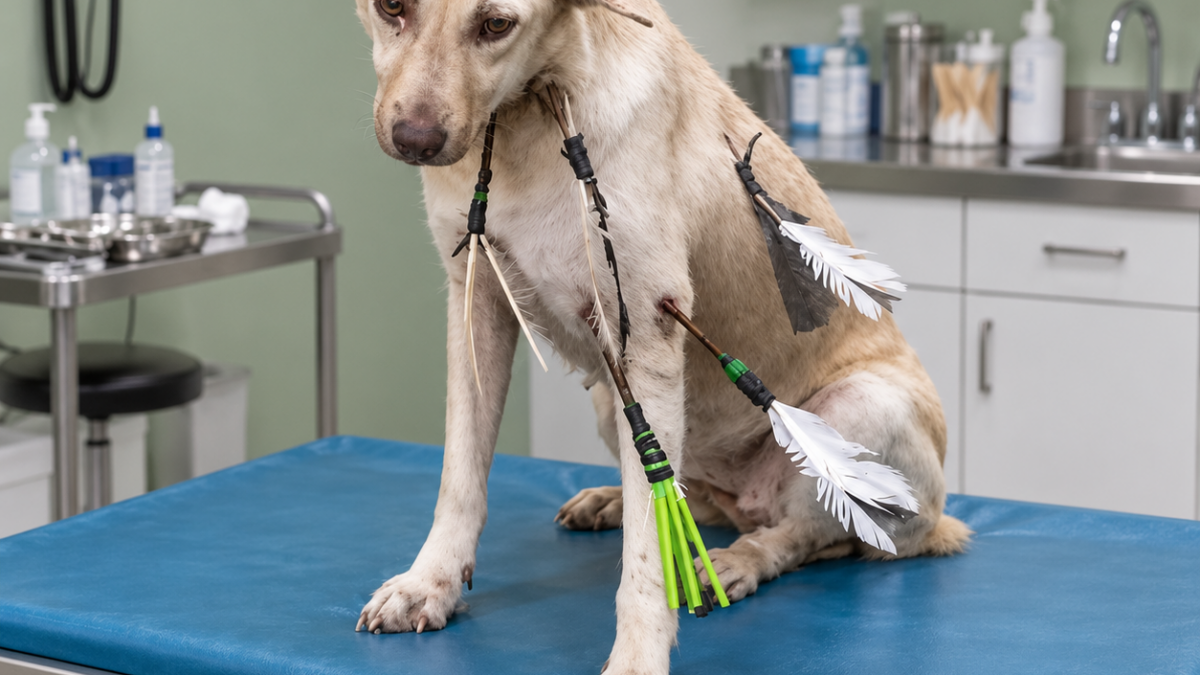
PART 2
“I’m sure of it,” Daniel said.
Dr. Moreno looked up from the X-rays.
“Sure of what?”
“That orange material.” He pointed carefully, without touching the dart. “I saw a dart with the same thing wrapped around it behind the warehouse maybe two weeks ago.”
“Where exactly?” I asked.
“Back fence. Near the loading dock.”
I stared at him.
“What did you do with it?”
“I pulled it out of the fence post.”
“And?”
He swallowed.
“I threw it away.”
For a second I wanted to yell.
Not because Daniel had done anything wrong. At the time it had been a piece of junk stuck in an old board. He had no reason to think it mattered.
But now four similar objects were buried in a dog.
Dr. Moreno brought us back to what mattered most.
“Whatever happened outside can wait. She can’t.”
Tiktok was beginning to shiver despite the warming blanket.
Her gums were pale.
She was dehydrated.
Pain had exhausted her body.
The veterinary team placed an IV catheter and started fluids. They gave her pain medication slowly, monitoring her breathing and heart rate.
Even then, Tiktok watched every hand.
Not with aggression.
With uncertainty.
That hurt me more.
A dog who has been hurt by people usually learns one of two things.
Some become defensive.
Some shut down.
Tiktok seemed caught between the two.
She expected pain, but she still wanted to believe kindness was possible.
I crouched beside the table.
“You don’t have to decide whether you trust us yet,” I whispered. “Just stay.”
Her eyes followed me.
That was enough.
An animal-control officer arrived before surgery began.
His name was Marcus Reed.
He had worked cruelty investigations for more than a decade, and he had the patient, careful manner of someone who knew anger could ruin evidence.
He photographed the darts exactly where they were.
He photographed Tiktok’s wounds.
He photographed her body condition.
Then he asked us not to remove or discard anything without documenting it.
Dr. Moreno nodded.
“Anything we remove will be preserved.”
Marcus turned to Daniel.
“Tell me exactly what you saw at the warehouse.”
Daniel described the dart in the fence.
“How long ago?”
“Maybe twelve days. Two weeks at most.”
“What did it look like?”
“Thin metal shaft. Orange tape or feathers near the back.”
“Length?”
Daniel held his hands apart.
Marcus wrote everything down.
I interrupted.
“Do you think somebody was shooting at her?”
Marcus closed his notebook.
“I think we have a dog with multiple penetrating injuries caused by objects that don’t belong inside an animal.”
“That wasn’t my question.”
“No.”
His voice stayed calm.
“Because right now I don’t know the answer.”
I hated that answer.
But I respected him for giving it.
He looked through the glass at Tiktok.
“We investigate what we can prove.”
I nodded.
“Then prove it.”
“I’ll try.”
The surgical team took Tiktok into the operating room shortly after ten that night.
I stayed.
Daniel stayed.
Neither of us discussed going home.
The first dart came out at 11:36 p.m.
A veterinary technician brought it through the doors sealed inside a sterile specimen container.
It was longer than I expected.
Seeing it outside Tiktok’s body made me sick.
The second dart came out twenty-eight minutes later.
The third required a larger incision because tissue had begun swelling tightly around the shaft.
The fourth was the dangerous one.
It had entered near the shoulder at an angle.
Dr. Moreno later explained that a careless attempt to pull it backward might have caused significantly more damage.
So they opened the tissue around it.
Slowly.
Millimeter by millimeter.
At 2:41 in the morning, the operating-room door finally opened.
Dr. Moreno came out still wearing her surgical cap.
“All four are removed.”
I stood so quickly my knees nearly hit the coffee table.
“Is she okay?”
“She’s stable.”
“Any nerve damage?”
“Nothing obvious.”
I closed my eyes.
Daniel put one hand on my shoulder.
Dr. Moreno continued.
“She’s going to be sore. Very sore. There was inflammation around two of the wounds, which tells me these objects had probably been inside her for a while.”
“How long?”
“I can’t give you an exact number. More than a few hours. Possibly days.”
Days.
I pictured Tiktok beneath the sunset again.
One step.
A cry.
One step.
A cry.
That had not been the beginning of her pain.
It had merely been the first moment we witnessed it.
“How did she keep moving?” I asked.
Dr. Moreno looked tired.
“Animals can endure an extraordinary amount when survival gives them no alternative.”
I looked through the window.
Tiktok was still unconscious.
Wrapped in blankets.
Bandaged.
Alive.
“That shouldn’t have been necessary.”
“No,” Dr. Moreno said.
“It shouldn’t.”
Marcus returned before sunrise to collect the darts.
Each was photographed, labeled and placed into evidence packaging.
The orange wrapping on the ends was visible on three of them.
One had partially broken off.
“What are they?” I asked.
Marcus examined one through the plastic.
“Probably blowgun darts.”
“People still use blowguns?”
“For target shooting, yes. They’re legal in a lot of places depending on the type and local law.”
I stared at the bag.
“For target shooting.”
“Yes.”
“That doesn’t look like a target.”
I nodded toward Tiktok’s kennel.
Marcus didn’t respond immediately.
“No,” he said finally. “It doesn’t.”
He asked Daniel to drive him to the warehouse after daylight.
I wanted to go.
Marcus refused.
“You have a dog waking from surgery.”
“That’s exactly why I want to go.”
“That’s exactly why you shouldn’t.”
I folded my arms.
“You always this irritating?”
“Usually.”
Daniel almost smiled.
Marcus continued.
“Let me look at the location before thirty angry people hear about this and start walking through whatever evidence may still exist.”
He was right.
Again, I hated it.
Again, I listened.
Tiktok woke around seven in the morning.
I had fallen asleep sitting upright in a chair beside her kennel.
A faint whimper pulled me awake.
Her eyes were open.
Cloudy from medication.
Confused.
I moved closer.
“Hey.”
Her ears shifted.
“It’s me.”
She tried to lift her head.
“Don’t.”
She lowered it again.
The expression in her eyes was different from the night before.
Still frightened.
Still tired.
But the constant physical panic had eased.
The darts were gone.
The pain remained, but the things causing the deepest agony were no longer inside her.
A technician brought a spoonful of soft food.
Tiktok sniffed it and turned away.
“That’s okay,” I said.
An hour later I offered her a tiny amount from my fingers.
She hesitated.
Then took it.
One bite.
Another.
Then a third.
It felt ridiculous to become emotional over three mouthfuls of canned food.
But rescue teaches you that victories are measured differently.
A dog eating can be a victory.
A dog sleeping can be a victory.
A tail moving once can be a victory.
Tiktok finished the food on my fingers and licked my thumb.
I smiled.
“Good girl.”
Her eyes closed again.
Marcus called that afternoon.
The warehouse still operated as a storage facility, but most of the rear property was unused.
A manager allowed investigators to inspect the fence.
Daniel found the section where he remembered seeing the dart.
The hole was still there.
More importantly, the warehouse had security cameras.
“You’re joking,” I said.
“I don’t joke much.”
“Can you see what happened?”
“We haven’t reviewed everything yet.”
“When will you?”
“Mara.”
I knew that tone.
“Fine.”
“I’ll call when we know something.”
I hung up frustrated.
Then I looked through the glass.
Tiktok was sleeping.
I reminded myself that she did not need my anger.
She needed my patience.
The first two days after surgery were difficult.
Her temperature rose.
One wound drained more than Dr. Moreno liked.
Antibiotics were adjusted.
She needed fluids.
Pain medication made her sleepy.
The first time she tried to stand, her legs shook so badly she collapsed back onto the blanket.
I reached for her instinctively.
She flinched.
My hand stopped.
“Sorry.”
I moved back.
Tiktok stared at me.
A few seconds later, she leaned forward and touched my hand with her nose.
I swallowed.
“Okay. We go slow.”
That became our rule.
Slow.
On the third morning she stood again.
This time she stayed upright.
A technician named Jules supported her with a towel sling beneath her belly.
“One step,” Jules said.
Tiktok moved her front paw.
Then the back.
No cry.
I felt my throat tighten.
Another step.
Still no cry.
“That’s it,” I whispered.
Tiktok took four steps before stopping.
Then something happened none of us expected.
Her tail moved.
Just once.
A tiny sweep.
Jules looked at me.
“Did you see that?”
“I saw it.”
The tail moved again.
That was the moment I knew the dog who had come to us was still in there.
Fear had not swallowed everything.
Pain had not taken everything.
Cruelty had not finished the job.
I went into the hallway because I didn’t want the staff watching me cry.
Daniel found me there.
“You okay?”
“She wagged.”
He waited.
“That’s why you’re crying?”
“Yes.”
He nodded solemnly.
“Understandable.”
“Don’t make fun of me.”
“I would never.”
“You absolutely would.”
He smiled.
“Maybe tomorrow.”
By Day Four, Tiktok was eating full meals.
By Day Five, she could walk the entire length of the recovery hallway.
Slowly.
Carefully.
But without crying.
The sound of her footsteps changed me.
The first night, every step had been followed by pain.
Now there was only the soft click of nails against tile.
Click.
Click.
Click.
Ordinary.
I had never been so grateful for ordinary.
Marcus came to the clinic that afternoon.
He didn’t call first.
I knew immediately he had something.
“What did you find?”
He glanced toward the recovery room.
“How is she?”
“Better. Don’t change the subject.”
He sat.
“The warehouse cameras recorded a dark pickup arriving behind the building several times over the last month.”
“And?”
“And one recording shows a man near the back fence holding what appears to be a blowgun.”
My hands went cold.
“Can you see his face?”
“Not clearly.”
“Then what good is it?”
“We can see the truck.”
“Plate?”
“Partial.”
I leaned forward.
“And he was shooting?”
“The footage shows him raising the object and firing toward something outside the camera angle.”
“Tiktok?”
“We don’t know.”
“Marcus.”
“We don’t know.”
His voice became firmer.
“If we start calling a possibility a fact, we hand a defense attorney exactly what he needs later.”
I leaned back.
He was right.
“I hate this.”
“That’s normal.”
“Do you?”
He looked toward Tiktok.
“Yes.”
That answer surprised me.
Marcus rarely allowed emotion into his voice.
Then he continued.
“We’re checking registered vehicles that match the visible plate characters.”
“How many?”
“More than one.”
“Nearby?”
“Yes.”
He stood.
“There’s something else.”
“What?”
“We found another dart.”
My stomach tightened.
“Where?”
“In the dirt near the fence.”
“Same orange wrapping?”
“Yes.”
“Blood?”
“Don’t know yet.”
I looked through the glass.
Tiktok was lying with her chin on her paws.
“How many animals do you think he did this to?”
Marcus was quiet.
“That’s one of the questions we’re asking.”
The thought followed me home.
Other animals.
Until then, my anger had been centered entirely on Tiktok.
Now I pictured dogs, cats, wildlife.
Anything moving through those empty lots.
How many had been hit?
How many had escaped?
How many had not?
The next morning, I asked Marcus whether we should post publicly asking for information.
“Not yet.”
“Why?”
“Because the person involved may destroy evidence.”
“What if somebody knows something?”
“They’ll still know something in forty-eight hours.”
He gave me a look.
“Trust me.”
I wanted to.
But waiting felt like doing nothing.
So I focused on Tiktok.
Her personality emerged in pieces.
First, we discovered she loved cheese.
Not liked.
Loved.
Jules opened a cheese stick across the room one afternoon.
Tiktok’s head snapped upward.
Her ears lifted.
Her eyes widened.
Jules laughed.
“Oh, so you can hear that through two doors?”
Tiktok stood.
Jules tore off a tiny piece.
Tiktok walked toward her.
No hesitation.
That became part of physical therapy.
Three steps for cheese.
Five steps.
Across the room.
Back again.
One morning she stole the entire unopened cheese stick from Daniel’s pocket.
He stared at the empty wrapper on the floor.
“You’re supposed to be recovering.”
Tiktok wagged.
“Criminal.”
She wagged harder.
I laughed.
There it was.
A normal dog.
Not a victim.
Not an evidence number.
A thief.
A shameless dairy thief.
We began seeing more of her each day.
She liked soft blankets but refused to sleep if the blanket had been folded too neatly.
She preferred water from a metal bowl.
She hated squeaky toys.
She loved tennis balls but seemed confused by the idea of bringing them back.
If you threw one, she chased it, picked it up and walked in the opposite direction.
Daniel called it “reverse fetch.”
Most importantly, she started seeking touch.
At first she tolerated our hands.
Then she accepted them.
Then one afternoon she crossed the room, pressed her side against my knees and stood there.
I rubbed her neck.
She leaned harder.
“You’re going to knock me over.”
Her tail moved.
I sat on the floor.
She lowered herself beside me.
A minute later, her head was in my lap.
I stayed there nearly forty minutes.
The investigation changed on Day Seven.
Marcus called before breakfast.
“We found the truck.”
My heart started pounding.
“Who owns it?”
“A man named Curtis Vale.”
“Where does he live?”
“About a mile from the warehouse.”
“Does he own a blowgun?”
There was a pause.
“Yes.”
I closed my eyes.
“Did he admit shooting Tiktok?”
“No.”
“What did he say?”
“He uses it for target practice.”
“Four darts were inside a dog.”
“I know.”
“His truck is on camera.”
“I know.”
“He’s holding a blowgun.”
“I know.”
I lowered my voice.
“What are we missing?”
“Proof that connects him specifically to the darts in Tiktok.”
“What kind?”
“Physical evidence. Better video. Witnesses. A statement. Something.”
I stared at the floor.
“Can’t you search his house?”
“Not because we’re angry.”
“Marcus.”
“We’re working on it.”
Again, I had to wait.
This time I didn’t do it quietly.
I called the warehouse manager and asked whether there were more cameras.
He said Marcus had already requested recordings from every unit.
I called animal control to ask whether there had been previous reports near Curtis’s street.
They couldn’t give me details from open files.
I checked lost-pet posts from the neighborhood.
That was where I found the first thing that frightened me.
A brindle mixed-breed dog named Lenny had disappeared six months earlier.
Another dog, Sadie, had gone missing the year before.
A cat named Pepper had vanished near the industrial road.
None of those disappearances proved anything.
Dogs run away.
Cats wander.
Coyotes live near drainage corridors.
But once a pattern enters your mind, it becomes difficult to stop seeing it.
I sent the public posts to Marcus.
He replied with four words.
**Already looking into them.**
That evening Tiktok took her first walk outside.
The clinic had a small fenced courtyard.
Dr. Moreno approved five minutes.
I clipped on a harness.
Tiktok froze when we approached the exterior door.
Her body stiffened.
I stopped.
“It’s okay.”
The door opened.
Fresh air moved inside.
Tiktok sniffed.
Then she stepped out.
Sunlight hit her face.
She stood there.
For almost a minute, she did nothing except breathe.
I watched her nose working.
Grass.
Cars.
Trees.
Food from a restaurant down the street.
Life.
Then she moved forward.
One step.
Two.
Ten.
No cries.
She stopped beside a patch of grass.
Then rolled onto her back.
I burst out laughing.
Jules stood in the doorway.
“What is she doing?”
“Apparently recovering dramatically.”
Tiktok kicked all four legs into the air.
Her bandaged side made the maneuver clumsy.
She didn’t care.
When she stood, grass clung to her coat.
She looked ridiculous.
Beautifully ridiculous.
That night I received another call from Marcus.
A neighbor had come forward.
A teenage boy had seen Curtis behind his garage months earlier holding a long tube.
The boy said Curtis had aimed toward a stray cat crossing an empty lot.
The teenager yelled.
Curtis lowered the tube.
The cat escaped.
“Why didn’t he report it?”
“He wasn’t sure what he saw. His mother thought he was exaggerating.”
“And now?”
“Now she contacted us after hearing there was an investigation involving an injured dog.”
“Is that enough?”
“It helps.”
“What about a search?”
“We’re closer.”
Two days later, investigators obtained legal authority to search Curtis’s property.
Marcus didn’t tell me before they went.
He knew better.
He called afterward.
His first words were, “We found darts.”
I sat down.
“How many?”
“Several dozen.”
“Orange wrapping?”
“Some.”
“Same kind?”
“Visually similar. We still need comparison.”
“What else?”
“A blowgun. Cutting tools. Metal stock. Different types of dart tips.”
I gripped the phone.
“Different types?”
“Some appear designed for ordinary target use.”
“And the others?”
He hesitated.
“Sharper.”
I shut my eyes.
“Did he say why?”
“He maintains he only shoots targets.”
“Then why was his truck at the warehouse?”
“He says he sometimes stopped there to practice against the old fence because he believed the area was abandoned.”
“That’s illegal by itself, isn’t it?”
“Potentially trespassing. Potentially unsafe discharge depending on applicable local ordinances.”
“But what about Tiktok?”
“We’re not done.”
I hated those three words.
But this time there was momentum.
Investigators took the recovered materials.
They compared shaft diameter.
Length.
Cutting patterns.
Wrapping material.
Adhesive.
Tool marks.
Dr. Moreno provided detailed documentation of each removed dart.
The process was slow because good cases are built from details nobody notices in television shows.
Not dramatic confessions.
Not perfect fingerprints.
Measurements.
Receipts.
Camera timestamps.
Tiny manufacturing habits.
A person may cut every piece of wire at a slightly different angle.
A particular tool leaves microscopic marks.
A brand of tape may have a distinctive weave.
A homemade dart is more individual than its maker realizes.
While investigators worked, Tiktok healed.
By Day Eleven, she was ready to leave the hospital portion of the clinic and enter foster care.
The problem was finding the right foster.
We received dozens of offers once people heard about her through local rescue networks.
Most were sincere.
But Tiktok needed a quiet home.
No chaos.
No constant visitors.
Someone patient enough to let her decide when she felt safe.
Then I thought of Elaine Carter.
Elaine had adopted a dog from us six years earlier.
Murphy.
A seven-year-old mixed breed with the temperament of a retired librarian.
Nothing surprised Murphy.
Thunderstorm?
He slept.
Doorbell?
One bark.
Another dog panicking?
Murphy sat nearby until the dog decided panic was embarrassing.
Elaine had fostered twice.
Both times, Murphy helped.
I called her.
She answered on the third ring.
“Mara, if this is about another dog—”
“It’s about another dog.”
“I knew it.”
“I need a foster.”
“No.”
“You haven’t heard—”
“No.”
I waited.
She sighed.
“What kind?”
I smiled.
“A female. Medium size. Very gentle.”
“No.”
“Recently injured.”
“Mara.”
“She’s recovering beautifully.”
Silence.
“Send me a picture.”
I was about to when Elaine stopped me.
“No. Actually don’t.”
“What?”
“If I see a sad face, I’ll say yes because I feel guilty.”
“That’s emotionally mature of you.”
“Thank you.”
“Come meet her.”
Silence.
“What time?”
Elaine arrived that afternoon.
Without Murphy.
She wanted to meet Tiktok first.
She entered the recovery room and sat against the far wall.
She did not reach toward Tiktok.
She did not call her.
She simply sat.
Tiktok watched.
Five minutes passed.
Then Tiktok stood.
She walked slowly toward Elaine.
Elaine looked away to reduce pressure.
Tiktok sniffed her shoe.
Her jeans.
Her hand.
Elaine lowered her fingers.
Tiktok touched them with her nose.
Then, without warning, she placed her head on Elaine’s knee.
Elaine’s face changed.
I saw it immediately.
“You’re doomed,” I said.
“Be quiet.”
Tiktok leaned closer.
Elaine stroked her cheek.
“I said I wasn’t going to decide because I felt sorry for you.”
Tiktok closed her eyes.
Elaine looked at me.
“I don’t feel sorry for her.”
“No?”
“I think she’s brave.”
I shook my head.
“She doesn’t need to be brave anymore.”
Elaine looked back at Tiktok.
“Then maybe she can learn something else.”
“What?”
“How to be spoiled.”
The Murphy introduction happened the next day.
Neutral yard.
Loose leashes.
No forced contact.
Murphy entered, sniffed the grass and behaved as though Tiktok did not exist.
That was perfect.
Tiktok stared at him.
Murphy sniffed a tree.
Tiktok approached.
He sniffed her once.
Then returned to the tree.
Tiktok followed.
Five minutes later, they were walking side by side.
Daniel stood beside me.
“That’s it.”
“What’s it?”
“She found her family.”
“It’s a foster.”
He laughed.
“Sure.”
I glared at him.
“Foster.”
“Absolutely.”
The first night at Elaine’s house, I expected trouble.
Instead, at 9:17 p.m., Elaine sent me a picture.
Murphy was sleeping on one end of the couch.
Tiktok was curled at the other.
Between them was exactly four inches of space.
Caption: **I have lost control of my home.**
I laughed for the first time in days without immediately thinking about the investigation.
The next morning came another photo.
Tiktok asleep on a dog bed.
Murphy asleep on the floor beside it.
Caption: **She stole his bed. He has accepted the collapse of civilization.**
That became her life.
Medication twice daily.
Short walks.
Wound checks.
Sleep.
Food.
Murphy.
Elaine.
Safety.
Every day, a little more of the old fear disappeared.
Tiktok still flinched when someone moved quickly behind her.
She didn’t like long narrow objects.
A broom frightened her.
When Elaine picked one up, Tiktok immediately left the room.
So Elaine changed how she cleaned.
She moved slowly.
She let Tiktok see the broom before lifting it.
She never pushed her.
Trust returned not because Tiktok forgot.
Trust returned because new experiences slowly became more numerous than the bad ones.
On Day Fourteen, Elaine sent me a video.
Tiktok and Murphy were running in the backyard.
Running.
I watched it six times.
The dog who had once cried every time she moved was sprinting around a maple tree.
Murphy chased her.
Tiktok changed direction so fast she nearly fell.
Elaine laughed behind the camera.
I sat at my desk and cried again.
Then Marcus called.
I almost didn’t answer because I assumed it was another “we’re still working” update.
Instead he said, “We got better footage.”
I straightened.
“What kind?”
“A second warehouse camera.”
“I thought you checked them all.”
“We did. This one was stored on a separate system because it belongs to a tenant.”
“What does it show?”
“Curtis’s truck stopping on the service road.”
My heart started pounding.
“And?”
“A dog entering the far side of frame.”
“Tiktok?”
“Likely. Same approximate size and coat pattern.”
“Then what?”
“Curtis exits the vehicle carrying the blowgun.”
I stopped breathing.
“He raises it.”
Marcus paused.
“The dog reacts and runs.”
“How many times?”
“The camera angle loses them after the first apparent shot.”
My jaw tightened.
“But it shows him shooting at her.”
“It shows him raising the blowgun toward a dog, followed immediately by the dog reacting and fleeing.”
“That’s shooting at her.”
“Mara.”
“Fine. Keep talking.”
“The timestamps line up with the other camera. And the dog’s route leads toward the drainage corridor where Tiktok was later found.”
I stood.
“Arrest him.”
“It doesn’t work because you say the words.”
“Marcus.”
“We’re submitting everything.”
The next two days were unbearable.
Then investigators received preliminary comparison results.
The darts removed from Tiktok were consistent in construction with darts recovered from Curtis’s garage.
Same shaft material.
Same diameter.
Same type of orange wrapping.
Similar cutting method.
Similar adhesive.
That still might have been explained as a hobbyist using common supplies.
Then one additional detail emerged.
A dart recovered from vegetation near the warehouse carried biological material consistent with canine blood.
Further testing tied evidence from the scene closely enough to strengthen the case substantially.
Combined with video, witness statements, Curtis’s possession of matching equipment and the veterinary evidence, authorities moved forward.
Curtis was charged with felony-level animal cruelty under the applicable statute, along with additional related counts arising from the investigation.
Marcus called me immediately afterward.
“It’s done.”
I knew what he meant.
“He’s arrested?”
“Yes.”
For months afterward, I remembered my reaction.
I didn’t cheer.
I didn’t smile.
I sat down beside Tiktok’s empty hospital kennel.
The blanket she had used was already gone.
The room smelled of disinfectant.
“It doesn’t feel like I thought it would,” I said.
Marcus understood.
“It rarely does.”
“I wanted this.”
“You wanted accountability.”
“I thought I’d feel better.”
“You might later.”
I looked at him.
“What if I wanted him to hurt?”
Marcus folded his arms.
“That’s different.”
“Is it terrible?”
“No.”
He paused.
“It’s human.”
I stared at the floor.
“I hate that he gets to sleep in a bed after she spent nights wandering with metal inside her.”
Marcus nodded.
“I understand.”
“I hate that someone can choose to do something like that and then say it was just an animal.”
“He hasn’t said that.”
“Not yet.”
Marcus pulled out a chair.
“You want to know the part people misunderstand about revenge?”
I looked at him.
“It feels powerful in your imagination because you control the ending there. Real life is different.”
“So what am I supposed to do?”
“Let the evidence punish him.”
“That sounds very official.”
“I’m an officer.”
“That explains it.”
He almost smiled.
Then he became serious again.
“You kept her alive. Dr. Moreno removed the darts. Elaine gave her a home. We built a case.”
He nodded toward the door.
“That’s not nothing.”
No.
It wasn’t.
Day Seventeen after Tiktok’s rescue, Dr. Moreno officially cleared her to leave clinic supervision and remain with Elaine permanently if the adoption passed final approval.
We all knew what was coming.
Elaine pretended she didn’t.
“I’m only fostering.”
Daniel nodded.
“Definitely.”
“Stop saying it like that.”
“Like what?”
“Like you know something.”
Murphy walked past wearing the new matching collar Elaine had purchased for Tiktok.
Daniel pointed.
“Purely temporary matching accessories.”
Elaine sighed.
“Fine.”
She knelt beside Tiktok.
“You want to stay?”
Tiktok licked her face.
“Terrible negotiator.”
The adoption paperwork was completed that afternoon.
Elaine signed.
I signed.
Tiktok placed one paw directly on the folder.
Daniel took a picture.
“That counts as legal consent,” he said.
“It does not,” I replied.
“It should.”
When Elaine clipped Tiktok’s new leash on, my chest tightened.
I had known this moment was coming.
That didn’t make it easier.
Rescue has a strange cruelty built into its happiest days.
You spend weeks teaching an animal that you will not leave.
Then you deliberately hand their leash to somebody else.
But that is the point.
You are not promising to be the final person.
You are promising to find the final person.
I crouched beside Tiktok.
Her wounds were mostly hidden beneath regrowing fur.
She looked stronger.
Her eyes were brighter.
“You remember the first night?”
Her ears lifted.
“I told you nobody was going to hurt you.”
She pressed her forehead into my chest.
I closed my eyes.
“I couldn’t promise the whole world.”
My voice shook.
“But I could promise this part.”
Elaine waited quietly.
Tiktok turned toward her.
Then toward me.
Then she walked to the clinic door.
No limp.
No cry.
Just an ordinary dog going home.
Outside, Murphy waited in the backseat.
Tiktok climbed in beside him.
Elaine closed the door.
Tiktok looked through the window.
I waved.
Then they drove away.
Daniel came to stand beside me.
“Stop.”
“I didn’t say anything.”
“You were going to.”
“I was going to say you’re crying.”
“I hate you.”
“No, you don’t.”
The court case took months.
That was another lesson.
Healing could happen faster than justice.
Tiktok learned to sleep through the night before attorneys finished exchanging documents.
She learned to play tug with Murphy before the preliminary hearing.
She learned which kitchen cabinet contained treats before motions were filed.
She gained weight.
Her coat became glossy.
The scars faded.
Meanwhile, Curtis’s defense challenged the evidence piece by piece.
They questioned whether the dog in the warehouse footage could be definitively identified as Tiktok.
They questioned whether the darts found in Curtis’s garage were unique.
They suggested another person could have used similar equipment.
They challenged timelines.
Chain of custody.
Witness memory.
Every question had to be answered.
I hated the process.
Marcus respected it.
“That’s how it’s supposed to work,” he told me.
“It feels like they’re putting Tiktok on trial.”
“They’re not.”
“They’re saying maybe it wasn’t her.”
“They’re testing whether the government can prove the case.”
“It feels personal.”
“It isn’t.”
“It is to me.”
He nodded.
“I know.”
When the case finally reached the courtroom, I attended every day I was allowed.
The first time I saw Curtis in person, I felt strangely disappointed.
That sounds terrible.
But I had imagined someone whose appearance would somehow reveal what he had done.
Someone visibly cruel.
Someone monstrous.
Curtis looked ordinary.
Late forties.
Short gray beginning in his hair.
Clean shirt.
Reading glasses.
The kind of man you might ask to hold a door.
That disturbed me.
Cruelty rarely arrives wearing a costume.
The prosecutor called me to testify about finding Tiktok.
I described the service road.
The tall grass.
The fading light.
The darts.
The cries.
The defense attorney stood.
“You are emotionally attached to this animal, correct?”
“Yes.”
“You work in rescue.”
“Yes.”
“So you routinely see injured animals.”
“Yes.”
“Would it be fair to say your emotional reaction to Tiktok was especially strong?”
“I don’t know how to measure that.”
“You described her as crying.”
“She vocalized every time she took a step.”
“Could that vocalization have resulted from fear rather than physical pain?”
“Possibly.”
He seemed satisfied.
Then I continued.
“But the veterinarian documented four penetrating wounds and deep tissue injuries, so physical pain seems like a reasonable factor.”
The prosecutor objected before the exchange became an argument.
The judge redirected us.
I kept my answers factual.
That was harder than I expected.
I wanted to turn toward Curtis and tell him what he had done.
I wanted to describe the way Tiktok leaned against my wrist in the van.
I wanted to tell him about the cheese.
About the first tail wag.
About the backyard.
But testimony was not the place for anger.
So I gave facts.
Then Dr. Moreno testified.
Her voice never shook.
She explained each wound.
Depth.
Angle.
Inflammation.
Surgical approach.
Pain response.
She showed the X-rays.
Four darts appeared bright against the image.
The prosecutor asked whether the injuries could reasonably have occurred accidentally through ordinary movement outdoors.
“No.”
“Why not?”
“Because each object entered with sufficient force to penetrate tissue independently.”
“Could a dog have fallen onto four darts?”
Dr. Moreno paused.
“In four separate locations, at varying angles, with this pattern? That would be extraordinarily implausible.”
The courtroom became very quiet.
“Would these injuries have been painful?”
“Yes.”
“How painful?”
The defense objected to speculation.
Dr. Moreno stayed within medical terms.
“Significantly.”
The next witness was the warehouse manager.
Then the teenager.
Then Marcus.
Finally, prosecutors played the synchronized video.
Curtis’s truck appeared on one camera.
His figure appeared.
The blowgun.
A dog in the distance.
Curtis raised the object.
The dog jerked.
Ran.
The courtroom was completely silent.
No dramatic music.
No close-up.
No narrator.
Just grainy security footage.
Yet it was the hardest thing I watched during the entire case.
Because I knew the dog at the far edge of that frame.
I knew what happened later.
I knew how she cried.
Curtis looked down.
His lawyer leaned toward him.
The prosecutor paused the video.
Then displayed the darts recovered from the garage beside photographs of the darts removed from Tiktok.
Piece by piece, the story tightened.
Not perfect.
Real cases are rarely perfect.
But enough that Curtis eventually chose not to gamble on every charge at trial.
A negotiated plea was reached.
He pleaded guilty to serious animal-cruelty offenses.
There were conditions.
Restitution.
A period of incarceration.
Probation.
Restrictions on animal ownership.
Restrictions connected to the weapon used.
Court-ordered compliance provisions.
Some people were angry the punishment was not harsher.
Others thought it was significant.
I didn’t know what amount of punishment could ever feel mathematically equal to deliberate suffering.
Pain does not convert neatly into months, dollars or legal conditions.
What mattered to me was that he could no longer pretend nothing happened.
The record said otherwise.
Before sentencing, the prosecutor asked whether I wanted to submit a victim-impact statement on behalf of the rescue organization.
I wrote six versions.
The first was angry.
The second was angrier.
The third was nearly unusable.
Then Elaine sent me a photograph.
Tiktok and Murphy were sleeping together on the couch.
Murphy’s head rested across Tiktok’s back.
Tiktok’s face was completely peaceful.
I deleted everything I had written.
At sentencing, I carried that photograph.
When my turn came, I stood at the podium.
Curtis sat behind his attorney.
I looked at the judge.
Then I looked at the picture.
“When we found Tiktok,” I began, “she cried every time she took a step.”
My voice sounded louder than expected.
“She had four darts inside her body.”
I held up the photograph.
“This is Tiktok now.”
The judge looked.
So did Curtis.
“She sleeps on a couch beside a dog named Murphy.”
A few people in the courtroom smiled.
“She steals his bed. She steals his treats. She follows her adoptive mom to the mailbox every afternoon.”
I looked at Curtis.
“For a long time, I wanted revenge.”
His expression changed slightly.
“I wanted the person responsible for her pain to understand pain.”
The courtroom stayed silent.
“But while the case moved through this court, Tiktok was busy doing something else.”
I looked at the photograph again.
“She was healing.”
I breathed.
“She learned to walk without crying.”
“She learned to run.”
“She learned that a hand reaching toward her could hold cheese instead of hurting her.”
“She learned that a car ride could end at a park instead of an emergency clinic.”
“She learned that when someone closes a door at night, they will still be there in the morning.”
My voice broke.
I paused.
Then continued.
“I realized something.”
“Revenge would keep the worst person in her life at the center of her story.”
I lowered the photograph.
“Justice means he does not get that place.”
Curtis looked at me now.
“What happened to her matters.”
“What the court decides matters.”
“But the life she has now matters too.”
I faced the judge.
“The person who hurt her gave her several days of pain.”
“The people who loved her intend to give her years of safety.”
“That is the ending I want remembered.”
I stepped away.
Outside the courthouse, Elaine was waiting.
Not inside.
We had decided Tiktok didn’t need to be part of the legal theater.
She owed nobody a public appearance.
But Elaine had brought her in the car.
The moment I crossed the street, the passenger window lowered.
Tiktok saw me.
Her entire body started moving.
Elaine opened the door.
Tiktok jumped out.
She ran across the grass toward me.
I dropped to my knees.
She collided with my chest.
I laughed.
Then cried.
Then laughed again.
Murphy followed more slowly because Murphy believed dignity mattered.
Elaine walked over.
“How was it?”
“It’s finished.”
“For real?”
“For real.”
She looked toward the courthouse.
Then down at Tiktok.
“Good.”
Tiktok rolled onto the grass.
Elaine smiled.
“Someone has dinner waiting.”
I looked at her.
“What?”
“Chicken.”
“For her?”
“And us.”
“Tiktok gets chicken?”
“She had a difficult year.”
“She has manipulated you.”
“Probably.”
Murphy sneezed.
“And Murphy?”
“He gets chicken too.”
“Justice.”
Elaine laughed.
That night I went home thinking I would finally stop dreaming about the service road.
I didn’t.
For months, the first scene still returned sometimes.
Tiktok walking through the grass.
The darts.
The sound.
But gradually, a different image began replacing it.
Tiktok running.
Elaine sent photographs constantly.
Tiktok asleep upside down with all four legs in the air.
Tiktok and Murphy wearing raincoats they both hated.
Tiktok standing beside an empty food bowl with an expression of legal outrage.
Tiktok discovering snow.
The snow photograph became a favorite because she looked personally offended by winter.
Elaine called.
“She stepped outside, looked at me, and immediately wanted to file a complaint.”
“That sounds like her.”
“She refuses to poop unless I shovel a path.”
“She has standards.”
“She has demands.”
Months passed.
Then a year.
On the anniversary of her rescue, Elaine brought Tiktok back to the clinic.
We did not call it an anniversary party because Dr. Moreno said celebrating the day a dog was nearly killed felt strange.
So Daniel called it “Tiktok’s Not Dead Day.”
Dr. Moreno hated the name.
Everyone else used it.
Tiktok walked through the clinic doors wearing a blue bandana.
The reaction was immediate.
Jules screamed.
Daniel got on the floor.
A receptionist abandoned the phone for three seconds.
Dr. Moreno came out of an exam room and covered her mouth.
“Oh my God.”
Tiktok ran toward her.
Dr. Moreno knelt.
“You got fat.”
Elaine gasped.
“She is healthy.”
“She is slightly fat.”
“She is loved.”
“She can be both.”
We laughed.
Tiktok did not care.
She had discovered someone was holding cheese.
The staff brought out her old file.
X-rays.
Photographs.
Surgical notes.
I looked at the first image again.
Four bright lines inside her body.
For a second, the clinic disappeared.
I heard the cry.
Then Tiktok bumped my leg.
I looked down.
She was waiting for cheese.
I closed the file.
That mattered.
The medical record preserved what happened.
We did not need to live inside it.
Daniel handed me a small frame.
Inside was the photograph from the day Elaine officially adopted Tiktok.
Elaine held the leash.
Murphy stood beside her.
Tiktok looked toward the parking lot.
Beneath it Daniel had printed one sentence:
**The last walk she ever had to take alone was already behind her.**
I stared at it.
“You’re trying to make me cry.”
“Yes.”
“At least you admit it.”
“I’ve grown.”
The frame went on the clinic reception desk.
It stayed there for years.
People sometimes asked about the dog.
We told them enough.
Not every detail.
Tiktok’s suffering was not entertainment.
But her survival mattered.
Her story reminded people why documenting cruelty mattered.
Why veterinary records mattered.
Why people should report suspicious behavior.
Why one person noticing an injured dog beside a road could change an entire life.
Two years after the rescue, Elaine called me one morning.
“Mara?”
Her voice sounded strange.
My heart jumped.
“What happened?”
“Nothing bad.”
“You cannot begin with that tone and then say nothing bad.”
“I need a favor.”
“What?”
“Can you come over?”
Twenty minutes later I was at her house.
Tiktok greeted me at the door.
Murphy was behind her.
Both seemed fine.
“What is happening?”
Elaine pointed toward the living room.
On the carpet was a small dog bed.
Inside it lay a puppy.
Tiny.
Brown.
One front leg wrapped in a bandage.
I stared at Elaine.
“No.”
“Yes.”
“You adopted a puppy?”
“Not exactly.”
Tiktok walked toward the bed.
The puppy lifted his head.
Tiktok lay beside him.
Elaine smiled.
“A local rescue needed a temporary foster after surgery.”
I looked at Tiktok.
She gently touched noses with the puppy.
“You agreed?”
“I thought Murphy could help.”
“And?”
Elaine pointed.
Murphy was asleep on the couch.
“Tiktok took over.”
The puppy tried to stand.
Tiktok immediately sat up.
She stayed beside him while he took three unsteady steps.
No barking.
No pushing.
Just presence.
I sat on the floor.
The symmetry nearly broke me.
Years earlier, humans had surrounded Tiktok while she learned to move without pain.
Now she was beside another injured dog doing the same thing.
Elaine saw my face.
“Don’t.”
“I’m not doing anything.”
“You’re going to cry.”
“I am absolutely going to cry.”
She handed me a tissue.
The puppy stayed three weeks.
Tiktok slept beside his pen.
She followed him outside.
She waited when he moved slowly.
When his bandage finally came off, he ran after her around the yard.
Tiktok slowed down so he could catch her.
That image stayed with me almost as strongly as the first night.
Cruelty had entered Tiktok’s life through another living being.
But so had kindness.
And kindness reproduced itself.
People had helped her.
Then she helped someone smaller.
Three years after her rescue, Tiktok began developing gray fur around her muzzle.
Not much.
Just enough to make Elaine complain.
“She’s aging.”
“That is generally what living things do.”
“I object.”
“Your objection is noted.”
Murphy had slowed down too.
Their races across the yard became shorter.
Their naps became longer.
The couch remained contested territory.
One autumn afternoon, Elaine invited me on a walk through a wooded trail outside town.
The leaves were orange and red.
Murphy walked beside Elaine.
Tiktok moved ahead.
Then she stopped.
Turned.
Waited.
I walked toward her.
She nudged my hand.
For reasons I couldn’t explain, that simple gesture transported me back to the service road.
I remembered telling her, “Nobody’s going to hurt you.”
At the time, I had believed I was making a promise.
Years later, I understood it differently.
Nobody can promise an animal—or a person—that nothing bad will ever happen again.
We cannot control every cruel stranger.
Every accident.
Every loss.
Every terrible choice someone else makes.
What we can promise is what happens after.
We can promise not to walk away.
We can promise to notice.
To stop.
To carry.
To document.
To treat.
To testify.
To adopt.
To stay.
Tiktok moved ahead again.
Murphy followed.
Their collars jingled.
Elaine walked beside me.
“You’re quiet.”
“Remembering.”
“The first night?”
“Yeah.”
She looked at Tiktok.
“I try not to imagine it.”
“I don’t think about it as much anymore.”
“What do you think about?”
At that moment Tiktok ran toward a pile of leaves and jumped into it.
Murphy followed with much less enthusiasm.
I smiled.
“That.”
Elaine laughed.
We kept walking.
Half a mile later, the trail curved toward a small wooden bridge.
Tiktok crossed first.
Halfway over, she stopped.
She looked back.
The afternoon sun fell across her face.
For a moment, I thought about the person who had fired those darts.
His name no longer felt important.
That surprised me.
There had been a time when I wanted his name permanently attached to everything.
I wanted people to know.
I wanted the world to identify the person responsible.
But years later, standing on that trail, I realized something.
He was becoming smaller in the story.
Not because what he did mattered less.
Because Tiktok’s life had become so much larger.
One terrible evening could no longer contain her.
Four darts could no longer define her.
A courtroom could no longer define her.
She had birthdays.
Favorite snacks.
A couch.
A yard.
A brother.
A mom.
A foster puppy she had helped.
She had years.
That was what cruelty had failed to anticipate.
Cruelty is often short-sighted.
It sees only the moment it controls.
The person holding the weapon feels powerful because, in that second, the animal has no power.
But cruelty cannot see all the hands that may arrive later.
It cannot see the rescuer kneeling beside the road.
The veterinarian staying awake until three in the morning.
The technician cleaning wounds.
The investigator reviewing hours of video.
The stranger opening her home.
The old dog making room on the couch.
It cannot see the years after.
Tiktok reached the end of the bridge.
She waited.
I caught up.
“You always in a hurry now?”
Her tail wagged.
She moved ahead.
Every step silent.
That was still the miracle.
No cry.
No trembling.
No foreign object buried beneath her skin.
Only the sound of paws against wood.
Click.
Click.
Click.
Years after the rescue, I finally understood why that sound mattered so much.
The first night, Tiktok’s body had turned movement into suffering.
Every attempt to continue hurt.
Yet she continued.
People sometimes called that bravery when they heard her story.
I stopped using that word.
Bravery implies choice.
Tiktok had not chosen to be brave.
She had been trying to survive.
There is a difference.
The life Elaine gave her meant Tiktok no longer had to earn safety through endurance.
She could be scared.
Lazy.
Spoiled.
Stubborn.
Silly.
She could refuse rain.
Demand chicken.
Steal Murphy’s bed.
Ignore a tennis ball after making someone throw it.
She could simply be a dog.
That was better than bravery.
Murphy died several years later.
Old age.
Peacefully.
At home.
Elaine called me the morning afterward.
I went over immediately.
Murphy lay wrapped in his favorite blanket.
Tiktok sat beside him.
She didn’t understand death the way humans do.
But she understood absence.
For two days, she searched the house.
She checked his bed.
The yard.
The hallway.
At dinner, she looked toward the kitchen door as if expecting him to appear.
Elaine cried constantly.
Tiktok began sleeping against her bedroom door.
On the third night, Elaine let Tiktok onto the bed.
She never left.
Murphy had been there when Tiktok arrived.
He had taught her calm without trying.
He had shown her how to exist in a home.
Where to sleep.
Where to wait for food.
Which noises mattered.
Which didn’t.
He had been her first proof that another dog could be safe.
Losing him hurt.
But even that grief became part of the life she had been allowed to have.
You cannot love without eventually risking loss.
The alternative is never having the love.
A month after Murphy died, Elaine sent me a picture.
Tiktok was sleeping in his old bed.
At first I felt sad.
Then I noticed something.
Beside her was one of Murphy’s worn tennis balls.
She had never cared much for tennis balls after the early days.
But she had carried that one into the bed.
I saved the photograph.
Tiktok grew older.
Her muzzle became white.
Arthritis appeared in one hip.
She took joint supplements.
Walks became shorter.
Elaine built a small ramp beside the back steps.
The first time Tiktok used it, she stopped halfway and looked insulted.
“She thinks I’m calling her old,” Elaine told me.
“You are calling her old.”
“She is mature.”
“She is ancient.”
“Leave.”
At ten or eleven—nobody knew her exact age—Tiktok still lit up whenever I visited.
She no longer ran across the room.
She walked.
But the tail was immediate.
That same tail we celebrated when it moved once in the hospital.
Now it thumped against furniture.
One winter evening I sat beside her on Elaine’s couch.
Snow fell outside.
Tiktok rested her head on my leg.
Her breathing was slow.
Comfortable.
I rubbed the scars beneath the fur near her shoulder.
They were almost impossible to find.
“You know,” I whispered, “you caused a lot of trouble.”
One ear moved.
“Police reports.”
No response.
“Court hearings.”
Tail thump.
“Made me cry in public.”
Another thump.
“Stole a lot of cheese.”
Both eyes opened.
I laughed.
“That still works?”
She lifted her head.
Elaine called from the kitchen.
“Don’t say cheese unless you have cheese.”
“Apparently I’ve made a legal commitment.”
“You have.”
Elaine brought two small pieces.
One for Tiktok.
One for herself.
“Where’s mine?”
“You’re not adorable enough.”
“Cruel.”
Tiktok took the cheese carefully from my fingers.
For a moment, I remembered the first tiny bite she accepted in the clinic.
Same gentle mouth.
Different world.
Years earlier, her body had contained four pieces of metal placed there by someone who wanted to hurt her.
Now her body contained arthritis, old scars, gray hair and an absurd amount of chicken.
I preferred this version.
People often ask rescue workers whether happy endings make the terrible cases worth it.
I never know how to answer.
Nothing makes cruelty “worth it.”
Tiktok did not need to suffer in order for her later happiness to have value.
Her suffering was unnecessary.
Pointless.
Wrong.
The happy ending did not justify the beginning.
It defeated it.
That distinction matters.
A good life afterward does not erase injustice.
It proves injustice did not get the final word.
Tiktok lived many years after those seventeen days.
That became the revenge I never knew I wanted.
Not violence.
Not humiliation.
Not suffering returned for suffering.
Time.
Curtis had controlled minutes.
Maybe hours.
Maybe several days.
Elaine controlled years through love.
Years of breakfasts.
Years of walks.
Years of vet appointments.
Years of rainy mornings.
Years of holidays.
Years of couch cushions covered in dog hair.
Years of photographs.
Years of ordinary life.
Cruelty had been dramatic.
Love was repetitive.
That was why love won.
It showed up every morning.
Tiktok’s last years were quiet.
Her walks shortened to the end of the block.
Then the mailbox.
Then the yard.
Elaine placed rugs across slippery floors because Tiktok’s back legs occasionally lost traction.
She added a second water bowl near the bedroom.
She stopped rearranging furniture because Tiktok navigated by habit when her eyesight began weakening.
I visited often.
One afternoon, Tiktok was asleep when I arrived.
I sat beside her.
She woke after several minutes.
Her cloudy eyes focused slowly.
Then her tail moved.
Once.
Twice.
Just like the clinic.
I put my hand against her cheek.
“Hey.”
She pushed her face into my palm.
Elaine stood in the doorway.
“She knew you.”
“Of course she did.”
“I wasn’t sure.”
I looked at her.
“She remembers important people.”
Elaine smiled through tears.
Tiktok lived long enough to become completely ordinary.
That may have been the greatest gift.
She was no longer introduced as “the dog who was shot with darts.”
At Elaine’s neighborhood gatherings she was just Tiktok.
The dog who begged.
The dog who hated rain.
The dog who once ate half a birthday cake when someone left it too close to the edge of a table.
The dog who barked at delivery drivers but wagged the moment they approached.
The dog who slept through fireworks but panicked when the smoke detector chirped.
The dog who helped one injured puppy learn to walk.
The dog who had loved Murphy.
Her trauma became history instead of identity.
And when the end eventually came, years after the service road, it came in the opposite way from everything that had happened before.
No fear.
No strange place.
No loneliness.
Elaine called me early one morning.
Her voice told me before the words did.
“It’s time.”
I drove over.
Tiktok was lying on her favorite blanket near the living-room window.
Morning sunlight touched her white muzzle.
Her breathing was slow.
Elaine sat beside her.
I knelt on the other side.
Tiktok opened her eyes.
Her tail moved once.
I laughed softly through tears.
“You still doing that?”
Elaine rubbed her ears.
The veterinarian came to the house.
No cold clinic table.
No bright emergency lights.
No pain.
No darts.
No strangers.
Only familiar hands.
Elaine whispered to her.
I did too.
“You don’t have to be brave anymore.”
Those were almost the same words I had spoken years earlier.
This time they meant something different.
“You did enough.”
Tiktok relaxed beneath our hands.
Her breathing became quieter.
Then stopped.
Elaine bent over her and cried into her fur.
I held both of them.
For a long time, nobody moved.
When I finally looked toward the window, the morning was bright.
I thought about sunset on the service road.
The beginning.
Then I looked at the room around us.
Photographs covered the wall.
Tiktok and Murphy.
Tiktok in snow.
Tiktok at the lake.
Tiktok beside the foster puppy.
Tiktok wearing a ridiculous birthday hat.
Tiktok asleep on Elaine’s pillow.
One photograph showed her running through autumn leaves.
That was the whole story.
Not the darts.
Not the courtroom.
Not the man who hurt her.
That.
A dog running.
Afterward, Elaine gave me Tiktok’s old blue bandana.
I kept it in my desk.
Beside it, I placed Daniel’s framed photograph from the adoption day.
**The last walk she ever had to take alone was already behind her.**
Years passed.
New dogs came through the clinic.
Different injuries.
Different stories.
Sometimes young volunteers asked which case I remembered most.
I never answered immediately.
There were many.
But eventually, I usually told them about Tiktok.
Not every detail.
Just enough.
I told them about finding a dog at sunset who cried when she stepped.
I told them about four darts.
The surgery.
Seventeen days.
Elaine.
Murphy.
The courtroom.
The years after.
Then I told them the part I wanted them to understand.
Rescue is rarely one heroic moment.
It is a chain.
One person notices.
Another stops.
Another drives.
Another treats.
Another investigates.
Another fosters.
Another adopts.
One person alone may not be able to change an animal’s entire life.
But they can become the next link.
The caller who reported Tiktok probably never knew everything that happened afterward.
They saw an injured dog.
They made one phone call.
That call led us to the service road.
The service road led to the clinic.
The clinic led to evidence.
Evidence led to accountability.
Recovery led to Elaine.
Elaine led to years.
That is how lives change.
Not always through miracles.
Through people refusing to look away.
I sometimes returned to that service road.
The warehouse eventually changed owners.
The back fence was replaced.
The drainage ditch was cleared.
If you drove past today, you would see nothing important.
No sign.
No memorial.
No indication that a terrified dog once walked out of the weeds carrying four darts in her body.
I liked that.
The place did not deserve to own her story.
Her real memorial was elsewhere.
In Elaine’s house.
In photographs.
In the puppy she comforted.
In the veterinary technicians who learned from her case.
In the investigators who documented it.
In the volunteers who became more careful observers because of what they saw.
And in me.
For years I thought the strongest memory would always be the sound of Tiktok crying.
I was wrong.
The memory that survived was the opposite.
Silence.
Her paws crossing a wooden bridge years later.
No cry afterward.
Her footsteps on autumn leaves.
Her nails on Elaine’s kitchen floor.
Her body running through grass.
Ordinary sounds.
The sounds of a life that continued.
That became the ending.
A stranger once tried to turn Tiktok’s body into a target.
He failed.
Her body became something else.
A body that healed.
A body that ran.
A body that slept safely beside another dog.
A body that grew old.
A body held gently at the end of a long life.
That was the justice no court could impose.
Curtis received the sentence the law allowed.
Tiktok received something larger.
She received time.
And time transformed everything.
The darts were removed in one night.
The wounds closed in weeks.
The fear faded over months.
The love lasted years.
When I think about her now, I do not picture the dog emerging from weeds.
I picture an old dog standing halfway across a wooden bridge, gray around the muzzle, looking back because the humans behind her were walking too slowly.
I picture her waiting.
Tail moving.
Safe enough to be impatient.
Then turning and continuing down the trail.
The first night we found her, Tiktok had walked because survival forced her forward.
Years later, she walked because there was somewhere she wanted to go.
There were people behind her.
A home ahead.
Nothing buried inside her except memories.
And every step was finally her own.








