PART 2: She Couldn’t Bark Anymore—When I Saw What Was Buried in Her Neck, I Nearly Dropped My Phone
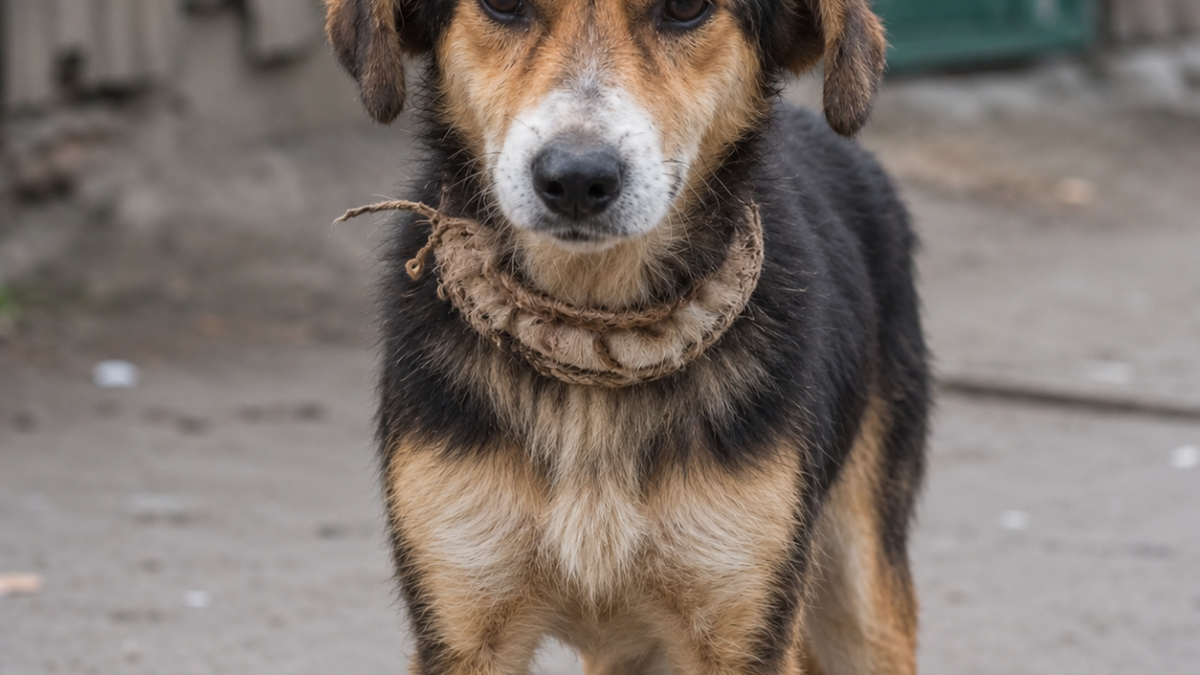
PART 2
I stayed in the waiting room the entire time.
Alex sat across from me.
At first, we talked.
Then we stopped.
There are only so many ways to say you hope a dog you met that morning survives the night.
Every time the operating-room doors opened, I looked up.
Every time they closed again, my stomach tightened.
Finally Dr. Morgan came out.
His surgical cap was still on.
There was blood on one glove.
I stood so quickly my chair scraped across the floor.
“Is she alive?”
“Yes.”
My knees almost gave out.
“But?”
He removed the glove slowly.
“The cord was worse than I expected.”
“How bad?”
“It was embedded around nearly the entire circumference of the neck.”
I covered my mouth.
“We had to remove it millimeter by millimeter.”
He continued.
“Some tissue had grown over it. Some had become infected. We had to stop several times around major vessels and near the trachea.”
“Is her airway okay?”
“Damaged, but intact.”
“Can she breathe?”
“Better than before.”
I looked toward the doors.
“Can I see her?”
“Not yet.”
“How long?”
“Give us time to stabilize her.”
He must have seen the fear on my face.
“She made it through surgery.”
That sentence became everything.
She made it through.
Not healed.
Not safe.
But through.
A nurse brought us the cord later.
It sat on a metal tray.
Thin.
Blue nylon.
The kind of cheap string people use to tie packages, secure sacks, or fasten something temporarily.
That was what nearly killed her.
I stared at it.
“How can something this small do that?”
Dr. Morgan looked tired.
“Time.”
He pointed at the cord.
“Pressure.”
Then toward the recovery room.
“And neglect.”
That word stayed with me.
Neglect.
Someone had tied the cord around a puppy.
Then watched her grow.
Or failed to watch.
Either way, no one removed it.
The first twenty-four hours were critical.
Her neck was severely swollen.
She received IV fluids, antibiotics, pain medication, anti-inflammatory treatment, oxygen support.
She barely moved.
I went home only because the clinic insisted.
I slept for maybe two hours.
At six in the morning, I called.
“She’s stable,” the technician said.
“Still breathing?”
“Yes.”
“On her own?”
“Yes.”
I started crying.
The technician waited quietly.
“Can I come?”
“After eight.”
I was there at 7:42.
They let me sit beside her kennel.
Her neck was wrapped in a clean bandage.
Her eyes opened when I spoke.
“Hey.”
She looked toward me.
I held my hand near the bars.
She sniffed.
Then pressed her nose against my fingers.
No rasp.
No attempt to bark.
Just breath.
Weak.
But freer.
“We need to name her,” Alex said behind me.
I looked at him.
“You’re here too?”
“I was nearby.”
“At eight in the morning?”
He shrugged.
“Fine. I was worried.”
I looked back at the dog.
“What do we call her?”
The technician said:
“Something strong.”
Alex said:
“Something happy.”
I said the first word that came to me.
“Hope.”
No one argued.
Hope.
On the third day, something happened that nobody in the clinic forgot.
Dr. Morgan was examining her while I sat nearby.
Hope had been breathing more comfortably since surgery, but she still seemed surprised by every deep inhale.
That morning, she lifted her head.
Slowly.
Then took one deep breath.
No wheeze.
Her eyes widened slightly.
She took another.
Then another.
She stood.
Dr. Morgan froze.
“Easy.”
Hope opened her mouth.
Nothing.
Then she tried again.
A small sound came out.
Not a real bark.
More like a cracked cough.
But louder than anything we had heard from her.
Her ears lifted.
She looked startled.
Alex laughed.
“She heard herself.”
Hope tried again.
A rough little bark.
I burst into tears.
Dr. Morgan smiled.
“Don’t encourage her too much. Her throat still needs rest.”
Hope barked again.
A little stronger.
Then wagged her tail.
That was the first time.
The entire clinic applauded.
Hope looked around as though she had no idea why everyone had lost their minds.
But I knew.
For months—maybe years—every attempt to make a sound had hurt her.
Now her body was discovering that air could move without pain.
Her voice was coming back.
The question was whether the rest of her life could too.
Hope stayed at the clinic for twelve days.
Her recovery was not smooth.
On day four, she developed a fever.
The infection in the neck tissues was more serious than expected.
For twenty-four hours, we worried about sepsis.
I barely slept.
On day six, the swelling increased again.
Dr. Morgan warned us that scar tissue around the trachea might create future breathing problems.
On day eight, she refused food.
I panicked.
He didn’t.
“Pain.”
“Is she getting worse?”
“Not necessarily.”
“Then why won’t she eat?”
“Because healing hurts.”
That sounded obvious after he said it.
Still, I sat beside her with small pieces of boiled chicken.
“Just one.”
Hope looked away.
“Please.”
Nothing.
“I found you. That means you have to cooperate.”
Alex walked past the door.
“That is not how rescue works.”
“Go away.”
He laughed.
I moved the chicken closer.
Hope sniffed.
Then finally ate.
One piece.
Then another.
By the end of the day, she ate half a bowl.
Progress became measured in tiny things.
A meal.
A bark.
A tail wag.
Ten steps down the hallway.
Sleeping without waking every few minutes.
Allowing someone to touch her neck without panicking.
That last one was hardest.
Whenever a hand moved near the bandage, Hope froze.
Not snapped.
Not ran.
Froze.
Her body became rigid.
Eyes wide.
Breathing fast.
Trauma lived there.
In the neck.
In the memory of pressure.
In whatever had happened before I met her.
I started wondering who had done it.
At first, everyone told me not to think about that.
Focus on Hope.
Let animal control investigate.
But I couldn’t stop.
Who ties nylon around a puppy’s neck?
Who sees it getting tighter and does nothing?
Who lets the dog get so thin?
Who leaves her wandering from gate to gate unable to breathe?
The answer came from something small.
On day ten, the clinic shaved more fur around Hope’s shoulder to treat a skin infection.
A technician felt a hard object beneath the skin.
“Chip.”
My heart jumped.
Hope had a microchip.
The first scan at intake had missed it because it had migrated farther down the shoulder.
They scanned again.
A number appeared.
Dr. Morgan looked at me.
“Now we may know where she came from.”
The registration was six years old.
That confused us.
Hope was no more than three.
The chip belonged originally to another dog.
A mixed-breed female named Daisy.
Registered to a man named Robert Hale.
Daisy had died four years earlier.
“So why is the chip in Hope?” I asked.
The technician frowned.
“Could have been reused improperly.”
“Can chips be reused?”
“They shouldn’t be.”
Animal control officer Sarah Collins took over.
She contacted the registry.
The chip had been manually updated two years earlier.
New dog.
New name.
Luna.
New owner:
Robert Hale.
Same man.
Hope had been Luna.
Sarah called me.
“You need to understand something.”
“What?”
“A microchip isn’t always definitive proof of current ownership.”
“I know.”
“But it gives us a starting point.”
“Does Robert still live nearby?”
“Yes.”
“How near?”
She hesitated.
“Three streets from where you found her.”
I went cold.
Hope had been moving from gate to gate.
Three streets.
Trying to find help.
Or maybe trying to find home.
“Can I come when you talk to him?”
“No.”
“Why?”
“Because you are emotional.”
“Of course I am.”
“Exactly.”
I hated her answer.
She was right.
Sarah visited Robert Hale that afternoon.
He was fifty-seven.
Owned a small repair shop.
Lived with his adult son.
No dogs visible at the property.
When Sarah asked about Luna, Robert said she had run away six months earlier.
“Six months?”
“Yes.”
He claimed the nylon cord had nothing to do with him.
Said he never tied dogs.
Said Luna had been healthy when she disappeared.
Sarah asked whether he had reported her missing.
No.
Posted online?
No.
Called shelters?
No.
Why?
“She was always roaming.”
That made no sense.
Hope’s condition suggested the cord had been embedded for a long time.
Maybe she had been loose.
Maybe someone else tied it.
Maybe Robert was telling the truth.
Then Sarah found an old photograph on Robert’s public social-media page.
Luna.
Younger.
Healthy.
Standing in a yard.
Around her neck was a thin blue nylon cord.
My stomach turned when Sarah showed me.
The same color.
The same width.
Possibly the same material.
Not enough to prove continuity.
But enough to ask questions.
The photograph was dated almost eighteen months earlier.
Caption:
New guard dog.
Hope had been barely more than a year old.
In the photo, the cord was loose.
A simple loop.
Probably not painful yet.
That was exactly what Dr. Morgan had described.
“It was once loose.”
Then she grew.
The cord didn’t.
Sarah returned to Robert’s property with another officer.
This time, he changed his story.
The cord was “temporary.”
Used because Luna kept slipping collars.
How long had she worn it?
“A few weeks.”
Then months.
He couldn’t remember.
Had he removed it before she ran away?
He said yes.
The photograph proved nothing more.
But neighbors remembered Luna.
One elderly man said:
“She was always tied near the shed.”
“With what?” Sarah asked.
“Blue line.”
“Rope?”
“Plastic cord. Something like that.”
Another neighbor had seen her as recently as three months earlier.
Not six.
“She was skinny.”
“Did the owner feed her?”
“I suppose.”
“Did you ever see her neck?”
“Couldn’t get close.”
A woman across the street remembered hearing strange sounds.
“Like coughing.”
“When?”
“Most of the summer.”
Hope had been suffering for months.
The timeline tightened.
Robert claimed she disappeared six months earlier.
Witnesses placed her there three months earlier.
He claimed the cord had been removed.
Witnesses remembered blue cord.
Then came the strongest evidence.
Robert’s son, Jason.
Twenty-nine years old.
At first, he refused to speak.
Then Sarah told him Hope had almost suffocated.
He went pale.
“She’s alive?”
That question mattered.
“You knew she was gone?”
Jason looked toward the house.
“My dad said she left.”
“When?”
“Maybe two weeks ago.”
Not six months.
Two weeks.
Sarah said nothing.
Jason realized immediately what he had done.
“He told you six months, didn’t he?”
She didn’t answer.
Jason sat down on the porch.
“Oh, man.”
“What happened to Luna?”
Jason rubbed his face.
“My dad got her as a puppy.”
“Why?”
“Security.”
“Security for what?”
“The shop.”
“Did she live inside?”
“No.”
“Was she tied?”
“Yes.”
“With the blue cord?”
Silence.
“Jason?”
“Yes.”
My hands shook when Sarah later repeated that statement.
Jason continued.
The cord started as a temporary tie when Luna was small.
Robert intended to replace it with a proper collar.
He never did.
Jason noticed it becoming tight months later.
He told his father.
Robert said:
“She’s fine.”
Later the fur covered the cord.
Then skin.
Jason admitted he stopped looking closely.
“Why?”
His answer was pathetic.
And painfully human.
“I didn’t want another fight.”
Sarah asked:
“So you knew?”
“I knew it was tight.”
“Did you know it was cutting into her?”
“Not like that.”
“Did she cough?”
“Yes.”
“Wheeze?”
“Yes.”
“Have trouble barking?”
He covered his face.
“Yes.”
“Did you call a veterinarian?”
“No.”
“Why?”
“My dad said vets cost too much.”
That sentence made me furious in a way I can still feel.
Too much.
A nylon cord.
A dog’s airway.
Pain with every breath.
Too much.
Sarah asked Jason how Hope got loose.
He looked ashamed.
“She didn’t.”
“What?”
“My dad let her go.”
“Explain.”
Two weeks earlier, Hope’s neck had begun leaking pus.
The smell was strong.
Jason told Robert again.
Robert apparently said:
“If she’s going to cost thousands, let someone else deal with her.”
That night, he untied the cord from the shed.
Not from her neck.
The cord was embedded.
He simply disconnected the free end.
Then opened the gate.
Hope walked out.
No shelter call.
No veterinarian.
No rescue.
Nothing.
Just a sick dog sent into the street.
Jason watched.
That part hurt almost as much.
“You watched her leave?” Sarah asked.
“Yes.”
“Did you try to stop him?”
“No.”
“Why?”
Jason cried.
“I don’t know.”
Sarah did.
Fear.
Habit.
Cowardice.
Maybe all three.
But none changed what happened.
Hope had walked from house to house for nearly two weeks.
Barely breathing.
Looking at people.
Trying to survive.
Until she reached my gate.
Robert was interviewed again.
This time with Jason’s statement.
He denied it.
Called his son a liar.
Claimed Jason was angry about money.
Then Sarah showed him veterinary photographs.
Hope’s neck.
He looked away.
“She did that to herself.”
“How?”
“Pulling.”
“The cord was tied around her neck while she grew.”
“She chewed collars.”
“This wasn’t a collar.”
“She was a dog.”
Sarah told me later that she stopped the interview for ten minutes after that sentence.
Not because she lost control.
Because she wanted to make sure she didn’t.
The cruelty investigation became formal.
Robert’s repair shop was inspected because witnesses said other dogs had been kept there over the years.
No animals remained.
But the shed still had a tie point.
Blue nylon fibers were stuck around the metal ring.
The same general material.
Again, no single piece proved everything.
Together, the picture was difficult to deny.
Hope was medically cleared to leave the clinic before the legal case ended.
The rescue asked whether I could foster her.
I said yes before they finished the question.
My husband, Stefan, was less surprised than I expected.
“You’ve visited her every day for two weeks.”
“That doesn’t mean anything.”
“You bought her a bed.”
“She needs a bed.”
“You bought two.”
“Options.”
“You bought a pink blanket.”
“It was cheap.”
“You named her.”
“We all named her.”
He smiled.
“She’s coming here forever.”
“Foster.”
“Of course.”
Hope entered our house slowly.
That first step through the doorway took almost five minutes.
She sniffed the threshold.
Pulled back.
Tried again.
I sat inside.
No leash tension.
No pressure.
“Whenever you’re ready.”
She looked at me.
Then stepped in.
Four paws.
Nothing happened.
She stood completely still.
A clock ticked.
The refrigerator hummed.
Stefan moved in the kitchen.
Hope jumped at the sound.
Then froze.
“Easy.”
She took another step.
The rug confused her.
The couch frightened her.
Stairs were impossible.
A ceiling fan sent her behind a chair.
Normal things were not normal to her.
She had grown up beside a shed.
Tied.
Watching life.
Not living inside it.
Her first meal at home took fifteen minutes.
Not because she didn’t want it.
Because she kept stopping.
Looking toward us.
As if waiting for someone to take it away.
I walked out of the room.
She ate.
That became our rule at first.
Food appears.
Humans step back.
Safety.
She slept on the floor beside the back door.
Not the bed.
Not the blanket.
Hard floor.
Head facing outside.
The posture of a dog who had spent her life monitoring danger.
At two in the morning, I found her awake.
“You okay?”
Her ears moved.
I sat six feet away.
Hope watched.
Then lowered her head.
Five minutes later, she slept.
The second night, she slept four feet from the door.
Third night, near the hallway.
One week later, she touched the edge of the dog bed.
Two weeks later, she lay on it.
Then immediately got off.
I still celebrated.
Healing becomes absurdly specific when you love an animal who has never known safety.
She ate from a bowl.
Celebration.
She barked at a delivery truck.
Celebration.
She stole bread.
Less celebration.
She rolled on the grass.
I cried.
Stefan took a video.
“Look at you.”
Hope rolled again.
For three years, movement around her neck had meant pressure.
Now she rubbed her entire body into soft grass.
Her scar remained visible.
A thick pale band under the fur.
Dr. Morgan warned us hair might never fully cover it.
I didn’t care.
Neither did Hope.
What she cared about was hands near her neck.
That took months.
We switched to a harness.
Never a collar.
At first, even the harness made her panic because straps passed near her shoulders.
I placed it on the floor.
Treats around it.
Then treats on it.
Then Hope sniffed.
Touched.
Walked away.
Next day.
Again.
Eventually I touched it to her back.
Then removed it.
A second.
Then five.
Then ten.
Three weeks before she allowed me to fasten it.
The first walk changed everything.
Hope stood at our gate.
Staring at the street.
This street.
The same one she had walked while nearly suffocating.
I almost turned back.
Maybe it was too much.
Then she stepped forward.
One house.
Two.
At the third gate, Hope stopped.
The elderly man outside stared.
“Is that the dog?”
I nodded.
“The one with the rope?”
“Yes.”
His face fell.
“I saw her.”
My chest tightened.
“When?”
“Before you took her in.”
“Did she come here?”
“Yes.”
“What did you do?”
He looked ashamed.
“I gave her water.”
“That helped.”
“I thought she had a cold.”
“You didn’t know.”
He stared at her scar.
“I should’ve looked closer.”
There it was again.
The spreading guilt of people who weren’t responsible.
Hope approached him.
He froze.
She sniffed his hand.
Then wagged.
The man started crying.
“I’m sorry.”
Hope didn’t care about apologies.
She cared that he had gentle hands.
She let him touch her shoulder.
Not neck.
Never neck.
That day, Hope walked past every gate where she might once have begged silently for help.
I don’t know whether she remembered.
I did.
The criminal case reached court five months later.
By then, Hope looked like another dog.
Weight restored.
Coat clean.
Eyes bright.
Voice still rough, but strong enough to bark.
And she barked.
At squirrels.
At delivery drivers.
At our vacuum cleaner.
At a plastic bag once.
Stefan complained.
“She discovered sound.”
“You wanted her healthy.”
“I regret everything.”
Hope barked.
He pointed.
“See?”
I loved every noisy second.
The hearing was harder.
Robert appeared with an attorney.
Jason testified for the prosecution.
That surprised everyone.
Especially his father.
Jason looked terrified.
His hands shook.
But he told the truth.
The puppy.
The cord.
The shed.
Months passing.
The cough.
The smell.
The day Robert opened the gate.
His father stared at him the entire time.
When the prosecutor asked:
“Why are you testifying?”
Jason looked toward the floor.
“Because I watched.”
Silence.
“I watched too long.”
The prosecutor waited.
Jason continued.
“I kept telling myself she belonged to my dad.”
His voice cracked.
“Like that meant it wasn’t my responsibility.”
I understood why Sarah later said his testimony mattered.
Not only legally.
Morally.
He had named the excuse.
Not my dog.
Not my business.
Not my problem.
The same excuse people had used as Hope walked from gate to gate.
Then Dr. Morgan testified.
He explained the injury.
How a cord becomes embedded.
How skin grows around foreign material.
How chronic infection develops.
How pressure can compromise the airway.
The prosecutor showed the blue cord removed during surgery.
Inside a clear evidence bag.
So thin.
So ordinary.
The judge stared at it.
“How long would this condition take to develop?”
Dr. Morgan answered carefully.
“Many weeks at minimum. More likely months.”
“Could it happen in a few days?”
“No.”
“Could the owner fail to notice?”
“Not reasonably.”
Robert’s attorney stood.
“What if the dog stayed outdoors?”
“Symptoms would still be obvious.”
“What symptoms?”
“Pain when moving the neck. Swelling. odor. drainage. difficulty swallowing. coughing. respiratory noise. inability to bark normally.”
“Could an untrained person mistake those symptoms for something less serious?”
“One symptom?”
Dr. Morgan paused.
“Maybe.”
“All of them together?”
“No.”
Then photographs.
Old social-media image.
Hope as Luna.
Young.
Healthy.
Blue cord.
The prosecutor asked Robert:
“Is that your dog?”
“Yes.”
“Your property?”
“Yes.”
“Did you place the cord around her neck?”
“I don’t remember.”
“Your caption says ‘new guard dog.’”
“That doesn’t mean I tied it.”
“Who did?”
“I don’t know.”
“Did the dog tie it?”
Objection.
Sustained.
Again, everyone understood.
Neighbor testimony.
Luna tied beside the shed.
Coughing.
Thin.
Blue cord.
Jason.
Then Robert.
He claimed he loved the dog.
That word made me feel sick.
“Did you take her to a veterinarian?”
“No.”
“Why?”
“Money.”
“Did you contact a rescue?”
“No.”
“Animal control?”
“No.”
“Shelter?”
“No.”
“Did you ask your son to help?”
“No.”
“What did you do when the wound began draining?”
Robert hesitated.
“I let her go.”
The prosecutor stepped closer.
“You opened the gate.”
“Yes.”
“Knowing she was injured.”
“Yes.”
“Knowing she couldn’t bark properly.”
“I didn’t know how bad it was.”
“Your son says she was struggling to breathe.”
“He exaggerates.”
“Did you hear the wheezing?”
“Yes.”
“Did you smell the infection?”
Silence.
“Mr. Hale?”
“Yes.”
“And you opened the gate.”
“Yes.”
“Why?”
Robert’s face hardened.
“I thought someone would pick her up.”
There it was.
The cruel logic people use to turn abandonment into charity.
Someone else will handle it.
The prosecutor asked:
“What if nobody did?”
Robert said nothing.
The judge did.
“That is precisely the problem.”
The outcome did not satisfy everyone.
It rarely does.
Robert received probation.
Fines.
Restitution toward medical costs.
Mandatory animal-welfare education.
Restrictions on possessing animals for a court-specified period.
The cruelty conviction remained on record.
Jason was not charged with the same severity because he cooperated and had not been the legal owner, though authorities documented his failure to intervene.
Some people online wanted prison.
Others wanted his business destroyed.
I wanted more too.
At first.
I wanted Robert to feel what Hope felt.
Air that wouldn’t come.
A cord tightening.
People walking past.
Then I looked at Hope.
She was asleep on our living-room rug.
Not thinking about Robert.
Not waiting for punishment.
Just sleeping.
That changed something.
The most satisfying consequence came months later.
Robert tried to acquire another dog from someone online.
The person recognized his name.
Called the rescue.
The placement was stopped because of his court restriction.
No shouting.
No public humiliation.
Just:
No.
You do not get another animal.
That was enough.
Hope had spent her puppyhood unable to choose anything.
Now the man who controlled her lost the ability to make that choice again.
But the bigger victory happened inside our house.
Hope learned stairs.
Slowly.
The first attempt ended after one step.
She froze.
I sat at the top.
“Come on.”
Nothing.
Stefan stood behind her.
“Don’t push.”
“I’m not.”
Hope lifted one paw.
Second step.
Then back down.
Next day, three.
A week later, halfway.
Then one afternoon, I heard claws on wood.
Hope came running into the bedroom.
I screamed.
Stefan ran in.
“What happened?”
“She did the stairs!”
He stared.
“You screamed because the dog walked upstairs?”
“Yes.”
“You need hobbies.”
Hope barked.
“See? She agrees.”
She discovered the couch next.
That took no training.
One day she simply jumped up.
Turned twice.
Collapsed.
Stefan returned from work.
“That’s my spot.”
Hope opened one eye.
“My spot.”
Nothing.
“She can’t stay there.”
I looked at him.
“Move her.”
He stared at the scar around her neck.
Then at me.
“Fine.”
He sat in the chair.
Hope won.
She discovered mirrors.
That was a disaster.
The first time she saw herself, she barked.
The reflection barked.
Hope jumped backward.
Barked again.
Reflection repeated.
She spent ten minutes trying to understand the rude dog trapped in the glass.
Then she walked behind the mirror.
Nothing.
Stefan laughed until he cried.
“She’s smarter than you.”
“Unnecessary.”
Hope returned.
Sniffed the glass.
Then lost interest forever.
She discovered toys.
At first, she didn’t know what to do.
I rolled a ball.
She watched it.
No movement.
Again.
Nothing.
A rope toy frightened her because it looked too much like cord.
I removed it immediately.
Then I bought a soft yellow duck.
Hope sniffed.
Pushed it.
It squeaked.
She jumped.
Then approached.
Pushed again.
Squeak.
Tail wag.
By the third squeak, she was obsessed.
For months, the yellow duck went everywhere.
Bed.
Kitchen.
Yard.
Once she brought it to Dr. Morgan’s clinic.
He laughed.
“So that’s your emotional support duck?”
Hope barked.
He nodded.
“I apologize.”
But the biggest breakthrough came with her voice.
Dr. Morgan had warned us the injury might permanently affect her bark.
He was right.
Hope never sounded like other dogs.
Her bark remained husky.
Rough.
A little broken.
I loved it.
Every sound meant air was moving.
One morning, a stranger approached the gate.
Hope barked.
Once.
Loud.
The man stopped.
She barked again.
Stefan came outside.
“Good girl.”
Hope’s tail wagged wildly.
She barked a third time.
I cried.
The stranger looked confused.
“Is she okay?”
I laughed through tears.
“She’s perfect.”
Her voice had once been taken by pain.
Now she used it for everything.
Hungry?
Bark.
Door?
Bark.
Squirrel?
Ten barks.
Dinner five minutes late?
Criminal offense.
Stefan began calling her “the megaphone.”
“That is disrespectful,” I said.
“She barked at a leaf.”
“The leaf moved suspiciously.”
One year after surgery, Dr. Morgan took new imaging.
The trachea had healed better than expected.
Some narrowing remained.
Scar tissue.
But no major obstruction.
“Can she live normally?”
“She is living normally.”
I smiled.
He was right.
Normal isn’t perfect anatomy.
Normal is life.
The rescue posted Hope’s anniversary photo.
Before:
Thin dog.
Dirty fur.
Head stretched forward.
Cord embedded.
After:
Healthy.
Golden-red coat.
White chest.
Dark ears.
Sitting between Stefan and me with her yellow duck.
The post spread.
People shared it.
Then something unexpected happened.
A woman messaged the rescue.
Her name was Carla.
She said she recognized Hope.
Not from Robert.
From before.
That made no sense.
Carla had briefly fostered a litter of puppies three years earlier.
The mother had been a stray.
One puppy had sandy fur, white chest, dark ears.
Carla sent photographs.
Hope.
Tiny.
Eight weeks old.
Healthy.
Wearing a red bandana.
I cried before I reached the third photo.
“How did Robert get her?”
The rescue checked records.
The puppies had been adopted through an informal community placement before the organization formalized paperwork.
Robert’s sister had taken Hope.
Her name then was Sunny.
Two months later, the sister moved to another state and gave the puppy to Robert.
So Hope had three names.
Sunny.
Luna.
Hope.
Three lives.
Carla visited.
Hope sniffed her.
No dramatic recognition.
Three years is a long time.
But Carla cried anyway.
“She used to sleep on my neck.”
I laughed.
“Not anymore.”
Carla touched Hope’s shoulder.
“She was loud.”
“What?”
“Terrible barker.”
I stopped.
“What did you say?”
“She barked at everything.”
My eyes filled instantly.
Hope had once had a normal voice.
Before the cord.
Before the damage.
That fact hurt.
Then Carla added:
“But this one sounds better.”
“What?”
“She sounds happy.”
I looked at Hope.
Rough bark.
Tail wagging.
Yellow duck in her mouth.
Maybe.
Two years passed.
Then three.
Hope became the dog who greeted everyone at the door.
Not fearfully.
Not desperately.
Confidently.
She learned visitors brought treats.
She learned rain meant sleeping on the couch.
She learned thunder meant squeezing between us in bed.
She learned baths were unacceptable.
She learned veterinary clinics contained cheese.
She learned Stefan always dropped food while cooking.
She learned my morning routine.
Coffee.
Back door.
Walk.
Breakfast.
She knew it better than I did.
The scar remained.
People asked.
Sometimes I told the story.
Sometimes I simply said:
“Old injury.”
Hope did not owe strangers her trauma.
Neither did I.
Then, three years after the court case, Jason contacted me.
Robert’s son.
I almost didn’t answer.
He asked if he could meet Hope.
My first reaction:
No.
Stefan disagreed.
“He testified.”
“He watched.”
“He knows.”
“He watched.”
“He also told the truth when it mattered.”
“After she almost died.”
“Yes.”
I hated that he was right.
Eventually I agreed.
Public park.
Neutral place.
Hope on harness.
Jason arrived alone.
He looked older.
Not physically much.
Emotionally.
When Hope saw him, she stopped.
Every muscle tightened.
Jason stopped too.
“I won’t come closer.”
Good.
We stood twenty feet apart.
Hope stared.
Then looked at me.
“Your choice.”
Jason sat on a bench.
Head down.
Hope sniffed the air.
Five minutes.
Ten.
Then she moved.
Not toward him.
Parallel.
Circling.
She smelled his shoes from several feet away.
Jason cried silently.
“Hi, Luna.”
Hope froze at the name.
My heart tightened.
Jason covered his face.
“I’m sorry.”
Hope did not approach.
He didn’t ask her to.
That mattered.
“I should have stopped him.”
I said nothing.
“I knew.”
He looked at me.
“Not everything. But enough.”
“Yes.”
“I was scared of my dad.”
“That doesn’t erase what happened.”
“I know.”
Good answer.
“I keep thinking about the day she left.”
His voice shook.
“She turned around once.”
I felt sick.
“What?”
“When Dad opened the gate.”
Jason swallowed.
“She walked out.”
Then looked back.
“He yelled, ‘Go.’”
Hope’s ears moved.
Jason cried harder.
“I stayed on the porch.”
Silence.
“I hate myself for that.”
I finally spoke.
“Does hating yourself help her?”
“No.”
“Does it protect another dog?”
He looked at me.
“No.”
“Then do something else.”
“What?”
“Be different when it happens again.”
Jason nodded.
He started volunteering at an animal shelter two months later.
Not because I told him.
Sarah did.
He cleaned kennels.
Walked dogs.
Transported animals.
The first year, I didn’t care.
Second year, he sent a message.
I reported a neighbor for leaving a dog tied without water.
I stared at it.
Then replied:
Good.
Nothing more.
People can change.
That does not erase harm.
Forgiveness and accountability are not opposites.
Neither requires forgetting.
Robert never apologized.
Not to me.
Not to Hope.
Not publicly.
Years later, I heard he moved away.
His court restrictions eventually ended.
A rescue background check still flagged the history.
That mattered.
But by then, Hope no longer reacted to his name.
Neither did I.
That surprised me.
For years, I thought revenge would feel like watching him lose something.
Instead, it felt like not caring anymore.
Hope became more important than Robert.
So much more.
Four years after I found her, we took her to the beach.
She had never seen the ocean.
At first, the waves scared her.
She barked.
The ocean ignored her.
She barked louder.
Stefan laughed.
“Finally found something louder than her.”
Hope approached the water.
A wave touched her paws.
She jumped backward.
Then attacked it.
For twenty minutes, she chased foam.
Barked at waves.
Ran.
Her scar disappeared beneath wet fur.
I watched her sprint along the sand.
Head high.
Neck turning freely.
Left.
Right.
Back toward us.
No cord.
No pressure.
No pain.
I cried.
Stefan didn’t tease me.
He knew.
Hope ran past.
Then turned.
Came back.
Stopped in front of me.
Barked.
Rough.
Loud.
Alive.
I put my hands around her face carefully.
“Use your voice.”
She barked again.
“Good girl.”
That became my favorite memory.
Not the surgery.
Not the court.
Not Robert’s conviction.
The ocean.
A dog whose every breath once hurt, barking at something enormous simply because she could.
Hope lived with us for eight years.
Longer than I expected.
Not long enough.
Never long enough.
As she aged, the scar tissue caused occasional coughing.
Nothing serious at first.
Then arthritis.
Gray fur around the muzzle.
Slower walks.
The yellow duck lost both wings and most of its stuffing.
We refused to throw it away.
“It is biohazard material,” Stefan said.
“It’s sentimental.”
“It’s mold with eyes.”
Hope slept with it anyway.
At ten or eleven, she developed heart disease.
Dr. Morgan had retired by then.
A younger veterinarian took over.
Medication helped.
She still had good years.
Good walks.
Good meals.
Good barks.
One winter morning, Hope woke me at four.
Not barking.
Panting.
I sat up.
“Hope?”
She looked at me.
Breathing faster.
I knew that sound.
Not the old wheeze.
Different.
We rushed to emergency care.
Fluid around the lungs.
Heart failure.
Medication stabilized her.
For a while.
Three months.
Then another episode.
Then another.
The veterinarian was honest.
“We can manage symptoms.”
“For how long?”
“No one knows.”
“Is she suffering?”
“Not constantly.”
That answer frightened me.
We took her home.
Hope still ate.
Still barked.
Still followed Stefan into the kitchen.
Still slept with the yellow duck.
Then one evening, she refused dinner.
I offered chicken.
Nothing.
Cheese.
Nothing.
Hope looked at me.
The same eyes from the gate.
Years earlier.
Tired.
Asking me to notice.
This time I understood immediately.
We called the veterinarian.
She came the next morning.
Hope lay in the yard.
Sunlight.
Soft grass.
No rope.
No clinic table.
Her yellow duck beside her.
Jason came too.
I hadn’t invited him.
He asked.
I said yes.
He stayed far away until I waved him closer.
Hope was too tired to react.
Jason knelt.
“Hi, girl.”
Her ear moved.
He cried.
“I’m sorry I didn’t help you then.”
Hope breathed.
He touched the grass.
Not her.
“I help now.”
That mattered to me.
Maybe to no one else.
Stefan sat on Hope’s other side.
I held her head.
“You know something?”
Hope’s eyes opened.
“The first time you came to my gate, you couldn’t bark.”
Her chest rose slowly.
“You tried.”
I stroked her cheek.
“And all I heard was that little broken hiss.”
Tears ran down my face.
“You were trying so hard to make somebody understand.”
Hope’s nose touched my hand.
“I understand now.”
The veterinarian gave the sedative.
Hope relaxed.
No panic.
No fight.
I kept talking.
“You don’t need to ask for help anymore.”
Her breathing slowed.
“You don’t have to watch gates.”
Another breath.
“You don’t have to keep your head still.”
Another.
“You don’t have to be brave.”
Stefan cried openly.
I kissed Hope’s forehead.
“And you don’t ever have to be quiet again.”
The final medication went in.
Hope exhaled.
Softly.
No wheeze.
No pain.
Just air.
Then stillness.
For a long time, I kept my hand beneath her chin.
I thought about the cord.
That cheap blue line.
How something so thin had once controlled every breath.
How it had nearly become the last thing to happen to her.
It wasn’t.
That mattered.
We buried Hope beneath the apple tree.
The yellow duck went with her.
Stefan objected.
“Finally.”
I laughed through tears.
Then he cried harder than I did.
Her stone says:
HOPE
SHE FOUND HER VOICE.
Nothing else.
The rescue kept the original cord as part of an education display.
At first, I hated that.
I didn’t want Hope reduced to what hurt her.
Then I read the plaque.
THIS CORD WAS ONCE LOOSE.
THE DOG GREW.
THE CORD DID NOT.
NEGLECT IS NOT ALWAYS SUDDEN. SOMETIMES IT TIGHTENS ONE DAY AT A TIME.
I agreed to let them keep it.
Because that was the lesson.
People imagine cruelty as one dramatic act.
A kick.
A blow.
A chain.
Sometimes cruelty is smaller.
Not removing something.
Not making a phone call.
Not spending money.
Not looking closely.
Walking past.
Telling yourself:
She’s fine.
Someone else will help.
Not my dog.
Not my business.
Hope nearly died from thousands of those little decisions.
But she survived because eventually one decision changed direction.
I opened a gate.
A rescue answered a phone.
Alex sat beside her.
Dr. Morgan operated.
A technician fed her.
Sarah investigated.
Jason finally told the truth.
Stefan made room in the house.
One decision.
Then another.
Then another.
That is how Hope healed too.
Not in one miracle.
Day by day.
Meal by meal.
Breath by breath.
Years after her death, I still hear dogs barking differently.
I notice hoarse sounds.
Coughs.
Necks.
Collars too tight.
Once, at a market, I saw a young dog tied outside a shop with a cord digging into the fur.
Not injured.
Not yet.
I waited for the owner.
A man came out.
“Your dog’s tie is too tight.”
He frowned.
“She’s fine.”
There it was.
The sentence.
I looked at the dog.
Then at him.
“No.”
My voice shook.
“She is today.”
He stared.
I continued.
“That doesn’t mean she will be next month.”
He rolled his eyes.
Then loosened it.
Maybe because I was annoying.
Maybe because people were watching.
I didn’t care.
The dog could turn her head freely.
That was enough.
Sometimes I wonder how many gates Hope stopped at before mine.
Five?
Ten?
Twenty?
How many people heard that broken hiss?
How many thought:
Old dog.
Sick dog.
Stray dog.
Someone else’s problem.
I don’t judge them as harshly as I used to.
Most probably didn’t understand.
Neither would I have, before Hope.
Now I do.
That is what rescue leaves behind.
Not only saved animals.
Changed witnesses.
Tamara before Hope might have walked past a coughing stray.
Tamara after Hope cannot.
Jason before Hope stayed silent.
Jason after Hope reports what he sees.
Sarah turned a thin nylon cord into a legal case.
Dr. Morgan turned it into training material.
Hope’s pain did not become meaningless.
But I would never say it happened for a reason.
I hate that phrase.
She should never have suffered.
Nothing good required that.
What mattered was what we did afterward.
The years she got.
The couch she stole.
The beach.
The yellow duck.
The loud, ugly bark I would give anything to hear again.
That is the ending I choose.
Not the dog at my gate.
Not pus.
Not surgery.
Not court.
Not Robert.
I remember Hope standing at the edge of the ocean.
Wet.
Golden fur shining.
Scar visible.
Head held high.
A wave coming toward her.
She leaned forward.
Opened her mouth.
And barked.
The sound was rough.
Broken around the edges.
Perfect.
The ocean came back.
Hope barked again.
For years, every breath had once hurt.
Now she had enough air to argue with the sea.
And if there is any justice greater than punishment, I think it is that.
The man who let her walk away believed he was getting rid of a problem.
Instead, Hope found a life so much larger than the yard where she had been tied.
She learned warmth.
Choice.
Safety.
Love.
She grew old.
And the dog who once wandered from gate to gate asking someone to notice her eventually became impossible for any of us to forget.
Robert lost the right to control her.
Jason learned to speak.
I learned to look closer.
And Hope—
Hope got her voice back.
That was the revenge.
That was the miracle.
And that was enough.








