PART 2: She Collapsed the Moment We Lifted Her Off the Street—The Vet Said She Had Almost No Time Left
PART 2
The first twenty-four hours felt longer than the entire week before them.
Reese barely moved.
Every few hours, somebody checked her blood pressure, temperature, hydration, glucose, electrolytes, heart rate, and the long list of numbers that had suddenly become the difference between hope and disaster.
I began hating numbers.
Seventeen pounds.
Too low.
Blood pressure.
Too unstable.
Electrolytes.
Too depleted.
Temperature.
Too cold.
One lab result would improve.
Another would worry us.
The veterinarian kept saying the same thing.
“We have to go slowly.”
I understood why.
A severely starved body is fragile in ways people don’t always see.
You cannot simply place a huge bowl of food in front of an animal and assume the crisis is over.
Reintroducing nutrition too quickly can create another emergency.
So Reese received tiny amounts.
Measured.
Controlled.
Monitored.
The first time we offered food, she sniffed it.
Then turned her face away.
My heart sank.
“She doesn’t want it.”
“She may not have the energy to want it yet,” the technician said.
That sentence hurt.
Imagine hunger lasting so long that even hunger itself becomes exhausted.
I sat beside her.
“Come on.”
Reese opened one eye.
“You don’t have to eat the whole thing.”
Nothing.
“One bite.”
Her nose moved slightly.
That was all.
We stopped pushing.
A few hours later, we tried again.
This time she licked the food.
Once.
Then again.
I looked at the technician.
“She tasted it.”
“I saw.”
A third lick.
Then Reese stopped.
Three licks.
That was our victory for the hour.
People continued sending cards.
Some were handmade.
Children drew dogs with hearts around them.
One card had a picture of a brown dog standing beneath a giant yellow sun.
On the bottom, in uneven handwriting, someone had written:
**Dear Reese, I don’t know you but I hope you get to run someday.**
I stared at that sentence for a long time.
Run.
We didn’t even know if she would stand.
I placed the card near her kennel.
“Someone has high expectations for you.”
Reese slept.
The second day was harder emotionally because nothing dramatic happened.
That sounds strange.
But in rescue, you begin wanting visible proof.
A lifted head.
A meal.
A wag.
Anything.
Reese mostly existed.
Breathed.
Received fluids.
Took tiny amounts of nutrition.
Slept.
The veterinarian told me that was enough.
“Her body needs rest.”
“I know.”
“You keep staring at her like you expect a miracle every five minutes.”
“I do.”
He smiled faintly.
“Recovery is usually less cinematic than that.”
He was right.
Bodies rebuild quietly.
Cell by cell.
Meal by meal.
Hour by hour.
Around midnight on the second night, Reese lifted her head when I entered.
Not much.
But deliberately.
I stopped.
“Did you hear me?”
Her eyes stayed open.
I walked closer.
Her nose moved.
“You did.”
I crouched beside her.
She sniffed my hand.
Then rested her chin on my fingers.
My throat tightened.
The first day, she had barely reacted to being carried.
Now she had chosen contact.
Tiny things.
Everything was tiny.
And enormous.
The third morning, my phone rang before sunrise.
I answered immediately.
“What happened?”
The veterinarian’s voice was calmer than it had been for two days.
“Her blood pressure is holding.”
I sat up.
“And?”
“Heart rate is steadier.”
“And?”
“Her electrolytes are responding.”
I waited.
He finally said:
“She’s out of immediate danger.”
I covered my face.
Not healthy.
Not recovered.
Not guaranteed.
But out of immediate danger.
For the first time, I allowed myself to cry without trying to hide it.
When I reached the clinic, Reese was awake.
She looked terrible.
Still painfully thin.
Still too weak to stand.
But her eyes seemed clearer.
I leaned down.
“You scared us.”
She sniffed my face.
I kissed the top of her head.
The technician laughed.
“Three days ago, you were afraid she’d die if we moved her.”
“I know.”
“Now you’re kissing her.”
“I know.”
Reese’s tail moved.
Barely.
One tiny sweep against the blanket.
I froze.
“Do that again.”
Nothing.
“Reese.”
Another small movement.
The technician smiled.
“There.”
I cried again.
Apparently that had become my primary skill.
From that day forward, progress came in pieces.
Food became the first major battle.
Reese wanted more than we could safely give her.
That change happened almost overnight.
She went from barely licking food to following every bowl with her eyes.
When meals arrived, she tried to lift herself.
“Easy.”
Her front paws pushed.
Her legs trembled.
She couldn’t stand.
But appetite had returned.
That mattered.
We fed carefully.
Small portions.
More frequently.
Reese swallowed every bite.
Then searched the bowl.
“More?”
She licked it.
“Not yet.”
She looked at me.
“You cannot guilt me.”
She licked the empty bowl again.
I sighed.
“You are extremely manipulative for someone who almost died.”
The veterinarian walked past.
“She’s learning.”
Within several days, Reese began recognizing meal times.
A cart rolled down the hallway.
Her head lifted.
A can opened.
Her ears moved.
Someone entered carrying a bowl.
Reese became completely alert.
I laughed.
“Your survival instinct has officially been replaced by your appetite.”
Good.
Let it.
Weight returned painfully slowly.
Seventeen pounds became eighteen.
Then nineteen.
Every number mattered.
This time I loved numbers.
The first pound gained felt more important than any award I had ever received.
A volunteer wrote it on a whiteboard.
**18 lbs!**
The next week:
**19.4!**
Then:
**20.2!**
Reese didn’t care.
She cared about breakfast.
Her body began filling out around her face first.
The hollow look near her eyes softened.
Her muzzle seemed less sharp.
Her ears became more expressive.
And then we discovered something else.
Reese loved affection.
Not tolerated.
Loved.
If somebody sat beside her, Reese tried to move closer.
If you scratched her neck and stopped, she lifted her head.
If you walked away too quickly, she watched.
One afternoon, I sat on the floor near her bedding.
Reese shifted.
Slowly.
Dragged herself several inches.
Stopped.
Rested.
Then moved again.
“What are you doing?”
Another few inches.
She reached me.
Placed her head across my thigh.
I didn’t move.
The technician in the doorway whispered:
“She wanted a cuddle.”
I looked down at Reese.
Her eyes closed.
A dog who had spent days ignored on a street was now using precious energy simply to get closer to a person.
That did something to me.
I stroked her cheek.
“You should save your strength.”
Reese pushed her face more firmly against me.
“Fine.”
For the next half hour, I became furniture.
Cards continued arriving.
The clinic eventually placed them along one wall.
Some were from children.
Some adults.
Some from people who had survived illness themselves.
One read:
**Reese, strangers care whether you wake up tomorrow.**
Another:
**You were invisible on that street, but you are not invisible now.**
That one made me angry and grateful at the same time.
Invisible.
She had not been invisible.
People had seen her.
That was worse.
Days later, I returned to the street where Reese had been found.
I told myself I wanted more information.
Maybe someone knew where she had come from.
Maybe she had an owner.
A yard.
A name before Reese.
I knocked on doors.
Most people were polite.
Some uncomfortable.
One woman said:
“I thought someone had already called.”
“Did you?”
“No.”
A man said:
“I figured she was a stray.”
“Would that make her less thirsty?”
He looked away.
I regretted the sharpness immediately.
Mostly.
Another person admitted:
“I saw her two mornings.”
“Why didn’t you stop?”
He hesitated.
“I was going to if she was still there later.”
Later.
That word followed Reese almost to death.
Later I’ll call.
Later someone will help.
Later she’ll move.
Later.
Sometimes later is simply too late wearing a nicer name.
I walked back toward my car angry.
Not because any one person had created Reese’s condition.
We had no evidence of that.
But the collective hesitation mattered.
Everyone assumed someone else would become responsible.
Eventually somebody did.
Days after she desperately needed them to.
I went back to the clinic.
Reese was eating.
Of course.
I sat beside her.
“I talked to your neighbors.”
She licked the bowl.
“They had excuses.”
More licking.
“You have no interest in this conversation.”
She looked up.
Food on her nose.
I laughed.
“Good.”
Maybe that was better.
Reese did not need anger.
We could carry it for her.
Day eleven arrived almost quietly.
I walked into the rehabilitation area and found two technicians standing several feet from Reese.
“What happened?”
One held up a hand.
“Wait.”
Reese was lying on a mat.
She moved her front paws beneath herself.
Then pushed.
Her body rose halfway.
Trembled.
I held my breath.
“Come on.”
One back leg found the floor.
Then the other.
Reese stood.
All four paws.
Her entire body shook.
Nobody moved.
Ten seconds.
Twenty.
I felt tears beginning.
Thirty.
Reese’s head lifted.
Forty.
One technician whispered:
“Good girl.”
Fifty.
Reese swayed.
I almost reached for her.
“Let her.”
Fifty-five.
Fifty-six.
Then she lowered herself carefully.
Almost one full minute.
I sat on the floor.
“Did that happen?”
The technician laughed.
“It happened.”
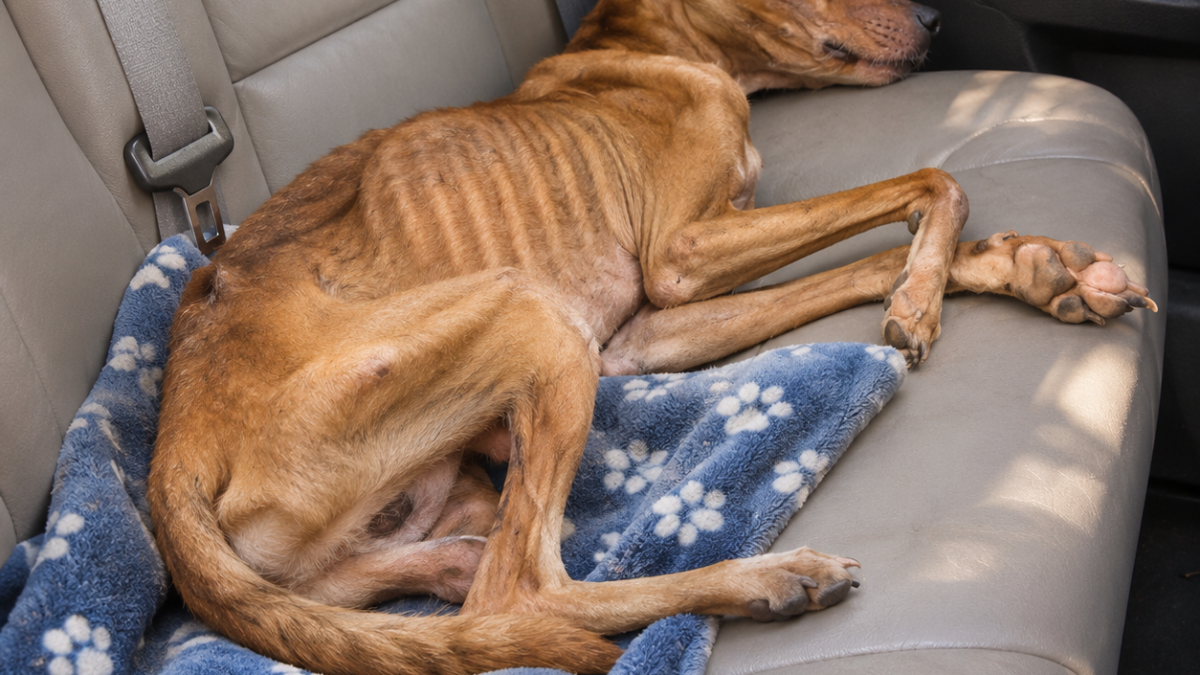
Eleven days earlier, Reese had collapsed inside the car because her legs could not carry seventeen pounds.
Now she had stood.
Nothing about it was graceful.
It was perfect.
I crouched beside her.
“You know someone sent you a card saying they wanted you to run.”
Reese licked my hand.
“One thing at a time.”
Standing became our new obsession.
Ten seconds.
Thirty.
A minute.
Then steps.
The first were ugly.
I loved every one.
Reese moved as if her paws belonged to four different dogs receiving instructions at different times.
Front right.
Pause.
Back left.
Wobble.
Correct.
Sit.
Try again.
We used support when needed.
Soft flooring.
Short sessions.
Food motivation.
Reese’s willingness was never the problem.
Her body simply had to catch up to her mind.
One afternoon, she took five steps toward me.
I held food.
She reached it.
Ate.
Then looked at me.
“That was bribery.”
Her tail wagged.
“Yes. And you fell for it.”
The next session, I stood without food.
Reese came anyway.
That felt even better.
Her first true walk happened around the room.
Not far.
She paused constantly.
But she made a loop.
When she returned to her bed, she collapsed into it.
Not medically.
Dramatically.
She threw herself down and sighed.
I laughed.
“You walked twelve feet.”
Reese closed her eyes.
“Apparently exhausting.”
The physical improvements exposed more of her personality.
Reese was gentle.
Absurdly affectionate.
Patient with handling.
Terrified of being left behind.
That last part took time to understand.
If someone sat with her and then stood to leave, Reese watched the door.
If the room stayed empty too long, she became restless.
When footsteps returned, she relaxed.
One evening, I stayed late.
I got up to refill my coffee.
Reese immediately tried to stand.
“Stay.”
She struggled.
I stopped.
“I’m coming back.”
Of course the words meant nothing.
But I returned quickly.
Reese watched me sit.
Then lowered her head.
That became a pattern.
Leaving.
Returning.
Leaving.
Returning.
Again.
Again.
Animals learn safety partly through repetition.
No grand speech could convince Reese that people returned.
People had to return.
So we did.
A foster volunteer named Claire began spending time with Reese during this stage.
Claire was in her forties.
Quiet.
Patient.
She had fostered older dogs before but never one recovering from severe starvation.
The first time she met Reese, she sat on the floor.
Reese stared.
Claire held out her hand.
No pushing.
Reese sniffed.
Then crawled closer.
Within ten minutes, Reese had her head in Claire’s lap.
I crossed my arms.
“That took me three days.”
Claire smiled.
“I’m charming.”
“Apparently.”
Reese slept.
Claire looked down at her.
“She’s so light.”
“Not for long.”
I hoped.
Claire started visiting nearly every day.
Sometimes she read beside Reese.
Sometimes she helped with feeding.
Sometimes rehabilitation.
Reese learned her footsteps.
If Claire entered the hallway, Reese’s head lifted.
Within two weeks, the reaction became impossible to miss.
“Your girlfriend is here,” I told Reese.
Tail wag.
Claire walked in.
Reese tried to stand immediately.
“Easy.”
Claire sat beside her.
Reese leaned against her chest.
I stared.
Claire looked at me.
“What?”
“Nothing.”
“You’re making a face.”
“She likes you.”
“I like her.”
Dangerous.
Very dangerous.
I knew where this was going long before Claire admitted it.
But first, Reese needed to become medically stable enough to leave.
That took weeks.
Weight gain continued.
Her coat improved.
The thin fur along her body began to shine.
Her hip bones no longer looked sharp enough to cut through skin.
Her stamina increased.
One afternoon, Reese walked the length of the clinic hallway.
Every employee stopped what they were doing.
She moved slowly.
Front paws careful.
Back legs still weak.
But she walked.
At the end of the hallway was Claire.
Reese saw her.
Her pace changed.
Not much.
A tiny acceleration.
“Reese.”
Claire crouched.
Reese crossed the final few feet.
Then pressed herself into Claire.
The entire hallway went silent.
One nurse whispered:
“That’s it.”
“What?”
“She found her person.”
Claire heard.
Her eyes filled.
“No.”
I laughed.
“No?”
“I’m fostering.”
“Sure.”
“I mean it.”
“Absolutely.”
Claire looked down.
Reese had climbed halfway into her lap.
“I have to think.”
“Take all the time you need.”
I already knew.
The first foster night was planned carefully.
Reese was strong enough to leave the clinic temporarily.
Medication organized.
Food measured.
Instructions printed.
Emergency numbers.
Claire looked nervous.
“What if she doesn’t eat?”
“Call.”
“What if she gets weak?”
“Call.”
“What if she falls?”
“Help her, evaluate, call if you’re concerned.”
“What if—”
“Claire.”
She stopped.
“Breathe.”
She looked at Reese.
“I don’t want to do anything wrong.”
“Then you’re already ahead of many people.”
We loaded Reese into the car.
This time, she didn’t collapse.
That alone made my throat tighten.
Claire opened the back door.
Reese looked up.
There was a small step.
Claire reached to lift her.
I stopped her.
“Wait.”
Reese sniffed.
Put one front paw up.
Then another.
Her back legs trembled.
Claire supported lightly beneath her chest.
Reese climbed.
By herself.
Not elegantly.
But she climbed into the car.
I covered my mouth.
The car.
The first car had carried a dying seventeen-pound dog who couldn’t stand.
Now Reese climbed into one because she was going home.
Claire didn’t notice me crying until she closed the door.
“Are you okay?”
“No.”
She laughed.
“Good.”
Reese stared through the window.
I touched the glass.
“Go.”
They left.
Claire sent an update twenty minutes later.
**She inspected every room.**
Then:
**She found the bed.**
Photo.
Reese standing beside a thick dog bed.
Thirty minutes later:
**Correction. She found MY bed.**
Another photo.
Reese curled against Claire’s pillows.
I laughed.
Perfect.
The first night, Reese slept beside Claire.
Not because Claire planned it.
Because Reese cried when left alone in the living room.
Claire went out to reassure her.
Reese followed her back.
Slowly.
Step by step.
Then climbed onto a small padded bench Claire had placed beside the bed.
Claire helped her the rest of the way.
Reese curled against her.
For eight hours, she barely moved.
Claire told me the next morning:
“She slept with one paw on my arm.”
“Making sure you stayed.”
“That’s what I thought.”
“How was breakfast?”
“She ate like I owed her money.”
“Excellent.”
Foster care changed Reese differently than the clinic had.
The clinic saved her body.
A home began teaching her what normal life felt like.
Doorbells.
Television.
Kitchen smells.
Vacuum cleaners.
Sofas.
Sunlight through windows.
The sound of keys without someone disappearing forever.
At first, whenever Claire left for even fifteen minutes, Reese became restless.
Claire installed a camera.
We watched the first recording together.
Claire left.
Reese stood near the door.
Waited.
Paced.
Lay down.
Got up.
Waited again.
Then Claire returned.
Reese’s tail exploded.
The next day, Claire left for twenty minutes.
Same pattern.
A week later, Reese lay down after five minutes.
Two weeks later, she slept.
That was progress.
Trust is sometimes measured by what an animal does when nobody is there.
Reese began believing Claire would return.
Her appetite stayed strong.
Too strong.
She had no understanding of personal food boundaries.
One evening, Claire called.
“Your dog stole my dinner.”
“My dog?”
“I left chicken on the coffee table.”
“You left chicken at Reese height.”
“I was gone ten seconds.”
“That’s an eternity.”
“She ate half.”
“How is she?”
“Thrilled.”
I laughed.
Claire didn’t.
“Should I worry?”
“About the amount?”
“Yes.”
“Monitor her. And stop leaving dinner in reach.”
Silence.
Then:
“She’s looking at the rest.”
“Move it.”
“I hate both of you.”
Reese gained healthy weight.
The veterinary team gradually adjusted the meal plan.
More calories.
Then maintenance.
Her body changed dramatically.
Photographs from the street became difficult to look at.
Not because they were graphic.
Because they showed a dog who looked almost transparent.
Now Reese had shoulders.
Muscle.
A chest.
A full face.
Her eyes looked softer.
Claire showed me one before-and-after image.
“I can’t believe that’s her.”
“I can.”
“How?”
“I remember carrying her.”
Claire became quiet.
“She was really that light?”
“Yes.”
“How did nobody help?”
There it was.
The question none of us could answer.
Maybe people thought someone else would.
Maybe they were afraid.
Busy.
Uncertain.
Maybe they convinced themselves it wasn’t their responsibility.
All those reasons had existed while Reese was dying in public.
Claire looked at the photograph.
“I want to take her back there.”
I stared.
“Why?”
“I don’t know.”
“That’s not a good reason.”
“I want…”
She stopped.
“What?”
“I want them to see her.”
I understood immediately.
Not Reese.
Them.
The people who had walked past.
“You want them to feel guilty.”
“Yes.”
Claire looked ashamed.
“I know that sounds bad.”
“No.”
It sounded human.
For a while, we didn’t do it.
Reese did not need the street.
Claire did.
Eventually, when Reese was strong enough for longer walks, we decided to return once.
Not as spectacle.
Not to shame specific people publicly.
Just a walk.
The day was bright.
Reese wore a red harness.
She had become strong enough to walk twenty minutes comfortably.
We parked near the place where she had been found.
Claire looked tense.
Reese looked interested.
Different smells.
New pavement.
Cars.
Dogs behind fences.
We got out.
Reese sniffed.
Then started walking.
No recognition we could see.
Of course.
Dogs do not narrate places the way we do.
She stopped near a tree.
Sniffed.
Moved on.
A woman came outside.
She stared.
“Is that…”
I knew her.
One of the people I had spoken to earlier.
“Reese.”
Her mouth opened.
“That dog?”
“Yes.”
The woman approached slowly.
“She looks completely different.”
Reese sniffed her hand.
The woman’s eyes filled.
“I saw her.”
I said nothing.
“Before.”
“I know.”
She looked at Reese.
“I should have called.”
Claire stiffened.
The woman continued before either of us responded.
“I kept thinking somebody would.”
There it was again.
Somebody.
She crouched.
Reese let her touch her shoulder.
The woman started crying.
“I’m sorry.”
Reese licked her fingers.
That almost made it worse.
Dogs are terrible at giving humans the punishment we think we deserve.
Reese did not understand negligence as an ethical concept.
She understood hand.
Smell.
Voice.
Right now.
The woman asked:
“Can she forgive people?”
Claire answered gently.
“She doesn’t owe us forgiveness.”
I looked at her.
Good answer.
We continued walking.
Another man recognized Reese.
He stared.
“That can’t be the same dog.”
“It is.”
He shook his head.
“She couldn’t even get up.”
“I know.”
“I thought she was dying.”
“She was.”
His face changed.
For several seconds, nobody spoke.
Then he said:
“I should’ve done something.”
This time, I answered:
“Yes.”
No cruelty.
No speech.
Just yes.
He nodded.
“I know.”
Reese sniffed a bush.
The entire moral crisis happening around her was less interesting than another dog’s scent.
I laughed.
Claire looked at me.
“What?”
“Nothing.”
That became Reese’s revenge against the street.
Not suffering inflicted on anyone.
Presence.
Walking.
Tail up.
Healthy.
The dog people had watched collapse returned on her own four paws and had more interest in bushes than in their excuses.
By the time we reached the car, Reese was tired.
Claire opened the door.
I watched carefully.
Reese stepped close.
Front paws up.
Pause.
Then she climbed inside.
All by herself.
Claire and I looked at each other.
Neither spoke.
Reese circled once on the back seat.
Then curled up.
When Claire got in, Reese lifted her head and pressed her face against Claire’s side.
Cuddles.
That was what she always wanted.
The street had given her nothing.
Reese left it asking only to be close to someone.
On the drive home, Claire finally said:
“I want to adopt her.”
I smiled.
“You think?”
“Don’t.”
“I’ve been waiting weeks.”
“I hate you.”
“No, you don’t.”
She looked into the mirror.
Reese was asleep.
“I’m serious.”
“So am I.”
Claire’s expression changed.
“I don’t want her to ever wonder where she belongs again.”
That was the answer.
The adoption paperwork became official several days later.
One of the clinic technicians brought out a box.
Inside were the cards Reese had received during treatment.
Dozens.
Claire looked surprised.
“These are all hers?”
“Yes.”
We sat on the floor and read them.
**Keep fighting.**
**You are loved.**
**I hope you stand again.**
Then we found the card with the child’s handwriting.
**Dear Reese, I don’t know you but I hope you get to run someday.**
Claire swallowed.
“We should keep this one.”
“We should keep all of them.”
She did.
The cards went into a box at home.
Years later, Claire still had them.
Reese’s first months after adoption were full of ordinary discoveries.
Stairs.
Terrible.
She hated them.
We introduced them carefully.
Eventually she managed short ones confidently.
Rain.
Also terrible.
Reese stood at the open door and looked at Claire as if the weather were personally offensive.
Claire called me.
“She won’t go outside.”
“It’s raining.”
“I know.”
“So does she.”
“What do I do?”
“Use a leash, umbrella and patience.”
Reese stepped into the rain.
Immediately tried to return.
Claire laughed.
“You survived near death, but water falling from the sky is unacceptable?”
Reese stared at her.
Apparently.
Car rides became something she loved.
That mattered emotionally.
The first car had been where her body collapsed.
Now, whenever Claire picked up the keys, Reese became excited.
The first time I witnessed it, I almost cried again.
Keys.
Tail wag.
Door.
Car.
Adventure.
Claire opened the back.
Reese climbed in.
No hesitation.
“You like cars now?”
Reese sniffed the seat.
Claire smiled.
“She knows they take her somewhere and bring her back.”
Bring her back.
Another pattern of trust.
Reese loved physical affection more as time passed.
She became a dog who believed personal space was a misunderstanding.
Sit on couch?
Reese beside you.
Lie in bed?
Reese against your legs.
Work at desk?
Reese beneath chair.
Stand in kitchen?
Reese leaning against ankle.
Claire complained constantly.
“I can’t move.”
“You adopted her.”
“I didn’t adopt a forty-pound shadow.”
“You literally did.”
“She wasn’t forty pounds then.”
“False advertising?”
“Exactly.”
Reese reached a healthy weight.
The first time the scale passed forty pounds, the clinic cheered.
Reese hated the noise.
We apologized.
Then gave treats.
She forgave us.
A year after rescue, Claire hosted a small gathering.
Only people Reese knew.
The vet.
Two technicians.
Me.
Several rescue volunteers.
No dramatic party.
Reese disliked crowded rooms.
Claire placed the cards on a table.
Beside them was the first photograph.
Seventeen-pound Reese.
Then a current photo.
Healthy.
Standing in sunlight.
One volunteer stared.
“That first dog doesn’t even look real.”
“She was.”
I remembered every bone beneath my hands.
She was.
During dinner, Reese positioned herself directly beneath the table.
Of course.
Someone dropped food.
Of course.
Reese found it before anyone.
Claire pointed.
“Do not encourage her.”
The veterinarian laughed.
“She earned at least one illegal snack.”
“No.”
Reese stared.
“Stop.”
Her tail wagged.
I watched her.
A year earlier, every calorie had been calculated because her body was too fragile to accept food normally.
Now we were arguing about table scraps.
Beautiful.
The investigation into where Reese had originally come from never produced a clear answer.
No confirmed owner appeared.
No reliable identification.
No evidence strong enough to invent a story around.
Some people wanted one.
They asked:
“Who starved her?”
I answered truthfully.
“We don’t know.”
“Who dumped her?”
“We don’t know that either.”
“But somebody must have.”
Maybe.
Maybe she escaped after prolonged neglect.
Maybe she was deliberately abandoned.
Maybe circumstances were more complicated.
We did not know.
I refused to give Reese a fictional villain just because audiences wanted one.
The reality we could prove was already enough.
She had been on that street for days.
People saw her.
Help came late.
That was a truth worth sitting with.
Sometimes harm is caused by one terrible person.
Sometimes suffering grows because ten ordinary people decide not to become involved.
The second truth may be harder.
Reese’s story changed behavior in that neighborhood.
I know because months later, the woman who had apologized called our rescue.
“There’s another dog.”
My heart jumped.
“Where?”
“Two streets over.”
“Condition?”
“Thin. Walking, but thin.”
“Do you have him secured?”
“Yes.”
“You stopped?”
“Yes.”
There was emotion in her voice.
“I wasn’t going to make the same mistake.”
We went.
The dog was hungry but not critical.
He had a microchip.
Lost.
His family had been searching for him for three days.
He went home that night.
The woman who called stood beside me afterward.
“If Reese hadn’t…”
She stopped.
I knew.
One dog nearly died because people waited.
The next dog got home because someone didn’t.
Maybe that was part of Reese’s revenge too.
She made indifference harder.
Two years passed.
Reese became Claire’s entire routine.
Morning walk.
Breakfast.
Couch.
Midday nap.
Evening drive sometimes.
Dinner.
Bed.
She still wanted cuddles constantly.
One night, Claire called me laughing.
“She pushed me out of bed.”
“How?”
“She kept moving closer.”
“That sounds like Reese.”
“I woke up on six inches of mattress.”
“Where was she?”
“Diagonal.”
“Of course.”
Reese could have slept anywhere.
She chose contact.
Maybe it came from those days on the street.
Maybe it was simply who she was.
We stopped analyzing everything.
Not every affectionate behavior needs to be trauma.
Sometimes a dog is just a dog who loves cuddles.
That distinction mattered.
We let Reese stop being a case.
She became Reese.
The dog who snored.
The dog who hated rain.
The dog who loved cars.
The dog who stole socks but never destroyed them.
The dog who would walk past her own food if Claire was crying.
That happened once.
Claire’s mother died unexpectedly.
I came over the evening she got the call.
Claire sat on the floor.
Reese had been eating.
The bowl still held food.
Reese left it.
Walked to Claire.
Pressed her body against her.
Claire wrapped both arms around Reese and cried.
I stood in the doorway.
The dog who had once nearly died because nobody stopped for her had become the one who stopped.
I never forgot that.
Claire later told me Reese stayed beside her for almost the entire night.
“Maybe she knew.”
“Dogs know something.”
“What?”
“I don’t know. That’s why I said something.”
Claire laughed despite herself.
Reese helped her through grief without needing to understand death.
Presence was enough.
Years three and four were uneventful.
That was perfect.
Veterinary checkups.
Good bloodwork.
Healthy weight.
A mild stomach upset once.
A paw injury from stepping somewhere awkward.
Normal dog problems.
The first time Reese required a vet visit for something minor, Claire panicked.
“She’s limping.”
“We’ll check.”
“What if it’s serious?”
“It might not be.”
“What if—”
“Claire.”
She stopped.
“You know what you’re doing?”
“What?”
“You’re turning every small problem into the street again.”
Silence.
She sighed.
“I know.”
The limp was a minor strain.
Rest.
Medication.
Fine.
Caregivers can carry trauma too.
When you almost lose an animal at the beginning, every future cough sounds like the beginning of the end.
We had to learn that Reese was allowed to have small problems.
She did not have to be dying every time something went wrong.
At five, Reese started slowing slightly.
Nothing concerning.
Maturity.
Less wild excitement.
More naps.
She still jumped into the car.
Still walked.
Still cuddled.
Still hated rain with theological conviction.
Claire bought her a yellow raincoat.
Reese hated that too.
The photograph remains one of my favorites.
Reese standing in the doorway wearing a yellow coat.
Expression deeply offended.
Claire behind her holding an umbrella.
I wrote:
**Survivor of severe starvation defeated by weather.**
Claire did not find that funny.
Everyone else did.
At six, Reese became a foster sister.
Claire agreed to take a severely underweight dog temporarily.
Not as critical as Reese had been.
But frightened.
The new dog’s name was Penny.
Penny hid.
Wouldn’t approach Claire.
Wouldn’t sleep unless the room was empty.
Reese noticed her immediately.
We introduced them carefully.
Penny stayed near the wall.
Reese sniffed.
Then walked away.
No pressure.
For several days, Reese simply existed near her.
Penny watched.
Reese ate.
Slept.
Asked for cuddles.
Went outside.
Came back.
Again and again.
On the fourth evening, Penny lay down near Reese.
Not touching.
Near.
The next day, closer.
A week later, Claire sent me a photograph.
Penny asleep with her back against Reese’s side.
I stared.
“Do you think Reese knows?” Claire asked.
“Knows what?”
“That Penny is scared the way she used to be.”
I thought about it.
“We can’t know.”
Claire nodded.
“But she’s helping.”
“Yes.”
That was enough.
Penny eventually found a home.
Reese fostered others afterward.
Not constantly.
We protected her peace.
But several frightened dogs passed through Claire’s house over the years.
Reese became the stable one.
The dog who demonstrated:
Food comes.
People return.
Doors open.
Beds are safe.
That transformation hit me harder than her weight gain.
Reese had gone from needing every ounce of care we could give to quietly teaching other dogs what safety looked like.
At seven, we received an unexpected letter.
Not to Reese.
To the rescue.
It came from a teenager.
He had been a child when Reese was hospitalized.
Inside was a photograph of the card he had sent years earlier.
The drawing of the dog under the yellow sun.
**I hope you get to run someday.**
The letter read:
**I was eight when my mom helped me send this. Reese was the first rescue dog I ever followed. I volunteer at an animal shelter now. I just wanted you to know.**
I called Claire.
“You need to see this.”
When she came, I showed her.
She cried immediately.
“Of course.”
I laughed.
“You’re worse than me now.”
We took Reese to the park the next weekend.
Not because she understood the letter.
For us.
Reese was older but healthy.
Claire unclipped the long training line inside a secure fenced field.
Reese stood.
Sniffed.
Then ran.
Not fast like a young dog.
But unmistakably ran.
Across the grass.
Ears back.
Mouth open.
Claire laughed.
I recorded it.
Later we sent the teenager a short response with a still photograph.
Reese mid-run.
No dramatic explanation.
Just:
**She did.**
Years passed.
Reese’s muzzle turned gray.
Slowly at first.
Then suddenly it seemed half her face had changed.
Claire hated it.
“She’s too young.”
“She’s not.”
“Don’t say that.”
“She’s aging.”
“I know.”
“That’s what we wanted.”
Claire looked at me.
“What?”
“When she was seventeen pounds.”
I nodded toward Reese.
“We wanted her to live long enough to get old.”
Claire’s face softened.
“That’s unfair.”
“Why?”
“Because now I have to be grateful for gray hair.”
“Yes.”
Reese slept between us.
Completely uninterested.
At nine, arthritis started in one hip.
Mild.
We adjusted walks.
Added joint support.
Soft bedding.
A ramp into the car.
Reese refused the ramp.
Of course.
Claire demonstrated it.
Reese walked around her and tried to climb directly into the car.
“You are missing the point.”
Reese put her front paws up.
Claire supported her.
They compromised.
Eventually Reese learned the ramp.
Then she discovered it was easier.
After that, she waited for it.
“Traitor,” Claire said.
At ten, car rides became shorter but more important.
Reese could no longer handle long hikes.
So Claire drove her to places where she could sniff.
A lake.
Quiet park.
Small trail.
Sometimes Reese barely walked.
She stood.
Sniffed.
Then returned to the car.
Still happy.
Movement is not the only form of living.
At eleven, her bloodwork showed kidney changes.
Nothing catastrophic.
Monitoring.
Diet.
Medication later.
Claire immediately spiraled.
“What if this is it?”
“It isn’t today.”
“But—”
“Today.”
I repeated.
“Stay in today.”
Reese ate dinner that night.
Then demanded Claire’s pillow.
Today was okay.
Months remained okay.
Then years became months.
Kidney disease progressed.
Arthritis worsened.
Reese slowed.
Her world gradually became smaller.
House.
Yard.
Car.
Short walks.
Claire.
Me.
A few familiar people.
But happiness still existed inside that smaller world.
That mattered.
People sometimes think a good life must remain as large as it once was.
Old dogs teach you otherwise.
A sun patch can become a whole afternoon.
A five-minute sniff outside can become an adventure.
A bowl of chicken can become celebration.
A familiar hand can become enough.
Reese still loved cuddles more than anything.
Even when getting onto the bed became difficult, she waited beside it.
Claire installed steps.
Reese used them.
Slowly.
Then curled against Claire exactly as she had on the first foster night.
One paw touching her arm.
Always contact.
At twelve, Reese stopped wanting long car rides.
That scared me.
Cars had become one of her joys.
But she still climbed into one for short trips.
Using the ramp.
No collapse.
Never again.
One evening, Claire and I sat beside her.
“She’s lived almost her whole life with me.”
“Yes.”
Claire looked at Reese.
“Do you think she remembers the street?”
“I don’t know.”
“I hope not.”
“So do I.”
“What if she remembers us finding her?”
“Maybe.”
Claire smiled sadly.
“Maybe she just remembers being warm afterward.”
I liked that version.
The final winter came quietly.
Reese ate less.
Then better.
Then less again.
Kidney disease took more from her.
The veterinarian adjusted everything.
Fluids.
Medication.
Appetite support.
For a while, it worked.
Then one morning Claire called me.
She didn’t say hello.
“She fell.”
I was already moving.
“Can she stand?”
“Not without help.”
“I’m coming.”
When I arrived, Reese was on her bed.
The resemblance to the first day hit me so hard I had to stop in the doorway.
Thin again.
Not seventeen pounds.
But fragile.
Tired.
Claire sat beside her.
“I hate this.”
“I know.”
“It looks like the car.”
I knew exactly what she meant.
Reese collapsing.
Her legs giving way.
Except this time was different.
She wasn’t starving.
Wasn’t abandoned.
Wasn’t lying on a public street while strangers passed.
She was old.
In a warm home.
On a thick bed.
Claire beside her.
There is a difference between a body failing because nobody cared and a body reaching the end after years of care.
Pain still hurts.
But the story is different.
The veterinarian came.
Examination.
Bloodwork.
Kidneys badly failing now.
Pain harder to control.
Strength declining.
We could hospitalize.
Try more.
Possibly gain days.
Maybe weeks.
Claire asked:
“Good weeks?”
The veterinarian was quiet.
“Unlikely.”
That was the answer.
Claire looked at Reese.
“She still wants cuddles.”
“Yes.”
“Does that mean she wants to stay?”
No one can answer that perfectly.
We talked about quality of life.
Eating.
Drinking.
Comfort.
Mobility.
Interest.
Rest.
Pain.
Reese still had moments.
But the balance had shifted.
Claire asked for one night.
The veterinarian agreed.
Reese ate several bites of chicken.
Drank.
Then slept against Claire.
I stayed on the couch.
Around two in the morning, I woke.
Claire was whispering.
“You remember the first night?”
Reese breathed slowly.
“You wouldn’t sleep unless you touched me.”
Claire’s hand rested against her chest.
“You still don’t.”
Reese’s paw lay across her wrist.
I closed my eyes.
In the morning, Reese refused breakfast.
Even chicken.
Claire cried.
“That’s it.”
I nodded.
The veterinarian came to the house.
No clinic.
No treatment table.
No harsh lights.
Reese’s bed.
Her blankets.
Her person.
Before the veterinarian arrived, Claire asked:
“Can we take her for a drive?”
I looked at Reese.
Tired.
But alert enough.
“A short one.”
We carried her carefully to the car.
The ramp was unnecessary now.
Claire supported her.
Reese placed her front paws inside.
For a second, I remembered the day she climbed in alone.
Strong.
Proud.
Then I remembered the first day.
Collapse.
Three car rides.
Three versions of Reese.
We helped her onto the back seat.
Claire sat beside her.
I drove.
We went to the park where Reese had once run for the child who wrote the card.
I opened the door.
Cold air entered.
Reese lifted her nose.
Sniffed.
Her tail moved once.
Claire smiled through tears.
“She knows.”
Maybe.
We didn’t take her out.
She didn’t need to walk.
We sat there.
Ten minutes.
Wind.
Trees.
Dogs far away.
Reese’s head against Claire.
Then we drove home.
Back in the bedroom, the veterinarian prepared everything.
Claire opened the old box of cards.
She chose one.
The first one.
**Dear Reese, I don’t know you but I hope you get to run someday.**
She placed it beside Reese.
“You did.”
I started crying.
The veterinarian gave the first medication.
Reese relaxed.
The stiffness left her body.
Claire lay beside her.
“You never have to be hungry again.”
My throat closed.
“You never have to lie somewhere waiting for somebody to notice.”
Reese breathed slowly.
Claire kissed her face.
“You were noticed.”
Another breath.
“You were loved.”
Reese’s paw rested on Claire’s arm.
Exactly where it belonged.
The veterinarian waited.
Claire nodded.
The final medication entered.
Reese exhaled.
Then became still.
For a long time, nobody moved.
Claire cried into her fur.
I sat beside them.
I remembered seventeen pounds.
The street.
The car.
The veterinarian telling me Reese might not have much time.
He had been right.
None of us have much time.
We simply didn’t know Reese still had years hidden inside hers.
Years of breakfast.
Cars.
Raincoats.
Parks.
Foster dogs.
Claire.
Cuddles.
Gray hair.
Arthritis.
Chicken.
Running.
A life.
That was the part nobody could see when she collapsed in the car.
Not even me.
A few months after Reese died, Claire finally opened the box of cards again.
She called me over.
“I want to do something.”
“What?”
She had arranged them across the dining table.
Dozens of messages.
Some faded.
Some childish.
Some beautifully written.
All sent to a dog the writers had never met.
“I want to make a fund.”
“For what?”
“Dogs people wait too long to help.”
I looked at her.
“Emergency rescue?”
“Yes.”
She touched one card.
“Transportation. Initial vet bills. Anything that keeps somebody from saying, ‘I thought someone else would handle it.’”
That sentence took me back.
Somebody else.
We created a small emergency fund in Reese’s name.
Not huge.
No grand launch.
But it helped.
The first animal it helped was an older dog found weak behind a grocery store.
Someone called immediately.
Not after days.
Immediately.
We got there.
He needed treatment.
He recovered.
The second was a cat hit by a car.
The third, a puppy with severe mange.
Different stories.
Same principle.
Don’t wait.
Months later, the woman from Reese’s old street contacted us again.
She had raised money in the neighborhood.
“I want it to go to the fund.”
Claire and I went to collect it.
The woman met us near the exact place Reese had been found.
I had not stood there since the day we brought Reese back healthy.
She held an envelope.
“I still think about her.”
“So do we.”
“I should have stopped.”
Claire looked at her.
“Yes.”
The woman’s eyes filled.
No sugarcoating.
Then Claire continued:
“But you stopped the next time.”
The woman nodded.
“That doesn’t erase Reese.”
“No.”
“It shouldn’t.”
“No.”
She handed over the envelope.
“What does the fund do?”
I answered:
“It gives the next animal less time to wait.”
She smiled through tears.
“That sounds like her.”
Maybe.
Reese never knew about the fund.
Never knew strangers sent cards.
Never knew people discussed her.
Never knew that one child began volunteering because of her.
Never knew a neighborhood changed because guilt became action.
She didn’t need to.
Her job was never to become a lesson.
She was allowed to simply live.
We were the ones responsible for learning.
I learned that visible suffering can still become invisible when everyone assumes responsibility belongs somewhere else.
I learned that intervention does not require certainty.
You don’t need to know whose dog it is before offering water or calling for help.
You don’t need a complete backstory before deciding a living creature is in trouble.
I learned that survival often begins with one person refusing to keep walking.
Most of all, I learned not to freeze an animal forever inside the photograph that made us care.
The Reese I remember most is not seventeen pounds.
She is forty pounds and trying to occupy Claire’s entire bed.
She is wearing a yellow raincoat and looking insulted.
She is climbing into a car.
She is pressing her head into somebody’s lap.
She is running through a field beneath a sky she did not care about nearly as much as the smells in the grass.
She is old, gray, demanding chicken.
That is rescue.
Not only pulling an animal away from death.
Giving them enough life afterward that death stops being the most interesting thing about them.
There was no confirmed villain in Reese’s story.
No person I could point to and say:
That one did all of this.
Maybe someone abandoned her.
Maybe someone neglected her before she reached that street.
We never proved it.
The truth we did know was uncomfortable enough.
For days, a severely ill dog lay where people could see her.
People waited.
Then one person didn’t.
That difference saved everything.
If people want revenge in Reese’s story, I tell them this:
Go look at the photograph of her standing on day eleven.
Then look at the video of her running years later.
Look at the car where she once collapsed.
Then look at the same dog climbing into one by herself.
Look at the street where everyone assumed someone else would help.
Then look at the emergency fund bearing Reese’s name, helping animals before days pass.
That is the answer.
The street did not get the final word.
Starvation did not get the final word.
Indifference did not get the final word.
Reese did.
And Reese’s answer was a long life filled with people who noticed when she entered a room.
People who checked whether she had eaten.
People who knew where she slept.
People who came back when they left.
People who wanted her close.
The dog who once lay alone in public became almost impossible to leave alone because she would follow you everywhere.
I think that is why the final image of Reese that stays with me is so simple.
Claire once sent me a photograph taken several years before Reese died.
Late evening.
Claire lying on the couch.
Reese curled against her chest.
Eyes closed.
One paw across Claire’s arm.
Nothing dramatic.
No medical equipment.
No rescue vehicle.
No scale reading seventeen pounds.
Just a dog asleep against somebody who had promised to return.
I saved it.
Whenever someone asks me whether Reese’s story had a happy ending, I think about that picture.
Then I say yes.
Not because she lived forever.
She didn’t.
Not because everything painful was erased.
It wasn’t.
A happy ending does not mean nothing bad happened.
It means the bad thing was not allowed to become the whole life.
Reese was left weak enough to collapse.
Then she stood.
She was ignored.
Then she became cherished.
She could barely lift her head.
Then she ran.
She spent days on a street where everyone assumed someone else would help.
Then she spent years in a house where one person could tell something was wrong just by the sound of her footsteps.
She almost disappeared in plain sight.
Instead, she became impossible to forget.
And every time another animal is helped a little sooner because someone remembers Reese, the same message continues moving forward:
Don’t wait for somebody else.
Stop.
Look.
Call.
Help.
Because somewhere between the moment an animal collapses and the moment they stand again, there may be an entire lifetime waiting for someone to give it a chance.








