PART 2: She Called the County on My Abandoned Vehicles Awkward, Since I’m the Judge Overseeing Their Cases
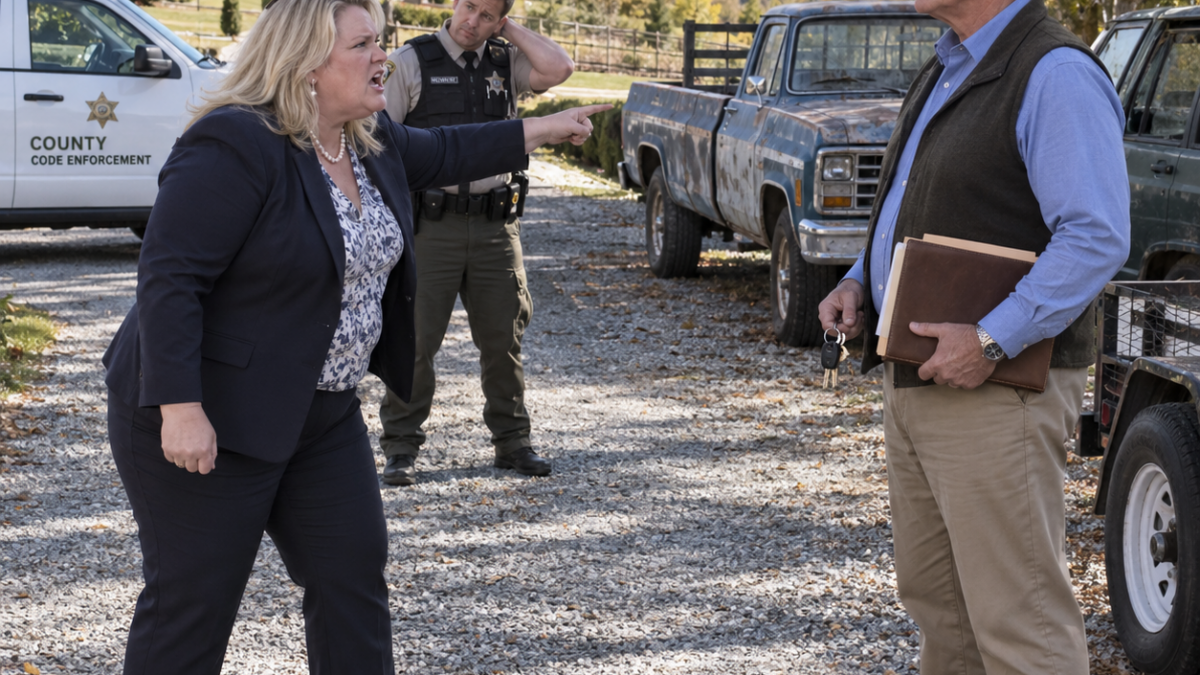
Karen told me the county would tow my father’s cars by Friday, crush them, and bill me for the privilege. She stood in my driveway smiling as if she had finally found the weapon that would force me to kneel. What she didn’t understand was that some threats become much more interesting once they’re put on official government paper.
“I don’t care if you’re the king of England,” she snapped. “Those heaps of scrap metal violate the rules, and I’ve already filed a formal complaint with the county.”
I looked past her toward the two covered cars beside my garage.
One was a 1969 Mustang Mach 1.
The other was a 1972 Chevrolet Chevelle SS.
Neither was abandoned.
Neither was scrap.
Both had valid collector registrations, and both had belonged to my father.
Karen Miller didn’t care.
She was president of the Crestwood Meadows Homeowners Association, and from what I had learned during my first month in the neighborhood, Karen believed those words gave her jurisdiction over everything from paint colors to children’s toys.
“They’ll be removed by Friday,” she continued. “Maybe losing them will finally teach you that rules apply to everyone.”
I took the packet she shoved toward my chest.
“Is that all?”
Her expression changed.
She had expected anger.
Maybe pleading.
Maybe threats.
Instead, I stood quietly in my driveway wearing jeans and an old Army T-shirt, holding the complaint she seemed so proud of filing.
“You think you’re smarter than everyone else, Mr. Thorne.”
“No.”
“You’ll understand when the tow trucks arrive.”
“Then I suppose we’ll both learn something.”
She turned sharply and marched away.
I waited until she reached the sidewalk before looking at the county seal printed across the first page.
That was when I realized just how badly she had miscalculated.
My name is Marcus Thorne.
Before moving to Crestwood Meadows, I spent twelve years in the Army Judge Advocate General’s Corps, then practiced law, and eventually became the presiding judge of our county administrative court.
For eight years, I had heard disputes involving code enforcement, property abatements, permits, licensing actions, and government orders.
Including the exact kind of complaint Karen had just filed.
That did not mean I could decide my own case.
Quite the opposite.
The moment I saw the case number, I knew I would have to recuse myself immediately and have another judge assigned.
But I also knew the process Karen had triggered better than almost anyone in the county.
And the process did not work the way she thought it did.
I carried the packet inside and sat at my dining-room table.
The house was painfully quiet.
My wife had died two years earlier, and after months of walking through rooms filled with memories, I had sold our city home and moved somewhere I thought would be peaceful.
Crestwood Meadows promised exactly that.
Large lots.
Old trees.
Quiet streets.
And a three-car garage big enough for the restoration project I had postponed for thirty years.
My father left me those two cars when he died.
The Mustang was the car he bought after his first promotion.
The Chevelle came later.
Some of my happiest childhood memories were spent handing him tools while he leaned over an engine.
After losing my wife, restoring those cars became more than a hobby.
It gave my hands something to do when my mind wandered toward grief.
Karen first noticed them within a week of my arrival.
Her initial violation notice claimed I was storing “inoperable and abandoned vehicles” in plain view.
I answered politely.
I attached their registrations.
I explained the restoration.
I cited the relevant state definitions.
Karen responded by doubling the fine.
At the bottom of the notice, she wrote in red ink:
RULES APPLY TO EVERYONE, MR. THORNE.
That was when my elderly neighbor, Eleanor Gable, quietly approached me.
“Please be careful with her,” she whispered.
Then she told me what Karen had done to her rose garden.
Her late husband had planted those roses over decades.
Karen measured the wooden trellises supporting them and decided they were an inch and a half too tall.
Forty-eight hours to remove them.
Daily fines if Eleanor refused.
Threats of a lien.
At seventy-eight years old and living alone, Eleanor surrendered.
She hired a gardener to tear everything out.
“She watched from across the street,” Eleanor told me, wiping tears from her face. “She watched them destroy George’s roses.”
That changed something in me.
My dispute had begun with two cars.
Now it had a face.
A widow standing in an empty garden.
I turned back to Karen’s county complaint and began reading every page carefully.
Then I reached the final section.
Investigation.
Notice.
Appeal.
Administrative hearing.
Judicial order.
I read it twice.
Karen had wanted to frighten me by involving the county.
Instead, she had opened a door she didn’t know existed.
And before that door closed again, I intended to find out exactly what else she had been hiding behind it.
PART 2
The next morning, I arrived at the courthouse twenty minutes earlier than usual.
The building was still quiet. The marble floors had just been polished, and the fluorescent lights in the clerk’s office gave everything that washed-out institutional glow familiar to anyone who has spent too much of his life around government buildings.
Sarah Whitcomb, our chief administrative clerk, was already at her desk.
Sarah had worked for the county longer than I had. She was in her early sixties, terrifyingly organized, and capable of remembering case numbers from five years earlier while simultaneously correcting three attorneys and eating yogurt.
She looked up when I entered.
“You’re early.”
“I need to file something before the docket starts.”
I handed her the recusal form.
She adjusted her glasses.
Her eyes stopped halfway down the page.
Then she looked up.
“You’re the respondent?”
“Apparently.”
“In a nuisance-abatement case?”
“That is what the form says.”
She looked at the case number again.
“Vehicles?”
“My father’s restoration projects.”
For one second, the professional mask cracked.
“You’re kidding.”
“I wish I were.”
She read the reason I had written.
DIRECT PERSONAL INVOLVEMENT AS SUBJECT OF CODE-ENFORCEMENT ACTION.
“You know what this means.”
“Yes.”
“You’re off the case completely.”
“Yes.”
“No informal conversations about the merits.”
“I know.”
“No peeking in the file once reassigned.”
“Sarah.”
“I’m required to say it.”
“You’re enjoying saying it.”
“A little.”
She stamped the form.
“Judge Albright is next in the rotation.”
That was good news.
Thomas Albright was one of the fairest judges I knew and one of the least sentimental.
He did not care whether someone was rich, poor, popular, connected, angry, sympathetic, or ridiculous.
He cared whether the law had been followed.
“That’s fine.”
Sarah leaned back.
“Who filed it?”
“A neighbor.”
“HOA?”
I looked at her.
“You know I can’t discuss the case once it’s assigned.”
“That means yes.”
“Good morning, Sarah.”
She smiled.
“Good morning, Judge.”
I left before she could ask another question.
By nine o’clock, the ethical issue was finished.
I would not touch the county case from the bench.
I would not call favors.
I would not tell investigators how to handle it.
I would participate exactly as any private homeowner would.
That distinction mattered deeply to me.
Karen had accused me of believing I was above the rules.
The fastest way to prove her right would have been to use my position.
I had spent too many years telling other people that government power had limits to suddenly pretend those limits disappeared when the government annoyed me.
So I became Marcus Thorne, homeowner.
And Marcus Thorne had options.
The first front was defensive.
I would prove my cars were not abandoned, junked, blighted, or illegally stored.
That part was easy.
The second front was more complicated.
I wanted to understand how Karen Miller had obtained so much control over Crestwood Meadows and whether that control had been used lawfully.
That meant paperwork.
Lots of it.
Fortunately, I liked paperwork.
My father used to say there were two kinds of people in the world: those who thought rules were boring and those who understood that rules told you exactly where the doors were.
That evening, my dining room became an evidence table.
I requested five years of HOA financial statements.
Vendor contracts.
Board minutes.
Architectural review records.
Violation histories.
Meeting attendance.
Insurance documents.
Capital-project approvals.
I also obtained publicly available corporate filings for businesses doing substantial work in Crestwood Meadows.
Then I began reading.
It was after midnight when I found the first problem.
GREENSCAPE SOLUTIONS.
The HOA paid the company $2,500 every month for landscaping services.
That was $30,000 annually before special projects.
Nothing inherently suspicious.
Until I checked the state business registry.
The registered agent was Gerald Miller.
Karen’s husband.
I sat back.
“Well.”
I printed the filing and placed it beside the HOA financial summary.
The governing documents required board members to disclose financial conflicts involving vendors.
I searched the minutes.
No disclosure.
I searched again.
Nothing.
Then another contractor caught my attention.
K ENTERPRISES.
Decks.
Fences.
Patio covers.
Gazebos.
The architectural review committee regularly directed homeowners toward K Enterprises when approving improvements.
I searched the company.
Owner: Karen Pruitt.
Pruitt was Karen’s maiden name.
I stared at the screen.
At first, I thought I had made a mistake.
I checked the address.
Same.
Telephone number?
Same area code.
The business license traced back to Karen.
Now we had a pattern.
Her husband’s company received HOA landscaping money.
Her own company benefited from architectural approvals.
And Karen controlled both the board presidency and the architectural review process.
That was not proof of every suspicion forming in my head.
But it was enough to keep digging.
The next afternoon, I walked next door.
Eleanor Gable answered wearing gardening gloves even though she no longer had much of a garden.
I held up a paper bag.
“Tea and cookies.”
Her eyes narrowed playfully.
“What do you want?”
“That obvious?”
“My husband used to bring flowers every time he had bad news.”
“This isn’t bad news.”
“Then you may come in.”
Her living room was filled with photographs.
George in a Navy uniform.
George holding a newborn baby.
George standing beside a camper.
George kneeling in front of the rose garden that no longer existed.
Eleanor followed my eyes.
“That picture was twenty-five years ago.”
“He looks proud.”
“Of the roses or himself?”
“Hard to tell.”
She smiled.
I poured tea.
Then I explained that Karen’s complaint about my cars had caused me to inspect HOA records.
I did not tell Eleanor I planned to destroy anyone.
I didn’t make promises.
I simply asked whether she had kept her violation notices.
She laughed sadly.
“All of them.”
She returned with a folder.
The rose-trellis order was there.
So were dozens of others.
Front door shade.
Mailbox finish.
Porch chair placement.
Garden edging.
Holiday decorations displayed one day too long.
Karen’s name appeared everywhere.
“This one,” Eleanor said, pulling out another notice, “was because George’s flag was still up after sunset.”
“Was it illuminated?”
“Yes.”
She pointed through the window toward an outlet.
“We had a light specifically for it.”
“Then why the notice?”
“Karen said the illumination wasn’t bright enough.”
I closed my eyes for a second.
“Did you appeal?”
“I didn’t know I could.”
That answer bothered me more than the notice.
“You were entitled to a hearing under the bylaws.”
“Nobody told me.”
I looked through several more documents.
The pattern was obvious.
Karen relied on people not understanding procedure.
She presented every demand as final.
Most homeowners assumed resistance would cost more than surrender.
“Eleanor, may I copy these?”
She hesitated.
“Will she know?”
“Not unless you choose to tell her.”
“What are you doing, Marcus?”
I looked toward the photograph of George standing beside the roses.
“Trying to understand whether the rules were protecting this neighborhood or protecting one person’s power.”
Her expression changed.
Hope is a dangerous thing to give someone unless you intend to stay around long enough to deserve it.
So I did not tell her we would win.
I simply said, “I think you deserved better than what happened to your garden.”
Her eyes filled.
“George would have fought her.”
“Maybe.”
“I told him for years he argued too much.”
“Most widows I know improve their husbands dramatically after death.”
She laughed through the tears.
“You’re terrible.”
“I’ve been told.”
When I returned home, I added Eleanor’s records to a new binder.
The title on the spine was simple.
CRESTWOOD MEADOWS.
My own vehicle case suddenly seemed very small.
Three days later, I met the Garcias.
They lived on the next block in a modest two-story house with bicycles leaning beside the garage.
Maria Garcia answered the door carrying an accordion file.
That alone told me I had found someone useful.
“I hear you’re fighting Karen.”
“I’m disputing a vehicle citation.”
She raised an eyebrow.
“That isn’t what Mrs. Gable says.”
“Eleanor is developing a flair for drama.”
Maria invited me in.
Her husband, Luis, joined us.
Two children colored at the kitchen table.
One of them had drawn a large purple dragon across several sheets of paper.
Maria noticed me looking.
“Karen fined us once for sidewalk chalk.”
I turned.
“Excuse me?”
“My daughter drew flowers on the sidewalk.”
“How long were they there?”
“About three hours.”
Luis gave a humorless laugh.
“Apparently childhood is a visual nuisance.”
Maria opened the accordion folder.
“I kept every notice.”
There were dozens.
A tricycle left on the grass.
A soccer goal visible from the road.
A trash bin returned late.
A chalk drawing.
A small inflatable pool.
One notice claimed their hanging flower baskets were the wrong style.
“How much have you paid?”
Maria looked at Luis.
“Three thousand, maybe more.”
“Over how long?”
“Five years.”
“Did you request hearings?”
“What hearings?”
Again.
Same pattern.
I explained the appeals language.
Luis stared at me.
“She told us board decisions were final.”
“They’re not.”
His jaw hardened.
“She lied.”
“I can’t tell you why she said it.”
“You know why.”
“I can tell you the rule.”
Maria tapped the folder.
“What do we do?”
“Keep everything.”
“That’s it?”
“For now.”
Luis leaned forward.
“Marcus, I’m tired of ‘for now.’”
“I understand.”
“No, you don’t. We have two kids. Every time that woman sends a letter, Maria gets sick to her stomach because we don’t know whether it’s fifty dollars or five hundred or another threat about a lien. I work overtime, and some of that money ends up paying fines because my daughter left a bicycle out.”
I let him finish.
Then I said quietly, “My wife died two years ago.”
His anger vanished.
“I’m sorry.”
“You couldn’t have known. I’m telling you because when she died, everybody wanted to fix something for me. They wanted to say the right sentence. Do the right thing. Make the pain go away.”
Maria listened.
“Nothing made it go away.”
I pointed toward their files.
“What you’re describing cannot be solved by one loud confrontation with Karen. If she has abused the rules for years, then we have to document it in a way she can’t dismiss as one angry family complaining.”
Luis leaned back.
“So you want patience.”
“I want precision.”
He looked at Maria.
She nodded.
“Okay.”
That became the beginning of our little coalition.
The next person Eleanor sent me to was David Mercer.
David was in his late twenties, though combat had put something older behind his eyes.
He had served two tours in Afghanistan with the Marines and now worked as a construction project manager.
The Marine Corps flag in his front yard was impossible to miss.
So was the certified letter taped to his front door.
“I’m guessing I know what that is.”
He followed my eyes.
“Third warning.”
“Flag?”
“Flag.”
He crossed his arms.
“She says only the American flag is permitted, and only under specific conditions.”
“Have you checked the governing documents?”
“Yeah.”
“What do they say?”
“They prohibit commercial banners and political signs. They don’t say a damn thing about service flags.”
“Correct.”
His eyebrows lifted.
“You already checked?”
“I read the covenants.”
“All of them?”
“Yes.”
“Why?”
“I’m a lawyer.”
“Retired?”
“Sort of.”
He laughed.
“I don’t know what sort of lawyer reads HOA covenants voluntarily.”
“The damaged kind.”
That got a real smile.
I told him what I was investigating.
He listened carefully.
When I mentioned K Enterprises and Greenscape Solutions, his expression changed.
“I’ve seen K Enterprises.”
“Where?”
“The clubhouse project.”
I straightened.
“What clubhouse project?”
He pointed toward the large community building near the pool.
“It was renovated about six months ago. New deck, pool equipment, wiring, patio expansion.”
“K Enterprises worked on it?”
“I saw their trucks.”
“Do you know anything about the construction?”
“I manage commercial projects for a living.”
“That wasn’t what I asked.”
David smiled.
“I noticed some things.”
“What things?”
He looked toward the clubhouse.
“Things I didn’t like.”
That evening, I invited David, the Garcias, and Eleanor to my house.
I deliberately kept the gathering small.
No grand speeches.
No neighborhood revolution.
Just records.
Coffee.
Cake.
A whiteboard.
At first, they simply talked.
The stories overlapped.
Karen had bullied each of them differently.
That was part of her effectiveness.
She individualized the pressure.
Eleanor believed she was the only widow being targeted.
The Garcias believed they were being judged as young parents.
David believed Karen had singled him out because he refused to remove the Marine flag.
Separately, each dispute seemed petty.
Together, they formed a system.
I stood beside the whiteboard.
“This is Karen.”
I wrote her name.
“This is K Enterprises.”
Line.
“This is Karen’s husband.”
Another line.
“Greenscape Solutions.”
Another line.
Then I wrote HOA FUNDS.
I drew the arrows.
Maria stared.
“She’s paying herself?”
“I’m saying companies tied directly to the Miller household receive significant business connected to the HOA.”
“Without disclosure?”
“I haven’t found any.”
David’s expression hardened.
“Slush fund.”
“Maybe. We need evidence before using that word publicly.”
Eleanor looked at me.
“You sound like a judge.”
The room became quiet.
I should have expected the question eventually.
Maria looked curious.
“What kind of law did you practice?”
I took a breath.
“Army JAG first. Private practice later.”
“And now?”
I had intentionally avoided emphasizing my judicial position because I did not want anyone assuming I could fix their HOA from the bench.
But hiding it indefinitely would create its own problems.
“I’m the presiding judge of the county administrative court.”
Luis stared.
“The county court handling Karen’s complaint?”
“Normally, yes.”
Maria’s mouth fell open.
Eleanor whispered, “Oh my.”
David started laughing.
“You’re serious?”
“Yes.”
“And she reported your cars to your own court?”
“Yes.”
“That is the funniest thing I’ve heard all year.”
“I’ve recused myself.”
David stopped laughing.
“Of course.”
“I have no judicial authority in the case now. Judge Albright has it. Everything we do here must be based on rights available to any homeowner.”
Maria looked relieved.
“Good.”
Luis turned toward her.
“Good?”
“Yes. Otherwise Karen could tell everyone he abused his position.”
She looked at me.
“She’ll probably say that anyway.”
“Almost certainly.”
David pointed at the whiteboard.
“So if this isn’t about your position, what is it about?”
“Records.”
“That’s all?”
“Records are usually enough.”
We began collecting them.
Maria’s violation archive became invaluable.
David reviewed construction contracts.
Eleanor supplied decades of institutional history.
I analyzed governing documents, state corporate filings, and procedural requirements.
Within two weeks, more homeowners quietly joined us.
Nobody called it a resistance.
That would have sounded ridiculous.
But the mood changed.
People started forwarding notices.
Photographing violations.
Requesting hearings instead of paying automatically.
Karen noticed.
Her response was predictable.
More letters.
More threats.
An HOA newsletter warned residents about “organized efforts to undermine neighborhood harmony.”
One afternoon, I received a notice for “excessive automotive activity.”
I had spent forty minutes changing a fuel line inside my garage.
I requested evidence.
Karen sent a photograph of my closed garage door.
That one actually made me laugh.
Then came the county inspector.
Officer Daniel Henderson arrived just after lunch.
He wore a county polo shirt and carried a tablet.
He introduced himself professionally.
“Mr. Thorne?”
“That’s me.”
“We received a nuisance complaint concerning two inoperable vehicles.”
“I expected you.”
He glanced at me.
“You did?”
“I received a copy.”
“Mind if I take a look?”
“Not at all.”
I led him to the garage.
The Mustang and Chevelle sat under their fitted covers.
I removed the Mustang’s cover first.
Primer-gray panels caught the sun.
Chrome trim had been restored.
The interior was temporarily stripped because I was redoing the wiring harness.
Henderson walked around it.
“Mach 1?”
“1969.”
“351?”
“Cleveland swap my father installed.”
He whistled.
“Nice.”
I uncovered the Chevelle.
“Seventy-two SS?”
“You know cars.”
“My brother restores Camaros.”
I handed him a folder.
Collector registrations.
Insurance documentation.
Restoration schedule.
Photographs showing the condition of both vehicles.
Receipts.
He reviewed them carefully.
Then he walked to the street and looked back toward my property.
No weeds.
No leaking fluids.
No broken glass.
No piles of parts outside.
No visible blight.
He sighed.
“The ordinance Karen cited concerns abandoned or nuisance vehicles contributing to public blight.”
“That was my reading.”
“These are restoration projects.”
“That was also my reading.”
He glanced at me.
“You a lawyer?”
“Yes.”
He looked at the complaint again.
“I’m marking it unfounded.”
“Thank you.”
“I have actual abandoned cars sitting on cinder blocks three neighborhoods over. This is not what the ordinance is for.”
“I appreciate your time.”
He started toward his truck.
Then I said, “Officer?”
He turned.
“I’ve been reviewing some public permit records related to the Crestwood clubhouse renovation.”
His posture changed slightly.
I continued carefully.
“I’m not asking you to investigate anything outside your duties here. But as a homeowner, I noticed there doesn’t appear to be a final certificate of occupancy in the public file.”
He looked at me longer than before.
“That isn’t my division.”
“I understand.”
“Building Safety handles it.”
“I know.”
He nodded once.
“If there’s a legitimate safety concern, you can report it through their public portal.”
“Thank you.”
Then he left.
I stood in the driveway watching the county truck disappear.
My cars were safe.
The first battle was finished.
The second had barely begun.
That night David came over carrying rolled blueprints.
“Where did you get those?”
“County permit file.”
He spread them across my table.
The clubhouse renovation had cost the HOA close to $300,000.
Karen had boasted about it repeatedly in newsletters.
It included a pool-deck replacement, new electrical systems, an extended patio, structural work, and interior improvements.
David pointed toward the electrical schematic.
“This is wrong.”
“How wrong?”
“Dangerously.”
He traced a circuit.
“Outlets this close to the pool require GFCI protection. This drawing shows several directly fed circuits without the proper protection indicated.”
“Could it be a drawing error?”
“Possible. So I checked photos from the construction.”
He showed me pictures from the HOA newsletter.
David zoomed in.
“The conduit used for the underwater-lighting run doesn’t match what I’d expect for this application.”
I studied the image.
“You can tell from that?”
“I build things for a living, Marcus.”
“Fair.”
He pulled another plan forward.
“Deck supports.”
“What about them?”
“Undersized.”
He pointed.
“Four-by-four posts.”
“Required?”
“For this load and height? Six-by-six under county standards.”
He moved to the ledger board.
“And this attachment detail is garbage.”
“How dangerous?”
“If built exactly this way, it could fail.”
“When?”
“No honest engineer would answer that from drawings alone. But it warrants inspection.”
That distinction mattered.
“Good.”
David frowned.
“Good?”
“You said ‘warrants inspection,’ not ‘it’s going to collapse tomorrow.’”
“I’m not Karen.”
“Exactly.”
Then we compared invoices.
HOA records showed a $75,000 payment to K Enterprises for pool-deck and patio work.
The permit application listed declared construction value at $30,000.
David tapped the numbers.
“Forty-five thousand dollars.”
“Difference in declared value doesn’t automatically mean theft.”
“No.”
“But combined with Karen owning K Enterprises?”
“Ugly.”
“Very.”
We kept going.
Several inspections had been completed by a county inspector named Bill Richardson.
Foundation.
Rough framing.
Electrical rough-in.
But no final inspection.
Status: PENDING.
David leaned back.
“They’re using the building anyway.”
“Yes.”
“Pool too?”
“Yes.”
“No certificate?”
“Not in the file.”
“That’s insane.”
I disliked that word when used legally, but here it seemed fair.
Without a final inspection, we could not assume the project met code.
Without a certificate of occupancy, portions of the renovated facility might not legally be open.
If David’s safety concerns were accurate, residents could be exposed to genuine risk.
That changed the equation.
Karen’s self-dealing irritated me.
Unsafe construction frightened me.
There were children at that pool every weekend.
This was no longer about correcting HOA governance.
We had an obligation to report the potential hazard.
The next morning, I used the county’s ordinary public reporting system.
No judicial stationery.
No courthouse email.
No phone call to anyone I knew.
I submitted the same kind of complaint any resident could file.
Permit number.
Specific safety concerns.
Missing final inspection.
Potential electrical issues.
Potential structural-support problems.
I attached public documents.
Then I waited.
Karen, meanwhile, celebrated the dismissal of the vehicle complaint in an unexpected way.
She lied about it.
At four in the afternoon, she appeared at my driveway.
“You think this changes anything?”
I had been sanding a fender.
“What?”
“The county.”
“They closed the complaint.”
“They made an administrative determination.”
“That is generally what closing a complaint means.”
Her face tightened.
“The HOA rules still apply.”
“Then give me the hearing I requested.”
“You don’t dictate board procedure.”
“The bylaws do.”
“I am the president.”
“Yes.”
“The board has discretion.”
“Within the bylaws.”
She stepped closer.
“You enjoy this.”
“No.”
“You’re smug.”
“No.”
“You think because you’re a judge—”
I put down the sanding block.
“Be careful, Karen.”
She stopped.
It was the first time my tone had changed.
“I have never invoked my office in an HOA matter. I recused myself from your county complaint immediately. I have not asked one employee of the county to give me special treatment. If you intend to accuse me publicly of judicial misconduct, make sure you can support it.”
For once, she did not interrupt.
I continued.
“You wanted the county involved. The county investigated. The complaint was unfounded. That part is finished.”
Her eyes narrowed.
“You think you won.”
“My cars were never abandoned.”
“You don’t belong here.”
That surprised me.
“Why?”
“People like you come in and think you know everything.”
“People like me?”
“Lawyers. Officials. Military men. You think ordinary community rules don’t apply.”
I almost laughed.
“Karen, I have spent most of my adult life applying rules.”
“Then obey them.”
“I will.”
I pointed toward my house.
“The actual ones.”
Her face flushed.
She turned and left.
Three days later, county Building and Safety vehicles arrived at the clubhouse.
I did not know the inspectors.
I did not speak to them.
I watched from my driveway while two inspectors, an electrician, and a structural specialist moved through the property.
They stayed for nearly four hours.
By late afternoon, a red notice appeared on the clubhouse doors.
UNSAFE TO OCCUPY.
The pool gate was chained.
The clubhouse was closed.
The neighborhood exploded.
Phones rang.
Messages flew through the private neighborhood group.
Karen sent an emergency email within an hour.
She blamed “malicious reporting.”
Government overreach.
Technical administrative discrepancies.
Vindictive residents.
She promised the facility would reopen quickly.
Then came the insurance letter.
I found mine in the mailbox the following day.
The carrier had suspended coverage for affected common facilities until the safety problems, permit status, and related issues were resolved.
I read the letter twice.
Then called David.
“You get yours?”
“Yeah.”
“This just became much bigger.”
“It was already big.”
“No. Before, Karen had a closed clubhouse. Now the HOA has an uninsured liability problem.”
There was silence.
Then David said, “Emergency meeting.”
“Already scheduled.”
“Karen’s going to blame you.”
“Yes.”
“Are you ready?”
“I’ve been ready since she threatened my father’s cars.”
That evening, Maria called.
“People are panicking.”
“I know.”
“My neighbor called her realtor. She says the insurance suspension may have to be disclosed.”
“That will depend on circumstances.”
“She’s furious.”
“Tell her to come to the meeting.”
“What are we going to do?”
“Present documents.”
“That’s it?”
“That is enough.”
The emergency meeting could not be held at the clubhouse because the clubhouse itself was legally closed.
So Karen rented the middle-school cafeteria.
There was something almost poetic about seeing a woman who had spent years acting like a monarch sitting behind a folding table beneath posters advertising the school lunch program.
More than a hundred homeowners attended.
Some stood along the walls.
The fear in the room was different from the fear Karen had cultivated.
This was financial fear.
People were worried about lawsuits.
Property values.
Repair assessments.
Insurance.
Their homes.
Karen began by blaming me.
Not indirectly.
By name.
“A single disgruntled homeowner has engaged in a coordinated campaign to damage this association because he refuses to follow simple rules.”
I sat beside Eleanor.
David was on my other side.
Maria and Luis were behind us.
I felt Eleanor stiffen.
I whispered, “Don’t react.”
Karen continued.
“This individual has abused his legal knowledge and connections to create unnecessary scrutiny—”
I stood.
Not quickly.
Not dramatically.
I simply stood.
Karen saw me.
“You are out of order.”
“I would like to respond to the accusation you just made publicly.”
“You will have an opportunity during member comment.”
“You accused me of abusing my public office.”
Her eyes flickered.
Several homeowners began murmuring.
I continued.
“For the record, I recused myself from the county case immediately after receiving notice of it. Judge Thomas Albright was assigned. I exercised no judicial authority over the investigation.”
Someone shouted from the back.
“Wait. You’re a judge?”
Karen banged the gavel.
“This is irrelevant!”
“No,” I said. “You made it relevant when you suggested I used my position.”
I turned toward the room.
“My vehicle case was investigated by the county and closed as unfounded. That determination was made by code enforcement, not by me.”
Karen interrupted.
“But then you attacked the clubhouse!”
“I reported documented safety concerns through the same public process available to every homeowner.”
“You knew exactly what would happen!”
“No. I knew an inspection would happen.”
“That is an abuse!”
David stood.
“No, Karen. Building unsafe structures is the problem.”
She pointed at him.
“Sit down!”
He didn’t.
“I’m a construction project manager. I reviewed the permit drawings.”
The room quieted.
David carried his laptop forward.
The school had left a projector available.
He connected it.
Karen’s face changed.
“Absolutely not.”
A homeowner near the front shouted, “Let him show us!”
Another voice joined.
“Show the records!”
Karen hammered the gavel.
I waited until the room settled.
Then the first document appeared on the screen.
HOA financial statement.
GREENSCAPE SOLUTIONS — $2,500 MONTHLY.
I spoke calmly.
“This is a vendor receiving approximately thirty thousand dollars per year before additional projects.”
Next slide.
State corporate filing.
REGISTERED AGENT: GERALD MILLER.
The room erupted.
Karen rose.
“My husband runs a legitimate business!”
“I did not say otherwise.”
“You’re implying criminal conduct.”
“I’m showing ownership.”
I clicked the next document.
HOA bylaws.
Conflict disclosure requirement.
“I have reviewed the board minutes available to homeowners. I have not found a disclosure or documented competitive process related to this recurring arrangement.”
Karen pointed at the screen.
“That was approved by the board!”
“Then produce the vote.”
Silence.
David changed slides.
K ENTERPRISES.
Then the state registration identifying Karen under her maiden name.
People shouted.
A man near the back stood.
“Your company built my fence!”
Karen’s face was white.
“You approved it!”
Another homeowner shouted.
“You told us we had to use them!”
“I never said had to!”
“You said nobody else met community standards!”
Maria stood holding her accordion file.
“I have your letter.”
Karen looked toward her.
Maria removed a document.
“‘Approval is contingent upon work being completed by K Enterprises or another contractor meeting association certification requirements.’ When we asked for the certification requirements, you never gave them to us.”
A murmur became an angry roar.
Karen struck the gavel repeatedly.
I held up my hand.
“Let her answer.”
The room gradually quieted.
Karen looked at me.
For the first time since I met her, she seemed truly frightened.
“I have done nothing wrong.”
“Then the records will protect you.”
Her mouth tightened.
David put the clubhouse invoice on-screen.
$75,000 paid to K Enterprises.
Then the permit.
Declared construction value: $30,000.
I did not accuse her of stealing $45,000.
That would have been premature.
Instead, I asked the obvious question.
“There is a substantial discrepancy between these records. The homeowners deserve an independent accounting.”
Karen slammed both hands onto the table.
“Construction permits use estimates!”
“Correct.”
“Then you know that number proves nothing!”
“By itself, correct.”
She stared at me.
I nodded.
“That is why I am asking for an audit rather than announcing a conclusion.”
That moment mattered.
Karen had expected a mob.
I refused to give her one.
The truth was damaging enough.
David displayed photographs of the deck.
Then the electrical drawings.
He explained the safety issues in plain English.
He was careful.
“I’m not claiming this deck would have collapsed tonight,” he said. “I’m saying the approved drawings and observed construction raised serious enough concerns that professional inspection was required. County professionals inspected it. They closed the facility.”
Someone shouted, “Why was it open without a final inspection?”
Karen looked toward her two board members.
Neither spoke.
“Karen?” another homeowner demanded.
She reached for the microphone.
“The final inspection was delayed because of county backlog.”
“Then why did you open the clubhouse?”
“We were advised we could.”
“By whom?”
Karen hesitated.
That hesitation was devastating.
A woman near the aisle stood.
“My grandchildren were in that pool last month.”
Another homeowner shouted.
“My daughter’s birthday party was on that deck.”
The anger shifted.
Money had upset them.
Safety enraged them.
Eleanor suddenly rose beside me.
She carried a single rose.
Months earlier, she had planted a few new bushes near her back porch.
This flower came from one of them.
She walked slowly toward the front.
Karen watched her.
“Eleanor, this is not the time.”
Eleanor stopped across the table.
“For thirty years, my husband gave me roses.”
The room became quiet.
Karen looked uncomfortable.
Eleanor continued.
“When he died, those plants were one of the last things I had that his hands had touched.”
“Eleanor—”
“You measured my trellises.”
Karen’s jaw tightened.
“They violated the height restriction.”
“By an inch and a half.”
“The rule does not say approximately.”
“No.”
Eleanor’s voice trembled.
“That’s what I told myself while I watched a gardener rip them out.”
Nobody moved.
“You told me rules were rules. You told me fairness required treating everyone the same.”
She placed the rose on the folding table.
“But you weren’t treating everyone the same, were you?”
Karen said nothing.
“You were using rules to make us afraid.”
“That’s ridiculous.”
“No.”
Eleanor surprised all of us by raising her voice.
“What is ridiculous is a seventy-eight-year-old woman being afraid of her neighbor because she owns a clipboard!”
Applause exploded.
Karen banged the gavel.
Eleanor did not flinch.
“You made me feel small,” she said. “You made all of us feel small.”
Karen shook her head.
“I maintained standards.”
“You maintained yourself.”
Silence.
Then David stood.
“Our bylaws permit a membership vote of no confidence under extraordinary circumstances.”
Karen shot to her feet.
“You cannot make that motion at an emergency meeting!”
David held up a printed copy.
“Yes, we can.”
“No!”
“I move that Karen Miller be removed as president pending a full independent forensic audit and investigation of all association contracting and financial activity.”
A voice shouted immediately.
“Second!”
Then another.
“Second!”
Then twenty more.
Karen’s two fellow board members looked trapped.
One of them, Arthur Bell, slowly moved his chair away from her.
Karen saw him.
“Arthur?”
He would not meet her eyes.
“You approved these contracts too!”
His face collapsed.
“I signed what you gave me.”
“You knew!”
“No.”
“You absolutely knew!”
That was the first crack.
Not legal proof.
But politically, it destroyed her.
The vote proceeded.
Nearly unanimous.
Karen Miller was removed.
For several seconds after the result was announced, she sat absolutely still.
The cafeteria erupted around her.
People hugged.
Some shouted.
Some cried.
Karen stared at the rose Eleanor had placed on the table.
I felt no joy.
Relief, yes.
Satisfaction, certainly.
But not joy.
A person losing power is not the same thing as a community gaining peace.
We still had enormous problems.
Closed clubhouse.
Suspended insurance.
Potential fraud.
Possible unsafe construction.
Financial exposure.
We had only removed the person blocking the door.
We had not yet walked through it.
Karen gathered her purse.
Then two sheriff’s deputies entered.
The room quieted again.
I had not expected them.
Neither had Karen.
One deputy approached.
“Karen Miller?”
She stared at him.
“Yes?”
“We have a warrant related to an ongoing financial-fraud investigation.”
Her eyes went to me.
Instantly.
“You.”
I shook my head.
“I didn’t know.”
“You did this!”
The deputy stepped between us.
“Ma’am.”
Karen’s breathing became ragged.
“This is his revenge!”
I stayed where I was.
The deputy continued reading the warrant information.
Fraud.
Embezzlement.
False invoicing.
The charges were allegations, not convictions, and I knew better than most that an arrest was not a verdict.
But investigators had clearly found enough evidence to seek judicial authorization.
Karen looked around the room.
The people she had frightened for years watched silently.
Nobody laughed.
Nobody cheered.
Eleanor began crying.
Not from happiness.
I went to her.
“You okay?”
She nodded.
“I wanted her stopped.”
“She is.”
“I didn’t want…”
She looked toward Karen.
“This.”
“I know.”
Karen was escorted from the cafeteria.
The rose remained on the table.
That image stayed with me longer than the handcuffs.
Because justice rarely feels like movies promise.
There is no perfect music.
No clean emotional release.
Sometimes the person who harmed you looks old and frightened under fluorescent lights, and you suddenly remember that consequences are real even when deserved.
Eleanor wiped her eyes.
“Does that make me weak?”
“No.”
“What does it make me?”
“Human.”
The next several months were ugly.
An interim board was established.
David agreed to serve as acting president.
Maria became secretary.
Luis joined the finance committee.
Eleanor, after initially refusing anything official, agreed to advise the landscaping and beautification group.
I declined every nomination.
“No.”
David stared at me across my kitchen table.
“We need someone who knows governance.”
“You have someone.”
“Who?”
“You.”
“I build warehouses.”
“You also read contracts, manage budgets, supervise vendors, and know how to ask questions.”
“You’re literally a judge.”
“Which is exactly why I don’t want to run my neighborhood.”
He groaned.
“At least be counsel.”
“No.”
“Advisor?”
“Coffee-drinking neighbor who occasionally answers questions.”
“I hate you.”
“That position is unpaid too.”
The forensic audit was brutal.
Investigators and accountants reconstructed years of transactions.
Some expenditures were legitimate.
Others were poorly documented.
And some were not defensible at all.
K Enterprises had billed the HOA for work that could not be matched to actual materials or labor.
Greenscape Solutions had received contracts without proper competitive bidding.
Several invoices appeared duplicated.
Payments had moved through entities controlled by Karen or her family.
The total suspected loss approached $200,000.
The clubhouse project required substantial repairs.
The deck had to be partially demolished.
Electrical work was replaced.
Pool equipment was brought into compliance.
A final inspection was completed only after months of corrective work.
The insurance carrier eventually reinstated coverage.
But homeowners still faced a special assessment.
That meeting was difficult.
David stood before the neighborhood and told them the truth.
“We have recovered some money. We are pursuing more. But repairs cannot wait.”
A man near the back stood angrily.
“So we pay for Karen stealing from us?”
“For now, we pay to protect the value and safety of our own property.”
“That isn’t fair.”
“No,” David said. “It isn’t.”
His honesty quieted the room.
He continued.
“I’m not going to tell you this is painless. It isn’t. I’m not going to call the assessment an investment opportunity or use corporate nonsense. We were harmed. Fixing the harm costs money.”
Someone asked whether payment plans would be available.
“Yes.”
Hardship options?
“Yes.
Full accounting?
Every month.
Vendor bids?
Published.
Board votes?
Recorded.
People were still angry.
But anger is different when nobody is hiding information.
The assessment passed.
The community began rebuilding.
Meanwhile, Karen’s criminal case moved forward.
Because I worked in the same county judicial system, I stayed completely away from it.
I did not ask prosecutors for updates.
I did not discuss evidence with investigators.
I did not attend hearings unless they were public and I had an ordinary reason to be there.
Eventually, the case was transferred to avoid even the appearance of institutional conflict.
I was glad.
Karen deserved a process nobody could reasonably claim I controlled.
Nearly a year after her arrest, she accepted a plea agreement involving felony financial offenses.
She received a custodial sentence, probation conditions after release, and restitution obligations.
Gerald’s landscaping company lost its HOA contract and eventually collapsed.
The Millers sold their house.
I learned all of that through public records and neighborhood gossip, the same way anyone else did.
Eleanor asked me once whether I felt vindicated.
We were standing near the clubhouse watching workers build new flower beds.
“I don’t know.”
“You don’t?”
“No.”
“If somebody had done that to me, I’d feel wonderful.”
“You’re the woman who cried when she was arrested.”
“That was different.”
“How?”
Eleanor considered.
“All right. Maybe I wouldn’t feel wonderful.”
She pointed at the fresh dirt.
“I do feel wonderful about these.”
The new beautification committee had decided to plant roses around the clubhouse.
Not because of Karen.
Because of George.
At least that was what everyone told Eleanor.
She suspected they were really for her.
She was correct.
The first planting day became an unofficial neighborhood holiday.
Families arrived with shovels.
Children carried watering cans.
David brought mulch.
Maria brought sandwiches.
Luis brought a speaker and played music.
Someone brought a folding table filled with lemonade.
I arrived late because court had run over.
Eleanor handed me a shovel.
“You’re working.”
“I’m seventy-two.”
“You restored two cars.”
“Cars don’t require kneeling in dirt.”
“Stop whining.”
“Yes, ma’am.”
We planted thirty-six rose bushes.
Pink.
Red.
Yellow.
White.
One section used the same variety George had planted beside Eleanor’s home decades earlier.
When she noticed, she stopped moving.
David pretended to become fascinated by a bag of mulch.
Maria suddenly needed to rearrange sandwiches.
Nobody wanted Eleanor to see us watching.
She touched one of the leaves.
“Who did this?”
Silence.
Then a child shouted, “Everybody!”
That broke us.
Eleanor laughed.
Then cried.
Then laughed again.
She sat on the edge of the new flower bed while Maria put an arm around her.
I looked toward the restored clubhouse.
New supports.
New electrical system.
New deck.
Fresh paint.
The entire building had been repaired properly.
No shortcuts.
No mystery invoices.
No family companies.
Three competitive bids were publicly reviewed.
David had become obsessive about documentation.
Every contract was online.
Every invoice searchable.
Every meeting streamed and archived.
I teased him about it.
“You’ve become worse than Karen.”
He stared at me.
“Take that back.”
“You have seventeen pages of procurement procedures.”
“Transparency requires process.”
“You sound like a lawyer.”
“Your influence.”
“Tragic.”
He smiled.
Then grew serious.
“You know what scares me?”
“What?”
“How easy it was.”
“For Karen?”
He nodded.
“She didn’t seize control in one day.”
“No.”
“She just kept taking a little more because nobody wanted the argument.”
“That is often how power accumulates.”
“People think corruption starts with bags of cash.”
“Usually starts with exceptions.”
He looked toward the pool.
“Just this once.”
“Yes.”
“For efficiency.”
“Yes.”
“Because everyone knows everyone.”
“Yes.”
“Because rules are inconvenient.”
“Yes.”
David shook his head.
“And then one day one person controls everything.”
“Which is why the solution isn’t finding a nicer dictator.”
He laughed.
“Eleanor said you’d say something like that.”
“What did she say?”
“She called you insufferably judicial.”
“Fair.”
The clubhouse reopened the following summer.
The reopening party drew nearly every family in Crestwood Meadows.
Children ran through sprinklers.
The pool was full.
Music played.
Someone grilled far too many hamburgers.
David’s Marine Corps flag flew from a properly installed pole.
The Garcias’ children covered a section of sidewalk with chalk drawings.
Nobody fined them.
A little girl drew a giant purple dragon that stretched almost twenty feet.
I stared at it.
Maria walked beside me.
“Public nuisance?”
“Obviously.”
“Daily fine?”
“At least five hundred dollars.”
She laughed.
Her daughter heard us.
“Judge Marcus!”
I turned.
“Are you going to arrest my dragon?”
“I don’t have jurisdiction over dragons.”
“What if it eats somebody?”
“Then we revisit the issue.”
She seemed satisfied with that answer.
The difference in the neighborhood was difficult to describe unless you had seen it before.
Homes looked less perfect.
And better.
A bicycle might be left in a driveway.
Children’s toys appeared on lawns.
Somebody painted a front door blue.
Not approved blue.
Just blue.
A retired teacher hung wind chimes.
Mr. Peters finally installed the wooden bench he had stored in his garage for years.
Eleanor replanted her home garden.
The new trellises were exactly six feet one and a half inches tall.
That was my idea.
She protested at first.
“What if somebody complains?”
“I will personally provide the measuring tape.”
She stared at me.
Then smiled.
“You’re petty.”
“Occasionally.”
She planted the first new rose where George’s oldest bush had stood.
I helped dig the hole.
“Too deep,” she said.
“I know how to dig a hole.”
“So did George.”
“What happened?”
“He dug them too deep.”
I handed her the shovel.
“Then perhaps your family has unreasonable expectations about excavation.”
She laughed.
For the first time, talking about George did not make her immediately sad.
It made her warm.
I understood that transition.
My own grief was changing too.
For months after my wife, Rebecca, died, every memory hurt because it ended with the same fact.
She was gone.
Gradually, the memories became places I could visit without bleeding.
Not every time.
But sometimes.
Restoring my father’s Mustang helped.
So did the neighborhood.
Every Saturday morning, I worked in the garage.
At first alone.
Then not.
David started dropping by.
Then Luis.
Then one of the Garcia children.
Then half the block seemed to believe my garage was a community center.
I complained constantly.
Nobody listened.
The Chevelle was the long-term project.
The Mustang came first.
Every bolt had a story.
I remembered my father teaching me how to set ignition timing.
I remembered sitting on the garage floor at fourteen while he explained why forcing a bolt usually made the problem worse.
“Patience isn’t doing nothing,” he told me.
“It’s doing the next correct thing instead of the fastest thing.”
For decades, I thought he had been talking about cars.
He hadn’t.
One afternoon, I found the original steering-wheel center cap in an old box.
Dad’s fingerprints were probably long gone, but I held it as though they might still be there.
Rebecca had understood what those cars meant.
Before she died, she made me promise I would restore at least one.
“You need something unnecessary,” she said.
“What does that mean?”
“Your entire life is duties.”
“I have hobbies.”
“Reading case law is not a hobby.”
“It can be.”
“No.”
I smiled at the memory.
She had been right.
Again.
The final part arrived on a Wednesday.
By Saturday morning, I knew the Mustang was ready.
David stood beside me.
Luis leaned against the workbench.
Eleanor sat in a folding chair near the garage door holding coffee.
Several children had gathered at the edge of the driveway.
I looked around.
“This is ridiculous.”
David grinned.
“You made the mistake of telling one person.”
“I told you.”
“Exactly.”
“You are one person.”
“Not anymore.”
I slid behind the wheel.
The interior smelled new and old at the same time.
Fresh upholstery.
Oil.
Metal.
Thirty years of memory.
I inserted the key.
For a moment, I could not turn it.
My father’s hands were everywhere in that car.
So were Rebecca’s words.
Something unnecessary.
Something mine.
Eleanor noticed.
“You all right?”
I nodded.
Then turned the key.
The starter engaged.
The engine coughed once.
Twice.
Then 351 cubic inches of Ford V8 came alive.
The garage shook.
Children covered their ears.
David shouted.
Luis laughed.
Eleanor stood clapping.
I stared through the windshield.
My vision blurred.
I reached for the ignition because suddenly I needed silence.
David put his hand through the open window.
“Don’t.”
I looked at him.
“Let it run.”
So I did.
The engine settled into a deep, uneven idle.
Not noise.
A heartbeat.
My father had been dead for years.
Rebecca had been gone two.
Karen had tried to call the Mustang abandoned.
For a while, maybe part of me had been abandoned too.
Sitting there, listening to that engine run, I understood why I had fought so hard.
Not because I was a judge.
Not because Karen insulted me.
Not even because the HOA fine was wrong.
Those cars represented continuity.
My father built memories into them.
Rebecca had pushed me to preserve them.
I was repairing more than steel.
Eleanor tapped the roof.
“Are you going to drive it?”
I wiped my eyes.
“Eventually.”
“You have been saying eventually for a year.”
“The responsible thing is additional testing.”
David groaned.
“Judge.”
“Don’t call me that in my garage.”
“Marcus.”
“What?”
“Drive the damn car.”
I laughed.
“All right.”
Everyone moved.
I backed out slowly.
The Mustang rolled into the sunlight.
Candy-apple red.
Chrome shining.
Engine rumbling.
At the end of the driveway, I stopped.
The two covered shapes that had started the entire conflict were gone now.
The Chevelle was inside waiting its turn.
The Mustang was alive.
I looked down the street.
Eleanor’s new roses.
David’s flag.
The Garcias’ chalk-covered sidewalk.
The distant clubhouse surrounded by flowers.
Everything Karen had tried to control had become evidence that control was never the same thing as community.
I drove slowly.
Neighbors came outside.
People waved.
Someone applauded.
That was embarrassing.
I waved them off.
At the clubhouse, children ran toward the fence.
I stopped near the new rose beds.
Eleanor had somehow gotten there before me in David’s truck.
She leaned through the window.
“George would have liked this.”
“Which part?”
“The car.”
“You sure?”
“He had terrible taste.”
“That seems unnecessary.”
She smiled.
“Your father would be proud.”
That landed harder.
I looked at the steering wheel.
“I hope so.”
“And Rebecca?”
I closed my eyes for a second.
“She’d complain that I spent too much money.”
“What else?”
“She’d want to drive.”
“Would you let her?”
“No.”
Eleanor slapped my shoulder.
“Then she’d be furious.”
“She usually was.”
I smiled.
“She’d be happy.”
“Yes.”
Eleanor stepped back.
“Then go.”
“Where?”
“Anywhere.”
That was something I had almost forgotten.
You could drive without a destination.
I left Crestwood Meadows and headed toward the county road.
Windows down.
Warm air moving through the cabin.
The engine humming beneath me.
For the first time in years, I was not going to court.
Not investigating Karen.
Not reviewing an invoice.
Not fixing someone else’s problem.
I was simply driving my father’s car.
I thought about the day Karen stood in my driveway and told me the county would crush it.
She had believed the threat gave her power.
In reality, it triggered the scrutiny that exposed everything she had spent years hiding.
But even that irony felt less important now.
The satisfying part was not that Karen went to prison.
It was not that her companies disappeared.
It was not that she lost her house.
Those were consequences.
Necessary ones.
The satisfying part was Eleanor getting her roses back.
The Garcias letting their children play without checking the clock.
David flying a flag for the Marines he still thought about every day.
Homeowners seeing every dollar of their own association money.
A clubhouse where parents could send their children into the pool without wondering whether someone had cut corners to increase a profit margin.
The sound of laughter where whispers used to be.
That was the victory.
Months later, Judge Albright stopped me outside Courtroom Three.
He smiled when he saw me.
“Marcus.”
“Tom.”
“Heard the Mustang is finished.”
“Courthouse gossip is getting out of control.”
“Sarah showed me a picture.”
“Of course she did.”
He walked beside me.
“Funny case.”
“Which case?”
“The vehicle complaint.”
“I believe you dismissed it.”
“I did.”
“Then why are we discussing it?”
“Because I read the inspector’s report.”
“And?”
“He described your property as, quote, ‘exceptionally well maintained.’”
“That seems appropriate.”
“He also wrote, ‘subject vehicles appear to be valuable restoration projects rather than abandoned automobiles.’”
“Good inspector.”
Tom grinned.
“Karen accused the county of favoritism afterward.”
“I heard.”
“She said you influenced me.”
“That must have been awkward.”
“Especially because we haven’t liked each other in fifteen years.”
“I like you.”
“No, you don’t.”
“Professionally.”
“That’s worse.”
We laughed.
Then Tom became serious.
“You handled the recusal exactly right.”
“It wasn’t difficult.”
“For some people, it would have been.”
“That’s the job.”
He nodded.
“Yes.”
As he walked away, I thought about that phrase.
That’s the job.
For most of my life, I had defined myself by jobs.
Soldier.
Lawyer.
Judge.
Husband.
Son.
Every role came with obligations.
Karen had turned her HOA presidency into an identity so complete that she could no longer distinguish service from ownership.
When residents disagreed with her, she experienced it as rebellion.
When rules limited her, she treated the rules as obstacles.
When people submitted, she mistook fear for respect.
That was her real failure.
Not understanding what the job was.
An HOA president does not own the neighborhood.
A judge does not own the law.
A commander does not own soldiers.
A husband does not own a wife.
Authority is borrowed.
Trust is borrowed.
Eventually, all of it has to be returned.
The new board understood that.
At least so far.
One evening, David knocked on my door carrying a clipboard.
I stared at it.
“No.”
“I haven’t said anything.”
“You’re holding a clipboard.”
“I need a signature.”
“Absolutely not.”
“It’s for the community barbecue.”
“Why?”
“Liability waiver for use of your Mustang.”
I stared.
“What?”
He started laughing.
“I’m kidding.”
I nearly closed the door.
“Wait.”
“What?”
“We do need something.”
“I knew it.”
He handed me an envelope.
Inside was a photograph.
The entire neighborhood stood in front of the reopened clubhouse.
Eleanor in the center.
The Garcias.
David.
Children.
Families.
Rose bushes lining the foreground.
On the back, dozens of people had signed their names.
At the bottom, Eleanor had written:
THANK YOU FOR REMINDING US THAT RULES SHOULD PROTECT PEOPLE, NOT FRIGHTEN THEM.
I read it twice.
David leaned against the doorway.
“You okay?”
“Yes.”
“You’re doing that thing.”
“What thing?”
“Pretending you’re not emotional.”
“I’m a judge.”
“You’re a terrible liar.”
“Get off my porch.”
He grinned.
“You coming to the barbecue Saturday?”
“Yes.”
“Bringing the Mustang?”
“No.”
“Why?”
“Because children have sticky hands.”
“I’ll tell them.”
“You’ll fail.”
“Probably.”
He started walking away.
“David.”
He turned.
“Thank you.”
His grin softened.
“You’re welcome.”
I framed the photograph.
It sits in my study now beside pictures of my father and Rebecca.
Not because I rescued Crestwood Meadows.
I didn’t.
That would give me too much credit and everyone else too little.
I found documents.
David understood construction.
Maria preserved records.
Eleanor found courage she had always possessed.
Homeowners voted.
Inspectors inspected.
Accountants followed money.
Prosecutors prosecuted.
Another judge handled the cases I could not.
The system worked because many people did their part.
That mattered to me.
Especially after everything Karen had done.
She had built her power by convincing everyone that only one person mattered.
The neighborhood recovered by discovering the opposite.
One person was never the whole story.
A year after the clubhouse reopened, Eleanor asked me to walk over one evening.
The roses were in full bloom.
Dozens surrounded the walkway.
A bronze plaque had been installed near the largest bed.
I immediately disliked that.
“What did you people do?”
“Read it.”
“I’m afraid to.”
“Marcus.”
I bent down.
The plaque said:
THE GEORGE GABLE MEMORIAL ROSE GARDEN
PLANTED IN HONOR OF THE NEIGHBORS WHO MAKE CRESTWOOD MEADOWS HOME.
I straightened.
“That is acceptable.”
Eleanor smiled.
“High praise.”
Then I noticed another small line.
RESTORED 2025.
Nothing about Karen.
Nothing about conflict.
Nothing about what had been destroyed.
I liked that most.
“You could have mentioned what happened.”
“Why?”
“So people remember.”
Eleanor touched a rose.
“They’ll remember.”
“How?”
“We tell them.”
She looked toward several children playing near the pool.
“But I don’t want the first thing they learn about this garden to be the woman who destroyed the old one.”
I understood.
“This one is about George.”
“Yes.”
“And you.”
“Mostly George.”
“Sure.”
She nudged me.
“And about starting again.”
That sentence stayed with me.
Starting again.
Not restoring exactly what was lost.
That was impossible.
Her original roses could never be returned.
Rebecca could not come back.
My father would never sit in the Mustang.
Time did not reverse simply because justice eventually arrived.
What we could do was decide what came next.
That evening, I returned home and opened the garage.
The Mustang sat on one side.
The Chevelle waited on the other.
Still rough.
Still incomplete.
I pulled the cover away.
Dust floated in the light.
I ran my hand over the hood.
“All right, Dad.”
I reached for my tools.
“Round two.”
Before I could begin, I heard a voice behind me.
“Judge Marcus?”
I turned.
The Garcia girl stood at the driveway holding purple sidewalk chalk.
“What?”
“Can I draw in front of your house?”
I looked at the chalk.
Then at her.
“What are you planning?”
“A dragon.”
“How large?”
“Really large.”
I considered the matter with appropriate judicial gravity.
“Will it breathe fire?”
“Yes.”
“Any risk to landscaping?”
“No.”
“Vehicles?”
“No.”
“Pedestrians?”
“No.”
She crossed her arms.
“You’re being weird.”
“I’m conducting a safety assessment.”
She rolled her eyes.
“Can I?”
I looked toward my immaculate driveway.
My father had taught me to keep a workspace clean.
Karen would have hated purple chalk.
Rebecca would have told me to stop being ridiculous.
“Yes.”
The girl smiled.
“But,” I added, “the dragon cannot block access to the garage.”
“Deal.”
Within twenty minutes, six children were drawing.
The dragon became enormous.
Purple scales.
Green eyes.
Orange fire.
It stretched halfway down my driveway.
One of the children added wings.
Another drew a castle.
Leo drew a red car beneath it.
“That is supposed to be my Mustang?”
“Yes.”
“It looks like a potato.”
“It’s a car.”
“Debatable.”
He handed me chalk.
“You draw one.”
“I don’t draw.”
“Everybody can draw.”
“That is demonstrably false.”
“Do it.”
I looked at the chalk.
Then sat down on the concrete.
My knees complained.
The children laughed.
I drew what was supposed to be a rose.
It looked worse than Leo’s Mustang.
“What is that?” he asked.
“A rose.”
“That looks like a cabbage.”
“Your artistic criticism has been noted.”
The Garcia girl added petals.
“Now it’s a rose.”
“Thank you.”
We sat there until the sun started going down.
My driveway was covered in color.
I knew rain would wash it away eventually.
That didn’t make it less worthwhile.
Maybe that was another thing I had spent too many years forgetting.
Not everything needed to last forever to matter.
When the children went home, I stayed outside.
The Mustang reflected the sunset.
Purple chalk covered the pavement.
The garage smelled faintly of oil.
From down the street came the sound of someone bouncing a basketball.
Farther away, laughter rose from the pool.
Eleanor’s roses moved gently in the evening breeze.
I thought about Karen’s first warning.
ABANDONED VEHICLES.
The phrase seemed almost funny now.
Abandoned.
Nothing here felt abandoned anymore.
Not the cars.
Not Eleanor.
Not the Garcias.
Not the neighborhood.
Not me.
I went inside and poured a glass of bourbon.
Rebecca’s photograph sat on the bookshelf.
I picked it up.
“You would’ve liked this place eventually.”
Her smile answered from another lifetime.
“You would have hated Karen.”
I paused.
“No. That’s not true.”
Rebecca rarely hated anyone.
“She would’ve exhausted you.”
That felt more accurate.
I looked out through the window.
The chalk dragon was still visible under the porch light.
I smiled.
Then something absurd happened.
My phone buzzed.
A message from David.
NEW HOA VIOLATION.
I stared at it.
Another message arrived.
PHOTO ATTACHED.
I opened it.
A mock violation form.
PROPERTY: 121 OAKBEND COURT.
VIOLATION: EXCESSIVE DRAGON PRESENCE.
REQUIRED CORRECTIVE ACTION: PROVIDE ONE PLATE OF COOKIES AT SATURDAY BARBECUE.
I laughed so loudly I startled myself.
Then I typed:
APPEAL REQUESTED.
His response came immediately.
DENIED.
I wrote:
SEE YOU IN COURT.
Three dots appeared.
Then:
NOT AGAIN.
I set the phone down.
For most of my career, I had seen people at their worst.
Neighbors fighting over fences.
Businesses fighting permits.
Families fighting property.
Citizens fighting government.
Government fighting citizens.
Law is necessary because goodwill is unreliable.
But law alone never creates community.
Rules can tell you how tall a fence may be.
They cannot make you care whether the widow behind it is lonely.
Rules can specify how HOA money is spent.
They cannot make board members honest.
Rules can require pool wiring to be safe.
They cannot make neighbors help each other plant roses.
That part comes from somewhere else.
Karen understood rules as weapons.
I had spent my life understanding them as boundaries.
Crestwood Meadows taught me there was another possibility.
Rules could also be promises.
A promise that nobody gets special treatment.
A promise that money belonging to everyone is accounted for.
A promise that a powerful person has limits.
A promise that the quiet person in the room still gets heard.
A promise that when someone accuses you, you have a fair chance to answer.
A promise that even the judge has to step aside when the judge is personally involved.
Especially then.
The law had not saved Crestwood Meadows by itself.
People did.
But good rules gave those people somewhere solid to stand.
The following Saturday, I drove the Mustang to the community barbecue.
Against my better judgment.
Every child in Crestwood Meadows appeared to have eaten barbecue sauce using only their hands.
I spent the afternoon guarding the paint.
Eleanor noticed.
“You look ridiculous.”
“They’re sticky.”
“They’re children.”
“Exactly.”
“Let them look inside.”
“No.”
She stared at me.
“No.”
“Marcus.”
“No.”
“Rebecca would let them.”
“That is emotional manipulation.”
“It worked.”
I closed my eyes.
“Fine.”
Within minutes, children surrounded the Mustang.
Leo sat behind the wheel.
“Don’t touch anything.”
“What does this do?”
“Don’t touch it.”
“This?”
“Definitely don’t touch that.”
The Garcia girl climbed into the passenger seat.
“This car is old.”
“So am I.”
“Older than you?”
“No.”
She considered.
“Almost.”
Eleanor nearly collapsed laughing.
David slapped my shoulder.
“Kids keep you humble.”
“Courts were easier.”
“Sure.”
Music played.
People ate.
The pool filled.
Sunlight reflected across the water.
The restored deck held dozens of people safely.
Near the entrance, the roses were blooming.
I looked around.
This was what Karen claimed she had been protecting.
Property values.
Standards.
Order.
But she never understood that a neighborhood could be technically perfect and spiritually empty.
Crestwood Meadows was messier now.
Louder.
More colorful.
More argumentative.
Meetings ran longer because homeowners actually spoke.
Votes were sometimes close.
People disagreed.
Contracts were debated.
Someone always complained about landscaping costs.
David occasionally threatened to resign.
Maria threatened to chain him to his chair.
Eleanor routinely ignored both of them.
It was imperfect.
And healthy.
Later that afternoon, David handed me a hamburger.
“You know what’s funny?”
“Usually nothing when you start a sentence like that.”
“If Karen had just ignored your cars, she might still be president.”
I looked at the Mustang.
“Probably.”
“She did it to herself.”
“Yes.”
“All because she wanted to win one stupid fight.”
“That happens.”
He shook his head.
“She thought filing that county complaint would scare you.”
“It did concern me.”
“Come on.”
“It concerned me ethically.”
“That is the most judge answer imaginable.”
I smiled.
David looked toward the clubhouse.
“Do you ever wish you’d told her who you were immediately?”
“No.”
“Why?”
“Would it have changed what was right?”
“No.”
“Then my title wasn’t relevant.”
“She might have backed off.”
“Exactly.”
He thought about that.
“You wanted to see what she would do if she thought you were ordinary.”
“I am ordinary.”
“You know what I mean.”
“Yes.”
I looked toward Eleanor’s roses.
“Power reveals itself most clearly when it thinks nobody important is watching.”
David nodded slowly.
“That sounds like something your father said.”
“No.”
“Rebecca?”
“No.”
“You?”
“I’m capable of occasional wisdom.”
“Debatable.”
We stood in silence for a while.
The Mustang gleamed in the parking area.
The old car Karen once promised would be crushed had become almost a neighborhood mascot.
People asked me about it constantly.
I still refused to let anyone eat inside.
Some principles are sacred.
A few months later, I drove it to my father’s grave.
I had not planned to.
One Sunday morning, I simply found myself turning toward the cemetery.
I parked near the family section and walked across the grass.
Dad’s stone was simple.
I stood there for a long time.
Then I said, “Finished the Mustang.”
Talking to graves had once felt strange.
Grief cures you of embarrassment.
“You were right about the carburetor.”
The wind moved through the trees.
“I changed the intake anyway.”
I smiled.
“You’d complain.”
I put my hands in my pockets.
“There was some trouble.”
That sounded inadequate.
“HOA.”
Even saying it beside a grave seemed absurd.
“Long story.”
I looked back toward the red Mustang visible between the trees.
“They called it abandoned.”
My throat tightened.
“I wasn’t going to let that happen.”
For a moment, I was a boy again.
Holding a flashlight wrong while Dad worked.
Listening to him curse at a bolt.
Waiting for the day he would trust me to turn the wrench myself.
“I took care of it.”
My voice cracked.
“And some other things.”
I stood there until the ache settled.
Then I said the thing I had really come to say.
“Thanks for leaving me something to fix.”
I walked back to the Mustang.
The engine started immediately.
On the drive home, I realized my father had left me more than the cars.
He had left a method.
Slow down.
Understand the problem.
Use the right tool.
Do not force what you have not first understood.
Finish what you start.
Karen had used force for everything.
Threats.
Fines.
Shame.
Fear.
She won quickly.
For years.
But every quick victory weakened the structure underneath her.
Eventually, all anyone had to do was inspect it.
When I returned to Crestwood Meadows, Eleanor was standing near my driveway.
She waved.
I stopped.
“You waiting for me?”
“No.”
“You’re standing in front of my house.”
“I was walking.”
“You live next door.”
“I took the scenic route.”
I raised an eyebrow.
She looked toward the Mustang.
“Where’d you go?”
“Visited my father.”
She nodded.
“Tell him about us?”
“A little.”
“What did he say?”
“He remains difficult to communicate with.”
She smiled.
Then she became serious.
“You look better.”
“Than what?”
“When you moved here.”
“I was younger.”
“You were sadder.”
I said nothing.
She touched the car lightly.
“I think George sent you.”
“That seems unlikely.”
“Why?”
“George never met me.”
“He knew I needed help.”
I shook my head.
“You don’t need help anymore.”
“Everybody needs help.”
She looked toward her roses.
“Just not always the same kind.”
Fair.
I parked the car.
Eleanor started toward her house.
“Dinner at six.”
“Excuse me?”
“You’re eating with me.”
“I have food.”
“You have frozen soup.”
“How do you know?”
“Your freezer is visible when you open your garage refrigerator.”
“That is disturbing.”
“Six o’clock.”
“I may be busy.”
“Doing what?”
I looked toward the Chevelle.
She pointed at me.
“No.”
“What?”
“You are not spending Sunday night with a transmission.”
“It’s peaceful.”
“Six.”
Then she walked away.
I laughed.
Rebecca would have adored her.
At six, I went next door.
Of course I did.
There were four people at the table.
Then six the following week.
Then eight.
Somehow Eleanor’s Sunday dinners became a neighborhood tradition.
Nobody organized them.
They simply happened.
People brought food.
Children appeared.
David argued politics with Luis until Maria threatened both of them with a serving spoon.
I stayed out of it.
I was a judge.
More importantly, I wanted dessert.
The neighborhood that once communicated through violation letters now communicated through casseroles.
That may be the most American ending possible.
Karen eventually disappeared from daily conversation.
At first, everyone talked about her.
Every meeting.
Every repair.
Every strange expense discovered in old records.
Then less.
Then rarely.
That was another kind of justice.
She stopped being the center of the story.
The new board did not name policies after her.
They did not hang photographs documenting the scandal.
They did not turn the clubhouse into a monument to victory.
They simply governed better.
Years of bad habits slowly gave way to ordinary life.
That was enough.
One evening, long after the barbecue crowd had gone home, I stood alone beside the pool.
The clubhouse lights reflected in the water.
The rose garden stretched along the walkway.
I could hear insects in the trees.
Somewhere beyond the houses, an engine started.
Not mine.
I thought about that first confrontation.
Karen on my driveway.
Papers waving.
“Those heaps of scrap metal will be crushed by Friday.”
At the time, the irony felt almost perfect.
She had no idea she was threatening the very judge whose court normally reviewed those orders.
But that was never the most important part.
The important part was what I did next.
I stepped aside.
I followed the process.
I let another judge handle my case.
Because fairness only matters when it limits you too.
Karen’s mistake was believing rules existed for everyone else.
My responsibility was proving they applied to me.
That distinction became the foundation for everything that followed.
I walked back toward my house.
The Mustang waited inside the open garage.
The Chevelle beside it was half dismantled now.
Parts organized carefully on shelves.
A long project ahead.
Good.
I had learned I needed projects.
I turned on the work light.
Then noticed a small envelope sitting on my workbench.
No stamp.
My name written across the front.
MARCUS.
Inside was a single photograph.
George and Eleanor in front of the original rose garden.
On the back, Eleanor had written:
SOME THINGS CAN’T BE BROUGHT BACK.
BUT SOMETIMES WHAT WE BUILD AFTERWARD CAN STILL BE BEAUTIFUL.
I sat down.
For several minutes, I did nothing.
Then I looked toward Rebecca’s photograph hanging beside the garage door.
She was laughing in that picture.
Wind in her hair.
Eyes half closed.
Alive.
I finally understood something I had resisted since she died.
Moving forward was not betrayal.
Repair was not replacement.
A new rose garden did not erase George’s old one.
A rebuilt neighborhood did not erase what residents had suffered.
Finishing the Mustang did not mean I loved my father less because the project was over.
Laughing again did not mean Rebecca mattered less.
You honor what is gone by carrying something good from it into what remains.
I folded Eleanor’s note and placed it in the Mustang’s glove box.
Then I walked over to the Chevelle.
I lifted the hood.
The engine bay was empty.
For most people, that would look like something broken.
To me, it looked like possibility.
I picked up a wrench.
Outside, somebody’s child drew chalk pictures on the sidewalk.
A dog barked.
A basketball bounced.
Wind moved through roses that had once been forbidden.
And somewhere beneath all those ordinary neighborhood sounds was the quietest, strongest thing I had heard in years.
Peace.
Not the kind Karen tried to enforce.
Not silence.
Not obedience.
Real peace.
The kind people build after they stop being afraid of one another.
The kind that leaves room for disagreement.
Children.
Engines.
Flags.
Flowers.
Memory.
And second chances.
I smiled and went back to work.
[END OF STORY]








