PART 2: She Brought Me an Old Pit Bull and Demanded I Put Him Down—Then His Microchip Exposed Who Was Waiting at Home
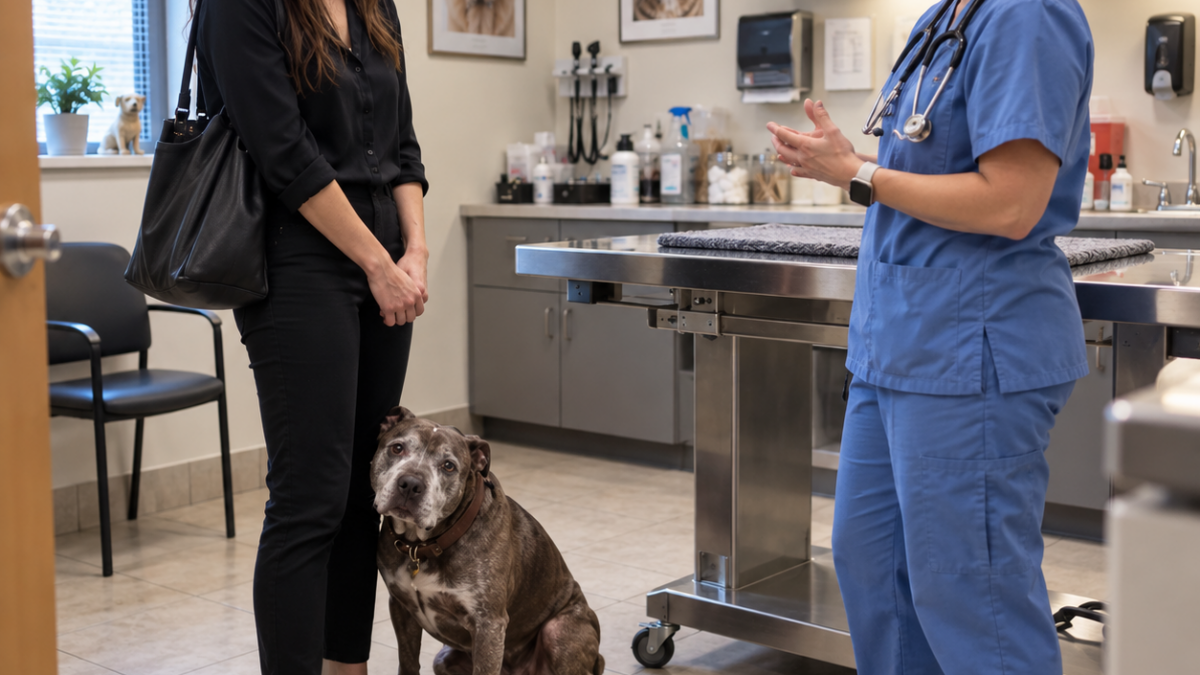
PART 2
I stepped into my office and shut the door, though I kept the glass panel uncovered so I could still see Duke through the examination room.
“Mr. Holman,” I said carefully, “I need you to tell me exactly what happened.”
The old man tried to steady his breathing.
“My dog disappeared Tuesday morning.”
“From your yard?”
“No. From my house.”
That answer put every instinct in my body on alert.
“What do you mean?”
“I woke up and he was gone. His leash was gone too.”
“Was the door open?”
“No.”
“Any sign someone broke in?”
Another silence.
Then he said something very quietly.
“My daughter has a key.”
I sat down.
“What is your daughter’s name?”
“Vanessa.”
The woman in my clinic had signed our intake sheet as Vanessa Holman.
I closed my eyes.
“Mr. Holman, how old is Vanessa?”
“Thirty-four.”
I looked through the glass.
Duke was standing now.
His nose pointed toward the sound of my voice.
“Is she tall, dark hair, wearing a navy jacket today?”
Richard stopped breathing for a second.
“She has Duke?”
“Yes.”
“Why?”
I hated what I had to say next.
“She brought him here asking me to euthanize him.”
The line went silent.
Not quiet.
Silent.
Then Richard made a sound I will never forget.
It wasn’t exactly a cry.
It was the sound of an old man having something inside him torn open.
“No.”
“Mr. Holman—”
“No. No, she wouldn’t.”
“Duke is alive.”
“She told me he ran away.”
“I understand.”
“She helped me put up flyers.”
My stomach dropped.
“What?”
“She drove me around the neighborhood yesterday. We went to the shelter. We called the police. She sat at my kitchen table and told me not to give up.”
I pressed my fingers against my forehead.
Vanessa had apparently helped her father search for the dog she herself had taken.
That changed the situation from a family disagreement into something darker.
“Mr. Holman, where are you right now?”
“At home.”
“Are you alone?”
“Yes.”
“Do you feel safe there?”
“Why are you asking me that?”
“Because if your daughter took Duke without your permission and then lied about it, I want to make sure there isn’t anything else happening that puts you at risk.”
He was silent again.
Then he asked, “Is Duke hurt?”
“No. He has arthritis and I want to run bloodwork because of his age, but he is not dying. He ate chicken ten minutes ago.”
Richard laughed through his tears.
“He’d eat through the side of a barn if there were chicken in it.”
That was the first thing he said that made me smile.
Duke’s head lifted when Richard’s voice came faintly through the phone.
“Would you like me to put you on speaker?”
“Yes.”
I walked back into the examination room and crouched beside Duke.
“Listen.”
I turned on the speaker.
Richard’s voice filled the room.
“Duke?”
The change in that dog was immediate.
His head snapped up.
Tail moving.
Not the polite little wag he had given us.
His entire body came alive.
“Hey, old man,” Richard whispered.
Duke began whining.
He pushed his face toward the phone.
Richard started crying harder.
“There’s my boy.”
Duke pawed at my knee.
Emma turned away and wiped her eyes.
I had seen animals recognize voices before.
But after the coldness of the woman who brought him in, watching Duke hear Richard felt like someone had opened a door.
“I’m bringing him home,” I said.
Richard hesitated.
“Vanessa is coming here later.”
“I know.”
“What happens when she realizes?”
“That’s why we need to handle this carefully.”
I told him not to call her yet.
I also asked permission to contact police and animal control.
He agreed.
Then, in a smaller voice, he said, “Doctor?”
“Yes?”
“Please don’t let her take him.”
“I won’t.”
I did not say those words casually.
At that moment, Duke was in my clinic under my care.
Until lawful ownership was sorted out, no one was walking out with him simply because she demanded it.
I called the county animal-control officer first.
Then the police non-emergency line.
Because Duke wasn’t a stray anymore.
He appeared to have been removed from his owner’s home without consent.
And someone had brought him to my clinic while falsely claiming ownership and asking for a lethal procedure.
Officer Miguel Alvarez arrived forty minutes later.
I knew Miguel from bite investigations and neglect cases.
He was calm, methodical and frustratingly resistant to emotional conclusions.
That was exactly what we needed.
He read the intake form.
Looked at the microchip registration.
Then asked me to repeat the conversation word for word.
“Did Vanessa ever specifically say Richard gave her permission?”
“No.”
“Did you ask whether she owned the dog?”
“Yes.”
“What did she say?”
“Yes.”
“Any documentation?”
“No.”
“Any veterinary records?”
“No.”
“Did she tell you why she wanted euthanasia?”
“She claimed he was suffering because he was old, sleeping more and not playing.”
Miguel looked at Duke.
Duke was currently attempting to convince Emma that he had not already received three pieces of chicken.
Miguel raised an eyebrow.
“He looks committed to life.”
“That’s my medical opinion too.”
“But medically?”
“Arthritis. Possibly some dental disease. Otherwise I have found no condition today that makes euthanasia medically necessary.”
“Can you document that?”
“I already am.”
“Good.”
I gave him permission to copy everything.
Then he called Richard.
The conversation took longer.
Afterward Miguel lowered his phone.
“He confirms he never gave Vanessa permission to take the dog.”
“So what happens?”
“I make a report.”
“That’s all?”
“For now.”
My frustration showed.
Miguel held up a hand.
“Claire, listen. We have an ownership dispute, possible theft of property, possible false representation and potentially elder-abuse concerns depending on what else is happening. I need facts before I start putting labels on people.”
“She tried to have his dog killed.”
“She requested euthanasia.”
“While falsely claiming ownership.”
“Apparently.”
“You heard Richard.”
“I did. And I believe him enough to keep investigating.”
That was as close to agreement as I was going to get.
“Vanessa is coming back at five.”
“I know.”
I glanced at the clock.
Three hours.
“What do you want me to do?”
“Act normally.”
I almost laughed.
“Normally?”
“Don’t accuse her. Don’t tell her where Duke is.”
“Where will he be?”
Miguel looked at me.
“With his owner.”
I exhaled.
“Good.”
“I want to talk to Richard first in person.”
“I told him I’d bring Duke home.”
“Then I’ll follow you.”
We closed the clinic for lunch an hour early.
Emma drove my car because I sat in the back with Duke.
He seemed to know something had changed.
He kept moving from one window to another, sniffing.
Richard lived fifteen minutes away in an older neighborhood of brick ranch houses, mature maples and narrow driveways.
Before we even turned onto his street, Duke stood.
His tail began striking the seat.
Once.
Twice.
Then faster.
“Does he know?” Emma asked.
“I think so.”
At the corner, Duke started whining.
When we pulled into a small driveway beside a white house with green shutters, he lost whatever dignity he had left.
He barked.
Scratched at the door.
Pushed his whole body against me.
“Easy!”
The front door opened.
Richard Holman came outside using a cane.
He was seventy-eight.
Thin.
Gray hair.
Plaid shirt tucked neatly into khaki pants.
Duke saw him.
The dog made a sound so raw that Emma covered her mouth.
I opened the car door.
“Careful—”
Duke jumped.
Arthritis forgotten.
He hit the driveway, nearly slipped, recovered and ran.
Richard dropped his cane.
“Duke!”
The old man went down on one knee.
Duke crashed into him.
I rushed forward because I was afraid Richard would fall.
He did.
Right onto the grass.
And he did not care.
He wrapped both arms around the dog.
Duke climbed halfway into his lap, whining, licking his face, pawing at his shirt.
“My boy.”
Richard buried his face against Duke’s neck.
“My boy. My boy.”
I stood there uselessly with tears running down my face.
Emma was crying openly.
Even Miguel, who had followed behind us, stared toward the sidewalk for a few seconds before approaching.
Richard eventually looked up.
His cheeks were wet.
“Thank you.”
I shook my head.
“Your microchip brought him home.”
“I almost let the registration expire last year.”
“Don’t ever do that.”
He laughed weakly.
“Never again.”
Duke refused to move more than two feet from him.
When Richard stood, Duke stood.
When Richard retrieved his cane, Duke followed.
Inside, I noticed something else.
Flyers covered the kitchen table.
**MISSING DOG — DUKE — 12-YEAR-OLD PIT BULL**
There were stacks of copies.
A roll of tape.
A handwritten list of shelters and veterinary offices.
Richard had truly been searching.
Vanessa had apparently been helping.
Miguel photographed everything.
Then we sat in the living room while Duke pressed against Richard’s legs.
“Tell us about Tuesday morning,” Miguel said.
Richard rubbed Duke’s ear.
“I had physical therapy at eight.”
“For what?”
“Hip replacement. Three months ago.”
“Who drove you?”
“Vanessa.”
“Does she live here?”
“No.”
“Does she have a key?”
“Yes.”
“Why?”
“She helps with groceries. Appointments. Things like that.”
“Financial matters?”
Richard hesitated.
“Some.”
Miguel noticed.
“What does that mean?”
“She pays a few bills online for me.”
“From your accounts?”
“Yes.”
“Does she have power of attorney?”
“Limited power. Only if I need help.”
I felt my stomach tighten.
Miguel asked, “When did you last see Duke Tuesday?”
“Around seven-thirty. He was eating breakfast.”
“You left at?”
“Seven-fifty.”
“Returned?”
“Ten-thirty.”
“Vanessa came inside with you?”
“Yes.”
“And Duke?”
“Gone.”
“Doors?”
“Closed.”
“Gate?”
“Closed.”
“Any damage?”
“No.”
“What did Vanessa say?”
Richard looked down.
“She said maybe I had let him out and forgotten.”
“Do you have memory problems?”
The question offended him.
“No.”
Miguel kept his tone neutral.
“I have to ask.”
“My memory is fine.”
“Any diagnosis of cognitive impairment?”
“No.”
“Does Vanessa believe you have one?”
Richard’s jaw tightened.
“She keeps telling me I’m getting forgetful.”
That sentence changed the temperature in the room.
I looked at Miguel.
He looked at Richard.
“What kinds of things does she say you forget?”
“Appointments. Keys. Whether I locked doors.”
“Do you?”
“Sometimes. I’m seventy-eight.”
“That’s not what I asked.”
Richard smiled faintly.
“No. Not enough that anybody should be making decisions for me.”
Miguel nodded.
“Have you and Vanessa argued about Duke?”
Richard’s hand stopped moving.
“Yes.”
“About what?”
“She thinks I shouldn’t have him anymore.”
“Why?”
“She says he’s dangerous.”
Duke was asleep with his head across Richard’s shoe.
I looked at him.
Miguel asked, “Has he bitten anyone?”
“Never.”
“Shown aggression?”
“Only if you count barking at the vacuum.”
Emma almost smiled.
“Why does she think he’s dangerous?”
“She doesn’t like pit bulls.”
“Anything else?”
Richard’s face hardened.
“She wants me to sell this house.”
There it was.
Miguel leaned forward.
“Why?”
“She says it’s too much for me.”
“Is it?”
“I hire someone for the lawn. I have a cleaner twice a month. I can cook. I can drive, though she doesn’t like me to. I manage.”
“What does Duke have to do with moving?”
“The assisted-living place she wants me to choose doesn’t allow dogs over thirty pounds.”
I stared at Richard.
“How long has she been pushing you to move?”
“Since my surgery.”
“And you refused because of Duke?”
“Partly.”
“Mostly?”
Richard looked at the sleeping dog.
“Mostly.”
Miguel wrote something.
“Did Vanessa know that?”
“She knew.”
I no longer needed imagination to see a possible motive.
Get rid of Duke.
Remove the largest emotional reason Richard had for refusing a move.
Then push the move again.
But motive was not proof.
Miguel asked another question.
“Who owns this house?”
“I do.”
“Mortgage?”
“Paid off.”
“Approximate value?”
Richard gave a number.
Nearly four hundred thousand dollars.
“And if you sold it?”
“I suppose the money would go toward my care.”
“Who manages your finances if you move?”
Richard looked uncomfortable.
“Vanessa has offered.”
Miguel stopped writing.
“Mr. Holman, I need you to do something today.”
“What?”
“Call your attorney.”
Richard frowned.
“My attorney?”
“And your bank.”
“Why?”
“I’m not saying Vanessa has taken money.”
Miguel’s voice became very precise.
“I’m saying we now have evidence she removed your dog from your home, told you he was missing, helped you search and then presented him at a veterinary clinic while claiming ownership. Given that she has access to your finances and has been encouraging a major change involving your home, I want somebody independent to review what authority she has.”
Richard looked older all of a sudden.
Not physically.
Emotionally.
“She’s my daughter.”
“I understand.”
“She wouldn’t steal from me.”
Miguel did not argue.
He simply said, “Then the review will confirm that.”
Richard lowered his eyes.
Duke lifted his head as if he sensed the shift and placed his chin on Richard’s knee.
The old man scratched behind his ears.
“I lost my wife two years ago.”
“I’m sorry,” I said.
“She adored this dog.”
Duke’s tail moved when Richard said the word dog in that soft voice.
“Margaret picked him at the shelter when he was a puppy. Everybody else wanted the little ones. She chose the pit bull with one ear folded backward.”
He smiled.
“She said he looked like he needed somebody stubborn.”
“And she was right?”
“She usually was.”
His smile disappeared.
“When Margaret got sick, Duke slept beside her bed every night.”
The room went silent.
“He stayed there after she died too. For almost a week, he’d go into our bedroom and lie on her side.”
I felt my throat tighten.
Richard looked at me.
“When Vanessa told me he was gone, I thought I’d lost the last living thing that remembered Margaret the way I did.”
Duke stood and pushed his head beneath Richard’s hand.
That was when my anger stopped feeling clinical.
I still had to behave professionally.
But I understood now what Vanessa had almost taken.
Not just a dog.
A history.
A marriage.
A widower’s last daily connection to the woman he had loved for forty-six years.
Miguel finished his report.
Then he called Richard’s attorney from the kitchen.
By three-thirty, Richard’s bank had temporarily suspended Vanessa’s online access at Richard’s request while his account authority was reviewed.
Nothing had been proven financially.
But Richard had decided he no longer wanted her handling his affairs.
At four-fifteen, I returned to the clinic.
Duke stayed with Richard.
Miguel stayed in the area.
Two officers planned to arrive before five.
Emma looked at me as we reopened the lobby.
“You think she’ll come?”
“Yes.”
“What are we telling her?”
“The truth.”
“All of it?”
“When Miguel says.”
At 4:58, Vanessa walked in.
Exactly on time.
She carried the same handbag.
Same controlled expression.
“What room?”
I stayed behind the desk.
“Good afternoon.”
“Is it done?”
Emma looked down at the computer.
I felt something inside me harden.
“No.”
Vanessa stared.
“What?”
“I did not euthanize Duke.”
Her face changed instantly.
“I told you to.”
“And I told you I had to complete medical and ownership verification first.”
“I am his owner.”
“No. You are not.”
For the first time that day, Vanessa looked frightened.
It lasted less than a second.
Then anger replaced it.
“You have no idea what you’re talking about.”
“Duke’s microchip is registered to Richard Holman.”
Her eyes narrowed.
“That’s my father.”
“I know.”
“He gave me the dog.”
“No, he did not.”
“You called him?”
“Yes.”
“You had no right.”
“I had every right to verify legal ownership before performing an irreversible procedure.”
She slammed her palm on the counter.
“My father is confused.”
I had been waiting for that sentence.
“He didn’t sound confused.”
“He’s old.”
“So is Duke.”
“That’s different.”
“How?”
She pointed toward the back.
“Give me the dog.”
“He isn’t here.”
Her expression froze.
“Where is he?”
I didn’t answer.
“Where is he?”
A voice came from behind her.
“At home with his owner.”
Vanessa turned.
Officer Alvarez stood near the lobby door.
Another uniformed officer stood beside him.
Vanessa went pale.
“What is this?”
Miguel approached calmly.
“Ms. Holman, I’d like to speak with you about how Duke came into your possession.”
She looked at me.
Then Emma.
Then Miguel.
“This is insane.”
“Did your father authorize you to take Duke?”
“Yes.”
Miguel said nothing.
“He did.”
“When?”
“Monday.”
“Verbally?”
“Yes.”
“Why did you tell him Duke ran away?”
She stopped.
Her face lost color.
“I didn’t.”
Miguel opened his notebook.
“Your father states you told him exactly that.”
“He misunderstood me.”
“You assisted him in making missing-dog flyers.”
No answer.
“You drove him to shelters.”
Vanessa’s mouth opened.
Closed.
Miguel continued.
“You then brought Duke here and identified yourself as the owner.”
“I’m his daughter. I handle things.”
“Did Richard give you permission to euthanize Duke?”
“My father can’t take care of him.”
“That isn’t what I asked.”
Vanessa’s voice rose.
“He’s seventy-eight years old. He had hip surgery. That dog could knock him over and kill him.”
“Has Duke knocked him over?”
“That isn’t the point.”
“Has he bitten him?”
“No.”
“Has he attacked anyone?”
“No.”
“Did a veterinarian recommend euthanasia?”
“No.”
“Then why were you demanding it?”
Vanessa turned toward me.
“Because she doesn’t know what that house is like.”
I said nothing.
Miguel asked, “What is it like?”
“My father refuses help. He refuses to move. He refuses to listen to anyone.”
“And Duke?”
“He uses that dog as an excuse.”
There it was.
The truth had finally escaped.
Nobody spoke for a moment.
Vanessa realized what she had said.
She quickly added, “I meant he won’t move somewhere safer because the dog can’t go.”
Miguel nodded slowly.
“So you removed the dog.”
“I was trying to help.”
“And told your father it disappeared.”
“I knew he’d never agree otherwise.”
Emma inhaled sharply beside me.
Miguel’s voice remained almost unnervingly calm.
“Then you brought Duke here for euthanasia.”
Vanessa crossed her arms.
“He is old.”
“I’m not asking about his age.”
“He’s going to die eventually.”
The words hit me harder than they should have.
Every living thing in that room was going to die eventually.
That did not give us the right to decide their life no longer mattered because keeping it was inconvenient.
I said, “Duke has arthritis. That is treatable. His bloodwork is excellent for his age.”
She looked at me as though I had betrayed her personally.
“You’re a veterinarian. You’re supposed to prevent suffering.”
“I am.”
“My father is suffering.”
“That does not make killing his healthy dog treatment.”
Her eyes flashed.
“You don’t know anything about my family.”
“No.”
I kept my voice level.
“But I know what walked into my examination room.”
Miguel asked Vanessa to step into one of our consultation rooms.
She refused.
Then changed her mind when he explained that otherwise the conversation could continue at the station.
For the next forty minutes, I treated patients while a family crisis unfolded fifteen feet away.
A cat with kidney disease.
A golden retriever with an ear infection.
A terrier who had eaten half a sock.
Ordinary medicine continued while Duke’s life rearranged itself outside our doors.
Vanessa eventually left with the officers.
She was not taken away in handcuffs.
Not that day.
The investigation was only beginning.
But she left without Duke.
And without the power to decide what happened to him next.
I drove back to Richard’s house after closing.
Duke met me at the door.
Actually met me.
Richard opened it, and Duke pushed past his leg, tail wagging.
“Well, hello to you too.”
I crouched.
He licked my chin.
Richard smiled.
“He remembers his accomplice.”
“Accomplice?”
“You two conspired against my daughter.”
“Your dog committed no crimes.”
“He stole half my roast beef at lunch.”
“That case has stronger evidence.”
Richard laughed.
It was the first time I heard him laugh without pain underneath it.
Then his expression became serious.
“What happened?”
I told him.
Not every detail.
Enough.
When I repeated Vanessa’s admission that she had removed Duke because Richard would not agree to move, his face became still.
“She said that?”
“Yes.”
He sat down.
Duke immediately leaned against his knee.
Richard looked at him for a long time.
“I knew she hated the dog.”
“I’m sorry.”
“I didn’t know she hated me enough to do that.”
I sat across from him.
“I don’t know whether hate is the right word.”
“What else would you call it?”
“Control.”
He looked at me.
“Sometimes people convince themselves that because they believe they know what’s best, they’re entitled to make choices that were never theirs.”
Richard gave a bitter smile.
“That sounds like a polite definition.”
“I’m a doctor. We like clinical language.”
He stared toward the window.
“When her mother died, Vanessa was sixteen.”
I hadn’t known Richard’s wife wasn’t Vanessa’s mother.
“Margaret was her stepmother?”
“No. Margaret was her grandmother.”
I blinked.
“Vanessa is your granddaughter?”
Richard nodded.
“My son died in a car accident when Vanessa was fourteen. Her mother had left years before. Margaret and I raised her.”
That hurt in a completely different way.
The young woman who had brought Duke to my clinic had not merely been an adult daughter trying to manage an aging father.
Richard and Margaret had raised her.
She had grown up in this house.
With Duke.
“She knew him as a puppy?”
“Yes.”
Richard’s voice hardened.
“She helped name him.”
I looked down at the dog.
“Then why?”
“I don’t know.”
Over the following weeks, we learned more.
Not all at once.
Truth rarely arrives cleanly.
Richard’s attorney reviewed his accounts.
Most were fine.
There was no dramatic empty bank account.
No stolen life savings.
That almost made me relieved.
Almost.
But there were things Richard had not fully understood.
Vanessa had changed the mailing address on several financial statements to her home after his hip surgery.
She had been researching real-estate agents.
She had obtained estimates for selling Richard’s house.
She had contacted two assisted-living facilities.
None of those actions alone were necessarily illegal.
She could argue she was planning.
Helping.
Preparing.
But Richard had repeatedly told her he did not want to sell.
Then there was the limited power-of-attorney document.
Richard’s attorney discovered Vanessa had been presenting it as broader authority than it actually granted.
She had no right to sell the house.
No right to change his residence.
No authority over his medical decisions unless Richard became incapacitated.
And Richard was not incapacitated.
His physician confirmed it.
That document was revoked immediately.
Richard also changed his locks.
It was one of the saddest things I ever watched an elderly man do.
I went over the evening the locksmith came because Duke needed a joint injection.
Richard held the new key in his palm.
“I gave her the old one when she turned sixteen.”
He looked at it.
“Twenty years.”
I didn’t know what to say.
Duke nudged his hand.
Richard smiled sadly.
“You’re the only one who still gets unrestricted access.”
Duke wagged.
The animal-control investigation focused on Duke.
Because legally, dogs are property in most contexts, and Vanessa had taken property she did not own.
But the euthanasia request complicated everything.
If I had believed her and performed the procedure, Duke would have been dead.
There was no undoing that.
Vanessa hired an attorney.
Her position was that Richard had verbally authorized her to “take care of the problem.”
Richard denied it.
She claimed she believed euthanasia was in Duke’s best interest.
My medical records contradicted any claim that Duke was obviously suffering beyond treatment.
She claimed she had signed herself in as owner because she considered herself responsible for Richard’s affairs.
The chip and veterinary history showed otherwise.
The case moved slowly.
As cases do.
Duke did not care.
He had more important concerns.
His arthritis improved on medication.
We started him on a joint supplement.
Richard added rugs through the hallway so Duke wouldn’t slip.
I showed him how to use a support harness on bad days.
Emma found a low orthopedic bed on sale and delivered it herself.
Duke ignored it for three nights.
Then discovered it was softer than the floor and claimed it permanently.
One afternoon I arrived for a house call and found Richard asleep in his recliner.
Duke was sleeping beside him.
One hand rested on the dog’s back.
I stood in the doorway and did not wake either of them.
That image became the answer to every argument Vanessa had made in my clinic.
The old man was safe.
The old dog was safe.
Neither needed to be removed from the other because somebody else found their life inconvenient.
Still, Richard had to face reality.
His hip was healing, but he could no longer pretend nothing had changed.
So instead of letting Vanessa choose his future, he built his own plan.
A neighbor agreed to walk Duke on mornings when Richard’s hip was stiff.
A home-care aide came three afternoons a week.
Richard installed grab bars.
He wore a medical-alert device.
His attorney arranged for a professional fiduciary to assist with complex finances if necessary.
He named his nephew Michael as backup medical contact.
Most importantly, every decision happened with Richard sitting at the table.
Not around him.
Not over him.
With him.
“Funny,” he told me once. “All Vanessa had to do was ask me what help I would accept.”
“What do you think you would’ve said?”
“No to most of it.”
I laughed.
He smiled.
“But maybe yes to enough.”
Three months after Duke came into my clinic, Vanessa was formally charged with misdemeanor theft and providing false information related to ownership during the attempted surrender.
The prosecutor declined to pursue a more serious animal-cruelty charge because Duke had not actually been harmed at the clinic and proving intent beyond the theft itself would be difficult.
Richard was furious.
“She tried to have him killed.”
“I know.”
“How is that not cruelty?”
His attorney explained it better than I could.
The law did not always match emotional reality.
A crime still had to fit a statute.
Evidence still had to prove specific elements.
I watched Richard learn one of the hardest lessons victims often learn.
Justice and satisfaction are not the same thing.
Then something happened that changed the case.
Vanessa sent Richard a letter.
Her attorney had probably advised against it.
She sent it anyway.
Richard called me the morning it arrived.
“Claire, can you come over?”
“What happened?”
“I need somebody here when I read something.”
I arrived twenty minutes later.
He sat at the kitchen table.
Duke beside him.
An envelope lay unopened.
Vanessa’s handwriting.
Richard slid it toward me.
“I can’t decide whether to read it.”
“You don’t have to.”
“What would you do?”
“I’d decide what I wanted from it first.”
He frowned.
“What does that mean?”
“If you’re hoping it will erase what happened, it won’t.”
He looked down.
“If you want information, it might give you some.”
“And if I want an apology?”
“You may get words.”
“That isn’t the same thing?”
“No.”
He nodded.
Then opened the letter.
He read silently.
His face changed several times.
Anger.
Pain.
Something like disbelief.
Finally he handed it to me.
“Read.”
I hesitated.
“You sure?”
“Yes.”
The letter was six pages.
Vanessa wrote that she had been terrified after Richard’s surgery.
She said the house felt unsafe for him.
She said Duke was large, old and difficult for Richard to manage.
She said every conversation about moving ended when Richard said, “I’m not leaving Duke.”
Then she wrote the sentence that explained everything.
**I started seeing him as the one thing standing between you and the decision I knew you needed to make.**
Not a dog.
Not family.
An obstacle.
She admitted taking Duke while Richard was at physical therapy.
She drove him to a friend’s house for two days.
Then, after Richard began calling shelters and posting flyers, she panicked.
She wrote that returning Duke would expose the lie.
Taking him to a shelter risked the microchip being scanned.
So she chose a veterinary clinic in another neighborhood and decided euthanasia would end the problem permanently.
My hand stopped on the paper.
She had selected my clinic because she had never been there before.
She believed we would not know Richard.
She believed an old pit bull would be easy to describe as suffering.
She believed age would do the rest.
I felt sick.
Richard’s hands shook.
“She planned it.”
“Yes.”
“She really planned it.”
Duke lifted his head.
Richard put one hand on him.
Vanessa went on to say she had convinced herself she was protecting Richard.
Then came another admission.
She wanted the house sold because she was drowning financially.
Credit-card debt.
A failed business.
A second mortgage on her own home.
She had told herself that if Richard moved, he would eventually give her money from the sale.
Richard stared at nothing for a long time.
“There it is.”
I said nothing.
“She wasn’t just worried about me.”
“No.”
“She needed money.”
“Yes.”
“She nearly killed Margaret’s dog because she wanted me to sell my house.”
The way he said Margaret’s name broke something in me.
He stood.
Duke stood too.
Richard walked to the window.
“I raised her.”
I remained silent.
“I went to every school play.”
Duke followed him.
“Margaret stayed up all night when Vanessa had the flu.”
His voice shook.
“When my son died, we told that girl she would never be alone.”
He turned.
“And she did this.”
I went to him.
Not as his veterinarian.
As another human being.
“I’m sorry.”
He looked at me with wet eyes.
“I keep trying to find the part where I failed her.”
“You may have made mistakes raising her.”
“Of course I did.”
“That still doesn’t make you responsible for this decision.”
He looked down at Duke.
“What do I do with that?”
“You decide what access to your life is safe now.”
That letter became evidence.
Vanessa’s attorney negotiated a plea.
She admitted taking Duke without permission and misrepresenting ownership.
She received probation, restitution for legal and veterinary costs related to the incident, community-service hours with an organization that did not place her in direct care of vulnerable adults or animals, and mandatory counseling as part of the agreement.
A protective order prevented her from entering Richard’s property without his written permission during the probationary period.
Some people expected me to feel triumphant.
I didn’t.
I had wanted accountability.
We got it.
But there is no sentence a judge can give that repairs a family.
The more satisfying consequence happened somewhere else.
Richard took control of his own life again.
He removed Vanessa from every financial account.
Changed beneficiaries where appropriate.
Updated his estate plan.
Not to punish her.
To protect himself.
He established a pet trust for Duke and any future animal he might have, naming Michael as caregiver if Richard died first.
When he told me, I laughed.
“Duke has a trust?”
“A small one.”
“He already thinks he owns your house.”
“He probably does.”
“What if he outlives you?”
“Then he’ll be Michael’s problem.”
Duke wagged.
Richard scratched his chin.
“Worth every penny.”
The local prosecutor also referred Richard’s situation to adult protective services.
Their investigator met with him.
Unlike Vanessa, she did not begin by telling him what he should do.
She asked what he wanted.
Richard wanted to stay in his home.
So they assessed what would make that safe.
Transportation options.
Medication support.
Home modifications.
Emergency contacts.
By spring, Richard was more independent than he had been before Vanessa started “helping.”
That irony was not lost on him.
“She tried to prove I couldn’t live alone,” he told me.
“And?”
“Turns out I just needed better help.”
Duke’s tail thumped against the floor.
“And a dog?”
“Essential medical equipment.”
“I am not writing that prescription.”
“You should.”
Our friendship grew almost accidentally.
Technically I was Duke’s veterinarian.
Practically, I became the person Richard called when he needed someone to tell him whether the dog’s limp was concerning.
Then whether a weird bump mattered.
Then whether Duke could eat blueberries.
Then whether I thought Richard should apologize to Vanessa.
That question came almost a year later.
I had stopped by to administer vaccines.
Duke was thirteen then.
His muzzle had become almost entirely white.
But he remained opinionated.
He barked at my medical bag.
Then accepted a treat from the same hand that gave him his injection.
“Traitor,” I told him.
Richard poured coffee.
“I got another letter.”
“From Vanessa?”
“Yes.”
“Do you want me to leave?”
“No.”
He sat.
“She wants to see me.”
“How do you feel about that?”
“I asked what you think.”
“I know.”
He sighed.
“You veterinarians always answer questions with questions?”
“Only when humans are involved.”
He smiled.
Then became serious.
“She says she finished counseling.”
“That’s good.”
“She says she’s been sober for nine months.”
I looked up.
“Sober?”
Richard nodded.
That part had not appeared in the case.
“Alcohol?”
“Mostly. Pills too, apparently.”
“Did you know?”
“No.”
“She told you now?”
“In the letter.”
He rubbed his hands together.
“She says the debt, the drinking, the panic… none of it excuses what she did.”
“That sounds accurate.”
“She says she doesn’t expect forgiveness.”
“What does she want?”
“To apologize in person.”
“And what do you want?”
Richard looked toward Duke.
“I don’t know.”
For several days, he debated.
Eventually he agreed to meet Vanessa in a counselor’s office.
Neutral place.
No access to the house.
No financial discussions.
No Duke.
He asked whether I would come.
I said no.
That surprised him.
“Why?”
“Because this part belongs to you.”
“You were there when it started.”
“No. It started long before she walked into my clinic.”
He knew I was right.
The meeting lasted forty minutes.
Richard called afterward.
“How was it?”
“Awful.”
“Did she apologize?”
“Yes.”
“Did you believe her?”
“I believe she regrets it.”
“That’s different.”
“Yes.”
“Did you forgive her?”
He was quiet.
“I told her I love her.”
“And?”
“I told her love isn’t the same as trust.”
I closed my eyes.
That was probably the most honest thing anyone could have said.
“Good.”
“She asked about Duke.”
My chest tightened.
“What did you say?”
“That he’s old, spoiled and expensive.”
“Accurate.”
“She asked if she could see him.”
“And?”
“I said no.”
I exhaled.
“Good.”
“Too harsh?”
“No.”
“He knew her once.”
“Yes.”
“But that doesn’t mean he owes her access now.”
Exactly.
Months later, Richard changed his mind.
Not because Vanessa pressured him.
Because he wanted to.
He invited her to meet Duke in the yard.
Michael attended.
So did the counselor.
Richard later told me everything.
Vanessa arrived with no treats.
No toys.
Nothing intended to manipulate the dog.
She stood near the gate.
Duke saw her.
Stopped.
His body became still.
Richard almost ended the visit immediately.
Then Duke walked forward.
Slowly.
He sniffed her shoes.
Her hands.
Vanessa crouched but did not touch him.
“Hi, Duke.”
His ears moved.
For several seconds he stared.
Then he turned around.
Walked back to Richard.
And sat beside him.
Vanessa cried.
Richard did too.
There was no growling.
No cinematic rejection.
No revenge in the way people imagine revenge.
Duke simply chose where he belonged.
He stayed beside Richard.
That was enough.
Vanessa left after ten minutes.
Richard did not invite her inside.
I asked later how he felt.
“Sad.”
“Why?”
“Because I wanted him to hate her.”
I understood.
“But he didn’t?”
“No.”
“He just wanted you.”
Richard looked at me.
“That hurt worse.”
Sometimes indifference is heavier than anger.
Duke had no need to punish Vanessa.
He had his person.
Life continued.
That sounds simple.
It wasn’t.
Trust between Richard and Vanessa rebuilt in inches.
Phone calls first.
Then coffee in public.
Then holidays with Michael present.
She never regained access to his accounts.
She never got a house key.
Richard never changed those boundaries.
Forgiveness, where it existed, did not erase consequences.
That mattered.
At fourteen, Duke slowed significantly.
His arthritis worsened.
We changed medications.
Added physical therapy.
Richard bought a ramp for the back steps.
Duke refused to use it for three days.
Then slipped once on the stairs and immediately decided the ramp was brilliant.
“Still thinks everything has to be his idea,” Richard complained.
“He learned it from you.”
Richard looked offended.
Duke sneezed.
“See? Even he disagrees.”
At fourteen and a half, Duke developed a heart murmur.
Then kidney disease.
Early stage.
Manageable.
We adjusted his diet.
Monitored bloodwork.
Richard followed every instruction so precisely that I once accused him of secretly attending veterinary school.
“I have nothing else to do.”
“You complain about every appointment.”
“That’s part of the treatment plan.”
Duke still ate.
Still wagged.
Still followed Richard from room to room.
Still slept on the rug beside the chair Margaret used to sit in.
That detail always stayed with me.
He remembered.
Perhaps not the way humans remember.
But something in him continued to choose that place.
One evening, Richard showed me a photograph.
Margaret and Duke.
Duke was maybe two years old.
Margaret sat on the porch with both arms around him.
“This was the week Vanessa graduated high school.”
I studied the picture.
Vanessa was visible in the background.
Young.
Smiling.
One hand on Duke’s back.
Three people.
One dog.
Before everything broke.
“Keep it,” Richard said.
“What?”
“The picture.”
“No.”
“I have copies.”
“Still no.”
“Why?”
“It belongs to you.”
He looked at it.
“Maybe that’s the problem. I keep thinking memories belong to people.”
“What do you mean?”
“They happen to everyone who was there.”
He tapped Vanessa’s face in the photo.
“She has that day too.”
I sat beside him.
“Does that make what happened harder?”
“Yes.”
Duke pushed his nose under Richard’s hand.
“Maybe easier too.”
“How?”
“Because I know she wasn’t always the person who walked into your clinic.”
That was an important distinction.
People do terrible things.
Sometimes they become permanently unsafe.
Sometimes they confront what they did and change.
We cannot erase either truth.
Vanessa eventually built a different life.
She sold her own house.
Paid down debt.
Worked for a payroll company.
Continued counseling.
Richard never gave her money from his house because he never sold it.
He stayed.
Duke stayed.
That was the consequence Vanessa had once tried to prevent.
Two years after the clinic incident, Richard invited her to Thanksgiving.
I was there too because apparently being someone’s veterinarian for long enough means you eventually get adopted by the whole household.
Vanessa arrived early.
Duke was asleep near the kitchen.
When he heard her voice, he raised his head.
She stopped.
“Can I?”
Richard looked at Duke.
Then at her.
“If he comes to you.”
Vanessa sat on the floor.
She did not call him.
Did not offer food.
Did not reach.
Duke stared for almost a minute.
Then he stood.
His legs were stiff.
He crossed the room.
Vanessa’s eyes filled.
He sniffed her.
Then, unexpectedly, rested his chin on her knee.
Nobody moved.
Vanessa covered her mouth.
“I’m sorry.”
Duke’s tail tapped the floor.
Once.
Richard turned away.
I saw his shoulders shake.
Vanessa did not hug the dog.
That was the most respectful thing she could have done.
She simply sat there.
After a minute Duke moved away and returned to Richard.
No miracle.
No complete restoration.
Just a small moment.
Sometimes that is all reconciliation should be.
Not forgetting.
Not pretending.
Not returning to what was.
Just allowing something new to exist beside what happened.
Duke reached fifteen.
For a pit bull of his size, every birthday felt borrowed.
Richard threw him a party.
I objected to the cheeseburger.
Lost the argument.
Duke wore a ridiculous paper crown for approximately eleven seconds.
Vanessa attended.
So did Michael.
Emma came from the clinic.
Officer Alvarez stopped by with a bag of dog treats.
“You created this monster,” I told Richard.
“You saved this monster.”
Duke stole part of my hamburger.
“Debatable.”
Miguel laughed.
Later that evening, Richard stood beside me on the porch.
Everyone else was inside.
“You know what still bothers me?”
“What?”
“If you had been having a bad day.”
I knew immediately what he meant.
“If you had believed her.”
I looked through the window at Duke.
He was sleeping beneath the table, surrounded by feet.
“I think about it too.”
“If the clinic had been busy.”
“Yes.”
“If she had gone somewhere else.”
“Yes.”
Richard’s voice lowered.
“He would have died.”
I didn’t soften it.
“Yes.”
For years, that possibility haunted me.
Veterinarians face impossible requests.
Families arrive exhausted.
Animals arrive old.
Sometimes euthanasia is the kindest medical choice.
Sometimes it is the last act of love.
But consent matters.
Ownership matters.
Clinical assessment matters.
And when something does not make sense, questions matter.
Richard looked at me.
“You didn’t save him because of some test.”
“No.”
“You saved him because you didn’t like Vanessa.”
I shook my head.
“That isn’t true.”
“You knew.”
“I suspected.”
“Same thing.”
“No.”
I turned toward him.
“There’s a dangerous difference between intuition and evidence.”
He listened.
“My instincts told me to slow down. The exam told me Duke wasn’t suffering the way she described. The chip told me who the registered owner was. Your statement told us he had been taken. The investigation told the rest.”
Richard nodded.
“So trust your instincts, but verify.”
“Exactly.”
“Sounds less romantic.”
“Medicine usually is.”
He smiled.
Then went inside to stop Duke from stealing pie.
The final year of Duke’s life was gentle.
Not perfect.
Gentle.
His kidneys worsened.
His back legs weakened.
He slept more.
But every morning, he still followed Richard into the kitchen.
Every afternoon, they sat by the window.
Every evening, Duke made one slow patrol through the house before settling beside Richard’s chair.
Vanessa visited once or twice a month.
Always with permission.
Never alone at first.
Eventually Richard allowed her to come without Michael present.
He never returned the house key.
Some boundaries had become permanent.
One evening, Richard called me.
His voice was different.
“Claire.”
“What happened?”
“Duke won’t eat.”
My heart sank.
“How long?”
“Since yesterday.”
“Water?”
“Very little.”
“Can he stand?”
“Barely.”
“I’m coming.”
When I arrived, Duke was on his bed.
Richard sat on the floor beside him.
I had never seen Richard on the floor voluntarily in all the years I knew him.
His hip made it difficult.
He did not care.
Duke lifted his head when I entered.
Tail movement.
Tiny.
Still there.
I examined him.
His gums were pale.
He was dehydrated.
Breathing faster than normal.
His abdomen felt uncomfortable.
At the clinic, tests would confirm what I already feared.
Kidney failure.
Possibly internal disease we had not detected before.
We could hospitalize.
IV fluids.
Ultrasound.
More bloodwork.
Perhaps buy some time.
Richard listened.
Then asked the question every loving owner eventually asks.
“Would it be for him or for me?”
I looked at Duke.
Then Richard.
“We might get a little more time.”
“How much?”
“I don’t know.”
“Would he feel good?”
“I don’t know.”
“Would he come home?”
“Maybe.”
Richard closed his eyes.
Duke rested his head on Richard’s shoe.
A long silence passed.
Then Richard said, “Margaret made me promise something.”
“What?”
“That when Duke’s time came, I wouldn’t keep him here because I was afraid to lose the last piece of her.”
My throat tightened.
“She knew you.”
“Too well.”
He stroked Duke’s white face.
“I almost broke that promise today.”
“That doesn’t make you selfish.”
“Yes, it does.”
“No. Wanting more time is love. What we do with that wanting is the harder part.”
Richard nodded slowly.
“Can we do it here?”
“At home?”
“Yes.”
“Of course.”
He looked relieved.
“I don’t want his last memory to be a clinic.”
I understood.
Especially not this clinic.
Duke’s life had almost ended there once for the wrong reason.
It would end at home for the right one.
Richard called Vanessa.
That surprised me.
“Are you sure?”
“Yes.”
“She should have the choice to say goodbye.”
I said nothing.
That was his decision.
Vanessa arrived forty minutes later.
No makeup.
Hair loose.
Eyes already red.
She entered quietly.
Duke heard her.
His eyes opened.
She sat several feet away.
“Hey, old man.”
His tail moved.
Barely.
She cried.
“I know I don’t deserve this.”
Richard stopped her.
“Don’t make his last hour about what you deserve.”
She nodded.
That may have been the kindest and hardest thing Richard ever said to her.
Vanessa moved closer.
Duke allowed her to touch his paw.
Richard held his head.
I prepared the medication.
Emma had come too.
She stood near the doorway.
Before I gave anything, Richard looked at me.
“Do you remember what she said when she brought him in?”
I knew exactly.
“He’s old. He’s suffering.”
Richard looked at Duke.
“She was wrong then.”
“Yes.”
“And now?”
I swallowed.
“Now his body is failing him, and we cannot make him comfortable enough to give him the life he still deserves.”
Richard nodded.
“That’s the difference?”
“Yes.”
He looked at Vanessa.
“She wanted his life to end because it was inconvenient.”
Then he looked back at Duke.
“We’re letting him go because keeping him would be for us.”
Vanessa broke down.
Richard did not comfort her.
Not then.
His hands stayed on Duke.
I gave the first injection.
A sedative.
Duke relaxed.
His breathing slowed.
Richard lay partly on the rug despite his hip.
Their faces were inches apart.
“There’s my boy.”
Duke’s eyes stayed on him.
“You found your way home.”
Vanessa whispered, “I’m sorry, Duke.”
His tail did not move.
He was too tired.
Richard kissed his forehead.
“Go find Margaret.”
That was the sentence that broke all of us.
I administered the final medication when Richard nodded.
Duke’s breathing became slower.
Then softer.
Then stopped.
I listened with my stethoscope.
Waited.
Listened again.
I placed one hand over Richard’s.
“He’s gone.”
Richard closed his eyes.
For several minutes, nobody spoke.
Vanessa covered her face.
Emma cried quietly.
I stayed on the floor.
Eventually Richard looked down at Duke.
“He got three more years.”
“Almost.”
“Three years she tried to take.”
“Yes.”
He touched Duke’s ear.
“Three good years.”
Very good.
Years of chicken stolen from tables.
Joint medication hidden in cheese.
Slow walks.
Thanksgiving.
Birthday crowns.
Afternoons beside a widower who needed him.
Reconciliation that did not erase betrayal.
A life completed on its own timeline.
That was the part Vanessa had almost taken.
Not simply Duke’s life.
His remaining life.
People sometimes talk about an old dog as if the years ahead matter less because there are fewer of them.
I learned from Duke that the opposite can be true.
When time is short, every ordinary day becomes more valuable.
Every breakfast.
Every nap.
Every slow walk to the mailbox.
Every tail wag when the person you love enters the room.
Three years can contain an entire second life.
After Duke died, Richard had his ashes placed in a wooden box beside Margaret’s photograph.
Vanessa offered to pay for it.
Richard declined.
Not angrily.
“I’ve got him.”
That phrase had become sacred.
A month later, Richard asked me to visit.
On the kitchen table sat an envelope.
“What now?”
“My will.”
“I am absolutely not reading your will.”
He laughed.
“Relax.”
He handed me one page.
It described a donation.
Richard had established a small fund through our clinic and the county shelter to help senior pet owners pay for microchips, arthritis medication and temporary in-home assistance after hospitalization.
He called it the Margaret and Duke Fund.
I read the name twice.
“You didn’t have to do this.”
“Yes, I did.”
“Why?”
“Because people shouldn’t lose their animals just because they get old at the same time.”
That sentence stayed with me.
The fund began modestly.
Then Richard told his church.
Other people donated.
Officer Alvarez connected us with local aging-services groups.
Within two years, we had helped dozens of elderly owners keep pets safely at home.
A widow recovering from a stroke kept her beagle because volunteers walked him for six weeks.
A man undergoing chemotherapy received temporary boarding for his cat.
An eighty-two-year-old woman received a ramp for her elderly Labrador.
Duke never met those animals.
He still changed their lives.
That became the most satisfying answer to what Vanessa had done.
She had tried to erase one old dog because she believed he stood in the way.
Instead, Duke became the reason other senior dogs stayed exactly where they belonged.
Richard once called that revenge.
I disagreed.
“Revenge wants somebody else to hurt.”
“What do you call this?”
“Consequences.”
“For Vanessa?”
“No.”
I smiled.
“For the world.”
He laughed.
Vanessa continued rebuilding her relationship with Richard.
Slowly.
She never managed his money again.
Never made medical decisions for him.
Never held a key.
But she called.
Visited.
Brought groceries when asked.
Left when asked.
Listened more.
Years later, when Richard eventually chose on his own to move into a smaller senior apartment, Vanessa helped pack boxes.
He did not move because somebody forced him.
He moved because stairs had become difficult and he found a place he liked.
Pets were allowed.
He no longer had Duke.
But the building had a therapy dog named Rosie.
Richard complained she was too small.
Then kept dog biscuits in his drawer for her.
I visited him there once.
He had Margaret’s photograph on a table.
Duke’s wooden box beside it.
Same arrangement as home.
“You happy?” I asked.
“I’m content.”
“Different?”
“Very.”
“Better?”
“At my age, content is underrated.”
I laughed.
Vanessa arrived while I was there.
She hugged him.
He hugged her back.
There were still scars.
You could feel them.
But there was also something that looked like family again.
Not the old version.
A new one built with boundaries.
When I left, Vanessa followed me into the hallway.
“Dr. Morgan?”
“Yes?”
“I never thanked you.”
“You don’t need to.”
“I do.”
“For stopping me.”
I studied her.
“You hated me for a long time.”
“Yes.”
“Do you still?”
“That isn’t a useful question.”
She almost smiled.
“Still the veterinarian.”
“Always.”
She looked toward Richard’s door.
“I thought I was solving a problem.”
“I know.”
“That scares me more now than if I’d been angry.”
“What do you mean?”
“I had made it sound reasonable in my head.”
That was one of the most honest things she ever said.
“I told myself Grandpa couldn’t manage Duke. I told myself Duke was old. I told myself assisted living was safer. I told myself selling the house would eventually help everybody.”
She looked at me.
“Every lie made the next one easier.”
“Yes.”
“If you hadn’t scanned that chip…”
I stopped her.
“But I did.”
She nodded.
“I know.”
“Live with what happened, not what almost happened.”
“I’m trying.”
“Good.”
That was the last serious conversation Vanessa and I ever had.
Richard died peacefully several years later.
Michael called me.
Vanessa was with him.
Richard had been ninety-one.
When his belongings were sorted, Vanessa gave me something.
The old red leash Duke had worn the day he almost died in my clinic.
“Grandpa kept it.”
I ran my hand over the worn nylon.
“Why?”
“He said it reminded him that sometimes one person asking one more question changes everything.”
I still have it.
It hangs in my office.
No plaque.
No inspirational quote.
Most clients don’t know what it is.
But when somebody brings me an old animal and says, “He’s just old,” I think about Duke.
I think about the way he took chicken from my hand.
The way his ears lifted when he heard Richard’s voice.
The way he ran across that lawn despite arthritis.
The way a man collapsed into the grass because something he believed was lost forever came home.
I also remember something harder.
Not every euthanasia request is wrong.
I have helped hundreds of families say goodbye when goodbye was the kindest choice left.
I have held paws while cancer won.
I have sat on floors with owners who would have traded years of their own lives for one more month with their animal.
Those decisions are not failures.
Sometimes love means ending suffering.
But Duke taught me the other side of that responsibility.
Age is not suffering.
Inconvenience is not suffering.
A slower walk is not suffering.
Sleeping more is not suffering.
Gray hair is not suffering.
And nobody gets to turn another living creature’s death into a shortcut around a problem they do not want to solve honestly.
The day Vanessa entered my clinic, she wanted a five-minute procedure.
She wanted paperwork.
A receipt.
An empty leash.
She wanted to return to Richard’s house and eventually tell him his missing dog had probably died somewhere.
Instead, Duke’s microchip made one small electronic beep.
That beep gave him almost three more years.
It gave Richard the truth.
It exposed a lie.
It forced a family to confront things that had been hidden beneath words like help, safety and responsibility.
It pushed an old man to take control of his own future.
It changed how I handle end-of-life requests.
And eventually it helped other elderly people keep the animals they loved.
Vanessa once believed Duke was standing in the way of Richard’s future.
She was wrong.
Duke became part of the reason Richard got his future back.
That is the ending I carry with me.
Not Vanessa standing in my lobby demanding that I kill a healthy dog.
Not the police report.
Not the courtroom.
Not even the apology.
I remember Duke running from my car into Richard’s arms.
I remember the old man falling into the grass.
I remember Duke licking his face as though three terrible days had simply disappeared.
And years later, when Duke’s body finally reached the point Vanessa had falsely claimed it had reached that first afternoon, I remember the difference.
The first time, Duke looked at me as if he were asking for a chance to keep living.
The last time, he was tired.
Safe.
Home.
Richard’s hands were on him.
The people who loved him were beside him.
Nothing was being taken.
Nothing was being forced.
Nobody was trying to remove an inconvenience.
We were protecting him from pain.
That is what euthanasia is supposed to be.
Not disposal.
Not convenience.
Not control.
Mercy.
Duke had almost been denied the years between those two moments.
Instead, he got every one of them.
And the woman who had tried to decide his life without permission eventually had to live with the most powerful consequence of all.
She watched the dog she once treated as an obstacle become the reason her grandfather stood up for himself, rebuilt his independence, protected other animals and spent his remaining years knowing that someone had finally listened when Duke could not speak for himself.
The morning Richard died, Michael told me they found Duke’s old collar beside his bed.
Richard had apparently been holding it.
I like to think that somewhere in his last thoughts there was a white-muzzled pit bull running across a lawn toward him again.
No limp.
No clinic.
No missing posters.
No locked doors.
Just Margaret waiting somewhere ahead and Duke refusing, as always, to let Richard make the journey alone.
And whenever I look at that old leash hanging in my office, I remember the promise I made to Duke before I knew his name.
I told him I would help him.
At the time, I thought that meant saving one dog.
I was wrong.
It meant believing what his body was telling me when the human beside him was lying.
It meant asking one more question.
Checking one more record.
Making one more phone call.
And refusing to let age be mistaken for a reason to erase a life that was still very much being lived.
Duke did not need me to speak for him forever.
He needed me to listen long enough for the truth to catch up.
And on the day that truth finally reached Richard Holman’s front yard, Duke did all the speaking himself.
He ran straight into the arms of the man who had been waiting for him.
He covered his face in kisses.
And for the first time since the woman had walked into my clinic and demanded that his life end, nobody in the world needed to ask whether that old dog still wanted to live.
The answer was right there in his wagging tail.








