PART 2: Rich HOA President Called the Cops on Me for Fishing My Own Lake—Then She Learned I Owned the Lake, the Only Road In, and Eight Years of Her Receipts
PART 2
I didn’t tear the sign down the next morning.
That surprised people later.
They assumed that because the sign was on my land, because it embarrassed me in front of my daughter, because Tammy had practically laughed when I asked for proof of ownership, my first instinct must have been to rip it out of the ground and throw it into a ditch.
It wasn’t.
Surveyors are trained to distrust impulse.
A boundary dispute is rarely won by whoever gets angriest first.
It is won by whoever can prove where the line is.
So I measured.
I photographed.
I documented.
And the next Saturday, Ellie and I went fishing beside Tammy’s sign.
She wore Sarah’s old navy sweatshirt because the morning was cold.
I carried the tackle box.
Ellie carried her mother’s rod.
As we walked down the bank, she glanced at the sign again.
“You’re really leaving it there?”
“For now.”
“Why?”
“Because sometimes when people are doing something wrong, the smartest thing you can do is let them keep doing it long enough to prove it.”
She frowned.
“That sounds like something Grandpa Herschel would say.”
“He would’ve said it with more cussing.”
That made her laugh.
God, I missed that sound.
Grief does something strange to a house.
After Sarah died, laughter felt almost disrespectful at first.
Like joy was a room we were no longer allowed to enter.
But children don’t stay inside grief the way adults do.
They run out of it for a few seconds, then come back.
Every time Ellie laughed, I tried to follow her.
We caught three bass that morning.
The biggest one was a little over four pounds.
Ellie insisted I hold it up.
“With the sign behind you,” she said.
“Why?”
“So someday we can laugh at how stupid it was.”
I held the fish.
She took the picture.
The sign was perfectly visible behind my shoulder.
**PRIVATE LAKE. HOA MEMBERS ONLY.**
A lie in clean lettering.
I saved the photograph.
Added the date.
Added the location.
Then we released the fish.
At that point, I still believed the sign might be the worst thing Tammy would do.
I had badly underestimated her.
## **THE WOMAN WITH THE CLIPBOARD**
Tammy Holcomb had been HOA president since 2017.
She was fifty-two, always perfectly put together, blonde highlights maintained with the discipline of a military schedule, white Cadillac Escalade, gold jewelry, expensive sunglasses, and a clipboard that never seemed to leave her hands.
The residents joked about the clipboard.
Not around her.
But they joked.
Tammy had rules about everything.
Trash cans had to be pulled behind the house by a specific hour.
Mailbox posts could only be painted from an approved list of shades.
Exterior holiday lights had a removal deadline.
Basketball goals couldn’t extend too far toward the street.
One man had received a warning because his garden hose was coiled in a way Tammy thought looked messy.
That was the kind of authority she liked.
Not solving problems.
Defining them.
Deciding that something harmless was suddenly unacceptable because she had noticed it.
But before she became HOA president, Lakeview Crossing had been just another subdivision built on land that once belonged to my family.
In 2015, my father sold eighty acres on the east side of the property to a developer named Garrett Holcomb.
Tammy’s husband.
That detail would matter later.
Garrett developed the land into one hundred twenty-seven homes.
But the sales contract excluded the lake.
It excluded Dawson Ridge Road.
Those remained with the Dawson Family Trust.
The subdivision was granted access through the road.
That was it.
People drove through.
We didn’t charge them.
My father believed neighbors should be neighbors.
After he died, I kept it that way.
Every spring, I filled potholes.
I replaced washed-out gravel.
I trimmed tree limbs.
I repaired drainage.
Nobody from the HOA paid me.
Nobody offered.
I didn’t ask.
My mistake was assuming that generosity stays recognizable as generosity.
Sometimes, if you leave a door open long enough, somebody decides they own the doorway.
Tammy did exactly that.
The first strange letter had arrived about a year after Sarah died.
**LAKE ACCESS REGISTRATION.**
Two hundred dollars annually.
Mandatory.
I laughed when I read it.
Then I threw it away.
That was another mistake.
I thought ignoring nonsense made it disappear.
Tammy interpreted silence as obedience.
She began referring to the lake in HOA newsletters as “Lakeview Crossing Community Lake.”
Then “our lake.”
Then “private HOA amenity.”
Words matter.
Repeat a claim often enough and people stop asking when it became true.
By the time Tammy installed the sign, most residents genuinely believed the HOA owned the water.
The problem was, Tammy wasn’t content with belief.
She wanted revenue.
## **THE YELLOW KAYAKS**
November brought eight kayaks.
Bright yellow molded plastic.
They appeared one Saturday morning stacked on a new wooden rack near the southern shoreline.
My shoreline.
Each kayak had a laminated tag attached to the handle.
**LAKEVIEW CROSSING RECREATION PROGRAM**
**$15 PER USE**
I stood beside the rack reading the cards.
Ellie stared at them.
“Did you buy those?”
“No.”
“Did Grandpa?”
“No.”
“Then who did?”
“Take a guess.”
She groaned.
“Tammy.”
“Tammy.”
The next HOA invoice answered the rest.
Every household had been charged a new mandatory **lake amenity fee**.
Two hundred dollars per year.
One hundred twenty-seven homes.
Twenty-five thousand four hundred dollars every year.
For access to my lake.
I did the math three times.
Then I sat at the kitchen table and stared at the number.
$25,400.
Sarah used to tease me because I double-checked restaurant bills.
“Surveyor brain,” she called it.
“You people can’t let a number exist without interrogating it.”
She was right.
Now my surveyor brain had something to interrogate.
I started asking residents questions.
Not confrontationally.
Just casually.
One Saturday, a married couple paddled past the dock in one of Tammy’s yellow kayaks.
They were probably in their late forties, matching visors, matching life jackets.
The woman smiled.
“Beautiful morning!”
“It is.”
“Do you live in Phase Three?”
“No, ma’am.”
“Oh. Which section?”
“I don’t.”
She looked confused.
I gestured toward the lake.
“My grandfather built this.”
The husband stopped paddling.
“Excuse me?”
“This is Dawson property.”
The woman glanced toward the HOA kayak.
“We paid at the clubhouse.”
“I’m sure you did.”
“Tammy said the lake belonged to the subdivision.”
“That’s what Tammy says.”
They stared at each other.
Then back at me.
I could see embarrassment creeping across their faces.
I felt sorry for them.
That was important.
They weren’t stealing.
They had been sold access by someone they trusted.
“You’re not in trouble,” I said.
The woman’s shoulders loosened.
“I don’t blame you.”
“Then why is she charging us?”
“That’s a question you may want to ask her.”
They paddled away much more slowly than they had arrived.
A week later, two more residents asked me about ownership.
Word was beginning to move.
Not loudly.
But movement had started.
Then Tammy made her next mistake.
She took the argument from signs and fees to steel and concrete.
## **THE FENCE**
Three weeks before Christmas, Ellie and I drove to the lake before sunrise.
The first thing I noticed was the frost.
The second was the fence.
Six feet of chain-link ran along the south bank.
Galvanized steel.
Fresh concrete footings.
A locked gate.
And another sign.
**AUTHORIZED HOA MEMBERS ONLY**
**NON-MEMBERS WILL BE PROSECUTED**
I stopped the truck.
Ellie said nothing.
She sat in the passenger seat with Sarah’s rod across her knees.
The silence lasted long enough that I finally looked at her.
She wasn’t angry.
She looked hurt.
“That’s Mom’s fishing spot.”
I wish I could explain what that sentence did to me.
There are moments after losing someone when grief comes back without warning.
Not like sadness.
Like impact.
Sarah’s place on the bank.
Her thermos.
Her laugh.
Her bare feet near the water.
Her hands teaching Ellie to tie a knot.
For a second, I could see all of it.
Then the chain-link fence came back into focus.
Some woman who had never met Sarah had fenced our daughter away from one of the last physical places where her mother still felt close.
I gripped the steering wheel.
Ellie looked at me.
“Dad?”
“Yeah?”
“Are you okay?”
I took a breath.
“Yeah.”
I wasn’t.
But parenting means sometimes giving your child the steadiness you don’t yet feel yourself.
I parked.
Walked to the fence.
Photographed everything.
Posts.
Concrete.
Gate.
Lock.
Sign.
Coordinates.
Then I drove home.
The next morning, I went to the hardware store.
Bought bolt cutters.
Kept the receipt.
The cashier looked at them.
“Big project?”
“Something like that.”
“You want the receipt?”
“Yes, ma’am.”
She handed it over.
I folded it carefully.
“I’m definitely going to want this one.”
I drove straight to the lake.
The gate was on my land.
The fence was on my land.
The lock was on a structure installed without my permission.
I placed the cutters around the shackle.
Squeezed.
The metal snapped.
The lock hit frozen ground.
I opened the gate.
Then I removed the sign.
I had barely set it in the back of my truck when a white Escalade appeared.
Tammy.
Of course.
She stopped hard enough to throw gravel.
Jumped out.
“What are you doing?”
“Removing an unauthorized lock.”
“You are destroying HOA property!”
“On my land.”
“I’m calling the police.”
“Okay.”
She blinked.
Maybe she expected resistance.
Maybe fear.
Instead, I leaned against my truck.
She called.
A deputy arrived fifteen minutes later.
Clint Yarborough.
I had known Clint since high school.
His father had bought fence posts from Granddad.
But Clint didn’t take my word for anything.
That was one of the reasons I respected him.
“What’s going on?”
Tammy spoke first.
“He destroyed HOA property and broke into a restricted recreational area.”
Clint looked at me.
“Wade?”
I handed him the deed.
Then the survey.
Then photographs.
Tammy crossed her arms.
“This is ridiculous.”
Clint radioed the county clerk.
A few minutes later, he returned to us.
“Mrs. Holcomb?”
“Yes?”
“County records show this property belongs to the Dawson Family Trust.”
Her jaw tightened.
“That’s outdated.”
“It isn’t.”
“The HOA has rights.”
“Maybe access rights somewhere. That’s a civil question.”
She pointed toward me.
“He cut our lock!”
Clint looked at the gate.
“On his property.”
“This is a community amenity!”
“Not according to the records I just confirmed.”
The look on Tammy’s face would have been funny if the situation hadn’t already caused so much damage.
She looked at Clint.
Then me.
Then the lake.
As if water itself had betrayed her.
She got back into the Escalade.
Before leaving, she rolled down the window.
“This isn’t over.”
I believed her.
That was the problem.
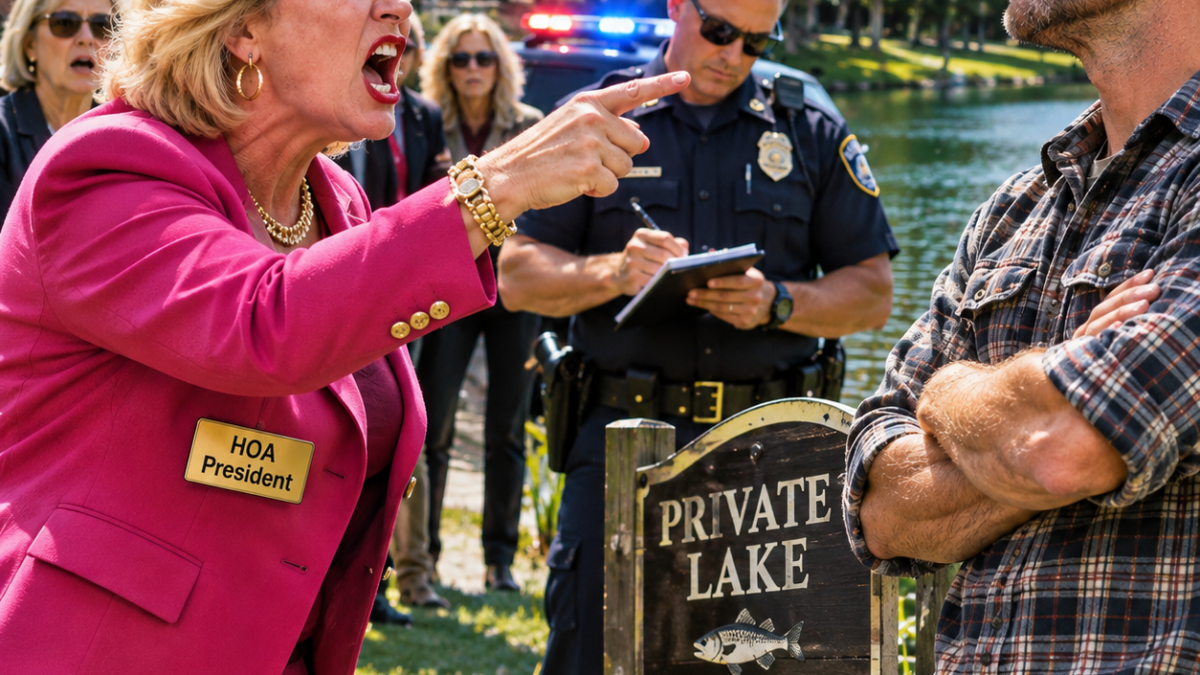
## **THE FIRST TIME SHE CALLED THE COPS ON ME FOR FISHING**
The incident that eventually became neighborhood legend happened two weeks later.
Saturday.
Six in the morning.
Ellie and I were on the dock.
Fog sat low over the water.
Sarah’s rod rested in Ellie’s hands.
We hadn’t been there twenty minutes when headlights came down the road.
Tammy’s Escalade.
She stopped near the bank.
Got out.
No good morning.
No hello.
“Get off the lake.”
I kept my voice low because Ellie was beside me.
“Ma’am, we’re fishing.”
“Did I stutter?”
Ellie looked at me.
Tammy pointed toward the truck.
“You are trespassing.”
“This property belongs to my family.”
“Your family?”
She looked at my faded jacket.
My muddy boots.
Then the old pickup parked near the dock.
Her eyes stopped on the inexpensive tackle box.
Something like disgust crossed her face.
“You look like a squatter.”
I could feel Ellie stiffen beside me.
“Tammy,” I said, “don’t talk like that in front of my daughter.”
“I don’t care about your daughter.”
That did it.
Not enough for me to yell.
Enough for me to remember every word.
She continued.
“I am the HOA president. This is a private lake.”
“It is.”
“Then leave.”
“Private to me.”
She laughed.
Actually laughed.
“You’re nobody.”
Ellie’s hand tightened around the rod.
I stood.
“Ma’am, please go home.”
Instead, Tammy pulled out her phone.
“I’m calling the sheriff.”
“Go ahead.”
She did.
Two patrol cars showed up.
Two.
For a father and his eleven-year-old daughter fishing at sunrise.
I will never forget how Ellie looked when the officers walked toward us.
Not because I was afraid of being arrested.
Because she was.
“Dad?”
“It’s okay.”
“Are they taking you?”
“No.”
“How do you know?”
“Because we haven’t done anything wrong.”
But she had already seen enough of the world to know that being right doesn’t always stop frightening things from happening.
One officer recognized me.
The other didn’t.
They asked for identification.
I gave it.
They asked what happened.
Tammy talked for five straight minutes.
Illegal fishing.
Trespassing.
Harassment.
Interfering with an HOA amenity.
When she finished, I handed them the deed.
The officers studied it.
Then one called dispatch.
Ten minutes later, the entire mood changed.
The older deputy walked toward Tammy.
“Ma’am, this is private Dawson property.”
“That’s what he keeps claiming.”
“No. That’s what county records show.”
“He can’t fish here without authorization.”
“He is the owner.”
Tammy stared at him.
Then at me.
“What about the HOA?”
The deputy shrugged.
“You’ll need to address that civilly.”
For the first time all morning, Tammy had no response.
She climbed into the Escalade.
Drove away.
Ellie watched the SUV disappear.
Then she looked at me.
“Why does she keep saying it’s hers?”
I sat beside her.
“Because she’s used to people believing her.”
“Do you think she believes it?”
That question stopped me.
Maybe she did.
That was the dangerous part.
A liar who knows she’s lying stays cautious.
A liar who repeats the lie until she believes it becomes reckless.
Tammy was becoming reckless.
## **NADINE**
The November HOA meeting gave me my first real ally.
Her name was Nadine Pruitt.
Retired CPA.
Thirty-one years at a Knoxville accounting firm.
Gray hair.
Reading glasses on a chain.
Sensible shoes.
The kind of woman you could overlook in a crowded room right up until she told you your numbers were wrong.
I attended the meeting specifically to ask one question.
Tammy sat behind her folding table with a cheap wooden gavel.
During public comment, I raised my hand.
She visibly disliked recognizing me.
“Yes, Mr. Dawson?”
“I’d like to see the deed showing HOA ownership of the lake.”
About forty heads turned.
Tammy didn’t move.
“The lake has always been community property.”
“That’s not what I asked.”
“Excuse me?”
“A development plan isn’t a deed. A plat isn’t a deed. I’d like to see the instrument transferring ownership.”
Her face tightened.
“The board has reviewed ownership.”
“Then producing the deed should be easy.”
“This meeting is not a courtroom.”
“No, ma’am.”
She lifted the gavel.
“The discussion is closed.”
“Do you have the deed?”
She hit the table.
“Meeting adjourned.”
Afterward, in the parking lot, Nadine approached me.
“Mr. Dawson?”
“Wade.”
“I’m Nadine Pruitt.”
“I know.”
She glanced toward the clubhouse.
“The numbers don’t make sense.”
“What numbers?”
“HOA finances.”
That got my attention.
She continued.
“There are transfers I can’t trace. Fees with no matching expenses. And I have never seen a deed for that lake.”
“Because there isn’t one.”
“I suspected that.”
“How long have you been looking?”
“About a year.”
“Why?”
She smiled slightly.
“Because Tammy hates questions.”
I laughed.
“So do bad balance sheets.”
That night, Nadine and I stood beneath a buzzing parking-lot light talking for nearly fifteen minutes.
Neither of us was loud.
We didn’t need to be.
She counted money.
I measured land.
Between us, Tammy had chosen a very unfortunate pair of people to lie to.
## **THE ROAD**
One cold January night, I found the document that changed everything.
My grandfather’s workshop still smelled like sawdust and machine oil.
I had converted part of it into an office, but some spaces never really change owners.
They hold onto the people who built them.
I was sorting old deeds, survey notes, tax receipts, and contracts.
At the bottom of a box sat an envelope labeled:
**DAWSON RIDGE ROAD**
I knew the deed existed.
I had read it years earlier.
But grief, work, raising Ellie alone, and simply trusting that old arrangements would continue had made me forget how important the wording was.
I opened it.
Read slowly.
The road began at County Road 441 and ran approximately seven-tenths of a mile to the Dawson property.
Ownership remained with the Dawson Family Trust.
Then I pulled the 2015 sales agreement.
Page four.
Paragraph nine.
Lake excluded.
Road excluded.
The subdivision received access.
Nothing else.
And there was Garrett Holcomb’s signature.
Blue ink.
Tammy’s husband knew.
He had always known.
I sat back.
Then I began calculating.
Lake amenity fee:
$200 per household annually.
Road maintenance fee:
$150 per household annually.
Total:
$350.
One hundred twenty-seven homes.
Eight years.
$355,600.
I stared at the number.
Then calculated again.
Same answer.
Three hundred fifty-five thousand six hundred dollars.
And the road maintenance?
I had done it.
Every spring.
My fuel.
My gravel.
My chainsaw.
My culvert pipe.
My labor.
Tammy had been collecting road fees while I maintained the road myself.
The anger I felt then was different from everything before.
Quiet.
Cold.
I thought about Sarah.
Ellie.
The fence.
The police.
The way Tammy had looked at my truck and decided what kind of man I was.
Then I understood something bigger.
She thought the lake gave me leverage.
It didn’t.
The road did.
Every resident used Dawson Ridge Road.
Every school bus.
Every delivery vehicle.
Every ambulance.
Every contractor.
The subdivision depended on access through land my family owned.
I could have gated it.
I could have charged.
I could have made life miserable.
That realization scared me more than it excited me.
Power feels different when you actually have it.
I called a real-estate attorney the next morning.
Arliss Pemberton.
His office was in Maryville inside an old converted house that creaked every time somebody moved.
A framed photograph of Johnny Cash hung behind his desk.
Arliss read everything.
He barely spoke for forty minutes.
Finally, he leaned back.
“Wade.”
“Yes?”
“They’ve been operating a toll booth on your driveway.”
I rubbed my forehead.
“That’s what it looks like.”
“No. That’s what it is.”
He pointed toward the documents.
“They’ve been collecting money based on ownership claims they cannot support.”
“Tammy says the HOA owns everything.”
Arliss smiled.
“Tammy can say she owns Dollywood. Doesn’t make Dolly Parton a tenant.”
I laughed despite myself.
Then his face became serious.
“How much?”
I slid the calculation across the desk.
$355,600.
His eyebrows rose.
“Well.”
“That bad?”
“For them?”
“Yes.”
## **BUILDING THE CASE**
Arliss had one rule.
“No heroics.”
“What does that mean?”
“No threats. No dramatic gate closing. No angry social-media posts. No touching anything you don’t have to touch.”
“I wasn’t planning to.”
“Good.”
He tapped the stack of paper.
“We let documents do the damage.”
That was language I understood.
Part one was a professional survey.
I surveyed my own property with the same standards I would use for a paying client.
Boundary points.
Coordinates.
Legal descriptions.
Lake shoreline.
Road alignment.
Every relevant encroachment.
Then I stamped it.
My name.
My license number.
My reputation.
Part two was surveillance.
Trail cameras.
One near the dock.
One near the road entrance.
One near the kayak rack.
One near the fence.
Nothing hidden inside anybody’s home.
Nothing aimed where it shouldn’t be.
Only my property.
Motion activated.
Date and time recorded.
Part three was money.
Nadine began requesting HOA records.
Tammy resisted.
Nadine requested again.
Eventually documents arrived.
Then the stories started.
One homeowner had been fined because his son’s basketball goal extended two inches too far.
Another received a violation over shutter color even though she had used an approved paint code.
A family had been threatened with a lien because Christmas lights remained up one day too long.
Nadine called me.
“She’s been training them not to question her.”
“How?”
“Small penalties.”
I understood.
“You make people fight enough tiny battles, eventually they stop fighting the big ones.”
“Exactly.”
More than thirty households agreed to start attending meetings.
Not to scream.
To ask questions.
That was much more dangerous for Tammy.
## **THE SPECIAL ASSESSMENT**
Once Tammy realized people were talking, she called an emergency meeting.
The email subject read:
**URGENT — PROTECTING COMMUNITY ASSETS FROM EXTERNAL THREATS**
I was the external threat.
The man whose family owned the land before the subdivision existed.
Eighty residents attended.
Tammy prepared a PowerPoint.
Of course she did.
Slide one showed a shield.
Slide two referenced “unauthorized lake use.”
She never said my name.
She didn’t have to.
Then she announced her proposal.
A five-hundred-dollar special assessment per household to fund legal action.
$500 times 127 homes.
$63,500.
To sue me.
For claiming ownership of property I owned.
Nadine stood.
“Before we vote, I want to see the deed.”
Tammy froze.
“The deed is on file.”
“I checked county records.”
Nadine’s voice remained calm.
“There is no deed transferring the lake to this association.”
“This is out of order.”
“Where is the deed?”
“Sit down.”
“Show us the deed.”
People began whispering.
Tammy hit the gavel.
“Nadine, you are out of order.”
“I’ll sit when you answer.”
Tammy’s face reddened.
I watched from the back.
For years, Tammy’s authority had depended on people assuming questions were inappropriate.
Nadine had just asked the simplest question imaginable.
**Where is the deed?**
Tammy couldn’t answer.
The special assessment still passed.
Barely enough.
But twenty-nine residents voted no.
That was unprecedented.
The cracks had started.
## **THE CEASE-AND-DESIST**
Two days later, a letter arrived from Garrett Holcomb’s personal attorney.
It demanded that I stop making “false and defamatory claims” regarding the lake and road.
I read it twice.
Then called Arliss.
“Garrett signed the 2015 contract excluding both properties.”
“I know.”
“And now his lawyer says I’m lying?”
“Yes.”
Arliss became quiet.
Then started laughing.
Not politely.
Full laughter.
“Wade, I’m framing this.”
“You’re joking.”
“I’m not.”
Weeks later, it was hanging beside Johnny Cash.
But Garrett’s involvement bothered me.
Until then, I had treated Tammy as the driving force.
Maybe Garrett was simply unwilling to contradict his wife publicly.
Maybe he had forgotten.
Then something happened that removed all doubt.
## **THREE TRUCKLOADS OF STONE**
I came home from a survey job in Sevier County just before dark.
My driveway was blocked.
Not partially.
Completely.
Three loads of crushed limestone had been dumped across Dawson Ridge Road.
Three feet high in places.
Eight feet wide.
A wall of rock.
My truck couldn’t pass.
I stood on County Road 441 staring at it.
Diesel still hung in the cold air.
Tire ruts had torn the shoulders.
I called Ellie.
She answered quickly.
“Dad?”
“You okay?”
“Yeah.”
“How did you get home?”
Silence.
“Ellie?”
“The bus couldn’t get through.”
My blood went cold.
“What?”
“It turned around.”
“How did you get home?”
“Mrs. Patterson picked me up.”
“You walked?”
“To the county road.”
It was cold enough that morning for frost.
My daughter had walked nearly seven-tenths of a mile because somebody deliberately blocked our road.
I parked.
Climbed over the rock.
Walked home.
Fourteen minutes.
I counted.
Ellie stood on the porch in pajamas and socks.
She looked small.
Too small.
“Dad?”
I hugged her.
Then she asked:
“Why does she hate us?”
There are questions you can answer with measurements.
Distance.
Elevation.
Property lines.
Then there are questions no instrument can help with.
“I don’t know if she hates us.”
“She keeps doing things.”
“I know.”
“She said she didn’t care about me.”
I closed my eyes for half a second.
“She was wrong to say that.”
“Does she want us to leave?”
“No.”
“How do you know?”
“Because this is our home.”
She pulled away.
“What if she blocks the road again?”
I looked at my daughter.
Then at Sarah’s photograph through the kitchen doorway.
“She won’t get the chance forever.”
That was the closest I came to promising revenge.
But what I meant was accountability.
The next morning, I checked the trail cameras.
Camera two had recorded the whole thing.
5:12 a.m.
First dump truck.
Then another.
Then a third.
And on the shoulder:
Tammy’s white Escalade.
Her headlights lit the limestone dust while she directed the trucks.
I watched once.
Then again.
Camera four showed something else.
Garrett Holcomb.
His dark pickup sat farther down the road.
Headlights off.
Engine running.
Watching.
Not directing.
Not touching anything.
But present.
Close enough to know.
Far enough to deny.
I copied the footage.
Hard drive.
Cloud backup.
Thumb drive.
Then I drove to Arliss.
He watched silently.
When the clip ended, he looked at me.
“You all right?”
“No.”
“Good answer.”
He wrote something down.
“This helps.”
“My daughter had to walk to the county road.”
“I know.”
“They could’ve blocked an ambulance.”
“I know.”
I stared at the screen.
“I want them finished.”
Arliss looked at me.
“Legally?”
I took a breath.
“Yes.”
He nodded.
“Then we stay patient.”
## **THE SIX-WEEK COUNTDOWN**
The annual HOA meeting was six weeks away.
Arliss wanted everything ready.
Nadine continued reviewing finances.
The more she found, the uglier it looked.
Road-maintenance payments left resident accounts.
But no legitimate road-maintenance contractor appeared.
Lake fees were collected.
Kayak payments were collected.
Legal assessment money began accumulating.
Meanwhile, I continued paying for gravel and repairs myself.
I contacted a local reporter named Jenny Calloway.
She covered county government and land disputes.
She asked three questions.
“Can you prove you own the lake?”
“Yes.”
“The road?”
“Yes.”
“Can you prove the HOA collected money related to both?”
“Yes.”
Silence.
“When is the annual meeting?”
I told her.
“I’ll be there.”
I hung up.
Then I sat on my porch.
The sun was setting behind the ridge.
For the first time since Sarah died, I wanted badly to talk to her about something that wasn’t grief.
I wanted to ask whether I was becoming too consumed by the fight.
Sarah had a way of seeing the part of me I hid behind logic.
If I complained about someone, she would listen for ten minutes and then say:
“Okay. What do you actually want?”
Not what are you angry about.
Not what do they deserve.
What do you want.
I looked toward the lake.
I wanted Ellie to feel safe there.
I wanted the residents to get their money back.
I wanted the road protected.
I wanted Tammy to stop.
That was enough.
## **THE ANNUAL MEETING**
The first Saturday in March, one hundred twelve people came to the community center.
The room only held about ninety comfortably.
Extra chairs lined the walls.
People stood near the back.
The air was too warm.
Coffee smelled burned.
Tammy stood at the front in a white blazer.
Fresh hair.
Perfect makeup.
Her gavel centered beside her papers.
Garrett sat to her left.
He looked older than he had when he signed the land contract years earlier.
Tammy began with a “State of the Community” report.
Enhanced recreation.
Infrastructure investment.
Strong governance.
Every phrase made Nadine look slightly more annoyed.
I waited outside until Arliss arrived.
Jenny joined us.
Deputy Clint Yarborough stood near the emergency exit.
Then we entered.
Tammy saw me.
For half a second, the PowerPoint remote stopped in her hand.
Then she recovered.
Arliss stood.
“Point of order.”
Tammy’s expression sharpened.
“What?”
“Your bylaws guarantee a homeowner comment period at general meetings.”
“Mr. Dawson is not a homeowner.”
“Your agenda also allows affected property owners to address matters involving association action.”
He held up the bylaws.
“You wrote the amendment yourself.”
That hurt her.
Not legally.
Emotionally.
Tammy loved rules.
Being trapped by one of her own rules felt personal.
She gestured toward the podium.
“Five minutes.”
Arliss smiled.
“We won’t need much longer.”
I walked to the front.
My hands were cold.
I could hear Sarah in my head.
**What do you actually want?**
Truth.
That was all.
I connected the laptop.
First slide.
The 1967 deed.
County recording information.
Dawson Family Trust.
Lake.
Road.
I spoke slowly.
“My name is Wade Dawson. My grandfather purchased this land in 1962. He built the lake in 1967. He built the road everyone in this neighborhood uses.”
Nobody spoke.
Second slide.
The 2015 sales contract.
Page four.
Paragraph nine.
Lake excluded.
Road excluded.
Garrett Holcomb’s signature.
I zoomed in.
Four feet wide on the screen.
Garrett’s name.
Blue ink.
People started whispering.
Tammy turned toward her husband.
He stared down.
Third slide.
My professional boundary survey.
Coordinates.
Property limits.
Encroachments.
My surveyor stamp.
Fourth slide.
HOA financial records.
Fees collected.
Lake amenity charges.
Road assessments.
Years.
Totals.
Nadine had done the accounting.
I had done the property work.
Together, the numbers formed a picture nobody could explain away.
I looked at the residents.
“You were charged money to use a lake the HOA does not own.”
Someone shouted:
“What?”
Another:
“How much?”
I clicked.
**$355,600**
The room erupted.
Tammy stood.
“That calculation is misleading!”
I raised my hand.
“Please let me finish.”
She reached toward the gavel.
Nadine called from the third row.
“Sit down, Tammy.”
People laughed.
Tammy didn’t.
Fifth slide.
Photographs.
The original HOA sign.
Kayak rack.
Fence.
Padlock.
My daughter’s fishing spot blocked by chain-link.
Then the limestone wall across Dawson Ridge Road.
Murmurs turned angry.
Sixth slide.
Trail-camera video.
5:12 a.m.
Three dump trucks.
Tammy’s Escalade.
Tammy standing beside the trucks.
Then Garrett’s pickup in the distance.
The room went completely quiet.
I let the clip continue for ten seconds longer than necessary.
Sometimes silence needs room.
Then I closed the laptop.
No dramatic music.
No speech.
Just me.
I looked toward Tammy.
Then toward the residents.
“I own the lake you’ve been charged to use.”
Nobody moved.
“I own Dawson Ridge Road, the road you drove on tonight.”
A woman covered her mouth.
“The HOA has been collecting money related to both for years.”
I pointed toward the screen.
“My family has received none of those road-maintenance funds.”
Then my voice changed.
Not intentionally.
It simply did.
“She called the police on me while I was fishing with my daughter on the lake my grandfather built.”
I looked toward Ellie’s empty chair in my mind.
She wasn’t at the meeting.
I refused to bring her into that room.
“She installed a fence that blocked my daughter from the place where she used to fish with her mother before my wife died.”
Several people looked down.
“And when I started asking questions, somebody dumped three truckloads of stone across my road.”
I clicked one final image.
Ellie standing near the blocked road in her winter coat.
No face visible.
Just the scale of the obstruction.
“My daughter’s school bus couldn’t reach our house.”
Now the room wasn’t angry.
It was furious.
A man stood.
“Tammy, is this true?”
She raised the gavel.
“This presentation is defamatory.”
Another resident shouted.
“Then show us the deed!”
Another.
“Where did the money go?”
Another.
“Garrett, you signed that contract!”
Every head turned toward Garrett.
He looked at the huge image of his own signature.
Then at Tammy.
Then at me.
I waited.
He could have lied.
Could have claimed forgery.
Could have claimed misunderstanding.
Instead, he said nothing.
That silence destroyed more of Tammy’s authority than anything I had presented.
Because husbands defend wives when the accusation is false.
Business partners deny fraud when documents are wrong.
People with an explanation explain.
Garrett had no explanation.
Tammy stared at him.
“Say something.”
He still didn’t.
That was when Deputy Yarborough moved forward.
He carried paperwork.
The room quieted again.
He stopped beside Tammy.
“Mrs. Holcomb?”
Her face changed.
“Yes?”
He handed her the documents.
She looked down.
“What is this?”
“Summonses related to the ongoing investigation.”
Her hand shook.
Not much.
But enough.
The gavel remained on the table.
She never touched it again.
## **THE MORNING AFTER**
The next day, the Blount County Register ran the story on its front page.
The headline wasn’t flattering.
Residents began contacting investigators.
Then state officials.
Then lawyers.
The HOA’s financial records were reviewed more deeply.
And that was when Nadine’s suspicion became something much worse.
Road-maintenance money had not merely been collected.
Some of it had been routed through the HOA and into Garrett Holcomb’s construction company as consulting or maintenance payments.
But Garrett’s company hadn’t maintained Dawson Ridge Road.
I had.
Every year.
I had the receipts.
Gravel.
Fuel.
Culvert material.
Equipment repairs.
I had photographs of the work.
Dates.
Invoices.
Meanwhile, Garrett’s company had received money for services that were difficult to match to real work.
When Arliss told me, I sat silently for nearly a minute.
“So he knew.”
“Yes.”
“He knew I owned the road.”
“Yes.”
“He knew I maintained it.”
“Yes.”
“And his company took money for maintenance?”
“That appears to be where the evidence is going.”
I thought back to the dark pickup sitting at the edge of the camera frame while Tammy directed dump trucks.
Garrett hadn’t been passive.
He had simply been quieter than she was.
Tammy liked attention.
Garrett liked distance.
Different style.
Same problem.
## **THE COURT CASE**
The legal proceedings lasted months.
I testified.
Nadine testified.
Deputy Yarborough testified.
County records were introduced.
The survey.
The original deeds.
The 2015 contract.
The HOA statements.
Photographs.
Video.
Receipts.
I was asked whether I had ever given the HOA ownership of the lake.
“No.”
The road?
“No.”
Did I allow residents to use the road?
“Yes.”
Had I charged them?
“No.”
Why not?
“Because my father didn’t, and my grandfather believed neighbors should be able to get home.”
Was I trying to revoke access now?
“No.”
The opposing lawyer looked surprised.
“Why not?”
“Because one hundred twenty-seven families didn’t personally lie to my daughter.”
A few people in the courtroom shifted.
“They didn’t install the fence. They didn’t call the cops. They didn’t dump the limestone.”
“So you don’t want the road closed?”
“No.”
“What do you want?”
There it was.
Sarah’s question.
I looked toward the judge.
“I want the truth written down so nobody can sell my family’s generosity as somebody else’s property again.”
The restitution order eventually required the residents to be repaid.
The financial consequences for the Holcombs were serious.
Properties were refinanced.
Assets were sold.
Garrett’s professional reputation took a hit.
Tammy disappeared from HOA leadership.
The Escalade vanished one week.
Nobody asked me where it went.
I didn’t care.
By then, the expensive SUV had become the least interesting part of the story.
## **THE NEW HOA**
Lakeview Crossing elected a new board.
Nadine became treasurer.
Nobody ran against her.
I told her that was because people were afraid she would audit their personal checking accounts if they did.
She almost smiled.
Cal Stedman became president.
Retired firefighter.
He ran meetings quickly.
No gavel.
No dramatic PowerPoints.
No laminated notices unless absolutely necessary.
The first time I attended one of his meetings, he looked at the agenda.
“We have landscaping, insurance renewal, and road access.”
He looked toward me.
“Wade?”
“Yes?”
“You still own the road?”
“Last I checked.”
“Great. That saves us twenty minutes.”
The room laughed.
I did too.
Then came the part that mattered.
The board abolished the road-maintenance assessment the HOA had been charging residents.
It abolished the lake amenity fee.
Then Cal and I sat down with Arliss and created a proper access agreement.
Permanent residential access to Dawson Ridge Road.
No toll.
No arbitrary assessment.
No one person could suddenly monetize it again.
The terms were recorded.
Clear.
Boring.
Exactly the way property documents should be.
When I signed, Cal asked:
“You’re sure you don’t want to charge something?”
“No.”
“After everything?”
“My grandfather didn’t build the road to trap people.”
He nodded.
“What about the lake?”
“That’s different.”
He waited.
I wasn’t sure yet.
## **ELLIE’S IDEA**
The answer came from Ellie.
April.
She came home from school still wearing her backpack.
Sarah’s fishing rod was in her other hand.
“Dad?”
“Why do you have that in the house?”
“I cleaned it.”
“Okay.”
She sat across from me.
“Can other kids fish at the lake?”
I stopped.
“What?”
“Not adults.”
“Why not adults?”
“They’re annoying.”
I laughed.
“Fair.”
She continued.
“Kids.”
“Why?”
She looked down at the rod.
“Mom liked teaching me.”
I said nothing.
“She would’ve taught other kids too.”
That was true.
Sarah couldn’t pass a kid struggling with a fishing line without getting involved.
She had once spent thirty minutes helping a stranger’s son untangle a bird’s nest of monofilament while I stood twenty feet away pretending not to laugh.
Ellie looked up.
“We should let them come.”
“Who?”
“Kids who don’t have a lake.”
I swallowed.
“Okay.”
Her face brightened.
“Really?”
“Really.”
That spring, we started the **Sarah Dawson Memorial Youth Fishing Program**.
Every Saturday from May through September.
Kids under sixteen.
Free.
No lake fee.
No HOA registration.
No clipboard.
The first Saturday, six kids came.
The next, nine.
Then fourteen.
Ellie became the unofficial junior instructor.
She taught kids how to bait hooks.
How to cast.
How to hold bluegill without getting stuck by the dorsal spines.
How to release fish gently.
One morning, a boy caught his first largemouth bass.
Maybe two pounds.
To him, it might as well have been a state record.
He screamed so loudly that two herons took off from the shallows.
Ellie laughed.
I was standing on the dock with coffee.
For one second, the sound was Sarah’s.
Same rhythm.
Same unguarded happiness.
I looked away toward the water because my eyes had filled.
Grief doesn’t disappear.
It changes temperature.
At first, it burns.
Later, sometimes, it becomes warm enough to hold.
## **THE WOMAN WHO USED TO THINK SHE OWNED EVERYTHING**
I saw Tammy once after the case was over.
Months later.
Maryville grocery store.
She was near the produce section.
No clipboard.
No HOA badge.
No meeting table.
Just a woman picking up a bag of apples.
She saw me.
We both stopped.
For a moment, I thought she might walk away.
Instead, she came closer.
“You ruined my life.”
No greeting.
No apology.
Just that.
I looked at her.
“I didn’t collect the fees.”
“You went public.”
“You called the police on me.”
“You embarrassed me.”
“You fenced my daughter out of her mother’s fishing spot.”
Her mouth tightened.
“I was protecting the community.”
“From who?”
“You.”
“Why?”
“You were threatening everything we had built.”
I stared at her.
“That’s the part you still don’t understand.”
“What?”
“You didn’t build the lake.”
She looked away.
“You didn’t build the road.”
Silence.
“You built houses near them.”
Her eyes came back to mine.
“That doesn’t make what happened fair.”
“No.”
She seemed surprised.
I continued.
“Fair would’ve been you reading the contract before charging one hundred twenty-seven families for property you didn’t own.”
“You think you’re better than me.”
“No.”
“Everyone does now.”
“I don’t think about you enough to decide.”
That hurt her more than an insult.
I could see it.
She wanted to remain the center of the story.
Even as the villain.
I had no interest in giving her that.
She lowered her voice.
“I lost everything.”
I thought about Sarah.
Then Ellie standing behind that fence.
Then three trucks dumping stone before sunrise.
“You lost a position.”
“My reputation.”
“That too.”
“My friends.”
“Maybe.”
“My husband’s business.”
I paused.
“I lost my wife.”
Tammy stopped breathing for half a second.
I didn’t raise my voice.
“Don’t compare consequences for choices to cancer.”
She looked down.
For once, there was no comeback.
I walked away.
That was the last conversation we ever had.
## **WHAT REVENGE ACTUALLY FELT LIKE**
People heard the story and called what happened revenge.
I understand why.
Tammy called the police on me.
Then eventually she faced investigators.
She charged money for my property.
Then she had to face financial consequences.
She tried to make me look like a trespasser.
Then deeds and surveys exposed her in front of the neighborhood.
There was symmetry.
But revenge didn’t feel the way movies make it look.
There was no moment when I watched her life collapse and felt complete.
What I felt was tired.
Relieved.
Protective of Ellie.
Sad that it had taken so much damage for people to start asking basic questions.
The satisfying part came later.
When Dawson Ridge Road became quiet again.
When residents waved instead of looking suspicious.
When nobody placed signs around my lake without permission.
When Ellie could walk to Sarah’s spot without seeing chain-link.
That was revenge I could live with.
Not destruction.
Restoration.
## **NADINE’S FIRST BUDGET**
The new HOA published its first full budget online.
Every account.
Every line item.
Every vendor.
Nadine insisted.
At the next meeting, a homeowner raised his hand.
“I have a question about page nine.”
Tammy would have treated that sentence like an assassination attempt.
Nadine smiled.
“Good.”
The man looked surprised.
She continued.
“If nobody has questions, I assume nobody read it.”
People laughed.
That became the new culture.
Questions weren’t rebellion.
They were responsibility.
Cal told me later:
“You know what the weirdest thing is?”
“What?”
“Meetings are shorter now.”
“Because nobody argues?”
“Because nothing is hidden.”
That sounded right.
Secrets take maintenance.
Truth is easier.
## **THE ROAD MY GRANDFATHER BUILT**
Dawson Ridge Road still isn’t fancy.
It’s gravel.
It gets dusty in summer.
Muddy after long rain.
Leaves collect near the drainage ditch every fall.
I still maintain sections of it because I like doing it.
Maybe that sounds strange.
But when I’m on the tractor dragging fresh gravel, I feel close to Granddad.
He used the same road.
Different tractor.
Same work.
Ellie sometimes rides with me.
One afternoon, she asked:
“Did Grandpa Herschel really build all this?”
“The road and lake.”
“By himself?”
“Mostly.”
“That’s insane.”
“He was stubborn.”
“You’re stubborn.”
“I prefer persistent.”
“Mom said stubborn.”
I looked at her.
She smiled.
“Fair.”
We kept driving.
At the lake, kids were already gathering for the Saturday program.
Parents carried folding chairs.
Somebody brought donuts.
A little girl stood at the dock holding a pink fishing rod like a sword.
Ellie jumped off the tractor.
“I have to help her.”
“With what?”
“She’s holding it wrong.”
I watched her run down the hill.
Sarah’s rod in one hand.
The girl’s pink rod in the other.
For years after Sarah died, I thought preserving memory meant keeping things unchanged.
Same rod.
Same dock.
Same routine.
I was wrong.
Memory survives by moving.
Sarah’s patience lived in Ellie now.
Granddad’s generosity lived in the road agreement.
My father’s quiet stewardship lived in the way I maintained the land.
The things we love don’t remain because we freeze them.
They remain because we carry them forward.
## **THE SIGN**
I kept Tammy’s original metal sign.
Not at the lake.
In the workshop.
It leaned against a wall behind an old workbench.
One afternoon, Ellie noticed it.
“Why do you still have that?”
“I don’t know.”
She read it.
**LAKEVIEW CROSSING HOA PRIVATE LAKE**
Then laughed.
“Can I have it?”
“What are you going to do with it?”
“Art project.”
That sounded dangerous.
“What kind of art project?”
“You’ll see.”
Two days later, she brought it back.
She had painted over the old wording.
In large blue letters, it now read:
**SARAH DAWSON MEMORIAL YOUTH FISHING**
Below that:
**SATURDAYS — KIDS FISH FREE**
I stared at it.
Ellie suddenly looked nervous.
“You hate it?”
“No.”
“You’re making a weird face.”
“I’m trying not to cry.”
“Oh.”
She stood beside me.
Then quietly said:
“Mom would like it.”
“Yeah.”
We mounted the sign near the dock.
Same piece of metal.
Completely different meaning.
Tammy had used it to claim something.
Ellie used it to share something.
That difference told the whole story better than any courtroom ruling ever could.
## **THE LAST SATURDAY OF SUMMER**
The final youth fishing Saturday that first year was warm.
Mist hovered over the water until almost eight.
Twenty-one children came.
The most we had ever hosted.
One father drove nearly an hour because his son had never fished before.
A grandmother brought two granddaughters.
Cal came with bait.
Nadine brought muffins and labeled the containers with costs because apparently retirement had not reduced her need to document transactions.
At around ten, Ellie walked onto the dock.
She was carrying Sarah’s rod.
I followed.
“Dad?”
“Yeah?”
“Can I ask you something?”
“Sure.”
“Do you think Mom knew?”
“Knew what?”
“That we’d still come here?”
I looked across the lake.
Sunlight sparkled off the surface.
“I think she hoped.”
Ellie was quiet.
“She told me once that if she died, you’d act like you had to fix everything.”
I stared at her.
“When did she say that?”
“In the hospital.”
“What else did she say?”
Ellie smiled.
“She said not to let you.”
I laughed.
That sounded exactly like Sarah.
“What was I supposed to do instead?”
“She said you had to keep living.”
My throat tightened.
Ellie looked toward the children on the bank.
“I think this counts.”
I followed her gaze.
Kids laughing.
Parents talking.
A boy holding up a bluegill.
The old HOA sign repainted with Sarah’s name.
“Yes.”
I nodded.
“I think it does.”
## **THE THING TAMMY NEVER UNDERSTOOD**
Tammy believed ownership meant control.
That if you owned something—or convinced people you did—you got to tell everybody else how to behave.
Granddad believed ownership meant responsibility.
If you owned land, you cared for it.
If somebody needed your road, you helped.
If you had more than you needed, you shared.
But sharing only works when both sides understand what it is.
A gift.
Not surrender.
For years, my family had allowed residents to cross our road freely.
Eventually, the HOA treated that generosity like entitlement.
Then Tammy went one step further.
She tried to convert generosity into authority.
She put prices on my lake.
Fees on my road.
Signs on my property.
Then called me a trespasser.
The most important thing I did wasn’t defeating her.
It was drawing the line again.
Not with anger.
With paper.
With surveys.
With deeds.
With records.
Once everybody saw the line, I could open the gate willingly again.
That mattered to me.
## **ELLIE’S FIRST BIG BASS**
The following summer, Ellie caught the largest bass of her life.
Just over six pounds.
She was thirteen.
Sarah’s rod bent hard.
“Dad!”
I was halfway down the bank.
“Keep tension!”
“I am!”
“Don’t horse it!”
“What does that even mean?”
“Don’t pull too hard!”
“You could’ve just said that!”
The bass broke the surface.
Ellie screamed.
Three kids nearby screamed too.
I grabbed the net.
We landed it.
For thirty seconds, Ellie couldn’t speak.
She just stared.
“Mom’s rod,” she finally whispered.
“Yeah.”
We took a photograph.
Ellie holding the fish.
Morning lake behind her.
The memorial sign visible near the dock.
I thought back to the picture she took years earlier of me holding a bass beside Tammy’s ownership sign.
Same lake.
Different sign.
Different world.
Ellie released the fish.
It disappeared beneath the surface.
She watched the ripples fade.
Then she looked at me.
“You know what’s funny?”
“What?”
“Tammy wanted to charge us two hundred dollars to do this.”
I laughed so hard I nearly dropped the net.
## **A NEW FAMILY MOVES IN**
A new family moved into Lakeview Crossing the next fall.
The Martins.
They knew nothing about the old fight.
At least not initially.
Their son, Lucas, was nine.
He came to the lake program.
His father approached me while Lucas fished.
“You Wade Dawson?”
“That depends.”
He smiled.
“I heard you own the lake.”
“I do.”
“And the road?”
“Yes.”
He looked uncomfortable.
“Do we owe you anything?”
“No.”
“Really?”
“Really.”
“Then why does everybody keep telling me to read the easement?”
I laughed.
“Local tradition.”
He looked toward the lake.
“This place is incredible.”
“Thank my grandfather.”
“Why do you let the kids fish free?”
I looked at Ellie.
She was helping Lucas tie a knot.
“My wife.”
He didn’t ask further.
Sometimes people understand when a story doesn’t need explaining.
## **THE LAST BOX OF SARAH’S THINGS**
Three years after Sarah died, I finally opened the last box from her side of the closet.
I had moved it to the workshop.
Then attic.
Then back to the workshop.
Inside were scarves.
Receipts.
Old photographs.
A travel mug.
And a small notebook.
Sarah wrote lists.
Groceries.
Books.
Things Ellie said that made her laugh.
I sat on the workshop floor reading.
Near the back was a page titled:
**Places I Want Ellie to Remember**
The first item:
**The lake at sunrise.**
I stopped reading.
That page nearly broke me.
Not because it was sad.
Because we had done it.
Despite cancer.
Despite Tammy.
Despite fences.
Despite cops.
Despite everything.
Ellie remembered.
Not just the lake.
The feeling.
The mornings.
The people.
I took the notebook to the dock.
Sat where Sarah used to sit.
Watched the water.
For the first time since her funeral, I spoke out loud.
“We kept it.”
The lake didn’t answer.
It didn’t need to.
## **WHEN THE REPORTER CAME BACK**
Jenny Calloway returned a few years later for a follow-up story.
She stood beside the memorial sign.
“People still talk about the HOA case.”
“I wish they’d find hobbies.”
She laughed.
“What happened changed statewide conversations about HOA transparency.”
“Sounds dramatic.”
“It was dramatic.”
“I was there.”
She looked toward the children fishing.
“Do you consider this the happy ending?”
I thought about it.
“No.”
She looked surprised.
“Why not?”
“Because happy endings make it sound like everything bad disappears.”
I nodded toward Ellie.
“She still doesn’t have her mother.”
Jenny lowered her notebook.
“The residents still lost money before getting restitution. People were embarrassed. Families fought. Some friendships ended.”
“So what is it?”
“A good ending.”
“What’s the difference?”
“A good ending doesn’t erase what happened. It gives what happened somewhere useful to go.”
She wrote that down.
I wished I had phrased it less neatly.
Sarah would’ve accused me of rehearsing.
## **THE ROAD AT NIGHT**
One winter evening, freezing rain hit the county.
Roads iced quickly.
Around midnight, my phone rang.
Cal.
“Wade?”
“What’s wrong?”
“Ambulance needs to get into Lakeview Crossing.”
I sat up.
“What happened?”
“Heart attack. One of the older residents.”
“Road?”
“County entrance is slick.”
“I’m coming.”
I put on boots.
Took the tractor.
Spread gravel and salt along the worst section.
The ambulance followed.
They reached the house.
The man survived.
His wife came to the farm two weeks later.
She brought a pie.
“You saved him.”
“No.”
“You cleared the road.”
“The paramedics saved him.”
“They couldn’t have reached him without the road.”
I looked toward the gravel.
That road had been used as a weapon during the fight.
Tammy blocked it.
I could have blocked it in return.
I was glad I hadn’t.
Granddad would’ve been glad too.
Property matters.
But people matter more.
That doesn’t mean you let people take from you.
It means you protect what is yours without forgetting why it has value.
## **A LETTER FROM NADINE**
Nadine eventually moved closer to her grandchildren.
Before leaving, she gave me an envelope.
“What’s this?”
“Open it later.”
I did.
Inside was a copy of the first HOA financial sheet where she had noticed the numbers didn’t add up.
Across the top, she had written:
**COUNT EVERYTHING.**
Below it:
**Especially when somebody tells you not to.**
I framed it.
It hangs in the workshop near the old sign.
Not because I enjoy remembering the conflict.
Because that sentence applies to more than money.
Count promises.
Count warnings.
Count who does the work.
Count who takes the credit.
Count who stays quiet when somebody weaker is being pushed around.
Numbers don’t solve morality.
But they make lies harder to hide.
## **THE FINAL TIME THE SHERIFF CAME TO THE LAKE**
Years later, another sheriff’s cruiser came down Dawson Ridge Road on a Saturday morning.
For half a second, the old feeling returned.
Then Deputy Yarborough stepped out carrying a fishing pole.
“You working today?” I asked.
“Nope.”
“You sure?”
“Badge is in the truck.”
He looked toward the water.
“My grandson’s here.”
A boy climbed from the passenger side.
Clint smiled.
“He’s never caught anything bigger than a minnow.”
Ellie, now older and far more confident, walked over.
“We can fix that.”
Clint looked at me.
“Remember the first time I came down here?”
“Unfortunately.”
“Tammy almost had me believing you were some lake-bandit mastermind.”
“I was very dangerous.”
“Walmart rod and all.”
We laughed.
His grandson caught a bass an hour later.
Not huge.
Big enough.
Clint took a picture.
I thought about that morning years ago when Ellie had watched patrol cars approaching as though her father might be taken away for standing on his own land.
Now one of those deputies was here voluntarily.
Fishing.
That was what restoration looked like.
Not forgetting.
Rewriting the meaning of the same place.
## **THE ANSWER I FINALLY GAVE ELLIE**
One evening, Ellie was fifteen.
We sat on the dock after everyone left.
She asked me something she had asked years earlier.
“Dad?”
“Yeah?”
“Remember when I asked why Tammy hated us?”
“I remember.”
“You said you didn’t know.”
“Still mostly don’t.”
She picked at a loose thread on her jeans.
“I think I do.”
“Why?”
“She needed us to be less important than her.”
I looked at my daughter.
That was a better answer than anything I had come up with.
“What makes you say that?”
“She kept talking about your truck and your clothes and the subdivision.”
I nodded.
“She thought expensive meant important.”
“Probably.”
“And if we owned the lake, then she had to admit somebody she looked down on had something she couldn’t control.”
I smiled faintly.
“You’ve been thinking about this.”
“Mom said mean people usually tell you what they’re insecure about if you listen long enough.”
I laughed.
“Your mother said too many smart things.”
“I know.”
Ellie leaned back.
“I don’t hate Tammy.”
“Good.”
“I used to.”
“So did I.”
She looked surprised.
“You hated her?”
“For a while.”
“What changed?”
I looked across the lake.
“She stopped mattering.”
Ellie nodded.
Then cast her line.
That was the moment I knew we were truly past it.
Not when the case ended.
Not when money was repaid.
Not when Tammy disappeared.
When my daughter could remember her without fear.
## **THE END THAT ACTUALLY MATTERED**
Today, the lake still belongs to the Dawson Family Trust.
The road does too.
The documents remain in the fireproof cabinet.
I keep copies in another location now.
Once you’ve watched someone try to turn your property into community mythology, you become enthusiastic about backups.
Residents use Dawson Ridge Road without charge.
The agreement is recorded.
Nobody can invent a toll.
Nobody can add an HOA road fee and pretend it goes to me.
The lake remains private.
But every Saturday in season, children fish for free.
Some are from Lakeview Crossing.
Some aren’t.
Nobody asks what their parents’ houses cost.
Nobody asks whether their truck is clean.
Nobody checks whether their clothes look expensive enough.
They bring a rod.
We find them a spot.
That’s it.
Ellie still uses Sarah’s rod.
She’ll probably outgrow it someday.
Maybe she’ll keep it forever.
Either is fine.
The dock has been repaired twice.
The boards where Sarah used to sit have been replaced.
At first, that bothered me.
Then I realized wood isn’t memory.
Water isn’t memory.
A fishing rod isn’t memory.
They help.
But memory lives in what people do with what they were given.
My grandfather gave us land.
My father gave neighbors access.
Sarah gave Ellie patience.
Tammy gave us something too, though I doubt she intended it.
She reminded us that generosity without boundaries eventually gets mistaken for weakness.
So now our boundaries are documented.
And our generosity is deliberate.
That’s better.
## **THE MORNING EVERYTHING FELT FINISHED**
There was one morning, years after the confrontation, when I finally felt the story end.
Not legally.
Emotionally.
I woke before sunrise.
Made coffee.
Drove to the lake.
Nobody else was there yet.
Mist covered the surface.
A heron stood near the shallows.
The memorial sign was damp with dew.
I sat where Sarah used to sit.
For a while, I listened.
Creek water.
Birds.
Wind moving through tulip poplar leaves.
Then I heard tires on gravel.
A minivan came down Dawson Ridge Road.
One of the Lakeview Crossing families.
Two kids jumped out.
Then another truck.
Then another.
By seven, the bank was full.
A little girl ran toward Ellie.
“Miss Ellie! Miss Ellie! I practiced casting!”
Ellie smiled.
“Show me.”
The girl cast.
Terrible.
Hook landed three feet away.
Ellie laughed.
“Okay. We have work to do.”
I watched.
Then Cal walked over.
Coffee in hand.
“You ever think about how close this came to being completely different?”
“What?”
“All of it.”
I knew what he meant.
I could have closed the road.
Could have fenced the lake completely.
Could have told every resident to stay off forever.
Legally, there were moments when I had enough leverage to make everyone suffer.
I didn’t.
Not because they deserved endless generosity.
Because I wanted to remain the kind of man Sarah believed I was.
“I thought about it.”
Cal nodded toward the kids.
“Glad you didn’t.”
“So am I.”
## **THE TITLE TAMMY WANTED**
If Tammy had written the story, the title would have been different.
**Dangerous Landowner Attacks Community Amenities.**
That was her version.
Maybe:
**HOA President Protects Families From Trespassing Rancher.**
She liked narratives where she was the authority and everybody else was a problem needing management.
But documents don’t care about narratives.
The deed said Dawson.
The contract said Dawson.
The survey said Dawson.
The road said Dawson.
The money trail said residents had been charged.
The receipts said I had done the maintenance.
The cameras showed the limestone trucks.
And Garrett’s own signature sat beneath the paragraph excluding the lake and road.
Eventually, reality became too heavy for her story to carry.
That was the real reason she lost.
Not because I shouted louder.
I rarely shouted at all.
Not because I had more money.
I didn’t.
Not because I had political connections.
I had none.
She lost because she kept betting that confidence could defeat documentation.
It can’t.
Not forever.
## **WHAT I WOULD TELL MY GRANDFATHER**
Sometimes I imagine Granddad sitting beside me on the dock.
He’d be old.
Suspenders.
Work shirt.
Hands that looked like they had been carved out of the same wood as the dock.
I imagine telling him everything.
“Some woman claimed your lake.”
He’d probably spit tobacco and laugh.
“She charged people to use it.”
He’d stop laughing.
“She called the cops on me.”
He’d shake his head.
“She blocked your road.”
That part would make him angry.
Then I’d tell him what we did afterward.
Residents kept free road access.
Kids fish on Saturdays.
The lake carries Sarah’s name now.
Ellie teaches them.
I think he’d like that.
Maybe he’d say:
“That’s why you keep the deed.”
Then he’d probably criticize my knot.
## **THE LAST CAST**
Near sunset one September evening, Ellie and I went fishing alone.
No program.
No residents.
No legal problems.
Just us.
She was nearly grown.
That still felt impossible.
We sat at the end of the dock.
She held Sarah’s rod.
I used mine.
For almost an hour, neither of us caught anything.
Then Ellie said:
“This is better.”
“Than what?”
“When it was just ours but we were fighting everybody.”
I thought about that.
“It was always ours.”
“You know what I mean.”
“I do.”
She looked toward the opposite bank.
“I like that kids come.”
“Me too.”
“But I also like when everybody leaves.”
“Definitely.”
She smiled.
Then cast.
The lure landed near the reeds.
A perfect cast.
Sarah would’ve been proud.
I looked toward the access road beyond the trees.
The road Tammy once treated like HOA infrastructure.
Still ours.
Still open.
Then toward the bank where the fence once stood.
Nothing there now.
Only grass.
Then toward the memorial sign.
Kids fish free.
Sarah’s name.
And I realized something.
Tammy had spent years confusing power with possession.
She thought if she could fine something, manage it, put a sign on it, call the police over it, and convince enough people she controlled it, then ownership would somehow follow.
But ownership isn’t the loudest voice.
Authority isn’t the fanciest title.
And generosity isn’t weakness.
I looked at Ellie.
She felt me watching.
“What?”
“Nothing.”
“That’s weird.”
“I’m allowed to look at my daughter.”
“Not like that.”
“Like what?”
“Like you’re about to say something emotional.”
I laughed.
“Fine.”
She rolled her eyes.
A few seconds later, her rod bent.
“Fish!”
She stood.
The line pulled.
I reached for the net.
“Take your time.”
“I know, Dad.”
“Keep the rod up.”
“I know.”
“Don’t—”
“I KNOW.”
I laughed.
She landed the fish herself.
A solid bass.
She held it for a moment, then carefully lowered it into the water.
The fish disappeared.
Ripples moved across the surface.
Then faded.
The lake became still again.
I thought about the morning police cars came down that road.
The morning Ellie asked if I was going to be arrested.
The morning Tammy looked at my family and saw nothing.
Now my daughter stood on the same dock, taller, stronger, laughing.
Nobody could fine her.
Nobody could fence her out.
Nobody could tell her she didn’t belong.
Because she knew exactly where she stood.
So did I.
The lake was ours.
The road was ours.
But the peace?
That belonged to everyone who finally learned to respect the difference between being welcomed somewhere and owning it.
And after everything Tammy tried to take from us, that quiet evening with my daughter felt like the only revenge that ever mattered.
I picked up my rod.
Ellie smiled.
“One more cast?”
I looked at the sun dropping behind the ridge.
“Yeah.”
One more cast.
Then another.
And neither of us was in any hurry to leave.








