PART 2: REY HAD 39 MINUTES LEFT BEFORE EUTHANASIA—THEN THE OLD GOLDEN RETRIEVER REACHED THROUGH THE CAGE AND PUT HIS PAW IN MY HAND
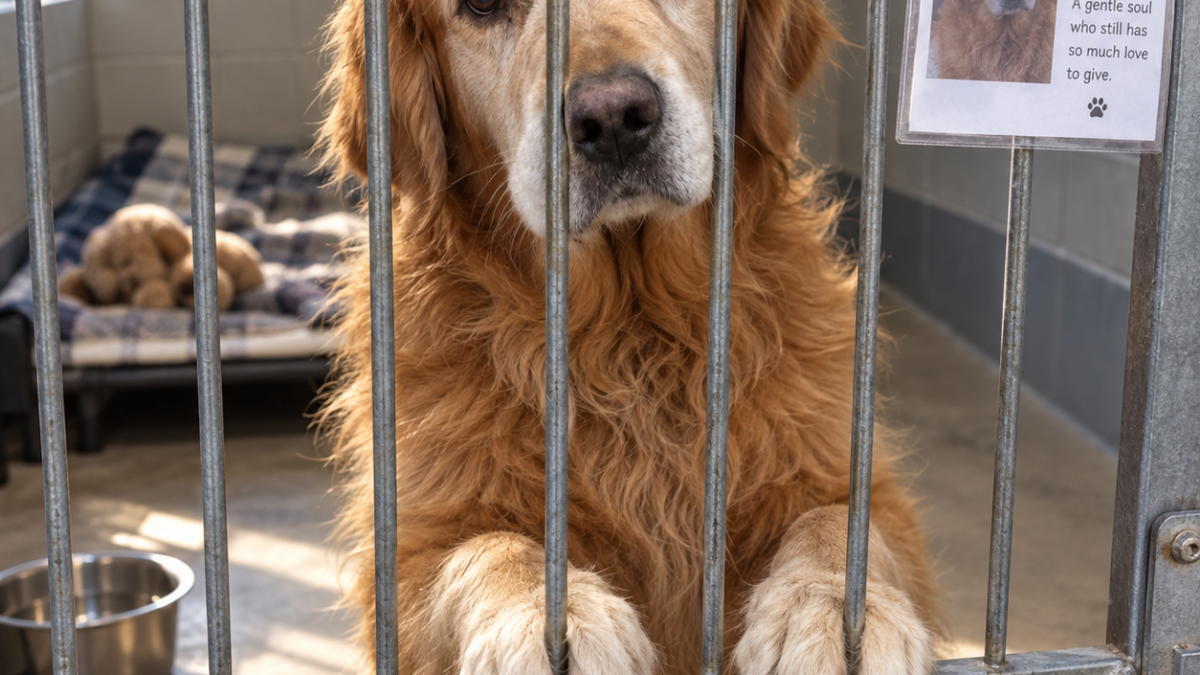
The old Golden Retriever never barked when people walked past his kennel, even though the card beside him said he had less than forty minutes left to live.
He simply stood on his trembling back legs, pressed his thin body against the bars, and watched every stranger as though he was still waiting for the one person who had promised to come back.
Then Rey reached one paw through the metal and placed it over my hand—and what I discovered about the family who had abandoned him made walking away impossible.
I had not gone to the shelter to adopt a dog.
That is the part I still think about.
My name is Claire Bennett, and on that Tuesday afternoon I was only dropping off three bags of donated blankets at a crowded county shelter outside Nashville, Tennessee.
I had already handed the blankets to a volunteer and was walking toward the exit when I noticed the dog in Kennel 47.
He was standing upright.
Not comfortably.
His back legs shook beneath him, and his front paws were hooked over the horizontal bar of the kennel door.
He was old.
That much was obvious.
His golden coat must once have been thick and bright, but now it was tangled around his hips and darkened with dirt. White fur covered most of his muzzle. His ribs showed beneath his sides.
Yet his eyes followed every person who passed.
Not desperately.
Quietly.
As if he had learned that making noise did not make anyone stay.
I slowed down.
A small white card was clipped beside his kennel.
REY.
11 YEARS OLD.
OWNER DECEASED.
SENIOR / ARTHRITIS / HEARING LOSS.
SCHEDULED EUTHANASIA: 4:00 P.M.
I read the last line twice.
Then I looked at my phone.
3:21.
“Today?”
A shelter employee pushing a cart stopped beside me.
She followed my stare.
Her expression changed.
“Yes.”
“Today at four?”
She nodded.
“There has to be a mistake.”
“I wish there were.”
I looked at Rey again.
He was still holding himself against the bars.
“Why him?”
The woman’s name tag read MARISOL.
She lowered her voice.
“We’re over capacity. Three dogs came in this morning from a seizure case, and we have nowhere to put them.”
“But he’s healthy?”
“Not exactly. He has arthritis. He’s underweight. He doesn’t hear well.”
“That doesn’t mean he’s dying.”
“No.”
“Then why euthanize him?”
Marisol glanced down the aisle.
“Because he’s eleven, he needs ongoing care, and in nine days nobody has asked to meet him.”
Nine days.
That was all the shelter had been able to give him after eleven years of belonging to someone.
I crouched in front of the kennel.
“Rey?”
His ears twitched.
I said it again, louder.
“Rey.”
This time his head lifted.
He struggled to reposition himself.
Then one paw slipped between the bars.
I thought he was reaching for balance.
Instead, he lowered it directly onto the back of my hand.
I froze.
His paw was heavy and warm.
He did not scratch.
Did not pull.
He simply left it there.
“Oh, buddy.”
Rey leaned his white muzzle between the bars.
I turned my palm upward.
He sniffed my fingers carefully before resting his nose against them.
Marisol stood behind me without speaking.
That was when I noticed the thin leather collar hidden beneath Rey’s dirty fur.
A small metal tag hung from it.
I turned it carefully.
One side carried his name.
The other had four engraved words.
DAD’S BEST FRIEND — REY.
I looked over my shoulder.
“Who was his owner?”
Marisol hesitated.
Then she disappeared into the office and returned with a thin folder.
Inside was a faded photograph.
Rey was much younger in it, sitting in green grass with a tennis ball in his mouth.
Beside him was an older man with gray hair and a red flannel shirt.
The man had one hand around Rey’s neck.
Both looked happy.
“His name was Walter Hayes,” Marisol said. “He died three months ago.”
“What happened to Rey?”
Her face hardened.
“Relatives came to the house.”
I waited.
“They removed furniture, tools, electronics—pretty much everything they wanted. The house was sold.”
“And the dog?”
“They left him in the backyard.”
I looked back at Rey.
Marisol continued quietly.
“Neighbors fed him. They said every morning he sat beside the back door. Every evening he moved to the gate.”
“For how long?”
“Almost three months.”
My stomach turned.
“He thought his owner was coming home.”
Marisol said nothing.
She did not have to.
I looked at my phone again.
3:24.
Thirty-six minutes.
Rey’s paw was still resting in my hand.
And suddenly the question was no longer whether I had come to the shelter intending to adopt a dog.
The question was whether I could live with myself if I left without him.
PART 2
“I want him.”
The words came out so quickly that Marisol blinked.
“What?”
“I want Rey.”
She looked at me, then at the clock mounted over the kennel aisle.
“Claire, I need to explain something before you make that decision.”
“Explain it while we do the paperwork.”
“I’m serious.”
“So am I.”
She crouched beside me.
Rey’s paw still rested across my hand.
“He’s not an easy adoption.”
“I understand that he’s old.”
“It’s more than age.”
“Tell me.”
“He has moderate arthritis in both hips. He needs pain medication. He may need bloodwork every few months. His hearing is poor. He’s anxious when left alone.”
I looked through the bars.
Rey had survived three months waiting beside an empty house.
Of course he was anxious when left alone.
Marisol continued.
“He sometimes refuses food unless a person sits near him.”
“That sounds manageable.”
“He has trouble getting up on slick floors.”
“I have rugs.”
“He may have accidents.”
“I own cleaning supplies.”
“He could live another three years.”
“I hope so.”
“He could live three months.”
I looked at her.
“That wouldn’t make him less worth taking home.”
Her face softened.
But she still did not move.
“There’s one more problem.”
“What?”
“Technically, because he is already on today’s euthanasia list, the adoption has to be approved by the supervisor.”
“Where is the supervisor?”
“In the medical wing.”
“Can you call her?”
Marisol stood.
“I’ll try.”
“Try quickly.”
She almost smiled.
Then she hurried away.
I stayed on the floor.
“Okay, Rey.”
His eyes remained on me.
“I’ve done impulsive things before.”
His tail gave the smallest movement.
“Bought a car I couldn’t afford once.”
Another tiny thump.
“Cut my own bangs in college.”
Nothing.
“That was worse than the car.”
His nose pressed harder into my hand.
I swallowed.
“I don’t know what your life looked like before this.”
His ears shifted.
“But if they let me take you, you’re not going back to an empty yard.”
Footsteps approached.
A woman in navy scrubs appeared beside Marisol.
She was in her fifties, with silver-framed glasses and the exhausted posture of someone who had been making difficult decisions all day.
“I’m Denise Alvarez,” she said. “Shelter director.”
“Claire.”
“You’re requesting to adopt Rey?”
“Yes.”
“Have you owned a senior dog?”
“My Labrador, Molly, lived to fourteen.”
“How long ago?”
“Five years.”
“Other pets currently?”
“No.”
“Children?”
“No.”
“Stairs?”
“Three porch steps. My bedroom is upstairs, but I can sleep downstairs.”
She studied me.
“You just met him.”
“Yes.”
“That concerns me.”
“Why?”
“Because emotion makes people say yes in shelters.”
I looked at Rey.
“And then?”
“Then two days later they realize the dog needs medication, help standing, nighttime bathroom trips, maybe expensive veterinary care.”
“I’m not bringing him back.”
“You can’t know that after five minutes.”
“No.”
I stood.
“But I know what happens at four.”
Denise’s expression changed.
Neither of us spoke.
Finally she said, “Come with me.”
I hated taking my hand away from Rey.
The second I stood, he dropped back onto all four paws.
His legs buckled slightly.
He recovered.
Then he watched me walk away.
I will never forget his face.
It was not panic.
It was resignation.
He had seen people leave before.
I turned around.
“I’m coming back.”
Rey stared at me.
“I mean it.”
Denise led me into a cramped office.
A stack of forms waited on the desk.
She shut the door.
“Rey’s situation is more complicated than that kennel card makes it look.”
I sat down.
“What do you mean?”
She opened his file.
“Animal control found him at his former residence after neighbors called repeatedly.”
“Marisol told me.”
“The property had already transferred ownership.”
“Who sold it?”
“Relatives.”
“Which relatives?”
“I can’t give you private information from the intake file.”
“Fair.”
She turned another page.
“When officers arrived, Rey had water and some food because neighbors had been feeding him through a gap in the fence.”
“So whoever abandoned him could argue he wasn’t starving.”
“They could.”
“Did anyone claim him?”
“No.”
“Did the family even ask where he went?”
“Not once.”
That answer made me angrier than I expected.
Denise slid the adoption application toward me.
“If we approve this, Rey becomes yours.”
“I understand.”
“No trial period.”
“Fine.”
“You’ll need a veterinary appointment quickly.”
“I’ll make one.”
“He needs a ramp or support harness.”
“I’ll buy both.”
“His adoption fee is waived because of his age.”
“I’ll donate it anyway.”
That stopped her.
Then she nodded toward the form.
“Start there.”
I filled it out faster than I had completed any document in my life.
Name.
Address.
Employer.
Veterinary reference.
Home ownership.
Emergency contact.
Experience with animals.
I signed every line.
Denise called my veterinarian.
Then my landlord.
Technically, I rented the farmhouse from my aunt.
My aunt answered on the second ring.
“You want to adopt what?”
“An eleven-year-old Golden Retriever.”
There was a pause.
“Is this another one of your projects?”
“He’s not a project.”
“That sounded defensive.”
“Because you said project.”
“How big?”
“Maybe sixty pounds when he’s healthy.”
“Does he chew walls?”
“He’s eleven.”
“That was not an answer.”
“Aunt June.”
She sighed.
“Dogs are allowed.”
“Thank you.”
“But if he eats the porch, I’m charging you.”
“He won’t eat the porch.”
“That is what people with porch-eating dogs always say.”
Denise could hear every word.
For the first time, she smiled.
At 3:43, she signed the approval.
I stared at the clock.
Seventeen minutes.
“Is that it?”
“Not quite.”
My stomach tightened.
“What now?”
“Medical release.”
Denise picked up the phone.
“Dr. Patel? Cancel Rey’s euthanasia order.”
The room went completely silent for me.
I heard her say it.
Cancel Rey’s euthanasia order.
A sentence.
Seven words.
And somewhere on the other side of the wall, a dog who had no idea what a clock was suddenly had tomorrow again.
I looked down because my eyes filled.
Denise pretended not to notice.
“Come on.”
We returned to Kennel 47.
Rey was lying on the concrete now.
When he saw Marisol, he raised his head.
When he saw me behind her, he struggled up.
His tail moved.
Once.
Twice.
Then faster.
I opened the kennel door.
Rey did not rush out.
He simply stood there.
I knelt.
“You remember me?”
His body leaned forward.
I held out my hands.
He walked three slow steps and pressed his entire head into my chest.
I wrapped my arms around him.
His coat smelled like disinfectant, old dirt, and dog.
I did not care.
“You’re coming home.”
Rey sighed.
A long, deep breath.
Then he leaned harder.
Marisol turned away and wiped her eyes.
Denise handed me a leash.
“Take care of him.”
“I will.”
Rey did not understand the words.
But he understood the open door.
We made it halfway down the hallway before his legs gave out.
He sank gently onto his side.
I panicked.
“Rey?”
Denise crouched immediately.
“He’s okay. His hips are weak.”
“I’ll carry him.”
“He weighs fifty-four pounds.”
“I don’t care.”
“You’ll hurt both of you.”
She called for a sling.
Two technicians helped support his back end.
We moved slowly toward the lobby.
People stopped.
A couple waiting with a terrier smiled when they saw him.
A little boy asked his mother, “Is that dog going home?”
She looked at me.
“Yes.”
I answered for her.
“He is.”
Outside, Rey stopped at my car.
He stared at the open rear door.
Then at me.
He would not move.
“Car trouble?”
Marisol asked.
“Maybe.”
She read his notes.
“Neighbors said the last vehicle ride he had was animal control bringing him here.”
That explained enough.
I climbed into the back seat.
“Okay.”
Rey watched.
“I’m getting in first.”
I patted the seat.
“You don’t have to be brave alone.”
He approached.
One paw.
Then another.
Marisol supported his hips.
I guided his shoulders.
Finally Rey was inside.
He turned in a slow circle.
Then lowered himself across the seat.
His head landed in my lap.
I closed the door.
Marisol stood outside the window.
“Send us a picture?”
“I will.”
“And Claire?”
“Yes?”
“Thank you.”
I looked down at Rey.
“No.”
I scratched the white fur beneath his chin.
“I think he saved himself. I just happened to read the clock.”
The first night was harder than I expected.
Rey would not eat.
I offered dry food.
Wet food.
Chicken.
Rice.
Nothing.
He drank.
Then stood beside my back door.
I opened it.
He stepped onto the porch.
The yard was fenced.
He walked to the gate.
And sat.
For forty minutes.
I sat beside him.
“What are we waiting for?”
He looked down the driveway.
I knew the answer.
Walter.
Rey had spent nearly three months waiting for a dead man to return.
Now a new house and a new person did not erase that expectation.
At ten-thirty, I tried bringing him inside.
He resisted.
Not aggressively.
He simply planted his feet.
So I brought a blanket outside.
I sat on the porch.
Rey lay beside me.
The night was cold.
Traffic hummed faintly from the highway.
Every time headlights appeared through the trees, Rey lifted his head.
Every single time.
The car would pass.
His head would lower.
Again.
Again.
Again.
At midnight, I started crying.
“Rey.”
He looked at me.
“He’s not coming.”
The words felt cruel.
But someone had to say them.
“Walter isn’t coming back.”
Rey’s ears shifted.
“I’m sorry.”
I touched his shoulder.
“I know that doesn’t mean anything to you yet.”
Another set of headlights appeared.
Rey sat up.
The vehicle passed.
He lowered himself.
I pulled the blanket over my legs.
“But I’m here.”
He looked at me again.
“I’m not Walter.”
His nose touched my knee.
“I’m not trying to be.”
For the first time that night, Rey moved away from the gate.
He lay beside me.
His back pressed against my leg.
At 1:17 in the morning, we went inside together.
I slept on the living-room floor beside his bed.
At 3:09, I woke because Rey was standing over me.
His face was inches from mine.
“What?”
His tail moved once.
Then he walked toward the door.
Bathroom.
Progress.
The following morning, I called Dr. Samuel Reed, the veterinarian who had cared for Molly.
He agreed to see Rey immediately.
The examination lasted nearly an hour.
Rey had arthritis.
Moderate hearing loss.
A mild skin infection.
A cracked molar that might eventually need treatment.
He was underweight by approximately twelve pounds.
But his heart was strong.
Lungs clear.
Bloodwork surprisingly good.
Dr. Reed looked at me.
“This dog is not dying.”
I felt something hot move through my chest.
“Could he have been euthanized yesterday because of his medical condition?”
“Medically?”
“Yes.”
“No.”
He removed his stethoscope.
“He’s an old dog with manageable problems.”
I sat very still.
“So he could have years.”
“Possibly.”
“How many?”
He smiled gently.
“Don’t do that to yourself.”
“What?”
“Count before you’ve started.”
I looked at Rey.
He was leaning against my leg.
Dr. Reed continued.
“Maybe six months. Maybe three years. Golden Retrievers don’t sign contracts.”
“Helpful.”
“I try.”
He prescribed anti-inflammatory medication, joint supplements, antibiotics for the skin infection, and a nutrition plan.
Then he examined the engraved tag.
“Dad’s best friend.”
“Apparently.”
“Do you know who Dad was?”
“Walter Hayes.”
Dr. Reed froze.
“You know him?”
He looked at me.
“Walter Hayes?”
“Yes.”
“Retired electrician?”
“I don’t know.”
“Lived over near Henderson Road?”
“That’s where animal control picked Rey up.”
Dr. Reed sat back.
“I knew Walter.”
I stared at him.
“You did?”
“He brought Rey here.”
“When?”
“For years.”
My pulse accelerated.
“So you have his medical records?”
“I should.”
He opened the computer.
After a moment, Rey’s history appeared.
Vaccinations.
Dental cleanings.
Annual exams.
Weight checks.
Notes going back ten years.
Walter had taken care of him.
Really taken care of him.
Dr. Reed scrolled.
“Last visit was seven months ago.”
“For what?”
“Arthritis.”
He read further.
“Walter asked about mobility support because he was worried Rey was struggling with the back steps.”
I felt sick.
The man who had owned Rey was planning ramps.
Months later, his relatives left the dog in a yard.
Dr. Reed leaned back.
“I heard Walter died.”
“Three months ago.”
“Heart attack?”
“I don’t know.”
“He came in after his wife passed. Rey was the thing keeping him moving.”
“How do you know?”
“Walter told everybody everything.”
That made me smile.
“What did he say about Rey?”
Dr. Reed looked toward the old dog.
“That Rey was the only roommate he’d ever had who didn’t complain about his cooking.”
I laughed.
Then Dr. Reed’s expression became more serious.
“He also said something strange at the last visit.”
“What?”
“He asked whether I knew anyone who handled pet trusts.”
I stopped breathing for a second.
“Pet trusts?”
“Yes.”
“He wanted to leave money for Rey?”
“I assumed so.”
“Did he?”
“I have no idea.”
I stared at the computer.
The relatives had taken Walter’s belongings.
Sold the house.
Left Rey behind.
If Walter had planned for him—
I pushed the thought away.
Maybe he had only asked.
Maybe nothing came of it.
But the question stayed with me.
That afternoon, Rey ate his first meal in my house.
Not from the bowl.
From my hand.
One piece at a time.
Chicken.
Rice.
Prescription kibble.
He chewed slowly.
After the tenth bite, I placed the rest in the bowl.
He stared at it.
Then at me.
“You want me to stay?”
I sat down beside him.
He ate.
That became our routine.
For the first week, Rey refused breakfast unless I sat within three feet.
If I stood too early, he stopped eating.
So I drank coffee on the kitchen floor.
I answered emails on the kitchen floor.
I had one work call from the kitchen floor while my supervisor asked why she could hear heavy breathing.
“That’s Rey.”
“Who is Rey?”
“My dog.”
“You got a dog?”
“Yesterday.”
“How old?”
“Eleven.”
My supervisor paused.
“You adopted an eleven-year-old dog?”
“Yes.”
Another pause.
“That is the most Claire thing you have ever done.”
I decided not to ask what that meant.
By day five, Rey learned where the treats were.
By day seven, he discovered my couch.
By day nine, he stopped waiting at the gate every morning.
Evenings were harder.
Around five-thirty, he still went to the front window.
Dr. Reed later explained that Walter probably came home around that hour.
Dogs remember schedules long after circumstances change.
I began sitting beside Rey at five-thirty.
Sometimes we watched the road together.
Sometimes I read.
Sometimes I told him about my day.
He did not care about my office politics.
He was an excellent audience anyway.
Two weeks after the adoption, the shelter called.
It was Denise.
“How’s our boy?”
“Currently asleep upside down on my couch.”
“Rey?”
“Yes.”
“You’re sure?”
“He snores too.”
She laughed.
“I’m calling for another reason.”
“What happened?”
“Someone contacted us about him.”
My hand tightened around the phone.
“Who?”
“A man claiming to be Walter Hayes’s nephew.”
I sat up.
“What does he want?”
“Rey.”
I looked across the room.
The dog was sleeping with one paw over his face.
“No.”
“Claire.”
“No.”
“Listen first.”
“I’m listening while saying no.”
Denise continued.
“The man says Rey was surrendered without family authorization.”
“He was abandoned in a yard.”
“I know.”
“He had three months to authorize something.”
“I know.”
“Who is he?”
“Mark Hayes.”
The name meant nothing to me.
“He claims he only recently learned Rey had been taken to the shelter.”
“That sounds convenient.”
“I agree.”
“What does he want?”
“He says Rey belongs to the estate.”
“Rey was legally adopted out.”
“Yes.”
“Then what is the problem?”
“Probably nothing. But he threatened legal action.”
I stood.
Rey opened one eye.
“Let him.”
“That may happen.”
“I am not giving this dog back to the people who left him.”
“I know.”
“No, Denise. I need you to hear me.”
“I do.”
“He waited three months.”
“I know.”
“They sold the house.”
“I know.”
“They took furniture but left a living animal.”
“I know.”
My voice broke.
Rey stood.
He walked toward me.
I lowered my voice.
“What if they somehow win?”
“Claire, breathe.”
I hated being told that, but she was right.
“I’m sorry.”
“Don’t apologize.”
“What do I do?”
“Keep every document from the adoption.”
“I have them.”
“Keep his veterinary records.”
“Yes.”
“And if anyone contacts you directly, don’t argue.”
“That will be difficult.”
“I know.”
“How do you know?”
“I met you.”
Fair.
The first letter arrived three days later.
Attorney letterhead.
MARK HAYES AND LINDA PRESCOTT, HEIRS OF WALTER HAYES.
Demand for return of personal property.
Including one male Golden Retriever named Rey.
Personal property.
I read those words until my jaw hurt.
Rey was lying beside my feet.
He had gained two pounds.
The skin infection was improving.
He had started carrying a faded green tennis ball around the house.
I took a picture of the letter and sent it to my older brother, Nathan.
Nathan was not an animal lawyer.
He handled probate and estate disputes in Louisville.
His response came thirty seconds later.
CALL ME.
I did.
“Do not reply to this yourself.”
“Hello to you too.”
“I’m serious.”
“So am I.”
“Claire.”
“They called him property.”
“Legally, animals are treated as property in many contexts.”
“Great system.”
“I did not write it.”
“What do they want?”
“I need the entire letter.”
I emailed it.
He read silently.
Then said, “Interesting.”
“I hate when lawyers say interesting.”
“They aren’t claiming sentimental ownership.”
“What does that mean?”
“They’re claiming estate ownership.”
“Why?”
“Could be leverage.”
“For what?”
“Maybe they think you’ll pay.”
“I already paid an adoption fee.”
“You said it was waived.”
“I donated one.”
“That is not legally relevant.”
“Nothing you say is emotionally satisfying.”
“That is why I bill hourly.”
“You’re my brother.”
“Exactly. You cannot afford me.”
Despite myself, I smiled.
Then Nathan became serious.
“Did Walter leave a will?”
“I don’t know.”
“Find out.”
“How?”
“Probate records are public.”
“You can check?”
“I already am.”
I heard typing.
“Walter Hayes, Davidson County…”
More typing.
Then silence.
“Nathan?”
“Hold on.”
My stomach tightened.
“What?”
“He did have a will.”
“Okay.”
“It was filed seven weeks ago.”
“By who?”
“Mark Hayes.”
“The nephew.”
“Yes.”
“What does it say?”
“I need to pull the full document.”
“Can you?”
“Give me a minute.”
I paced the kitchen.
Rey followed.
I sat.
He sat.
I stood.
He stood.
“Rey, you’re making this worse.”
He wagged his tail.
Nathan came back.
“Claire.”
His tone had changed.
“What?”
“You need a lawyer in Tennessee.”
“Why?”
“Because there is a paragraph about Rey.”
I stopped.
“What does it say?”
“I’m going to read it.”
Paper rustled.
“‘I direct that my dog Rey, if living at the time of my death, remain in the care of my sister Eleanor Hayes, or, if she is unable to serve, with a suitable permanent caregiver selected by my veterinarian, Dr. Samuel Reed.’”
I sat down hard.
Nathan continued.
“‘I allocate twenty-five thousand dollars from my estate for Rey’s food, veterinary care, medication, grooming, and related needs for the remainder of his natural life.’”
I could not speak.
“There’s more.”
“What?”
“Any funds remaining after Rey’s death are to be donated to a senior-dog rescue.”
I looked down at him.
Rey placed his chin on my knee.
“They knew.”
“Maybe.”
“They filed the will.”
“Mark did.”
“So he knew.”
“Likely.”
“Where is Eleanor?”
“I’m checking.”
A long silence.
Then Nathan said, “She died last year.”
Before Walter.
So the responsibility passed to Dr. Reed.
Not Mark.
Not Linda.
Dr. Reed.
I stood so quickly Rey startled.
“I need to call Sam.”
“Not yet.”
“Why?”
“Because if the will is valid and the family sold assets without honoring a specific directive, this could be bigger than a dog dispute.”
“Bigger how?”
“Estate administration.”
I thought about Walter’s house.
Furniture.
Tools.
Electronics.
Rey left outside.
“What did they do with the twenty-five thousand dollars?”
“That is exactly the question.”
Nathan helped me find a Tennessee probate attorney named Ellen Shaw.
I met her the following morning.
She was small, sharp-eyed, and terrifying in a way I found immediately comforting.
She read the letter from Mark’s attorney.
Then Walter’s will.
Then my adoption documents.
Then Rey’s veterinary records.
Finally she looked at me.
“Do you want the legal answer or the emotional answer?”
“Legal first.”
“Good.”
She tapped the adoption file.
“The shelter appears to have followed proper stray and abandonment procedures before adoption. Your title to Rey is strong.”
I exhaled.
“But?”
“There is always a but.”
“I knew it.”
“The estate had a specific directive for his care. The heirs had an obligation to disclose that.”
“They didn’t.”
“Apparently not.”
“And they abandoned him.”
“According to the animal-control report, yes.”
“Can they take him?”
“Probably not.”
“Probably?”
“Lawyers who promise certainty are selling something.”
I hated that answer.
She continued.
“More importantly, I want to know where the twenty-five thousand dollars went.”
“So do I.”
“We’ll ask.”
Mark’s attorney responded within two days.
The trust provision, he argued, was “impractical” after Eleanor’s death.
Ellen almost laughed when she read that sentence.
“What?”
“Impractical?”
She pushed the paper toward me.
“The will literally names a backup person.”
“Dr. Reed.”
“Yes.”
“Could Mark have missed that?”
“No.”
“Could his attorney?”
“Not if he read the document.”
I felt heat rise into my face.
“So they ignored it.”
“That appears possible.”
“What happens now?”
“Now we request an accounting.”
That was when the fight changed.
Until then, Mark Hayes wanted a dog.
Suddenly he wanted us to stop asking questions.
His attorney withdrew the demand for Rey’s return.
Ellen was not impressed.
“They’re hoping that satisfies you.”
“It doesn’t.”
“Good.”
I looked at her.
“What if this hurts Rey?”
“How?”
“Stress. Court. Strangers.”
“Rey does not have to attend court.”
“I know.”
“Then let the humans handle what the humans did.”
That sentence stayed with me.
Rey’s job was not to prove anyone had failed him.
His job was to get better.
So that is what we focused on.
He started physical therapy.
At first he hated the underwater treadmill.
The technician lowered him into warm water.
Rey looked at me with betrayal so profound I nearly apologized to him.
“You’re fine.”
He stared.
“You like water.”
More staring.
“You’re a Golden Retriever.”
His expression suggested I was stereotyping him.
After three sessions, he stopped resisting.
After six, he could stand more easily.
After ten, he began trotting short distances in my yard.
The first time he ran after the green tennis ball, I cried.
It was not much of a run.
Maybe twenty feet.
His back legs moved stiffly.
The ball stopped before he reached it.
But Rey picked it up.
Turned.
And came back to me with his tail high.
For one second I saw the young dog from Walter’s photograph.
The same bright eyes.
The same ball.
The same pride.
I took a picture.
Then I sent it to Dr. Reed.
His response:
Walter would have framed that.
I stared at the message for a long time.
That evening I printed the photograph.
I put it beside the old picture from the shelter.
Young Rey with Walter.
Old Rey with me.
Not replacing.
Continuing.
The estate accounting arrived three weeks later.
Ellen called me into her office.
“Sit.”
“I hate when people tell me to sit.”
“Sit anyway.”
I did.
She opened a thick folder.
“Walter’s house sold for four hundred eighty-two thousand dollars.”
“Okay.”
“His bank accounts totaled approximately one hundred sixty thousand.”
I blinked.
“He had money.”
“He lived modestly.”
“What about Rey’s twenty-five thousand?”
“Distributed.”
“To who?”
“Mark and Linda.”
I stared at her.
“All of it?”
“Along with most of the estate after expenses.”
“But the will—”
“I know.”
“They just took it?”
“That is what the accounting indicates.”
My fingers curled.
“Can they do that?”
“Not properly.”
“What else?”
Ellen slid another document toward me.
“Personal property inventory.”
Tools.
Furniture.
Vehicle.
Jewelry.
Household goods.
Then one line.
Animal — Golden Retriever — nominal value.
I read it again.
“Nominal value.”
“That is what they wrote.”
“The dog their uncle specifically set aside twenty-five thousand dollars to care for.”
“Yes.”
“What did they do with Walter’s things?”
“Much was sold through an estate company.”
“And Rey was left in the yard.”
“Yes.”
Something inside me hardened.
For weeks I had tried to imagine a misunderstanding.
Maybe Mark thought a neighbor would take Rey.
Maybe someone forgot.
Maybe grief made people careless.
But the accounting was dated twelve days after Walter’s death.
The house was listed for sale.
Assets inventoried.
Money calculated.
Rey written down.
Nominal value.
A living animal had been reduced to a line on paper and then left behind because caring for him cost money.
I looked at Ellen.
“What can we do?”
“A lot.”
The probate court ordered Mark, as executor, to appear.
That was the first time I saw him.
He was fifty-something, expensive watch, gray suit.
Linda sat behind him.
She looked older.
Nervous.
I sat with Ellen.
I was not technically a beneficiary.
But because I had become Rey’s lawful owner and Dr. Reed had been named backup caregiver, the court allowed evidence related to the ignored provision.
Mark’s attorney argued that Walter’s directive became impossible after Eleanor died.
The judge looked at him.
“Counsel, paragraph eight names Dr. Samuel Reed.”
“Yes, Your Honor, but—”
“So how was performance impossible?”
The attorney shifted.
Mark stared at the table.
Dr. Reed testified.
The judge asked him directly.
“Were you ever contacted by Mr. Hayes’s estate regarding Rey?”
“No.”
“Would you have accepted responsibility to place Rey with a suitable caregiver?”
“Absolutely.”
“Were you aware of the twenty-five-thousand-dollar allocation?”
“Not until Ms. Shaw contacted me.”
The judge looked toward Mark.
“Mr. Hayes, did you read your uncle’s will before administering the estate?”
Mark’s attorney rose.
“My client—”
“I asked Mr. Hayes.”
Mark looked up.
“Yes.”
“Did you understand the paragraph concerning the dog?”
“I thought Eleanor was supposed to take him.”
“She was deceased.”
“Yes.”
“Did you read the next sentence?”
Silence.
“Yes.”
“Did you contact Dr. Reed?”
“No.”
“Why?”
Mark hesitated.
“He’s a veterinarian. I didn’t think Uncle Walter really meant—”
The judge interrupted.
“The document uses his full name.”
Mark’s face reddened.
“I thought Rey would be okay at the house.”
“For three months?”
Linda looked down.
The judge continued.
“Who was feeding the animal?”
“I assumed neighbors.”
“You assumed neighbors would feed an elderly dog while you sold the property?”
Mark’s attorney objected.
The judge overruled him.
Mark swallowed.
“We were handling a lot.”
Ellen handed the court photographs.
Rey behind Walter’s house.
Thin.
Dirty.
Waiting beside the door.
Then Rey at the shelter.
Then his veterinary body-condition assessment.
I had seen those photographs.
Still, I had to look away.
Mark did not.
That angered me more.
The judge asked, “When did you last personally see the dog?”
Mark hesitated.
“Maybe a week after Walter died.”
“Was food left?”
“Yes.”
“How much?”
“I don’t remember.”
“Water?”
“Yes.”
“Who was assigned to return?”
“No one specifically.”
There it was.
No one specifically.
The sentence that almost killed Rey.
Nobody was assigned.
Nobody took responsibility.
Everyone assumed someone else would.
The hearing lasted two hours.
The judge removed Mark as executor.
A neutral administrator was appointed.
The court ordered further review of distributions made contrary to Walter’s will.
The twenty-five thousand dollars intended for Rey had to be restored to the estate from funds already distributed.
Additional attorney fees and costs were assessed.
But the moment I remember most came after the hearing.
Mark approached me in the hallway.
Ellen stepped forward immediately.
“You should speak through counsel.”
“I just want one minute.”
I looked at her.
“It’s okay.”
She stayed beside me.
Mark glanced at the photographs in my folder.
“How is he?”
I stared at him.
“Rey?”
“Yes.”
“He’s alive.”
Mark’s jaw tightened.
“I didn’t mean for him to end up at that shelter.”
“You left him at an empty house.”
“We thought someone would take him.”
“Who?”
He said nothing.
“Which person?”
“No one specifically.”
I almost laughed at hearing it again.
“You sold Walter’s house.”
“It wasn’t that simple.”
“It seems pretty simple.”
“You don’t know our family.”
“You’re right.”
I held up the picture of Rey at the shelter.
“I know this dog.”
Mark looked at it.
For the first time, his face changed.
Maybe shame.
Maybe annoyance.
Maybe both.
“He was always Uncle Walter’s dog.”
“Yes.”
“My uncle treated him like a person.”
“That sounds like Walter’s best quality.”
Mark looked at me sharply.
“You think I’m some monster.”
“I think you knew an eleven-year-old dog existed, knew Walter wanted him cared for, and chose not to make sure that happened.”
“That isn’t—”
“And the result is the same whether you call yourself a monster or not.”
Ellen touched my arm.
Enough.
I stepped back.
Mark said quietly, “Can I see him?”
“No.”
His face hardened.
“Why not?”
“Because Rey spent three months watching the gate for people who never came.”
I kept my voice calm.
“He doesn’t owe you closure.”
Then I walked away.
That was the revenge I wanted most.
Not shouting.
Not threats.
Not hurting Mark.
Just refusing to make Rey carry the emotional weight of the people who had failed him.
The money Walter intended for Rey was eventually placed into a court-supervised care account.
But there was a problem.
Rey was legally mine now.
The will had expected Dr. Reed to choose a caregiver.
Technically, that had never happened.
So the neutral estate administrator asked Dr. Reed to document whether I was suitable.
He came to my house.
He walked in carrying a clipboard.
I stared at him.
“You’re enjoying this.”
“A little.”
Rey trotted toward him with the green ball.
Dr. Reed scratched his ears.
“Hello, neglected animal.”
Rey wagged.
“Clearly suffering.”
“He had chicken for breakfast.”
“Abuse.”
“Get out.”
Dr. Reed inspected the ramp I had installed.
Medication organizer.
Orthopedic bed.
Rugs on slick floors.
Food.
Fenced yard.
Then he sat at my kitchen table.
“Walter wanted someone suitable.”
I looked at Rey.
“Do you think I am?”
Dr. Reed smiled.
“I think Walter would have liked you.”
That hit harder than I expected.
“You didn’t know me.”
“I know what he worried about.”
“What?”
“Rey being alone.”
My eyes filled.
Dr. Reed signed the form.
“He isn’t.”
The care fund reimbursed veterinary expenses, medication, therapy, and food.
I did not need all of it.
So Ellen petitioned the court to interpret Walter’s final instruction about remaining money broadly.
The judge approved.
Anything unused after Rey’s death would go to a senior-dog rescue.
I added my own money.
Then something unexpected happened.
The local newspaper reported the probate dispute.
Not because I contacted them.
Court records were public.
The headline was terrible.
ELDERLY DOG LEFT BEHIND DESPITE OWNER’S $25,000 CARE PLAN.
People began calling the shelter.
Not about Rey.
About senior dogs.
Denise called me laughing and crying at the same time.
“Do you know what you did?”
“What?”
“We have three applications for Martha.”
“Who is Martha?”
“Thirteen-year-old hound mix. Here fifty-one days.”
My throat tightened.
“Really?”
“And somebody asked about Gus.”
“The blind terrier?”
“Yes.”
“What about Oscar?”
“Pending home visit.”
Oscar was a twelve-year-old shepherd nobody had wanted for months.
I sat down.
Rey was sleeping beside my desk.
“That’s good.”
“No, Claire.”
Denise’s voice softened.
“That’s extraordinary.”
A week later, Oscar went home.
Then Gus.
Then Martha.
Walter’s story and Rey’s story did something none of us had planned.
They made people look twice at the kennels they usually walked past.
Not everyone adopted.
Some sponsored medication.
Some paid adoption fees.
Some donated orthopedic beds.
A retired couple started fostering elderly dogs.
The shelter created a program.
They named it Walter’s Promise.
I argued against the name at first.
“Walter didn’t abandon Rey.”
“That’s why we’re using his name,” Denise said.
The program matched senior dogs with foster homes and covered initial veterinary expenses through donations.
A photograph of Walter and young Rey hung beside the adoption desk.
Under it were the words:
OLD DOESN’T MEAN FINISHED.
When I brought Rey to the opening, he was supposed to sit quietly beside me.
He did not.
He stole a sandwich from a reporter.
An entire turkey sandwich.
I watched in horror as eleven-year-old arthritic Rey moved faster than I had seen him move since adoption.
“Rey!”
He carried the sandwich behind Denise’s chair.
The reporter laughed.
“I guess he feels better.”
“Apparently too good.”
Rey swallowed half the evidence.
Dr. Reed confiscated the rest.
“You’re a disgrace.”
Rey wagged.
The photograph from that moment ended up in the newspaper.
Rey staring proudly at the camera.
Turkey hanging from his mouth.
Me reaching toward him.
Denise laughing.
It became my favorite picture.
Not because it was dignified.
Because the dog who once stood silently behind kennel bars begging people not to leave had become secure enough to commit theft in public.
That is recovery.
Not perfection.
Confidence.
Rey’s waiting behavior faded slowly.
For months, he still watched the road at five-thirty.
Then one evening I noticed he had not gone to the window.
He was asleep beside me.
I almost woke him.
Then I understood.
Some ritual inside him had finally loosened.
He no longer expected Walter’s truck.
That realization made me strangely sad.
I did not want him to forget Walter.
But Dr. Reed told me something important.
“Dogs don’t need to forget one person to love another.”
So I kept Walter’s photograph beside Rey’s bed.
Sometimes Rey sniffed it.
Sometimes he ignored it.
Once, after I moved the frame to dust, he stood where it had been and stared at me until I returned it.
“Okay.”
I set it back.
“Your roommate stays.”
His tail moved.
On the first anniversary of Walter’s death, I took Rey to his grave.
I had debated whether it was foolish.
Dogs do not understand cemeteries the way we do.
But it felt right.
Dr. Reed told me where Walter was buried.
A quiet cemetery outside town.
I parked near the path.
Rey moved slowly that day.
His arthritis had been worse after a cold front.
We walked toward the stone.
WALTER JAMES HAYES.
BELOVED HUSBAND, BROTHER, FRIEND.
I sat beside it.
Rey sniffed the grass.
Then the base of the headstone.
He walked around once.
And lay down.
His chin rested on the grass.
I did not know whether he recognized Walter’s scent.
Probably not after a year.
Maybe he simply sensed my stillness.
Maybe he was tired.
It did not matter.
I placed the old green tennis ball beside the stone.
“Your boy is okay.”
My voice broke.
Rey raised his head.
I rubbed his ear.
“He waited a long time for you.”
A breeze moved across the cemetery.
“I hope wherever you are, you know somebody came.”
Rey leaned against me.
We stayed for almost an hour.
When we left, I did not take the tennis ball.
The next morning Rey searched the house for it.
I felt guilty.
So I bought six identical ones.
He rejected all six.
Apparently I had abandoned a priceless artifact.
I went back to the cemetery.
The ball was still there.
Wet from dew.
I brought it home.
Rey carried it proudly into the living room.
“Fine.”
I pointed at him.
“You win.”
He always did.
Eighteen months passed.
Rey turned thirteen.
Dr. Reed did not know his exact birthday, so I chose the day I adopted him.
We celebrated with a small cake made from pumpkin and peanut butter.
Megan came.
Aunt June came.
Denise.
Marisol.
Dr. Reed.
Nathan drove down from Kentucky.
Rey wore a ridiculous blue bandana.
He tolerated photographs for approximately four minutes.
Then he slept through his own party.
At one point, Nathan stood beside me watching him.
“You realize this started because you went to donate blankets.”
“Yes.”
“You were supposed to spend ten minutes there.”
“Yes.”
“You came home with a senior dog and triggered probate litigation.”
“Yes.”
He took a drink.
“I’m never sending you to pick up groceries.”
“Smart.”
By then, Mark Hayes had repaid the money the court ordered restored.
He had also been assessed a portion of the estate’s legal expenses because of his mishandling as executor.
Linda negotiated repayment separately.
Neither was charged criminally in connection with Rey’s abandonment because proving individual responsibility beyond a reasonable doubt was difficult.
At first that bothered me.
I wanted a dramatic punishment.
I wanted a judge to say exactly what I felt.
But Ellen reminded me that justice is rarely shaped like revenge.
Mark lost control of the estate.
He repaid money.
His conduct became part of a public court record.
Most importantly, he never got Rey.
And Walter’s instructions were finally honored.
That mattered more.
The remaining funds would help other old dogs after Rey was gone.
I hated thinking about that last part.
So I stopped.
At thirteen and a half, Rey began having more difficult mornings.
His hips stiffened.
His hearing declined until I had to stand where he could see me before calling.
He developed cataracts.
But he still ate.
Still wanted walks.
Still stole socks.
Still greeted me at the door.
His favorite place became the porch.
Not the gate.
The porch.
That distinction mattered.
He no longer watched for someone else.
He watched for me.
Every weekday, when my car turned into the driveway, Rey stood.
Even when it hurt.
I would see him through the windshield.
White face.
Tail moving.
Waiting.
But now waiting had an ending he could trust.
I came home.
Every time.
One October evening, I was late.
A wreck had closed the interstate.
My phone died.
I did not reach the house until almost nine.
When my headlights swept across the porch, Rey was there.
Standing.
Aunt June had come to check on him and later told me he refused to go inside.
I parked crookedly.
Jumped out.
“Rey!”
His tail began moving.
I ran to him.
He walked down the ramp.
Slowly.
Then pressed into my legs.
“I’m sorry.”
I knelt.
“I’m sorry.”
His nose touched my cheek.
I held his face.
“I came back.”
Those three words destroyed me.
Because suddenly I understood the promise I had made the first day without realizing it.
I’m coming back.
At the shelter.
At the veterinarian.
Every time I left for work.
Every trip to the store.
Every night I closed a door.
Rey did not need a perfect home.
He needed a predictable one.
One where departure was not abandonment.
The following winter, Dr. Reed found a mass.
It was on Rey’s spleen.
At first, we monitored it.
Then it grew.
Surgery was possible.
But at fourteen, with arthritis and declining strength, it carried significant risk.
I asked the question I had been avoiding for nearly three years.
“What would you do if he were yours?”
Dr. Reed sat across from me.
“He is happy today.”
“That isn’t an answer.”
“It is the answer.”
I looked at Rey.
He was sleeping on the exam-room floor.
“We treat the dog in front of us,” Dr. Reed said.
“Not the scan?”
“Not the calendar.”
I swallowed.
“So what do I watch for?”
“Appetite. Breathing. Pain. Interest in things he loves. More good days than bad.”
I nodded.
“And when that changes?”
“You’ll know.”
I hated that.
Everyone says you’ll know.
Nobody explains how.
For five months, Rey remained himself.
Slower.
Whiter.
But himself.
He celebrated another adoption anniversary.
Fourteen.
We skipped the party.
Instead, I took him to Walter’s grave.
The old green ball came with us.
This time I kept it.
Rey lay beside the stone.
I sat with my hand on his back.
“You gave me a lot of trouble.”
His ear moved.
“Lawyers.”
Nothing.
“Court.”
Nothing.
“Physical therapy bills.”
He sighed.
“Turkey theft.”
His tail moved.
I smiled.
“You’re worth it.”
On the way home, we stopped for vanilla ice cream.
Rey got a small cup.
He ate every bite.
That became our last perfect day.
Three weeks later, he stopped eating breakfast.
I sat beside his bowl.
He sniffed it.
Walked away.
At dinner, same thing.
The next morning, he refused chicken.
Rey had never refused chicken.
I called Dr. Reed.
Ultrasound showed internal bleeding.
The splenic mass had ruptured.
There were options.
Emergency surgery.
Transfusion.
Hospitalization.
Maybe days.
Maybe months.
Maybe he would die on the table.
I looked at Rey.
He could barely stand.
His gums were pale.
His eyes found mine.
I knew.
That was what people meant.
You know.
Not because you are ready.
Because your love finally becomes stronger than your need to keep them.
I sat on the floor.
“I’m not doing surgery.”
Dr. Reed nodded.
Tears filled his eyes.
He had known Rey longer than I had.
“I think that’s kind.”
“I don’t want to be kind.”
“I know.”
“I want another year.”
“I know.”
“I want Walter’s twenty-five thousand dollars to buy another year.”
Dr. Reed sat beside me.
“Money can buy treatment.”
He looked at Rey.
“Not time.”
I buried my face in Rey’s neck.
His fur still smelled the same.
Warm.
Dusty.
Familiar.
“Can we go home?”
“Yes.”
“How long?”
“Hours. Maybe a day.”
I brought him home.
Denise came.
Marisol.
Megan.
Aunt June.
Nathan drove overnight.
Nobody stayed long.
I wanted the final hours quiet.
At sunset, Rey asked to go outside.
I could tell by the way he looked at the door.
I supported his hips with the sling.
We moved slowly onto the porch.
He lowered himself near the top of the ramp.
The evening was warm for February.
Birds moved in the trees.
A truck passed on the road.
Rey did not lift his head.
He was not waiting for Walter anymore.
He was not waiting for anyone.
I sat beside him.
The green tennis ball lay between his paws.
“You remember this?”
His eyes moved toward it.
“Of course you do.”
I put my hand on his chest.
His breathing was shallow.
“Walter loved you.”
His ear moved.
“The shelter loved you.”
His eyes closed.
“I loved you.”
Then I corrected myself.
“I love you.”
His tail tapped the porch.
Once.
I cried so hard I could barely see.
“You were supposed to have thirty-nine minutes.”
That was what destroyed me most.
Thirty-nine minutes.
That had been the future left to him when I stopped at Kennel 47.
Thirty-nine minutes became almost three years.
Three birthdays.
Hundreds of breakfasts.
Walks.
Car rides.
Physical therapy sessions.
Turkey theft.
Court hearings he never knew existed.
Walter’s Promise.
Senior dogs finding homes.
Three years of coming back.
Dr. Reed arrived at eight.
I had asked him to come to the house.
Rey hated clinic floors.
I did not want his last moment there.
We made a bed on the porch.
Dr. Reed listened to his heart.
“He’s tired.”
“I know.”
“Are you ready?”
“No.”
He waited.
I looked at Rey.
His head rested in my lap.
“I’m ready enough.”
Dr. Reed gave him a sedative first.
Rey relaxed.
His breathing slowed.
I stroked the white fur around his eyes.
“Hey.”
His eyes opened slightly.
“It’s Claire.”
His tail moved.
“You don’t have to wait anymore.”
I swallowed.
“I’m right here.”
The final injection went in.
I felt Rey breathe.
Once.
Twice.
Then a long, gentle exhale.
His body became completely still.
Dr. Reed listened.
Then removed the stethoscope.
“He’s gone.”
I bent over him.
I had imagined that moment many times.
I thought I would scream.
Instead I whispered.
“Good boy.”
That was all.
Good boy.
Because he was.
Rey was cremated with Walter’s green tennis ball.
I kept the metal tag.
DAD’S BEST FRIEND — REY.
Two weeks later, Ellen called.
“There’s something you need to see.”
I did not want to see anything.
But I went.
She handed me the final accounting of Rey’s care fund.
After veterinary bills, therapy, medication, food reimbursements, and other approved expenses, more than eighteen thousand dollars remained.
Under Walter’s will, it went to senior-dog rescue.
I stared at the number.
“Can it go to Walter’s Promise?”
“Yes.”
“All of it?”
“Yes.”
“Do it.”
That money became the foundation for a permanent senior-dog medical fund at the shelter.
Other people contributed.
Walter’s Promise expanded.
Old dogs received dental work.
Blood tests.
Pain medication.
Mobility carts.
Tumor removals.
Hospice foster care.
And time.
Especially time.
The shelter changed its policy too.
Healthy or medically manageable senior dogs would no longer move automatically toward euthanasia simply because they were old and space was tight.
They would receive priority foster outreach first.
It was not a guarantee.
Shelters still face impossible choices.
But it bought dogs like Rey something he almost lost.
A chance to be seen.
One year after Rey died, Denise invited me to the shelter.
“I don’t think I can.”
“You can.”
“I hate that kennel aisle.”
“I know.”
But I went.
Kennel 47 was empty.
For a moment I saw him again.
Old golden coat.
White muzzle.
Paws gripping the bars.
3:21 on the clock.
Then Denise led me to the lobby.
A small bronze plaque had been mounted beside the entrance to Walter’s Promise.
It read:
REY
AGE 11 WHEN ADOPTED
AGE 14 WHEN DEEPLY MISSED
HE HAD 39 MINUTES LEFT.
SOMEONE STOPPED.
BECAUSE OF HIM, OTHERS GET MORE TIME.
I covered my mouth.
Denise stood beside me.
“We argued about the last line.”
“Who won?”
“I did.”
“Obviously.”
She handed me a folder.
“What’s this?”
“Current dogs in the program.”
“I’m not adopting another dog.”
“I didn’t ask.”
I opened it.
Photographs.
Maggie, twelve-year-old Beagle.
Henry, thirteen-year-old Lab mix.
Rose, ten-year-old shepherd.
Then I reached the last page.
A Golden Retriever.
Female.
Twelve.
White face.
Arthritis.
Owner entered assisted living.
Her name was Sunny.
I closed the folder.
“No.”
Denise smiled.
“I still didn’t ask.”
“I know what you’re doing.”
“I am standing.”
“You’re manipulative.”
“Probably.”
I looked through the lobby window.
Sunny was outside with a volunteer.
She moved slowly across the grass.
Then stopped.
She saw me through the glass.
Her tail moved.
I hated Denise.
I went outside.
Sunny approached.
No drama.
No desperate reaching through bars.
She simply leaned against my leg.
I scratched her ear.
“You have terrible timing.”
Her tail moved faster.
I did not adopt Sunny that day.
I fostered her.
For twenty-six hours.
Then I adopted her.
Nathan refused to discuss it.
“You have a problem.”
“I have a dog.”
“You have another senior dog.”
“Yes.”
“How old?”
“Twelve.”
Silence.
Then:
“Please tell me nobody stole her inheritance.”
“Not this time.”
“Goodbye, Claire.”
Sunny never replaced Rey.
That is not how love works.
Rey had his place.
Walter had his.
Sunny made another.
Years have passed now.
Walter’s Promise still exists.
Every December, the shelter sends me a report.
How many senior dogs entered foster care.
How many were adopted.
How many received hospice care.
How many died with someone beside them instead of alone in a kennel.
That last number matters most to me.
Because I still think about the clock.
3:21.
Thirty-nine minutes.
A schedule written beside a dog’s name.
The world had decided Rey’s life was almost finished because his owner was dead, his body was old, and nobody seemed interested.
But the world was wrong.
Rey still had mornings left.
He had tennis balls left.
He had porch naps.
Chicken dinners.
A ridiculous amount of medication hidden in cheese.
He had a courtroom battle he never understood.
He had newspaper photographs.
He had people saying his name.
He had other old dogs going home because strangers heard what happened to him and looked twice.
Most of all, he had the experience he had been waiting for since Walter died.
Someone came back.
Again.
And again.
And again.
People sometimes ask whether I feel angry at Walter’s relatives.
I used to.
I wanted revenge.
I wanted them to feel the loneliness Rey felt at that gate.
I wanted them to understand what three months meant to an old dog who had spent eleven years trusting one man.
But eventually I stopped wanting Rey’s story to belong to them.
Mark and Linda answered in court.
Money was restored.
The estate was corrected.
The truth became public.
That was accountability.
Revenge would have kept them at the center.
They did not deserve the center.
Rey did.
Walter did.
The people who chose differently did.
So when I tell Rey’s story now, I do not begin with the relatives who left him.
I begin with his paw.
An old Golden Retriever behind cold metal bars.
Too tired to bark.
Too defeated to whine.
Still willing to reach toward a stranger one more time.
He did not know me.
He could not know what I would do.
Maybe he had reached toward other people during those nine days.
Maybe I was simply the first one who stopped long enough.
I will never know.
What I do know is this:
At 3:21 on a Tuesday afternoon, Rey put his paw in my hand.
At 4:00, he was supposed to die.
Instead, at 4:00, we were struggling together toward my car.
And for almost three years after that, every time I came home, the old dog who had once been left behind was waiting on my porch.
Not because he feared I had abandoned him.
But because he had finally learned the difference.
This time, the person he loved always came back.








