PART 2: Rescuers Thought the Cat Was Dead Beneath the Rubble—Then Her Paw Moved and They Saw the Baby Under Her
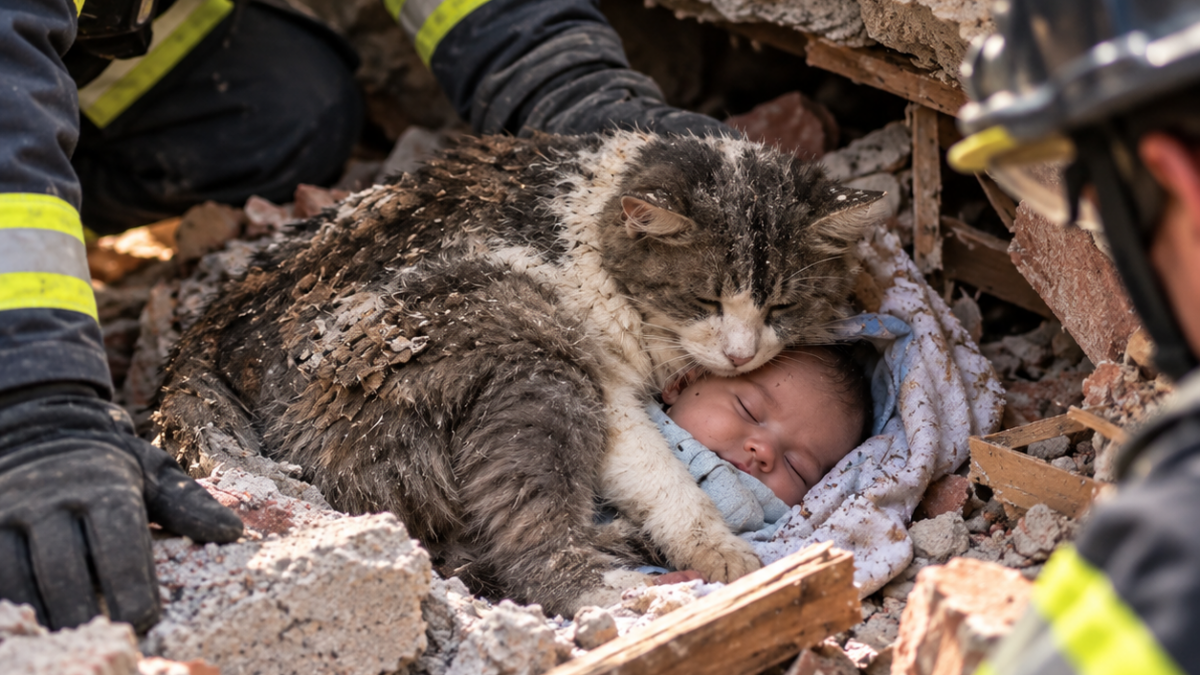
We were seconds away from covering the cat and moving on when I saw one dust-covered paw move beneath the rubble.
She had been lying there for nearly twelve hours, her body cold and barely alive, but what we discovered beneath her made every exhausted rescuer in that ruined room stop breathing.
And before that night was over, we would learn that she had not simply survived the collapse—she had spent every remaining ounce of strength protecting the one life no one knew was still there.
My name is Daniel Mercer, and I had been working urban search and rescue for seventeen years when the old house on Harrow Street came down.
It happened shortly after sunset.
Two stories.
Brick exterior.
Timber framing.
More than a hundred years old.
Neighbors said they heard a cracking sound, then something like thunder.
By the time our first trucks arrived, half the building had folded inward.
Dust filled the street.
Windows were gone.
The roof had collapsed into what used to be the second floor.
We knew several people had been inside.
For hours, we worked beneath portable floodlights.
We cut through wood.
Moved bricks by hand.
Crawled through spaces barely wide enough for our shoulders.
Every few minutes, someone called for silence.
“Quiet!”
Generators shut down.
Tools stopped.
We listened.
Sometimes we heard pipes dripping.
Sometimes settling timber.
Sometimes nothing.
That silence is one of the worst things you can hear at a collapse.
By three in the morning, we were exhausted.
We had already pulled out two injured adults.
Another resident had been found outside before we arrived.
But one family was still unaccounted for.
A young mother.
Her infant son.
And the family cat.
No one knew where they had been when the building came down.
Near dawn, my partner, Luis Ortega, and I reached what appeared to have been a first-floor bedroom.
A wardrobe lay on its side.
A crib had disappeared under plaster and broken timber.
Children’s clothes were scattered through the debris.
A blue stuffed elephant lay beneath a cracked door.
Luis stopped.
“Daniel.”
I followed his light.
A cat was lying between two sections of fallen ceiling.
Gray-and-white fur.
Covered in so much dust she almost blended into the concrete.
She wasn’t moving.
I crawled closer.
“Oh, sweetheart.”
Her body felt cold through my glove.
Luis looked away.
“We need to keep searching.”
I knew.
Every minute mattered.
I was about to move her carefully aside when Luis suddenly grabbed my shoulder.
“Wait.”
“What?”
“I saw something.”
We stared.
Nothing.
Then—
The cat’s front paw twitched.
Barely.
“She’s alive.”
I slipped two fingers against her neck.
At first, I felt nothing.
Then something fluttered.
A pulse.
So weak I almost convinced myself I had imagined it.
“Get the medic.”
Luis turned to call out.
I began removing small pieces of plaster from around the cat’s body.
That was when I saw something beside her stomach.
Not fur.
Skin.
Tiny fingers.
I froze.
“Luis.”
He turned.
I removed another piece of debris.
A small hand appeared.
Then part of a blue blanket.
“Oh my God.”
The cat wasn’t lying randomly beneath the rubble.
She was lying over something.
Someone.
We lifted her only inches.
Under her body was a baby.
Alive.
His face was dusty, but his chest moved.
Slowly.
Regularly.
The blanket around him was thin.
The room was freezing.
Yet when the medic reached us and checked him, he looked up in disbelief.
“Temperature’s holding.”
I stared at the cat.
Her own body was ice cold.
She had spent hours pressed against that child.
Whatever warmth she had left had gone into him.
Luis whispered, “She kept him warm.”
The baby gave a small cry.
The cat’s ear moved.
Just once.
Then her body went limp again.
I grabbed her gently.
“No. No, you don’t get to quit now.”
The medic reached for the baby.
Another rescuer took the cat.
As they began moving them toward the opening, I looked at the crushed room around us.
Then I saw something beneath the broken crib.
A woman’s bracelet.
And beyond it, a hand.
The baby’s mother was still somewhere under the wreckage.
And the building had just begun shifting again.
PART 2
The first warning came through the floor.
A deep, wooden groan.
Not loud.
Not dramatic.
But every rescuer in that room knew what it meant.
Something above us had moved.
Luis looked toward the doorway.
“Secondary shift.”
“I heard it.”
Our structural specialist’s voice came over the radio.
“Interior teams, hold position. We have movement on the east wall.”
I looked at the baby.
The medic already had him secured against his chest in a thermal wrap.
Another firefighter, Ben Collins, held the cat in both hands.
She looked almost boneless.
Her head hung against his wrist.
“Get them out,” I said.
Ben nodded.
“What about you?”
I pointed toward the hand beneath the crib.
“We still have someone.”
Luis followed my light.
The fingers were motionless.
The bracelet caught the beam from my helmet lamp.
Blue stones.
Silver chain.
A name engraved on the clasp.
EMILY.
The missing mother’s name was Emily Hart.
Luis swore under his breath.
Our radio crackled.
“Mercer, Ortega, evacuate the room until structure is reassessed.”
I pressed the transmit button.
“We have visual contact on another victim. Adult female, possible entrapment.”
A pause.
Then our incident commander answered.
“Condition?”
“Unknown.”
“Can you access safely?”
I looked above us.
A split ceiling joist had wedged against part of the collapsed second floor.
Dust sifted from it.
Safe was a relative word.
“Not yet.”
“Then withdraw.”
Every instinct in me resisted.
But rescue work does not reward bravery without discipline.
A dead rescuer helps no one.
I looked at the hand one more time.
“We’re coming back.”
Luis glanced at me.
“You telling her or yourself?”
“Both.”
We followed the others through the narrow tunnel we had cleared.
The baby cried once.
That tiny sound carried through the wreckage.
It did something to everyone who heard it.
Men who had been working for twelve hours stood straighter.
A paramedic at the opening reached for him.
“What’s his name?”
I had no idea.
One of the neighbors had given us the family information earlier.
Emily Hart.
Twenty-eight.
Infant son, approximately four months old.
The paramedic checked the list.
“Noah.”
The baby’s name was Noah.
The moment the medic carried him into the ambulance, people outside began shouting questions.
We ignored them.
Ben still had the cat.
A veterinary emergency technician from a nearby animal hospital had been called after several pets were found during the collapse.
She rushed over.
“Oh, no.”
“She has a pulse,” Ben said.
“Barely.”
The technician wrapped the cat in warm blankets.
“Name?”
“No clue.”
A neighbor standing behind the tape heard us.
“That’s Luna.”
We turned.
An older woman raised both hands as if afraid we might not believe her.
“Emily’s cat. Her name is Luna.”
The technician bent over her.
“Come on, Luna.”
I stood there for maybe three seconds.
Long enough to see oxygen tubing placed near the cat’s face.
Long enough to see Noah’s ambulance doors close.
Then our commander called me.
“Daniel.”
I turned.
Chief Marcus Hale stood beside the collapse diagram we had sketched across the hood of a command vehicle.
“The east wall is unstable.”
“I know.”
“We’re shoring before anyone goes back.”
“There’s a woman inside.”
“And I want you alive when you reach her.”
He pointed toward the building.
“Five minutes.”
Five minutes can feel like nothing.
Five minutes can also feel unbearable when someone is trapped beneath a house.
We worked fast.
Temporary supports were brought through the access path.
A structural engineer directed placement.
Every movement felt too slow.
I kept seeing Emily’s hand.
And Luna.
Cold.
Motionless.
Covering Noah.
My brain began doing what it always did during high-stress rescues.
It tried to turn emotion into tasks.
Shore.
Cut.
Lift.
Listen.
Move.
Do not imagine.
Imagining is dangerous until the job is done.
When Hale finally nodded, Luis and I went back in with two additional rescuers.
The room looked worse than before.
That may have been psychological.
The crib had been crushed flat beneath a beam.
The hand remained visible.
We began clearing around it.
Small debris first.
Plaster.
Wood fragments.
Broken toys.
A photograph frame.
Part of a lamp.
Then we found the woman’s arm.
She was on her side beneath what remained of a bed frame.
The position confused me.
“Why is she over here?”
Luis studied the debris.
The crib had originally stood against the opposite wall.
The collapse had shifted almost everything.
I followed the broken flooring.
Then I understood.
The floor beneath the crib had partially dropped.
Noah had probably been thrown or carried several feet when the room collapsed.
Somehow Luna had ended up with him in a pocket formed beneath the fallen wardrobe and ceiling.
Emily had been trapped separately.
“Emily!” I shouted.
No response.
I reached her face.
Dust-covered.
Blood at the hairline.
But when I placed two fingers against her neck—
Pulse.
Strong enough.
“She’s alive.”
Luis leaned close.
“Emily, if you can hear me, my name is Luis. We’re rescue. Your baby is alive.”
Nothing.
“Emily, Noah is alive.”
Her eyelids moved.
I thought I had imagined it.
Then her lips parted.
No sound.
I leaned closer.
“Noah is safe.”
A breath.
Then one word.
“Luna?”
Of all the things she could have asked, she asked for the cat.
I almost laughed.
“She’s alive too.”
Emily’s face changed.
Not much.
A release around the eyes.
Then she lost consciousness again.
“We’ve got her,” I said.
It took another forty minutes.
A beam pinned her lower leg.
We used airbags to lift the weight millimeter by millimeter.
One wrong movement could have shifted the load onto her chest.
Every few minutes we stopped.
Listened.
Rechecked.
The sun was rising by the time we finally slid Emily onto a rescue board.
Outside, Noah’s ambulance had already left for St. Vincent Medical Center.
Luna had been taken to an emergency animal hospital less than a mile away.
Emily went directly into another ambulance.
I climbed in long enough to speak to the paramedic.
“She asked about her baby and the cat.”
He nodded.
“We’ll tell the ER.”
Then Emily opened her eyes.
“Sir…”
I leaned closer.
“Noah?”
“He’s at St. Vincent. He was breathing on his own when he left.”
Tears slid sideways across her dusty face.
“And Luna?”
“Veterinary hospital.”
“Alive?”
“Yes.”
She closed her eyes.
“Good girl.”
That was all.
The ambulance doors shut.
I thought the rescue was over.
It wasn’t.
Not even close.
By noon, the old house on Harrow Street had become a crime scene.
Not officially at first.
The fire marshal had concerns.
Then the city building inspector found something strange.
The collapse pattern did not look like simple age-related failure.
One interior supporting wall had been removed during renovation.
Not weakened.
Removed.
A wall that should have carried part of the second-floor load.
Temporary posts had been installed, but two had been cut short.
The beam above them had been notched aggressively to make room for plumbing.
I was washing dust from my hands when Chief Hale came toward me.
“You’re not going home yet.”
“I wasn’t planning to.”
“Building department wants to talk to everyone who saw the interior.”
“Why?”
He looked toward the ruined structure.
“Because this may not have been an accident.”
That sentence changed the entire day.
The property belonged to a man named Franklin Voss.
He owned eight rental buildings across the city.
According to tenants, renovations had been underway for months.
Unlicensed crews.
Night work.
Walls moved.
Pipes rerouted.
No permits visible.
Emily had complained repeatedly about cracks in her ceiling.
A neighbor named Mrs. Alvarez had complained about doors no longer closing properly.
Another tenant had photographed a widening gap near the staircase.
Three days before the collapse, a loud cracking sound had been reported to the landlord.
Voss sent someone.
The worker allegedly told the tenants:
“Old houses make noise.”
No engineer came.
No evacuation happened.
At first, I tried not to care.
Not because I didn’t care.
Because I had learned not to build stories before facts.
But then I visited Noah.
I wasn’t supposed to.
Rescuers usually don’t follow patients into their lives.
You can’t.
There are too many.
But something about that child under Luna had followed me home.
I had slept three hours.
Woke up thinking I felt a cat’s pulse beneath my fingers.
By afternoon, I was at St. Vincent.
Emily was in surgery for a fractured leg and internal injuries.
Noah was under observation.
A pediatric nurse recognized my uniform.
“You’re one of the rescuers?”
“Yes.”
She smiled.
“He’s doing well.”
“Really?”
“Some bruising. Mild dehydration. We’re monitoring his lungs for dust exposure, but he’s stable.”
I stared through the nursery window.
Noah was asleep.
Small.
Wrapped in white.
Alive.
“How was his temperature when he arrived?”
“Surprisingly normal.”
The nurse shook her head.
“Considering where he was found, somebody got very lucky.”
I thought of Luna.
“Not luck.”
The veterinary hospital was next.
The receptionist knew who I meant before I finished the sentence.
“The collapse cat?”
“Luna.”
“Yes. She’s here.”
“How is she?”
The woman’s expression softened.
“Critical, but better than when she came in.”
A veterinarian named Dr. Maya Chen spoke with me.
“Hypothermia was our biggest immediate concern. Her body temperature was dangerously low.”
“But she’ll live?”
“We’re cautiously optimistic.”
“What else?”
“Dehydration. Minor lacerations. Bruising. One cracked rib. Dust inhalation.”
I looked through the glass.
Luna lay inside an oxygen enclosure.
She was a small cat.
Smaller than I remembered beneath the rubble.
Gray back.
White chest.
White front paws.
One paw bandaged.
“How long could she have kept Noah warm?”
Dr. Chen folded her arms.
“Hard to quantify.”
“She was colder than he was.”
“Yes.”
“So she gave him heat.”
“In simple terms, yes. A cat’s normal body temperature is higher than a human’s. Close physical contact can reduce heat loss, especially when another body blocks airflow and insulation is limited.”
“She covered him.”
“From what you described, she did.”
I stared at Luna.
“Would she know what she was doing?”
Dr. Chen smiled faintly.
“That’s the question everyone will ask.”
“And?”
“We should be careful about assigning human reasoning to animals.”
“Fair.”
“But cats recognize family. They respond to cries. They seek warmth. Some become highly protective of infants they live with.”
She looked at Luna.
“Whatever language we use, she stayed.”
That was enough for me.
She stayed.
Two words.
Simple.
The next day, Emily woke fully.
Her first request after speaking to doctors was to see Noah.
Her second was to know about Luna.
A nurse showed her a photo from the veterinary hospital.
Luna, wrapped in blankets, eyes open.
Emily cried.
Later, when I visited, she told me the story of how Luna came into their family.
“She wasn’t supposed to be ours.”
Emily smiled despite the bruising on her face.
“My husband found her behind a grocery store six years ago.”
“Your husband?”
Her smile disappeared.
“Evan died last year.”
“I’m sorry.”
“Cancer.”
She looked toward Noah’s bassinet.
“Luna slept beside him every night when he was sick.”
I sat quietly.
“After Evan died, she started sleeping outside Noah’s room.”
“As if she was guarding him?”
Emily nodded.
“She hated the crib at first. Wouldn’t go near it.”
“Then?”
“When Noah came home, she changed.”
Emily looked down at her hands.
“She would sit beside me during feedings. If he cried, she’d come find me.”
A tear fell.
“I used to joke that she thought I was incompetent.”
I smiled.
“Maybe she did.”
Emily laughed weakly.
Then her face changed.
“The night the house collapsed…”
I waited.
“I was packing.”
“Packing?”
“We were leaving.”
That caught my attention.
“Why?”
“The cracks.”
She looked at me.
“I told Mr. Voss the ceiling was moving.”
“Moving?”
“You could see the line widening.”
“When?”
“That afternoon.”
“What did he say?”
Emily’s expression hardened.
“He said if I was so worried, I could pay for a hotel myself.”
I felt something in my chest tighten.
“Did you have that in writing?”
“Text message.”
That mattered.
A lot.
Emily continued.
“I called my sister. She was coming to pick us up.”
“What time?”
“Eight.”
The collapse happened at 7:42.
Eighteen minutes.
She had been eighteen minutes away from leaving.
“I was in the bedroom putting Noah into his carrier.”
Her eyes filled.
“Luna was under the crib.”
“What happened?”
“I heard a crack.”
She closed her eyes.
“Not like before. Bigger.”
Her breathing changed.
I almost told her to stop.
Instead she continued.
“I grabbed Noah.”
“The ceiling came down?”
“The floor moved first. I fell.”
Her hand went to her temple.
“I remember Noah crying.”
She began shaking.
“I remember losing him.”
“He survived.”
“I know.”
“Emily, you don’t have to—”
“I heard Luna.”
I stopped.
“What?”
“After I fell.”
Her eyes opened.
“I couldn’t move. Something was on my leg.”
She swallowed.
“Noah was crying somewhere I couldn’t see him.”
“And Luna?”
“She was meowing.”
“Where?”
“Near him.”
Emily covered her mouth.
“I called her name.”
Her voice cracked.
“Luna! Luna, get Noah!”
Every hair on my arms rose.
“I know she couldn’t understand that.”
Emily shook her head.
“I know how it sounds.”
“It doesn’t matter.”
“She went toward his crying.”
I leaned forward.
“You saw her?”
“For a second. There was dust everywhere. But I saw her jump over something.”
Emily looked toward Noah.
“Then I don’t remember anything until you found me.”
The story spread before anyone could stop it.
A firefighter mentioned the cat to his wife.
A nurse told someone.
Someone photographed Luna through the veterinary hospital window.
By the third day, local news had the headline:
CAT FOUND SHELTERING BABY AFTER BUILDING COLLAPSE
Reporters gathered outside both hospitals.
Emily refused interviews.
So did I.
Chief Hale said one sentence publicly:
“The infant and animal were found alive in the same survivable void. We are grateful both received immediate medical care.”
He hated sensationalism.
So did I.
But privately, among the team, nobody called Luna “the cat.”
She became “the little gray firefighter.”
Luis started it.
“Should give her a helmet.”
“She weighs eight pounds,” I said.
“Small helmet.”
“Stop.”
“Badge?”
“No.”
He bought one anyway.
Not a real badge.
A pet tag shaped like a firefighter shield.
It said:
LUNA — STAYED ON DUTY
We gave it to Emily later.
She cried again.
The investigation into the building collapse deepened.
The city pulled records.
There were no permits for the structural renovations.
A contractor listed by Voss denied doing the work.
Neighbors supplied videos of men removing framing from inside the first floor.
One showed a worker carrying out sections of wall studs.
Another showed a dumpster filled with heavy timber.
The most damaging evidence came from a carpenter named Pete Dalton.
He had worked for Voss for six days.
Then quit.
He told investigators that Voss wanted the first floor opened up to create larger rental units.
Pete warned him a central wall appeared load-bearing.
Voss allegedly answered:
“It’s an old divider. Take it out.”
Pete refused.
Voss hired someone else.
Pete had text messages.
Photos.
And one voice recording.
The recording was never meant to become evidence.
Pete had recorded it because he wanted proof after an argument over unpaid wages.
Voss’s voice was clear.
“I don’t need an engineer to tell me what a wall does.”
Another man asked:
“What if it carries the floor?”
Voss laughed.
“Then brace it. We’re not spending ten grand on paperwork.”
I heard the recording months later.
By then, Emily and Noah were living with her sister.
Luna was home too.
Her recovery took longer than Noah’s.
For the first week, she barely moved.
Emily visited the animal hospital in a wheelchair.
Noah sat in her lap.
When Luna saw them, she tried to stand.
Dr. Chen stopped her.
“Easy.”
Luna ignored her.
She dragged herself toward the edge of the enclosure.
Noah made a small sound.
A soft baby coo.
Luna’s ears lifted.
Emily started crying.
“Hi, baby girl.”
Luna pressed her face against Emily’s hand.
Then she looked toward Noah.
Emily brought him close enough for Luna to smell his blanket.
Luna sniffed.
Her whole body relaxed.
That moment affected Dr. Chen too.
She turned away and pretended to adjust equipment.
I saw her wiping her eye.
Nobody said anything.
Rescue workers and veterinarians learn to grant one another dignity.
Luna went home ten days later.
The veterinary staff lined the hallway.
Emily carried her in a soft-sided crate.
Noah slept against Emily’s sister.
I met them outside.
Emily looked surprised.
“You came.”
“I was nearby.”
That was a lie.
I had driven forty minutes.
She knew.
“Thank you.”
Luna meowed from the crate.
Emily smiled.
“She wants out.”
“Probably wants to inspect your driving.”
“She’s judgmental.”
“Cats specialize in that.”
Then Emily became serious.
“Daniel.”
“Yes?”
“I don’t know how to thank you.”
“You don’t.”
“But you—”
“We did our job.”
“You found them.”
“We almost missed Luna.”
The truth still bothered me.
If Luis had not seen that paw—
If I had moved her aside—
If we had assumed—
I stopped.
Emily read something on my face.
“But you didn’t.”
“No.”
“You didn’t.”
She reached through the crate door and touched Luna.
“And neither did she.”
The criminal investigation took four months before charges were announced.
Franklin Voss was charged with multiple offenses related to unlawful construction, reckless endangerment, building-code violations, and falsified records.
The exact charges changed as prosecutors reviewed evidence.
Civil lawsuits followed.
Voss gave interviews through his attorney.
He denied responsibility.
He blamed subcontractors.
He blamed the age of the building.
He blamed water damage.
He blamed previous owners.
Everyone, it seemed, except himself.
Then he made a mistake.
A reporter asked whether tenants had warned him about structural problems.
Voss answered:
“No one told me anyone was in danger.”
Emily had the text messages.
So did investigators.
Her message from 4:16 p.m.:
The crack over the baby’s room is wider. The wall is making popping sounds. I don’t feel safe here with Noah. Please send someone qualified.
Voss at 4:31:
Old buildings shift. Stop panicking. If you leave, rent is still due.
Emily at 5:02:
I’m serious. If you won’t send an engineer, I’m taking my baby out tonight.
Voss:
Do what you want. Don’t expect me to pay for your hotel.
The collapse happened less than three hours later.
The messages became public during pretrial proceedings.
Voss stopped giving interviews.
People called it justice.
I didn’t.
Not yet.
Justice wasn’t a headline.
Emily still woke screaming.
Noah developed respiratory issues for several weeks.
Luna panicked whenever something heavy fell.
Emily lost almost everything she owned.
Photographs.
Evan’s clothes.
Noah’s first hospital bracelet.
Wedding albums.
A wooden box Evan had made.
Those things didn’t come back because a landlord faced charges.
One afternoon, about six months after the collapse, Emily called me.
“Can you come over?”
“Everything okay?”
“Yes.”
A pause.
“Actually, I don’t know.”
I went.
She and Noah were living in a small rented house on Birch Avenue.
One story.
New construction.
Lots of windows.
The first thing I noticed was Luna sitting on the back of the couch.
Healthy.
Her fur had grown back around the shaved patches.
Only a faint scar remained near her ribs.
She watched me enter.
“You remember me?”
Luna blinked.
“Deep affection.”
Emily laughed from the kitchen.
“She remembers.”
Noah was in a high chair.
Six months old now.
Round cheeks.
Bright eyes.
When he saw Luna, he squealed.
Luna jumped down.
Not toward me.
Toward him.
She sat beneath his chair.
A piece of banana fell.
She sniffed it and looked offended.
“Not a fruit cat,” Emily said.
“Standards.”
Then I saw why she had called.
On the table was a box.
Inside were items recovered from the collapse.
A firefighter had found them during final debris processing.
Emily’s bracelet.
Evan’s watch.
Two photographs.
And Noah’s blue stuffed elephant.
The same one I had seen beneath the cracked door.
Its fabric was torn.
One ear missing.
Emily held it.
“I don’t know whether to keep it.”
“Why not?”
“Every time I see it, I’m back there.”
I nodded.
“But throwing it away feels wrong.”
“You don’t have to decide today.”
She looked at me.
“That’s what my therapist says.”
“She sounds smarter than me.”
“She charges more.”
I smiled.
Then Emily reached into the box.
She pulled out something small.
A red collar.
Luna’s old collar.
Bent.
Dust still trapped in the buckle.
The emergency vet had replaced it after the rescue.
Emily touched it.
“She was wearing this.”
“Yeah.”
“I keep thinking about her under there.”
I knew.
“So do I.”
“Do you?”
“More than I probably should.”
Emily looked toward Luna.
“She wasn’t always brave.”
That surprised me.
“No?”
“She used to hide from the vacuum.”
“Reasonable.”
“She was terrified of thunderstorms.”
“Also reasonable.”
“When Evan was sick, she wouldn’t enter his room if the oxygen machine was running.”
Emily smiled faintly.
“She was scared of everything.”
I watched Luna clean one paw.
“What changed?”
Emily looked at Noah.
“Maybe nothing.”
I understood.
Bravery is not the absence of fear.
Sometimes it is deciding something else matters more.
Luna didn’t need to be fearless.
She only needed to stay.
That night, Emily decided not to throw away the collar.
She framed it beside a photo of Evan holding Luna as a kitten.
Not the collapse.
Not the rubble.
The life before.
The civil case moved faster than the criminal one.
The city condemned Voss’s remaining Harrow Street properties pending inspection.
Two other buildings had structural violations.
One contained tenants who were temporarily relocated.
Investigators found unpermitted electrical work.
Improper plumbing cuts through joists.
Load-bearing alterations.
Nobody died.
That mattered.
Bruno—I mean Noah; there are stories that stay in your head and names sometimes try to cross them. Noah’s case became part of why those inspections happened quickly.
One tenant, Mrs. Alvarez, told me:
“Maybe the baby saved us too.”
I said:
“Luna helped.”
She laughed.
“The cat saved half the neighborhood.”
Stories grow.
You have to be careful with them.
Luna did something extraordinary.
That doesn’t mean we need to turn her into magic.
She was still a cat.
She chased dust.
She knocked over water glasses.
She hated closed doors.
She once bit Luis when he tried to put the firefighter-shaped tag on her collar.
He deserved it.
We visited together.
Luis held up his bandaged finger.
“I saved you.”
Luna stared.
“You’re welcome.”
She turned away.
Emily laughed so hard she had to sit down.
That normal laughter mattered.
For months after the collapse, Emily had sounded like someone holding herself together from the outside.
The first time I heard her laugh without stopping herself, I knew healing had begun.
Not finished.
Begun.
The criminal trial started fourteen months after the collapse.
I was subpoenaed.
So were Luis, Hale, the building inspector, Pete Dalton, several tenants, engineers, and Emily.
I hated court.
Rescue sites make sense to me.
A beam weighs what it weighs.
A void exists or it doesn’t.
A pulse is there or it isn’t.
Courtrooms depend on language.
Sequence.
Interpretation.
Memory.
Defense attorneys do their job by testing all of it.
When I testified, Voss sat thirty feet away.
Gray suit.
Silver tie.
Hair carefully combed.
I expected to feel rage.
Instead, I felt almost nothing.
He was smaller than the idea of him.
The prosecutor asked me to describe the rescue.
I did.
The room was silent when I explained finding Luna.
Then Noah.
Then Emily.
The prosecutor displayed photographs.
I looked away from one.
Luna’s body over Noah.
A rescue photographer had taken it seconds after we uncovered them.
I had forgotten the camera existed.
In the photograph, Luna looked dead.
That was what struck me.
Her face rested against the blanket.
Her fur white with dust.
Noah’s small hand visible under her chest.
I heard someone in the jury box inhale sharply.
The prosecutor asked:
“What did you initially believe about the cat?”
“That she was deceased.”
“What changed?”
“My partner saw her paw move.”
“And the infant?”
“He was beneath her.”
“Condition?”
“Alive. Breathing.”
“Was the cat warm?”
“No.”
“Was the infant?”
“He was significantly warmer than she was.”
The defense objected when the prosecutor asked what I believed Luna had done.
The judge sustained it.
Rightly.
I could describe observations.
Not scientific conclusions beyond my training.
Dr. Chen later testified about thermoregulation.
A pediatric physician testified that Noah’s maintained body temperature likely improved his chance of avoiding severe hypothermia.
No one said “hero cat” in court.
They didn’t need to.
Then the structural engineer testified.
That changed the atmosphere.
He displayed a diagram of the building.
The removed wall.
The notched beam.
The altered joists.
The temporary posts.
He used simple language.
“Imagine a table,” he told the jury. “Now remove one leg and shave half the material from another. It may remain standing briefly. That does not mean it is safe.”
The prosecutor asked:
“Was the collapse foreseeable?”
The engineer paused.
“Given the visible distress reported in the structure and the unpermitted alterations, a qualified inspection would have identified serious risk.”
“Could evacuation have prevented injuries?”
“Evacuation would have removed people from the hazard.”
Voss looked down.
Then Pete’s recording played.
“I don’t need an engineer to tell me what a wall does.”
Voss’s own voice filled the courtroom.
“Then brace it. We’re not spending ten grand on paperwork.”
I saw Emily close her eyes.
She sat behind the prosecutor.
Noah was with her sister.
Luna was home.
For once, I was glad.
That room was no place for either of them.
The defense argued Voss had relied on workers.
That he was not an engineer.
That he could not personally know the structure would fail.
That tenants had continued living there.
That old buildings contain hidden defects.
Some of those points were legitimate questions.
Responsibility had to be proven.
Not assumed.
Then Emily testified.
She walked with a slight limp that remained from her injury.
The prosecutor showed her texts.
Emily read them aloud.
Her own warning.
Voss’s response.
Stop panicking.
She paused.
Her voice almost broke.
The prosecutor waited.
Emily continued.
If you leave, rent is still due.
The courtroom was completely silent.
“What did you do after receiving that message?” the prosecutor asked.
“I called my sister.”
“Why?”
“To leave.”
“When was she coming?”
“Eight.”
“What time did the building collapse?”
“7:42.”
Eighteen minutes.
Again.
Those eighteen minutes hung in the room.
The defense attorney approached gently.
He was not cruel.
Good lawyers don’t need to be.
“Ms. Hart, you had concerns earlier that day?”
“Yes.”
“But you remained in the apartment?”
“I was packing.”
“You had been there for several hours after first noticing the crack?”
“Yes.”
“So you did not personally believe collapse was imminent?”
Emily looked at him.
“I believed it was dangerous enough to take my four-month-old baby out that night.”
He nodded.
“But you didn’t call emergency services.”
“No.”
“Why?”
“Because my landlord told me I was panicking.”
That answer landed harder than shouting would have.
The defense attorney sat down.
The trial lasted nearly three weeks.
The verdict came on a Friday.
Voss was convicted on several counts related to reckless conduct and code violations; not every charge resulted in conviction.
That mattered too.
Real justice is rarely clean enough for a story.
Some claims were dismissed.
Some counts were reduced.
The jury distinguished among them.
I respected that.
When the verdict was read, Emily did not cheer.
Neither did I.
Voss stared forward.
His wife cried.
I found myself noticing that.
Another person hurting.
Consequences spread.
That does not erase responsibility.
But it complicates revenge.
Outside, reporters surrounded Emily.
“Do you feel justice was served?”
“What would you say to Mr. Voss?”
“Do you forgive him?”
That last question made me angry.
Emily stopped.
She looked at the reporter.
“I don’t owe anyone forgiveness on a schedule.”
Then she walked away.
That was the best answer I heard all day.
Voss later received a prison sentence, financial penalties, and restrictions related to property management after the court considered the offenses and other factors.
Civil judgments required compensation to injured tenants.
His property company collapsed financially.
Some people in the neighborhood called that revenge.
Emily didn’t.
A year after sentencing, we sat in her backyard while Noah played in a plastic sandbox.
He was almost two.
Luna lay in the sun.
Noah picked up a toy truck.
He crawled toward Luna.
“Gentle,” Emily warned.
He placed the truck beside her.
Luna sniffed it.
Noah laughed.
I said, “You ever think about Voss?”
Emily looked surprised.
“Less.”
“That good?”
“Yes.”
“What changed?”
She watched Noah.
“I got tired of letting him live in rooms he wasn’t in.”
I understood immediately.
Trauma had already occupied enough space.
She wasn’t giving it the backyard too.
Noah stood.
Wobbled.
Fell onto his diaper.
Luna opened one eye.
Emily smiled.
“This is what I want.”
“What?”
“Boring.”
I laughed.
“Boring?”
“Breakfast. Laundry. Noah throwing peas. Luna screaming because her bowl is technically visible at the bottom.”
“That sounds serious.”
“She has suffered.”
We laughed.
Boring.
I started thinking about that word differently.
Rescue workers are often present on the worst day of someone’s life.
We see disaster.
Impact.
Blood.
Collapse.
Fire.
We rarely see boring.
Boring is what survivors fight to return to.
Bills.
Groceries.
School.
Bedtime.
A cat sleeping in a window.
Those ordinary things become sacred after chaos.
Luna aged.
Slowly.
At first, she seemed unchanged.
Then gray hairs appeared around her face.
Her jumps became shorter.
She stopped climbing the kitchen cabinets.
Emily considered that progress.
Noah grew faster.
At three, he called Luna “Nuna.”
At four, he told everyone she was “my rescue cat.”
Emily corrected him.
“She rescued you.”
Noah thought about it.
Then said:
“We rescued each other.”
Children sometimes stumble into truth adults spend years explaining.
At five, Noah started kindergarten.
His class had a safety week.
Firefighters visited.
Luis and I went.
I had forgotten Noah’s school was on the list.
The teacher introduced us.
Noah raised his hand immediately.
“My cat is a firefighter.”
The whole class laughed.
I looked at Luis.
He whispered, “Finally. Recognition.”
The teacher smiled.
“Tell us about your cat.”
Noah stood.
He told the story as only a five-year-old could.
“The house fell down and Luna laid on me so rocks couldn’t get me and then Mr. Daniel found us because her foot went boop.”
Boop.
Seventeen years of rescue training reduced to boop.
Accurate enough.
“And my mom was under the floor but they got her too.”
He pointed at me.
“Mr. Daniel is old.”
The room exploded.
I stared.
“Thank you, Noah.”
Luis nearly collapsed laughing.
After the presentation, Noah ran toward me.
“Did Luna really save me?”
The question surprised me.
I crouched.
“She helped keep you safe.”
“Did she know?”
There it was again.
The question adults asked.
I gave him the only honest answer.
“I don’t know what she understood.”
Noah frowned.
“But she stayed with you.”
He smiled.
“That means yes.”
Maybe, to him, it did.
Luna developed kidney disease when Noah was seven.
Dr. Chen was still her veterinarian.
By then Luna was around thirteen.
Medication.
Special food.
Fluids under the skin.
Emily learned how to administer them.
Noah helped by holding treats.
Luna hated every second.
“She fought a building,” Noah complained one afternoon, “but she hates a tiny needle.”
“Bravery is selective,” I said.
Luna hissed at me.
“See?”
Noah giggled.
Her condition stabilized for almost two years.
Then declined.
I knew before Emily called.
Some voices change when they carry an ending.
“Daniel?”
“Yeah.”
“Can you come?”
I had heard those words from too many people.
I knew.
I drove over.
Noah was nine.
Old enough to understand death.
Young enough to hate that understanding.
Luna lay on a blanket near the living-room window.
Sunlight covered half her body.
The same gray-and-white fur.
Much thinner now.
Noah sat beside her.
He was crying silently.
Emily sat on the floor too.
When I entered, Luna opened her eyes.
“Hey, little firefighter.”
Her tail did not move.
Cats don’t make endings easy with familiar gestures.
But she lifted her head slightly.
I sat.
Noah asked:
“Is she scared?”
I looked at Emily.
She nodded for me to answer.
“I don’t know.”
“Was she scared under the house?”
“Yes.”
“How do you know?”
“Because everything alive gets scared.”
He wiped his face.
“But she stayed.”
“Yes.”
Noah looked at Luna.
“I’ll stay too.”
That nearly broke me.
Dr. Chen came to the house.
She had treated Luna from the first night.
When she saw her, she knelt.
“Well, look at you.”
Luna blinked.
Dr. Chen smiled through tears.
“You’ve always been difficult.”
Emily laughed softly.
“That’s putting it kindly.”
We all stayed.
Noah kept one hand on Luna’s back.
Emily held her head.
I sat nearby.
Before Dr. Chen gave the final medication, Noah leaned close.
“Thank you for keeping me warm.”
Luna’s eyes were almost closed.
He kissed her head.
“I’m warm now.”
No one in that room could speak for several seconds.
Luna died in sunlight.
Not under concrete.
Not cold.
Not alone.
Warm.
That word mattered.
Emily had Luna cremated.
Half the ashes stayed in a small wooden box Evan had made years earlier.
The other half were scattered in the backyard where Luna liked to sleep.
Noah insisted on keeping the firefighter-shaped tag Luis had given her.
It hung from a hook beside his bed.
LUNA — STAYED ON DUTY
At thirteen, Noah wrote a school essay about her.
Emily sent me a copy.
The title was:
The Cat Who Didn’t Leave
I read it twice.
Then a third time.
Noah did not describe Luna as heroic because she was fearless.
He wrote:
I think Luna was probably scared too. That is why I think what she did matters. If you are never scared, staying is easy. She stayed when everything was falling.
I kept that sentence.
Still have it.
By then, Harrow Street had changed.
The collapsed house was gone.
The lot remained empty for several years during litigation.
Eventually the city acquired it.
Residents proposed different uses.
Parking.
New housing.
A small community garden.
Mrs. Alvarez wanted a memorial.
Emily resisted.
“I don’t want Noah’s childhood turned into a disaster monument.”
Fair.
They compromised.
The city built a small pocket park.
No dramatic statue.
No giant plaque.
Just trees.
Benches.
A play area.
And near one corner, a small bronze silhouette of a cat curled around a child.
Underneath were six words:
WHEN EVERYTHING FELL, SHE STAYED.
No name.
Emily wanted it that way.
People who knew, knew.
People who didn’t could still understand.
The park opened ten years after the collapse.
Noah was ten.
He stood beside Emily.
I stood with Luis, Hale, Dr. Chen, and several rescuers.
Pete Dalton came too.
He had carried guilt for years because he had known the work was dangerous and only quit instead of reporting it.
“I should have called the city,” he once told me.
“Maybe.”
“You’re supposed to tell me it wasn’t my fault.”
“I don’t know enough to tell you that.”
He appreciated the honesty.
Eventually he began speaking to construction apprentices about refusing unsafe work.
“Walking away protects you,” he told them. “Reporting it may protect the next person.”
That was part of the aftermath too.
Not revenge.
Responsibility spreading in the other direction.
At the park opening, Noah touched the bronze cat.
“Doesn’t look like her.”
Luis said, “Needs more attitude.”
Emily laughed.
Noah looked at me.
“Do you remember her moving her paw?”
“Yes.”
“How much?”
“What?”
“How much did it move?”
I held my thumb and finger less than an inch apart.
“Maybe this much.”
He stared.
“That’s it?”
“That’s it.”
“And you saw it?”
“Luis did.”
Noah looked at Luis.
For once, Luis stopped joking.
“I almost didn’t.”
Noah was quiet.
Then he touched the bronze cat again.
“My whole life happened because you saw that.”
Luis shook his head.
“No.”
Noah frowned.
“Why?”
“Your whole life happened because she moved it.”
That became another sentence I kept.
Years passed.
I retired from active rescue at fifty-eight.
My knees made the decision before I did.
Luis retired one year later and claimed he only did it because I was “making old age look lonely.”
Chief Hale had retired earlier.
Dr. Chen expanded her hospital.
Emily became a tenant-safety advocate.
Not full time at first.
Then more.
She spoke at city meetings.
Helped families document unsafe conditions.
Worked with housing nonprofits.
She never described herself as an activist.
“I just know what cracks sound like,” she said.
The laws changed too.
After Harrow Street and several other incidents, the city strengthened inspection requirements for structural renovations in older rental properties.
Emergency complaint procedures improved.
Tenants could submit photo documentation directly to inspectors.
Landlords could no longer close certain structural complaints without qualified review.
No single tragedy caused all of it.
Policy rarely comes from one event.
But Harrow Street was cited repeatedly.
That mattered.
Franklin Voss served his sentence.
Eventually he was released.
I know because a reporter called me.
“Do you have a response?”
“No.”
“Do you think he served enough time?”
“That’s not for me to decide.”
“Would you meet him?”
“No.”
That answer surprised even me.
Years earlier, I had imagined what I would say.
I would tell him about Noah’s temperature.
Luna’s cracked rib.
Emily’s limp.
The eighteen minutes.
I would make him understand.
By then, I no longer believed understanding could be forced.
And I didn’t need him for the ending.
That was the revenge, if anyone insisted on using the word.
Voss had spent ten thousand dollars he didn’t want to spend on engineering and turned it into the most expensive decision of his life.
His company disappeared.
His properties were sold.
His name became attached to public court records and safety training examples.
But even that wasn’t the satisfying part.
The satisfying part was Noah.
Alive.
Growing.
Annoying his mother.
Loving science.
Breaking his wrist at twelve because he thought he could jump a bicycle ramp.
Normal problems.
Beautifully normal problems.
At sixteen, Noah became a volunteer at Dr. Chen’s animal hospital.
He claimed it wasn’t because of Luna.
No one believed him.
He was especially good with frightened cats.
He would sit on the floor.
Wait.
No grabbing.
No forcing.
One afternoon I visited.
He was beside a carrier containing a trembling orange cat.
“You learned that from your mother?”
“No.”
“Dr. Chen?”
“No.”
“Me?”
He looked offended.
“Definitely not.”
He nodded toward the carrier.
“Luna.”
I smiled.
“She teach you directly?”
“Pretty much.”
The cat slowly came forward.
Noah extended one finger.
The animal sniffed it.
“See?”
I did.
At eighteen, he graduated high school.
Emily invited me.
I sat three rows behind her.
When Noah’s name was called, she cried before he even reached the stage.
Afterward, he found me.
He was taller than I was.
That felt unfair.
“You’re old.”
“You’ve been saying that since kindergarten.”
“Consistent.”
“What are you studying?”
He smiled.
“Emergency medicine.”
I laughed.
Emily groaned.
“I tried.”
“Paramedic?”
“Maybe doctor.”
“Big difference.”
“I have time.”
He looked toward his mother.
“I want to work somewhere people show up on their worst day.”
That sentence hit me.
I had spent my life doing exactly that.
“What makes you think you’ll be good at it?”
Noah looked at me.
“Because I know the worst day isn’t always the end.”
I had no response.
That was Luna again.
The worst day not being the end.
Emily eventually moved out of the Birch Avenue house.
Not because of bad memories.
Because Noah left for college and she wanted something smaller.
Before selling, she asked if I wanted to come by.
The house looked empty without furniture.
In the backyard, beneath the tree where Luna’s ashes had been scattered, Emily had planted lavender.
“Will the buyers keep it?”
“Probably.”
“And if they don’t?”
She shrugged.
“Luna won’t mind.”
We stood quietly.
Then she said:
“I used to think surviving meant getting back what you had.”
I looked at her.
“It doesn’t?”
“No.”
She touched the old scar near her temple.
“You don’t get it back.”
“What happens?”
“You build something else.”
That may be the truest thing anyone ever told me about survival.
You don’t restore the old life exactly.
You build something else.
Noah built a future.
Emily built purpose.
Pete built courage he wished he had used sooner.
Our department built better collapse protocols for locating small animals because pets sometimes indicate survivable spaces near people.
Dr. Chen created an emergency veterinary partnership with city disaster response.
And Luna—
Luna built nothing intentionally.
She was a cat.
That is important.
She did not choose to become a symbol.
She did not know about policies.
Trials.
Parks.
Essays.
She knew Noah smelled familiar.
She knew the floor shook.
She knew he cried.
She knew warmth.
She knew staying.
Maybe that is enough.
More than enough.
Twenty years after the collapse, I went back to Harrow Street alone.
I was seventy by then.
The pocket park trees had grown tall.
Children played where a house once stood.
Parents sat on benches.
Someone had left flowers beside the bronze cat.
I sat nearby.
A little girl climbed onto the bench beside her father.
She pointed.
“Daddy, why is the kitty laying on the baby?”
The father read the plaque.
WHEN EVERYTHING FELL, SHE STAYED.
He thought for a moment.
“Maybe the kitty was keeping the baby safe.”
“Was she his mommy?”
“No.”
“Then why?”
The father smiled.
“Sometimes you protect someone because they’re yours in a different way.”
The little girl considered this.
Then she ran back to the slide.
I sat there with tears in my eyes.
Not because I was sad.
Not exactly.
Memory changes temperature with time.
At first, Harrow Street had been cold in my mind.
Concrete.
Dust.
Luna’s body.
Noah’s tiny hand.
Years later, when I remembered it, I thought of warmth.
The warmth she gave him.
The sunlight when she died.
The park.
The life that continued.
A phone buzzed in my pocket.
Noah.
He was thirty by then.
A pediatric emergency physician.
Of course he was.
He sent me a photograph.
A newborn girl asleep against his chest.
His daughter.
Meet Emily Luna Hart.
I stared at the name.
Then called him.
“You named your daughter after your mother and cat?”
“My wife approved.”
“Does your mother know?”
“She’s holding her now.”
“And Luna?”
He laughed.
“Pretty sure she knows.”
“You’re a doctor. You don’t get to say things like that.”
“I’m off duty.”
I sat looking at the bronze silhouette.
“How is your mom?”
“Crying.”
“Good.”
“Daniel?”
“Yeah?”
“Do you remember that night often?”
I looked around the park.
“Less than I used to.”
“Me too.”
That surprised me.
“You don’t remember it.”
“Not directly.”
“No.”
“But I remember the story.”
There is a difference.
Memory inherited is not memory lived.
I was glad.
Noah did not remember being cold beneath a house.
He remembered being told he was loved.
Protected.
Found.
That was better.
A few months later, I met baby Emily Luna.
Noah placed her in my arms.
“Careful.”
“I have handled babies before.”
“You found one.”
“Technically.”
“That doesn’t qualify you.”
His mother laughed.
Emily—older now, silver in her hair—sat across from us.
“She has his eyes.”
“Whose?”
“Noah’s.”
“Thank God,” Noah said.
His wife threw a pillow at him.
The baby slept.
Warm.
Safe.
I looked down.
For just a second, I saw another small hand under dust.
Then the image changed.
Because the present was stronger.
That was the final lesson Harrow Street gave me.
The past does not disappear.
It loses the right to be the only picture.
For years, people asked me whether Luna saved Noah.
I always answered carefully.
“I can tell you what I observed.”
A cat stayed over an infant for hours.
Her body temperature dropped dangerously.
His did not.
She shielded him from falling fragments inside a survivable void.
Was that instinct?
Attachment?
Warmth-seeking behavior?
Protection?
Love?
People can choose their word.
I know mine now.
She stayed.
That is enough.
And people asked whether Franklin Voss got what he deserved.
I stopped answering that too.
Deserve is a difficult measurement.
Courts measure crimes.
Civil systems measure damages.
People measure pain.
None convert perfectly.
What mattered was that responsibility was established.
Warnings were documented.
Unsafe practices were exposed.
Other buildings were inspected.
Rules improved.
People learned.
And Voss no longer controlled the story.
That mattered most.
He had tried to save money by ignoring a wall.
For years afterward, strangers knew the name Luna instead.
He became the man in the legal records.
She became the cat in the park.
That is as close to revenge as life needed to get.
The building fell because someone decided safety was too expensive.
Luna answered by spending everything she had.
Heat.
Strength.
Comfort.
Maybe consciousness itself.
She spent it on a baby who could give her nothing back.
One choice was selfishness.
The other was instinctive generosity.
One destroyed a home.
The other preserved a life.
If you ask me which one deserves to be remembered, I don’t have to think.
I still keep one object from the rescue.
Not rubble.
Not photographs.
Not newspaper clippings.
A tiny piece of blue blanket.
The paramedic cut away a damaged section when Noah reached the ambulance.
He gave it to me months later.
“I figured you’d want this.”
I didn’t.
Then I took it anyway.
For years it sat in a drawer.
Now it lives inside a small wooden box.
My granddaughter once found it.
“What is this?”
I told her.
Not the whole story.
Just enough.
“A cat kept a baby warm with this blanket.”
She looked skeptical.
“A cat?”
“Very stubborn one.”
“Did the baby live?”
“Yes.”
“Did the cat?”
“Yes.”
“Then it’s a happy story.”
Children simplify things beautifully.
I almost corrected her.
There was death.
Injury.
Crime.
Trauma.
Loss.
But then I thought about Noah.
Emily.
The park.
Baby Emily Luna.
Maybe she was right.
Not because nothing terrible happened.
Because terrible wasn’t the final thing.
That is different.
The last time I saw Noah at Harrow Park, he brought his daughter.
She was three.
She ran straight toward the bronze cat.
“Kitty!”
Noah lifted her.
“That kitty has your name.”
She looked at him.
“Why?”
He sat beside the sculpture.
I stayed back.
This was his story to tell now.
“A long time ago, when Daddy was a baby, a house fell down.”
Her eyes widened.
“Boom?”
“Big boom.”
“Were you scared?”
“I was too little to remember.”
“Where was Grandma?”
“Nearby.”
“Where was kitty?”
“With me.”
“What kitty?”
“Luna.”
The little girl touched the bronze ear.
“What did Luna do?”
Noah looked toward me.
Then back at his daughter.
“She stayed until help came.”
The child nodded as though this made perfect sense.
Then she kissed the bronze cat.
Noah looked away.
I pretended not to see him crying.
Some moments deserve privacy even in public.
We sat on the bench afterward.
His daughter chased leaves.
Noah said:
“You know what bothers me?”
“What?”
“If Luis hadn’t seen the paw.”
I had spent years with that same thought.
“I know.”
“What if—”
“No.”
He looked at me.
I surprised myself with how firmly I said it.
“No more what-ifs.”
He was quiet.
“We had enough of those.”
“What do you think instead?”
I watched his daughter.
“What happened.”
“And?”
“You lived.”
He nodded.
“Luna lived.”
“For years.”
“Mom lived.”
“Yes.”
“You found us.”
“We found you.”
“Difference?”
“Always.”
He smiled.
“Still correcting wording.”
“Retirement hasn’t cured me.”
His daughter ran back.
“Daddy!”
He opened his arms.
She jumped into them.
A full life can fit inside moments like that.
No courtroom.
No collapse.
No villain.
Just someone running toward someone who stays.
When I finally stood to leave, Noah hugged me.
He had done that many times over the years.
This one felt different.
Maybe because we were both older.
Maybe because endings become visible eventually.
“Thank you,” he said.
“You don’t have to thank me.”
“I know.”
“Then stop.”
“No.”
I laughed.
He did too.
As I walked toward my car, I passed the bronze plaque one more time.
WHEN EVERYTHING FELL, SHE STAYED.
Six words.
Years ago, I would have told you the most important part was fell.
The collapse.
The danger.
The rescue.
Now I know better.
The important word is stayed.
Buildings fall.
People fail.
Systems fail.
Bodies fail.
Time takes things.
Staying is what we do against all of that.
Luna stayed with Noah.
We stayed in the rubble for Emily.
Emily stayed with Luna through kidney disease.
Noah stayed beside Luna at the end.
Dr. Chen stayed until her breathing stopped.
Neighbors stayed involved until inspections happened.
Pete stayed with his testimony when lawyers challenged him.
Emily stayed involved until tenant protections changed.
And decades later, Noah stayed long enough to tell his daughter why a little bronze cat had her name.
That is how one night survives.
Not through rubble.
Through people carrying forward what mattered.
If I close my eyes now, I can still return to that room.
I wish I couldn’t.
But I can.
The flashlight beam.
The broken crib.
The smell of plaster.
Luis saying, “Wait.”
The paw.
One tiny movement.
My fingers at Luna’s neck.
Nothing.
Then—
A pulse.
So small.
The smallest physical thing that changed so many lives.
I remember lifting plaster.
Seeing Noah’s hand.
I remember how warm his skin felt compared with hers.
I remember thinking:
How?
How is this baby alive?
Years answered that question in different ways.
Medicine.
Chance.
Architecture.
A survivable void.
Timing.
Rescue training.
And Luna.
Never just one thing.
Survival is often a chain.
If one link fails, the outcome changes.
But Luna was one of the links.
A living, breathing, terrified little animal who stayed where she was needed.
So when people ask me for the ending, I don’t tell them about the sentencing first.
I don’t tell them about the lawsuit.
I don’t tell them about the building code.
I tell them this:
The baby grew up.
His mother grew older.
The cat came home.
She slept in sunny windows.
She stole food.
She hated needles.
She lived long enough to hear Noah call her name.
She died warm.
The house disappeared.
A park grew in its place.
Children play there.
A small bronze cat watches them.
And one of those children now carries Luna’s name.
That is the ending.
Not rubble.
Not revenge.
Continuance.
A man once decided safety cost too much.
A cat decided nothing.
She simply heard a baby cry and stayed.
And somehow, out of all the destruction that night, that was the choice that lasted longest.
My name is Daniel Mercer.
I spent seventeen years believing rescue meant pulling people out.
Harrow Street taught me something different.
Sometimes rescue begins before rescuers arrive.
Sometimes the first rescuer weighs eight pounds.
Sometimes she has gray fur, white paws, and absolutely no idea that anyone will ever know what she did.
Sometimes she is already almost gone when you find her.
Sometimes all she can do is move one paw.
And sometimes one paw is enough.
Enough to make someone stop.
Enough to make someone check.
Enough to uncover a child.
Enough to save a life.
Enough to become a story passed from a mother to a son, from a son to a daughter, long after the house itself is gone.
I thought Luna was dead when I first touched her.
I was wrong.
And because Luis noticed one almost invisible movement, we discovered that beneath her cold body was a warm baby still breathing.
For years, people called that a miracle.
Maybe it was.
But miracles sound effortless.
Luna’s wasn’t.
She paid for Noah’s warmth with her own.
She took dust into her lungs.
She cracked a rib.
She stayed in darkness for almost twelve hours.
She had no guarantee anyone was coming.
No understanding of rescue teams.
No knowledge of hospitals.
No promise of survival.
She stayed anyway.
That is not effortless.
That is everything.
And if I have learned one thing from all the worst places I entered during my career, it is this:
You do not always get to choose what falls around you.
You do get to choose, in whatever way you are capable, what you refuse to abandon.
Luna chose Noah.
Or instinct chose him.
Or love did.
Use whatever word lets you sleep.
I know only what I saw.
A cold cat.
A warm baby.
One body covering another.
One paw moving.
And a life underneath it that went on.
And on.
And on.








