PART 2: Raider Weighed Only 18 Pounds—Then Surgeons Found What Hunger Had Forced Him to Eat
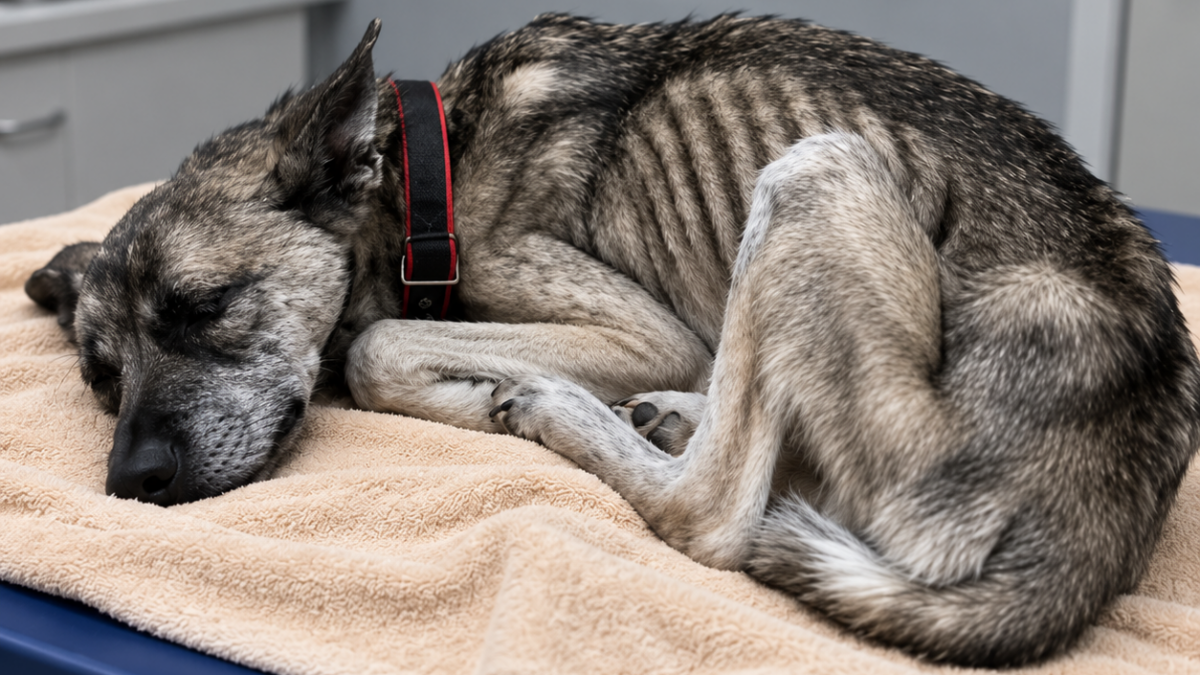
PART 2
I was sitting beside Raider when the monitor changed.
At first, I didn’t understand what I was hearing.
The machine had been making the same quiet rhythm for hours, a steady sequence of soft beeps that had somehow become reassuring simply because they remained predictable.
Then one of the numbers began drifting downward.
A technician walked over.
She checked the cuff around Raider’s leg.
Adjusted it.
Ran the reading again.
Her expression changed.
“What is it?”
She didn’t answer immediately.
Instead, she called for the veterinarian.
That frightened me more than any explanation could have.
Dr. Melissa Grant came in quickly and looked at the monitor.
“His pressure is dropping.”
“How low?”
“Lower than I want.”
Raider barely moved.
He was still recovering from surgery, still weak from months of starvation, and now his body seemed to be reminding us that survival would not come easily simply because the foreign material had been removed.
“What do you do?”
“We support him.”
Melissa checked his gums.
Then his IV line.
Medication was adjusted.
Fluids were carefully managed.
Everything had to be done with precision because Raider’s system had no tolerance for mistakes.
Too little support and his organs might not receive enough blood.
Too much fluid and his weakened body could struggle in other ways.
I stood near the wall while the team worked.
There was nothing useful for me to do.
That was one of the hardest parts.
During rescue, people often imagine the dramatic moment matters most.
The door opening.
The dog being lifted.
The emergency drive.
But sometimes the worst moment comes afterward, when experts are doing everything possible and you are forced to stand still.
Raider’s eyes opened briefly.
I moved closer.
“Still here?”
His gaze settled on me.
His head remained on the blanket.
“That’s enough.”
His eyes closed again.
The pressure slowly stabilized.
Not dramatically.
No sudden miracle.
Just numbers moving in the direction we needed.
Melissa let out a breath.
“We’re not out of trouble.”
“I know.”
“He may do this again.”
“I know.”
“He’s profoundly malnourished. Every system in his body has adapted to surviving without enough nutrition. Now we’re asking those systems to function differently.”
I looked at Raider.
“He finally gets food and that can hurt him too.”
“If we move too fast, yes.”
There was something cruel about that.
Raider had spent so long starving that even feeding him required caution.
Every instinct in me wanted to put a bowl in front of him and let him eat until he could no longer remember hunger.
Instead, recovery began with tiny quantities.
Carefully calculated calories.
Controlled intervals.
Bloodwork repeated.
Electrolytes watched closely.
Raider was given an NG tube so nutrition could be delivered in amounts his body could handle.
The first time I saw the tube, I hated it.
He looked so fragile already.
Now there was another reminder of how far from normal his life had become.
Melissa noticed my expression.
“This is helping him.”
“I know.”
“It lets us control exactly what he receives.”
“I know.”
“He doesn’t have the reserves for guesswork.”
I nodded.
Raider looked toward me.
“Sorry, buddy.”
His ears moved slightly.
“We’ll get you to the good part.”
For the next three days, I measured progress in numbers most people would never celebrate.
Stable phosphorus.
Improved potassium.
Better hydration.
A blood-pressure reading that stayed where we wanted it for several hours.
A body temperature that didn’t fall.
No vomiting.
No abdominal pain.
Every small medical detail meant his body was tolerating nourishment.
The veterinary team refused to rush.
That patience saved him.
On the second day after surgery, Raider tried to stand.
I was beside the kennel when his front legs shifted beneath him.
“Easy.”
He pushed himself upward.
His rear legs trembled violently.
One technician immediately moved to support him.
Raider stood for perhaps four seconds.
Then his legs folded.
We lowered him gently.
I was smiling before I realized it.
“That counts.”
The technician laughed.
“He barely stood.”
“He stood.”
Raider looked up at us.
“Four seconds,” I said. “Champion.”
The next time, he managed seven.
Then ten.
The problem wasn’t only weakness.
Raider had lost enormous amounts of muscle.
His body had consumed itself to survive.
When calories disappeared, fat went first.
Then muscle.
Eventually the body had been forced to preserve only what it absolutely needed.
The magnificent dog Raider should have been had been reduced almost to structure.
Bone.
Skin.
Heart.
Will.
That last part had somehow survived better than anything else.
By the fourth day, he was awake for longer periods.
That was when I first heard him “talk.”
I had stepped out for coffee and returned carrying a cup and a clean blanket.
Raider looked at me.
Then he made a low, strange sound.
Not a growl.
Not a whine.
Almost a complaint.
I froze.
“What was that?”
He made it again.
A technician behind me laughed.
“He’s been doing that all morning.”
“Talking?”
“That’s what we’re calling it.”
I crouched.
“You’ve got opinions now?”
Raider stared at me.
Another grumble.
I laughed.
It was the first sound from him that didn’t seem connected to fear or pain.
That mattered more than I expected.
Suffering makes animals quiet in ways healthy animals rarely are.
They conserve everything.
Energy.
Movement.
Expression.
Raider beginning to complain meant his personality was finding room to return.
I started talking back.
“You don’t like the blanket?”
Grumble.
“You want to go home?”
Longer grumble.
“You want a steak?”
Raider’s ears lifted.
The technician laughed.
“Careful. He understood that one.”
Of course, steak was the last thing he could have.
His meals remained tiny.
Each increase was calculated.
When they began transitioning some medication from IV to oral form, I celebrated again.
Melissa shook her head.
“You know most people don’t get excited about oral antibiotics.”
“Most people haven’t watched this dog survive emergency surgery at eighteen pounds.”
“Fair.”
Raider tolerated the medication.
Then came another important milestone.
The NG tube was no longer needed continuously.
He began taking small amounts of food by mouth.
The first bowl looked absurdly tiny.
A few spoonfuls.
Raider smelled it.
His entire body changed.
His head lifted.
His eyes became sharp.
He leaned toward it.
Then looked at me.
I had never seen hunger and hope exist together so clearly.
“Slow.”
The technician placed the bowl down.
Raider ate every bit in seconds.
Then licked the bottom.
Then the sides.
Then the floor around it.
Then he looked at us.
His expression was unmistakable.
More.
My heart broke.
“You’re done.”
Raider stared.
“That’s all.”
He licked the bowl again.
“I know.”
He looked toward the food cart.
“No.”
The technician whispered, “This part is brutal.”
She was right.
Saving a starving dog sometimes means denying the thing he wants most.
But for the first time in Raider’s life, the denial came from protection rather than neglect.
That difference mattered even if he couldn’t understand it.
We fed him again later.
Another small portion.
Then another.
His bloodwork stayed stable.
The feared metabolic shifts remained controlled.
Each meal became a test his body passed.
By day six, Raider was walking with assistance.
The physical-therapy team used a support sling beneath his abdomen.
Two people helped guide him.
His legs shook.
His paws dragged occasionally.
He tired quickly.
But he walked.
Five feet.
Rest.
Another five.
Rest.
When Raider reached the end of the hallway, I crouched there waiting.
“Come on.”
His head lifted.
The therapist moved slowly.
Raider took another step.
Then another.
His body swayed.
He stopped.
I held out my hand.
“Just one more.”
He stepped toward me.
I touched his face.
“There.”
His tail moved.
Barely.
But I saw it.
“That was a wag.”
The therapist smiled.
“I saw it too.”
Raider seemed embarrassed by our excitement.
That became another pattern.
Every small thing he did turned into a celebration.
Standing.
Eating.
Walking.
Tail wagging.
Taking medication.
Normal stool.
Sleeping comfortably.
Most healthy dogs do those things without anyone noticing.
For Raider, ordinary life had become extraordinary.
The more stable he became, the more questions began to bother me.
Where had he been?
Who had owned him?
How long had he been starving?
How did an animal who should have weighed nearly eighty pounds reach eighteen without someone seeing?
We reported everything.
Animal control opened an investigation.
The hospital documented Raider’s condition carefully.
Photographs.
Body-condition score.
Surgical findings.
Removed foreign material.
Bloodwork.
Weight.
Muscle wasting.
Everything.
The surgeon wrote one sentence that stayed with me:
**The gastrointestinal foreign material is consistent with scavenging behavior but does not account for the degree of chronic emaciation observed.**
In plain language, the plastic and rubber bands had not made Raider thin.
Hunger had made him eat the plastic and rubber bands.
That distinction became important later.
At first, we knew almost nothing about Raider’s history.
No microchip.
No collar with identification.
No clear information from where he had been found.
He had been discovered near an industrial storage property after a worker noticed him trying to get beneath a loading dock.
The worker, Marcus, had been the first person to approach.
I met him at the hospital.
He stood outside Raider’s room looking through the glass.
“That’s him?”
“Yes.”
“He looks better.”
It had been only six days.
Raider still looked skeletal.
But Marcus was right.
His eyes were different.
“What happened when you found him?”
Marcus shook his head.
“I thought he was already dying.”
“Was he alone?”
“As far as I saw.”
“Any food around?”
“No.”
“Water?”
“There was a drainage ditch.”
“Could he stand?”
“Barely.”
Marcus looked uncomfortable.
“He tried to run when I got close, but he fell.”
My stomach tightened.
“How did you catch him?”
“I didn’t. I sat down.”
“What?”
“I figured if I chased him, he’d hurt himself. So I sat on the ground and threw a piece of my sandwich near him.”
“What kind?”
Marcus smiled weakly.
“Turkey.”
Raider had crawled toward the food.
Marcus threw another piece.
Then another.
Finally, Raider came close enough to be wrapped in a work jacket.
“I should’ve noticed how thin he was before he got that close,” Marcus said.
“You found him.”
“Somebody had to have seen him earlier.”
That question stayed with both of us.
Somebody had.
We just didn’t know who yet.
The first useful lead came from a delivery driver.
He saw Raider’s photo posted by animal control and recognized him.
“I’ve seen that dog.”
Officer Sarah Collins called me immediately.
“Where?”
“Property about three miles from where he was found.”
“What kind of property?”
“Residential. Large yard. Detached garage.”
“Who lives there?”
“We’re checking.”
The delivery driver remembered Raider because the dog had once barked from behind a fence.
Months earlier.
Back when he was still large enough to be recognizable as a healthy adult.
That one memory gave investigators a location.
When officers arrived at the property, nobody answered the door.
But neighbors did.
One neighbor remembered a large brindle dog.
Another remembered hearing barking from the backyard.
A third said the dog had disappeared several weeks earlier.
The registered property owner was a man named Glenn Parker.
He eventually contacted animal control.
At first, Glenn said Raider was not his dog.
Then investigators showed him older photographs provided by a neighbor.
His explanation changed.
He said Raider had belonged to a cousin.
Then he said the dog had been left temporarily.
Then he claimed Raider had escaped months ago.
“Which is it?” I asked Sarah when she called me.
“That’s what we’re sorting out.”
“Was Raider at that property?”
“Multiple witnesses place a dog matching him there.”
“For how long?”
“At least several months.”
“Did anyone see him recently?”
“Yes.”
That word mattered.
“How recently?”
“One neighbor says about three weeks before he was found.”
Three weeks.
Raider had not been missing for months.
At least not according to that witness.
Sarah continued.
“The neighbor also says the dog looked thin.”
“How thin?”
“We’re asking for more detail.”
“Eighteen pounds thin?”
“Probably not yet.”
I closed my eyes.
That somehow made it worse.
There had been a period when Raider was deteriorating.
A window.
Days or weeks when someone could have intervened before his body consumed itself.
“How does an eighty-pound dog become eighteen?”
Sarah’s answer was quiet.
“Not quickly.”
The medical evidence agreed.
Melissa estimated the weight loss had occurred over a substantial period.
Chronic starvation.
Not several missed meals.
Not a dog lost outdoors for a few days.
Something longer.
Something systematic.
As Raider improved, the investigation deepened.
At the hospital, however, his world remained small.
Food.
Physical therapy.
Rest.
Medication.
Human voices.
The first time we took him outside, the sun was bright.
Raider hesitated at the door.
I wondered whether he associated open space with fear.
We used the support sling.
He stepped onto the grass.
Stopped.
Sniffed.
Then lifted his face toward the sunlight.
I will never forget that.
His eyes closed.
The wind moved across his skin.
There was barely enough fur and tissue covering his ribs.
He simply stood there for several seconds.
Then sat down from exhaustion.
I sat beside him.
“Feels good?”
Raider leaned slightly against my leg.
It was the first time he chose physical contact.
I didn’t move.
Trust from Raider came slowly.
He was not aggressive.
He was cautious.
If someone reached too quickly, he flinched.
If a metal bowl clattered against the floor, he froze.
If a man raised his voice in the hallway, his eyes widened.
We never pretended we knew exactly why.
There are dangers in turning every behavior into a story.
Trauma should not become fiction.
We respected what Raider showed us.
Slow hands.
Quiet voices.
Predictable routines.
Choice whenever possible.
That worked.
Within days, he began approaching the front of his kennel when I arrived.
Then the tail wag became stronger.
Then one morning, Raider actually smiled.
People argue about whether dogs smile.
I know what I saw.
His mouth opened slightly.
Eyes softened.
Ears relaxed.
He looked at me and something about his entire face changed.
“There he is.”
The technician beside me nodded.
“He’s a handsome dog under all that.”
I imagined him at a healthy weight.
Strong chest.
Muscle.
Bright coat.
It was difficult to picture.
But I wanted to see it.
The hospital kept increasing his food slowly.
Two hundred calories.
Then more.
Frequent meals.
Never enough at once to satisfy his hunger.
Raider learned the schedule quickly.
He knew which cart carried food.
Which refrigerator held the special diet.
Which technician was easiest to manipulate.
A young veterinary assistant named Mia became his favorite.
She tried to deny it.
“He likes everybody.”
“No. He stares at you like you personally invented food.”
Mia smiled.
“Maybe I did.”
Whenever she entered, Raider started talking.
Low grumbles.
Little whines.
Occasionally a full dramatic groan.
“Raider, you ate twenty minutes ago.”
Groan.
“You are not starving.”
Longer groan.
The irony hurt every time.
Technically, his body was still recovering from starvation.
Emotionally, though, his demands sounded wonderfully normal.
One afternoon, Melissa called me into her office.
“I think we can start discussing discharge.”
I stared at her.
“Home?”
“Soon.”
“How soon?”
“If his bloodwork stays stable, his incision continues healing and he tolerates the current feeding plan, maybe a few days.”
I felt immediate joy.
Then fear.
“Can I handle him?”
“Yes.”
“What if something goes wrong?”
“You call.”
“What if he crashes?”
“You bring him back.”
“What if—”
Melissa smiled.
“You’ve been here almost every day. You know his routine better than most people.”
“I’m not a veterinarian.”
“No. But you don’t have to be. You have instructions.”
I looked through the glass.
Raider was standing at the front of the kennel because Mia had walked past carrying food.
“He can really leave?”
“He needs a home environment to continue recovering. Hospitals are important, but they’re stressful.”
That night I prepared my house.
A low bed.
Non-slip rugs.
Baby gates to limit unnecessary movement.
A feeding schedule on the refrigerator.
Medication chart.
Scale.
Water bowl.
I removed trash cans because Raider had spent too long learning that inedible objects might be food.
That habit couldn’t be trusted yet.
I picked up rubber bands.
Hair ties.
Plastic bags.
Anything small enough to swallow.
The reality of what he had eaten stayed with me.
A rubber band sitting innocently on a table suddenly looked different when I remembered surgeons pulling them from Raider’s stomach.
He hadn’t been mischievous.
He had been desperate.
I wanted his new environment to teach him a new rule.
Food would come from bowls.
Every day.
On time.
He would never need to search garbage again.
Discharge day arrived with more emotion than I expected.
Mia hugged Raider.
Melissa reviewed the feeding plan twice.
I asked the same questions three times.
“What if he acts hungry?”
“He will.”
“How much extra can I give him?”
“None unless we change the plan.”
“He’s going to hate me.”
“He’ll survive.”
I laughed.
“Poor choice of words.”
Melissa winced.
“Fair.”
Raider wore a support harness.
He walked slowly toward the exit.
Every employee seemed to appear.
Someone clapped.
Another person whispered, “Good boy.”
Mia cried openly.
Raider stopped at the automatic doors.
They opened.
He looked outside.
Then back at me.
“Home.”
He took a step.
Then another.
The dog who had entered that hospital at eighteen pounds walked out on his own feet.
Weakly.
Carefully.
But he walked.
The ride home was quiet.
Raider lay across a padded area in the back seat.
Every few minutes, I checked him in the mirror.
At one point, our eyes met.
“You okay?”
His tail moved once.
I laughed.
“Good.”
When we reached the house, he hesitated before entering.
New smells.
New space.
I let him take his time.
He sniffed the doorway.
Then the rug.
Then the wall.
Then his bed.
He circled once.
Lay down.
And slept for nearly three hours.
That first night, I woke constantly.
2:00 a.m.
Raider sleeping.
3:15.
Still sleeping.
4:40.
His breathing sounded strange.
I turned on the light.
He opened one eye.
I realized he had been snoring.
“Seriously?”
Raider groaned.
“You almost gave me a heart attack.”
He went back to sleep.
The next morning began the routine that would define our lives for months.
Tiny meal.
Medication.
Rest.
Short supported walk.
Rest.
Another meal.
Physical therapy.
Rest.
More food.
I weighed him regularly.
The first increase was less than a pound.
I celebrated anyway.
Eighteen became nineteen.
Then twenty.
Twenty-one.
Twenty-three.
Slow.
Controlled.
Every pound meant his body was rebuilding something starvation had taken.
But weight alone was not enough.
Muscle mattered.
Physical therapy became essential.
At first, Raider hated the exercises.
We practiced controlled sit-to-stand movements.
Short walks over textured surfaces.
Gentle weight shifting.
Stepping across low poles.
He would look at me as though I had personally invented suffering.
“Come on.”
Raider sat.
“One more.”
He looked away.
“You survived surgery.”
No response.
“You can step over a pool noodle.”
Raider sighed.
“Yes, I heard that.”
Eventually he moved.
One paw.
Then another.
“Good.”
Tail wag.
Treat.
That was another challenge.
Food rewards had to fit within his nutritional plan.
Raider quickly learned every exercise produced something edible.
His enthusiasm increased dramatically.
By the fourth week at home, he could walk around the yard without the support sling for short periods.
His rear legs remained thin.
His stamina was poor.
But he was steadier.
One morning, he followed me into the kitchen without assistance.
I turned around and almost tripped over him.
“You walked all the way in here?”
Raider looked at the counter.
Breakfast.
“Of course. Food.”
Still, I knelt and hugged him.
His body stiffened for half a second.
Then relaxed.
That became another milestone.
Raider learning to accept affection without uncertainty.
The investigation continued in parallel.
Sarah called regularly.
They had obtained veterinary records from a clinic Glenn once used.
Raider had been seen there nearly a year earlier.
Weight: seventy-six pounds.
I sat down when she told me.
“Seventy-six.”
“Yes.”
“So we know.”
“We know he was a healthy adult at that point.”
“What happened after?”
“No documented veterinary care.”
“Nothing?”
“Nothing we’ve found.”
The clinic record included Glenn’s name as the person who brought Raider in.
That weakened his claim that Raider had never really belonged to him.
Then came photographs.
A neighbor named Mrs. Alvarez had taken pictures during a backyard cookout months earlier.
Raider appeared behind the fence.
Still healthy.
Another photo two months later showed him thinner.
Not skeletal yet.
But noticeably reduced.
Time stamped.
Dated.
Then a third photo.
Raider near the garage.
Hip bones visible.
That one was taken roughly five weeks before he was found.
I stared at the image.
There it was.
The progression.
Healthy.
Thin.
Emaciated.
A body disappearing in stages.
Sarah said investigators also found food bags on the property.
“Dog food?”
“Mostly empty.”
“So he had access to food?”
“Access is different from feeding.”
She was right.
Glenn’s story changed again.
He now claimed Raider had developed stomach problems and refused food.
The surgery complicated that claim in a way he didn’t anticipate.
If Raider had become thin because of the obstruction, maybe that explanation could create doubt.
But the surgeon’s findings did not support it.
The foreign material was serious.
Life-threatening.
But Raider’s degree of chronic muscle wasting indicated long-term inadequate nutrition.
The obstruction had likely developed after prolonged scavenging.
That mattered.
Melissa provided a formal statement.
She explained that a dog refusing food because of illness should have been brought to a veterinarian.
Even if Glenn’s latest explanation were true, failure to seek care while Raider lost more than fifty pounds would still represent severe neglect.
There was no version of the story where doing nothing became acceptable.
I felt anger return.
Not the explosive anger from the first day.
Something colder.
Raider had not vanished suddenly into bad health.
He had faded in front of people.
That was what hurt.
Neighbors had seen him.
Glenn had lived there.
A dog does not lose almost three quarters of his body weight invisibly.
Someone had watched.
Someone had ignored.
The investigator eventually asked me whether I would be willing to testify if the case reached court.
“Yes.”
No hesitation.
Raider deserved witnesses.
He had been silent for too long.
At home, Raider knew none of this.
His priorities had become increasingly normal.
Breakfast.
Walk.
Sleep.
Lunch.
Inspect the kitchen.
Nap.
Physical therapy.
Dinner.
Ask for more dinner.
He also discovered toys.
The first stuffed toy confused him.
I placed it near his bed.
Raider smelled it.
Looked at me.
Smelled it again.
Then walked away.
“Okay.”
An hour later, I heard something behind me.
Raider had picked up the toy.
He held it carefully.
No chewing.
Just holding.
I smiled.
“Yours.”
His ears lifted.
“You can have it.”
He walked to the bed and lay down with the toy between his paws.
For three days, he treated it like something precious.
Then he discovered it could squeak.
His entire relationship with it changed.
Squeak.
Raider jumped.
Squeak.
Head tilt.
Squeak.
He bit harder.
Squeak.
Then came the first full bark.
Deep.
Surprised.
I laughed.
“That’s your enemy now?”
Raider barked at the toy.
By evening, stuffing covered half the floor.
I stared.
“Apparently you’re feeling better.”
He wagged.
The dog who had once eaten plastic out of desperation was now destroying a toy simply because destruction was fun.
That distinction made me happier than it should have.
His weight continued climbing.
Thirty pounds.
Thirty-five.
Forty.
At forty pounds, Raider still looked thin.
That gave me perspective on how horrifying eighteen had been.
His shoulders began filling out.
The ridge of his spine became less sharp.
His ribs were still visible but no longer seemed to cut through his skin.
His face changed too.
The hollow appearance around his eyes softened.
His coat became glossy.
His energy increased.
Raider began talking more.
He had opinions about everything.
Late meals.
Closed doors.
Physical therapy.
The neighbor’s lawn mower.
Me leaving the room without him.
Visitors.
Once, I delayed breakfast by seven minutes because I was on the phone.
Raider stood in the kitchen and produced a series of dramatic groans.
The person on the phone asked, “What is that?”
“Someone who thinks he hasn’t eaten in months.”
Raider groaned again.
The irony was painful and funny at the same time.
His relationship with food remained complicated.
Even when meals became larger and more normal, he ate too quickly.
He searched counters.
He checked trash cans.
He tried to swallow things that smelled remotely edible.
We worked with a behavior specialist named Hannah.
She explained that chronic food deprivation can create lasting insecurity.
“You can’t explain to him that the bowl will be full tomorrow.”
“So what do I do?”
“Show him.”
“How?”
“Consistency.”
Same meal times.
Puzzle feeders.
Slow bowls.
No punishment for scavenging.
Trade unsafe objects for safe rewards.
Teach him that giving something up does not mean losing everything.
That last part mattered.
The first time Raider grabbed a paper towel, my instinct was to rush toward him.
Hannah stopped me.
“Don’t chase.”
“He’ll eat it.”
“Offer the trade.”
I held a piece of approved treat.
Raider froze.
“Drop.”
He stared.
The smell won.
He released the paper.
Treat.
Praise.
Over time, he learned.
Not perfectly.
But better.
Food stopped feeling like an emergency.
That was one of the quietest and most important parts of recovery.
A dog can gain weight before he gains security.
Raider’s body learned first.
His mind took longer.
The court case began when Raider was nearing fifty pounds.
I brought photographs but left Raider home.
He did not need to enter a room full of strangers to prove he had suffered.
The evidence already did that.
Glenn sat with his attorney.
He looked ordinary.
That surprised me even though it shouldn’t have.
Cruelty does not have a uniform.
The prosecutor began with veterinary records.
Seventy-six pounds at the earlier clinic visit.
Eighteen pounds at rescue.
Photographs.
Surgical findings.
Timeline.
One image showed Raider standing in the hospital on the first day.
Several people in the courtroom visibly reacted.
The judge leaned forward.
Glenn’s attorney argued that Raider had escaped.
Then that he had been sick.
Then that Glenn had tried to feed him.
The shifting explanations were difficult to reconcile.
Melissa testified.
The prosecutor asked, “Could an adult dog naturally decline from approximately seventy-six pounds to eighteen without obvious signs?”
“No.”
“Could this happen in a few days?”
“No.”
“Could the gastrointestinal obstruction explain the total weight loss?”
“No.”
“Why not?”
“The degree of muscle wasting indicated chronic malnutrition. The foreign material was medically significant, but it did not account for the entire condition.”
“What did the foreign material suggest?”
Melissa paused.
“It was consistent with indiscriminate ingestion. In context, scavenging while severely hungry was a reasonable concern.”
The attorney objected to speculation.
The judge limited the answer to medical evidence.
That was fair.
Facts mattered more than dramatic language.
Then Marcus testified about finding Raider.
Mrs. Alvarez testified about the photographs.
The earlier veterinary records were entered.
A former tenant from the property testified that food was not always provided consistently.
That was the first time I heard something concrete about the household itself.
According to him, Glenn often complained about the cost of feeding a large dog.
He had once joked that Raider “ate like a horse.”
A joke.
I thought about the rubber bands.
Plastic.
Hair.
My hands tightened.
The prosecutor asked whether the tenant ever saw Raider without food.
“Yes.”
“How often?”
“Sometimes a day. Sometimes longer.”
“Did you provide food?”
“Sometimes.”
Glenn looked down.
I stopped looking at him.
The details were enough.
I did not need his face.
The hearing ended without a final decision.
Court moves slowly.
Raider recovered faster.
By sixty pounds, strangers no longer recognized him from the early photographs.
That became one of my favorite things.
A neighbor stopped me during a walk.
“What breed is he?”
We talked for several minutes.
She admired his coat.
His size.
His calm expression.
She had no idea she was looking at a dog who once weighed eighteen pounds.
I didn’t tell her.
Not every person needed the tragedy first.
Sometimes Raider deserved to simply be introduced as Raider.
He loved walks.
He loved car rides.
He loved Mia when she visited.
He hated rain.
He tolerated baths.
He became obsessed with a red rubber ball.
He learned to bark at the mail truck.
He slept on his back when he felt safe.
That last habit took months.
The first time, I walked into the room and stopped.
Raider was upside down.
Chest exposed.
Legs loose.
Completely asleep.
A dog who expects danger rarely sleeps that way.
I sat on the floor.
Watched him.
His paws twitched in a dream.
Then he snored.
I smiled.
Trust has no dramatic sound.
Sometimes it is just snoring.
The legal case finally reached resolution after several months.
Glenn accepted responsibility for animal neglect under the charges supported by the evidence.
The court imposed fines, restitution related to Raider’s medical care, probationary conditions and restrictions on future animal ownership.
I had imagined feeling victorious.
Instead, I felt tired.
Outside the courthouse, Sarah found me.
“You okay?”
“I think so.”
“Not what you expected?”
“No.”
“What did you expect?”
“I don’t know. Something bigger.”
She nodded.
“Cases rarely feel as big as the suffering that started them.”
“That’s exactly it.”
Raider had almost died.
The punishment was paperwork.
Money.
Rules.
Restrictions.
The imbalance bothered me.
Then Sarah said something I remembered for years.
“The goal isn’t to make him starve because Raider starved.”
I looked at her.
“The goal is to reduce the chance another animal ends up like Raider.”
That settled something inside me.
Revenge would have been symmetrical pain.
Justice was prevention.
I could live with that.
When I got home, Raider met me at the door carrying the red ball.
He weighed sixty-eight pounds.
His tail hit the wall.
Thump.
Thump.
Thump.
“You have no idea where I’ve been.”
Raider dropped the ball at my feet.
I picked it up.
“You don’t care.”
He barked.
“Of course.”
I threw it.
He ran.
That was the moment the case stopped being the center of his story.
Not because it was unimportant.
Because Raider had moved beyond it.
His life had become bigger.
At seventy-two pounds, Melissa declared him close to ideal weight.
I stared at the scale.
“Seventy-two.”
“Healthy seventy-two.”
“He was eighteen.”
“I remember.”
“Four times his rescue weight.”
“Almost.”
Raider looked toward the treat jar.
Melissa laughed.
“He’s still hungry.”
“He will be hungry at one hundred pounds.”
“Don’t let him hear that.”
The next milestone was muscle.
Weight had returned faster than strength.
His shoulders needed more development.
His hindquarters remained weaker than expected.
We kept walking.
Longer distances.
Gentle inclines.
Controlled exercises.
Months passed.
The dog who once needed a sling began trotting.
Then running.
Not far.
Not fast initially.
But one morning at the park, I threw his red ball.
Raider took off.
Full stride.
Strong.
Balanced.
For several seconds I simply watched.
He reached the ball.
Turned.
Ran back.
I had tears in my eyes by the time he arrived.
Raider dropped the ball.
“What?”
He barked.
“You’re showing off.”
Another bark.
I threw it again.
He ran farther.
That became one of my favorite memories.
Not the first bite of food.
Not the court case.
Not even the surgery.
Running.
Because running uses excess.
Excess energy.
Excess muscle.
Enough strength to waste some simply because movement feels good.
Starving bodies do not run for joy.
Raider could.
About a year after his rescue, Marcus visited.
He hadn’t seen Raider since the hospital.
When the door opened, Raider barked.
Marcus stopped.
“That’s not him.”
I laughed.
“It is.”
“No.”
Raider approached.
Marcus crouched slowly.
“Raider?”
Something happened.
Raider smelled his hands.
Then his coat.
His tail began moving.
Marcus’s face broke.
“He remembers.”
“Maybe.”
Raider leaned against him.
That answered enough.
Marcus wrapped both arms around Raider’s neck.
“I thought you were dead that day.”
Raider licked his face.
Marcus laughed and cried at the same time.
“You look huge.”
Raider did look huge compared with eighteen pounds.
Not overweight.
Just restored.
Shoulders broad.
Chest deep.
Coat healthy.
The body he should have had all along.
Marcus stayed for nearly two hours.
Before leaving, he looked at me.
“Did you keep him?”
I glanced at Raider.
Technically, I had fostered him during recovery.
Then longer.
Then much longer.
The rescue organization had gently mentioned adoption applications.
I had ignored the emails.
Raider slept beside my bed.
His food bins were in my kitchen.
His ball lived beneath my couch.
He knew my car.
My schedule.
My voice.
“He’s still technically fostered.”
Marcus smiled.
“That sounds like denial.”
He was right.
I completed the adoption paperwork the next week.
When I signed my name, Raider was lying beneath the table.
Nothing changed for him.
Everything changed on paper.
He had a permanent home.
The dog who had once wandered near a loading dock eating anything his body could find now had a person legally responsible for making sure hunger never touched him again.
That responsibility felt sacred.
Raider’s second year became wonderfully boring.
Annual vaccines.
Normal bloodwork.
Healthy weight.
Long walks.
Toys destroyed.
Visitors greeted.
The absence of crisis became the gift.
His food insecurity improved too.
He stopped checking the trash constantly.
He could leave kibble in a puzzle toy and return later.
That amazed me.
At first, every edible thing had to disappear immediately.
Now food could exist without emergency.
One evening, Raider ate half his dinner.
Then walked away.
I stared.
“You forgot something.”
He looked back.
“There’s food.”
No interest.
I almost called Melissa.
Then Raider drank water and lay down.
Twenty minutes later, he finished the rest.
That normal behavior nearly made me cry.
He trusted the bowl to remain.
He trusted food could wait.
Hunger was no longer chasing him.
His relationship with plastic took longer.
Any crinkling bag attracted him.
Hair ties remained dangerous.
Rubber bands were banned from reachable areas permanently.
I found myself seeing ordinary household objects through Raider’s history.
People joked that my house was dog-proofed like a toddler lived there.
They weren’t wrong.
I would rather rearrange a thousand drawers than watch another surgeon remove garbage from his stomach.
Raider aged well.
At four, he was powerful.
At six, he had settled into himself.
At eight, the first gray appeared near his muzzle.
I loved it immediately.
Gray meant time.
Time was the thing someone had nearly stolen from him.
Every gray hair was proof Raider had stayed.
The ownership restriction from Glenn’s case later became relevant too.
Sarah contacted me several years after the trial.
“He tried to register another large dog at the property.”
My stomach tightened.
“What happened?”
“The prior order was flagged.”
“And?”
“The placement was stopped pending review. He does not have the dog.”
I sat quietly.
“Good.”
That one word carried everything.
Another Raider had been prevented before there was another Raider.
The court case suddenly felt larger than it had the day it ended.
Consequences sometimes reveal their value later.
Raider knew nothing about that.
He was outside chasing squirrels badly.
He never caught one.
I was grateful.
By nine, arthritis appeared in his hips.
Melissa prescribed medication and recommended shorter walks.
Raider rejected the concept of shorter walks.
The first time I turned toward home early, he planted all four feet.
“Come on.”
Nothing.
“We’re going back.”
Raider looked down the street.
“You’re old.”
He groaned.
“Yes, I said it.”
He sat.
“You’re making this difficult.”
Eventually, I followed his preferred route.
We walked slowly.
That became our compromise.
Less distance some days.
More time.
Raider inspected every mailbox like it contained evidence.
Every tree needed careful examination.
Every neighbor deserved a greeting.
The walks stopped being exercise and became ritual.
I liked them better that way.
At ten, Raider became afraid of thunderstorms.
He had never cared much before.
Age changes animals.
The first time he began pacing during thunder, I sat beside him.
“Hey.”
Raider leaned against my legs.
The same dog who once flinched from fast hands now deliberately pressed his whole body into me.
I put a blanket around him.
“You’re safe.”
Thunder rolled.
Raider stayed.
That became our storm routine.
Blanket.
Couch.
My hand on his chest.
No need to fix the weather.
Just stay through it.
The irony was not lost on me.
Raider had once survived conditions no animal should survive.
Now, after years of safety, he was allowed to be frightened by thunder.
That was another luxury.
Animals in survival mode do not get to have ordinary fears.
Raider had become ordinary enough to be scared of weather.
I welcomed it.
The red ball stayed with him for years.
Not the original.
He destroyed that one quickly.
I bought replacements.
Same size.
Same shape.
Different versions.
Eventually, his teeth weakened and we switched to softer toys.
He still brought them to me.
At eleven, his runs became trots.
At twelve, trots became enthusiastic walks.
At thirteen, he began needing help into the car.
Every change hurt.
Then I remembered eighteen pounds.
Emergency surgery.
The NG tube.
Four seconds standing.
Old age was not tragedy.
Old age was the future we had begged for.
That perspective helped.
Not always.
But enough.
One autumn afternoon, Raider was sleeping in a patch of sunlight when Marcus visited again.
Marcus had aged too.
He sat beside Raider.
“Still remember me?”
Raider opened his eyes.
Tail thump.
Marcus smiled.
“I’ll take that.”
We talked about the loading dock.
Marcus told me something I hadn’t known.
“When I found him, I almost didn’t go behind the building.”
“What?”
“I was late for a delivery.”
My stomach tightened.
“I heard something hitting metal.”
“Raider?”
“Probably his tags or claws. I figured it was a raccoon.”
“So why did you look?”
Marcus shrugged.
“I don’t know.”
He looked at Raider.
“I just thought if it’s hurt, I’ll hate myself for leaving.”
I sat quietly.
One decision.
Five minutes.
That was the distance between Raider being found and Raider possibly dying alone.
Marcus rubbed Raider’s shoulder.
“He changed how I do things.”
“How?”
“I check.”
I understood.
That was another part of Raider’s legacy.
Not dramatic.
Just one person becoming less willing to ignore something unusual.
Marcus had since helped two stray dogs and one injured cat because, as he put it, “Raider ruined my ability to mind my own business.”
I laughed.
“Good.”
Raider groaned from the floor.
Marcus pointed.
“He agrees.”
At thirteen and a half, Raider’s kidneys began showing early decline.
Nothing immediately catastrophic.
Medication.
Diet changes.
Monitoring.
I reacted badly.
Melissa remained calm.
“This is manageable right now.”
“But it can progress.”
“Yes.”
“He’s been through enough.”
“I know.”
I looked at Raider.
He was trying to open the treat cabinet with his nose.
Melissa smiled.
“He does not appear emotionally defeated.”
That helped.
We adjusted.
Special diet.
More frequent checks.
Extra water bowls.
Raider continued living.
That became another lesson.
A diagnosis is not always the end of the story.
Sometimes it is simply the beginning of a different routine.
Months passed.
Then a year.
Raider slowed more.
His hearing weakened.
His eyes clouded slightly.
He still knew meal times to the minute.
Some things age does not touch.
At fourteen, he became selective about breakfast.
That frightened me.
Food had always been the center of his world.
The first morning he left half the bowl untouched, I called Melissa immediately.
We went in.
Bloodwork showed progression of kidney disease.
Not a crisis.
But real.
We modified treatment.
Appetite stimulants helped.
For a while, Raider returned to eating normally.
Then came another decline.
Slower.
More serious.
He began losing weight.
Nothing like before.
But the scale triggered something in me.
Seventy-two.
Seventy.
Sixty-eight.
I hated every number.
Melissa noticed.
“You’re seeing eighteen.”
I looked at her.
“Yes.”
“This isn’t that.”
“I know.”
“He’s not starving.”
“I know.”
“You’re feeding him.”
“I know.”
“His body is old and ill. That’s different.”
Intellectually, I understood.
Emotionally, every pound felt like history trying to repeat itself.
Raider sensed none of that.
He still wanted walks.
Short ones.
He still carried a soft red ball.
He still talked when dinner was late.
He still slept beside my bed.
Then one morning, he couldn’t get up without help.
I lifted his rear half.
He stood.
Took a few steps.
Stopped.
Looked at me.
That expression stayed with me.
Not pain exactly.
Fatigue.
Deep fatigue.
The kind I had seen once before.
At the hospital.
Eighteen pounds.
Surgery.
The first week.
I called Melissa.
She came to the house later that day.
We talked for a long time.
Quality of life.
Pain.
Appetite.
Mobility.
Comfort.
Good hours.
Bad hours.
There is no equation that makes those conversations easy.
I wanted certainty.
There was none.
Only love making its best decision with incomplete information.
Raider lay beside us.
Melissa examined him gently.
“He’s tired.”
“I know.”
“We can support him a little longer.”
“Should we?”
She looked at me.
“That depends on whether the support is for him or for you.”
That hurt because it was true.
I sat beside Raider after she left.
The red ball was near his paws.
He had carried it there but no longer wanted to play.
I picked it up.
“You remember these?”
Raider opened one eye.
“Probably destroyed fifty of them.”
Tail tap.
I laughed.
“You were expensive.”
Another tail tap.
I touched the scar from his abdominal surgery.
Barely visible beneath fur.
For years, I had almost forgotten it.
That scar had once represented a desperate operation on a body too weak for anesthesia.
Now it was simply part of an old dog.
I thought about every version of Raider.
The skeleton.
The patient.
The walker in a sling.
The food thief.
The talker.
The runner.
The healthy seventy-two-pound dog.
The gray-faced old man.
They were all him.
The next few days were gentle.
I stopped asking him for unnecessary effort.
We sat outside.
He smelled the air.
Marcus visited.
Mia came too.
She cried the moment she saw him.
“You’re old.”
Raider groaned.
She laughed through tears.
“Still talking.”
She sat beside him for an hour.
At one point, Raider rested his head on her foot.
Mia looked at me.
“He used to scream at me for food.”
“I remember.”
“He was so skinny.”
“I know.”
“I didn’t think he’d leave the hospital.”
“Neither did I.”
Raider slept.
Mia whispered, “Look what he got.”
Years.
That was the answer.
He got years.
Not enough.
Never enough.
But years nobody expected during that first surgery.
On Raider’s last morning, the weather was clear.
He refused breakfast.
Even chicken.
That was when I knew he was done negotiating.
I carried his bed outside.
The sun reached him.
Raider lifted his face.
Exactly as he had the first time we took him outside the hospital.
The memory hit me so strongly I had to sit down.
Same sun.
Different dog.
Back then, bones and fear.
Now, gray hair and age.
I rested my hand on his shoulder.
“You made it.”
Raider breathed slowly.
“You know that?”
His tail moved once.
I cried.
“You made it all the way.”
Melissa came later.
Raider stayed outside.
I wanted him in the place he had chosen.
No hospital lights.
No beeping machines.
No NG tube.
No pressure cuff.
Just grass.
Sun.
Home.
I lay beside him.
For years, I had carried anger about what someone had done to him.
At that moment, none of it belonged there.
Glenn did not deserve a place in Raider’s final memory.
Neither did court.
Neither did the photographs.
Only Raider.
I put my forehead against his.
“You should have been eighty pounds.”
My voice broke.
“You were eighteen.”
His eyes opened slightly.
“I thought I was rescuing a dying dog.”
I smiled through tears.
“You turned into the loudest roommate I’ve ever had.”
His tail moved.
“You stole food.”
Another breath.
“You destroyed every red ball I bought.”
I stroked the side of his face.
“You learned that bowls refill.”
That was the one that broke me.
Because more than weight, surgery or walking, that had been the deepest recovery.
Raider learned the bowl would refill.
Every day.
For years.
No plastic.
No rubber bands.
No hair.
No searching for garbage because hunger hurt.
Food arrived.
Always.
Until eventually he could walk away from a half-full bowl and trust it would still exist later.
That was freedom.
Melissa asked if I was ready.
Nobody is ready.
I nodded.
Raider was calm.
My hand stayed on his chest.
His breathing slowed.
Then stopped.
For a while, I remained on the grass beside him.
The red ball lay near his front paw.
His body looked peaceful.
Old.
Healthy enough that nobody seeing him then would have imagined the first photograph.
I picked up the ball.
Held it.
And realized something.
Raider had not died from neglect.
Neglect had tried.
It failed.
Raider died from being old.
From having lived long enough for time to do what starvation could not.
That was the ending.
Not eighteen pounds.
Not the surgery.
Not the garbage in his stomach.
Old age.
Home.
Sunlight.
A person beside him.
Weeks later, Sarah sent me an old document from the case because she thought I might want it.
The original intake form listed:
Estimated ideal weight: approximately 80 lbs.
Actual intake weight: 18 lbs.
I stared at those two numbers.
Then I found another record from years later.
Weight: 72.4 lbs.
Healthy body condition.
Stable.
I framed neither document.
Raider was not numbers.
But I kept both.
Beginning and middle.
The ending lived elsewhere.
In photographs.
Raider running with the red ball.
Raider sleeping upside down.
Raider leaning against Marcus.
Raider begging Mia for food.
Raider gray-faced beneath the sun.
That was the story I wanted people to know.
If someone asked what happened to the man responsible, I told them.
There was an investigation.
Evidence.
Court consequences.
Restitution.
Restrictions.
Later, those restrictions helped prevent another dog from entering his care.
That mattered.
But revenge was never the best part.
The best part was Raider becoming too healthy to recognize.
The best part was someone meeting him years later and saying, “That can’t be the same dog.”
The best part was sixty pounds.
Then seventy.
Then gray hair.
The best part was Raider growing bored enough to destroy toys.
Secure enough to leave food behind.
Safe enough to complain.
Loved enough to become difficult.
Old enough to slow down.
That was the revenge cruelty could never answer.
Raider got time.
Every year he lived turned those eighteen pounds into a smaller part of his life.
Every meal pushed starvation farther into the past.
Every walk proved his legs had recovered.
Every nap proved his body felt safe.
Every complaint proved he expected to be heard.
Every gray hair proved he had stayed.
And the objects surgeons removed from his stomach—the rubber bands, the plastic, the hair—stopped being the symbol of who Raider was.
They became evidence of a place he survived.
Nothing more.
Years later, I still find myself checking the floor for rubber bands.
Habit.
I still keep trash covered.
I still slow down when I see a thin dog near the road.
Raider changed the way I move through the world.
Marcus says the same.
Mia does too.
Even Sarah once told me his case became part of how she trained new officers to document chronic starvation.
Not because Raider’s suffering was meant to teach anyone.
It wasn’t.
He should never have had to endure it.
But once it happened, we refused to let it disappear without consequence.
That distinction matters.
Suffering does not become good because somebody learns from it.
We simply owe the victim something better afterward.
Raider got that something better.
A hospital team who refused to give up.
Careful feeding instead of deprivation.
Physical therapy instead of collapse.
Food security instead of scavenging.
A house instead of a loading dock.
A red ball instead of plastic.
A family instead of abandonment.
Years instead of a grave.
Sometimes I still sit in the yard where Raider spent his last morning.
I can picture him there at every age.
Skinny and uncertain.
Then stronger.
Then powerful.
Then gray.
If I close my eyes, I can almost hear that ridiculous talking noise.
The demanding groan.
The bark for food.
The deep sigh when I asked him to do one more physical-therapy exercise.
I miss those sounds more than I expected.
Silence is what remains after animals who filled a house are gone.
But silence does not erase them.
It makes room for memory.
And when I remember Raider now, I no longer see every rib first.
I see him running.
That is the image I choose.
Raider at healthy weight.
Red ball ahead of him.
All four legs working.
Body strong.
Sun on his coat.
Running simply because he could.
The dog who had once spent every remaining calorie trying not to die eventually had enough strength to waste some on joy.
There is no better ending than that.
Someone reduced Raider to eighteen pounds.
Someone let him become so hungry that rubber bands and plastic entered his stomach because hunger had erased the line between food and garbage.
That person faced consequences.
But Raider delivered the final answer himself.
He gained weight.
He healed.
He trusted.
He ate.
He played.
He complained.
He ran.
He grew old.
And by the time his life ended, starvation had become only the first chapter of a story much larger than the person who almost destroyed him.
Raider should have weighed nearly eighty pounds.
In the end, the number that mattered most was not eighteen.
It was the number of years he lived after someone finally decided his life was worth saving.
That was Raider’s victory.
And that was enough.








