PART 2: Our Labrador Vanished in a Wildfire—Two Days Later, We Heard a Weak Bark From the Ravine
PART 2
The edge of the ravine was steeper than I remembered.
Loose dirt broke beneath my boots as I moved along the ridge, trying to locate the sound.
“Jasper!” I shouted.
A bark answered.
Closer now.
Definitely real.
My knees nearly gave out.
“That’s him,” William said.
I looked at my son.
For the first time in forty-eight hours, I saw hope in his face.
“That’s him.”
Thomas caught up behind us.
“Where?”
“Down there.”
We moved carefully along the edge until Sarah spotted a narrow game trail descending through the trees.
“I can get down that way,” she said.
“No,” I answered immediately. “I’ll go first.”
“Jake, the ground’s wet.”
“I said I’ll go first.”
There was no arguing with me.
I grabbed a thick branch and started down.
The slope turned muddy almost immediately.
Twice I slipped and caught myself against tree trunks.
William followed several yards behind.
“Careful!”
“I am.”
Another bark echoed through the ravine.
Then came another sound.
A soft, frightened whinny.
I froze.
William nearly walked into me.
“Did you hear that?”
He stared past me.
“That was a horse.”
My heart slammed against my ribs.
“No way.”
We moved faster.
At the bottom of the ravine, the trees grew denser. Fallen branches covered the ground, and storm debris had gathered between two large rocks.
I couldn’t see Jasper.
Then something moved beneath a cedar tree.
Yellow fur.
“Jasper!”
His head lifted.
I’ve never forgotten what he looked like.
Mud covered almost his entire body.
His coat was dark with soot.
One ear was crusted with dried blood.
His paws were raw.
His eyes were half closed from exhaustion.
But when he recognized me, his tail struck the ground once.
Just once.
Then he tried to stand.
“Stay down, buddy.”
I dropped beside him.
He licked my wrist.
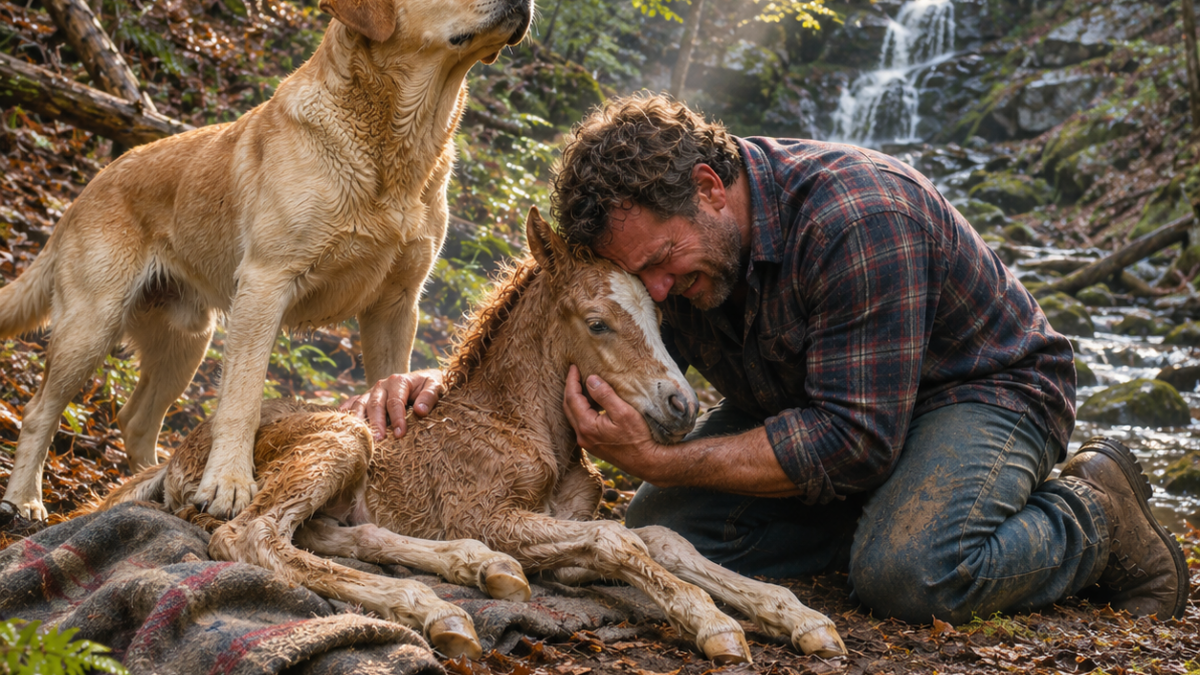
Behind him, pressed tightly against the rock wall beneath an overhanging tree, was Stormy’s foal.
Alive.
I stared.
I genuinely could not speak.
William came down behind me and stopped dead.
“Oh my God.”
The foal was trembling.
His coat was dirty, his mane singed along one side, and there was a shallow burn on his shoulder.
But he was standing.
Alive.
Jasper had positioned himself between the foal and the open ravine.
Sarah reached us a few minutes later.
She knelt beside Jasper and immediately began examining him.
“Water.”
Thomas handed down a bottle.
“Slowly,” Sarah said. “Don’t let him gulp.”
Jasper barely had the strength to drink.
I poured a little water into my palm.
He lapped it weakly.
The foal watched us but didn’t move away from him.
That was when I began noticing things.
Broken branches.
Tracks in the mud.
A trail coming down the opposite side of the ravine.
And on Jasper’s coat, beneath the soot, thin scratches running across his shoulders.
Sarah noticed too.
“What happened to him?”
“I don’t know.”
She examined one of his paws.
“These pads are torn badly.”
“How far could he have traveled?”
“With a foal?” She shook her head. “Farther than I would have thought possible.”
William crouched beside the little horse.
“How did he even get him out of the barn?”
Nobody answered.
We wouldn’t understand that part until later.
At that moment, I only knew that my dog had survived.
And somehow, so had that newborn foal.
I wrapped my arms around Jasper’s neck.
He leaned against me.
“Good boy,” I whispered.
His tail moved again.
“Good boy.”
Then he tried to get up.
Sarah pushed him gently back down.
“No, Jasper.”
He struggled again.
“What is he doing?” William asked.
I followed Jasper’s eyes.
He was looking at the foal.
Even then, after two nights without food, injured and nearly unable to stand, he was still checking on him.
Sarah’s voice cracked.
“He’s guarding it.”
I turned away because I didn’t want my son to see me cry.
We had no easy way to get either animal out.
Thomas climbed back to the top and called the fire department.
Chief O’Brien arrived with three men and rescue equipment.
When Frank finally reached the bottom, he looked at Jasper and shook his head.
“I’ll be damned.”
“You told me to prepare myself.”
Frank smiled slightly.
“Glad you didn’t listen.”
It took nearly two hours.
They used a rescue sling for the foal and a stretcher for Jasper.
Jasper hated the stretcher.
He kept trying to lift his head whenever the foal made a sound.
When we finally reached the top, Elizabeth was waiting beside the truck.
She saw Jasper and covered her mouth.
Then she ran.
“Oh, Jasper.”
She dropped to her knees.
He recognized her immediately.
His tail thumped.
Elizabeth buried her face against his neck.
“You stupid, wonderful dog.”
Sarah had already called the veterinary clinic.
Dr. Rebecca Hale met us there.
Jasper was dehydrated, exhausted, mildly burned, and suffering from smoke inhalation.
His paws were badly damaged.
The cut near his ear required twelve stitches.
But Rebecca believed he would recover.
The foal was in better condition than expected.
Dehydrated, slightly burned, frightened—but alive.
Stormy had been wandering the far pasture since the fire, calling constantly.
When we brought her foal home the following afternoon, she heard him before she saw him.
Her scream carried across the farm.
The foal answered.
Stormy came running.
I’ve seen a lot of animals reunited in my life.
Nothing prepared me for that.
She pushed her nose over the gate.
The foal pressed his face against hers.
Elizabeth stood beside me crying openly.
William whispered, “We have to name him.”
I looked at Jasper, lying on a blanket nearby with both front paws bandaged.
“What do you think?”
William thought for a second.
“Phoenix.”
Elizabeth smiled through her tears.
“Phoenix.”
A creature that survived the fire.
It was perfect.
But the story should have ended there.
For several days, I believed it had.
I believed the fire had been a terrible accident and that somehow, through courage and instinct, Jasper had given us one miracle inside a disaster.
Then Chief O’Brien came back.
He arrived on Friday afternoon in an unmarked county vehicle.
I was replacing a temporary fence near the burned barn.
He got out slowly.
“Jake.”
“Chief.”
“Got a minute?”
Something in his expression tightened my stomach.
We walked toward the ruins.
Investigators had already examined the site, but yellow tape still surrounded part of the foundation.
Frank stopped near what used to be our feed room.
“We found something.”
“What?”
He looked toward the house before answering.
“Possible accelerant.”
I stared at him.
“What does that mean?”
“It means the fire may not have started naturally.”
For a moment, the words didn’t make sense.
“Electrical?”
He shook his head.
“We don’t think so.”
“Lightning?”
“There was no storm.”
I already knew that.
He looked directly at me.
“Jake, somebody may have started that fire.”
The world became very quiet.
I looked at the blackened remains of my grandfather’s barn.
Then toward the pasture where Stormy stood beside Phoenix.
Then toward the house where Jasper was recovering.
“Who?”
“We don’t know yet.”
“You don’t come here unless you have more than that.”
Frank exhaled.
“We found two separate ignition points.”
My hands closed into fists.
“Two?”
“One near the hay storage. One behind the feed room.”
“That can’t happen accidentally.”
“Usually not.”
My first emotion wasn’t fear.
It was rage.
Someone hadn’t simply burned a building.
They had set fire to a barn with living animals inside.
They had almost killed Jasper.
They had almost killed Phoenix.
And they had done it while my family slept less than a hundred yards away.
“Who did this?”
“We’re investigating.”
“That isn’t an answer.”
“It’s the only one I can give you right now.”
I stepped toward him.
“Frank, who?”
He held my gaze.
“Do you have enemies?”
I laughed once.
Not because anything was funny.
“I’m a horse farmer.”
“That wasn’t my question.”
I thought about it.
We’d had disagreements over land.
Arguments with suppliers.
A few angry customers over the years.
Nothing that came close to this.
Then one name entered my mind.
And I hated myself for thinking it.
“No.”
Frank noticed.
“What?”
“Nothing.”
“Jake.”
I looked away.
There was a man named Curtis Bell.
He owned several properties along the county road east of us and had spent the previous year trying to purchase farmland for a commercial development.
He wanted our property most of all.
Our land connected two larger parcels he’d already acquired.
Without ours, his development plan had a hole in the middle of it.
Curtis had approached me three times.
The first offer had been polite.
The second had been aggressive.
The third had ended badly.
He’d come to the farm six weeks before the fire wearing expensive boots that had never seen mud and a smile I didn’t trust.
“Jake, I’m offering more than this place is worth.”
“To you, maybe.”
“To anyone.”
“Then buy someone else’s farm.”
“Your property controls access.”
“Sounds like your problem.”
His smile disappeared.
“You’re standing in the way of a lot of money.”
“My grandfather stood here before you were born.”
“Sentiment doesn’t pay taxes.”
“Neither does selling something I don’t want to sell.”
He stepped closer.
“One day, you’re going to realize you’re holding on to an old barn and a pile of memories.”
I remember looking at him and saying, “Then they’ll still be mine.”
He left furious.
But angry wasn’t the same as arson.
I told Frank about him anyway.
He wrote the name down.
“Anybody else?”
“Not like that.”
Frank nodded.
“Don’t confront him.”
“I wasn’t planning to.”
He gave me a look that said he didn’t believe me.
He was right.
That evening, I drove into town.
Curtis Bell’s office sat above a real estate agency on Main Street.
His truck was parked outside.
I remained in my pickup for ten minutes.
Part of me knew Frank was right.
The other part kept seeing Jasper at the bottom of that ravine.
Burned.
Bleeding.
Still guarding Phoenix.
I got out.
Curtis was alone in his office.
He looked surprised when I entered.
“Jake.”
“Curtis.”
He leaned back in his chair.
“Heard about the fire. Terrible thing.”
“Was it?”
He frowned.
“What?”
“You heard me.”
He studied my face.
Then he stood.
“I don’t know what you’re suggesting.”
“The fire department thinks someone started it.”
His expression changed.
Only slightly.
But I saw it.
Then he laughed.
“You think I burned your barn?”
“I didn’t say that.”
“You didn’t have to.”
I walked closer.
“You threatened me.”
“I made you an offer.”
“You told me I’d regret keeping the farm.”
“Business talk.”
“My animals were inside.”
Curtis’s face hardened.
“You’d better be very careful.”
“Why?”
“Because accusing people of crimes without evidence can get expensive.”
I stared at him.
“Interesting.”
“What?”
“I never said I had no evidence.”
For the first time, Curtis looked uncertain.
It was a bluff.
I had nothing.
But he didn’t know that.
“What evidence?”
I smiled.
“Have a good night, Curtis.”
I turned and left.
As I reached the stairs, he called after me.
“Jake.”
I stopped.
“You should take the insurance money.”
I looked over my shoulder.
“What?”
“Rebuild somewhere else. Sell me the land.”
There it was.
The offer.
Again.
Less than four days after my barn burned.
I said nothing.
I drove home.
When I told Elizabeth what I’d done, she was furious.
“You went there alone?”
“Yes.”
“After Frank specifically told you not to?”
“Yes.”
“What were you thinking?”
“That I wanted to see his face.”
“And?”
“He’s hiding something.”
“Or you wanted him to be.”
That hurt because she might have been right.
She sat across from me at the kitchen table.
“Jake, listen to me. We almost lost everything. I’m not losing you because you decide to become some kind of detective.”
“I won’t.”
“Promise me.”
I looked through the window.
Jasper was asleep on his blanket near the back door.
Phoenix stood beside Stormy in the pasture.
“I promise I won’t do anything stupid.”
Elizabeth raised an eyebrow.
“Your definition of stupid concerns me.”
Despite everything, I almost smiled.
The investigation continued.
For the first week, there was little news.
Then Sarah came to me with something.
She had been helping clean debris around the old equipment shed when she found a small black object under a bush near the driveway.
It was a security camera.
Or what remained of one.
We had installed four cameras after fuel had been stolen from neighboring farms the previous summer.
I’d assumed every camera near the barn had burned.
This one hadn’t.
The housing was damaged, but the memory card was still inside.
William took it to his computer.
Most of the footage was corrupted.
Then, at 1:17 a.m. on the night of the fire, we found a twenty-three-second clip.
A vehicle appeared at the edge of the frame.
Dark pickup.
No headlights.
It stopped near the service road behind our property.
A man got out.
We couldn’t see his face.
But we saw his jacket.
And we saw him carrying a red fuel can.
Elizabeth whispered, “Oh my God.”
William froze the image.
The man walked toward the barn.
At 1:31, he appeared again.
This time he was running.
Thirty minutes later, our barn was gone.
Frank came immediately.
He took the card.
“Do you recognize the truck?”
I shook my head.
Dark Ford.
Older model.
Could have belonged to hundreds of people.
But two days later, police found something else.
A gas station camera six miles away had recorded the same truck around midnight.
The driver paid cash for two fuel cans.
The image wasn’t clear enough to identify him.
But his left taillight was cracked in a distinctive pattern.
Frank showed me the still photograph.
“Recognize it?”
“No.”
“You sure?”
“Yes.”
Then William, who was standing behind me, spoke.
“I do.”
We turned.
He looked pale.
“Where?”
“Dad… I’ve seen that truck.”
“Whose?”
He swallowed.
“Eddie Cole’s.”
The name hit me like cold water.
Eddie had worked for us.
Not recently.
He’d been our maintenance man for almost four years.
He could repair fences, tractors, plumbing, anything.
I fired him eight months earlier after discovering he’d been stealing fuel and selling equipment parts.
He had begged me not to call the sheriff.
I didn’t.
That decision would haunt me.
At the time, I thought I was giving him a second chance.
I told him to leave and never come back.
His final words to me had been, “You’re going to regret treating me like trash.”
Now William was telling me the truck on the video looked like his.
But there was another connection.
One I didn’t know yet.
Police questioned Eddie.
He denied everything.
He claimed his truck had been at home all night.
His girlfriend supported his story.
Then investigators checked his financial records.
Three weeks before the fire, Eddie had received five thousand dollars in cash.
The source was difficult to trace.
But a deposit of the same amount had been withdrawn the day before from an account belonging to a small construction company.
That company was controlled by Curtis Bell.
Frank returned to my farm the following morning.
This time two detectives came with him.
“We need you to stay out of this now,” one of them told me.
I laughed bitterly.
“I’ve been told that before.”
“We mean it.”
“What did you find?”
They wouldn’t tell me everything.
But enough.
Phone records showed multiple calls between Eddie and Curtis in the week before the fire.
One call lasted twenty-seven minutes.
Another occurred at 12:48 a.m. on the night the barn burned.
Less than thirty minutes before Eddie’s truck appeared on camera.
Curtis claimed they had discussed repair work on another property.
Eddie claimed the same.
Neither could explain why the calls suddenly stopped after the fire.
Still, suspicion wasn’t proof.
Weeks passed.
Jasper slowly recovered.
His bandages came off.
The burns healed.
His fur began growing back around the injured ear.
But he had changed.
Whenever he smelled smoke—even from Elizabeth’s fireplace—he became restless.
He would pace toward the door.
Check the pasture.
Check Phoenix.
Then return.
Sarah said it was probably trauma.
I understood.
I wasn’t sleeping much either.
Every small noise woke me.
Every vehicle on the county road made me look through the window.
One night, I found William sitting on the porch beside Jasper.
It was nearly midnight.
“You okay?” I asked.
He shrugged.
I sat beside him.
After a while, he said, “I keep thinking I should’ve done more.”
“During the fire?”
He nodded.
“You tried to run into a burning barn.”
“I didn’t get Phoenix.”
“Neither did I.”
“Jasper did.”
“Yes.”
William looked at the dog.
“How?”
That question stayed with us.
How had Jasper gotten a three-day-old foal out of a burning barn?
The answer came unexpectedly.
A month after the fire, an insurance investigator named Donna Reeves asked to interview me.
She had studied the burn patterns and wanted to reconstruct the sequence.
We walked through what remained of the barn.
“The main doors were blocked quickly,” she said. “Probably within three or four minutes.”
“Then Jasper couldn’t have used them.”
“No.”
She pointed toward the back wall.
“Did you have a livestock access door here?”
“A half-door. We used it to move feed.”
“Was it locked?”
I thought.
“Usually latched from the inside.”
“Could a dog push it open?”
“If the lower latch wasn’t fully seated.”
She showed me a photograph from the ruins.
The metal latch had been found outside the normal burn-collapse pattern.
The door had been forced outward before the wall fell.
“So he pushed through it?”
“Possibly.”
“With the foal?”
Donna shook her head.
“Not exactly.”
She showed me tracks preserved in damp soil beyond the barn’s rear foundation.
Investigators had photographed them on the morning after the fire.
Small hoofprints.
Dog tracks.
Side by side.
Jasper hadn’t carried Phoenix.
He had led him.
My throat tightened.
Donna continued.
“Animals follow pressure and movement. A dog with good livestock instincts can drive a young animal.”
“He wasn’t trained for that.”
“Maybe nobody told him.”
I laughed softly.
It was the first time I’d laughed since the fire.
We reconstructed the likely path.
Jasper had entered the stall area as smoke filled the barn.
Somehow, he had pushed or frightened Phoenix toward the rear corridor.
The foal’s mother was outside in another paddock that night because Sarah had recommended giving Phoenix space in the warmer enclosed stall.
Jasper probably barked and nipped at Phoenix’s legs until the frightened foal moved.
He forced him toward the small rear door.
Then through it.
But instead of stopping once they were outside, Jasper kept him moving.
Why?
Because the hay storage was exploding into flames.
Wind carried sparks across the pasture.
Fire began spreading through dry grass near the southern fence.
Jasper had led Phoenix toward the woods.
Eventually, they reached the ravine.
There, hidden beneath trees and surrounded by damp ground, they survived.
Two nights.
No food.
Very little water.
Jasper could have left.
He could easily have returned home once the danger passed.
He didn’t.
He stayed with Phoenix.
Sarah believed the scratches on Jasper’s shoulders came from repeatedly climbing the ravine in search of water.
There was a narrow stream thirty yards below where we found them.
Dog tracks ran between the stream and the shelter.
Phoenix couldn’t reach it safely.
Sarah’s theory was that Jasper drank there himself and returned every time because he refused to abandon the foal.
We would never know everything.
But the evidence told enough.
When local newspapers heard about the story, Jasper became something of a celebrity.
People sent him treats.
Children mailed drawings.
One little girl drew Jasper wearing a firefighter helmet beside Phoenix.
Elizabeth framed that one.
I wasn’t interested in attention.
I wanted the barn rebuilt.
I wanted my family safe.
And I wanted whoever started the fire held responsible.
Two months passed.
Then Eddie Cole disappeared.
He missed an interview with investigators.
His girlfriend claimed she didn’t know where he’d gone.
His truck vanished too.
For three days, police searched.
On the fourth day, I received a call.
It was Eddie.
I recognized his voice immediately.
“Jake.”
I sat up in bed.
It was 3:12 a.m.
“Where are you?”
“I need help.”
My blood went cold.
“What kind?”
“They’re going to blame me for everything.”
“You burned my barn.”
Silence.
“Eddie.”
“I didn’t know animals were inside.”
My entire body went rigid.
Beside me, Elizabeth woke.
“What?”
I raised a finger.
“Say that again.”
“I said I didn’t know.”
“You worked here four years.”
“I thought you’d moved them.”
“At two in the morning?”
“I was told the new foal would be in the outside paddock.”
“By who?”
Silence.
“Eddie. By who?”
“I can’t.”
“Then don’t call me.”
“Jake, wait.”
I almost hung up.
Then he said the name.
“Bell.”
Elizabeth sat fully upright.
I switched the phone to speaker.
“What did Curtis tell you?”
Eddie breathed heavily.
“He said nobody would get hurt.”
“Keep talking.”
“He wanted the barn gone.”
“Why?”
“Insurance. Pressure. I don’t know. He said once the barn burned, you’d finally sell.”
I closed my eyes.
Rage came back hotter than before.
“You set two fires.”
“Yes.”
“For five thousand dollars?”
“He said he’d give me fifteen. Five up front.”
“You almost killed my son.”
“I didn’t know he was going to run out there.”
“You almost killed my dog.”
“I didn’t know.”
“You almost burned a newborn horse alive.”
“I said I didn’t know!”
His voice cracked.
There it was.
Not remorse.
Fear.
“Why are you calling me?”
“Curtis knows the cops are looking at me.”
“So?”
“He said if I talked, I’d regret it.”
“You helped him burn my farm.”
“I know.”
“No, Eddie. I don’t think you do.”
Elizabeth touched my arm.
She pointed to her phone.
She was already texting Frank.
I kept Eddie talking.
“Where are you?”
“No.”
“You said you wanted help.”
“I need you to tell them I’ll cooperate.”
“Tell them yourself.”
“I can’t trust them.”
“You can trust the police more than you can trust Curtis.”
Silence.
Then Eddie whispered, “He tried to kill me.”
That changed everything.
“What?”
“Yesterday.”
“What happened?”
“He told me to meet him at the old quarry. Said he had the rest of my money. When I got there, he wasn’t alone.”
“Who was with him?”
“I don’t know. Some guy.”
“What happened?”
“They tried to force me into a truck.”
“You got away?”
“Barely.”
I looked at Elizabeth.
She looked terrified.
“Where are you now?”
Eddie hesitated.
Then he told me.
An abandoned fishing cabin near Lake Mercer.
Forty miles away.
“Stay there.”
“Are you coming?”
“No.”
“Jake—”
“The police are.”
He swore.
Then the line went dead.
Frank called me thirty seconds later.
“Don’t go anywhere.”
“I wasn’t planning to.”
“Jake.”
“What?”
“I know you.”
I looked at Elizabeth.
She folded her arms.
“Apparently everyone does.”
I stayed home.
Police found Eddie at dawn.
He surrendered.
And once he was in custody, he talked.
He talked for nine hours.
He gave investigators text messages.
Payment records.
The fuel receipt.
A voice recording.
That recording destroyed Curtis Bell.
Apparently Eddie had become nervous after the fire and secretly recorded a conversation with Curtis.
On it, Curtis could be heard telling him:
“You were paid to solve a problem, not create one.”
Eddie answered, “There were animals in there.”
Curtis said, “Animals aren’t people.”
When Frank later let me hear that sentence, I had to leave the room.
Animals aren’t people.
Maybe not.
But Jasper had shown more loyalty, courage, and decency in one night than Curtis Bell had shown in his entire life.
The arrests happened quietly.
Curtis was taken into custody outside his office on a Monday morning.
Eddie was already cooperating.
Charges included arson, conspiracy, property destruction, and animal cruelty, along with several related offenses investigators uncovered during the case.
Curtis’s lawyer tried to paint Eddie as a disgruntled former employee acting alone.
It didn’t work.
The phone records were too strong.
The payment trail was too clear.
And the recording was devastating.
But Curtis still had one final card to play.
Money.
He had a lot of it.
Enough to hire excellent lawyers.
Enough to delay.
Enough to make our lives miserable.
His attorneys challenged everything.
The camera footage.
The search warrants.
Eddie’s testimony.
The recording.
For months, the case dragged on.
Meanwhile, rebuilding the farm became a daily battle.
Insurance covered much of the structure but not everything we’d lost.
Neighbors helped.
Thomas organized volunteers.
Sarah created an online fundraiser without telling us.
I initially told her to take it down.
She refused.
“People want to help.”
“I don’t like asking.”
“You didn’t ask.”
“I still don’t like it.”
Sarah pointed toward Jasper.
“He didn’t ask for help either. We still carried him out of the ravine.”
I had no answer to that.
People donated lumber.
A local hardware store gave us roofing materials at cost.
A retired carpenter showed up one morning with his tools and simply said, “Tell me where you need me.”
Then firefighters arrived.
Frank brought twelve men on their day off.
They rebuilt stalls.
William painted doors.
Elizabeth organized meals.
And every morning, Jasper limped out to inspect the work.
His limp became less noticeable each week.
Phoenix grew quickly.
He followed Jasper everywhere.
It became ridiculous.
If Jasper lay beside the fence, Phoenix stood beside him.
If Jasper walked to the water trough, Phoenix walked along the other side.
If Jasper barked, Phoenix lifted his head.
They had survived something together that none of us could fully understand.
Their bond never disappeared.
By spring, the new barn was standing.
It wasn’t the same.
That hurt.
My grandfather’s hand-cut beams were gone.
My father’s workbench was gone.
The initials William had carved into a stall when he was eight were gone.
But the building was strong.
Fire-resistant siding.
Modern alarms.
Sprinklers.
Cameras.
And above the main entrance, Elizabeth hung a wooden sign.
HARTFORD FARM
Beneath it, in smaller letters:
HOME IS WHAT WE PROTECT.
I pretended not to get emotional.
Nobody believed me.
The trial began eleven months after the fire.
I attended almost every day.
Seeing Curtis in a suit made me angrier than I expected.
He looked calm.
Clean.
Untouched.
For almost a year, my family had lived with the consequences of a decision he’d made because I wouldn’t sell him my land.
Jasper still startled awake at certain smells.
Elizabeth still checked smoke alarms twice before bed.
William had stopped sleeping in the upstairs room facing the barn because he said the orange sky returned in his dreams.
Yet Curtis sat behind his attorney with neatly combed hair as if this were a business disagreement.
Eddie testified on the third day.
He looked older.
Smaller.
He admitted everything.
The prosecutor asked, “Why did you agree to set the fire?”
Eddie stared down.
“Money.”
“Did Mr. Bell instruct you to harm any person?”
“No.”
“Did he ask whether animals would be inside?”
Eddie swallowed.
“I told him there might be.”
The courtroom went silent.
“What did he say?”
Eddie looked toward Curtis.
“He said Hartford cared too much about those animals. Said losing the barn would make him desperate.”
My hands shook.
Elizabeth took one of them beneath the table.
The prosecutor continued.
“Did he instruct you to ensure the barn was empty?”
“No.”
“Did you attempt to?”
“No.”
“Why?”
Eddie’s voice was barely audible.
“Because I wanted the money.”
At least that answer was truthful.
Then the prosecutor played the recording.
Animals aren’t people.
You could feel the courtroom change.
Even the jurors reacted.
Curtis’s attorney objected repeatedly.
It didn’t matter.
The words had already landed.
When it was my turn to testify, I didn’t want revenge.
Not anymore.
I thought I did.
For months, I imagined Curtis losing everything.
His money.
His property.
His reputation.
I imagined him frightened the way we’d been frightened.
I imagined him watching something he loved disappear.
But when I sat in that witness chair, those thoughts felt small.
The prosecutor asked me about the night of the fire.
I described waking to the horses.
Running barefoot.
Watching William try to enter the barn.
Hearing the roof collapse.
Searching for Jasper.
Finding him.
Then the prosecutor asked, “Mr. Hartford, what was the greatest loss caused by the fire?”
Curtis’s attorney shifted.
He probably expected me to talk about money.
I looked at the jury.
“Trust.”
The prosecutor paused.
“Can you explain?”
“I used to go to sleep believing that if I worked hard, treated people fairly, and took care of my family, we’d be okay. After that night, every sound outside felt dangerous.”
I looked toward Curtis.
“He didn’t just burn a barn. He made my son feel unsafe in his own home. He made my wife afraid of the smell of smoke. He nearly killed animals that depended on us.”
My voice tightened.
“And he nearly killed a dog whose only response to danger was to save something weaker than himself.”
Nobody spoke.
I continued.
“I’ve spent most of my life around animals. People like to say animals don’t understand courage because they don’t think like we do.”
I shook my head.
“I think sometimes they understand it better.”
The defense attorney tried to attack me on cross-examination.
He suggested that my anger toward Curtis had influenced the investigation.
I answered calmly.
He suggested I had financial motives for claiming arson.
I answered calmly.
Then he made a mistake.
“Mr. Hartford,” he said, “would you agree that, emotionally speaking, you’ve turned this dog into something of a hero?”
I looked at him.
“No.”
He smiled.
“No?”
“I didn’t turn Jasper into anything.”
I leaned slightly toward the microphone.
“He did that himself.”
Several jurors looked down to hide smiles.
The defense attorney moved on.
The verdict came after nine hours of deliberation.
Guilty.
Not on every count.
But on the major ones.
Conspiracy.
Arson.
Criminal property destruction.
Animal cruelty.
The judge sentenced Curtis months later.
Eddie received a reduced sentence because of his cooperation, but he still went to prison.
I didn’t celebrate.
That surprised me.
I expected satisfaction.
Instead, I felt relief.
The kind you feel when carrying something heavy for so long that you’ve forgotten what it feels like to put it down.
Outside the courthouse, reporters waited.
One asked me, “Do you feel justice was served?”
I looked at Elizabeth.
Then William.
Then Sarah and Thomas, who had come with us.
“Yes.”
Another reporter asked, “Do you forgive them?”
That question irritated me.
People like forgiveness to be simple.
It isn’t.
“I don’t know,” I said.
And that was the truth.
I didn’t spend my days hating Curtis anymore.
But forgiveness?
Maybe that would come.
Maybe not.
What mattered was that he could no longer hurt us.
Two years passed.
The farm changed.
We changed with it.
William left for college but came home almost every weekend.
Sarah eventually opened a small veterinary rehabilitation center nearby.
Thomas still appeared whenever something broke, usually while complaining that I was incapable of maintaining equipment properly.
Elizabeth planted maple trees along the western pasture.
The new barn weathered into the landscape until, from a distance, it almost looked like it had always belonged there.
Phoenix grew into a beautiful gelding.
Strong.
Chestnut-colored.
Confident.
The burn scar on his shoulder became harder to see as he matured.
But one habit never changed.
Every morning when Jasper walked toward the pasture, Phoenix came to the fence.
They greeted each other.
Dog and horse.
No drama.
No ceremony.
Just an old routine between two animals who had once spent two nights together at the bottom of a ravine.
Jasper grew gray around the muzzle.
His injured paw bothered him during cold weather.
On those mornings, he walked slowly.
Phoenix slowed too.
I noticed that the first time one winter.
Jasper was crossing the pasture lane.
Phoenix walked along the inside of the fence beside him.
Step for step.
When Jasper stopped, Phoenix stopped.
When Jasper continued, Phoenix continued.
I stood watching them until Elizabeth came outside.
“What are you doing?”
“Nothing.”
She followed my eyes.
Then she smiled.
“Still guarding each other.”
“Looks that way.”
A few years later, we held a small open-house event for the volunteer firefighters and neighbors who had helped rebuild.
Frank O’Brien had retired by then.
He arrived carrying a bag of treats for Jasper.
“You know,” I told him, “feeding him every time you visit is why he likes you.”
Frank crouched beside Jasper.
“That’s called strategy.”
“You’re bribing my dog.”
“He has excellent judgment.”
Phoenix stood at the fence behind them.
Frank pointed.
“That one jealous?”
“Probably.”
Frank laughed.
Then his expression softened.
“I still think about that morning.”
“So do I.”
“When we searched the barn, I was certain they were gone.”
“I know.”
“You were a pain in the ass about it.”
“I know that too.”
He stood.
“Good thing.”
I looked toward the western hills.
The ravine was hidden beyond the trees.
We rarely went there anymore.
Not because I hated the place.
Actually, the opposite.
One summer, William and I returned to the exact spot where we’d found Jasper and Phoenix.
The cedar tree was still there.
The little stream still moved between the rocks.
William was twenty-one by then.
He stood silently for a while.
“Smaller than I remember,” he said.
“Everything from childhood is.”
“I wasn’t a child.”
“You were seventeen.”
“Exactly.”
I laughed.
He walked toward the shelter beneath the rocks.
“Dad.”
“What?”
He pointed.
Someone had placed a small metal tag on the tree.
I stepped closer.
It was old and scratched.
On it were two words.
JASPER’S PLACE.
I looked at William.
“You?”
He shook his head.
“Mom?”
“No idea.”
Later we discovered Thomas had put it there after the rescue.
He denied it for months.
Eventually Sarah exposed him.
We left the tag.
Years have passed since the fire now.
People sometimes ask whether the story has become exaggerated over time.
It hasn’t.
If anything, the truth is stranger than the version people repeat.
They say Jasper saved a foal from a burning barn.
That’s true.
But it’s not the whole story.
He didn’t simply lead Phoenix outside.
He led him away from the spreading fire.
He stayed with him through two freezing nights.
He was injured.
Hungry.
Dehydrated.
Free to leave at any time.
He didn’t.
And when we found him, barely strong enough to stand, his first concern wasn’t us.
It was Phoenix.
That’s the part I’ll remember until the day I die.
Not the flames.
Not Curtis Bell.
Not the trial.
Not even the moment we heard Jasper bark.
I’ll remember kneeling in the mud and watching an exhausted dog try to stand because a frightened newborn horse had moved behind him.
People often talk about loyalty as if it’s obedience.
It isn’t.
Obedience is doing what you’re told.
Loyalty is choosing to stay when leaving would be easier.
Jasper chose to stay.
There is one more thing.
The blue blanket Jasper used to sleep on beside the old barn entrance was destroyed in the fire.
For months afterward, Elizabeth tried to find one like it.
Same material.
Same size.
Same color.
Nothing looked right.
Then, on the first anniversary of the fire, Sarah came to the farm carrying a box.
Inside was a new blue blanket.
On one corner, she’d had two small figures embroidered.
A yellow dog.
And a chestnut foal.
Below them were the words:
**NO ONE GETS LEFT BEHIND.**
Elizabeth cried.
William claimed there was dust in his eye.
I didn’t bother lying.
We placed the blanket beside the entrance of the new barn.
Jasper sniffed it.
Turned in a circle.
Lay down.
Phoenix walked to the fence and lowered his head.
For a few minutes, everything was completely quiet.
The sun was setting behind the western trees, turning the sky orange.
That color used to make my stomach tighten.
For a long time, orange meant fire.
Loss.
Fear.
But that evening it looked different.
Warm.
Peaceful.
Elizabeth stepped beside me.
“You okay?”
I nodded.
“Yeah.”
She slipped her hand into mine.
Across the yard stood the barn someone had tried to take from us.
Beyond it grazed the horse someone had treated as disposable.
At the doorway slept the dog who had refused to accept that anything weaker than himself should be abandoned.
Curtis Bell once believed burning our barn would make me sell.
Instead, neighbors rebuilt it.
He believed destroying what I loved would make me leave.
Instead, it reminded me why I stayed.
That was the closest thing to revenge I ever needed.
Not watching him lose his freedom.
Not watching his business collapse.
Not hearing the verdict.
The real answer to what he did stood right in front of me.
A rebuilt barn.
A living horse.
A loyal old dog.
A family still together.
He tried to reduce our lives to ashes.
We built again.
And this time, we built something stronger.
Jasper lifted his head when Phoenix made a quiet sound from the pasture.
For a moment, the old dog watched him.
Phoenix stared back.
Then Jasper lowered his head onto the blue blanket and closed his eyes.
He didn’t need to guard him anymore.
But somehow, I knew he always would.
And every time I look toward that barn at sunset, I remember the lesson Jasper taught all of us in that ravine:
Sometimes the strongest heart isn’t the one that fights the fire.
It’s the one that refuses to leave someone behind.
The verdict should have made me feel victorious.
For almost a year, I had imagined that moment.
I had imagined the jury returning to the courtroom, imagined hearing the word guilty, imagined looking across the room at Curtis Bell and finally seeing fear in the eyes of the man who had nearly destroyed my family.
But when it happened, I didn’t feel victory.
I felt tired.
The foreman stood.
“Guilty.”
Conspiracy to commit arson.
Guilty.
Destruction of property.
Guilty.
Animal cruelty.
Guilty.
There were other charges, technical ones I barely understood, and Curtis wasn’t convicted on every single count.
But he was convicted on the ones that mattered.
Beside me, Elizabeth squeezed my hand so tightly my fingers hurt.
William stared straight ahead.
Sarah covered her mouth.
Thomas whispered, “Thank God.”
I looked at Curtis.
For months, he had sat in that courtroom with the same expression he’d worn the day I confronted him in his office.
Controlled.
Polished.
Superior.
As if money could put distance between him and consequences.
That expression was gone.
He looked smaller.
Not physically.
Something inside him had collapsed.
His attorney leaned toward him and whispered urgently, but Curtis wasn’t listening.
His eyes had found mine.
For a few seconds, neither of us looked away.
I wondered what he expected to see in my face.
Satisfaction?
Hatred?
Maybe he expected me to smile.
I didn’t.
I simply looked at him.
And I think that bothered him more.
The judge ordered him taken into custody pending sentencing.
A deputy stepped behind his chair.
Curtis stood slowly.
As they led him toward the side door, he turned once.
“Jake.”
His lawyer immediately grabbed his arm.
“Do not speak to him.”
Curtis ignored him.
“This isn’t over.”
The courtroom went silent.
The deputy moved him forward.
I stayed seated.
Maybe a year earlier, those words would have frightened me.
That day, they didn’t.
I looked at the man who had tried to burn me out of my own life.
“It is for me,” I said.
And I meant it.
Outside the courthouse, cameras were waiting.
I hated cameras.
I hated microphones even more.
Reporters had been following the case since the recording became public.
The story had everything newspapers liked.
Land.
Money.
Arson.
A corrupt businessman.
A former employee who turned witness.
And, of course, Jasper and Phoenix.
One reporter stepped in front of me.
“Mr. Hartford, are you satisfied with the verdict?”
I stopped.
Elizabeth stood beside me.
William was a few feet behind us.
I thought about the question.
“Satisfied isn’t the word.”
“What is?”
“Relieved.”
“Do you believe Curtis Bell got what he deserved?”
“He’ll be sentenced by the court.”
“Do you want the maximum sentence?”
For a moment, I saw the barn again.
Flames against the night.
William trying to get through the door.
Jasper at the bottom of the ravine, bleeding and exhausted.
Phoenix trembling behind him.
“Yes,” I said.
Then I continued before the reporter could turn it into something ugly.
“But not because I want revenge.”
“What do you want?”
I looked directly into the camera.
“I want him to have enough time to understand that what he did wasn’t a business decision. It wasn’t leverage. It wasn’t pressure.”
My voice hardened.
“He set fire to a place filled with living creatures because I wouldn’t sell him dirt.”
Nobody interrupted.
“If he spends years thinking about that, good.”
I stepped away.
That night, we drove home without talking much.
The farm looked different when we turned onto the long gravel road.
The new barn stood under the moonlight.
Clean lines.
New siding.
A metal roof.
It had taken months to rebuild.
Neighbors had come every weekend.
Firefighters had worked on their days off.
People I barely knew had sent money, lumber, feed, tools.
A hardware store owner named Mr. Collins had shown up one morning with a truck full of hinges, nails, and electrical supplies.
When I asked what I owed him, he said, “You can pay me by not arguing.”
I argued anyway.
He ignored me.
The new barn wasn’t my grandfather’s barn.
Nothing could replace that.
But it was ours.
That mattered.
When I stepped out of the truck, Jasper came limping slowly across the yard.
His limp was worse when the air was cold.
I bent down.
“Well, buddy.”
He pushed his head against my leg.
Elizabeth knelt and rubbed his ears.
William walked toward the pasture.
Phoenix immediately came to the fence.
He had grown.
Sometimes I still pictured him as that shaking three-day-old foal in the ravine.
But he wasn’t small anymore.
His legs were strong.
His chest had filled out.
His coat shone in the moonlight.
William rested both arms on the fence.
“You know,” he said, “he has no idea what happened today.”
I walked over.
“Probably better that way.”
Phoenix reached over the rail and nudged William’s shoulder.
William laughed.
Then he looked at me.
“Did we win?”
The question caught me off guard.
“What?”
“The trial.”
“Yes.”
“No. I mean… did we win?”
I looked at him.
He had changed since the fire.
Seventeen had become eighteen.
Then nineteen.
But some nights I could still see the boy standing barefoot in the yard, trying to run into a burning barn.
“I don’t know,” I said.
He looked surprised.
“We won the case.”
“Yes.”
“But?”
I leaned against the fence.
“A win would be waking up that night before any of it happened.”
He looked toward the barn.
“We can’t do that.”
“No.”
“So what’s the next best thing?”
I thought about it.
“This.”
“This?”
I nodded toward the farm.
“You’re standing here. Your mom’s standing there. Jasper is stealing something out of Sarah’s bag.”
We turned.
Jasper had his nose buried in Sarah’s tote.
She slapped his shoulder lightly.
“Absolutely not.”
He emerged with half a sandwich in his mouth.
Thomas laughed.
I pointed.
“That. That’s the next best thing.”
William smiled.
A month later, Curtis returned to court for sentencing.
This time, I almost didn’t go.
Elizabeth asked me why.
“I heard the verdict.”
“You don’t want to hear the sentence?”
“I don’t know.”
She studied me across the kitchen table.
“You’ve gone this far.”
“That’s exactly why.”
She understood before I finished.
For nearly a year, Curtis had occupied space in my head.
Every conversation with investigators.
Every court appearance.
Every document.
Every nightmare.
Every time Jasper jumped at smoke.
Every time William woke at three in the morning and walked outside.
Curtis was there.
I was tired of carrying him.
Elizabeth reached across the table.
“Then go for closure.”
“I don’t know if closure is real.”
“Maybe not.”
She squeezed my hand.
“But endings are.”
So I went.
Before sentencing, victims were allowed to speak.
The prosecutor asked whether I wanted to give a statement.
I had written one the night before.
Four pages.
I hated every word.
It sounded angry.
Then forgiving.
Then dramatic.
None of it sounded like me.
When my name was called, I walked to the podium without the pages.
The judge looked at me.
“Mr. Hartford, take your time.”
I nodded.
Then I faced Curtis.
“I spent a long time trying to decide what I wanted to say to you.”
Curtis didn’t move.
“I thought I wanted you to understand what you took from us.”
I looked around the courtroom.
“The barn was built by my grandfather. My father worked there. My children grew up there. You destroyed all of that.”
I paused.
“But wood can be replaced.”
Curtis finally raised his eyes.
“What you really took was peace.”
My voice became quieter.
“For months, my wife woke up at every sound outside. My son blamed himself because he couldn’t save the animals. My dog panicked whenever he smelled smoke.”
The judge listened without interrupting.
“I hated you for that.”
Curtis shifted.
“I wanted you to lose everything.”
That got his attention.
“I wanted your business gone. I wanted your money gone. I wanted you afraid.”
I breathed slowly.
“But something changed.”
I thought of Jasper.
“I realized that if I spent the rest of my life measuring justice by how miserable you became, then you would still own part of my life.”
The courtroom was silent.
“So I don’t care about your business anymore.”
Curtis’s jaw tightened.
“I don’t care about your money.”
I looked directly at him.
“And after today, I don’t intend to think about you very often.”
His face changed.
There it was.
The one thing a man like Curtis Bell could not tolerate.
Irrelevance.
“You wanted my farm because you thought everything had a price.”
I shook my head.
“You were wrong.”
I stepped away from the podium.
I never told him I forgave him.
Because I hadn’t.
Maybe I never would.
But forgiveness and freedom are not the same thing.
I didn’t need to forgive him to stop carrying him.
The judge imposed a substantial prison sentence.
Eddie received a shorter sentence under his cooperation agreement.
Before Eddie was taken away, he asked through his attorney whether he could speak to me.
I nearly said no.
Then I agreed.
We met in a small room beside the courtroom.
A deputy stood near the door.
Eddie looked terrible.
Prison clothes.
Hollow cheeks.
Eyes that couldn’t stay still.
He sat across from me.
“Jake.”
I didn’t answer.
He swallowed.
“I know saying sorry doesn’t mean anything.”
“Then why say it?”
He looked down.
“Because I am.”
I waited.
He rubbed his wrists.
“I really didn’t think anybody would get hurt.”
“That doesn’t help.”
“I know.”
“You worked for me four years.”
His eyes filled.
“You knew Jasper slept near that barn.”
“I know.”
“You knew Stormy had just had a foal.”
“I didn’t know the foal was inside.”
“You didn’t check.”
“No.”
“Because five thousand dollars mattered more.”
He closed his eyes.
“Yes.”
At least he didn’t lie.
I leaned back.
“You know what Jasper did?”
Eddie nodded.
“I read about it.”
“No. Do you know?”
He looked confused.
“That dog had every chance to save himself.”
I pointed toward him.
“You had every chance to walk away.”
His face crumpled.
“Jasper stayed.”
I stood.
“That is the difference between you and him.”
I walked toward the door.
“Jake.”
I stopped.
“I am sorry.”
I turned.
This time, I believed him.
It didn’t change anything.
“I hope one day you’re sorry because of what you did, not because you got caught.”
Then I left.
I never spoke to Eddie again.
The years after the trial were quieter.
Not perfect.
But quiet.
William went to college.
The morning we helped him move into his dorm, Elizabeth cried before we’d even reached the highway.
“Mom.”
“I am not crying.”
“You are absolutely crying.”
“I have allergies.”
“In August?”
“They’re seasonal.”
William looked at me.
“Help me.”
“I’ve been married to her twenty-two years. You’re on your own.”
He laughed.
I hadn’t realized how much I missed that sound.
Before leaving, he crouched beside Jasper.
“You take care of them.”
Jasper licked his face.
Elizabeth said, “He was already doing that before you were born.”
William hugged him.
Then he walked to Phoenix’s pasture.
Phoenix came immediately.
William scratched the white mark on his forehead.
“You too.”
Phoenix exhaled against his shirt.
My son turned away quickly.
That time, I pretended not to notice his eyes.
Sarah eventually stopped working as a veterinary assistant.
Not because she left animal care.
Because she went further.
She opened a rehabilitation center for injured farm animals on property five miles from us.
She named it Second Chance Veterinary Recovery.
Her first patient was an old mare with a fractured leg.
Her second was a sheepdog that had been hit by a truck.
Her third was a newborn calf nobody thought would survive.
The calf survived.
Of course it did.
Sarah had become very stubborn.
One afternoon, she came to the farm with paperwork.
“What is this?”
“A board position.”
“No.”
“You didn’t even read it.”
“I don’t need to.”
“I want you on the advisory board.”
“Sarah, I know nothing about running a veterinary center.”
“You know farmers.”
“I am one.”
“Exactly.”
“No.”
She smiled.
I knew that smile.
“You already said yes.”
“I absolutely did not.”
“I put your name on the website.”
“You what?”
Elizabeth laughed from the kitchen.
I ended up on the board.
Thomas never stopped reminding me that I was now, in his words, “a fancy medical executive.”
I reminded him that I still had to clean stalls.
He said that made it funnier.
Phoenix kept growing.
By his fourth year, he had become one of the gentlest horses I’d ever owned.
Children could stand beside him.
Nervous riders trusted him.
He seemed to sense fear.
Sarah said it wasn’t unusual for horses that had survived trauma to become unusually attentive.
I didn’t know whether that was science or sentiment.
I only knew Phoenix had patience.
Especially with Jasper.
Jasper was getting older.
The gold around his face slowly turned white.
His movements became slower.
Cold weather made his old injuries ache.
But every morning, he still walked toward Phoenix’s pasture.
And every morning, Phoenix came to him.
One winter, Jasper developed arthritis badly enough that he stopped making the full walk.
I found him halfway there one morning, standing still.
“Come on, buddy.”
He looked at the pasture.
Then at me.
I crouched.
“You don’t have to do it.”
Jasper ignored me and took another step.
Then another.
Phoenix saw him.
The horse walked to the fence.
Jasper finally reached him.
Phoenix lowered his head.
For several minutes, they simply stood there.
I heard Elizabeth behind me.
“He was waiting for him.”
I nodded.
“Yeah.”
Jasper pressed his nose against Phoenix’s muzzle.
Elizabeth wiped her eyes.
“Do you think he remembers the ravine?”
“Phoenix?”
“Both.”
I considered it.
“I don’t know.”
She smiled sadly.
“I think they do.”
Years earlier, I might have argued.
Animals don’t remember stories the way humans do.
They don’t sit around replaying events.
But maybe memory isn’t always a story.
Maybe sometimes memory is simply knowing who stayed beside you when you were afraid.
That year, Jasper’s health declined.
Nothing dramatic.
Nothing sudden.
Age simply began taking what time always takes.
His hearing weakened.
His eyes clouded slightly.
He slept more.
Then one evening, Sarah examined him in our kitchen.
Her expression told me before she spoke.
“He’s hurting more than he’s showing you.”
I looked toward Jasper.
He was asleep beside the table.
“How much?”
“Some days are good.”
“And the bad ones?”
She hesitated.
“Jake.”
I hated that tone.
Everyone had used that tone with me the morning after the fire.
“Don’t.”
“I’m not saying today.”
“Then don’t say anything.”
Elizabeth touched my shoulder.
“Jake.”
I walked outside.
I was angry.
Not at Sarah.
Not really.
I stood by the fence until darkness came.
Phoenix wandered over.
I rubbed his forehead.
“You owe him, you know.”
Phoenix breathed softly.
“He saved your life.”
The horse stood beside me.
“He saved all of us.”
That sounded ridiculous.
But it was true.
Before the fire, I’d believed strength meant preventing bad things.
After Jasper, I understood strength differently.
Sometimes strength was surviving.
Sometimes it was rebuilding.
Sometimes it was staying beside someone when you couldn’t fix what was happening.
Two months later, Jasper stopped eating.
Sarah came again.
This time, I didn’t walk away.
She examined him gently.
Then she sat on the floor beside him.
“I think he’s telling you.”
Elizabeth cried silently.
William drove home that evening.
He arrived after midnight.
Jasper was lying on his blue blanket in the living room.
When William knelt beside him, Jasper’s tail moved twice.
“Hey, old man.”
William buried his face against Jasper’s neck.
For the first time since he was a little boy, my son sobbed in my arms.
The next morning was warm.
Unusually warm for the season.
We carried Jasper outside on his blanket.
Not because he couldn’t walk at all.
Because we didn’t want him to struggle.
We laid him beside the pasture fence.
Phoenix saw him.
He came immediately.
He didn’t reach over playfully.
Didn’t nudge.
He simply stood.
Sarah sat beside Jasper.
Thomas came too.
Even Frank O’Brien drove out.
Nobody spoke much.
Jasper opened his eyes.
Phoenix lowered his head over the fence.
Their noses touched.
Once.
Then Jasper relaxed.
I sat beside him with my hand against his chest.
“You did good, buddy.”
His eyes moved toward me.
“You did more than good.”
I couldn’t see clearly anymore.
“You can rest.”
Elizabeth knelt beside me.
William held Jasper’s paw.
Sarah gave him the medication.
There was no panic.
No fear.
Jasper took one slow breath.
Then another.
Then he was gone.
Phoenix remained at the fence.
He stayed there for nearly an hour.
Nobody tried to move him.
We buried Jasper on a hill overlooking the western pasture.
From there, you could see the barn.
Phoenix’s field.
The woods.
And beyond the trees, the ridge above the ravine.
Thomas made the marker.
A simple piece of oak.
JASPER
FAITHFUL FRIEND
HE NEVER LEFT ANYONE BEHIND
For weeks afterward, Phoenix still walked to the fence every morning.
At first, he waited.
That was the hardest part.
He would stand where Jasper used to meet him and look toward the house.
Sometimes for ten minutes.
Sometimes longer.
Eventually, he stopped waiting.
But he never stopped visiting the spot.
The first anniversary after Jasper died, William came home.
We walked to the grave together.
Phoenix followed us along the fence line.
William placed something beside the marker.
A worn blue piece of fabric.
Part of Jasper’s blanket.
“Mom saved it,” he said.
I nodded.
We stood there quietly.
Then William asked, “Do you ever wish the fire never happened?”
“Every day.”
He looked surprised.
“Even after everything?”
“Especially after everything.”
He looked toward Phoenix.
“But then we wouldn’t have this story.”
“No.”
I put a hand on his shoulder.
“Pain doesn’t become good just because something beautiful grows after it.”
He listened.
“The fire was still evil. Jasper being brave doesn’t make it less evil.”
“Then what’s the point?”
I looked at the grave.
“The point is that evil didn’t get the final word.”
William’s eyes moved toward the barn.
I continued.
“Curtis thought the ending would be ashes.”
Phoenix lifted his head.
“He was wrong.”
Five years after the fire, Hartford Farm held its first community rescue day.
Sarah suggested it.
Thomas claimed it was his idea.
Nobody believed him.
Families came from all over the county.
Firefighters taught children about barn safety.
Veterinarians offered free basic checks.
Local farmers donated feed.
We raised money for Sarah’s rehabilitation center.
Near the entrance, Elizabeth hung a large photograph.
It had been taken shortly after Phoenix recovered.
Jasper was lying beside the fence.
Phoenix had his head lowered toward him.
Under the photograph were the words:
THE JASPER FUND
Every dollar went toward emergency veterinary care for animals whose owners couldn’t afford treatment.
By the end of the day, we’d raised more than we expected.
By the fifth year, the fund had helped dozens of animals.
A burned sheepdog.
Three horses rescued from neglect.
A barn cat injured in a storm.
A foal whose mother died during birth.
That one got me.
I stood beside the little foal’s stall at Sarah’s center.
He was weak.
Confused.
Scared.
“What are you going to name him?” I asked.
Sarah smiled.
“Not Jasper.”
“Good.”
“I figured that would be too much.”
She handed me a bottle.
“Feed him.”
“I didn’t volunteer.”
“You’re on the board.”
“I regret that daily.”
I fed him.
He survived.
Of course he did.
Sometimes visitors to Hartford Farm ask me about Jasper.
They know the story from newspapers or from someone who heard it from someone else.
The details change.
Some versions say Jasper carried Phoenix on his back.
He did not.
One version claims he fought off wolves in the ravine.
There were no wolves.
Another says he ran through a wall of fire.
Maybe.
I don’t know.
The truth is enough.
A barn burned.
A newborn foal was trapped.
A dog led him out.
The dog could have come home.
Instead, he stayed.
Two nights.
Cold.
Hungry.
Injured.
Protecting a creature that wasn’t his own.
Years after Jasper died, Curtis Bell sent me a letter from prison.
I almost threw it away unopened.
Elizabeth asked, “Do you want to know what he says?”
“No.”
She nodded.
“Then don’t read it.”
I left it on my desk for three days.
On the fourth, I opened it.
The letter was short.
Curtis wrote that prison had given him time to think.
He said he’d lost his company.
Most of his property had been sold to pay legal costs, restitution, and civil judgments.
His wife had divorced him.
His former business partners wanted nothing to do with him.
He said he understood now that he’d destroyed his own life over a piece of land that had never belonged to him.
At the end, he wrote:
I know you probably hate me. I don’t blame you.
I read the sentence twice.
Then I took a pen.
For several minutes, I considered answering.
I could have told him I didn’t hate him anymore.
I could have told him about Jasper’s death.
About the rescue fund.
About Phoenix.
About the barn.
I could have told him that Hartford Farm was worth more to me now than it had ever been before he tried to take it.
Instead, I folded the letter.
I put it back in the envelope.
And I never answered.
That was my final revenge.
Not cruelty.
Not humiliation.
Not making sure Curtis knew how well we had done without him.
It was understanding that he no longer deserved a place in our story.
Curtis Bell had tried to write the ending.
He had chosen fire.
Jasper had chosen something else.
And in the end, Jasper’s choice lasted longer.
Today, the maple trees Elizabeth planted after the fire are tall enough to cast shade across the pasture.
The barn has scratches on the doors now.
Dents.
Mud.
Real life.
William has children of his own.
When he brings them to the farm, they always run to Phoenix first.
Phoenix is old now.
White has begun appearing around his face.
He moves more slowly.
But he still comes when he hears children.
One afternoon, William’s daughter asked me why there was a wooden marker on the hill.
“Who’s Jasper?”
I looked at William.
He smiled.
“You tell her.”
So I took my granddaughter’s hand.
We walked up the hill together.
Phoenix followed along the fence.
At Jasper’s grave, she read the words slowly.
“Faithful friend.”
“Yes.”
“He never left anyone behind.”
“No.”
She looked up.
“What did he do?”
I sat beside her.
For years, people had told Jasper’s story in newspapers.
On television.
Online.
Somewhere, strangers probably still shared photographs of him.
But sitting there with my granddaughter, none of that mattered.
I pointed toward the barn.
“A long time ago, there was a fire.”
Her eyes widened.
I told her everything.
The horses screaming.
The orange sky.
The missing foal.
The search.
The ravine.
The bark.
Jasper.
When I finished, she was quiet.
Then she asked, “Was Jasper scared?”
That question stopped me.
Nobody had ever asked me that before.
I looked at the grave.
“Yes.”
She frowned.
“But he was brave.”
“Yes.”
“How can you be scared and brave?”
I smiled.
“That’s the only time bravery counts.”
She thought about that.
Then she placed a tiny wildflower beside Jasper’s marker.
Phoenix stood nearby.
The afternoon sun moved through the trees.
For a moment, I could almost see Jasper there again.
Not sick.
Not old.
Six years old.
Golden coat muddy.
Eyes tired.
Tail moving once when he saw us coming down into that ravine.
I had spent years thinking the fire was the moment that changed our family.
I was wrong.
The fire only destroyed things.
Jasper was the one who changed us.
He taught William that courage didn’t mean being fearless.
He taught Elizabeth that a home could be rebuilt without losing the memories that came before it.
He taught me that revenge and justice were not the same thing.
Curtis wanted to take something from me.
For a long time, I believed the best answer would be watching him lose even more.
But Jasper had never cared about punishing anybody.
He had seen danger.
He had seen someone weaker than himself.
And he had acted.
That was all.
No anger.
No reward.
No audience.
Just loyalty.
Sometimes I stand outside the barn at sunset.
The western sky turns orange.
Once, that color meant the worst night of my life.
Now it means evening.
That’s all.
Just evening.
A family finishing another day.
Horses settling into their stalls.
Children laughing near the house.
A farm that survived.
Phoenix often stands near Jasper’s old spot.
When the wind moves through the grass, the trees above Jasper’s grave bend slightly.
And every now and then, I remember something Chief O’Brien said when we found Jasper in the ravine.
He looked at me and said, “Good thing you didn’t give up.”
For years, I thought he meant the search.
Now I think it meant more than that.
We didn’t give up on the farm.
We didn’t give up on each other.
William didn’t let fear define him.
Elizabeth didn’t let the fire turn our home into a place she hated.
I didn’t let Curtis turn anger into the rest of my life.
And Jasper…
Jasper never gave up on Phoenix.
That was where everything began.
A tired dog.
A frightened foal.
Two freezing nights in a ravine.
And one simple decision.
Stay.
Years later, after the trials, the rebuilding, the losses, and the funerals, I understand why that mattered.
Anyone can remain when life is easy.
The measure of love is what you do when staying costs you something.
Jasper paid in pain.
In hunger.
In fear.
And still he stayed.
Curtis Bell once thought power meant having enough money to make other people bend.
He was wrong.
Power was Jasper standing between a newborn foal and danger when there was nobody there to praise him.
Power was neighbors rebuilding a barn they didn’t own.
Power was my son coming home after years away and still walking first to Jasper’s grave.
Power was Phoenix surviving long enough for my grandchildren to touch the scar on his shoulder and hear the story of the dog who saved him.
Curtis tried to destroy our farm because he couldn’t own it.
Instead, he gave us a reason to understand exactly what it was worth.
Not dollars.
Not acreage.
Not buildings.
People.
Animals.
Memories.
Promises.
The kind of things fire can damage but never fully destroy.
Sometimes people still ask me whether Jasper was a hero.
I used to answer yes immediately.
Now I answer differently.
“No,” I tell them.
“He was Jasper.”
Because hero was never a job he applied for.
He didn’t know anyone would tell his story.
He didn’t know photographs would be printed.
He didn’t know children would draw pictures of him.
He didn’t know a rescue fund would eventually carry his name.
He simply saw someone who needed him.
And he stayed.
Maybe that’s what heroes really are.
Not people—or dogs—trying to become something extraordinary.
Just ordinary souls making the right choice when walking away would be easier.
My granddaughter took my hand as we walked back down the hill.
Behind us was Jasper’s grave.
Ahead of us was the barn.
Phoenix walked beside the fence.
The sun was low.
The sky was orange.
This time, I smiled at it.
I had spent years waiting for the story of that fire to end.
Standing there, I finally understood.
The fire had ended long ago.
What remained wasn’t the story of what Curtis Bell destroyed.
It was the story of what Jasper saved.
A foal.
A family.
A farm.
And, in ways I didn’t understand until much later, a part of me.
Curtis had wanted revenge because I wouldn’t give him my land.
I had wanted revenge because he almost took everything I loved.
Neither of us understood what Jasper understood instinctively.
You don’t defeat destruction by becoming more destructive.
You defeat it by protecting what deserves to survive.
So we rebuilt.
We stayed.
We loved harder.
And every year that Hartford Farm remained standing became another answer to the man who wanted it reduced to ashes.
He tried to leave us with nothing.
Instead, he became a footnote.
Jasper became the story.
And that was enough.
More than enough.
Because long after the flames disappeared, long after the courtroom emptied, long after the people responsible had paid their price, one truth remained.
On the worst night of our lives, when every instinct should have told him to run for safety, Jasper chose to stay beside a helpless newborn foal.
And because he stayed, Phoenix lived.
Because Phoenix lived, we kept believing something good could still come out of that terrible night.
And because we kept believing, we rebuilt everything the fire tried to take from us.
That is how Jasper got his revenge.
Not with anger.
Not with violence.
Not by destroying the people who hurt us.
He defeated them simply by saving what they had tried to destroy.
And even now, whenever I pass that hill and see his name carved into the oak marker, I still hear that faint bark from the ravine.
One bark.
Then another.
A sound so weak I almost ignored it.
The sound that told me not everything was lost.
The sound that changed our lives.
The sound of a loyal old dog saying, in the only way he knew how:
I’m still here.
And he’s still with me.








