PART 2: On a Burning Bridge, a Dog Wrapped His Paws Around My Neck—Then Refused to Let Me Run From the One Thing I Feared Most
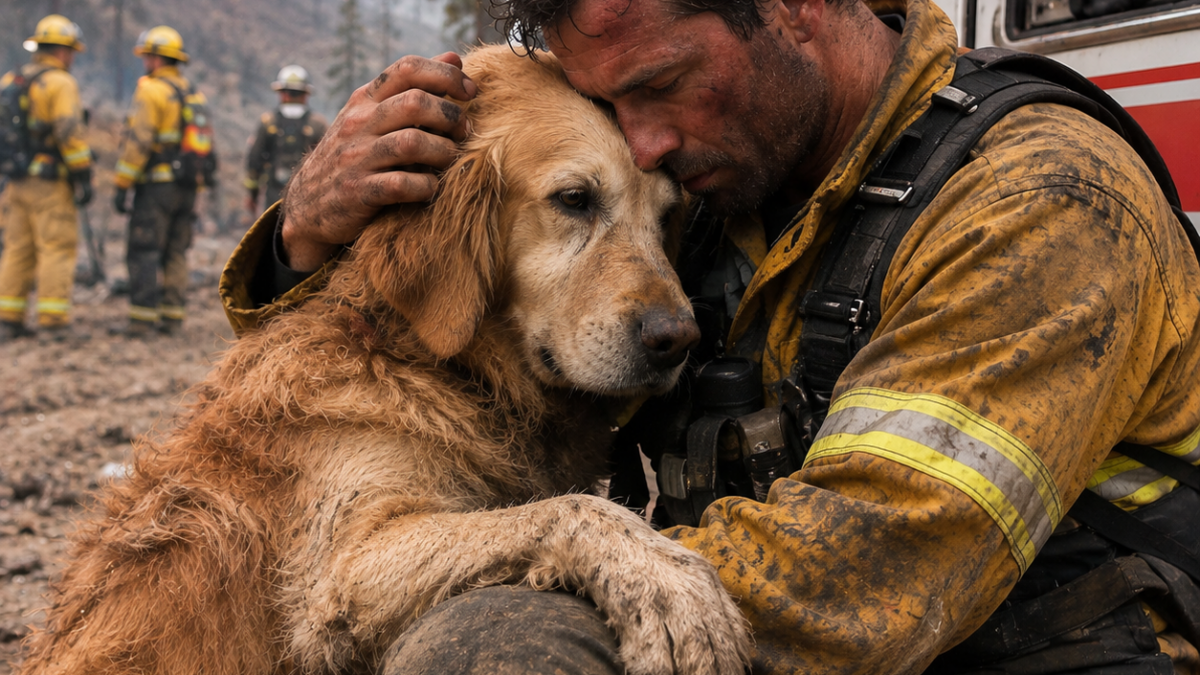
PART 2
The first veterinarian who examined Benson told me he was lucky.
I remember almost laughing.
Lucky.
His paws were burned and torn open.
He had smoke irritation.
His coat was scorched along his left side.
He was dehydrated.
He had lost enough weight that his ribs showed when he breathed.
There was an old scar across his shoulder that had nothing to do with the wildfire.
And according to Dr. Hannah Pierce, he was probably ten years old.
Maybe eleven.
But he was alive.
In emergency medicine, sometimes that is what lucky means.
“He’ll need wound care every day,” Dr. Pierce said.
I stood beside the treatment table while Benson watched me.
“Pain medication?”
“Yes.”
“Antibiotics?”
“Probably.”
“Anything else?”
“Rest.”
I nodded.
“And we need to find his owner.”
That sentence bothered me.
I didn’t know why.
I looked down at Benson.
He immediately lifted his head.
“Microchip?”
“We’re checking.”
A technician returned several minutes later.
“No chip.”
“Collar?”
“Nothing when you found him?”
I shook my head.
Dr. Pierce examined the fur around his neck.
“There are pressure marks.”
“What does that mean?”
“He wore a collar regularly.”
“So somebody owned him.”
“Almost certainly.”
I stared at Benson.
“Then why was he alone?”
Dr. Pierce gave me the answer veterinarians give when the truth is unavailable.
“We don’t know.”
He spent two nights at the clinic.
I visited both days.
I told myself it was because I was the person who had rescued him.
That was nonsense.
We rescued animals all the time.
I did not visit every raccoon.
But Benson was different.
The first afternoon, I stood outside his kennel.
He was asleep.
I thought about leaving before he woke.
Then his eyes opened.
He saw me.
His entire tail began moving.
He tried to stand.
“Don’t.”
He struggled anyway.
I opened the kennel.
He limped toward me.
Then pressed his forehead into my chest.
Dr. Pierce walked by.
“That’s interesting.”
“What?”
“He barely responds to the staff.”
“He likes firefighters.”
“Apparently one firefighter.”
I scratched behind Benson’s ear.
“Temporary trauma attachment.”
Dr. Pierce smiled.
“Is that your professional diagnosis?”
“Yes.”
“You’re a firefighter.”
“Cross-disciplinary expertise.”
She laughed.
The truth was I needed it to be temporary.
Attachment had always made me nervous.
Not dogs specifically.
People.
Anything that could leave.
My father left when I was six.
Not died.
Left.
There is a difference.
My mother spent the next ten years working two jobs and pretending she wasn’t exhausted.
When I was sixteen, she died in a car accident on the way home from a night shift.
After that, I lived with an aunt who was kind but overwhelmed.
At eighteen, I joined the fire academy because emergencies made sense to me.
Someone was trapped.
You went in.
Something was burning.
You put it out.
Someone was bleeding.
You stopped it.
Clear problem.
Clear objective.
Relationships were worse.
No protocol.
No protective gear.
No guarantee that doing everything correctly stopped people from disappearing.
So I became good at leaving first.
Girlfriends eventually used the same words.
“You never let me in.”
“You’re here, but you’re not really here.”
“You act like needing somebody is weakness.”
They were right.
I hated that.
The last serious relationship I had ended two years before Benson.
Her name was Emily.
She wanted marriage.
A house.
Kids.
A life that required permanence.
I wanted her.
I just could not promise I would still know how to want her ten years later.
Eventually she stopped waiting.
I told myself I was relieved.
Then I spent two years avoiding the restaurants we used to visit.
That was my definition of relief.
When Benson was discharged, Cedar County Animal Services had nowhere immediately available to place him.
The wildfire had overloaded every shelter in the region.
Displaced dogs.
Cats.
Livestock.
Animals found wandering burn zones.
I was standing at the clinic desk when Dana Wells from animal control said, “We need a foster.”
I knew what was coming.
“No.”
She looked at me.
“I didn’t ask yet.”
“Your face did.”
“He trusts you.”
“He’ll trust someone else.”
“Maybe.”
“No.”
“Jake.”
“I work twenty-four-hour shifts.”
“We can arrange backup care.”
“I live in a rental.”
“Pets allowed?”
I didn’t answer.
Dana smiled.
“You checked.”
“That proves nothing.”
“Take him for a week.”
“No.”
Benson was sitting beside me.
His bandaged paw rested on my boot.
Dana looked down.
Then back at me.
“One week.”
I hated her.
“Seven days.”
“Seven.”
“Then he goes to a real foster.”
“Absolutely.”
Benson came home with me that afternoon.
The house I was renting sat ten miles outside the evacuation zone.
Small place.
Two bedrooms.
Cheap furniture.
Almost no decorations.
I had been there eight months.
It still looked like I had moved in yesterday.
Benson walked through the door and immediately began changing it.
First came the dog bed.
Then bowls.
Then medication bottles on the kitchen counter.
Then towels near the door.
Within forty-eight hours, there were tennis balls beneath my couch.
He followed me everywhere.
If I went to the kitchen, Benson came.
Bathroom, Benson waited outside.
Laundry room, Benson lay in the doorway.
If I sat on the couch, he rested his head on my thigh.
At night, I put his bed beside mine.
He ignored it.
At 2:00 a.m., I woke because seventy pounds of Labrador had climbed onto the mattress.
“Absolutely not.”
Benson pressed against me.
“You have a bed.”
No response.
“A very expensive bed.”
He sighed.
“Get down.”
He placed one paw across my stomach.
I stared at the ceiling.
“This is emotional manipulation.”
His breathing slowed.
I should have moved him.
Instead, I fell asleep.
The next morning, Cole stopped by.
He walked into my bedroom looking for a phone charger and froze.
Benson was on my bed.
I was making coffee.
Cole looked at me.
Then at Benson.
Then at me.
“Don’t.”
“I haven’t said anything.”
“You’re thinking.”
“I have known you nine years.”
“Cole.”
“You once ended a relationship because a woman left a toothbrush at your apartment.”
“That is not what happened.”
“You said, and I quote, ‘It feels permanent.’”
Benson jumped down and followed me into the kitchen.
Cole pointed.
“That dog has moved into your bed.”
“Temporary foster.”
“Sure.”
“Seven days.”
“What day is this?”
“Three.”
“Right.”
He opened the refrigerator.
“Why is there cooked chicken in here?”
“Medication.”
“For the dog?”
“Yes.”
“You meal-prepped for a dog.”
“I will throw you out.”
Cole laughed.
Benson adored him immediately.
Traitor.
By day seven, nobody mentioned moving him.
Not Dana.
Not Dr. Pierce.
Not me.
I told myself that was because his paws still needed treatment.
Day twelve, I said the same thing.
Day eighteen, the burns had improved.
Day twenty-three, Dana called.
“We have a foster opening.”
I stood in my kitchen.
Benson was sleeping beside the table.
“Oh.”
“Nice woman. Retired nurse. Fenced yard.”
“That sounds good.”
“Yes.”
Long silence.
“When?”
“Tomorrow.”
I looked down.
Benson opened one eye.
I hated the feeling that went through me.
“Can we wait another week?”
Dana said nothing.
“His medication schedule is complicated.”
“It’s not.”
“He knows this house.”
“He’ll adapt.”
“He still has nightmares.”
Another silence.
Then Dana asked quietly, “Do you want him to leave?”
That made me angry.
Because I knew the answer.
“That isn’t the point.”
“What is the point?”
“I’m not the right person.”
“Why?”
“I work too much.”
“We have dog walkers.”
“I travel during fire season.”
“Boarding exists.”
“I’ve never owned a dog.”
“You’ve kept him alive for almost a month.”
“That’s not the same as ten years.”
There it was.
Ten years.
Dana heard it too.
“You’re afraid he’s old.”
I said nothing.
“You think if you keep him, you’re going to lose him.”
“Of course I’m going to lose him.”
“Eventually.”
“He’s already ten.”
“Maybe.”
“Maybe eleven.”
“Yes.”
“So best case, what? Three years? Four? Five if we’re lucky?”
Dana waited.
“What kind of deal is that?”
I hated myself as soon as I said it.
I looked down.
Benson was watching me.
Dana spoke gently.
“That’s not a deal, Jake.”
I swallowed.
“What is it?”
“A life.”
I closed my eyes.
She continued.
“You don’t get to decide love is worthless because it comes with an ending.”
I hung up on her.
Very mature.
That night, I didn’t sleep.
Benson did.
Pressed against my back.
Around three in the morning, he started trembling.
His paws moved.
Small sounds came from his throat.
Nightmare.
I turned.
“Hey.”
He woke suddenly.
For half a second, his eyes were wild.
Then he saw me.
He immediately pushed himself against my chest.
I wrapped an arm around him.
“You’re home.”
The word came out before I thought about it.
Home.
Benson sighed.
My throat tightened.
In the morning, I called Dana.
“Cancel tomorrow.”
“You mean the transfer?”
“Yes.”
“You want another week?”
“No.”
Silence.
Then she laughed.
“What?”
“I owe Cole twenty dollars.”
“You bet on me?”
“Everybody did.”
“I hate all of you.”
“Adoption paperwork at three.”
“Fine.”
Benson officially became mine twenty-eight days after I carried him off that bridge.
I signed his name as Benson Mercer.
The receptionist smiled.
“You gave him your last name.”
“Apparently.”
“He’s family.”
The word made my stomach tighten.
Family.
I signed anyway.
For several months, Benson and I learned each other.
He hated vacuum cleaners.
Loved scrambled eggs.
Refused to go outside in heavy rain.
Snored loudly enough to interfere with television.
And he had one behavior that never changed.
Hugs.
Not constantly.
But when I came home from a long shift, he would rear carefully onto his hind legs, put both front paws on my shoulders, and press himself against me.
The first time Cole saw it, he became quiet.
“That’s what he did on the bridge?”
“Yes.”
“Exactly like that?”
“Pretty much.”
Cole scratched Benson’s head.
“Man.”
“What?”
“I think he thinks you’re his person.”
I pretended to be annoyed.
I wasn’t.
The nightmares slowly decreased.
Mine did too.
I had never considered myself traumatized by the job.
Firefighters are very talented at believing trauma only counts when somebody else has it worse.
But I woke from bad calls sometimes.
Children.
Car wrecks.
Burn victims.
Faces that stayed.
Before Benson, I usually got up.
Turned on the television.
Waited for morning.
With Benson, I would wake and feel his body beside me.
Warm.
Breathing.
Alive.
Sometimes his head came up.
He would look at me.
Then move closer.
No questions.
No advice.
Just presence.
I started sleeping better.
Then the wildfire ended.
Rain finally came in September.
The evacuation zones reopened.
Families returned to whatever remained of their homes.
Some found houses.
Some found foundations.
Some found nothing.
That was when people began trying to locate missing animals.
We checked Benson’s information again.
No chip.
No shelter report matching him.
No missing-dog listing.
Nothing.
“That seems strange,” I told Dana.
“If he was loved, somebody should be looking.”
“Maybe his owner died.”
“Maybe.”
“Maybe their home burned.”
“Maybe.”
“Maybe they evacuated out of state.”
“Possible.”
I didn’t like any answer.
Then, almost four months after the bridge rescue, Benson appeared on local television.
Not because I wanted him to.
The fire department hosted a community event honoring civilian volunteers and rescue crews.
Someone had told the station about the dog from Hollister Bridge.
A reporter asked for an interview.
I declined.
Cole accepted on my behalf.
I threatened his life.
He reminded me homicide violated department policy.
So Benson and I ended up on camera.
The reporter asked how I found him.
I described the bridge.
The fire.
The rescue.
Then she asked, “What made you adopt him?”
I looked down.
Benson was sitting beside me.
He leaned against my leg.
“I think he adopted me first.”
Corny.
True.
The segment aired that evening.
By morning, it had been shared thousands of times.
My phone would not stop vibrating.
Firefighters from other counties sent messages.
People mailed toys to the station.
Someone sent Benson a firefighter jacket.
Then came a message that changed everything.
A woman named Nicole Harris contacted animal control.
**I know that dog. His name wasn’t Benson. His name was Duke.**
Dana called me.
I was eating breakfast.
“Jake.”
Her voice sounded wrong.
“What happened?”
“We may have found Benson’s previous owner.”
My fork stopped.
“Owner?”
“Maybe.”
I looked at Benson.
He was waiting beside my chair for eggs.
“Who?”
“Man named Brent Calloway.”
“Where?”
“East Ridge.”
That was less than fifteen miles from the bridge.
“What happened to him?”
“We don’t know yet.”
“You said previous owner.”
“Nicole says she’s Brent’s former neighbor.”
I stood.
“Did he report Benson missing?”
“No.”
“Did he evacuate?”
“Yes.”
“When?”
“Two days before you found Benson.”
I felt something cold settle inside me.
“Without the dog?”
Dana hesitated.
“That’s what we need to determine.”
The investigation started quietly.
At first I wasn’t supposed to be involved.
I involved myself anyway.
Nicole gave a statement.
She had lived next door to Brent Calloway for three years.
She recognized Benson from the television segment immediately.
“He had that dog forever,” she told investigators.
“Eight or nine years.”
His old name had been Duke.
According to Nicole, Brent treated him decently when Duke was young.
Hunting trips.
Lake trips.
Truck rides.
Then Duke got older.
Slower.
His hips became stiff.
He no longer wanted to jump into Brent’s truck.
Brent began complaining.
Called him useless.
Old.
A burden.
During evacuation, Nicole saw Brent loading his pickup.
Coolers.
Tools.
Two rifles.
A television.
Camping gear.
No dog.
She asked where Duke was.
Brent told her, “He’ll be fine.”
Nicole thought he meant someone else was taking him.
Then came the detail that made my hands go cold.
She had seen Benson tied near Brent’s back shed the night before.
“Tied?”
I asked Dana.
“Yes.”
“During an evacuation?”
“We don’t know when or how he got loose.”
I stared at her.
“He left him.”
“Jake.”
“He left an old dog tied outside while a wildfire was coming.”
“We need evidence.”
“Nicole is evidence.”
“Witness testimony is part of evidence.”
“Part?”
“We need more.”
I stood.
“More?”
Dana’s voice sharpened.
“Do not go to Brent Calloway’s house.”
I looked at her.
“I didn’t say I would.”
“You have that face.”
“What face?”
“The face firefighters get right before doing something they later call ‘necessary.’”
I said nothing.
“Jake.”
“I won’t go.”
I went.
Not that day.
Two days later.
I told myself I wanted answers.
That was partly true.
Mostly, I wanted to look at the man who had decided Benson was disposable.
Brent’s house had survived the fire.
Barely.
Trees behind the property were black.
One side of the fence had burned.
The shed Nicole described was still standing.
A heavy chain lay near it.
I saw it from the driveway.
I knocked.
A man in his late forties opened the door.
Stocky.
Beard.
Baseball cap.
He looked at me.
Then at the fire department T-shirt I was wearing.
His expression changed.
“You’re that guy.”
“Jake Mercer.”
He folded his arms.
“I know.”
“I found your dog.”
“He’s not my dog anymore.”
That surprised me.
“So you admit Benson was yours?”
“Duke.”
“His name is Benson now.”
Brent laughed.
“Whatever.”
Something in me hardened.
“How did he end up on Hollister Bridge?”
“No idea.”
“You left him here during the evacuation.”
“He got loose.”
Nicole had warned me he would say that.
“From that chain?”
His eyes moved toward the yard.
Small mistake.
“You tied him?”
“I tied him sometimes.”
“During a wildfire?”
“You a cop?”
“No.”
“Then get off my property.”
I didn’t move.
“You knew he was old.”
“He was a dog.”
“You knew he couldn’t move fast.”
“He got loose.”
“Did you look for him?”
Brent stared.
“Fire was coming.”
“You evacuated two days early.”
“I had things to move.”
“Things.”
His face tightened.
“You don’t know what happened.”
“Tell me.”
“I had one truck.”
“So?”
“So I took what mattered.”
The sentence landed between us.
I looked at him.
“What mattered.”
He realized too late what he had said.
“I didn’t mean—”
“Yes, you did.”
“Look, the dog was old. Bad hips. Could barely get into the truck anymore.”
I took one step toward him.
Brent straightened.
“Careful.”
I stopped.
That was important.
Because part of me wanted to do something stupid.
I thought of Benson waiting at home.
I stepped backward.
“You know what’s funny?”
Brent said nothing.
“You were right about one thing.”
“What?”
“He could barely get into a truck.”
I looked toward the burned hillside.
“But when a bridge was on fire and everything around him was collapsing, he still found enough strength to put his paws around my neck.”
Brent’s face changed.
“He trusted a complete stranger more than the man who owned him for nine years.”
“That’s not my problem.”
“No.”
I nodded.
“Not anymore.”
I left.
Dana was furious.
“You promised.”
“I promised I wouldn’t go that day.”
“That is not how promises work.”
“Semantics.”
“You could have damaged the case.”
“I didn’t.”
“You could have been arrested.”
“I wasn’t.”
“You could have punched him.”
I didn’t answer.
Dana closed her eyes.
“You thought about it.”
“He said he took what mattered.”
Her anger disappeared.
“What?”
I told her.
Dana became very still.
“He said that?”
“Yes.”
“Exactly?”
“Yes.”
“Did you record it?”
“No.”
“Of course you didn’t.”
“I wasn’t planning litigation.”
“You went there because you were angry.”
“Yes.”
“Finally, truth.”
The official investigation found more than I had.
Nicole had photographs from evacuation morning.
Benson—then Duke—was visible near the shed.
Chain attached.
Timestamped.
Another neighbor had security footage showing Brent’s truck leaving.
No dog visible.
A county deputy who drove through later remembered seeing an animal near the property but had been unable to stop because flames were crossing the road.
Then investigators found something unexpected.
Brent had contacted his insurance company after the fire and listed several items as lost or damaged.
Among them was a line:
**One hunting dog—presumed deceased.**
He had assigned Benson a dollar value.
Three hundred dollars.
That number made me angrier than almost anything else.
Three hundred dollars.
Benson slept beside my chest every night.
He waited at the window when I went to work.
He had changed the way I slept, ate, came home, and thought about the future.
Brent had reduced him to three hundred dollars on an insurance form.
Dana found me sitting outside the station after she told me.
“You okay?”
“No.”
“Good answer.”
“He tried to claim money for him.”
“Yes.”
“While Benson was alive.”
“Yes.”
“And he never searched.”
“No evidence he did.”
“Nothing?”
“Nothing.”
I looked at her.
“Can they charge him?”
“They’re talking to the district attorney.”
For the next month, nothing happened quickly enough for me.
Meanwhile, Benson continued being Benson.
He didn’t know he had become evidence.
He didn’t know his old name had returned.
He didn’t know Brent Calloway existed again in my life.
One evening, I tested something.
“Duke.”
Benson’s head lifted.
My stomach dropped.
He knew.
Of course he knew.
Nine years do not disappear because someone decides you are inconvenient.
I knelt.
“Duke.”
He walked toward me.
His tail moved.
I hated the sadness that hit me.
That name belonged to a life before me.
A life that probably had good parts.
Maybe Brent had once loved him.
Maybe he had thrown tennis balls.
Maybe Benson had slept at the foot of his bed.
Human beings are complicated enough to love someone for years and still betray them when love becomes inconvenient.
I put both hands around Benson’s face.
“Your name is Benson now.”
His tail moved harder.
“You okay with that?”
He licked my nose.
“Disgusting.”
He leaned forward.
Paws over my shoulders.
Hug.
I held him.
“I’m not leaving you.”
The words came easily now.
That was new.
A week later, Brent called me.
I still don’t know how he got my number.
“Mercer.”
I recognized the voice.
“What do you want?”
“My dog.”
I nearly laughed.
“What?”
“I talked to a lawyer.”
“Congratulations.”
“You took my property.”
“I rescued an abandoned dog.”
“He got loose.”
“You claimed he died.”
Silence.
Then, “That doesn’t change ownership.”
“It might change your insurance situation.”
His voice hardened.
“You think you’re smart?”
“No.”
I looked toward Benson.
“I think you’re scared.”
“I want Duke back.”
That was when I understood.
Not love.
Not regret.
Control.
Benson’s story had gone public.
Investigators were asking questions.
If Brent could frame the situation as a lost dog accidentally recovered by someone else, maybe the abandonment looked less intentional.
“You don’t want him.”
“You don’t know what I want.”
“You had months to look.”
“I was dealing with the fire.”
“You had months after.”
No answer.
“You never called a shelter.”
Silence.
“You never posted a flyer.”
Silence.
“You never contacted animal control.”
“Give me my dog.”
“No.”
“You don’t have the right.”
“Watch me.”
I hung up.
Three days later, I received a certified letter from an attorney.
Brent was asserting ownership.
I read it twice.
Then a third time.
Benson sat beside me.
“Apparently you’re property.”
He rested his head on my knee.
“I don’t think so either.”
The legal fight became ugly.
Brent claimed Benson had escaped during evacuation.
He claimed he believed the dog died in the wildfire.
He claimed he had been too traumatized to search.
He claimed my adoption had been improper because the shelter had not identified him.
That last argument worried me.
Animal services had followed lost-animal procedures.
But disasters complicate everything.
Records go missing.
Owners evacuate.
Animals cross counties.
Brent’s attorney argued that property rights remained.
My attorney—yes, I suddenly needed one—argued abandonment.
Photographs.
Witnesses.
Insurance claim.
Failure to search.
The chain.
Then there was another problem.
Benson’s veterinary records from before the fire.
Brent had them.
They showed chronic arthritis.
A veterinarian had recommended daily medication eight months before the fire.
Brent never filled the prescription after the first month.
The records also contained a note.
**Owner reports dog increasingly difficult to manage due to age. Discussed quality-of-life support and mobility options.**
The veterinarian later testified Brent repeatedly complained about cost.
That mattered.
But I did not want the case to become only about Brent.
I hated that he had become so large in Benson’s story.
So I focused on the dog in front of me.
We walked.
We went to the lake.
I bought a ridiculous orange life jacket even though Labradors can swim.
Cole took one look at Benson wearing it and said, “He looks embarrassed.”
“He’s safe.”
“He’s a Labrador.”
“He’s old.”
“He’s plotting your death.”
Benson stood beside the water looking deeply offended.
The first time he entered the lake, I worried.
Then he swam.
Slowly.
His old body suddenly moved differently.
Weightless.
Free.
He paddled out ten feet.
Turned.
Came back.
Then went again.
I stood knee-deep in the water.
“You like this?”
Benson swam toward me.
He put both paws on my shoulders.
I nearly fell backward.
Cole laughed so hard he sat down.
“Every time?”
I held Benson.
“Apparently.”
That summer, Benson became stronger than he had been when I found him.
His fur grew back.
The burns healed.
His paws toughened.
Arthritis still slowed him, but medication helped.
He gained eleven pounds.
Dr. Pierce declared him “a very handsome old man.”
I disliked how proud that made me.
Then came the first hearing.
Brent sat twenty feet away.
Benson was not allowed in the courtroom, which was probably wise.
Nicole testified first.
She described evacuation morning.
The chain.
Brent leaving.
The deputy testified.
The insurance investigator testified.
Then I testified.
Brent’s attorney asked whether I had formed an emotional attachment to the dog.
“Yes.”
“Strong attachment?”
“Yes.”
“So you have a personal interest in keeping him.”
“Yes.”
“Would you say that interest could affect your interpretation of Mr. Calloway’s actions?”
“No.”
“Why not?”
“Because photographs don’t care about my feelings.”
His attorney frowned.
I continued.
“The photo shows Benson chained outside.”
He objected.
The judge allowed me to answer only the question asked.
Fine.
Then the attorney tried something else.
“Mr. Mercer, you are a firefighter.”
“Yes.”
“You entered a dangerous structure to retrieve this animal.”
“Bridge.”
“Excuse me?”
“It was a bridge.”
He stared.
“You risked your life.”
“Yes.”
“Would it be fair to say that experience created an unusually intense emotional bond?”
“Yes.”
“So perhaps your desire to keep the dog is partly based on the dramatic nature of the rescue rather than what is legally appropriate.”
I looked at Brent.
Then back at the attorney.
“No.”
“No?”
“I wanted to keep him because every night after the fire, he woke up terrified and came looking for me.”
The courtroom went quiet.
“I wanted to keep him because he followed me from room to room because he thought if he stopped watching, I might disappear.”
The attorney started to interrupt.
I continued.
“I wanted to keep him because somebody taught that dog people leave.”
The judge looked at me.
I stopped.
“Answer only the question, Mr. Mercer.”
“Yes, Your Honor.”
The hearing was continued.
More evidence.
More waiting.
Then something happened that transformed the case.
Brent came to my house.
He showed up at 7:30 on a Saturday morning.
I was making coffee.
Benson barked.
Not his normal bark.
Low.
Uncertain.
I looked through the window.
Brent stood outside my fence.
I stepped onto the porch.
“You need to leave.”
“I want to see him.”
“No.”
“He’s mine.”
“No.”
“Let him decide.”
That sentence almost made me laugh.
“You abandoned him.”
“Open the gate.”
“No.”
Benson walked onto the porch behind me.
Brent saw him.
His face changed.
“Duke.”
Benson froze.
There it was again.
Recognition.
Brent crouched.
“Come here, boy.”
I did nothing.
I would not interfere.
Part of me was terrified.
What if Benson ran to him?
What if nine years meant more than what happened after?
Would that change the facts?
No.
Would it hurt?
Absolutely.
Brent patted his thigh.
“Duke.”
Benson took one step.
Then another.
Brent smiled.
“There he is.”
Benson reached the edge of the porch.
Stopped.
His ears lowered.
Brent extended his hand.
“Come on.”
Benson turned around.
Walked back to me.
Then did the thing he always did.
Front paws up.
Over my shoulders.
He pressed himself against me.
I wrapped my arms around him.
Brent stood.
“That’s because you trained him.”
“I didn’t.”
“You turned him against me.”
I looked at Benson’s gray head beside mine.
“No.”
I lowered him carefully.
“I think you did that yourself.”
Brent stepped toward the gate.
“Give me the dog.”
I pulled out my phone.
“I’m calling the sheriff.”
His face changed.
Then he said something I will never forget.
“You don’t even know him.”
I stared.
“Nine years,” he said. “I had him nine years. You’ve had him less than one.”
He was right.
And still wrong.
“You’re right.”
Brent looked surprised.
“I don’t know everything.”
I put a hand on Benson’s back.
“I don’t know what he looked like as a puppy.”
I swallowed.
“I don’t know what his favorite toy was when he was two.”
Brent said nothing.
“I don’t know the first time he learned to swim.”
Benson leaned against me.
“But I know what he sounds like when he wakes up afraid.”
Brent’s eyes moved.
“I know he won’t eat unless someone stays in the room during thunderstorms.”
I took one step closer to the fence.
“I know he still turns around when somebody calls him Duke.”
Brent looked away.
“And I know after nine years with you, he spent three months with me before he could sleep through the night.”
That hit.
His jaw tightened.
“You think you’re better than me.”
“No.”
I shook my head.
“I think when he needed you most, you left.”
Sirens sounded down the road.
Brent backed away.
He left before the deputy arrived.
The incident helped my case.
So did Brent’s angry text messages afterward.
His lawyer was probably delighted.
By autumn, criminal charges had also been filed.
Animal abandonment during a declared emergency.
Potential insurance fraud related to the false loss claim.
The exact charges shifted through negotiations, but the central facts did not.
Brent had left.
Benson remained.
The civil ownership case was resolved first.
I sat beside my attorney while the judge reviewed the evidence.
My hands were shaking.
I had crawled across burning structures with steadier hands.
Then the judge said the words.
“The evidence supports intentional abandonment.”
I stopped breathing.
Brent’s claim was denied.
The adoption stood.
Benson was legally mine.
I closed my eyes.
My attorney touched my shoulder.
“You okay?”
I nodded.
I wasn’t.
I wanted to get home.
When I walked through my front door, Benson was waiting with Cole.
“Did you win?” Cole asked.
I looked at Benson.
“Yeah.”
Cole smiled.
“Good.”
Benson came toward me.
I knelt.
“You’re stuck with me.”
His tail moved.
“Sorry.”
Then the paws came up.
Around my shoulders.
I buried my face in his neck.
“I’ve got you.”
But this time something inside me corrected the sentence.
We had each other.
The criminal case ended months later.
Brent accepted a plea agreement involving animal abandonment and an insurance-related offense.
He paid restitution.
Received probation conditions.
Was temporarily prohibited from owning animals.
The exact punishment felt smaller than my anger had wanted.
At first.
Then I realized punishment was never going to restore what Benson had endured.
The real consequence was simpler.
Brent had lost the right to decide Benson’s future.
And Benson’s future turned out to be bigger than either of us expected.
The television station reported on the court decision.
The dog from the burning bridge became local news again.
People began contacting our department.
Some wanted photographs.
Some wanted interviews.
I said no to most of them.
Then I received one letter.
A boy named Ethan.
Twelve years old.
His family had lost their home in the wildfire.
Their dog had died.
Ethan wrote:
**When I saw Benson hug you, I cried because my dog used to put his paws on me like that. I haven’t wanted another dog because I feel like that would mean I forgot him. But my mom says maybe someday we can rescue one.**
I read the letter three times.
Then I drove to the shelter.
Dana was at her desk.
“I have an idea.”
“That sentence usually means paperwork for me.”
“Senior dogs.”
“What about them?”
“People ignore them.”
“Yes.”
“What if the department partnered with shelters during disaster preparedness events?”
She stared.
“Go on.”
“Microchips. Evacuation plans. Senior-animal assistance. Temporary foster networks during wildfires.”
Dana’s expression changed.
“That’s actually not terrible.”
“Thank you.”
“For you.”
“Unnecessary.”
Benson became the unofficial face of the program.
We called it Stay Together.
The purpose was simple.
During disasters, people were often forced into impossible decisions because they had no plan for animals.
Transportation.
Medication.
Shelters that accepted pets.
Elderly dogs that could not climb into vehicles.
Large animals.
We built resources around those problems.
Because somewhere in Brent Calloway’s failure was a lesson.
The fire had created pressure.
But the decision to leave Benson was still a decision.
Maybe other people could be given better options before panic arrived.
Our first event drew thirty people.
The second drew ninety.
By the next wildfire season, nearly four hundred animals in the county had registered emergency contacts.
Dozens received microchips.
Volunteer drivers signed up to help elderly residents transport pets.
A local boarding facility offered emergency kennels.
Benson attended every event he could.
He wore a red bandana.
Kids loved him.
He tolerated them with the exhausted dignity of an elderly professor.
And whenever someone asked me why the program existed, I told them the truth.
“Because I found a dog on a bridge who should never have been there.”
Three years passed.
Benson turned gray almost everywhere.
His hips worsened.
He developed a heart murmur.
Dr. Pierce adjusted medication.
I adjusted my life.
I built a ramp beside the porch.
Then another beside my truck.
Cole walked through my backyard one afternoon and stared at the construction.
“You built a ramp that costs more than your couch.”
“My couch is cheap.”
“You bought the couch used.”
“Exactly.”
Benson stood at the top of the ramp.
Cole looked at him.
“You know you’ve ruined Jake.”
Benson wagged his tail.
“I used to have standards.”
Cole laughed.
“No. You had walls.”
That shut me up.
Because he was right.
Benson had changed things beyond dog ownership.
I started answering my sister’s calls more often.
We had never been close after our mother died.
I visited her family for Thanksgiving instead of volunteering for holiday shifts.
I became godfather to Cole’s daughter.
I started going to therapy.
That one surprised everyone, including me.
The department had a counselor named Dr. Alvarez.
I had avoided her for years.
Then one night, after a difficult structure fire, I woke sweating.
Benson pressed himself against me.
I looked at him.
And for the first time, I understood that leaning on someone did not make the building collapse.
Sometimes it kept you standing.
So I called.
Therapy was terrible.
Useful.
But terrible.
Dr. Alvarez asked questions I hated.
“Why do you think staying feels dangerous?”
“Because people leave.”
“Everyone?”
“Eventually.”
“Death is not abandonment.”
“It feels similar.”
She nodded.
“What did Benson teach you?”
I stared.
“That’s manipulative.”
“How?”
“You know the answer.”
“I want yours.”
I thought for a long time.
“He stayed.”
Dr. Alvarez smiled slightly.
“And?”
I looked out the window.
“I stayed too.”
That was the part I had never given myself credit for.
Benson didn’t heal me simply because he needed me.
I changed because I finally stopped running.
Then Emily came back into my life.
Not romantically.
Not at first.
She saw Benson at a wildfire preparedness event.
I was talking to a family about evacuation crates when I heard a familiar voice.
“You finally got a dog.”
I turned.
Emily.
Same brown hair.
Same eyes.
Older.
So was I.
Benson walked directly to her.
Traitor number two.
She knelt.
“What’s his name?”
“Benson.”
“He’s beautiful.”
“He knows.”
She scratched beneath his chin.
Then looked at me.
“I saw the news.”
“Oh.”
“The bridge.”
“Yeah.”
“And the court case.”
“Unfortunately.”
She stood.
“You look different.”
“More exhausted?”
“No.”
She studied me.
“Present.”
That word hit harder than I expected.
We talked for ten minutes.
Then twenty.
We exchanged numbers.
I did not panic.
That alone was progress.
We had coffee a week later.
Then dinner.
No promises.
No dramatic reunion.
Just two people who had lived separate lives long enough to become slightly different versions of themselves.
Emily had been married briefly.
Divorced.
No children.
She worked as a physical therapist.
I apologized for the way I had ended things.
Not because I wanted her back.
Because she deserved it.
“I made you feel like wanting a future was unreasonable.”
She looked at me.
“You were scared.”
“That doesn’t excuse it.”
“No.”
She smiled.
“But it explains some of it.”
Benson loved her.
Of course.
Eventually she started staying over.
Benson immediately abandoned my side of the bed for hers.
“I rescued you.”
Benson ignored me.
Emily laughed.
“He has taste.”
Six months later, she moved in.
I expected panic.
It came.
Boxes appeared.
Her books mixed with mine.
Shoes near the door.
A second toothbrush in the bathroom.
I stared at the toothbrush for an embarrassingly long time.
Emily caught me.
“You okay?”
“Yes.”
She followed my eyes.
“Oh.”
I laughed nervously.
“Apparently I have history with toothbrushes.”
“So I’ve heard.”
“Cole talks too much.”
Emily took my hand.
“I’m not asking you to promise nothing will ever change.”
I looked at her.
“I’m asking you to be here while it’s here.”
I squeezed her hand.
“I can do that.”
Benson sat in the hallway watching us.
Emily looked at him.
“Your work here is done.”
It wasn’t.
There was one last lesson.
The hardest one.
Benson turned fourteen.
Dr. Pierce called it remarkable.
I called it insufficient.
His heart murmur worsened.
Arthritis became severe.
Walks shortened.
The dog who had once crossed a burning bridge could eventually manage only the end of the street.
So I bought a wagon.
Cole laughed.
Dana laughed.
Emily helped me add cushions.
Benson loved it.
He rode through the neighborhood like a retired king inspecting his property.
Sometimes he walked halfway.
Then looked at me.
I understood.
Into the wagon.
At home, I added rugs everywhere.
My clean minimalist rental had become a house full of dog beds, ramps, medicine, photographs, and Emily’s plants.
It looked lived in.
That would once have terrified me.
Now it felt safe.
Then, one November morning, Benson refused breakfast.
That scared me more than any fire alarm.
Benson never refused food.
Dr. Pierce examined him.
Blood tests.
Ultrasound.
X-rays.
I sat in the same kind of sterile room where she had first treated his burned paws years earlier.
She returned.
Her face told me first.
“Jake.”
“No.”
She sat down.
There was a mass near his spleen.
Likely cancer.
Possibly bleeding.
Surgery at his age, with his heart, carried serious risk.
Without surgery, we might have days.
Weeks.
Maybe slightly longer.
I stared at the floor.
“What would you do?”
Dr. Pierce hated that question.
I knew.
“What would you do?”
She looked through the glass at Benson.
“I would ask whether treatment gives him more good life or only more time.”
I hated her for being right.
Emily sat beside me.
Her hand found mine.
Years earlier, I would have pulled away.
I held on.
We chose comfort care.
The first week was good.
Benson ate.
Slept.
Walked into the yard.
He hugged me twice.
The second week had more difficult days.
The third week, I started counting.
Good morning.
Bad afternoon.
Good evening.
Bad night.
Dr. Pierce had told me I would know.
I didn’t want to know.
Then one Saturday, Benson could not stand.
I helped him.
His legs trembled.
He looked at me.
Not scared.
Tired.
I remembered the bridge.
The burning wood.
His paws around my shoulders.
I had told him, “I’ve got you.”
That promise was not supposed to mean I would hold him here forever because I was afraid to let him go.
I called Dr. Pierce.
She came to the house.
Emily sat beside me.
Cole came.
Dana came.
Benson lay in the backyard beneath the maple tree.
He loved that spot.
The afternoon was cool.
No smoke.
No sirens.
No fire.
I sat on the ground.
Benson’s head rested in my lap.
Dr. Pierce explained what would happen.
I barely heard her.
“Jake,” Emily whispered.
I looked at her.
“You don’t have to be strong.”
That sentence would once have made me angry.
Instead, I cried.
Openly.
Benson opened his eyes.
His tail moved once.
I bent down.
“You remember the bridge?”
He breathed slowly.
“I thought I saved you.”
My voice broke.
“God, I was stupid.”
Emily put a hand on my back.
“You dragged me into a life I didn’t know I wanted.”
Benson’s eyes stayed on me.
“You made me care.”
I laughed through tears.
“You made me buy a three-hundred-dollar dog ramp.”
Cole laughed behind me.
I kept talking.
“You made me go to therapy.”
Dana wiped her eyes.
“You made me let people stay.”
I put my forehead against his.
“And now you’re asking me to do the one thing I still don’t know how to do.”
His breathing was shallow.
“Let you leave.”
I closed my eyes.
“You can go.”
My entire body shook.
“I’ll be okay.”
That was partly a lie.
But it was the kind of lie love sometimes needs.
“I’ve got you.”
Dr. Pierce administered the medication.
Benson relaxed.
His breathing slowed.
Then, with strength I still don’t understand, he lifted one front paw.
Placed it against my shoulder.
Not both.
Just one.
I pulled him closer.
I wrapped my arms around him exactly the way I had on the bridge.
His head rested beside my neck.
His last breath happened there.
In my arms.
I don’t remember how long I stayed.
Maybe ten minutes.
Maybe an hour.
No one rushed me.
Eventually, Emily sat beside me.
I looked at Benson.
“That’s it?”
She knew what I meant.
How could a life suddenly be still?
How could a heart beat thousands of times beside yours and then simply stop?
She put her head on my shoulder.
“No.”
I looked at her.
“No?”
“That isn’t it.”
She touched my chest.
“He changed everything after him.”
I understood.
Not immediately.
But later.
The house was unbearable that first night.
No nails on the floor.
No heavy breathing beside the bed.
No dog waiting outside the bathroom.
I stood in the hallway and thought about sleeping at the station.
Running.
Old instinct.
Then Emily came downstairs.
“You leaving?”
I looked at the keys in my hand.
“No.”
It was the first decision.
Small.
But important.
I put the keys down.
We went to bed.
I cried again.
She stayed.
I let her.
That was Benson’s final gift.
A year later, Emily and I married.
Small ceremony.
Backyard.
Cole stood beside me.
Dana came.
Dr. Pierce came.
There was an empty chair near the front with Benson’s red firefighter bandana draped across it.
Some people thought that was ridiculous.
I didn’t care.
During my vows, I said something Emily understood immediately.
“I used to think love was dangerous because everything ends.”
She squeezed my hands.
“I was wrong.”
I looked toward the empty chair.
“Love is valuable because things end.”
Emily cried.
So did I.
Cole definitely cried but claimed smoke from the barbecue was responsible.
Two years after Benson died, the county opened a new emergency animal evacuation center.
The Stay Together program had grown.
Permanent kennels.
Transport vans.
Microchip clinics.
Emergency medication records.
Foster networks.
A shaded outdoor area.
Near the entrance, a bronze plaque was mounted.
I didn’t know about it until opening day.
Dana led me over.
At the top was Benson’s name.
**BENSON’S BRIDGE**
Underneath:
**For every animal who deserves not to be left behind.**
I stared at it.
“You did this?”
Dana smiled.
“Community did.”
I touched the plaque.
For a second, I could feel his weight around my shoulders again.
Later that afternoon, a family arrived with an old yellow Labrador.
Twelve years old.
Gray muzzle.
Owner had recently died.
The daughter could not keep him.
He sat near the intake desk.
Quiet.
Watching people pass.
I noticed him immediately.
Emily noticed me noticing.
“No.”
“I didn’t say anything.”
“Jake.”
“I’m just looking.”
“Absolutely not.”
The Labrador stood.
Walked toward me.
Stopped.
Then leaned his entire body against my leg.
Emily closed her eyes.
“You have got to be kidding me.”
Dana laughed from across the room.
I looked down.
The dog looked up.
His name was Walter.
Two weeks later, Walter moved into our house.
Not because he replaced Benson.
Nothing could.
That was another lesson.
Love is not a chair with only one seat.
Adding someone new does not push the dead out.
Benson remained.
In the ramp I never removed.
In the program bearing his name.
In my marriage.
In the way I answered my sister’s calls.
In every night I woke from a bad dream and reached toward Emily instead of leaving the room.
In the fact that when Walter became sick three years later, I did not regret adopting an old dog simply because goodbye came quickly.
People still ask me about that day on the bridge.
Firefighters new to the department have heard the story.
Somebody always exaggerates it.
The bridge was ten stories high.
The flames were fifty feet tall.
I jumped a collapsing gap carrying a hundred-pound dog.
None of that happened.
The truth is better.
I was afraid.
Benson was afraid.
The bridge was failing.
I reached him.
He reached for me.
That was all.
Years later, I went back to the site.
The old bridge was gone.
County crews had replaced it with steel and concrete.
Safe.
Wide.
Ordinary.
Emily came with me.
Walter stayed home because his hips were bad.
We stood near the center.
I looked down into the gorge.
“This is where?”
Emily asked.
I nodded.
“Roughly.”
I walked toward the far side.
I remembered smoke.
Heat.
Burning wood.
Then I remembered Benson.
His paws around my shoulders.
I had spent years interpreting that moment as gratitude.
Maybe it was.
But I think now there was more.
Benson had been alone for days.
Maybe longer.
His world had burned.
The person he trusted had left him chained behind.
He escaped somehow.
Then fire pushed him toward that bridge until he had nowhere left to go.
When I reached him, he did the bravest thing possible for an animal who had been betrayed.
He trusted again.
He wrapped himself around a stranger.
He believed I would carry him.
That was the part that changed me.
Not that Benson trusted me.
That he trusted after everything.
For years, I had used loss as evidence that attachment was dangerous.
My father left.
My mother died.
Relationships ended.
Calls went bad.
People disappeared.
So I built a life where no one got close enough to destroy me.
I called it independence.
It was fear.
Benson had more reason to fear trust than I did.
And he still put his paws around my neck.
Standing on that new bridge years later, I finally understood why the memory had always felt larger than a dog rescue.
Benson had shown me something I had spent my entire life avoiding.
Being held is dangerous.
Holding someone is dangerous.
Loving anything means eventually having something to lose.
There is no way around that.
The only alternative is having nothing.
I looked at Emily.
She stood beside me waiting.
Years earlier, I might have looked away.
Instead, I reached for her hand.
She smiled.
“You okay?”
“Yeah.”
“You sure?”
I looked down at the gorge.
“Yeah.”
We started walking.
Halfway across, she stopped.
“What?”
“Nothing.”
She wrapped both arms around my neck.
A full hug.
I laughed.
“What are you doing?”
“Checking whether bridges make everyone emotional.”
I held her.
For a moment, I closed my eyes.
There was no fire.
No sirens.
No collapsing wood.
Only wind through the valley.
Her heartbeat against me.
Solid ground beneath my feet.
I thought of Benson.
And I knew exactly what he had given me.
Not bravery.
I already knew how to run into dangerous places.
He taught me a different kind of courage.
The courage to stay after the emergency.
To let somebody know me when there was no uniform between us.
To say I need you.
To believe I might survive grief without avoiding love.
To understand that an ending does not cancel everything that came before it.
Brent Calloway once decided Benson was no longer worth the trouble.
An old dog.
Bad hips.
Medication.
Slow.
Three hundred dollars on an insurance form.
He thought leaving Benson behind meant Benson’s story ended there.
It didn’t.
Benson crossed a burning bridge.
He survived.
He became family.
His story changed county emergency procedures.
Animals were evacuated because of him.
Owners made plans because of him.
Shelters built partnerships because of him.
A firefighter who had spent his entire adult life running toward emergencies and away from intimacy finally learned the difference between being needed and being loved.
That was Benson’s revenge.
Not Brent’s punishment.
Not the court.
Not the fines.
Not losing ownership.
Those things mattered.
Accountability matters.
But the ending that satisfied me most was this:
Brent left Benson because he believed the dog’s useful years were over.
He was wrong.
The years after Benson was abandoned became the most important years of his life.
And mine.
That is what I think about when people call him a rescue dog.
The phrase still makes me smile.
Because yes, I carried Benson off that bridge.
Technically.
My arms were under him.
My boots were on the burning wood.
I brought him down.
But rescue did not end when we reached solid ground.
That was where it started.
Benson rescued me slowly.
He did it by following me into the kitchen.
By sleeping against my back.
By waiting at the window.
By making me come home.
By forcing me to plan tomorrow because tomorrow included medication, breakfast, and a walk.
By showing me that somebody could need me without trapping me.
By making me experience loss again and proving that I could survive it.
People think the opposite of loss is permanence.
It isn’t.
Nothing is permanent.
The opposite of loss is presence.
Being there while you can.
Holding on while there is something to hold.
And when the time comes, loving enough to release it without pretending it never mattered.
I learned all of that from an old Labrador on a burning bridge.
If you had told thirty-four-year-old me, as I climbed toward that frightened dog, that one day I would be married, volunteering with an animal disaster program, adopting elderly dogs, going to therapy, and openly discussing feelings, I probably would have climbed back into the fire.
But life has a sense of humor.
Sometimes the thing you rescue becomes the thing that breaks open every locked door inside you.
Benson did that.
And even now, years after his death, there are nights when I dream of the old bridge.
In the dream, the fire is always behind him.
Benson is always waiting.
I climb.
He sees me.
His paws come up.
Around my shoulders.
His face against my neck.
But the dream has changed.
For years, I dreamed I was trying desperately to carry him to safety.
Now, when I dream about that day, I realize he is holding me up too.
We cross together.
And when I wake, Emily is beside me.
Walter’s successor—yes, there has been another old dog since then—is snoring near the foot of the bed.
My house is cluttered.
There are photographs everywhere.
Dog bowls in the kitchen.
Shoes by the door.
People who expect me at Thanksgiving.
A wife who knows exactly when I’m pretending to be fine.
A life full of things I could lose.
And instead of terrifying me, that makes me grateful.
Because I finally understand what Benson knew while the bridge burned beneath us.
When everything feels unstable, when the world is collapsing, when there seems to be nothing solid left, sometimes the bravest thing you can do is reach for someone.
And trust that when you put your arms around them—
they will hold you back.








