PART 2: Nobody Wanted This Burned Cat for 1,556 Days—Then a Scarred Little Girl Looked at Him and Said, “He Looks Like Me.”
PART 2
“He looks like me.”
Her voice was so soft that for half a second, I thought I had imagined it.
Her mother didn’t.
The woman’s knees seemed to weaken. She reached for the metal frame of the enclosure, steadied herself, and stared at her daughter.
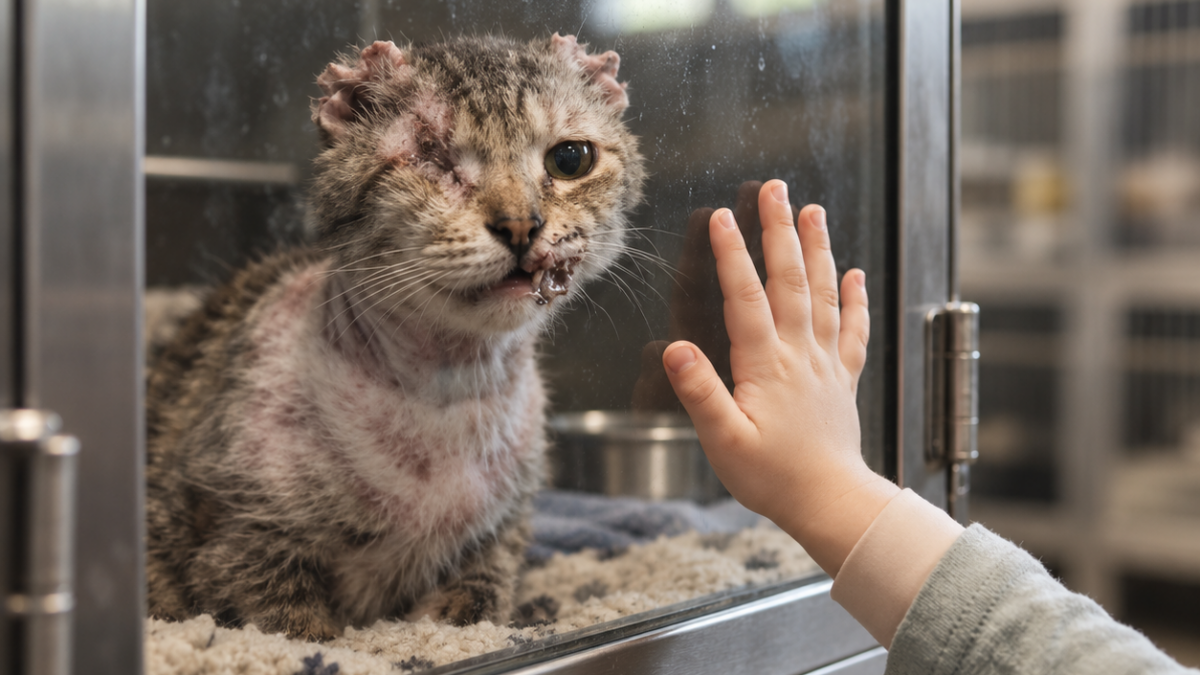
The girl kept one hand between the bars.
Quasi kept his face pressed against it.
Then she looked up at her mother again.
“Can we take him home?”
Her mother made a sound that wasn’t quite a laugh and wasn’t quite a sob.
She covered her mouth with both hands.
I had seen hundreds of adoptions in nineteen years. I had seen children scream with excitement over puppies. I had watched old men cry when a frightened dog finally crawled into their laps. I had watched people drive three states to adopt animals they had seen online.
But I had never seen anything like the expression on that woman’s face.
It wasn’t happiness alone.
It was relief.
The kind that arrives after you have spent so long trying to save somebody you love that you have forgotten what hope feels like.
She crouched beside her daughter.
“You want him?”
The girl nodded.
“Are you sure?”
Another nod.
Then she looked at me.
Not at the floor.
Not at her mother.
At me.
Directly.
“Can I hold him?”
Those were the first words she had spoken to me.
I swallowed hard.
“Absolutely.”
I unlocked Quasi’s enclosure.
Normally, when strangers entered his space, he waited.
He had learned patience the way unwanted animals do.
He never rushed anymore.
He had spent too many years watching hands reach toward other cages.
But this time, when I opened the door, he stepped forward immediately.
The girl sat on the floor.
Her mother began to say, “Honey, be careful—”
Then stopped.
Quasi climbed into the girl’s lap.
Just like that.
No hesitation.
No fear.
He circled once, awkwardly because of the shortened tail and the stiffness in his scarred skin, then settled against the right side of her body.
The scarred side.
The girl froze.
I thought perhaps the weight surprised her.
Then I saw tears rolling down the left side of her face.
She didn’t wipe them away.
She lowered her head until her cheek almost touched his.
Quasi began to purr.
It was not a delicate sound.
Years of injury had left his breathing slightly rough, and his purr had a low, uneven vibration to it.
The girl smiled.
It was the first smile I had seen from her.
Her mother turned away.
I pretended to be busy with the latch because I knew she needed a moment.
Then I heard her whisper, “Oh, thank God.”
I looked at her.
She was crying openly now.
“I’m sorry,” she said.
“You don’t need to apologize.”
“You don’t understand.”
So she told me.
Eighteen months earlier, when her daughter was seven, a fire had broken out in their home at night.
Her daughter had been trapped in her bedroom.
Firefighters reached her, but not before flames and heat caused third-degree burns over a large part of her body, especially along her right side.
There had been surgeries.
Eleven already.
More scheduled.
Skin grafts.
Compression garments.
Physical therapy.
Nightmares.
Months when sleeping meant waking up screaming.
Months when showering hurt.
Months when getting dressed hurt.
Months when strangers stared.
But her mother said the physical pain had not been the part she feared most.
“The doctors knew what to do with the burns,” she whispered. “I didn’t know what to do when she stopped believing she belonged anywhere.”
I glanced toward the girl.
She was running two fingers gently over the smooth scar where Quasi’s ear should have been.
He leaned into her.
Her mother lowered her voice further.
“When she first went back around other children, they asked questions. At first she tried answering.”
She took a shaky breath.
“Then one boy called her a monster.”
My stomach tightened.
“She stopped talking to the other kids after that. Not gradually. Almost completely. Seven months. She speaks to us, her doctors, her therapist sometimes. But outside the family…”
She looked at me.
“You just heard more from her in ten minutes than most people have heard in months.”
I didn’t know what to say.
There are moments when saying something comforting feels smaller than simply standing beside someone.
So I stood there.
Her daughter looked up.
“Mom?”
“Yes, baby?”
“Does he hurt?”
Her mother glanced at me.
I answered carefully.
“Sometimes his scars get dry and uncomfortable. His gums need special care because part of his lip is missing. But right now he isn’t in pain.”
The girl looked down at him.
“Does he know he looks different?”
That question went through me.
I sat on the floor a few feet from her.
“I don’t know what Quasi thinks when he sees himself,” I said. “But I know what he thinks when someone is kind to him.”
“What?”
“That he wants to stay close.”
She considered this.
Then she whispered to the cat, “Me too.”
Her mother cried again.
I nearly did.
Actually, that’s not true.
I did.
I excused myself under the pretense of getting the adoption paperwork.
I made it halfway down the hall before my vision blurred.
Our volunteer coordinator, Denise, was behind the front desk.
She looked at me.
“What happened?”
I shook my head.
“Nothing.”
“You’re crying.”
“For once, nothing happened.”
She stared at me.
I laughed through my tears.
“Get Quasi’s file.”
Denise froze.
“What?”
“Get his adoption file.”
Her hand flew to her chest.
“No.”
“Yes.”
“No way.”
I nodded.
Denise started crying.
Within five minutes, three employees knew.
Within ten, everyone did.
We tried to behave professionally.
We failed miserably.
One kennel technician went into the supply room because he didn’t want the family to see him crying.
Our veterinarian happened to be there that afternoon and came out pretending he needed to “review the home-care instructions.”
He had treated Quasi for years.
He sat across from the girl and explained the scar cream, the eye drops, and the cleaning Quasi sometimes needed around his exposed gums.
The girl listened with more concentration than most adults.
“How often?” she asked.
“His gums?”
She nodded.
“Usually a thorough cleaning once a month, but you’ll want to check them regularly.”
“I can do that.”
Her mother touched her shoulder.
“We can do that.”
The girl shook her head.
“I want to.”
The veterinarian smiled.
“All right. Then I’ll teach you.”
For the next twenty minutes, he showed her exactly how to hold Quasi’s head gently, how to inspect the tissue, and how to recognize irritation.
She asked about his eye.
His skin.
His food.
Whether sunlight bothered him.
Whether cold weather made his scars hurt.
Nobody had ever asked us so many questions about Quasi.
People had always wanted to know what happened to him.
This girl wanted to know how to take care of what remained.
There is a difference.
A very big one.
Her mother filled out the adoption paperwork.
When she reached the section asking why they had chosen this particular animal, she stared at the blank line for a long time.
Then she wrote three words.
“He chose her.”
I saw it later.
I kept a photocopy.
I still have it.
When everything was finished, I went to retrieve the carrier we normally provided for cat adoptions.
The girl shook her head.
“I want to carry him.”
Her mother hesitated.
“It’s safer in the carrier, sweetheart.”
The girl tightened her arms around Quasi.
“Please.”
We compromised.
The carrier went with them for the car ride.
But the girl carried Quasi from the adoption room to the parking lot herself.
His scarred side rested against her scarred side.
His missing ear was beside her reconstructed one.
The place where his fur never grew back touched the compression garment beneath her sleeve.
Halfway to the car, she stopped.
“What is his real name?”
I smiled.
“Quasi.”
“Why?”
I hesitated.
The truth was uncomfortable.
A volunteer had chosen it years before because his damaged appearance reminded her of Quasimodo.
At the time it had seemed affectionate.
Standing beside that girl, I suddenly hated it.
“You can change it,” I said quickly. “Lots of adopted pets get new names.”
She studied him.
“No.”
“No?”
“He knows it.”
“He probably does.”
“Then it’s his.”
She scratched gently under his chin.
“And I like him how he is.”
Her mother closed her eyes.
Sometimes children say things adults spend years trying to understand.
The girl climbed into the back seat.
Her mother placed the carrier beside her and opened its door.
Quasi walked in, turned around, and immediately walked back out.
He climbed into the girl’s lap.
We all laughed.
Even the girl.
Especially the girl.
Her mother finally persuaded him into the carrier by placing the girl’s sweater inside.
Before closing the door, the girl put her fingers through the ventilation holes.
Quasi pressed his cheek against them.
Exactly as he had through the cage bars.
Only now the cage was going somewhere.
I stood in the parking lot until their car disappeared.
Then I went back inside.
Cage Seven was empty.
For years, I had imagined that sight.
I thought it would make me happy.
Instead I stood in front of it and cried so hard Denise had to hand me tissues.
His blanket was still there.
So was the shallow ceramic dish he liked.
A few hairs clung to the fabric.
Not many.
Quasi had never had many to leave behind.
Denise stood beside me.
“You okay?”
“Yeah.”
I looked into the empty cage.
“I just wish it hadn’t taken four years.”
She touched my shoulder.
“At least he doesn’t know how long four years is.”
I looked at her.
“I think animals know waiting.”
She didn’t answer.
That evening, after we closed, I checked the shelter records.
One thousand five hundred fifty-six days.
That was how long Quasi had lived with us.
Four years.
Three months.
And a few days.
I scrolled through his adoption history.
Fourteen inquiries.
Fourteen.
I remembered almost every one.
The woman who gasped.
The man who asked if we had anything “less damaged.”
The college couple who said they wanted a special-needs animal but decided Quasi would be “too emotionally heavy.”
The family who allowed their little boy to point and laugh until one of our volunteers asked them to leave.
And that couple who stayed four minutes.
I closed the file.
For the first time, their rejection did not feel like the ending of Quasi’s story.
The next morning, my phone rang before seven.
It was the girl’s mother.
Immediately, my heart jumped.
Adoption calls that early are rarely casual.
“Is he okay?”
She laughed.
“He’s fine.”
I exhaled.
“He slept with her.”
I smiled.
“Already?”
“He cried outside her bedroom until she opened the door.”
“That sounds like Quasi.”
“No. You don’t understand.”
Her voice changed.
“She slept.”
I waited.
“She slept through the night.”
The words came out slowly.
“As in… all night?”
“All night.”
Her mother began crying.
“So did I.”
She explained that her daughter had struggled with nightmares since the fire.
Some nights she woke once.
Some nights five or six times.
Occasionally she refused to fall asleep at all because closing her eyes made her feel as though she were back in the smoke.
But that night, Quasi had climbed onto the bed.
He settled beside her right shoulder.
When she shifted, he shifted.
When she woke once around midnight, she found his face against her cheek.
She put her hand on his chest.
Felt him breathing.
And went back to sleep.
“I know one night doesn’t mean everything is fixed,” her mother said.
“No.”
“But I haven’t seen her wake up rested in eighteen months.”
I leaned against the desk.
“What did she say this morning?”
There was a pause.
“She said Quasi keeps the fire dreams away.”
That became the beginning.
Not a miracle.
I want to be clear about that.
Love does not erase trauma.
A cat cannot undo burns.
A good night cannot erase eighteen months of fear.
There were still surgeries.
Still therapy.
Still scar care.
Still school.
Still people who stared too long.
Still days when her daughter did not want to leave the house.
But Quasi gave her something none of us had been able to give her.
Evidence.
Living, breathing evidence that a body could be terribly changed and still be worthy of tenderness.
Six days after the adoption, her mother sent me a photograph.
The girl sat cross-legged on her bed doing homework.
Quasi lay across the open workbook.
His one eye was closed.
The message beneath the photo said:
Apparently he does not support mathematics.
I laughed so loudly Denise came out of the supply room to see what happened.
A week later came another photograph.
Quasi in the bathroom sink.
The girl beside him brushing her teeth.
Then another.
Quasi wrapped in a blanket with only his scarred face sticking out.
The girl had apparently informed her mother that “he gets cold where his fur forgot to grow.”
I showed that one to our veterinarian.
He pretended something had gotten in his eye.
Three weeks after the adoption, the mother visited the shelter alone.
I barely recognized her.
Not physically.
Her face looked the same.
But the exhaustion had loosened its grip on her.
She brought a box of cookies for the staff.
I took her into my office.
“How are they?”
She sat down and smiled.
“I don’t know how to explain it without making it sound dramatic.”
“Try me.”
“My daughter talks to the cat all day.”
“That sounds good.”
“No. I mean all day.”
She laughed.
“She tells him things she won’t tell me. Things she won’t tell her therapist.”
My smile faded slightly.
“What kinds of things?”
“The fire. School. The surgeries.”
She looked down at her hands.
“She told him she hates it when people say she’s brave.”
I understood.
Adults say “brave” when they don’t know what else to say to a hurt child.
“What did you do?”
“Nothing. I sat outside the room and listened.”
Her eyes filled.
“She told him, ‘I don’t want to be brave. I just want to be normal.’”
I nodded.
“And then?”
“Quasi sneezed.”
I laughed.
“She told him, ‘Yeah. Me too.’”
We sat quietly.
Then she said, “Her therapist thinks this is helping her externalize some of what she’s been holding in.”
“That sounds promising.”
“It is.”
She looked toward the adoption floor.
“But there’s something else.”
I waited.
“She wants to come back here.”
“To visit?”
“To volunteer.”
I blinked.
“She’s nine.”
“I know.”
“We don’t normally allow volunteers that young except with a parent.”
“I’ll be with her.”
“What does she want to do?”
Her mother smiled.
“Sit with the cats nobody visits.”
I had to look away.
We arranged it.
Saturday mornings.
One hour.
Mother and daughter together.
The first Saturday, the girl arrived carrying a small backpack and wearing the same long sleeves.
Quasi stayed home.
“He gets mad in the car,” she explained.
That was the most she had ever said to Denise.
Denise nodded gravely.
“Very reasonable.”
The girl smiled.
We had three cats that week who were struggling with adoption.
An elderly black cat named Morris.
A shy tortoiseshell named Penny.
And a three-legged gray cat named Rocket, who had the unfortunate habit of hiding whenever anyone entered the room.
The girl started with Morris.
She sat inside his enclosure and read him a book.
She did not pet him until he approached first.
Forty minutes later, Morris was asleep against her leg.
A family adopted him the following week.
Was it because of her?
Probably not directly.
But when they asked why Morris seemed so comfortable with people, I told them about the girl who sat and read to him.
They liked that.
The next Saturday she chose Penny.
Then Rocket.
She never selected the cutest animal.
Never the youngest.
Never the easiest.
She always asked the same question.
“Who has been here longest?”
We began calling her our Waiting Room Specialist.
She hated the name.
So, naturally, Denise used it constantly.
Within six weeks of adopting Quasi, something else happened.
The girl spoke to one of our adult visitors.
Not because she was forced.
Not because her mother prompted her.
A woman was standing in front of Rocket’s enclosure.
The girl was nearby folding towels.
The woman pointed toward the missing hind leg.
“Does that bother him?”
The girl looked at Rocket.
Then at the woman.
“No.”
The woman glanced at her scars and then quickly looked away.
The old pattern.
I saw it.
The girl saw it too.
For a second, her shoulders tightened.
I expected her to retreat.
Instead she walked over.
“He runs faster than some of the cats with four legs,” she said.
“Really?”
“Yeah.”
Rocket chose that moment to shoot across the enclosure and climb a shelf.
The woman laughed.
The girl laughed too.
They talked for almost two minutes.
Her mother stood behind the reception desk with one hand pressed to her chest.
I pretended not to notice her crying.
After they left, the girl went right back to folding towels.
No celebration.
No announcement.
But on Monday, her mother called.
“Her therapist timed it,” she said.
“Timed what?”
“She spoke to a stranger for one minute and forty-eight seconds.”
I smiled.
“Rocket deserves a commission.”
“He probably does.”
By summer, the girl was speaking more often.
Not constantly.
Not easily.
But more.
Then came a setback.
There always does.
Her mother warned me about it before they arrived one Saturday.
Another surgery had been scheduled.
The doctors needed to release contracted scar tissue along the side of her face and neck.
The procedure was necessary.
The girl understood that.
She still hated it.
She had started waking at night again.
She barely spoke.
And for the first time since adopting him, she pushed Quasi away when he climbed onto her bed.
“I don’t know why,” her mother said quietly. “She’s angry at everybody.”
“She’s allowed.”
“I know.”
“She’s even allowed to be angry at him.”
Her mother smiled sadly.
“Try telling him that.”
When they arrived, the girl walked past me without saying hello.
She went straight to the quiet room.
I found her sitting beside a senior cat.
I sat on the floor several feet away.
We stayed silent for a long time.
Finally she said, “They have to cut me again.”
My chest tightened.
I kept my voice steady.
“I heard.”
“I don’t want them to.”
“I know.”
“Mom says it’ll help.”
“She probably believes that.”
“She says I’ll feel better later.”
“Maybe you will.”
She looked at me sharply.
“You sound like her.”
“That’s unfortunate.”
The corner of her mouth twitched.
Then disappeared.
She looked down.
“I hate later.”
I thought about Quasi.
Four years of later.
“I think later can be pretty rude,” I said.
She glanced at me.
“It makes you wait for everything.”
“Exactly.”
She stroked the old cat beside her.
Then her fingers stopped.
“Do you think Quasi remembers when he got burned?”
I answered carefully.
“I don’t know.”
“Do you think he dreams about it?”
“I don’t know that either.”
“He moves sometimes when he sleeps.”
“Cats dream.”
“What if he remembers?”
“Then he wakes up somewhere safe.”
Her eyes lifted to mine.
I went on.
“He wakes up in your house. On your bed. Next to you.”
She stared at me for several seconds.
Then whispered, “I don’t always feel safe.”
“I know.”
“Even at home.”
“I know.”
“Is that stupid?”
“No.”
“Everybody keeps telling me the fire is over.”
I nodded.
“Your body learned something terrifying. Sometimes bodies take longer to believe what our brains already know.”
She was quiet.
Then she said, “Quasi’s body looks like the fire isn’t over.”
I felt that sentence settle into the room.
“What does Quasi act like?”
She thought.
“Like he owns my pillow.”
I smiled.
“Anything else?”
“Like breakfast should happen whenever he wants.”
“Very true.”
“And he screams if Mom closes the bathroom door.”
“I didn’t know that.”
“He screams a lot.”
“So his body carries what happened. But his life isn’t only what happened.”
She looked toward the window.
“No.”
“Neither is yours.”
She didn’t answer.
I didn’t push.
That evening, her mother texted me.
There was a photograph attached.
Quasi was under the blankets.
Only his head showed.
Beside him was the girl’s hand.
The message read:
She let him back on the bed.
The surgery took place two weeks later.
I heard afterward that when the nurses wheeled her toward the operating room, she carried a photograph of Quasi.
Not a pretty photograph.
She had chosen one that showed all of him clearly.
Missing eye.
Missing ears.
Exposed teeth.
Scars.
She told the nurse, “He had worse.”
I’m not sure that was medically accurate.
It didn’t matter.
When she woke from anesthesia, the first thing she asked was whether Quasi had eaten breakfast.
Her mother laughed so hard she cried.
The recovery was difficult.
Pain always sounds abstract when doctors discuss it in advance.
Then you live through it.
There were days the girl refused to look in the mirror because swelling temporarily changed her face again.
Days she asked why every improvement required hurting first.
Days her mother called me from the hospital parking garage because she could not cry in front of her daughter anymore and needed somewhere to fall apart.
I listened.
That became part of our friendship.
Not advice.
Mostly listening.
Three days after the girl returned home, Quasi did something extraordinary.
Or ordinary.
Sometimes there is no difference.
He crawled onto her chest while she was lying on the couch.
Her mother worried he would hurt her incision and tried to move him.
The girl stopped her.
“He knows.”
Quasi settled lower.
He placed his damaged face beside hers.
She closed her eyes.
And slept for almost three hours.
Her mother sent no photograph that time.
She told me later she had considered taking one.
Then decided against it.
“Some moments belong to the people inside them,” she said.
I understood.
By September, the girl was preparing to return to school.
That frightened her more than surgery.
At the shelter, she could control where she stood.
At home, she was protected.
School meant hallways.
Whispers.
Questions.
Children trying not to stare.
Children not trying at all.
Her mother asked whether she wanted to transfer.
The girl said no.
“I want my school.”
“Then we’ll make a plan.”
The therapist helped.
Teachers were informed.
The counselor agreed to give her somewhere quiet to go if she felt overwhelmed.
Still, the night before the first day, she called me.
Not her mother.
Me.
I was cleaning the intake room when my phone rang.
“Hello?”
Nothing.
Then:
“It’s me.”
I knew immediately.
“Hey.”
“Can you talk?”
“Of course.”
“I don’t want to go tomorrow.”
“You don’t have to convince me that school is terrible.”
“That’s not funny.”
“A little funny?”
“No.”
“Okay.”
Silence.
Then she said, “What if they look at me?”
“They probably will.”
I heard her breathing change.
I quickly added, “Not because there’s something wrong with you.”
“Then why?”
“Because people notice things they aren’t used to seeing.”
“I hate it.”
“I know.”
“What am I supposed to say?”
“You don’t owe everyone an explanation.”
“My therapist says that.”
“Your therapist sounds smart.”
“She is.”
“What do you want to say?”
“I don’t know.”
“Then don’t decide tonight.”
More silence.
Quasi meowed loudly in the background.
I smiled.
“Is that my former resident?”
“He’s sitting on my backpack.”
“Maybe he doesn’t want you to go either.”
“He wants my sandwich.”
“That sounds more realistic.”
She laughed.
Then her voice softened.
“What did you say when people called Quasi ugly?”
I stopped wiping the counter.
“I usually told them they didn’t know him.”
“What if somebody calls me ugly?”
That question hurt more than I let her hear.
I leaned against the sink.
“You want to know what I think you should say?”
“Yes.”
“Whatever makes you feel safe.”
“That’s not an answer.”
“It’s the best one I’ve got.”
She groaned.
Adults are very annoying when we refuse to give children movie dialogue.
Then I said, “But if you want the truth, anyone who decides who you are by looking at your scars has told you more about themselves than they’ve told you about you.”
She was quiet.
“Can I tell them about Quasi?”
“Absolutely.”
“Can I show his picture?”
“You better choose a good one.”
“He doesn’t have bad ones.”
I smiled.
“Exactly.”
The next afternoon, her mother called.
“She made it.”
“All day?”
“All day.”
“How?”
Her mother laughed.
“With the cat.”
“What?”
“She brought photographs.”
Apparently, the first child who asked about her scars did so awkwardly.
Not cruelly.
Just bluntly.
“What happened to your face?”
The girl froze.
Every prepared answer disappeared.
Then she remembered Quasi.
She took out her phone.
“This is my cat.”
The child stared at the photo.
“What happened to him?”
“He got burned.”
“Whoa.”
“He survived.”
“Does he bite?”
“No.”
“Can he see?”
“With one eye.”
“Does he sleep with you?”
“Every night.”
The conversation moved.
Just like that.
Not away from the scars.
Through them.
Toward something she loved.
By lunchtime, two other children had seen Quasi’s picture.
By the end of the week, half the class knew about him.
And something changed.
When children asked about her burns, she did not always shut down.
Sometimes she answered.
Sometimes she said, “I don’t want to talk about it.”
Sometimes she showed them Quasi.
The boy who had called her a monster the previous year was still there.
That worried her mother more than anything.
The confrontation happened on a Thursday.
I learned about it that afternoon.
The boy saw her in the hallway.
He stared.
She kept walking.
Then he said her name.
She stopped.
Her friend beside her stopped too.
The boy looked down.
“I’m sorry.”
That was all.
No dramatic speech.
No teacher forcing him.
No public humiliation.
Just two words.
She stood there for several seconds.
Then said, “Okay.”
And walked away.
Her mother asked later if she forgave him.
The girl shrugged.
“I don’t know yet.”
I loved that answer.
Children are often pressured to forgive quickly because adults are uncomfortable with unresolved pain.
But forgiveness isn’t a receipt you hand someone because they finally apologized.
She was allowed time.
She was learning that too.
Weeks passed.
School became routine.
Not easy.
Routine.
There is a difference.
Routine meant she could have a bad Tuesday without believing her whole life was collapsing.
It meant she could come home angry about homework instead of devastated by a stranger’s stare.
It meant her mother could ask, “How was school?” and occasionally hear the universal child response:
“Fine.”
Her mother told me the first time that happened, she went into the laundry room and laughed until she cried.
“I waited two years to be annoyed by the word ‘fine,’” she said.
Meanwhile, Quasi became thoroughly spoiled.
Four years in a shelter had apparently convinced him he was owed interest.
He refused to drink from a normal bowl after discovering the kitchen faucet.
He learned that the girl’s grandmother would share turkey.
He slept only on the right side of the bed.
He sat outside the bathroom and screamed if the door closed.
He knocked pens off desks.
He developed an irrational hatred of one particular blue sock.
He also gained nearly two pounds.
Our veterinarian put him on a diet.
The girl protested.
“He survived being set on fire.”
The veterinarian nodded.
“He did.”
“He lived in a cage for four years.”
“Yes.”
“And now you’re taking away snacks?”
“Correct.”
She stared at him.
“That’s cruel.”
He stared back.
“He is overweight.”
Quasi screamed from the carrier.
The girl pointed.
“Even he disagrees.”
I laughed so hard I had to leave the room.
The diet lasted.
Mostly.
I suspect the grandmother sabotaged it.
That winter, the air turned unusually dry.
Quasi’s scar tissue began cracking in several places.
His skin required petroleum ointment morning and night.
The first time her mother tried to do it, he escaped under the bed.
The girl crawled after him.
Ten minutes later, she emerged holding Quasi like a baby.
“Give it to me.”
Her mother handed her the ointment.
The girl sat on the rug.
“Come on, buddy.”
She warmed a small amount between her fingers.
Then gently worked it into the tight skin along his neck.
Quasi closed his eye.
He purred.
Her mother filmed about fifteen seconds.
She showed me later.
The remarkable part wasn’t Quasi.
It was the girl’s hands.
They were steady.
Scarred, yes.
Some areas were still covered by compression material.
But steady.
She touched his damaged skin without fear.
Without pity.
Without treating him as fragile.
She simply cared for him.
When she finished, she wiped her fingers and said:
“There.”
Quasi immediately licked the ointment.
“No!”
He tried again.
“Quasi!”
He trotted away.
Her mother laughed behind the camera.
The girl chased him.
It was ridiculous.
Ordinary.
Beautiful.
Around Christmas, the shelter received a package.
Inside were twenty small fleece blankets.
A note was taped to the top.
For the cats who are still waiting.
No name.
But I recognized the handwriting.
I called her mother.
“You didn’t have to do this.”
“She saved her allowance.”
“All of it?”
“Almost.”
“Why?”
Her mother was quiet.
“Because she remembers what you told her.”
“What did I tell her?”
“That Quasi waited 1,556 days.”
My throat tightened.
“She asked how many nights that was.”
“The same number.”
“I know. She didn’t.”
Her mother laughed softly.
“When I told her, she sat there for a long time. Then she said nobody should have that many lonely nights.”
We put a blanket in every cat enclosure.
One went into Cage Seven.
A new resident occupied it now.
A twelve-year-old white cat named Pearl whose owner had died.
Pearl had kidney disease and an unpleasant habit of slapping anyone who touched her feet.
She had been overlooked for three months.
When the girl came in after Christmas, she went straight to Pearl.
“Is she mean?”
Denise said, “Only if you have hands.”
The girl nodded seriously.
“Fair.”
She sat outside the cage for half an hour.
Pearl eventually came forward.
The girl didn’t reach in.
She just talked.
About Quasi.
School.
Her upcoming surgery.
A science project.
Eventually Pearl lay down beside the bars.
Three weeks later, an elderly woman adopted her.
The girl began keeping a notebook.
She wrote the names of long-term animals in it.
Date they arrived.
Things they liked.
Things they feared.
Which treats worked.
Which toys.
Where they liked being scratched.
When one was adopted, she drew a small house beside the name.
I saw the notebook only once.
Pages of little houses.
Some names had waited months for one.
Some only weeks.
Beside Quasi’s name, she had drawn the largest house.
Underneath it she wrote:
1,556 days.
Never again.
That spring, a local newspaper reporter contacted the shelter.
Someone had told her about the girl and Quasi.
We did not know who.
The reporter wanted to write a story.
My first reaction was yes.
Publicity helps shelters.
Quasi’s story could bring donations.
It might help scarred or disabled animals get adopted.
Then I called the girl’s mother.
She said she would ask her daughter.
The answer came back twenty minutes later.
No.
The girl did not want photographs of her face printed.
I told the reporter no.
She tried to persuade me.
“We can frame it sensitively.”
“No.”
“We wouldn’t exploit—”
“No.”
“This could really help the shelter.”
I looked through my office window toward Cage Seven.
“No.”
That surprised some people.
We needed money.
Always.
But I had spent years watching strangers believe they were entitled to judge Quasi because they could see his wounds.
I was not going to teach this girl that she owed the world access to hers simply because her story was inspiring.
The reporter respected the decision eventually.
The story never ran.
I am glad.
What happened next mattered more.
One afternoon, nearly a year after the adoption, the girl came into the shelter without her compression garment covering her neck.
It was the first time I had ever seen her there without it.
I noticed.
Of course I noticed.
Everyone did.
Nobody said anything.
That was the gift.
She folded towels.
Cleaned water bowls with her mother.
Sat with a frightened kitten.
Then came into my office.
“Did you see?”
I knew what she meant.
“Yes.”
“You didn’t say anything.”
“I figured if you wanted me to say something, you’d tell me.”
She considered this.
“Does it look bad?”
There are questions children ask that contain traps built by the world, not by the child.
I could have said no.
That would have been easy.
But she owned a mirror.
She knew her neck was scarred.
Pretending otherwise would tell her scars were something we needed to deny.
So I said, “It looks healed.”
She touched the skin.
“That’s not what I asked.”
“No.”
She was getting very good at catching adults.
I smiled.
“It looks like your neck.”
She rolled her eyes.
“You’re bad at this.”
“Probably.”
Then I added, “You look like you.”
She stopped.
Her hand remained on the scar.
“Mom says that too.”
“Your mom sounds smart.”
“You always say that.”
“She keeps being right.”
The girl sat down.
“Sometimes I still wish it was gone.”
“I know.”
“Quasi doesn’t care.”
“No.”
“Cats don’t care about anything.”
“Except breakfast.”
“And doors.”
“And gravity.”
She smiled.
Then she said something I wrote down later because I did not want to forget it.
“I think I’m starting not to care every minute.”
Not “I love my scars.”
Not “I’m glad the fire happened.”
Not some neat ending adults like to put on survival.
I’m starting not to care every minute.
That was healing.
Not erasing.
Making room.
She turned ten that year.
For her birthday, she did not ask for a party.
She asked friends to bring cat food to the shelter.
There were seven children at first.
Then nine.
Then twelve because apparently word spread.
I worried the attention would overwhelm her.
It didn’t.
The children carried bags of food through the lobby.
One boy brought a ridiculous feather toy nearly as tall as he was.
A girl brought three cans of tuna even though we had specifically said not to.
Someone made a card that said HAPPY BIRTHDAY CAT LADY.
The girl taped it to the wall.
I watched her talking.
Actually talking.
To children.
Some knew about the fire.
Some did not.
Nobody seemed to care much.
They cared about cake.
And kittens.
And whether they were allowed to name a newly arrived orange cat “Cheeto.”
We did not allow it.
They called him Cheeto anyway.
At one point, I looked across the room at her mother.
She was watching too.
Our eyes met.
Neither of us said anything.
We didn’t need to.
Seven months of silence.
Now we couldn’t get twelve children to stop talking.
That evening, after everyone left, the girl helped sweep the floor.
“I’m ten now.”
“So I heard.”
“That means I’m older.”
“That’s generally how birthdays work.”
She gave me a look.
“I can do more stuff.”
“Oh no.”
“At the shelter.”
“There it is.”
“I can clean cages.”
“With your mom.”
“I can feed.”
“With your mom.”
“I can do adoptions.”
“No.”
“Why?”
“Because you are ten.”
“You just said I’m older.”
“Not that much older.”
She folded her arms.
Then I saw something that nearly broke me.
She was pouting.
A completely ordinary ten-year-old pout.
No fear.
No self-consciousness.
No hand raised to cover the right side of her face.
Just irritation because an adult had denied her something.
I smiled.
“What?”
“Nothing.”
“You’re being weird.”
“Probably.”
The next phase came slowly.
The girl began to use mirrors again.
Her mother told me months later.
At first, only with Quasi.
She would pick him up and stand in front of the bathroom mirror.
Scar beside scar.
Her face.
His.
She had spent months avoiding reflections after the fire.
Mirrors told her what had been taken.
With Quasi there, the mirror seemed to say something different.
One morning, her mother found them standing together.
The girl held Quasi beside her face.
She looked at his reflection.
Then hers.
“We’re the same,” she told him.
Quasi yawned.
Her mother laughed.
The girl laughed too.
Later she corrected herself.
“Not exactly the same.”
“Good,” her mother said. “Because if you start knocking glasses off counters, we’re going to have problems.”
The girl smiled.
“He does that because he’s curious.”
“He does that because he’s a jerk.”
“Mom!”
“Lovable jerk.”
“That’s better.”
At his next veterinary visit, we noticed a cloudiness developing in Quasi’s remaining eye.
A cataract.
Not severe yet.
But there.
The news frightened the girl.
His one functioning eye had always seemed sacred.
He had already lost so much.
When our veterinarian explained that Quasi might eventually lose more vision as he aged, the girl became very quiet.
“Will he go blind?”
“Possibly someday. Not necessarily soon.”
“Can you fix it?”
“There may be options depending on how it progresses. Right now we monitor him.”
She looked at Quasi.
He was attempting to eat the paper covering the examination table.
“How will he know where I am?”
Her mother touched her shoulder.
The veterinarian smiled.
“Cats use more than vision. Smell. Hearing. Memory.”
“He doesn’t have ears.”
“He has ear canals. He can still hear.”
She touched one of the small scarred folds where an ear had once been.
“What if everything gets worse?”
There it was.
Not just Quasi.
Everything.
Her surgeries.
Her scars.
Her future.
The fear that once something terrible happens, life becomes an endless series of losses.
I moved closer.
The veterinarian answered first.
“Then we handle what gets worse when it gets worse.”
“That sounds scary.”
“It can be.”
“And if he can’t see?”
“Then you help him.”
She looked at him.
“Like he helped me?”
The veterinarian paused.
“Yes.”
The girl nodded.
“Okay.”
Not brave.
Not fearless.
Okay.
That night, she rearranged her bedroom.
Not dramatically.
She moved a wastebasket away from the path between the bed and the door.
She stopped leaving shoes in the middle of the floor.
She told her mother they needed to keep Quasi’s food in one place so he could find it if his vision worsened.
Her mother called me laughing.
“He can still see perfectly well.”
“I know.”
“She has created an accessibility plan for a cat who just chased a moth across the kitchen.”
“That sounds like her.”
“She labeled his food drawer.”
“Of course she did.”
There was something profound beneath the humor.
The child who had once felt helpless inside her own changed body had become someone capable of adapting the world for another changed body.
That mattered.
Quasi’s cataract progressed slowly.
His gums required regular cleaning.
His scars still cracked in dry air.
None of that made the girl love him less.
If anything, care became part of their language.
Every morning before school, she checked his skin.
Every month, she helped with his mouth.
When he resisted, she bribed him with a tiny piece of chicken.
When he got too heavy, she complained that our veterinarian was starving him.
When his eye watered, she wiped it.
When she had procedures, he slept beside her.
They took turns being the one who needed tending.
I sometimes wonder whether that is the best definition of family I have ever seen.
The person who tends to you today may need you tomorrow.
Neither debt cancels the other.
Two years after Quasi’s adoption, we held a small open house at the shelter.
Nothing fancy.
Discounted adoption fees.
Coffee.
Cookies.
A local pet store donated supplies.
The girl, now older and far more confident, asked if she could make something for the wall.
I expected drawings.
Instead she arrived carrying fourteen index cards.
Each card had one sentence.
She taped them beside photographs of animals waiting for homes.
The first said:
Please ask what I love before you decide what I look like.
The second:
Sometimes the animal hiding in the back is waiting for somebody patient.
The third:
Old is not the same as finished.
The fourth:
Scars mean something happened. They do not tell you everything that happens next.
I stopped at that one.
She noticed.
“That one’s Quasi’s.”
“I figured.”
There were cards about shy dogs.
Three-legged animals.
Senior cats.
Animals requiring medication.
No pity.
No inspirational clichés.
Just invitations to look longer.
A couple entered around noon.
They were in their fifties.
They told me they wanted a calm cat.
I showed them several.
Then we reached a black cat named Samson.
Samson had one eye removed because of glaucoma.
The wife stopped.
Her husband hesitated.
I knew the hesitation.
I had seen it fourteen times with Quasi.
Then the woman noticed the card beside Samson’s enclosure.
Scars mean something happened. They do not tell you everything that happens next.
She read it twice.
“Who wrote that?”
I pointed across the room.
The girl was refilling water bowls.
“She did.”
The woman looked at the girl.
Then at Samson.
She asked to meet him.
Forty minutes later, Samson went home.
The girl drew another house in her notebook.
That afternoon, while we cleaned up, I told her.
“You know what you did?”
“What?”
“You got Samson adopted.”
“No.”
“You helped.”
“He got himself adopted.”
I smiled.
“That sounds familiar.”
She looked at me.
“What?”
“Nothing.”
Three months later, another injured cat arrived.
Not burned.
Hit by a car.
One rear leg had to be amputated.
Part of his jaw had been repaired with surgery.
He was young and frightened.
When the girl first saw him, she went completely still.
I expected her to approach.
She didn’t.
“What’s wrong?” I asked.
She looked at me.
“People are going to walk past him.”
Some would.
We both knew it.
“Maybe.”
“That’s not fair.”
“No.”
Her face hardened.
“Why do people do that?”
“Sometimes they’re scared of medical needs. Sometimes they want a pet that fits an idea they already have. Sometimes looking at an injured animal makes them think about things they don’t want to think about.”
“That’s stupid.”
“Sometimes.”
She looked through the glass.
The cat hid beneath a blanket.
“What if nobody takes him?”
“We keep looking.”
“For four years?”
“If that’s what it takes.”
Her jaw tightened.
“No.”
I raised an eyebrow.
“No?”
“He’s not waiting four years.”
And for the first time, I heard something in her voice I had not heard before.
Not sadness.
Determination.
The good kind of anger.
The kind that does not need to hurt someone in order to change something.
She went home and made a plan.
With her mother’s help, she wrote descriptions for our long-term animals.
Not descriptions about what was wrong with them.
Descriptions about who they were.
Sammy: professional blanket thief, suspicious of vacuum cleaners, enjoys tuna and sitting on paperwork.
Martha: fourteen years old, believes human laps are furniture provided exclusively for her.
Duke: missing one leg, still convinced squirrels are personally insulting him.
The injured cat became:
Walter: recovering gentleman, terrible table manners, excellent listener.
We posted the descriptions at the shelter.
Visitors laughed.
They lingered.
They asked questions.
Walter went home after thirty-three days.
The girl crossed his name from the waiting list.
One afternoon I asked her, “How does it feel?”
“What?”
“Thirty-three days instead of 1,556.”
She smiled.
“Better.”
That was her revenge on every person who had once looked at Quasi and turned away.
Not humiliation.
Not punishment.
Not cruelty returned for cruelty.
She simply learned to make people look again.
Years in animal rescue taught me that second looks save lives.
Sometimes human ones too.
Her mother once told me she feared the fire would divide her daughter’s life into two permanent pieces.
Before.
After.
Before she had smooth skin.
After she had scars.
Before she trusted people.
After she feared them.
Before she was a child.
After she became “the burned girl.”
But Quasi complicated that story.
Because there was another before and after now.
Before Quasi.
After Quasi.
Before him, scars represented what fire had stolen.
After him, scars could also mean survival.
Before him, difference meant isolation.
After him, difference became recognition.
Before him, people looking at her face felt like judgment.
After him, sometimes a person looking was just a person looking.
She still had bad days.
This matters.
I do not want to turn her life into a sentimental story where one animal erased everything difficult.
He didn’t.
There were surgeries she hated.
There were photographs she refused to take.
There were summers when heat made compression garments unbearable.
There were strangers who stared.
There were cruel comments.
There were nights she cried.
There were times she asked why the fire happened to her.
No cat can answer that.
Neither can I.
But on those nights, Quasi stayed.
That was what he had always been good at.
Staying.
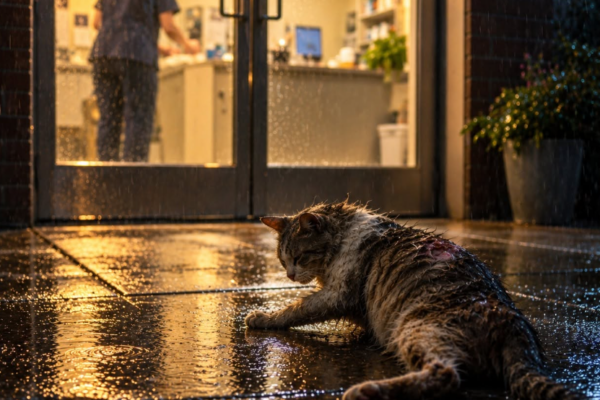
He stayed in a storm drain long enough to be found.
He stayed alive through injuries no animal should have survived.
He stayed gentle.
He stayed at the front of his cage while people chose prettier cats.
He stayed for 1,556 days.
And when the person he had apparently been waiting for finally arrived, he stayed beside her too.
Several years after the adoption, I visited their home for the first time.
I had been invited before.
Scheduling never worked.
Finally, on a Sunday afternoon, I drove out.
The house was ordinary.
That surprised me.
I don’t know why.
Some stories grow so large in your mind that you expect the setting to match.
But healing usually happens in ordinary places.
A driveway with chalk drawings.
A kitchen with dishes drying beside the sink.
A backpack dropped near the stairs.
A half-dead houseplant on the windowsill.
The girl opened the door.
She had grown taller.
Her hair had grown around the scarred area of her scalp, though one section would never grow completely.
Her face had changed too.
Not because the scars disappeared.
They hadn’t.
She had simply grown into herself around them.
“Hi.”
“Hi.”
“You’re late.”
“By two minutes.”
“Quasi’s been waiting.”
“Quasi doesn’t own a watch.”
“He knows.”
“Of course he does.”
The cat was asleep upstairs.
On the right side of her bed.
Exactly where her mother said he always slept.
When he heard my voice, his head lifted.
His remaining eye was cloudier now.
He stared.
Then sniffed.
I sat beside him.
“Remember me?”
He walked forward.
Slowly.
Older.
Stiffer.
He pressed the scarred side of his face into my palm.
I had to look away.
The girl noticed.
“You’re crying.”
“No.”
“You are.”
“Dust.”
“There’s no dust.”
“You’ve become very argumentative.”
“I learned from Mom.”
Her mother shouted from downstairs.
“I heard that.”
The girl grinned.
Quasi climbed awkwardly into my lap.
He was heavier than when I last held him.
His skin felt warm.
Familiar.
“You did pretty well,” I whispered.
The girl sat beside me.
“What?”
“I was talking to him.”
“I know.”
“What did you think I said?”
“I don’t know.”
She touched Quasi’s paw.
I looked at her.
“How are you doing?”
The question came out before I could stop it.
Adults had probably asked her that a thousand times.
She thought about it anyway.
“Good.”
“Good?”
“Yeah.”
No speech.
No profound insight.
Just good.
Downstairs, we ate lunch.
The girl complained about school.
Her mother complained about the girl leaving cups in her room.
The girl accused her mother of stealing French fries.
Her mother denied it.
Quasi sat under the table waiting for evidence.
At one point, the girl’s sleeve slid back.
Scars ran along her forearm.
I saw them.
Then I realized I had not really noticed them.
Not the way I once did.
She was telling a story about a science teacher.
Her hands moved while she talked.
The scars were simply part of the hands.
That realization embarrassed me.
Because I had always considered myself someone who saw beyond Quasi’s injuries.
But maybe I had still been dividing him into two categories.
The damaged parts.
And the “real” cat beneath them.
The girl had understood something better.
There was no beneath.
Quasi was not a beautiful cat despite his scars.
He was Quasi.
Scars included.
She was not herself despite what happened to her.
She was herself.
History included.
After lunch, she showed me something in her room.
The notebook.
The one with the little houses.
It was thicker now.
She had added pages.
Dozens of names.
Maybe hundreds.
Beside each adopted animal was a house.
Some pages were full of them.
I found Quasi near the beginning.
QUASI.
1,556 DAYS.
Underneath, in older childish handwriting:
NEVER AGAIN.
She had crossed out those words.
Beneath them, in newer handwriting, she had written:
KEEP LOOKING.
I pointed.
“You changed it.”
She nodded.
“Why?”
“Because sometimes animals still wait a long time.”
“That’s true.”
“I can’t make never again happen.”
“No.”
“But I can keep looking for their person.”
I smiled.
“That sounds harder.”
“It is.”
“And better.”
“Yeah.”
She turned the page.
There were blank lines waiting for new names.
Quasi walked over and sat on the notebook.
The girl sighed.
“You’re literally sitting on your own story.”
He began washing one paw.
She pushed gently.
He refused to move.
I laughed.
Some things never change.
Before I left, her mother pulled me aside.
“There’s something I never told you.”
We stood near the front door.
The girl was upstairs.
“What?”
“The day we came to the shelter…”
She looked toward the stairs.
“It almost didn’t happen.”
“What do you mean?”
“She refused to get in the car.”
I listened.
“The therapist suggested an animal. I showed her pictures online for weeks. Puppies. Kittens. Every cute thing I could find.”
“She wasn’t interested.”
“Not at all.”
Her mother smiled sadly.
“That morning I told her we were going anyway. She cried. Told me she didn’t want an animal staring at her.”
My chest tightened.
“Why?”
“Because everybody stared.”
Of course.
“She said a pet would stare too?”
“She said she didn’t want anything watching her sleep.”
I thought of Quasi on the right side of her bed.
Her mother continued.
“We sat in the driveway for almost forty minutes.”
“What changed her mind?”
“I don’t know.”
She shook her head.
“She finally got in.”
We both looked upstairs.
“So if she’d refused…”
“I know.”
Quasi might have spent another day in Cage Seven.
Then another.
Maybe another year.
The girl might have found another animal.
Maybe one she loved.
Maybe healing would have come by some different road.
We never know the alternate lives we nearly lived.
That may be why ordinary decisions frighten me now.
Turn left.
Walk inside.
Open one more door.
Look at one more cage.
Stay four minutes longer.
Sometimes the entire future is waiting behind something you almost skipped.
I hugged her mother before leaving.
At the car, the girl called after me.
“Wait.”
She ran outside.
Quasi was not with her.
“He hates the porch,” she explained.
“Reasonable.”
She handed me a folded piece of paper.
“What’s this?”
“Open it later.”
I waited until I returned to the shelter.
Denise was working.
I sat in my office and unfolded it.
It was a drawing.
Not sophisticated.
Not meant to be.
A girl and a cat were standing beside each other.
The girl’s right side was marked with pink lines.
The cat had one eye.
Above them she had written:
SOMEONE WILL STAY.
I kept that too.
It hangs near my desk.
Years have passed since the day Quasi left Cage Seven, but people still ask me which adoption I remember most.
I never have to think.
Not because his injuries were the worst.
Not because the girl’s story was the saddest.
I remember it because it changed the way I understand being seen.
For years, everyone who stopped at Quasi’s cage saw the same physical facts.
Missing ears.
Missing eye.
Exposed teeth.
Scarred skin.
Those things were real.
The problem was not that people noticed them.
The problem was that many decided those facts were the entire animal.
Then a nine-year-old girl arrived.
She noticed every scar too.
Maybe more clearly than anyone.
But the scars told her a different story.
Not ruined.
Survived.
Not frightening.
Familiar.
Not unlovable.
Understood.
And Quasi looked at her the same way.
He did not know she had been bullied.
He did not know she avoided mirrors.
He did not know about eleven surgeries.
He did not know four more might be coming.
He did not know she had barely spoken to another child for months.
He knew her hand was warm.
He knew she touched him gently.
He knew when he pressed the side of his face most people avoided against her palm, she did not pull away.
That was enough.
Maybe that is what she needed most.
Not someone telling her she was beautiful.
Not someone telling her scars did not matter.
Not someone insisting she be brave.
Just another living creature saying, in the only language he had:
I’m not looking away.
Quasi grew older.
His cataract worsened.
His joints stiffened.
He required more care.
The girl grew older too.
More procedures.
More school years.
More people.
More mirrors.
Their bodies kept changing.
Their bond did not.
Every night Quasi still chose the right side of her bed.
His scarred face near her scarred face.
When the dry winter air cracked his skin, she applied ointment.
When surgery left her sore and frightened, he stayed beside her.
When his vision dimmed, she kept the room predictable.
When she woke from bad dreams, she reached for him.
Two survivors.
Neither fixing the other.
Neither needing to.
Just staying.
One evening her mother sent me a final photograph.
Not for the shelter.
Not for social media.
Just for me.
The girl was lying on her side.
Quasi lay facing her.
Their foreheads almost touched.
His one cloudy eye was open.
Hers were closed.
Her hand rested against his chest.
No dramatic caption.
No explanation.
Her mother wrote only:
Still together.
I stared at that photograph for a long time.
Then I looked across my office at the drawing taped beside my desk.
SOMEONE WILL STAY.
Four years earlier, Cage Seven held an animal people struggled to look at.
A little girl later entered our shelter carrying scars people struggled not to stare at.
The world had taught both of them, in different ways, that visible damage made others uncomfortable.
Then they met.
And neither looked away.
That was the victory.
Not that Quasi became beautiful to people who had rejected him.
Not that the girl somehow conquered every insecurity.
Not that scars vanished.
They never did.
The victory was that neither of them had to disappear in order to be loved.
Quasi had spent 1,556 days waiting while people chose someone else.
Fourteen visitors had paused.
Nobody stayed.
Then one child who understood what fire could take placed her hand against his cage.
He pressed his ruined cheek into her fingers.
And instead of seeing a monster, she saw somebody like herself.
And for the first time in years, when she saw herself reflected in another living thing, she did not turn away.
Neither did he.
Sometimes the most satisfying answer to every person who made you feel broken is not revenge.
It is building a life so full of love that their cruelty no longer gets to write the ending.
And somewhere tonight, on the right side of a girl’s bed, an old scarred cat is sleeping beside the person who finally chose him.
Scar against scar.
Breath beside breath.
No cage between them.
No one walking away.
Home.