PART 2: Nobody Wanted the “Ugly” Kitten—Then One Woman Saw What Everyone Else Missed
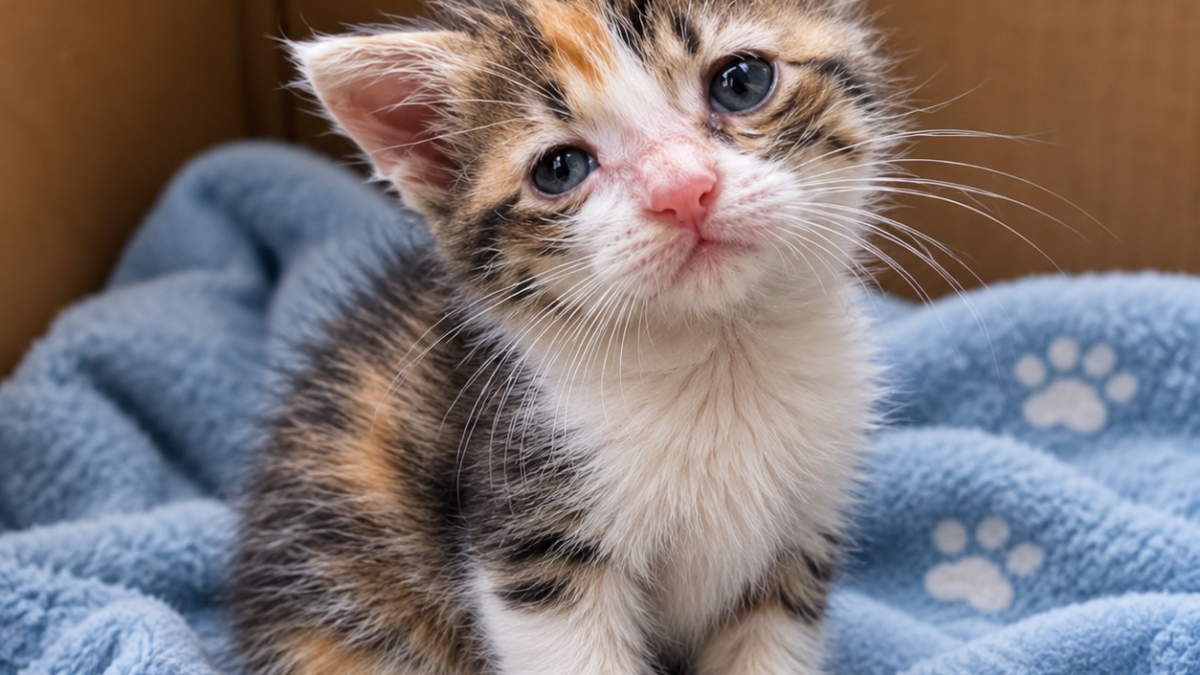
When he was born, every other kitten in his litter found someone willing to hold them, photograph them, and talk excitedly about taking them home, while the smallest one—the kitten with the crooked little face, mismatched eyes, patchy coat, and one ear that refused to stand straight—was left behind as if the way he looked had somehow decided the value of the life inside him.
For nearly two months, I watched families walk into the shelter, laugh as playful kittens climbed into their laps, point toward the prettiest faces behind the glass, and then quietly move past his enclosure without even opening the door, while that tiny kitten dragged himself to the front every single time because he still believed the next pair of hands might finally be reaching for him.
Then, on a bitter November afternoon when I had almost started wondering whether I would eventually have to take him home myself, a woman walked into the shelter carrying an old photograph in her coat pocket, stopped in front of his enclosure, and asked me one question that none of the other visitors had ever thought to ask.
I still remember the first day I saw him.
It was cold enough that the windows of my car had fogged from the inside while I drove across town.
I had been volunteering with a small animal rescue for several years, mostly helping with foster placements, emergency pickups, and difficult adoption cases. That afternoon, one of the shelter employees called me.
Her name was Megan.
“Can you come in?” she asked.
Something in her voice made me straighten in my seat.
“What happened?”
“We have a kitten.”
I almost laughed.
“You’re a shelter, Megan. You have a lot of kittens.”
“Not like this one.”
She grew quiet.
Then she said, “People won’t even go near him.”
Twenty minutes later, I walked through the shelter’s side entrance.
Megan met me in the hallway and led me toward a small nursery room where abandoned and newborn kittens were kept.
At the far end was a cardboard nesting box lined with a pale blue towel.
Inside lay the smallest kitten I had seen in months.
At first glance, I understood what Megan meant.
His face was asymmetrical. One side of his muzzle curved slightly downward, and one eye appeared larger than the other. His short fur grew unevenly in little patches along his forehead and shoulders. One ear stood normally.
The other folded sideways.
He wasn’t frightening.
He wasn’t grotesque.
He was simply different.
But sometimes different is all it takes for people to become cruel.
“What happened to him?” I asked.
“He was born this way.”
“Health problems?”
“The vet thinks some developmental abnormalities. We still need more testing. He can eat. He reacts to sound. He’s gaining weight, just more slowly than his littermates.”
“Where are the others?”
Megan hesitated.
“Gone.”
I looked at her.
“Adopted?”
“Not through us.”
The mother cat’s owners had found homes for the other kittens themselves.
Everyone wanted the fluffy white one.
Someone took the orange kitten.
A family chose the gray female.
Then there was this little guy.
Nobody wanted him.
So his owners brought him here.
Megan folded her arms.
“We posted his picture twice.”
“And?”
“You don’t want to read the comments.”
I knew immediately what she meant.
Some people had called him ugly.
Someone had asked whether his face could be “fixed.”
Another person wanted to know if the shelter had a “normal-looking kitten instead.”
I crouched beside his box.
He heard my voice.
His head lifted slowly.
Then, with obvious effort, he pushed himself toward me.
His legs trembled.
I held out one finger.
The kitten reached it.
And wrapped both front paws around it.
Then he pressed his crooked little face against my skin.
I froze.
He didn’t know what anyone had written about him.
He didn’t know people thought one eye was too large.
He didn’t know his ear was supposed to point upward.
He knew only that there was a warm hand near him.
And he wanted to be touched.
Over the next several weeks, I visited him almost every day.
We named him Oliver.
He grew stronger.
Not quickly.
But steadily.
And whenever visitors entered the nursery, Oliver developed the same heartbreaking routine.
He would hear voices.
Push himself toward the edge of his bed.
Raise his strange little face.
And wait.
Again.
And again.
And again.
People chose kittens beside him.
Above him.
Across from him.
But almost never Oliver.
After nearly two months, even Megan stopped saying, “Maybe today.”
Then one afternoon, the shelter door opened.
A woman in a dark green coat walked inside alone.
She was probably in her mid-forties.
Her name was Claire Bennett.
She told me she wanted to adopt a cat.
I started toward the main adoption room.
But she stopped me.
“I don’t want you to show me the easiest one.”
I turned around.
She reached into her coat pocket.
“I want to see the one nobody wants.”
PART 2
For several seconds, I just stared at her.
People came into shelters saying a lot of things.
They wanted a friendly cat.
A quiet cat.
A cat that didn’t shed much.
A cat good with children.
A cat that looked like one they’d owned years before.
Almost nobody walked through the front door and deliberately asked for the animal everyone else had passed over.
I glanced at Megan.
She had heard the question too.
“You mean Oliver?” I asked.
Claire nodded.
“If that’s his name.”
“How did you hear about him?”
She reached into her pocket again and took out her phone.
On the screen was one of the shelter posts.
Oliver’s uneven little face stared back at me.
“I saw this three nights ago.”
I immediately remembered the post.
I also remembered the comments beneath it.
Claire must have seen something in my expression.
“I read those too,” she said.
“Then you know he may need additional medical care.”
“I know.”
“He may always look different.”
“I know.”
“We don’t know whether there will be future complications.”
“I understand.”
She wasn’t impatient.
She wasn’t offended by my questions.
She answered each one quietly.
Then she looked past me toward the hallway.
“Can I meet him?”
I led her into the nursery.
Oliver was asleep.
His body was curled into the same blue towel he’d had since the week he arrived.
Claire stopped outside the enclosure.
She didn’t make the sound people sometimes make when they see an animal with an unusual appearance.
No gasp.
No sad little “Oh.”
She simply looked.
Oliver woke.
He blinked.
Then his larger eye focused on Claire.
His head lifted.
I opened the enclosure.
“You can sit beside him.”
Claire lowered herself onto the floor.
Oliver sniffed.
Then began his familiar crawl toward the edge.
I had watched him do that for dozens of strangers.
I knew what came next.
Most people would touch his head once, smile awkwardly, then glance toward the other kittens.
Claire didn’t.
She held her hands in her lap and waited.
Oliver reached her knee.
He sniffed the fabric of her coat.
Then put one paw on her leg.
Claire’s lips trembled.
“Hello,” she whispered.
Oliver climbed another inch.
His back legs weren’t perfectly coordinated yet, so he slipped.
Claire caught him with both hands.
He looked up.
And began to purr.
Loudly.
Absurdly loudly for something that small.
Claire laughed.
Then covered her mouth.
Tears filled her eyes.
I sat a few feet away.
“Are you okay?”
She nodded.
But she couldn’t speak.
Oliver pressed his head beneath her hand.
Claire finally whispered, “He does that.”
“Does what?”
“Trusts people.”
I looked at her.
“After everything, he still trusts people.”
Something about the way she said it made me realize she wasn’t talking only about Oliver.
Then she pulled a photograph from her coat pocket.
Not her phone this time.
An actual photograph.
Old.
Bent at the corners.
It showed a little girl sitting on the floor with a black-and-white cat.
The girl couldn’t have been older than nine.
On the left side of her face was a large birthmark extending from her temple toward her jaw.
Claire handed me the photograph.
“That’s me.”
I looked at the girl.
Then at Claire.
Makeup partially covered the mark now, but once I knew where to look, I could still see it.
“When I was a kid,” she continued, “children stared.”
Her thumb rubbed Oliver’s folded ear.
“Adults did too. Adults just thought they were better at hiding it.”
I didn’t know what to say.
Claire smiled sadly.
“I learned very young that people can decide what you are before you’ve even opened your mouth.”
Oliver climbed into her lap.
She looked down at him.
“My mother brought home that cat when I was nine.”
She pointed at the photograph.
“His name was Winston.”
“He looks happy.”
“He was.”
“What happened to him?”
“He died when I was twenty-four.”
Claire smiled again.
“I had him fifteen years.”
She looked at Oliver.
“When I saw this little guy online, I wasn’t thinking about adopting another cat. I wasn’t ready.”
“Ready for what?”
“My husband died last year.”
The room seemed to become quieter.
“I’m sorry.”
“Thank you.”
Claire took a slow breath.
“Daniel loved animals. We always had cats. After he died, the house became so quiet that I stopped going into certain rooms.”
Oliver had curled into a ball against her stomach.
She stroked him.
“I saw his picture at two in the morning.”
“Oliver’s?”
“Yes.”
“And you decided to adopt him?”
“No.”
That surprised me.
“What did you decide?”
“That I hated every person who called him ugly.”
I laughed despite myself.
Claire did too.
Then she became serious.
“I kept scrolling.”
She saw the comments.
People joking about his face.
People asking what was wrong with him.
Someone had written that the shelter should “put him out of his misery.”
Oliver wasn’t in misery.
He was eating.
Playing.
Purring.
Learning.
He simply wasn’t conventionally beautiful.
Claire had shut off her phone.
Then turned it back on five minutes later.
“I looked at his picture again.”
She glanced at me.
“And suddenly I could hear Daniel.”
“What would he say?”
Claire smiled.
“He’d say, ‘So when are you picking him up?’”
—
I didn’t let her adopt Oliver that day.
That surprises people whenever I tell the story.
Claire seemed perfect.
Her home was stable.
Her references checked out.
She understood animals.
She had the money for veterinary care.
But Oliver still needed medical testing, and I wanted to make sure she understood exactly what might be involved.
She came back two days later.
Then again.
And again.
She never asked me to hurry.
One afternoon, I found her sitting cross-legged in front of Oliver’s enclosure reading a book aloud.
“You know he doesn’t understand that, right?” I asked.
She didn’t look up.
“He has better literary taste than most people.”
“What are you reading?”
“Charlotte’s Web.”
“That’s emotionally dangerous.”
“He can handle it.”
Oliver was asleep against her leg.
Within a week, he started reacting to the sound of her footsteps.
Megan noticed first.
“Watch.”
Claire entered the hallway.
Oliver’s head popped up.
His good ear turned toward the door.
Then he stood.
He didn’t crawl anymore.
He walked.
Unsteadily.
Crookedly.
But he walked directly toward Claire.
Megan whispered, “Well, that’s it.”
“What?”
“He chose her.”
—
The veterinary report came back the following Monday.
Oliver had a congenital craniofacial difference.
Nothing life-threatening.
One tear duct didn’t drain correctly.
One side of his jaw was slightly underdeveloped.
His folded ear had some hearing loss, though not complete deafness.
He would need monitoring.
Possibly dental work later.
Maybe eye treatment.
But the veterinarian looked at me and said something I still remember.
“He doesn’t know he’s different.”
That evening I called Claire.
“Still want him?”
She didn’t even let me finish.
“When can I bring him home?”
Three days later, Oliver left the shelter.
Claire brought a soft carrier, two blankets, a ridiculous number of toys, and a tiny blue collar with a silver tag.
The tag said:
**OLIVER BENNETT**
On the back:
**ALREADY LOVED.**
Megan cried when she saw it.
I pretended I didn’t.
Before Claire left, she held Oliver against her chest.
“Thank you.”
“For what?”
“For not giving up on him.”
I looked at Oliver.
“I don’t think he gave us much choice.”
Claire laughed.
Then she carried him through the front door.
For the first time since he was born, Oliver wasn’t being taken somewhere because nobody wanted him.
He was going home because someone did.
—
For the first month, Claire sent me photos almost every day.
Oliver sleeping on her pillow.
Oliver stealing chicken.
Oliver attacking a roll of toilet paper.
Oliver sitting inside the bathroom sink.
Oliver staring at himself in the mirror.
Oliver upside down in a laundry basket.
My favorite was a photograph of him asleep beside an old framed picture of Daniel.
Claire wrote:
**He sleeps there every afternoon.**
Oliver adjusted quickly.
Claire didn’t.
At least not at first.
Grief had turned her home into a museum.
Daniel’s coat remained by the door.
His coffee mug stayed in the kitchen cabinet where he’d left it.
A pair of worn gardening gloves sat on a shelf in the garage.
For months after his death, Claire had carefully avoided changing anything.
Oliver didn’t respect that.
He climbed onto Daniel’s chair.
Knocked over a stack of magazines.
Dragged one of Daniel’s socks beneath the couch.
He chased dust through rooms Claire had stopped entering.
At three in the morning, he sprinted down the hallway as though pursued by invisible demons.
One evening, Claire called me laughing so hard I could barely understand her.
“What happened?”
“He fell into the bathtub.”
“Was there water?”
“Yes.”
“Is he okay?”
“He’s furious.”
I heard a loud meow in the background.
“That sounds personal.”
“He’s sitting outside the bathroom screaming at me.”
“Why?”
“I think he blames me for gravity.”
It was the first time I had heard Claire laugh like that.
Not politely.
Not because she felt she should.
Really laugh.
Oliver hadn’t replaced Daniel.
Animals don’t replace people.
But he changed the silence.
That mattered.
—
Three months passed.
Oliver grew.
His face became even more unusual as he matured.
The asymmetry remained.
One eye stayed larger.
His folded ear never straightened.
His coat remained thinner in several spots.
And somehow he became more beautiful to everyone who actually knew him.
He was affectionate.
Curious.
Fearless.
He loved strangers.
He loved children.
He loved the veterinarian, which made no sense at all.
But his greatest obsession was Claire.
If she went upstairs, Oliver followed.
If she cooked, Oliver sat between her feet.
If she cried, he climbed onto her chest.
Claire told me that one night she had been sitting on the bedroom floor going through Daniel’s things.
She found his wedding ring in a small wooden box.
She hadn’t expected to cry.
But she did.
Oliver had been downstairs.
A minute later, he appeared in the doorway.
He walked across the room.
Climbed into her lap.
And pressed his crooked face beneath her chin.
“He didn’t do anything,” Claire told me later.
“He didn’t need to.”
—
Then someone posted a picture of Oliver online.
Not Claire.
Me.
The shelter was running a campaign about special-needs animals.
I asked Claire for permission.
She sent me a photograph of Oliver sitting in a sunny window.
I wrote:
**Remember the kitten nobody stopped to meet?**
Then I explained that Oliver had been adopted.
That he was healthy.
That his appearance wasn’t a tragedy.
That the right home had simply taken longer to find.
The post spread farther than any of us expected.
First a few hundred shares.
Then a few thousand.
Comments poured in.
Most were kind.
People called Oliver handsome.
Beautiful.
Perfect.
Unique.
Parents posted pictures of children with facial differences.
Adults shared stories about birthmarks, scars, disabilities, and childhood bullying.
One mother wrote that her eight-year-old daughter had asked to print Oliver’s picture for her bedroom because “he looks different and he’s happy anyway.”
Claire called me.
“Do you realize what you’ve done?”
“What?”
“Oliver has fans.”
I laughed.
“How many?”
“Someone made fan art.”
“No.”
“Yes.”
She texted it to me.
A cartoon Oliver wore a tiny crown.
The caption read:
**KING OF CROOKED FACES.**
I laughed until my stomach hurt.
Then I noticed Claire wasn’t laughing anymore.
“What?”
“There are reporters messaging me.”
“Don’t answer anyone you don’t want to.”
“I don’t want him turned into a circus.”
“Then don’t let them.”
She was quiet.
“Daniel would love this.”
“I think so too.”
She sighed.
“He always said the things we try hardest to hide are often the things people remember us for.”
—
Oliver’s story kept spreading.
A local children’s hospital contacted Claire.
They had a program where therapy animals visited patients.
Would she consider having Oliver evaluated?
Claire called me immediately.
“You think he’s capable?”
“Oliver once tried to befriend a vacuum cleaner.”
“So that’s a yes?”
“It’s an enthusiastic yes.”
He passed the temperament assessment.
The evaluator couldn’t stop laughing.
“He has no survival instincts.”
Oliver had walked directly into the lap of every stranger in the room.
He was fitted with a little therapy vest.
Claire sent me a photograph.
One ear up.
One ear sideways.
Huge eye.
Blue vest.
Utterly serious expression.
I wrote back:
**He looks employed.**
She replied:
**More employable than me.**
—
His first hospital visit changed everything.
I went because Claire was nervous.
We visited a pediatric floor.
The first child Oliver met was a ten-year-old girl named Emma.
She had undergone reconstructive surgery after being injured in a house fire.
Part of her face was covered in healing scars.
When we entered, Emma turned toward the wall.
Her mother whispered, “She’s been having a hard week.”
Claire sat in a chair.
She didn’t force anything.
Oliver did.
He climbed onto the bed.
Walked across the blanket.
And sat directly against Emma’s arm.
The girl glanced at him.
Then stared.
“What happened to his face?”
Claire smiled.
“Nothing happened.”
Emma looked confused.
“He was born like that.”
“Does it hurt?”
“No.”
“Do other cats make fun of him?”
That question hit every adult in the room.
Claire paused.
“I don’t think cats care very much what other cats look like.”
Emma touched Oliver’s folded ear.
“People do.”
Her mother looked away.
Oliver began to purr.
Emma touched the uneven fur above his eye.
“He looks funny.”
Claire nodded.
“He does.”
The girl waited.
No correction.
No lecture.
Then Emma said, “I look funny too.”
Her mother’s face crumpled.
Claire leaned forward.
“You look like someone who’s been through something difficult.”
Emma looked at Oliver.
“Is he still cute?”
Claire smiled.
“What do you think?”
The girl studied him.
Then Oliver rolled onto his back and exposed his stomach.
Emma laughed.
It was a tiny laugh.
But her mother started crying.
“Yes,” Emma said.
“He’s very cute.”
—
After that, Oliver became a regular visitor.
Children loved him.
Especially children who looked different.
Children with scars.
Children using wheelchairs.
Children who had lost hair during treatment.
Children with limb differences.
Children who were simply tired of adults looking at them with pity.
Oliver never stared.
He never asked questions.
He never looked uncomfortable.
He just climbed onto the bed.
Purred.
And existed.
Crooked face.
Folded ear.
Uneven fur.
No apology.
A photograph of Oliver and Emma was later shared with permission by the hospital.
That picture went even farther than the shelter post.
Within weeks, Oliver’s story had been featured by local news outlets.
Then national animal pages.
Then larger organizations.
Claire was careful.
No sensational headlines about a “deformed” cat.
No pity.
No pretending Oliver had been rescued from something worse than simple human shallowness.
Her message remained the same.
“He wasn’t suffering because he looked different. He suffered because people decided different meant undesirable.”
That sentence became attached to his story.
And eventually, it reached the people who had surrendered him.
—
I was at the shelter on a Tuesday morning when a man and woman walked through the front door.
I didn’t recognize them.
Megan did.
She stopped moving.
The couple approached the desk.
“We need to speak to whoever is in charge of the cat.”
Megan’s voice cooled.
“Which cat?”
“Oliver.”
I looked up.
The woman pointed toward a printed article she’d brought with her.
Oliver’s face was on the front.
My stomach tightened.
Megan looked at me.
That was when I understood.
These were the people who had brought him in.
The original owners of his mother.
The people who had found homes for every kitten except him.
I walked over.
“I’m Anna,” I said. “I helped coordinate Oliver’s adoption.”
The man’s name was Derek.
The woman was Lisa.
Derek smiled as though we were discussing a forgotten package.
“We think there’s been a misunderstanding.”
“What misunderstanding?”
“About the kitten.”
“What about him?”
Lisa spoke.
“We didn’t abandon him.”
I didn’t answer.
“We surrendered him properly,” she continued.
“Yes.”
“And now he’s apparently worth money.”
There it was.
Not ten seconds.
Not even ten seconds before they said it.
I felt Megan stiffen beside me.
“What money?”
Derek held up the article.
“There are sponsorships.”
“There are charitable partnerships.”
“Same thing.”
“No.”
He frowned.
“We’ve had people contact us.”
“Why?”
“Someone figured out he came from our cat.”
That concerned me.
“How?”
“Small town.”
He shrugged.
“People talk.”
Lisa leaned toward the counter.
“We think we should be involved.”
“In what?”
“His social media.”
I almost laughed.
“You surrendered him.”
“We were told he’d probably have medical problems.”
“That isn’t what your surrender form says.”
Derek’s expression changed.
“What does it say?”
I knew exactly what it said.
I had read it.
The reason listed was:
**UNWANTED DUE TO APPEARANCE / POSSIBLE SPECIAL NEEDS.**
I didn’t quote it yet.
Instead I said, “Oliver was legally surrendered to the shelter. The shelter adopted him to Claire. You have no ownership claim.”
“We’re not necessarily talking about ownership.”
Derek smiled.
“We’re talking about his story.”
I stared at him.
“His story?”
“We bred the mother.”
“No,” Megan said sharply. “Your unspayed pet had a litter.”
Derek ignored her.
“If people are making money from our cat’s kitten—”
“Stop.”
My voice came out harder than I intended.
The lobby went quiet.
“Oliver isn’t a product.”
Lisa crossed her arms.
“Nobody said that.”
“You just did.”
“We just think it’s unfair.”
I laughed once.
“Unfair?”
She looked offended.
“Yes.”
I leaned on the counter.
“Do you know what Oliver did every time someone entered the kitten room?”
Neither answered.
“He crawled to the front.”
Derek glanced away.
“He was barely walking when you brought him here. For weeks, he dragged himself toward strangers because he wanted someone to pick him up.”
Lisa looked uncomfortable.
“That has nothing to do with—”
“It has everything to do with this.”
I lowered my voice.
“You didn’t want him when he needed a home. You don’t get to want a percentage now that strangers know his name.”
Derek’s face hardened.
“We’ll talk to an attorney.”
“Please do.”
Megan slid a copy of the surrender agreement across the counter.
“And take this with you.”
—
Claire didn’t react the way I expected when I told her.
I expected anger.
Instead, she went silent.
Then she asked, “They want money?”
“They haven’t said a number.”
“But that’s what they want.”
“Yes.”
Oliver was apparently sitting in her lap during the call.
I heard him purring.
Claire whispered, “Poor baby.”
“He doesn’t know.”
“I know.”
“He doesn’t have to know.”
“I know.”
Then her voice changed.
“They don’t get him.”
“No.”
“I mean legally.”
“No. They signed him over.”
“They cannot take him.”
“They can’t.”
“Promise me.”
“I promise.”
It was the first time I’d heard fear in her voice.
Because Oliver wasn’t just a cat anymore.
Not to Claire.
He was the creature that had followed her into rooms grief had kept closed.
He slept beside Daniel’s photograph.
He waited outside the shower.
He rode in her car to the hospital.
He sat with children who were afraid of mirrors.
If Derek and Lisa thought they could simply return and claim him because attention had made him valuable, they had badly misunderstood Claire.
—
Their attorney sent a letter anyway.
It claimed the couple had surrendered Oliver based on “incomplete information” regarding his medical prognosis.
It suggested the shelter had “commercially exploited” his image.
It requested records concerning donations connected to his story.
It also demanded that Claire stop using Oliver’s image in any compensated media until ownership questions were resolved.
Our attorney read it.
Then looked at me.
“This is mostly noise.”
“Mostly?”
“They can make noise expensive.”
That was the problem.
Even a weak claim costs money to answer.
The shelter wasn’t wealthy.
Claire wasn’t wealthy.
And Derek seemed to know it.
Over the following two weeks, things became uglier.
Anonymous accounts appeared online.
They claimed Claire had “stolen” Oliver.
They said the shelter had intentionally hidden his improved medical prognosis from his first family.
One post claimed Oliver had been “taken from loving owners.”
Another accused Claire of profiting from a disabled animal.
The lies spread just enough to hurt.
Not enough to convince everyone.
Enough to confuse people.
Claire began receiving ugly messages.
At first she ignored them.
Then someone posted a photograph of her house.
That changed everything.
The police became involved.
The hospital temporarily paused Oliver’s visits while they reviewed security concerns.
Claire called me crying.
Not because of the messages.
Because Oliver’s hospital visits had stopped.
“There are kids expecting him Thursday.”
“They’ll understand.”
“No, they won’t.”
“Claire.”
“One little boy is having surgery Friday.”
Her voice broke.
“He asked if Oliver could come before.”
That was the moment I became angry in a way I hadn’t been before.
Derek and Lisa weren’t simply trying to recover a cat.
They were punishing everyone connected to him because they wanted control over the attention they had once rejected.
—
Then Megan found the old messages.
The shelter had archived screenshots from Oliver’s original adoption posts.
Including comments from the account Lisa used at the time.
I sat beside Megan at the computer.
“Are you sure?”
“Same name. Same profile.”
She opened one.
Oliver’s newborn picture appeared.
Beneath it, someone had asked:
**Why are you surrendering only this kitten?**
Lisa had replied:
**Because the others are normal. We don’t have the time or money to deal with whatever is wrong with this one.**
Another person had written:
**He’s adorable.**
Lisa replied:
**You can have him if you think so.**
Another comment was worse.
Someone asked whether they might regret giving him away if his condition turned out to be cosmetic.
Lisa wrote:
**No. I wouldn’t want to look at that every day.**
I stared at the screen.
Megan whispered, “There it is.”
Not revenge.
Evidence.
There is a difference.
—
Our attorney sent the screenshots to their attorney.
The legal tone changed almost immediately.
The ownership claim weakened.
The request for money disappeared.
But Derek made one last mistake.
He contacted a reporter.
He gave an interview claiming the shelter had “villainized” his family.
The reporter called us for comment.
Claire initially refused.
Then she changed her mind.
“I’ll talk,” she said.
“Are you sure?”
“Yes.”
“Why?”
“Because I’m tired of people talking about Oliver as if he belongs to whoever can tell the loudest story.”
The interview took place at the shelter.
Claire brought Oliver.
He wore his therapy vest.
I sat nearby.
The reporter asked Claire why she had adopted him.
She took out the old photograph.
The one of herself as a child.
She told the story of the birthmark.
Winston.
Daniel.
Grief.
Then she said:
“I didn’t rescue Oliver because I felt sorry for him. I adopted him because everybody kept describing what was unusual about his face, while nobody seemed to be describing the cat.”
The reporter looked at Oliver.
“What kind of cat is he?”
Claire laughed.
“Annoying.”
I nearly choked.
She smiled.
“He screams if I shut the bathroom door. He steals chicken. He sleeps on clean laundry. He wakes me up at four in the morning because he thinks birds are an emergency.”
Then her expression softened.
“He also knows when I’m sad.”
She touched his head.
“And he sits with children during some of the hardest days of their lives.”
The reporter asked about the original owners.
Claire paused.
Then said:
“I don’t hate them for surrendering him.”
That surprised me.
“If they couldn’t care for him, bringing him to a shelter was better than neglecting him.”
The reporter nodded.
“But?”
Claire looked directly at the camera.
“But I do think it’s important to remember the difference between giving up an animal because you cannot meet its needs and giving up an animal because you don’t like looking at it.”
Silence.
Then the reporter asked:
“Do you believe that’s what happened?”
Claire didn’t answer directly.
She didn’t need to.
Our attorney had authorized the shelter to release the surrender form and archived public comments.
The evidence spoke for itself.
—
The story aired two nights later.
It was devastating.
Not because anyone shouted.
Nobody did.
The report calmly laid out the timeline.
Oliver was born.
The other kittens were placed.
Oliver was surrendered.
The reason on the paperwork was shown.
His original adoption post appeared.
Then the old comments.
**Because the others are normal.**
**I wouldn’t want to look at that every day.**
Then came footage of Oliver at the children’s hospital.
Emma was not shown.
Another family had given permission for their son to appear.
He was six.
He had lost one eye to cancer.
Oliver sat beside him wearing his vest.
The boy stroked Oliver’s crooked face and said:
“He has a weird eye like me.”
Off camera, Claire asked:
“Does that bother you?”
The boy shook his head.
“No.”
Then he kissed Oliver’s head.
That ten-second clip did more than any angry argument could have done.
Derek’s interview aired next.
He claimed they’d been worried about veterinary costs.
The reporter then read the old comment.
**I wouldn’t want to look at that every day.**
Derek had no explanation.
By the following morning, the online story had completely reversed.
The people who had called Claire a thief deleted their posts.
Some apologized.
Others simply disappeared.
The hospital called.
Oliver’s visits could resume.
Claire cried when she told me.
“So Thursday?”
“Thursday.”
“And the little boy?”
“His surgery was delayed until Monday.”
She laughed through her tears.
“Oliver can see him.”
—
But consequences were still coming.
During the dispute, our veterinarian reviewed Oliver’s original records.
Something didn’t match.
The date his owners claimed he had been born.
The date he was surrendered.
The medical notes.
Then Megan remembered something.
“The mother cat.”
“What about her?”
“They still have her.”
I understood immediately.
“Is she spayed?”
“No idea.”
She checked.
The same couple had advertised another litter online.
That became a bigger issue.
Not because breeding a household cat automatically made them criminals.
But because the advertisement mentioned repeated litters, and one photograph showed the mother in visibly poor condition.
An animal welfare officer visited.
What happened next came out gradually.
Lisa and Derek had more animals than anyone realized.
Several cats.
Two dogs.
Most were fine.
But the mother cat, Daisy, had been bred repeatedly.
She was thin.
She had untreated dental disease.
One of the newer kittens showed a facial abnormality similar to Oliver’s.
That kitten had not been taken to a veterinarian.
The officer issued orders requiring treatment.
The breeding stopped.
A rescue group helped rehome two of the cats.
Daisy was eventually surrendered voluntarily.
Megan called me.
“Guess where she is.”
I knew.
“No.”
“Yes.”
I drove to the shelter.
Daisy sat inside a quiet room.
She was a small tortoiseshell cat with tired green eyes.
I had never met Oliver’s mother.
When I opened the door, she didn’t approach.
She watched me carefully.
“Poor girl.”
Megan leaned against the frame.
“We’re getting her teeth treated next week.”
“What happens after?”
“Foster, probably.”
I looked at Daisy.
Then I had a terrible idea.
Or maybe a perfect one.
—
Claire brought Oliver in the following Saturday.
I didn’t tell her why.
“You’re acting suspicious.”
“I always act suspicious.”
“No. Usually you’re worse at hiding it.”
Oliver sat in his carrier complaining loudly.
I led Claire toward the quiet room.
Before I opened the door, I said, “We don’t know whether they’ll recognize each other.”
Claire’s expression changed.
“Who?”
I opened the door.
Daisy was curled on a blanket.
Oliver went silent.
For a moment, nothing happened.
Claire looked at me.
“Is that—”
“His mother.”
She covered her mouth.
We placed Oliver’s carrier on the floor and opened it.
He stepped out.
Daisy stood.
Her body became still.
Oliver sniffed.
Daisy sniffed back.
No dramatic movie moment.
No instant embrace.
Cats don’t owe us theater.
They circled each other.
Oliver wandered toward a food bowl.
Daisy watched him.
Then she approached and sniffed his neck.
Oliver turned.
Daisy licked the top of his head once.
Claire started crying immediately.
“You’re ridiculous,” I whispered.
“Shut up.”
Daisy licked Oliver again.
Then Oliver walked away as if being reunited with his mother after months apart was mildly less interesting than the food.
Claire laughed.
“I think that went well.”
“It went like cats.”
—
Daisy entered foster care with Claire.
Officially temporary.
Nobody believed that.
Oliver followed her everywhere for the first week.
Daisy tolerated him.
Then one evening Claire sent me a photograph.
Oliver and Daisy were asleep together in Daniel’s chair.
Oliver’s head rested across his mother’s back.
The caption said:
**Temporary is not going well.**
I called her.
“You’re keeping her.”
“I don’t know.”
“You bought her a heated bed.”
“She was cold.”
“You changed your work schedule for her dental surgery.”
“She needed someone.”
“You ordered a tag.”
Silence.
“What does it say?”
Claire sighed.
“Daisy Bennett.”
I laughed.
“Congratulations on your temporary cat.”
—
Derek and Lisa never regained Oliver.
They never received money.
They never controlled his image.
Their legal threat was withdrawn.
More importantly, the attention they had tried to exploit forced scrutiny onto how they were treating the animals still in their home.
Daisy received veterinary care.
The new kitten with facial differences was evaluated early and adopted through a rescue that understood its needs.
The repeated breeding ended.
If you want to call that revenge, you can.
I don’t.
Revenge would have been making them suffer simply because Oliver had suffered.
What happened was better.
They had once looked at a tiny kitten and decided his appearance made him less valuable.
Months later, they watched thousands of people see exactly what they had failed to see.
And when they tried to turn that attention into money, the very spotlight they wanted illuminated their own choices instead.
They did that to themselves.
—
Oliver’s life kept getting bigger.
But Claire worked hard to keep it normal.
Three days a week, he was nobody famous.
He was just a cat.
He chased Daisy through the hallway.
He slept in cardboard boxes despite owning beds that cost more than some furniture.
He stole food.
He screamed at birds.
He sat on Claire’s laptop during video calls.
On Thursdays, he visited the hospital.
One afternoon, I joined them again.
Emma was there.
Almost a year had passed since their first meeting.
Her scars had healed considerably.
She wore her hair pulled away from her face now.
The first time I met her, she had turned toward the wall when strangers entered.
This time she walked into the room herself.
“Oliver!”
The cat immediately started purring.
Emma knelt.
“He got fat.”
Claire gasped.
“Excuse me.”
“He did.”
Oliver rolled onto his side.
Emma rubbed his stomach.
“I have something.”
She pulled a sheet of paper from her backpack.
It was a drawing.
Oliver sat in the center wearing a red cape.
Around him were children.
Some had wheelchairs.
Some had scars.
One had no hair.
One wore an eye patch.
At the top, Emma had written:
**DIFFERENT DOESN’T MEAN BROKEN.**
Claire stared at it.
“Can I keep this?”
Emma nodded.
“It’s for Oliver.”
“Then I’ll ask his permission.”
Claire held the drawing in front of him.
Oliver sniffed it.
Then bit the corner.
Emma burst out laughing.
“I think he likes it.”
—
That drawing eventually hung in Claire’s living room.
Beside Daniel’s photograph.
Beside the old photograph of Claire and Winston.
Three different parts of her life.
Three reminders that love had arrived in different forms.
One evening, about a year after Oliver’s adoption, I visited Claire for dinner.
Daisy was asleep near the fireplace.
Oliver was on the windowsill.
Claire handed me a glass of wine and asked:
“Do you remember the first day?”
“Of course.”
“He was so tiny.”
“He was ugly.”
Claire turned slowly.
I laughed.
“Kidding.”
“You’re banned from my house.”
“He was weird-looking.”
“Get out.”
“He still is.”
Oliver looked toward us.
His large eye made him appear deeply offended.
Claire pointed.
“See? You hurt his feelings.”
“He’s thinking about chicken.”
“Same thing.”
We laughed.
Then Claire became quiet.
“I used to think Daniel was the last person who would ever know me completely.”
I didn’t interrupt.
“After he died, I didn’t want a new life.”
She stared at Oliver.
“I wanted the old one back.”
“That makes sense.”
“No.”
She shook her head.
“It was impossible.”
Oliver jumped from the windowsill and walked toward her.
Claire picked him up.
“But this little guy kept destroying the museum.”
“The museum?”
“My house.”
She smiled.
“I was preserving everything exactly the way Daniel left it.”
Oliver climbed onto her shoulder.
“Then Oliver came in and didn’t care.”
“He is historically disrespectful.”
“He knocked over Daniel’s picture the first week.”
“I remember.”
“He slept in his chair.”
“Yes.”
“He stole one of his socks.”
“Still missing?”
“Under the refrigerator.”
She laughed.
Then her eyes filled.
“And somehow I started living here again.”
—
A few months later, Claire asked the shelter if she could establish a small medical fund in Daniel’s name.
Nothing enormous.
She wasn’t wealthy.
But Oliver’s story had generated donations, speaking invitations, and a few carefully approved partnerships.
Claire refused to keep most of the proceeds.
The money went into the **Daniel Bennett Second Look Fund**.
The idea was simple.
It would help animals who were repeatedly overlooked because of appearance, age, disability, or manageable medical conditions.
The name came from something Claire said during planning.
“Sometimes they don’t need a miracle.”
She looked at Oliver.
“They just need someone to look twice.”
The first animal helped by the fund wasn’t a kitten.
It was a twelve-year-old dog named Roscoe with one eye.
Then came a three-legged cat.
A rabbit with scarred ears.
A senior Chihuahua with almost no teeth.
A kitten born with a twisted front leg.
Not all of them became internet stories.
Thank God.
Most simply went home.
That was enough.
—
Two years after Oliver’s adoption, I received an email.
The subject line read:
**I think I was one of those people.**
The woman who wrote it had visited the shelter while Oliver was waiting.
She remembered him.
She remembered looking into his enclosure.
She remembered deciding immediately that she didn’t want him.
She had chosen a fluffy gray kitten instead.
Her email wasn’t defensive.
She wrote:
**I didn’t say anything cruel, but I remember thinking he looked wrong. I have thought about that a lot since seeing his story. I realize now that I made a decision about an animal in two seconds because of his face.**
Then she wrote:
**Last week I adopted a cat with one eye. I don’t know if I would have done that before Oliver.**
I forwarded it to Claire.
She called me.
“That’s why.”
“Why what?”
“That’s why the story had to become public.”
I smiled.
“For one cat?”
“For the next Oliver.”
—
As Oliver got older, his medical needs became clearer.
His jaw required dental surgery.
His eye needed daily drops for a while.
His hearing on one side remained limited.
None of it changed him.
Well, the eye drops changed him.
He hated them.
Claire would approach with the bottle.
Oliver would see it.
Then run.
For a cat supposedly born with coordination problems, he became remarkably athletic when medication was involved.
Once he climbed the curtains.
Claire called me.
“He’s halfway to the ceiling.”
“Take a picture.”
“Help me.”
“Picture first.”
“I hate you.”
But beneath the comedy, Claire took his care seriously.
Every appointment.
Every medication.
Every evaluation.
Once, after a dental procedure, she slept on the floor beside him because he seemed restless.
At two in the morning, Daisy joined them.
Claire woke beneath one blanket with two cats pressed against her.
She later told me:
“I couldn’t move my legs, but emotionally it was lovely.”
—
The years softened Oliver’s face.
His unusual features never disappeared.
They became his face.
That’s the strange thing about love.
At first you notice differences.
Then familiarity takes over.
Eventually, trying to imagine the person—or animal—without those differences feels wrong.
Oliver’s folded ear was Oliver.
His crooked muzzle was Oliver.
His mismatched eyes were Oliver.
If someone had offered Claire surgery to make him look “normal,” she would have laughed them out of the room.
Nothing about him needed cosmetic correction.
The only things we treated were the things that caused discomfort.
That distinction became important to Claire.
Whenever reporters asked whether Oliver’s appearance could have been fixed, she said:
“Fixed into what?”
—
One spring morning, the shelter held an adoption event focused on special-needs and senior animals.
Claire brought Oliver as an ambassador.
He sat on a table wearing a tiny bow tie.
He hated the bow tie.
I knew because he spent twenty minutes trying to remove it.
A little boy approached with his father.
The boy pointed at Oliver.
“Why does his face look like that?”
His father immediately whispered, “Don’t say that.”
Claire smiled.
“It’s okay.”
She crouched beside the boy.
“He was born that way.”
The boy studied Oliver.
“Can I touch him?”
“Absolutely.”
He stroked Oliver’s folded ear.
“It’s soft.”
“It is.”
“Does he know his face is different?”
Claire glanced at me.
Then back at the child.
“I don’t think he spends much time worrying about it.”
The boy nodded seriously.
Then said:
“That’s smart.”
His father laughed.
So did we.
The boy’s family adopted a senior cat that afternoon.
Not because of Oliver alone.
But maybe Oliver helped.
—
Daisy died first.
She had been older than we originally realized.
Claire had her for almost four years.
Cancer came quickly.
Oliver stayed beside her during the last week.
The night before her final veterinary appointment, Claire placed a mattress on the living-room floor.
Daisy slept against her chest.
Oliver slept against Daisy.
When the veterinarian came the next morning, Daisy was surrounded by the family she hadn’t had when she was younger.
Afterward, Oliver walked through the house searching.
Room to room.
Calling.
Claire called me because she didn’t know what to do.
“There isn’t anything to do.”
“He keeps looking.”
“I know.”
“How long?”
“I don’t know.”
She cried.
Oliver’s grief lasted weeks.
He waited near Daisy’s food bowl.
He slept in her bed.
At night he sometimes cried in the hallway.
Claire sat with him.
The cat who had once helped her survive Daniel’s absence now needed her to help him survive Daisy’s.
That’s what relationships become when they’re real.
Not rescue.
Not ownership.
Reciprocity.
You carry each other when it’s your turn.
—
Oliver eventually returned to the hospital.
His first visit after Daisy died was quieter.
Emma was fifteen by then.
Nearly grown.
She volunteered in the same program where she had once been a patient.
When Oliver saw her, he walked straight over.
Emma sat on the floor.
“Hey, ugly.”
Claire gasped theatrically.
Emma laughed.
“I’m allowed.”
Oliver climbed into her lap.
She scratched his chin.
“You know what you did to me?”
Oliver purred.
“You made me stop hiding my hair.”
Claire looked at her.
Emma had undergone additional procedures, but her scars were still visible.
She no longer covered them.
“I thought if you could walk around looking like that…”
She pointed at Oliver.
“…I could probably survive high school.”
Claire laughed.
“That may be the nicest insult he’s ever received.”
Emma kissed his head.
—
Years passed.
Oliver’s online fame faded.
New stories replaced his.
New animals went viral.
New videos caught people’s attention.
That suited Claire perfectly.
Oliver didn’t care.
He had never known he was famous.
He knew his food bowl.
His favorite windowsill.
The sound of Claire’s car.
The hospital.
The children.
Me.
A few shelter employees.
And the blue blanket Claire had saved from his original enclosure.
Yes.
She had kept it.
When Oliver first went home, Megan gave her the towel because it smelled familiar.
Claire washed it hundreds of times.
Eventually the fabric became thin.
But Oliver still slept on it.
—
On his tenth birthday, the shelter held a small celebration.
Not because ten was extraordinary for a cat.
Because Megan insisted.
She baked a cake for the humans.
Claire brought Oliver.
I brought photographs.
We spread them across a table.
Baby Oliver.
Tiny enough to hold with one hand.
Oliver crawling toward Claire.
Oliver in his therapy vest.
Oliver with Emma.
Oliver with Daisy.
Oliver asleep beside Daniel’s photograph.
Oliver standing beneath the sign for the Daniel Bennett Second Look Fund.
By then, that fund had helped more than two hundred animals.
Two hundred.
I stared at the number for a long time.
All because one kitten had been considered too strange-looking to choose.
Claire stood beside me.
“What are you thinking?”
“That none of this was supposed to happen.”
“What do you mean?”
“I mean, according to everyone who walked past him, Oliver was the kitten nobody wanted.”
Claire looked across the room.
Oliver was trying to steal icing.
She smiled.
“They were wrong.”
“Yes.”
“No.”
She shook her head.
“They were looking at the wrong thing.”
—
I thought about the original owners sometimes.
I wondered whether they ever saw Oliver after the news cycle ended.
Whether they regretted surrendering him.
Whether they regretted only losing the attention.
I never found out.
Eventually, it didn’t matter.
Oliver’s life wasn’t meaningful because they regretted anything.
That would have given them too much power over the ending.
His life was meaningful because of what happened after their decision.
The little kitten they didn’t want became a companion to a grieving widow.
A comfort to frightened children.
The reason another rejected cat was given a second chance.
The face of a fund that helped animals nobody stopped to notice.
That was enough.
More than enough.
—
Oliver’s final year began quietly.
He slowed down.
Jumped less.
Slept more.
His kidneys weakened.
Claire adjusted his food.
Medication appeared beside the sink.
Veterinary appointments became more frequent.
The little kitten who once needed extra care had become an old cat who needed it again.
Claire gave it without complaint.
One December night, she called me.
Her voice was steady.
Too steady.
“Can you come over?”
I knew.
When I arrived, snow had begun falling.
Oliver was on the couch.
The old blue towel lay beneath him.
Claire sat beside him.
His face looked smaller than I remembered.
His folded ear had gone thin.
His large eye remained bright enough to recognize me.
“Hey, buddy.”
His tail moved.
Once.
I sat.
Claire stroked him.
“He stopped eating yesterday.”
“What did the vet say?”
“His kidneys are failing.”
I nodded.
There are no useful sentences in moments like that.
Claire looked toward Daniel’s photograph.
Then toward Daisy’s collar, which hung from a small hook near the fireplace.
“I’ve done this too many times.”
“Yes.”
“It doesn’t get easier.”
“No.”
Oliver shifted.
Claire immediately adjusted his blanket.
“He was supposed to be the difficult one.”
I looked at her.
“What?”
“The special-needs cat.”
She laughed softly through tears.
“Remember?”
“I remember.”
“He caused me fewer problems than almost anyone I’ve ever known.”
“That isn’t true.”
She looked offended.
“He destroyed your curtains.”
“One curtain.”
“He urinated in my shoe.”
“You deserved it.”
“He ate a piece of my sandwich while looking directly at me.”
“He was confident.”
We both laughed.
Oliver opened his eye.
As if annoyed that we were discussing his criminal record.
Claire bent down.
“It’s okay.”
She kissed his forehead.
“You don’t have to do anything else.”
—
The veterinarian came to the house the following afternoon.
Emma came too.
She was twenty-one.
A nursing student.
The little girl who once asked whether other cats laughed at Oliver now sat beside him as an adult.
Megan came.
I came.
Claire didn’t want a crowd.
But Oliver had collected people.
That was unavoidable.
He lay on his blue towel.
Claire held him.
Emma rubbed his folded ear.
Megan whispered:
“You were worth the wait, little man.”
Claire started crying.
Oliver purred.
Weakly.
But unmistakably.
The veterinarian gave him the first medication.
His body relaxed.
Claire pressed her face against his.
“Daniel would have loved you.”
She took a breath.
“He would have pretended he didn’t want a cat.”
I smiled.
“He would have lost that argument.”
“Immediately.”
She kissed Oliver again.
“Thank you for making the house messy.”
Another kiss.
“For ruining my curtains.”
Another.
“For sitting with me.”
Her voice disappeared.
“For staying.”
Oliver died in the arms of the woman who had walked into the shelter years earlier and asked to meet the kitten nobody wanted.
He left this world being wanted by more people than we could count.
—
We didn’t hold a funeral.
Claire said Oliver would have considered that excessive.
Instead, several weeks later, she invited us to the shelter.
A new plaque had been installed outside the nursery.
It read:
## **THE OLIVER ROOM**
Below that:
**FOR THE ONES PEOPLE ALMOST WALK PAST.**
Claire stood in front of it with her hands in her pockets.
“I hate this.”
I looked at her.
“The plaque?”
“No.”
She wiped her face.
“That he’s important enough to have one.”
I understood.
Important enough to have a plaque meant absent enough to need one.
Inside the room, a kitten was sleeping.
Tiny.
Black fur.
One missing back foot.
Claire stared.
I watched her.
“No.”
She looked at me.
“I didn’t say anything.”
“You’re thinking.”
“That’s not illegal.”
“You are not adopting a kitten today.”
Claire looked through the glass.
The kitten woke.
It saw us.
Then hopped toward the front on three and a half legs.
Claire closed her eyes.
“Oh, that’s unfair.”
I started laughing.
She pointed at me.
“Don’t.”
“You walked in here years ago and specifically asked for the cat nobody wanted.”
“I remember.”
“This is your fault.”
“No, Oliver started it.”
The kitten pressed its nose against the glass.
Claire crouched.
I shook my head.
“Daniel would say—”
“Don’t you dare.”
“When are you picking him up?”
She laughed and cried at the same time.
Then she opened the enclosure.
—
People sometimes ask me what happened to the ugly kitten.
I always correct them.
Not angrily.
Just accurately.
There was never an ugly kitten.
There was a kitten with a crooked face.
A folded ear.
Mismatched eyes.
Uneven fur.
A kitten whose first owners saw those things and decided they didn’t want him.
Then dozens of visitors saw those same things and kept walking.
And finally one woman walked in carrying a photograph of a little girl who had once known exactly what it felt like to be stared at.
Claire didn’t look past Oliver’s differences.
That’s not what happened.
She saw them.
She simply didn’t confuse them with his worth.
That distinction changed both their lives.
It changed mine too.
Before Oliver, I thought adoption was mostly about matching animals with homes.
After Oliver, I understood how often the real battle happens before anyone signs paperwork.
It happens in that first second.
That first glance.
That instinctive judgment.
Pretty.
Ugly.
Healthy.
Broken.
Easy.
Difficult.
Worth it.
Not worth it.
Oliver spent his entire life proving how little those first judgments know.
The people who rejected him eventually watched strangers celebrate the face they had been embarrassed to look at.
The people who tried to profit from his story lost the right to control it.
The mother who had been bred again and again finally slept safely in the same home as her son.
Children who were afraid of their own scars touched Oliver’s face and realized difference didn’t cancel beauty.
More than two hundred overlooked animals received medical care because one unwanted kitten became impossible to ignore.
And Claire?
The woman who entered the shelter thinking she was adopting a cat discovered that Oliver had his own plans.
He opened rooms she had closed after Daniel died.
He brought noise into silence.
He knocked things over.
He made her laugh when laughing felt disloyal.
He sat with her when grief returned.
And years later, when his own body became tired, she did for him what she had promised from the first day.
She stayed.
That is the part I remember most.
Not the internet attention.
Not the reporters.
Not the legal fight.
Not even the way people who had rejected Oliver eventually had to watch the world embrace him.
I remember one moment from the beginning.
A cardboard box.
A pale blue towel.
A kitten so small his legs shook when he moved.
I extended one finger.
Oliver wrapped both front paws around it.
Then he pressed his strange little face against my hand.
He didn’t know anyone thought he was ugly.
He didn’t know he had already been rejected.
He didn’t know his photograph would someday reach thousands of people.
He didn’t know he would sit beside frightened children in hospital beds.
He didn’t know his mother would eventually sleep beside him again.
He didn’t know that years later, a room at the shelter would bear his name.
He wanted only one thing.
For someone not to pull their hand away.
And eventually, someone didn’t.
Claire reached back.
Then she kept reaching back for the rest of his life.
Maybe that was Oliver’s real revenge.
The world had looked at him once and decided there wasn’t enough beauty there to love.
Then he spent the rest of his life surrounded by so much love that nobody who had rejected him could ever honestly claim they had been right.








