PART 2: Nobody Wanted the 154-Pound Saint Bernard—Until a Terrified Abandoned Puppy Chose Him as His Only Safe Place
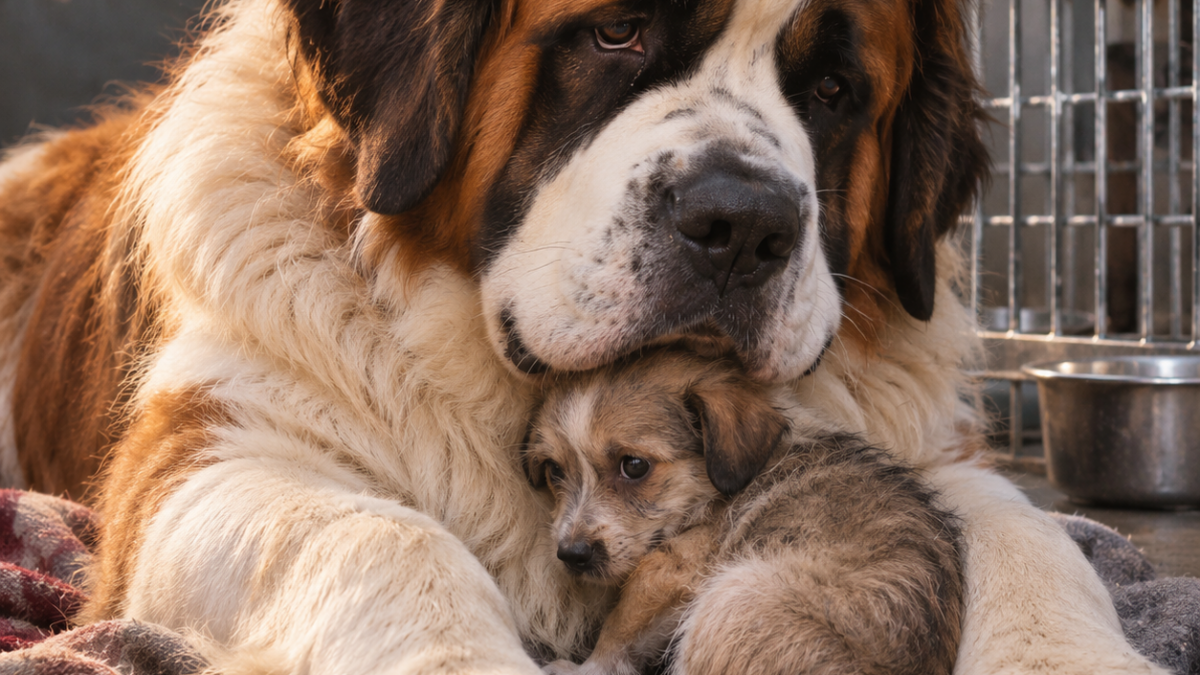
PART 2
The next morning, I watched the footage three times.
Lucie stood beside me with her arms folded tightly across her chest.
Neither of us spoke during the first viewing.
On the second, I started noticing details.
Every time Pipo whimpered, Boris lifted his head.
Sometimes he pushed his muzzle closer to the bars.
He never barked at him.
He never tried to force his way into the kennel.
He simply made sure the puppy knew he was there.
On the third viewing, I noticed something that broke me completely.
At 2:14 in the morning, Pipo woke suddenly.
His little body jerked upright.
He looked around the dark kennel, clearly frightened.
Then he saw Boris.
Boris was asleep.
Pipo crawled closer to the gate.
He stretched one paw through the bars.
The paw couldn’t reach Boris.
There was too much distance.
But Boris woke.
He looked at the tiny paw.
Then moved forward until his nose touched it.
Pipo lay back down.
Within minutes, he was asleep again.
I paused the video.
Lucie wiped her eyes.
“He knows.”
I stared at the frozen image.
“Knows what?”
“What it feels like when somebody disappears.”
I looked at her.
Lucie was twenty-three, one of our youngest employees, but sometimes she understood animals better than people twice her age.
I turned back to the screen.
Maybe she was right.
Maybe Boris heard something in Pipo’s cries that the rest of us couldn’t hear.
Not noise.
Loss.
The next night, we put Boris’s blanket back in his bed.
By morning, it was in front of Pipo again.
The night after that, the same thing happened.
Eventually, we stopped moving it.
If Boris wanted the cold floor, we let him have it.
But I began worrying about something else.
Pipo couldn’t spend his life depending on Boris.
And Boris was almost twenty times his size.
Kindness through a kennel gate was one thing.
Direct contact was another.
So three days later, I organized their first supervised meeting.
We used the small exercise yard behind the shelter.
Lucie carried Pipo outside first.
The puppy immediately moved toward the fence.
He looked tiny standing in the grass.
Then I brought Boris in.
“Easy,” I whispered.
Boris walked three steps.
Stopped.
Looked at Pipo.
Then did something unexpected.
He lay down.
Not beside the puppy.
Not even particularly close.
Several yards away.
He rested his chin on the grass.
And waited.
Pipo stared at him.
One minute passed.
Then another.
Finally, Pipo took two steps forward.
Stopped.
Another step.
Stopped again.
Boris didn’t move.
The puppy approached one of his giant front paws.
Sniffed it.
Jumped backward.
Boris remained still.
Pipo tried again.
This time, he sniffed Boris’s shoulder.
Then his ear.
Boris slowly turned his head.
Pipo froze.
Boris looked away.
It was almost as though he understood that even direct eye contact might frighten him.
Pipo moved closer.
And then, to my disbelief, he climbed right between Boris’s front legs.
The Saint Bernard lowered his enormous head.
For one second, I worried he was going to stand.
Instead, he placed his chin gently in the grass beside the puppy.
Pipo curled against his chest.
Then closed his eyes.
Lucie covered her mouth.
“Claire.”
“I see it.”
“I’ve never seen him do that.”
Neither had I.
Over the next several days, we repeated the meetings.
Pipo changed quickly.
He began finishing his food.
He stopped retreating every time someone approached his kennel.
He even started playing.
The first time Lucie rolled a soft ball across the exercise yard, Pipo chased it.
His legs tangled underneath him.
He tumbled forward.
Boris lifted his head.
Pipo ran straight back to him.
He pressed his nose against Boris’s chest.
Almost checking.
You’re still here?
Boris licked the top of his head.
Pipo turned and ran after the ball again.
Lucie laughed.
“He’s learning how to be a puppy.”
That was exactly what it looked like.
Boris was not teaching him commands.
He wasn’t correcting him.
He was giving him something even more basic.
Permission to feel safe.
But safety inside a shelter is temporary.
That is the reality nobody likes to talk about.
Our job was not to keep dogs forever.
Our job was to find homes.
Pipo was young.
Small.
Adorable.
People asked about him almost every day.
Boris was older.
Huge.
Expensive to feed.
He needed space.
People admired him.
Pipo attracted them.
There is a difference.
I knew what was coming.
I just didn’t know how much it was going to hurt.
The following Saturday, a family came through our front door.
Sophie.
Her husband, Marc.
And their twelve-year-old daughter, Manon.
“We’re looking for a puppy,” Sophie said.
I already knew where this was headed.
Manon spotted Pipo less than five minutes later.
“Oh my gosh.”
She crouched near his kennel.
“Mom, look at him.”
Pipo retreated initially.
Manon didn’t reach for him.
She just sat.
That mattered.
“Hi,” she whispered.
Pipo watched her.
Manon remained still.
After a minute, he stepped forward.
Then another.
Eventually, he sniffed her fingers.
Sophie smiled.
Marc asked sensible questions.
Food.
Vaccinations.
Training.
Housebreaking.
Exercise.
Their home had a fenced yard.
Someone was usually home during the day.
Everything sounded good.
We moved into the exercise yard.
Pipo followed Manon.
She rolled his ball.
He chased it.
For a puppy who had once flattened himself against the rear wall whenever a person entered, it was remarkable.
The family fell in love with him.
I could see it happening.
By the time we returned to the office, Manon had already decided where his bed would go.
“Near my room,” she said.
Sophie laughed.
“We haven’t even finished the paperwork.”
“But we’re taking him, right?”
Marc smiled.
“If everything checks out.”
I should have been happy.
This was what we wanted.
A frightened abandoned puppy had a family.
A home.
A yard.
A child who adored him.
I opened the adoption file.
Then Lucie came to collect Pipo.
She lifted him gently.
Pipo happened to look through the open doorway.
Boris was in the neighboring relaxation area.
The change was immediate.
Pipo stopped playing.
His ears lowered.
He stared at Boris.
Lucie began walking.
Pipo whimpered.
She stopped.
“What’s wrong?”
Pipo twisted in her arms.
His little paws reached backward.
Toward Boris.
“Pipo…”
Lucie lowered him to the floor.
He ran.
Straight to the divider.
He pressed himself against it.
Boris stood.
Slowly.
The Saint Bernard walked toward him.
Lowered his head.
Their noses touched through the bars.
Pipo stopped crying instantly.
Sophie stared.
Marc’s smile disappeared.
Manon moved closer.
“What happened?”
I closed the adoption file.
Nobody said anything.
Then Sophie looked at me.
“But… he’s afraid to leave with us?”
I looked at Pipo.
Then Boris.
This was the moment described in every shelter handbook in simple words.
Animal behavior.
Attachment.
Transition.
Adoption readiness.
But nothing about the scene in front of me felt simple.
I took a breath.
“There’s something you need to know about these two.”
Manon sat down on the floor.
I told them everything.
I told them about Boris’s previous owner.
Madame Moreau.
Six years together.
The care facility.
The blue blanket.
I told them how Boris spent his first weeks waiting at the door whenever a car arrived.
Then I told them about Pipo.
The box.
The roadside.
The crying.
And finally, I showed them the video.
All four of us stood around my computer.
11:07 p.m.
Pipo crying.
Boris appearing.
The blue blanket in his mouth.
The enormous dog pushing the fabric through the bars.
The puppy curling against it.
Boris sleeping outside.
Manon began crying before the video ended.
Sophie wiped her cheek.
Marc stood very still.
When it finished, nobody spoke.
Then Manon asked the question I had been afraid of.
“Can they stay together?”
Marc looked at her.
“Manon…”
“I mean here.”
“This is a shelter.”
“I know.”
“They’re both supposed to get homes.”
“Then can they get the same home?”
Silence.
Manon looked at me.
“Can someone adopt them together?”
“Yes.”
Her eyes brightened.
Marc understood immediately.
“No.”
Manon turned.
“Dad—”
“No, sweetheart.”
“Why?”
“We came for one small dog.”
Boris chose that moment to stand fully.
All 154 pounds of him.
Marc pointed.
“That is not a small dog.”
Manon looked back at Boris.
“He’s just big.”
“That is exactly the problem.”
Despite everything, I almost laughed.
Marc wasn’t cruel.
He was being practical.
There is nothing wrong with practical.
Boris ate more than some families’ grocery budgets could comfortably handle.
He needed room in a car.
He shed enough fur to build a second Saint Bernard.
Veterinary expenses for a giant breed could be significant.
Adopting out of emotion was dangerous.
I had seen too many emotional adoptions fail.
I would not allow that to happen to Boris.
Sophie touched Pipo through the gate.
“What happens if we take him?”
I answered truthfully.
“He may struggle at first.”
“For how long?”
“I don’t know.”
“Will he adjust?”
“Probably.”
Probably.
I hated that word.
Manon looked at me.
“And Boris?”
I hesitated.
“What happens to him?”
“He stays here until we find him a family.”
“Without Pipo?”
“Yes.”
The girl stared at Boris.
Boris was watching the puppy.
Manon stood.
“I don’t want Pipo today.”
Sophie blinked.
“What?”
“Not if taking him means doing that.”
She pointed toward the two dogs.
Marc crouched beside his daughter.
“Sweetheart, we can’t save every animal.”
“I know.”
“This is still a good home for Pipo.”
“I know.”
“Then what are you saying?”
Manon looked at him.
“I’m saying I don’t want my first thing as his family to be taking away the dog who made him stop being scared.”
Marc closed his eyes.
Sophie looked at me.
I could see emotion fighting common sense on her face.
I stepped in.
“You don’t have to decide today.”
Marc stood.
“I think that’s best.”
Manon looked crushed.
They left without Pipo.
When the door closed, I returned to the kennel area.
Pipo was asleep.
Curled beside the divider.
Boris lay on the opposite side.
Their backs were almost touching through the barrier.
Lucie joined me.
“Did I ruin the adoption?”
“No.”
“I shouldn’t have carried him past Boris.”
“It would have happened eventually.”
“What do we do now?”
I looked at them.
“Our job.”
Which sounded much easier than it was.
Three days passed.
No call from Sophie.
Pipo continued improving.
Boris continued sleeping outside his kennel.
Then another complication arrived.
A man named Rémi contacted us about Boris.
He lived outside the city.
Large property.
No small children.
Experience with big dogs.
He had recently lost a Bernese mountain dog.
On paper, he looked almost perfect.
I scheduled a meeting.
When I told Lucie, her expression changed.
“What?”
“Nothing.”
“Say it.”
“If he takes Boris…”
“I know.”
“What about Pipo?”
“I know.”
“But Claire—”
“I know.”
She became quiet.
Then she said, “You keep saying that.”
“Because I do know.”
“Then why are you doing it?”
That irritated me.
“Because this is a shelter, Lucie.”
“I know what this is.”
“Do you? Because Boris has been here nearly two months.”
“So?”
“So every kennel matters. Every day matters. Every dog we cannot admit because we are full matters.”
“I’m not saying keep him forever.”
“Then what are you saying?”
“I’m saying don’t separate them.”
“And if nobody wants 154 pounds of Boris plus a puppy?”
She didn’t answer.
I softened my voice.
“I wish love solved logistics.”
Lucie looked toward the kennels.
“Sometimes it should.”
Rémi arrived Thursday afternoon.
He was calm.
Patient.
Experienced.
Boris liked him.
That almost made it worse.
Rémi sat in the exercise yard for twenty minutes without calling Boris over.
Eventually Boris approached him.
Rémi scratched his chest.
“Beautiful boy.”
Boris leaned slightly into his hand.
I could imagine him there.
A large yard.
Quiet home.
Experienced owner.
Safety.
It was a good option.
Then Pipo saw them through the fence.
The puppy ran over.
Boris turned immediately.
Rémi noticed.
“That the little guy?”
I nodded.
“They’re bonded?”
“I’m careful with that term.”
“Attached, then.”
“Very.”
Pipo pushed his nose against the fence.
Boris approached.
Rémi watched their greeting.
Then he looked at me.
“Can I meet him too?”
That surprised me.
“Pipo?”
“Yes.”
I brought Pipo in.
The puppy ignored Rémi initially.
He went directly to Boris.
Then, once he settled, he approached the stranger.
Rémi smiled.
“I see.”
“See what?”
“The big one isn’t the nervous one anymore.”
I looked at Boris.
“No.”
“He has a job.”
The word stopped me.
A job.
Maybe that was why Boris had changed.
He had spent weeks waiting for Madame Moreau.
Waiting was helpless.
Caring for Pipo was not.
Rémi rubbed Boris’s neck.
“I came for one dog.”
My stomach tightened.
Here it came.
He continued.
“But I’m not taking this one away from that one.”
I stared at him.
“You’re interested in both?”
He laughed.
“No.”
The disappointment must have shown on my face.
“My place is right for Boris,” he said. “Maybe. But I work long days sometimes. A puppy is not realistic.”
“I understand.”
“I also don’t think you should send Boris home with me today.”
“Why?”
“Because you don’t want to.”
“That isn’t relevant.”
“It is when you run the shelter.”
He stood.
“Give it another week.”
“Rémi—”
“If nobody comes for both, call me.”
He pointed toward Boris.
“If you decide his best chance is with me, I’ll take good care of him.”
Then he looked at Pipo.
“But give someone a chance to surprise you first.”
That night, I went home exhausted.
At 8:17 p.m., my phone rang.
Sophie.
I answered immediately.
“Hello?”
“Claire?”
“Yes.”
“It’s Sophie. Pipo’s… almost family.”
Almost family.
I smiled despite myself.
“How are you?”
“Confused.”
“That sounds familiar.”
She laughed.
Then became serious.
“We’ve been arguing for three days.”
“About Boris?”
“About everything.”
She explained.
Marc had made a list.
Food costs.
Veterinary costs.
Car space.
Training.
Cleaning.
Travel.
They measured doorways.
They measured their living room.
They measured the back of their car.
Manon created her own list.
Reasons Boris should come home.
Reason number one:
Pipo loves him.
Reason number two:
He gave Pipo his blanket.
Reason number three:
He needs somebody too.
There were seventeen reasons.
I laughed.
“What did Marc say?”
“He created a spreadsheet.”
“That sounds serious.”
“You have no idea.”
Then Sophie paused.
“Can we come back?”
“To see Pipo?”
“No.”
My heart jumped.
“To meet Boris properly.”
They arrived Saturday morning.
Marc walked in carrying a notebook.
I looked at it.
He sighed.
“Don’t.”
I smiled.
“I didn’t say anything.”
“My wife told you about the spreadsheet.”
“She might have.”
“I hate all of you.”
Manon ran toward the kennel hall.
Sophie grabbed the back of her jacket.
“Walking.”
“Right. Sorry.”
This time we focused on Boris.
Not his sad story.
Not the video.
The reality.
We showed them how much he ate.
How strong he was on a leash.
How much grooming his coat required.
I explained joint problems common in giant dogs.
The possibility of expensive medical care.
Exercise needs.
Heat sensitivity.
Drool.
A lot of drool.
At one point Boris shook his head.
A long string landed across Marc’s sleeve.
Manon burst into laughter.
Marc stared at it.
I handed him a towel.
“Consider this part of the orientation.”
He cleaned his sleeve.
“That should be in the brochure.”
We let Boris spend time with each family member.
With Sophie, he was affectionate but calm.
With Marc, he seemed respectful.
With Manon, something different happened.
She sat in the grass.
Boris approached slowly.
He stood in front of her.
Then turned around.
And sat directly on her feet.
Manon disappeared behind his body.
“Dad!”
Marc laughed.
“Still think he’s just big?”
“I can’t feel my legs!”
Pipo ran circles around them.
For the first time, I saw all five together.
Not as visitors.
As a family.
I tried not to get ahead of myself.
Shelter work teaches you that hope must survive paperwork.
We conducted the home check two days later.
The house wasn’t enormous.
But it was comfortable.
The yard was secure.
There was shade.
The floors were mostly non-slip.
They had already moved a small table to create more space.
Marc showed me a large dog bed in the living room.
“You bought that already?”
“No.”
Sophie appeared behind him.
“He absolutely bought that already.”
“I said we could return it.”
“You removed the tags.”
Marc looked betrayed.
“That was supposed to stay private.”
Manon’s room had a smaller bed for Pipo.
Beside it was a folded blue blanket.
I stopped.
“That’s not Boris’s.”
“No,” Manon said. “I got one that looks like his.”
“Why?”
“So Pipo can have his own.”
I looked away before they saw me cry.
Still, I refused to approve the adoption immediately.
Emotion could make good people promise too much.
I wanted them to sleep on it.
Marc stared at me.
“You’re making us wait again?”
“Yes.”
“You are a difficult woman.”
“So I’ve been told.”
“How long?”
“Twenty-four hours.”
Manon groaned.
I pointed at her.
“Especially you.”
The next afternoon, Marc called.
“We’re still insane.”
“That sounds promising.”
“We want them both.”
I closed my eyes.
“Are you sure?”
“No.”
That was not the answer I expected.
Marc continued.
“I don’t think anybody can be sure what the next ten years will bring.”
I stayed quiet.
“But we understand what we’re agreeing to.”
“That matters more.”
“We want both.”
When I told Lucie, she screamed.
Actually screamed.
Pipo started barking.
Boris lifted his head.
I laughed.
“Control yourself.”
“You approved them?”
“Yes.”
“Both?”
“Yes.”
She hugged me hard enough to hurt.
“When?”
“Friday.”
Then her expression changed.
“What?”
“Madame Moreau.”
I had been thinking about her too.
Boris’s former owner.
The woman whose blanket had somehow become the center of this entire story.
I called her daughter.
I explained the adoption.
There was silence on the line.
Then crying.
I waited.
“Sorry,” she said.
“Don’t apologize.”
“My mother asks about him almost every day.”
My chest tightened.
“Does she know he’s here?”
“Yes.”
“Does she want updates?”
“She does, but…”
“What?”
“I haven’t told her how hard adoption has been.”
I understood.
“Would she want to know he found a family?”
“She would want to know everything.”
I told her about Pipo.
The blanket.
The security camera.
The family.
When I finished, she was crying again.
“Can you do something for me?”
“Of course.”
“Can you bring Boris to see her?”
I hesitated.
The care facility normally didn’t allow resident pets.
But visits?
Maybe.
“I’ll ask.”
It took several phone calls.
A meeting.
Proof of vaccinations.
An agreement to use the outdoor garden.
But finally, they said yes.
I called Sophie.
“The adoption is still Friday.”
“Okay.”
“But there’s somewhere I’d like to take Boris first.”
Friday morning arrived bright and cold.
Sophie’s family came early.
Manon wore a new jacket.
Marc had towels in the car.
Lots of towels.
“For drool?” I asked.
“For survival.”
Pipo was practically bouncing.
Boris seemed different.
Dogs always know when humans are behaving strangely.
I fastened his leash.
Then picked up the blue blanket.
He watched me.
“Come on, big guy.”
The care facility was thirty minutes away.
Madame Moreau’s daughter met us outside.
She looked at Boris and covered her mouth.
“Oh my God.”
Boris stared at her.
His tail moved.
Once.
He remembered.
She knelt.
“Hi, Boris.”
He stepped forward.
She buried both hands in his fur.
“My mother is waiting.”
We entered the garden.
Madame Moreau sat beneath a covered patio.
She looked smaller than I expected.
Silver hair.
Thin hands.
A blanket across her knees.
For six years, Boris had known her every movement.
Then, without explanation, she disappeared.
He saw her.
Stopped.
I felt the leash tighten.
Madame Moreau lifted one hand.
“Boris?”
His entire body changed.
The enormous Saint Bernard made a sound I had never heard from him before.
Not a bark.
Not a whine.
Something between the two.
Then he pulled.
I let go.
“Boris!”
He ran.
Madame Moreau started crying before he reached her.
Boris stopped directly in front of the wheelchair.
For one second, he stared at her.
Then he lowered his head into her lap.
Her arms wrapped around him.
“My boy.”
Nobody moved.
“My beautiful boy.”
Boris pressed closer.
His tail swept wildly behind him.
Madame Moreau buried her face in his fur.
“I’m sorry.”
The words were muffled.
“I’m so sorry.”
I looked at Sophie.
She was crying.
Marc was pretending not to.
Manon made no attempt to hide it.
Pipo stood beside her.
Watching.
Madame Moreau lifted Boris’s face.
“You thought I left you.”
That sentence destroyed me.
“You thought I didn’t want you.”
Boris licked her chin.
She laughed through tears.
“Oh, you ridiculous animal.”
She looked at me.
“Has he been good?”
“The best.”
“Does he still steal bread?”
I laughed.
“We haven’t tested that.”
“He steals bread.”
Marc nodded solemnly.
“Important information.”
Madame Moreau looked toward him.
“Are you the family?”
Marc stepped forward.
“Yes.”
She studied him.
Then Sophie.
Then Manon.
Her eyes moved to Pipo.
“That’s the puppy?”
I nodded.
We had told her.
But seeing him was different.
Pipo hesitated.
Then approached Boris.
He sat beside the Saint Bernard.
Madame Moreau stared at the two of them.
“So that’s who you gave my blanket to.”
Boris looked at her.
She smiled.
“You always were soft.”
Her hands shook as she stroked his ears.
“I suppose I can forgive you.”
Manon walked closer.
“We’ll take care of him.”
Madame Moreau looked at her.
“I know you will.”
“How?”
“Because you’re here.”
Manon frowned.
“What do you mean?”
Madame Moreau glanced around the garden.
“You could have picked up your puppy and gone home.”
Manon looked at Pipo.
“I couldn’t.”
“Exactly.”
The old woman reached for her hand.
“Promise me something.”
“Anything.”
“When Boris gets old…”
Marc closed his eyes.
Boris was already six.
Large breeds do not get enough years.
Madame Moreau continued.
“When he walks slowly, walk slowly with him.”
Manon nodded.
“When he has trouble getting up, don’t get impatient.”
“I won’t.”
“When he becomes expensive…”
Marc smiled sadly.
“I think that part is for me.”
Madame Moreau laughed.
“Yes. That part is definitely for you.”
Then her expression became serious again.
“And when the day comes that loving him hurts very badly…”
She looked at all three of them.
“Remember that the pain at the end is the price for all the good days before it.”
Nobody spoke.
I looked down at the blue blanket in my arms.
Madame Moreau noticed it.
“My blanket.”
“Boris’s blanket,” I corrected gently.
She smiled.
“I suppose it is.”
I started to hand it to her.
She shook her head.
“No.”
“But—”
“He needs it.”
Her eyes moved to Pipo.
“They need it.”
I placed the blanket beside Boris.
Pipo immediately stepped onto one corner.
Madame Moreau laughed again.
“There.”
She wiped her face.
“That settles it.”
We stayed nearly an hour.
When it was time to leave, I dreaded what might happen.
Boris had already lost this woman once.
Would making him leave again reopen everything?
Madame Moreau seemed to understand my concern.
She took Boris’s face between her hands.
“Listen to me.”
He stared at her.
“You are going home.”
His tail moved.
“Not with me.”
She swallowed.
“But you are going home.”
Sophie began crying again.
Madame Moreau kissed Boris’s forehead.
“You don’t have to wait for me anymore.”
I looked away.
Even now, years later, that sentence still reaches somewhere inside me.
You don’t have to wait for me anymore.
Boris pressed his head against her one final time.
Then something remarkable happened.
Pipo walked toward Madame Moreau.
He placed his front paws carefully against her footrest.
She touched his head.
“So you’re the little troublemaker.”
Pipo licked her fingers.
“You take care of my boy.”
Manon laughed softly.
“I think Boris takes care of him.”
Madame Moreau nodded.
“That’s probably true.”
When we walked away, Boris looked back twice.
But he kept walking.
That mattered.
The first time he arrived at the shelter, he had stared at the gate after Madame Moreau’s daughter drove away.
He had waited for the car to return.
Now he looked back.
Then turned forward.
Toward Sophie.
Marc.
Manon.
And Pipo.
Toward what came next.
Back at the shelter, we completed the paperwork.
I reviewed every page.
Marc signed.
Sophie signed.
Manon watched impatiently.
“Are they ours yet?”
“One more signature.”
Marc signed.
“Now?”
I looked at her.
“Now.”
She dropped to her knees.
Pipo ran into her arms.
Boris stood beside them.
Lucie was already crying.
Again.
I handed Manon Boris’s leash.
She looked at it.
“You trust me?”
“No.”
Her eyes widened.
Marc laughed.
“I trust your parents.”
I handed the leash to Sophie.
“Good recovery,” Marc said.
“I’ve done this before.”
We walked outside.
Boris approached their car.
Stopped.
Marc opened the back.
They had folded the seats and placed a thick mat inside.
Boris inspected it.
Then climbed in.
Slowly.
Pipo tried to follow but couldn’t reach.
Manon lifted him.
The puppy immediately crawled across the mat and curled against Boris.
Sophie took the blue blanket from me.
“Where should this go?”
Before I could answer, Pipo grabbed one corner.
Everyone laughed.
“Apparently he has opinions,” Marc said.
They placed it between the dogs.
I stood beside the car.
For some reason, letting them leave was almost as emotional as seeing them arrive.
This is the strange cruelty of shelter work.
Success means goodbye.
Manon hugged me.
“Can we visit?”
“You better.”
Lucie leaned through the door.
“Send pictures.”
“A lot,” I added.
“An unreasonable number.”
Sophie smiled.
“We will.”
Marc started the engine.
Boris looked through the window.
For one horrible second, I remembered the way he had watched cars arrive after Madame Moreau disappeared.
But this time he wasn’t watching someone leave him.
He was inside the car.
The car was taking him too.
They drove away.
Lucie stood beside me.
The parking lot became quiet.
“I hate this job,” she whispered.
I nodded.
“Me too.”
“We’re both lying.”
“Yes.”
The first photo arrived forty-seven minutes later.
Pipo asleep in the small bed Manon had prepared.
Boris asleep beside the bed.
Not in the giant expensive dog bed Marc had bought.
On the floor.
Marc captioned the photo:
I paid 90 euros for that bed.
I replied:
Get used to disappointment.
The next photo came at dinner.
Boris sitting in the kitchen.
Staring at a loaf of bread.
I immediately forwarded it to Madame Moreau’s daughter.
Her response came seconds later.
I warned you.
Within a week, Sophie sent me videos every day.
Pipo chased toys through the yard.
Boris followed slowly.
Sometimes Pipo became frightened by sudden sounds.
A dropped pan.
A truck outside.
Thunder.
Whenever it happened, he looked for Boris.
At first, he ran directly to him.
Then gradually, something changed.
He began recovering on his own.
He would hear a noise.
Freeze.
Look at Boris.
Boris would remain where he was.
Pipo would breathe.
Then continue playing.
That was the part people misunderstand about safety.
Real safety does not make you permanently dependent.
It gives you enough courage to become independent.
Boris had not taught Pipo to hide behind him.
He had taught him the world could be survived.
Three months after the adoption, the family returned to the shelter.
Pipo had doubled in size.
He still looked tiny beside Boris.
Manon walked him confidently on a leash.
Boris came through the door behind Marc.
The Saint Bernard stopped.
He recognized the building.
For a moment, his expression changed.
My heart sank.
Then Pipo pulled toward the exercise yard.
Boris followed.
No panic.
No waiting.
Just recognition.
This had been one chapter.
Not his whole life.
Lucie knelt beside Pipo.
“Look at you!”
Pipo licked her entire face.
She laughed.
Boris walked toward me.
I placed both hands on his cheeks.
“You happy?”
He leaned his weight against me.
“He is,” Marc said.
I looked up.
“How do you know?”
“He snores.”
“That’s your evidence?”
“Before, he only slept lightly.”
I remembered the shelter.
Boris lifting his head whenever footsteps passed.
Whenever a door opened.
Whenever a car arrived.
Marc continued.
“At home, when he sleeps, he’s gone.”
Sophie laughed.
“Completely unconscious.”
“That’s trust,” I said.
Manon pointed toward Pipo.
“And he doesn’t cry at night anymore.”
Pipo was currently attacking Lucie’s shoelace.
“I can see he has other hobbies.”
Their visits continued.
So did our updates to Madame Moreau.
Sometimes Sophie brought Boris to the care facility.
Pipo went too.
The staff eventually began recognizing them.
Other residents asked to pet Boris.
He became something of a celebrity.
The first time Madame Moreau saw Pipo confidently walking into the garden, she laughed.
“Look at him.”
Pipo ran straight to her.
“He used to be afraid of people?”
“Everyone,” Sophie said.
Madame Moreau looked at Boris.
“You fixed him.”
Manon shook her head.
“No.”
“What?”
“Boris didn’t fix him.”
The old woman raised an eyebrow.
Manon had grown thoughtful over those months.
“He just stayed until Pipo fixed himself.”
I heard that story later from Sophie.
I wrote the sentence down.
I still have it.
He just stayed until Pipo fixed himself.
That is probably the best description of love I have ever heard.
A year passed.
Then another.
Pipo became a healthy adult dog.
He never became large.
Boris remained enormous beside him.
Their habits changed.
Pipo no longer slept pressed against Boris every night.
Sometimes he slept with Manon.
Sometimes in his own bed.
Sometimes upside down on the sofa, which Marc had once declared completely off-limits to dogs.
I saw photographic evidence proving that rule lasted eleven days.
Boris preferred the floor near the living room window.
But every night before settling elsewhere, Pipo walked over to him.
Touched noses.
Then went to sleep.
Like a check-in.
Still here?
Still here.
Madame Moreau’s health declined during the second year.
Her daughter called me one morning.
I knew before she spoke.
“She passed away last night.”
I sat down.
“I’m sorry.”
“She was peaceful.”
I closed my eyes.
“Did she see Boris recently?”
“Last week.”
That helped.
A little.
“There’s something in her room for the family.”
“What?”
“A letter.”
The following weekend, Sophie, Marc, and Manon came to the facility.
I joined them.
Boris moved more slowly now.
He was eight.
Still healthy, but giant dogs tell time differently than we do.
Pipo walked beside him.
Madame Moreau’s daughter gave Manon an envelope.
Inside was a handwritten letter.
Manon read it aloud.
The old woman had thanked them.
Not for adopting Boris.
For giving him another life after hers had become too small to hold him.
She wrote about the day she first met him as a puppy.
How he destroyed a slipper.
How he once ate half a birthday cake.
How he slept beside her bed whenever she was sick.
Then near the end, she wrote:
Please never tell Boris I gave him away. I didn’t. Life took us in different directions, and you were kind enough to meet him on the other side.
Manon stopped reading.
Sophie cried.
Marc looked toward the ceiling.
I pressed my fingers against my lips.
Boris lay beside the wheelchair Madame Moreau had once used.
Pipo lay beside him.
The letter continued.
And please take care of the little one too. Any animal capable of making Boris give away his favorite blanket must be very special.
Manon laughed through her tears.
The final line was simple.
Thank you for letting my old friend stop waiting.
We framed that letter.
It hangs in their living room now.
I know because I have seen it.
Years later, when people ask me which dog changed my view of shelter animals most, I still think of Boris.
Not because he was the biggest dog we ever had.
Not because his adoption was complicated.
Not even because of what happened with Pipo.
I think about Boris because he taught me something that eleven years of experience had failed to teach me.
I used to believe rescue worked in one direction.
Humans rescue animals.
We find them.
Feed them.
Treat them.
Adopt them.
Simple.
Then Boris arrived grieving a woman he loved.
Pipo arrived terrified of a world that had already thrown him away.
Neither one was what people imagine when they picture a rescuer.
One was an aging giant who could not understand why home had disappeared.
The other was a trembling puppy who could barely tolerate a hand reaching toward him.
Yet Boris saved Pipo.
And Pipo saved Boris.
Pipo gave Boris something to do besides wait.
Boris gave Pipo something to believe in besides fear.
Then the two of them forced a family to reconsider what they had thought they wanted.
And that family gave both dogs a home.
Even Madame Moreau, from a wheelchair in a care facility, gave something back.
She gave Boris permission to stop waiting.
Nobody rescued anybody alone.
That was the truth.
One winter afternoon, almost four years after Boris left the shelter, Sophie called me.
Her voice sounded strange.
“Claire?”
“Yes?”
“Do you have time?”
My stomach tightened.
“What happened?”
“Boris.”
I sat down.
He was ten now.
Very old for such a large dog.
His hips had become weak.
He had heart problems.
They had managed the condition with medication for months.
But that morning, he had collapsed.
They had taken him to the veterinarian.
He was home again.
The vet believed he had days.
Maybe less.
“I’m coming,” I said.
“You don’t have to.”
“I’m coming.”
When I arrived, Boris was lying in the living room.
On the blue plaid blanket.
The original one.
Madame Moreau’s blanket.
His blanket.
Pipo lay beside him.
Manon was sixteen now.
She sat on the floor with Boris’s head in her lap.
When she saw me, she tried to smile.
“He remembers you.”
Boris lifted his eyes.
His tail moved once.
I knelt.
“Hi, big guy.”
His breathing was slow.
He looked tired.
Not frightened.
Just tired.
Marc stood near the window.
Sophie sat beside him.
Nobody knew what to do with their hands.
That is the cruelty of loving an old dog.
For years, you do everything.
Feed them.
Walk them.
Protect them.
Treat them.
Then one day the kindest thing you can do is stop trying to keep them.
The veterinarian came to the house that evening.
Everyone gathered around Boris.
Manon remained on the floor.
Pipo refused to leave.
The veterinarian explained the process.
Manon nodded.
Then suddenly she said, “Wait.”
Everyone stopped.
She ran upstairs.
When she returned, she carried something.
A second blue plaid blanket.
The one she had bought before the adoption.
Pipo’s blanket.
She spread it beside Boris.
Pipo stepped onto it.
Then lay down.
Boris turned his head toward him.
The two dogs touched noses.
Still here?
Still here.
Manon began crying.
“I don’t want him to think we’re sending him away.”
Sophie wrapped her arms around her daughter.
“He knows.”
“How?”
I answered.
“Because this time, nobody is leaving him.”
The room became silent.
Manon stroked Boris’s face.
“My grandma—”
She stopped.
Madame Moreau wasn’t technically her grandmother.
But over the years, that was what she had begun calling her.
“My grandma told me something the first day.”
We waited.
“She said when loving him hurts very badly, I should remember that the pain at the end is the price for all the good days before it.”
Marc covered his eyes.
Manon kissed Boris’s head.
“I don’t want to pay.”
Nobody had an answer.
Because none exists.
The veterinarian gave the first medication.
Boris relaxed.
His head became heavier in Manon’s lap.
Pipo moved closer.
The second medication came later.
Manon whispered.
“You don’t have to wait.”
The same words Madame Moreau had once said.
“You can go.”
Boris exhaled.
And did not inhale again.
Pipo remained beside him.
For several minutes, nobody moved.
Then Pipo stood.
He sniffed Boris’s face.
His ears lowered.
He pawed once at the blue blanket.
Then he lay down again.
Not on his own blanket.
On Boris’s.
The same blanket Boris had once pushed through a kennel gate to comfort a terrified eight-week-old puppy.
I turned away and cried.
That night, before I left, Manon asked me something.
“Was adopting both of them the right thing?”
I stared at her.
“Why would you ask that?”
“Because this hurts so much.”
I sat beside her.
“That doesn’t mean it was wrong.”
She looked at Boris’s empty bed.
“It feels wrong.”
“I know.”
“What if Pipo gets depressed?”
“He might grieve.”
“What do we do?”
I looked at Pipo.
He was lying near Marc.
Not alone.
“Stay.”
Manon looked at me.
I smiled through tears.
“Boris taught us that.”
For weeks, Pipo searched for him.
He checked Boris’s favorite spot near the window.
He sniffed the yard.
He sometimes stood at the living room entrance as if expecting a huge brown-and-white shape to appear.
At night, he slept on Boris’s blanket.
But slowly, life returned.
Manon walked him.
Marc played with him.
Sophie let him sleep on the sofa despite insisting she absolutely did not.
And one evening, a strange thing happened.
Sophie sent me the security-camera footage from their living room.
Yes.
Another camera.
Another night.
Pipo was asleep on Boris’s blanket.
Then he heard something.
A soft crying sound.
The family had recently begun fostering dogs for our shelter.
One of them was a frightened young female rescued from a neglect case.
She was sleeping in a gated area beside the kitchen.
She started whining.
Pipo lifted his head.
He listened.
Then stood.
He picked up one corner of Boris’s blue blanket.
I stared at the video.
“No,” I whispered.
Pipo dragged it across the living room.
Slowly.
Awkwardly.
He brought it to the gate.
Dropped it.
Then pushed one corner through.
The frightened dog sniffed the blanket.
Pipo lay down outside the gate.
And stayed there.
I replayed the video.
Once.
Twice.
Three times.
Then I called Sophie.
She answered immediately.
“You saw it?”
“Yes.”
Neither of us spoke for several seconds.
Finally she whispered, “He remembered.”
I shook my head even though she couldn’t see me.
“No.”
“What?”
“He learned.”
That was different.
Remembering is keeping something behind you.
Learning is carrying it forward.
Years before, Boris had been the dog nobody chose.
Too old compared with the puppies.
Too large for most homes.
Too expensive.
Too inconvenient.
He arrived with one old blanket and the memory of a woman who could no longer keep him.
Then a terrified puppy cried in the darkness.
And Boris made a decision no human taught him to make.
He left his warm bed.
Picked up the last thing that smelled like home.
And gave part of it away.
Maybe that was why his story stayed with me.
Because Boris didn’t become extraordinary when somebody finally adopted him.
He was extraordinary long before anyone wanted him.
He was extraordinary on that cold shelter floor when no visitors were watching.
No camera operator stood nearby.
No applause came.
No reward waited in the morning.
There was only a frightened puppy on one side of the bars.
And a lonely old dog on the other.
One understood fear.
The other understood loss.
Between them was a blue blanket.
That was enough.
Today, the blanket is still in Sophie and Marc’s house.
It is worn thin.
One corner is torn.
The plaid pattern has faded.
Manon, now an adult, refuses to throw it away.
Pipo is older too.
His muzzle has begun turning gray.
And according to Sophie, whenever they foster a frightened dog, Pipo usually spends the first few nights somewhere nearby.
Not always at the gate.
Not always with the blanket.
He doesn’t need to copy Boris perfectly.
That was never the lesson.
The lesson was simpler.
Sometimes an animal doesn’t need you to fix everything.
Sometimes he doesn’t need you to understand exactly what happened before you met him.
Sometimes he doesn’t need a speech, a command, or a solution.
Sometimes he only needs somebody willing to stay close enough that the darkness doesn’t feel empty.
Boris understood that before any of us did.
A 154-pound Saint Bernard who had lost his home saw an eight-week-old puppy shaking alone behind bars and somehow recognized the one thing no medical chart could describe.
Pipo wasn’t asking to be rescued again.
He was asking not to be abandoned again.
So Boris stayed.
Then Pipo stayed with Boris.
Then a twelve-year-old girl refused to take one home without thinking about the other.
Then her parents made room for a dog they had never planned to adopt.
Then an elderly woman who thought she had failed her best friend got to hold him one more time and tell him he was going home.
And years later, when Boris was the one who needed someone to stay, every person he had brought together surrounded him.
Nobody left.
Not Sophie.
Not Marc.
Not Manon.
Not me.
And certainly not Pipo.
Boris spent his first weeks at our shelter watching doors, waiting for the person he loved to return.
He spent his final moments surrounded by people and one little dog who had learned from him exactly what love was supposed to look like.
Nobody was coming back for Boris anymore.
Nobody needed to.
Because by then, everyone he loved was already there.
And that is why, after all these years, whenever someone asks me whether animals really understand love, loyalty, grief, or compassion, I no longer try to explain it.
I tell them about a freezing shelter hallway.
I tell them about a terrified puppy.
I tell them about an old blue plaid blanket.
And I tell them about Boris—the enormous dog almost everyone admired but nobody initially wanted—who carried that blanket across the floor one quiet night, pushed half of it through a set of metal bars, and lay down beside a puppy who thought the whole world had forgotten him.
Because sometimes the most powerful rescue does not begin when someone opens a cage.
Sometimes it begins when one broken heart recognizes another.
And chooses to stay.








