PART 2: Nina Was Dying Beneath a 13-Pound Tumor—Eight Days After We Rescued Her, She Faced the Surgery That Could Kill Her
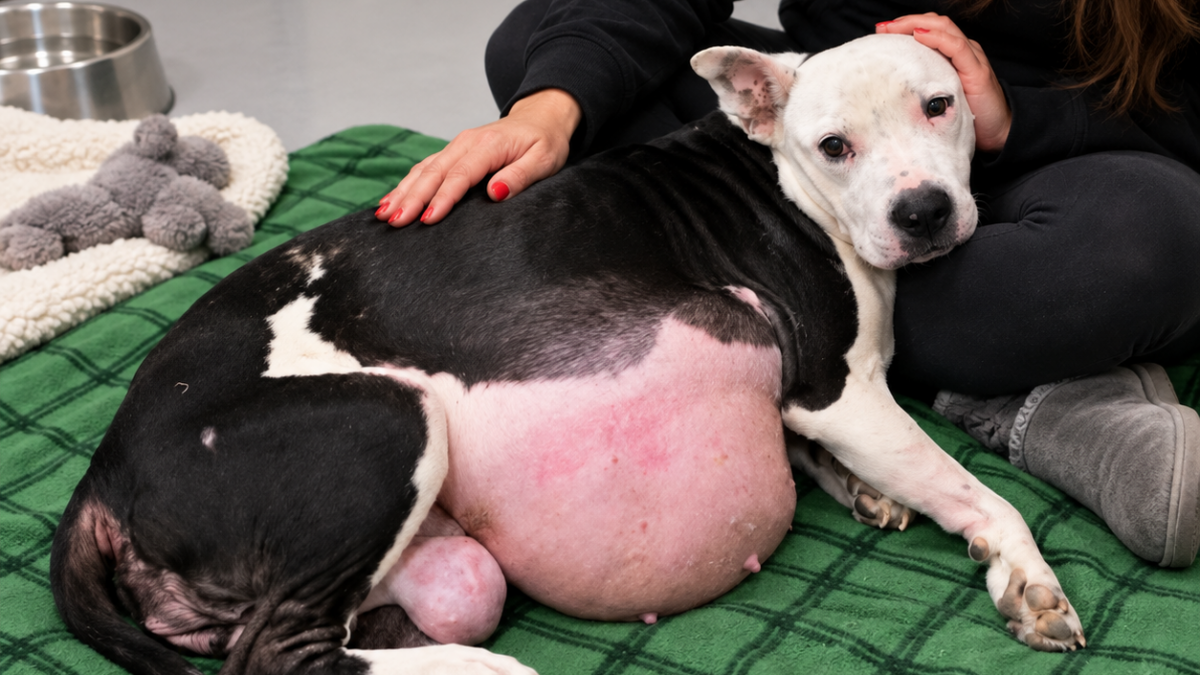
PART 2
I stood in the hallway staring at those doors long after Nina disappeared behind them.
There is a particular kind of helplessness that comes with rescue work.
People imagine the difficult part is getting an animal away from cruelty.
Sometimes it is.
Sometimes you spend hours negotiating, documenting, calling officers, locating transport, finding emergency veterinary care, and convincing a frightened animal that the hands reaching toward her are not going to hurt her.
But there is another kind of difficult that comes afterward.
It is the moment when you have done everything you can do, and someone else has to carry the fight.
That morning, the person carrying it was Nina.
Dr. Morgan came through the doors once before the procedure began.
He still had his surgical cap hanging loose behind his neck.
“We’re ready,” he told me.
I stood.
“How bad?”
He understood what I meant.
“We won’t know until we’re in there.”
“And if she starts bleeding?”
“We’re prepared.”
That answer should have comforted me.
It didn’t.
He must have seen that on my face because he added, “She’s stronger today than she was eight days ago.”
“Is she strong enough?”
He looked toward the surgery suite.
“I wouldn’t be taking her in there if I thought we had no chance.”
No chance.
I hated those words even though he had meant them positively.
Because they reminded me that there was still a chance we could lose her.
I nodded.
“Please bring her back.”
His expression softened.
“That’s the plan.”
Then he disappeared again.
I sat down.
Five minutes passed.
Then ten.
Then twenty.
Every sound made me look toward the doors.
A metal cart rolled by.
A technician walked past carrying towels.
A phone rang at the reception desk.
Somewhere down the hallway, another dog barked twice.
The world continued behaving normally.
I wanted to grab it by the shoulders and say, Don’t you understand what is happening in there?
Nina had survived too much to die now.
That thought kept circling in my head.
She had survived the tumor growing until it dragged beneath her.
She had survived infection.
She had survived hunger.
She had survived whatever days and nights had brought that exhausted look into her eyes.
She had survived long enough for somebody to finally notice.
Surely that had to mean something.
But rescue work does not operate on fairness.
I knew that better than anyone.
Good animals die.
Neglected animals sometimes arrive too late.
You can pour everything you have into saving them and still end up holding an empty collar.
So I stopped bargaining with the universe and did the only thing I could.
I waited.
Forty minutes.
An hour.
An hour and twenty minutes.
Then one of the veterinary technicians came through the doors.
Her name was Carla.
The second I saw her face, I stood so quickly my chair scraped across the floor.
“What happened?”
“She’s still in surgery.”
My stomach dropped.
Carla lifted a hand.
“That doesn’t mean something is wrong.”
“Then why are you out here?”
“We needed additional supplies.”
“Is she bleeding?”
There was a fraction of a pause.
“More than we’d like.”
I felt the hallway tilt.
“But they’re controlling it.”
“Carla.”
“They’re controlling it.”
I searched her face.
She wasn’t smiling.
But she wasn’t panicking either.
“Her blood pressure?”
“Being supported.”
“Heart?”
“Steady.”
“Are you telling me the truth?”
“Yes.”
She put her hand briefly on my shoulder.
“She’s fighting.”
Then she hurried away.
I sat back down.
Fighting.
Of course she was.
Nina had been fighting long before any of us knew her name.
The difference was that now she had help.
Another hour passed.
I stopped checking the clock.
Time had become useless.
Then the doors opened again.
This time Dr. Morgan walked out.
His mask hung beneath his chin.
There was blood on his surgical gown.
For one terrible second he said nothing.
I couldn’t breathe.
Then he smiled.
“She made it.”
My knees nearly gave out.
“What?”
“She made it through surgery.”
I covered my mouth.
The sound that came out of me was somewhere between a laugh and a sob.
“The tumor?”
“Gone.”
“All of it?”
“The large mass is gone.”
He looked exhausted.
“So are the smaller ones?”
“Not today. Her body had enough. We did what was safest.”
That made sense, but I barely heard him.
Nina was alive.
“How much did it weigh?”
“We’ll confirm, but about thirteen pounds.”
I stared at him.
Even though I already knew the estimate, hearing it after the surgery was different.
Thirteen pounds had just been lifted from a dog whose entire body had been dangerously thin.
“How did she survive carrying that?”
He shook his head.
“Dogs survive things that would surprise you.”
“When can I see her?”
“Give us a little time. She’s still waking up.”
“Is she in pain?”
“We’re managing it.”
“Is she stable?”
“Right now, yes.”
Right now.
The two words stopped me from celebrating too early.
Dr. Morgan must have noticed.
“The next twenty-four hours matter,” he said. “The next several days matter. Surgery is not the finish line.”
“I know.”
“But this was the biggest immediate obstacle.”
I looked toward the closed doors.
“She crossed it.”
“Yes,” he said. “She did.”
It was nearly an hour before Carla came for me.
“Come quietly,” she said.
Nina lay inside a recovery kennel surrounded by blankets.
For a second I almost didn’t recognize her.
Without the massive tumor, the shape of her body looked completely different.
She was still skeletal.
Still weak.
Still bandaged.
Still attached to monitoring equipment.
But the terrible weight was gone.
I crouched outside the kennel.
“Nina?”
One ear moved.
That tiny motion broke something open inside me.
“Nina, I’m here.”
Her eyelids fluttered.
She tried to lift her head.
“Don’t,” I whispered. “You don’t have to do anything.”
Her head settled back onto the blanket.
I slid two fingers through the kennel door.
For several seconds she didn’t move.
Then her nose shifted toward my hand.
She touched it.
That was all.
But I knew she had found me.
“I told you,” I whispered. “I said I’d be here.”
Carla was standing behind me.
When I turned, she was wiping her eyes.
“You okay?” I asked.
She laughed quietly.
“I’m supposed to ask you that.”
Neither of us was okay.
Not really.
Not after seeing what Nina had endured.
But that afternoon, for the first time, hope was stronger than fear.
The first night after surgery was rough.
Nina’s temperature had to be watched closely.
Her blood pressure remained a concern.
She needed pain control, fluids, antibiotics, and frequent monitoring.
At midnight I called the clinic.
At 2:15 I almost called again.
At 3:00 I gave up pretending I might sleep.
At 4:12 my phone rang.
I grabbed it before the second ring.
“Hello?”
It was Carla.
My heart stopped.
“She’s okay,” she said immediately.
I sat down on the edge of my bed.
“You could have led with that faster.”
“I literally led with it.”
I laughed despite myself.
“What happened?”
“She woke up more fully.”
“And?”
“She ate.”
I went silent.
“How much?”
“Not much. A few bites.”
“On her own?”
“On her own.”
I closed my eyes.
Carla continued.
“And then she got annoyed because we wouldn’t give her more.”
That was the best sentence I had heard in weeks.
“Seriously?”
“Seriously.”
“What did you give her?”
“A little recovery food.”
“And she wanted more?”
“She looked at me like I had personally betrayed her.”
I laughed again.
It felt strange.
For eight days, every conversation about Nina had been about danger.
Infection.
Blood loss.
Tumors.
Weight.
Fever.
Risk.
And now, at four in the morning, we were talking about a dog being offended by the size of her meal.
It was wonderful.
The next morning, Nina was more alert.
When I entered the recovery area, her eyes followed me.
“Hi, beautiful.”
Her tail moved.
Not a real wag.
More like a small thump against the blanket.
I froze.
“Did you see that?”
Carla looked over.
“See what?”
“She wagged.”
Nina did it again.
Thump.
Carla grinned.
“There you go.”
I knelt beside her.
“You are showing off now.”
Nina’s eyes slowly closed.
For the next few days, progress came in inches.
She ate a little more.
Then a little more.
She stood with assistance.
She took several careful steps.
She urinated normally.
Her temperature stabilized.
Her incision looked clean.
The infection around her hindquarters began responding to treatment.
Every morning she looked slightly less like a dog disappearing in front of us.
The most surprising change was not physical.
It was her personality.
The first week, Nina had been almost silent.
She accepted care.
She leaned into touch.
But she rarely asked for anything.
After surgery, something began to shift.
One afternoon Carla walked away with Nina’s bowl before Nina had finished licking it.
Nina raised her head and made a sound.
“Was that a bark?” I asked.
Carla turned.
Nina barked again.
It was hoarse and unimpressive.
But it was definitely a bark.
Carla stared at her.
“You have opinions now?”
Nina barked once more.
I laughed.
“Apparently.”
We gave her another spoonful of food.
She stopped barking.
“That dog just trained us,” Carla said.
“Yes, she did.”
It was the first glimpse of the dog hidden beneath the suffering.
Nina was gentle.
But she was not empty.
She had preferences.
She liked warm blankets.
She disliked having her temperature taken.
She preferred chicken to almost everything else.
She wanted somebody close while she ate.
And if you stopped scratching beneath her jaw too soon, she would lift one paw and rest it on your wrist.
Slowly, those details replaced the tumor as the first thing we thought about when we said her name.
But outside the clinic, another part of Nina’s story was unfolding.
Three days after surgery, I received a call from Officer Calvin Reed with the county animal cruelty unit.
He had been involved in Nina’s confiscation.
“I wanted to update you,” he said.
I stepped outside the clinic so Nina wouldn’t hear the tension in my voice, even though I knew that was irrational.
“What happened?”
“We’re documenting her veterinary condition.”
“For the case?”
“Yes.”
I looked through the glass door at Nina sleeping under a fleece blanket.
“What do you need?”
“Photographs from intake, veterinary findings, weight, temperature, description of the tumors, infection, body condition, everything.”
“You’ll have it.”
“There may be questions later.”
“Ask them.”
He hesitated.
“We also recovered information indicating Nina had been in that condition for some time.”
My hand tightened around the phone.
“How long?”
“I’m not going to give you a number yet. I want the evidence to speak for itself.”
“Did they know?”
Another pause.
“The investigation will address that.”
That answer was professionally cautious.
I understood why.
But I also understood what he was not saying.
A thirteen-pound tumor does not appear between breakfast and dinner.
A dog does not become painfully thin overnight.
Severe skin infection does not happen in the time it takes someone to forget one veterinary appointment.
Whatever explanation eventually came, Nina’s body had already given testimony.
I looked through the window again.
She was sleeping.
Her breathing was slow and even.
“What happens next?” I asked.
“We build the case.”
“And Nina?”
“Right now, you build her back.”
That sentence stayed with me.
You build her back.
So that was exactly what we did.
Nine days after surgery, Nina left the hospital for medical foster care.
Her foster was a woman named Elaine Porter.
Elaine had been fostering difficult medical cases for almost fifteen years.
She lived in a one-story brick house outside Memphis with a fenced backyard, two older dogs, and a kitchen that always smelled faintly of coffee and boiled chicken.
When she came to meet Nina, she sat on the floor instead of approaching her directly.
Nina studied her.
Elaine waited.
After about thirty seconds, Nina took three slow steps forward.
Then she pressed her forehead against Elaine’s shoulder.
Elaine looked at me over Nina’s back.
“Oh,” she whispered.
I knew that look.
Foster parents sometimes recognize trouble immediately.
Not medical trouble.
Emotional trouble.
The kind where you realize you might already love the animal you are supposed to return someday.
“Don’t,” I warned.
Elaine kept stroking Nina’s neck.
“Don’t what?”
“You know exactly what.”
“I have no idea what you’re talking about.”
“Nina is a foster.”
“I know.”
“A temporary foster.”
“I know.”
“You said that about Jasper.”
“That was different.”
“You adopted Jasper.”
“He had anxiety.”
“You said that about Millie.”
“Millie hated everybody except me.”
“You adopted her too.”
Elaine looked down at Nina.
“Well, this one hasn’t asked.”
Nina lifted one paw and placed it against Elaine’s knee.
I stared.
Elaine smiled.
“You were saying?”
We both laughed.
The first night at Elaine’s house, Nina slept almost fourteen hours.
Elaine sent me a photograph at 6:30 the next morning.
Nina was stretched across an orthopedic bed beneath a blue blanket.
Without the tumor, her body looked impossibly narrow.
But her face was peaceful.
The message beneath the picture said:
SHE SNORES.
I replied:
GOOD. LET HER.
The next picture arrived at 8:04.
Nina was standing in the kitchen staring at an empty bowl.
The message:
SHE ALSO BELIEVES BREAKFAST HAS BEEN DELAYED ILLEGALLY.
I smiled.
That became our new rhythm.
Every day, Elaine sent updates.
Nina ate.
Nina slept.
Nina went outside.
Nina discovered that the refrigerator contained important things.
Nina decided the sofa was preferable to the expensive dog bed.
Nina followed Elaine into the laundry room and then became offended when nothing edible appeared.
Her body was still healing.
But Nina was beginning to live instead of merely surviving.
The first time she walked across Elaine’s backyard without assistance, Elaine sent me a video.
I watched it seven times.
The November grass was pale and damp.
Nina stepped slowly from the patio.
She stopped.
Lifted her nose.
And stood perfectly still.
A breeze moved across the yard.
Nina closed her eyes.
That was it.
No dramatic music.
No running.
No miraculous transformation.
Just a dog standing in cold morning air.
But I cried anyway.
Because before her rescue, even standing had been work.
Now she could stand simply because she wanted to feel the wind.
Two weeks later, her stitches came out.
Dr. Morgan examined the incision.
“Beautiful,” he said.
Elaine raised an eyebrow.
“You’re calling her beautiful or your stitches?”
“Both.”
Nina leaned against Elaine’s leg.
Her weight had begun creeping upward.
Not quickly.
That would not have been healthy.
But steadily.
Her coat looked better.
The raw skin near her tail was healing.
Her eyes seemed brighter.
Then Dr. Morgan grew serious.
“We still have the smaller masses.”
I knew the conversation was coming.
“When?”
“Not yet.”
Elaine’s hand stopped on Nina’s back.
“How long?”
“I want more weight on her. I want her bloodwork stronger. She just survived a major operation. We give her body time.”
“And the pathology?”
He explained that the tissue removed in the first surgery had been submitted for examination and that Nina would need continued monitoring regardless of what the report showed.
No one wanted to pretend the word tumor had disappeared simply because the largest one was gone.
Elaine nodded.
“Then we keep building her.”
There was that phrase again.
Building her back.
And Nina seemed determined to help.
By Christmas, she had developed several very strong opinions.
First, blankets belonged in piles.
If Elaine folded them neatly, Nina would pull them down and rearrange them.
Second, dinner should occur at precisely 5:15.
At 5:12 Nina would position herself in the kitchen.
At 5:14 she would stare.
At 5:15 she would make one low sound.
Not exactly a bark.
More like a complaint filed with management.
Third, every visitor belonged to her.
It didn’t matter whether someone had come to repair the dishwasher or deliver a package.
Nina wanted to inspect them.
If they passed inspection, she leaned against their knees.
If they sat down, she tried to put her head in their lap.
The dog who had arrived too weak to ask for anything had become an expert at asking.
I loved every second of it.
Then, three days after Christmas, Officer Reed called again.
“We’ve got a hearing date.”
My stomach tightened.
“When?”
“January.”
“For what?”
“The court will address the cruelty case and ownership restrictions.”
“Will I need to testify?”
“Possibly.”
I looked across Elaine’s living room.
Nina was asleep on her side.
A red blanket covered half her body.
For weeks I had been concentrating on healing.
Suddenly the past had walked back into the room.
“What are they saying happened to her?” I asked.
“I can’t discuss every statement.”
“Calvin.”
“I know.”
“What explanation did they give for a dog carrying a thirteen-pound tumor?”
He exhaled.
“The defense position appears to be that the condition progressed faster than they realized and that financial limitations delayed treatment.”
I stared at Nina.
“Financial limitations?”
“I’m telling you the position. I’m not endorsing it.”
“She was starving.”
“I know.”
“She had a fever.”
“I know.”
“Her skin was infected.”
“I know.”
“She could barely walk.”
“I know.”
“And we’re supposed to believe nobody noticed?”
“No,” he said calmly. “We’re supposed to document what we can prove.”
That shut me up.
He was right.
Anger is easy.
Proof is harder.
And if we wanted accountability that lasted longer than outrage, proof was what mattered.
“What do you need from me?”
“Everything.”
So we gave him everything.
Photographs.
Intake notes.
Lab results.
The measured weight of the removed tumor.
Records of Nina’s fever.
Documentation of her body condition.
Treatment notes.
Surgical reports.
Photographs of the infected areas.
Records showing the emergency stabilization required before surgeons believed she had any reasonable chance of surviving anesthesia.
We built the truth page by page.
Elaine hated the process.
Not because she disagreed with it.
Because every document forced us to look backward.
One afternoon she sat at her kitchen table while I organized photographs.
She pointed toward one image from the day Nina was rescued.
“Take that one off the screen.”
“I need to label it.”
“Then label it quickly.”
I glanced at her.
Her jaw was tight.
Nina lay asleep near her feet.
“You okay?”
“No.”
Neither of us pretended otherwise.
Elaine rubbed her forehead.
“I know these pictures matter. I know they do. But every time I see her like that, I want to go back in time.”
“And do what?”
“Get there sooner.”
I understood.
Every rescuer knows that thought.
What if somebody had called a month earlier?
Six months earlier?
What if someone had noticed?
What if someone had refused to look away?
But rescue is full of impossible backward questions.
You cannot save an animal yesterday.
You only get today.
I closed the folder.
“Look at her.”
Elaine did.
Nina had rolled onto her back.
One front leg stuck straight into the air.
Her mouth had fallen partly open.
She looked ridiculous.
Elaine smiled despite herself.
“That,” I said, “is today.”
In January, we went to court.
I did not bring Nina.
There was no reason to make her sit in a strange building surrounded by stress and voices she might remember.
Elaine stayed home with her.
Before I left, Nina followed me to the door.
“You’re staying here,” I told her.
She stared at me.
“You have already provided enough evidence.”
Her tail wagged.
“Exactly.”
The courthouse was colder than I expected.
Officer Reed met me in the hallway carrying a thick file.
He looked tired.
“You ready?”
“No.”
“Good answer.”
“Why?”
“People who are excited to testify usually make me nervous.”
I almost smiled.
Then I saw the person connected to Nina’s former home farther down the corridor.
My body reacted before my mind did.
My shoulders tightened.
My hands curled.
For a second, all I could see was Nina on that first day.
The tumor.
The ribs.
The infected skin.
The fever.
The exhausted eyes.
Officer Reed stepped slightly in front of me.
“Stay with the facts.”
“I know.”
“Not your anger.”
“I know.”
He studied me.
“Do you?”
I took a breath.
“Yes.”
Inside the courtroom, Nina became a collection of evidence.
Case number.
Photographs.
Veterinary findings.
Dates.
Measurements.
Statements.
The clinical language was almost harder to hear than emotional language would have been.
“Severely underconditioned.”
“Untreated mammary masses.”
“Secondary infection.”
“Elevated temperature.”
“Significant surgical risk.”
“Thirteen-pound mass.”
Each phrase sounded clean.
Professional.
Controlled.
Nothing about Nina’s suffering had felt clean or controlled.
The defense emphasized uncertainty.
How quickly had the tumor grown?
Could an owner without medical training understand the seriousness?
Could weight loss be harder to notice over time?
Had there been an intention to cause suffering?
The questions made my jaw ache from clenching it.
But Dr. Morgan stayed calm.
He explained what a reasonable person would have been able to observe.
Not cancer biology.
Not surgical terminology.
Observable things.
A mass large enough to alter a dog’s gait.
Severe weight loss.
Raw and infected skin.
Difficulty moving.
A condition requiring immediate medical stabilization.
Then the attorney asked him a question I still remember.
“Doctor, are you saying you know exactly when this animal should have been taken to a veterinarian?”
Dr. Morgan paused.
“No.”
The attorney looked satisfied.
Then Dr. Morgan continued.
“I am saying she should have been taken long before she arrived at my hospital.”
The room went quiet.
He did not raise his voice.
He did not dramatize.
He did not need to.
The records did that for him.
When it was my turn, I described finding Nina.
I described her weakness.
The way the tumor pulled at her body.
The fever.
The infection.
The eight days spent stabilizing her before surgery.
“What did the dog do when you approached?” the prosecutor asked.
“She leaned into my hand.”
“Did she behave aggressively?”
“No.”
“Did she resist treatment?”
“No.”
“How would you describe her condition?”
I looked toward the judge.
“Like she had been surviving one day at a time for a very long time.”
The defense objected.
The judge instructed me to stay within my direct observations.
Fair enough.
So I did.
I told them about the trembling.
The difficulty walking.
The temperature.
The ribs.
The infected skin.
The thirteen-pound mass.
Facts.
One after another.
There was something strangely powerful about refusing to exaggerate.
The truth did not need help.
The case did not end with some dramatic prison sentence or a screaming confrontation on courthouse steps.
Real accountability is often quieter than people imagine.
There were findings entered.
Penalties imposed.
Restitution toward part of Nina’s medical care was ordered.
Restrictions were placed on future animal ownership.
Additional compliance conditions followed.
It did not erase what Nina had experienced.
Nothing could.
But it mattered.
Outside the courtroom, I stood beneath the gray January sky.
Officer Reed came out behind me.
“You all right?”
“I thought I’d feel better.”
He nodded.
“Most people do.”
“And?”
“They usually don’t.”
I looked at him.
“Why not?”
“Because justice isn’t time travel.”
That landed hard.
He continued.
“It can stop something from happening again. It can create consequences. It can put the truth on the record. But it can’t give her back the months she lost.”
I watched traffic moving beyond the courthouse.
“So what does?”
“Nothing gives them back.”
He closed the file under his arm.
“You give her better ones.”
When I reached Elaine’s house, Nina was waiting at the front window.
The second she saw my car, she disappeared.
By the time I opened the door, she was standing in the hallway.
Her whole body moved when she wagged now.
“Nina!”
She came toward me.
Not quickly.
She still had a slightly careful gait.
But there was purpose in it.
I knelt.
She pushed her head against my chest.
For several seconds I said nothing.
Elaine leaned against the kitchen doorway.
“How did it go?”
“There were consequences.”
“Enough?”
I looked down at Nina.
“No.”
Elaine nodded.
“Yeah.”
“But there are restrictions. Restitution. A record. The case is over.”
Nina licked my chin.
Elaine smiled.
“Apparently she’s satisfied with the report.”
I held Nina’s face gently between my hands.
“You know what, girl?”
Her brown eyes fixed on mine.
“You won.”
Elaine shook her head.
“She didn’t win in court.”
“No.”
I looked around the warm house.
At the blankets.
The food bowl.
The toys scattered near the sofa.
At a dog who had once been treated as though her suffering could be ignored and who now had two grown adults rearranging their schedules around her dinner time.
“She won this.”
That was Nina’s revenge.
Not suffering returned for suffering.
Not cruelty answered with cruelty.
A life so comfortable, safe, and loved that everything done to reduce her existence to pain became only the first part of her story.
And Nina was not finished writing the rest.
By late January, she was strong enough for another major veterinary conversation.
The two smaller tumors along her left mammary chain had not disappeared.
We had always known they would have to be addressed.
Dr. Morgan examined her carefully.
“She’s gained weight.”
Elaine smiled proudly.
“She has worked very hard.”
I looked at Nina.
“She has eaten very hard.”
Nina wagged.
Dr. Morgan checked her bloodwork again.
“The numbers are much better.”
“Good enough?” I asked.
He nodded slowly.
“I think we’re approaching the safest window we’re going to get.”
Elaine’s smile faded.
“Another surgery.”
“Yes.”
The word hung there.
We had spent weeks celebrating the first operation as the mountain Nina had climbed.
Now there was another one.
Smaller.
More controlled.
But still anesthesia.
Still incisions.
Still risk.
Elaine sat beside Nina on the exam-room floor.
“Do we have another option?”
“We can wait,” Dr. Morgan said. “But I don’t see an advantage in waiting indefinitely.”
Elaine looked at me.
I knew what she was asking without words.
Could we put her through this again?
Then I remembered the first surgery.
We had not rescued Nina simply to make her comfortable for a few weeks.
We had rescued her to give her every reasonable chance at a full life.
“What would you do if she were yours?” I asked.
Veterinarians hate that question.
Dr. Morgan thought before answering.
“With how much stronger she is now? I’d proceed.”
Elaine stroked Nina’s ears.
“Then we proceed.”
The second surgery was scheduled for February.
This time, Nina arrived at the clinic differently.
During her first surgery, she had been carried inside because walking was so difficult.
Now she walked through the front door herself.
She recognized Carla immediately.
Her tail wagged.
Carla crouched.
“Look at you.”
Nina pushed her forehead into her chest.
“She remembers you,” I said.
“She remembers that I have chicken.”
Carla reached into her pocket.
I stared at her.
“You bribed a surgical patient?”
“It is called relationship building.”
Nina accepted the tiny treat.
Elaine looked down at her.
“Traitor.”
The humor helped.
But when they took Nina toward the treatment area, Elaine’s face changed.
“Does this get easier?”
“No.”
“You could have lied.”
“I tried. I’m bad at it.”
She folded her arms.
“I hate those doors.”
“So do I.”
The second surgery lasted less time.
There was less blood loss.
No terrifying update in the middle.
No sudden need for additional support.
When Dr. Morgan came out, he was smiling before he spoke.
“She did great.”
Elaine closed her eyes.
“Thank God.”
“The smaller masses are removed. She’s recovering.”
“Can we see her?”
“Soon.”
This time, when Nina woke, she seemed irritated rather than defeated.
Carla sent us a photograph of her lying in recovery with the kind of expression only a dog can produce when she believes humans have made a very poor decision.
Elaine looked at it.
“She’s furious.”
“That’s healthy.”
“She looks like she’s planning something.”
“Probably dinner.”
By evening, Nina was eating.
Within days, she was back at Elaine’s house.
Recovery was slower than Nina preferred.
She felt good enough to follow Elaine around but was not allowed to climb furniture.
This became a major dispute.
On the third day, Elaine called me.
“We have a problem.”
“What happened?”
“Nina believes medical restrictions are unconstitutional.”
I laughed.
“What did she do?”
“She tried to get on the sofa.”
“Did you stop her?”
“Yes.”
“Good.”
“She waited until I went to the bathroom and tried again.”
“Nina.”
“I came out and caught her halfway up.”
“What did she do?”
“She froze.”
I could picture it.
“And?”
“Then she backed down and walked to her bed like she had never seen the sofa before in her life.”
I laughed so hard I had to sit down.
Weeks passed.
Her incision healed.
Her fur began filling in around shaved areas.
Her ribs became less visible.
The angular hollows around her hips softened.
The dog underneath all that neglect finally began to appear.
And she was beautiful.
Not in the sentimental way people sometimes use the word for rescue animals.
Nina was genuinely beautiful.
She had warm brown eyes, expressive ears, a soft face, and a way of looking at people as if she were studying whether they were worth trusting.
Trust came more easily now.
But not carelessly.
A dropped metal pan still made her duck.
A raised voice from the television could send her from the room.
If someone reached suddenly over her head, her shoulders lowered.
Healing does not erase memory.
It teaches the body that memory does not have to control every moment.
Elaine learned Nina’s triggers.
She warned visitors.
“Let her come to you.”
Most did.
The ones who listened usually ended up with Nina leaning against their legs within minutes.
One afternoon, a delivery driver arrived with a large box.
Elaine opened the door.
The man saw Nina behind her and stopped.
“Is that the dog?”
Elaine frowned.
“What dog?”
“The one with the tumor.”
He had apparently seen one of the rescue updates.
“Yes.”
His eyes widened.
“That’s her?”
Nina stepped forward.
He looked almost stunned.
“I wouldn’t have recognized her.”
Elaine smiled.
“That’s the point.”
The man crouched carefully.
Nina sniffed his hand.
Then she rested her chin on his knee.
He swallowed.
“My wife showed me her picture,” he said. “I couldn’t look at it twice.”
Elaine glanced at Nina.
“You can look now.”
That became another part of Nina’s transformation.
People who had first seen her photographs with horror began seeing new ones with disbelief.
The change was dramatic.
But Elaine and I were cautious about the word transformation.
It made the process sound magical.
Nothing about Nina’s recovery was magic.
It was medicine.
Food.
Rest.
Clean bedding.
Wound care.
Surgery.
Medication.
Monitoring.
Patience.
Money.
Skilled veterinary work.
Foster care.
And thousands of small acts nobody would ever see in a single before-and-after photograph.
It was Elaine getting up at 2:00 a.m. because Nina was restless.
It was Carla kneeling on a clinic floor to coax her into eating.
It was Dr. Morgan reviewing lab results late in the day.
It was volunteers washing blankets.
It was Officer Reed preserving evidence carefully enough that the case could withstand challenge.
It was every person who refused to treat Nina’s condition as someone else’s problem.
That was how you built a dog back.
By March, Nina could trot.
The first time it happened, none of us were prepared.
Elaine had opened the back door on a warm afternoon.
I was visiting.
Nina walked onto the patio.
A squirrel landed near the fence.
Nina’s head snapped up.
The squirrel froze.
Nina froze.
“Oh, no,” Elaine said.
The squirrel ran.
Nina took off.
Not fast.
Not gracefully.
But unmistakably running.
“Nina!”
Elaine hurried after her.
I started laughing.
Nina trotted about fifteen feet before remembering she was a middle-aged dog recovering from months of medical problems.
She stopped beside a small maple tree.
The squirrel was long gone.
Elaine reached her.
“You have lost your mind.”
Nina looked pleased with herself.
“I cannot believe you ran.”
Nina’s tongue hung from the side of her mouth.
Elaine pointed toward the house.
“We are going inside before you decide to climb a fence.”
Nina ignored her.
I bent down.
“You chased a squirrel.”
Her tail wagged furiously.
That night, I went home and found the first photograph I had taken of her.
I put it beside the picture from the backyard.
The contrast hurt.
In the first image, Nina’s head hung low.
The giant tumor distorted her entire stance.
Her ribs showed.
Her coat looked dull.
Her eyes were tired.
In the second, she stood beneath a tree looking toward a fence where a squirrel had disappeared.
Her body was fuller.
Her head was up.
Her ears were alert.
Her mouth was open.
She looked interested in the world.
That difference mattered more to me than anything that had happened in court.
The court could punish neglect.
It could restrict future ownership.
It could assign responsibility.
But the court could not manufacture joy.
Nina had done that herself.
Spring arrived.
Warm weather transformed Elaine’s backyard.
Grass thickened.
Trees budded.
Birds appeared along the fence.
Nina discovered sunbathing.
Every morning after breakfast she asked to go outside.
Then she selected one patch of sunlight and lowered herself into it with a long sigh.
Elaine bought her an outdoor bed.
Nina ignored it.
She preferred grass.
Elaine moved the bed into the sunny spot.
Nina moved three feet away and lay on the grass again.
“You spent seventy dollars on that,” I told her.
“I know.”
“She hates it.”
“I know.”
“Can I have it?”
“No.”
Nina opened one eye.
“She’s laughing at you.”
“I know.”
Those ordinary conversations became precious.
The more normal Nina’s life became, the more extraordinary it felt.
Then came the day Elaine had been pretending would never arrive.
Nina was medically cleared for adoption.
The rescue coordinator called me first.
“Are you sitting down?”
“What?”
“Nina’s cleared.”
I smiled.
“Seriously?”
“Seriously.”
I knew what came next.
“And Elaine?”
“She hasn’t been told.”
“Oh, I want to be there.”
The coordinator laughed.
“You’re terrible.”
“Absolutely.”
That evening, I went to Elaine’s house carrying the adoption packet.
She opened the door and looked at the folder.
“No.”
I held it up.
“You don’t even know what this is.”
“Yes, I do.”
“Nina has been medically cleared.”
Elaine looked down.
Nina stood beside her.
“So she’s available?”
“She is.”
Elaine’s face changed.
For months she had known this day would come.
Foster means temporary.
That is the agreement.
You take an animal into your home knowing that if everything goes right, someday someone else gets to love them.
It is one of the strangest forms of success I know.
Elaine swallowed.
“Okay.”
I nearly felt sorry for her.
Nearly.
“We should probably discuss potential adopters.”
She nodded without looking at me.
“What kind of home?”
“Well, somebody patient.”
“Obviously.”
“Somebody experienced.”
“Yes.”
“Preferably someone who already understands her medical history.”
Elaine’s eyes narrowed.
“You’re enjoying this.”
“A little.”
She stared.
I slid the application across the table.
At the top, I had written one name.
Elaine Porter.
She looked at it.
Then at me.
“You’re horrible.”
“You’re welcome.”
She sat down.
Nina approached her.
Elaine placed both hands around Nina’s face.
“You want to stay?”
Nina licked her nose.
Elaine started crying.
That ended the interview.
The adoption became official three days later.
Elaine signed every page.
When she reached the final line, her hand shook.
I watched her write her name.
“There,” she said.
“There.”
“She’s mine?”
I smiled.
“She’s yours.”
Elaine looked down at Nina.
“No.”
I blinked.
“What?”
She wiped her eyes.
“I think I’m hers.”
That was probably more accurate.
We celebrated with a small gathering in Elaine’s backyard.
Nothing elaborate.
A few rescue volunteers.
Carla.
Officer Reed.
Dr. Morgan arrived late, still wearing scrubs.
Nina moved among everyone like a host inspecting her guests.
When she reached Dr. Morgan, she sniffed him.
He scratched her neck.
“You caused me a lot of stress.”
Nina wagged.
I handed him a paper plate.
“She says the feeling was mutual.”
Carla brought Nina a small dog-safe treat shaped like a bone.
Elaine had insisted there would be no ridiculous adoption party.
Then she decorated the patio with a banner anyway.
Officer Reed stood near the fence watching Nina.
I joined him.
“Different dog,” he said.
“Same dog.”
He nodded.
“That’s better.”
We watched Nina approach Elaine.
Elaine was talking to Dr. Morgan.
Without looking down, she rested one hand on Nina’s back.
Nina leaned against her.
Reed smiled.
“You know what I remember?”
“What?”
“The day we removed her.”
“So do I.”
“She looked like she’d stopped expecting anything.”
I watched Nina steal a piece of chicken from Carla’s hand.
“She expects plenty now.”
“Good.”
There was a pause.
Then he said, “That’s the part people should see.”
“Not the court case?”
“The court case matters.”
He looked toward Nina.
“But this matters too.”
I knew exactly what he meant.
Cruelty stories often end at rescue.
Somebody arrives.
A chain is cut.
A gate opens.
The animal is carried away.
Everyone feels relief.
But rescue is not an ending.
It is permission for another story to begin.
Nina’s began with hard things.
More veterinary appointments.
Regular monitoring.
Follow-up imaging.
Bloodwork.
Weight checks.
A careful diet.
Skin treatment.
Scar management.
Watching every lump and bump.
There were no guarantees.
There never are.
But she also got things that had nothing to do with medicine.
She got her own spot on the sofa.
She got a green collar with a small silver tag.
She got weekend rides in Elaine’s car.
She got to stick her nose into grocery bags.
She got birthday toys even though nobody knew her exact birthday.
She got a bed beside Elaine’s, which she used approximately thirty percent of the time because she preferred sleeping near the bedroom door.
She got a Christmas stocking.
She got a ridiculous raincoat she hated.
She got brushed in the backyard.
She got talked to constantly.
She got apologized to when Elaine accidentally stepped on her paw.
She got small pieces of scrambled egg on Sunday mornings.
She got annoyed when dinner was late.
She got to be stubborn.
She got to be lazy.
She got to be loved without earning it.
Those things sound ordinary.
That was exactly why they mattered.
For Nina, ordinary life was the miracle.
Several months after her adoption, Elaine called me early on a Saturday.
Her voice sounded strange.
“What’s wrong?”
“Nothing.”
“You sound like something’s wrong.”
“Come over.”
“Elaine.”
“Just come over.”
My stomach tightened.
“Is Nina okay?”
“Yes.”
“Are you sure?”
“She is more than okay.”
That made no sense.
I drove there anyway.
When I reached the house, Elaine was waiting outside.
“You scared me.”
“Sorry.”
“No, you’re not.”
“No.”
“Where is she?”
“Backyard.”
We walked around the side gate.
Nina was standing near the far end of the yard.
She had something in her mouth.
“What is that?”
Elaine smiled.
“A ball.”
I stared.
Nina had never shown much interest in toys.
Treats, yes.
Blankets, absolutely.
Toys were beneath her.
Elaine took another tennis ball from her pocket.
“Watch.”
She tossed it about fifteen feet.
Nina dropped the first ball.
Then she ran.
Actually ran.
Her legs stretched beneath her.
Her ears lifted.
Her tail flew behind her.
She reached the ball, grabbed it, turned, and came trotting back.
I couldn’t speak.
Elaine was crying before I was.
Nina dropped the ball near her feet.
“Again?” Elaine asked.
Nina stared at her.
Elaine threw it.
Nina ran.
I saw the first day in my mind.
The enormous tumor.
The awkward stance.
The tiny steps.
The exhaustion.
And now this dog was running because somebody had thrown a tennis ball.
No emergency.
No medical reason.
No survival instinct.
She ran because running was fun.
I wiped my face.
Elaine laughed.
“Look at her.”
“I’m looking.”
“Can you believe that?”
No.
I couldn’t.
Nina brought the ball back.
This time she dropped it at my feet.
I picked it up.
“You sure?”
Her tail wagged.
I threw it.
She chased it.
That was the moment I finally understood what Officer Reed had meant outside the courthouse.
Justice wasn’t time travel.
We could not go backward.
We could not remove every day Nina had spent hurting.
We could not make somebody notice sooner.
We could not shrink the tumor before it became thirteen pounds.
We could not erase fear from her nervous system.
But we could fill the days ahead of her so completely that suffering no longer owned the whole story.
And life gave us plenty of days to fill.
That summer, Nina went on her first real trip.
Elaine rented a small cabin near a lake outside the city.
It was only a weekend.
Nothing dramatic.
Nina spent the drive sleeping with her head against the back seat.
When they arrived, she stepped out onto a gravel path and immediately began investigating everything.
Trees.
Leaves.
A picnic table.
A patch of moss.
The edge of the dock.
Elaine sent me pictures.
In one, Nina stood near the water staring at a duck.
In another, she was asleep on the cabin porch.
The third showed Elaine sitting on the steps with Nina pressed against her side.
I called.
“You know you can just send normal vacation pictures.”
“These are normal vacation pictures.”
“You sent me nineteen.”
“There may be more.”
“There are definitely going to be more.”
“Yes.”
I saved every one.
The most important veterinary appointment came that fall.
Almost a year had passed since Nina’s rescue.
Elaine and I sat in the exam room while Dr. Morgan reviewed her latest tests.
Nina stood between our chairs.
She had gained healthy weight.
Her coat looked glossy.
The old surgical scars had faded beneath new fur.
Dr. Morgan turned from the computer.
“Everything we’re seeing today is encouraging.”
Elaine gripped Nina’s collar.
“Say that again.”
He smiled.
“Today’s exam is good.”
“What about the imaging?”
“No concerning changes on what we’ve reviewed.”
“And bloodwork?”
“Looks good.”
“And you’re not hiding a ‘but’?”
“Elaine.”
“I know how veterinarians talk.”
He laughed.
“No hidden ‘but.’ We continue monitoring her. That doesn’t change.”
Elaine finally exhaled.
Nina looked up at her.
“You hear that?” she whispered. “You’re doing good.”
Nina sneezed.
Dr. Morgan leaned back.
“Strong medical opinion.”
We all laughed.
Before leaving, Nina walked toward the surgical doors.
She stopped several feet away.
Her ears lowered.
I watched her body become still.
She remembered.
Maybe not the details.
Maybe only the smell.
The sounds.
The sensation.
But something in that hallway belonged to an old fear.
Elaine crouched beside her.
“You don’t have to go there.”
Nina looked at her.
“We’re leaving.”
She turned.
And walked toward the front door.
That simple act affected me more than I expected.
The first time Nina came through those doors, she had no choice.
Her body dictated everything.
Pain dictated everything.
Emergency dictated everything.
Now she could walk away.
Choice is one of the quietest gifts rescue gives back.
A year after her confiscation, we marked the date.
Not as the anniversary of what happened to her.
As Nina Day.
Elaine thought the name sounded ridiculous.
Then she baked dog-safe treats shaped like hearts.
Carla brought balloons.
Officer Reed stopped by after work.
Dr. Morgan sent a card.
A few volunteers gathered in Elaine’s backyard.
Someone asked me to say something.
I hate speeches.
I told them that.
They ignored me.
So I stood beside Nina with one hand resting on her back.
“A year ago,” I said, “some of us were afraid this dog would not survive eight days.”
Everyone became quiet.
Nina looked up at me.
“We counted everything then. Her temperature. Her weight. Her meals. Her blood results. The size of the tumor. We measured every risk because we were terrified one of them would become the reason we lost her.”
Elaine’s eyes were already wet.
I continued.
“Today I think we should count different things.”
I looked around the yard.
“How many dinners has she demanded early?”
Elaine laughed.
“Too many.”
“How many blankets has she stolen?”
“Every blanket I own.”
“How many squirrels has she failed to catch?”
“All of them.”
“How many strangers has she convinced to pet her?”
Carla raised her hand.
“Statistically impossible to calculate.”
Everyone laughed.
Nina wagged because laughter now meant good things to her.
I looked down at her.
“That’s what we count now.”
I scratched behind her ear.
“Not what she carried.”
“Everything she got to put down.”
For a second nobody spoke.
Then Nina noticed the tray of treats.
She pulled toward it.
Elaine laughed through her tears.
“And apparently we count calories.”
Nina got her treat.
Actually, she got two.
That evening, after everyone left, I stayed behind to help Elaine clean up.
The sun dropped behind the trees.
Nina slept on the patio.
Elaine gathered paper plates.
“You know what I was thinking today?”
“What?”
“I barely recognize the dog from those first pictures.”
I stacked cups.
“Sometimes I do.”
“When?”
“When she gets really tired.”
Elaine looked over.
“There’s a certain expression.”
She knew.
“I see it too.”
We were quiet.
Trauma does not always disappear.
Sometimes it becomes faint.
A shadow at the edge of a good life.
A reaction to a noise.
A hesitation near a door.
A look that lasts half a second.
Nina carried some of those shadows.
But now they had competition.
The sound of Elaine opening the refrigerator.
The jingle of a leash.
The word “ride.”
The smell of chicken.
A tennis ball bouncing across grass.
The pressure of a familiar hand resting gently on her back.
Memory was no longer only what had happened to her.
Memory was becoming what happened afterward.
That winter, Nina discovered snow.
Memphis did not give us much of it, but one morning a thin white layer covered Elaine’s yard.
Nina stepped outside.
Stopped.
Lifted one paw.
Put it down.
Lifted the other.
Then looked back at Elaine with visible suspicion.
Elaine filmed everything.
“Go on.”
Nina refused.
“It’s snow.”
Nina stared.
“You have survived two surgeries and you’re afraid of half an inch of snow?”
Nina took one cautious step.
Then another.
She sniffed.
Something changed.
She lowered her nose and pushed it into the snow.
Then she sneezed so hard she startled herself.
Elaine burst out laughing.
Nina began trotting around the yard.
Within five minutes, she was eating snow off the grass.
Elaine sent me the video.
I watched it before breakfast.
Then I watched it again.
There are some images you store because they become answers to old ones.
Whenever I remembered the tumor, I could remember the tennis ball.
Whenever I remembered her ribs, I could remember her sleeping belly-up on Elaine’s sofa.
Whenever I remembered her fever, I could remember her running through snow.
Whenever I remembered the way she looked at me on that first day, I could remember the way she looked at Elaine when dinner was six minutes late.
The past remained true.
It simply stopped being the only truth.
The legal case also remained part of Nina’s history.
The restrictions imposed after the hearing stayed in effect.
The restitution payments went toward veterinary costs.
Compliance checks followed through the proper channels.
I heard occasional updates from Officer Reed, but I stopped asking for details.
Not because accountability had stopped mattering.
Because I realized I had been allowing the person connected to Nina’s suffering to occupy too much space in a story that no longer belonged to them.
Nina’s life was not about revenge.
It was about reclamation.
Her body had been reclaimed from disease.
Her days had been reclaimed from neglect.
Her trust had been reclaimed from fear.
Her future had been reclaimed from everyone who once acted as though it did not matter.
That was enough.
More than enough.
Two years after I first saw her, I visited Elaine on a warm November afternoon.
I brought a new blanket.
Elaine opened the door and immediately shook her head.
“You should stop enabling her.”
“Where is she?”
“Bedroom.”
“Why?”
“She stole my pillow.”
“Seems reasonable.”
“You two deserve each other.”
I walked down the hallway.
Nina was lying in the middle of Elaine’s bed.
Her muzzle had begun turning gray.
The pillow in question was underneath her front legs.
“Nina.”
Her head lifted.
Then her tail began hitting the comforter.
Thump.
Thump.
Thump.
I sat beside her.
She moved closer until her shoulder touched my leg.
I ran my fingers over the fur where the giant tumor once hung.
There was only a scar beneath the coat.
My hand moved toward her chest.
Her breathing was deep and relaxed.
“You know,” I told her, “you caused a lot of trouble.”
Nina licked my hand.
“Expensive trouble.”
Another lick.
“Very dramatic.”
She rolled partly onto her side.
“You disagree?”
Her eyes closed.
I smiled.
There was something almost impossible about sitting beside her.
On the day we met, I had been afraid to imagine a future.
Now we had accumulated years of it.
Elaine appeared in the doorway.
“She still does that?”
“What?”
“The hand thing.”
I looked down.
Nina had placed one paw on my wrist.
“Yes.”
“She does it to me every night.”
That gesture took me back instantly.
The clinic floor.
The giant mass.
The weak dog quietly asking my hand to remain against her face.
Some things had never changed.
The meaning had.
Back then, I interpreted it as a plea.
Please stay.
Now I understood it differently.
You’re here.
Good.
Nina fell asleep with her paw still on me.
Elaine leaned against the doorframe.
“I think about that first night sometimes.”
“At your house?”
“No. Her first night at the hospital.”
I nodded.
“I was sure we were going to lose her.”
“So was I.”
“And now she steals pillows.”
“The recovery has been devastating.”
Elaine smiled.
“She stole half a sandwich yesterday.”
“What kind?”
“Turkey.”
“Good choice.”
“You are absolutely no help.”
We lowered our voices so Nina could sleep.
Outside, leaves scraped across the yard.
The house was warm.
Her food bowl waited in the kitchen.
Her leash hung by the door.
A basket in the living room overflowed with toys she barely used.
There were medications in a cabinet.
Veterinary records in a folder.
Photographs on the refrigerator.
Normal evidence of a life.
Before I left, Elaine walked me to the door.
Nina followed.
I crouched one more time.
She pressed her head beneath my hand.
“You keep taking care of her.”
Elaine folded her arms.
“Excuse me?”
I smiled.
“I’m talking to Nina.”
Elaine laughed.
Nina wagged.
As I drove home, I thought about that first promise.
You’re not doing this alone anymore.
At the time, I thought it meant surgery.
Medicine.
Rescue.
I thought I was promising to stand beside her through a medical emergency.
I hadn’t understood that the promise would stretch across years.
Through operations.
Courtrooms.
Foster care.
Adoption.
Follow-up appointments.
Tennis balls.
Snow.
Stolen pillows.
Late dinners.
Gray fur.
Ordinary mornings.
That was the beautiful part.
Saving Nina had not been one heroic act.
It had been hundreds of people refusing to quit at hundreds of small moments.
The officer who entered the property.
The hands that lifted her.
The technician who cleaned her wounds.
The veterinarian who looked at a dangerously weak dog and searched for a path forward.
The surgeon who removed thirteen pounds from her body.
The overnight staff who watched her monitors.
The specialist who reviewed her case.
The volunteers who raised money and washed bedding.
The foster who became family.
And Nina.
Especially Nina.
Because after everything was done to help her, she still had to choose life every morning.
She chose food.
She chose people.
She chose trust.
She chose the backyard.
She chose the sofa.
She chose the tennis ball.
She chose to put her face into our hands again and again even though human hands had once failed her terribly.
I sometimes hear people call animals like Nina lucky.
I understand why.
She was rescued.
She received medical care.
She survived surgery.
She found a home.
But whenever someone says it, part of me thinks about what had to happen before anyone could call her lucky.
A dog should not have to nearly die to earn kindness.
She should not have had to carry a thirteen-pound tumor before her pain became impossible to ignore.
She should not have needed a courtroom to establish that her suffering mattered.
She should not have needed strangers to fight for the basic things she deserved from the beginning.
So I do not think of Nina as lucky.
I think of her as finally seen.
And being seen changed everything.
Years later, the photograph people remember most is not the one from her rescue.
It is a picture Elaine took in the backyard.
Nina is standing in sunlight.
Her body is healthy.
Her old scars are hidden beneath fur.
A tennis ball rests near her front paws.
Her ears are up.
Her eyes are bright.
And her mouth is open in that loose, relaxed expression dogs get when they are comfortable in their own world.
There is nothing dramatic happening.
That is why I love it.
No emergency.
No operating room.
No courtroom.
No one crying.
No one fighting.
Nina is simply standing in her yard.
Her yard.
Beside her house.
Near the woman who became her family.
That photograph is the ending I wanted for her before I knew whether she would survive the first surgery.
It is the promise I was too afraid to make when she rested her head against my wrist.
Green grass.
A soft bed.
Full meals.
Sunlight.
Ordinary mornings.
She got them.
She got all of them.
And if there was one final piece of justice in Nina’s story, it arrived so quietly that nobody recognized it at first.
Her past became boring to her.
The house where she had suffered no longer mattered.
The people connected to that suffering no longer defined her.
The courtroom did not define her.
The tumor did not define her.
Eventually, even the word rescue stopped defining her.
She was just Nina.
Elaine’s dog.
The blanket thief.
The squirrel chaser.
The dinner-time supervisor.
The dog who hated raincoats.
The dog who stole turkey sandwiches.
The dog who believed every visitor had come specifically to see her.
The dog who slept with one paw touching the person she trusted.
That was the part cruelty never got to take from her.
It could weaken her body.
It could leave scars.
It could steal time.
But it could not decide how her story ended.
Nina did that.
And she chose a good life.
One evening, long after the court files had been closed and the photographs from her rescue had been moved into an archive folder, Elaine sent me one more picture.
No message.
Just Nina asleep under a blanket.
Her gray muzzle rested against the pillow she had stolen.
One paw was stretched toward the empty side of the bed.
I stared at the picture for a long time.
Then I remembered a dog lying in a clinic, too weak to stand comfortably, pressing her face into my hand.
I had told her she would not do it alone anymore.
I wondered sometimes whether she had understood.
Looking at that final photograph, I knew the answer.
She had.
And after everything Nina had survived, she never had to be alone again.
[END OF FULL STORY]








