PART 2: My Wife Dumped My Rescue Dog on Death Row While I Was Deployed—So My Military Brothers Drove 500 Miles to Bring Him Home
My wife promised me she would protect the one living thing that still woke screaming from nightmares whenever I wasn’t there.
Then, while I was seven thousand miles away on deployment, she drove him to an overcrowded shelter, told them he was dangerous, and walked away without telling me where he was.
By the time I discovered what she had done, a red notice had already been placed on his cage—and I had less than twenty-four hours to somehow reach him from the other side of the world.
My name is Daniel Mercer.
I was thirty-six then, a staff sergeant in the United States Army, and I had been overseas for almost four months.
Barnaby had been mine for two years.
Calling him ugly was easy.
He was a thirty-five-pound terrier mix with one floppy ear, a crooked front paw, patchy fur along his shoulders, and thin white scars crossing his back from whatever life he had survived before I found him.
I met him during a volunteer cleanup at an animal rescue after deputies removed more than forty dogs from a hoarding property.
Most of the dogs barked.
Barnaby didn’t.
He pressed himself against the back wall of his kennel and shook so violently that his metal water bowl rattled.
I sat on the floor outside his cage for almost an hour without touching him.
Eventually he crawled forward.
Not toward my hand.
Toward my boots.
He placed one paw on the toe of my left combat boot and fell asleep.
That was it.
He came home with me three days later.
Barnaby never completely lost his fear.
Thunder sent him beneath furniture.
Raised voices made him flatten himself against the floor.
Strangers had to earn every inch of his trust.
But with me, he was different.
He followed me everywhere.
When I cleaned my boots, he lay beside them.
When I slept, he curled against the foot of the bed.
And when I received deployment orders, I worried about him almost as much as I worried about leaving my wife.
Sarah knew that.
The night before I left, I sat beside Barnaby on our bedroom floor and handed him one of my old green Army socks.
It smelled like sweat, boot leather, and probably every field exercise I had ever hated.
Barnaby grabbed it gently and carried it to his bed.
Sarah laughed.
“That disgusting thing is staying downstairs.”
“Please,” I said. “Just let him have it.”
She rolled her eyes.
“Fine.”
Then I looked directly at her.
“Promise me you’ll take care of him.”
Her expression softened.
“Daniel, he’s a dog.”
“He’s my dog.”
“I know.”
“Promise.”
She sighed.
“I promise.”
For the first month overseas, she sent me pictures.
Barnaby beside the couch.
Barnaby sleeping near the door.
Barnaby holding that ridiculous green sock.
Then the pictures stopped.
Whenever I asked, Sarah changed the subject.
Finally, during one satellite call, I heard Barnaby whining in the background.
“What’s wrong with him?”
Sarah snapped.
“Everything.”
I went silent.
“What does that mean?”
“He scratches the floor. He sheds. He smells. He freaks out whenever somebody comes over.”
“Sarah, he’s traumatized.”
“I know what he is.”
Her voice rose.
“I can’t look at this ugly mutt for another second.”
“Sarah—”
“I’m serious.”
“Do not do anything with my dog.”
The connection crackled.
“Then maybe you should’ve thought of that before leaving him here.”
My stomach dropped.
“Sarah, listen to me. I need you to promise me—”
The line went dead.
She ignored every call after that.
For three weeks, I convinced myself she had only been angry.
Then, late on a Thursday night, a message arrived from Emily Harper, the wife of another soldier in my unit.
She volunteered with rescue groups back home.
Her message contained seven words.
Daniel, please tell me this isn’t Barnaby.
Underneath was a photograph.
I stopped breathing.
He was lying in the corner of a concrete kennel.
His ribs showed.
His head was lowered.
And between his teeth was my old green sock.
Across the photograph were four red words:
URGENT — EUTHANASIA FRIDAY, 5 PM.
I called the shelter.
I offered money.
I offered veterinary costs.
I offered to sign anything electronically.
The woman on the phone sounded genuinely sorry.
But because Barnaby had been surrendered as an alleged aggression risk, someone approved to take responsibility for him had to physically remove him.
I looked at the clock.
Thursday night.
I was thousands of miles away.
I walked outside the barracks, sat down in the dirt, and covered my face.
That was when Sergeant First Class Mike Donovan found me.
He took my phone.
Read the shelter notice.
Then asked only one question.
“What time does he die?”
“Seventeen hundred tomorrow.”
Mike stared at the screen.
Then he opened a private veterans network on his phone and posted Barnaby’s picture.
ONE OF OUR OWN IS STUCK OVERSEAS. HIS DOG DIES AT 1700 TOMORROW. WHO IS CLOSE?
Replies began appearing almost immediately.
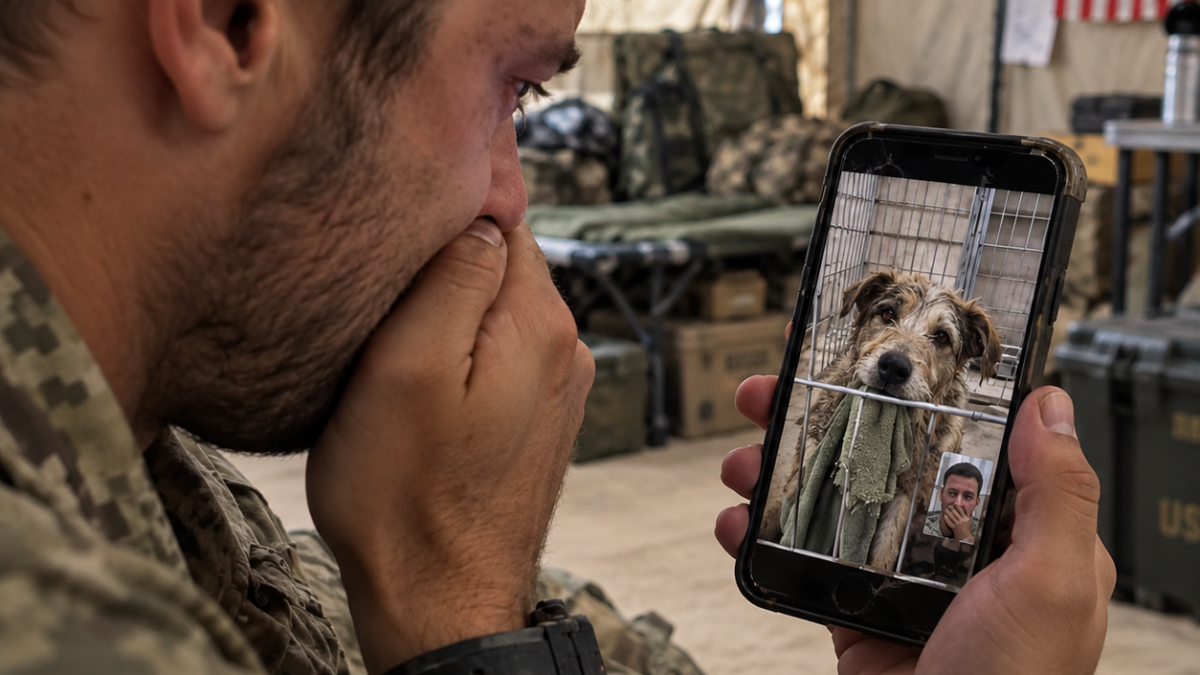
At 4:15 the next afternoon, my phone rang.
Video call.
Mike’s face appeared from inside the shelter.
Behind him was Barnaby’s cage.
“Talk to him,” Mike shouted.
I pressed the phone close.
“Barnaby.”
The dog didn’t move.
“Buddy. It’s me.”
One ear lifted.
His entire body went rigid.
“Barnaby, I’m coming home.”
The green sock slipped from his mouth.
Then he slowly turned toward the sound of my voice.
And what he did next silenced everyone standing in that shelter.
PART 2
Barnaby stared at the phone.
For one second.
Two.
Three.
Then he tried to stand.
His back legs slipped beneath him.
Mike instinctively reached toward the kennel door, but the shelter worker beside him stopped him.
“Wait.”
Barnaby struggled again.
His body was weak enough that even standing seemed difficult, but he forced himself upright.
Then he took one step.
Another.
His eyes never left the phone.
I had spent almost four months telling myself that dogs didn’t understand deployments.
That Barnaby wasn’t counting days.
That he wasn’t lying beside the front door wondering why I had disappeared.
But when he heard my voice, something returned to his face.
Recognition.
He came to the chain-link gate.
Slowly.
He pressed his nose against the metal.
Then he made a sound I had never heard from him before.
Not a bark.
Not a whine.
Something between the two.
A broken little cry.
My vision blurred.
“Hey, buddy.”
Barnaby pushed harder against the gate.
“I’m here.”
He began wagging his tail.
Barely.
Just the last few inches.
Mike turned his face away from the camera.
The shelter worker covered her mouth.
Another veteran standing behind him wiped his eyes.
Barnaby pawed at the gate.
Then he looked around as though expecting me to walk through the shelter door.
That nearly destroyed me.
“I’m sorry,” I whispered.
Mike heard me.
He turned back toward the phone.
“Stop.”
I looked at him.
“This isn’t on you.”
“I left him.”
“You deployed.”
“I left him with her.”
“You left him with your wife because she gave you her word.”
I couldn’t answer.
Mike’s voice hardened.
“Your dog needs you functional right now. Fall apart later.”
That was the most Army thing anybody could have said to me.
And somehow it worked.
I wiped my face.
“What do you need?”
Mike grinned.
“That’s better.”
He turned toward the shelter employee.
“Ma’am, tell him.”
Her name was Carla Ruiz.
I would remember that woman for the rest of my life.
She had been working at the county facility for nine years.
“We still need an approved release,” she said. “Because he was owner-surrendered with an aggression notation, he can’t simply be adopted over the counter.”
My heart sank again.
“But your friend’s rescue contact arranged for a licensed organization to pull him.”
Emily.
Of course.
While I had been sitting in the desert believing I had no options, people back home had been moving.
Carla continued.
“They sent authorization about twenty minutes ago.”
“What does that mean?”
Mike smiled.
“It means your boy is leaving.”
I looked at the clock.
4:23 p.m.
Thirty-seven minutes.
Carla unlocked the outer kennel.
Barnaby immediately retreated.
His tail disappeared beneath him.
That was the tragedy of traumatized dogs.
Love didn’t erase fear.
Recognition didn’t erase fear.
His body remembered cages.
Strangers.
Hands reaching for him.
Carla crouched sideways.
She didn’t stare at him.
Didn’t grab.
She simply opened the kennel and placed a slip lead on the floor.
Mike put my phone near the gate.
“Talk.”
I did.
“Barnaby.”
His eyes shifted toward me.
“Remember Mike?”
He didn’t.
They had never met.
But that didn’t matter.
“Mike’s my friend.”
Barnaby remained frozen.
“He’s going to bring you home.”
Mike sat on the floor.
Combat veteran.
Six-foot-two.
Two hundred twenty pounds.
He folded himself cross-legged outside a kennel and waited for a terrified little terrier to make a decision.
Five minutes passed.
Then Barnaby stepped forward.
One paw.
He stopped.
Mike didn’t move.
Another paw.
Carla quietly slid the lead around Barnaby’s neck.
He flinched.
But he didn’t bite.
Didn’t growl.
Didn’t lunge.
The dog labeled dangerously aggressive pressed himself against the floor and shook.
That detail mattered later.
At the time, I was just trying to breathe.
Mike held out his palm.
Barnaby sniffed it.
Then Mike did something I had forgotten I had told him months earlier.
He unlaced one boot.
He pushed it forward.
Barnaby stared.
Then crawled toward it.
Placed his paw across the toe.
And stayed there.
Mike laughed.
“Are you kidding me?”
I started crying again.
“That’s what he does.”
“Well, I guess I’m down a boot.”
At 4:41 p.m., Barnaby crossed the shelter lobby.
At 4:44, he walked through the front doors.
Sixteen minutes before five.
Mike turned the camera toward the building behind him.
“Look.”
Barnaby stood in the parking lot.
Sunlight hit his face.
He blinked.
Then lowered his head and picked up the green sock Carla had carried out with his paperwork.
Mike knelt.
“Mission accomplished, brother.”
I couldn’t speak.
For several seconds, the only thing I could do was stare at my dog standing in a parking lot seven thousand miles away.
Alive.
Finally I managed two words.
“Thank you.”
Mike shook his head.
“Don’t thank me yet. This little guy smells like a sewer.”
Carla laughed.
So did I.
That laugh hurt.
But it was the first good pain I had felt in weeks.
What I didn’t understand yet was how close Barnaby had actually come to dying.
The rescue organization that officially pulled him sent him directly to an emergency veterinary clinic.
Mike drove.
Two other veterans followed.
The four-man relay that had formed during the night had covered nearly five hundred miles between them.
One drove from Ohio to West Virginia.
Another took over near Charleston.
Mike picked up the final leg.
A fourth veteran had been waiting as backup in case a car broke down.
None of them knew me personally.
They only knew I was deployed.
They only knew Barnaby belonged to one of theirs.
That had been enough.
Dr. Evelyn Chen examined him.
She video-called me later that evening.
Barnaby was on a blanket behind her.
The green sock rested beneath his chin.
“He’s significantly dehydrated,” she said.
“How bad?”
“He’s lost almost nine pounds.”
My stomach clenched.
Barnaby had weighed thirty-seven when I deployed.
Nine pounds was almost a quarter of his body weight.
“He hasn’t been eating?”
“Not adequately.”
“Why?”
“Stress is part of it.”
“Part?”
Dr. Chen hesitated.
“His shelter records say he was surrendered as aggressive.”
“I saw.”
“I’ve handled him. My technicians have handled him. Shelter staff handled him. He has not displayed aggression.”
“So she lied.”
“I can’t tell you what happened before he arrived.”
I understood the boundary.
Doctors dealt in observations.
Not accusations.
“What else?”
“His paw pads are inflamed. He has stress-related gastrointestinal symptoms. And I’m concerned about how shut down he is.”
“Can he recover?”
“Yes.”
That single word gave me air.
“But recovery needs stability.”
“He’ll get it.”
Dr. Chen looked directly into the camera.
“Who is taking him?”
I glanced toward Mike.
He was sitting in the corner of the exam room with one boot still unlaced.
“I am,” he said.
Dr. Chen raised an eyebrow.
“For how long?”
“Until Daniel gets home.”
Mike lived with his wife, Rebecca, two teenage sons, and an eighty-pound German shepherd named Moose.
I knew this.
I also knew Mike worked ridiculous hours and already had a full house.
“You don’t have to do that.”
“Correct.”
“Mike.”
“That’s why it’s meaningful.”
“Your wife is going to kill you.”
Rebecca’s voice came from somewhere off camera.
“No, I’m going to kill you, Daniel, if you send that dog anywhere else.”
Mike turned the phone.
Rebecca Donovan stood in the doorway carrying a new dog bed.
“I already made up the guest room.”
I laughed through tears.
“You people are insane.”
She pointed at me.
“Deployed soldiers don’t get voting privileges.”
Then she walked over to Barnaby.
She didn’t touch him.
She simply placed the new bed beside the wall and laid my green sock in the middle.
Barnaby watched.
That was how he moved into the Donovans’ house.
Not dramatically.
Not happily.
At first, he hid.
He refused to enter the kitchen if everyone was standing.
He panicked when Moose barked.
He slept beside Mike’s boots.
Rebecca sent me videos every day.
In the first one, Barnaby was curled beneath a table.
In the second, he ate chicken from her hand.
In the third, he followed Moose into the yard.
In the fourth, one of Mike’s sons sat on the floor doing homework while Barnaby slept against his leg.
Slowly, my dog came back.
I should have felt only relief.
Instead, once I knew Barnaby was safe, the anger came.
It arrived quietly.
Cold.
Precise.
I called Sarah.
This time she answered.
“Oh,” she said. “So now you have time to call?”
I almost laughed.
“Where’s Barnaby?”
Silence.
I knew the answer.
She knew I knew.
“Sarah.”
“I couldn’t handle him.”
“Where is he?”
“He’s gone.”
“What does gone mean?”
“I surrendered him.”
“Where?”
She exhaled dramatically.
“I don’t know. Some county shelter.”
“You knew exactly where.”
“He was ruining the house.”
My hand tightened around the phone.
“The house?”
“The floors. The rugs. He smelled. He scratched the new couch.”
“So you took him to a kill shelter.”
“Don’t be dramatic.”
“He was scheduled to die today.”
That stopped her.
For two seconds.
Then she said something I will never forget.
“Well, maybe that would’ve been kinder.”
There are moments when a marriage ends before anybody files paperwork.
That was mine.
Not because she disliked my dog.
People can fail with traumatized animals.
They can become overwhelmed.
They can ask for help.
They can admit they cannot cope.
But Sarah had alternatives.
My mother.
My brother.
Mike’s family.
Emily.
The rescue I adopted Barnaby from.
My veterinarian.
Any one of them would have taken him.
Instead, she lied about him being dangerous and placed him somewhere she knew I could not reach him.
Then she hid it.
“You said he was aggressive.”
“He was.”
“No.”
“He growled.”
“When?”
“When I tried moving him.”
“How?”
“What does that matter?”
“How did you move him?”
Silence.
“Sarah.”
“I pulled him off the couch.”
“By what?”
“His collar.”
My eyes closed.
A dog with neck trauma.
A dog rescued from abuse.
A dog who froze whenever somebody grabbed him.
“You dragged him by his collar.”
“Oh my God, Daniel. Stop acting like I tortured him.”
“Did he bite you?”
“No.”
“Did he snap?”
“He growled.”
“So he warned you because he was terrified.”
“He embarrassed me.”
I thought I had misunderstood.
“What?”
“People would come over and he’d hide behind furniture. He looked disgusting. Jessica brought her Maltipoo over and Barnaby scared it.”
“How?”
“He stared at it.”
I actually laughed.
Not because anything was funny.
Because the alternative was shouting.
“You surrendered my dog because he stared at another dog?”
“I wanted a normal dog.”
That sentence explained more than she realized.
Then I heard barking behind her.
High-pitched.
Young.
“What is that?”
Nothing.
“Sarah.”
She sighed.
“A dog.”
“What dog?”
“A puppy.”
My chest went cold.
She had replaced him.
“How long?”
“What?”
“How long after you surrendered Barnaby did you buy the puppy?”
“Daniel—”
“How long?”
“Same weekend.”
I lowered my head.
“What kind?”
“A Cavapoo.”
“How much?”
“That’s none of your business.”
“If it came from our account, it is absolutely my business.”
She said nothing.
That night I logged into our bank account.
Four thousand two hundred dollars.
Luxury pet boutique.
The day after Barnaby entered the shelter.
Then I saw more.
New furniture.
Professional photography.
Home decor.
A designer dog carrier.
A social media management service.
Sarah had spent more than eleven thousand dollars in six weeks.
Most of it came from an account containing my deployment pay.
I took screenshots.
Not because I intended revenge.
Not yet.
Because Army training had drilled one habit into me:
If something matters, document it.
I saved every bank record.
Every shelter notice.
Every message.
Every photograph.
I asked Emily to preserve the urgent-list screenshot.
Mike saved the original veterans-network post.
Carla sent the rescue organization Barnaby’s shelter records.
Then something arrived that changed everything.
An email from the rescue where I had originally adopted Barnaby.
The director, Melissa Warren, had learned what happened.
Attached was my adoption contract.
One section was highlighted.
If the adopter can no longer care for the animal, the dog must be returned to the originating rescue. Transfer, abandonment, resale, or surrender to another facility is prohibited without written consent.
Sarah had signed the contract too.
Her signature was directly beneath mine.
Melissa called me.
“Daniel, she had no authority under our agreement to surrender him.”
“What happens now?”
“We already contacted the county.”
“Can she take him again?”
“No.”
I breathed out.
Barnaby was safe.
Legally safe.
That mattered more than anything else.
Then Melissa said, “There’s another issue.”
“What?”
“The county surrender form.”
My stomach tightened.
“What about it?”
“Sarah signed as sole owner.”
“She wasn’t.”
“I know.”
“She knew I was deployed.”
“Yes.”
“What else?”
“She checked a box stating Barnaby had bitten a household member.”
I stood so fast my chair fell backward.
“She told me he never bit her.”
“Do you have that in writing?”
“No. Phone call.”
“Any witnesses?”
I looked toward the barracks.
Two soldiers had been sitting nearby when I made the call.
One had heard nearly everything.
“Yes.”
Melissa became quiet.
“Get statements.”
That was when my anger turned into purpose.
I wasn’t interested in screaming at Sarah.
I didn’t need to humiliate her online.
I didn’t need to destroy her life.
I needed facts.
And facts, properly organized, could do more damage than rage ever would.
I called an attorney recommended through military legal assistance.
Her name was Captain-turned-civilian attorney Allison Grant.
She listened without interrupting.
When I finished, she said, “Do you want to stay married?”
“No.”
No hesitation.
“All right. Then we deal with this in the correct order.”
“What order?”
“Protect the dog. Protect your finances. Protect your property. File.”
Within forty-eight hours, Allison helped me separate my direct deposit.
I froze my personal credit.
We documented withdrawals.
She prepared divorce paperwork.
Because I was deployed, there were protections and procedural complications under federal law, but those protections existed to keep service members from being unfairly disadvantaged—not to trap me inside a marriage.
Sarah received the petition six days later.
I knew exactly when.
She called twelve times.
I answered the thirteenth.
“What the hell is wrong with you?”
Her voice was shaking.
“You filed for divorce?”
“Yes.”
“Over a dog?”
“No.”
“What else could this possibly be?”
“Trust.”
“Oh, spare me.”
“You promised to protect something helpless because I asked you to. Then you dumped him somewhere he could die, lied about him biting you, hid it from me, and spent thousands from our account replacing him.”
“He’s an animal.”
“And you’re my wife.”
She became quiet.
“That’s the point.”
“You’re throwing away six years of marriage.”
“No. I’m acknowledging what happened to it.”
“You’re going to regret this.”
Maybe.
I didn’t know.
Divorce isn’t victory.
Anybody who tells you otherwise probably hasn’t lived through one.
It is paperwork wrapped around grief.
Even when you know it is necessary.
Especially then.
Sarah cried.
Then shouted.
Then apologized.
Then blamed deployment stress.
Then blamed Barnaby.
Then blamed me.
Then offered to get him back herself.
That almost made me laugh.
“He’s already out.”
Silence.
“What?”
“My friends rescued him yesterday.”
She said nothing.
“He’s safe.”
Then she whispered, “You had people drive all that way for that dog?”
“Yes.”
“That is insane.”
“No.”
I stared across the desert.
“It’s loyalty.”
I hung up.
The next two months were some of the strangest of my life.
By day, I worked.
By night, whenever communications allowed, I watched Barnaby recover through a screen.
He gained weight.
His coat improved.
He started playing with Moose.
The first time he wagged his entire tail instead of just the tip, Rebecca sent me a thirty-second video and then called because she was crying.
Mike pretended he wasn’t.
Barnaby also developed a new habit.
At 7:00 every evening, he carried my green sock to the front door.
Then he lay down beside it.
Nobody taught him that.
He simply did it.
Mike eventually stopped sending me that particular video because it wrecked me every time.
The deployment continued.
That was the cruel part.
Saving Barnaby did not magically put me on an airplane home.
I still had a mission.
I still had soldiers depending on me.
I couldn’t leave because my marriage had collapsed.
I couldn’t leave because my dog missed me.
So I compartmentalized.
Military people get good at that.
Maybe too good.
Then Sarah made another mistake.
She began posting online.
At first, nothing directly about me.
Pictures of the designer puppy.
Perfect white furniture.
Matching sweaters.
Captions about “choosing peace.”
Then someone sent Allison screenshots.
One picture had been posted less than forty-eight hours after Barnaby was surrendered.
Sarah sat on our couch holding the new puppy.
The caption said:
Sometimes you have to remove damaged things to make room for the life you deserve.
I stared at it for a long time.
Allison called.
“Don’t respond publicly.”
“I wasn’t going to.”
“Good.”
“She called him a damaged thing.”
“I know.”
“While he was sitting in a shelter.”
“I know.”
“What do we do with it?”
“We save it.”
That became our rule.
She posts?
Save it.
She texts?
Save it.
She changes her story?
Save it.
And Sarah changed her story repeatedly.
In one message, Barnaby had allegedly attacked her.
In another, he had never bitten but was “emotionally threatening.”
In another, she claimed the shelter employee told her marking him aggressive would help him get behavioral treatment.
Carla denied that.
The surrender form showed Sarah had specifically described an alleged bite.
No injury.
No medical treatment.
No report.
No date that remained consistent.
The county eventually removed the bite designation from Barnaby’s record after reviewing his behavior and the contradictory information.
That mattered because the label could have followed him forever.
It could have cost him insurance eligibility.
Future adoption options.
His life.
The rescue filed a formal complaint regarding the contract violation.
The county investigated whether Sarah had knowingly provided false information on the surrender form.
It did not become some dramatic felony prosecution.
Real life rarely works like that.
But the record was corrected.
Her false statements were documented.
And she could no longer pretend the story was simply “I rehomed a dog my husband didn’t want.”
Meanwhile, the designer puppy became another issue.
His name was Winston.
I knew because Sarah created an entire social media account for him.
Winston was adorable.
Tiny.
Apricot-colored.
Completely innocent.
And, according to bank statements, astonishingly expensive.
Sarah purchased custom beds.
Clothes.
Grooming packages.
Professional photo sessions.
Then, once she realized the divorce would divide finances and that my deployment pay was no longer landing in the joint account, spending slowed.
Three months later, Winston disappeared from her posts.
That bothered me.
I asked Allison whether we should care.
She paused.
“Legally?”
“No.”
“Then why are you asking?”
“Because none of this is Winston’s fault.”
Allison sighed.
“You’re going to make me investigate your wife’s replacement dog, aren’t you?”
“Probably.”
We didn’t need to.
Emily called first.
“Daniel, you’re not going to believe this.”
I knew immediately.
“Where is Winston?”
“How did you know?”
“Where?”
“A breed-specific rescue forty minutes from your house.”
I closed my eyes.
Sarah had surrendered him too.
Reason?
Too much energy.
Separation anxiety.
House-training issues.
He was eight months old.
I felt no satisfaction.
None.
That surprised me.
Part of me had imagined that consequences would feel good.
Instead, all I could picture was another confused dog staring through another kennel door.
“Is he safe?”
“Yes. Foster home.”
“Good.”
“Do you want to do anything?”
“No.”
Then I changed my mind.
“Actually, yes.”
“What?”
“Make sure the rescue has whatever vet records are in the house.”
Allison arranged through Sarah’s attorney for Winston’s veterinary documents to be released.
Nothing more.
No public shaming.
No revenge post.
Winston eventually went to a retired couple with a fenced yard and two grandchildren.
Emily sent me a picture.
He was asleep upside down on a sofa.
I saved it beside Barnaby’s shelter photograph.
Not because the stories were the same.
Because the lesson was.
Dogs should not pay for human failures.
Five months after Barnaby was rescued, our deployment ended.
I knew the date two weeks ahead.
Mike knew too.
He said nothing to Rebecca.
Or so he claimed.
When our transport landed stateside, there was the normal chaos.
Families.
Signs.
Children running.
Soldiers pretending not to cry.
I scanned the crowd.
My mother was there.
My younger brother.
Emily.
Rebecca.
Mike had driven separately because he had been back home for years and technically had no reason to be at my unit’s return.
But he was there.
Standing at the edge of the crowd.
Holding a leash.
Barnaby was beside him.
For a second, I couldn’t move.
He looked healthier.
Much healthier.
His ribs were gone.
His coat had filled in.
But he still had the floppy ear.
The crooked paw.
The scars.
And hanging from his mouth was the green sock.
“Barnaby.”
His head snapped up.
The sock fell.
I dropped my duffel.
He ran.
Not fast at first.
Three uncertain steps.
Then recognition overtook fear.
He sprinted.
The leash ripped through Mike’s hand.
Someone shouted.
Barnaby crossed the concrete and hit me so hard in the knees that I nearly went backward.
I dropped to the ground.
He climbed into my chest.
Whining.
Crying.
Licking my face.
His whole body shook.
Mine did too.
“I’m here.”
He pawed at my uniform.
“I’m here, buddy.”
He pushed his face beneath my arm.
I buried my hands in his fur.
Around us, people stopped.
I heard Rebecca crying.
My mother crying.
Probably Mike too, though he denied it for the next three years.
Barnaby pulled back.
Looked at me.
Then pressed one paw onto my boot.
Exactly where he had placed it the first day we met.
I broke.
Completely.
I had spent months functioning because other people needed me functional.
That day, I let myself fall apart.
Barnaby stayed against me through all of it.
Mike eventually crouched beside us.
“Sergeant.”
I looked up.
“You ready to go home?”
I looked at Barnaby.
“Yeah.”
Then I realized something.
I didn’t have one.
Not really.
Sarah was living in the house pending the divorce.
Allison had advised me not to simply move back in and create unnecessary conflict.
My mother had offered her place.
Mike had offered his.
Instead, I rented a small furnished house for three months.
Nothing fancy.
Two bedrooms.
Fenced backyard.
Old oak tree.
Barnaby walked inside, sniffed every room, and chose the corner beside my bed.
That was enough.
The first few nights were difficult.
For both of us.
I woke at sudden noises.
So did he.
Sometimes I found him standing beside the bedroom door with the green sock.
Sometimes he found me sitting in the kitchen at three in the morning.
We developed a routine.
If I woke first, I made coffee.
If he woke first, he put his head on my knee.
Neither of us asked questions.
About two weeks after I returned, Barnaby did something that told me more about his time away than any veterinary report could.
I grabbed my car keys.
He saw them.
His body collapsed.
He crawled backward beneath the kitchen table.
I froze.
“Barnaby?”
He trembled.
Then I understood.
Some combination of keys, door, car.
Maybe Sarah had used the same motion before taking him to the shelter.
Maybe his fear came from something earlier in life.
I would never know.
I put the keys down.
Sat on the floor.
We didn’t leave for forty minutes.
After that, I began working with a veterinary behaviorist.
Dr. Lena Ortiz.
She never promised to “fix” Barnaby.
I liked her immediately for that.
“Trauma isn’t disobedience,” she told me. “His nervous system learned certain events predict danger. We teach him new predictions.”
So we did.
Keys.
Treat.
No departure.
Keys.
Treat.
Walk to the door.
Return.
Keys.
Treat.
Open door.
Close door.
Weeks passed.
Eventually Barnaby learned that keys could mean hiking.
Or coffee.
Or the park.
Not abandonment.
I was learning similar lessons myself.
A ringing phone did not always mean bad news.
A relationship ending did not mean life ended with it.
Trust could be rebuilt.
Just not always with the person who broke it.
The divorce hearing was scheduled four months after I returned.
By then, Sarah had hired an aggressive attorney named Peter Galloway.
He sent requests about property.
Accounts.
Furniture.
My retirement benefits.
The usual unpleasant arithmetic of separating lives.
Then he added something I hadn’t expected.
Sarah wanted Barnaby.
I thought I had misread the document.
I called Allison.
“She wants what?”
“Barnaby.”
“She surrendered him.”
“I’m aware.”
“She said she couldn’t stand looking at him.”
“I’m aware.”
“She replaced him the next day.”
“I am deeply aware, Daniel.”
“Then why?”
Allison was quiet.
“Leverage.”
That word made me angrier than anything Sarah had said.
Barnaby wasn’t leverage.
He wasn’t a sofa.
Or a truck.
Or a line on a spreadsheet.
“What does she actually want?”
“Her attorney suggested she might withdraw the claim regarding the dog in exchange for a more favorable division of certain funds.”
I laughed.
Coldly.
“No.”
“Good.”
“No negotiation involving Barnaby.”
“That was my answer too.”
Then Sarah escalated.
Her attorney argued that Barnaby was marital property because I adopted him after we married.
Allison responded with the adoption contract, veterinary records, payment history, rescue communications, deployment correspondence, and the fact Sarah had voluntarily surrendered him.
Galloway then claimed I had “abandoned” Barnaby by deploying.
I read that sentence twice.
Then three times.
Allison warned me not to react.
I reacted privately.
I walked five miles with Barnaby until my anger burned down enough to speak rationally.
At the hearing, Sarah sat across from me.
I had not seen her in person since before deployment.
She looked different.
Maybe I did too.
For a moment, six years of memories tried to return.
Our wedding.
Road trips.
Christmas mornings.
The day my father died and she sat beside me until sunrise.
Human beings are complicated.
Someone can love you once.
Someone can comfort you once.
Someone can still become capable of doing something you cannot forgive.
I didn’t need to rewrite our entire marriage as evil to know it was over.
The judge addressed property first.
Then finances.
Finally, Barnaby.
Sarah’s attorney stood.
“Your Honor, while this may sound unusual, the animal was acquired during the marriage and therefore—”
The judge raised a hand.
“I have read the filings.”
Galloway stopped.
The judge looked toward Sarah.
“Mrs. Mercer, you surrendered this animal?”
“Yes, but—”
“And represented yourself as sole owner?”
“I was the one caring for him.”
“While your husband was deployed pursuant to military orders?”
“Yes.”
“You reported a bite?”
Sarah hesitated.
“He frightened me.”
“That was not my question.”
Silence.
“Did he bite you?”
“No.”
The courtroom became very still.
Galloway shifted.
The judge looked down at the surrender form.
“You checked a box indicating a household-member bite.”
“I was upset.”
“Did you understand that designation could influence the animal’s disposition?”
“I didn’t know they were going to kill him.”
Carla was sitting behind me.
She had taken the day off to attend.
I felt her move.
The judge continued.
“Your signed surrender document acknowledges that the facility could euthanize surrendered animals based upon capacity, medical condition, or behavioral assessment.”
Sarah stared downward.
“I didn’t read everything.”
The judge removed his glasses.
“Apparently not.”
Then Allison stood.
She presented the original rescue agreement.
Both signatures.
Mine.
Sarah’s.
Return-to-rescue clause.
Then Barnaby’s veterinary intake report after Mike saved him.
Weight loss.
Dehydration.
Stress.
Then photographs.
The shelter photograph appeared on the monitor.
Barnaby in the back of the cage.
My green sock in his mouth.
I had seen it hundreds of times by then.
It still hurt.
Sarah looked away.
Allison did not raise her voice.
That was what made her effective.
“Your Honor, my client is not asking the court to punish his spouse by awarding him this animal. He is asking the court to recognize reality. He rescued Barnaby before any dispute arose. He maintained veterinary care. He trained him. He paid for his needs. During deployment, he specifically arranged care with his spouse, who promised to provide it.”
She paused.
“When Mrs. Mercer decided she no longer wanted to care for the dog, she had multiple alternatives required by contract and available through family, friends, and the originating rescue. Instead, she surrendered him to a county facility, misrepresented his behavioral history, concealed the surrender from my client, purchased another dog the following day, and later surrendered that animal as well.”
Galloway objected to the last sentence.
The judge allowed it only for limited context.
Then Allison placed one final image on the screen.
Sarah’s social media post.
Her holding Winston.
Sometimes you have to remove damaged things to make room for the life you deserve.
The date was visible.
One day after Barnaby entered the shelter.
Sarah whispered something to her attorney.
He shook his head.
The judge looked at the image for a long moment.
Then at me.
“Mr. Mercer, where is Barnaby currently?”
“At my house, Your Honor.”
“Condition?”
“Healthy.”
“Any aggression?”
“No.”
“Behavioral treatment?”
“Yes. For trauma and separation anxiety.”
“Who pays?”
“I do.”
“If you are transferred?”
“I have a written care plan involving my mother, Sergeant Donovan, and Barnaby’s rescue organization.”
“Why so many backups?”
I looked at Sarah.
Then back at the judge.
“Because he’ll never be left without options again.”
That was the only moment my voice cracked.
The judge looked down.
Barnaby was awarded to me.
Exclusively.
Permanently.
Sarah relinquished any claim.
It should have felt like victory.
Instead, I felt tired.
Outside the courthouse, Sarah followed me down the steps.
“Daniel.”
I stopped.
Allison stayed nearby.
Sarah looked smaller than I remembered.
“Are you happy now?”
“No.”
That seemed to surprise her.
“You got everything you wanted.”
“No.”
“You got the dog.”
“I got Barnaby.”
“Same thing.”
“No. It isn’t.”
She folded her arms.
“So what? You want me to apologize again?”
“You never apologized.”
“I said I was sorry you were hurt.”
“That’s not the same thing.”
She looked away.
People moved around us.
Lawyers.
Families.
A deputy.
Cars passing.
Finally she said, “I couldn’t handle him.”
That was the first honest sentence I had heard from her about Barnaby.
“You could have told me.”
“You were overseas.”
“You could have called my mother.”
“I didn’t want everyone thinking I was incapable.”
“You could’ve called the rescue.”
“They would’ve judged me.”
“So you chose the option where nobody would know.”
She looked at me.
“I just wanted him gone.”
“I know.”
“I didn’t think he would actually die.”
“You didn’t check.”
She said nothing.
That was the center of it.
Not hatred.
Not some elaborate plan.
Indifference.
She needed Barnaby removed from her life badly enough that she stopped caring what removal meant.
I had seen versions of that in war.
People think cruelty always looks angry.
Sometimes it looks impatient.
Sometimes it looks inconvenienced.
Sometimes it signs a form and walks away.
Sarah wiped beneath one eye.
“What happens to me now?”
I almost answered bitterly.
Then I stopped.
Revenge would have been easy in that moment.
I could have said something cruel enough to follow her home.
Instead I said, “You live with your choices.”
Then I walked away.
The divorce became final six weeks later.
I kept Barnaby.
Sarah kept most of the furniture she cared about.
The house was sold.
Accounts were divided according to the settlement.
Because the financial records clearly showed significant discretionary spending from joint funds immediately before and during separation, some of those expenditures were accounted for in the final division.
I didn’t become rich.
She didn’t become destitute.
Nobody was dramatically destroyed.
That isn’t what satisfying consequences look like in real life.
She simply stopped being able to use my income to fund a life she had built while hiding what she had done.
And she lost any legal claim to the dog she had nearly killed.
For me, that was enough.
Almost.
There was one unfinished piece.
The men who saved Barnaby.
I owed them something I could never repay with money.
Mike refused gas reimbursement.
So did the others.
The first veteran in the relay was Aaron Price, a Marine who had served in Iraq.
The second was James Cole, former Army cavalry.
The third was Rob Ellis, an Air Force veteran who drove nearly two hundred miles despite having work at six the next morning.
Mike took the final leg.
Four men.
Three states.
Five hundred miles.
Sixteen minutes to spare.
Months after the divorce, I invited all of them to my place.
Rebecca came.
Emily came.
Carla came.
Melissa from the rescue came.
Dr. Chen came.
Even Allison stopped by for an hour.
We grilled burgers.
Barnaby spent most of the afternoon moving from veteran to veteran, sniffing boots.
Aaron laughed.
“So this is why we were told to wear combat boots?”
“He has standards,” Mike said.
Barnaby eventually settled beneath the picnic table with his head on Mike’s boot.
I went inside.
When I returned, I was carrying a wooden shadow box.
Inside were four items.
A photograph of Barnaby walking out of the shelter.
The printed veterans-network post.
The shelter release timestamp.
And my old green sock.
Or what remained of it.
Barnaby had finally torn a hole through the heel.
Mike stared at the box.
“You framed a dirty sock?”
“Historic artifact.”
Rebecca laughed.
“Biohazard.”
I handed Mike four smaller boxes.
One for each driver.
Inside each was a metal challenge coin I had commissioned.
One side showed a dog paw over a pair of combat boots.
The other had only three lines:
NO ONE LEFT BEHIND
500 MILES
16 MINUTES
Mike became very interested in his beer.
Aaron stared at the coin.
Rob looked toward the yard.
James cleared his throat.
Finally Mike said, “You know we’d do it again.”
“I know.”
“For anybody.”
“I know.”
“That’s the point.”
I nodded.
“I know.”
Barnaby crawled out from beneath the table.
He went to Mike first.
Then Aaron.
James.
Rob.
Four men he had once been terrified of.
Four strangers who had rearranged their lives because a photograph on a screen said a soldier’s dog needed help.
Barnaby sniffed each of them.
Then returned to me.
He sat on my left side.
Paw on my boot.
Mike raised his beer.
“To the ugliest dog in America.”
I pointed at him.
“Careful.”
Rebecca laughed.
Barnaby wagged.
Mike corrected himself.
“To the most expensive free dog in America.”
“That’s better.”
We toasted.
Months became years.
Barnaby never became a perfectly normal dog.
I stopped wanting him to.
He remained suspicious of loud men.
He disliked kennels.
He hated tile floors.
He still carried socks.
Mostly mine.
Occasionally Mike’s if Mike visited and became careless.
He learned to ride in the car without panicking.
That took almost a year.
The first successful trip was only around the block.
The second went to the park.
Eventually, I could say, “Want to go?”
And Barnaby would run to the door.
He discovered hiking.
Peanut butter.
Snow.
He loved snow.
The first winter after I came home, he stood in the backyard during a storm, staring upward while flakes landed on his nose.
Then he lost his mind.
He ran circles around the yard until he crashed into a lawn chair.
I laughed harder than I had in years.
My neighbor looked over the fence.
“That your dangerous dog?”
Barnaby was lying upside down in the snow.
“Terrifying,” I said.
Life became quieter.
Better.
Not perfect.
I eventually left active duty.
I continued working with veterans, especially guys coming home carrying more than anybody could see.
Barnaby came with me sometimes.
We never certified him as a formal service dog.
He didn’t need another job.
But veterans liked him.
Maybe because he didn’t look heroic.
He looked damaged.
Scarred.
Asymmetrical.
Cautious.
Then they watched him walk into a room full of strangers, choose somebody sitting alone, and place his paw on a boot.
One afternoon, a young infantry veteran named Kyle came to our peer-support center.
He barely spoke.
He had lost two friends overseas and carried the kind of guilt that made eye contact difficult.
Barnaby walked across the room.
Sat beside him.
Kyle ignored him.
Barnaby waited.
Then placed one paw on Kyle’s shoe.
Kyle stared down.
His face changed.
“What’s he doing?”
I shrugged.
“He does that.”
“Why me?”
I could have given him a sentimental answer.
I didn’t.
“Maybe you have good boots.”
Kyle laughed once.
Barely.
It was enough.
Twenty minutes later, he was talking.
That became Barnaby’s unofficial work.
Not therapy.
Presence.
There is a difference.
He never demanded explanations.
Never asked where somebody had been.
Never told them to get over anything.
He simply stayed.
I understood why that mattered.
Years later, I received an email I did not expect.
From Sarah.
We had not spoken in a long time.
The subject line contained one word.
Barnaby.
I stared at it for ten minutes before opening it.
Daniel,
I don’t know if you’ll read this.
I saw a picture of Barnaby online at the veterans center.
He looks happy.
I’ve thought about what happened more times than I can count.
For years I told myself I was overwhelmed and you left me with a difficult dog.
That was true, but it wasn’t the truth that mattered.
The truth was I cared more about how my life looked than about what happened to him after I got rid of the problem.
I lied because I knew if I told the shelter he was only scared, someone might tell me to take him home or contact the rescue.
I wanted a clean exit.
I understand now how close that came to killing him.
I’m sorry.
Not because of the divorce.
Not because I lost anything.
Because I did something cruel to an animal that trusted our home.
I don’t expect forgiveness.
Sarah
I read it twice.
Then closed the laptop.
I didn’t answer that day.
Or the next.
Eventually I wrote three sentences.
Thank you for finally being honest. Barnaby is safe and loved. I hope you treat the next vulnerable thing that depends on you differently.
Then I sent it.
Forgiveness is complicated.
I did not invite her back into my life.
I did not decide what she had done suddenly didn’t matter.
But I also did not want to spend the rest of my life carrying anger for her.
Barnaby had already taught me what carrying the past everywhere looked like.
You survive.
But you never rest.
I wanted both of us to rest.
Barnaby was eleven when his muzzle began turning almost completely white.
His crooked paw developed arthritis.
Hikes became shorter.
Then walks became shorter.
He still followed me room to room, but slowly.
One morning I noticed he had not touched breakfast.
My heart knew before my mind did.
Dr. Ortiz examined him.
Bloodwork.
Ultrasound.
More tests.
Cancer.
Aggressive.
The kind that gives you decisions instead of miracles.
I sat in the same kind of veterinary exam room where, years earlier, another doctor had told me Barnaby could recover from the shelter.
Now I asked the question nobody wants to ask.
“How long?”
Dr. Ortiz looked at Barnaby.
“Maybe weeks.”
I stared at the floor.
Barnaby placed his paw on my boot.
Of course he did.
I laughed once.
Then cried.
“Figures.”
Dr. Ortiz gave us pain medication.
We went home.
I called Mike.
He came that evening.
So did Rebecca.
Then Aaron.
James.
Rob lived farther away by then, but he drove in the next morning.
Five hundred miles had saved Barnaby once.
Nobody was letting distance matter now.
For two weeks, Barnaby was spoiled beyond reason.
Steak.
Eggs.
Peanut butter.
Slow walks.
Sunlight in the backyard.
Mike brought a new green Army sock.
Barnaby sniffed it.
Then looked at him as though deeply offended by the counterfeit.
“That dog has become arrogant,” Mike said.
“He earned it.”
On Barnaby’s final morning, he could not stand without help.
I carried him outside.
Wrapped him in a blanket.
Sat beneath the oak tree in my yard.
His head rested across my boot.
Mike sat beside us.
Rebecca was there.
My mother.
A few others.
No crowd.
No speeches.
Just people who loved him.
The veterinarian came to the house.
Before she began, I took the old green sock from a drawer.
The original.
Faded.
Torn.
Washed enough times that it probably no longer smelled anything like the man who had deployed years earlier.
Barnaby’s eyes opened when I placed it beside him.
He sniffed it once.
Then rested his chin on it.
My throat closed.
“Hey, buddy.”
His ear moved.
“You remember that?”
His tail tapped the blanket.
Once.
I leaned down.
“You did good.”
I had spent years thanking people for saving Barnaby.
In that moment, I realized I had never properly thanked him.
“You waited for me.”
My voice broke.
“You didn’t have to.”
Barnaby breathed slowly.
“You waited anyway.”
I pressed my forehead to his.
“When I left, I thought I was the one asking you to be brave.”
Mike looked away.
I kept talking.
“You were brave enough for both of us.”
Barnaby’s paw moved.
It found my boot.
The vet gave the medication.
I kept one hand against his chest.
The other around his paw.
His breathing softened.
Slowed.
Then stopped.
His paw remained on my boot.
For a long time, nobody moved.
Mike finally whispered, “Sixteen minutes.”
I looked at him.
“What?”
“We got him out with sixteen minutes left.”
I nodded.
Mike’s eyes were red.
“Those sixteen minutes turned into what? Seven more years?”
“Seven years, three months.”
Mike laughed through tears.
“You counted?”
“Every day.”
We buried Barnaby beneath the oak tree.
I placed the green sock with him.
Some people thought that was strange.
They did not understand.
It was never really a sock.
It was a promise.
A smell from home.
Something he could hold when the person he trusted was too far away to touch.
Above his grave, I placed a small stone.
No long inscription.
No military language.
No grand declaration.
Only:
BARNABY
HE WAITED.
WE CAME.
A year later, the veterans center expanded its animal-support program.
We partnered with the rescue that originally saved Barnaby.
Traumatized dogs were paired—not automatically adopted, not presented as cures—with veterans who understood what it meant to live with a nervous system that sometimes reacted to the past as though it were still happening.
We called the program Barnaby’s Boots.
Mike chose the name.
I pretended to hate it.
We helped place eleven dogs the first year.
Twenty-three the second.
Not every match worked.
We never forced it.
Sometimes a veteran needed a different dog.
Sometimes a dog needed a different home.
The lesson I had learned mattered:
Love is not possession.
Love is responsibility.
It is knowing when to ask for help before your frustration becomes somebody else’s suffering.
Every year, around the anniversary of Barnaby’s shelter rescue, four challenge coins appear on my kitchen table.
Mike.
Aaron.
James.
Rob.
We meet.
Sometimes at my place.
Sometimes theirs.
We drink coffee or beer depending on the hour.
We tell the same stories.
Mike continues insisting he was the one who taught Barnaby to trust boots.
Nobody believes him.
And at exactly 4:44 p.m.—the time Barnaby walked through those shelter doors—we raise a glass.
Not to me.
Not to the military.
To the scared little dog with the crooked paw who refused to let go of a filthy green sock while he waited for somebody to come.
People still occasionally tell me, “You saved him.”
They’re wrong.
A chain of people saved Barnaby.
Emily recognized his photograph.
Carla refused to treat him as just another kennel number.
A rescue signed his release.
Four veterans drove through the night.
Dr. Chen repaired his body.
Rebecca gave him a temporary home.
Mike gave him his boots.
And Barnaby did the hardest part.
He kept trusting.
After everything people had done to him, he kept leaving a tiny door open.
That was his courage.
As for Sarah, I stopped thinking of what happened as revenge a long time ago.
She lost the marriage.
Lost access to my money.
Lost any claim to Barnaby.
Had her false shelter statements documented.
And eventually had to face, in her own words, the truth about what she had done.
But my real victory was never watching her lose something.
It was watching Barnaby gain everything she had tried to take from him.
Safety.
A home.
Friends.
Years.
And, finally, peace.
The day she surrendered him, she saw a scarred, anxious dog who did not match the life she wanted people to see.
The veterans who drove five hundred miles saw something completely different.
They saw one of ours.
Not because Barnaby wore a uniform.
Not because he had served.
But because somewhere overseas, one soldier loved him and could not reach him.
For those men, that was enough.
And when Barnaby had only sixteen minutes left, they made sure distance didn’t become a death sentence.
I used to think loyalty was a military word.
Something carved into plaques.
Printed on unit crests.
Shouted during ceremonies.
Barnaby taught me otherwise.
Loyalty is quieter than that.
Sometimes it is a frightened dog sleeping against a pair of boots.
Sometimes it is four strangers filling gas tanks at two in the morning.
Sometimes it is a wife at home making space for an animal she has never met because her husband says, “One of our guys needs help.”
Sometimes it is sitting beside an old dog beneath an oak tree because he stayed when you needed him, and now you will stay when he needs you.
I still own the boots Barnaby first slept against.
They are too worn to use.
The leather is cracked.
The soles are nearly smooth.
One of them has tooth marks from when Barnaby stole it during his second year home.
They sit beside his photograph in my office.
Every so often, a veteran visiting the center asks why I keep a ruined pair of boots.
I tell them the truth.
Because once, a terrified dog believed the safest place in the world was wherever those boots happened to be.
And for the rest of his life, I tried to become the man he believed was standing inside them.
The day Sarah surrendered Barnaby, she saw a damaged dog who no longer fit the picture she wanted her life to become.
The men who drove five hundred miles through the night saw something entirely different.
They saw a frightened animal who belonged to a soldier who could not reach him.
For them, that was enough.
For years afterward, I kept thinking about those sixteen minutes.
Barnaby had walked out of that shelter at 4:44 in the afternoon.
His euthanasia appointment had been set for five.
Sixteen minutes separated everything we eventually had from the ending that almost happened.
Sixteen minutes between Barnaby sleeping beside my boots again and Barnaby becoming another number on a county report.
Sixteen minutes between the veterans center knowing his name and nobody ever knowing what he could have become.
Sixteen minutes between seven more years of life and none at all.
I used to believe big changes required big moments.
Combat teaches you to think that way.
Explosions.
Orders.
Helicopters.
Sirens.
Decisions made in seconds.
But Barnaby taught me that sometimes an entire future can fit inside sixteen quiet minutes.
After he died, I thought the house would return to the silence I remembered from before him.
It didn’t.
It became a different kind of silence.
The kind where you keep expecting to hear something that will never happen again.
For the first month, I still woke up at six and stepped carefully over the place beside my bed where Barnaby used to sleep.
I still opened the back door before remembering no one was waiting behind me.
I still dropped pieces of chicken on the kitchen floor and stared at them because no crooked little dog appeared to clean them up.
The worst habit was the boots.
Every night when I came home, I left them beside the front door.
For seven years, Barnaby would eventually find his way over and lie against them.
Sometimes immediately.
Sometimes hours later.
But he always did.
After he was gone, I still placed them there.
The first few evenings, I didn’t even realize why.
Then one night I came downstairs around two in the morning and found myself standing in the dark, staring at those empty boots.
I sat down on the floor.
I stayed there for almost an hour.
People sent cards.
Flowers.
Messages.
The veterans from the relay called.
Mike showed up without asking and replaced a broken section of my backyard fence that had not needed replacing for six months.
That was his version of grief.
He fixed things.
Rebecca brought food I didn’t need.
My mother called every morning.
The veterans center gave me space.
I appreciated all of it.
But grief does not disappear because people are kind.
It simply becomes easier to carry when someone occasionally takes one corner of it.
About six weeks after Barnaby died, I almost shut down Barnaby’s Boots.
I walked into the veterans center one morning and saw his photograph hanging above the program desk.
In the picture he was sitting beside me, one ear straight, one ear folded, scars visible beneath his coat.
Underneath it were the words:
HE WAITED. WE CAME.
I couldn’t look at it.
I went into my office and called Mike.
“I’m done.”
He was quiet.
“With what?”
“The dog program.”
“Why?”
“I can’t keep walking past that picture.”
Another silence.
Then Mike asked, “You want me to take it down?”
“No.”
“Then what do you want?”
“I don’t know.”
That was the truth.
I had built so much of my life around making Barnaby’s survival mean something that losing him made the whole thing feel unbearable.
Mike came over that afternoon.
He didn’t lecture me.
He didn’t tell me Barnaby would want me to keep going.
I hate when people say things like that.
Dogs don’t leave instructions.
They don’t make us promise to turn grief into purpose.
They simply love us while they’re here.
Mike understood that.
He sat in my office, looked at Barnaby’s picture, and said, “Close it if you need to.”
I looked at him.
“You mean that?”
“Yeah.”
“What about the veterans waiting?”
“We’ll find somewhere else for them.”
“The rescue dogs?”
“Same.”
“The funding?”
“We’ll return what has to be returned.”
I leaned back.
“You’re making this very easy.”
“No. I’m making sure you know it’s your choice.”
That irritated me more than pressure would have.
I looked at the picture again.
Then through the glass wall toward the program room.
A young woman named Tara was sitting on the floor with a brindle dog named Scout.
Tara had been an Army medic.
She had come home after a roadside bombing killed two people in her vehicle.
When she first arrived at the center, she could barely sit with her back to an open doorway.
Scout had spent almost a year in foster care because sudden movements terrified him.
They had been introduced three weeks earlier.
That morning Scout was asleep with his head on Tara’s boot.
I stared at them.
Mike followed my eyes.
He said nothing.
Ten minutes passed.
Finally I asked, “You hungry?”
“Always.”
“Fine. Program stays open.”
Mike smiled.
“You’re stubborn.”
“So are you.”
“That’s why we’re friends.”
Barnaby’s Boots stayed open.
But after Barnaby died, I changed one thing.
We stopped talking about rescue as though veterans saved dogs or dogs saved veterans.
I had heard both versions too many times.
They sounded good.
They were also too simple.
People are not projects.
Neither are animals.
So we changed our approach.
The goal became companionship without expectation.
A dog did not have to heal anyone.
A veteran did not have to redeem an animal’s past.
Sometimes they simply shared space.
Sometimes that became a bond.
Sometimes it didn’t.
When it didn’t, we tried again.
That mattered to me because Barnaby had never fixed me.
And I had never fixed Barnaby.
He was still afraid of kennels the day he died.
I still had nights when sleep would not come.
He still startled at keys.
I still hated certain sounds.
Healing had never meant becoming untouched by the past.
It meant the past stopped deciding every single moment.
Barnaby and I had learned that together.
Within three years, Barnaby’s Boots expanded into two neighboring counties.
We worked with four rescue organizations.
A veterinary hospital donated discounted care.
A retired dog trainer volunteered every Thursday.
Mike somehow convinced a local construction company to renovate an old storage room into a quiet introduction space where nervous dogs and nervous people could meet without fluorescent lights, barking kennels, or crowds.
On the wall, Rebecca hung four framed photographs.
The first showed Barnaby inside the shelter.
The second showed Mike carrying him through the parking lot.
The third showed Barnaby asleep beside my combat boots.
The fourth showed him years later surrounded by veterans at the center.
I hated the first photograph.
But I never asked her to remove it.
The difference between the first and fourth was the entire point.
One afternoon, nearly four years after Barnaby died, a young Marine named Eric came into the center.
He was twenty-seven.
He had been medically discharged after an injury overseas.
He walked with a cane and carried a kind of anger that filled the room before he said anything.
His mother had convinced him to come.
He made it clear he didn’t want to be there.
“I don’t need a therapy dog.”
“We don’t have therapy dogs,” I told him.
“Then what is this place?”
“Dogs and veterans.”
“That’s stupid.”
“Probably.”
He looked at me, expecting an argument.
I didn’t give him one.
For three visits, Eric refused to interact with any dog.
He drank coffee.
Sat near the exit.
Made sarcastic comments.
Then one Thursday, a rescue brought in a black mixed-breed dog named Finch.
Finch was missing part of one ear.
He had been found chained behind an abandoned trailer.
He disliked men.
Eric disliked almost everybody.
Perfect match.
The first time they saw each other, both moved to opposite sides of the room.
I almost laughed.
Over the next hour, neither approached the other.
At the end, Eric stood.
“Dog hates me.”
“Seems mutual.”
He gave me a dirty look.
Then he came back the next week.
Finch was there.
Same distance.
Same silence.
Third week, Finch moved two feet closer.
Fourth week, Eric sat on the floor.
Fifth week, Finch slept near his cane.
Three months later, Eric adopted him.
The day he signed the paperwork, he stood beneath Barnaby’s photograph.
“That your dog?”
“Yeah.”
“The death-row one?”
“Yeah.”
Eric looked at the shelter picture.
“How close?”
“Sixteen minutes.”
He nodded.
Then looked at Finch.
“Guess some dogs get lucky.”
I thought about it.
“Maybe people do too.”
Eric didn’t answer.
But months later, he sent me a photograph of Finch lying across his legs on a couch.
Underneath he wrote:
Still annoying. Keeping him.
I printed it.
It went on the wall.
More pictures followed.
Veterans.
Dogs.
Families.
Birthdays.
Hikes.
Quiet living rooms.
One photo showed a former Navy corpsman sitting on a porch with a three-legged shepherd.
Another showed a woman who had served in Afghanistan laughing while a bulldog stole her gardening glove.
Some matches lasted years.
Some ended when dogs grew old.
Every ending hurt.
But after Barnaby, I understood that pain was not evidence something had gone wrong.
Sometimes grief was simply the receipt for having loved something long enough.
Sarah’s apology remained in my email.
I never deleted it.
I also never reread it often.
Over time, she became less important to the story.
That surprised me.
For years, when people heard what happened, they focused immediately on her.
They wanted to know if she lost everything.
If she suffered.
If karma destroyed her life.
I understood the instinct.
I had felt it too.
But eventually her consequences seemed small compared with Barnaby’s life.
Sarah had made one cruel choice that nearly ended him.
The rest of his story belonged to everyone who chose differently afterward.
To Emily for noticing.
To Carla for caring.
To the rescue for acting.
To four veterans who drove through the night.
To veterinarians.
To Rebecca.
To Mike.
To me.
And mostly to Barnaby.
That realization finally released something in me.
I no longer needed Sarah to suffer enough to balance the scale.
There was no scale.
Nothing could make almost losing Barnaby acceptable.
Nothing could give him more than the years he got.
The only meaningful response was to make those years matter.
So we did.
On the tenth anniversary of Barnaby’s shelter rescue, the four veterans came back to my house.
Mike arrived first.
Aaron came from Ohio.
James drove six hours.
Rob flew in and rented a car.
They were older.
So was I.
Mike’s hair had gone mostly gray.
Aaron had two grandchildren.
James had retired.
Rob had survived heart surgery.
We stood beneath the oak tree where Barnaby was buried.
His stone had weathered.
The letters were still readable.
BARNABY
HE WAITED.
WE CAME.
Mike put his challenge coin on the stone.
Aaron did the same.
Then James.
Rob.
I placed mine last.
For a while, nobody spoke.
Finally Rob said, “Five hundred miles.”
James shook his head.
“Felt longer.”
“You complained the entire way.”
“I was driving at three in the morning.”
Mike pointed at him.
“You stopped twice for coffee.”
“I was preserving operational readiness.”
We laughed.
It felt good.
Then Aaron became quiet.
“You ever think about what would’ve happened if we got there late?”
“Yes.”
All four men looked at me.
I nodded.
“Every day for a long time.”
“And now?”
I looked toward the house.
On the porch railing were photographs from Barnaby’s Boots.
We had helped more than a hundred veterans find animal companions by then.
Some adoptions.
Some fosters.
Some simply weekly visits with dogs for people who weren’t ready to take one home.
I looked back at the stone.
“Now I think about what happened because you weren’t.”
No one spoke after that.
We stayed until sunset.
Before leaving, Mike picked up his coin.
The others did too.
I left mine.
It is still there.
Most mornings now, I walk past Barnaby’s grave before work.
I’m older than the man who first saw that shelter photograph.
My knees hurt.
My hearing isn’t what it was.
I no longer wear combat boots every day.
But I kept the original pair.
They sit inside my office beneath Barnaby’s photograph.
People still ask why.
Sometimes I tell the whole story.
Sometimes I don’t.
Sometimes I simply say a dog once trusted those boots when he couldn’t trust much else.
That answer is enough.
Not long ago, a veteran I had never met came into the center with his teenage son.
They had driven almost two hours.
The father had seen a news story about Barnaby’s Boots.
He had been struggling since leaving the service.
His son had convinced him to visit.
They walked through the hallway slowly.
When they reached Barnaby’s photographs, the teenager stopped.
“Dad, that’s the dog.”
His father stared.
“The one from the shelter?”
I nodded.
The teenager read the plaque underneath.
Sixteen minutes.
He looked at me.
“Is that real?”
“Every second.”
He stared at the first photograph again.
Barnaby curled against wet concrete.
Green sock in his mouth.
Then he looked at the last picture.
Barnaby in sunlight.
Gray muzzle.
Paw resting on my boot.
The boy became quiet.
His father did too.
Finally the veteran asked, “How did you know he was worth saving?”
The question caught me off guard.
I thought about Barnaby’s scars.
His fear.
His ruined coat.
The way he had been called ugly.
Dangerous.
Damaged.
Unwanted.
I thought about the men who filled their gas tanks without asking what kind of dog he was.
I thought about Mike sitting on the shelter floor with one boot unlaced.
Then I answered.
“We didn’t.”
The man frowned.
I continued.
“We didn’t know what he would become. We didn’t know if he’d ever trust people again. We didn’t know if he’d be easy to live with. We didn’t know if he’d ever stop being scared.”
I looked at Barnaby’s photograph.
“He didn’t have to prove he was worth saving first.”
The veteran lowered his eyes.
His son reached over and squeezed his arm.
That was when I realized Barnaby was still doing what he had always done.
He was still putting a paw on somebody’s boot.
Just differently now.
I used to think the greatest thing those veterans gave me was seven more years with my dog.
It wasn’t.
The greatest thing they gave me was proof that helplessness is not always the end of the story.
I had been sitting in the dirt seven thousand miles away, convinced I had no power.
Then one man asked for help.
Four others answered.
A rescue opened a door.
A shelter worker waited.
And a terrified dog walked into the sunlight sixteen minutes before he was supposed to die.
Everything that came afterward grew from that moment.
Barnaby’s recovery.
My divorce.
My understanding of loyalty.
The veterans program.
The dogs we helped.
The people who slowly found their way back into life.
All because a handful of strangers decided distance was not an excuse.
That is the ending I keep.
Not Sarah.
Not the shelter cage.
Not the red euthanasia notice.
Not even Barnaby’s final morning beneath the oak tree.
I remember those things.
But they are not where the story ends.
The story ends every time somebody at the veterans center kneels beside a frightened dog instead of walking past.
It ends every time a veteran who believes he has nothing left to offer takes a leash in his hand.
It ends every time someone says, “I can drive the first leg.”
Or, “I’ll meet you halfway.”
Or simply, “Tell me where he is.”
That is what Barnaby left behind.
Not tragedy.
A relay.
One person carrying hope until the next person can take it.
Then the next.
Then the next.
Until somebody who thought he had been abandoned discovers he wasn’t.
Sometimes when I lock the center at night, I stop beside Barnaby’s photograph.
I touch the old challenge coin I carry in my pocket.
Then I look down at the boots beneath the frame.
I can almost feel the weight of his paw again.
And I hear myself saying the same words I said through that satellite phone while he trembled inside a shelter cage thousands of miles away.
“Barnaby. Hey, buddy. I’m here.”
Back then, I thought those words were for him.
Now I understand they were the promise all of us were making.
Mike.
Aaron.
James.
Rob.
Rebecca.
Emily.
Carla.
Every person who helped afterward.
We’re here.
You haven’t been forgotten.
You don’t have to earn rescue.
You don’t have to look perfect.
You don’t have to stop being afraid before somebody chooses you.
Just hold on.
Someone is coming.
Barnaby held on.
For sixteen more minutes.
Then seven more years.
And because he did, more lives than he ever knew found their way home too.








