PART 2: My Pit Bull Gave His Bed and Food to an Abandoned Bichon—Then Her Former Owner Came Back and Learned Who She Chose
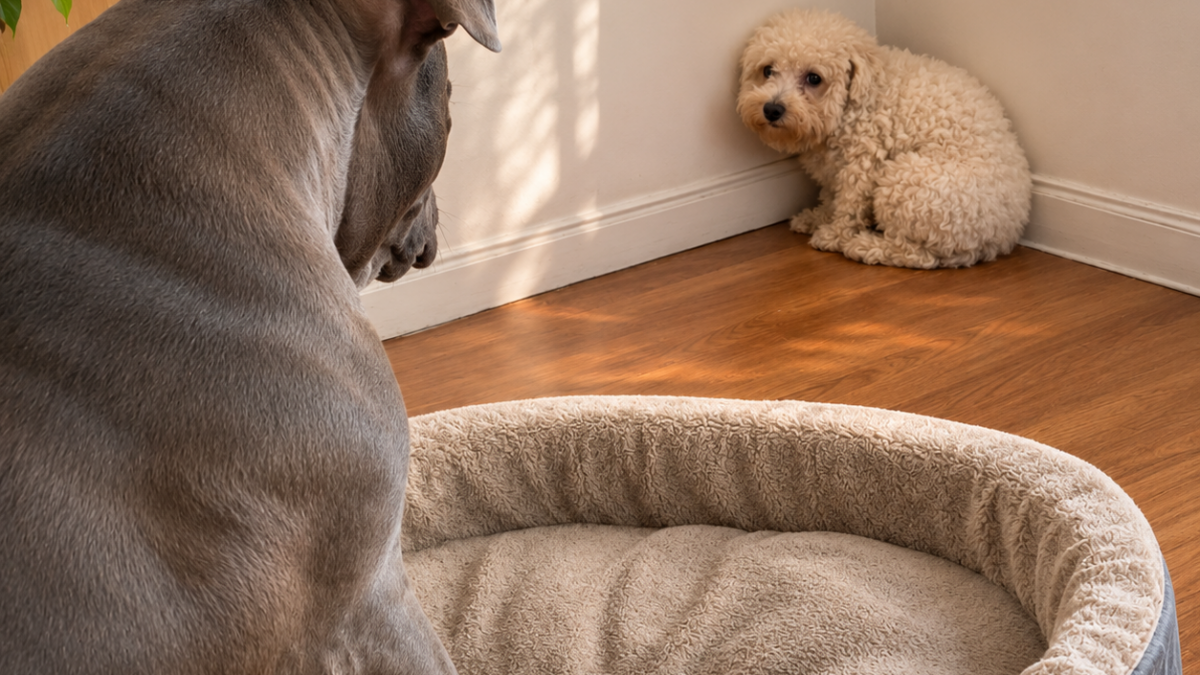
PART 2
I named her Lily three days later.
Not because the name had some deep meaning.
I simply needed something to call her besides “sweetheart” and “little girl,” and when the veterinarian asked what name to put on her temporary chart, Lily came out of my mouth before I had time to think.
The veterinarian was Dr. Melissa Grant.
She had treated Henry since he was a puppy and had long ago stopped pretending not to judge me when I brought him in overweight after the holidays.
The moment she saw Lily, her expression changed.
“How long have you had her?”
“Since yesterday.”
“Found where?”
“Under a bench near Franklin Park.”
“Collar?”
“No.”
“Microchip?”
“I don’t know.”
“We’ll check.”
Lily stood frozen on the examination table.
Her body was so tense that I could feel the muscles vibrating beneath my hand.
Dr. Grant reached toward her.
Lily flattened instantly.
Not moving away.
Flattening.
There is a difference.
A frightened animal sometimes runs.
Lily seemed to believe running wasn’t allowed.
Dr. Grant stopped.
She looked at me.
“That reaction concerns me.”
“I know.”
“What happens when you raise your hand?”
“She ducks.”
“Fast movements?”
“Same.”
“Men?”
“Haven’t tested that.”
“Don’t.”
She called a female technician.
Together, they worked slowly.
No restraints unless absolutely necessary.
No sudden reaching.
Every movement announced before it happened, even though Lily couldn’t understand the words.
“I’m touching your shoulder now.”
“I’m checking this paw.”
“You’re safe.”
The examination took almost an hour.
By the end, we knew Lily was probably around four years old.
She was badly underweight.
Her coat was severely matted.
She had an untreated ear infection.
Several toenails had curled painfully.
There was a healed fracture in one rib.
And around her neck, hidden beneath the tangled fur, was a band of thickened scar tissue.
I stared at it.
“What causes that?”
Dr. Grant didn’t immediately answer.
“A collar that stayed too tight for too long could.”
My stomach turned.
“How long?”
“Long enough.”
She continued checking Lily’s skin.
There were other small scars.
Nothing dramatic enough to tell a complete story.
That almost made it worse.
Small evidence.
A body keeping records nobody had bothered to read.
“Can you tell if someone hit her?”
“No.”
Dr. Grant’s voice was careful.
“We shouldn’t claim something we can’t prove.”
Lily stared at the wall.
“But?”
“But this is a dog who has learned to expect physical correction.”
I swallowed.
“And the rib?”
“Could have happened many ways.”
“Could someone have kicked her?”
“Kate.”
“I know.”
I looked away.
I wanted a villain immediately.
A face.
A name.
Someone I could hate cleanly.
Reality rarely gives you that.
Dr. Grant scanned Lily twice.
No chip.
No identification.
Animal control had no matching lost report.
I filed a found-dog report anyway.
Legally, I had to.
Emotionally, I hated doing it.
“What if someone claims her?” I asked.
“If an owner can prove ownership, there are procedures.”
I looked at Lily.
She had pressed herself into the corner of the examination room.
“I don’t want to give her back to someone who did this.”
“Neither do I.”
“What if they come?”
“Then we document everything.”
Dr. Grant handed me copies of the medical findings.
“Every scar. Every infection. Her weight. Her condition.”
That made me feel slightly better.
Not much.
When we returned home, Henry was waiting near the door.
Lily saw him.
Something in her changed.
Not comfort exactly.
But recognition.
Henry walked backward.
He had already learned she preferred space.
He went to his bowl.
Picked it up again.
Carried it toward the hallway.
“Henry.”
He looked at me with the bowl in his mouth.
“You have to eat too.”
He continued walking.
Of course he did.
He placed it near Lily.
Then backed away.
She stared.
Henry sat.
I expected another standoff.
Instead, Lily took one step.
Then another.
She lowered her head.
Ate one piece of kibble.
Henry’s tail moved once against the floor.
Lily jumped backward.
Henry immediately froze.
His tail stopped.
That surprised me.
Henry had adjusted himself.
He understood that even happiness could frighten her.
Lily waited.
Then approached again.
One piece.
Another.
Another.
By the time she stopped, she had eaten maybe twelve pieces of Henry’s food.
I cried.
Over twelve pieces of kibble.
Henry watched me.
“Don’t judge me.”
His tail moved.
“Quietly.”
It moved slower.
“Thank you.”
The next week became a lesson in patience.
Lily slept against the hallway wall.
Henry slept in his bed nearby.
Every night, he left the other half empty.
Every morning, Lily was slightly closer.
Three feet.
Two and a half.
Two.
One night, I found her sleeping with her nose touching the edge of his cushion.
Henry was awake.
He didn’t move.
His eyes met mine.
I whispered:
“Good boy.”
His tail started moving.
Lily woke.
Henry instantly stopped again.
I almost laughed.
He had become more careful than I was.
There were things Lily could tolerate from Henry that she couldn’t tolerate from me.
If I walked too quickly behind her, she panicked.
Henry could pass beside her without reaction.
If I placed a toy near her, she ignored it.
If Henry carried the same toy across the room and dropped it, Lily watched.
When I tried encouraging her toward the yard, she froze at the doorway.
Henry went outside.
Then came back.
Then outside again.
Like a demonstration.
Eventually Lily followed him.
The first time her paws touched grass, she stood there for almost a minute.
Henry waited.
Then he trotted toward the middle of the yard.
Lily took three steps.
Stopped.
Henry returned.
He didn’t sniff her.
Didn’t push her.
He simply stood beside her.
Another three steps.
Within fifteen minutes, they were beneath the maple tree.
That night, Lily slept one foot from the bed.
Progress didn’t happen in straight lines.
I learned that quickly.
On the ninth day, I dropped a metal pan in the kitchen.
The sound exploded through the house.
Lily screamed.
Not barked.
Screamed.
She bolted into the hallway and tried to force herself beneath a cabinet that was too low for her body.
“Lily!”
I reached down.
Wrong decision.
She snapped.
Her teeth caught the side of my hand.
Not badly.
Enough to draw blood.
I pulled away.
Lily froze.
The expression on her face changed instantly.
Pure terror.
Not because she’d bitten me.
Because she expected what came next.
Punishment.
Henry appeared in the doorway.
He looked at my hand.
Then at Lily.
He walked between us.
I stared.
Not aggressively.
Henry simply placed his body sideways in front of Lily.
A barrier.
“Henry.”
His head turned toward me.
I couldn’t believe it.
“You think I’m going to hurt her?”
He didn’t move.
Behind him, Lily was shaking.
I sat on the floor.
“You’re right.”
Henry’s ears lifted.
“I moved too fast.”
I kept my hands in my lap.
“Lily.”
She wouldn’t look at me.
“You’re not in trouble.”
Nothing.
“I promise.”
Henry stood there for almost five minutes.
Then he looked behind him.
Lily’s trembling slowed.
He stepped away.
Lily remained.
I didn’t touch her.
That night, she didn’t eat.
She returned to the hallway wall.
All the progress seemed gone.
I sat in the living room staring at her.
Dr. Grant had warned me.
“Trauma isn’t a staircase. Don’t expect every day to be better than the last.”
I understood the sentence intellectually.
Living it was different.
Henry did exactly what he had done on the first night.
He brought his bowl.
Then his bed.
He lay on one half.
And waited.
Around midnight, Lily moved closer.
At one in the morning, she reached the bed.
At two, she placed one paw on the empty half.
Then pulled it back.
Henry didn’t move.
Another paw.
Then her front half.
At 2:17 in the morning, Lily climbed completely into Henry’s bed.
She curled herself into the smallest possible ball.
Her back barely touched his.
Henry opened his eyes.
Looked at her.
Then looked at me.
I had both hands over my mouth.
He lowered his head.
That was all.
I slept on the couch because I was terrified moving toward my bedroom might disturb them.
When I woke at six, Lily was still there.
Henry had shifted during the night.
One front leg rested lightly over her back.
The tiny Bichon that had been afraid of hands was asleep beneath the leg of a seventy-pound Pit Bull.
I took one photograph.
Then put the phone away.
Some moments don’t need an audience.
Over the next month, Lily’s body healed faster than her mind.
The ear infection disappeared.
Dr. Grant removed the worst mats under mild sedation.
Beneath them was a much smaller dog than I expected.
Her white coat began growing back.
Her eyes looked enormous without all the dirty fur around them.
“She looks like a cotton ball with anxiety,” I told Henry.
Henry sneezed.
Lily stared at me.
“Sorry.”
She gradually began eating from her own bowl.
Henry seemed personally offended by this development.
The first morning I placed separate bowls down, he picked his up and carried it beside hers.
“Really?”
Henry ate.
Lily ate.
Shoulder to shoulder.
That became breakfast.
Then Lily discovered toys.
Not because of me.
Of course.
Henry had a red rubber ball he loved.
He carried it everywhere.
One afternoon, he dropped it near Lily.
She ignored it.
Henry picked it up.
Dropped it again.
Nothing.
Third attempt.
Lily sniffed it.
Henry backed away.
Lily touched the ball with one paw.
It rolled.
She jumped.
Henry bounced.
Lily jumped again.
Then suddenly she chased it.
Not far.
Maybe four feet.
But she chased it.
Henry exploded into play.
He lowered his front half, rear end in the air, tail whipping.
Lily froze.
Too much.
Henry stopped.
Then, amazingly, he lowered himself onto his stomach.
Smaller.
Less intimidating.
Lily stared.
Then bounced once.
Henry bounced.
Lily ran.
Henry followed at half speed.
That afternoon, for the first time, I heard Lily bark from excitement.
A tiny, sharp bark.
She seemed surprised by herself.
I laughed.
Henry ran in a circle.
Lily chased him.
And there she was.
Somewhere underneath the fear, a dog had been waiting.
Dr. Grant nearly cried when she saw the video.
“That’s not the same dog.”
“It is.”
“You know what I mean.”
I did.
By the sixth week, Lily followed Henry everywhere.
Kitchen.
Yard.
Bedroom.
Porch.
If he slept, she slept.
If he drank, she drank.
If he stared at me while I ate, Lily stared too.
“Absolutely not.”
Two pairs of eyes.
“You’ve taught her begging.”
Henry’s tail moved.
“No.”
Lily’s tail moved.
I gave them chicken.
I had become weak.
But there were still triggers.
Men frightened her.
Especially men wearing work boots.
The first time my brother came over, Lily disappeared behind Henry.
My brother stopped immediately.
“What do I do?”
“Nothing.”
“Nothing?”
“Don’t look at her.”
“I feel rude.”
“She’ll survive.”
He sat.
Henry approached him.
Lily watched.
Twenty minutes later, she came halfway across the room.
An hour later, she sniffed my brother’s shoe.
He looked at me with tears in his eyes.
“Can I touch her?”
“No.”
He nodded.
“Okay.”
The next visit, Lily let him touch her shoulder once.
Then retreated.
My brother looked like he’d won the lottery.
People underestimate what trust means when it comes easily.
Lily made us earn every inch.
Two months after I found her, animal control called.
I was standing in the grocery store.
The moment I heard the officer’s voice, my stomach tightened.
“We may have information about your found dog.”
I stopped beside the freezer aisle.
“What information?”
“A man contacted us after seeing a photograph shared by one of the veterinary clinics.”
My hand tightened around the cart.
“Owner?”
“Possibly.”
I couldn’t breathe.
“What does possibly mean?”
“He claims the dog belongs to his former girlfriend.”
“Then why is he calling?”
“He says she left the dog with him after they separated.”
“And?”
“He says the dog escaped.”
I looked through the glass freezer door without seeing anything.
“When?”
“He claims approximately two weeks before you found her.”
Two weeks.
Lily had not looked like a dog who’d spent two weeks outside.
She looked like a dog whose problems started long before that.
“Does he have proof?”
“Photos.”
My chest tightened.
“What happens now?”
“We investigate.”
I drove home without buying half the groceries on my list.
Henry met me at the door.
Lily behind him.
She had begun greeting me.
Not running.
Just standing.
That was enough.
I crouched.
“They found someone.”
Henry’s ears moved.
Lily came closer.
“They say you belonged to somebody.”
I hated the words.
**Belonged to.**
A dog wasn’t a chair.
But law liked ownership.
I called Dr. Grant.
She was quiet.
“Do not panic.”
“Easy for you to say.”
“We documented her condition.”
“What if he takes her?”
“Kate.”
“What if he does?”
“Let the process work.”
“I hate the process.”
“I know.”
The man came to animal control two days later.
His name was Brent Lawson.
I wasn’t supposed to attend the first meeting.
I went anyway.
He brought photographs.
The dog in them was Lily.
No question.
Cleaner.
Younger.
Long white coat.
In one photograph, she was sitting on a couch beside a woman.
In another, Brent was holding her.
“Her name is Bella,” he said.
Lily.
Bella.
My stomach twisted.
The animal control officer asked:
“How long was she in your care?”
“About four months.”
“And before that?”
“My ex had her.”
“Where is your ex?”
“Moved out of state.”
“Does she want the dog?”
Brent shrugged.
“Don’t know.”
That shrug told me something.
Maybe unfairly.
Maybe not.
The officer continued.
“How did Bella escape?”
“Back gate.”
“When?”
He gave a date.
“Did you file a missing report?”
“No.”
“Post online?”
“No.”
“Contact shelters?”
“I was busy.”
I stared at him.
He noticed.
“You Kate?”
“Yes.”
“You’ve got my dog.”
My jaw tightened.
The officer interrupted.
“Mr. Lawson.”
“What?”
“We have significant veterinary concerns.”
He looked irritated.
“She always had skin issues.”
“The dog was severely underweight.”
“She was picky.”
“Untreated ear infection.”
“I didn’t know.”
“Overgrown nails.”
“I worked long hours.”
“Scarring around the neck.”
Brent looked away.
“Old.”
Dr. Grant had provided a written statement.
The officer read part of it.
Brent became defensive.
“You people are acting like I tortured her.”
Nobody had said that.
Interesting choice of words.
“I fed her.”
The officer asked, “How often?”
Brent hesitated.
“Every day.”
“Once?”
“Usually.”
“What kind of food?”
“I don’t remember the brand.”
“How much?”
“A bowl.”
“How large?”
“I don’t know.”
I listened.
Every answer made me angrier.
Then came the question that mattered.
“Why do you want her back?”
Brent looked at me.
“Because she’s mine.”
Not:
I miss her.
Not:
I was terrified when she disappeared.
Not:
Is she okay?
She’s mine.
I felt my hands curl beneath the table.
The officer continued.
“Have you spoken to the registered owner?”
“She was never registered.”
“Your former girlfriend?”
“No.”
“Then ownership isn’t as clear as you’re suggesting.”
Brent leaned back.
“This is ridiculous.”
I said nothing.
He looked at me.
“How much do you want?”
I stared.
“What?”
“You’ve fed her. Vet bills, whatever.”
The officer said, “Mr. Lawson.”
But he kept going.
“Five hundred?”
Something inside me changed.
“You think I’m holding her for money?”
“Everybody wants something.”
I almost stood.
The officer put one hand up.
“Kate.”
I stayed seated.
Brent sighed.
“Look, my niece likes that dog. I told her I’d get her back.”
There.
Finally.
Not Lily.
Not Bella.
Not the little dog who flinched when a hand moved.
His niece wanted her.
I said quietly:
“She screams when metal hits the floor.”
Brent looked at me.
“She hides from men wearing boots.”
Nothing.
“She flattened herself against my hallway wall the first night because she was afraid to move.”
His face tightened.
“You don’t know what happened before I got her.”
“Maybe not.”
I leaned forward.
“But you had her four months.”
“So?”
“And you didn’t notice she was terrified?”
Silence.
He looked away.
The investigation continued.
Legally, it was messy.
There was no microchip.
No registration in Brent’s name.
His former girlfriend eventually responded.
She provided a written statement saying she had left the dog temporarily while securing housing and later asked Brent to surrender her to a rescue because she could not take her back.
Brent had told her he would “handle it.”
He never surrendered Lily.
She also told animal control something that changed everything.
Brent sometimes kept Lily outside for long periods.
He used a tight training collar because she “wouldn’t listen.”
When asked if he struck her, the woman said she had seen him shove Lily with his foot.
Not enough to prove every injury.
Enough.
Brent was not charged with some dramatic felony.
Real life rarely delivers courtroom fireworks on demand.
But animal control refused to simply hand Lily over.
After several meetings and the threat of a formal neglect proceeding, Brent signed a surrender.
He wanted reimbursement.
He didn’t get it.
I signed adoption papers eleven weeks after finding Lily under the bench.
The officer slid the paperwork toward me.
“Name?”
“Lily.”
“Not Bella?”
I looked down at the little dog sitting beside Henry.
“Bella belonged to whatever happened before.”
I signed.
“She’s Lily now.”
That should have been the ending.
It wasn’t.
Because trauma doesn’t disappear when paperwork changes.
Three weeks after the adoption became official, Lily ran away.
It happened during a thunderstorm.
My neighbor had hired a tree service.
One of the workers dropped a metal ladder beside the fence just as thunder cracked overhead.
Lily panicked.
She didn’t think.
Fear doesn’t think.
She squeezed through a gap beneath the back gate I had not realized existed.
By the time I reached the yard, she was gone.
“Lily!”
Rain hammered down.
Henry ran to the gate.
He looked toward the road.
My heart dropped.
“No.”
I grabbed leashes.
Phone.
Flashlight.
Henry was already whining.
“Find her.”
I don’t know why I said it.
Henry wasn’t a trained tracking dog.
But he knew Lily.
He knew her smell.
He knew her.
We ran.
Down the sidewalk.
Across the park.
The same park where I had first found her.
Henry pulled toward the benches.
Nothing.
“Lily!”
Thunder.
Henry flinched but kept moving.
We reached the walking trail.
He stopped.
Sniffed.
Turned toward the drainage path.
“Go.”
He pulled.
The rain had turned the dirt into mud.
I nearly fell twice.
Henry dragged me toward a concrete culvert beneath the road.
Then he stopped.
His entire body went still.
I heard something.
A tiny sound.
Whining.
“Lily?”
Henry moved toward the culvert opening.
I shined the flashlight.
Two eyes reflected from deep inside.
“Oh my God.”
Lily was there.
Wedged behind debris.
Soaked.
Terrified.
I crouched.
“Baby.”
She flattened.
Even me.
In that panic, I was just another approaching human.
Henry stepped forward.
I released his leash.
“Easy.”
He entered the culvert.
Slowly.
Water ran around his paws.
Lily watched him.
Henry stopped five feet away.
Then lay down.
That’s all.
No pushing.
No licking.
No trying to drag her out.
He lay down in the muddy water.
Lily trembled.
Another thunderclap.
She crawled forward.
One foot.
Then another.
Henry stayed.
Finally, she reached him.
She pressed her body against his chest.
Henry lowered his head over her.
I sat outside that culvert crying in the rain.
“Come on.”
Henry looked toward me.
“Bring her home.”
He stood.
Lily stood with him.
Every time Henry moved, Lily moved.
Together they came out.
I wrapped Lily in my jacket.
She shook uncontrollably.
Henry pressed against my leg.
We walked home in the storm.
That night, Lily didn’t sleep against Henry.
She slept on him.
Directly across his chest.
Henry didn’t move for six hours.
The next morning, Dr. Grant examined her.
Nothing broken.
No serious injury.
“She’s lucky.”
I looked at Henry.
“No.”
I touched his head.
“She’s got him.”
Months passed.
Then years.
Lily changed.
Not completely.
Some fears remained.
Loud metal sounds always bothered her.
Strange men took time.
Thunderstorms required Henry.
But she became funny.
Bossy.
Possessive about blankets.
She learned that if she barked once beside the pantry, I sometimes gave treats.
Henry regretted teaching her that.
She developed an obsession with stealing his toys even though half of them were larger than her head.
She learned to sleep upside down.
The first time I saw her like that, belly exposed, paws loose, I stood in the doorway for a long time.
A dog only sleeps like that when she feels safe.
That image meant more to me than any adoption certificate.
Henry and Lily became inseparable.
People laughed when they saw them.
A seventy-pound gray Pit Bull.
A twelve-pound white Bichon.
Henry walked slowly so Lily could keep up.
If she stopped, he stopped.
At dog parks, if another dog overwhelmed Lily, Henry stepped between them.
Never attacked.
Never growled unless absolutely necessary.
He simply became a wall.
Lily knew.
Whenever she was nervous, she moved toward him.
Once, a woman at the park pulled her child backward when she saw Henry.
“Careful. That’s a Pit Bull.”
I heard her.
A few minutes later, Lily became frightened by a skateboard.
She ran directly underneath Henry’s chest.
Henry stood over her.
The woman’s expression changed.
Her daughter asked:
“Mom, is he protecting the little dog?”
The woman watched.
“Yes.”
Her voice became quieter.
“I think he is.”
That moment stayed with me.
Henry had spent his life being judged by his body.
Lily had spent hers being damaged by people who looked harmless.
Appearances had failed both of them in different ways.
They didn’t care.
They judged behavior.
Simple.
Maybe dogs are smarter.
The photograph that eventually became famous happened by accident.
Lily was asleep in Henry’s bed.
Henry came over.
There was almost no room left.
He looked at me.
I laughed.
“You created this problem.”
He carefully climbed onto the edge.
Half his body hung off.
Lily remained sprawled across the middle like royalty.
I took a picture.
My sister posted it.
Caption:
**He gave her half his bed when she was afraid. Now she takes all of it.**
The photo spread.
First locally.
Then farther.
Thousands of people shared it.
Some knew the backstory.
Many didn’t.
Then a local rescue asked if I would tell the story.
I agreed under one condition.
“Do not make Henry look like some miracle because he’s a Pit Bull.”
The woman frowned.
“What do you mean?”
“I mean don’t make the story ‘dangerous Pit Bull surprisingly nice.’”
She understood.
“He’s just nice.”
“Exactly.”
They told both stories.
Lily learning trust.
Henry offering it without demanding anything back.
Donations came in.
Enough that the rescue created a small rehabilitation room for frightened dogs.
Quiet lighting.
Beds.
Sound insulation.
No metal kennel doors slamming.
They asked what to name it.
I said no names.
They ignored me.
The plaque eventually read:
**HENRY & LILY ROOM**
Underneath:
**Trust cannot be forced. It can only be offered.**
I pretended to hate it.
I didn’t.
Brent apparently saw the story.
I knew because he sent me a message.
Three years had passed.
**Looks like you made money off my dog.**
I stared at the screen.
Then laughed.
Not because it was funny.
Because I finally understood how little power he had.
Years earlier, that message would have made me furious.
Now Lily was asleep beside Henry.
Safe.
Healthy.
Loved.
Brent was typing bitter words into a phone.
I didn’t answer.
That was the revenge.
Silence.
He had once believed ownership meant control.
Lily had taught me something better.
Love is not possession.
If you love an animal, you don’t demand that it remain because it belongs to you.
You make yourself someone it wants to stay with.
Brent lost Lily long before I found her.
Henry won her trust without ever asking for it.
There was no comparison.
Time moved.
Henry’s gray muzzle slowly turned white.
At eight, arthritis began bothering one hip.
At nine, he stopped jumping onto the couch.
Lily adapted before I did.
If Henry was slow getting up, she waited.
If he rested during walks, she sat beside him.
Somewhere along the way, the protected became the protector.
The first time Henry had a bad arthritis flare, he remained in bed most of the day.
Lily refused breakfast.
I put her bowl down.
Nothing.
She carried one piece of kibble to Henry.
Dropped it beside his face.
I froze.
“Seriously?”
Henry opened one eye.
Lily pushed the kibble closer with her nose.
Henry ate it.
Then Lily returned to the bowl.
Another piece.
She brought him six pieces one at a time.
I sat on the floor and cried.
Years earlier, Henry had carried his bowl to her.
Now she was bringing food to him.
Not because anyone trained her.
Because somewhere inside that little dog, kindness had become a language she finally knew how to speak.
“You taught her that,” I whispered.
Henry’s tail moved.
Lily brought another piece.
At ten, Henry developed a mass.
Cancer.
My stomach dropped when Dr. Grant said the word.
Lily was beside him in the examination room.
She had never liked clinics, but if Henry went, she went.
“What are our options?”
“Surgery.”
“Risk?”
“Moderate.”
“Chance?”
“Good enough that I’d consider it.”
I looked at Henry.
Then Lily.
“Do it.”
The surgery went well.
But Henry spent two nights in the hospital.
Lily stopped eating.
Again.
I brought her home.
She walked through every room.
Looking.
Then sat beside the front door.
Waiting.
The old Lily was still inside her.
The little dog who understood disappearance too well.
I slept near the door with her.
“He’s coming back.”
She stared.
“I promise.”
The next afternoon, Dr. Grant called.
“Come get your boy.”
I took Lily.
When Henry emerged from the treatment area, groggy, wearing a ridiculous recovery suit, Lily screamed.
A happy scream.
She ran toward him so fast the leash slipped from my hand.
Henry could barely stand.
His tail moved.
Lily covered his face in kisses.
Dr. Grant wiped her eyes.
“Okay.”
She cleared her throat.
“That’s enough.”
Nobody listened.
Henry came home.
Lily slept beside him every night during recovery.
If he moved, she woke.
If I approached with medication, she inspected it.
“I’m not poisoning him.”
She stared at me.
“You know me.”
More staring.
I showed her the pill.
“See?”
Nothing.
“You’ve become difficult.”
She climbed back beside Henry.
He recovered.
We got three more good years.
Three.
When you’re young, three years feels short.
When you’re living with an old dog after cancer, three years feels like stolen treasure.
Henry turned thirteen.
Lily was probably around fourteen by then.
Two old dogs.
One giant.
One tiny.
Still sharing the same bed.
I bought a larger one eventually.
Henry still slept on one side.
Lily still took most of it.
Tradition mattered.
One winter morning, Henry couldn’t get up.
I knew before I touched him.
He looked tired in a way sleep could not fix.
Lily stood beside him.
She licked his ear.
Henry tried to lift his head.
Couldn’t.
I called Dr. Grant.
She came to the house.
She had known Henry almost his entire life.
The moment she walked in, her face changed.
She examined him.
Listened to his heart.
His lungs.
Then sat beside me.
“Kate.”
I shook my head.
“No.”
“I think we’re there.”
“No.”
Lily climbed into the bed.
She pressed herself against Henry’s chest.
I covered my mouth.
Dr. Grant waited.
“I need more time.”
“I know.”
“How much?”
“Whatever you need right now.”
I sat beside Henry.
I thought about the first night Lily came.
Henry carrying his bowl.
Pushing his bed.
Leaving half.
Never forcing.
Just offering.
He had spent his whole life like that.
Offering.
Food.
Space.
Safety.
His body between Lily and anything that frightened her.
His patience.
His heart.
I put my face against his.
“You were supposed to be the scary one.”
His eyes moved toward mine.
I laughed through tears.
“Everybody warned me when I adopted you.”
I remembered.
Pit Bull.
Be careful.
Strong dog.
Powerful breed.
Know what you’re getting into.
Nobody warned me about this.
Nobody warned me that one day the hardest thing Henry would ever do to me was become old.
Lily licked his face.
Henry’s tail moved once.
Dr. Grant prepared the medication.
“Can she stay?”
“Yes.”
“I want her to understand.”
Dr. Grant nodded.
“That’s okay.”
I wrapped one arm around Henry.
My other hand rested on Lily.
“You know what you did?”
Henry breathed slowly.
“You gave her everything.”
Lily pressed closer.
“Your food.”
Another breath.
“Your bed.”
Another.
“Your courage.”
My voice collapsed.
“And then your heart.”
Lily made a tiny sound.
Henry turned his nose toward her.
Barely.
She licked him.
I whispered:
“She’s safe.”
Henry’s eyes remained on mine.
“You hear me?”
Tears fell onto his face.
“She’s safe.”
That was the promise I thought he needed.
Because if Henry’s entire relationship with Lily had been one long act of protection, then perhaps he needed permission to stop.
“I’ve got her now.”
His breathing slowed.
“You can rest.”
Dr. Grant gave the medication.
Henry relaxed.
Lily’s body became tense.
She sniffed his face.
Again.
Again.
Henry took one final breath.
Then nothing.
Lily waited.
She nudged him.
I broke.
She nudged harder.
No response.
Then Lily climbed fully onto Henry’s chest.
She curled herself there.
Exactly where she had slept during thunderstorms.
I don’t know how long we sat.
An hour.
Maybe more.
Dr. Grant didn’t rush us.
Eventually Lily lifted her head.
She looked at me.
Her eyes held that same question I’d seen beneath the park bench years earlier.
**What happens now?**
I picked her up.
“We stay.”
That was the answer Henry had taught both of us.
“We stay.”
The weeks after Henry died were hard.
Lily searched.
His bed.
His bowl.
The yard.
She waited beside the back door in the evenings.
For the first time in years, she slept against the hallway wall.
That terrified me.
I remembered the beginning.
I knew what grief could do to an animal.
So I did what Henry had done.
I didn’t force.
I placed food near her.
Sat several feet away.
Waited.
The first night, I moved Henry’s bed into the hallway.
Lily stared at it.
Then at me.
I sat on one side.
Not literally inside it.
I wasn’t that flexible.
But beside it.
“There’s room.”
Lily didn’t move.
I waited.
An hour later, she came closer.
Another hour.
She placed one paw on the cushion.
I started crying.
History.
But different.
This time Henry wasn’t there to teach us.
We had learned.
Lily climbed into the bed.
She curled up.
I rested my hand near her.
Not touching.
She moved toward it.
Her body pressed against my fingers.
That was enough.
We spent months grieving Henry.
The rescue held a small memorial.
I didn’t want one.
They convinced me.
At the entrance to the rehabilitation room, they placed a second plaque beneath the first.
**HENRY**
**He never asked a frightened dog to trust him.**
**He simply became someone she could.**
Lily attended.
She walked into the room.
Sniffed the beds.
Then lay down beneath the plaque.
People cried.
I cried.
Lily slept.
She had never cared much for ceremonies.
Years earlier, I thought Henry had saved Lily because he shared food and a bed.
I eventually understood it was deeper.
Henry never demanded proof of improvement.
He didn’t become impatient when Lily moved backward.
He never punished fear.
He never seemed offended by distrust.
He simply showed up tomorrow.
And the next day.
And the next.
Until Lily stopped preparing for kindness to disappear.
That was his gift.
Lily lived another three years after Henry.
She became an old white cloud.
Her hearing faded.
Her eyesight softened.
But her confidence remained.
She greeted visitors.
She slept upside down.
She still hated thunder, but now she came to me instead of hiding.
Every storm, I wrapped her in Henry’s old blanket.
“Your big guy isn’t here.”
I’d stroke her head.
“But I’m here.”
She believed me.
That mattered.
On Lily’s final summer, something happened that closed the circle.
The rescue called me.
A young Pit Bull had arrived.
Black.
Maybe two years old.
Found chained behind an abandoned building.
Terrified of people.
They didn’t ask me to adopt him.
They knew better.
They asked whether Lily might help.
I laughed.
“Lily?”
The dog who once couldn’t leave a wall?
“Yes.”
“Why?”
“Because she knows.”
So we visited.
The Pit Bull’s name was Sam.
He was curled in the back of the quiet room.
Lily walked in slowly.
No fear.
No hesitation.
She stopped six feet away.
Then lay down.
Sam watched.
Lily closed her eyes.
I nearly fell apart.
Henry.
That was Henry.
Not literally.
But the lesson.
The language.
Lily had learned it.
She didn’t approach Sam.
Didn’t sniff.
Didn’t demand.
She offered presence.
The next visit, Sam came closer.
The third, closer again.
On the fifth, he slept three feet from Lily.
A month later, he was adopted by a family with two teenage girls.
Before he left, he touched noses with Lily.
I cried the entire drive home.
“You did it.”
Lily slept in the passenger seat.
“You became Henry.”
Not exactly.
Nobody becomes anyone else.
But kindness had traveled.
Henry gave it to Lily.
Lily carried it forward.
That is the closest thing to immortality I understand.
Lily died at seventeen.
At home.
In Henry’s bed.
Of course.
Her body had become frail.
Kidneys failing.
Arthritis.
Age.
Dr. Grant came again.
Older now.
So was I.
We sat beside Lily.
Her white coat was thin.
Her breathing slow.
I placed Henry’s old collar beside her.
Lily sniffed it.
I don’t know whether enough of his scent remained after all those years.
Maybe.
Maybe memory doesn’t need scent.
I whispered:
“You found him.”
Her eyes moved.
“That first night.”
I smiled through tears.
“You thought I rescued you.”
Another breath.
“I didn’t.”
I touched the scar beneath her neck.
“Henry did.”
Then I corrected myself.
“No.”
I shook my head.
“You rescued yourself too.”
Because that’s important.
Love can create safety.
It cannot force someone to live.
Lily eventually stepped forward.
She ate.
Played.
Trusted.
Loved.
Those choices belonged to her too.
I kissed her head.
“Your bed is waiting.”
I don’t know why I said that.
Maybe I wanted to believe Henry existed somewhere.
Maybe I only meant rest.
Either way, Lily’s tail moved once.
Dr. Grant gave the medication.
I held her.
“No more being afraid.”
Her body relaxed.
“No more running.”
Another breath.
“No more hiding under benches.”
Another.
“You’re safe.”
Lily exhaled.
And was gone.
Afterward, I buried her ashes beside Henry’s.
The stone is simple.
Two names.
**HENRY & LILY**
Beneath them:
**He offered half his bed.**
**She gave him her whole heart.**
People still send me their photograph.
The one where Lily occupies almost the entire bed and Henry is hanging off the edge.
It still circulates online.
Sometimes the story changes.
Internet stories do that.
People say Henry found Lily.
He didn’t.
They say Henry carried her home.
No.
They say Lily was his puppy.
Definitely not.
The truth is simpler.
I found a frightened little dog under a bench.
I brought her home.
And my Pit Bull understood before I did that love was not the first thing she needed.
First, she needed control.
Space.
Food she could approach on her own.
A bed she could enter or refuse.
A friend who didn’t demand anything.
Henry offered those things.
Then waited.
People ask me why I call that revenge.
Because Lily had been taught that closeness meant danger.
Henry taught her closeness could mean warmth.
Someone had taught her hands were frightening.
We taught her hands could scratch behind her ears.
Someone had taught her food wasn’t guaranteed.
Henry carried his own bowl to her.
Someone had made her believe every safe place could disappear.
Henry offered half his bed every night until she understood it would still be there tomorrow.
Whoever failed Lily—whether through cruelty, neglect, indifference or simple selfishness—lost.
They did not get the final version of her.
They knew the frightened dog.
I knew the dog who stole chicken from the counter.
Henry knew the dog who climbed on top of him during storms.
Children at the rescue knew the little white dog who walked confidently into fearful-dog rooms.
Sam knew the old Bichon who lay six feet away and asked for nothing.
Her past made her afraid.
It did not get to decide who she became.
That was the revenge.
Brent once called her his dog.
He was wrong.
I eventually stopped saying she was mine too.
Lily belonged to herself.
For a while, she chose us.
That was worth more than ownership ever could be.
And Henry understood that from the first night.
He could have walked directly toward her.
He didn’t.
Could have sniffed her.
Didn’t.
Could have defended his bowl.
His bed.
His home.
Instead, he brought everything closer.
Then moved himself farther away.
He gave her the one thing fear had taken from her.
Choice.
Eat if you want.
Sleep here if you want.
Come closer if you want.
I’m here.
I won’t chase you.
I won’t force you.
I won’t hurt you.
Maybe that is why she trusted him first.
And maybe that is why, years later, when Henry’s own body failed, Lily knew exactly what to give back.
Food.
Presence.
Patience.
Her body beside his.
Everything he had once offered her.
I still live in the same house.
The hallway looks bigger now.
Too big.
No Henry bed taking up half the floor.
No Lily curled against the wall.
For months after Lily died, I considered moving the old bed.
I couldn’t.
Eventually a foster dog came for one weekend.
Then another.
Then another.
I don’t foster constantly.
I’m not pretending I became some saint of animal rescue.
I’m still impatient.
Still complain about hair.
Still hate muddy floors.
But when the shelter calls about a frightened dog, sometimes I say yes.
Henry’s bed is still in the hallway.
Different cover.
Same cushion.
Some dogs use it.
Some don’t.
That’s fine.
One nervous little spaniel spent four days sleeping three feet away from it.
On the fifth night, she placed one paw on the edge.
I sat on the stairs watching.
I didn’t move.
Another paw.
Then she climbed in.
I cried.
Of course I did.
That bed has made me cry an unreasonable number of times.
Above it hangs one photograph.
Henry on one side.
Lily taking the rest.
Underneath, I framed the line from the rescue plaque:
**Trust cannot be forced. It can only be offered.**
People sometimes think the story is about a Pit Bull proving stereotypes wrong.
Partly.
Henry did that simply by being Henry.
But to me, the story is about something harder.
What do you do when love isn’t enough yet?
When someone is too frightened to receive it?
We often respond by giving more.
More attention.
More touching.
More reassurance.
More pressure disguised as kindness.
Henry did the opposite.
He made room.
That was his genius.
And that is what Lily carried forward.
The little dog under the bench did not need me to convince her that humans were good.
She had evidence against that argument.
She needed new evidence.
Day after day.
A bowl appearing.
Nobody taking it away.
A bed staying in the same place.
A door opening.
Nobody forcing her through it.
A hand lowering when she flinched.
A Pit Bull lying nearby.
Today.
Tomorrow.
Again.
Trust isn’t created in one emotional moment.
It is built through repetition.
Safety repeated until the body believes it.
Henry knew.
Or acted as though he did.
And Lily learned.
By the end of her life, she no longer slept pressed against walls.
She slept in the middle of rooms.
On her back.
Feet in the air.
Taking up space.
That might be my favorite part of the entire story.
A dog who once tried to become invisible eventually became extremely inconvenient to walk around.
She learned that the world could adjust to her.
She didn’t always have to make herself smaller.
Sometimes, late at night, I still picture that first hallway.
Henry lying on half his bed.
Lily against the wall.
Three feet between them.
At the time, it looked enormous.
Now I know those three feet contained the whole story.
Fear on one side.
Trust on the other.
And between them, no force.
Just time.
Henry waited.
Lily crossed the distance herself.
First six inches.
Then another.
Until one night, she climbed into his bed.
Years later, when Henry was dying, she climbed onto that same chest again.
Beginning and end.
The scared little dog and the gentle Pit Bull.
I was lucky enough to witness both.
If I could return to that cold Tuesday beneath the bench, I would still stop.
Of course.
But I wouldn’t tell Lily:
“Trust me.”
I know better now.
Trust is not something you request.
I would simply kneel in the rain.
Wait.
Then take her home.
And let Henry show her the rest.
Because Henry never promised Lily the whole world.
He offered something smaller.
His bowl.
Half a bed.
A quiet place beside him.
Then he offered the same thing tomorrow.
And tomorrow.
And tomorrow.
Until eventually that frightened little dog realized what he had really been giving her all along.
Not food.
Not a cushion.
Not protection.
A home.
And when Lily finally gave him her heart in return, she gave it freely.
That made all the difference.
For a long time after Lily died, I couldn’t bring myself to remove Henry’s bed from the hallway.
It was ridiculous, really.
The fabric had been replaced twice.
The stuffing had flattened.
One corner was permanently dented from years of Henry sleeping with his shoulder pressed into it.
Another side had tiny claw marks from Lily turning circles before lying down.
It was just a dog bed.
That’s what anyone else would have seen.
To me, it was the beginning of everything.
The first night Lily came home, that bed had been a border between fear and trust.
Henry had pushed it toward her with his nose.
He had climbed onto one half.
Then left the other half empty.
No demand.
No expectation.
No invitation she was required to accept.
Just space.
Years later, after Henry died, Lily slept there while learning how to grieve without him.
Then, at the end of her own life, she died in that same bed with Henry’s collar beside her.
I told myself I kept it because I might foster another dog.
That was partly true.
The deeper truth was that removing it felt too much like closing a door.
So I left it.
Months passed.
Then one rainy Friday, the rescue called.
I almost didn’t answer.
I knew what those calls meant.
“Kate?”
It was Maria, the coordinator.
“No.”
She laughed softly.
“I haven’t asked anything.”
“You’re about to.”
“We have a dog.”
“Of course you do.”
“Small terrier mix. Female. Maybe five.”
I looked toward the hallway.
Henry’s empty bed sat exactly where it had for years.
“What happened?”
Maria became quieter.
“Owner died.”
That was not what I expected.
“No family?”
“None who can take her.”
“Behavior?”
“She doesn’t bite.”
A pause.
“She doesn’t do much of anything.”
I closed my eyes.
I knew that description.
“What do you mean?”
“She stays in the back of the kennel.”
“Eating?”
“Barely.”
“Name?”
“Maisie.”
I hated the fact that I was already picturing her.
“Maria.”
“I know.”
“No, you don’t.”
“I think I do.”
“I am not replacing Lily.”
“I didn’t ask you to.”
“Or Henry.”
“I know.”
Silence.
Then Maria said:
“Maybe that’s why you should come meet her.”
I went the next morning.
Of course I did.
Maisie was not Lily.
That mattered immediately.
She was brown and white.
Long-bodied.
One ear stood upright while the other folded halfway over.
Her fur was rough.
She was older than Lily had been when I found her.
And unlike Lily, Maisie did not flatten herself when people approached.
She simply looked away.
She had been loved.
That was obvious.
The problem wasn’t that she had learned people were dangerous.
She had learned one person was home.
And that person had disappeared.
Different wound.
Same silence.
I sat outside her kennel.
No reaching.
No calling.
No treats.
Maria watched from the doorway.
“You still do that.”
“What?”
“Sit.”
“I learned from better teachers.”
Maisie did not look at me for almost twenty minutes.
I started reading from my phone because I had forgotten to bring a book.
A news article.
Terrible choice.
After five minutes, I stopped.
“You deserve better literature.”
Her ear moved.
I laughed quietly.
“Okay. You heard that.”
I drove home and found an old paperback.
The next day, I returned.
Sat.
Read.
Maisie ignored me.
Third day.
Same.
Fourth.
She looked at me twice.
Fifth.
She moved closer to the front of the kennel.
Not much.
Maybe eight inches.
That was enough.
I went home that evening and stood beside Henry’s bed.
“You two did this to me.”
No answer.
Obviously.
But I could almost imagine Henry’s expression.
Patient.
Unimpressed.
Lily’s would have been worse.
She had become bossy in old age.
I smiled.
On the seventh visit, Maisie came close enough to sniff my shoe.
I did not move.
She stayed there for three seconds.
Then retreated.
Maria whispered from behind me:
“You’re good at this.”
“No.”
I kept my eyes on Maisie.
“I’m just not in a hurry.”
That was different.
Before Lily, I had thought helping meant doing.
Approach.
Feed.
Touch.
Reassure.
Solve.
Henry had taught me that sometimes help looked like restraint.
Don’t reach.
Don’t crowd.
Don’t demand gratitude.
Don’t turn another creature’s fear into your need to feel useful.
Just stay.
Three weeks later, Maisie came home as a foster.
Temporary.
I said that word very firmly.
Maria nodded with the expression of someone humoring a child.
The first thing Maisie did was notice the bed.
She stopped in the hallway.
Sniffed it.
Then walked away.
I felt disappointed.
Immediately, I felt ridiculous.
“That’s fine.”
Maisie looked at me.
“You don’t have to like it.”
She slept beside the couch that night.
The next morning, she slept near the kitchen.
On the third night, I woke around two and walked downstairs for water.
Maisie was standing beside Henry’s bed.
Sniffing.
She placed one front paw on it.
My chest tightened.
Then another.
She climbed in.
Turned twice.
Curled up.
And went to sleep.
I stood in the dark kitchen and cried silently.
Not because she looked like Lily.
She didn’t.
Not because I thought Henry was somehow there.
I didn’t.
I cried because something that had begun as one dog’s gift to another was still being used.
Henry never knew Maisie.
Lily never knew Maisie.
But the place where they had practiced trust had become useful again.
That meant more to me than any plaque.
Maisie stayed four months.
Then a widow named Ellen adopted her.
The first time Ellen visited, she sat on the floor without asking Maisie to come.
I liked her immediately.
Maisie eventually approached.
Sniffed her hands.
Then sat beside her.
Ellen cried.
“I lost my husband last year.”
I looked at Maisie.
“Then you two may understand each other.”
Ellen smiled.
“I was hoping that.”
When she took Maisie home, I stood at the door and felt the familiar ache.
Not loss exactly.
Release.
Lily had once taught me that letting someone go into a good home was not abandonment.
Henry had taught Lily.
Lily had taught me.
And now, somehow, I was repeating it.
That became the pattern of the next several years.
I never became a full-time foster.
I was too attached to my furniture and too fond of sleeping.
But every few months, the rescue called about a dog who needed quiet more than activity.
A frightened senior.
A dog recovering from neglect.
A mother dog after her puppies were adopted.
A shepherd who had spent six years chained outside and panicked inside houses.
They came.
They stayed.
Some ignored the bed.
Some claimed it immediately.
One enormous mastiff named Duke tried to fit into it despite being twice Henry’s size.
His front half fit.
His back half did not.
He seemed satisfied.
I sent a photograph to Maria.
She replied:
Henry would approve. Lily would tell him to move.
She was right.
The rescue room carrying Henry and Lily’s names continued growing too.
At first, it had been one quiet room.
Then a second.
Then an outdoor courtyard with covered areas where fearful dogs could observe people from a distance.
Volunteers received training.
Not sophisticated clinical training.
Simple things.
Don’t corner.
Don’t loom over.
Don’t stare continuously.
Let the dog choose distance.
Watch body language.
Reward curiosity.
Respect retreat.
The slogan over the doorway stayed the same:
TRUST CANNOT BE FORCED. IT CAN ONLY BE OFFERED.
Years after the sign went up, I visited one afternoon and saw a teenage boy sitting on the floor reading a comic book.
Across the room, a trembling spaniel was pressed beneath a bench.
The boy wasn’t looking at him.
Just reading.
I stood behind the observation window.
Maria came beside me.
“First day.”
“The boy or the dog?”
“Both.”
I smiled.
The spaniel’s nose appeared.
Then one eye.
The boy kept reading.
Five minutes later, the dog crawled half his body out.
I wiped my eyes.
Maria pretended not to notice.
“Henry did that,” I whispered.
She shook her head.
“Henry started it.”
Important distinction.
Henry had not saved every dog.
Lily hadn’t either.
What they had done was leave a method behind.
A behavior.
A language.
A way of saying:
You can come closer when you’re ready.
That’s a powerful thing to inherit.
I received one final message from Brent many years after Lily became mine.
I almost deleted it without reading.
The subject line said:
About Bella.
I stared at the name.
Bella.
A name from a life Lily had outgrown.
I opened it.
The message was shorter than I expected.
He said he had seen that Lily had died.
He had seen the memorial post from the rescue.
He wrote:
I know you probably hate me.
I didn’t.
Not anymore.
Hate requires attention.
Lily had taken mine somewhere better.
He continued.
I was not good to her.
That line surprised me.
No excuse attached.
No “but.”
Then:
I didn’t think I was abusing her. I thought dogs were supposed to obey. When she was scared, it made me angry. When she wouldn’t come near me, I thought she was stubborn. Seeing what she became with your dog made me realize she wasn’t the problem.
I read that twice.
Then a third time.
There was more.
He said his niece had adopted a dog years later.
He had warned her not to “spoil it.”
She told him the story of Henry and Lily without realizing he had known Lily before.
He didn’t tell her.
Not then.
He watched her dog.
Watched how she waited when it was afraid.
Watched how trust grew.
Then he finally understood.
At the end, he wrote:
I don’t expect forgiveness. I just wanted you to know I know what I did now.
I sat with that message for a long time.
Part of me wanted to respond:
Too late.
Because it was.
Understanding after Lily’s death did not undo her scars.
It did not erase the tight collar.
The fear of boots.
The scream when metal hit the floor.
Regret does not travel backward.
But neither is it worthless.
I replied with four words.
Then don’t repeat it.
He answered:
I won’t.
That was our final conversation.
I never heard from him again.
And strangely, that gave the story one more layer of closure.
For years, I had thought revenge meant Lily becoming happy without him.
That was still true.
But there was something even more satisfying.
Her life had become evidence.
Evidence strong enough to force the person who failed her to see himself clearly.
Lily did not need to confront him.
She did not need to bite him.
Run from him.
Reject him at a dramatic doorway.
She simply lived well.
Sometimes a healed life is the most brutal mirror.
The frightened dog he had blamed became affectionate.
Playful.
Trusting.
Generous.
She helped another abused dog years later.
She gave Henry food when he was sick.
She offered comfort.
All the qualities Brent may once have believed she lacked had been there.
Fear had only buried them.
That was the truth he eventually had to live with.
He had mistaken fear for disobedience.
Henry had recognized fear as fear.
One responded with pressure.
One responded with space.
Only one of them received Lily’s trust.
Years later, a local school asked me to speak to a group of older students about animal welfare.
I initially said no.
Public speaking is punishment disguised as education.
Then the teacher told me the students were studying how behavior is shaped by environment.
That interested me.
So I agreed.
I brought no dramatic rescue photographs.
No before-and-after slideshow.
Just two pictures.
The first showed Lily under the park bench.
Tiny.
Wet.
Matted.
Eyes wide.
The second showed Lily asleep upside down in Henry’s bed years later.
Feet in the air.
Mouth slightly open.
Henry barely hanging off the edge.
I put both on the screen.
“Same dog.”
The room went quiet.
One student raised her hand.
“How did you make her stop being scared?”
“I didn’t.”
She frowned.
“Henry didn’t either.”
“Then what happened?”
“We stopped giving her reasons to be afraid.”
That answer changed the room.
I explained.
Safety doesn’t erase memory.
Confidence doesn’t mean a traumatic past was imaginary.
Lily did not become a different animal.
The environment changed.
Then behavior had room to change too.
A boy near the back asked:
“So love fixed her?”
“No.”
I was careful.
“Love helped.”
“But love without respect can still become pressure.”
I told them about Henry’s bowl.
His bed.
The empty half.
“Henry never asked Lily to prove she trusted him.”
I paused.
“He behaved like someone trustworthy and let her decide.”
One student wrote that down.
I noticed.
For some reason, that affected me more than applause would have.
Maybe she would remember.
Maybe years later, some frightened dog would benefit.
Or some frightened person.
Because the principle was larger than dogs.
Space.
Consistency.
Choice.
Trust earned through repetition.
Henry had understood without language.
Humans needed seminars.
Typical.
As I grew older, I started thinking more about why Henry behaved that way.
Was it instinct?
Temperament?
Did he sense Lily’s fear?
Did he understand sharing the bowl the way I interpreted it?
I don’t know.
And I became less interested in claiming certainty.
Maybe Henry carried the bowl simply because food was socially important to him.
Maybe pushing the bed was coincidence shaped by my emotional memory.
Maybe some details gained meaning because of what happened later.
But even if I strip away every interpretation, the behavior remains.
He did not crowd her.
He repeatedly allowed proximity on her terms.
He adjusted when his movements frightened her.
He stood between us after she bit me because she was panicking.
He lay down in muddy water inside a culvert until she came to him.
And Lily changed around him.
That is enough.
You don’t need to turn an animal into a human to respect what happened.
The bond was real.
Different from ours.
Still real.
One winter, more than a decade after I first found Lily, the rescue replaced the original Henry & Lily Room sign.
The wood had faded.
Letters were cracking.
Maria called.
“We’re making a new one.”
“Okay.”
“Do you want the old sign?”
I immediately said yes.
It sits in my garage now.
Above Henry’s original bed.
Yes.
I eventually moved the bed.
Not because I was ready.
Because the hallway needed repairs.
I thought moving it would hurt.
It did.
Then it didn’t.
That’s something grief had taught me.
Objects matter because of meaning.
Meaning does not vanish when the object changes location.
I set the bed beneath the old sign in a small room near the back of the house.
That room became my foster room.
Simple.
Washable floor.
Quiet.
Two beds.
One crate left open.
Soft lighting.
No pressure.
On the wall:
TRUST CANNOT BE FORCED. IT CAN ONLY BE OFFERED.
Below it is the photograph.
Henry half falling off the cushion.
Lily occupying almost everything.
Every new foster eventually sees it.
Obviously, they don’t know what it means.
But I do.
One particularly frightened dog arrived there named Rosie.
She was a Beagle mix.
She had spent most of her life in a hoarding situation.
Human contact overwhelmed her.
For six days, she hid behind the open crate.
I sat.
Read.
Worked on my laptop.
Ignored her.
On the seventh day, I fell asleep in the chair.
When I woke, something warm touched my ankle.
Rosie.
Her nose rested against my sock.
I didn’t move.
For ten minutes.
My back hurt terribly.
Worth it.
Then she went away.
The next day she came closer.
Within three weeks, she was sleeping on Henry’s bed.
Within two months, she had a home with an older couple who sent me photographs every Christmas.
One showed Rosie stretched across their couch.
I laughed.
“Of course.”
Safe dogs become furniture problems.
That’s another lesson.
Eventually, I had to stop fostering.
My knees weren’t good enough.
My back complained.
The rescue volunteers had become younger.
Some weren’t even born when I found Lily.
That realization was offensive.
But it also felt right.
The work didn’t need me forever.
Good things should outgrow their founders.
The Henry & Lily Room was eventually managed by a trainer named Jasmine.
She was twenty-six.
Calm.
Smart.
Far more knowledgeable than I had ever been.
One day she asked:
“What do you want people to remember about them?”
I almost answered immediately.
Then I stopped.
Not:
Pit Bulls are gentle.
Too simple.
Not:
Rescue dogs can heal.
Too vague.
Not even:
Kindness matters.
True, but ordinary.
Finally I said:
“Remember that fear looks different when you stop taking it personally.”
Jasmine waited.
I explained.
“When Lily backed away, someone before me may have seen rejection.”
“When she froze, maybe they saw stubbornness.”
“When she snapped, they could have called her aggressive.”
“When she wouldn’t eat, difficult.”
“When she wouldn’t approach, ungrateful.”
I looked toward the room.
“Henry never seemed insulted by her fear.”
“He didn’t need her reaction to prove anything about him.”
Jasmine nodded slowly.
“That’s good.”
“It took me years to understand.”
She wrote it down.
Later, the rescue added a small line to the volunteer training manual:
Do not make an animal’s fear about your feelings.
That may be the most practical thing Henry ever taught us.
Near the end of my time volunteering, a young couple arrived hoping to adopt a frightened dog named Millie.
Millie had been returned twice.
Both families said she was “too withdrawn.”
She hid when visitors came.
Didn’t enjoy crowded parks.
Avoided strangers.
The couple sat with her.
No touching.
No baby voice.
No coaxing.
Just quiet.
The woman eventually asked me:
“What if she never becomes outgoing?”
“Then she never becomes outgoing.”
She looked surprised.
“Is that okay?”
“Does she need to?”
“No.”
“Then why make it the goal?”
The man smiled.
“I like staying home anyway.”
Perfect.
They adopted Millie.
Six months later, they sent a picture.
Millie asleep between them on a couch.
No big transformation.
No dog park.
No dramatic social butterfly story.
Just safe.
That mattered.
Not every healing story ends with an animal becoming fearless.
Some end with fear becoming manageable.
With a smaller world that is still a good world.
Lily herself never loved thunder.
She never loved strange men.
Even in old age, a dropped metal object could make her jump.
And yet she had a beautiful life.
Healing is not the same as becoming untouched by the past.
It is learning the past no longer controls every decision.
That distinction became important to me.
Years after both dogs were gone, I visited their graves one spring morning.
The grass had grown around the stones.
Henry’s marker sat slightly crooked.
Lily’s beside it.
I fixed Henry’s.
Then sat down.
I didn’t cry.
That surprised me.
For a long time, visiting had made my throat tighten before I even reached the tree.
That morning, I just sat.
Birds.
Wind.
Cars far away.
Normal sounds.
I thought about their first night.
Three feet apart.
Then their last years.
Always touching.
Henry’s leg across Lily.
Lily curled into his chest.
Two dogs whose bodies could not have looked more different.
The world had assumptions about both.
Henry looked powerful.
So people assumed danger.
Lily looked delicate.
So people assumed she had always been treated gently.
Both assumptions were wrong.
Bodies don’t tell you histories.
Behavior tells you more.
Patience tells you more.
What happens when nobody is watching tells you most.
I ran my hand across Henry’s stone.
“You gave away your bed.”
Then Lily’s.
“And somehow took all of it.”
I laughed.
That felt like them.
Not tragedy.
Not trauma.
Two ridiculous dogs arguing silently about bed space.
I prefer remembering that.
Because their lives were not only rescue stories.
That is another trap.
Animals who survive bad things should not spend the rest of their narratives defined by what hurt them.
Lily was abandoned.
Yes.
Afraid.
Yes.
But she also stole chicken.
Hated rain after baths.
Loved warm laundry.
Snored surprisingly loudly for twelve pounds.
Manipulated Henry constantly.
Barked at vacuum cleaners after eventually deciding she was no longer afraid of them.
Once chased a butterfly into a flower bed and emerged covered in mud.
Henry was gentle.
Yes.
Protective.
Yes.
He also ate half a birthday cake when I left the kitchen for forty seconds.
Destroyed a remote control.
Feared a decorative inflatable snowman.
Refused to walk past one house because a ceramic goose stood near the driveway.
Lives are bigger than wounds.
That may be the most satisfying ending of all.
Whoever hurt Lily did not get to reduce her to a frightened dog forever.
Whoever judged Henry by his breed did not get to reduce him to an intimidating body.
They became complicated.
Funny.
Annoying.
Tender.
Old.
Loved.
Ordinary.
Ordinary is underrated.
Trauma is dramatic.
Safety is often boring.
Breakfast.
Naps.
Medicine.
Dirty paws.
A dog taking too much bed.
Those boring days were the victory.
Thousands of them.
That is what I think about when people call their story “inspiring.”
I understand.
But I wish more people understood the real goal of rescue is not an inspiring story.
It is a boring life.
A dog sleeping safely.
Food tomorrow.
A veterinarian when needed.
Someone noticing when behavior changes.
A home where mistakes don’t mean exile.
Boring.
Beautiful.
Henry gave Lily that.
Eventually, Lily gave pieces of it to others.
And I was simply lucky enough to live inside the story for a while.
The original bowl is gone now.
It cracked years ago.
Henry’s bed remains.
The collar remains.
Photographs remain.
But the thing I value most cannot be stored.
It is the pause.
That moment before reaching toward a frightened animal.
The decision not to insist.
I use it with people now too.
When someone is grieving.
When someone is scared.
When they retreat.
I don’t rush to fill the silence as often.
I learned from a Pit Bull.
Sometimes you put something good within reach.
Then step back.
You stay available.
You let the other person cross the distance themselves.
Maybe that’s why Henry’s story never really ended when he died.
The behavior stayed.
First in Lily.
Then in me.
Then in volunteers.
Then in people I will never meet.
That is how kindness survives.
Not as memory alone.
As imitation.
Someone sees a better way.
Then repeats it.
One day, years after Lily died, I received a photograph from Jasmine.
A volunteer sat on the floor inside the quiet room.
A terrified little white dog was pressed against the wall.
Across from her was a large brindle Pit Bull belonging to another volunteer.
The Pit Bull lay on a mat.
He wasn’t looking at the white dog.
Between them sat a bowl of food.
Jasmine’s message read:
Thought you’d appreciate this.
I stared at that photograph for a long time.
Different dogs.
Different people.
Same distance.
Same offer.
I wrote back:
Give them time.
Two weeks later, she sent another.
The little white dog was sleeping beside the Pit Bull.
I cried.
Of course.
Some habits never changed.
That night, I went into the foster room.
Sat on Henry’s old bed.
Looked at the faded sign.
Trust cannot be forced.
It can only be offered.
I thought of the rainy Tuesday.
Lily beneath the bench.
Her body trying to disappear.
I thought of carrying her home, terrified Henry might frighten her.
Instead, the biggest dog in the room understood he needed to become smaller.
Quieter.
Less demanding.
He didn’t rescue Lily in one grand act.
He gave her hundreds of small safe moments.
The bowl.
The bed.
The yard.
The ball.
The culvert.
The hospital.
The storms.
The years.
That is what built trust.
And in the end, Lily did something just as remarkable.
She took the kindness she received and gave it away.
First to Henry when he became old.
Then to Sam.
Then simply by being evidence that fear could change shape.
That’s the ending I choose.
Not Henry dying.
Not Lily dying.
Not Brent’s regret.
Not even the graves.
The ending is movement.
Kindness moving from one life into another.
Henry to Lily.
Lily to Sam.
Lily to me.
Me to Maisie.
Volunteers to dogs whose names I will never know.
Maybe one frightened animal right now is lying in a quiet room while somebody sits nearby and refuses to rush.
Maybe that person learned the method from someone who learned it from someone else.
Maybe they have never heard of Henry or Lily.
Good.
That means it worked.
The best legacy doesn’t need its name repeated.
It only needs the behavior repeated.
And if I could see Henry again for one minute, I think I would tell him that.
“You know that little dog you gave half your bed to?”
He’d probably wag.
“She took the whole thing, by the way.”
Definitely wag.
“But she learned what you were teaching.”
I would scratch his ears.
“She passed it on.”
Then I’d tell Lily:
“You crossed the distance.”
Because Henry offered safety.
But Lily chose courage.
Both mattered.
That’s why their story still belongs to both of them.
One offered.
One accepted.
Then one day, the dog who had needed everything became the dog who had something to give.
And that is how I know the story ended well.
Not because Lily forgot what happened to her.
She didn’t.
Not because Henry lived forever.
He couldn’t.
It ended well because fear did not get the final word.
Trust did.
And long after both of them were gone, trust was still moving through the world, one quiet step at a time.








