PART 2: My Partner’s Dog Took a Bullet Meant for Him—Then the Vet Stopped Us Before We Entered the ICU
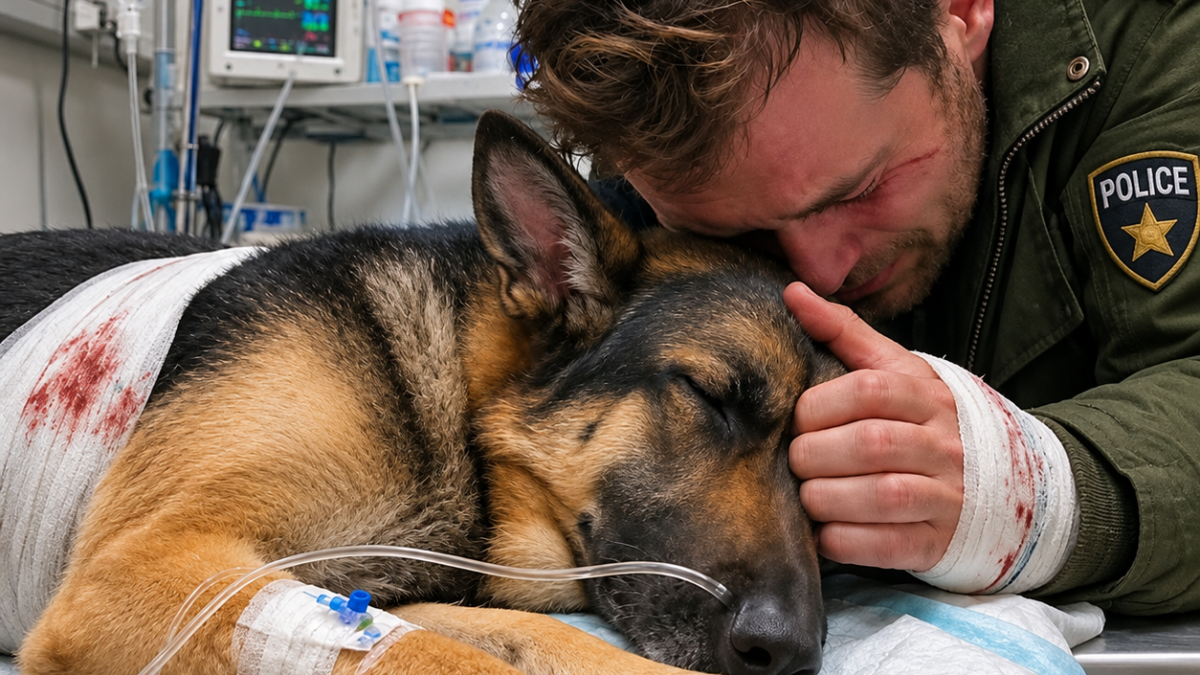
PART 2
The veterinarian looked at him for what felt like an eternity.
Then she nodded.
“Yes.”
Julien’s knees almost gave out.
I caught his arm.
The movement hurt him immediately, and he pulled his injured side inward, but he did not complain.
“He’s alive?”
“Yes.”
The doctor glanced toward the ICU door.
“But something changed during the night.”
Julien swallowed.
“Better or worse?”
She hesitated.
That hesitation terrified me.
“Different.”
Julien stared at her.
“I don’t understand.”
“Neither did we at first.”
She led us toward a small consultation room beside the intensive-care unit.
Julien shook his head.
“No.”
“Mr. Moreau—”
“I’ve waited ten days.”
His voice was weak, but there was steel underneath it.
“I’m not sitting in another room while he’s twenty feet away.”
The veterinarian studied him.
Then nodded.
“All right.”
She pulled up a chair in the corridor instead.
Julien lowered himself carefully.
I stayed standing.
The doctor crouched slightly so she was not towering over him.
“Rex’s condition has remained critical,” she began. “You know that.”
Julien nodded.
“He suffered severe trauma. We have been supporting his breathing, circulation, pain control, and monitoring him around the clock.”
“Marc told me.”
“His body has been fighting.”
Julien looked toward the door.
“And last night?”
“At 2:16 this morning, his heart rhythm became unstable.”
I felt my stomach tighten.
Julien did not move.
“We intervened immediately,” she continued. “For several minutes, we were genuinely afraid we were going to lose him.”
Julien’s jaw clenched.
“But you didn’t.”
“No.”
The doctor paused.
“Afterward, he began responding differently.”
“To what?”
“Sound.”
Julien stared.
The veterinarian looked at me.
“Yesterday evening, someone from your unit left a bag of his equipment here.”
I remembered.
One of our colleagues had brought Rex’s working harness, one of Julien’s old uniform shirts, and a blanket from the K9 vehicle because the veterinary team had asked whether familiar smells might help.
The veterinarian continued.
“We placed the shirt near him. His heart rate changed.”
Julien’s eyes filled instantly.
“Because it smelled like me?”
“We think so.”
“What else?”
“We played a voice recording.”
He looked confused.
“A recording?”
“One of your colleagues sent us a short video. You were speaking to Rex during training.”
Julien turned toward me.
I shook my head.
“I didn’t know.”
The doctor said, “When he heard your voice, his eyes moved.”
Julien stopped breathing.
At least that is what it looked like.
“What?”
“Not fully open. But movement.”
“Was he awake?”
“We cannot call it full consciousness yet.”
“Did he hear me?”
The veterinarian’s expression softened.
“I believe some part of him did.”
Julien leaned forward despite the pain.
“I need to go in.”
“Before you do, I need you to understand something.”
“What?”
“He may not react.”
Julien looked at her.
“He may not open his eyes. He may not move. His condition is still extremely serious.”
“I understand.”
“And if he becomes stressed—”
“I’ll leave.”
The doctor nodded.
“One more thing.”
Julien waited.
“We have to limit this to a few minutes.”
He looked at the ICU door.
Then back at her.
“I only need him to hear me once.”
The veterinary nurse brought us protective gowns.
Julien struggled to put his on because of his injuries.
I helped him.
His hands were shaking.
Not from weakness.
I had worked beside that man in situations where people were shouting, weapons were drawn, and everything around us was unpredictable.
I had never seen his hands shake like that.
Before the nurse opened the door, Julien looked at me.
“What do I say?”
I almost laughed because the question was so unlike him.
“You’ve talked to that dog every day for four years.”
“That’s different.”
“No, it isn’t.”
He stared down.
“What if he’s waiting for permission to stop?”
The words hit me hard.
I knew what he was asking.
What if Rex had survived ten days only because some part of him was still holding on?
What if hearing Julien meant he could finally let go?
I did not know how to answer.
So I said the only thing I believed.
“Then tell him whatever you’d want him to hear.”
Julien nodded once.
The door opened.
Rex was in a large intensive-care enclosure surrounded by equipment.
Tubes.
Monitors.
Lines.
A blanket covered most of his body.
His head rested on one side.
For a moment, I barely recognized him.
Police dogs seem indestructible when you work beside them.
They jump fences.
Run through darkness.
Pull toward danger with complete confidence.
Seeing Rex motionless beneath hospital lights felt wrong.
Julien stopped at the doorway.
His mouth opened.
Nothing came out.
The veterinarian moved a chair closer.
Julien sat beside Rex.
“Hey.”
His voice cracked immediately.
No reaction.
Julien tried again.
“Hey, buddy.”
Rex remained still.
I stood several feet behind them.
The veterinarian watched the monitors.
Julien reached toward the enclosure but stopped before touching him.
“Can I?”
The doctor nodded.
“Gently.”
Julien placed two fingers against Rex’s forehead.
The Malinois did not move.
I watched Julien close his eyes.
“I’m here.”
His hand shook.
“You hear me?”
Nothing.
Julien took a slow breath.
“You did your job.”
The monitor continued its steady rhythm.
“You hear me, Rex?”
His voice grew rougher.
“You did your job.”
He leaned closer.
“You don’t have to protect me right now.”
My throat tightened.
Julien stroked the side of Rex’s face.
“I’m okay.”
His breathing hitched.
“I’m hurt, but I’m okay.”
Still nothing.
“You saved me.”
The veterinarian looked at the monitor.
Something changed in her expression.
I saw it too.
The heart rate increased slightly.
Not dangerously.
Just enough to notice.
Julien did not see.
He was looking only at Rex.
“I should have been faster.”
I stepped forward.
“Julien—”
He ignored me.
“I should have seen him sooner.”
“Julien.”
“I should have—”
The veterinarian interrupted.
“Mr. Moreau.”
He looked up.
“Keep talking.”
“What?”
“His heart rate changed when you spoke.”
Julien stared at the monitor.
Then at Rex.
“Buddy?”
The heart rate shifted again.
Julien began crying.
Not loudly.
Tears simply moved down his face.
“Rex.”
The dog’s ear moved.
Just slightly.
I thought I imagined it.
Julien froze.
The veterinarian leaned closer.
“Again.”
“Rex?”
The ear moved.
This time there was no doubt.
Julien covered his mouth.
I felt the hair rise along my arms.
The dog’s eyelids trembled.
“Come on.”
Julien bent forward.
“I’m right here.”
Rex’s eyes opened.
Only a slit.
Clouded.
Unfocused.
They closed again.
Julien laughed through his tears.
“That’s him.”
The veterinarian whispered, “Stay calm.”
But Julien was barely holding himself together.
“Hey, buddy.”
Rex’s eyes opened again.
Longer this time.
His gaze moved.
Not much.
Then it stopped on Julien.
The entire room seemed to become still.
Julien did not move.
Neither did I.
Rex stared at him.
Then his front paw shifted beneath the blanket.
An inch.
Maybe less.
Julien reached for it.
Rex’s paw moved again.
Toward him.
Julien slid his hand underneath it.
The dog’s paw rested against his palm.
That was all.
No dramatic jump.
No sudden recovery.
Just one paw.
One hand.
And four years of partnership contained inside that touch.
Julien bent his head over Rex’s paw.
“You idiot.”
His voice broke.
“You absolute idiot.”
Rex’s eyes remained open.
“You weren’t supposed to do that.”
The veterinarian turned slightly away.
Even she was crying.
Julien rubbed his thumb over Rex’s paw.
“You were supposed to stay behind me.”
Rex blinked.
“No.”
Julien shook his head.
“Don’t look at me like that.”
I laughed despite myself.
It came out like a sob.
For several minutes, Julien simply talked.
Nothing important.
That may have been what made it important.
He told Rex about the hospital food.
About one of our colleagues who still owed him twenty euros.
About how terrible my coffee was.
I protested.
Julien ignored me.
Rex watched.
His eyes closed occasionally.
Then opened again when Julien spoke his name.
Finally, the veterinarian touched Julien’s shoulder.
“We need to let him rest.”
Julien nodded.
But he did not release Rex’s paw.
“Just a second.”
The veterinarian waited.
Julien leaned toward the dog’s ear.
“I’m coming back.”
Rex’s eyes moved.
“You understand?”
Julien swallowed.
“I’m coming back.”
Then he let go.
Rex’s paw remained where Julien’s hand had been.
We left.
Outside the ICU, Julien leaned against the wall.
For several seconds, neither of us spoke.
Then he asked, “Did you see that?”
“Yes.”
“He knew me.”
“Yes.”
“He knew me.”
This time, I understood he was not asking.
He needed to say it aloud.
The veterinarian joined us.
“That was the strongest purposeful response we’ve seen.”
Julien looked at her.
“So he’s waking up?”
“Maybe.”
“Maybe?”
“I need you to be careful with hope.”
Julien’s expression changed.
“Doctor, ten minutes ago you were telling me he might not react at all.”
“That’s true.”
“He opened his eyes.”
“Yes.”
“He moved toward me.”
“Yes.”
“So let me have hope.”
She looked at him for a moment.
Then smiled.
“Fair enough.”
Hope did not mean recovery became easy.
The next forty-eight hours were still dangerous.
Rex’s neurological responses improved gradually.
Then stalled.
Then improved again.
Julien returned to the hospital under strict orders.
He hated leaving.
“I told him I was coming back.”
“You are.”
“When?”
“When your doctors say you can.”
He glared at me.
“You enjoy this.”
“Immensely.”
He did not laugh.
That evening, the veterinarian called me.
Rex had opened his eyes spontaneously.
The next morning, he responded when a nurse said his name.
By the third day after Julien’s visit, he could lift his head for several seconds.
I told Julien.
He cried again.
Then pretended he had something in his eye.
Police officers are extremely predictable when they do not want to admit they are emotional.
A week later, Julien was allowed another visit.
This time Rex was conscious when we entered.
Weak.
Confused.
But awake.
The moment Julien appeared, Rex tried to stand.
The veterinarian immediately stopped him.
“No.”
Rex struggled.
Julien hurried forward.
“Stay.”
It was the first command he had given his partner since the shooting.
Rex stopped.
Everyone in the room stared.
Julien smiled.
“Still listening.”
Rex’s tail moved beneath the blanket.
Once.
Then again.
Julien looked at me.
“Did you see?”
“Yes.”
“You keep asking me that.”
“Because you’re old.”
“I am six years older than you.”
“Ancient.”
The veterinarian shook her head.
“I can see why the dog prefers both of you unconscious.”
That was the first time we laughed inside that room.
Recovery happened slowly.
Rex had significant injuries.
There were concerns about infection.
Muscle loss.
Pain.
Whether he would ever return to full working condition.
Julien asked the question before anyone else did.
“Will he work again?”
The veterinarian looked uncomfortable.
“You’re asking very early.”
“I need the truth.”
“We don’t know.”
Julien nodded.
Then surprised everyone.
“He doesn’t need to.”
The veterinarian looked at him.
“If he never works another day, he comes home.”
I knew what that meant.
Police K9 partnerships are complicated by duty, certification, fitness, and departmental decisions.
But Julien had already made his emotional decision.
Rex was not equipment.
Not to him.
Never had been.
The shooting investigation continued while both recovered.
The armed man had survived the confrontation and was taken into custody.
Evidence from the warehouse established far more than we had known when we first entered.
There were illegal weapons.
Stolen goods.
Evidence linking the location to other serious offenses.
But Julien cared about none of that when I first told him.
“Is he charged?”
“Yes.”
“With shooting Rex?”
“The full incident is part of the case.”
Julien stared at the floor.
“I want him to know.”
“Know what?”
“That Rex lived.”
I looked at him.
“Why?”
Julien’s jaw tightened.
“Because he tried to take everything from me.”
There it was.
The anger I had been waiting for.
Not loud.
Not explosive.
Worse.
Cold.
“You know how this works,” I said.
“He fired at me.”
“Yes.”
“And Rex—”
“I know.”
Julien looked away.
“I want him to look at what he did.”
I sat opposite him.
“You want justice?”
“Yes.”
“Then let the case do that.”
His eyes came back to mine.
“Easy for you to say.”
“No.”
My voice became harder.
“I was there too.”
Silence.
“I heard the shot. I saw both of you fall. I put my hands in Rex’s blood while we waited for transport.”
Julien said nothing.
“I wanted to hurt him too.”
That surprised him.
“You?”
“Yes.”
“What stopped you?”
“Twenty-eight people were trusting me to remain a police officer instead of becoming another angry man in a warehouse.”
He almost smiled.
“That sounds rehearsed.”
“It does now.”
I leaned back.
“But revenge is cheap, Julien.”
His face hardened.
“What he gets in a courtroom will never feel equal to what Rex went through.”
“No.”
“Then what?”
I thought about the dog in ICU.
“Rex living.”
Julien looked at me.
“That’s the part he couldn’t control.”
The anger in his face shifted.
“He pulled the trigger.”
“Yes.”
“But he does not get to decide the ending.”
That sentence stayed with both of us.
Months later, when the criminal case moved forward, Julien gave a statement.
I was there.
His injuries had improved.
He still moved carefully.
Rex was in rehabilitation and officially removed from operational duty while his future was evaluated.
Julien was asked about the warehouse.
He described the sequence calmly.
The darkness.
Rex alerting.
The armed man appearing.
The weapon.
The shot.
Then the question came.
“What did your dog do?”
Julien stopped.
For the first time in his testimony, his voice changed.
“He moved in front of me.”
“Was that commanded?”
“No.”
“Did you direct him to engage?”
“No.”
“What did he do?”
Julien looked straight ahead.
“He saw the weapon before I could fully react, and he placed himself between the gun and me.”
Silence filled the room.
“And the result?”
Julien inhaled.
“I’m alive.”
That was all.
He did not dramatize it.
He did not need to.
The court proceedings eventually led to serious consequences for the shooter related to the attack, the firearm, and the criminal activity tied to the warehouse.
Julien attended part of the process.
Not all of it.
The first time he saw the man again, I stood beside him.
I watched Julien’s hands.
They remained still.
The defendant avoided his eyes.
Later, outside, Julien said, “I thought I’d feel something.”
“What?”
“I don’t know.”
He looked toward the courthouse.
“Victory.”
“Do you?”
“No.”
We walked toward the car.
Then I asked, “What do you feel?”
Julien thought for a while.
“I want to go see Rex.”
That was the answer.
So we did.
By then, Rex had moved from intensive care into rehabilitation.
The first time we watched him try to walk again, Julien nearly broke.
Rex wore a supportive harness.
Two veterinary rehabilitation staff stood beside him.
His front legs worked better than the rear.
He took one step.
His back end trembled.
Second step.
His paw dragged.
Julien clenched his fists.
“Come on, buddy.”
Third step.
Rex stopped.
The therapist said, “That’s enough.”
Julien shook his head.
Rex tried again.
“Rex, stay.”
The dog looked at him.
Julien crouched painfully.
“You don’t have to prove anything.”
Rex’s tongue came out slightly.
Panting.
Julien put a hand against his chest.
“You already proved everything.”
Rex leaned into him.
That became the pattern of rehabilitation.
Rex wanted too much.
Julien wanted too much for him.
The veterinary team forced both of them to slow down.
Physical therapy.
Controlled movement.
Hydrotherapy.
Strength work.
Rest.
More rest than either handler or dog wanted.
Some days Rex improved.
Some days he seemed exhausted by movements that had once been effortless.
Julien attended as many sessions as his own medical appointments allowed.
Eventually, he was cleared to walk without assistance.
Not comfortably.
But independently.
The first time both of them entered the rehabilitation yard together, I stood behind the fence.
Rex wore a harness.
Julien still had a slight limp.
They looked at each other.
Julien smiled.
“We’re pathetic.”
Rex wagged.
“Speak for yourself,” I said.
Julien looked back.
“Nobody asked you.”
They walked.
Slowly.
Twenty yards.
Turn.
Twenty yards back.
No commands beyond what was necessary.
No police work.
No search.
No pursuit.
Just two wounded partners learning how to move through the world again.
Halfway back, Rex stumbled.
Julien immediately reached for the harness.
Rex regained his balance.
He looked up.
Julien looked down.
For several seconds, they stood there.
Then Julien laughed.
“You’re supposed to be helping me.”
Rex’s tail moved.
“I think he is,” I said.
Julien scratched his neck.
“Yeah.”
He looked toward me.
“He is.”
The department eventually faced the question everyone had avoided.
Could Rex return to duty?
Veterinary evaluations were cautious.
He had recovered far beyond what anyone predicted during those first ten days.
But “alive” and “fit for police work” are very different standards.
A working Malinois needs speed.
Power.
Endurance.
Precision.
Confidence in movement.
Rex had most of his personality back.
He did not have the same body.
The final recommendation came several months after the shooting.
Retirement.
Julien read the document twice.
Then folded it.
I waited for him to react.
He did not.
Finally I asked, “You okay?”
“Yes.”
“You sure?”
He looked at the paper.
“He earned it.”
I smiled.
“Definitely.”
“What happens officially?”
“There’s paperwork.”
“Of course.”
“Everything important in policing eventually becomes paperwork.”
He laughed.
Then looked through the glass where Rex was sleeping.
“I want him.”
“I assumed.”
“No, I mean officially. Home. Mine.”
“Julien.”
“What?”
“That dog has thought you were his for four years.”
He stared at me.
“Do not ruin this.”
“I’m just saying.”
The adoption and retirement arrangements were completed.
The day Rex left veterinary rehabilitation permanently, half our unit showed up.
The staff had made a small sign.
REX — RETIRED, NOT DEFEATED.
Julien called it embarrassing.
Then took a photograph of it.
Rex walked out wearing a simple collar.
No working harness.
No police markings.
He stopped in the lobby because everyone was watching.
Then he saw Julien.
His tail started.
Julien crouched.
“Ready?”
Rex walked toward him.
Slowly.
One front paw.
Then the other.
His gait was not perfect.
Probably never would be.
Julien did not care.
He clipped on the leash.
The dog looked toward the clinic doors.
Julien looked at me.
“Last time he left a hospital, he was carried.”
I nodded.
“This time he walks.”
They went through the doors together.
Outside, Rex stopped.
Cold air moved through his coat.
Traffic sounded in the distance.
He lifted his nose.
Then he walked toward Julien’s car.
He remembered it.
Of course he did.
Julien opened the back.
Rex tried to jump.
Six people shouted, “No!”
Rex looked offended.
I laughed so hard my ribs hurt.
Julien used the small ramp we had brought.
“Retired,” he told the dog. “You are now officially fragile.”
Rex climbed inside and immediately turned around as if insulted.
“Same personality,” I said.
“Unfortunately.”
The first night at home was harder than Julien expected.
Rex had slept in his house before, but this was different.
No shift tomorrow.
No equipment by the door.
No command to load into the vehicle.
Julien told me later that Rex woke three times and walked toward the room where his working harness had been stored.
Each time, he stood there.
Waiting.
Julien finally moved the equipment.
Not because Rex needed to forget.
Because both of them needed to learn a new routine.
Morning walks.
Medication.
Rehabilitation exercises.
Food.
Rest.
Short trips.
No warehouse searches.
No dangerous arrests.
No nights waiting in a vehicle outside an operation.
At first, Rex became restless whenever Julien put on a jacket.
He would go to the door.
“You’re retired.”
Rex stared.
“I’m serious.”
Tail wag.
“You nearly died.”
Rex stepped closer to the door.
Julien called me.
“He doesn’t understand retirement.”
“He’s French.”
“What does that mean?”
“Nobody understands retirement.”
“That is not helpful.”
Slowly, Rex learned.
Or at least accepted.
He discovered afternoons in the garden.
Sleeping in sunlight.
Walking without a working harness.
Visitors who did not mean an operation was beginning.
Julien learned too.
For four years, his identity had included Rex beside him at work.
Now he had to return without him.
The first day Julien was medically cleared for administrative duty, he stood in his kitchen putting on his jacket.
Rex went to the door.
Julien froze.
Then knelt.
“Not today.”
Rex stared.
Julien swallowed.
“You stay.”
Rex remained standing.
“You saved me once.”
His voice became softer.
“I’m not asking you to do it again.”
Rex sat.
Julien left.
When he reached his car, he cried.
He told me that later.
I told him I already knew.
“How?”
“You forgot your sunglasses.”
“What?”
“You came into the office with red eyes and claimed it was allergies in December.”
He glared.
“I hate you.”
“No, you don’t.”
Rex adapted faster than Julien.
Dogs often do.
They live closer to what is happening now.
Humans insist on replaying what already happened.
Julien replayed the warehouse endlessly.
He heard the shot in dreams.
Sometimes he woke reaching toward the floor as though Rex was still lying there.
He began seeing a psychologist through the department.
At first, he hated it.
“This is ridiculous.”
“You almost died.”
“So?”
“So normal people have reactions.”
“I am normal.”
“That argument just destroyed itself.”
Over time, he admitted what really haunted him.
Not being shot.
Rex moving first.
“He chose me.”
We were sitting outside the K9 unit one evening.
“Yes.”
“He had a second.”
“Probably less.”
“And he chose.”
I looked at him.
“What would you have done?”
“For Rex?”
“For me.”
Julien frowned.
“If I saw someone aiming at you?”
“Yes.”
“I’d move.”
“Exactly.”
“That’s different.”
“Because?”
“I know what I’m doing.”
I laughed.
“That is debatable.”
He ignored me.
“He’s a dog.”
I looked at him.
“And?”
Julien stared across the yard.
“He shouldn’t have had to make that choice.”
“No.”
“But he did.”
“Yes.”
He rubbed his hands together.
“I don’t know how to live with that.”
I thought about the first hospital visit.
The paw in his hand.
“Maybe you don’t repay it.”
He looked at me.
“What?”
“You keep trying to balance some imaginary account.”
“He saved my life.”
“I know.”
“How do you repay that?”
“You don’t.”
“That’s not good enough.”
“It has to be.”
I nodded toward the parking lot.
“You give him a good life. That’s it.”
Julien stayed quiet.
“Food. Walks. Pain medication when he needs it. Let him steal your sofa.”
“He already does.”
“Then he’s collecting interest.”
That finally made him smile.
The most surprising part came almost a year after the shooting.
Our unit was invited to a recognition ceremony.
Several officers involved in the warehouse operation were being honored.
So was Rex.
Julien initially refused.
“He doesn’t care about medals.”
“No.”
“He doesn’t understand ceremonies.”
“No.”
“He’ll hate the crowd.”
“Maybe.”
“So why go?”
“Because you understand.”
Julien looked at me.
“And because the people who work with these dogs understand.”
Eventually, he agreed.
Rex arrived wearing no working gear.
Only a collar.
His gait still had a slight irregularity in the rear.
Most people would not notice.
I did.
Julien did.
When they entered the hall, the room stood.
Julien looked immediately uncomfortable.
Rex looked delighted.
To him, one hundred people standing probably meant something interesting was about to happen.
The official speaking described the operation briefly.
Then the shooting.
Then Rex’s action.
Julien stared at the floor.
When Rex’s name was called, Julien walked forward with him.
The citation recognized extraordinary courage in protecting his handler under immediate threat.
A small medal was attached to a ceremonial ribbon.
Rex tried to sniff it.
People laughed.
Julien knelt.
“Of course.”
Then someone in the audience began clapping.
One person.
Then another.
The whole room joined.
Rex looked around.
Julien’s face changed.
He put one arm around the dog’s neck.
Rex leaned against him.
And in front of everyone, Julien stopped trying to hide what it meant.
He cried.
No shame.
No turning away.
He simply held Rex.
The applause continued.
Afterward, reporters asked questions.
Julien answered a few.
One asked, “Do you consider Rex a hero?”
Julien looked at the dog.
“No.”
The reporter seemed surprised.
“No?”
“He’s my partner.”
“Isn’t what he did heroic?”
“Yes.”
“But you wouldn’t call him a hero?”
Julien rubbed Rex’s head.
“I’m saying the word isn’t big enough.”
That quote appeared everywhere afterward.
Julien hated that.
I enjoyed it immensely.
He received messages from strangers.
Children sent drawings.
Former handlers sent photographs of retired K9s.
One letter came from the family of an officer Rex had helped locate during an earlier missing-person search.
Another from a woman whose father had once been found by our unit after wandering away during winter.
Julien kept them all.
One envelope remained unopened for weeks.
The return address was from a correctional facility.
He knew immediately.
The shooter.
Julien brought it to me.
“What do I do?”
“Whatever you want.”
“You want to read it?”
“No.”
“Why?”
“Because it’s addressed to you.”
He stared at it.
“What if it’s an apology?”
“Then you decide what it’s worth.”
“What if it isn’t?”
“Then you decide what that’s worth too.”
The envelope sat on his kitchen counter for nine days.
On the tenth, he opened it.
I was not there.
Later, he called.
“He apologized.”
I waited.
“That’s good.”
“No.”
“Why?”
“It’s not.”
He sounded angry.
“What did he say?”
“That he panicked.”
I said nothing.
“That he wasn’t thinking clearly.”
Still nothing.
“That he never meant to hit the dog.”
Julien laughed bitterly.
“As if that fixes anything.”
“No.”
“He said he thinks about that night.”
“I imagine he does.”
“He asked me to forgive him.”
There it was.
The real problem.
“What are you going to do?”
“I don’t know.”
“You don’t owe him anything.”
“I know.”
“Forgiveness included.”
Silence.
Then Julien said, “I don’t want to hate him forever.”
“That’s different.”
“Is it?”
“Yes.”
I leaned against my kitchen counter.
“Not hating someone is something you do for yourself.”
“And forgiveness?”
“That’s your business.”
He stayed quiet.
“What would you do?”
“Stop asking me questions that make me sound wise.”
“Marc.”
I sighed.
“I would not answer today.”
“Why?”
“Because you’re still angry.”
“I’m always going to be angry.”
“Maybe.”
I thought about Rex.
“But the dog is sleeping on your sofa while the man who shot him is sitting in prison.”
Julien said nothing.
“Do you understand?”
“No.”
“You keep thinking you need a better revenge.”
His breathing slowed.
“You already have it.”
“What?”
“Go look at Rex.”
There was a pause.
Then I heard movement.
Julien must have walked into the living room.
“He’s asleep.”
“Exactly.”
“What does that mean?”
“It means the shooter failed.”
Silence.
“He tried to kill you.”
“Yes.”
“You lived.”
“Yes.”
“He shot Rex.”
Julien looked at the dog.
“He lived.”
“Yes.”
“He tried to destroy your partnership.”
Nothing.
“Instead Rex retired into your house and now owns your furniture.”
Julien laughed.
A real laugh.
“So what am I supposed to write back?”
“You don’t have to write anything.”
He never did.
Not because the apology meant nothing.
Because Julien eventually understood that closure did not have to come from the person who caused the wound.
Sometimes closure was Rex asleep with his paws moving in a dream.
Sometimes it was a slow walk through the neighborhood.
Sometimes it was a veterinary checkup showing stable progress.
Sometimes it was a ridiculous argument over who had stolen half a sandwich.
Rex.
Always Rex.
Two years after the warehouse incident, I retired from the unit.
My own dog had retired earlier.
Julien remained, though his work changed.
He no longer served in exactly the same operational role.
His injuries had consequences too.
Some pain remained.
Certain movements never became completely comfortable again.
But he was alive.
Rex was older.
Gray had begun appearing around his muzzle.
His rear leg remained weaker.
Long walks were slower.
Short ones seemed to matter more.
One autumn afternoon, I visited Julien at home.
Rex was sleeping on the terrace.
I sat beside him.
He opened one eye.
“Remember me?”
Tail thump.
“Good.”
Julien brought coffee.
We sat.
For a while, nobody said anything.
Rex slept between us.
Eventually, I asked, “Do you still hear it?”
Julien knew what I meant.
“The shot?”
“Yes.”
“Sometimes.”
“Less?”
“Yes.”
He looked down at Rex.
“You?”
“Sometimes.”
“Dreams?”
“Mostly when something echoes indoors.”
Julien nodded.
We both understood.
Then he said, “I used to think that was the sound I’d remember most.”
“What is now?”
He thought.
“The monitor.”
I looked at him.
“In the clinic?”
“Yes.”
“When his heart rate changed?”
Julien nodded.
“When I said his name.”
Rex opened his eyes briefly.
Julien smiled.
“That sound.”
He leaned down.
“I thought the gunshot would always be louder.”
He scratched Rex’s chest.
“It isn’t anymore.”
That may be the most important thing I learned from them.
Trauma is loud.
Healing usually is not.
A gunshot echoes.
Recovery sounds like breathing.
A monitor settling.
A paw moving across a blanket.
A dog’s nails clicking slowly across a kitchen floor.
A leash being clipped on for an ordinary walk.
A man laughing again.
The shooter had one second.
One trigger pull.
For a while, it seemed as though that second would define everything that came after.
It didn’t.
Because life continued producing seconds of its own.
The second Rex opened his eyes.
The second his paw moved into Julien’s hand.
The second he stood.
The second he walked.
The second he went home.
Thousands of ordinary seconds eventually became larger than the violent one.
That was the real revenge.
Not violence returned.
Not hatred.
Not imagining suffering for the man responsible.
The revenge was that the bullet failed to write the ending.
Years later, when people asked me about the most extraordinary thing I had ever seen during eighteen years in the K9 unit, they expected a dramatic answer.
A chase.
An arrest.
A search.
I always thought about the warehouse.
But not the moment everyone assumed.
Not the gunshot.
Not even Rex jumping between the weapon and Julien.
I remembered the veterinary ICU.
Julien in bandages.
Barely able to sit comfortably.
His hand inside the enclosure.
Rex unconscious beneath a blanket.
Julien whispering:
“You did your job.”
Then that tiny movement.
An ear.
An eyelid.
A paw.
I remembered the way Rex looked at him when his eyes finally opened.
Dogs do not understand medals.
Court cases.
Sentences.
Newspaper headlines.
They do not understand the word hero the way we use it.
But Rex understood Julien.
He knew his voice.
His smell.
His hand.
That was enough to pull something inside him toward the surface.
People liked to say Julien saved Rex during rehabilitation.
Julien never accepted that.
“He came back on his own,” he said.
Maybe.
But I think partnerships are rarely that simple.
Rex saved Julien in the warehouse.
Julien gave Rex a reason to fight through those next terrible days.
Then each carried the other through recovery.
One taking slower steps because of damaged ribs.
One because of damaged legs.
One learning not to blame himself.
One learning how to live without work.
That was how they healed.
Together.
There came a time when Rex could no longer climb onto Julien’s bed without help.
Julien bought a ramp.
Then Rex refused to use it.
“He thinks it’s beneath him,” Julien complained.
“He is a retired decorated officer.”
“He is a dog.”
Rex stared at him.
I said, “Careful. He heard that.”
Eventually Rex used the ramp.
Only when nobody seemed to be watching.
His age began showing more strongly.
The dog who once seemed capable of running forever became selective about movement.
Cold mornings made him stiff.
He slept more.
Julien adjusted everything around him.
Rugs on slippery floors.
Raised food bowls.
Shorter walks.
More veterinary checks.
Medication.
One night Julien called me.
I knew from his voice something was wrong.
“He wouldn’t eat dinner.”
“How long?”
“Just tonight.”
“Any other symptoms?”
“He’s tired.”
“Julien.”
“I know.”
“You know what?”
“I’m panicking.”
That honesty surprised me.
“Call the vet.”
“I already did.”
“Then follow what they say.”
“What if—”
“Don’t.”
Silence.
“You always tell me not to catastrophize.”
“That’s because you do it professionally.”
Rex ate breakfast the next morning.
Julien sent me a photograph of the empty bowl.
No message.
I replied:
“Drama queen.”
He sent back:
“Me or Rex?”
“Both.”
Years passed.
Rex grew old.
That is the price of the ending we had once begged for.
During those first ten days, we wanted only one thing.
More time.
Then we received it.
And time does what time always does.
It moves.
Rex became nine.
Then ten.
His muzzle became almost completely gray.
His hearing softened.
His eyes clouded slightly.
But when Julien picked up a leash, Rex still stood.
Slower.
Always.
One winter afternoon, I visited them after snow.
Julien and I walked with Rex along a quiet path.
His steps were careful.
The old dog stopped repeatedly to smell everything.
Julien waited.
No impatience.
No command.
At one point, Rex simply stood staring across a field.
Julien stopped beside him.
“What is he doing?”
I asked.
“Being retired.”
“That looks suspiciously like doing nothing.”
“Exactly.”
We stood there too.
I thought about the warehouse.
Darkness.
Concrete.
A gun.
That impossible second.
If you had shown me this quiet winter scene that night, I would not have believed you.
Rex alive.
Old.
Retired.
Annoyingly slow.
Julien complaining about the cold.
Me complaining about Julien.
Everything normal.
That became my definition of a happy ending.
Not perfection.
Normality.
The chance to become boring again.
Rex never returned to police work.
He never needed to.
He had done enough.
More than enough.
The armed man eventually disappeared from our daily conversations.
The legal case ended.
The headlines stopped.
People moved on.
But Rex remained.
Every morning.
Every walk.
Every ordinary evening.
That was justice.
The man who pulled the trigger became a file.
Rex became a life.
And if I had to choose between those two kinds of remembrance, I knew which mattered.
On the anniversary of the shooting one year, Julien did something unexpected.
He drove to the veterinary clinic.
Not for an appointment.
Rex was with him.
The staff recognized them immediately.
Several nurses came out.
One veterinarian crouched slowly.
“Rex?”
His tail moved.
She laughed.
“You look much better standing up.”
Julien smiled.
“He has opinions now.”
“He always had opinions.”
They took a photograph.
The veterinarian who had stopped us outside the ICU stood beside Rex.
Afterward she pulled me aside.
“I didn’t think he would survive that first week.”
“I know.”
“I genuinely thought that visit might be goodbye.”
I looked across the lobby.
Julien was talking to a technician.
Rex was leaning against his leg.
“What changed?”
I asked.
She considered.
“Medicine.”
I nodded.
“Luck.”
“Yes.”
“Julien?”
She smiled.
“I’m a scientist.”
“So?”
“So I’m not going to tell you love woke a dog from a coma.”
“Very disappointing.”
She laughed.
“But.”
I waited.
“We know familiar voices and smells can matter neurologically.”
“So you’re saying love.”
“I am saying familiar sensory stimulation.”
“Love with paperwork.”
She shook her head.
“You police people are impossible.”
Before we left, she knelt beside Rex again.
“You were a terrible patient.”
Rex licked her face.
She laughed.
“Apparently no remorse.”
Outside, Julien stopped near the car.
“You know what I was thinking?”
“That we need lunch?”
“No.”
“Then I’m less interested.”
He ignored me.
“I asked you that first day if you thought he’d hear me.”
I remembered.
In the parking lot.
Julien pale.
Bandaged.
Terrified.
“Yes.”
“You wouldn’t answer.”
“I answered.”
“You said we were going to see him.”
“That was an answer.”
“It was a politician’s answer.”
“I was protecting you.”
Julien looked at Rex.
“He heard me.”
“Yes.”
For a moment, we were back there.
Ten days after the gunshot.
ICU door.
Doctor approaching.
Julien asking only one thing.
Is my dog alive?
If I could have spoken to the version of myself standing in that corridor, I would have told him:
Yes.
He is alive.
And one day he will walk out.
He will retire.
He will steal food.
He will refuse a ramp because he is stubborn.
He will grow gray.
He will sleep in sunlight.
He will stand in a room while people applaud him.
His handler will live long enough to complain about him every day.
The man who shot them will face consequences.
But that will not be the part that matters most.
The part that matters is what happens after everyone stops looking.
The quiet mornings.
The slow walks.
The healing.
The years.
That is the part violence can never predict.
Rex had thrown himself between a gun and the person he trusted most.
For ten days, none of us knew whether that choice had cost him his life.
It didn’t.
It cost him his career.
It cost him pain.
Months of rehabilitation.
Permanent physical limits.
But it gave Julien something no award could ever repay.
Time.
And Julien spent that time the only way he could.
Giving it back.
He stayed.
When Rex could not walk, Julien waited.
When Rex became frustrated, Julien waited.
When old age eventually slowed him even more, Julien waited.
That became their story.
Not one dog saving one man.
Two partners refusing to leave each other behind.
And when I think about revenge now, I think about how little revenge actually matters compared with that.
The shooter had violence.
Rex had loyalty.
The shooter had one bullet.
Julien and Rex had years.
The bullet was loud.
Those years were stronger.
So if you ask me what happened after the veterinarian stopped us outside that ICU room, I will tell you this:
Rex lived.
Not instantly.
Not easily.
Not without scars.
But he lived.
He opened his eyes when Julien spoke.
He placed his paw into the hand of the man he had saved.
He learned to walk again.
He retired.
He went home.
And the person who had tried to end their story had to live with the fact that he failed.
That is enough justice for me.
Because the last time I saw Rex, he was lying in a patch of afternoon sun with his gray muzzle resting across Julien’s shoe.
The same fearless dog who had once launched himself toward a gun no longer had anything left to prove.
Julien looked down at him.
Rex opened one eye.
Julien smiled.
“You good, buddy?”
His tail hit the floor once.
Yes.
He was good.
And after everything, that was the ending he deserved.
The gunshot lasted less than a second.
But even now, years later, I can still hear it.
Not the way you hear an ordinary loud noise and then forget it. I hear the echo rolling through the empty warehouse, the sharp crack bouncing off concrete walls, the sudden scraping of boots, and then Julien screaming one name.
“Rex!”
My name is Marc Delorme.
For eighteen years, I worked in a police K9 unit in northern France. I had been inside buildings where suspects were armed, searched forests in freezing rain, spent nights tracking missing people, and stood beside dogs that would keep working long after most humans had reached their limit.
I thought I understood courage.
Then I watched Rex move.
He was a six-year-old Belgian Malinois, lean, fast, and almost frighteningly intelligent.
His handler, Julien Moreau, had worked with him for four years.
They had completed more than one hundred and fifty operations together.
Dangerous arrests.
Searches for missing people.
Late-night calls.
Long surveillance assignments.
The kind of work where you learn very quickly who stays calm under pressure.
Rex trusted Julien completely.
And Julien trusted him just as much.
We joked about it sometimes.
If Julien was tense after a difficult call, Rex would walk over and rest one paw on his knee.
If Julien touched his tactical vest, Rex was already waiting by the door.
If Julien said nothing but changed the way he breathed, Rex noticed.
One night I told him, “That dog reads you better than your family does.”
Julien scratched behind Rex’s ears.
“He doesn’t read me.”
“What does he do?”
“He knows me.”
At the time, I laughed.
After the warehouse, I understood.
It happened in November 2024.
We were called to an old industrial building outside Lille after reports of suspicious activity.
The initial information was vague.
Possible trespass.
Possible stolen property.
We expected to check the building and secure it.
Nothing more.
When we arrived, the place was almost completely dark.
Our flashlights moved across rusted machinery, abandoned pallets, broken shelving, and narrow corridors created by stacked equipment.
Julien moved ahead with Rex.
I followed several yards behind with my own dog.
We were progressing carefully when Rex stopped.
Instantly.
No hesitation.
His ears lifted.
His back straightened.
Every muscle in his body tightened.
Julien noticed immediately.
“What is it, buddy?”
Rex stared toward a gap between two large stacks.
I saw movement.
Then a man stepped forward.
He had a gun.
Everything after that became fragments.
Julien shifting his weight.
My hand moving.
A command forming in my throat.
And Rex.
Rex did not run straight at the gunman.
That detail matters.
He moved sideways.
Directly across Julien.
He placed himself between the weapon and his handler.
The gun fired.
Rex dropped.
Julien shouted his name.
Then Julien went down too.
For the next several minutes, training took over.
Commands.
Radio calls.
Movement.
Securing the threat.
Calling emergency services.
Making sure there was no second attacker.
When I finally reached Julien, he was lying on the concrete.
His face was pale.
Blood was spreading across his clothing.
Rex lay beside him.
The dog’s breathing was weak and uneven.
Julien tried to move.
“Don’t.”
He ignored me.
His hand reached toward Rex.
“Rex…”
“Julien, stay still.”
“Rex.”
His fingers touched the dog’s coat.
“Stay with me, buddy.”
I knelt between them.
There are moments in police work when everything inside you wants to become emotional, but you cannot allow it yet.
That was one of them.
Rex’s coat was soaked with blood.
I could see enough to know the injuries were severe.
Julien looked at me.
“Marc.”
“I’m here.”
“Save him.”
It was not an order.
It was a plea.
The paramedics arrived.
Julien was taken to the hospital.
Rex was transported separately to an emergency veterinary clinic with intensive-care facilities.
I remember standing outside after both vehicles left.
The warehouse suddenly felt enormous.
Quiet.
The smell of gunpowder still hung in the air.
My hands were covered in Rex’s blood.
One of my colleagues asked, “You okay?”
“No.”
He nodded.
Neither of us pretended otherwise.
The first twenty-four hours were terrible.
Julien underwent surgery.
Then another procedure.
His injuries were serious enough that doctors kept him under close observation.
Rex’s condition was even more uncertain.
The bullet had caused severe trauma.
The veterinary team stabilized him, but he remained unconscious.
Whenever I called the clinic, I heard the same words.
“Critical.”
“Stable for now.”
“Too early to know.”
“Very guarded prognosis.”
I began hating those phrases.
The third day passed.
Then the fourth.
Rex did not wake.
I visited the veterinary clinic after work.
Sometimes I stood outside his ICU enclosure and talked even though I was not sure he could hear me.
“Julien is still here.”
Nothing.
“He’s going to be furious if you leave.”
Nothing.
“You know how annoying he is.”
Still nothing.
I felt ridiculous.
But I kept talking.
On the seventh day, the veterinarian asked me to step into a consultation room.
That alone told me the news was not good.
She sat opposite me.
“Rex has survived longer than we initially feared he might.”
I waited.
“But?”
She exhaled.
“But we are still not seeing the neurological improvement we hoped for.”
I looked down at my hands.
“Is he dying?”
“I’m telling you his prognosis remains extremely guarded.”
That sentence again.
“What does that actually mean?”
She chose her words carefully.
“It means we need to prepare for the possibility that he may not recover.”
I sat there staring at the floor.
Police work teaches you procedures for almost everything.
What to do during an armed confrontation.
How to secure evidence.
How to clear a building.
Nobody teaches you how to tell a wounded officer that the dog who saved his life may die before he gets to see him.
I sat in my car outside the clinic for nearly an hour.
When Julien was finally awake enough to speak clearly, I went to the hospital.
He looked terrible.
Bandages.
Bruising.
Pain medication.
One arm held close to his ribs whenever he moved.
His first question was immediate.
“Where’s Rex?”
I had prepared an entire speech.
I forgot all of it.
“At the veterinary clinic.”
“He’s alive?”
“Yes.”
Julien stared at me.
“But?”
I hated that he knew me well enough to hear the missing word.
“He’s in critical condition.”
Julien closed his eyes.
His jaw tightened.
For several seconds, I thought he might be asleep.
Then he whispered, “I saw him.”
“What?”
“He moved in front of me.”
I said nothing.
“I saw the gun.”
His eyes opened.
“Then Rex was there.”
His voice broke.
“He knew.”
“Yes.”
“He knew what was happening.”
I pulled a chair closer.
“Julien—”
“He saved me.”
I nodded.
“Yes.”
“I should be with him.”
“You can barely sit up.”
“I don’t care.”
“Your doctors do.”
He turned his face away.
“I’m not leaving him alone.”
“He isn’t alone.”
“He’s my dog.”
“I know.”
“No.”
Julien looked back at me.
“He’s my partner.”
That ended the argument.
Not because I could take him immediately.
I couldn’t.
But I understood why he would keep asking.
Every day after that, he did.
“Can I go today?”
“No.”
“Tomorrow?”
“Ask your doctor.”
“I did.”
“What did he say?”
“He said no.”
“Then why are you asking me?”
“Because you’re easier to manipulate.”
Despite everything, I laughed.
On the tenth morning, his medical team finally agreed to a short supervised visit.
When I told him, Julien became completely quiet.
No celebration.
No smile.
He simply nodded.
I helped him into my car.
The movement alone left him breathing hard.
During the drive, he stared out the window.
After nearly twenty minutes, he spoke.
“Marc.”
“Yeah?”
“Do you think he’ll hear me?”
I kept my eyes on the road.
“I think you should talk to him.”
“That wasn’t my question.”
“I know.”
“You think he’ll know I’m there?”
I wanted to say yes.
Instead, I said, “We’re going to give him the chance.”
Julien looked out the window again.
When we arrived, a veterinary nurse met us.
She recognized Julien immediately.
Everyone at that clinic knew Rex’s story by then.
She led us toward the intensive-care section.
A few yards before the door, the veterinarian responsible for Rex approached.
She looked at Julien’s bandages.
Then at me.
Then back at him.
“Mr. Moreau, before you go in, I need to explain something that happened during the night.”
Julien stopped.
His face changed instantly.
“Doctor.”
“Yes?”
“Please don’t make me wait.”
She remained silent.
“Is my dog alive?”
“Yes.”
Julien’s shoulders dropped.
I caught his arm because his balance shifted.
He winced.
“He’s alive?”
“Yes.”
“But?”
She looked toward the ICU.
“At approximately two-sixteen this morning, Rex developed a serious heart-rhythm problem.”
Julien stared.
“We intervened immediately.”
“You almost lost him.”
“Yes.”
He lowered his head.
“But afterward, something changed.”
Julien looked back up.
“What?”
“His responses.”
She explained that one of our colleagues had brought in Rex’s working harness and an old shirt belonging to Julien.
The staff placed the shirt near him.
His heart rate changed.
Then they played a short recording of Julien talking during a training session.
“His eyes moved,” the veterinarian said.
Julien looked at me.
“You knew?”
“No.”
“Did he wake up?”
“Not fully,” she answered. “But it was the strongest response we’ve seen.”
Julien took one step toward the ICU door.
“I want to see him.”
“We can allow a short visit.”
“Now.”
“Yes.”
Before entering, the veterinarian warned him.
“He may not react again.”
“I understand.”
“He may not open his eyes.”
“I understand.”
“And if his vital signs become unstable, we stop.”
Julien nodded.
“I understand.”
The nurse helped us put on protective gowns.
Julien’s hands were trembling.
I had seen him enter buildings knowing armed suspects might be inside.
I had never seen his hands shake like that.
He looked at me.
“What do I say?”
I stared at him.
“You’re asking me?”
“What if this is goodbye?”
There it was.
The question neither of us had wanted to say aloud.
“What if he’s been holding on because he thinks I need him?”
I swallowed.
“Then tell him the truth.”
“What truth?”
“That you’re here.”
The ICU door opened.
Rex lay beneath a blanket surrounded by monitors and medical equipment.
For one terrible second, Julien did not move.
The dog who had always been restless now looked impossibly still.
Julien walked closer.
Slowly.
The veterinarian placed a chair beside Rex.
He sat.
“Hey.”
No response.
Julien swallowed.
“Hey, buddy.”
Nothing.
He looked at the veterinarian.
“Can I touch him?”
“Gently.”
Julien reached forward.
Two fingers touched the side of Rex’s head.
The dog did not move.
Julien closed his eyes.
“I’m here.”
Silence.
“You hear me?”
The monitor continued steadily.
“You did your job.”
His voice cracked.
“You hear me, Rex?”
He leaned closer.
“You did your job.”
I turned my face away for a second.
Julien continued.
“I’m okay.”
His voice became weaker.
“I’m still here.”
Nothing.
“You saved me.”
I saw the veterinarian glance at the monitor.
Then look again.
Julien had not noticed.
“I should have been faster,” he whispered.
“Julien,” I said.
“I should have seen him.”
“Stop.”
“I should have protected him.”
The veterinarian raised one hand.
“Mr. Moreau.”
Julien looked at her.
“Keep talking.”
“Why?”
“His heart rate changed.”
Julien turned back toward Rex.
“Buddy?”
The monitor shifted again.
His eyes widened.
“Rex?”
One ear moved.
Barely.
Julien froze.
I thought I had imagined it.
Then the veterinarian whispered, “Again.”
“Rex.”
The ear moved.
Julien covered his mouth.
The dog’s eyelids fluttered.
“Come on, buddy.”
Julien leaned forward.
“I’m here.”
Rex’s eyes opened slightly.
Then closed.
Julien started crying.
No attempt to hide it.
No embarrassment.
“Come on.”
The eyes opened again.
This time they remained open longer.
Unfocused at first.
Then they moved.
Toward Julien.
Rex looked at him.
I will never forget Julien’s face.
Relief.
Pain.
Guilt.
Love.
All at once.
Rex’s front paw shifted beneath the blanket.
An inch.
Then another.
Julien put his hand beneath it.
The paw settled into his palm.
Julien bent over it.
“You idiot.”
He laughed through tears.
“You absolute idiot.”
Rex blinked.
“You weren’t supposed to do that.”
His thumb moved over Rex’s paw.
“You were supposed to stay behind me.”
Rex kept looking at him.
Julien shook his head.
“No. Don’t give me that look.”
Even the veterinarian smiled.
For several minutes, Julien talked.
Not about the shooting.
Not about death.
He told Rex that hospital food was terrible.
That I still made bad coffee.
“That is completely unnecessary,” I said.
Julien ignored me.
He told Rex one of our colleagues still owed him money.
He described the weather.
Normal things.
That was what Rex needed.
Normal.
Eventually, the veterinarian said, “We need to let him rest.”
Julien nodded.
But he kept holding the paw.
“One second.”
He leaned close.
“I’m coming back.”
Rex watched him.
“You understand?”
Julien swallowed.
“I’m coming back.”
Then he released the paw.
Outside the ICU, Julien leaned against the wall.
“Did you see that?”
“Yes.”
“He knew.”
“Yes.”
“He knew it was me.”
“I know.”
The veterinarian joined us.
“That was the strongest purposeful response Rex has shown.”
Julien looked at her.
“He’s waking up?”
“He may be.”
“May?”
“I don’t want to give you certainty I can’t promise.”
Julien stared at her.
“Ten minutes ago you told me he might not react.”
“Yes.”
“He opened his eyes.”
“Yes.”
“He moved toward me.”
“Yes.”
“Then let me have hope.”
The veterinarian smiled.
“Okay.”
Hope did not make the next week easy.
Rex remained fragile.
Some hours he seemed more alert.
Others he slept almost constantly.
But the direction had changed.
He began opening his eyes spontaneously.
Then lifting his head.
Then responding to voices.
When Julien visited again, Rex was awake.
The moment he saw his handler, he tried to stand.
“Stay.”
Rex stopped.
Julien laughed.
“Still listening.”
The tail moved beneath the blanket.
That tiny wag became another victory.
Weeks passed.
Rex left intensive care.
Then began rehabilitation.
His muscles had weakened badly.
His injuries had affected his movement.
The first time he attempted to walk with support, Julien stood beside him.
One step.
Rex’s rear leg trembled.
Second step.
His paw dragged.
Third step.
He almost fell.
Julien grabbed the rehabilitation harness.
“Easy.”
Rex tried again.
“Enough,” the therapist said.
Rex resisted.
Julien crouched.
“You don’t have anything left to prove.”
The dog panted.
Julien placed a hand against his chest.
“You already did it.”
Rex leaned into him.
That became their routine.
Physical therapy for Rex.
Medical rehabilitation for Julien.
Sometimes I drove them both.
One would complain from the front seat.
The other from the back.
I never decided which was worse.
Eventually, Julien could walk without assistance.
Rex could too.
Neither moved exactly as before.
One afternoon, they walked together in the rehabilitation yard.
Twenty slow yards.
Turn.
Twenty back.
Halfway, Rex stumbled.
Julien reached down.
Rex recovered.
They looked at each other.
Julien smiled.
“We’re a mess.”
Rex wagged.
“You both are,” I said.
Julien looked over his shoulder.
“Nobody invited you.”
The department eventually had to decide whether Rex could return to operational work.
Everyone already knew the likely answer.
His recovery had been extraordinary.
But police work demands more than survival.
Speed.
Endurance.
Perfect mobility.
The veterinary recommendation was retirement.
Julien read the paperwork quietly.
I asked, “You okay?”
“Yes.”
“You sure?”
“He earned it.”
Then he looked toward Rex.
“He comes home with me.”
“Obviously.”
“I mean permanently.”
“Julien, he already thinks your house belongs to him.”
“This is serious.”
“So am I.”
The formal retirement arrangements were completed.
On the day Rex left rehabilitation, several members of our unit came.
The clinic staff had made a sign:
REX — RETIRED, NOT DEFEATED.
Julien complained that it was embarrassing.
Then secretly photographed it.
Rex walked through the lobby wearing an ordinary collar.
No working harness.
No police markings.
He saw Julien.
Tail wag.
Slowly, he crossed the room.
Julien clipped on the leash.
The last time Rex had left a hospital, he had been carried.
This time, he walked.
Outside, he tried to jump into the car.
Six people shouted at once.
“No!”
Rex looked offended.
Julien pointed toward the small ramp.
“You are officially fragile.”
Rex stared at him.
“Use it.”
He climbed the ramp with the expression of a dog who believed everyone around him had lost their minds.
Retirement was strange for both of them.
Rex still went to the door whenever Julien put on his jacket.
The first time Julien returned to the station without him, Rex stood waiting.
Julien knelt.
“Not today.”
Rex stared.
“You stay.”
No movement.
“You saved me once.”
Julien stroked his neck.
“I’m not asking you to do it again.”
Rex sat.
Julien left.
He later admitted he cried in the car.
I told him I already knew.
“How?”
“You walked into the office with red eyes.”
“Allergies.”
“In November?”
“I have seasonal allergies.”
“To what? Paperwork?”
He told me to shut up.
The shooter’s case continued in parallel.
There were serious charges tied not only to the shooting but to other criminal activity uncovered at the warehouse.
Julien wanted justice.
At first, what he really wanted was revenge.
He did not say that word.
He did not need to.
One evening, he told me, “I want him to know Rex lived.”
“Why?”
“Because he tried to take everything from me.”
I understood.
But I said, “Then Rex living is the answer.”
“That’s not enough.”
“It has to be.”
Julien looked angry.
“He shot my dog.”
“Yes.”
“He almost killed us.”
“Yes.”
“And you expect me to just move on?”
“No.”
I leaned forward.
“I expect you not to let him decide what kind of man you become afterward.”
That silenced him.
Months later, Julien gave formal testimony.
He described the warehouse.
The gun.
The shot.
Then someone asked, “What did Rex do?”
Julien paused.
“He moved in front of me.”
“Did you command him?”
“No.”
“Did you direct him toward the suspect?”
“No.”
“Then why did he move?”
Julien looked straight ahead.
“Because he knew.”
“Known what?”
“That I was in danger.”
“And the result?”
Julien inhaled.
“I’m alive.”
The courtroom became completely quiet.
The shooter eventually faced serious legal consequences.
I expected Julien to feel victorious.
He didn’t.
Outside the courthouse, I asked him, “What do you feel?”
He thought about it.
“I want to see Rex.”
So we left.
That became his real answer.
Not the courtroom.
Rex.
Months after the shooting, Rex could walk comfortably enough for short neighborhood walks.
He would never return to full police work.
He did not care.
He discovered sleeping in sunlight.
Taking too much space on the sofa.
Stealing Julien’s food.
Ignoring expensive dog beds in favor of lying directly in doorways.
One day I visited and found Rex stretched across the couch.
“Is he allowed there?”
“No.”
Rex did not move.
I looked at Julien.
“You appear to have excellent control of your former police dog.”
“He’s retired.”
“So rules no longer apply?”
“Apparently.”
Recovery changed Julien too.
The gunshot followed him into sleep.
Sometimes he dreamed about the warehouse.
Sometimes loud noises made him stop moving for half a second.
He began therapy.
He complained constantly.
“This is ridiculous.”
“You almost died.”
“So?”
“That is generally considered traumatic.”
“I’m fine.”
“You just told me you haven’t slept three nights in a row.”
He glared at me.
“Stop using facts against me.”
Eventually he admitted what bothered him most.
Not the bullet.
Rex’s decision.
“He chose to move in front of me.”
“Yes.”
“He had less than a second.”
“Yes.”
“And he chose me.”
I looked at him.
“What would you have done if the situation was reversed?”
Julien stared.
“What?”
“If you saw someone about to hurt Rex.”
“I’d move.”
“Exactly.”
“That’s different.”
“Why?”
He opened his mouth.
Then closed it.
For months, Julien had been trying to repay Rex.
As if courage created a debt.
I finally told him, “You can’t pay him back.”
“I have to.”
“No.”
“He saved my life.”
“Yes.”
“So what do I do?”
“Give him a good one.”
Julien looked at Rex sleeping nearby.
“That’s it?”
“That’s everything.”
Years passed.
The violent second inside the warehouse became smaller.
Not forgotten.
Never.
But surrounded by ordinary life.
Rex grew gray around the muzzle.
His injured leg became stiffer in winter.
Julien bought rugs so he would not slip.
Then a ramp for the bed.
Rex refused to use it because apparently retirement had not reduced his pride.
Eventually he used it only when nobody appeared to be watching.
Julien shortened the walks.
Changed medication when necessary.
Took him to regular veterinary appointments.
And every morning, Rex still watched him.
Still followed him.
Still knew him.
On the first anniversary of the shooting, our unit held a small recognition ceremony.
Julien did not want to attend.
“He doesn’t understand medals.”
“No.”
“He doesn’t care about recognition.”
“No.”
“Then why?”
“Because we do.”
Eventually, he agreed.
When Julien entered with Rex, the room stood.
Rex looked around, completely confused but pleased by the attention.
The citation described extraordinary courage in protecting his handler.
When they attached the ceremonial medal, Rex immediately tried to sniff it.
People laughed.
Then applause began.
Julien knelt beside him.
He put one arm around Rex’s neck.
And he cried.
No pretending.
No turning away.
Later, a reporter asked, “Do you consider Rex a hero?”
Julien looked down at him.
“No.”
The reporter seemed surprised.
“No?”
“He’s my partner.”
“But what he did was heroic.”
Julien nodded.
“Yes.”
“So why not call him a hero?”
Julien rubbed Rex’s head.
“Because the word isn’t big enough.”
That quote followed him everywhere.
He hated it.
I loved reminding him.
Nearly two years after the shooting, I visited Julien at home.
Rex was sleeping outside in a patch of afternoon sun.
His muzzle was much grayer.
I sat down beside him.
He opened one eye.
“Remember me?”
His tail hit the ground once.
“Good.”
Julien brought coffee.
We sat in silence for a while.
Then I asked, “Do you still hear it?”
He knew immediately.
“The gunshot?”
“Yes.”
“Sometimes.”
“Less?”
He nodded.
“You?”
“Sometimes.”
Julien looked at Rex.
“I used to think that would always be the loudest sound.”
“What is now?”
He thought.
“The monitor.”
“In the ICU?”
“Yeah.”
“When his heart rate changed?”
Julien nodded.
“When I said his name.”
He smiled.
“That sound is louder now.”
That sentence stayed with me.
Trauma is loud.
Healing usually isn’t.
A gunshot explodes through a room.
Recovery sounds like a quiet monitor changing rhythm.
An ear moving.
A paw sliding into a hand.
Nails clicking slowly across a kitchen floor.
A leash being clipped on.
A dog sighing in the sun.
A man laughing again.
The armed man had one second.
One trigger pull.
For a while, that second seemed powerful enough to define everything.
It wasn’t.
Because life kept adding seconds.
The second Rex opened his eyes.
The second his paw moved.
The second he stood.
The second he walked.
The second he went home.
Then thousands of ordinary seconds afterward.
Breakfast.
Walks.
Sleep.
Rainy afternoons.
Veterinary appointments.
Arguments over stolen sandwiches.
Those seconds eventually became larger than the violent one.
That was the revenge.
Not hurting the man who fired the gun.
Not hatred.
Not making someone else suffer.
The revenge was that the bullet failed to decide the ending.
Rex lived.
Julien lived.
Their partnership changed, but it did not disappear.
The man who tried to end everything became a criminal case, then a file, then a memory.
Rex became an old dog sleeping on Julien’s floor.
And if you ask me which fate matters more, I know the answer.
The last time I saw Rex, he was lying with his gray muzzle resting across Julien’s shoe.
The afternoon sun came through the window.
His breathing was slow.
Peaceful.
Julien looked down.
“You good, buddy?”
Rex opened one eye.
His tail hit the floor.
Once.
Julien smiled.
I thought about the warehouse.
The darkness.
The gun.
The shot.
Rex jumping.
Julien falling.
Ten days of waiting.
Then I looked at the old dog in front of me.
Still there.
Still beside his partner.
He no longer needed to run toward danger.
He no longer needed to prove courage.
He had already given everything anyone could have asked from him.
The shooter had one bullet.
Rex and Julien got years.
And in the end, the years were louder.








