PART 2: My Old Dog Stole Exactly Three Pieces of Bread Every Day—When I Followed Him, I Found the Puppy He Was Secretly Keeping Alive
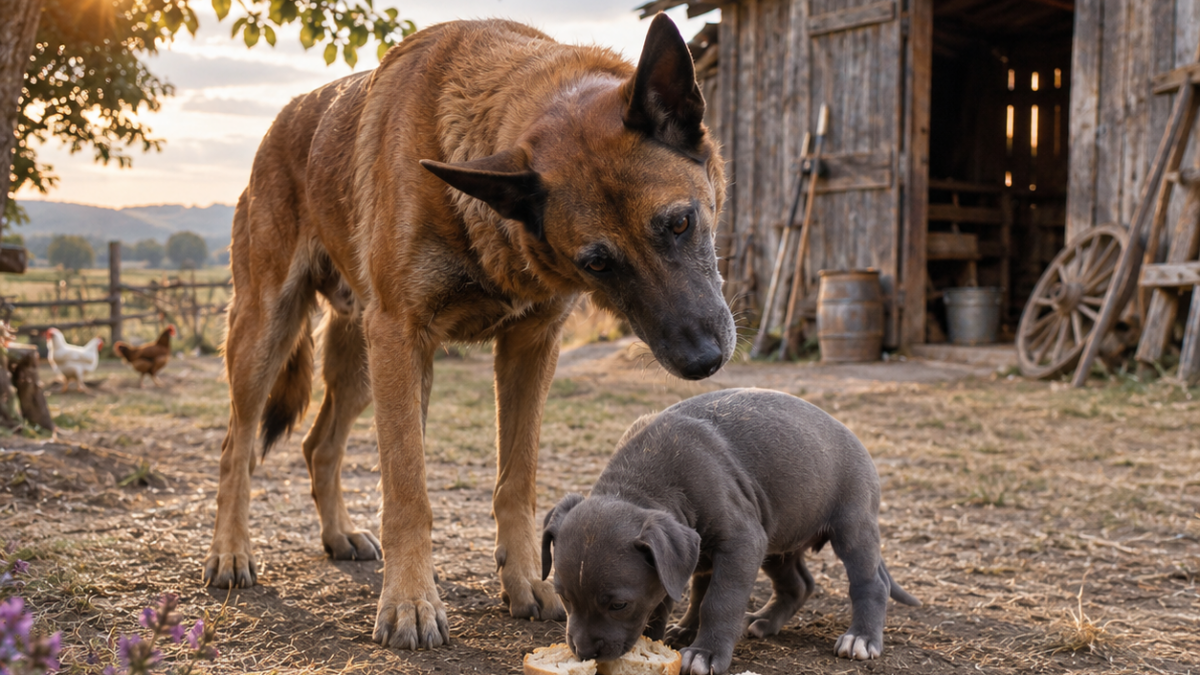
PART 2
I stayed hidden for almost ten minutes.
The puppy finished the bread and licked the dirt where the pieces had been.
Then he walked toward Rex.
At first, I thought he was going to sniff him.
Instead, the little dog pressed his entire body against Rex’s front leg.
Rex looked down.
Then lowered his head and gently licked the puppy’s ear.
Something in my chest tightened.
I had seen Rex do a lot of things in ten years.
Protect calves.
Chase coyotes.
Find a lost hen during a storm.
Sit beside Eleanor’s chair during the last months of her illness.
But I had never seen him look at another animal quite like that.
He looked responsible.
That was the only word for it.
As though somewhere along the line, Rex had made a decision.
This one is mine.
The puppy lay down beside him.
Rex stayed.
I started wondering how long this had been happening.
Days?
Weeks?
Two months?
Had Rex found him around the same time the bread started disappearing?
Probably.
I wanted to walk out immediately.
Pick the puppy up.
Bring him inside.
Feed him properly.
But I stopped myself.
The puppy was clearly terrified of people.
I could see it in every movement.
Whenever a bird landed nearby, he flinched.
When the wind rattled a sheet of loose metal on the shed roof, he dropped flat against the ground.
If I walked toward him too quickly, he might run.
And if he ran beyond the fence, the county road was less than half a mile away.
So I backed away.
Rex came home around sunset.
I was sitting on the porch.
He stopped when he saw me.
For one ridiculous second, I swear he looked guilty.
I folded my arms.
“Three pieces?”
Rex stared at me.
“Exactly three?”
His ears moved.
I pointed toward the barn.
“You think I don’t count?”
Rex walked toward me.
Then sat.
“You could have told me.”
He placed one paw on my boot.
I laughed.
“All right.”
I rubbed his head.
“Tomorrow we do it properly.”
The next morning, I prepared a bowl.
Not bread.
Soft puppy food mixed with warm water.
Some boiled chicken.
A little rice.
I carried it toward the shed.
Rex followed.
About fifty feet away, I stopped.
The puppy appeared immediately when he saw Rex.
Then he saw me.
He froze.
Every muscle in his body locked.
I lowered the bowl.
Then walked backward.
The puppy didn’t move.
Rex looked at me.
“Go on.”
Rex approached him.
The puppy relaxed slightly.
I backed away another twenty feet.
Then sat on an old fence post.
Rex walked to the bowl.
He sniffed it.
Then looked at the puppy.
The puppy crept forward.
One step.
Then another.
He reached the bowl.
Started eating.
I had never seen an animal eat like that.
Not enjoyment.
Urgency.
Every bite looked like he feared it might be taken away.
I kept my distance.
When he finished, he licked the bowl for almost two minutes.
Then crawled back under the shed.
That became our routine.
Every morning, Rex and I brought food.
Every evening, we came again.
For the first four days, the puppy refused to approach if I was closer than thirty feet.
On the fifth, twenty-five.
A week later, twenty.
Rex did most of the work.
He would walk over first.
Sit beside the bowl.
Wait.
The puppy trusted him completely.
I was simply tolerated.
I named him Scout in my head.
I didn’t tell anyone.
There was nobody to tell.
Then my daughter, Rachel, called one evening.
“How are you?”
“Old.”
“That’s not new.”
“Then why ask?”
She laughed.
Rachel lived three hours away with her husband and two kids.
“You sound weird.”
“What does weird sound like?”
“Like you’re hiding something.”
I looked toward the floor.
Rex was asleep beside my chair.
“You inherited your mother’s suspicion.”
“Dad.”
I sighed.
“I found a puppy.”
There was silence.
“You found a what?”
“Rex found him.”
“What does that mean?”
So I told her.
All of it.
The bread.
The shed.
The puppy.
When I finished, Rachel said, “Take him to a vet.”
“I know.”
“When?”
“He won’t let me touch him.”
“You’re keeping a feral puppy under a shed?”
“No. Rex is.”
“That is not better.”
“He trusts Rex.”
“He needs medical care.”
“I know.”
“Dad.”
“I said I know.”
She sighed.
“You always do this.”
“Do what?”
“Act like saying ‘I know’ counts as a plan.”
That sounded exactly like Eleanor.
I hated when my children sounded like their mother.
Mostly because they were usually right.
The next day, I called Dr. Helen Moore.
She had treated my animals for more than twenty years.
When I explained, she said she would come to the farm.
No carrier.
No clinic.
No forced handling.
“Let me see him where he feels safe.”
She arrived that afternoon.
Scout disappeared beneath the shed.
Helen sat beside me in the grass.
Rex lay between us.
For nearly forty minutes, nothing happened.
Then Scout’s nose appeared.
Helen didn’t move.
He looked at Rex.
Then us.
Eventually, he came out.
Helen studied him from a distance.
“Too thin.”
“I noticed.”
“Probably worms.”
She watched him walk.
“Possible injury in the left hind leg.”
“Can you treat him?”
“Eventually.”
She looked at me.
“Not by chasing him.”
For the next week, Helen left medication mixed into food.
The puppy improved.
His appetite remained enormous.
But his coat became less dull.
The trembling in his rear leg eased.
Then, on the eighteenth day, Scout made his first mistake.
Or maybe his first act of courage.
I was sitting beside the shed reading a newspaper.
Rex slept nearby.
Scout came out.
He ate.
Then instead of returning beneath the shed, he stayed beside Rex.
I kept reading.
Five minutes passed.
Then ten.
I lowered the paper slightly.
Scout was staring at me.
I looked away.
Another ten minutes.
Then I felt something touch my boot.
I froze.
Scout’s nose.
He sniffed the leather.
I didn’t move.
He backed away.
Then returned.
Another sniff.
I whispered, “Hello, little man.”
Scout jumped backward.
Rex lifted his head.
Scout looked at him.
Rex put his head back down.
That seemed to be enough reassurance.
Scout approached again.
This time, I lowered one hand.
Palm down.
Not reaching.
Just offering.
He sniffed my fingers.
Then ran beneath the shed.
I sat there grinning like an idiot.
Rex opened one eye.
“You did see that, right?”
He closed it again.
“Fine. Be unimpressed.”
Three days later, Scout let me touch the top of his head.
One second.
Then he retreated.
The next day, two seconds.
Within another week, I could sit close enough to scratch behind his ears.
That was when I noticed the scars.
Small marks around his neck.
Thin, circular.
Like something had rubbed against the skin for a long time.
A chain.
My stomach turned.
I called Helen.
She examined him properly for the first time.
Scout trembled but stayed beside Rex.
The diagnosis wasn’t terrible.
Malnutrition.
Parasites.
An old untreated fracture in one rear leg that had healed badly but didn’t require surgery.
And scars.
A lot of them.
“Can you tell what happened?”
Helen shook her head.
“Some.”
“Chain?”
“Yes.”
“Anything else?”
She looked at his ears.
“Possible bites.”
“From another dog?”
“Maybe.”
I felt anger rise.
Helen noticed.
“James.”
“What?”
“Don’t invent a story before you have one.”
“Somebody did this.”
“Yes.”
“Who?”
“I don’t know.”
That answer stayed with me.
Over the next month, Scout stopped living under the shed.
At first, he followed Rex only as far as the barn.
Then the porch.
Then the kitchen door.
The first time he crossed into the house, I didn’t even notice.
I was making coffee.
Rex walked in.
Scout followed.
Four steps.
Then he realized he was indoors.
He froze.
I froze too.
Rex continued toward his water bowl.
Scout looked around.
Ceiling.
Walls.
Cabinets.
Me.
His body lowered.
I turned away.
“Coffee?”
I said to nobody in particular.
Scout stayed.
Thirty seconds.
A minute.
Then he walked back outside.
That was enough.
Three days later, he came in again.
A week after that, he slept in the kitchen.
Not overnight.
Just one afternoon.
Rex lay on his rug.
Scout curled against his side.
I stood in the doorway watching them.
For the first time since Eleanor died, the house felt less empty.
That scared me a little.
Loneliness becomes a habit.
After enough years, you start defending it.
Then Scout began doing something unexpected.
He followed me.
Not Rex.
Me.
Only a few feet.
To the barn.
To the garden.
To the porch.
He never stayed far from Rex.
But sometimes he chose my direction.
I pretended not to care.
Then Rachel visited.
She arrived with my grandchildren, Noah and Emma.
The moment their car entered the driveway, Scout disappeared.
Rachel stepped out.
“Where is he?”
“Hello to you too.”
“Dad.”
“Under the porch.”
She looked toward it.
“You named him?”
“Scout.”
She smiled.
“You said you weren’t keeping him.”
“I said no such thing.”
“You absolutely did.”
“I said Rex was keeping him.”
Rachel hugged me.
“You’re impossible.”
The children wanted to see Scout.
I warned them.
“Sit down. Don’t chase him.”
Emma was nine.
Noah twelve.
They sat in the grass.
Rex joined them.
That helped.
After almost an hour, Scout appeared.
Emma didn’t move.
She whispered, “He’s little.”
“He won’t be forever.”
Scout approached Rex.
Then Noah.
Then Emma.
He sniffed Emma’s hand.
She looked at me.
Her eyes widened.
I raised one finger.
Don’t move.
Scout touched his nose to her palm.
Emma smiled.
That afternoon, Scout played for the first time.
Noah rolled a tennis ball.
Scout watched.
Rex ignored it.
Noah rolled it again.
Scout chased it.
Only two steps.
Then he stopped.
The third time, he ran.
Not far.
Maybe ten yards.
But he ran like a puppy.
He grabbed the ball.
His tail went wild.
The children cheered.
Scout dropped the ball immediately and looked terrified.
Rex stood.
Walked to him.
Touched his shoulder with his nose.
Scout relaxed.
Noah lowered his voice.
“Sorry.”
He rolled the ball gently.
Scout chased it again.
By sunset, he was exhausted.
Rachel stood beside me.
“He’s staying.”
“Looks that way.”
She smiled.
“You’re happy.”
“I’m tired.”
“Dad.”
I looked toward Rex and Scout.
“Maybe.”
Rachel rested her head against my shoulder the way she had as a child.
“You deserve maybe.”
Two weeks later, everything changed.
I received a call from Helen.
“James, did you ever report Scout as found?”
“No.”
“You need to.”
“Why?”
“Because I scanned him.”
“A microchip?”
“Yes.”
I stood still.
“Somebody owns him?”
“Somebody registered him.”
The words felt different.
“Who?”
“I can’t give you that information directly.”
“Why not?”
“Privacy laws.”
“Helen.”
“Animal control can.”
I called immediately.
An officer named Mark Ellis came to the farm.
He scanned Scout again.
Confirmed the chip.
Then checked the database.
His expression changed.
“What?”
He looked at me.
“This dog was registered to a breeder named Calvin Rourke.”
The name meant nothing to me.
Mark noticed.
“You don’t know him?”
“No.”
“You’re lucky.”
“What does that mean?”
Calvin Rourke owned a property twelve miles north of my farm.
He bred pit bulls.
Officially.
Unofficially, there had been complaints for years.
Unlicensed litters.
Neglect.
Dogs disappearing.
Noise at night.
But complaints were one thing.
Proof was another.
“Was Scout reported missing?”
Mark looked at his tablet.
“No.”
“Then why is he chipped?”
“Probably part of a litter record.”
“How old is he?”
“Approximately five months.”
I looked toward Scout.
He was lying beside Rex.
“Why was he under my shed?”
Mark didn’t answer.
I asked the question differently.
“Do I have to give him back?”
“Not right now.”
“Not right now?”
“We have to notify the registered owner.”
My stomach tightened.
“No.”
“James.”
“Look at him.”
“I am.”
“You saw the scars.”
“Yes.”
“You saw the leg.”
“Yes.”
“You think I’m handing him to whoever did that?”
Mark sighed.
“I said we have to notify him.”
“You can notify him that he’s not getting the dog.”
“That’s not how this works.”
“It is on my farm.”
Mark looked at me for a long time.
“You know, my father said you were difficult.”
“Your father was right.”
He almost smiled.
Then he became serious.
“We’ll open a welfare review.”
“That sounds like paperwork.”
“It is paperwork.”
“Wonderful.”
“But it matters.”
Three days later, Calvin Rourke came to my farm.
I knew who he was before he introduced himself.
White pickup.
Black baseball cap.
Mid-forties.
Heavy shoulders.
Hard face.
He stepped out and looked around the property.
Rex was beside me.
Scout was inside the barn.
“James Coleman?”
“Yes.”
“Calvin Rourke.”
“I know.”
He smiled without warmth.
“Heard you found one of my dogs.”
“One of your dogs?”
“Gray pit pup.”
I folded my arms.
“You lose a lot?”
His smile disappeared.
“That dog belongs to me.”
“He was half-starved under my shed.”
“He got out.”
“From twelve miles away?”
“He could’ve.”
“With a broken leg?”
“Old injury.”
“Yes.”
I stared at him.
“I noticed.”
Calvin stepped closer.
“Look, I’m not here to argue. The chip proves ownership.”
“Then explain why you never reported him missing.”
“He was one puppy.”
That sentence told me everything I needed to know.
One puppy.
Disposable.
Replaceable.
Rex growled.
Low.
I put a hand on his shoulder.
Calvin looked at him.
“Control your dog.”
“He is controlled.”
“I want mine.”
I moved between him and the barn.
“No.”
His face hardened.
“You don’t get to decide.”
“Maybe not.”
I nodded toward the road.
“But neither do you.”
Mark Ellis’s patrol truck appeared.
Calvin looked at me.
“You called animal control?”
“I called somebody who enjoys paperwork.”
Mark got out.
Calvin swore.
The argument lasted twenty minutes.
In the end, Scout remained with me temporarily pending investigation.
Calvin left furious.
Before getting into his truck, he looked back.
“You’re making a mistake, old man.”
Rex growled again.
I smiled.
“I’ve made plenty.”
Calvin drove away.
That night, Scout slept beneath the kitchen table.
He hadn’t done that before.
I wondered if he smelled Calvin on my clothes.
Or maybe he heard the man’s voice through the barn wall.
I sat on the floor.
Rex joined me.
Scout looked at us.
“You’re not going back.”
I don’t know whether I was promising him or myself.
“You hear me?”
Scout crawled toward Rex.
I lowered my hand.
He placed his chin on it.
That was the first time he had ever done that.
The investigation moved slowly.
Too slowly.
Officers inspected Calvin’s property.
He had twenty-three dogs.
All legally registered.
Food present.
Water present.
Kennels technically compliant.
Nothing dramatic enough to seize them.
Mark called.
“I know you don’t like it.”
“You’re right.”
“We need evidence.”
“Scout is evidence.”
“He is evidence of injury. Not necessarily who caused it.”
“So he walks?”
“For now.”
I hung up angry.
That afternoon, Rex stole three pieces of bread again.
I caught him.
“Seriously?”
He looked at me.
Scout was no longer starving.
He ate three proper meals a day.
But Rex still carried the bread to the old shed.
Scout followed.
They sat there together.
Rex dropped the bread.
Scout ate one piece.
Left the other two.
Then lay beside him.
I finally understood.
It wasn’t about hunger anymore.
It was their ritual.
The place where one old dog had first told one abandoned puppy:
You’re not alone.
I stopped counting the bread.
Winter arrived.
Scout grew.
Fast.
His ribs disappeared beneath muscle.
His coat became glossy.
His damaged leg still made him limp slightly after hard running, but Helen said it might improve with age.
Rex slowed.
That frightened me.
His arthritis worsened.
Some mornings, he struggled to rise.
Scout noticed.
Whenever Rex stood, Scout waited.
If Rex stopped halfway across the yard, Scout stopped too.
The roles were changing.
One December morning, Rex slipped near the barn.
His back legs gave out.
I ran toward him.
Scout got there first.
He stood beside Rex.
Pressed his shoulder against him.
Rex used Scout to push himself upright.
I stood a few feet away.
My eyes burned.
“Well.”
Rex looked at me.
“You trained your replacement.”
Scout wagged his tail.
I didn’t mean it.
Not really.
There was no replacing Rex.
But time doesn’t care about what we’re ready for.
Then the first real break in Calvin’s case came from a teenager.
His name was Eli Mason.
Seventeen years old.
He worked part-time at a feed store.
One evening, Mark called.
“Can you come to the county office?”
“Why?”
“We found someone.”
Eli had worked for Calvin for six months.
Cleaning kennels.
Feeding dogs.
He quit after witnessing things he couldn’t forget.
He had photographs on his phone.
Dogs chained for long periods.
Injuries.
Crowded sheds.
One photograph showed several puppies.
One of them was gray.
Scout.
My stomach tightened.
“How old?”
Mark said, “Maybe three months there.”
Scout was chained to a post.
His body was thin.
Eli told investigators the puppies were sometimes left without food as punishment when they didn’t perform as Calvin wanted.
“Perform what?” I asked.
Mark hesitated.
“Conditioning.”
“For fighting?”
“We’re investigating.”
My hands went cold.
“Scout?”
“No evidence Scout was fought.”
“Then why the bite scars?”
“We don’t know.”
Eli had more.
He said Scout had a bad leg after Calvin kicked a gate while the puppy was trapped against it.
I closed my eyes.
“Did he see that?”
“Yes.”
“Can he testify?”
“He says he will.”
That night, I sat beside Scout.
He was almost seven months old now.
Strong.
Still goofy around Rex.
Still nervous with strangers.
I looked at the scar near his neck.
“I know.”
Scout looked at me.
“I know what happened.”
He came closer.
Put one paw on my boot.
I realized something then.
I’d spent months wanting to know.
Now that I did, the knowledge didn’t help.
It didn’t erase anything.
It only gave my anger a name.
Calvin Rourke.
Investigators returned to his property with a warrant.
This time they found more.
Hidden kennels behind a locked shed.
Medication without proper records.
Dogs with injuries.
A ledger.
Cash payments.
Names.
Dates.
One section appeared connected to illegal dogfighting.
Several arrests followed.
Calvin was one of them.
The news spread quickly.
People knew his name now.
Reporters arrived at the farm.
I sent them away.
Scout didn’t need cameras.
Rex didn’t care about headlines.
Then Calvin made bail.
Three nights later, my barn caught fire.
Not the whole barn.
A pile of straw beside the south wall.
I smelled smoke before bed.
By the time I got outside, flames were climbing the siding.
I grabbed the hose.
Rex barked.
Scout went wild.
He ran toward the barn.
“Scout!”
I stopped him.
The fire department arrived before the flames spread to the main roof.
Damage was limited.
But the fire chief found something.
Gasoline.
Someone had poured it onto the straw.
I knew immediately.
“Calvin.”
The sheriff said, “We don’t know that.”
“I do.”
“James.”
“He threatened me.”
“We have that report.”
“He knew where I lived.”
“So do fifty other people.”
I hated the answer because it was correct.
Suspicion wasn’t proof.
But I knew.
For the first time in years, I loaded my old shotgun.
Then I sat at the kitchen table looking at it.
Rex lay beside me.
Scout watched from the hallway.
Eleanor’s voice seemed to come from somewhere in memory.
James, don’t become stupid just because someone else is cruel.
I unloaded the gun.
Locked it away.
Then called Rachel.
“I need help.”
She was quiet.
That wasn’t something I said often.
“I’m coming tomorrow.”
“No.”
“You literally just said you need help.”
“I need cameras.”
“Dad.”
“Security cameras.”
She sighed.
“I’ll bring both.”
Rachel came with her husband, Daniel.
We installed cameras across the farm.
Driveway.
Barn.
Shed.
Back pasture.
For two weeks, nothing happened.
Then, at 2:13 one morning, Rex barked.
Not his normal bark.
Alarm.
I got out of bed.
Scout was already awake.
I checked the camera monitor.
A vehicle sat beyond the west fence.
Lights off.
Someone climbed through.
I called 911.
Then watched.
The figure moved toward the old shed.
Carrying something.
A plastic container.
My stomach dropped.
Gasoline.
I wanted to go outside.
Every instinct told me to confront him.
Then I looked at Rex.
Old.
Gray.
Scout beside him.
I stayed inside.
The figure reached the shed.
Then the motion light came on.
The camera captured his face.
Not Calvin.
A younger man.
His nephew, Darren Rourke.
I recognized the name from the investigation.
Darren froze.
Then ran.
Deputies caught him less than two miles away.
Gasoline was found in his truck.
His phone made things worse.
Messages from Calvin.
Delete the old place.
Make sure the dogs aren’t there.
Another message:
Scare the old man enough and he’ll shut up.
When Mark showed me the messages, I had to sit down.
Not because I was afraid.
Because of the line about the dogs.
Make sure the dogs aren’t there.
For one second, part of me thought:
At least he didn’t want to burn them.
Then I realized how insane that thought was.
A man had tried to burn my property because a starving puppy survived him.
Calvin’s bail was revoked.
More charges followed.
Witness tampering.
Conspiracy.
Attempted arson.
The case became much bigger than Scout.
Eli testified.
Veterinarians testified.
Neighbors testified.
Financial records showed payments linked to dogfighting events.
Calvin’s lawyers fought everything.
They called the images misleading.
The ledger misunderstood.
The nephew unreliable.
Then Darren accepted a plea deal.
He testified that Calvin ordered the intimidation.
The courtroom became silent when prosecutors showed the text messages.
I sat with Rachel.
She held my hand.
“Mom would be furious.”
“At Calvin?”
“At you for trying to handle all this alone.”
I almost smiled.
“You’re probably right.”
Scout did not come to court.
Neither did Rex.
They stayed home with Daniel.
I wanted them nowhere near Calvin.
During the trial, Eli described Scout.
He didn’t know we had named him that.
He called him “the little gray male.”
“He was gentle,” Eli said.
The prosecutor asked, “What happened to him?”
Eli swallowed.
“He wouldn’t fight back when the other puppies pushed him.”
My hands tightened.
“What did Mr. Rourke do?”
“He said weak dogs were useless.”
The defense objected.
The judge overruled.
Eli continued.
“One day the puppy hurt his leg near the gate. After that, Mr. Rourke said there was no point feeding him.”
My throat closed.
“What happened next?”
“I came to work and he was gone.”
“Did Mr. Rourke say where?”
Eli nodded.
“He said he dumped him.”
“Where?”
“South county.”
My farm was south county.
There it was.
Scout hadn’t escaped.
He had been discarded.
Because he was injured.
Because he was gentle.
Because he wouldn’t become what Calvin wanted.
I looked down.
For months, I’d thought Scout was lucky Rex found him.
Now I understood something else.
Calvin had thrown him away because he believed gentleness made him worthless.
Rex had found that same gentleness.
And protected it.
When it was my turn to testify about the fire and Darren’s visit, Calvin stared at me.
I looked back.
I expected rage.
Instead, I felt something closer to pity.
This man had spent years measuring dogs by aggression.
Strength.
Profit.
Control.
Rex, old and arthritic, had done more good with three pieces of stolen bread than Calvin had done with all his money and kennels.
The verdict came after two days.
Guilty on multiple counts.
Not every charge.
Enough.
Calvin was sentenced to years in prison.
He was permanently prohibited from owning, breeding, selling, training, or supervising animals.
Darren received a reduced sentence for cooperation.
The property was seized.
The surviving dogs were transferred to rescue organizations.
When Mark told me, I asked one question.
“All of them?”
“All we found.”
“Alive?”
“Most.”
That word hurt.
Most.
I didn’t ask about the rest.
The legal system gave me what it could.
It could punish Calvin.
It couldn’t go backward.
It couldn’t give Scout a different beginning.
It couldn’t erase scars.
It couldn’t make “most” become “all.”
I learned to accept the difference between justice and repair.
Justice belongs to courts.
Repair belongs to time.
And sometimes to old dogs.
Spring returned.
Rex turned eleven.
Scout turned one.
I celebrated his birthday on the day Rex first stole the bread.
It wasn’t his real birthday.
It was the only date that mattered to me.
Rachel brought the kids.
Helen came.
Mark stopped by.
I put three pieces of bread on a plate.
Rachel laughed.
“You’re feeding him bread for his birthday?”
“Tradition.”
Rex walked toward the plate.
Scout followed.
I broke the bread.
One piece for Rex.
One for Scout.
One for me.
No chickens were invited.
That afternoon, Scout and Rex walked to the old shed.
I followed.
Scout no longer crawled underneath it.
He was too big anyway.
He stood beside Rex.
Rex lowered himself carefully to the grass.
Scout lay down.
I sat nearby.
The three of us stayed there until sunset.
I realized I was happy.
At sixty-eight years old.
Widowed.
Bad knees.
Half the barn siding still darker where the fire had burned.
And happy.
Not because nothing bad had happened.
Because something good had survived it.
Then Rex started coughing.
At first, I blamed age.
Helen didn’t.
She listened to his chest.
Ran tests.
The expression on her face told me before she spoke.
Cancer.
Lung.
Advanced.
I stared at the wall of her clinic.
“How long?”
“James.”
“How long?”
“Maybe months.”
Scout sat beside Rex.
Rex looked tired.
I swallowed.
“Pain?”
“Manageable for now.”
“For now.”
“Yes.”
I drove home in silence.
Rex sat in the back with Scout.
At a red light, I looked in the mirror.
Scout had his head resting across Rex’s back.
I pulled over.
Couldn’t breathe.
For ten years, Rex had been the constant.
Eleanor died.
Children moved.
Friends retired.
Neighbors sold land.
Rex stayed.
He had seen me become old without mentioning it.
Dogs are kind that way.
At home, I sat on the porch.
Rex lay beside me.
“You could’ve told me.”
His ears moved.
“You knew.”
I laughed once.
“You always know first.”
Scout came and lay on Rex’s other side.
We had four good months.
I made them count.
No dramatic bucket list.
Rex didn’t want beaches or hamburgers from restaurants.
He wanted the farm.
Morning walks.
The barn.
My porch.
Scout.
Every afternoon, they went to the shed.
Rex got slower.
Scout adjusted.
When Rex couldn’t walk all the way, Scout would stop halfway.
Wait.
Then continue.
One afternoon, Rex collapsed.
Scout immediately ran to him.
I was fifty yards away.
By the time I reached them, Scout was standing beside Rex.
Pushing against his shoulder.
Exactly as he’d done during winter.
Rex tried to rise.
Couldn’t.
I knelt.
“It’s okay.”
Rex looked at me.
There are moments when you know.
No test.
No doctor.
You just know.
I carried him home in the bed of my truck because I couldn’t lift him all the way.
Scout jumped in beside him.
At the house, Helen came.
She examined Rex.
Then looked at me.
“James.”
I shook my head.
“Not yet.”
She didn’t argue.
Rex slept that night.
The next morning, he wouldn’t eat.
Scout brought him bread.
I swear that’s what happened.
I had put some pieces in the chickens’ bowl.
Scout walked outside.
Returned with three.
He placed them in front of Rex.
I sat down hard on the kitchen floor.
Rex sniffed the bread.
Then looked at Scout.
Scout pushed one piece closer with his nose.
Rex didn’t eat.
But he licked Scout’s face.
Once.
Slowly.
I started crying.
Helen returned that afternoon.
Rachel came too.
Noah and Emma sat on the porch.
I didn’t want Rex in a clinic.
He had spent his life on this farm.
He would leave it here.
We carried his bed beneath the old oak tree near the barn.
Scout lay beside him.
I sat on the other side.
Rachel knelt behind me.
My hand rested on Rex’s head.
His eyes were tired.
But still sharp.
Still him.
“You stole my bread.”
His tail moved weakly.
“Ten years. Perfect behavior.”
I laughed through tears.
“Then you became a thief.”
Scout lifted his head.
“You knew I needed him, didn’t you?”
Rex breathed slowly.
Maybe that was nonsense.
Maybe Rex only heard my voice.
Maybe dogs don’t make plans about what happens after they’re gone.
But I believed he had known something I didn’t.
That one day the farmhouse would be too quiet again.
That one day I would need a reason to get up.
That one day he wouldn’t be there.
So he found Scout.
Or Scout found him.
Maybe both.
I put my forehead against Rex’s.
“You did good.”
His eyes closed.
“You did everything right.”
Helen gave him the first injection.
Rex relaxed.
Scout pressed closer.
Then the second.
Rex took one slow breath.
Then another.
Then none.
Scout stayed beside him.
Nobody moved.
For nearly half an hour.
Finally, Scout stood.
He sniffed Rex’s face.
Licked his ear.
Then lay down again.
I buried Rex beside the old shed.
Rachel asked why there.
“Because that’s where he became a father.”
We placed a simple stone.
REX
LOYAL FRIEND
HE SHARED WHAT HE HAD
For weeks, Scout carried bread to the grave.
Three pieces.
Every afternoon.
He would take them from the chickens’ bowl.
Walk to Rex.
Drop them beside the stone.
Then sit.
The first time I saw it, I nearly stopped breathing.
I wanted to move the bread.
I didn’t.
The chickens could survive the loss.
Some rituals are worth feeding.
Scout changed after Rex died.
He stayed close to me.
Closer than before.
He began sleeping beside my bed.
Rex’s place.
The first night, I woke and saw him there.
Gray body curled on the rug.
I whispered, “That’s not yours.”
Scout opened one eye.
I smiled.
“Fine.”
Life moved.
That’s what it does.
The barn was repaired.
The criminal case ended.
Calvin went to prison.
The rescued dogs found homes.
Eli eventually started working with an animal rescue.
Mark still visited once in a while.
Rachel called too often.
I complained.
Then answered every time.
Scout grew into a powerful dog.
Sixty-five pounds.
Broad chest.
Small limp.
Gentle eyes.
People who didn’t know him sometimes crossed the road when they saw us.
Scout never cared.
He loved children.
He loved chickens.
He hated rain.
And he had one strange habit.
Every afternoon, he still took exactly three pieces of bread.
One day, two years after Rex died, I followed him.
Not because I didn’t know where he was going.
Because I missed following.
Scout walked to Rex’s grave.
He placed the bread down.
Then something moved near the fence.
A cat.
Tiny.
Orange.
Thin.
Scout looked at it.
I stopped.
“No.”
Scout picked up one piece of bread.
Walked toward the kitten.
My mouth fell open.
“You’ve got to be kidding me.”
The kitten backed away.
Scout set the bread down.
Then sat.
Exactly the way Rex had sat.
I laughed so hard I had to lean against the shed.
“You learned from the best.”
The kitten eventually came closer.
Not because bread is ideal food for a cat.
It isn’t.
But because hunger is persuasive.
The next morning, I bought kitten food.
Rachel nearly fell over laughing when I called.
“You have a cat now?”
“I do not.”
“You absolutely have a cat.”
“Scout has a cat.”
“That sounds familiar.”
I hung up on her.
The kitten stayed.
We named her Daisy.
Scout adored her.
Daisy slept on Scout.
Stole his bed.
Bit his ears.
He tolerated everything.
Watching them together, I finally understood Rex’s real legacy.
It wasn’t that he saved one puppy.
It was that he taught that puppy what kindness looked like.
And Scout passed it on.
Calvin had wanted dogs to learn violence.
Rex taught one of his discarded puppies something stronger.
Mercy.
That’s where Calvin truly lost.
Not in court.
Not when the judge sentenced him.
Not when his kennels were emptied.
He lost when Scout became gentle.
He lost when the dog he considered weak grew strong without becoming cruel.
He lost when Scout learned to protect something smaller than himself instead of hurting it.
Years later, I received a letter from Eli.
He had helped open a rehabilitation program for dogs seized from abuse cases.
On the wall hung a photograph.
Scout sitting beside Rex’s grave.
Daisy curled between his front paws.
Underneath it was a line:
**Strength is what you choose to protect.**
I framed the letter.
It sits beside Eleanor’s photograph.
I’m seventy-two now.
Scout is five.
Daisy owns the house.
The farm is smaller.
I sold the far pasture last year because my knees finally won their argument with me.
Rachel wants me to move closer to her.
I tell her no.
She tells me we’ll discuss it again.
We do.
Every month.
I still wake early.
Still feed the chickens.
Still soak old bread.
And yes, I still count the pieces.
Not because I’m worried someone will steal them.
Because some memories deserve numbers.
Three pieces disappeared when Rex first found Scout.
Three pieces kept a starving puppy alive long enough for me to find him.
Three pieces became a promise between two animals.
Now every afternoon, Scout takes three.
Sometimes to Rex’s grave.
Sometimes Daisy steals one.
Sometimes Scout eats one himself.
I never stop him.
A few months ago, my grandson Noah visited.
He’s seventeen now.
Almost a man.
We sat near the shed.
He asked, “Grandpa, do you ever think about what would’ve happened if you hadn’t followed Rex?”
“All the time.”
“Scout would’ve died?”
“Maybe.”
“And if Rex hadn’t found him?”
“Probably.”
Noah looked toward Scout.
He was lying in the grass while Daisy attacked his tail.
“That’s crazy.”
“What is?”
“How one little thing changes everything.”
I nodded.
“Three pieces of bread.”
He smiled.
“Yeah.”
I looked at Rex’s stone.
“No.”
“What?”
“The bread wasn’t the little thing.”
“What was?”
I thought about it.
“Rex noticing.”
Noah frowned.
“Noticing what?”
“That somebody needed him.”
That was the whole story.
Not the theft.
Not the court case.
Not Calvin.
Not even the fire.
It began because an old dog noticed something small and frightened beneath a shed.
Everyone else had missed him.
Maybe cars had passed.
Maybe people had driven those roads.
Maybe Calvin had thrown the puppy away expecting nature to finish what neglect started.
But Rex noticed.
Then he came back.
Again.
Again.
Again.
Three pieces at a time.
People talk about kindness as if it has to be dramatic.
It doesn’t.
Sometimes kindness looks like stealing bread.
Sometimes it looks like sitting beside someone while they eat.
Sometimes it looks like walking slower because your old friend can’t keep up anymore.
Sometimes it looks like carrying food to a grave because you still remember who fed you when you had nothing.
Calvin Rourke believed strength meant making an animal afraid enough to obey.
Rex believed strength meant making a frightened animal safe enough to eat.
One man had money, kennels, land and control.
The other had white fur around his muzzle, bad hips and three stolen pieces of bread.
I know which one changed the world.
At least our little part of it.
Rex is gone.
Calvin is still serving his sentence.
The old shed is leaning farther every year.
I should probably tear it down.
I won’t.
That is where Scout was hungry.
Where Rex fed him.
Where I learned that my dog had a secret life of his own.
Where something abandoned became something loved.
Sometimes, around four in the afternoon, I sit beside it.
Scout joins me.
Daisy usually climbs onto my lap whether invited or not.
The sun crosses the western pasture.
The chickens complain.
The cows chew.
And for a few minutes, the farm feels exactly the way it should.
Full.
Not crowded.
Full.
There is a difference.
After Eleanor died, I thought the rest of my life would mostly be about losing things.
Strength.
Friends.
Animals.
Land.
Time.
Rex taught me something else before he left.
Even late in life, something can still arrive.
Something you didn’t expect.
Something you didn’t ask for.
Something small enough to hide beneath an old shed.
And sometimes that new thing doesn’t replace what you lost.
It shouldn’t.
Scout never replaced Rex.
Daisy never replaced anyone.
They simply made the empty places less empty.
Maybe that’s all love is allowed to do.
Not erase.
Not replace.
Just stay beside the loss and make life possible around it.
Last week, Scout stole three pieces of bread.
I followed him.
Old habit.
He walked to Rex’s grave.
Daisy followed.
Scout placed one piece in front of the stone.
A second beside Daisy.
Then he carried the third to me.
He dropped it at my feet.
I looked at him.
“What is this?”
Scout sat.
I picked up the bread.
It was wet and covered in dirt.
“I appreciate the gesture.”
His tail wagged.
“I am not eating this.”
More wagging.
I laughed.
Then I sat beside Rex’s grave.
Scout leaned against me.
Daisy curled on the grass.
I broke the bread in half.
One piece for Scout.
The other I placed beside Rex’s stone.
“Don’t tell the chickens.”
Scout rested his head on my knee.
I ran my hand over the scar near his neck.
It was faint now.
Still there.
Some things stay.
But scars are strange.
They prove something happened.
They don’t get to decide what happens next.
Calvin gave Scout that scar.
Rex gave him everything that came after.
Food.
Safety.
Trust.
Family.
A future.
If people ask whether Calvin got what he deserved, I tell them the court decided that.
I don’t need to.
My idea of revenge changed as I got older.
When I first learned what Calvin had done, I wanted him afraid.
I wanted him powerless.
I wanted him to lose everything.
Some of that happened.
But it didn’t heal Scout.
The thing that healed Scout was waking up every morning without being hurt.
It was Rex waiting beside his food.
It was Emma rolling a tennis ball gently after she realized cheering scared him.
It was Helen kneeling twenty feet away instead of forcing him into a cage.
It was sleeping inside.
Running in the yard.
Protecting Daisy.
It was discovering that being gentle didn’t make him weak.
That was the revenge Calvin could never undo.
He tried to turn Scout into something violent.
Instead, Scout became kind.
He tried to make him disposable.
Instead, Scout became family.
He threw him away because he thought an injured, frightened puppy had no value.
Years later, that same dog is sleeping beside my bed, guarding my farm and teaching a kitten how to trust the world.
Calvin lost long before his prison sentence began.
Rex won the moment Scout ate those first three pieces of bread.
I just didn’t understand it yet.
Sometimes I think about the afternoon when I hid behind the barn.
Sixty-seven years old.
Bad knees.
Suspicious of my own dog.
I remember seeing Rex lower the bread.
The puppy crawling out.
That little tail beginning to move.
And Rex sitting in the sun as if there were nowhere else on earth he needed to be.
If I could go back to that afternoon, I wouldn’t interrupt them.
I wouldn’t call Scout.
I wouldn’t step closer.
I’d do exactly what I did.
Stand there.
Watch.
And let an old dog teach me the lesson I’d somehow missed after nearly seven decades of living.
You don’t need to understand why someone is hurting before you help them.
You don’t need permission to be kind.
And sometimes the smallest thing you give away becomes the reason someone survives long enough to find a home.
Rex stole bread from my chickens for weeks.
I never punished him.
How could I?
It was the best thing he ever stole.
Because every one of those missing pieces led me to Scout.
And Scout led me back to something I thought I’d lost when Eleanor died.
A reason to look forward to tomorrow.
So now, every morning, I still place bread in the old wooden bowl.
And every afternoon, exactly three pieces disappear.
I know who takes them.
I know where they go.
And I never count them as missing anymore.
Rex had been gone for almost a year before I finally understood that grief has routines.
People talk about grief as if it arrives like a storm.
It does at first.
The first few days after Rex died, I couldn’t walk past his empty rug without feeling something tear open inside me.
I couldn’t hear Scout’s nails on the kitchen floor without turning around expecting two dogs instead of one.
I couldn’t put food in the chickens’ wooden bowl without remembering the first three pieces Rex had stolen.
But storms eventually move.
Grief doesn’t.
It learns your schedule.
It knows when you wake up.
It waits beside the coffee pot.
It follows you to the barn.
It sits quietly in the passenger seat when you drive into town.
And every afternoon, around four, it walked with Scout to Rex’s grave.
Scout never missed a day.
Rain.
Heat.
Cold.
Didn’t matter.
He would go to the chickens’ bowl, take exactly three pieces of bread, and carry them toward the old shed.
The first piece he dropped beside Rex’s stone.
The second he usually ate.
The third he left nearby.
At first, I assumed it was simply habit.
Then one afternoon, I discovered who the third piece was for.
A tiny orange kitten had appeared beside the western fence.
She was dirty, thin, and furious at the world.
The first time I saw her, she hissed at Scout so hard that I laughed.
Scout weighed almost sixty pounds by then.
The kitten couldn’t have weighed three.
She stood with her back arched and every hair raised.
Scout stopped.
He stared at her.
Then he slowly placed the bread on the ground.
The kitten hissed again.
Scout sat.
I stood twenty feet away, watching history repeat itself.
“You’ve got to be kidding me,” I whispered.
Scout didn’t move.
The kitten looked at him.
Then at the bread.
Hunger won.
She approached.
Snatched the piece.
Ran beneath the shed.
Scout stayed.
The next afternoon, he did the same thing.
And the next.
By the fourth day, I bought proper kitten food.
Rachel called that evening.
“What are you doing?”
“Nothing.”
“You called me and immediately said nothing. That means something happened.”
“Scout found a cat.”
Silence.
Then laughter.
I held the phone away from my ear.
“Are you finished?”
“No.”
“Rachel.”
“You spent months insisting Scout wasn’t your dog because Rex found him.”
“That was different.”
“And now?”
“Scout has a cat.”
She laughed harder.
“I hate all of you.”
“You love us.”
“That is unfortunately true.”
We named her Daisy.
I say “we,” but Scout chose her first.
Daisy eventually decided the entire farmhouse belonged to her.
She slept in Rex’s old chair.
She climbed onto Scout’s back.
She attacked my bootlaces every morning.
One afternoon, I found her sitting directly in the middle of the kitchen table.
“Absolutely not.”
She looked at me.
“Get down.”
Nothing.
Scout was lying nearby.
I pointed at Daisy.
“Do something.”
Scout closed his eyes.
“Coward.”
The house had been quiet after Eleanor died.
Then it became quieter after Rex.
Daisy changed that.
She knocked things over.
She chased shadows.
She once climbed into the pantry and couldn’t figure out how to get back out.
Scout stood outside the door barking until I came.
For the first time in years, I heard myself laugh when nobody else was around.
That surprised me.
Sometimes happiness returns so quietly you don’t recognize it at first.
I thought Scout had learned kindness from Rex.
I was right.
But I began to understand that Scout was teaching me something too.
Rex had saved him because he noticed.
Scout had saved Daisy the same way.
And maybe both of them had been saving me little by little.
I had spent years after Eleanor’s death believing that my life was mostly behind me.
At sixty-seven, then sixty-eight, then seventy, I counted what was disappearing.
Friends.
Strength.
Land.
Animals.
Time.
I didn’t count what was still arriving.
Scout.
Daisy.
Noah growing into a young man.
Emma calling me to ask whether she could spend weekends at the farm.
Rachel showing up with groceries I hadn’t asked for.
Mark Ellis stopping by “to check on Scout” and somehow staying for coffee every time.
Life wasn’t finished bringing things to me.
I had simply stopped looking at the gate.
Calvin Rourke’s trial became old news.
His name disappeared from the local papers.
His kennels were shut permanently.
The property was sold.
Some of the money from seized assets went into animal welfare programs.
Eli Mason, the seventeen-year-old who had testified against him, began working full-time with a rescue organization.
Years later, Eli returned to the farm.
He was twenty-three by then.
Taller.
More confident.
But when he saw Scout, his face changed.
Scout was sleeping beneath the oak tree.
Eli stopped near the porch.
“That’s him?”
“That’s him.”
Scout raised his head.
Eli didn’t move.
“He won’t remember me.”
“Maybe not.”
“I remember him.”
Scout stood.
Walked toward us.
Eli crouched slowly.
Scout sniffed his hand.
Then leaned against his knee.
Eli looked down quickly.
I pretended not to notice the tears.
“He used to hide behind the water barrel,” Eli said.
“At Calvin’s?”
“Yeah.”
He rubbed Scout’s neck carefully.
“I’d sneak food to him sometimes.”
I looked at him.
“You never told me that.”
“I was scared Calvin would find out.”
Scout pushed his head under Eli’s hand.
Eli laughed softly.
“He always did that?”
“No.”
“What?”
“That.”
Eli looked confused.
“He used to run from hands.”
Eli’s face tightened.
“I know.”
We sat on the porch.
Daisy jumped into Eli’s lap without invitation.
He looked startled.
“She does that.”
“I don’t really like cats.”
Daisy began purring.
“You’ve been overruled.”
For a while, nobody spoke.
Then Eli said, “I used to think about him a lot.”
“Scout?”
“All of them.”
He looked toward the fields.
“The dogs we couldn’t help.”
I understood that kind of guilt.
It isn’t logical.
That doesn’t make it less real.
“You were seventeen.”
“I was old enough to know.”
“And scared enough to stay quiet.”
He nodded.
“I hate that.”
I looked at Scout.
“Do you think he hates you?”
Eli glanced at him.
“No.”
“Then maybe you shouldn’t spend the rest of your life doing a job Scout already refused to do.”
“What job?”
“Punishing you.”
He stared at me.
“That sounds like something your wife would’ve said.”
I smiled.
“You never met Eleanor.”
“No.”
“Neither did Scout.”
I scratched his ear.
“But apparently everybody on this farm keeps stealing her lines.”
Eli visited more after that.
Eventually, he opened a small rehabilitation center with two veterinarians.
He called it Second Chance Farm.
When I first saw the sign, I mocked him.
“Subtle.”
“What?”
“Second Chance Farm.”
“You don’t like it?”
“Sounds like a movie.”
He smiled.
“It’s better than James Coleman Memorial Grumpy Old Man Center.”
“I am not dead.”
“That was my main objection.”
The center specialized in animals seized from neglect and abuse cases.
The first year, they helped thirty-seven dogs.
The second, nearly sixty.
Scout occasionally visited.
Not as a therapy dog officially.
Scout didn’t care about titles.
He simply seemed to understand frightened animals.
When a dog hid in the back of a kennel, Scout would lie outside.
No barking.
No pushing.
Just there.
Exactly like Rex.
One afternoon, Eli called me.
“You need to see this.”
“What?”
“Come over.”
“That’s not an explanation.”
“Bring Scout.”
When we arrived, a young brindle dog was hiding in a corner.
She had been removed from a hoarding case.
Nobody had managed to get close for three days.
Scout entered the room.
He saw her.
Then lay down.
Ten feet away.
The dog watched him.
Scout looked away.
Five minutes.
Ten.
Twenty.
Eventually, she crawled forward.
She didn’t reach the humans.
She reached Scout.
She put her nose against his paw.
Scout remained still.
Eli stood beside me.
“Where did he learn that?”
I swallowed.
“Three pieces of bread at a time.”
Eli didn’t understand.
I did.
Rex had been gone four years by then.
Yet there he was.
Not physically.
In behavior.
In patience.
In the way Scout understood that the most frightened creatures don’t need to be chased.
They need somebody safe enough to wait.
That realization changed how I thought about death.
I’d always assumed dying meant leaving.
Maybe part of it does.
But some things remain in the people and animals who learned from you.
Eleanor was gone.
Yet Rachel still tilted her head exactly like her mother when she thought I was lying.
Rex was gone.
Yet Scout still carried food to frightened animals.
Nobody disappears completely if something they taught survives.
Calvin, meanwhile, became exactly what he’d feared most.
Irrelevant.
His appeals failed.
His properties disappeared.
His kennel business vanished.
People who had once protected him stopped returning calls.
Years after his conviction, I received a letter.
The return address was the state prison.
Calvin Rourke.
I almost threw it into the stove.
Instead, I left it on the kitchen counter.
For three days.
Every time I passed, I looked at it.
Scout sniffed it once.
Daisy slept on it.
That seemed appropriate.
Finally, I opened it.
The handwriting was surprisingly neat.
James,
I don’t expect you to answer this.
I’ve had years to think about what happened.
For a long time, I blamed Eli. Then Darren. Then the police. Then you.
I told myself people exaggerated. I told myself dogs were animals and people had become too soft.
I don’t know exactly when that changed.
Maybe it was when my daughter stopped visiting.
Maybe it was when I realized nobody trusted me because I had spent my life believing fear was the same thing as respect.
I remember the gray puppy.
I remember thinking he was useless because he wouldn’t become aggressive.
I know now that says more about me than it ever did about him.
I heard he’s alive.
I’m glad.
I read the letter twice.
Then I stopped.
There was more.
An apology.
An explanation about his father.
About growing up around men who treated animals as tools.
About money.
About pride.
I didn’t need it.
For years, I had wanted Calvin to understand exactly what he had done.
Now he claimed he did.
And strangely, it didn’t matter as much as I’d imagined.
Rachel visited that afternoon.
She saw the letter.
“What’s that?”
I handed it to her.
She read.
Her face hardened.
“What are you going to do?”
“Nothing.”
“You could write back.”
“Why?”
“I don’t know.”
“Exactly.”
She folded the letter.
“Do you forgive him?”
I looked toward the yard.
Scout was sleeping in the sun.
Daisy curled against his stomach.
“No.”
Rachel looked surprised.
“I don’t hate him either.”
“Then what?”
“I think I’m done.”
She sat beside me.
“That sounds like forgiveness.”
“No.”
I shook my head.
“Forgiveness is something people talk about when they want an ending that fits neatly.”
I looked at the letter.
“I don’t need him to suffer anymore.”
“That sounds close.”
“Maybe.”
I took the paper.
“But I don’t need to give him peace either.”
Rachel nodded slowly.
“So what do you do with it?”
I walked to the stove.
Then stopped.
I didn’t burn it.
Instead, I put it in a drawer.
Not because it mattered.
Because it didn’t.
That was the point.
For years, Calvin had occupied a place in my anger.
Now he was paper in a drawer I rarely opened.
Rex was a stone beneath an oak tree I visited every day.
There are different kinds of permanence.
Calvin never understood that.
By the time Scout turned seven, I was seventy-four.
My knees were worse.
My doctor used increasingly insulting phrases like “age appropriate.”
One morning, I fell beside the barn.
Nothing dramatic.
I slipped on ice.
Landed badly.
I couldn’t stand.
For several seconds, I just sat there.
Then Scout appeared.
He came running.
Daisy followed at a safer, less heroic speed.
Scout stood beside me.
I grabbed his collar.
“Don’t move.”
He planted his feet.
Using his shoulder, I pushed myself upright.
Once I was standing, Scout looked at me.
I laughed.
“This again?”
He wagged his tail.
“You did that for Rex.”
More wagging.
“I am not as old as Rex.”
Scout stared.
“Don’t argue.”
That evening, Rachel arrived.
Apparently I had made the mistake of telling Emma what happened.
“You’re moving.”
Rachel walked into the kitchen without saying hello.
“No.”
“Dad.”
“No.”
“You fell and couldn’t get up.”
“I got up.”
“Using Scout as furniture.”
“He volunteered.”
“That’s not the point.”
“I am not leaving.”
Rachel closed her eyes.
I knew that expression.
Eleanor.
Again.
“What if nobody was here?”
“Scout was.”
“He is a dog.”
“He takes offense when you say things like that.”
“Dad!”
Scout left the room.
I pointed.
“See? Hurt feelings.”
Rachel nearly laughed.
Nearly.
Then her eyes filled.
“I can’t lose you because you’re too stubborn to accept help.”
That changed the conversation.
I looked at my daughter.
She was no longer the teenager who left for college crying in Eleanor’s arms.
She was a mother.
A woman with gray beginning near her temples.
Someone who worried about me because I had become what my parents had once been.
Old enough to scare my children.
I sighed.
“I don’t want to leave this place.”
“I know.”
“Your grandfather cleared that field.”
“I know.”
“Your mother is everywhere in this house.”
“I know.”
“Rex is buried out there.”
Rachel sat beside me.
“I know.”
She took my hand.
“Then let us help you stay.”
That was the compromise.
Not moving.
Accepting help.
Daniel repaired the porch railing.
Noah installed handrails where I insisted they were unnecessary.
Emma reorganized my medication and threatened me with violence if I mixed up the bottles.
A farmhand named Carlos began helping three mornings a week.
I hated it.
Then I didn’t.
This was another lesson I had somehow avoided for most of my life.
Being independent and being alone are not the same thing.
Rex had understood that long before I did.
Scout became older too.
His muzzle slowly turned gray.
The little limp from his childhood injury became more noticeable during winter.
Sometimes we’d walk toward Rex’s grave together and both of us would slow at the same place.
I would look at Scout.
“You’re getting old.”
He would look at me.
“Don’t.”
He wagged his tail.
“That’s disrespectful.”
One spring afternoon, Emma came to the farm carrying a puppy.
I saw it before she even got out of the car.
“No.”
She laughed.
“Grandpa, I haven’t said anything.”
“You don’t need to.”
“She’s not yours.”
“Good.”
“She’s from Second Chance Farm.”
“Still good.”
“I’m fostering her.”
“Wonderful.”
Emma put the puppy down.
Tiny.
Black-and-white.
One ear upright.
One folded.
The puppy saw Scout.
Ran toward him.
Scout looked at me.
I knew that look.
“Don’t ask me.”
The puppy climbed onto his front paws.
Scout sighed.
Emma smiled.
“He likes her.”
“He tolerates her.”
“That’s how you started with Daisy.”
“I never tolerated Daisy.”
Daisy was lying in my chair.
She opened one eye.
Scout slowly stood.
The puppy followed him.
He walked toward Rex’s grave.
I stared.
“What’s her name?”
“Hope.”
I groaned.
“Second Chance Farm has become unbearable.”
Emma laughed.
Hope followed Scout to the stone.
Scout placed three pieces of bread.
One at the grave.
One for himself.
Then he pushed the third toward Hope.
She ate it.
Emma stopped beside me.
“Why three?”
I looked at my granddaughter.
She knew parts of the story.
Not all.
“Come sit down.”
We sat beneath the oak tree.
I told her everything.
The missing bread.
Following Rex.
Finding Scout.
Calvin.
The fire.
The trial.
Rex’s last morning.
Scout carrying bread to his grave.
Daisy.
When I finished, Emma was crying.
“You never told me all of that.”
“You never sat still long enough.”
“Grandpa.”
I smiled.
She looked toward Scout.
“So he remembers?”
“Rex?”
She nodded.
“I don’t know.”
“But he still brings the bread.”
“Yes.”
“Why?”
I looked at the stone.
“Maybe remembering isn’t always thinking about the past.”
“What is it?”
“Sometimes it’s repeating the good thing someone taught you.”
Hope spent the summer at the farm.
She was eventually adopted by a young couple with two children.
Scout didn’t seem sad when she left.
He simply returned to his routine.
That was another thing animals understood better than me.
Love doesn’t always require possession.
Sometimes you help something until it doesn’t need you anymore.
Then you let it go.
Scout turned nine.
The same age Rex had been when the bread started disappearing.
That fact bothered me more than it should have.
I began watching him too closely.
Every slow step.
Every long nap.
Every hesitation.
One afternoon, Helen’s daughter—who had taken over much of the veterinary practice—examined him.
“He’s doing well.”
“For nine?”
“For any age.”
“You’re sure?”
She smiled.
“James.”
“What?”
“You’re trying to negotiate with biology.”
“I don’t negotiate. I argue.”
“I know.”
Scout was healthy.
Older.
But healthy.
We got two more years.
Two excellent years.
Then one October morning, Scout didn’t come when I called.
I found him beside Rex’s grave.
Lying down.
Daisy was beside him.
She had become an old cat by then.
Scout lifted his head.
Didn’t stand.
I knew.
Some things become recognizable after you’ve lived long enough.
I walked slowly toward him.
Sat.
“Hey.”
His tail moved.
Once.
I placed my hand on his shoulder.
He leaned into me.
The veterinarian came later.
Heart failure.
Advanced.
Possibly manageable for a short time.
Not curable.
That evening, I sat on the porch with Scout.
I thought I would fall apart.
I didn’t.
Maybe age changes grief.
Or maybe Rex had prepared me.
Scout rested his head against my boot.
“You know where you’re going, right?”
His ear moved.
“I don’t.”
I looked toward Rex’s grave.
“But if I’m wrong about everything else, I hope I’m wrong enough that he’s waiting.”
Scout closed his eyes.
For the next two weeks, he weakened.
Daisy barely left him.
Then one morning, Scout refused food.
I placed three pieces of bread in front of him.
He sniffed them.
Didn’t eat.
Instead, he pushed one toward Daisy.
She sniffed it and looked offended.
I laughed.
Even then.
“You still don’t understand cats.”
Scout looked at me.
The veterinarian came that afternoon.
We carried Scout beneath the oak tree.
Beside Rex.
Exactly where I knew he belonged.
Rachel came.
Noah.
Emma.
Eli drove from Second Chance Farm.
Mark was retired by then but arrived anyway.
Nobody said much.
Scout rested on a blanket.
I sat beside him.
My hands shook.
Not from age.
“Your old man is right there.”
I nodded toward Rex’s stone.
Scout’s eyes moved.
Maybe toward my voice.
Maybe toward the grave.
“You made good use of the time he bought you.”
My throat tightened.
“You know that?”
Scout breathed.
“You were supposed to die under that shed.”
Rachel began crying behind me.
“You didn’t.”
I ran my hand along the old scar near his neck.
“You lived.”
One breath.
“You played.”
Another.
“You protected Daisy.”
Daisy was curled beside him.
“You taught frightened dogs how to wait.”
Eli covered his face.
“You took Rex’s three pieces of bread and turned them into eleven years.”
I bent close.
“That was a pretty good deal.”
Scout’s tail moved once.
The veterinarian gave him the medication.
His body softened.
I put my forehead against his.
“I’ll be okay.”
That was a lie.
Maybe Scout knew.
But sometimes love permits a lie.
His breathing slowed.
Then stopped.
Daisy stayed beside him until sunset.
We buried Scout next to Rex.
Two stones.
Rex’s read:
LOYAL FRIEND
HE SHARED WHAT HE HAD
Scout’s read:
HE PASSED IT ON
Emma chose the words.
I couldn’t improve them.
The following spring, Daisy died in her sleep on my bed.
She had ignored every rule in the house until the end.
We buried her between the two dogs.
Her marker read:
SHE OWNED EVERYTHING
Rachel said it was disrespectful.
I said Daisy would’ve approved.
Now I’m seventy-nine.
The farm belongs legally to Rachel, though she lets me pretend otherwise.
Carlos does most of the heavy work.
Noah handles repairs.
Emma became a veterinary technician and works with Eli at Second Chance Farm.
Sometimes children from the rehabilitation program visit the property.
They stand near Rex and Scout’s stones.
Emma tells the story.
I usually stay on the porch.
I’ve heard it enough.
But sometimes I listen.
She always gets one detail wrong.
She says Rex stole bread.
I don’t correct her in front of the children.
But Rex never stole anything.
Not really.
He borrowed three pieces from seventeen chickens that had more than enough.
And with those three pieces, he started something nobody could have predicted.
A starving puppy lived.
That puppy grew gentle.
A frightened kitten found safety.
A young man named Eli found the courage to spend his life repairing what he’d once been too frightened to stop.
A rescue center opened.
Hundreds of animals passed through it.
My daughter stopped worrying quite so much about me.
My grandchildren learned that strength isn’t domination.
And an old widower who thought the meaningful part of his life had ended discovered he had years of love left to give.
Calvin Rourke wanted dogs to fight because he believed violence proved strength.
His name now survives mostly in court records.
Rex’s name is painted on a wall at Second Chance Farm.
Scout’s photograph hangs beside it.
Underneath are the words:
THREE PIECES WERE ENOUGH TO BEGIN.
If that isn’t revenge, I don’t know what is.
Not destroying Calvin.
Not making him suffer.
Making everything he believed in look small.
He believed gentleness was weakness.
Rex proved gentleness could save a life.
He believed Scout was worthless.
Scout became a teacher to animals that feared people.
He believed fear created obedience.
We learned trust created something stronger.
And he believed throwing Scout away meant Scout’s story was finished.
It had barely started.
Every afternoon, I still put bread in the chickens’ bowl.
Yes.
I still have chickens.
Only nine now.
Seventeen became too much.
I place three extra pieces in the bowl.
Nobody takes them anymore.
At first, that hurt.
Then I started carrying them myself.
One for Rex.
One for Scout.
One for Daisy.
Daisy never cared for bread, but fairness matters.
I walk slowly now.
Sometimes with a cane.
Sometimes Emma comes with me.
We reach the oak tree.
I place the pieces beside the stones.
Then I sit.
The old shed still stands.
Barely.
Everyone tells me it needs to come down.
It probably does.
But I like looking at it.
That broken building is where I learned one of the most important things of my life.
You never really know what someone is carrying when they walk away from you.
I thought Rex was stealing food.
He was carrying hope.
I thought Scout was just a starving puppy.
He was carrying the next chapter of my life.
I thought grief meant everything good was behind me.
I was wrong.
Sometimes love arrives late.
Sometimes it limps.
Sometimes it’s covered in dirt.
Sometimes it crawls out from beneath an abandoned shed.
And sometimes it takes exactly three pieces of bread to convince it to stay.
I don’t know how many afternoons I have left.
At seventy-nine, you stop pretending the number is endless.
But I’m not afraid of that the way I used to be.
When my time comes, Rachel will keep the farm.
Emma has already promised to keep the oak tree.
Noah says he’ll rebuild the shed instead of tearing it down.
I told him that’s ridiculous.
Secretly, I’m glad.
And somewhere on this land, there will always be three small stones beneath an old tree.
Rex.
Scout.
Daisy.
Three lives that shouldn’t have mattered to anyone outside this farm.
But they mattered to me.
They mattered to each other.
And because they did, hundreds of other animals got another chance.
That’s the part Calvin never understood.
Cruelty can spread.
But so can kindness.
Sometimes much farther.
Cruelty gave Scout scars.
Kindness gave him eleven years.
Cruelty left him beneath a shed.
Kindness found him.
Cruelty tried to teach him violence.
Rex taught him mercy.
And mercy kept moving long after Rex was gone.
So when people ask me what my old dog stole every afternoon, I tell them the truth.
Bread.
Three pieces.
But if they ask what he gave me in return, that’s harder to answer.
A puppy.
A family.
A reason to stay on the farm.
A reason to laugh again after Eleanor.
A way to understand loss without letting it empty me.
Maybe even a different way to grow old.
All for three pieces of bread.
The chickens probably still think it was a terrible bargain.
I think it was the best trade I ever made.








