PART 2: My Neighbor’s Indoor Cat Had Never Stepped Outside—Then She Screamed at My Door and Kept Looking Back at His House
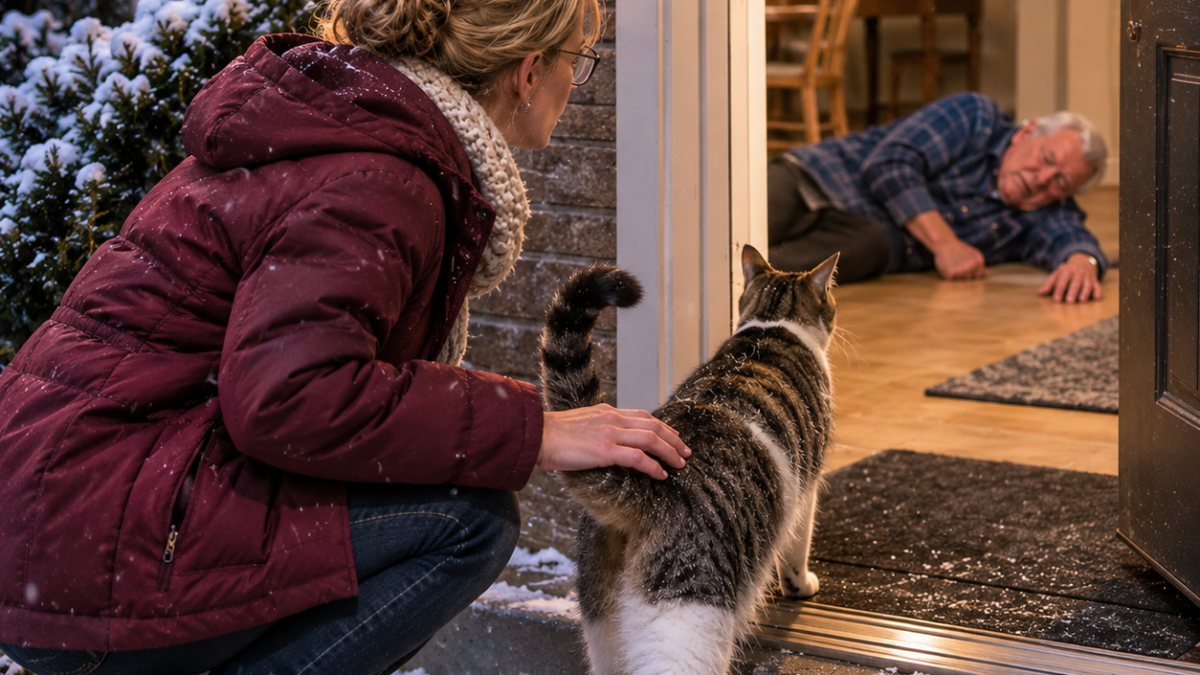
At 8:40 on a freezing January night, my seventy-three-year-old neighbor’s indoor cat appeared at my front door making a sound so desperate that my husband muted the television and asked me if an animal was dying outside.
She had never been on our porch, never wandered the street, and had spent her entire life inside Howard’s house, yet the second I opened the door she refused to come in and instead walked away, stopping every few feet to stare back at me.
By the time she led me to Howard’s dark house and pushed against a door that should have been closed, I knew I wasn’t following a frightened cat anymore—I was being taken somewhere.
The scratching started lightly.
Scrape.
Pause.
Scrape, scrape.
I was carrying two coffee mugs from the kitchen when I stopped in the hallway.
“Keith?”
My husband looked up from the couch.
“Yeah?”
“Did you hear that?”
He muted the television.
The sound came again, harder this time.
Then came the cry.
I had owned cats when I was younger. I knew the impatient meow for food, the irritated yowl of a cat locked outside a bedroom, the strange chirping sound they sometimes make at birds.
This wasn’t any of those.
It was sharp and strained, almost ragged.
Keith stood up.
“What the hell is that?”
I pulled back the front curtain.
A gray-and-white cat stood on our porch with both front paws against the glass.
I recognized her immediately.
“Ada.”
Keith came beside me.
“Howard’s cat?”
“Yeah.”
We both stared at her.
That alone was strange enough.
Howard Fenn lived about forty yards down the street. He was seventy-three, widowed, private but friendly, and so predictable that I could almost tell the time by his routines. He got his newspaper early, checked his mailbox before noon, and usually turned on his porch light before dinner.
Ada was just as predictable.
I had seen her through Howard’s windows hundreds of times.
I had never seen her outside.
Not once.
I opened our front door.
Cold air rushed around my ankles.
Ada did not enter.
Instead, she stepped backward.
Then she turned and walked down our front path.
“Ada?”
She stopped.
Looked over her shoulder.
Walked several more feet.
Stopped again.
Looked back.
Keith frowned.
“She wants something.”
“I think she wants me to follow her.”
He stared at me.
Then at Ada.
“You’re serious?”
Ada cried again.
That decided it.
I shoved my feet into my boots, grabbed my coat, and stepped outside.
The moment I did, Ada moved.
Not wildly.
Not like a frightened animal trying to escape.
She walked toward Howard’s house.
Every ten or fifteen feet, she stopped and checked behind her.
I followed.
Keith came after me.
“Howard!” I called as we approached his property.
No answer.
His house was almost completely dark.
That bothered me immediately.
Howard usually kept his kitchen light on at night.
Tonight there was nothing.
Ada climbed the front steps.
She scratched once at the door.
Then she pushed her head against it.
The door moved inward.
My stomach tightened.
“Howard?” I called again.
Nothing.
Ada slipped inside.
I hesitated at the threshold.
The air coming from the house felt wrong.
Cold.
Not just winter cold from an open doorway.
The still, heavy cold of a house without heat.
Keith was a few steps behind me.
“Sandra, wait.”
But then Ada cried from somewhere inside.
I stepped in.
“Howard?”
My boots sounded too loud on the floor.
Ada disappeared around the corner toward the kitchen.
I followed her.
Then I heard something else.
A low sound.
Barely there.
Not a word.
More like someone trying to force air through a throat that would not cooperate.
My hand went to the wall.
“Ada?”
I reached the kitchen doorway.
First I saw a slipper.
Then the leg of a pair of dark pants.
Then a hand lying palm-down on the cold tile.
Ada stood beside it.
She looked at me.
And I realized Howard was on the floor.
Completely still.
PART 2:
For one horrible second, my brain refused to connect what my eyes were seeing.
I knew the hand belonged to Howard.
I knew a person lying motionless on a kitchen floor in January was an emergency.
But some stubborn part of me kept expecting him to move, sit up, laugh, tell me he had slipped while reaching under the table.
Then I saw his face.
“Howard.”
I dropped beside him.
His eyes were open.
That was the first thing that gave me hope.
“Howard, can you hear me?”
His gaze shifted toward me.
Slowly.
His mouth moved.
Nothing understandable came out.
Behind me, Keith swore under his breath.
“Call an ambulance,” I said.
He already had his phone out.
I touched Howard’s shoulder but stopped myself from trying to roll him or lift him.
His left arm lay strangely along his side.
His face looked uneven.
One corner of his mouth sagged in a way that made my stomach drop.
Keith spoke rapidly to the dispatcher.
“Male, seventy-three. Conscious. He’s on the floor. Speech is impaired. One side of his body isn’t moving.”
He listened.
“Yes.”
Another pause.
“Yes, possible stroke.”
Stroke.
Hearing the word made the room change.
A fall could be fixed.
A broken hip was terrible, but understandable.
A stroke was something else.
I leaned closer.
“Howard, squeeze my hand.”
I placed my fingers against his right hand.
Weak pressure closed around them.
“Good. Good, Howard.”
I moved to his left side.
“Can you move this hand?”
Nothing.
I looked at Keith.
He saw my face.
He turned back to the dispatcher.
“His left side isn’t responding.”
Ada had stayed near Howard’s head.
She paced once around him, then pressed her nose toward his cheek.
“Ada,” I whispered. “Back up a little, sweetheart.”
She ignored me.
That was when I noticed how cold Howard’s skin felt.
Not cool.
Cold.
I looked around the kitchen.
“Why is it freezing in here?”
Keith glanced toward the hallway.
“I’ll check.”
The dispatcher had told us not to move Howard unless absolutely necessary, so I stayed beside him while Keith walked away.
Howard tried to speak again.
His eyes had the furious, frightened look of someone who knew exactly what he wanted to say but could not make his body cooperate.
“It’s okay,” I said.
I had no idea whether it was okay.
“You don’t have to talk.”
His right hand twitched toward the floor.
Then toward Ada.
I looked at her.
“You mean Ada?”
Howard blinked.
I almost laughed from nerves.
“She came and got me.”
His brow moved.
I leaned closer.
“She came to our house, Howard.”
His eyes changed.
For the first time, there was something beyond fear in them.
Confusion.
Maybe disbelief.
“Ada came to my door.”
He stared at her.
Then at me.
Keith called from the hallway.
“Sandra.”
“What?”
“The thermostat’s on the floor.”
“What?”
“It’s been knocked off the wall.”
I looked at Howard.
The kitchen chair near him had tipped sideways. The leg of the chair pointed toward the hall.
It was easy to imagine how it had happened.
Howard had collapsed.
Maybe he had grabbed for the chair or wall.
Something had struck the thermostat.
The heat had shut off.
“Tell them,” I said.
Keith relayed the information.
The dispatcher apparently asked for the temperature inside.
“We don’t know,” Keith said. “But it’s really cold. He’s been down for some time.”
How long?
That question suddenly terrified me.
I looked at Howard’s face.
“Howard, do you know when you fell?”
He tried to speak.
I couldn’t understand the answer.
“Don’t strain.”
Ada settled beside his shoulder.
I reached toward her carefully.
This time she allowed me to touch her back.
Her body trembled under my fingers.
“You knew, didn’t you?” I whispered.
Of course she couldn’t answer.
And at that moment I wasn’t thinking about animal behavior or intelligence or instinct.
I was simply frightened.
Frightened that we were too late.
Frightened that Howard had been lying there for hours.
Frightened that a cat had understood the seriousness of the situation before any human being did.
Keith knelt on Howard’s other side.
“They’re coming.”
“How long?”
“Minutes.”
Minutes.
Ordinarily that word meant almost nothing.
That night, every second seemed visible.
The second hand on Howard’s kitchen clock moved with a tiny click.
Howard breathed.
Ada watched him.
I rubbed my hands together because my fingers were becoming numb.
Then I realized Howard had been exposed to that cold far longer than we had.
I wanted to cover him, but the dispatcher had told us not to move or manipulate him unnecessarily.
So I kept talking.
“Stay with us.”
His eyes opened wider.
“Ambulance is almost here.”
He blinked.
“You’re not alone.”
Another blink.
“You hear me?”
His fingers closed weakly around mine.
Then red light flashed across the wall.
Keith jumped to his feet.
“They’re here.”
He ran toward the front door.
The next few minutes moved fast.
Two paramedics came in first with medical bags.
Another followed with equipment.
They took one look at Howard and went to work.
One of them asked me, “Family?”
“Neighbor.”
“Do you know his medical history?”
“No. I’m sorry.”
“When was he last known well?”
“I don’t know.”
“Did anyone speak to him today?”
“Not that I know of.”
He nodded without judgment and continued examining Howard.
Another paramedic asked Howard to smile.
His face moved unevenly.
“Raise both arms.”
The right arm lifted slightly.
The left did not.
“Can you tell me your name?”
Howard forced out a sound.
The paramedic leaned closer.
“Howard?”
A faint nod.
“Howard, you’re doing fine. We’re going to take care of you.”
One of them checked his temperature.
His expression changed almost imperceptibly.
“What is it?” I asked.
He didn’t answer immediately.
They started preparing Howard for transport.
Ada backed beneath the table.
Her eyes were huge.
The paramedics placed Howard onto a stretcher.
As they lifted him, he groaned.
Ada shot out from beneath the table.
“Ada!”
She followed them down the hallway.
I caught up near the front door.
She stopped there.
Howard’s stretcher rolled down the steps.
Ada stood at the threshold and watched.
The ambulance doors closed.
She did not cry.
She did not scratch.
She simply stared until the ambulance disappeared.
Then she sat down.
Keith stood behind me.
“What do we do now?”
I looked at Ada.
“Take her with us.”
He glanced inside Howard’s house.
“She’ll probably be more comfortable here.”
“Not tonight.”
He understood.
We found Ada’s food in the kitchen.
A litter box was downstairs.
Her carrier was in a closet, but getting her into it turned out to be impossible.
The second I put the carrier down, she ran behind the couch.
“I’m not chasing her,” Keith said.
“Neither am I.”
I found a soft blanket on the back of Howard’s chair.
When I picked it up, Ada emerged.
She sniffed it.
Then she let me wrap it around her.
I carried her outside.
She stiffened the moment we stepped onto the porch.
For a second I worried she would claw her way free and run back inside.
Instead, she stared down the street toward where the ambulance had gone.
“He’s gone to the hospital,” I whispered.
She pressed into the blanket.
At our house, I set her down in the living room.
She immediately went to the front window.
Not to the food.
Not to the water.
Not to explore.
Straight to the window facing Howard’s house.
She sat.
And stayed there.
That night, none of us slept much.
Keith went to bed after midnight.
I tried.
Every time I closed my eyes, I saw Howard on that floor.
Then I saw Ada at our door.
I kept replaying it.
Scratch.
Cry.
Walk.
Stop.
Look back.
It bothered me because the more I replayed it, the harder it was to explain as coincidence.
If Ada had simply escaped Howard’s house, why had she come directly to ours?
If she wanted shelter, why had she refused to enter?
If she wanted food, why had she immediately walked away?
And why had she checked repeatedly to make sure I followed?
I got out of bed at one in the morning.
Ada was still at the window.
“Ada.”
Her ear moved.
“That’s enough.”
Nothing.
I sat beside her.
The street was empty.
Howard’s house was dark.
“You know he isn’t there.”
Ada looked toward me.
Then back toward Howard’s house.
I rubbed the side of her neck.
“You did everything you could.”
Even as I said it, I wondered why I was talking to her as if she understood.
Maybe because that night, she seemed to understand more than I did.
The hospital would not give us detailed information because we weren’t family.
All they would confirm was that Howard had been admitted and was receiving care.
He had no children nearby.
His closest relatives lived several hours away.
Keith managed to contact a nephew using a number we found near Howard’s phone.
The nephew said he would drive in the next morning.
That was all we knew.
Ada refused breakfast.
I put down the same food she ate at Howard’s house.
She smelled it and walked away.
At lunch, I tried again.
Nothing.
She drank some water.
Then returned to the window.
“This isn’t good,” I told Keith.
“She’s stressed.”
“I know.”
“She’ll eat.”
“What if she doesn’t?”
“We’ll call a vet.”
By that evening, I was worried about two lives instead of one.
Around seven, the phone rang.
Howard’s nephew had reached the hospital.
Howard was alive.
Stable, but still in serious condition.
I sat down at the kitchen table.
“Alive,” I repeated.
Keith nodded.
“That’s what matters.”
Ada was in the doorway.
I looked at her.
“He’s alive.”
Her head tilted.
I knew better than to claim she understood the words.
But she walked toward me.
Then toward the front door.
And sat there.
The next morning she still refused food.
By the second day, I called the veterinary clinic.
They told me stress could cause a cat to stop eating, but prolonged refusal could become dangerous.
Try quiet.
Try familiar food.
Try a familiar blanket.
Keep her routine as normal as possible.
Normal.
There was nothing normal about any of this.
That afternoon, I brought Howard’s blanket into the living room and sat beside Ada.
She kept watching the window.
I laid the blanket across my lap.
“Ada.”
Her ears turned.
“Come here.”
She didn’t move.
I patted the blanket.
“You know this.”
She stood.
Walked toward me.
Sniffed the fabric.
Then, slowly, climbed onto my legs.
I barely breathed.
Keith came through the room carrying laundry.
I held up one finger.
Don’t move.
He nodded and backed away.
Ada circled once and settled.
Her body was tense at first.
Then, gradually, it relaxed.
I stroked her head.
After a minute, I felt the vibration.
Purring.
It was the first time since Howard’s collapse that she had made a peaceful sound.
She stayed there for nearly twenty minutes.
Then she stood.
Jumped down.
Walked to her bowl.
And began eating.
I covered my mouth.
Keith stood in the doorway.
“Finally.”
I nodded.
I was far more emotional about a cat eating three bites of food than I would ever have imagined.
On the third day, we were allowed to visit Howard.
The doctor met us first.
He explained that Howard had suffered a major stroke.
The left side of his body had been badly affected.
His speech was impaired.
His recovery would depend on many factors, and at his age there were no guarantees about how much function would return.
Then the doctor mentioned something else.
“When he arrived, his core temperature was 34.1 degrees Celsius.”
I stared at him.
“That low?”
“Yes.”
“So he had hypothermia.”
“Yes.”
The doctor was calm.
Professional.
But his tone made it clear this was serious.
“How long had he been on the floor?”
“Based on the clinical picture and what we’ve been able to establish, perhaps around three hours.”
Three hours.
I tried to imagine it.
Howard falling.
Unable to reach the phone.
Unable to stand.
The heating system shutting off.
January cold slowly creeping through the house.
Ada beside him.
“What if we hadn’t found him?” I asked.
The doctor paused.
“There are never absolute guarantees with these things.”
“I understand.”
“But given his age, the severity of the stroke, and the hypothermia, another sixty to ninety minutes without intervention could very well have been fatal.”
The room seemed to narrow.
“An hour?”
“Possibly.”
I looked at Keith.
He was staring at the floor.
An hour.
We had spent longer than that watching movies.
Longer than that grocery shopping.
Longer than that scrolling on our phones without noticing time passing.
That night, Howard had perhaps one more hour.
Maybe ninety minutes.
And somehow Ada had left the only home she knew.
Walked down a street she had never explored.
Found us.
And convinced me to follow.
The doctor continued talking about treatment.
Rehabilitation.
Mobility.
Speech therapy.
I heard most of it.
But that number stayed in my mind.
Sixty to ninety minutes.
When we entered Howard’s room, he was awake.
I almost didn’t recognize him.
Not because he looked drastically different.
Because illness had taken away the small things that made Howard seem strong.
He always stood straight.
Always moved quickly.
Always spoke clearly.
Now he lay against white pillows with his left arm resting motionless beside him.
His eyes found mine.
“Sandra.”
The word came slowly.
But it was clear.
I smiled.
“Hi.”
He tried to lift his left hand.
Nothing happened.
His jaw tightened.
I pulled a chair closer.
“You don’t have to prove anything to me.”
Howard looked annoyed.
“Wasn’t.”
“Of course not.”
That almost got a smile.
Keith stepped forward.
“You gave us a scare.”
Howard looked at him.
“Sorry.”
“Don’t apologize.”
He closed his eyes briefly.
Then opened them.
“Ada?”
That was the first real question he asked.
“She’s safe.”
His shoulders relaxed.
“She’s at our house.”
Howard looked confused.
“Your house?”
“Yes.”
“Why?”
I hesitated.
I suddenly realized nobody had told him how we found him.
His nephew knew.
The doctors knew.
The paramedics knew.
But Howard didn’t.
I leaned forward.
“You don’t remember?”
He shook his head slightly.
“What’s the last thing you remember?”
“Kitchen.”
He swallowed.
“Fell.”
His speech took effort.
“Ada there.”
Keith looked at me.
I said, “She left.”
Howard’s eyes sharpened.
“What?”
“Ada left the house.”
“No.”
“I know.”
He frowned.
“She doesn’t.”
“I know.”
“She’s indoor.”
“Yes.”
He stared at me.
I continued carefully.
“She came to our front door.”
Howard said nothing.
“She scratched the glass.”
Nothing.
“She was making this awful sound. I opened the door, and she wouldn’t come inside.”
His eyes had widened.
“She walked down our path, then stopped and looked back at me.”
Howard’s right hand tightened around the blanket.
“I followed her.”
He stared at my face.
“She led me here.”
Still no response.
“She went right to your house, Howard.”
His mouth opened.
Then closed.
“She doesn’t know you.”
“I know.”
“She doesn’t know the street.”
“I know.”
“She’s never been outside.”
“I know.”
Howard turned his head toward the window.
For several seconds, he didn’t speak.
Then he whispered, “No.”
I thought he was rejecting the story.
“Howard—”
“She’s never been outside.”
The words were slow.
Almost to himself.
“I know.”
He looked back.
“She found you?”
My throat tightened.
“She found me.”
His eyes closed.
His right hand covered his face.
For a second, nothing happened.
Then his shoulders moved.
I looked away.
Keith did too.
Howard was crying.
Not loudly.
Not dramatically.
He simply kept his hand over his eyes while tears ran down toward his ears.
Finally he lowered his hand.
His voice was rougher.
“My wife picked her.”
I waited.
“I didn’t know that.”
Howard took a breath.
“She died.”
“I know.”
“House got quiet.”
Each sentence required concentration.
“Too quiet.”
He paused.
“Went to shelter.”
“Wellington County?”
He nodded.
“Didn’t plan to get kitten.”
A faint smile appeared.
“Ada planned it.”
That sounded like Howard.
I smiled.
“What happened?”
“She hid from everybody.”
He took another breath.
“I sat down.”
His eyes drifted toward the ceiling as if he could still see the memory.
“She came over.”
“Just to you?”
“Climbed right up.”
He touched his chest with his right hand.
“Here.”
I imagined tiny Ada climbing onto him.
“How old was she?”
“Little.”
He almost laughed.
“Too little.”
“And you took her home.”
“She took me.”
That time I did laugh.
So did Keith.
Howard’s smile disappeared slowly.
“My wife would’ve loved her.”
The room grew quiet.
I reached out and touched his right hand.
“She took good care of you.”
Howard looked toward me.
“No.”
He swallowed.
“Saved me.”
I didn’t argue.
Howard remained in the hospital for nineteen days.
The first week was the hardest.
His stroke had not just weakened his left side.
It had taken his confidence.
Before the stroke, Howard was independent to the point of stubbornness.
He repaired his own fence.
Changed his own light fixtures.
Cleared his own snow.
When we offered help, he usually thanked us and said he already had it handled.
Now he needed assistance simply to stand.
The first time I saw him in physical therapy, I understood how much that cost him.
A therapist positioned a walker in front of him.
“Ready?”
Howard nodded.
“Lean forward.”
He did.
“Push through your right leg.”
Howard rose several inches.
His left knee buckled.
Two therapists caught him.
His face went red.
“Again.”
“Howard, rest.”
“Again.”
“You’ve already done three attempts.”
“Again.”
The therapist looked at me.
I stepped outside.
I knew Howard well enough to understand that being watched made it worse.
Ten minutes later, the therapist came out.
“He’s determined.”
“That’s one word.”
She smiled.
“Stubborn?”
“That’s the one.”
When I entered, Howard was sweating.
He wouldn’t look at me.
I sat down.
“Good session?”
“Terrible.”
“You stood.”
“For four seconds.”
“That’s four more than yesterday.”
He glared at me.
I held up my hands.
“Fine. Terrible.”
A reluctant smile appeared.
Then disappeared.
“Ada?”
“At the window every night.”
Howard looked toward me.
“Still?”
“Every night.”
He swallowed.
“Tell her…”
He stopped.
The words wouldn’t come.
I waited.
He tried again.
“Tell her I’m coming.”
“I will.”
That evening, I went home and sat beside Ada.
“Howard says he’s coming.”
She stared through the window.
“He’s working on it.”
Her tail moved once.
The next few days developed their own rhythm.
Morning: Ada ate, explored our house for exactly five minutes, then returned to the front window.
Afternoon: I visited Howard.
Evening: Ada sat by the window again.
Keith began calling it “the watch.”
“Your shift started,” he would say when Ada took her position.
Once I told Howard.
He laughed.
“Guard cat.”
“Against what?”
He shrugged.
“Bad thermostats.”
Even his jokes came slower now.
That hurt me more than I expected.
Not because slow speech was tragic.
Because Howard noticed it.
Sometimes he would start a sentence, lose a word, and stop.
The anger on his face was immediate.
Once he tried three times to say “rehabilitation.”
He couldn’t get it out.
Finally he slammed his right hand against the bed rail.
“Howard.”
He turned away.
“You know what I mean.”
“Yes.”
“That’s not…”
He stopped again.
“It’s not what?”
“Same.”
“No.”
His eyes filled with frustration.
“No, it isn’t.”
I didn’t tell him everything would return.
I didn’t know that.
Instead I said, “Then we deal with what is.”
He looked toward me.
“You sound like Keith.”
“That is the meanest thing you’ve ever said.”
A laugh escaped him.
It was uneven and short.
But it was a laugh.
Those moments mattered.
About a week after the stroke, I contacted the humane society.
I wasn’t looking for publicity.
I wasn’t trying to turn Ada into a celebrity.
I simply wanted somebody knowledgeable to tell me whether what happened had an ordinary explanation.
The humane society connected me with a veterinary behaviorist.
I told her the story exactly as it happened.
No embellishment.
No claims about Ada understanding medicine.
Just facts.
Howard collapsed.
Ada was inside.
Somehow she got out through the incompletely latched front door.
She traveled roughly forty yards.
She came to our illuminated home.
She scratched.
She vocalized.
When I opened the door, she refused to enter.
She walked away.
She repeatedly looked behind her.
She returned to Howard.
“What do you think happened?” I asked.
The behaviorist was quiet.
“Cats are highly sensitive to changes in routine.”
“So she knew something was wrong?”
“She almost certainly knew something was unusual.”
“Could she recognize a stroke?”
“Not in the human diagnostic sense.”
“Of course.”
“She may have responded to his movement, vocalizations, scent, breathing, posture, distress. We don’t know which cues.”
“That explains her being upset.”
“Yes.”
“But not coming to us.”
“No.”
I leaned back.
“Could she have known where we lived?”
“She may have observed your home through windows. Heard your voices. Seen movement.”
“Howard says she’s never been outside.”
“That doesn’t mean she had no awareness of the outside environment.”
“That makes sense.”
I wanted that answer to satisfy me.
It didn’t.
“What about the way she kept looking back?”
The behaviorist paused.
“That is interesting.”
“She wasn’t wandering.”
“I understand.”
“She would walk maybe ten feet, stop, turn, look directly at me, then continue once I moved.”
Another pause.
“I can tell you what the cat did,” she said. “I cannot tell you how the cat knew to do it.”
I wrote that sentence down after we finished speaking because I didn’t want to forget it.
Not because it proved anything supernatural.
It didn’t.
The behaviorist had actually been careful not to make claims she couldn’t support.
That was why the sentence stayed with me.
She wasn’t saying Ada had human reasoning.
She was saying the observed behavior was real even when the mechanism remained uncertain.
That felt important.
Sometimes people think if we cannot explain something completely, we have to choose between two extremes.
Miracle.
Or coincidence.
I stopped believing those were the only choices.
Ada noticed Howard was in trouble.
Ada left.
Ada found us.
Ada behaved in a way that made me follow.
Whatever happened inside her mind between those steps belonged to her.
Howard improved.
Slowly.
He learned to stand with assistance.
Then with a walker.
His left leg began cooperating just enough to support him.
His left arm remained weaker.
His speech improved, but some words continued to arrive late.
Every gain thrilled him for about five minutes.
Then he became frustrated by the next thing he couldn’t do.
“You walked twelve feet,” I told him after one therapy session.
“Used to walk miles.”
“You also used to be seventy-two.”
He stared at me.
“I’m seventy-three.”
“That explains it.”
He laughed.
Then the therapist made him walk twelve feet again.
On the fifteenth day, Howard called me himself.
I almost didn’t answer because I didn’t recognize the hospital number.
“Sandra.”
His voice was slower but clearer.
“Howard?”
“Yes.”
“You called me.”
“That’s how phones work.”
I sat down.
That dry humor meant more to me than any medical chart.
“What’s going on?”
“Need favor.”
“Anything.”
“Ada.”
I smiled.
“What about her?”
“Put phone near her.”
I looked across the room.
Ada was on Howard’s blanket.
“You want to talk to your cat?”
“Don’t judge.”
“I’m not judging.”
I walked over and switched the phone to speaker.
“Ada.”
Her ears lifted.
Howard spoke.
“Ada.”
She sat up.
I stopped breathing.
“Ada, girl.”
She jumped from the couch.
Walked toward the phone.
Sniffed it.
Then gave one short meow.
Howard went silent.
“Howard?”
Nothing.
“You okay?”
His voice came back rough.
“Yeah.”
Ada rubbed her face against the phone.
“Stupid cat,” Howard whispered.
I smiled.
“You called her.”
“Still stupid.”
But I heard him crying.
Ada stayed beside the phone until the call ended.
The next morning, she ate more than she had since arriving.
Four days later, Howard was cleared to go home.
The news created a different problem.
His house could not remain exactly as it had been.
A home care worker assessed the rooms.
The loose thermostat had already been replaced and secured with brackets.
Furniture was rearranged to give his walker space.
Loose rugs disappeared.
A medical alert pendant was ordered.
Howard objected to almost every change.
“They’re removing my house one object at a time.”
Keith carried out another rug.
“That rug nearly killed me twice and I don’t even live here.”
“I liked that rug.”
“It tried to assassinate you.”
Howard glared.
Keith rolled it up.
“The rug loses.”
I stood near the kitchen counter laughing.
Howard pointed at me.
“You’re supposed to be on my side.”
“I’m on the side where you don’t end up on the floor.”
“Traitors.”
“Alive traitors.”
That ended the argument.
The thermostat bothered Howard most.
Not the device itself.
What it represented.
He stood in front of it one afternoon, leaning against his walker.
The new brackets were visible.
“I hit that?”
“Probably when you fell.”
He touched the wall.
“Don’t remember.”
“Probably better.”
He looked toward the kitchen floor.
“Ada remembers.”
I didn’t answer.
On discharge day, Howard insisted on one thing.
“Don’t bring her over until I’m home.”
“Why?”
“Want her to see me there.”
I understood.
So we waited.
A family member brought Howard back.
I watched from our window as the car pulled in.
Ada was asleep.
Then she heard a car door.
Her head shot up.
She ran to the window.
Howard appeared.
Slowly.
Walker first.
Then one foot.
Then the other.
Ada stood on her hind legs against the glass.
She made a sound I had never heard before.
Not the scream from that first night.
Something softer.
Almost questioning.
“He’s home,” I whispered.
She began pacing.
I picked her up.
She twisted in my arms.
“Okay, okay.”
Keith opened the door.
Cold air entered.
Ada froze.
Across the street, Howard was standing inside his doorway.
He saw her.
Even from that distance, I saw his face change.
I carried Ada across.
Halfway there, she began struggling again.
The second we entered Howard’s doorway, I lowered her.
For one beat, she stood motionless.
Then she ran.
Howard bent slightly.
“Ada.”
She reached his walker.
Rubbed one side of her body against his right ankle.
Turned.
Rubbed the other side against his left shoe.
Then she stood on her hind legs with her front paws against his shin.
Howard’s right hand came down.
He touched the top of her head.
“Ada.”
That was all he said.
Her purr was loud enough for me to hear.
I backed toward the doorway.
Howard looked up.
“Sandra.”
“Yeah?”
“Thank you.”
I shook my head.
“You know who to thank.”
His gaze dropped.
Ada was circling his feet.
Howard’s mouth trembled.
“The one who went for help.”
“What?”
He smiled faintly.
“That’s what she is.”
Ada looked up at him.
“The one who went for help.”
The phrase stayed.
For the first six hours after Howard came home, Ada barely let him out of her sight.
When he sat, she sat near his feet.
When he stood, she followed the walker.
When he went to the kitchen, she went too.
I brought soup over that evening.
Howard was sitting at the same kitchen table beside the spot where he had collapsed.
Ada lay under his chair.
One paw rested on top of his shoe.
“She’s attached,” I said.
Howard looked down.
“She thinks I’ll disappear.”
“Maybe.”
He reached beneath the table.
Ada pressed her head into his fingers.
“I did.”
I knew what he meant.
From Ada’s perspective, Howard had been there.
Then strangers carried him away.
He vanished for nineteen days.
I put the soup in the refrigerator.
“She’ll calm down.”
“What if I don’t want her to?”
I smiled.
“Then I guess you’re stuck.”
He nodded.
“Fine.”
For the next several weeks, Howard’s recovery continued at home.
A care worker came three times a week.
Therapy appointments filled his calendar.
His nephew visited more often.
Keith checked the furnace twice even after the technician told him it was working perfectly.
Howard complained about everyone “hovering.”
Then one morning I saw him outside by himself.
My heart almost stopped.
He was walking slowly toward the mailbox with his walker.
I ran out.
“Howard!”
He looked at me.
“What?”
“What are you doing?”
“Escaping.”
“You can’t just go walking around alone.”
“I’m going fifteen feet.”
“You could fall.”
“So could you.”
“You had a stroke.”
“I remember.”
I stopped.
That answer took the anger out of me.
Of course he remembered.
Every second of his life now reminded him.
The walker.
The pendant.
The slow words.
The home visits.
The chair in the shower.
The thermostat brackets.
Ada following him whenever he stood.
I stepped back.
“Fine.”
Howard nodded.
“Thank you.”
“But I’m watching.”
“I know.”
He made it to the mailbox.
Opened it.
Removed two envelopes.
Turned.
Walked back.
It took nearly five minutes.
When he reached his porch, he was exhausted.
But he was smiling.
Ada watched through the window.
That afternoon, Howard told me something I hadn’t known.
He remembered parts of the time he spent on the floor.
Not everything.
But enough.
“I was making tea,” he said.
We were sitting in his living room.
Ada occupied the cushion between us.
“Then?”
“Felt strange.”
“What kind of strange?”
“Hand.”
He looked at his left hand.
“Wouldn’t work.”
He flexed the fingers slightly.
“Cup fell.”
“What did you do?”
“Tried to grab counter.”
He paused.
“Missed.”
I imagined the fall.
“What do you remember after that?”
“Floor.”
“Were you conscious?”
“Mostly.”
“Could you call out?”
“Tried.”
He touched his mouth.
“Words wrong.”
I nodded.
“Ada came.”
I looked down at her.
“She was in the kitchen?”
“Yes.”
“What did she do?”
“Meowed.”
“Normal?”
Howard shook his head.
“Different.”
The same way I had described her sound.
“What happened after that?”
He stared toward the front hall.
“She walked around me.”
“For how long?”
“Don’t know.”
“Then?”
“She disappeared.”
I leaned forward.
“You saw her leave?”
“No.”
“But you noticed she was gone.”
“Yes.”
“How?”
“No sound.”
That answer hurt somehow.
Howard was lying on the floor.
The house cold.
The cat gone.
“What did you think?”
“Thought she hid.”
“Were you scared?”
Howard looked at me like the question was ridiculous.
“Yes.”
It was the first time I had heard him admit it directly.
“I thought…”
He stopped.
“What?”
His right hand tightened around the walker.
“Thought nobody coming.”
I felt pressure behind my eyes.
“Howard.”
He looked down.
“I knew phone was there.”
He pointed toward the counter.
The phone was only a few feet from where he had fallen.
Close enough to see.
Too far to reach.
“I kept trying.”
His voice became quieter.
“Couldn’t move.”
Ada stood and walked onto his lap.
Howard rested his right hand on her back.
“Then I heard door.”
“The front door?”
“Maybe.”
“Did you know Ada left?”
“No.”
His expression tightened.
“I was getting cold.”
I waited.
“Then I remember her.”
“Coming back?”
“Yes.”
He looked at me.
“And then you.”
I exhaled.
“So she came back before me.”
Howard nodded.
“I saw her.”
That detail struck me.
Ada hadn’t simply escaped.
She left.
Found me.
Then returned to Howard.
I followed.
A complete loop.
I thought about the behaviorist’s words.
I can tell you what the cat did.
I cannot tell you how the cat knew to do it.
Howard scratched behind Ada’s ears.
“She was yelling at you?”
“That’s one way to describe it.”
“She yells at me for dinner.”
“This was different.”
“I know.”
“How?”
He gave me a tired smile.
“Because you followed.”
Over time, life became less medical.
That was important.
For the first month, every conversation with Howard seemed to involve blood pressure, medication, therapy, appointments, mobility, or safety.
By spring, we started talking about ordinary things again.
Weather.
Property taxes.
A broken fence.
The terrible coffee at a local diner.
Howard hated needing help, but he gradually learned the difference between accepting help and surrendering independence.
His walker became less of an enemy.
The alert pendant became something he wore without complaint.
Mostly.
One afternoon I noticed it wasn’t around his neck.
“Howard.”
He looked up.
“Where’s the pendant?”
He touched his chest.
Nothing.
His expression changed.
“Bathroom.”
I stared at him.
“You forgot it.”
“Temporarily misplaced.”
“You forgot it.”
“Strong accusation.”
I pointed toward the hallway.
“Get it.”
He shook his head.
“You’ve become unbearable.”
“And yet somehow you survived me.”
He retrieved it.
Ada developed her own routines.
She still followed Howard more closely than before.
But the intense panic gradually faded.
She no longer jumped up every time he moved.
She slept in her old places.
She sat in the sunny window.
She demanded food.
She became, once again, a cat.
Except for one habit.
Every evening, at roughly the same time, Ada walked to Howard’s front door.
She sat facing our house.
And stayed there for approximately four minutes.
The first time I noticed, I was washing dishes.
I looked out.
There she was.
A small gray-and-white shape behind the glass.
“Keith.”
He came over.
“What?”
“Look.”
He leaned closer.
“Ada?”
“She’s staring at us.”
“She probably sees movement.”
“Maybe.”
The next evening, she did it again.
Then again.
After about a week, I mentioned it to Howard.
He nodded.
“You noticed?”
“Yes.”
“How long has she been doing that?”
“Since I came home.”
“Every night?”
“Pretty much.”
“How long does she sit there?”
Howard looked at his watch.
“Four minutes.”
“You timed her?”
“Got bored.”
I laughed.
“What do you think she’s doing?”
Howard looked toward my house.
“Checking.”
“On us?”
He shrugged.
“Maybe.”
I wanted to make fun of him.
I couldn’t.
Because every night, Ada sat where she could see the house she had run to when Howard needed help.
One evening I stood at our window when she appeared.
I lifted my hand.
“Hello, Ada.”
Obviously, she couldn’t hear me.
But she stayed.
Four minutes later, she stood, turned, and disappeared back into Howard’s living room.
The next night I waved again.
Soon it became my own habit.
Not every night.
But often.
There was no emergency now.
No desperate scratching.
No screaming.
No dark house.
Just a cat looking across the street.
And me looking back.
Several months after the stroke, Howard and I returned to the kitchen floor in conversation.
Not literally.
Neither of us liked standing near that spot for long.
But the memory was always there.
Howard had replaced the chair he knocked over.
I asked why.
“Broken.”
“From the fall?”
“Maybe.”
He opened a cabinet.
“Didn’t like looking at it.”
That was honest.
I understood.
Objects can become evidence.
The chair.
The thermostat.
The phone on the counter.
For me, the front door of my own house had become an object like that.
Sometimes I still heard scratching in my memory.
One night during a storm, a branch scraped the window.
I jumped.
Keith noticed.
“You okay?”
“Yeah.”
He looked toward the door.
“Thought it was her?”
I nodded.
He didn’t laugh.
The experience had affected him too.
We talked occasionally about what would have happened if we hadn’t been home.
The behaviorist warned me against turning hypothetical scenarios into certainty.
Ada might have tried another house.
She might have gone farther.
Someone else might have found Howard.
But I could not stop thinking about one detail.
Our house was the only nearby house with visible lights.
Maybe that was what Ada saw.
Maybe that was enough.
Animals don’t need to understand every step of a human problem to act on the part they do understand.
Ada may not have known the word stroke.
She may not have understood death.
She may not have understood ambulance.
But she knew Howard was wrong.
She knew he wasn’t getting up.
She knew his sounds were different.
And perhaps she knew another human being was needed.
That is already extraordinary without adding anything else.
Howard eventually told the story to his nephew.
I happened to be present.
His nephew laughed at first.
Not because he didn’t believe it.
Because it sounded impossible.
“Ada?”
Howard pointed toward the cat.
“That one.”
“She went to Sandra’s house?”
“Yes.”
“By herself?”
“Yes.”
His nephew looked at me.
I nodded.
“She stood at our door and screamed until I came outside.”
He looked back at Ada.
“You?”
Ada washed one paw.
Howard smiled.
“Don’t expect confession.”
His nephew crouched.
“You saved him?”
Ada ignored him.
Howard’s expression softened.
“The one who went for help.”
The nephew stopped smiling.
He looked at his uncle.
Then at Ada.
“That’s what you call her now?”
“Sometimes.”
I could hear emotion entering his voice.
His nephew stood and hugged him.
Howard tolerated it for about three seconds.
“That’s enough.”
His nephew held on one second longer.
“Too bad.”
Ada left the room.
Later, Howard complained to me.
“Family gets dramatic.”
I stared at him.
“You cried when I told you what Ada did.”
“Private.”
“You did it in front of me.”
“Bad judgment.”
That was Howard.
The more he recovered, the more himself he became.
Not his old self.
That distinction mattered.
People often talk about recovery as though the goal is to return exactly to who you were.
Howard couldn’t.
The stroke had changed things.
His left side remained weak.
His speech remained slower.
Fatigue came faster.
Tasks required planning.
But he was still Howard.
Just a Howard who now knew how quickly independence could disappear.
A Howard who accepted the home care worker three times a week.
A Howard who kept the pendant around his neck.
A Howard who checked the front door latch carefully.
And a Howard who no longer called Ada “just the cat.”
One summer evening, he invited Keith and me over for dinner.
That alone felt like a milestone.
Howard insisted on cooking.
We were allowed to carry plates.
Nothing more.
Ada sat beneath the table.
At one point Keith said, “Remember when we thought you’d never let anybody help you?”
Howard pointed his fork at him.
“I still don’t.”
“You’re letting us wash dishes.”
“That’s because I’m intelligent.”
“Strategic delegation?”
“Exactly.”
I looked down at Ada.
“She gets credit for management.”
Howard followed my gaze.
“She runs everything.”
Ada blinked slowly.
At around 8:40, she stood.
Walked toward the front door.
Sat.
Keith glanced at the clock.
“Is this the thing?”
Howard nodded.
“The inspection.”
I walked beside her.
Through the glass I could see my own house across the street.
Empty.
Lights on.
Waiting.
That was exactly what Ada had seen on January 3.
For the first time, I tried to see the night from her perspective.
Howard falls.
His body stops working normally.
He doesn’t get up.
His voice changes.
The house becomes cold.
The usual routine disappears.
Ada moves through the rooms.
No other human.
Then through the front window:
Light.
Across the street.
Life.
Maybe that was all it took.
Maybe not.
I sat beside her.
“You saw our lights, didn’t you?”
Ada stared ahead.
Howard called from the kitchen.
“She’s not going to testify.”
“I know.”
“Attorney says she’s unreliable.”
I smiled.
Four minutes passed.
Ada stood.
She returned to Howard.
Routine complete.
The anniversary of the stroke arrived quietly.
January 3.
I expected Howard to ignore it.
Instead, he knocked on our door at 8:30 that evening.
It took him longer to cross the street now, especially in winter.
Keith opened the door.
“Howard?”
He held a paper bag.
“Brought pie.”
“Why?”
Howard looked irritated by the question.
“People need reasons?”
“Usually when you carry pie through snow.”
I stepped into the hallway.
Then I understood the date.
Howard saw it on my face.
“Don’t.”
“I didn’t say anything.”
“You were going to.”
“No.”
“Yes.”
He came inside.
Ada was not with him.
She rarely went outside now, despite having demonstrated she could.
Howard had returned her to being an indoor cat.
“I’m not testing fate,” he said whenever anyone joked about it.
We ate pie.
Nobody made a speech.
At 8:40, I looked at the clock.
Howard noticed.
“Exactly?”
“Pretty close.”
He sat quietly.
“That’s when she came.”
“Yes.”
He looked toward our front door.
For several seconds the room was completely silent.
Then he said, “I had about an hour.”
“Maybe.”
“That’s what doctor said?”
“Sixty to ninety minutes was his estimate.”
Howard nodded.
“I think about that.”
“I know.”
“No.”
He looked directly at me.
“I think about what an hour is.”
I waited.
“TV show.”
“Yes.”
“Trip to grocery store.”
“Yes.”
“Nap.”
I understood.
“It doesn’t feel like much.”
“No.”
“But it was everything.”
That sentence stayed with me.
An hour can be nothing.
An hour can be a life.
Howard stood carefully.
Keith reached for him.
Howard waved him off.
“I’m fine.”
He walked toward the front window.
Across the street, Ada was visible behind his glass door.
Sitting.
Facing us.
Howard saw her.
A smile moved slowly across his face.
“There.”
I joined him.
Ada looked toward our house.
Howard lifted his hand.
So did I.
Keith stood behind us.
For four minutes, none of us said anything.
Then Ada turned away.
Howard whispered, “Duty complete.”
He went home a few minutes later.
I watched him cross.
Walker touching the pavement.
Step.
Walker.
Step.
Slow, but moving.
Ada waited inside.
When he opened the door, she rubbed against his legs.
Years from now, people may hear this story and decide Ada’s behavior was instinct.
They may say she followed light.
They may say she had seen us through a window before.
They may say her repeated glances were ordinary feline checking behavior that I interpreted through the emotion of the moment.
They may be right.
Others may call what she did love.
They may say animals understand far more than science has proven.
Maybe they are right too.
I stopped needing to choose.
I know what I saw.
A cat who had never visited my home came to my door.
She cried until I opened it.
She did not come inside.
She walked away.
She stopped.
She looked back.
She continued only after I followed.
She returned to the house where her owner was lying helpless on the floor.
Because I followed her, Howard received medical care before the stroke and hypothermia took away the little time he had left.
Those facts are enough for me.
Howard is still here.
His left side is still weaker than his right.
He still uses a walker.
His speech slows when he is tired.
A home care worker still visits three times a week.
The alert pendant still hangs around his neck.
The thermostat is still held securely in place by brackets Keith insists could “probably survive an earthquake.”
Howard still complains about those brackets.
Ada is seven now, older in the face but still sharp-eyed.
She sleeps in her favorite window.
She steals Howard’s chair whenever he stands.
She yells for dinner.
She refuses most visitors.
In other words, she behaves like a perfectly ordinary cat.
Until evening.
Then, before settling down for the night, she walks to the front door.
She sits.
Faces our house.
And stays there for about four minutes.
Most nights, if I notice her, I stand at my own window.
Sometimes I wave.
Sometimes I don’t.
There is something peaceful about simply being there.
The first time Ada and I faced each other across that distance, everything was wrong.
Howard’s house was dark.
His body was cold.
He was trapped on the kitchen floor.
Ada’s cries were frantic.
Time was disappearing.
Now the house behind her is warm.
Howard is usually in his chair.
Sometimes I can see him reading.
Sometimes he watches television.
Sometimes he notices Ada at the door and looks across at me too.
No one needs rescuing.
No ambulance is coming.
No one is counting minutes.
And maybe that is why those four minutes matter so much to me.
They remind me of the difference between that night and this one.
Howard once told me he doesn’t think of Ada as his pet anymore.
“Then what is she?” I asked.
He was quiet for a while.
Finally, he looked down at her.
“My family.”
Ada rubbed her cheek against his hand.
Howard smiled.
Then he added, “And the one who went for help.”
That was exactly right.
She had never explored the street.
Never visited our home.
Never been trained to seek assistance.
Nobody taught her what a stroke looked like.
Nobody showed her how to find a neighbor.
Nobody told her time was running out.
But when the one person who had become her entire world fell to the floor and could not get back up, Ada did something she had never done before.
She left home.
She went toward the only light she could find.
She scratched at a stranger’s door.
She cried until I answered.
And when I opened that door, she did not ask me to save her.
She turned around.
Walked back toward Howard.
And made sure I followed.
[END OF STORY]








