PART 2: My Neighbor Tore Down 200 Feet of My Fence While I Was Gone—So I Rebuilt the Property Line in Concrete and Steel
PART 2
I sat behind the wheel for several seconds with the engine still running.
My brain kept trying to restore the missing image.
Fence.
Posts.
Shade.
The familiar line.
But there was nothing.
A few concrete footings remained.
Some posts had been cut.
Others had been yanked from the ground.
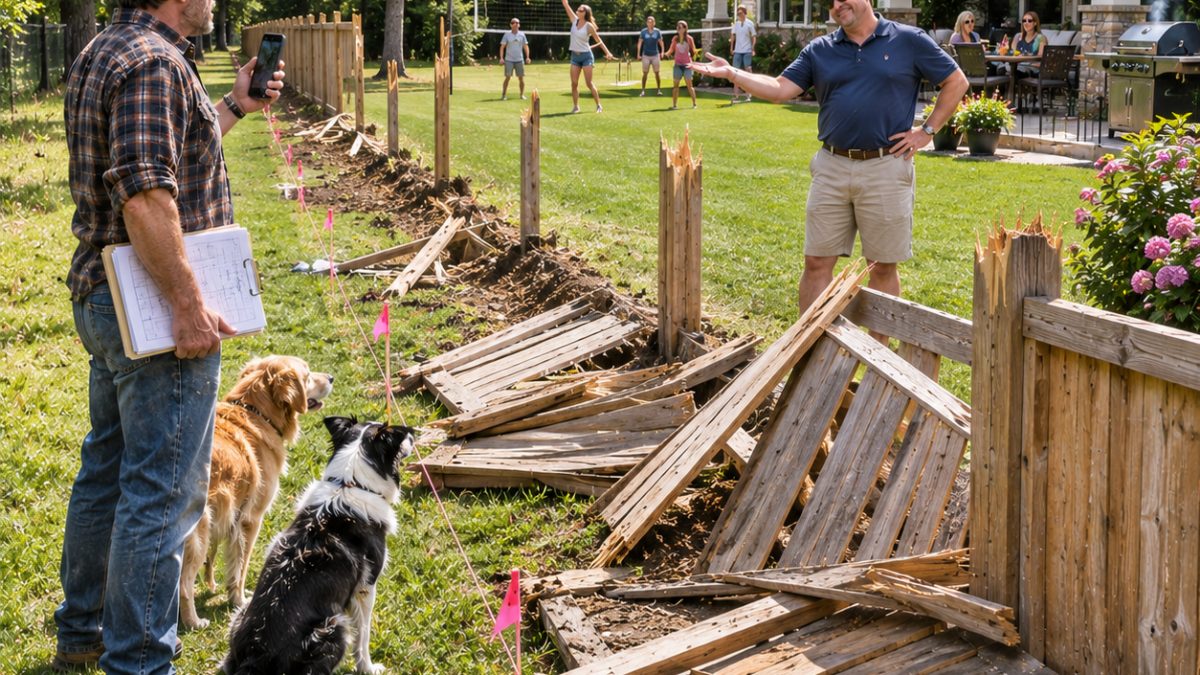
Panels lay stacked crookedly on my side as though somebody had dismantled a shed and left the debris for me to clean up.
Beyond that, Daniel and Claire’s yard flowed directly into mine.
Exactly what he’d said he wanted.
Open.
Connected.
Communal.
There was even a volleyball net stretched across the area where the fence had stood.
Children ran through the opening.
One of them chased a blue ball onto my grass.
Nobody stopped him because, visually, there was nothing left to say he had crossed anywhere.
I got out.
Closed the truck door.
The slam sounded louder than it should have.
I walked toward the backyard.
I don’t remember deciding to go to Daniel’s patio.
I just remember arriving.
He stood beside a stainless-steel grill.
Spatula in one hand.
A drink beside him.
Claire sat at a patio table.
Their children were playing.
Daniel looked up.
“Hey, Grant. You’re back.”
I stared at him.
“What happened to my fence?”
He glanced toward the open yard.
Then actually smiled.
“Oh. That.”
I waited.
“We took it down.”
For a second, I thought I had misunderstood.
“You took down my fence.”
“Our architect suggested opening the space.”
I looked at Claire.
She didn’t say anything.
Daniel continued.
“It looks incredible, doesn’t it? Everything feels twice as big.”
“That’s my property line.”
“I know where the line is.”
“Then why is my fence gone?”
He gave that little shrug people use when they’re confident enough to mistake confidence for logic.
“The yards were boxed in.”
“They were separate properties.”
“They’re still separate properties.”
“You removed a structure from mine.”
His smile faded slightly.
“Grant, nobody’s taking your land.”
I pointed toward his children running through my backyard.
“You literally removed the thing separating it.”
“It’s grass.”
I stared.
Daniel waved the spatula.
“Property lines are constructs, man. You’re still the owner. We’re just making better use of the space.”
I looked at him long enough that he stopped smiling altogether.
“Put it back.”
He laughed.
Not loudly.
Just one dismissive breath.
“We already hauled most of it off.”
“What?”
“The bad panels.”
“They weren’t bad.”
“They were old.”
“They were eight years old.”
“Exactly.”
I felt my jaw tighten.
Daniel continued.
“Removal cost about twelve hundred bucks.”
I couldn’t believe where the conversation was going.
Then he proved me right.
“If you want, you can Venmo me half.”
Claire finally looked away.
I didn’t say anything.
There are moments where more words don’t improve reality.
They only give the other person opportunities to make it worse.
So I turned around.
Walked back onto my property.
Pulled out my phone.
Photographed everything.
Broken posts.
Remaining concrete.
Stacked boards.
Missing sections.
Volleyball net.
Foot traffic.
Wide shots showing the open boundary.
Close-ups showing where hardware had been removed.
I took video.
Timestamped.
Then I called Melissa Carter.
Melissa had been my attorney for several years.
Not because I lived in courtrooms.
Because after a bad partnership had cost me more money than hiring a lawyer early would have, I learned to value people who understood documents before documents became emergencies.
She answered on the third ring.
“Grant?”
“I need you to look at some pictures.”
“What happened?”
“My neighbors tore down my fence.”
Pause.
“How much?”
“Most of the shared boundary.”
“Your fence?”
“Yes.”
“On your property?”
“Yes.”
“Without permission?”
“Yes.”
I sent the photos while we talked.
Ten minutes later, she called back.
Her voice had changed.
“Tell me they did not actually do this.”
“They did.”
“Have you spoken to them?”
“Yes.”
“What did they say?”
I hesitated.
“Property lines are constructs.”
Silence.
Then:
“I’m sorry?”
“They said the yards look better open.”
Another pause.
“They also want me to Venmo half the demolition cost.”
Melissa made a sound somewhere between a laugh and a cough.
“Judges love people who explain their own intent.”
“What do I do?”
“Nothing tonight.”
“I want the volleyball net off my property.”
“I understand.”
“Kids are running through the yard.”
“Do your dogs come home tonight?”
“No. Tomorrow.”
“Good. Keep them boarded one more day if you can.”
I hated that.
The fence existed partly so Milo and June could be home.
Now I had to pay another night of boarding because somebody else had decided my boundary was ugly.
Melissa continued.
“Do not touch their belongings tonight. Do not threaten Daniel. Do not remove evidence. Photograph everything.”
“Already doing it.”
“Good.”
“What about the fence pieces?”
“Leave them exactly where they are.”
I looked at the pile of panels.
“Fine.”
“I’ll pull the deed, survey, and permits tomorrow. You still have your original construction records?”
“Yes.”
“Photos from when you built it?”
“Probably.”
“Find them.”
We hung up.
I stood in the yard.
Sun dropping through the trees.
The opening made the property feel unfamiliar.
I hated how quickly that happened.
One week.
Eight years of certainty gone in seven days.
I boarded Milo and June for another night.
That hurt more than I wanted to admit.
Milo had spent the afternoon pacing in my friend’s kennel because he knew I was home and didn’t understand why I hadn’t picked him up.
June wouldn’t eat dinner.
I sat alone at my kitchen table and went through old photos.
Fence construction.
2016.
Me carrying posts.
Concrete bags.
String lines.
Milo as a younger dog sticking his head into every hole I dug.
June watching from the porch because she had only been with me four months and still didn’t trust power tools.
I found receipts.
Permit confirmation.
Survey.
Photos showing every post inside the boundary.
Then I found one picture I’d forgotten.
My father.
He had come out the first Saturday I started building.
Cancer hadn’t been diagnosed yet.
He was holding a level against one of the first posts.
His cap was backward because he said the brim kept hitting the board.
He looked irritated.
He always looked irritated in photographs.
Dad died the following year.
I sat there staring at that picture.
The fence suddenly felt heavier.
Daniel had no way of knowing.
That wasn’t his fault.
But it was another reminder that people rarely know the full value of what they casually decide belongs to someone else.
The next morning Melissa sent the demand letter.
It was precise.
No emotion.
No mention of my father.
No mention of the dogs.
No insults.
Her letter identified the fence as my lawful private property, documented its location, described Daniel and Claire’s unauthorized entry and removal, and demanded complete restoration at their expense.
Not a hedge.
Not a shorter barrier.
Not a shared redesign.
Restoration.
She gave them a short deadline to confirm compliance.
I picked up Milo and June that afternoon.
For the first time since 2016, I couldn’t simply open the back door.
I clipped leashes onto both dogs.
Milo pulled immediately.
June froze when she saw the open space.
She stood on the porch staring toward Daniel’s yard.
Children were outside.
Their golden retriever ran freely.
June backed away.
I crouched beside her.
“It’s okay.”
She looked at me.
I knew she didn’t believe me.
Neither did I.
For the next week, I walked my own dogs on leashes through my own backyard.
That detail became the thing I resented most.
Not Daniel’s stupid phrase.
Not even the volleyball net.
Every morning, I stood on land I had fenced specifically for these dogs and held a leash because another man wanted his yard to “flow.”
Daniel acted as if nothing had changed.
One afternoon, he waved while I walked Milo.
I did not wave back.
Three days after the demand letter, Melissa forwarded their response.
Chicago law firm.
Thick letterhead.
Polished language.
Their position was almost impressive in how carefully it avoided the obvious.
The fence was described as “visibly deteriorated.”
Removal had allegedly been undertaken “in good faith.”
The open design supposedly improved “shared aesthetic value.”
They offered to resolve the disagreement by installing a three-foot decorative hedge along the original line.
Cost split evenly.
I read it twice.
Then called Melissa.
“Three-foot hedge?”
“Yes.”
“My dogs can jump that standing still.”
“I know.”
“They destroyed a six-foot fence.”
“I know.”
“And now they want me to pay half for bushes.”
“Yes.”
I heard keyboard tapping.
“We aren’t accepting.”
“Good.”
“I’m filing.”
The request moved faster than I expected.
Emergency injunctive relief.
Trespass.
Destruction of property.
Restoration.
Damages.
Melissa also requested restrictions preventing Daniel or Claire from making further alterations to my parcel while the dispute was pending.
That part mattered.
The day their attorney received the filing, the volleyball net disappeared.
No apology.
Just gone.
For the first time, Daniel seemed to understand that using my land while litigation was active might photograph badly.
The court date came within a week.
Judge Howard Ellison.
Older man.
Silver hair.
Quiet voice.
Small courtroom.
No television drama.
No shouting.
Melissa organized everything into a binder.
Original survey.
Permit.
Fence receipts.
2016 photographs.
Current photographs.
Demand letter.
Their response.
She even included the image of Dad holding the level, though she told me she wasn’t planning to use it unless the history of the fence became relevant.
Daniel and Claire sat across the room with their attorney.
Daniel wore a charcoal suit.
Claire wore cream.
She looked at me once.
Then away.
Their lawyer spoke first.
He described “neighboring parcels historically functioning as open green space.”
That was not true.
My fence had existed eight years.
He discussed “shared recreational value.”
Not relevant.
He called the fence “aging.”
Melissa asked:
“Do you dispute ownership?”
Their attorney paused.
“Ownership of the land?”
“Yes.”
“No.”
“Ownership of the fence?”
Longer pause.
“No.”
That was the case in two answers.
Judge Ellison reviewed the photographs.
“What authority did your clients rely upon before entering the plaintiff’s property and removing his fence?”
Their attorney began:
“They believed—”
“What authority?”
Silence.
“They had none, Your Honor.”
Judge Ellison nodded.
Then looked at Daniel.
“Mr. Whitmore, did you personally authorize removal?”
Daniel shifted.
“Yes.”
“Did Mr. Mercer give you permission?”
“No.”
“Did you believe the fence was located on your property?”
“No.”
I actually looked at him then.
He had just admitted it.
The judge continued.
“Then why did you remove it?”
Daniel’s attorney stood slightly.
“Your Honor—”
“I asked your client.”
Daniel swallowed.
“We thought the properties would function better as open space.”
Judge Ellison stared at him.
“The properties.”
“Yes.”
“Plural.”
Daniel didn’t answer.
Judge Ellison set down the photo.
“The plaintiff’s fence was a lawful structure located entirely on his property. Its removal without consent constitutes an unauthorized entry and destruction of property.”
No raised voice.
That made it stronger.
He ordered restoration of the six-foot privacy barrier along the established property line within fourteen days, at Daniel and Claire’s expense, subject to applicable code and permitting requirements.
Melissa had also requested the order specify what happened if they failed.
The judge included enforcement language allowing further relief and cost recovery if they did not comply.
Outside, Daniel stayed near his attorney.
Claire walked ten feet behind him.
Nobody spoke to me.
I didn’t care.
For the first time since returning from the coast, I believed the problem might end.
Fourteen days.
That’s all.
I called the boarding facility.
“Hopefully the fence is back in two weeks.”
The woman who knew Milo laughed.
“He’s going to be happy.”
I was too.
Day one.
Nothing.
Day two.
Nothing.
Day three.
A landscaping truck arrived at the Whitmore property.
For a moment, I thought maybe they were preparing the fence line.
No.
They installed ornamental grasses beside Claire’s patio.
Day five.
No fence.
Day seven.
I called Melissa.
“They haven’t ordered materials.”
“How do you know?”
“No deliveries. No crew.”
“They still have time.”
“They’re not doing it.”
“I agree.”
“How can you agree and tell me to wait?”
“Because a deadline matters only after it expires.”
I hated lawyer logic.
Mostly because it was usually right.
Day nine.
Daniel’s children played soccer near the open boundary.
One ball rolled onto my land.
Their son ran after it.
When he saw me standing on my porch, he stopped.
He was maybe nine.
“Sorry, Mr. Mercer.”
“It’s okay.”
He picked up the ball.
“Dad says the fence is coming back.”
“Good.”
He looked toward his house.
“Mom says it should’ve never come down.”
That surprised me.
I didn’t respond.
Not my place.
He ran home.
Day twelve.
No action.
Day fourteen.
I woke early.
Waited.
Nothing.
Sunset came.
Deadline expired.
The boundary remained open.
That night June barked at something near the tree line.
She couldn’t run out because she was tethered.
I stood there holding her lead in the dark.
Something inside me hardened.
Not rage.
Decision.
The next morning I called Melissa.
“They didn’t do it.”
“I know.”
“How?”
“Their attorney emailed at eleven last night.”
“What’d he say?”
“They believe the order’s wording permits discussion of an alternative barrier.”
“Does it?”
“No.”
I closed my eyes.
“What now?”
“We seek contempt and enforcement.”
“How long?”
“Could take several weeks.”
I looked through the window.
Open boundary.
“What else?”
Pause.
“We can ask the court for supplemental authorization allowing you to reconstruct and recover reasonable costs if they continue refusing.”
“How fast?”
“I can request expedited consideration.”
“Do it.”
Melissa hesitated.
“You were about to ask something else.”
“I don’t want the same fence.”
Silence.
Then:
“What do you want?”
I looked at the old panels Daniel’s crew had left behind.
Warped now from lying improperly stacked.
Some broken.
Some missing.
Something about rebuilding exactly what he’d casually destroyed felt wrong.
Not because wood was inadequate.
Because I knew how the story would continue.
He would call it ugly.
He would complain.
Maybe lean things against it.
Maybe alter something when I traveled.
I didn’t want revenge for revenge’s sake.
I wanted finality.
“I want something nobody can carry away while I’m gone.”
Melissa understood immediately.
“No improvising.”
“I know.”
“Survey.”
“Yes.”
“Engineering if necessary.”
“Yes.”
“Permits.”
“Yes.”
“And I want the court to know exactly what you’re proposing before you build it.”
That slowed me down.
Good.
Anger wanted an excavator tomorrow.
Law wanted paper.
We gave law paper.
Melissa filed a supplemental enforcement request.
She documented the missed deadline.
Included photographs showing no restoration.
Included my proposal for a permanent privacy barrier on the same established line.
Steel posts anchored in reinforced concrete.
Solid metal privacy panels.
Height compliant with local code.
No encroachment.
No hazard.
No alteration to the neighboring parcel.
Daniel’s attorney objected.
Called it punitive.
Judge Ellison held a brief enforcement conference.
This time Daniel looked less confident.
The judge asked:
“Did you restore the fence within fourteen days?”
“No.”
“Why?”
Daniel’s attorney said they had been “evaluating alternatives.”
Judge Ellison looked at the original order.
“What portion of this order invited alternative evaluation?”
Nothing.
Melissa presented contractor estimates.
Wood restoration.
Composite.
Steel privacy system.
The steel option cost more upfront but required less maintenance and provided equivalent or greater privacy.
Judge Ellison was careful.
He did not order a “revenge wall.”
He authorized me to restore a lawful six-to-eight-foot privacy barrier along my surveyed boundary, subject to permits, and to seek recovery of reasonable costs up to the amount the court later found appropriate.
That distinction mattered.
The court wasn’t helping me punish Daniel.
It was restoring my right to secure my property after he ignored the first order.
Melissa turned to me outside.
“Now you can make your calls.”
I did.
The surveyor came first.
Not because we doubted the line.
Because Melissa wanted no argument later.
Every corner marked again.
Photographed.
Coordinates recorded.
Then the contractor.
Tony Ramirez.
Fifty-three.
Commercial fencing and security barriers.
He walked the line.
Looked at my damaged posts.
Looked toward Daniel’s yard.
“What happened?”
“Neighbor removed the old fence.”
“All of it?”
“Two hundred feet.”
Tony whistled.
“Court order?”
I handed him the paperwork.
He read enough.
“What are you thinking?”
“Steel posts.”
“Good.”
“Concrete footings.”
“Obviously.”
“Solid panels.”
“What material?”
We discussed options.
Powder-coated steel.
Heavy gauge.
Privacy-rated.
No sharpened edges.
No spikes.
Nothing theatrical.
Eight feet where code allowed, stepped down where required.
Dark charcoal finish.
The kind of barrier used around high-end properties and equipment yards when durability mattered.
Tony smiled.
“You trying to keep something in or something out?”
I looked toward the house.
“Both.”
Milo and June.
Peace and intrusion.
Both.
Permits were confirmed.
Engineering details checked.
Melissa reviewed everything.
Then we scheduled installation.
The morning the trucks came, I woke before dawn.
Coffee.
Boots.
Milo stood at the back door.
June watched from the hallway.
“Maybe soon.”
They didn’t understand.
I did.
At seven-ten, engines rolled down the drive.
Tony’s truck.
Flatbed.
Concrete mixer.
Crew trailer.
Steel panels stacked under straps.
The metal caught the morning sun.
Cold.
Dark.
Permanent-looking.
Melissa arrived twenty minutes later.
Jeans.
Boots.
Clipboard.
“You didn’t need to come.”
“Yes, I did.”
“Why?”
“Because if Daniel sneezes near this crew, I want a record.”
Fair.
The surveyor confirmed every mark once more.
Tony’s crew started digging.
The first holes were deeper than my original wood-post footings.
Rebar cages.
Concrete.
Heavy steel posts.
No shortcuts.
Around nine, Daniel stepped outside.
Coffee.
Of course.
For several seconds he just stood on his patio.
Then he walked toward us.
Fast.
“What is this?”
I didn’t answer immediately.
He reached the line.
Saw the stacked steel.
The holes.
Concrete.
His expression changed.
“What are you doing?”
“Restoring the fence.”
He laughed sharply.
“That isn’t my fence.”
“No.”
“Your fence was wood.”
“Your crew removed that one.”
“This is insane.”
Melissa stepped forward.
“Mr. Whitmore, the court authorized my client to restore a lawful privacy barrier after your failure to comply with the initial order.”
“You’re his attorney.”
“Yes.”
“You’re letting him build a prison wall.”
“I’m making sure he builds within the order and local code.”
Daniel looked at me.
“This is retaliation.”
I met his eyes.
“No.”
“What do you call this?”
“A fence you can’t throw in a dumpster.”
His face went red.
Melissa gave me a look.
I shut up.
Tony’s crew continued.
First post.
Concrete.
Second.
Third.
Each one perfectly aligned.
Daniel paced.
“You know what this will do to our yard?”
I said nothing.
He continued.
“We renovated specifically for openness.”
I almost laughed.
Melissa answered instead.
“Your design preference does not create rights on Mr. Mercer’s property.”
Claire—who had mostly stayed inside since court—came out around eleven.
Arms folded.
She stared at the steel.
“This is hostile.”
Her voice wasn’t loud.
I looked at her.
“So was tearing down my fence while I was away.”
She flinched.
Daniel said:
“We’ve been trying to resolve this.”
Melissa looked at him.
“You were ordered to resolve it.”
“You people keep saying that.”
The phrase landed oddly.
Melissa raised an eyebrow.
Daniel immediately realized how it sounded.
“I mean lawyers.”
She said:
“I understood you.”
He stepped away.
By noon, the skeleton of the new fence stretched across the property.
Steel posts rising.
Perfect line.
Milo watched from inside.
Whenever the crew moved near the house, he barked.
Tony asked:
“Those the reason for the fence?”
“Part of it.”
He looked at June hiding behind the sliding door.
“Rescues?”
“Yes.”
“Then build it right.”
That sentence hit me unexpectedly.
My father would have said the same.
By mid-afternoon, panels began going in.
Solid steel.
No gaps.
No visibility.
Each one secured with tamper-resistant hardware.
The barrier climbed across the landscape.
Daniel’s renovated yard disappeared from view.
So did mine from his.
Privacy restored physically before I felt it emotionally.
With every panel, the house seemed more familiar.
Not because steel looked like the old wood.
It didn’t.
The old fence had been warm.
Natural.
A little imperfect.
This one looked deliberate.
Strong.
Unmistakable.
Daniel hated it.
That was obvious.
He called someone.
Then someone else.
A county inspector arrived before the crew finished.
Greg—no, Daniel—had apparently filed a complaint.
Good.
I preferred official inspection.
The inspector checked permits.
Height.
Setback.
Line.
Footings.
No violation.
Daniel stood nearby.
“This isn’t residential.”
The inspector looked at him.
“It is an approved privacy fence.”
“It looks commercial.”
“Appearance isn’t the standard I’m checking.”
“It destroys the aesthetic of my property.”
The inspector looked toward Melissa.
Then me.
“This structure is on Mr. Mercer’s parcel?”
“Yes.”
He checked the survey.
“Yes.”
He handed back the paperwork.
“Everything I’m seeing is compliant.”
Daniel walked away.
The final panel went in before sunset.
Tony tightened the last connection.
Crew cleaned debris.
Concrete still curing.
I stood in the backyard.
For the first time in weeks, Daniel’s property was gone from my view.
The open space he had forced on me disappeared.
The boundary returned.
But heavier.
Stronger.
More certain.
Milo came outside on a long lead.
He sniffed the new fence.
Walked its length.
June came slowly.
She approached one panel.
Sniffed.
Then looked at me.
I unclipped Milo.
He ran.
Full speed.
One end of the yard to the other.
Turn.
Back.
Years seemed to fall off him.
June watched.
Then I unclipped her too.
She hesitated for maybe three seconds.
Then ran after him.
I sat on the porch step.
I had expected to feel victorious when the steel wall stood finished.
Instead, I watched my dogs run.
That was the moment the whole fight finally became about the right thing again.
Not Daniel.
Not court.
Not revenge.
Safety.
Home.
The thing I’d built the first fence for.
June stopped beneath the oak tree.
Lay down.
Milo rolled in the grass.
I laughed.
Melissa stood beside me.
“You okay?”
“Yeah.”
“You don’t look happy.”
“I am.”
I watched the dogs.
“Just not for the reason I thought.”
A week later, the financial fight began.
Melissa filed for cost recovery.
Invoices.
Survey.
Permits.
Materials.
Labor.
Attorney hours tied to enforcement.
She also pursued contempt related to Daniel and Claire’s failure to restore the fence within fourteen days.
Daniel counterclaimed.
Seventy-five thousand dollars.
Alleged diminished property value.
Loss of aesthetic enjoyment.
Emotional distress.
“Visually oppressive boundary condition.”
That phrase became my favorite.
I called Melissa.
“Visually oppressive boundary condition?”
“Yes.”
“Can we put that on a T-shirt?”
“No.”
“Why?”
“Because I represent adults.”
“Debatable.”
She laughed despite herself.
The second substantive hearing happened several weeks later.
Judge Ellison looked tired before anyone spoke.
He had seen all of us too many times for a fence case.
Daniel’s attorney argued that the steel replacement exceeded what was necessary.
Melissa pointed to the supplemental order.
Permits.
Inspection.
The fact Daniel had been given the initial opportunity to restore the original barrier himself and refused.
Judge Ellison asked:
“Mr. Whitmore, why did you not reinstall the original fence within the fourteen days provided?”
Daniel said:
“We believed there were better solutions.”
“For whom?”
Silence.
The judge continued.
“Was the order unclear?”
“No.”
“Were you unable financially to comply?”
Daniel hesitated.
“No.”
“Did you seek modification before the deadline?”
“No.”
Judge Ellison leaned back.
“Then you chose not to comply.”
No dramatic accusation.
Just fact.
Daniel’s attorney tried again.
Property value.
Aesthetics.
Excessive material.
Judge Ellison reviewed the code approval.
“The replacement barrier is lawful.”
Then the court dismissed Daniel’s counterclaim.
He ordered reasonable reconstruction costs recoverable, with the final amount tied to what was necessary for permitted restoration and enforcement.
Not every dollar I spent became Daniel’s responsibility.
Melissa warned me about that.
Some upgrade costs were mine.
Fair.
I had chosen stronger materials.
I accepted my share.
The point wasn’t to make Daniel pay for my desire to never replace the fence again.
The point was that his refusal had consequences.
Outside court, Daniel finally approached me.
No attorney beside him.
Claire stood farther away.
“This didn’t have to happen.”
I looked at him.
“You’re right.”
He expected more.
I continued.
“You could’ve left the fence alone.”
His face tightened.
“You know what I mean.”
“I do.”
He looked exhausted.
“The steel is excessive.”
“Then you should’ve rebuilt the wood.”
That stopped him.
We stood there.
Then Daniel said:
“I thought you’d get used to the open yard.”
“I didn’t want an open yard.”
“I know that now.”
That was the first honest sentence I’d heard from him since he moved in.
I nodded.
He walked away.
The property became quiet again.
At first, too quiet.
Daniel and Claire stopped spending as much time outside.
Their children still played.
Their golden retriever barked on the other side of the steel.
Milo occasionally barked back.
June didn’t.
She preferred the fact she could no longer see strangers moving through the neighboring yard.
Her pacing stopped.
That alone was worth more than any courtroom satisfaction.
Still, I wasn’t entirely comfortable with what the fence represented.
Visitors noticed.
“Wow.”
“That’s serious.”
“Security wall?”
“Neighbor issue.”
I hated explaining it.
The steel fence made the story visible even when Daniel wasn’t.
For months, every time I saw it, I remembered anger.
His smile.
Property lines are constructs.
Venmo me half.
The wall protected my peace physically but kept the conflict alive visually.
That bothered me.
My father had always said tools should solve problems, not become monuments to them.
I started wondering whether the steel fence had become a monument.
Then something happened that changed the relationship again.
Storm.
Big one.
Straight-line winds.
Branches everywhere.
Power out.
Around midnight, I heard Milo barking.
Different bark.
Not territorial.
Urgent.
I stepped onto the porch with a flashlight.
Wind still pushing rain.
Then I heard someone shouting beyond the fence.
Daniel.
“Grant!”
I ran toward the gate.
Opened it.
Daniel stood in the road soaked through.
“Claire fell.”
“What happened?”
“Tree limb. She was moving something off the patio. She slipped. I think her ankle’s broken. Ambulance is taking forever.”
I grabbed my keys.
“Get her.”
We loaded Claire into my truck because it could reach the road faster than waiting for the ambulance to navigate fallen branches.
Her ankle turned out to be badly fractured.
Not life-threatening.
Painful.
Daniel sat beside me in the emergency-room waiting area at two in the morning.
Neither of us spoke for a long time.
Finally:
“Thanks.”
“Of course.”
He stared at the floor.
“You could’ve told me to wait for the ambulance.”
“Why would I?”
He almost smiled.
“Given everything.”
I looked at him.
“The fence isn’t a declaration of war, Daniel.”
“It kind of looks like one.”
“That’s because you tore down the peaceful version.”
He laughed once.
Quietly.
Then looked ashamed for laughing in a hospital.
Claire needed surgery.
Weeks of recovery.
Daniel suddenly had two children, a full-time job, a dog, household responsibilities, and a wife who couldn’t put weight on one leg.
I didn’t become his caretaker.
But I helped where being a decent neighbor made sense.
Moved a fallen branch.
Accepted a delivery when he wasn’t home.
Once fed their dog because Daniel was at the hospital.
He thanked me.
No speeches.
Something softened.
Not the boundary.
The people.
Months later, Claire was walking again with a slight limp.
She approached me near the mailbox.
“Thank you for what you did during the storm.”
“You already thanked me.”
“I know.”
Then:
“And I’m sorry about the fence.”
I looked at her.
She continued.
“I knew Daniel wanted it gone.”
I waited.
“I didn’t think he’d actually remove it without asking you again.”
“But you let it happen.”
“Yes.”
No excuse.
“I should have stopped him.”
I nodded.
“Yes.”
She swallowed.
“I kept telling myself it wasn’t my decision.”
That phrase felt familiar.
People use it to avoid responsibility for decisions they are standing beside.
Claire looked toward the steel fence.
“I hate that thing.”
“I figured.”
“But I understand why it’s there.”
That mattered more.
“Thank you.”
She walked home.
Daniel’s apology came much later.
Nearly a year after the fence was rebuilt.
He approached while I was repairing a mower.
“Can we talk?”
I turned off the engine.
“Sure.”
He looked at the fence.
Then at me.
“I was wrong.”
I waited.
“I know that sounds obvious.”
“It does.”
“I don’t mean court-wrong.”
That got my attention.
“I thought because you weren’t using the space the way I wanted, it was wasted.”
I said nothing.
“I thought the fence was antisocial.”
“Wasn’t meant to be social.”
“I know.”
He rubbed one hand over his jaw.
“I grew up in subdivisions. Open yards. Kids everywhere. My parents’ place had no fences.”
“Okay.”
“When we moved here, I thought I could recreate that.”
“On both properties.”
He nodded.
“That was the part I refused to see.”
I looked toward the trees.
Daniel continued.
“I told myself I was improving things.”
“You were.”
“For yourself.”
“Yes.”
He swallowed.
“I’m sorry.”
I didn’t forgive him dramatically.
No handshake right away.
No:
Forget about it.
Because I hadn’t.
I said:
“I appreciate you saying it.”
He nodded.
That was enough.
Over the next few years, the steel fence changed character.
Vines grew along sections on my side.
Not invasive.
Virginia creeper in controlled areas.
Climbing hydrangea.
The charcoal panels softened behind green.
I planted shrubs.
Milo got older.
June became more confident.
The fence stopped looking like a response.
It became background.
That was important.
Milo died first.
Fourteen.
Cancer.
Fast decline.
I buried his ashes beneath the oak he loved.
June lasted another two years.
When she went, the yard felt too large.
For a while, I considered selling.
Three acres without dogs felt different.
The fence still stood.
Ironically, now I had less practical need for it than ever.
Daniel and Claire were still next door.
Their children were teenagers.
One Saturday Daniel saw me sitting near the oak.
He didn’t ask why.
He already knew about Milo.
He came over carrying two beers.
Sat nearby.
“June?”
“Yesterday.”
He nodded.
“I’m sorry.”
We sat.
After a while he said:
“They liked this yard.”
“Yeah.”
“The fence too.”
I looked at him.
“You’re pushing your luck.”
He smiled.
“Old fence or new one?”
“Both.”
We drank.
That’s when I realized Daniel had somehow become a neighbor again rather than an opponent.
Not a friend exactly.
But someone whose presence no longer made my shoulders tighten.
Years earlier, I would have thought that impossible.
People don’t always remain the worst thing they did to you.
Sometimes they do.
Sometimes they don’t.
The trick is not confusing forgiveness with surrender.
I could acknowledge Daniel changed without pretending what he did was acceptable.
The steel fence remained.
So did the lesson.
One afternoon, his son—now seventeen—helped me move a workbench.
We were carrying it toward my garage when he asked:
“Is it true Dad tore down your fence?”
I looked toward Daniel, who was pretending not to listen.
“Yes.”
His son laughed.
“That’s insane.”
Daniel said:
“Thank you.”
The boy continued.
“Then you built this?”
“Eventually.”
He looked at the steel.
“Dad says it cost him a fortune.”
Daniel groaned.
I said:
“Your father had several opportunities to make cheaper decisions.”
His son laughed harder.
Daniel pointed at me.
“This is why I never tell him stories.”
That was the first time the whole event became a family joke instead of an open wound.
I didn’t mind.
Humor arriving later is different from mockery arriving too early.
The years passed.
Trees grew.
The steel weathered well.
No rot.
No leaning posts.
No replacement boards.
Tony had built it exactly as promised.
One morning, he happened to drive by on another job.
Stopped.
Walked the line.
“Still straight.”
“Better be.”
He slapped one post.
“Concrete’s not going anywhere.”
I thought about the title people eventually gave the story when they heard it.
They tore down my fence, so I ended their property with concrete and steel.
Dramatic.
Almost threatening.
Reality was quieter.
I didn’t end their property.
I clarified where it ended.
That’s what boundaries do.
The steel wasn’t punishment by itself.
It was a physical sentence:
**Your choices stop here.**
So do mine.
That second half matters.
Because boundaries run both directions.
I could not tell Daniel what color to paint his house.
Could not tell his children how loudly to laugh.
Could not control his patio.
Could not dictate his landscaping because I disliked it.
His land was his.
Mine was mine.
Respect is easier when everybody accepts both truths.
Years after the legal fight, Daniel wanted to build a shed.
He walked over with plans.
“I had a survey.”
I laughed.
“Already?”
“Yes.”
“Proud of you.”
“Don’t.”
He showed me anyway.
Shed sat fifteen feet inside his side.
No issue.
He said:
“Contractor tried to tell me approximate was good enough.”
“What did you say?”
“Get me a survey.”
I smiled.
Lesson learned.
Eventually Daniel and Claire sold.
Corporate relocation.
The week before moving, they invited me over for dinner.
I almost declined.
Then went.
Their patio looked different.
The open-yard dream long gone.
But it felt comfortable.
Private.
The steel fence stood beyond their landscaping.
Claire had planted tall ornamental grasses near it.
Softened the view.
Their son grilled.
Daniel burned chicken.
I reminded him I had once seen him holding a spatula when he admitted tearing down my fence.
“Worst barbecue conversation of my life.”
“Mine too.”
Claire said:
“I’m still mad about the Venmo comment.”
Daniel looked at her.
“You were there.”
“Yes.”
“You didn’t stop me.”
“I’m aware.”
We laughed.
That surprised me.
A thing that had once made me shake with anger had become absurd enough to laugh at.
Before dessert, Daniel handed me an envelope.
I frowned.
“What’s this?”
“Not money.”
“Good.”
Inside was a photograph.
Taken from their upstairs window after the steel fence had been completed.
You could see my yard.
Fresh fence.
Milo running.
June behind him.
The two dogs frozen mid-stride.
I stared.
“When?”
“The first week.”
“Why did you take this?”
Claire answered.
“I thought the fence looked horrible.”
Daniel smiled.
“She was documenting it for the lawyer.”
Claire rolled her eyes.
“Then I never sent it.”
I looked again.
Milo.
June.
Running.
The first week they were free in the yard again.
I swallowed.
“Can I keep this?”
“That was the idea.”
I nodded.
“Thank you.”
They moved two days later.
The new neighbors were an older couple.
Sam and Evelyn.
First conversation with Sam:
“That’s one hell of a fence.”
“It has a story.”
“Do I want to know?”
“Probably not.”
He laughed.
We never had a boundary dispute.
The steel fence became just a fence.
Which might be the best ending possible.
I stayed on the property.
Didn’t sell.
Instead, I changed what the land meant.
I adopted another dog.
Not immediately.
Two years later.
Small brown mutt named Rosie.
Nothing like Milo or June.
Rosie was terrified of stairs but somehow fearless around deer.
First day home, I opened the back door.
She ran outside.
Stopped when she reached the steel fence.
Sniffed.
Turned.
Ran back.
Safe.
I stood on the porch watching.
And suddenly every dollar, every hearing, every argument felt distant.
Because the purpose had returned.
Not revenge.
Protection.
I eventually hung the old photograph of Dad beside one of the first wood posts in my workshop.
The picture Daniel gave me of Milo and June went beside it.
Two fences.
Two moments.
Same property line.
Dad helping build the first.
The dogs running behind the second.
People ask which fence I preferred.
The wood.
Without question.
It had warmth.
History.
My father’s hands on it.
It represented a time before conflict.
But I never blamed the steel for replacing it.
Steel was what came after somebody taught me that peace sometimes needs structure.
That’s different.
One evening, years later, I walked the boundary after a storm.
Branches.
Leaves.
Fence straight.
Concrete footings solid.
I stopped near the spot where Daniel had once stood holding his spatula.
I could still hear:
**Property lines are just constructs.**
Funny.
In one narrow sense, he wasn’t entirely wrong.
Property boundaries are human agreements.
Lines on documents.
Survey coordinates.
Legal concepts.
But agreements only function when people honor them.
The moment somebody stops honoring the invisible line, society gives us ways to make it visible.
Surveys.
Courts.
Orders.
And, sometimes, concrete and steel.
The mistake Daniel made wasn’t believing property lines were constructs.
It was believing that meant they were optional.
They aren’t.
The same is true of many boundaries.
Personal.
Emotional.
Physical.
A boundary doesn’t need to be natural to be real.
A locked door is a construct.
A wedding vow is a construct.
A contract is a construct.
The rule that says you don’t walk into someone else’s home and take what you want is a construct.
Civilization is full of invisible lines we agree to respect because life becomes ugly when people decide only physical force makes something real.
Daniel forced me to make one invisible line physical.
That’s all.
The revenge was satisfying.
I’m not going to pretend otherwise.
Watching those steel posts go into reinforced concrete while Daniel stood there realizing he couldn’t laugh the problem away?
Satisfying.
Seeing the final panel close the view between our properties?
Satisfying.
Hearing his $75,000 counterclaim dismissed?
Very satisfying.
But none of those moments lasted as long as I expected.
The lasting satisfaction came later.
Milo running.
June sleeping beneath the oak.
Rosie exploring the yard.
Opening the back door without a leash.
Sitting on the porch without wondering whether somebody considered my space communal.
Peace is quieter than revenge.
That’s why it’s easy to overlook.
But it’s what I wanted from the beginning.
The strangest part is that if Daniel had asked differently, the story could have been completely different.
Imagine our first conversation.
He says:
“Grant, would you ever consider replacing part of the fence with something more open?”
I say:
“No. I need it for the dogs.”
He says:
“Understood.”
End.
No lawyers.
No court.
No steel.
No $75,000 claim.
No contempt motion.
No contractors.
No years of tension.
The entire conflict began because he heard “no” and treated it as the beginning of negotiation instead of the end of permission.
That’s where most boundary disputes really start.
Not at the property line.
At the word no.
Some people believe no means:
Convince me.
Pressure me.
Wait until I’m gone.
Do it first and apologize later.
Daniel believed that.
Until a judge taught him otherwise.
If I ever sell this property, the next owner will receive a survey showing a clean boundary.
They’ll see a steel privacy fence.
Maybe they’ll hate it.
Maybe they’ll replace it someday.
That’s their choice.
Because it will be theirs.
That’s the part I care about.
Choice.
I didn’t build the first fence because wood mattered.
I didn’t build the second because steel mattered.
I built both because being able to decide what happens inside your own boundary matters.
That’s what Daniel took when he removed the first fence.
Not lumber.
Choice.
The court restored it.
The new fence made it impossible to misunderstand.
Every so often, someone visits and asks why I needed something so heavy.
I usually say:
“Long story.”
If they push:
“Neighbor removed the first one.”
Most people laugh because it sounds unbelievable.
Then they look at the steel.
“Bet nobody’s removing that.”
Exactly.
That’s the joke.
And also the point.
On the anniversary of my father’s death one year, I took the photograph of him outside.
Sat near the oak.
Rosie beside me.
Dad never met Daniel.
Never saw the steel fence.
He would’ve hated the legal bills.
He would’ve liked Tony’s concrete work.
He would’ve said the steel was overbuilt.
Then inspected every weld.
I could practically hear him.
“Could’ve used six-foot posts.”
“I know.”
“Eight’s excessive.”
“I know.”
“Looks solid.”
“Yep.”
That imagined conversation made me smile.
I placed the picture back in the workshop.
Then walked the yard.
The fence cast a long shadow in the late-afternoon sun.
For a moment, I thought about the first fence.
Pressure-treated wood.
Dad holding the level.
Milo digging in fresh soil.
June afraid of the drill.
Gone.
Some things don’t come back exactly the way they were.
That’s another truth people don’t like.
Justice can restore rights.
It can’t rewind time.
The original fence was destroyed.
The father who helped me build it was dead.
The dogs who needed it first were gone.
The best I could do was build something new without pretending it was the same thing.
Maybe that is what healing is.
Not restoration to the exact previous condition.
A stronger structure built on the same line.
I didn’t expect a fence dispute to teach me that.
It did.
Rosie ran past.
Chasing a leaf.
I laughed.
The fence caught the wind.
Solid.
Quiet.
No rattling.
No gaps.
On the other side, Evelyn was gardening.
She called:
“Rosie chasing deer again?”
“Leaf this time.”
“Progress.”
Normal neighbor conversation.
Exactly what Daniel and I could have had from day one.
No war.
No performance.
No need to merge yards to prove friendliness.
We could be separate and still be decent.
That’s the final lesson I kept.
Privacy is not hostility.
A boundary is not rejection.
A fence doesn’t automatically mean:
I hate you.
Sometimes it means:
This is where I feel safe.
Good neighbors understand that without needing the personal history.
They don’t need to know why June feared strangers.
They don’t need to know about my failed engagement.
My father.
My business partner.
The two years I saved for lumber.
They only need to know:
That belongs to him.
I should ask.
It’s amazing how much peace fits inside those two ideas.
The sun dropped lower.
I called Rosie.
She ran toward the porch.
I opened the door.
Before going inside, I looked back one last time.
Three acres.
Old pines.
Oak.
The steel line disappearing into shadow.
People sometimes describe what I did as revenge.
They’re not wrong.
There was revenge in it.
Daniel removed wood because he thought I wouldn’t stop him.
I replaced it with something far harder to remove.
Poetic justice has its pleasures.
But if revenge had been the only goal, I would have stayed angry after the wall went up.
I didn’t.
Eventually, Daniel apologized.
Claire apologized.
We helped each other during a storm.
We drank beers.
They moved.
Life continued.
The wall remained because its purpose was bigger than the argument that created it.
It protected the land.
The dogs.
The quiet.
The right to choose.
And that’s why, when I look at it now, I don’t think about Daniel Whitmore.
I think about Dad holding that level in 2016.
I think about Milo sprinting across grass.
June finally sleeping without watching every stranger.
Rosie discovering leaves.
I think about how peace can look fragile until somebody takes it away.
Then you understand what you’re willing to build to get it back.
Daniel once told me property lines were constructs.
Maybe.
But after court orders, survey stakes, reinforced concrete, and eight-foot steel posts, there was nothing abstract about mine anymore.
He wanted the two properties to flow together.
Instead, he ended up with the clearest boundary on the entire road.
And once all the anger burned out, that was enough.
His land ended where it was supposed to.
Mine began where it always had.
Nobody needed to argue anymore.
The line was quiet again.
Only this time, it was impossible to erase.
**— END OF STORY —**








