PART 2: My Neighbor Stole Eight Feet of My Backyard With a New Fence—So I Made Those Eight Feet Ruin His Perfect Yard
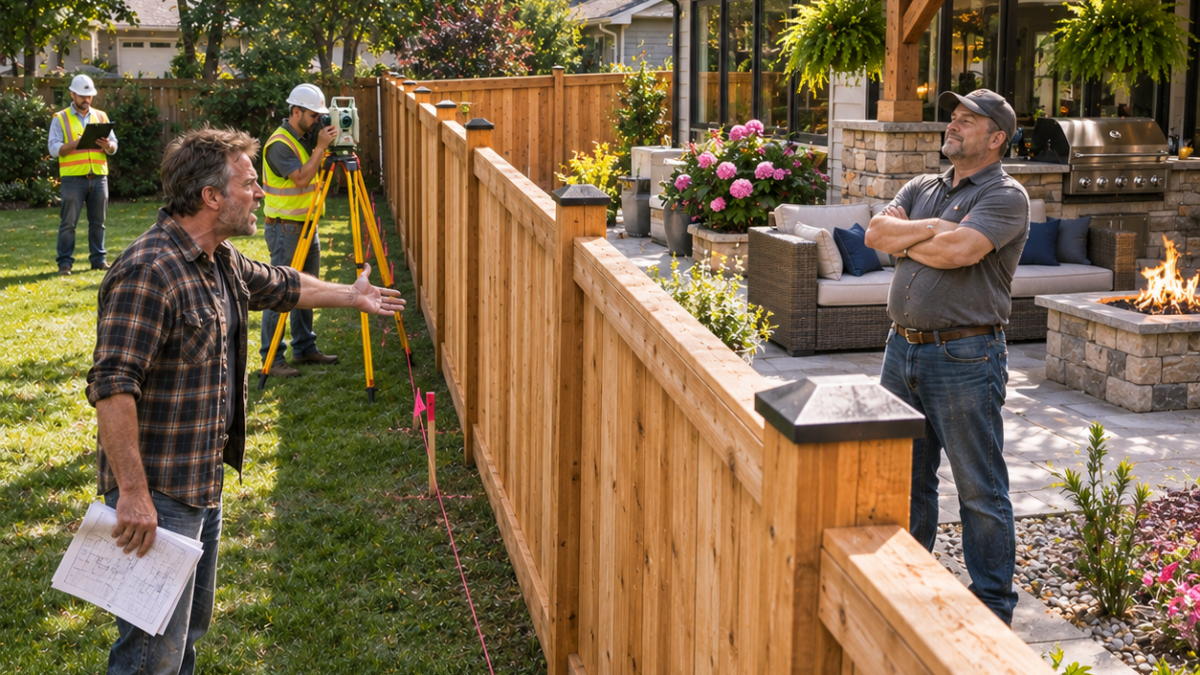
PART 2
Carl Weller was sixty-one.
Gray beard.
Sunburned neck.
Blue ball cap embroidered with **MIDWEST SURVEY SERVICES**.
He arrived in a dusty pickup that looked like it had spent thirty years finding boundaries people wished were somewhere else.
He opened the door.
Looked at the maples.
Looked at the fence.
Then at me.
“Nice lot.”
“Hopefully still mine.”
Carl chuckled.
“That’s why I’m here.”
He didn’t care about my theory.
That was reassuring.
He cared about monuments.
Recorded plats.
Existing legal descriptions.
Prior surveys.
Reference points.
The kind of boring things that become incredibly exciting when eight feet of your backyard disappears overnight.
I handed him Walter’s old survey.
Carl studied it.
“Good document.”
“Still valid?”
“The boundary doesn’t expire because the paper gets old.”
Then he went to work.
Tripod.
Instrument.
Measuring rod.
County records.
He located one old iron pin near the side lot.
Then another.
One was buried beneath years of soil.
He dug carefully.
Confirmed dimensions.
Checked angles.
For three hours, he walked back and forth.
I sat on my porch pretending I wasn’t watching.
Every time Carl stopped near the fence, my pulse changed.
Halfway through, Tyler stepped onto his deck.
He folded his arms.
Watched.
Ashley joined him.
She said something.
Tyler answered.
Both looked toward me.
Nobody waved.
I didn’t either.
Around eleven-thirty, Carl came toward the porch wiping dirt from his hands.
“Well.”
I stood.
“You found it?”
“I found it.”
“And?”
He pointed toward the fence.
“You were right.”
“How far?”
“About eight feet.”
I stared at him.
“Eight?”
“Approximately. Slight variation depending on where you measure, but you’re not dealing with inches.”
He walked toward the grass.
Pulled out bright orange flags.
Then started marking.
One.
Two.
Three.
Four.
Every flag landed well inside what Tyler now thought of as his fenced backyard.
When Carl finished, there was a straight orange line running across the grass.
On one side:
My house.
On the other:
Eight feet of my property.
Then Tyler’s fence.
Carl stood back.
“Textbook.”
“What does that mean?”
“Clear encroachment.”
I looked at the orange flags.
The visual effect was almost ridiculous.
You didn’t need legal training.
The fence wasn’t near the line.
It was obviously behind it.
Tyler came down from his deck.
Walked halfway across his yard.
Stopped.
He didn’t cross the orange line.
Interesting.
“What’s all that?” he called.
Carl looked at me.
I answered.
“Property line.”
Tyler frowned.
“No, it’s not.”
Carl turned.
“I’m the surveyor.”
Tyler looked at him.
Then at the flags.
“Our contractor had stakes.”
Carl asked:
“From whom?”
“I don’t know.”
“Did you commission a boundary survey?”
“The fence company handled it.”
Carl gave him the neutral expression of a man who had heard that answer many times.
“I can only tell you what I established from the recorded documents and monuments.”
Tyler pointed.
“You’re saying this whole strip is his?”
“Yes.”
Ashley had come down the deck stairs by then.
She looked at Tyler.
“Eight feet?”
Tyler ignored her.
Carl packed his equipment.
Before leaving, he told me the official report would arrive soon.
I thanked him.
Then photographed everything.
Wide shots.
Close-ups.
Fence.
Flags.
Maples.
Relationship to my house.
Relationship to Tyler’s deck.
Enough that nobody could later claim perspective had been misleading.
The official survey arrived the next day.
Stamped.
Signed.
Clear.
I emailed Tyler.
No emotional language.
**Hey Tyler, I had the property professionally surveyed. The fence is approximately eight feet inside my parcel. I’ve attached the survey and photos. Let me know when you want to discuss moving it back to the boundary.**
Send.
That was it.
No threat.
Three days passed.
Nothing.
Four.
Five.
A week.
No response.
Meanwhile, Tyler and Ashley kept using the backyard as though nothing had happened.
New patio furniture appeared on the deck.
A swing set arrived.
Landscapers planted ornamental shrubs near the fence.
That irritated me more than I expected.
The survey wasn’t hypothetical anymore.
Tyler had it.
Yet he was adding improvements beside a fence he now knew was in the wrong place.
I waited another day.
Then walked around and knocked.
Ashley answered.
Her face changed when she saw me.
“Hey.”
“Hi, Ashley. Tyler home?”
She hesitated.
Then:
“Tyler? It’s Ethan.”
He appeared.
Same casual posture.
No apology.
“What’s up?”
“You saw my email?”
“Oh. Yeah.”
I waited.
That was apparently his entire response.
“So when are you moving the fence?”
Tyler rubbed the back of his neck.
“Look, man.”
There it was.
The universal beginning of a sentence somebody uses when they’re about to explain why your problem should become your sacrifice.
“Moving that fence is going to cost a lot.”
“I understand.”
“Posts are set in concrete.”
“I saw.”
“The job’s finished.”
“On my property.”
His expression tightened.
“It’s not like you don’t have a yard.”
I blinked.
“What?”
“You still have plenty of yard.”
I stared at him.
“Are you suggesting I give you eight feet?”
Tyler shrugged.
“Fences end up a little off sometimes.”
“A little off?”
“It doesn’t affect anything.”
“It affects eight feet of my land.”
“You weren’t using it.”
That sentence landed harder than I expected.
Not because it was clever.
Because it exposed his logic.
Unused meant available.
I looked behind him.
Ashley stood at the end of the hallway.
She was watching.
Her expression wasn’t supportive.
Tyler gave a half-smile.
“Anyway, we’re busy.”
Then he closed the door.
I stood there for several seconds.
Not stunned.
Just furious.
Quietly furious.
The kind that doesn’t make you punch anything.
It makes you think too much.
I walked home.
Went straight into my backyard.
The new fence stood there clean and expensive.
Cedar still pale.
Beyond it, I could see the upper branches of the maples.
But not their trunks.
Those trees had been part of my yard for eleven years.
Now Tyler’s kids played beside them.
His landscapers had mulched around one.
A new bed of flowers curved across part of my land.
I realized he wasn’t simply refusing to move a fence.
He was already redesigning my property as his.
I went inside.
Opened my laptop.
County parcel records.
Recorded plat.
Deed.
Walter’s survey.
Carl’s survey.
I read everything.
Then I called an attorney.
Her name was Rachel Mendoza.
Property litigation.
Small firm downtown.
Her website didn’t have photos of gavels or scales of justice.
Good sign.
I sent everything.
She called the next morning.
“Your survey looks very clear.”
“So I can make him move it?”
“You can pursue removal.”
“How long?”
“Depends whether he fights.”
“Could be months?”
“Yes.”
I looked out the window.
“Do I have to let him use that eight feet until then?”
Pause.
“Define use.”
“His fence encloses it.”
“That doesn’t transfer ownership.”
“I know.”
“What are you thinking?”
I explained the idea forming in my head.
Raised planter boxes.
On my land.
Inside the area his fence had enclosed.
Rachel was silent for a moment.
Then:
“How do you access the strip?”
There was an opening around the side where the fences hadn’t fully tied into the public frontage yet.
I could reach my land without entering Tyler’s house or crossing property that belonged exclusively to him.
“Good,” she said.
“What can I legally build?”
“That’s where you stop asking a lawyer to guess and check the local ordinance.”
Fair.
She continued.
“You also need to be careful about intent.”
“Meaning?”
“If you construct something lawful on your land, that’s one thing. If you create a dangerous condition solely to harm your neighbor, that’s another.”
“No danger.”
“What are the planters for?”
“Privacy landscaping.”
Rachel laughed.
“That’s your answer?”
“It would be true.”
“Partly.”
“Very.”
“What are you planting?”
“Bamboo.”
Silence.
Then:
“What kind?”
I hadn’t thought that far.
She said:
“Do not plant invasive running bamboo near a boundary without checking local rules and containment requirements.”
That sent me to a landscaper.
Miguel Santos.
He had installed drainage and trees for several homes in Cedar Ridge.
Forty-eight.
Beard.
Work boots always covered in soil.
I showed him the survey.
We walked around the side.
He looked at the orange flags.
Then at the fence.
Whistled.
“That’s not even close.”
“Nope.”
“What are you thinking?”
“Raised planters along my side of the true boundary.”
He looked confused.
“Inside their fence?”
“Inside my property.”
Miguel smiled.
“Okay.”
“Four feet high.”
His smile widened.
“Okay.”
“Nearly three feet wide.”
Now he understood.
“And what goes in them?”
“Clumping bamboo.”
Miguel laughed.
Not a polite chuckle.
Full laugh.
Hands on hips.
“Oh, man.”
“What?”
“You’re angry.”
“I’m gardening.”
“Sure.”
I pointed at him.
“Contained clumping bamboo.”
“Good.”
“No running species.”
“Also good.”
“I don’t want roots crossing into their property.”
“Now you’re an ethical villain.”
“I’m not a villain.”
Miguel looked at the fence.
“Depends which porch you’re standing on.”
I liked him immediately.
Before we did anything, Miguel helped me check local requirements.
Setbacks for large raised planters.
Drainage.
Height.
Whether they qualified as structures or landscape features.
We designed them so water stayed on my property.
No hidden hazards.
No unstable retaining walls.
Everything fully inside Carl’s surveyed line.
Rachel reviewed the plan.
Her exact words were:
“I would prefer a demand letter and court order.”
“I know.”
“But I don’t see anything here that transfers your land to him just because his fence surrounds it.”
“So?”
“So if you’re doing lawful landscaping on your own property and can access it lawfully, document everything.”
“That’s a yes?”
“That’s a lawyer refusing to give you a slogan.”
Close enough.
She also sent Tyler a formal letter.
Not yet a lawsuit.
Demand to relocate the fence.
Survey attached.
Deadline.
Notice that my use of the disputed strip would continue unless he obtained lawful relief.
Tyler’s response came through email.
He disputed that I should “interfere” with his enjoyment of the enclosed yard while the fence issue was being “worked out.”
Worked out.
Interesting phrase.
Nothing had been worked out because he’d refused to do anything.
Then he suggested we split the cost of moving the fence.
I read that twice.
He built it.
On my land.
Ignored my warning.
Received a survey.
Refused removal.
Now I should pay half.
Rachel called.
“Want me to answer?”
“Yes.”
Her response was one paragraph.
**My client will not contribute to the cost of correcting an encroachment created entirely by your client.**
Tyler didn’t reply.
So I scheduled Miguel.
Monday morning.
Seven-thirty.
Landscaping truck.
Small excavator.
Steel posts.
Cedar boards.
Soil.
Bamboo.
I stood on my porch with coffee.
The symmetry was satisfying.
Tyler had watched his fence go up while I wondered what was happening.
Now he watched my crew arrive.
His back door opened within minutes.
He stood on the deck.
Ashley joined him.
Miguel’s crew began moving equipment around the side access.
They entered the eight-foot strip.
My eight-foot strip.
First hole.
Then second.
Tyler lasted approximately two minutes.
He came down the stairs.
Walked quickly across the grass.
“What are you doing?”
Miguel looked up.
“You’ll need to ask the property owner.”
Tyler turned toward me.
I walked closer.
“We’re installing planters.”
“Here?”
“Yes.”
“Inside my fence?”
“On my land.”
“This is my backyard.”
I pointed at an orange flag.
“No.”
For the first time since the problem began, Tyler did not answer immediately.
Ashley came closer.
“What exactly are you building?”
“Raised planter boxes.”
“How big?”
“Four feet tall.”
Tyler looked at the holes.
“Why do you need twelve steel posts for planters?”
“Because they’re substantial.”
Miguel coughed to hide a laugh.
Tyler looked toward him.
Miguel suddenly became very interested in the excavator.
“What are you planting?” Ashley asked.
“Bamboo.”
Tyler’s head snapped toward me.
“Bamboo?”
“Clumping bamboo.”
“Are you insane?”
“No.”
“That stuff spreads everywhere.”
“This variety stays contained. It’ll also be in planters.”
Miguel added:
“Root barriers too.”
Tyler stared.
Then understood the real issue.
“How tall?”
Miguel answered before I could.
“Eventually? Depends on cultivar.”
I said:
“Tall enough for privacy.”
Tyler’s face changed.
“Privacy from what?”
I looked at his six-foot cedar fence.
“Exactly.”
He ran both hands over his head.
“This is ridiculous.”
Then walked away.
The crew kept working.
Steel posts.
Concrete.
Frame.
The sound of construction carried across both yards.
By noon, three neighbors had invented reasons to walk past.
Mrs. Keating walked her dog twice.
Chuck slowly drove through the alley in a truck that had no business in the alley.
Nobody asked me directly.
Not yet.
By the end of day one, twelve steel posts formed a line.
By the end of day two, large cedar planter boxes stretched nearly the length of the encroached strip.
Four feet high.
Almost three feet wide.
Filled with engineered soil.
They looked less like ordinary garden boxes than a raised landscape wall.
And because Tyler’s fence sat another eight feet behind the true boundary, the planters were now inside the space he had mentally annexed into his backyard.
He hated them.
I could tell because he stopped pretending not to.
Tuesday evening, he came outside.
“You know this makes the yard look terrible.”
“Which yard?”
He glared.
“You know what I mean.”
“My side of the line looks fine.”
“They’re inside our fence.”
“Your fence is inside my yard.”
His jaw tightened.
“Do you have to say that every time?”
“Until the geography changes.”
Ashley stood on the deck.
She said:
“Tyler.”
He turned.
“What?”
“Just come inside.”
He looked at me once more.
Then left.
Miguel planted bamboo Wednesday.
Clumping species.
Contained.
Four- to five-foot starter plants.
The effect wasn’t dramatic immediately.
Green stalks.
Thin leaves.
A little sparse.
Tyler apparently found that reassuring.
I heard him tell someone:
“All that for some plants.”
But bamboo is patient.
So was I.
The first two weeks mostly involved watering.
New growth.
Small shoots.
Then summer heat arrived.
The plants took off.
New stalks appeared.
Leaves thickened.
The screen became denser.
Six feet.
Then seven.
By July, some stalks were approaching eight.
From my side, it looked beautiful.
Green leaves moved in the wind.
The planters hid Tyler’s fence.
Birds occasionally landed in the bamboo.
The sound was softer than cedar.
From Tyler’s side?
Different story.
His deck stood perhaps six feet beyond the fence in places.
The fence already enclosed the yard.
Now, eight feet closer to his house, a four-foot-high raised wall topped by increasingly tall bamboo occupied the strip he had stolen.
His outdoor space visually shrank.
The expensive landscaping along his fence began losing afternoon light.
A row of sun-loving shrubs he had installed shortly before the survey started thinning.
The deck fell into shade earlier.
By August, the backyard felt enclosed.
Not unusable in a literal sense.
His children could still play.
The dog still ran.
But the bright, open, landscaped yard Tyler had spent a small fortune creating now felt narrow and dark.
Exactly because he had insisted eight feet didn’t matter.
One evening I sat on my porch.
Wind carried voices.
Tyler:
“This is insane.”
Ashley:
“Well, we did build the fence.”
Silence.
Tyler:
“The contractor did.”
Ashley:
“You told him where.”
Another silence.
Then the back door shut.
I didn’t smile.
Okay.
I smiled a little.
But the satisfaction was different from what I expected.
I had imagined feeling powerful.
Instead, I mostly felt relieved.
Tyler could finally see those eight feet.
Before the planters, they were abstract.
Grass.
Extra space.
Something he decided I had enough of.
Now every time he sat on his deck, eight feet had a shape.
A height.
A shadow.
A consequence.
That mattered.
But the conflict wasn’t over.
Tyler hired an attorney.
Rachel forwarded me the letter.
They claimed the landscaping had been installed with malicious intent to interfere with their use.
I asked:
“Can they force removal?”
“Anyone can ask.”
“That’s comforting.”
“We have your survey.”
“Yes.”
“Landscape plan?”
“Yes.”
“Local compliance?”
“Yes.”
“Contained plants?”
“Yes.”
“Drainage?”
“Yes.”
“And we have written requests predating the planters asking him to move his fence.”
I leaned back.
“So?”
“So the fact you dislike him does not automatically mean you lose the right to use your own property.”
She paused.
“But we’re not getting cute.”
“What does that mean?”
“No emails saying ‘I hope his yard dies.’”
“I didn’t send any.”
“No social media.”
“I haven’t posted anything.”
“No threatening to add more.”
“I don’t need more.”
“Good.”
Then she said something that brought me back to reality.
“If Tyler decides to litigate aggressively, this could still get expensive.”
That bothered me.
I wasn’t wealthy.
Comfortable.
But not wealthy.
Tyler’s refusal had already cost me the survey, attorney consultation, planter construction, landscaping.
I could afford it.
Didn’t mean I enjoyed watching money disappear.
For the first time, I wondered whether I had made the conflict too big.
That evening, I walked around the yard with Maggie.
She was old by then.
Twelve.
Gray around the muzzle.
She stopped near the orange boundary flag.
Sniffed.
Then sat.
I scratched behind her ears.
“You think I went too far?”
Maggie panted.
Useless legal counsel.
I looked toward the bamboo.
It was tall enough now that I couldn’t see much of Tyler’s yard.
Maybe that was a benefit.
Then I remembered his sentence.
You still have plenty of yard.
And I thought about what happens if people accept that logic.
Eight feet today.
Then the next owner assumes the fence is correct.
Ten years later, memories fade.
Survey documents disappear.
Someone sells.
Someone claims adverse use.
Even if the law ultimately protects you, the problem gets harder.
Boundaries aren’t only about today’s inconvenience.
They are about what gets inherited by tomorrow’s strangers.
I was not going to leave that ambiguity behind.
Two days later, Carl came back.
I paid him for another short visit.
Not because the line had changed.
Because I wanted permanent reference documentation after the planters were installed.
He checked.
Planters stayed entirely inside my parcel.
Nothing crossed.
He looked at the bamboo.
Then at me.
“You mad at somebody?”
“Landscaping.”
“Sure.”
I smiled.
“You surveyors don’t judge.”
“We judge constantly.”
He packed his instrument.
“We just don’t put it on the plat.”
The formal fence-removal deadline passed.
Tyler did nothing.
Rachel prepared the next legal step.
Before filing, she called his attorney.
One last attempt.
The attorneys discussed settlement.
Tyler offered to purchase the eight-foot strip.
Not an easement.
Buy it.
Twenty thousand dollars.
I declined.
Twenty-five.
Declined.
Rachel asked:
“Are you sure?”
“Yes.”
“Market value of that strip is nowhere near twenty-five.”
“I know.”
“You’re refusing a premium.”
“Yes.”
“Why?”
I stared toward the maples.
One trunk remained on my side of Tyler’s fence.
Those trees had been there before either of us.
“Because I don’t want my backyard smaller.”
Simple as that.
Rachel accepted it.
Ownership includes the right to reject a good price.
Tyler apparently didn’t understand.
His attorney’s next message called my refusal “economically irrational.”
Rachel showed me.
I laughed.
“My divorce attorney once called keeping Maggie economically irrational.”
“How’d that work?”
I looked at the old Labrador asleep beside my chair.
“Best bad financial decision I ever made.”
Rachel laughed.
“Then we’ll file.”
She prepared an action seeking removal of the encroaching fence and associated relief.
Before it was officially served, Ashley knocked on my front door.
Alone.
She looked tired.
Not hostile.
“Can we talk?”
“Yes.”
We stayed outside.
She looked toward the back.
“That bamboo is killing my hydrangeas.”
“Those aren’t hydrangeas.”
She frowned.
“What?”
“The plants by the fence are dwarf viburnum.”
She stared.
“That’s not the point.”
“Sorry.”
She almost laughed despite herself.
Then became serious again.
“Is there really no way you would take the planters out?”
“There is.”
She waited.
“Move the fence.”
“Tyler says you’re trying to humiliate him.”
“No.”
“It feels like it.”
“I asked him privately before I did anything.”
“I know.”
That surprised me.
“He told you?”
“Eventually.”
“Did he tell you what I asked for?”
“That the fence move to the survey line.”
“Yes.”
Ashley looked toward the street.
“He says the fencing company wants almost nine thousand to redo it.”
“I didn’t hire them.”
“I know.”
She rubbed one arm.
“I’m not saying you should pay.”
“Good.”
“I just…”
She stopped.
“You know when you buy your first house and everything feels like it’s supposed to be exciting?”
“Yes.”
“This whole summer has been contractors and lawyers and arguments.”
Her voice softened.
“The kids don’t even like playing outside now because Tyler complains about the bamboo every time he sees it.”
That took some satisfaction out of the story.
The children hadn’t built the fence.
They hadn’t told me I had enough yard.
I asked:
“What do you want me to do?”
“Take the planters out.”
“And leave the fence?”
She closed her eyes.
“No.”
At least she understood.
“I want him to move the fence.”
“Then we agree.”
Ashley looked at me.
“He thinks if he gives in now, you’ll feel like you beat him.”
I stared.
“Does he think I wake up wanting to beat Tyler?”
“I don’t know what he thinks anymore.”
I lowered my voice.
“Ashley, I don’t care who wins.”
She glanced at the bamboo.
I corrected myself.
“Fine. I cared at first.”
That got a tiny smile.
“But I want my land back.”
She nodded.
“Okay.”
Then went home.
Three nights later, the argument in their yard got loud enough that I closed my windows.
I couldn’t hear every word.
I heard Ashley say:
“It’s not ours.”
Then Tyler:
“I know that.”
That was new.
Then:
“Then why are we still doing this?”
Silence followed.
The next morning, Tyler didn’t come outside before work.
Two days later, he knocked.
The moment I’d been waiting for.
Except when it arrived, I didn’t feel triumphant.
He looked exhausted.
Hair messy.
No gym clothes.
No confident half-smile.
“Hey.”
“Hey.”
“Can we talk?”
I stepped outside.
He looked over my shoulder toward the backyard.
“That stuff is ruining the yard.”
I nodded.
“It’s on my property.”
“I know.”
That was the first time he said it without qualification.
No:
But.
No:
Contractor.
No:
Survey dispute.
I know.
He continued.
“The deck barely gets sun after four.”
I said nothing.
“The plants along the fence are struggling.”
“That sounds frustrating.”
He looked at me, trying to decide whether I was being sarcastic.
Maybe I was.
A little.
Then he sighed.
“Will you remove it?”
“Maybe.”
His eyes lifted.
“Really?”
“If the fence moves.”
He looked down.
“Back to the survey line?”
“Yes.”
“All eight feet.”
“All my eight feet.”
He breathed out slowly.
“What if we split the moving cost?”
“No.”
He nodded before I’d even finished.
He knew.
“Okay.”
Silence.
“I’ll move it.”
I didn’t speak immediately.
I wanted to make sure the words were real.
“When?”
“Two weeks.”
“Have your attorney coordinate with Rachel.”
He looked irritated.
“Do we need lawyers for everything?”
“At this point?”
He nodded.
“Fair.”
He turned to leave.
“Tyler.”
He looked back.
“When the fence is corrected, the planters go.”
“All of them?”
“Yes.”
“The bamboo too?”
“Yes.”
“You’re not leaving some wall just to…”
“To what?”
He didn’t finish.
“No.”
I said.
“The point is getting my property back.”
His shoulders dropped slightly.
Maybe that was the moment he finally believed me.
Two weeks later, the fencing company returned.
Same company.
Same style truck.
Different mood.
I happened to be in my kitchen when I saw them.
I walked outside with coffee.
Not because I needed to supervise.
Because after months of looking at that fence, I wanted to see it move.
Workers removed panels.
One by one.
Then posts.
Concrete cracked underground.
Posts came free.
The line slowly retreated.
Eight feet.
An extraordinary amount of conflict compressed into an ordinary distance.
One worker stopped near me.
“You the neighbor?”
“Yes.”
He looked at Carl’s markers.
“Wish we’d had these the first time.”
“So do I.”
He shook his head.
“Homeowner gave us marks.”
“Temporary construction marks?”
“Apparently.”
There was the original mistake.
Not conspiracy.
Not secret plan to steal land.
Bad information.
But mistakes have a moment where they can remain mistakes or become choices.
Tyler’s became a choice when I showed him the survey and he refused to act.
By evening, the fence sat on the actual boundary.
Straight.
Clean.
Exactly where it belonged.
My maple trees returned visually to my yard.
The eight-foot strip was still occupied by planters, but for the first time in months, the fence no longer claimed it.
Carl came the next morning.
Confirmed.
Correct.
Then Miguel arrived.
He grinned when he saw the moved fence.
“Victory garden coming out?”
“Yep.”
“Shame.”
“You want the bamboo?”
“Already have a customer.”
“Good.”
Removing the planters took much less time than installing them.
Bamboo carefully lifted.
Soil removed.
Boards dismantled.
Steel posts cut and extracted.
We preserved the lawn as best we could.
By afternoon, the strip was open.
Grass damaged in places.
Nothing permanent.
Sunlight reached Tyler’s deck again.
His children came outside.
The younger boy kicked a soccer ball.
It rolled to the new fence.
Stopped.
Tyler stood on the deck.
He looked at me.
I raised one hand.
He hesitated.
Then raised his.
That was all.
The legal case stopped.
Settlement paperwork documented the corrected boundary.
Each side covered its agreed expenses.
Tyler did not pay me damages.
I didn’t demand emotional compensation.
I got the thing I had asked for from the beginning.
My land.
Back.
That should have been the end.
Emotionally, it wasn’t.
For several weeks, every time I mowed the backyard, I slowed at the boundary.
Eight feet.
I had never appreciated how much ground eight feet actually was.
Across the full width of the rear yard, it represented a substantial area.
Enough for trees.
A garden.
A shed setback.
A future buyer to care about.
Tyler’s phrase became almost funny.
**You still have plenty of yard.**
Maybe.
But people don’t get to take from you until the remainder reaches some acceptable minimum.
Imagine using that logic anywhere else.
“You still have plenty of money.”
“You still have plenty of driveway.”
“You still have plenty of house.”
Ownership doesn’t work by leftover quantity.
A few months later, Tyler’s golden retriever Cooper escaped.
The side gate hadn’t latched.
I was raking leaves.
Cooper ran straight into my yard.
Stopped.
Looked at me.
Then decided freedom was more exciting and headed toward the street.
I dropped the rake.
Caught him by the collar before he reached the sidewalk.
Tyler came running.
“Cooper!”
I handed him over.
“Gate.”
“I know.”
He clipped the leash.
Then looked at me.
“Thanks.”
“No problem.”
He hesitated.
“After everything, you still…”
“It’s a dog, Tyler.”
“Right.”
He nodded.
That tiny interaction softened something.
Not friendship.
But the conflict stopped being the only story we had about each other.
Winter came.
Snow covered the yards.
The new fence line looked ordinary.
The bare bamboo strip disappeared beneath white.
One morning I saw Tyler shoveling his deck.
I was clearing my drive.
He raised his shovel.
I raised mine.
Boring.
Perfect.
The next spring, I replanted grass where the planter boxes had been.
Then I did something Walter would have found ironic.
I planted along the boundary.
Not a fence.
Three serviceberry shrubs.
Low enough not to block Tyler’s yard.
Native.
White flowers in spring.
Birds loved them.
Miguel helped.
“You’ve become nice.”
“I was always nice.”
“You built twelve steel-post planters and a bamboo wall.”
“Temporary landscaping.”
Miguel laughed.
“Sure.”
I looked toward the new fence.
“Think these will cause problems?”
“No.”
Then:
“Unless Tyler hates birds.”
“He’ll survive.”
A few weeks later, Ashley caught me watering them.
“They’re pretty.”
“Thanks.”
“What are they?”
“Serviceberry.”
She nodded.
Then laughed.
“Not bamboo.”
“Not bamboo.”
That was the closest we ever came to joking about it.
My dog Maggie died that summer.
Thirteen years old.
Arthritis had gotten worse.
Then kidneys.
The vet came to the house.
I sat with her in the backyard.
Near the maple tree.
The same area that had disappeared behind Tyler’s fence.
Maggie rested her head on my leg.
I stroked the gray fur around her ears.
She’d spent eleven years running across that grass.
Afterward, I buried some of her ashes beneath one of the serviceberries.
Not all.
Just a little.
That changed the way I thought about the boundary forever.
During the dispute, eight feet had represented principle.
Ownership.
Respect.
After Maggie died, part of it held memory.
Tyler didn’t know.
I never told him.
Didn’t need to.
But whenever someone later said:
“It was only eight feet,”
I thought about that serviceberry.
Land acquires value because life happens on it.
The market doesn’t measure all of that.
Two years passed.
The serviceberries grew.
The fence weathered from pale cedar to warm gray.
Tyler and Ashley stayed.
Their kids got older.
We became the kind of neighbors who waved.
Occasionally talked about weather.
Once Tyler borrowed a socket set.
Returned it the same evening.
Progress.
Then one Saturday he walked over carrying a beer.
I was sitting on the porch.
“Want one?”
I stared.
“Is this poisoned?”
“Probably.”
I took it.
He sat on the bottom step.
For a minute, neither of us spoke.
Then Tyler said:
“I was an asshole.”
I nearly choked.
“What?”
“The fence.”
“I know what you mean.”
He looked toward the back.
“I’ve been thinking about it.”
“For two years?”
“Not constantly.”
“Good.”
He smiled.
Then became serious.
“The contractor gave me marks.”
“I heard.”
“I thought they were the line.”
“That was a mistake.”
“Yeah.”
He looked at the beer bottle.
“But once you showed me the survey, I knew.”
There it was.
The sentence I’d once wanted desperately.
I said nothing.
Tyler continued.
“I looked at what moving it would cost, and I told myself you wouldn’t care eventually.”
“I cared.”
“No kidding.”
We both laughed slightly.
He shook his head.
“Then the bamboo showed up.”
“That helped?”
“No.”
Another laugh.
“Actually, yeah.”
He looked at me.
“Every day I walked onto that deck and saw it, I knew exactly why it was there.”
“That was the idea.”
“I figured.”
Silence.
Then:
“I’m sorry.”
No explanation after it.
No:
But.
No:
Contractor.
Just:
I’m sorry.
I nodded.
“Thank you.”
He looked surprised.
“That easy?”
“What do you want me to do?”
“I don’t know. Make me suffer.”
“Been there.”
He laughed.
We finished the beers.
Didn’t become best friends.
But something changed.
The dispute finally stopped standing between every future conversation.
I understood Walter’s comment differently after that.
**Fences make people think they’re enemies.**
The fence wasn’t what created the problem.
Disrespect was.
But once the fence became the symbol of the conflict, every board felt hostile.
After it moved, it became what a fence should be.
Privacy.
Boundary.
Nothing more.
Years later, Ashley and Tyler sold.
Work transfer.
North Carolina.
Before moving, Tyler came over.
“New owners had a survey.”
“Smart.”
“I told them the fence story.”
“You did?”
“Short version.”
“Which version is that?”
“I was an idiot. Neighbor planted bamboo.”
“Accurate.”
He laughed.
Then handed me a folder.
“Copy of their survey.”
“I don’t need it.”
“I know.”
He looked toward the boundary.
“I thought you’d appreciate it.”
I did.
The new owners were a couple named Jason and Priya.
One child.
No dog.
They moved in.
No drama.
At the first conversation, Jason pointed toward the fence.
“Survey says line is right here.”
“Yep.”
He laughed.
“Previous owner was very specific about that.”
“I imagine.”
Then he said:
“Apparently there was bamboo?”
“Long story.”
Priya looked interested.
Jason shook his head.
“He told me not to ask.”
Smart man.
The serviceberries eventually grew high enough to flower heavily.
Each spring, white blossoms.
Each fall, red-orange leaves.
The middle shrub—the one holding some of Maggie’s ashes—became the strongest.
Probably coincidence.
I allowed myself the superstition.
One spring morning, I stood there with coffee.
The backyard looked peaceful.
Exactly the feeling I’d had when I bought the place after the divorce.
No orange flags.
No landscapers.
No lawyers.
No bamboo.
Just grass.
Trees.
Fence.
I thought about how close I’d come to allowing the boundary to stay wrong simply because fixing it was uncomfortable.
What would have happened?
Maybe nothing for years.
Then I sell.
Buyer orders survey.
Problem discovered.
Maybe Tyler sells first.
New buyer assumes fence is correct.
Suddenly two strangers inherit an argument neither created.
Maybe someone eventually claims ownership based on years of occupation.
Maybe not.
Either way, the ambiguity grows.
That’s what people misunderstand when they call boundary disputes petty.
A few feet today becomes a title problem tomorrow.
The right time to correct a line is when everybody still knows how it got crossed.
Rachel invited me to speak briefly at a homeowner workshop once.
I declined.
Then she bribed me with lunch.
I agreed.
About thirty people attended.
Fence disputes.
Easements.
Shared driveways.
Trees.
Drainage.
Rachel told the bamboo story without names.
People laughed.
Then somebody asked:
“So should we all plant bamboo if a neighbor encroaches?”
I answered before Rachel could.
“No.”
Everyone laughed again.
I continued.
“Get a survey.”
Rachel nodded approvingly.
“Then a lawyer if necessary.”
More approval.
“Then understand local rules.”
“Yes.”
“And only then decide what you’re doing.”
A man raised his hand.
“But the bamboo worked.”
“For me.”
“So?”
“So copying the funny part without checking the legal part is how you become the next person hiring Rachel.”
She pointed at me.
“Finally, useful advice.”
I told them the truth.
The satisfying part of my story wasn’t bamboo.
It was certainty.
Before Carl’s survey, I had a feeling.
After it, I had evidence.
That’s what changed the balance.
Tyler could dismiss me.
He could not erase monuments, measurements, and a stamped boundary.
The planter boxes were leverage.
The survey was the foundation.
Without it, I would have been two angry neighbors arguing over grass.
With it, one of us had built a fence eight feet over the line.
That’s a different conversation.
I also admitted something I rarely told people.
The revenge felt good.
At first.
Seeing Tyler realize the planters were going in?
Good.
Watching bamboo grow?
Good.
Hearing him complain that his deck lost sunlight after he’d told me I had plenty of yard?
Extremely satisfying.
But that satisfaction had an expiration date.
After Ashley talked about the children avoiding the backyard, I enjoyed it less.
After I saw perfectly healthy landscaping dying in shade, I enjoyed it less.
After I watched thousands of dollars of fencing get ripped out and reinstalled, I enjoyed it less.
Revenge is sweetest before you start seeing the waste.
The best part came after.
When the planters were gone.
Fence corrected.
Grass restored.
Nobody had to lose anything else.
That’s what made the ending satisfying.
I didn’t need Tyler’s backyard ruined forever.
I needed him to stop using mine.
There is a difference.
At sixty, I still live in the same house.
The white siding has been replaced.
Porch rebuilt.
Kitchen renovated.
My divorce feels like something that happened to a younger man.
Walter is gone.
Maggie is gone.
Tyler lives three states away.
Yet the backyard still widens unexpectedly behind the house.
Exactly as Walter told me.
The serviceberries stand near the fence.
One afternoon Jason, the current neighbor, called over.
“Ethan?”
“Yeah?”
“Think this tree is yours or mine?”
I walked over.
A young volunteer maple had sprouted almost on the line.
We both looked at it.
Then at each other.
Jason said:
“Survey?”
I laughed.
“Probably.”
He laughed too.
We ended up checking the recorded pins.
Tree was slightly his side.
He wanted to keep it.
I didn’t care.
Conversation lasted ten minutes.
No attorneys.
No orange flags.
No bamboo wall.
That’s how it should be.
People sometimes ask whether I’d do the same thing again.
My answer has changed.
Would I defend the eight feet?
Absolutely.
Would I get the survey immediately?
Yes.
Would I document everything?
Yes.
Would I give the neighbor a fair opportunity to fix it?
Yes.
Would I build four-foot planter boxes and grow a wall of bamboo again?
Maybe.
But probably only after exhausting simpler options.
Age makes you less impressed by cleverness and more impressed by problems that end quickly.
Still, I don’t regret what happened.
Because there was a moment when Tyler looked at a professional survey and effectively said:
Your ownership matters less than my inconvenience.
That required an answer.
The answer happened to be green.
Eight feet of clumping bamboo.
Tall enough to turn his sunny designer backyard into a narrow shaded space.
Legal enough to stand.
Temporary enough to disappear the moment he corrected the problem.
Poetic?
Definitely.
Petty?
Probably.
Effective?
Absolutely.
The important part is that I knew when to stop.
The morning Miguel removed the final planter box, I stood on the grass and watched sunlight stretch all the way toward Tyler’s deck.
There was no urge to replace it with something worse.
No victory sign.
No final insult.
I just wanted the strip open.
Miguel walked toward me.
“You look sad.”
“Why?”
“Your evil garden is gone.”
“It served its purpose.”
He looked toward the correctly placed fence.
“Going to miss it.”
“I won’t.”
He laughed.
“Sure.”
The truck drove away.
I walked the recovered strip slowly.
Eight feet.
Not huge.
Not small.
Mine.
I reached the maple tree.
Put one hand against its trunk.
For months, that tree had been visually part of Tyler’s enclosed yard.
Now it stood where it always had.
Nothing about the tree had changed.
Nothing about the deed had changed.
Only the fence.
That’s what made the whole fight so strange.
Ownership had never moved.
Tyler only made it look like it had.
And sometimes appearance becomes powerful when nobody challenges it.
A fence can create a story.
This is mine.
That is yours.
People trust physical lines.
Future buyers trust them.
Children grow up believing them.
Neighbors forget what existed before.
That’s why I couldn’t leave it.
Not because eight feet of grass would change my life.
Because silence might eventually make a false line feel true.
Years after Tyler left, I found Walter’s original survey while cleaning a filing cabinet.
Old paper.
Creased.
Yellowing.
His handwriting at the top:
**REAR WIDENS—DON’T FORGET.**
I laughed.
He had probably written it decades earlier for himself.
I framed a photocopy and put it in my workshop.
Not because I expect another fence war.
As a reminder.
Don’t forget.
Don’t forget what belongs to you.
Don’t forget to verify before accusing.
Don’t forget that mistakes deserve a chance to be corrected.
Don’t forget that refusal changes what a mistake becomes.
And maybe most important:
Don’t forget that once somebody fixes the wrong, you don’t have to keep punishing them forever.
Tyler eventually fixed it.
He apologized.
We moved on.
That matters.
Otherwise every conflict becomes a permanent identity.
I don’t want to be “the bamboo guy” forever.
Though apparently half of Dayton disagrees.
Chuck still calls me that.
Last Christmas he sent me a card.
Front showed a panda eating bamboo.
Inside:
**THINKING OF YOU.**
I called him.
“You’re an idiot.”
“Still got any bamboo?”
“No.”
“Shame.”
I hung up.
Some legends refuse to die.
But when I stand in the backyard now, I don’t see revenge.
I see the maple trees.
Serviceberries.
Grass.
The correctly placed fence.
I see Maggie running when she was young.
I remember starting over after divorce.
I remember Walter laughing about fences making enemies.
And yes, I remember Tyler telling me:
**You still have plenty of yard.**
He was right about one thing.
I did have plenty.
That was never the point.
The point was that all of it was mine.
Nobody else gets to decide how much you’re allowed to keep simply because they want the rest.
That’s the lesson those eight feet taught me.
And in the end, I didn’t make Tyler’s backyard smaller.
I simply stopped letting him make mine smaller.
The bamboo disappeared.
The planters disappeared.
The anger disappeared.
But the property line stayed exactly where it had always been.
And every spring, when the serviceberries bloom along that line, I look at the fence sitting eight feet farther back than where Tyler first put it and remember something simple:
Sometimes you don’t need to take revenge forever.
You only need to make disrespect uncomfortable long enough for respect to become the easier choice.
Then you remove the wall.
Let the sunlight back in.
And go back to enjoying your yard.
My neighbor quietly moved his brand-new privacy fence eight feet into my backyard, sealed a strip of my land inside the expensive outdoor space he had just spent weeks renovating, and then stood in his doorway with a half-smile and told me I still had “plenty of yard” when a licensed survey proved exactly how much property he had taken.
He thought the cost of moving those cedar panels mattered more than the survey, more than the deed, and apparently more than the fact that I had owned that piece of ground for eleven years, because every time I asked him to correct the mistake, Tyler kept acting as though eight feet of somebody else’s property became his simply because he had already paid a contractor to put a fence around it.
What Tyler didn’t understand when he shut the door in my face was that I had stopped asking myself how to make him give the land back and started wondering what I was legally allowed to do with those same eight feet while they were still sitting inside the backyard he was so proud of.
My name is Ethan Cole.
I was forty-six when this happened.
I live in Dayton, Ohio, in a neighborhood built sometime in the late seventies.
Nothing fancy.
Modest two-story houses.
Wide streets.
Old maples.
Concrete sidewalks cracked in the places where roots pushed upward.
The kind of neighborhood where people lift two fingers from the steering wheel when they pass even if they have no idea what your last name is.
I bought my house eleven years earlier after my divorce.
At the time, I didn’t need impressive.
I needed quiet.
My ex-wife and I had spent two years turning a bad marriage into an even worse ending.
Lawyers.
Boxes.
Arguments over furniture neither of us really wanted.
By the time the paperwork was finished, I was tired of every room I walked into reminding me of a conversation I’d rather forget.
Then I found the house on Willowbrook Lane.
White siding.
Small wooden porch.
Two-car garage.
Nothing that would ever make the cover of a magazine.
But the backyard was different.
The lot sat at a slight angle, so the rear widened more than you expected from the street.
Grass stretched behind the house toward a row of mature maple trees.
No fence.
The property behind mine was open too.
The two yards flowed together visually, separated only by those maples and a boundary nobody had needed to argue about in decades.
The previous owner, Walter Keene, was seventy-two when he sold me the place.
At closing, he tapped the old survey folded inside the file.
“Keep that.”
“I will.”
“Corner back there fools people.”
“What do you mean?”
“The lot widens.”
He smiled.
“Looks smaller than it is.”
Then he said something I remembered years later.
“I never liked fences.”
“Why?”
“Fences make people start thinking about enemies.”
He laughed.
I did too.
Back then, it sounded like something an old man said because he didn’t want to spend money replacing cedar.
For eleven years, the open yard worked.
My Labrador, Maggie, ran lazy circles through the grass until arthritis slowed her down.
Kids chased baseballs.
Neighbors occasionally crossed the back corner while talking.
Nobody cared because everybody knew the difference between casual use and ownership.
In October, the maples turned deep red.
Leaves covered the lawn.
I would rake them into one enormous pile and regret starting halfway through.
That backyard became the first place after the divorce where I felt like my life belonged to me again.
Then the house behind mine sold.
The old owner had died.
His children listed it.
A young couple bought it in spring.
Tyler and Ashley Monroe.
Late twenties or early thirties.
Two small children.
One golden retriever named Cooper who apparently believed every leaf, squirrel, delivery truck, plastic bag, and passing cloud needed to be barked at.
At first, I liked them.
They were energetic.
Excited.
The kind of new homeowners who had a project planned before the moving truck left.
Within two weeks, the old house changed completely.
New roof.
New siding.
Black window frames.
Fresh landscaping.
Stone borders.
A deck rebuilt with composite boards.
Contractors came and went every morning.
I figured they were building the home they wanted.
Good for them.
Then the fence company arrived.
Big white van.
Trailer stacked with fresh cedar.
Metal hardware.
Concrete.
Four-man crew.
I watched them unload while drinking coffee at my kitchen window.
Privacy fence.
Nothing unusual.
With two kids and a dog, I understood.
They worked all day.
Post-hole augers.
Drills.
Boards.
By evening, six-foot cedar panels stretched across the rear of Tyler and Ashley’s property.
I stood on my porch looking at it.
Something felt wrong.
Not dramatically wrong.
Just… closer.
The maples looked different.
The yard felt shorter.
Perspective changes when a fence appears where open space used to be.
So I told myself that was all it was.
The next morning, I couldn’t let it go.
There was one measurement I remembered from Walter’s survey.
Back porch corner to the maple nearest the old boundary.
About thirty feet.
I got a tape.
Hooked it at the corner.
Walked toward the new fence.
Twenty-two feet.
I stared.
Measured again.
Twenty-two.
Eight feet missing.
I stood there with the tape in my hand.
The maple tree was on the other side of Tyler’s new fence.
That’s when my stomach tightened.
Maybe the contractor had made a mistake.
Maybe temporary stakes were wrong.
Maybe I misunderstood Walter’s old survey.
There were a dozen innocent explanations.
I chose the best one first.
I walked around the block and knocked on Tyler’s front door.
He answered in gym clothes.
“Hey, Ethan.”
“Hey. I think there might be an issue with the fence.”
His expression barely changed.
“What issue?”
“I think it may be inside my property line.”
“How far?”
“Could be several feet.”
Tyler leaned against the frame.
“Our contractor followed the stakes.”
“Survey stakes?”
“Yeah.”
“You have a survey?”
“Not on me.”
I waited.
He shrugged.
“Those guys know what they’re doing.”
“I’d still double-check before they finish everything.”
He looked toward the inside of his house.
“The job’s already paid.”
“That doesn’t change the boundary.”
He smiled slightly.
“The fence looks good where it is.”
I stared at him.
That was the first warning.
Not:
I’ll check.
Not:
That would be a problem.
The fence looks good where it is.
I kept my voice calm.
“All right.”
Tyler nodded.
“Sounds good.”
Then closed the door.
I walked back around.
Stopped near the maple tree I could no longer reach from my own backyard.
And for the first time, I looked at that beautiful new cedar fence not as a privacy improvement—
but as a claim.
That afternoon I called a surveyor.
Two days later, orange flags began appearing across Tyler’s perfect new backyard.
And by the time Carl finished driving in the last one, there was no longer anything to misunderstand.
— END OF FACEBOOK OPENING —
Carl Weller was sixty-one.
Gray beard.
Sunburned neck.
Blue ball cap embroidered with MIDWEST SURVEY SERVICES.
He arrived in a dusty pickup that looked like it had spent thirty years finding boundaries people wished were somewhere else.
He opened the door.
Looked at the maples.
Looked at the fence.
Then at me.
“Nice lot.”
“Hopefully still mine.”
Carl chuckled.
“That’s why I’m here.”
He didn’t care about my theory.
That was reassuring.
He cared about monuments.
Recorded plats.
Existing legal descriptions.
Prior surveys.
Reference points.
The kind of boring things that become incredibly exciting when eight feet of your backyard disappears overnight.
I handed him Walter’s old survey.
Carl studied it.
“Good document.”
“Still valid?”
“The boundary doesn’t expire because the paper gets old.”
Then he went to work.
Tripod.
Instrument.
Measuring rod.
County records.
He located one old iron pin near the side lot.
Then another.
One was buried beneath years of soil.
He dug carefully.
Confirmed dimensions.
Checked angles.
For three hours, he walked back and forth.
I sat on my porch pretending I wasn’t watching.
Every time Carl stopped near the fence, my pulse changed.
Halfway through, Tyler stepped onto his deck.
He folded his arms.
Watched.
Ashley joined him.
She said something.
Tyler answered.
Both looked toward me.
Nobody waved.
I didn’t either.
Around eleven-thirty, Carl came toward the porch wiping dirt from his hands.
“Well.”
I stood.
“You found it?”
“I found it.”
“And?”
He pointed toward the fence.
“You were right.”
“How far?”
“About eight feet.”
I stared at him.
“Eight?”
“Approximately. Slight variation depending on where you measure, but you’re not dealing with inches.”
He walked toward the grass.
Pulled out bright orange flags.
Then started marking.
One.
Two.
Three.
Four.
Every flag landed well inside what Tyler now thought of as his fenced backyard.
When Carl finished, there was a straight orange line running across the grass.
On one side:
My house.
On the other:
Eight feet of my property.
Then Tyler’s fence.
Carl stood back.
“Textbook.”
“What does that mean?”
“Clear encroachment.”
I looked at the orange flags.
The visual effect was almost ridiculous.
You didn’t need legal training.
The fence wasn’t near the line.
It was obviously behind it.
Tyler came down from his deck.
Walked halfway across his yard.
Stopped.
He didn’t cross the orange line.
Interesting.
“What’s all that?” he called.
Carl looked at me.
I answered.
“Property line.”
Tyler frowned.
“No, it’s not.”
Carl turned.
“I’m the surveyor.”
Tyler looked at him.
Then at the flags.
“Our contractor had stakes.”
Carl asked:
“From whom?”
“I don’t know.”
“Did you commission a boundary survey?”
“The fence company handled it.”
Carl gave him the neutral expression of a man who had heard that answer many times.
“I can only tell you what I established from the recorded documents and monuments.”
Tyler pointed.
“You’re saying this whole strip is his?”
“Yes.”
Ashley had come down the deck stairs by then.
She looked at Tyler.
“Eight feet?”
Tyler ignored her.
Carl packed his equipment.
Before leaving, he told me the official report would arrive soon.
I thanked him.
Then photographed everything.
Wide shots.
Close-ups.
Fence.
Flags.
Maples.
Relationship to my house.
Relationship to Tyler’s deck.
Enough that nobody could later claim perspective had been misleading.
The official survey arrived the next day.
Stamped.
Signed.
Clear.
I emailed Tyler.
No emotional language.
Hey Tyler, I had the property professionally surveyed. The fence is approximately eight feet inside my parcel. I’ve attached the survey and photos. Let me know when you want to discuss moving it back to the boundary.
Send.
That was it.
No threat.
Three days passed.
Nothing.
Four.
Five.
A week.
No response.
Meanwhile, Tyler and Ashley kept using the backyard as though nothing had happened.
New patio furniture appeared on the deck.
A swing set arrived.
Landscapers planted ornamental shrubs near the fence.
That irritated me more than I expected.
The survey wasn’t hypothetical anymore.
Tyler had it.
Yet he was adding improvements beside a fence he now knew was in the wrong place.
I waited another day.
Then walked around and knocked.
Ashley answered.
Her face changed when she saw me.
“Hey.”
“Hi, Ashley. Tyler home?”
She hesitated.
Then:
“Tyler? It’s Ethan.”
He appeared.
Same casual posture.
No apology.
“What’s up?”
“You saw my email?”
“Oh. Yeah.”
I waited.
That was apparently his entire response.
“So when are you moving the fence?”
Tyler rubbed the back of his neck.
“Look, man.”
There it was.
The universal beginning of a sentence somebody uses when they’re about to explain why your problem should become your sacrifice.
“Moving that fence is going to cost a lot.”
“I understand.”
“Posts are set in concrete.”
“I saw.”
“The job’s finished.”
“On my property.”
His expression tightened.
“It’s not like you don’t have a yard.”
I blinked.
“What?”
“You still have plenty of yard.”
I stared at him.
“Are you suggesting I give you eight feet?”
Tyler shrugged.
“Fences end up a little off sometimes.”
“A little off?”
“It doesn’t affect anything.”
“It affects eight feet of my land.”
“You weren’t using it.”
That sentence landed harder than I expected.
Not because it was clever.
Because it exposed his logic.
Unused meant available.
I looked behind him.
Ashley stood at the end of the hallway.
She was watching.
Her expression wasn’t supportive.
Tyler gave a half-smile.
“Anyway, we’re busy.”
Then he closed the door.
I stood there for several seconds.
Not stunned.
Just furious.
Quietly furious.
The kind that doesn’t make you punch anything.
It makes you think too much.
I walked home.
Went straight into my backyard.
The new fence stood there clean and expensive.
Cedar still pale.
Beyond it, I could see the upper branches of the maples.
But not their trunks.
Those trees had been part of my yard for eleven years.
Now Tyler’s kids played beside them.
His landscapers had mulched around one.
A new bed of flowers curved across part of my land.
I realized he wasn’t simply refusing to move a fence.
He was already redesigning my property as his.
I went inside.
Opened my laptop.
County parcel records.
Recorded plat.
Deed.
Walter’s survey.
Carl’s survey.
I read everything.
Then I called an attorney.
Her name was Rachel Mendoza.
Property litigation.
Small firm downtown.
Her website didn’t have photos of gavels or scales of justice.
Good sign.
I sent everything.
She called the next morning.
“Your survey looks very clear.”
“So I can make him move it?”
“You can pursue removal.”
“How long?”
“Depends whether he fights.”
“Could be months?”
“Yes.”
I looked out the window.
“Do I have to let him use that eight feet until then?”
Pause.
“Define use.”
“His fence encloses it.”
“That doesn’t transfer ownership.”
“I know.”
“What are you thinking?”
I explained the idea forming in my head.
Raised planter boxes.
On my land.
Inside the area his fence had enclosed.
Rachel was silent for a moment.
Then:
“How do you access the strip?”
There was an opening around the side where the fences hadn’t fully tied into the public frontage yet.
I could reach my land without entering Tyler’s house or crossing property that belonged exclusively to him.
“Good,” she said.
“What can I legally build?”
“That’s where you stop asking a lawyer to guess and check the local ordinance.”
Fair.
She continued.
“You also need to be careful about intent.”
“Meaning?”
“If you construct something lawful on your land, that’s one thing. If you create a dangerous condition solely to harm your neighbor, that’s another.”
“No danger.”
“What are the planters for?”
“Privacy landscaping.”
Rachel laughed.
“That’s your answer?”
“It would be true.”
“Partly.”
“Very.”
“What are you planting?”
“Bamboo.”
Silence.
Then:
“What kind?”
I hadn’t thought that far.
She said:
“Do not plant invasive running bamboo near a boundary without checking local rules and containment requirements.”
That sent me to a landscaper.
Miguel Santos.
He had installed drainage and trees for several homes in Cedar Ridge.
Forty-eight.
Beard.
Work boots always covered in soil.
I showed him the survey.
We walked around the side.
He looked at the orange flags.
Then at the fence.
Whistled.
“That’s not even close.”
“Nope.”
“What are you thinking?”
“Raised planters along my side of the true boundary.”
He looked confused.
“Inside their fence?”
“Inside my property.”
Miguel smiled.
“Okay.”
“Four feet high.”
His smile widened.
“Okay.”
“Nearly three feet wide.”
Now he understood.
“And what goes in them?”
“Clumping bamboo.”
Miguel laughed.
Not a polite chuckle.
Full laugh.
Hands on hips.
“Oh, man.”
“What?”
“You’re angry.”
“I’m gardening.”
“Sure.”
I pointed at him.
“Contained clumping bamboo.”
“Good.”
“No running species.”
“Also good.”
“I don’t want roots crossing into their property.”
“Now you’re an ethical villain.”
“I’m not a villain.”
Miguel looked at the fence.
“Depends which porch you’re standing on.”
I liked him immediately.
Before we did anything, Miguel helped me check local requirements.
Setbacks for large raised planters.
Drainage.
Height.
Whether they qualified as structures or landscape features.
We designed them so water stayed on my property.
No hidden hazards.
No unstable retaining walls.
Everything fully inside Carl’s surveyed line.
Rachel reviewed the plan.
Her exact words were:
“I would prefer a demand letter and court order.”
“I know.”
“But I don’t see anything here that transfers your land to him just because his fence surrounds it.”
“So?”
“So if you’re doing lawful landscaping on your own property and can access it lawfully, document everything.”
“That’s a yes?”
“That’s a lawyer refusing to give you a slogan.”
Close enough.
She also sent Tyler a formal letter.
Not yet a lawsuit.
Demand to relocate the fence.
Survey attached.
Deadline.
Notice that my use of the disputed strip would continue unless he obtained lawful relief.
Tyler’s response came through email.
He disputed that I should “interfere” with his enjoyment of the enclosed yard while the fence issue was being “worked out.”
Worked out.
Interesting phrase.
Nothing had been worked out because he’d refused to do anything.
Then he suggested we split the cost of moving the fence.
I read that twice.
He built it.
On my land.
Ignored my warning.
Received a survey.
Refused removal.
Now I should pay half.
Rachel called.
“Want me to answer?”
“Yes.”
Her response was one paragraph.
My client will not contribute to the cost of correcting an encroachment created entirely by your client.
Tyler didn’t reply.
So I scheduled Miguel.
Monday morning.
Seven-thirty.
Landscaping truck.
Small excavator.
Steel posts.
Cedar boards.
Soil.
Bamboo.
I stood on my porch with coffee.
The symmetry was satisfying.
Tyler had watched his fence go up while I wondered what was happening.
Now he watched my crew arrive.
His back door opened within minutes.
He stood on the deck.
Ashley joined him.
Miguel’s crew began moving equipment around the side access.
They entered the eight-foot strip.
My eight-foot strip.
First hole.
Then second.
Tyler lasted approximately two minutes.
He came down the stairs.
Walked quickly across the grass.
“What are you doing?”
Miguel looked up.
“You’ll need to ask the property owner.”
Tyler turned toward me.
I walked closer.
“We’re installing planters.”
“Here?”
“Yes.”
“Inside my fence?”
“On my land.”
“This is my backyard.”
I pointed at an orange flag.
“No.”
For the first time since the problem began, Tyler did not answer immediately.
Ashley came closer.
“What exactly are you building?”
“Raised planter boxes.”
“How big?”
“Four feet tall.”
Tyler looked at the holes.
“Why do you need twelve steel posts for planters?”
“Because they’re substantial.”
Miguel coughed to hide a laugh.
Tyler looked toward him.
Miguel suddenly became very interested in the excavator.
“What are you planting?” Ashley asked.
“Bamboo.”
Tyler’s head snapped toward me.
“Bamboo?”
“Clumping bamboo.”
“Are you insane?”
“No.”
“That stuff spreads everywhere.”
“This variety stays contained. It’ll also be in planters.”
Miguel added:
“Root barriers too.”
Tyler stared.
Then understood the real issue.
“How tall?”
Miguel answered before I could.
“Eventually? Depends on cultivar.”
I said:
“Tall enough for privacy.”
Tyler’s face changed.
“Privacy from what?”
I looked at his six-foot cedar fence.
“Exactly.”
He ran both hands over his head.
“This is ridiculous.”
Then walked away.
The crew kept working.
Steel posts.
Concrete.
Frame.
The sound of construction carried across both yards.
By noon, three neighbors had invented reasons to walk past.
Mrs. Keating walked her dog twice.
Chuck slowly drove through the alley in a truck that had no business in the alley.
Nobody asked me directly.
Not yet.
By the end of day one, twelve steel posts formed a line.
By the end of day two, large cedar planter boxes stretched nearly the length of the encroached strip.
Four feet high.
Almost three feet wide.
Filled with engineered soil.
They looked less like ordinary garden boxes than a raised landscape wall.
And because Tyler’s fence sat another eight feet behind the true boundary, the planters were now inside the space he had mentally annexed into his backyard.
He hated them.
I could tell because he stopped pretending not to.
Tuesday evening, he came outside.
“You know this makes the yard look terrible.”
“Which yard?”
He glared.
“You know what I mean.”
“My side of the line looks fine.”
“They’re inside our fence.”
“Your fence is inside my yard.”
His jaw tightened.
“Do you have to say that every time?”
“Until the geography changes.”
Ashley stood on the deck.
She said:
“Tyler.”
He turned.
“What?”
“Just come inside.”
He looked at me once more.
Then left.
Miguel planted bamboo Wednesday.
Clumping species.
Contained.
Four- to five-foot starter plants.
The effect wasn’t dramatic immediately.
Green stalks.
Thin leaves.
A little sparse.
Tyler apparently found that reassuring.
I heard him tell someone:
“All that for some plants.”
But bamboo is patient.
So was I.
The first two weeks mostly involved watering.
New growth.
Small shoots.
Then summer heat arrived.
The plants took off.
New stalks appeared.
Leaves thickened.
The screen became denser.
Six feet.
Then seven.
By July, some stalks were approaching eight.
From my side, it looked beautiful.
Green leaves moved in the wind.
The planters hid Tyler’s fence.
Birds occasionally landed in the bamboo.
The sound was softer than cedar.
From Tyler’s side?
Different story.
His deck stood perhaps six feet beyond the fence in places.
The fence already enclosed the yard.
Now, eight feet closer to his house, a four-foot-high raised wall topped by increasingly tall bamboo occupied the strip he had stolen.
His outdoor space visually shrank.
The expensive landscaping along his fence began losing afternoon light.
A row of sun-loving shrubs he had installed shortly before the survey started thinning.
The deck fell into shade earlier.
By August, the backyard felt enclosed.
Not unusable in a literal sense.
His children could still play.
The dog still ran.
But the bright, open, landscaped yard Tyler had spent a small fortune creating now felt narrow and dark.
Exactly because he had insisted eight feet didn’t matter.
One evening I sat on my porch.
Wind carried voices.
Tyler:
“This is insane.”
Ashley:
“Well, we did build the fence.”
Silence.
Tyler:
“The contractor did.”
Ashley:
“You told him where.”
Another silence.
Then the back door shut.
I didn’t smile.
Okay.
I smiled a little.
But the satisfaction was different from what I expected.
I had imagined feeling powerful.
Instead, I mostly felt relieved.
Tyler could finally see those eight feet.
Before the planters, they were abstract.
Grass.
Extra space.
Something he decided I had enough of.
Now every time he sat on his deck, eight feet had a shape.
A height.
A shadow.
A consequence.
That mattered.
But the conflict wasn’t over.
Tyler hired an attorney.
Rachel forwarded me the letter.
They claimed the landscaping had been installed with malicious intent to interfere with their use.
I asked:
“Can they force removal?”
“Anyone can ask.”
“That’s comforting.”
“We have your survey.”
“Yes.”
“Landscape plan?”
“Yes.”
“Local compliance?”
“Yes.”
“Contained plants?”
“Yes.”
“Drainage?”
“Yes.”
“And we have written requests predating the planters asking him to move his fence.”
I leaned back.
“So?”
“So the fact you dislike him does not automatically mean you lose the right to use your own property.”
She paused.
“But we’re not getting cute.”
“What does that mean?”
“No emails saying ‘I hope his yard dies.’”
“I didn’t send any.”
“No social media.”
“I haven’t posted anything.”
“No threatening to add more.”
“I don’t need more.”
“Good.”
Then she said something that brought me back to reality.
“If Tyler decides to litigate aggressively, this could still get expensive.”
That bothered me.
I wasn’t wealthy.
Comfortable.
But not wealthy.
Tyler’s refusal had already cost me the survey, attorney consultation, planter construction, landscaping.
I could afford it.
Didn’t mean I enjoyed watching money disappear.
For the first time, I wondered whether I had made the conflict too big.
That evening, I walked around the yard with Maggie.
She was old by then.
Twelve.
Gray around the muzzle.
She stopped near the orange boundary flag.
Sniffed.
Then sat.
I scratched behind her ears.
“You think I went too far?”
Maggie panted.
Useless legal counsel.
I looked toward the bamboo.
It was tall enough now that I couldn’t see much of Tyler’s yard.
Maybe that was a benefit.
Then I remembered his sentence.
You still have plenty of yard.
And I thought about what happens if people accept that logic.
Eight feet today.
Then the next owner assumes the fence is correct.
Ten years later, memories fade.
Survey documents disappear.
Someone sells.
Someone claims years of use.
Even if the law ultimately protects you, the problem gets harder.
Boundaries aren’t only about today’s inconvenience.
They’re about what gets inherited by tomorrow’s strangers.
I was not going to leave that ambiguity behind.
Two days later, Carl came back.
I paid him for another short visit.
Not because the line had changed.
Because I wanted permanent reference documentation after the planters were installed.
He checked.
Planters stayed entirely inside my parcel.
Nothing crossed.
He looked at the bamboo.
Then at me.
“You mad at somebody?”
“Landscaping.”
“Sure.”
I smiled.
“You surveyors don’t judge.”
“We judge constantly.”
He packed his instrument.
“We just don’t put it on the plat.”
The formal fence-removal deadline passed.
Tyler did nothing.
Rachel prepared the next legal step.
Before filing, she called his attorney.
One last attempt.
The attorneys discussed settlement.
Tyler offered to purchase the eight-foot strip.
Not an easement.
Buy it.
Twenty thousand dollars.
I declined.
Twenty-five.
Declined.
Rachel asked:
“Are you sure?”
“Yes.”
“Market value of that strip is nowhere near twenty-five.”
“I know.”
“You’re refusing a premium.”
“Yes.”
“Why?”
I stared toward the maples.
One trunk remained on my side of Tyler’s fence.
Those trees had been there before either of us.
“Because I don’t want my backyard smaller.”
Simple as that.
Rachel accepted it.
Ownership includes the right to reject a good price.
Tyler apparently didn’t understand.
His attorney’s next message called my refusal “economically irrational.”
Rachel showed me.
I laughed.
“My divorce attorney once called keeping Maggie economically irrational.”
“How’d that work?”
I looked at the old Labrador asleep beside my chair.
“Best bad financial decision I ever made.”
Rachel laughed.
“Then we’ll file.”
She prepared an action seeking removal of the encroaching fence and associated relief.
Before it was officially served, Ashley knocked on my front door.
Alone.
She looked tired.
Not hostile.
“Can we talk?”
“Yes.”
We stayed outside.
She looked toward the back.
“That bamboo is killing my hydrangeas.”
“Those aren’t hydrangeas.”
She frowned.
“What?”
“The plants by the fence are dwarf viburnum.”
She stared.
“That’s not the point.”
“Sorry.”
She almost laughed despite herself.
Then became serious again.
“Is there really no way you would take the planters out?”
“There is.”
She waited.
“Move the fence.”
“Tyler says you’re trying to humiliate him.”
“No.”
“It feels like it.”
“I asked him privately before I did anything.”
“I know.”
That surprised me.
“He told you?”
“Eventually.”
“Did he tell you what I asked for?”
“That the fence move to the survey line.”
“Yes.”
Ashley looked toward the street.
“He says the fencing company wants almost nine thousand to redo it.”
“I didn’t hire them.”
“I know.”
She rubbed one arm.
“I’m not saying you should pay.”
“Good.”
“I just…”
She stopped.
“You know when you buy your first house and everything feels like it’s supposed to be exciting?”
“Yes.”
“This whole summer has been contractors and lawyers and arguments.”
Her voice softened.
“The kids don’t even like playing outside now because Tyler complains about the bamboo every time he sees it.”
That took some satisfaction out of the story.
The children hadn’t built the fence.
They hadn’t told me I had enough yard.
I asked:
“What do you want me to do?”
“Take the planters out.”
“And leave the fence?”
She closed her eyes.
“No.”
At least she understood.
“I want him to move the fence.”
“Then we agree.”
Ashley looked at me.
“He thinks if he gives in now, you’ll feel like you beat him.”
I stared.
“Does he think I wake up wanting to beat Tyler?”
“I don’t know what he thinks anymore.”
I lowered my voice.
“Ashley, I don’t care who wins.”
She glanced at the bamboo.
I corrected myself.
“Fine. I cared at first.”
That got a tiny smile.
“But I want my land back.”
She nodded.
“Okay.”
Then went home.
Three nights later, the argument in their yard got loud enough that I closed my windows.
I couldn’t hear every word.
I heard Ashley say:
“It’s not ours.”
Then Tyler:
“I know that.”
That was new.
Then:
“Then why are we still doing this?”
Silence followed.
The next morning, Tyler didn’t come outside before work.
Two days later, he knocked.
The moment I’d been waiting for.
Except when it arrived, I didn’t feel triumphant.
He looked exhausted.
Hair messy.
No gym clothes.
No confident half-smile.
“Hey.”
“Hey.”
“Can we talk?”
I stepped outside.
He looked over my shoulder toward the backyard.
“That stuff is ruining the yard.”
I nodded.
“It’s on my property.”
“I know.”
That was the first time he said it without qualification.
No:
But.
No:
Contractor.
No:
Survey dispute.
I know.
He continued.
“The deck barely gets sun after four.”
I said nothing.
“The plants along the fence are struggling.”
“That sounds frustrating.”
He looked at me, trying to decide whether I was being sarcastic.
Maybe I was.
A little.
Then he sighed.
“Will you remove it?”
“Maybe.”
His eyes lifted.
“Really?”
“If the fence moves.”
He looked down.
“Back to the survey line?”
“Yes.”
“All eight feet.”
“All my eight feet.”
He breathed out slowly.
“What if we split the moving cost?”
“No.”
He nodded before I’d even finished.
He knew.
“Okay.”
Silence.
“I’ll move it.”
I didn’t speak immediately.
I wanted to make sure the words were real.
“When?”
“Two weeks.”
“Have your attorney coordinate with Rachel.”
He looked irritated.
“Do we need lawyers for everything?”
“At this point?”
He nodded.
“Fair.”
He turned to leave.
“Tyler.”
He looked back.
“When the fence is corrected, the planters go.”
“All of them?”
“Yes.”
“The bamboo too?”
“Yes.”
“You’re not leaving some wall just to…”
“To what?”
He didn’t finish.
“No.”
I said.
“The point is getting my property back.”
His shoulders dropped slightly.
Maybe that was the moment he finally believed me.
Two weeks later, the fencing company returned.
Same company.
Same style truck.
Different mood.
I happened to be in my kitchen when I saw them.
I walked outside with coffee.
Not because I needed to supervise.
Because after months of looking at that fence, I wanted to see it move.
Workers removed panels.
One by one.
Then posts.
Concrete cracked underground.
Posts came free.
The line slowly retreated.
Eight feet.
An extraordinary amount of conflict compressed into an ordinary distance.
One worker stopped near me.
“You the neighbor?”
“Yes.”
He looked at Carl’s markers.
“Wish we’d had these the first time.”
“So do I.”
He shook his head.
“Homeowner gave us marks.”
“Temporary construction marks?”
“Apparently.”
There was the original mistake.
Not conspiracy.
Not secret plan to steal land.
Bad information.
But mistakes have a moment where they can remain mistakes or become choices.
Tyler’s became a choice when I showed him the survey and he refused to act.
By evening, the fence sat on the actual boundary.
Straight.
Clean.
Exactly where it belonged.
My maple trees returned visually to my yard.
The eight-foot strip was still occupied by planters, but for the first time in months, the fence no longer claimed it.
Carl came the next morning.
Confirmed.
Correct.
Then Miguel arrived.
He grinned when he saw the moved fence.
“Victory garden coming out?”
“Yep.”
“Shame.”
“You want the bamboo?”
“Already have a customer.”
“Good.”
Removing the planters took much less time than installing them.
Bamboo carefully lifted.
Soil removed.
Boards dismantled.
Steel posts cut and extracted.
We preserved the lawn as best we could.
By afternoon, the strip was open.
Grass damaged in places.
Nothing permanent.
Sunlight reached Tyler’s deck again.
His children came outside.
The younger boy kicked a soccer ball.
It rolled to the new fence.
Stopped.
Tyler stood on the deck.
He looked at me.
I raised one hand.
He hesitated.
Then raised his.
That was all.
The legal case stopped.
Settlement paperwork documented the corrected boundary.
Each side covered its agreed expenses.
Tyler did not pay me damages.
I didn’t demand emotional compensation.
I got the thing I had asked for from the beginning.
My land.
Back.
That should have been the end.
Emotionally, it wasn’t.
For several weeks, every time I mowed the backyard, I slowed at the boundary.
Eight feet.
I had never appreciated how much ground eight feet actually was.
Across the full width of the rear yard, it represented a substantial area.
Enough for trees.
A garden.
A shed setback.
A future buyer to care about.
Tyler’s phrase became almost funny.
You still have plenty of yard.
Maybe.
But people don’t get to take from you until the remainder reaches some acceptable minimum.
Imagine using that logic anywhere else.
“You still have plenty of money.”
“You still have plenty of driveway.”
“You still have plenty of house.”
Ownership doesn’t work by leftover quantity.
A few months later, Tyler’s golden retriever Cooper escaped.
The side gate hadn’t latched.
I was raking leaves.
Cooper ran straight into my yard.
Stopped.
Looked at me.
Then decided freedom was more exciting and headed toward the street.
I dropped the rake.
Caught him by the collar before he reached the sidewalk.
Tyler came running.
“Cooper!”
I handed him over.
“Gate.”
“I know.”
He clipped the leash.
Then looked at me.
“Thanks.”
“No problem.”
He hesitated.
“After everything, you still…”
“It’s a dog, Tyler.”
“Right.”
He nodded.
That tiny interaction softened something.
Not friendship.
But the conflict stopped being the only story we had about each other.
Winter came.
Snow covered the yards.
The new fence line looked ordinary.
The bare bamboo strip disappeared beneath white.
One morning I saw Tyler shoveling his deck.
I was clearing my drive.
He raised his shovel.
I raised mine.
Boring.
Perfect.
The next spring, I replanted grass where the planter boxes had been.
Then I did something Walter would have found ironic.
I planted along the boundary.
Not a fence.
Three serviceberry shrubs.
Low enough not to block Tyler’s yard.
Native.
White flowers in spring.
Birds loved them.
Miguel helped.
“You’ve become nice.”
“I was always nice.”
“You built twelve steel-post planters and a bamboo wall.”
“Temporary landscaping.”
Miguel laughed.
“Sure.”
I looked toward the new fence.
“Think these will cause problems?”
“No.”
Then:
“Unless Tyler hates birds.”
“He’ll survive.”
A few weeks later, Ashley caught me watering them.
“They’re pretty.”
“Thanks.”
“What are they?”
“Serviceberry.”
She nodded.
Then laughed.
“Not bamboo.”
“Not bamboo.”
That was the closest we ever came to joking about it.
My dog Maggie died that summer.
Thirteen years old.
Arthritis had gotten worse.
Then kidneys.
The vet came to the house.
I sat with her in the backyard.
Near the maple tree.
The same area that had disappeared behind Tyler’s fence.
Maggie rested her head on my leg.
I stroked the gray fur around her ears.
She had spent eleven years running across that grass.
Afterward, I buried some of her ashes beneath one of the serviceberries.
Not all.
Just a little.
That changed the way I thought about the boundary forever.
During the dispute, eight feet had represented principle.
Ownership.
Respect.
After Maggie died, part of it held memory.
Tyler didn’t know.
I never told him.
Didn’t need to.
But whenever someone later said:
“It was only eight feet,”
I thought about that serviceberry.
Land acquires value because life happens on it.
The market doesn’t measure all of that.
Two years passed.
The serviceberries grew.
The fence weathered from pale cedar to warm gray.
Tyler and Ashley stayed.
Their kids got older.
We became the kind of neighbors who waved.
Occasionally talked about weather.
Once Tyler borrowed a socket set.
Returned it the same evening.
Progress.
Then one Saturday he walked over carrying a beer.
I was sitting on the porch.
“Want one?”
I stared.
“Is this poisoned?”
“Probably.”
I took it.
He sat on the bottom step.
For a minute, neither of us spoke.
Then Tyler said:
“I was an asshole.”
I nearly choked.
“What?”
“The fence.”
“I know what you mean.”
He looked toward the back.
“I’ve been thinking about it.”
“For two years?”
“Not constantly.”
“Good.”
He smiled.
Then became serious.
“The contractor gave me marks.”
“I heard.”
“I thought they were the line.”
“That was a mistake.”
“Yeah.”
He looked at the beer bottle.
“But once you showed me the survey, I knew.”
There it was.
The sentence I’d once wanted desperately.
I said nothing.
Tyler continued.
“I looked at what moving it would cost, and I told myself you wouldn’t care eventually.”
“I cared.”
“No kidding.”
We both laughed slightly.
He shook his head.
“Then the bamboo showed up.”
“That helped?”
“No.”
Another laugh.
“Actually, yeah.”
He looked at me.
“Every day I walked onto that deck and saw it, I knew exactly why it was there.”
“That was the idea.”
“I figured.”
Silence.
Then:
“I’m sorry.”
No explanation after it.
No:
But.
No:
Contractor.
Just:
I’m sorry.
I nodded.
“Thank you.”
He looked surprised.
“That easy?”
“What do you want me to do?”
“I don’t know. Make me suffer.”
“Been there.”
He laughed.
We finished the beers.
Didn’t become best friends.
But something changed.
The dispute finally stopped standing between every future conversation.
A few months after that, Tyler asked me for Carl’s number.
I stared at him.
“What are you building?”
“Nothing.”
“Then why do you need a surveyor?”
“We’re thinking about putting in a shed next year.”
I laughed so hard he eventually did too.
“You’re learning.”
“Shut up.”
Carl came out.
Marked everything.
The shed went in twelve feet from the line.
Tyler sent me a photograph after the concrete was poured.
Caption:
NOT YOUR LAND.
I replied:
PROUD OF YOU.
That might have been the first moment we became something closer to actual neighbors.
Not friends.
But no longer opponents.
The old conflict became a story we could reference without the temperature in the room changing.
One summer evening, our electricity went out during a storm.
Trees down.
Half the neighborhood dark.
I had a portable generator, but the pull cord snapped.
Tyler came over with tools and helped repair it.
Rain pouring off the garage roof.
Flashlights.
Mosquitoes.
At one point he looked toward the fence.
“Can you imagine if the bamboo were still there?”
“We’d have privacy.”
“We’d have a jungle.”
“Your fault.”
“I know.”
He said it without irritation.
Just fact.
That was when I realized the apology had been real.
Not because he said it once.
Because he no longer needed to defend the old version of himself.
Walter had once said fences make people think they’re enemies.
I understood that differently now.
The fence wasn’t what created the problem.
Disrespect was.
But once that fence became the symbol of the conflict, every board felt hostile.
After it moved, it became what a fence should be.
Privacy.
Boundary.
Nothing more.
Years later, Ashley and Tyler sold.
Work transfer.
North Carolina.
Before moving, Tyler came over.
“New owners had a survey.”
“Smart.”
“I told them the fence story.”
“You did?”
“Short version.”
“Which version is that?”
“I was an idiot. Neighbor planted bamboo.”
“Accurate.”
He laughed.
Then handed me a folder.
“Copy of their survey.”
“I don’t need it.”
“I know.”
He looked toward the boundary.
“I thought you’d appreciate it.”
I did.
Then he looked at the serviceberries.
“They’ve gotten big.”
“Yeah.”
“Those staying?”
“Yes.”
“Good.”
I almost told him about Maggie.
Didn’t.
Some memories belong quietly to the land.
Tyler looked toward the fence one last time.
“You know, when we bought this place, I thought owning a house meant I could finally do whatever I wanted.”
I smiled.
“Common mistake.”
“You?”
“When I bought mine, I thought being alone meant nobody could bother me.”
“How’d that go?”
I looked at him.
“Then you moved in.”
He laughed.
We shook hands.
Not dramatic.
No speech.
Moving truck left the next morning.
I watched from my kitchen window.
The same place where years earlier I’d watched the fencing crew unload cedar panels.
Funny how ordinary beginnings look before they become stories.
The new owners were a couple named Jason and Priya.
One child.
No dog.
They moved in.
No drama.
At the first conversation, Jason pointed toward the fence.
“Survey says line is right here.”
“Yep.”
He laughed.
“Previous owner was very specific about that.”
“I imagine.”
Then he said:
“Apparently there was bamboo?”
“Long story.”
Priya looked interested.
Jason shook his head.
“He told me not to ask.”
Smart man.
The serviceberries eventually grew high enough to flower heavily.
Each spring, white blossoms.
Each fall, red-orange leaves.
The middle shrub—the one holding some of Maggie’s ashes—became the strongest.
Probably coincidence.
I allowed myself the superstition.
One spring morning, I stood there with coffee.
The backyard looked peaceful.
Exactly the feeling I’d had when I bought the place after the divorce.
No orange flags.
No landscapers.
No lawyers.
No bamboo.
Just grass.
Trees.
Fence.
I thought about how close I’d come to allowing the boundary to stay wrong simply because fixing it was uncomfortable.
What would have happened?
Maybe nothing for years.
Then I sell.
Buyer orders survey.
Problem discovered.
Maybe Tyler sells first.
New buyer assumes fence is correct.
Suddenly two strangers inherit an argument neither created.
Maybe someone eventually claims rights based on years of occupation.
Maybe not.
Either way, the ambiguity grows.
That’s what people misunderstand when they call boundary disputes petty.
A few feet today becomes a title problem tomorrow.
The right time to correct a line is when everybody still knows how it got crossed.
Rachel invited me to speak briefly at a homeowner workshop once.
I declined.
Then she bribed me with lunch.
I agreed.
About thirty people attended.
Fence disputes.
Easements.
Shared driveways.
Trees.
Drainage.
Rachel told the bamboo story without names.
People laughed.
Then somebody asked:
“So should we all plant bamboo if a neighbor encroaches?”
I answered before Rachel could.
“No.”
Everyone laughed again.
I continued.
“Get a survey.”
Rachel nodded approvingly.
“Then a lawyer if necessary.”
More approval.
“Then understand local rules.”
“Yes.”
“And only then decide what you’re doing.”
A man raised his hand.
“But the bamboo worked.”
“For me.”
“So?”
“So copying the funny part without checking the legal part is how you become the next person hiring Rachel.”
She pointed at me.
“Finally, useful advice.”
I told them the truth.
The satisfying part of my story wasn’t bamboo.
It was certainty.
Before Carl’s survey, I had a feeling.
After it, I had evidence.
That’s what changed the balance.
Tyler could dismiss me.
He could not erase monuments, measurements, and a stamped boundary.
The planter boxes were leverage.
The survey was the foundation.
Without it, I would have been two angry neighbors arguing over grass.
With it, one of us had built a fence eight feet over the line.
That’s a different conversation.
I also admitted something I rarely told people.
The revenge felt good.
At first.
Seeing Tyler realize the planters were going in?
Good.
Watching bamboo grow?
Good.
Hearing him complain that his deck lost sunlight after he’d told me I had plenty of yard?
Extremely satisfying.
But that satisfaction had an expiration date.
After Ashley talked about the children avoiding the backyard, I enjoyed it less.
After I saw perfectly healthy landscaping dying in shade, I enjoyed it less.
After I watched thousands of dollars of fencing get ripped out and reinstalled, I enjoyed it less.
Revenge is sweetest before you start seeing the waste.
The best part came after.
When the planters were gone.
Fence corrected.
Grass restored.
Nobody had to lose anything else.
That’s what made the ending satisfying.
I didn’t need Tyler’s backyard ruined forever.
I needed him to stop using mine.
There is a difference.
At sixty, I still live in the same house.
The white siding has been replaced.
Porch rebuilt.
Kitchen renovated.
My divorce feels like something that happened to a younger man.
Walter is gone.
Maggie is gone.
Tyler lives three states away.
Yet the backyard still widens unexpectedly behind the house.
Exactly as Walter told me.
The serviceberries stand near the fence.
One afternoon Jason, the current neighbor, called over.
“Ethan?”
“Yeah?”
“Think this tree is yours or mine?”
I walked over.
A young volunteer maple had sprouted almost on the line.
We both looked at it.
Then at each other.
Jason said:
“Survey?”
I laughed.
“Probably.”
He laughed too.
We ended up checking the recorded pins.
Tree was slightly his side.
He wanted to keep it.
I didn’t care.
Conversation lasted ten minutes.
No attorneys.
No orange flags.
No bamboo wall.
That’s how it should be.
People sometimes ask whether I’d do the same thing again.
My answer has changed.
Would I defend the eight feet?
Absolutely.
Would I get the survey immediately?
Yes.
Would I document everything?
Yes.
Would I give the neighbor a fair opportunity to fix it?
Yes.
Would I build four-foot planter boxes and grow a wall of bamboo again?
Maybe.
But probably only after exhausting simpler options.
Age makes you less impressed by cleverness and more impressed by problems that end quickly.
Still, I don’t regret what happened.
Because there was a moment when Tyler looked at a professional survey and effectively said:
Your ownership matters less than my inconvenience.
That required an answer.
The answer happened to be green.
Eight feet of clumping bamboo.
Tall enough to turn his sunny designer backyard into a narrow shaded space.
Legal enough to stand.
Temporary enough to disappear the moment he corrected the problem.
Poetic?
Definitely.
Petty?
Probably.
Effective?
Absolutely.
The important part is that I knew when to stop.
The morning Miguel removed the final planter box, I stood on the grass and watched sunlight stretch all the way toward Tyler’s deck.
There was no urge to replace it with something worse.
No victory sign.
No final insult.
I just wanted the strip open.
Miguel walked toward me.
“You look sad.”
“Why?”
“Your evil garden is gone.”
“It served its purpose.”
He looked toward the correctly placed fence.
“Going to miss it.”
“I won’t.”
He laughed.
“Sure.”
The truck drove away.
I walked the recovered strip slowly.
Eight feet.
Not huge.
Not small.
Mine.
I reached the maple tree.
Put one hand against its trunk.
For months, that tree had been visually part of Tyler’s enclosed yard.
Now it stood where it always had.
Nothing about the tree had changed.
Nothing about the deed had changed.
Only the fence.
That’s what made the whole fight so strange.
Ownership had never moved.
Tyler only made it look like it had.
And sometimes appearance becomes powerful when nobody challenges it.
A fence can create a story.
This is mine.
That is yours.
People trust physical lines.
Future buyers trust them.
Children grow up believing them.
Neighbors forget what existed before.
That’s why I couldn’t leave it.
Not because eight feet of grass would change my life.
Because silence might eventually make a false line feel true.
Years after Tyler left, I found Walter’s original survey while cleaning a filing cabinet.
Old paper.
Creased.
Yellowing.
His handwriting at the top:
REAR WIDENS—DON’T FORGET.
I laughed.
He had probably written it decades earlier for himself.
I framed a photocopy and put it in my workshop.
Not because I expect another fence war.
As a reminder.
Don’t forget.
Don’t forget what belongs to you.
Don’t forget to verify before accusing.
Don’t forget that mistakes deserve a chance to be corrected.
Don’t forget that refusal changes what a mistake becomes.
And maybe most important:
Don’t forget that once somebody fixes the wrong, you don’t have to keep punishing them forever.
Tyler eventually fixed it.
He apologized.
We moved on.
That matters.
Otherwise every conflict becomes a permanent identity.
I don’t want to be “the bamboo guy” forever.
Though apparently half of Dayton disagrees.
Chuck still calls me that.
Last Christmas he sent me a card.
Front showed a panda eating bamboo.
Inside:
THINKING OF YOU.
I called him.
“You’re an idiot.”
“Still got any bamboo?”
“No.”
“Shame.”
I hung up.
Some legends refuse to die.
But when I stand in the backyard now, I don’t see revenge.
I see the maple trees.
Serviceberries.
Grass.
The correctly placed fence.
I see Maggie running when she was young.
I remember starting over after divorce.
I remember Walter laughing about fences making enemies.
And yes, I remember Tyler telling me:
You still have plenty of yard.
He was right about one thing.
I did have plenty.
That was never the point.
The point was that all of it was mine.
Nobody else gets to decide how much you’re allowed to keep simply because they want the rest.
That’s the lesson those eight feet taught me.
And in the end, I didn’t make Tyler’s backyard smaller.
I simply stopped letting him make mine smaller.
The bamboo disappeared.
The planters disappeared.
The anger disappeared.
But the property line stayed exactly where it had always been.
And every spring, when the serviceberries bloom along that line, I look at the fence sitting eight feet farther back than where Tyler first put it and remember something simple:
Sometimes you don’t need to take revenge forever.
You only need to make disrespect uncomfortable long enough for respect to become the easier choice.
Then you remove the wall.
Let the sunlight back in.
And go back to enjoying your yard.
— END OF STORY —








