PART 2: My Neighbor Poured a Foundation Across My Only Driveway While I Was Gone—So I Let the Court Give Him 14 Days
PART 2
“Yeah,” Daniel continued. “We thought that section was ours.”
“You thought?”
“Our contractor measured from the county road.”
“Your contractor measured wrong.”
Another pause.
Then:
“He’s been doing this a long time.”
“So have surveyors.”
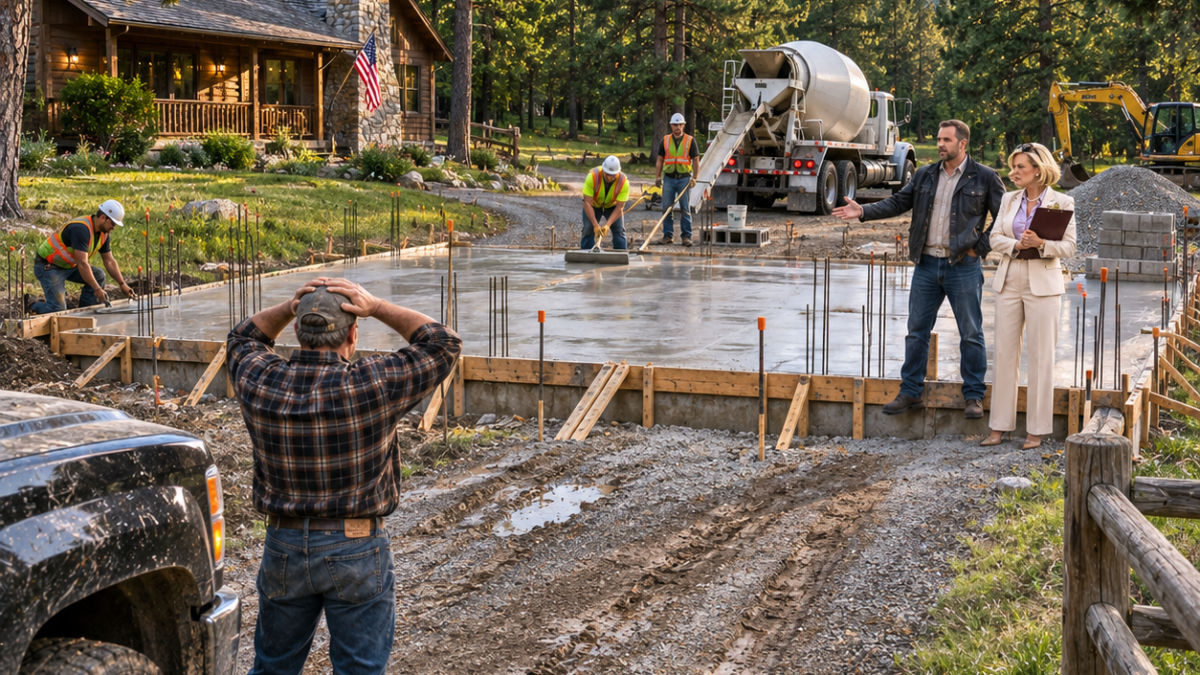
I walked along the slab.
The forms cut across gravel I had personally spread two summers earlier.
Daniel said:
“Look, I don’t think this needs to become a whole thing.”
“You blocked my only driveway.”
“You can get around it.”
I stopped walking.
“Where?”
“There’s open land on the other side.”
“The trees?”
“Yeah.”
I almost laughed.
The “open land” he referred to contained lodgepole pine, exposed granite, brush, and enough slope to turn a pickup onto its side if you chose the wrong line.
“You want me to build another road through my property because you poured a foundation across the existing one?”
“You’re making it sound dramatic.”
“No. I’m describing it.”
Daniel’s voice changed.
The friendly new-neighbor tone disappeared.
“Our contractor says we’re within our boundary.”
“He isn’t.”
“If you’re that sure, take it up legally.”
Then he hung up.
I stood there with my phone in my hand.
That sentence settled something in me.
Take it up legally.
Fine.
I would.
But first I had to get home.
I parked before the slab.
Loaded groceries into two bags.
Carried my fishing gear in separate trips.
Then walked the remaining distance through dusk.
It took almost forty minutes to move everything.
My truck stayed outside the barrier.
That night I sat on the porch.
No lights except the cabin and stars.
Normally the place felt peaceful.
That night the silence felt insulting.
I kept seeing the foundation.
Somebody had not accidentally placed a mailbox three feet over a line.
They had ordered concrete.
Excavation.
Forms.
Rebar.
A mixer.
Crew.
Hours of labor.
Every step required someone to look at my driveway and decide:
His access matters less than our building.
I barely slept.
By morning, anger had become something more useful.
A checklist.
Survey.
Title documents.
Photographs.
Date.
Construction status.
Access condition.
Then lawyer.
I drove into town and met Martin Keller.
Everyone called him Marty.
Sixty-something.
Property lawyer.
Office above an insurance agency.
Books everywhere.
No decorative courtroom photographs.
No framed newspaper articles.
Just folders.
Marty had represented ranchers, timber owners, families fighting over inherited parcels, and people who discovered twenty years too late that a fence wasn’t where they thought.
I spread my survey across his desk.
He adjusted his glasses.
Read the legal description.
Checked the marked driveway.
Then looked at my photographs.
“How wide is the concrete?”
“Across the full road.”
“Survey current?”
“Certified when I purchased. Monuments are still present.”
He traced the line.
Then said:
“This isn’t close.”
I leaned forward.
“How far off?”
“Based on this, the structure is fully inside your parcel.”
“Fully?”
“Not straddling.”
He tapped the paper.
“They didn’t miss by eighteen inches.”
“That’s what I thought.”
Marty leaned back.
“Thought isn’t enough.”
“I know.”
“I want a fresh boundary confirmation.”
“Fine.”
“Then we give them one formal opportunity to correct it voluntarily.”
“How long?”
“Ten days.”
I stared.
“Marty, I can’t drive to my house.”
“I know.”
“Ten days?”
“If we ask a judge to intervene, I want to show we behaved reasonably.”
“They poured a building on my driveway.”
“And I want them to be the unreasonable ones on paper.”
That sentence became the philosophy of the entire case.
We commissioned a boundary verification.
Same answer.
Daniel’s foundation sat completely on my land.
Marty drafted a demand.
No emotional language.
No threats.
Survey attached.
Ownership described.
Access obstruction documented.
Remove the structure.
Restore my driveway.
Ten days.
Sent certified.
Daniel received it.
For about thirty-six hours, I convinced myself reality would finally win.
A lawyer’s letter changes people.
So does a stamped survey.
Then Marty called.
“They retained counsel.”
“Of course.”
“Seattle firm.”
“Why Seattle?”
“Expensive letterhead?”
I almost smiled.
“What are they saying?”
“They relied on their contractor’s measurements.”
“That doesn’t change the line.”
“No.”
“They removing it?”
“No.”
I closed my eyes.
Marty continued.
“They’re proposing an easement.”
I opened them.
“What?”
“They want to negotiate permanent access rights over that portion of your driveway so the foundation can remain.”
I laughed.
Not because it was funny.
Because the audacity was so clean.
“They build on my land.”
“Yes.”
“Block my road.”
“Yes.”
“Then offer to buy permission after the fact.”
“Essentially.”
“How much?”
“They haven’t proposed a number.”
“Doesn’t matter.”
Marty waited.
“No.”
“You sure?”
“Yes.”
“Even if they offer substantial money?”
“My driveway is the only practical access to my home.”
“I needed to hear you say it.”
“Why?”
“Because once we file, settlement discussions will come.”
I thought of the cabin.
The road.
Eleven years of hauling gravel.
The privacy.
The reason I bought the land.
“No easement.”
Marty nodded.
“Then we file.”
That should have frozen construction.
At least morally.
It didn’t.
Two mornings later, I heard generators.
Nail guns.
Diesel.
I walked down from the cabin.
A framing crew stood on the foundation.
Walls going up.
Daniel’s garage had become more than a slab.
They were racing ahead.
I called Marty.
“They’re building.”
“Photograph everything.”
“Should I stop them?”
“No.”
“They’re on my property.”
“Do not interfere physically.”
I hated that answer.
But understood it.
I took photographs.
Video.
Dates.
License plates.
Crew information where visible.
An hour later, Daniel arrived carrying coffee.
Sunglasses.
Expensive boots that had never done actual work.
I walked toward him.
“You’re really continuing?”
He looked at the framing.
“Looks that way.”
“Your lawyer knows this is disputed.”
“Yes.”
“My survey says you’re entirely on my property.”
“Your survey.”
“Independent licensed survey.”
He shrugged.
“My attorney said unless a judge orders us to stop, we’re entitled to proceed.”
I studied him.
“Did your attorney tell you what happens if you lose?”
Daniel smiled.
“Then we’ll deal with it.”
There it was.
Consequences as a future expense.
Something rich people sometimes confuse with permission.
I stepped back.
“Okay.”
He frowned.
Maybe he expected shouting.
I walked away.
For the next six weeks, I lived an absurd routine.
Drive home.
Park before Daniel’s construction.
Carry groceries.
Walk to cabin.
If I needed tools, another trip.
Propane tank?
Wheelbarrow.
Lumber?
Impossible without planning.
Every ordinary task became a reminder that somebody else’s building occupied my access.
Meanwhile the garage grew.
Wall framing.
Roof trusses.
Sheathing.
It became more expensive every week.
Daniel seemed to think momentum was evidence.
If enough lumber stood above the slab, perhaps the court would become emotionally attached to it.
People down the road began asking questions.
Hank Miller stopped one afternoon.
Seventy-three.
Had owned land nearby since before I arrived.
He looked at the structure.
Then me.
“That across your road?”
“Yep.”
“On your parcel?”
“Yep.”
Hank removed his cap.
Scratched his head.
“That’s ambitious.”
“One word for it.”
He looked toward the Harpers’ property.
“They new?”
“Spring.”
Hank nodded as though that explained something.
Then:
“You got a lawyer?”
“Yes.”
“Good.”
He put his cap back on.
“Don’t touch their building until somebody with a robe tells you to.”
That was almost exactly Marty’s advice.
I was surrounded by irritatingly reasonable people.
Six weeks after filing, we got our hearing.
Small courtroom.
Wood paneling.
Old-paper smell.
Judge Halvorson.
Daniel and Elise sat across from me.
Daniel wore a navy suit.
Elise wore gray.
Their attorney looked like every commercial-litigation lawyer I’ve ever seen.
Perfect tie.
Perfect file.
Perfect confidence.
Marty looked like he had stopped at court between repairing a fence and buying groceries.
That’s why I liked him.
The judge reviewed the documents.
Current survey.
Historical survey.
Title.
Photographs.
Access map.
Daniel’s attorney made the good-faith argument.
His clients relied on a contractor.
Demolition would be financially wasteful.
The structure was already substantially complete.
Perhaps an easement or compensation could solve matters more efficiently.
Judge Halvorson listened.
No expression.
Then he looked at the survey.
“The boundary isn’t ambiguous.”
Daniel’s attorney paused.
“Your Honor, our clients acted in good faith.”
“Good faith does not transfer title.”
Silence.
The judge looked toward Daniel.
“You constructed a permanent structure on property that does not belong to you.”
Daniel shifted.
“And the structure blocks the plaintiff’s only reasonable existing access to his residence.”
His attorney began:
“There are alternative—”
The judge lifted one hand.
“I’ve reviewed the topography.”
That ended it.
Then came the order.
Remove the structure.
Full removal.
Restore the land and access.
Fourteen days.
If Daniel failed to comply, I would be authorized to arrange removal and seek recovery of reasonable costs.
No dramatic speech.
No pounding gavel.
Just law.
Daniel did not look at me leaving the courtroom.
Elise did.
Only once.
Her expression wasn’t anger.
It looked almost like embarrassment.
Outside, Marty closed his folder.
“Now we wait.”
“They’ll remove it.”
“Maybe.”
“They’d have to be insane not to.”
Marty gave me the kind of look lawyers give people who still believe rational behavior becomes automatic after court orders.
Day one.
Nothing.
Day two.
Nothing.
Day three.
A worker arrived.
I thought:
Finally.
He installed additional roof sheathing.
I called Marty.
“He’s still building.”
“I know.”
“How?”
“Their attorney notified us they may seek reconsideration.”
“Does that stay the order?”
“No.”
“So why are they building?”
“Ask Daniel.”
I didn’t.
Day five.
More lumber.
Day seven.
Garage door framing.
Day nine.
Electrical boxes.
Not connected.
Still installed.
Every morning, I walked down expecting demolition.
Every evening, the garage remained.
Waiting became harder than anger.
Anger gives you something to do.
Waiting asks whether you trust a piece of paper more than what your own eyes see.
Day twelve.
Nothing.
Marty called.
“I have a demolition contractor lined up.”
“You already did that?”
“Yes.”
“You didn’t think they’d comply.”
“I hoped.”
“Who’s the contractor?”
“Tony Ramirez.”
I knew the name.
Local excavation.
Road work.
Demo.
Reliable.
Marty continued.
“If day fourteen expires with no compliance, we notify everyone and move according to the order.”
I looked toward the structure.
“Can Daniel stop us?”
“He can comply before the deadline.”
Day thirteen.
I saw Elise.
She stood beside the garage alone.
No crew.
I was walking groceries uphill.
She watched me pass.
Then said:
“Nathan.”
I stopped.
It was the first time we’d spoken directly since this started.
“Yeah?”
She looked at my grocery bags.
“You do this every time?”
“What?”
“Carry everything from there?”
“Yes.”
She looked toward the slab.
“I didn’t realize.”
I almost laughed.
“How?”
“Daniel said you had another access.”
“He was wrong.”
She looked toward the forest.
“There isn’t a road?”
“No.”
Silence.
Then:
“I thought there was.”
I shifted the bags.
“You could have walked over and looked.”
She flinched.
Fair.
I continued uphill.
That conversation mattered later.
At the time, I was too angry to care.
Day fourteen arrived.
Sunrise.
No demolition crew.
No Harper workers either.
By noon, still nothing.
By sunset, the garage remained.
The deadline expired.
Day fifteen.
5:40 a.m.
I made coffee.
Put on boots.
Walked down the driveway.
The air was cold.
Pine smell.
Mist low between trees.
At 6:17, I heard diesel.
Tony Ramirez came around the county-road bend driving a flatbed.
Excavator chained behind.
Two dump trucks followed.
Marty arrived ten minutes later.
Jeans.
Jacket.
Court order in a waterproof folder.
We had already provided notice and coordinated with the sheriff’s office so no one could later claim a crew had simply appeared and destroyed property without authority.
A deputy parked nearby.
Not to make arrests.
To keep the peace.
Tony looked at the garage.
Then at me.
“That it?”
“That’s it.”
He walked the perimeter.
Checked utility locates.
Reviewed the order and site plan.
Then said:
“Once I start, this isn’t going back together.”
I looked at the structure.
Fresh lumber.
Roof.
Six weeks of work.
Thousands of dollars.
A mistake that had been offered multiple opportunities to stop being a mistake.
“Start.”
Tony climbed into the excavator.
For a few seconds, nothing happened.
Machine idling.
Birds.
Pines.
Morning light.
I remember that pause more clearly than the demolition itself.
There is a strange moment before an irreversible consequence when everybody involved still knows the world could have been different if someone had made a better decision earlier.
Then the bucket lifted.
Touched the side wall.
Pressed.
Wood groaned.
Nails screamed.
The framing bowed.
Then collapsed inward.
No explosion.
No cinematic destruction.
Controlled pressure.
Engineering in reverse.
Second push.
Roof section folded.
Dust rose.
Tony repositioned.
Another wall dropped.
Within an hour, the building no longer looked like a garage.
By lunch, it was debris.
The slab took longer.
Hydraulic breaker.
Concrete cracking in thick chunks.
Rebar exposed.
Bent.
Cut.
Loaded out.
Each strike traveled through the ground.
I felt them in my boots.
By late afternoon, gravel began appearing beneath the demolished concrete.
My driveway.
Scarred.
Dirty.
Damaged.
But visible.
Tony’s crew removed debris.
Regraded.
Prepared the road for restoration.
I stood at the county-road end and looked toward the cabin.
For the first time in nearly two months, nothing blocked the curve.
I had forgotten how ordinary it looked.
That’s what almost made me emotional.
Not victory.
Normal access.
At 4:20, Daniel’s SUV came flying around the bend.
Brakes.
Dust.
He stopped thirty feet from us.
Door opened.
“What the hell did you do?”
I didn’t raise my voice.
“You had fourteen days.”
He looked at the debris trucks.
Then the bare ground.
“You destroyed my garage!”
Marty walked closer.
Daniel pointed at me.
“You know what that cost?”
I reached into my jacket.
Removed another copy of the order.
Held it out.
“Yes.”
He stared.
Didn’t take it.
Then snatched the paper.
Read.
His jaw tightened.
“This isn’t over.”
Marty said:
“Daniel.”
Daniel looked at him.
“It is very close to over.”
Elise stepped from the passenger side.
She didn’t yell.
She looked at the open driveway.
Then at me.
Then at Daniel.
“Did you know?”
Daniel turned.
“Know what?”
“That he couldn’t get to the house.”
“We talked about this.”
“No.”
Her voice sharpened.
“You told me he had another road.”
Daniel’s face changed.
“Elise, not here.”
She looked toward the forest.
Then back at the cleared driveway.
“There isn’t another road.”
“There’s land.”
“That’s not a road.”
Daniel rubbed one hand over his face.
I suddenly understood why she’d looked embarrassed on day thirteen.
She hadn’t known everything.
That did not make her innocent of ignoring obvious questions.
But it changed the shape of the conflict.
Daniel looked at me.
“You could’ve taken the easement money.”
“I didn’t want to sell my driveway.”
“It was a strip of gravel.”
“To you.”
He laughed bitterly.
“You’re really going to act like this was about principle?”
“What do you think it was about?”
“You wanted to win.”
Maybe part of me did.
By then, I was honest enough to admit that.
But winning was not why I had refused the easement.
I pointed toward the cabin.
“I bought this place because I wanted one road that belonged to me.”
Daniel stared.
I continued.
“You had your whole parcel to design around.”
He said nothing.
“You chose my access.”
Still nothing.
The deputy finally stepped closer.
“Folks, let’s keep this civil.”
Daniel laughed without humor.
“Civil.”
Then got back into the SUV.
A week later, he sued me.
Eighteen thousand dollars.
Unlawful destruction.
Loss of investment.
Emotional distress.
Damage to construction materials.
When Marty read the complaint, he removed his glasses.
“Some people don’t know when they’re finished.”
“You worried?”
“No.”
The second hearing was shorter.
Same judge.
Daniel’s new claim depended on pretending the first order did not exist.
Judge Halvorson read the relevant paragraph aloud.
If the defendants fail to remove the encroaching structure within fourteen days, plaintiff may arrange removal and seek reasonable costs.
Then he looked at Daniel’s attorney.
“What exactly is the basis for this claim?”
The attorney tried.
Good-faith misunderstanding.
Excessive demolition.
Value of materials.
The judge stopped him.
“Was the structure removed by your clients within the deadline?”
“No.”
“Was plaintiff authorized to arrange removal after that deadline?”
“Yes, Your Honor.”
“Then the claim for unlawful destruction fails.”
Dismissed.
Then came my costs.
Marty’s fees connected to enforcing the order.
Documented demolition expenses subject to the court’s review.
Driveway damage.
Tree damage.
Three thousand four hundred dollars for specific property restoration beyond ordinary removal work.
Daniel’s expression changed.
Not explosive anger.
Something heavier.
The moment consequences stop being theoretical.
Marty and I left.
No celebration.
No courthouse photograph.
I bought him lunch.
Burger.
Coffee.
He said:
“You look disappointed.”
“Why?”
“You’ve been waiting months to win.”
I looked out the diner window.
“I’ve been waiting months to drive home.”
Marty smiled.
“That’s a better answer.”
Tony restored the driveway.
Fresh gravel.
Drainage corrected.
Damaged shoulder rebuilt.
Two young pines Daniel’s crew had crushed couldn’t be saved.
I replanted three.
Hank helped.
He insisted.
“Three?”
“One extra.”
“For spite?”
“Insurance.”
He laughed.
The first time I drove all the way to the cabin again, I went slowly.
Ridiculously slowly.
Gravel under tires.
Curve.
Pines.
Cabin appearing through trees.
Exactly the view I’d seen hundreds of times.
I stopped halfway.
Rolled down the window.
Nothing dramatic.
Wind.
Birds.
A squirrel that looked annoyed I had returned.
I drove on.
Parked beside my house.
Sat behind the wheel.
Then laughed.
Two months of lawyers and excavators just to do the thing I’d been doing without thinking since 2011.
Drive home.
That’s the part property conflicts teach you.
You don’t appreciate access until somebody treats it like an optional convenience.
Daniel and Elise eventually built their house.
Properly.
Far enough inside their line.
Different garage placement.
Permits.
Survey.
Everything they should have done the first time.
For months, we didn’t speak.
Not even a wave.
That was fine with me.
People romanticize neighborly reconciliation.
Sometimes peace is two people leaving each other alone.
Winter came.
Snow covered the driveway.
I plowed.
The new pines disappeared beneath white.
No construction noise.
No trucks.
No lawyers.
Then one February afternoon, Elise walked over.
She wore a heavy coat.
Carried an envelope.
I was splitting wood near the cabin.
“Nathan?”
I put down the maul.
“Yeah?”
She held out the envelope.
“What is it?”
“A check.”
I didn’t take it.
“For?”
“The trees.”
“The court already addressed damage.”
“I know.”
She looked uncomfortable.
“This isn’t Daniel.”
That made sense.
“How much?”
“Enough for replacements.”
“I replaced them.”
“Then consider it an apology.”
I studied her.
“From you?”
“Yes.”
I took the envelope.
Didn’t open it.
She looked toward the driveway.
“I should have asked more questions.”
I waited.
“When Daniel said the contractor checked everything, I believed him.”
“That happens.”
“When you sent the survey, I still believed him.”
“That also happens.”
She nodded.
“I didn’t want to believe we’d done something that stupid.”
There it was.
The more expensive a mistake becomes, the harder people fight to call it something else.
She continued.
“By the time I understood, lawyers were involved.”
“You could’ve stopped construction.”
“I know.”
I appreciated the answer.
Not:
Daniel wouldn’t let me.
Not:
Our attorney said.
Just:
I know.
She started walking away.
“Elise.”
She turned.
I handed back the envelope.
“You don’t owe me anything beyond what the court settled.”
Her eyes narrowed.
“I’m trying to apologize.”
“Then apologize.”
She stood there.
Cold wind moving through pines.
Finally:
“I’m sorry.”
“Thank you.”
That was enough.
She left with the check.
Daniel never apologized.
Also fine.
Not every story needs both people transformed.
Spring returned.
Mud.
Rain.
Green.
The three replacement pines survived.
One leaned after a storm.
I staked it.
Life returned to ordinary maintenance.
Then I learned something about the original driveway.
Hank stopped by carrying an old county map.
His father had owned acreage nearby.
“This might interest you.”
The map dated from the late 1980s.
There it was.
My access road.
Same curve.
Not perfectly drawn.
But recognizable.
It had served the old homestead decades before I bought the land.
I traced it.
“Thought you said it might predate that.”
Hank nodded.
“Probably does.”
I stared.
Daniel had arrived in Idaho and treated that road like unused space.
But people had driven it before either of us owned anything nearby.
Families.
Farm trucks.
Maybe hunters.
Maybe timber crews.
A road survives because it works.
The terrain had already taught someone where access belonged.
I framed a copy of the map.
Not to prove ownership.
That was already proven.
Because I liked seeing the driveway as part of something longer than my argument.
The legal bills ended.
Daniel paid what the court required.
My life did not improve because he lost money.
That mattered.
I had never wanted financial ruin.
I wanted my road back.
The difference is important.
People later heard the story and said:
“You called a demolition crew on your neighbor’s garage?”
Technically.
But that version skipped nearly everything.
I called a lawyer first.
Then a surveyor.
Then gave them ten days voluntarily.
Then went to court.
Then waited through litigation.
Then watched them continue construction.
Then got an order.
Then waited fourteen more days.
Only after they ignored the court did Tony’s excavator arrive.
Demolition wasn’t my first response.
It was their last remaining consequence.
That distinction became more important every time somebody told the story like I had woken one morning angry and hired a bulldozer.
One man at the hardware store recognized me.
“You’re the guy who tore down his neighbor’s garage.”
“I hired the crew.”
“Same thing.”
“Not really.”
He laughed.
“I would’ve done it the first day.”
“No, you wouldn’t.”
His smile disappeared.
“Why?”
“Because you’d have been paying for his new garage afterward.”
He thought about that.
“Good point.”
Law is boring until you need it.
Then boring becomes extremely valuable.
Years passed.
Daniel and I eventually reached the nod stage.
Not friendship.
If we passed at the mailbox:
Head tilt.
Sometimes:
“Morning.”
Nothing else.
One summer his truck wouldn’t start.
I drove by.
Stopped.
For a second, both of us looked uncomfortable.
“You need a jump?”
He stared.
Then:
“Yeah.”
I connected cables.
His engine turned over.
He said:
“Thanks.”
“Sure.”
I drove away.
People hearing that part expect some deep reconciliation.
There wasn’t one.
Helping someone with a dead battery doesn’t erase a lawsuit.
But neither does a lawsuit require me to become a person who leaves somebody stranded just because I can.
Daniel stayed on his land.
I stayed on mine.
That was enough.
My seven and a half acres changed slowly.
I added a small equipment shed near the cabin.
Before pouring anything, I pulled the survey.
Hank saw me.
Started laughing.
“What?”
“You checking your own property line?”
“Absolutely.”
“Traumatized.”
“Educated.”
I permitted the shed.
Set it back far more than required.
Tony poured the slab.
When he arrived, he grinned.
“Across the driveway?”
“Try it.”
He laughed.
“Just checking.”
The joke became local shorthand.
If somebody built anything:
“Keep it off Nathan’s driveway.”
I endured it.
The cabin remained.
Same porch.
Same metal roof.
Same western light.
The biggest physical change was the pines along the damaged section.
They grew.
Slowly at first.
Then faster.
Within several years, one stood taller than me.
I sometimes thought about the foundation when I passed them.
Not with anger anymore.
Memory without heat.
That is how you know something is finished.
One evening, Elise stopped while walking her dog.
She pointed at the trees.
“They’re doing well.”
“They are.”
“Daniel says you’re still mad.”
I looked at her.
“Does he?”
“Are you?”
I thought about it.
“No.”
She seemed surprised.
“I don’t trust him.”
“Fair.”
“But anger takes energy.”
She nodded.
Then said:
“He still thinks the judge should have let us buy the easement.”
I laughed.
“That sounds like Daniel.”
“He thinks everything has a price.”
“Most things do.”
I looked toward the road.
“Not everything is for sale.”
Elise smiled faintly.
“I know.”
She walked on.
That sentence stayed with me.
Not everything is for sale.
I wasn’t protecting some sacred historical monument.
It was gravel.
Culvert.
Dirt.
But ownership means the right to decide.
If Daniel had asked before construction:
Nathan, would you sell an access easement?
Maybe I would still have said no.
Probably.
But that would have been negotiation.
Instead, he built first and tried to convert trespass into leverage.
That’s what I objected to.
People sometimes confuse investment with entitlement.
I spent $100,000 building this.
Therefore you can’t make me remove it.
But the amount someone spends violating your boundary doesn’t gradually transfer the boundary to them.
It simply makes the mistake more expensive to correct.
Daniel learned that.
I learned something too.
I learned how quickly being obviously right can make you reckless.
The day I returned and saw concrete across my driveway, part of me wanted to find a rented excavator immediately.
I knew heavy equipment.
Could have broken the slab.
Probably could have cleared enough road before sunset.
Would have felt incredible.
Would also have created a completely different legal case.
Maybe Daniel would have sued successfully.
Maybe someone got hurt.
Maybe I damaged material beyond what was necessary.
Being right about ownership did not give me unlimited freedom in how I responded.
Marty understood that from day one.
“Let them be unreasonable on paper.”
That sentence saved me from myself.
I wrote it on a scrap of lumber in my workshop.
Not inspirational art.
Just a reminder.
Patience isn’t surrender.
Documentation isn’t weakness.
Legal process isn’t always fast.
But speed and strength are not the same thing.
Several years after the dispute, a young couple bought land farther down the road.
They came by one afternoon.
“Are you Nathan?”
“Depends.”
The husband laughed nervously.
“We heard you know surveys.”
“I know enough to call a surveyor.”
They were planning a driveway.
Wanted to use an old logging path near another parcel.
I asked:
“Whose property?”
“Ours, we think.”
I shook my head.
“No.”
He looked confused.
“No what?”
“Don’t build on ‘we think.’”
I gave him Wade—different surveyor, not part of this case; names get reused in small professional circles sometimes. Better yet, I gave him the number of a local licensed Idaho surveyor I trusted.
They had the boundary marked before excavation.
The path crossed a corner of a neighbor’s parcel.
Thirty feet.
They adjusted the road.
Cost them maybe two thousand dollars.
The husband came back later.
“You saved us a nightmare.”
“No.”
“The surveyor did.”
He smiled.
“Same difference.”
It wasn’t.
That was another lesson.
The right professional at the right time is cheaper than the right lawyer later.
Marty eventually retired.
His office closed.
At the retirement dinner, he told the driveway story.
His version was terrible.
Made me sound patient.
I objected.
“You called me twelve times in the first week,” he said.
“Reasonable follow-up.”
“You asked if you could chain the foundation to your truck.”
“I was brainstorming.”
“You own an F-250, Nathan. You were not brainstorming.”
Everyone laughed.
Then Marty raised his glass.
“To people who call before doing the stupid thing.”
I drank to that.
Tony still runs demolition equipment.
Older now.
His son manages most jobs.
Every couple years Tony texts me a photograph of some structure being demolished.
Caption:
**Driveway clear?**
I reply:
**So far.**
The court order sits in my fireproof safe.
Not framed.
Not displayed.
I keep the stamped survey too.
And the late-1980s map Hank gave me.
Three documents.
Three different meanings.
The survey says where ownership lies.
The court order says what happens when someone refuses to respect it.
The old map reminds me the driveway was useful long before either Daniel or I turned it into an argument.
That last one might matter most.
At sixty-five, I thought about selling.
Seven and a half acres is a lot of work.
Snow doesn’t care how old your knees are.
Trees fall.
Gravel migrates.
Drainage clogs.
I listed the chores.
Then sat on the porch.
Wind moving through pines.
No traffic.
No foundation.
Decided not yet.
Maybe someday.
If I sell, the driveway will go with the land.
The next owner might pave it.
Widen it.
Change the curve.
That’s their choice.
And that’s the entire point.
The story was never about preserving every piece of gravel forever.
It was about who gets to decide.
One night after heavy rain, I walked down with a flashlight to check the culvert.
Water moved exactly where it should.
No erosion.
I stood near the place where Daniel’s foundation once crossed the road.
You cannot see anything now.
No concrete scar.
No rebar.
No forms.
Grass beside the gravel.
Pines.
Dark soil.
If I brought someone there without telling the story, they would never know a garage had stood there.
I like that.
Some people preserve damage like proof.
I don’t need proof anymore.
The records exist.
The road exists.
I know what happened.
That’s enough.
I sat on the porch afterward.
Wind against the metal roof.
And asked myself the question people always ask when they hear the whole thing.
Was it worth it?
The attorney.
Survey.
Court.
Stress.
Weeks carrying groceries up my own driveway.
Living beside people who disliked me.
Could I have just accepted Daniel’s proposal?
Rerouted access?
Sold the easement?
Avoided the fight?
Financially, maybe some settlement could have been easier.
Emotionally, probably not.
Because every time I drove through the trees around his garage, I would have been teaching myself the same thing Daniel assumed from the beginning:
That whoever acts first gets to redefine your rights.
I couldn’t live with that.
Not on land I had bought specifically for peace.
So yes.
It was worth it.
Not because watching the excavator tear down the garage felt good.
It did.
I’d be lying if I said otherwise.
The first wall folding inward was satisfying.
The slab cracking was satisfying.
Daniel finally reading the court order after ignoring it for two weeks was extremely satisfying.
But those moments passed.
The lasting part is quieter.
I can turn off the county road.
Drive between the pines.
Feel gravel under my tires.
Follow the curve.
See my cabin appear through the trees.
Then park beside my own house without asking anybody’s permission.
That’s all I wanted before Daniel arrived.
It’s all I wanted after he left the courtroom.
And it’s what I still have.
The morning after that last rainstorm, I drove into town for coffee.
When I came home, sunlight was cutting between the pines in long gold stripes.
I slowed at the exact place where the concrete once stood.
No reason.
Just memory.
Then I kept driving.
No barrier.
No detour.
No construction crew.
No lawyer.
Just the road.
My road.
And sometimes the most satisfying revenge isn’t taking something from the person who tried to take from you.
It’s making sure that, after all the noise is over, everything that was yours is still exactly where it belongs.
**— END OF STORY —**