PART 2: My Neighbor Cut a Road Through My Hillside While I Was Deployed—So I Made Him Put Every Inch Back
PART 2
I stopped the truck so quickly my bag slid off the passenger seat.
For a second, I didn’t even park properly.
Engine still running.
Door open.
I walked toward the hill.
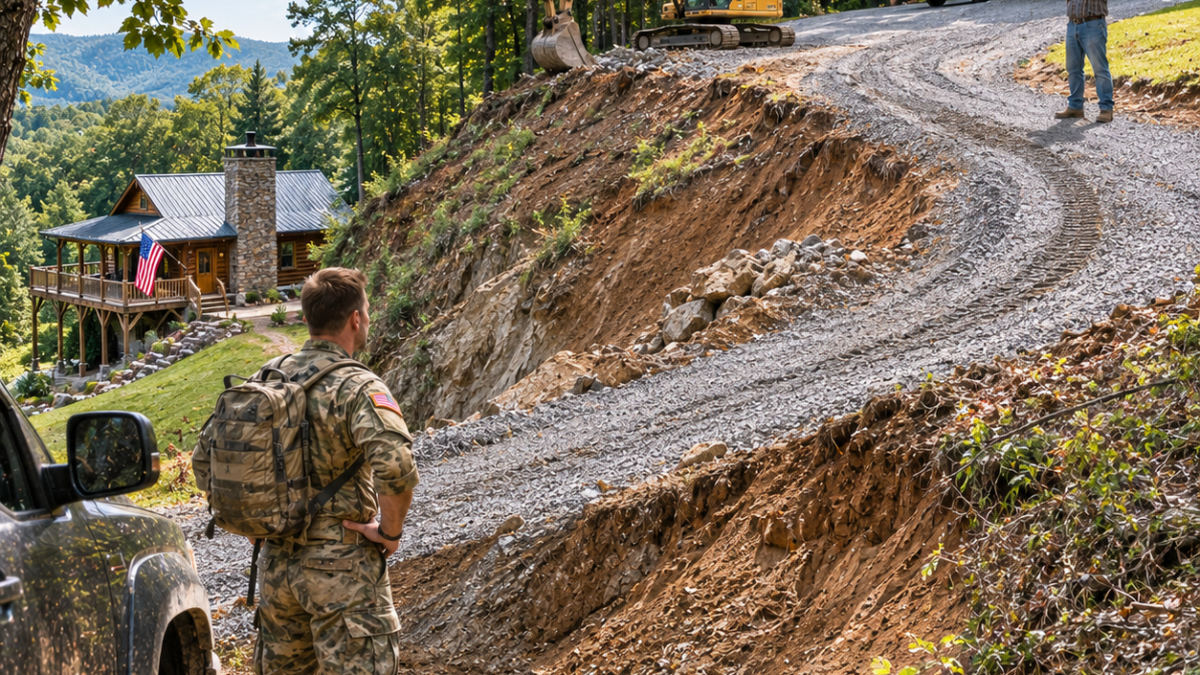
The closer I got, the larger it became.
Forty feet across.
Maybe twelve feet wide.
Deep enough that exposed soil layers ran along the side like somebody had sliced through a cake.
But it wasn’t raw dirt anymore.
Gravel had been laid.
Not casually dumped.
Placed.
Spread.
Compacted.
A real access path.
There were tire tracks pressed into the surface.
Truck tires.
Trailer.
They curved exactly where I knew they would.
Downhill toward Rick’s drive.
I didn’t need a detective.
I knew his boat trailer.
I had watched those same tires make the impossible turn before.
Now the turn wasn’t impossible.
Because part of my hillside had disappeared.
Three hardwood trees were gone.
Not trimmed.
Gone.
Stumps removed or buried.
Roots disturbed.
The drainage line I’d been building toward had been interrupted by the cut.
The upper edge looked too steep in places.
Loose soil had already started sloughing into the gravel.
I stood there for a long time.
People imagine that kind of moment as explosive.
Shouting.
Fists clenched.
Marching straight next door.
I didn’t feel that.
I felt cold.
The sort of anger that drains noise out of you.
Because nothing about what I was seeing could be explained by a mistake.
Nobody accidentally excavates forty feet of hillside.
Nobody accidentally rents heavy equipment.
Nobody accidentally removes trees.
Nobody accidentally orders multiple loads of gravel.
This had required planning.
Money.
Time.
A decision made over and over again.
Somewhere during my deployment, Rick had stood on my property and said:
Do it.
I pulled out my phone.
Opened the album from thirteen months earlier.
Same angle.
Untouched slope.
Three trees.
Ground cover.
Drainage.
Then I held the phone up against the view in front of me.
Before.
After.
The difference was brutal.
That was when I noticed the first real problem beyond trespass.
Water.
A small storm had come through recently.
You could see the evidence.
Runoff had followed the new gravel cut instead of dispersing across the slope.
A thin channel had formed along one edge.
Mud collected lower down.
I knew enough from the work I’d already done to understand one thing.
Rick hadn’t only changed the shape of the land.
He had changed the way the hill handled rain.
That could become expensive.
I didn’t go to Rick’s door.
Part of me wanted to.
I pictured him answering.
Me asking what he had done.
Him shrugging.
Then we’d argue.
Maybe he’d claim he thought I wouldn’t care.
Maybe he would say the line was somewhere else.
Maybe he’d offer to “smooth it out.”
None of that helped me.
So I went inside my house.
Dust everywhere after thirteen months.
Sheet over the couch.
Stale smell.
I set my bag on the floor.
Sat at the kitchen table.
Called Daniel Reeves.
Daniel was my attorney.
Not a buddy.
Not somebody I called socially.
He had handled a contract matter for me years earlier.
Calm.
Precise.
Never seemed impressed by emotion.
Which was exactly what I needed.
He answered.
“You home?”
“Just got back.”
“How was it?”
“I’ve got a problem.”
His tone changed.
“Go.”
“My neighbor excavated my property while I was gone.”
“How much?”
“Forty feet of hillside. Maybe twelve wide.”
Silence.
“Road?”
“Access road.”
“For him?”
“Yes.”
“Trees?”
“Three mature hardwoods gone.”
“Any idea when?”
“No.”
“Photos from before?”
“Yes.”
“Survey?”
“Yes.”
“Don’t touch anything.”
“I wasn’t planning to.”
“Don’t confront him either.”
I looked toward Rick’s house through the trees.
“Why?”
“Because right now the site speaks for itself. Let it keep speaking.”
He was right.
“Document everything again. Same angles as your old photos if possible. Video. Measurements. Tire tracks. Drainage. Do not drive on the excavation.”
“Okay.”
“I’ll start making calls.”
“Who?”
“Engineer first.”
We hung up.
I spent the rest of the afternoon outside.
Photographs.
Video.
Wide shots.
Close-ups.
Gravel depth.
Exposed soil.
Missing trees.
The connection to Rick’s driveway.
I walked the perimeter without stepping onto the new road more than necessary.
I used my old photos to replicate positions.
At one point I could align the previous tree trunk with empty sky.
That image bothered me more than anything.
The next morning Daniel called.
“Geotechnical engineer’s coming tomorrow.”
“Good.”
“You also need a current survey.”
“I have one.”
“I want the boundary marked again.”
“Fine.”
“Do not assume the old markers are untouched.”
That possibility made my stomach tighten.
I checked.
They appeared intact.
Still, Daniel was right.
Two days later, the surveyor confirmed the excavation was inside my parcel.
Not near it.
Inside.
That eliminated one possible excuse.
Then Foster arrived.
Elliot Foster.
Mid-sixties.
Quiet.
Boots coated in red Tennessee dirt.
He moved slowly across the hill.
Not because he was old.
Because he paid attention.
He knelt near the cut.
Picked up soil.
Looked at the gravel.
Walked uphill.
Then downhill.
Checked where water had concentrated.
I followed.
“What do you think?”
He didn’t answer immediately.
That made me nervous.
Finally he said:
“Whoever did this compromised the slope.”
One word.
Compromised.
“What does that mean?”
“It means they changed the geometry without stabilizing the system.”
He pointed toward the upper section.
“You had natural slope holding here. Vegetation. Root system. Distributed runoff.”
Then toward the road.
“Now you’ve created a cut face and a channel.”
“The gravel doesn’t stabilize it?”
“Gravel is a driving surface.”
He looked at me.
“It isn’t magic.”
Fair.
He explained that water would find the easiest route.
The new cut gave it one.
During heavy rain, runoff could concentrate.
That meant erosion.
Undercutting.
Loss of soil.
Potential sliding in vulnerable sections.
Not necessarily tomorrow.
Maybe not this year.
But hills remember bad grading.
I asked:
“Can it be repaired?”
“Yes.”
“How?”
“Remove the gravel. Regrade. Reestablish drainage. Stabilize. Restore vegetation. Some areas may need engineered fill and compaction.”
“How much?”
“I don’t estimate until I finish.”
The military teaches you not to ask questions you aren’t ready to hear answered.
I asked anyway.
“Roughly.”
Foster looked at the cut.
“Not cheap.”
Great.
The report arrived two days later.
Thirty-four thousand dollars estimated remediation.
I read the number twice.
Thirty-four thousand.
To undo four days of somebody else’s convenience.
Daniel called.
“Read it?”
“Yes.”
“Thoughts?”
“I want to send Rick the invoice.”
“Not yet.”
“Why?”
“Because we’re not finished.”
An arborist came next.
Three hardwoods.
Mature.
Replacement value.
Loss.
Site impact.
Eight thousand four hundred dollars.
Now we were over forty-two thousand before legal fees.
Before inspections.
Before environmental compliance.
Before anything else.
I sat at the kitchen table staring at the two reports.
The hill outside looked the same as yesterday.
But the numbers changed the way I saw it.
Every scoop of dirt had a cost.
Every tree.
Every load of gravel.
Rick had treated the land like spare material.
Now professionals were assigning a price to putting back what he’d removed.
Daniel’s next move was county code enforcement.
I wasn’t sure about that.
“Do we need regulators involved?”
“They’re already involved.”
“How?”
“An excavation of this size isn’t private just because it’s on private land.”
He was right again.
An inspector named Harris arrived.
Eleven years in enforcement.
Sunworn face.
Minimal conversation.
He walked the site.
Looked at the cut.
Looked at the connection to Rick’s driveway.
Then asked:
“Who did this?”
“My neighbor.”
“Permit?”
“None that I know of.”
Harris checked.
Nothing.
He stood near the exposed soil.
“I haven’t seen an unauthorized disturbance this size in a while.”
“What does that mean?”
“Means I need to document it.”
He explained that earth disturbance above certain thresholds triggered erosion and sediment-control requirements.
Permit.
Plan.
Stabilization.
Inspection.
The exact rules depended on the work.
Rick apparently had done none of it.
That shifted the dispute again.
It was no longer just me saying:
You damaged my land.
Now government records would say:
This work was not authorized.
Harris photographed.
Measured.
Made notes.
Several days later, notices went out.
I didn’t enjoy that moment.
I thought I would.
Instead, I felt tired.
Every new professional confirmed what I already knew, but confirmation meant the problem got bigger.
Engineer.
Arborist.
Inspector.
Attorney.
Surveyor.
This wasn’t a neighbor argument anymore.
It was an operation.
Three days after the violation notice, Daniel called.
“Rick’s attorney contacted me.”
“Rick has an attorney now?”
“He does.”
“What does he want?”
“To minimize what this turns into.”
I leaned back.
“Not fix it?”
“That wasn’t his wording.”
“Of course.”
Daniel sounded almost amused.
“We’re not negotiating blind.”
“What do you need?”
“Records.”
The excavation had a paper trail somewhere.
Heavy equipment doesn’t materialize from the forest.
Gravel doesn’t deliver itself.
Daniel pursued rental records.
Delivery invoices.
Contractor information.
Dates.
It took time.
But not much.
Rick hadn’t tried very hard to hide anything.
Why would he?
He probably never expected anyone to investigate.
Excavator rental.
Four consecutive days.
Rick Dalton.
His business name.
His signature.
Dates eight months into my deployment.
Then gravel.
Multiple truckloads.
Delivery receipts.
And the part that made me sit back in my chair:
Delivery address.
Mine.
Not Rick’s.
My property.
Daniel sent the compiled evidence.
After that, the language from Rick’s side changed.
No more suggestion the work might be uncertain.
No boundary dispute.
No “maybe.”
The question became money.
I finally saw Rick in person about a week later.
I was outside with Foster reviewing one section.
Rick stood on his deck.
Arms crossed.
Watching.
For several minutes, neither of us spoke.
Then I walked toward the line.
Stopped on my side.
“You cut forty feet into my property.”
He looked at the hill.
No apology.
“It cleaned that area up.”
I almost smiled.
“Cleaned it up?”
“Wasn’t doing anything before.”
There it was.
The same logic I suspected from the beginning.
Unused meant available.
“You built a road.”
“It improved access.”
“For you.”
Rick shrugged.
“You weren’t here.”
That sentence landed harder than everything else.
Not:
I thought it was mine.
Not:
The contractor made a mistake.
You weren’t here.
As if absence canceled ownership.
I nodded.
“Yeah.”
He looked at me.
“We’re going to clean it up.”
Then I walked away.
I didn’t need more.
Daniel later told me:
“You understand he just made our case easier.”
“I know.”
“Good.”
Once the evidence was complete, Daniel laid out the exposure.
Remediation.
Thirty-four thousand.
Tree loss.
Eight thousand four hundred.
Administrative penalties already above six thousand and potentially increasing depending on compliance.
Engineering.
Survey.
Legal fees.
Inspections.
Restoration monitoring.
A little over sixty thousand dollars in realistic total exposure.
Maybe more if the fight expanded.
I asked:
“Can we go criminal?”
Daniel didn’t answer immediately.
“There are potential allegations that could be referred depending on the facts and authorities.”
“Should we?”
“That’s not the same question.”
“What is?”
“What do you want?”
I looked out the window.
The hill.
Rick’s shortcut.
“I want my land back.”
“Anything else?”
“I want him to pay for all of it.”
“That’s reasonable.”
“I don’t want another year of this.”
“Then settlement may be the smartest outcome.”
Part of me wanted to push harder.
I’ll admit that.
Rick had waited until I was thousands of miles away.
He’d used equipment on my land.
Removed trees.
Changed drainage.
Driven across it for months.
There was something deeply personal about that.
It wasn’t only dirt.
I had been away serving.
He had seen absence and treated it like opportunity.
Part of me wanted maximum pain.
But I had spent enough years around consequences to know pain isn’t always the same thing as resolution.
I told Daniel:
“Make it simple.”
He waited.
“He pays everything necessary to restore the property, reimburses our documented costs, resolves the penalties he caused, and stops using the land.”
“And if he refuses?”
“Then we go all the way.”
Daniel nodded.
“That’s clean.”
Rick’s lawyer received the demand.
There wasn’t much back and forth.
The numbers were supported.
The rental paperwork was signed.
The delivery records were almost insulting in their clarity.
The engineer’s report was detailed.
Rick paid.
Not one giant check.
Stages.
Escrow.
Contractors.
Reimbursements.
But he paid.
No dramatic courtroom trial.
No screaming confession.
Money moved.
Then the restoration crew arrived.
That was the part I had waited for.
Day one.
Excavators.
Dump trucks.
Engineers.
Crew.
The new road started disappearing.
The first bucket removed gravel.
Then another.
Layer after layer.
Material Rick had paid to bring in was hauled back out at his expense.
I stood with coffee.
I expected joy.
Mostly I felt relief.
The hill looked wounded.
But for the first time, the damage was moving backward.
By lunch, large sections of gravel were gone.
The underlying cut appeared fully.
Foster walked it.
Directed crews.
No guessing.
The restoration plan had sequence.
Remove foreign material.
Prepare subgrade.
Rebuild slope geometry.
Compact engineered fill in controlled lifts.
Restore drainage pathways.
Stabilize.
Seed.
Monitor.
Everything Rick had skipped.
One day to cut.
Eighteen days to properly rebuild.
That ratio stayed with me.
Destruction is fast.
Restoration is slow.
Day three, they started replacing material.
Day five, drainage work.
Day seven, grading.
Rain interrupted the schedule once.
Ironically, the storm demonstrated why Foster had worried.
Water tried to follow the old road path.
Temporary controls captured it.
He pointed.
“See that?”
“Yes.”
“That would’ve kept cutting.”
I stared.
Rick’s road might have become a drainage ditch.
Then an erosion channel.
Maybe worse.
Suddenly the $34,000 didn’t feel theoretical.
Day nine, the slope began resembling itself.
Not exactly.
Land doesn’t rewind.
But the shape returned.
Day twelve, stabilization matting.
Day fourteen, topsoil.
Day sixteen, seed.
Trees were harder.
You can’t replace mature hardwoods instantly.
New trees went in where appropriate.
Not equivalent.
But future.
Rick watched most days.
From his deck.
Same posture.
Arms crossed.
We didn’t speak.
Not once during the eighteen-day restoration.
There was nothing left to say.
His boat trailer sat near his house.
His driveway stayed exactly as inconvenient as before.
On day eighteen, Foster completed the final inspection.
He walked the slope.
Checked compaction documentation.
Drainage.
Surface stabilization.
Then signed off.
“It’s good.”
“Back to normal?”
He looked at me.
“Back to stable.”
Different phrase.
More honest.
“Trees need time. Vegetation needs time. But structurally, the damage has been corrected.”
I shook his hand.
“Thank you.”
After everybody left, I stood there alone.
Quiet.
The restored slope looked strange because I knew what had happened.
A stranger wouldn’t.
Fresh seed.
New trees.
Clean grading.
No gravel road.
No boat tracks.
No shortcut.
The land had its shape again.
I sat on a rock near the hill until sunset.
Thirteen months away.
Then weeks of reports.
Numbers.
Calls.
Inspections.
Lawyers.
Equipment.
Now silence.
That was what I had bought the property for.
Silence.
Two weeks later, I saw Rick backing his boat trailer into his driveway.
I wasn’t watching on purpose.
I was outside.
Same routine.
Reverse.
Stop.
Forward.
Turn.
Reverse.
Get out.
Look.
Shake head.
Try again.
Five minutes.
Maybe six.
I expected satisfaction.
The movie version of me would have smiled.
Maybe lifted coffee in a little salute.
I didn’t.
I just watched long enough to understand the final math.
Rick had wanted to eliminate five inconvenient minutes.
That desire cost him more than sixty thousand dollars.
Months of stress.
Government penalties.
Legal fees.
Engineering.
Tree replacement.
Restoration.
And trust between neighbors.
All to end exactly where he started.
Same driveway.
Same angle.
Same trailer.
Same problem.
He eventually got it parked.
Went inside.
I went back to work.
For months afterward, we barely spoke.
Occasional nod.
Nothing more.
The kind of acknowledgment strangers give when they repeatedly see each other.
That hurt in a way money didn’t quantify.
Before the excavation, Rick and I weren’t friends.
But there had been possibility.
Maybe we’d eventually share tools.
Watch each other’s property.
Help after a storm.
Normal neighbor things.
That possibility disappeared.
Trust is weird.
You don’t notice how useful it is until it’s gone.
I installed a camera near the hillside.
Then another near the gate.
Not because I expected Rick to do something again.
Because I no longer liked leaving the property blind.
That bothered me.
I didn’t want my home to feel like something I needed to monitor.
But after somebody uses your absence as permission, absence feels different.
Daniel noticed.
“You’ve got cameras everywhere.”
“Two.”
“That counts as everywhere to you.”
“I leave again next year.”
“You worried?”
“Yes.”
He nodded.
No joke.
“Fair.”
Before the next deployment, I documented the property even more carefully.
Survey markers photographed.
Slope.
Trees.
Drainage.
Gate.
Camera backups.
Rick saw me one afternoon.
“You leaving?”
“Eventually.”
He nodded.
Then:
“Nothing’s going to happen.”
I looked at him.
He realized how that sounded.
“I mean from me.”
I didn’t answer right away.
Finally:
“Good.”
That was our entire conversation.
I left for five months.
Coming home that time felt different.
I drove the road slowly.
I saw the hill before the house.
Untouched.
I didn’t realize I’d been holding my breath until I exhaled.
That annoyed me.
Rick’s decision had altered the way homecoming felt.
But over time, that changed too.
The cameras became ordinary.
The hill grew grass.
New trees established roots.
Rain came.
Drainage worked.
Foster returned once after a major storm.
“Looks good.”
That mattered.
Life continued.
A year later, Rick approached me while I was working near the gate.
“Can we talk?”
I almost said no.
Instead:
“Sure.”
He stood with both hands in his pockets.
No contractor confidence.
No shrug.
“I owe you an apology.”
I didn’t make it easy.
“Yes.”
Rick nodded.
“I thought you’d say that.”
“What do you want me to say?”
“Nothing.”
He looked toward the slope.
“I convinced myself I was improving it.”
“You improved your driveway.”
“That’s what I mean.”
He rubbed his jaw.
“I kept telling myself you’d probably grade that side anyway.”
“Eventually.”
“Right.”
“Not for you.”
“I know.”
Silence.
Then:
“When you were gone, it started with me driving over there once.”
I looked at him.
“What?”
“The grass.”
Before the excavation, apparently he’d pulled the boat trailer partly across the lower edge of my property to make the turn.
Once.
Then again.
Nothing happened.
No one stopped him.
I wasn’t home.
The temporary shortcut worked.
The idea grew.
“What made you think excavating it was okay?”
Rick looked embarrassed.
“I didn’t.”
That answer surprised me.
“I knew I should’ve asked.”
“But you didn’t.”
“No.”
“Why?”
“Because I knew you’d say no.”
There it was.
The cleanest truth in the entire story.
He hadn’t misunderstood.
He hadn’t forgotten.
He hadn’t thought it was his.
He knew permission would be denied.
So he waited until permission wasn’t available to ask.
I felt anger return.
Not like before.
Older.
Cooler.
I said:
“You understand that makes it worse.”
“Yes.”
“Then why tell me?”
“Because I’ve spent two years telling myself I made a mistake.”
He looked at me.
“I didn’t make a mistake. I made a choice.”
That mattered.
I didn’t forgive him immediately.
I said:
“Thank you for being honest.”
Rick nodded.
“That’s all I wanted to say.”
He walked home.
I thought about his words for days.
**I didn’t make a mistake. I made a choice.**
That was true.
And maybe that’s why the restoration mattered so much.
You can’t always undo choices emotionally.
You can undo their physical consequences.
The hill had been rebuilt.
The trees were growing.
The road was gone.
I didn’t need to carry the rest forever.
A few months later, a storm took down a pine near Rick’s driveway.
It fell partly across the road.
I had a chainsaw.
Rick did too.
We met there without discussing the irony.
We cut.
Dragged limbs.
Cleared the road.
Afterward, he handed me a bottle of water.
“Thanks.”
“Sure.”
He looked toward my hillside.
“New trees are doing well.”
“Yeah.”
Then:
“I still hate backing the boat in.”
I almost smiled.
“Sell the boat.”
He laughed.
That was the first laugh between us since before the excavation.
Small.
But something.
We never became friends.
I don’t want to manufacture that ending because it sounds nicer.
Some actions permanently limit a relationship.
That’s okay.
We became civil.
Respectful.
Cautious.
Rick never crossed my property again.
Not by a foot.
When he needed access near the line for a contractor years later, he came over first.
“Mind if they stage equipment here for two hours?”
I looked at the area.
“Where?”
He showed me.
I gave permission in writing.
He followed exactly what we’d agreed.
That was almost more meaningful than an apology.
Behavior.
Not words.
The hillside kept recovering.
Second summer, vegetation thick.
Third, the replacement hardwoods were still young but healthy.
One autumn, I sat up there after rain.
Water moved through the drainage exactly as designed.
Spread.
Slow.
No erosion.
No gravel.
No channel.
I thought about Foster saying:
**Hills remember bad grading.**
Maybe they remember good repair too.
The cabin came next.
Finally.
Years after I bought the land.
Foundation.
Framing.
Roof.
Small porch.
Exactly the modest place I’d imagined before deployment.
I built it above the restored slope but far enough back for stability.
Foster reviewed the plan.
When he saw me again, he looked at the hill.
“Still behaving?”
“Better than some neighbors.”
He laughed.
The cabin took almost a year because I still refused to rush.
I worked with professionals where I needed them.
Did smaller jobs myself.
When it was finished, I spent the first night there alone.
No furniture except a mattress and one chair.
I sat on the porch.
Wind through trees.
The thing I had wanted in 2020.
Steady.
Mine.
I could see part of Rick’s driveway below.
He was backing the boat trailer.
Still awkward.
I smiled.
Not because he was suffering.
Because some problems belong to the person who owns them.
That’s a lesson both of us had finally learned.
Several years after the excavation, Daniel retired from practice.
Before he did, he invited me to lunch.
“You’re one of my favorite property cases.”
“That feels insulting.”
“It is.”
“Why?”
“Because the facts were ridiculous.”
He stirred his coffee.
“Neighbor waits until client deploys, rents excavator under his own name, sends gravel to client’s address, builds road, then acts surprised when records exist.”
“When you say it like that…”
“I said it exactly like that to his attorney.”
I laughed.
Then Daniel became serious.
“You know what saved you?”
“Photos.”
“Partly.”
“Survey?”
“Partly.”
“What?”
“You didn’t touch the road.”
I thought.
“If you’d gone out there with your tractor and tried to push everything back before the engineer looked at it, we would’ve lost evidence.”
“I didn’t have a tractor.”
“That also saved you.”
He smiled.
Then:
“You documented before you left. That’s the big one.”
He was right.
The photographs turned memory into proof.
The landscape couldn’t become a debate.
No one could say:
It was always graded.
The slope was already disturbed.
Trees weren’t there.
There it was.
Timestamped.
Untouched.
That lesson stayed with me.
Not paranoia.
Records.
When you own land, keep records.
When you improve it, document.
When boundaries matter, survey.
When water matters, understand drainage.
And when someone damages something, don’t let anger destroy the evidence before facts can speak.
I learned all of that from forty feet of hillside.
I also learned that revenge changes shape as you get older.
At first, I wanted Rick punished.
When Foster said thirty-four thousand, part of me thought:
Good.
When penalties appeared:
Good.
When total exposure passed sixty thousand:
Good.
But eventually those numbers stopped feeling like revenge and started feeling like restoration.
They became what it cost to put back what should not have been touched.
That’s a healthier way to think about consequences.
Not:
How much pain can I cause?
But:
What does it take to make the wrong whole?
Rick paid that amount.
He lived with the result.
His driveway remained his problem.
My hill became mine again.
That was enough.
The most satisfying day wasn’t when he wrote a check.
It wasn’t when the gravel trucks hauled his shortcut away.
It wasn’t even the day Foster signed off.
It happened years later.
I came home from another trip.
Short one.
Only five days.
I drove toward the property at sunset.
For a moment, an old instinct returned.
I looked at the tree line first.
Checked the slope.
Then I realized I didn’t need to.
Nothing had changed.
I parked.
Walked to the porch.
Sat.
The hillside was green.
The young hardwoods moved in the breeze.
Rain from the previous night had left dark patches of soil, but drainage was clean.
Rick’s driveway remained below.
His trailer parked beside the house.
Normal.
For the first time in years, I had returned home without feeling the need to inspect whether somebody had altered it.
That was when I knew the situation was truly over.
Not when the lawyers closed the file.
Not when the money cleared.
When trust in the land itself came back.
I still didn’t trust Rick the way I might have before.
But I trusted the boundary again.
Sometimes that’s enough.
People hear the story and focus on the sixty-three thousand dollars.
Depending how you calculate final restoration, professional fees, penalties, and related costs, that was roughly where the consequence landed.
Big number.
Easy headline.
**Neighbor Cuts Road Through Soldier’s Property and Pays $63,000.**
But money isn’t the most expensive part.
The expensive part was thirteen months of him looking at my absence and deciding it meant I wouldn’t know.
The expensive part was me coming home and seeing a piece of land I had planned for years rewritten without me.
The expensive part was learning my neighbor knew I would say no and decided that was exactly why he shouldn’t ask.
You can’t invoice that.
You can only decide what to do with it.
I chose not to push beyond what was necessary once the property was restored.
Some people told me I should have.
“You should’ve buried him.”
“Should’ve pressed every possible charge.”
“Should’ve sued for more.”
Maybe.
Daniel said we had options.
I understood them.
But my goal had never been to ruin Rick.
That distinction became important.
I wanted the hill back.
I wanted the environmental damage corrected.
I wanted the trees accounted for.
I wanted every professional cost caused by his choice covered.
I wanted his shortcut gone.
I got all of those things.
Anything beyond that risked becoming less about justice and more about appetite.
I had seen enough appetite for punishment in my career and life.
It rarely ends where you think.
So I stopped.
No victory sign.
No social-media post.
No humiliating him in town.
No photograph of the bill taped to his mailbox.
Just restoration.
Maybe that’s not cinematic enough.
It was enough for me.
Rick eventually sold the boat.
I found out because one afternoon I saw somebody drive away towing it.
He came over later.
“Thought you’d be happy.”
“Why?”
“No more trailer.”
“Your trailer was never my problem.”
He smiled ruefully.
“The driveway was.”
“Your driveway was also never my problem.”
“That was apparently the lesson.”
We both laughed.
He bought a smaller fishing boat years later.
Easier trailer.
Fit his driveway.
No excavation required.
Imagine that.
One spring morning, I found him near the boundary looking uphill.
I walked over.
“What?”
“Nothing.”
“You’re staring at my hill.”
He held up both hands.
“I’m not touching it.”
I laughed.
He pointed toward one of the replacement hardwoods.
“That one survived.”
“Yeah.”
“Good.”
Then:
“I still feel bad about the trees.”
That surprised me.
“Why those?”
“Because money couldn’t put them back.”
Exactly.
It was the first time he’d identified the part I had felt most clearly.
The land could be reshaped.
Gravel removed.
Drainage restored.
Fines paid.
But a mature tree grows on its own clock.
Replacement isn’t reversal.
I said:
“They’ll grow.”
Rick nodded.
“Long after we’re gone.”
“Probably.”
He returned home.
I stood beneath one of the young trees.
Maybe eight feet tall then.
Thin trunk.
Nothing like what had been removed.
But alive.
Future sometimes looks unimpressive when it starts.
Years later, that tree is taller than the cabin roof.
The others too.
The scar of the road has vanished beneath roots and grass.
If you didn’t know where to look, you wouldn’t find it.
I know.
Of course I know.
Some memories stay mapped even after the physical evidence disappears.
I can stand on the hill and trace the exact route.
Start here.
Curve down.
Connect there.
But I no longer see it automatically.
That’s progress.
One evening, after a long rain, I walked up with a flashlight.
Water moved gently through the restored channels.
No erosion.
No movement.
The replacement trees dripped.
The cabin lights glowed behind me.
I thought about the day I came home from deployment.
Same road.
Same property.
Completely different feeling.
Back then, the cut looked like proof that my land had not been safe while I was gone.
Now the restored hill looked like proof that damage doesn’t get final authority just because it happens first.
That idea stayed with me.
Rick changed the land.
Then the land was changed back.
Not perfectly.
Not cheaply.
Not quickly.
But deliberately.
He had used heavy equipment to make his life easier.
I used engineers, records, legal process, and eighteen days of restoration to make sure his convenience didn’t become permanent.
Maybe that is revenge.
If so, it’s the kind I can live with.
No broken windows.
No sabotaged driveway.
No destroyed boat.
No threats.
He made a choice.
The consequences followed it.
And the final consequence was almost poetic.
After spending more than sixty thousand dollars, Rick still had to back his trailer through the same awkward turn he had been trying to avoid.
The first time I watched him do it after restoration, I didn’t laugh.
Years later, I understand why.
Winning doesn’t always feel like celebration.
Sometimes it feels like things returning to their proper place.
His driveway.
His trailer.
His inconvenience.
My hillside.
My trees.
My drainage.
My decision.
That’s all I wanted.
And in the end, that’s exactly what I got.
One Saturday, Rick came over while I was working near the cabin.
He stood at the bottom of the porch.
“Can I ask you something?”
“Sure.”
“If I’d asked before you deployed, would you have let me build an access path?”
I thought about it.
“No.”
He laughed.
“Didn’t even hesitate.”
“Would’ve told you why.”
“Drainage?”
“Drainage. Cabin plans. Trees. Future retaining.”
He nodded.
“That’s what I figured.”
“Then why ask now?”
Rick looked toward his driveway.
“I guess I wanted to know if I was right about you saying no.”
“You were.”
He smiled sadly.
“Which somehow makes what I did worse.”
“Yes.”
He nodded.
“Yeah.”
Then he left.
That conversation closed something for me.
Rick had always known.
That’s why he waited.
Once he admitted that, there was no mystery left.
No need to replay the event looking for misunderstanding.
There wasn’t one.
He crossed a line intentionally.
Then paid to restore it.
Simple.
Not good.
But simple.
If there is one thing thirteen months away taught me, it’s that home doesn’t mean the building.
A building can be rebuilt.
Painted.
Sold.
Home is control over the small things you expect to still be there when you return.
The gate.
The tree line.
The curve of the hill.
The sound water makes after rain.
The place you imagine while you’re far away.
For thirteen months, I had pictured that property exactly as I left it.
Rick changed it without knowing that, in some distant room on the other side of the world, I sometimes thought about that hill when I needed something ordinary to hold on to.
Again, he couldn’t have known.
But that’s the thing about respecting property.
You shouldn’t need to understand every emotional reason somebody values it.
Ownership should be enough.
Permission should be enough.
No should be enough.
Rick didn’t understand that before.
He does now.
The cabin porch has become my favorite place.
Morning coffee.
Evenings after rain.
The slope is visible from one corner.
Sometimes deer cross it.
Once a black bear.
I stay inside for that.
The trees grow.
The road doesn’t exist.
And every time Rick struggles with a trailer below, I don’t see revenge anymore.
I see the boundary functioning correctly.
His problem stays with him.
Mine stays with me.
That’s peace.
People often think peace means nobody ever crosses a line.
It doesn’t.
Sometimes peace means knowing what to do when they do.
Document.
Verify.
Bring in people who understand what happened.
Restore.
Then stop.
Don’t spend the rest of your life living in the moment of violation.
That’s the part I had to learn last.
For a while, every time I looked at the hillside, I saw Rick’s road.
Even after it was gone.
Then one day I saw only grass.
I can’t tell you when the change happened.
No ceremony.
The memory just stopped arriving first.
That’s how I knew I’d finally gotten more than my land back.
I’d gotten my home back.
The sun was setting the last time I thought about the original cut in detail.
I was sitting on the porch.
Wind moving through the replacement hardwoods.
Somewhere downhill, a trailer hitch clanged.
I smiled.
Not because Rick was still dealing with that driveway.
Because the sound came from his property.
Where it belonged.
The hillside in front of me was quiet.
Where it belonged.
And after everything—the deployment, the excavation, the reports, the engineers, the $34,000 restoration, the lost trees, the fines, the legal bills, the eighteen days of rebuilding—that simple arrangement felt more satisfying than punishment ever could.
He wanted an easier driveway.
He found one on my land.
Then I made him pay to erase every inch of it.
And when the last load of gravel disappeared, the real victory wasn’t that Rick had lost his shortcut.
It was that my hillside stopped being part of his solution.
It became mine again.
Exactly as it should have been from the beginning.
I came home after thirteen months away expecting the hardest part of my deployment to be behind me, but before I even shut off my truck, I saw that somebody had carved a forty-foot access road straight through the hillside I had spent two years stabilizing, packed it with gravel, and connected it directly to my neighbor’s driveway like a piece of my property had simply become his while I was gone.
The tire tracks told me exactly who had been using it, but what made my stomach turn wasn’t the boat trailer or the missing trees—it was realizing that this had required an excavator, gravel deliveries, days of work, and enough planning that my neighbor had looked at land he knew belonged to me and repeatedly decided my absence was the same thing as permission.
What he didn’t know as I stood there comparing the fresh excavation to the photographs I’d taken the night before leaving was that I wasn’t going to argue about what he’d done, and before he understood how serious that distinction was, the dirt he had moved for convenience was going to become the most expensive driveway shortcut he’d ever taken.
I bought the property in late 2020, outside a small mountain town in Tennessee.
It wasn’t a luxury estate.
There was no finished lodge with a stone fireplace, no lake view, no perfect driveway winding through landscaped acreage.
It was mostly trees.
Slope.
Rock.
A little clearing.
And potential.
That was exactly why I bought it.
I was still active-duty then, and I wanted something that would exist between deployments.
Something steady.
A place I could work on slowly.
I had spent enough years living out of duffel bags, temporary housing, barracks rooms, rental houses, and places where every object I owned had to be easy to move.
The Tennessee land was different.
It didn’t need to move.
It could wait for me.
That mattered more than I knew how to explain.
The lot had a steep grade along one side.
Most people would have seen that as a problem.
I saw a project.
Drainage first.
Then stabilization.
Eventually retaining walls.
After that, maybe a modest cabin tucked back from the road.
Nothing huge.
Two bedrooms.
A porch.
Wood stove.
Enough glass to look out at the trees.
I didn’t want a showpiece.
I wanted somewhere I could come home to and recognize.
I spent the first two years working slowly.
Weekends.
Leave periods.
Any time I was stateside long enough.
I installed drainage where runoff naturally collected.
Cleared deadfall.
Marked the future retaining wall.
Had rough plans drawn.
Tracked where water moved during storms.
Photographed the slope through different seasons.
You learn patience in the military whether you want to or not.
Sometimes patience means waiting for orders.
Sometimes it means sitting in an airport for fourteen hours.
Sometimes it means accepting that the thing you really want cannot happen yet.
The property taught me another version of the same lesson.
Build it right.
Build it when you can.
Don’t rush the ground.
My neighbor Rick Dalton didn’t share that philosophy.
Rick was in his early fifties.
Broad shoulders.
Gray starting around the temples.
He looked like a man who had spent his younger years doing physical work and his later years discovering it was easier to tell other people how to do it.
He knew equipment.
Construction.
Grading.
At least enough to be confident.
Probably more than enough to be dangerous.
When we first met, we were fine.
Not friends.
Not enemies.
Neighbors.
Nod at the road.
Couple sentences about weather.
Maybe a complaint about deer.
That was enough for me.
Rick’s property sat downhill and slightly beside mine.
His house was already finished.
His problem was the driveway.
You could see the problem immediately if he had his boat trailer attached.
The drive ended at an awkward angle before the terrain dropped.
Backing the trailer in looked like solving geometry while angry.
Reverse.
Stop.
Forward.
Turn.
Reverse.
Get out.
Look.
Shake his head.
Try again.
I’d watched him do it more than once.
Five minutes if he was having a good day.
Longer if he wasn’t.
Rick hated it.
I could tell by the way he handled the steering wheel.
This wasn’t mild inconvenience.
It offended him.
And there was an obvious solution.
My hillside.
If somebody cut a section of my slope and created a flatter path, Rick could swing his truck and boat trailer straight through that area and line up beautifully with his driveway.
The only problem was that the hillside belonged to me.
The first time he mentioned grading it, we were standing near the property line.
He pointed uphill.
“You ever thought about knocking some of that down?”
“Eventually.”
“Would make that whole section more useful.”
“I’ve got plans.”
“What kind?”
“Drainage. Retaining. Maybe access to the cabin site later.”
Rick looked at the slope.
“You could open this side.”
“Maybe someday.”
He nodded.
But the expression stayed.
Not listening.
Calculating.
I remember that now.
At the time, I didn’t attach much meaning to it.
Before I deployed, I went through the same routine I always did.
Locked the gate.
Secured equipment.
Turned off what needed to be turned off.
Photographed the property.
Every side.
Every structure.
Every boundary marker.
Every access point.
Some people think that sounds paranoid.
Spend enough time leaving a place unattended and documentation starts to feel like common sense.
On my last evening, I walked the hillside.
The sun was low.
I remember standing near the section closest to Rick’s driveway.
I looked at the drainage channel I’d been shaping.
Looked at the three hardwoods near the edge.
Thought about where the retaining structure might eventually go.
That was all.
No drama.
No intuition that somebody was about to change it.
I left the next morning.
Thirteen months later, I came home.
Same road.
Same curve through the trees.
Same mountain ridges behind everything.
And then the tree line looked wrong.
I slowed.
Something had been removed.
Not one tree.
A section.
I leaned forward over the steering wheel.
Then I saw the cut.
=== END OF FACEBOOK OPENING ===
I stopped the truck so quickly my bag slid off the passenger seat.
For a second, I didn’t even park properly.
Engine still running.
Door open.
I walked toward the hill.
The closer I got, the larger it became.
Forty feet across.
Maybe twelve feet wide.
Deep enough that exposed soil layers ran along the side like somebody had sliced through a cake.
But it wasn’t raw dirt anymore.
Gravel had been laid.
Not casually dumped.
Placed.
Spread.
Compacted.
A real access path.
There were tire tracks pressed into the surface.
Truck tires.
Trailer.
They curved exactly where I knew they would.
Downhill toward Rick’s drive.
I didn’t need a detective.
I knew his boat trailer.
I had watched those same tires make the impossible turn before.
Now the turn wasn’t impossible.
Because part of my hillside had disappeared.
Three hardwood trees were gone.
Not trimmed.
Gone.
Stumps removed or buried.
Roots disturbed.
The drainage line I’d been building toward had been interrupted by the cut.
The upper edge looked too steep in places.
Loose soil had already started sloughing into the gravel.
I stood there for a long time.
People imagine that kind of moment as explosive.
Shouting.
Fists clenched.
Marching straight next door.
I didn’t feel that.
I felt cold.
The sort of anger that drains noise out of you.
Because nothing about what I was seeing could be explained by a mistake.
Nobody accidentally excavates forty feet of hillside.
Nobody accidentally rents heavy equipment.
Nobody accidentally removes trees.
Nobody accidentally orders multiple loads of gravel.
This had required planning.
Money.
Time.
A decision made over and over again.
Somewhere during my deployment, Rick had stood on my property and said:
Do it.
I pulled out my phone.
Opened the album from thirteen months earlier.
Same angle.
Untouched slope.
Three trees.
Ground cover.
Drainage.
Then I held the phone up against the view in front of me.
Before.
After.
The difference was brutal.
That was when I noticed the first real problem beyond trespass.
Water.
A small storm had come through recently.
You could see the evidence.
Runoff had followed the new gravel cut instead of dispersing across the slope.
A thin channel had formed along one edge.
Mud collected lower down.
I knew enough from the work I’d already done to understand one thing.
Rick hadn’t only changed the shape of the land.
He had changed the way the hill handled rain.
That could become expensive.
I didn’t go to Rick’s door.
Part of me wanted to.
I pictured him answering.
Me asking what he had done.
Him shrugging.
Then we’d argue.
Maybe he’d claim he thought I wouldn’t care.
Maybe he would say the line was somewhere else.
Maybe he’d offer to “smooth it out.”
None of that helped me.
So I went inside my house.
Dust everywhere after thirteen months.
Sheet over the couch.
Stale smell.
I set my bag on the floor.
Sat at the kitchen table.
Called Daniel Reeves.
Daniel was my attorney.
Not a buddy.
Not somebody I called socially.
He had handled a contract matter for me years earlier.
Calm.
Precise.
Never seemed impressed by emotion.
Which was exactly what I needed.
He answered.
“You home?”
“Just got back.”
“How was it?”
“I’ve got a problem.”
His tone changed.
“Go.”
“My neighbor excavated my property while I was gone.”
“How much?”
“Forty feet of hillside. Maybe twelve wide.”
Silence.
“Road?”
“Access road.”
“For him?”
“Yes.”
“Trees?”
“Three mature hardwoods gone.”
“Any idea when?”
“No.”
“Photos from before?”
“Yes.”
“Survey?”
“Yes.”
“Don’t touch anything.”
“I wasn’t planning to.”
“Don’t confront him either.”
I looked toward Rick’s house through the trees.
“Why?”
“Because right now the site speaks for itself. Let it keep speaking.”
He was right.
“Document everything again. Same angles as your old photos if possible. Video. Measurements. Tire tracks. Drainage. Do not drive on the excavation.”
“Okay.”
“I’ll start making calls.”
“Who?”
“Engineer first.”
We hung up.
I spent the rest of the afternoon outside.
Photographs.
Video.
Wide shots.
Close-ups.
Gravel depth.
Exposed soil.
Missing trees.
The connection to Rick’s driveway.
I walked the perimeter without stepping onto the new road more than necessary.
I used my old photos to replicate positions.
At one point I could align the previous tree trunk with empty sky.
That image bothered me more than anything.
By sunset, my phone battery was nearly dead.
I went inside.
There were still unopened bags on the floor.
Food I hadn’t put away.
Thirteen months of mail stacked in bins a friend had collected for me.
I should have been unpacking.
Calling family.
Sleeping.
Instead I sat on the edge of my bed scrolling between photographs.
Before.
After.
Before.
After.
I had spent thirteen months imagining home as something frozen in place.
Not because I was naïve enough to believe nothing ever changes.
Storms happen.
Trees fall.
Grass grows.
But those are changes that belong to the land.
This was different.
Somebody had edited my home while I wasn’t there.
I had thought about that hillside more than once while I was gone.
Not constantly.
But in the quiet moments.
The future cabin.
The wall.
The porch.
Sometimes when I couldn’t sleep, I pictured coffee there in the morning.
You hold onto ordinary images when everything around you feels temporary.
Rick couldn’t have known that.
And he didn’t need to.
That was the point.
He didn’t need to understand why I valued the land.
Knowing it wasn’t his should have been enough.
I slept badly.
At three in the morning, I woke convinced I had heard machinery.
Nothing.
Just wind.
The next morning Daniel called.
“Geotechnical engineer’s coming tomorrow.”
“Good.”
“You also need a current survey.”
“I have one.”
“I want the boundary marked again.”
“Fine.”
“Do not assume the old markers are untouched.”
That possibility made my stomach tighten.
I checked.
They appeared intact.
Still, Daniel was right.
A surveyor came that afternoon.
He located the pins.
Measured.
Confirmed.
The cut sat fully within my parcel.
No shared easement.
No disputed strip.
No unusual deed language.
No ambiguity.
It was mine.
That eliminated one possible defense before Rick even tried to make it.
Two days later, Foster arrived.
Elliot Foster.
Mid-sixties.
Quiet.
Boots coated in red Tennessee dirt.
He moved slowly across the hill.
Not because he was old.
Because he paid attention.
He knelt near the cut.
Picked up soil.
Looked at the gravel.
Walked uphill.
Then downhill.
Checked where water had concentrated.
I followed.
“What do you think?”
He didn’t answer immediately.
That made me nervous.
Finally he said:
“Whoever did this compromised the slope.”
One word.
Compromised.
“What does that mean?”
“It means they changed the geometry without stabilizing the system.”
He pointed toward the upper section.
“You had natural slope holding here. Vegetation. Root system. Distributed runoff.”
Then toward the road.
“Now you’ve created a cut face and a channel.”
“The gravel doesn’t stabilize it?”
“Gravel is a driving surface.”
He looked at me.
“It isn’t magic.”
Fair.
He explained that water would find the easiest route.
The new cut gave it one.
During heavy rain, runoff could concentrate.
That meant erosion.
Undercutting.
Loss of soil.
Potential sliding in vulnerable sections.
Not necessarily tomorrow.
Maybe not this year.
But hills remember bad grading.
I asked:
“Can it be repaired?”
“Yes.”
“How?”
“Remove the gravel. Regrade. Reestablish drainage. Stabilize. Restore vegetation. Some areas may need engineered fill and compaction.”
“How much?”
“I don’t estimate until I finish.”
The military teaches you not to ask questions you aren’t ready to hear answered.
I asked anyway.
“Roughly.”
Foster looked at the cut.
“Not cheap.”
Great.
He stayed almost four hours.
He drove probes into sections of exposed soil.
Measured slope angle.
Studied drainage above and below the excavation.
At one point he asked whether I had photos after major storms from before deployment.
I did.
That surprised him.
“You document everything?”
“Habit.”
“Good habit.”
I pulled the photos.
He compared water staining.
Vegetation.
Drainage.
Then said:
“This helps.”
That was the first time I felt grateful for my own obsessive records.
Foster left just before dark.
Rick never came outside.
I knew he was home because his truck was there.
The boat was parked beside the garage.
For the first time, I wondered whether he knew professionals were looking at the hill.
Of course he did.
He could see them.
What I didn’t know was what he thought I would do.
Maybe he assumed I would eventually come knock on the door.
Maybe he was waiting to explain.
Maybe he was already talking to someone.
I didn’t care.
Not yet.
Foster’s report arrived two days later.
Thirty-four thousand dollars estimated remediation.
I read the number twice.
Thirty-four thousand.
To undo four days of somebody else’s convenience.
Daniel called.
“Read it?”
“Yes.”
“Thoughts?”
“I want to send Rick the invoice.”
“Not yet.”
“Why?”
“Because we’re not finished.”
An arborist came next.
Three hardwoods.
Mature.
Replacement value.
Loss.
Site impact.
Eight thousand four hundred dollars.
Now we were over forty-two thousand before legal fees.
Before inspections.
Before environmental compliance.
Before anything else.
The arborist stood where one tree had been.
He looked at an old photo.
“Good oak.”
“Yeah.”
“How old?”
“Don’t know.”
“Forty years. Maybe more.”
I stared at the empty spot.
“You can replace the value?”
“I can estimate value.”
“Not the tree.”
“No.”
That distinction bothered me.
Money could pay for a new sapling.
It couldn’t buy forty years.
The first tree I planned to sit under beside a future cabin no longer existed.
Rick hadn’t only moved dirt.
He had made choices about time.
Daniel’s next move was county code enforcement.
I wasn’t sure about that.
“Do we need regulators involved?”
“They’re already involved.”
“How?”
“An excavation of this size isn’t private just because it’s on private land.”
He was right again.
An inspector named Harris arrived.
Eleven years in enforcement.
Sunworn face.
Minimal conversation.
He walked the site.
Looked at the cut.
Looked at the connection to Rick’s driveway.
Then asked:
“Who did this?”
“My neighbor.”
“Permit?”
“None that I know of.”
Harris checked.
Nothing.
He stood near the exposed soil.
“I haven’t seen an unauthorized disturbance this size in a while.”
“What does that mean?”
“Means I need to document it.”
He explained that earth disturbance above certain thresholds triggered erosion and sediment-control requirements.
Permit.
Plan.
Stabilization.
Inspection.
The exact rules depended on the work.
Rick apparently had done none of it.
That shifted the dispute again.
It was no longer just me saying:
You damaged my land.
Now government records would say:
This work was not authorized.
Harris photographed.
Measured.
Made notes.
At one point he crouched near the lower drainage path.
“This runoff leaving your parcel?”
“Not before.”
He looked at me.
“You sure?”
I pulled out the old photo.
He compared.
Then nodded.
“Keep that.”
Several days later, notices went out.
I didn’t enjoy that moment.
I thought I would.
Instead, I felt tired.
Every new professional confirmed what I already knew, but confirmation meant the problem got bigger.
Engineer.
Arborist.
Inspector.
Attorney.
Surveyor.
This wasn’t a neighbor argument anymore.
It was an operation.
Three days after the violation notice, Daniel called.
“Rick’s attorney contacted me.”
“Rick has an attorney now?”
“He does.”
“What does he want?”
“To minimize what this turns into.”
I leaned back.
“Not fix it?”
“That wasn’t his wording.”
“Of course.”
Daniel sounded almost amused.
“We’re not negotiating blind.”
“What do you need?”
“Records.”
The excavation had a paper trail somewhere.
Heavy equipment doesn’t materialize from the forest.
Gravel doesn’t deliver itself.
Daniel pursued rental records.
Delivery invoices.
Contractor information.
Dates.
It took time.
But not much.
Rick hadn’t tried very hard to hide anything.
Why would he?
He probably never expected anyone to investigate.
Excavator rental.
Four consecutive days.
Rick Dalton.
His business name.
His signature.
Dates eight months into my deployment.
Then gravel.
Multiple truckloads.
Delivery receipts.
And the part that made me sit back in my chair:
Delivery address.
Mine.
Not Rick’s.
My property.
Daniel called me when that invoice came in.
“You sitting down?”
“Yes.”
“Good.”
He emailed it.
I opened the attachment.
There it was.
My address.
Quantity.
Delivery dates.
Customer authorization.
Rick’s company.
I laughed.
Not because it was funny.
Because it was so careless.
“He used my address?”
“He used the location where the gravel was delivered.”
“Which is evidence.”
“Very useful evidence.”
“Did he really think I’d never come home?”
Daniel paused.
“I don’t think people planning shortcuts usually think about the full timeline.”
That was probably true.
Maybe Rick had convinced himself it would become normal before I returned.
Maybe once the road existed, he’d argue it was too expensive to remove.
Maybe he thought I would appreciate the grading.
Maybe he thought I wouldn’t want conflict after deployment.
Maybe he thought all of those things.
Every version required the same arrogance.
He assumed the future version of me would accommodate the past version of him.
Daniel sent the compiled evidence.
After that, the language from Rick’s side changed.
No more suggestion the work might be uncertain.
No boundary dispute.
No “maybe.”
The question became money.
I finally saw Rick in person about a week later.
I was outside with Foster reviewing one section.
Rick stood on his deck.
Arms crossed.
Watching.
For several minutes, neither of us spoke.
Then I walked toward the line.
Stopped on my side.
“You cut forty feet into my property.”
He looked at the hill.
No apology.
“It cleaned that area up.”
I almost smiled.
“Cleaned it up?”
“Wasn’t doing anything before.”
There it was.
The same logic I suspected from the beginning.
Unused meant available.
“You built a road.”
“It improved access.”
“For you.”
Rick shrugged.
“You weren’t here.”
That sentence landed harder than everything else.
Not:
I thought it was mine.
Not:
The contractor made a mistake.
You weren’t here.
As if absence canceled ownership.
I nodded.
“Yeah.”
He looked at me.
“We’re going to clean it up.”
Then I walked away.
I didn’t need more.
Daniel later told me:
“You understand he just made our case easier.”
“I know.”
“Good.”
But that conversation stayed with me.
You weren’t here.
I had spent thirteen months away because that was where my orders sent me.
The property still received tax bills.
Still had my name on the deed.
Still waited.
Rick treated distance as vacancy.
That was the part I had trouble forgiving.
Not because service entitled me to special treatment.
It didn’t.
But it made the timing feel deliberate in a way I couldn’t ignore.
He didn’t act while I was there.
He acted after I left.
That wasn’t coincidence.
Once the evidence was complete, Daniel laid out the exposure.
Remediation.
Thirty-four thousand.
Tree loss.
Eight thousand four hundred.
Administrative penalties already above six thousand and potentially increasing depending on compliance.
Engineering.
Survey.
Legal fees.
Inspections.
Restoration monitoring.
A little over sixty thousand dollars in realistic total exposure.
Maybe more if the fight expanded.
I asked:
“Can we go criminal?”
Daniel didn’t answer immediately.
“There are potential allegations that could be referred depending on the facts and authorities.”
“Should we?”
“That’s not the same question.”
“What is?”
“What do you want?”
I looked out the window.
The hill.
Rick’s shortcut.
“I want my land back.”
“Anything else?”
“I want him to pay for all of it.”
“That’s reasonable.”
“I don’t want another year of this.”
“Then settlement may be the smartest outcome.”
Part of me wanted to push harder.
I’ll admit that.
Rick had waited until I was thousands of miles away.
He’d used equipment on my land.
Removed trees.
Changed drainage.
Driven across it for months.
There was something deeply personal about that.
It wasn’t only dirt.
I had been away serving.
He had seen absence and treated it like opportunity.
Part of me wanted maximum pain.
But I had spent enough years around consequences to know pain isn’t always the same thing as resolution.
I told Daniel:
“Make it simple.”
He waited.
“He pays everything necessary to restore the property, reimburses our documented costs, resolves the penalties he caused, and stops using the land.”
“And if he refuses?”
“Then we go all the way.”
Daniel nodded.
“That’s clean.”
Rick’s lawyer received the demand.
There wasn’t much back and forth.
The numbers were supported.
The rental paperwork was signed.
The delivery records were almost insulting in their clarity.
The engineer’s report was detailed.
Rick paid.
Not one giant check.
Stages.
Escrow.
Contractors.
Reimbursements.
But he paid.
No dramatic courtroom trial.
No screaming confession.
Money moved.
Then the restoration crew arrived.
That was the part I had waited for.
Day one.
Excavators.
Dump trucks.
Engineers.
Crew.
The new road started disappearing.
The first bucket removed gravel.
Then another.
Layer after layer.
Material Rick had paid to bring in was hauled back out at his expense.
I stood with coffee.
I expected joy.
Mostly I felt relief.
The hill looked wounded.
But for the first time, the damage was moving backward.
By lunch, large sections of gravel were gone.
The underlying cut appeared fully.
Foster walked it.
Directed crews.
No guessing.
The restoration plan had sequence.
Remove foreign material.
Prepare subgrade.
Rebuild slope geometry.
Compact engineered fill in controlled lifts.
Restore drainage pathways.
Stabilize.
Seed.
Monitor.
Everything Rick had skipped.
One day to cut.
Eighteen days to properly rebuild.
That ratio stayed with me.
Destruction is fast.
Restoration is slow.
Day two was mostly cleanup.
Chunks of compacted gravel came out in heavy loads.
Some had mixed with native soil and had to be separated.
The crew uncovered old root channels where the hardwoods had been removed.
Foster photographed everything.
Day three, trucks delivered engineered fill.
Day four, compaction began.
Lift by lift.
Moisture checked.
Density tested.
I didn’t understand every number.
I understood the discipline.
No shortcuts.
Day five, drainage crews reconstructed the path water should have followed.
Swales.
Subsurface control.
Surface grading.
Foster stood beside me.
“This is the part you can’t see once it’s done.”
“Most important part?”
“One of them.”
He pointed toward a buried drainage feature.
“People spend money on surfaces because surfaces are visible.”
Then he pointed at the trench.
“Ground doesn’t care what looks good.”
That sounded like something my father would have said.
Day six, rain started.
Not heavy.
Enough to slow work.
I stood under the porch watching water move over the half-restored slope.
Temporary erosion controls held.
No muddy torrent.
No gravel channel.
Foster drove out in the rain anyway.
He watched runoff.
Made notes.
“Good test.”
“You planned weather?”
“I charge extra for that.”
I laughed.
First real laugh since coming home.
Day seven, the crews returned.
Day eight, more grading.
Day nine, the slope started looking familiar.
That was almost worse emotionally.
There were moments when I could stand at one angle and imagine the road had never existed.
Then I’d move ten feet and see fresh fill.
Equipment tracks.
Missing trees.
The land was coming back and reminding me it could never come back exactly.
Day ten, one of Rick’s relatives came to his house.
They stood on the deck watching.
I heard nothing.
Didn’t care.
Day eleven, Rick himself walked closer to the boundary.
He didn’t cross.
For the first time since the restoration began, he called out.
“You rebuilding it steeper than before?”
Foster looked at me.
I answered.
“No.”
Rick frowned.
“Looks steeper.”
Foster said calmly:
“We’re restoring engineered geometry based on pre-disturbance conditions and stability requirements.”
Rick looked at him.
Then at me.
“Whatever.”
He walked away.
That interaction told me something.
Even after paying, part of him still wanted to supervise the consequences.
Day twelve, stabilization matting went down.
Day thirteen, topsoil.
Day fourteen, new trees arrived.
Not replacements in the emotional sense.
Replacement plantings.
Young.
Straight.
Fragile-looking.
I watched them go into the ground where mature trees had stood.
One crewman asked:
“You want this oak three feet farther left? Better sight line from the future cabin.”
I thought about it.
“No.”
“Why?”
“Put it where the old one was as close as practical.”
He nodded.
Maybe that was sentimental.
I didn’t care.
Day fifteen, more soil finish work.
Day sixteen, seed.
Day seventeen, final drainage testing.
Day eighteen, inspection.
Foster completed the final walk.
Compaction records.
Slope.
Drainage.
Surface stabilization.
Then signed off.
“It’s good.”
“Back to normal?”
He looked at me.
“Back to stable.”
Different phrase.
More honest.
“Trees need time. Vegetation needs time. But structurally, the damage has been corrected.”
I shook his hand.
“Thank you.”
After everybody left, I stood there alone.
Quiet.
The restored slope looked strange because I knew what had happened.
A stranger wouldn’t.
Fresh seed.
New trees.
Clean grading.
No gravel road.
No boat tracks.
No shortcut.
The land had its shape again.
I sat on a rock near the hill until sunset.
Thirteen months away.
Then weeks of reports.
Numbers.
Calls.
Inspections.
Lawyers.
Equipment.
Now silence.
That was what I had bought the property for.
Silence.
Two weeks later, I saw Rick backing his boat trailer into his driveway.
I wasn’t watching on purpose.
I was outside.
Same routine.
Reverse.
Stop.
Forward.
Turn.
Reverse.
Get out.
Look.
Shake head.
Try again.
Five minutes.
Maybe six.
I expected satisfaction.
The movie version of me would have smiled.
Maybe lifted coffee in a little salute.
I didn’t.
I just watched long enough to understand the final math.
Rick had wanted to eliminate five inconvenient minutes.
That desire cost him more than sixty thousand dollars.
Months of stress.
Government penalties.
Legal fees.
Engineering.
Tree replacement.
Restoration.
And trust between neighbors.
All to end exactly where he started.
Same driveway.
Same angle.
Same trailer.
Same problem.
He eventually got it parked.
Went inside.
I went back to work.
For months afterward, we barely spoke.
Occasional nod.
Nothing more.
The kind of acknowledgment strangers give when they repeatedly see each other.
That hurt in a way money didn’t quantify.
Before the excavation, Rick and I weren’t friends.
But there had been possibility.
Maybe we’d eventually share tools.
Watch each other’s property.
Help after a storm.
Normal neighbor things.
That possibility disappeared.
Trust is weird.
You don’t notice how useful it is until it’s gone.
I installed a camera near the hillside.
Then another near the gate.
Not because I expected Rick to do something again.
Because I no longer liked leaving the property blind.
That bothered me.
I didn’t want my home to feel like something I needed to monitor.
But after somebody uses your absence as permission, absence feels different.
Daniel noticed.
“You’ve got cameras everywhere.”
“Two.”
“That counts as everywhere to you.”
“I leave again next year.”
“You worried?”
“Yes.”
He nodded.
No joke.
“Fair.”
Before the next deployment, I documented the property even more carefully.
Survey markers photographed.
Slope.
Trees.
Drainage.
Gate.
Camera backups.
I made a folder.
Printed copies.
Cloud backup.
One set with Daniel.
That felt excessive.
It also let me sleep.
Rick saw me one afternoon.
“You leaving?”
“Eventually.”
He nodded.
Then:
“Nothing’s going to happen.”
I looked at him.
He realized how that sounded.
“I mean from me.”
I didn’t answer right away.
Finally:
“Good.”
That was our entire conversation.
I left for five months.
The difference between thirteen months and five sounds enormous.
It isn’t when you’re waiting to come home.
The first weeks were busy enough that I didn’t think about Tennessee much.
Then one night I checked the camera.
Hill.
Trees.
No movement.
A month later.
Same.
Another storm.
I watched the drainage through a low-resolution feed like a man checking on a sleeping child.
No erosion.
No vehicle tracks.
I hated that Rick’s decision had turned me into someone who checked his own land from another time zone.
So after the third month, I stopped looking daily.
Once a week.
Then less.
Coming home that time felt different.
I drove the road slowly.
I saw the hill before the house.
Untouched.
I didn’t realize I’d been holding my breath until I exhaled.
That annoyed me.
Rick’s decision had altered the way homecoming felt.
But over time, that changed too.
The cameras became ordinary.
The hill grew grass.
New trees established roots.
Rain came.
Drainage worked.
Foster returned once after a major storm.
“Looks good.”
That mattered.
Life continued.
A year later, Rick approached me while I was working near the gate.
“Can we talk?”
I almost said no.
Instead:
“Sure.”
He stood with both hands in his pockets.
No contractor confidence.
No shrug.
“I owe you an apology.”
I didn’t make it easy.
“Yes.”
Rick nodded.
“I thought you’d say that.”
“What do you want me to say?”
“Nothing.”
He looked toward the slope.
“I convinced myself I was improving it.”
“You improved your driveway.”
“That’s what I mean.”
He rubbed his jaw.
“I kept telling myself you’d probably grade that side anyway.”
“Eventually.”
“Right.”
“Not for you.”
“I know.”
Silence.
Then:
“When you were gone, it started with me driving over there once.”
I looked at him.
“What?”
“The grass.”
Before the excavation, apparently he’d pulled the boat trailer partly across the lower edge of my property to make the turn.
Once.
Then again.
Nothing happened.
No one stopped him.
I wasn’t home.
The temporary shortcut worked.
The idea grew.
“What made you think excavating it was okay?”
Rick looked embarrassed.
“I didn’t.”
That answer surprised me.
“I knew I should’ve asked.”
“But you didn’t.”
“No.”
“Why?”
“Because I knew you’d say no.”
There it was.
The cleanest truth in the entire story.
He hadn’t misunderstood.
He hadn’t forgotten.
He hadn’t thought it was his.
He knew permission would be denied.
So he waited until permission wasn’t available to ask.
I felt anger return.
Not like before.
Older.
Cooler.
I said:
“You understand that makes it worse.”
“Yes.”
“Then why tell me?”
“Because I’ve spent two years telling myself I made a mistake.”
He looked at me.
“I didn’t make a mistake. I made a choice.”
That mattered.
I didn’t forgive him immediately.
I said:
“Thank you for being honest.”
Rick nodded.
“That’s all I wanted to say.”
He walked home.
I thought about his words for days.
I didn’t make a mistake. I made a choice.
That was true.
And maybe that’s why the restoration mattered so much.
You can’t always undo choices emotionally.
You can undo their physical consequences.
The hill had been rebuilt.
The trees were growing.
The road was gone.
I didn’t need to carry the rest forever.
A few months later, a storm took down a pine near Rick’s driveway.
It fell partly across the road.
I had a chainsaw.
Rick did too.
We met there without discussing the irony.
We cut.
Dragged limbs.
Cleared the road.
Afterward, he handed me a bottle of water.
“Thanks.”
“Sure.”
He looked toward my hillside.
“New trees are doing well.”
“Yeah.”
Then:
“I still hate backing the boat in.”
I almost smiled.
“Sell the boat.”
He laughed.
That was the first laugh between us since before the excavation.
Small.
But something.
We never became friends.
I don’t want to manufacture that ending because it sounds nicer.
Some actions permanently limit a relationship.
That’s okay.
We became civil.
Respectful.
Cautious.
Rick never crossed my property again.
Not by a foot.
When he needed access near the line for a contractor years later, he came over first.
“Mind if they stage equipment here for two hours?”
I looked at the area.
“Where?”
He showed me.
I gave permission in writing.
He followed exactly what we’d agreed.
That was almost more meaningful than an apology.
Behavior.
Not words.
The hillside kept recovering.
Second summer, vegetation thick.
Third, the replacement hardwoods were still young but healthy.
One autumn, I sat up there after rain.
Water moved through the drainage exactly as designed.
Spread.
Slow.
No erosion.
No gravel.
No channel.
I thought about Foster saying:
Hills remember bad grading.
Maybe they remember good repair too.
The cabin came next.
Finally.
Years after I bought the land.
Foundation.
Framing.
Roof.
Small porch.
Exactly the modest place I’d imagined before deployment.
I built it above the restored slope but far enough back for stability.
Foster reviewed the plan.
When he saw me again, he looked at the hill.
“Still behaving?”
“Better than some neighbors.”
He laughed.
The cabin took almost a year because I still refused to rush.
I worked with professionals where I needed them.
Did smaller jobs myself.
When it was finished, I spent the first night there alone.
No furniture except a mattress and one chair.
I sat on the porch.
Wind through trees.
The thing I had wanted in 2020.
Steady.
Mine.
I could see part of Rick’s driveway below.
He was backing the boat trailer.
Still awkward.
I smiled.
Not because he was suffering.
Because some problems belong to the person who owns them.
That’s a lesson both of us had finally learned.
Several years after the excavation, Daniel retired from practice.
Before he did, he invited me to lunch.
“You’re one of my favorite property cases.”
“That feels insulting.”
“It is.”
“Why?”
“Because the facts were ridiculous.”
He stirred his coffee.
“Neighbor waits until client deploys, rents excavator under his own name, sends gravel to client’s address, builds road, then acts surprised when records exist.”
“When you say it like that…”
“I said it exactly like that to his attorney.”
I laughed.
Then Daniel became serious.
“You know what saved you?”
“Photos.”
“Partly.”
“Survey?”
“Partly.”
“What?”
“You didn’t touch the road.”
I thought.
“If you’d gone out there with your tractor and tried to push everything back before the engineer looked at it, we would’ve lost evidence.”
“I didn’t have a tractor.”
“That also saved you.”
He smiled.
Then:
“You documented before you left. That’s the big one.”
He was right.
The photographs turned memory into proof.
The landscape couldn’t become a debate.
No one could say:
It was always graded.
The slope was already disturbed.
Trees weren’t there.
There it was.
Timestamped.
Untouched.
That lesson stayed with me.
Not paranoia.
Records.
When you own land, keep records.
When you improve it, document.
When boundaries matter, survey.
When water matters, understand drainage.
And when someone damages something, don’t let anger destroy the evidence before facts can speak.
I learned all of that from forty feet of hillside.
I also learned that revenge changes shape as you get older.
At first, I wanted Rick punished.
When Foster said thirty-four thousand, part of me thought:
Good.
When penalties appeared:
Good.
When total exposure passed sixty thousand:
Good.
But eventually those numbers stopped feeling like revenge and started feeling like restoration.
They became what it cost to put back what should not have been touched.
That’s a healthier way to think about consequences.
Not:
How much pain can I cause?
But:
What does it take to make the wrong whole?
Rick paid that amount.
He lived with the result.
His driveway remained his problem.
My hill became mine again.
That was enough.
The most satisfying day wasn’t when he wrote a check.
It wasn’t when the gravel trucks hauled his shortcut away.
It wasn’t even the day Foster signed off.
It happened years later.
I came home from another trip.
Short one.
Only five days.
I drove toward the property at sunset.
For a moment, an old instinct returned.
I looked at the tree line first.
Checked the slope.
Then I realized I didn’t need to.
Nothing had changed.
I parked.
Walked to the porch.
Sat.
The hillside was green.
The young hardwoods moved in the breeze.
Rain from the previous night had left dark patches of soil, but drainage was clean.
Rick’s driveway remained below.
His trailer parked beside the house.
Normal.
For the first time in years, I had returned home without feeling the need to inspect whether somebody had altered it.
That was when I knew the situation was truly over.
Not when the lawyers closed the file.
Not when the money cleared.
When trust in the land itself came back.
I still didn’t trust Rick the way I might have before.
But I trusted the boundary again.
Sometimes that’s enough.
People hear the story and focus on the sixty-three thousand dollars.
Depending how you calculate final restoration, professional fees, penalties, and related costs, that was roughly where the consequence landed.
Big number.
Easy headline.
Neighbor Cuts Road Through Soldier’s Property and Pays $63,000.
But money isn’t the most expensive part.
The expensive part was thirteen months of him looking at my absence and deciding it meant I wouldn’t know.
The expensive part was me coming home and seeing a piece of land I had planned for years rewritten without me.
The expensive part was learning my neighbor knew I would say no and decided that was exactly why he shouldn’t ask.
You can’t invoice that.
You can only decide what to do with it.
I chose not to push beyond what was necessary once the property was restored.
Some people told me I should have.
“You should’ve buried him.”
“Should’ve pressed every possible charge.”
“Should’ve sued for more.”
Maybe.
Daniel said we had options.
I understood them.
But my goal had never been to ruin Rick.
That distinction became important.
I wanted the hill back.
I wanted the environmental damage corrected.
I wanted the trees accounted for.
I wanted every professional cost caused by his choice covered.
I wanted his shortcut gone.
I got all of those things.
Anything beyond that risked becoming less about justice and more about appetite.
I had seen enough appetite for punishment in my career and life.
It rarely ends where you think.
So I stopped.
No victory sign.
No social-media post.
No humiliating him in town.
No photograph of the bill taped to his mailbox.
Just restoration.
Maybe that’s not cinematic enough.
It was enough for me.
Rick eventually sold the boat.
I found out because one afternoon I saw somebody drive away towing it.
He came over later.
“Thought you’d be happy.”
“Why?”
“No more trailer.”
“Your trailer was never my problem.”
He smiled ruefully.
“The driveway was.”
“Your driveway was also never my problem.”
“That was apparently the lesson.”
We both laughed.
He bought a smaller fishing boat years later.
Easier trailer.
Fit his driveway.
No excavation required.
Imagine that.
One spring morning, I found him near the boundary looking uphill.
I walked over.
“What?”
“Nothing.”
“You’re staring at my hill.”
He held up both hands.
“I’m not touching it.”
I laughed.
He pointed toward one of the replacement hardwoods.
“That one survived.”
“Yeah.”
“Good.”
Then:
“I still feel bad about the trees.”
That surprised me.
“Why those?”
“Because money couldn’t put them back.”
Exactly.
It was the first time he’d identified the part I had felt most clearly.
The land could be reshaped.
Gravel removed.
Drainage restored.
Fines paid.
But a mature tree grows on its own clock.
Replacement isn’t reversal.
I said:
“They’ll grow.”
Rick nodded.
“Long after we’re gone.”
“Probably.”
He returned home.
I stood beneath one of the young trees.
Maybe eight feet tall then.
Thin trunk.
Nothing like what had been removed.
But alive.
Future sometimes looks unimpressive when it starts.
Years later, that tree is taller than the cabin roof.
The others too.
The scar of the road has vanished beneath roots and grass.
If you didn’t know where to look, you wouldn’t find it.
I know.
Of course I know.
Some memories stay mapped even after the physical evidence disappears.
I can stand on the hill and trace the exact route.
Start here.
Curve down.
Connect there.
But I no longer see it automatically.
That’s progress.
One evening, after a long rain, I walked up with a flashlight.
Water moved gently through the restored channels.
No erosion.
No movement.
The replacement trees dripped.
The cabin lights glowed behind me.
I thought about the day I came home from deployment.
Same road.
Same property.
Completely different feeling.
Back then, the cut looked like proof that my land had not been safe while I was gone.
Now the restored hill looked like proof that damage doesn’t get final authority just because it happens first.
That idea stayed with me.
Rick changed the land.
Then the land was changed back.
Not perfectly.
Not cheaply.
Not quickly.
But deliberately.
He had used heavy equipment to make his life easier.
I used engineers, records, legal process, and eighteen days of restoration to make sure his convenience didn’t become permanent.
Maybe that is revenge.
If so, it’s the kind I can live with.
No broken windows.
No sabotaged driveway.
No destroyed boat.
No threats.
He made a choice.
The consequences followed it.
And the final consequence was almost poetic.
After spending more than sixty thousand dollars, Rick still had to back his trailer through the same awkward turn he had been trying to avoid.
The first time I watched him do it after restoration, I didn’t laugh.
Years later, I understand why.
Winning doesn’t always feel like celebration.
Sometimes it feels like things returning to their proper place.
His driveway.
His trailer.
His inconvenience.
My hillside.
My trees.
My drainage.
My decision.
That’s all I wanted.
And in the end, that’s exactly what I got.
One Saturday, Rick came over while I was working near the cabin.
He stood at the bottom of the porch.
“Can I ask you something?”
“Sure.”
“If I’d asked before you deployed, would you have let me build an access path?”
I thought about it.
“No.”
He laughed.
“Didn’t even hesitate.”
“Would’ve told you why.”
“Drainage?”
“Drainage. Cabin plans. Trees. Future retaining.”
He nodded.
“That’s what I figured.”
“Then why ask now?”
Rick looked toward his driveway.
“I guess I wanted to know if I was right about you saying no.”
“You were.”
He smiled sadly.
“Which somehow makes what I did worse.”
“Yes.”
He nodded.
“Yeah.”
Then he left.
That conversation closed something for me.
Rick had always known.
That’s why he waited.
Once he admitted that, there was no mystery left.
No need to replay the event looking for misunderstanding.
There wasn’t one.
He crossed a line intentionally.
Then paid to restore it.
Simple.
Not good.
But simple.
If there is one thing thirteen months away taught me, it’s that home doesn’t mean the building.
A building can be rebuilt.
Painted.
Sold.
Home is control over the small things you expect to still be there when you return.
The gate.
The tree line.
The curve of the hill.
The sound water makes after rain.
The place you imagine while you’re far away.
For thirteen months, I had pictured that property exactly as I left it.
Rick changed it without knowing that, in some distant room on the other side of the world, I sometimes thought about that hill when I needed something ordinary to hold on to.
Again, he couldn’t have known.
But that’s the thing about respecting property.
You shouldn’t need to understand every emotional reason somebody values it.
Ownership should be enough.
Permission should be enough.
No should be enough.
Rick didn’t understand that before.
He does now.
The cabin porch has become my favorite place.
Morning coffee.
Evenings after rain.
The slope is visible from one corner.
Sometimes deer cross it.
Once a black bear.
I stay inside for that.
The trees grow.
The road doesn’t exist.
And every time Rick struggles with a trailer below, I don’t see revenge anymore.
I see the boundary functioning correctly.
His problem stays with him.
Mine stays with me.
That’s peace.
People often think peace means nobody ever crosses a line.
It doesn’t.
Sometimes peace means knowing what to do when they do.
Document.
Verify.
Bring in people who understand what happened.
Restore.
Then stop.
Don’t spend the rest of your life living in the moment of violation.
That’s the part I had to learn last.
For a while, every time I looked at the hillside, I saw Rick’s road.
Even after it was gone.
Then one day I saw only grass.
I can’t tell you when the change happened.
No ceremony.
The memory just stopped arriving first.
That’s how I knew I’d finally gotten more than my land back.
I’d gotten my home back.
The sun was setting the last time I thought about the original cut in detail.
I was sitting on the porch.
Wind moving through the replacement hardwoods.
Somewhere downhill, a trailer hitch clanged.
I smiled.
Not because Rick was still dealing with that driveway.
Because the sound came from his property.
Where it belonged.
The hillside in front of me was quiet.
Where it belonged.
And after everything—the deployment, the excavation, the reports, the engineers, the $34,000 restoration, the lost trees, the fines, the legal bills, the eighteen days of rebuilding—that simple arrangement felt more satisfying than punishment ever could.
He wanted an easier driveway.
He found one on my land.
Then I made him pay to erase every inch of it.
And when the last load of gravel disappeared, the real victory wasn’t that Rick had lost his shortcut.
It was that my hillside stopped being part of his solution.
It became mine again.
Exactly as it should have been from the beginning.
— END OF STORY —








