PART 2: My Neighbor Built His Garage Five Feet Over My Driveway—Then Learned Why Those Five Feet Mattered
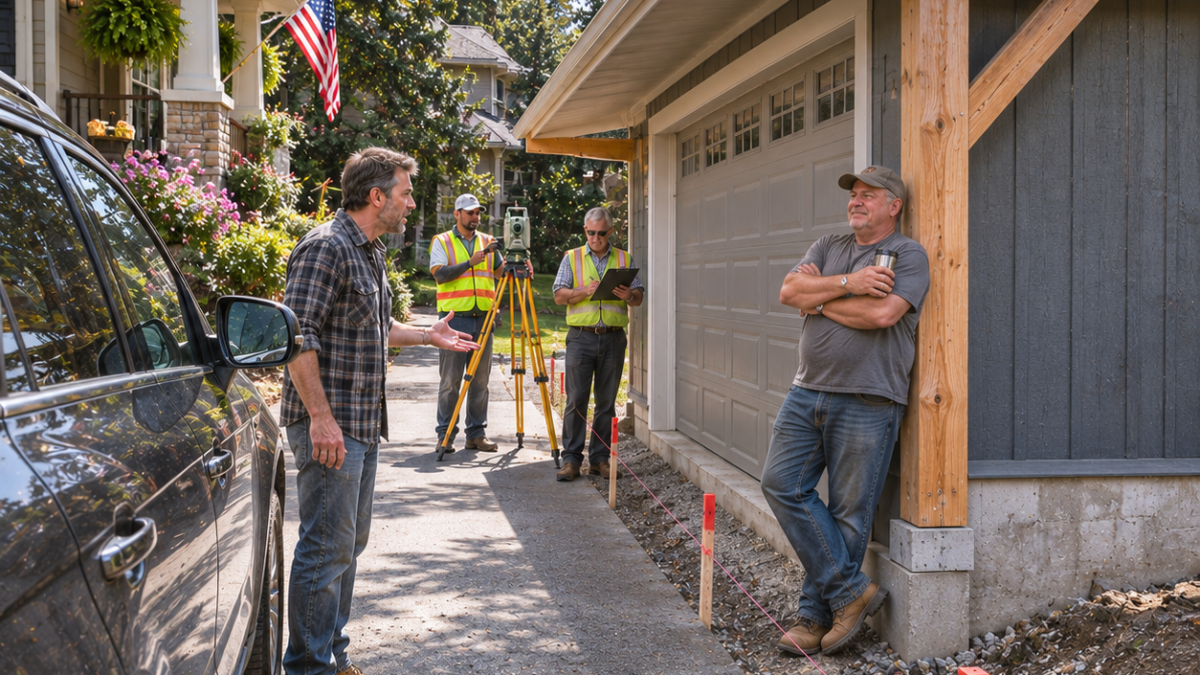
The surveyor’s name was Dale Mercer.
No relation to me.
Late fifties.
Weathered face.
Dusty white truck with faded lettering down the doors that looked like it had already survived a hundred property disputes.
He arrived two days later.
Stepped out.
Looked at my house.
Looked at Greg’s construction.
Then back at me.
“Somebody build where they shouldn’t?”
“That’s what we’re finding out.”
Dale nodded.
“Good answer.”
He didn’t start by walking to the garage.
That told me I had hired the right man.
People who have never seen a professional survey imagine somebody stretching a tape from a fence post and announcing where the line is.
A real survey is less theatrical.
Records.
Monuments.
Recorded plats.
Known control points.
Measurements checked against other measurements.
Dale pulled the plat for both parcels.
Located the original corners.
Set up his total station.
Walked the frontage.
Then the rear.
Greg appeared about twenty minutes later.
Coffee in one hand.
Phone in the other.
“What are you doing?”
“Survey.”
Greg smiled.
“Told you the contractor measured.”
Dale kept working.
Greg waited for some acknowledgment.
Didn’t get one.
Then returned inside.
For almost an hour, Dale barely spoke.
Every few minutes he checked his data collector.
Walked.
Measured.
Entered something.
Moved again.
I tried to stay out of the way.
I failed.
Eventually he crouched near the driveway.
Tapped a bright red stake into the ground.
The sound was sharper than I expected.
Then another farther back.
Then a third.
An invisible boundary slowly became visible.
Dale motioned toward me.
“Walk with me.”
We followed the red stakes.
When we reached Greg’s garage, Dale stopped.
Didn’t say anything.
Just pointed.
The first structural corner stood on my side.
Not close.
Not touching.
Over.
“How far?” I asked.
He checked.
“Right around four feet at the structural corner.”
I looked upward.
“And the roof?”
“Projection gets closer to five.”
I let out a breath I hadn’t realized I was holding.
“So I’m not imagining it.”
“No.”
“Any ambiguity?”
“Not much.”
He pointed toward the established monuments.
“This line is pretty clean.”
Clean.
I liked that word.
Not maybe.
Not depending how you interpret it.
Clean.
Dale finished.
Took photographs.
Prepared a sketch.
A few days later, the stamped report arrived electronically and by mail.
I printed copies.
Photographed the red stakes.
The garage corner.
Roof.
My driveway.
My SUV.
One photo from behind the wheel showed how much narrower the usable lane had become.
Then I put everything into a large envelope.
I walked over.
Nobody answered.
So I placed the survey documents where Greg would receive them.
No handwritten note.
No insults.
No threats.
Just measurements.
Day one passed.
Nothing.
Day two.
Workers returned.
Day three.
More siding.
That was when I understood what Greg had decided.
Ignore it.
I walked over again.
He opened the door after my second knock.
No smile this time.
“Yeah?”
“You got the survey?”
“Yes.”
“What are you doing about the garage?”
He sighed.
“Look, tearing part of that garage apart isn’t happening.”
“It’s on my property.”
“It’s four feet.”
“Four feet of my property.”
“Do you know what it cost?”
“I didn’t build it.”
His mouth tightened.
“You still have space.”
“Not enough for some larger vehicles.”
“You’ll figure it out.”
There it was again.
That assumption.
His construction.
My adjustment.
I stood there a few seconds.
Then said:
“All right.”
He looked almost surprised.
Maybe he wanted a fight.
Maybe he had prepared arguments.
I gave him nothing.
I turned around.
Walked home.
That evening, I sat at my kitchen table with the survey.
I kept hearing:
You’ll figure it out.
It wasn’t the phrase itself.
It was what it meant.
Greg wasn’t disputing the line anymore.
Not really.
He had been shown a licensed survey and hadn’t ordered one of his own.
He wasn’t saying:
You’re mistaken.
He was saying:
The mistake is expensive, so you absorb it.
I could have called a lawyer immediately.
Part of me wanted to.
Injunction.
Demand letter.
Court.
But legal disputes take time.
Three months if you’re lucky.
Sometimes a year.
Meanwhile the garage would stay above my driveway every single morning.
I wanted a solution faster than that.
Still, I knew enough not to improvise.
Being angry doesn’t create legal rights.
So I started with the documents.
My deed.
Title report.
Recorded plat.
Survey.
Any easements.
Nothing gave the Turner property any right to use my driveway.
No shared driveway.
No access easement.
No reciprocal parking rights.
The entire gravel lane sat on my parcel.
From the street to my detached garage.
That gave me an idea.
A very simple one.
But simple ideas can become expensive mistakes if you skip the boring part.
So I called a property attorney.
Claire Donnelly.
She had handled a fence and drainage dispute for a friend several years earlier.
Direct.
Practical.
More interested in documents than dramatic speeches.
I brought her the survey.
Photographs.
Deed.
Plat.
She read.
Then asked:
“Why haven’t you sued?”
“Time.”
“That isn’t necessarily a bad reason.”
“I want my driveway usable now.”
“What are you thinking?”
I told her.
A height-control bar at the entrance.
Two steel posts.
Crossbar.
Visible.
Marked.
Nothing hidden.
Nothing intended to damage vehicles.
Designed entirely within my property.
Claire leaned back.
“So you’re trying to make his garage difficult to use.”
“I’m controlling my driveway.”
“Those can be the same thing.”
“I know.”
She tapped the survey.
“There’s a difference between something being on your land and every possible use being automatically lawful.”
“I figured.”
“You need to check local zoning, right-of-way, sight distance, emergency access, utilities, maybe permitting depending on height and construction.”
“Okay.”
“And if you install something solely to injure his use, expect a nuisance argument.”
“It won’t touch his land.”
“That helps. Doesn’t end the analysis.”
I nodded.
“What would you do?”
“Personally?”
“Yes.”
“I’d send a demand and seek an injunction.”
“Months.”
“Potentially.”
“In the meantime?”
She stared at the photograph of Greg’s roof.
Then smiled faintly.
“Check the county.”
So I did.
Planning office.
Public works.
Fire marshal.
The driveway served only my lot.
The front of my house already met fire-access requirements.
My detached garage did not require full-size apparatus access beneath the proposed bar.
The structure could not sit in public right-of-way.
Couldn’t interfere with utilities.
Needed appropriate footings.
Reflective clearance marking.
Nothing particularly complicated.
Seven feet of clearance was acceptable for the private use I described.
My SUV would pass.
My utility trailer would pass.
My lawn equipment would pass.
Most standard cars would pass.
Greg’s larger pickup might fit vertically.
But his actual problem wasn’t just height.
It was geometry.
The garage had been built so close to my side that entering it cleanly required a wide swing through my driveway entrance.
The crossbar would force vehicles to stay within the narrower path I legally controlled instead of using my entire frontage like a turning apron.
I asked Claire one more time:
“Too far?”
“You gave him the survey?”
“Yes.”
“You asked him to correct it?”
“Twice.”
“He refused?”
“Yes.”
“What exactly did he say?”
“You’ll figure it out.”
Claire almost smiled.
“Then make sure your paperwork is perfect.”
I hired a metal fabrication company.
Two posts.
Heavy black crossbar.
Reflective clearance marker.
Bolted and concreted properly.
The foreman asked:
“Seven feet?”
“Yes.”
“Any reason?”
“Private access control.”
He looked at my detached garage.
Then at Greg’s structure.
Then at me.
“Understood.”
The installation was scheduled for the following Tuesday.
I didn’t warn Greg.
Not because I wanted to surprise him.
Because we’d already discussed the issue twice.
The survey had been delivered.
There was nothing else to negotiate.
Tuesday morning, I was outside with coffee when the fabrication truck arrived.
Two workers unloaded steel.
Marked post locations.
Confirmed dimensions.
Started digging.
Greg’s door opened.
Melissa came out behind him.
Greg walked over quickly.
“What’s going on?”
“Installing a clearance bar.”
“A what?”
“Height control for the driveway.”
“Why?”
“To protect access to my garage.”
He looked at the workers.
Then the steel.
Then me.
“What height?”
“Seven feet.”
Greg’s expression changed.
Not much.
But enough.
“You can’t put that there.”
“It’s on my property.”
“That isn’t the point.”
“It kind of is.”
One worker lowered a steel post into the first footing.
Greg moved toward him.
“Stop.”
The worker looked at me.
I said:
“Keep working.”
Greg stared.
“You’re doing this because of my garage.”
“I’m doing it because my driveway is mine.”
Melissa stepped closer.
She hadn’t said anything yet.
“Did you get approval?”
Good question.
I handed her a folder.
County review.
Permit where required.
Utility verification.
Fire-access confirmation.
Survey.
Melissa flipped through it.
Greg looked increasingly annoyed.
“You went through all this just to make a point?”
“No.”
The second post rose.
“I went through all this because your building is four feet onto my property and you told me to figure it out.”
His jaw tightened.
Behind us, the workers lifted the crossbar.
That was the moment Greg understood.
The steel moved upward.
Seven feet.
Then locked into place.
He stared at the bar.
Then toward his garage.
Then back toward the driveway.
You could almost watch the calculations.
Pickup length.
Turning radius.
Garage opening.
Width.
Possible approach.
He finally said:
“Seven feet?”
“Approximately.”
“That’s low.”
“For some vehicles.”
“You’re making it impossible to use our garage.”
I paused.
Let him hear his own sentence.
Then said:
“Interesting.”
His face hardened.
“What’s that supposed to mean?”
“You built your garage partly over my land.”
“So?”
“And now you’re angry because you can’t use my land to make the garage function properly.”
“It’s not your land we’re talking about.”
I pointed at the survey stake.
“We have covered this.”
Greg ran a hand through his hair.
Melissa looked toward him.
“The survey really says four feet?”
“Yes.”
Greg said:
“It’s disputed.”
I looked at him.
“By what survey?”
He didn’t answer.
I asked again.
“What licensed survey contradicts mine?”
Still nothing.
The workers bolted on a reflective sign.
CLEARANCE 7′-0″
The metal settled with a deep final sound.
Permanent.
At least for the moment.
The crew cleaned up.
Tested the installation.
My SUV passed underneath easily.
I drove through once.
Stopped.
Backed out.
Passed again.
No problem.
Greg watched.
I won’t lie.
The second pass was unnecessary.
It felt good anyway.
The next morning, Greg tried his truck.
I was making coffee when I heard the engine.
I looked through the kitchen window.
His pickup approached from the alley behind his property.
He backed.
Turned.
Inched forward.
Stopped.
Reversed.
Adjusted.
Tried again.
The crossbar forced him to stay within a tighter approach path.
Without swinging wide through my driveway, his garage angle was awful.
He backed up.
Tried a third time.
Stopped.
Finally parked on the street.
I returned to my coffee.
A small part of me wanted to laugh.
A larger part felt something else.
Relief.
For the first time since the garage went up, I wasn’t the person being told to adapt.
The next test came three days later.
Delivery van.
Tall roof.
Driver stopped before the crossbar.
Got out.
Looked at the sign.
Looked toward Greg.
Greg walked down.
They talked.
The driver pointed upward.
Greg pointed toward the garage.
The driver shook his head.
Boxes came off by hand.
By the end of the week, the expensive new garage was mostly storage.
Bicycles.
Boxes.
Tools.
Lawn equipment.
Melissa’s smaller crossover could make the turn if driven carefully.
Greg’s truck could not.
And that distinction mattered.
I hadn’t blocked the garage.
I had stopped donating my land to make their bad design convenient.
Greg filed a complaint with the county.
I expected it.
Inspector arrived Thursday.
Measured everything.
Checked paperwork.
Confirmed the bar stayed inside my parcel.
Confirmed public right-of-way remained clear.
Checked sight lines.
Emergency access.
Utilities.
No violation.
Greg stood nearby.
“So that’s it?”
The inspector looked at him.
“The structure complies with the approval.”
“It blocks my garage.”
The inspector looked toward Greg’s garage.
Then at the red survey stake.
“Your garage appears to have a separate encroachment issue.”
“I know that.”
“Then that’s between you, your neighbor, and your legal counsel.”
Greg went inside.
That afternoon Claire called.
“He retained counsel.”
“Already?”
“You installed a steel reminder in front of his house.”
“Fair.”
“Their attorney sent a demand.”
“To remove it?”
“Yes.”
“Grounds?”
“Interference with beneficial use of their property. Malicious intent. Nuisance.”
“What do you think?”
“I think their garage crossing your boundary makes their position awkward.”
“Awkward isn’t impossible.”
“No.”
Claire paused.
“I want to send your formal encroachment demand now.”
“Do it.”
She sent everything.
Survey.
Photos.
Timeline.
My initial conversation with Greg.
Delivery of the report.
His refusal.
County approval for the clearance structure.
Then one clear demand:
Remove every encroachment.
Wall.
Roof projection.
Gutter.
Any foundation element.
Restore the boundary.
Thirty days.
Otherwise we would seek injunctive relief and associated damages.
Greg’s attorney responded with an offer.
Five thousand dollars for an easement.
I declined.
A week later:
Ten thousand.
Declined.
Then fifteen.
Claire called.
“That’s real money.”
“I know.”
“Maybe enough to cover a lot of inconvenience.”
“I don’t want an easement.”
“Tell me why.”
I looked through the window at the garage.
“Because it attaches their mistake to my deed.”
“Correct.”
“Future owner of my place inherits it.”
“Yes.”
“Future owner of theirs relies on it.”
“Yes.”
“And my driveway stays narrow forever because Greg spent money before checking the line.”
Claire was quiet.
“That’s a rational reason.”
“And I don’t like being offered money after the building is already here.”
“That part is emotion.”
“I know.”
“Emotion isn’t prohibited. Just know which argument is legal and which is personal.”
That was one of the best things anybody told me through the dispute.
Greg tried another solution.
He brought out a contractor to examine whether a separate access lane could be built entirely on his side.
I watched them measure.
They studied drainage.
Utilities.
Fence placement.
Slope.
The contractor shook his head several times.
Later I learned the numbers.
Creating a new approach would cost more than modifying the garage.
The building had been designed around space Greg didn’t own.
That was the basic problem.
Not my crossbar.
Not my attitude.
His design.
Melissa figured that out before he did.
She knocked on my door alone one evening.
“Can we talk?”
“Sure.”
I stayed on the porch.
She looked toward the garage.
“I want to see the survey.”
I brought out a copy.
She studied it.
“This line?”
“Yes.”
“Our lot ends here?”
“Yes.”
“And this corner is over?”
“Nearly four feet.”
Her finger moved.
“The roof too?”
“Almost five at the farthest projection.”
Melissa closed her eyes briefly.
“Greg said six inches.”
I said nothing.
“He said your survey was exaggerated.”
“He has never commissioned another survey.”
She looked toward their house.
Then back at the page.
“When did you give him this?”
“Before the bar.”
“How long before?”
“Several days.”
“He said you surprised us.”
I let that sit.
Melissa looked embarrassed.
“I told him we should get our own survey before the garage.”
That surprised me.
“What happened?”
“He said the builder had already measured everything.”
I almost laughed.
Not at her.
At how expensive that sentence had become.
Melissa looked at me.
“If we fix the encroachment, does the bar actually come down?”
“Yes.”
“Immediately?”
“After a licensed survey confirms everything is clear.”
“That’s it?”
“That’s it.”
“No money?”
“No.”
“No legal release where we admit something crazy?”
“My lawyer will handle the normal paperwork.”
Melissa nodded.
Then walked home.
Two days later, Greg knocked.
Different energy.
No coffee.
No half-smile.
No casual dismissal.
“Can we talk?”
I stepped outside.
“Sure.”
He looked toward the crossbar.
“This situation isn’t working.”
“I’ve noticed.”
He exhaled.
“Look, I get the survey.”
That was the first time he’d said that.
“Okay.”
“I understand the corner crosses.”
“And the roof.”
“Yes.”
“And the roof.”
He looked annoyed saying it.
“But tearing that entire side apart is expensive.”
“I know.”
“We can trim the roof.”
“The structural corner stays on my property.”
“What if we move just the post?”
“Your foundation and wall still cross.”
Greg rubbed both hands over his face.
“What do you want?”
There it was.
The question he’d refused to ask from the beginning.
I answered immediately.
“Move the entire garage fully onto your parcel.”
“All of it?”
“Yes.”
“Nothing over?”
“Nothing.”
He looked at the bar.
“And then you remove that?”
“Yes.”
“You’ll put it in writing?”
“Yes.”
“How soon?”
“As soon as Dale—or another mutually acceptable licensed surveyor—confirms you’re clear.”
Greg stared at the ground.
“Could’ve just sued.”
“I still can.”
He looked up.
“You wanted to make a point.”
“No.”
“Come on.”
“I wanted you off my property.”
“Same thing.”
“No.”
I pointed toward the steel.
“If I wanted control over you, I’d keep the bar after you fixed the garage.”
That stopped him.
I continued.
“The bar has one purpose.”
“To screw me.”
“To make my property matter.”
He laughed bitterly.
“That’s the same thing from where I’m standing.”
“Then stand on your side.”
He looked at me.
For a second, I thought I had pushed too hard.
Then, surprisingly, Greg laughed.
Not friendly.
But real.
“Fair.”
He looked back at the garage.
“All right.”
“You’ll move it?”
“We’ll fix it.”
Claire drafted the agreement.
Simple enough.
Turners correct all encroachments.
Walls.
Foundation elements.
Roof.
Gutters.
Drainage.
Trim.
Anything crossing the boundary.
No contractor enters my driveway without advance permission.
New survey after work.
Once clear, I remove the height-control structure within a stated period.
Mutual releases after compliance.
Greg signed.
So did Melissa.
Construction began the following week.
Watching a nearly finished garage get corrected is very different from watching one built.
Construction usually has optimism.
Workers bring new lumber.
Fresh materials.
Everything moves forward.
Correction looks like accounting.
Siding came off.
Roof shingles stripped.
Sheathing removed.
Framing exposed.
The corner wall disappeared.
Workers cut.
Reframed.
Adjusted trusses.
Modified the footprint.
For several days, the garage looked like a storm had torn through it.
I didn’t enjoy watching as much as I expected.
There was satisfaction.
Sure.
But mostly I saw wasted money.
Wasted labor.
Good lumber being removed because nobody had spent a small fraction of the construction budget on a survey before work began.
One afternoon the original builder arrived.
He and Greg argued.
Their voices carried.
“You told me it was fine.”
“I told you the approximate line.”
“You said you measured.”
“I measured from the site plan.”
“You said boundary.”
“I said layout.”
That conversation explained a lot.
Greg had heard what he wanted.
The builder had apparently been happy not to correct the misunderstanding.
Their dispute became their problem.
Exactly where it belonged.
Melissa came outside during the second week.
I was washing my SUV.
She stood near the red stakes.
“This is ugly.”
“The rebuild?”
“All of it.”
I shut off the hose.
“I agree.”
She looked toward the garage.
“Greg didn’t sleep for three nights after we signed.”
“I didn’t sleep much when the garage nearly took off my mirror.”
“I know.”
Silence.
Then she said:
“I should’ve talked to you sooner.”
I shrugged.
“You weren’t the one telling me to figure it out.”
“No.”
She looked uncomfortable.
“But I knew something was wrong after the survey.”
I waited.
“I didn’t say anything because I didn’t want to fight with him.”
That was more honest than most people would admit.
“Did that help?”
“No.”
She smiled sadly.
“No, it did not.”
The work took almost three weeks.
Then Dale returned.
Same truck.
Same faded logo.
He set up his equipment.
Checked the line.
Walked every relevant point.
Greg stood nearby.
Melissa too.
I tried not to hover again.
Failed again.
Finally Dale said:
“Clear.”
One word.
Three weeks of repair.
Thousands of dollars.
Months of tension.
Clear.
He handed me the certification.
Then Greg.
The garage now sat fully inside the Turner parcel.
Roof.
Gutter.
Foundation.
Everything.
The metal crew returned Friday.
They removed the crossbar.
Unbolted steel.
Lifted it down.
Pulled the posts.
Patched footing locations.
By late afternoon, my driveway was open.
No black steel.
No warning sign.
No physical reminder of the fight.
Just gravel.
Greg walked over.
“Feels strange.”
“What?”
“Not seeing the bar.”
“I prefer it.”
“So do I.”
We stood awkwardly.
Then he said:
“For what it’s worth…”
I waited.
“I should have gotten the survey.”
“Yes.”
He laughed.
“You really aren’t going to make this easy?”
“You want me to pretend you shouldn’t have?”
“No.”
He looked at the ground.
“Fair.”
Then he held out his hand.
I looked at it.
Shook.
That wasn’t forgiveness.
Not yet.
But it was the first normal thing we’d done since construction started.
We did not become friends.
That’s important.
Stories like this usually end with neighbors sharing beers and laughing about the crazy misunderstanding.
That wasn’t us.
Some disputes destroy trust before trust exists.
Afterward, we became civil.
Wave.
Nod.
Occasional:
“Morning.”
That was enough.
Melissa was friendlier.
Their children occasionally retrieved balls from my yard.
The golden retriever eventually stopped barking at me.
And the garage?
It worked perfectly.
Greg could drive into it from his own property.
His truck made the turn.
Delivery vans could reach the area.
Nobody needed my driveway.
That fact bothered me more than I expected.
Because it proved the entire fight had been avoidable.
A legal design existed.
It simply cost Greg more than assuming my land was available.
Months passed.
Cedar Ridge returned to ordinary life.
Then Walt came back to visit.
He lived two counties away now but still knew half the neighborhood.
He parked near my house.
Same gray mustache.
A little thinner.
“Had to see the famous garage.”
I groaned.
“Who told you?”
“Everybody.”
“Fantastic.”
We walked toward the boundary.
Walt stared.
“Looks normal.”
“It is now.”
He looked toward my driveway.
Then laughed.
“Your kingdom survived.”
I remembered the beer years before.
“That stupid line.”
“It wasn’t stupid.”
“It’s gravel.”
Walt pointed at me.
“Still yours.”
That was Walt.
No philosophy required.
He understood something I had spent months proving.
Boundaries only feel complicated when somebody refuses to respect them.
A year after the dispute, Greg bought a larger pickup.
Lifted slightly.
The kind of truck I expected would struggle even after the rebuild.
One Saturday morning, I was outside cleaning leaves.
He backed toward the garage.
Turned.
Entered cleanly.
No use of my driveway.
No hesitation.
He parked.
Got out.
Saw me.
“See?”
“What?”
“Fits.”
I nodded.
“Amazing what happens when the building’s on the correct property.”
He shook his head.
“You couldn’t let me have one moment?”
“No.”
Then he laughed.
For the first time, I laughed too.
Maybe that was as close to friendship as we ever got.
The red survey stakes eventually disappeared.
Wood rots.
Snowplows knock things loose.
Kids kick them.
They aren’t meant to mark a boundary forever.
But the permanent survey pins remained.
So did the records.
The line went back to being invisible.
That’s how property boundaries should work.
Most days, nobody should need to think about them.
They matter precisely because everybody agrees they are there.
When respect disappears, red stakes become necessary.
I kept the steel crossbar.
Good steel isn’t cheap.
It sat behind my detached garage for almost two years.
One winter, I decided to build a heavier workbench.
I cut part of the crossbar down.
Welded a frame.
Bolted a thick maple top onto it.
Black steel beneath.
Solid.
Greg saw me working.
He walked over.
“Is that the bar?”
“Part of it.”
He stared.
“You turned it into a table?”
“Workbench.”
“That thing ruined my month.”
“Now it holds my vise.”
He laughed.
“Perfect.”
That workbench is still in my garage.
Sometimes when I tighten something in the vise, I remember Greg standing beneath the original crossbar saying:
You can’t just do this.
The funny part is, that was nearly the same feeling I had standing beneath his garage.
The difference wasn’t who was angrier.
The difference was survey, ownership, permission, and paperwork.
Those boring words are what separate defending your rights from simply imposing your will.
Claire later asked whether she could use the dispute anonymously during a property-law seminar.
I agreed.
Several months later she sent me one of her slides.
SELF-HELP REMEDIES: LAWFUL DOES NOT ALWAYS MEAN WISE.
I called.
“You turned me into a warning.”
“A successful warning.”
“That sounds worse.”
“It isn’t.”
She explained that my clearance bar had worked because the facts were unusually clean.
Private driveway.
No easement.
No public access.
County review.
Visible structure.
No emergency obstruction.
No hidden danger.
Different facts could have produced a very different result.
Another jurisdiction might treat the same tactic differently.
A judge might find bad-faith nuisance conduct.
Emergency access requirements might prohibit it.
That humbled me.
People who heard the story began asking:
“Should I do what you did?”
My answer became:
“No.”
They were always surprised.
“But it worked.”
“For my property.”
“Same idea.”
“No.”
A cousin wanted to put concrete blocks across a driveway because neighbors used it to turn around.
I told him to check the title and local laws.
Turned out there was a recorded access easement he hadn’t known about.
If he’d copied my “revenge,” he would have created his own problem.
That taught me another lesson.
Internet revenge stories love universal solutions.
Property law does not.
Survey first.
Documents.
Professionals.
Then decisions.
The most powerful thing I did was not install steel.
It was call Dale.
Everything depended on knowing where the line actually was.
Years passed.
The Turners’ kids became teenagers.
One afternoon their son backed a little utility trailer too close to my side.
Greg stood in the driveway.
“Watch the line!”
I happened to be trimming bushes.
I looked over.
Greg saw me smiling.
“What?”
“Nothing.”
He pointed at me.
“Not one word.”
I raised both hands.
“Didn’t say anything.”
His son looked confused.
“What line?”
Greg answered:
“Long story.”
I went back to work.
There was something satisfying about that.
Not because Greg was afraid of me.
Because he had become the person teaching someone else that boundaries mattered.
That was better than humiliation.
Walt died several years later.
His daughter called.
She knew we had stayed in touch.
Asked whether I would attend his memorial.
I did.
Family photographs covered several tables.
Walt fishing.
Walt beside an old Mustang.
Walt at the machine shop.
Then a picture in front of his former house.
Greg’s house now.
Behind him, my gravel driveway.
No garage.
No survey stakes.
No dispute.
Just two neighboring properties existing peacefully.
Walt’s daughter noticed me studying it.
“Something wrong?”
“No.”
I smiled.
“Your dad used to call that driveway my kingdom.”
She laughed.
“That sounds exactly like him.”
I took a photograph of the picture with her permission.
Still have it.
Not because the driveway is special.
Because it reminds me what things looked like before anyone had to defend anything.
The ideal boundary is boring.
Claire once asked me whether I regretted the clearance bar.
I had to think.
“Not exactly.”
“That means yes.”
“No.”
“What would you do differently?”
I answered honestly.
“Call you sooner.”
“Good.”
“Maybe send a formal demand before the bar.”
“Better.”
“Possibly seek temporary injunctive relief.”
“Very good.”
I looked at her.
“Are you billing me for this conversation?”
“Absolutely.”
She wasn’t.
But I deserved that.
Looking backward, I realized how easily being obviously right could have made me reckless.
The first time I saw the roof hanging over my driveway, I wanted to solve the problem myself.
Sawzall.
Jack.
Chain.
Something.
Anything immediate.
That would have been stupid.
The garage belonged partly to Greg even though part of it occupied my space.
Damaging it before legal review could have turned me into the defendant.
Being right about the boundary didn’t give me unlimited freedom in how I responded.
That distinction matters.
Winning doesn’t mean every tactic was wise.
It means enough decisions were wise to reach the right result.
A few years after the dispute, a young couple bought a house farther down Cedar Ridge.
They stopped by.
“Are you the driveway guy?”
I closed my eyes.
“Apparently.”
They laughed.
They planned to replace an old fence and widen their driveway.
The husband said:
“We think the boundary’s over here.”
I shook my head.
“No.”
He looked confused.
“No what?”
“Don’t build on ‘we think.’”
I gave them Dale’s number.
He had mostly retired but referred them to another licensed surveyor.
Survey showed their old fence was sixteen inches over the neighbor’s line.
Nobody had known.
Both families met.
Split the cost.
New fence went in correctly.
No argument.
No lawyers.
No steel crossbar.
A month later, the young husband came over.
“You saved us a nightmare.”
“No.”
“Surveyor did.”
“Same thing.”
“It absolutely isn’t.”
But I liked the outcome.
A good lesson is one somebody else can use without repeating the damage that taught it.
Cedar Ridge slowly changed.
Houses sold.
Children grew.
Walt’s house became Greg’s home rather than “the Turner place.”
My detached garage got a new roof.
My SUV changed twice.
The maples grew larger.
The driveway needed new gravel every few years.
Every time a dump truck delivered stone, I thought about those weeks when commercial vehicles couldn’t pass comfortably because Greg’s roof occupied the airspace above my property.
That phrase still sounds ridiculous.
Airspace.
But roofs project.
Snow falls.
Gutters drain.
Vehicles turn.
A few feet can matter in ways you don’t understand until something permanent occupies them.
One winter made that obvious.
Heavy snow.
Then warm rain.
Water poured from Greg’s corrected roof into his own drainage system.
Before the repair, that roof edge would have dumped runoff directly onto my driveway.
Ice.
Erosion.
Mud.
Potential damage every winter.
The dispute had never only been about my SUV mirror.
It was about what twenty years of leaving the encroachment would have created.
Maintenance disputes.
Insurance questions.
Future sales.
Title concerns.
Repairs.
Who replaces the roof?
Who enters whose land?
What happens if the garage burns?
What happens if I sell?
Imagine a buyer ordering a survey and discovering someone else’s building four feet across the boundary.
Now my “just a few feet” becomes their problem.
Then their lender’s.
Then their title company’s.
Then another lawyer’s.
Ignoring a boundary does not make it disappear.
It simply postpones the argument.
That was why the fifteen-thousand-dollar easement offer never tempted me enough.
The money was real.
But the issue attached to the land permanently.
Greg had made a temporary mistake.
I was not going to create a permanent legal arrangement just to make his mistake easier.
One Saturday evening, Greg stopped near my garage while I was working at the steel bench.
“Can I ask you something?”
“Sure.”
“If I’d offered twenty-five grand, would you have taken it?”
I thought.
“No.”
“Thirty?”
“No.”
He laughed.
“Everybody has a number.”
“Probably.”
“What was yours?”
“I don’t know.”
“That means you would’ve sold.”
“Maybe for enough money to buy another house.”
Greg shook his head.
“That driveway cannot be worth that much.”
“To you.”
He stopped smiling.
I hadn’t meant it harshly.
I explained.
“The strip itself isn’t worth another house.”
“Exactly.”
“But changing how I use my property might be.”
Greg looked toward the garage.
“So it was emotional.”
“Partly.”
“Thought your lawyer said that was bad.”
“She said know the difference.”
He nodded.
“Fair.”
We stood quietly.
Then he said:
“I would’ve taken the fifteen.”
“I know.”
“How?”
“Because you offered it.”
He laughed.
Years after the dispute, I learned more about what had happened between Greg and the original builder.
They ended up in arbitration over the correction costs.
Greg argued the contractor had assured him the placement was proper.
The contractor argued his contract required the owner to provide verified boundary information and that the stakes Greg showed him were not survey monuments.
I wasn’t involved.
Didn’t testify.
Didn’t need to.
Eventually, the builder paid part of the correction cost.
Greg absorbed the rest.
That made sense to me.
Mistakes are often shared.
Greg should have ordered a survey.
The builder should have insisted on clearer boundary verification before placing a permanent structure so close to a line.
I didn’t need one villain to carry all of it.
That’s another thing you learn after anger fades.
Reality becomes less convenient.
During the dispute, Greg felt like the entire problem.
Years later, I could admit several people made bad decisions.
Greg.
Builder.
Maybe me for waiting as long as I did before formal notice.
What mattered was who corrected them when the facts became clear.
Greg eventually did.
Late.
Expensively.
Reluctantly.
Still did.
That deserved at least recognition.
Melissa and I talked more than Greg and I did.
Mostly small things.
Her dog escaping.
Packages delivered to the wrong porch.
One afternoon, she brought over a plate of cookies around Christmas.
“No survey attached,” she said.
I laughed.
“Risky.”
She smiled.
“Greg said I shouldn’t make property jokes.”
“He’s probably right.”
“Which is why I did.”
We stood at the door.
Then she said:
“Thank you for taking the bar down.”
“I told you I would.”
“I know.”
She looked toward the driveway.
“But I wasn’t sure.”
“Why?”
“Because by then we had made you angry.”
I thought about it.
“I was angry.”
“Exactly.”
I said:
“The bar wasn’t there because I enjoyed having it.”
She nodded.
“I understand that now.”
That conversation stuck with me.
People often assume anger automatically leads to revenge.
Sometimes it does.
But the strongest boundary is one you enforce only as long as necessary.
The bar stopped being necessary.
So it came down.
If I had kept it just because Greg hated it, then somewhere along the way the dispute would have changed.
I would have stopped defending access and started enjoying control.
That was not the person I wanted to become.
When I turned sixty, I started thinking about selling the house.
The detached garage felt large.
The yard demanded more work every year.
Leaves.
Snow.
Gravel.
Gutters.
A smaller place sounded attractive.
I mentioned it to Greg once.
He looked genuinely surprised.
“You’re leaving?”
“Maybe eventually.”
He glanced toward the driveway.
“You fought that hard for it.”
“I didn’t fight because I had to die here.”
He thought.
“Fair.”
Defending property doesn’t mean becoming trapped by it.
That’s another distinction people miss.
The line mattered because it was my choice what happened on my land.
That includes choosing to sell someday.
If I do, the next owner gets a clean title.
No garage encroachment.
No awkward easement created under pressure.
No explanation about why a neighbor’s roof hangs over their driveway.
They get boring paperwork.
That might be the best inheritance I can give a stranger.
A clean problem-free boundary nobody ever thinks about.
I ended up staying.
At least for now.
One autumn evening, rain tapped against the detached garage roof while I worked at the old steel bench.
Door open.
Driveway dark.
Wet leaves scattered across gravel.
Greg came home.
Headlights swept through the trees.
His truck turned cleanly.
Entered his garage entirely from his side.
Door closed.
Everything worked.
Exactly the way it should have from the beginning.
I stared toward the property line.
Couldn’t see it.
No red stakes.
No crossbar.
No argument.
Just two houses.
That’s when I finally understood the best outcome of the entire fight.
I had wanted Greg to understand me.
For months, I wanted him to admit:
You were right.
I was wrong.
Those are satisfying words.
But they aren’t necessary.
You cannot force understanding.
You can require correction.
You can create lawful consequences.
You can insist on the line.
Understanding may come later.
Or never.
The rebuilt garage was the correction.
The bar had been the temporary consequence.
Whatever Greg learned emotionally belonged to him.
My business was the boundary.
That’s all.
People still ask me:
“Would you do the same thing again?”
The answer isn’t as simple as it used to be.
Would I surrender the four feet?
No.
Would I ignore the roof?
No.
Would I let somebody tell me I could still squeeze through so it wasn’t a big deal?
Definitely not.
But would I immediately build the clearance bar again?
Maybe not.
I’d call the surveyor faster.
Hire the lawyer earlier.
Put the demand in writing immediately.
Possibly seek temporary court relief rather than rely on a self-help solution.
Experience doesn’t only confirm what you did right.
It shows you how close you may have come to doing something wrong.
Still, I don’t regret forcing the issue.
Because Greg’s preferred solution was simple:
I absorb the inconvenience because correcting his construction was expensive.
That is a dangerous rule.
It rewards whoever builds first.
Whoever pushes hardest.
Whoever spends the most before asking permission.
Under that rule, the boundary stops meaning anything.
I wasn’t willing to teach Greg—or myself—that acting first creates ownership.
So I checked the line.
I gave him the evidence.
Gave him an opportunity.
Then another.
When he told me:
“You’ll figure it out.”
I did.
Just not the way he expected.
The steel bar stood for less than two months.
The corrected garage has stood for years.
That comparison tells the entire story.
My goal was never to keep Greg’s garage useless forever.
It was to make leaving the encroachment uncorrected less convenient than fixing it properly.
Once correction became the sensible option, the fight ended.
One Saturday morning years later, I backed my SUV down the driveway.
Different SUV.
Same gravel.
I reached the spot where Greg’s old support beam had once come within an inch of my mirror.
Nothing was there.
Open air.
Sunlight.
A few maple leaves.
I stopped.
Put the vehicle in park.
Got out.
No real reason.
Just memory.
I stood on the gravel.
Looked toward Greg’s garage.
Fully inside his property.
Then at mine.
The driveway still ran exactly where it had when Walt lived next door.
I remembered the old man raising his beer.
That’s your kingdom.
Ridiculous phrase.
But maybe not entirely.
A kingdom doesn’t need to be large.
It just needs a border that means something.
I got back into the SUV.
Continued toward the street.
Greg was outside retrieving his newspaper.
He raised one hand.
I raised mine.
No lawyers.
No red stakes.
No steel bar.
No surveyor.
No argument.
Just two neighbors who finally understood where one man’s choices stopped and the other man’s began.
And that’s the part people usually miss when they hear how I made Greg’s garage almost impossible to use.
I didn’t win because I found a clever way to punish him.
I won because the punishment was temporary and the boundary was permanent.
I never touched his garage.
Never damaged it.
Never blocked his property.
I simply stopped allowing his building to depend on land that was never his.
Eventually, he had two choices.
Keep an expensive garage that barely worked because it had been built around someone else’s driveway—
or move it back where it belonged.
For weeks, he’d expected me to adjust to his mistake.
In the end, he adjusted to the survey.
The steel came down.
The driveway opened.
The garage worked.
And the five feet he’d dismissed as meaningless became the five feet that taught both of us why property lines exist in the first place.
My neighbor built a second garage so far over my property line that one corner sat almost four feet inside my land and the roof hung nearly five feet over the driveway I had owned and maintained for almost a decade, yet when I showed him exactly how close his support beam had come to taking the mirror off my SUV, he laughed, took another sip of coffee, and told me it was “just a few feet” because I could still squeeze past if I drove carefully.
Three days after a licensed surveyor drove bright red stakes through the ground and handed me a stamped report proving the encroachment beyond any reasonable argument, Greg Turner stood in his doorway, barely glanced at the measurements, and told me tearing apart an expensive new garage was simply not going to happen, as though the amount of money he had spent somehow gave him the right to decide how much of my land I was required to surrender.
What Greg couldn’t see while I walked back down my own driveway without raising my voice was that I had already stopped trying to convince him to respect the boundary, and once I confirmed exactly what I was legally allowed to do on every inch of the property he kept calling insignificant, I realized I didn’t need to touch his garage at all to make those few feet become the most important part of it.
I’d lived in Cedar Ridge for almost ten years.
It wasn’t a gated neighborhood.
No dramatic HOA president patrolled the sidewalks. Nobody measured lawns with rulers or sent violation letters because someone’s mailbox was the wrong shade of beige.
Cedar Ridge was simply an older residential pocket where the houses were far enough apart to give people privacy and close enough that everybody recognized everybody else’s truck.
My place sat on a corner lot.
Two-story house.
Detached garage behind it.
Old maples along the street.
Nothing luxurious.
The feature I cared about most was the long gravel driveway running down the side of the house before widening behind it.
That driveway was how I reached my detached garage, how delivery trucks reached the back of the property, how I moved trailers, lumber, lawn equipment, and anything else too large to carry through the front yard.
It wasn’t decorative.
It was access.
And it was mine.
The previous owner next door was an older man named Walt Patterson.
Walt had lived there for twenty-six years.
Gray mustache.
Retired machinist.
Could turn any conversation into a lecture about carburetors if you gave him more than thirty seconds.
We got along.
Not barbecue-every-weekend close, but good neighbors.
If my snowblower wouldn’t start, Walt appeared with tools.
If his gutters needed a ladder, I helped.
One summer evening we sat near my driveway drinking beer while he pointed toward the narrow strip between our properties.
“That right there,” he said, “is your kingdom.”
I laughed.
“Pretty unimpressive kingdom.”
“Still yours.”
That was Walt’s entire philosophy of property.
Know what’s yours.
Respect what’s someone else’s.
No drama necessary.
Then Walt sold.
The Turners arrived the following spring.
Greg and Melissa.
Mid-thirties.
Two kids.
Golden retriever.
Brand-new SUV that remained suspiciously clean despite the muddy spring.
Greg shook my hand on moving day.
“We’re excited to make this place ours.”
“Good house.”
“We’ve got plans.”
Everybody who buys a house has plans.
Paint.
Kitchen.
Deck.
Landscaping.
I didn’t think anything of it.
About three weeks later, trucks began arriving early in the morning.
Lumber.
Concrete materials.
Workers.
One afternoon I wandered over.
Greg stood beside a contractor looking at drawings.
“What are you building?”
“Second garage.”
He looked genuinely excited.
“Tools, bikes, maybe a workshop. I want room for the truck too.”
“Sounds good.”
I looked at where they were working.
Something felt wrong.
Too close.
But construction sites are deceptive when nothing has vertical scale yet.
Strings and stakes make things look larger or smaller depending on where you stand.
Maybe their line sat farther toward my driveway than I remembered.
Maybe I was overthinking it.
So I gave them the benefit of the doubt.
About a week later, I backed my SUV down the driveway.
My side mirror missed one of Greg’s new support posts by less than an inch.
I hit the brakes.
Sat there.
Heart doing that little jump you feel after almost hitting something you weren’t expecting to exist.
Then I stepped out.
Looked up.
The edge of Greg’s roof wasn’t near my driveway.
It was hanging over it.
By several feet.
A dark strip of shadow crossed gravel that had always been mine.
I walked next door.
Greg stood near the contractor drinking coffee.
“Hey.”
He looked up.
“What’s up?”
“Your garage is over my driveway.”
Greg glanced at the framing.
Then gave a short laugh.
“No, contractor measured everything. We’re good.”
“Did you get a boundary survey?”
“The builder handled all that.”
“That isn’t what I asked.”
Greg shrugged.
“I mean, even if it’s off a little, it’s just a few feet.”
I stared at him.
He added:
“You can still get in and out, right?”
That was the moment the problem changed.
A construction mistake can be corrected.
An attitude is harder.
I nodded slowly.
“All right.”
Greg smiled like we’d settled it.
I walked back toward my house.
But I didn’t go inside.
I stood in the driveway.
Looked at the roof.
Looked at the support post.
Then at my SUV.
If I was wrong, I wanted to know.
If I was right, I wanted something stronger than an argument.
The next morning I called a licensed surveyor.
And before I hung up, I told him one thing.
“If I’m wrong, I’ll apologize.”
I looked through my window at the garage hanging over my gravel.
“But if I’m right, I need to know exactly how right.”
— END OF FACEBOOK OPENING —
The surveyor’s name was Dale Mercer.
No relation to me.
Late fifties.
Weathered face.
Dusty white truck with faded lettering down the doors that looked like it had already survived a hundred property disputes.
He arrived two days later.
Stepped out.
Looked at my house.
Looked at Greg’s construction.
Then back at me.
“Somebody build where they shouldn’t?”
“That’s what we’re finding out.”
Dale nodded.
“Good answer.”
He didn’t start by walking to the garage.
That told me I had hired the right man.
People who have never seen a professional survey imagine somebody stretching a tape from a fence post and announcing where the line is.
A real survey is less theatrical.
Records.
Monuments.
Recorded plats.
Known control points.
Measurements checked against other measurements.
Dale pulled the plat for both parcels.
Located the original corners.
Set up his total station.
Walked the frontage.
Then the rear.
Greg appeared about twenty minutes later.
Coffee in one hand.
Phone in the other.
“What are you doing?”
“Survey.”
Greg smiled.
“Told you the contractor measured.”
Dale kept working.
Greg waited for some acknowledgment.
Didn’t get one.
Then returned inside.
For almost an hour, Dale barely spoke.
Every few minutes he checked his data collector.
Walked.
Measured.
Entered something.
Moved again.
I tried to stay out of the way.
I failed.
Eventually he crouched near the driveway.
Tapped a bright red stake into the ground.
The sound was sharper than I expected.
Then another farther back.
Then a third.
An invisible boundary slowly became visible.
Dale motioned toward me.
“Walk with me.”
We followed the red stakes.
When we reached Greg’s garage, Dale stopped.
Didn’t say anything.
Just pointed.
The first structural corner stood on my side.
Not close.
Not touching.
Over.
“How far?” I asked.
He checked.
“Right around four feet at the structural corner.”
I looked upward.
“And the roof?”
“Projection gets closer to five.”
I let out a breath I hadn’t realized I was holding.
“So I’m not imagining it.”
“No.”
“Any ambiguity?”
“Not much.”
He pointed toward the established monuments.
“This line is pretty clean.”
Clean.
I liked that word.
Not maybe.
Not depending how you interpret it.
Clean.
Dale finished.
Took photographs.
Prepared a sketch.
A few days later, the stamped report arrived electronically and by mail.
I printed copies.
Photographed the red stakes.
The garage corner.
Roof.
My driveway.
My SUV.
One photo from behind the wheel showed how much narrower the usable lane had become.
Then I put everything into a large envelope.
I walked over.
Nobody answered.
So I placed the survey documents where Greg would receive them.
No handwritten note.
No insults.
No threats.
Just measurements.
Day one passed.
Nothing.
Day two.
Workers returned.
Day three.
More siding.
That was when I understood what Greg had decided.
Ignore it.
I walked over again.
He opened the door after my second knock.
No smile this time.
“Yeah?”
“You got the survey?”
“Yes.”
“What are you doing about the garage?”
He sighed.
“Look, tearing part of that garage apart isn’t happening.”
“It’s on my property.”
“It’s four feet.”
“Four feet of my property.”
“Do you know what it cost?”
“I didn’t build it.”
His mouth tightened.
“You still have space.”
“Not enough for some larger vehicles.”
“You’ll figure it out.”
There it was.
That assumption.
His construction.
My adjustment.
I stood there a few seconds.
Then said:
“All right.”
He looked almost surprised.
Maybe he wanted a fight.
Maybe he had prepared arguments.
I gave him nothing.
I turned around.
Walked home.
That evening, I sat at my kitchen table with the survey.
I kept hearing:
You’ll figure it out.
It wasn’t the phrase itself.
It was what it meant.
Greg wasn’t disputing the line anymore.
Not really.
He had been shown a licensed survey and hadn’t ordered one of his own.
He wasn’t saying:
You’re mistaken.
He was saying:
The mistake is expensive, so you absorb it.
I could have called a lawyer immediately.
Part of me wanted to.
Injunction.
Demand letter.
Court.
But legal disputes take time.
Three months if you’re lucky.
Sometimes a year.
Meanwhile the garage would stay above my driveway every single morning.
I wanted a solution faster than that.
Still, I knew enough not to improvise.
Being angry doesn’t create legal rights.
So I started with the documents.
My deed.
Title report.
Recorded plat.
Survey.
Any easements.
Nothing gave the Turner property any right to use my driveway.
No shared driveway.
No access easement.
No reciprocal parking rights.
The entire gravel lane sat on my parcel.
From the street to my detached garage.
That gave me an idea.
A very simple one.
But simple ideas can become expensive mistakes if you skip the boring part.
So I called a property attorney.
Claire Donnelly.
She had handled a fence and drainage dispute for a friend several years earlier.
Direct.
Practical.
More interested in documents than dramatic speeches.
I brought her the survey.
Photographs.
Deed.
Plat.
She read.
Then asked:
“Why haven’t you sued?”
“Time.”
“That isn’t necessarily a bad reason.”
“I want my driveway usable now.”
“What are you thinking?”
I told her.
A height-control bar at the entrance.
Two steel posts.
Crossbar.
Visible.
Marked.
Nothing hidden.
Nothing intended to damage vehicles.
Designed entirely within my property.
Claire leaned back.
“So you’re trying to make his garage difficult to use.”
“I’m controlling my driveway.”
“Those can be the same thing.”
“I know.”
She tapped the survey.
“There’s a difference between something being on your land and every possible use being automatically lawful.”
“I figured.”
“You need to check local zoning, right-of-way, sight distance, emergency access, utilities, maybe permitting depending on height and construction.”
“Okay.”
“And if you install something solely to injure his use, expect a nuisance argument.”
“It won’t touch his land.”
“That helps. Doesn’t end the analysis.”
I nodded.
“What would you do?”
“Personally?”
“Yes.”
“I’d send a demand and seek an injunction.”
“Months.”
“Potentially.”
“In the meantime?”
She stared at the photograph of Greg’s roof.
Then smiled faintly.
“Check the county.”
So I did.
Planning office.
Public works.
Fire marshal.
The driveway served only my lot.
The front of my house already met fire-access requirements.
My detached garage did not require full-size apparatus access beneath the proposed bar.
The structure could not sit in public right-of-way.
Couldn’t interfere with utilities.
Needed appropriate footings.
Reflective clearance marking.
Nothing particularly complicated.
Seven feet of clearance was acceptable for the private use I described.
My SUV would pass.
My utility trailer would pass.
My lawn equipment would pass.
Most standard cars would pass.
Greg’s larger pickup might fit vertically.
But his actual problem wasn’t just height.
It was geometry.
The garage had been built so close to my side that entering it cleanly required a wide swing through my driveway entrance.
The crossbar would force vehicles to stay within the narrower path I legally controlled instead of using my entire frontage like a turning apron.
I asked Claire one more time:
“Too far?”
“You gave him the survey?”
“Yes.”
“You asked him to correct it?”
“Twice.”
“He refused?”
“Yes.”
“What exactly did he say?”
“You’ll figure it out.”
Claire almost smiled.
“Then make sure your paperwork is perfect.”
I hired a metal fabrication company.
Two posts.
Heavy black crossbar.
Reflective clearance marker.
Bolted and concreted properly.
The foreman asked:
“Seven feet?”
“Yes.”
“Any reason?”
“Private access control.”
He looked at my detached garage.
Then at Greg’s structure.
Then at me.
“Understood.”
The installation was scheduled for the following Tuesday.
I didn’t warn Greg.
Not because I wanted to surprise him.
Because we’d already discussed the issue twice.
The survey had been delivered.
There was nothing else to negotiate.
Tuesday morning, I was outside with coffee when the fabrication truck arrived.
Two workers unloaded steel.
Marked post locations.
Confirmed dimensions.
Started digging.
Greg’s door opened.
Melissa came out behind him.
Greg walked over quickly.
“What’s going on?”
“Installing a clearance bar.”
“A what?”
“Height control for the driveway.”
“Why?”
“To protect access to my garage.”
He looked at the workers.
Then the steel.
Then me.
“What height?”
“Seven feet.”
Greg’s expression changed.
Not much.
But enough.
“You can’t put that there.”
“It’s on my property.”
“That isn’t the point.”
“It kind of is.”
One worker lowered a steel post into the first footing.
Greg moved toward him.
“Stop.”
The worker looked at me.
I said:
“Keep working.”
Greg stared.
“You’re doing this because of my garage.”
“I’m doing it because my driveway is mine.”
Melissa stepped closer.
She hadn’t said anything yet.
“Did you get approval?”
Good question.
I handed her a folder.
County review.
Permit where required.
Utility verification.
Fire-access confirmation.
Survey.
Melissa flipped through it.
Greg looked increasingly annoyed.
“You went through all this just to make a point?”
“No.”
The second post rose.
“I went through all this because your building is four feet onto my property and you told me to figure it out.”
His jaw tightened.
Behind us, the workers lifted the crossbar.
That was the moment Greg understood.
The steel moved upward.
Seven feet.
Then locked into place.
He stared at the bar.
Then toward his garage.
Then back toward the driveway.
You could almost watch the calculations.
Pickup length.
Turning radius.
Garage opening.
Width.
Possible approach.
He finally said:
“Seven feet?”
“Approximately.”
“That’s low.”
“For some vehicles.”
“You’re making it impossible to use our garage.”
I paused.
Let him hear his own sentence.
Then said:
“Interesting.”
His face hardened.
“What’s that supposed to mean?”
“You built your garage partly over my land.”
“So?”
“And now you’re angry because you can’t use my land to make the garage function properly.”
“It’s not your land we’re talking about.”
I pointed at the survey stake.
“We have covered this.”
Greg ran a hand through his hair.
Melissa looked toward him.
“The survey really says four feet?”
“Yes.”
Greg said:
“It’s disputed.”
I looked at him.
“By what survey?”
He didn’t answer.
I asked again.
“What licensed survey contradicts mine?”
Still nothing.
The workers bolted on a reflective sign.
CLEARANCE 7′-0″
The metal settled with a deep final sound.
Permanent.
At least for the moment.
The crew cleaned up.
Tested the installation.
My SUV passed underneath easily.
I drove through once.
Stopped.
Backed out.
Passed again.
No problem.
Greg watched.
I won’t lie.
The second pass was unnecessary.
It felt good anyway.
That afternoon, Cedar Ridge started doing what small neighborhoods do whenever something unusual happens.
People noticed.
Not all at once.
First, Mrs. Keating from two houses down slowed her morning walk long enough to stare at the steel crossbar.
Then Hank Miller, who lived on the next block, drove past twice in the same twenty minutes even though there was no reason for him to circle back.
By evening, Walt’s old friend Chuck had texted me.
Heard you installed a toll booth.
I replied:
No tolls.
His answer:
Yet.
I didn’t want the dispute turning into neighborhood entertainment.
Greg probably didn’t either.
But a seven-foot black steel bar is not subtle.
The next morning brought the first real test.
Greg came from the alley behind his property in his pickup.
I was making coffee when I heard the engine.
I looked through the kitchen window.
He backed.
Turned.
Inched forward.
Stopped.
Reversed.
Adjusted.
Tried again.
The crossbar forced him to stay within a tighter approach path.
Without swinging wide through my driveway, his garage angle was awful.
He backed up.
Tried a third time.
Stopped.
Finally parked on the street.
I returned to my coffee.
A small part of me wanted to laugh.
A larger part felt something else.
Relief.
For the first time since the garage went up, I wasn’t the person being told to adapt.
The next test came three days later.
Delivery van.
Tall roof.
Driver stopped before the crossbar.
Got out.
Looked at the sign.
Looked toward Greg.
Greg walked down.
They talked.
The driver pointed upward.
Greg pointed toward the garage.
The driver shook his head.
Boxes came off by hand.
By the end of the week, the expensive new garage was mostly storage.
Bicycles.
Boxes.
Tools.
Lawn equipment.
Melissa’s smaller crossover could make the turn if driven carefully.
Greg’s truck could not.
And that distinction mattered.
I hadn’t blocked the garage.
I had stopped donating my land to make their bad design convenient.
The first Saturday after the bar went up, Greg had friends over.
Three pickup trucks lined the street.
I was working in my detached garage when I heard somebody outside say:
“Why the hell is there a height bar?”
Another voice:
“Neighbor dispute.”
Then laughter.
Greg’s voice came next.
“He’s being ridiculous.”
I kept sanding a cabinet door.
One friend asked:
“Isn’t the garage over his line?”
Silence.
Then Greg:
“It’s complicated.”
That was the first time I heard him soften the facts for someone else.
Not:
The survey is wrong.
Not:
It’s my land.
Complicated.
By then, the facts were simple enough that only the emotions remained complicated.
A few minutes later, somebody knocked on my garage frame.
One of Greg’s friends stood there.
Mid-forties.
Baseball cap.
Beer in hand.
“Hey, man.”
“Hey.”
“Can I ask you something?”
“Sure.”
“Is that thing really on your property?”
“The bar?”
“No. Greg’s garage.”
“Yes.”
“How far?”
“About four feet at the structure. Roof almost five.”
He whistled.
“Greg said inches.”
I said nothing.
The man looked toward the Turners’ house.
“Yeah.”
Then walked away.
I wondered how many versions of the story Greg had told.
Probably the same number any of us tell when we’re embarrassed.
County came next.
Greg had filed a complaint.
I expected it.
Inspector arrived Thursday.
Measured everything.
Checked paperwork.
Confirmed the bar stayed inside my parcel.
Confirmed public right-of-way remained clear.
Checked sight lines.
Emergency access.
Utilities.
No violation.
Greg stood nearby.
“So that’s it?”
The inspector looked at him.
“The structure complies with the approval.”
“It blocks my garage.”
The inspector looked toward Greg’s garage.
Then at the red survey stake.
“Your garage appears to have a separate encroachment issue.”
“I know that.”
“Then that’s between you, your neighbor, and your legal counsel.”
Greg went inside.
That afternoon Claire called.
“He retained counsel.”
“Already?”
“You installed a steel reminder in front of his house.”
“Fair.”
“Their attorney sent a demand.”
“To remove it?”
“Yes.”
“Grounds?”
“Interference with beneficial use of their property. Malicious intent. Nuisance.”
“What do you think?”
“I think their garage crossing your boundary makes their position awkward.”
“Awkward isn’t impossible.”
“No.”
Claire paused.
“I want to send your formal encroachment demand now.”
“Do it.”
She sent everything.
Survey.
Photos.
Timeline.
My initial conversation with Greg.
Delivery of the report.
His refusal.
County approval for the clearance structure.
Then one clear demand:
Remove every encroachment.
Wall.
Roof projection.
Gutter.
Any foundation element.
Restore the boundary.
Thirty days.
Otherwise we would seek injunctive relief and associated damages.
Greg’s attorney responded with an offer.
Five thousand dollars for an easement.
I declined.
A week later:
Ten thousand.
Declined.
Then fifteen.
Claire called.
“That’s real money.”
“I know.”
“Maybe enough to cover a lot of inconvenience.”
“I don’t want an easement.”
“Tell me why.”
I looked through the window at the garage.
“Because it attaches their mistake to my deed.”
“Correct.”
“Future owner of my place inherits it.”
“Yes.”
“Future owner of theirs relies on it.”
“Yes.”
“And my driveway stays narrow forever because Greg spent money before checking the line.”
Claire was quiet.
“That’s a rational reason.”
“And I don’t like being offered money after the building is already here.”
“That part is emotion.”
“I know.”
“Emotion isn’t prohibited. Just know which argument is legal and which is personal.”
That was one of the best things anybody told me through the dispute.
Greg tried another solution.
He brought out a contractor to examine whether a separate access lane could be built entirely on his side.
I watched them measure.
They studied drainage.
Utilities.
Fence placement.
Slope.
The contractor shook his head several times.
Later I learned the numbers.
Creating a new approach would cost more than modifying the garage.
The building had been designed around space Greg didn’t own.
That was the basic problem.
Not my crossbar.
Not my attitude.
His design.
The pressure started showing inside the Turner household.
I didn’t know every detail.
Didn’t want to.
But some arguments carried through open windows.
One evening, I was taking trash out when I heard Melissa say:
“You told me it was six inches.”
Greg said something I couldn’t catch.
Then Melissa:
“No, you said he was exaggerating.”
A door closed hard.
I went inside.
Their marriage wasn’t my business.
But it told me something.
Greg hadn’t only minimized the encroachment to me.
He had minimized it to his own wife.
Maybe because admitting four feet meant admitting he’d ignored a real problem after she had trusted him to manage the project.
Melissa figured that out before he did.
She knocked on my door alone one evening.
“Can we talk?”
“Sure.”
I stayed on the porch.
She looked toward the garage.
“I want to see the survey.”
I brought out a copy.
She studied it.
“This line?”
“Yes.”
“Our lot ends here?”
“Yes.”
“And this corner is over?”
“Nearly four feet.”
Her finger moved.
“The roof too?”
“Almost five at the farthest projection.”
Melissa closed her eyes briefly.
“Greg said six inches.”
I said nothing.
“He said your survey was exaggerated.”
“He has never commissioned another survey.”
She looked toward their house.
Then back at the page.
“When did you give him this?”
“Before the bar.”
“How long before?”
“Several days.”
“He said you surprised us.”
I let that sit.
Melissa looked embarrassed.
“I told him we should get our own survey before the garage.”
That surprised me.
“What happened?”
“He said the builder had already measured everything.”
I almost laughed.
Not at her.
At how expensive that sentence had become.
Melissa looked at me.
“If we fix the encroachment, does the bar actually come down?”
“Yes.”
“Immediately?”
“After a licensed survey confirms everything is clear.”
“That’s it?”
“That’s it.”
“No money?”
“No.”
“No legal release where we admit something crazy?”
“My lawyer will handle the normal paperwork.”
Melissa nodded.
Then hesitated.
“Can I ask you something else?”
“Sure.”
“Did you build that bar because you wanted us to feel trapped?”
I thought about the answer.
“I built it because Greg decided I could live with less driveway.”
“That isn’t what I asked.”
She was right.
I leaned against the porch post.
“At first?”
“Yes.”
“I wanted him to understand what inconvenience felt like.”
Melissa looked down.
“At least you’re honest.”
“But that isn’t why it’s still there.”
She looked up.
“Why?”
“Because until the garage moves, taking it down means going back to exactly where we started.”
That made sense to her.
I could see it.
She folded the survey.
“I wish he had just stopped the first day you said something.”
“So do I.”
She handed the paper back.
Then walked home.
Two days later, Greg knocked.
Different energy.
No coffee.
No half-smile.
No casual dismissal.
“Can we talk?”
I stepped outside.
“Sure.”
He looked toward the crossbar.
“This situation isn’t working.”
“I’ve noticed.”
He exhaled.
“Look, I get the survey.”
That was the first time he’d said that.
“Okay.”
“I understand the corner crosses.”
“And the roof.”
“Yes.”
“And the roof.”
He looked annoyed saying it.
“But tearing that entire side apart is expensive.”
“I know.”
“We can trim the roof.”
“The structural corner stays on my property.”
“What if we move just the post?”
“Your foundation and wall still cross.”
Greg rubbed both hands over his face.
“What do you want?”
There it was.
The question he’d refused to ask from the beginning.
I answered immediately.
“Move the entire garage fully onto your parcel.”
“All of it?”
“Yes.”
“Nothing over?”
“Nothing.”
He looked at the bar.
“And then you remove that?”
“Yes.”
“You’ll put it in writing?”
“Yes.”
“How soon?”
“As soon as Dale—or another mutually acceptable licensed surveyor—confirms you’re clear.”
Greg stared at the ground.
“Could’ve just sued.”
“I still can.”
He looked up.
“You wanted to make a point.”
“No.”
“Come on.”
“I wanted you off my property.”
“Same thing.”
“No.”
I pointed toward the steel.
“If I wanted control over you, I’d keep the bar after you fixed the garage.”
That stopped him.
I continued.
“The bar has one purpose.”
“To screw me.”
“To make my property matter.”
He laughed bitterly.
“That’s the same thing from where I’m standing.”
“Then stand on your side.”
He looked at me.
For a second, I thought I had pushed too hard.
Then, surprisingly, Greg laughed.
Not friendly.
But real.
“Fair.”
He looked back at the garage.
“All right.”
“You’ll move it?”
“We’ll fix it.”
Before he left, he stopped.
“One thing.”
“What?”
“If I do this, I need you to stop talking to people about us.”
I frowned.
“I haven’t been.”
“Everybody knows.”
“Because there’s a seven-foot steel bar at the end of the driveway.”
He looked irritated.
“You know what I mean.”
“I didn’t post anything. Didn’t call neighbors. Didn’t put you online.”
He knew that was true.
The neighborhood had produced its own gossip.
I continued.
“I’ll keep legal details between the lawyers unless someone asks me directly.”
Greg nodded.
“Fine.”
Then he left.
Claire drafted the agreement.
Simple enough.
Turners correct all encroachments.
Walls.
Foundation elements.
Roof.
Gutters.
Drainage.
Trim.
Anything crossing the boundary.
No contractor enters my driveway without advance permission.
New survey after work.
Once clear, I remove the height-control structure within a stated period.
Mutual releases after compliance.
Greg signed.
So did Melissa.
Construction began the following week.
Watching a nearly finished garage get corrected is very different from watching one built.
Construction usually has optimism.
Workers bring new lumber.
Fresh materials.
Everything moves forward.
Correction looks like accounting.
Siding came off.
Roof shingles stripped.
Sheathing removed.
Framing exposed.
The corner wall disappeared.
Workers cut.
Reframed.
Adjusted trusses.
Modified the footprint.
For several days, the garage looked like a storm had torn through it.
I didn’t enjoy watching as much as I expected.
There was satisfaction.
Sure.
But mostly I saw wasted money.
Wasted labor.
Good lumber being removed because nobody had spent a small fraction of the construction budget on a survey before work began.
One afternoon the original builder arrived.
He and Greg argued.
Their voices carried.
“You told me it was fine.”
“I told you the approximate line.”
“You said you measured.”
“I measured from the site plan.”
“You said boundary.”
“I said layout.”
That conversation explained a lot.
Greg had heard what he wanted.
The builder had apparently been happy not to correct the misunderstanding.
Their dispute became their problem.
Exactly where it belonged.
The reconstruction also exposed how deeply the original mistake had been built into everything.
The roof wasn’t the only issue.
One gutter line had been routed to discharge near my driveway.
A portion of trim crossed the line.
Even the foundation geometry assumed more width than Greg owned.
Correcting one corner meant adjusting structural framing farther back.
One contractor told me quietly:
“This would’ve been a thousand-dollar survey problem before concrete.”
“What is it now?”
He looked toward Greg.
“Not my number to share.”
Then winced.
“Enough.”
I understood.
Melissa came outside during the second week.
I was washing my SUV.
She stood near the red stakes.
“This is ugly.”
“The rebuild?”
“All of it.”
I shut off the hose.
“I agree.”
She looked toward the garage.
“Greg didn’t sleep for three nights after we signed.”
“I didn’t sleep much when the garage nearly took off my mirror.”
“I know.”
Silence.
Then she said:
“I should’ve talked to you sooner.”
I shrugged.
“You weren’t the one telling me to figure it out.”
“No.”
She looked uncomfortable.
“But I knew something was wrong after the survey.”
I waited.
“I didn’t say anything because I didn’t want to fight with him.”
That was more honest than most people would admit.
“Did that help?”
“No.”
She smiled sadly.
“No, it did not.”
The work took almost three weeks.
Then Dale returned.
Same truck.
Same faded logo.
He set up his equipment.
Checked the line.
Walked every relevant point.
Greg stood nearby.
Melissa too.
I tried not to hover again.
Failed again.
Finally Dale said:
“Clear.”
One word.
Three weeks of repair.
Thousands of dollars.
Months of tension.
Clear.
He handed me the certification.
Then Greg.
The garage now sat fully inside the Turner parcel.
Roof.
Gutter.
Foundation.
Everything.
Greg studied the sheet.
Then looked at Dale.
“Absolutely sure?”
Dale stared at him.
I almost laughed.
Greg realized what he’d asked.
“Right.”
Dale packed his equipment.
Before leaving, he looked at me.
“Anything else?”
“No.”
“Good.”
Then to Greg:
“You?”
Greg shook his head.
“I’ve had enough surveying for one lifetime.”
Dale said:
“That’s usually when people learn to get one before building.”
Greg didn’t laugh.
I did.
The metal crew returned Friday.
They removed the crossbar.
Unbolted steel.
Lifted it down.
Pulled the posts.
Patched footing locations.
By late afternoon, my driveway was open.
No black steel.
No warning sign.
No physical reminder of the fight.
Just gravel.
Greg walked over.
“Feels strange.”
“What?”
“Not seeing the bar.”
“I prefer it.”
“So do I.”
We stood awkwardly.
Then he said:
“For what it’s worth…”
I waited.
“I should have gotten the survey.”
“Yes.”
He laughed.
“You really aren’t going to make this easy?”
“You want me to pretend you shouldn’t have?”
“No.”
He looked at the ground.
“Fair.”
Then he held out his hand.
I looked at it.
Shook.
That wasn’t forgiveness.
Not yet.
But it was the first normal thing we’d done since construction started.
We did not become friends.
That’s important.
Stories like this usually end with neighbors sharing beers and laughing about the crazy misunderstanding.
That wasn’t us.
Some disputes destroy trust before trust exists.
Afterward, we became civil.
Wave.
Nod.
Occasional:
“Morning.”
That was enough.
Melissa was friendlier.
Their children occasionally retrieved balls from my yard.
The golden retriever eventually stopped barking at me.
And the garage?
It worked perfectly.
Greg could drive into it from his own property.
His truck made the turn.
Delivery vans could reach the area.
Nobody needed my driveway.
That fact bothered me more than I expected.
Because it proved the entire fight had been avoidable.
A legal design existed.
It simply cost Greg more than assuming my land was available.
Months later, I found out exactly how much the correction had hurt.
Not from Greg.
From Walt’s old friend Chuck, who somehow knew everything despite supposedly minding his own business.
He caught me at the hardware store.
“Heard Turner spent almost thirty grand fixing that garage.”
“I don’t know.”
“That’s what Mike at the lumber yard says.”
“Mike shouldn’t know.”
“Mike knows everything.”
I shook my head.
Chuck grinned.
“Worth it?”
“What?”
“Watching him spend thirty grand?”
I thought.
“No.”
Chuck looked disappointed.
“No?”
“I would’ve preferred he spent eight hundred on a survey.”
That answer surprised even me.
But it was true.
Revenge feels more satisfying before you see the waste.
Once the walls came apart, I didn’t see Greg’s punishment.
I saw materials being thrown away.
Contractors repeating work.
Money disappearing because two men—Greg and the builder—had been too confident to verify a line.
Walt came back to visit the next spring.
He lived two counties away now but still knew half the neighborhood.
He parked near my house.
Same gray mustache.
A little thinner.
“Had to see the famous garage.”
I groaned.
“Who told you?”
“Everybody.”
“Fantastic.”
We walked toward the boundary.
Walt stared.
“Looks normal.”
“It is now.”
He looked toward my driveway.
Then laughed.
“Your kingdom survived.”
I remembered the beer years before.
“That stupid line.”
“It wasn’t stupid.”
“It’s gravel.”
Walt pointed at me.
“Still yours.”
That was Walt.
No philosophy required.
He understood something I had spent months proving.
Boundaries only feel complicated when somebody refuses to respect them.
A year after the dispute, Greg bought a larger pickup.
Lifted slightly.
The kind of truck I expected would struggle even after the rebuild.
One Saturday morning, I was outside cleaning leaves.
He backed toward the garage.
Turned.
Entered cleanly.
No use of my driveway.
No hesitation.
He parked.
Got out.
Saw me.
“See?”
“What?”
“Fits.”
I nodded.
“Amazing what happens when the building’s on the correct property.”
He shook his head.
“You couldn’t let me have one moment?”
“No.”
Then he laughed.
For the first time, I laughed too.
Maybe that was as close to friendship as we ever got.
The red survey stakes eventually disappeared.
Wood rots.
Snowplows knock things loose.
Kids kick them.
They aren’t meant to mark a boundary forever.
But the permanent survey pins remained.
So did the records.
The line went back to being invisible.
That’s how property boundaries should work.
Most days, nobody should need to think about them.
They matter precisely because everybody agrees they are there.
When respect disappears, red stakes become necessary.
I kept the steel crossbar.
Good steel isn’t cheap.
It sat behind my detached garage for almost two years.
One winter, I decided to build a heavier workbench.
I cut part of the crossbar down.
Welded a frame.
Bolted a thick maple top onto it.
Black steel beneath.
Solid.
Greg saw me working.
He walked over.
“Is that the bar?”
“Part of it.”
He stared.
“You turned it into a table?”
“Workbench.”
“That thing ruined my month.”
“Now it holds my vise.”
He laughed.
“Perfect.”
That workbench is still in my garage.
Sometimes when I tighten something in the vise, I remember Greg standing beneath the original crossbar saying:
You can’t just do this.
The funny part is, that was nearly the same feeling I had standing beneath his garage.
The difference wasn’t who was angrier.
The difference was survey, ownership, permission, and paperwork.
Those boring words are what separate defending your rights from simply imposing your will.
Claire later asked whether she could use the dispute anonymously during a property-law seminar.
I agreed.
Several months later she sent me one of her slides.
SELF-HELP REMEDIES: LAWFUL DOES NOT ALWAYS MEAN WISE.
I called.
“You turned me into a warning.”
“A successful warning.”
“That sounds worse.”
“It isn’t.”
She explained that my clearance bar had worked because the facts were unusually clean.
Private driveway.
No easement.
No public access.
County review.
Visible structure.
No emergency obstruction.
No hidden danger.
Different facts could have produced a very different result.
Another jurisdiction might treat the same tactic differently.
A judge might find bad-faith nuisance conduct.
Emergency access requirements might prohibit it.
That humbled me.
People who heard the story began asking:
“Should I do what you did?”
My answer became:
“No.”
They were always surprised.
“But it worked.”
“For my property.”
“Same idea.”
“No.”
A cousin wanted to put concrete blocks across a driveway because neighbors used it to turn around.
I told him to check the title and local laws.
Turned out there was a recorded access easement he hadn’t known about.
If he’d copied my “revenge,” he would have created his own problem.
That taught me another lesson.
Internet revenge stories love universal solutions.
Property law does not.
Survey first.
Documents.
Professionals.
Then decisions.
The most powerful thing I did was not install steel.
It was call Dale.
Everything depended on knowing where the line actually was.
Years passed.
The Turners’ kids became teenagers.
One afternoon their son backed a little utility trailer too close to my side.
Greg stood in the driveway.
“Watch the line!”
I happened to be trimming bushes.
I looked over.
Greg saw me smiling.
“What?”
“Nothing.”
He pointed at me.
“Not one word.”
I raised both hands.
“Didn’t say anything.”
His son looked confused.
“What line?”
Greg answered:
“Long story.”
I went back to work.
There was something satisfying about that.
Not because Greg was afraid of me.
Because he had become the person teaching someone else that boundaries mattered.
That was better than humiliation.
Walt died several years later.
His daughter called.
She knew we had stayed in touch.
Asked whether I would attend his memorial.
I did.
Family photographs covered several tables.
Walt fishing.
Walt beside an old Mustang.
Walt at the machine shop.
Then a picture in front of his former house.
Greg’s house now.
Behind him, my gravel driveway.
No garage.
No survey stakes.
No dispute.
Just two neighboring properties existing peacefully.
Walt’s daughter noticed me studying it.
“Something wrong?”
“No.”
I smiled.
“Your dad used to call that driveway my kingdom.”
She laughed.
“That sounds exactly like him.”
I took a photograph of the picture with her permission.
Still have it.
Not because the driveway is special.
Because it reminds me what things looked like before anyone had to defend anything.
The ideal boundary is boring.
Around that same time, Greg and Melissa went through another renovation.
Kitchen this time.
I noticed construction vehicles.
Cabinets.
Dumpsters.
Nothing near my line.
One afternoon Greg walked over holding a roll of drawings.
“You’ve ruined me.”
“How?”
“I got three surveys.”
“For a kitchen?”
“For everything.”
I laughed.
“Good.”
“Contractor thinks I’m insane.”
“Better than spending thirty grand twice.”
Greg stared.
“Chuck told you?”
“Chuck tells everyone everything.”
Greg shook his head.
“Thirty-two.”
“What?”
“The correction.”
I hadn’t asked.
He continued.
“Thirty-two thousand, not counting legal fees.”
I winced.
“That hurts.”
“You sound sympathetic.”
“I can be right and still understand thirty-two thousand hurts.”
He nodded.
“I was mad at you for months.”
“I noticed.”
“Then I got mad at the builder.”
“Also noticed.”
“Then Melissa got mad at me.”
“That one carried.”
Greg laughed.
“Eventually I figured out I was mostly mad because the cheapest moment to fix it was the first day you said something.”
That might have been the closest thing to full accountability I ever got from him.
I said:
“Probably.”
He rolled up his plans.
“Should’ve listened.”
“Yes.”
“Still can’t let me have a graceful moment.”
“No.”
He walked home laughing.
That conversation changed how I remembered him.
Not enough to erase the dispute.
Enough to make him human again.
During the fight, Greg had become a symbol in my head.
Entitlement.
Arrogance.
Disrespect.
Years later, he was just a guy who made an expensive decision, doubled down because pride made backing up embarrassing, then eventually corrected it.
That’s less satisfying than a villain.
More accurate.
Claire once asked me whether I regretted the clearance bar.
I had to think.
“Not exactly.”
“That means yes.”
“No.”
“What would you do differently?”
I answered honestly.
“Call you sooner.”
“Good.”
“Maybe send a formal demand before the bar.”
“Better.”
“Possibly seek temporary injunctive relief.”
“Very good.”
I looked at her.
“Are you billing me for this conversation?”
“Absolutely.”
She wasn’t.
But I deserved that.
Looking backward, I realized how easily being obviously right could have made me reckless.
The first time I saw the roof hanging over my driveway, I wanted to solve the problem myself.
Sawzall.
Jack.
Chain.
Something.
Anything immediate.
That would have been stupid.
The garage belonged partly to Greg even though part of it occupied my space.
Damaging it before legal review could have turned me into the defendant.
Being right about the boundary didn’t give me unlimited freedom in how I responded.
That distinction matters.
Winning doesn’t mean every tactic was wise.
It means enough decisions were wise to reach the right result.
A few years after the dispute, a young couple bought a house farther down Cedar Ridge.
They stopped by.
“Are you the driveway guy?”
I closed my eyes.
“Apparently.”
They laughed.
They planned to replace an old fence and widen their driveway.
The husband said:
“We think the boundary’s over here.”
I shook my head.
“No.”
He looked confused.
“No what?”
“Don’t build on ‘we think.’”
I gave them Dale’s number.
He had mostly retired but referred them to another licensed surveyor.
Survey showed their old fence was sixteen inches over the neighbor’s line.
Nobody had known.
Both families met.
Split the cost.
New fence went in correctly.
No argument.
No lawyers.
No steel crossbar.
A month later, the young husband came over.
“You saved us a nightmare.”
“No.”
“Surveyor did.”
“Same thing.”
“It absolutely isn’t.”
But I liked the outcome.
A good lesson is one somebody else can use without repeating the damage that taught it.
Cedar Ridge slowly changed.
Houses sold.
Children grew.
Walt’s house became Greg’s home rather than “the Turner place.”
My detached garage got a new roof.
My SUV changed twice.
The maples grew larger.
The driveway needed new gravel every few years.
Every time a dump truck delivered stone, I thought about those weeks when commercial vehicles couldn’t pass comfortably because Greg’s roof occupied the airspace above my property.
That phrase still sounds ridiculous.
Airspace.
But roofs project.
Snow falls.
Gutters drain.
Vehicles turn.
A few feet can matter in ways you don’t understand until something permanent occupies them.
One winter made that obvious.
Heavy snow.
Then warm rain.
Water poured from Greg’s corrected roof into his own drainage system.
Before the repair, that roof edge would have dumped runoff directly onto my driveway.
Ice.
Erosion.
Mud.
Potential damage every winter.
The dispute had never only been about my SUV mirror.
It was about what twenty years of leaving the encroachment would have created.
Maintenance disputes.
Insurance questions.
Future sales.
Title concerns.
Repairs.
Who replaces the roof?
Who enters whose land?
What happens if the garage burns?
What happens if I sell?
Imagine a buyer ordering a survey and discovering someone else’s building four feet across the boundary.
Now my “just a few feet” becomes their problem.
Then their lender’s.
Then their title company’s.
Then another lawyer’s.
Ignoring a boundary does not make it disappear.
It simply postpones the argument.
That was why the fifteen-thousand-dollar easement offer never tempted me enough.
The money was real.
But the issue attached to the land permanently.
Greg had made a temporary mistake.
I was not going to create a permanent legal arrangement just to make his mistake easier.
One Saturday evening, Greg stopped near my garage while I was working at the steel bench.
“Can I ask you something?”
“Sure.”
“If I’d offered twenty-five grand, would you have taken it?”
I thought.
“No.”
“Thirty?”
“No.”
He laughed.
“Everybody has a number.”
“Probably.”
“What was yours?”
“I don’t know.”
“That means you would’ve sold.”
“Maybe for enough money to buy another house.”
Greg shook his head.
“That driveway cannot be worth that much.”
“To you.”
He stopped smiling.
I hadn’t meant it harshly.
I explained.
“The strip itself isn’t worth another house.”
“Exactly.”
“But changing how I use my property might be.”
Greg looked toward the garage.
“So it was emotional.”
“Partly.”
“Thought your lawyer said that was bad.”
“She said know the difference.”
He nodded.
“Fair.”
We stood quietly.
Then he said:
“I would’ve taken the fifteen.”
“I know.”
“How?”
“Because you offered it.”
He laughed.
Years after the dispute, I learned more about what had happened between Greg and the original builder.
They ended up in arbitration over the correction costs.
Greg argued the contractor had assured him the placement was proper.
The contractor argued his contract required the owner to provide verified boundary information and that the stakes Greg showed him were not survey monuments.
I wasn’t involved.
Didn’t testify.
Didn’t need to.
Eventually, the builder paid part of the correction cost.
Greg absorbed the rest.
That made sense to me.
Mistakes are often shared.
Greg should have ordered a survey.
The builder should have insisted on clearer boundary verification before placing a permanent structure so close to a line.
I didn’t need one villain to carry all of it.
That’s another thing you learn after anger fades.
Reality becomes less convenient.
During the dispute, Greg felt like the entire problem.
Years later, I could admit several people made bad decisions.
Greg.
Builder.
Maybe me for waiting as long as I did before formal notice.
What mattered was who corrected them when the facts became clear.
Greg eventually did.
Late.
Expensively.
Reluctantly.
Still did.
That deserved at least recognition.
Melissa and I talked more than Greg and I did.
Mostly small things.
Her dog escaping.
Packages delivered to the wrong porch.
One afternoon, she brought over a plate of cookies around Christmas.
“No survey attached,” she said.
I laughed.
“Risky.”
She smiled.
“Greg said I shouldn’t make property jokes.”
“He’s probably right.”
“Which is why I did.”
We stood at the door.
Then she said:
“Thank you for taking the bar down.”
“I told you I would.”
“I know.”
She looked toward the driveway.
“But I wasn’t sure.”
“Why?”
“Because by then we had made you angry.”
I thought about it.
“I was angry.”
“Exactly.”
I said:
“The bar wasn’t there because I enjoyed having it.”
She nodded.
“I understand that now.”
That conversation stuck with me.
People often assume anger automatically leads to revenge.
Sometimes it does.
But the strongest boundary is one you enforce only as long as necessary.
The bar stopped being necessary.
So it came down.
If I had kept it just because Greg hated it, then somewhere along the way the dispute would have changed.
I would have stopped defending access and started enjoying control.
That was not the person I wanted to become.
When I turned sixty, I started thinking about selling the house.
The detached garage felt large.
The yard demanded more work every year.
Leaves.
Snow.
Gravel.
Gutters.
A smaller place sounded attractive.
I mentioned it to Greg once.
He looked genuinely surprised.
“You’re leaving?”
“Maybe eventually.”
He glanced toward the driveway.
“You fought that hard for it.”
“I didn’t fight because I had to die here.”
He thought.
“Fair.”
Defending property doesn’t mean becoming trapped by it.
That’s another distinction people miss.
The line mattered because it was my choice what happened on my land.
That includes choosing to sell someday.
If I do, the next owner gets a clean title.
No garage encroachment.
No awkward easement created under pressure.
No explanation about why a neighbor’s roof hangs over their driveway.
They get boring paperwork.
That might be the best inheritance I can give a stranger.
A clean, problem-free boundary nobody ever thinks about.
I ended up staying.
At least for now.
One autumn evening, rain tapped against the detached garage roof while I worked at the old steel bench.
Door open.
Driveway dark.
Wet leaves scattered across gravel.
Greg came home.
Headlights swept through the trees.
His truck turned cleanly.
Entered his garage entirely from his side.
Door closed.
Everything worked.
Exactly the way it should have from the beginning.
I stared toward the property line.
Couldn’t see it.
No red stakes.
No crossbar.
No argument.
Just two houses.
That’s when I finally understood the best outcome of the entire fight.
I had wanted Greg to understand me.
For months, I wanted him to admit:
You were right.
I was wrong.
Those are satisfying words.
But they aren’t necessary.
You cannot force understanding.
You can require correction.
You can create lawful consequences.
You can insist on the line.
Understanding may come later.
Or never.
The rebuilt garage was the correction.
The bar had been the temporary consequence.
Whatever Greg learned emotionally belonged to him.
My business was the boundary.
That’s all.
People still ask me:
“Would you do the same thing again?”
The answer isn’t as simple as it used to be.
Would I surrender the four feet?
No.
Would I ignore the roof?
No.
Would I let somebody tell me I could still squeeze through so it wasn’t a big deal?
Definitely not.
But would I immediately build the clearance bar again?
Maybe not.
I’d call the surveyor faster.
Hire the lawyer earlier.
Put the demand in writing immediately.
Possibly seek temporary court relief rather than rely on a self-help solution.
Experience doesn’t only confirm what you did right.
It shows you how close you may have come to doing something wrong.
Still, I don’t regret forcing the issue.
Because Greg’s preferred solution was simple:
I absorb the inconvenience because correcting his construction was expensive.
That is a dangerous rule.
It rewards whoever builds first.
Whoever pushes hardest.
Whoever spends the most before asking permission.
Under that rule, the boundary stops meaning anything.
I wasn’t willing to teach Greg—or myself—that acting first creates ownership.
So I checked the line.
I gave him the evidence.
Gave him an opportunity.
Then another.
When he told me:
“You’ll figure it out.”
I did.
Just not the way he expected.
The steel bar stood for less than two months.
The corrected garage has stood for years.
That comparison tells the entire story.
My goal was never to keep Greg’s garage useless forever.
It was to make leaving the encroachment uncorrected less convenient than fixing it properly.
Once correction became the sensible option, the fight ended.
One Saturday morning years later, I backed my SUV down the driveway.
Different SUV.
Same gravel.
I reached the spot where Greg’s old support beam had once come within an inch of my mirror.
Nothing was there.
Open air.
Sunlight.
A few maple leaves.
I stopped.
Put the vehicle in park.
Got out.
No real reason.
Just memory.
I stood on the gravel.
Looked toward Greg’s garage.
Fully inside his property.
Then at mine.
The driveway still ran exactly where it had when Walt lived next door.
I remembered the old man raising his beer.
That’s your kingdom.
Ridiculous phrase.
But maybe not entirely.
A kingdom doesn’t need to be large.
It just needs a border that means something.
I got back into the SUV.
Continued toward the street.
Greg was outside retrieving his newspaper.
He raised one hand.
I raised mine.
No lawyers.
No red stakes.
No steel bar.
No surveyor.
No argument.
Just two neighbors who finally understood where one man’s choices stopped and the other man’s began.
And that’s the part people usually miss when they hear how I made Greg’s garage almost impossible to use.
I didn’t win because I found a clever way to punish him.
I won because the punishment was temporary and the boundary was permanent.
I never touched his garage.
Never damaged it.
Never blocked his property.
I simply stopped allowing his building to depend on land that was never his.
Eventually, he had two choices.
Keep an expensive garage that barely worked because it had been built around someone else’s driveway—
or move it back where it belonged.
For weeks, he’d expected me to adjust to his mistake.
In the end, he adjusted to the survey.
The steel came down.
The driveway opened.
The garage worked.
And the five feet he’d dismissed as meaningless became the five feet that taught both of us why property lines exist in the first place.
— END OF STORY —








