PART 2: My Neighbor Built a 600-Sq-Ft Garage Into My Driveway—Then the Survey Stakes Went In
PART 2
I searched again.
Owner name.
Doug Holcomb.
Tammy Holcomb.
Parcel number.
Street address.
Five-year date range.
Accessory structure.
Addition.
Garage.
Foundation.
Electrical.
Nothing.
Not denied.
Not expired.
Not pending.
Nothing.
I sat back from the screen.
The structure was roughly six hundred square feet.
Attached to the house.
Concrete slab.
Electrical service.
Sixteen-foot roll-up door.
Fresh roof tie-ins.
This wasn’t a garden shed somebody had dragged onto blocks.
It was permanent construction.
And I couldn’t find a single permit associated with it.
That did not automatically mean I had won anything.
Databases can lag.
Records get indexed under contractors.
Addresses get entered wrong.
That’s the difference between having experience and having an opinion.
Experience teaches you not to confuse the first thing you find with the final answer.
So I took screenshots.
Saved them.
Wrote down the time.
Then opened the recorded subdivision plat.
My job requires me to look at property and engineering drawings regularly.
Bridge approaches.
Drainage areas.
Access corridors.
Foundation limits.
A line on paper is never “just a line” when concrete gets poured against it.
I zoomed in on my parcel.
Then the Holcombs’.
The property line ran exactly where I remembered it.
Along the side of my driveway.
Not through the center.
Not five feet toward my house.
Their garage wall appeared very close to that line based on the satellite layer.
The apron appeared to cross it.
But an online map was not a survey.
I knew better than to treat pixels like monuments.
I closed the file.
Then Tammy gave me my second gift.
That evening, she posted photographs of the garage in the Bluebell Ridge neighborhood Facebook group.
She and Doug stood in front of it holding champagne glasses.
Tammy wore a sequin top.
Doug looked like he had just personally built the Pentagon.
Caption:
**Doug is SO talented! Best hubby ever built me my dream garage! Blessed life, handy husband ❤️❤️❤️**
Forty-seven likes.
Heart reactions.
Comments saying **GOALS**.
One neighbor, Connie Marsh, reacted with a single raised-eyebrow emoji.
I took a screenshot.
Not because I cared about Facebook.
Because Tammy had publicly documented ownership, construction, timing, and intent.
Then I started a folder.
**HOLCOMB**
The next morning I wrote a formal complaint to the HOA board.
No insults.
No threats.
I described exactly what I knew.
Unpermitted construction based on the records currently available.
Garage access requiring use of my driveway.
Possible encroachment.
Concrete apron crossing the apparent parcel boundary.
I attached the permit-search screenshots.
Asked for the architectural approval Tammy claimed existed.
Asked that nobody use my driveway for garage access until ownership was verified.
Then I delivered the complaint to Preston Ridley.
Three days later, the HOA answered.
The board had “reviewed” my complaint.
No violation.
The garage had supposedly been approved by the Architectural Review Committee on April 14.
I read the date.
Then read it again.
April 14 was a Wednesday.
I remembered because Lily had a dentist appointment that afternoon.
I had left work early.
We came home around four.
No architectural committee.
No cars at the clubhouse.
No notice.
No email.
Nothing.
Maybe they met somewhere else.
Possible.
So I called Preston.
“Can I get the April fourteenth minutes?”
Long silence.
“Well…”
“Tammy says the committee approved the garage that day.”
“Yes.”
“So I want the minutes.”
“Tammy keeps most of the records.”
“Then ask Tammy.”
“She’s been busy.”
“Preston.”
Another silence.
“I’ll see what I can find.”
I hung up.
I was beginning to understand his role.
Tammy liked power.
Preston liked not being yelled at.
That combination is more dangerous than people think.
A bully does not need a whole room full of bullies.
Sometimes all she needs is a room full of people who would rather sign than argue.
Three days later, Connie Marsh walked into my yard carrying a manila folder.
She was sixty.
Retired school librarian.
Gray hair cut short.
Reading glasses hanging from a cord.
She watched me pull weeds for about ten seconds.
Then said:
“There wasn’t a meeting.”
I straightened.
“What?”
“April fourteenth.”
She tapped the folder.
“I’m on the Architectural Review Committee.”
That got my attention.
We sat beneath my patio cover.
I poured coffee.
Connie opened the folder.
Meeting minutes.
Committee schedules.
Old agendas.
Two years of records.
“Your garage wasn’t approved.”
“Not my garage.”
She smiled.
“Good point.”
She slid a sheet toward me.
“The committee hasn’t voted on a structural addition next door in almost a year.”
“So where did their approval come from?”
Connie looked toward the Holcomb house.
“You already know.”
“Tammy?”
“She writes half the minutes herself.”
“Preston signs?”
“Usually.”
“Why?”
“Because Preston has the spine of cooked spaghetti.”
I tried not to laugh.
Connie didn’t.
“The last person who challenged her got four violations in a week.”
“What happened?”
“Lien threats. Hearings. Letters. They sold and moved to Frisco.”
“Were the violations real?”
“Some were arguable.”
“And the others?”
She gave me a look.
“You’ve met Tammy.”
That week I received two more notices.
Exterior paint violation.
$300.
Lawn height.
$150.
My house had not been repainted.
I measured my lawn in six spots.
Tallest blade:
Three and a half inches.
I photographed the tape.
Saved every image.
Added the notices to the folder.
That night, Lily found them.
“Daddy?”
“Yeah?”
She sat on the kitchen floor with her back against a cabinet.
“Are we going to have to move again?”
That question hurt more than Tammy’s garage.
Lily had already lost a mother.
Then a house.
Now some woman with a clipboard had made my ten-year-old daughter wonder whether home itself was temporary.
I sat beside her.
“No.”
“But they keep sending those.”
“I know.”
“Are we in trouble?”
“No.”
I took her hand.
“We’re staying.”
“You promise?”
“Yes.”
I meant it.
The next morning I parked my truck on my driveway.
Nothing dramatic.
I didn’t block the street.
Didn’t park sideways.
Didn’t touch their concrete.
I simply used the portion of my driveway where I had always parked.
Unfortunately for Doug, that was also the exact area his new garage door required him to cross.
At 6:58, I heard the horn.
Long blast.
Then another.
I was pouring coffee.
Three shorter blasts followed.
Then Tammy.
“GARRETT!”
I looked outside.
Doug sat in his pickup inside the new garage.
Engine running.
Unable to leave without crossing where my F-250 sat.
Tammy stood on the porch wearing a cream-colored nightgown and a pearl necklace.
Either she had dressed for the confrontation or she slept in jewelry.
I never learned which.
She screamed:
“Move your truck!”
I stepped onto my porch carrying coffee.
“No.”
“You’re blocking our garage!”
“Your garage opens onto my driveway.”
“Move it or I’m calling police.”
“Call.”
She did.
Two officers arrived.
Tammy met them near the curb.
By the time they got out, she was crying.
Real tears?
Maybe.
Tammy seemed like someone who could produce tears on schedule.
“He’s harassing us.”
The older officer approached me.
“Sir, your neighbor says you’re blocking their driveway.”
“That’s mine.”
I handed him the recorded plat.
“Their new garage exits onto my property. I’ve asked them not to use it until the boundary is verified.”
He studied the drawing.
Looked at the garage.
Looked at my truck.
Then Tammy.
“This appears to be a civil boundary matter.”
Tammy stopped crying.
Just like that.
The officer gave me back the plat.
“Best thing is to get a licensed survey.”
The younger officer lingered.
Quietly he added:
“Stamped survey. Pins. Don’t rely on an online map.”
“Already planning it.”
They left.
Two hours later, Doug appeared with a wheelbarrow.
Crushed limestone.
He dumped the first load where his concrete apron met my driveway.
Then another.
Then another.
By the fourth, a six-inch layer of gray stone covered part of my concrete.
I stood near my garage.
“Doug.”
He shoveled.
“That needs to come off my driveway.”
He kept working.
“Survey says otherwise.”
“What survey?”
“My guy knows where the line is.”
“Who is your guy?”
He smiled.
“Someone who knows more than you.”
“Name?”
“You don’t need it.”
Tammy sat nearby drinking iced tea.
She called:
“That’s our side now.”
I looked at the gravel.
Then Doug.
“I’ll give you one chance to remove it voluntarily.”
He laughed.
“Or what?”
“Nothing.”
His smile changed.
People expect threats.
Threats give them something to fight.
I took a photograph.
Then went inside.
That evening, Doug mounted two halogen floodlights on the garage.
One aimed toward my bedroom.
The other toward Lily’s.
At 10:15 they came on.
White light poured through her curtains.
She came into my room rubbing her eyes.
“Daddy, it’s too bright.”
I carried her back.
Closed the blinds.
Still bright.
She slept in my bed that night on the side her mother used to sleep on.
I sat on the hallway floor.
A bar of white light showed beneath the bedroom door.
That was the first time I nearly lost my temper.
Not because of concrete.
Not because of the garage.
Because Doug and Tammy had reached into my daughter’s bedroom without setting foot inside it.
I opened the Holcomb folder.
Looked at everything.
Then closed it.
It wasn’t enough.
The next morning, before sunrise, I started doing what I actually do for a living.
I am a structural engineer.
A large part of my work involves existing conditions.
What was built.
What was approved.
What the plans say.
What the ground says.
And which version matters when the two disagree.
I pulled county appraisal records.
Subdivision plats.
Permit records.
Available utility drawings.
HOA corporate filings.
GIS overlays.
I did not rely on any one source.
The permit issue remained.
Nothing.
Then setback information.
The garage appeared far too close to the boundary.
Then the concrete apron.
Clearly crossing based on available mapping.
Then the HOA records Connie had given me.
The April 14 meeting did not fit the committee calendar.
Two members had been out of town.
A third had been recovering from surgery.
That did not automatically prove fraud.
But it made me want certified copies.
I called Wade Callaway.
No relation.
Licensed land surveyor.
Sixty-three.
Sunburned year-round.
Had worked with me on commercial sites in Denton County.
I said:
“I need a boundary survey.”
“What’d your neighbor build?”
“How do you know it’s a neighbor?”
“You sound tired.”
“Garage.”
“Fence line?”
“Worse.”
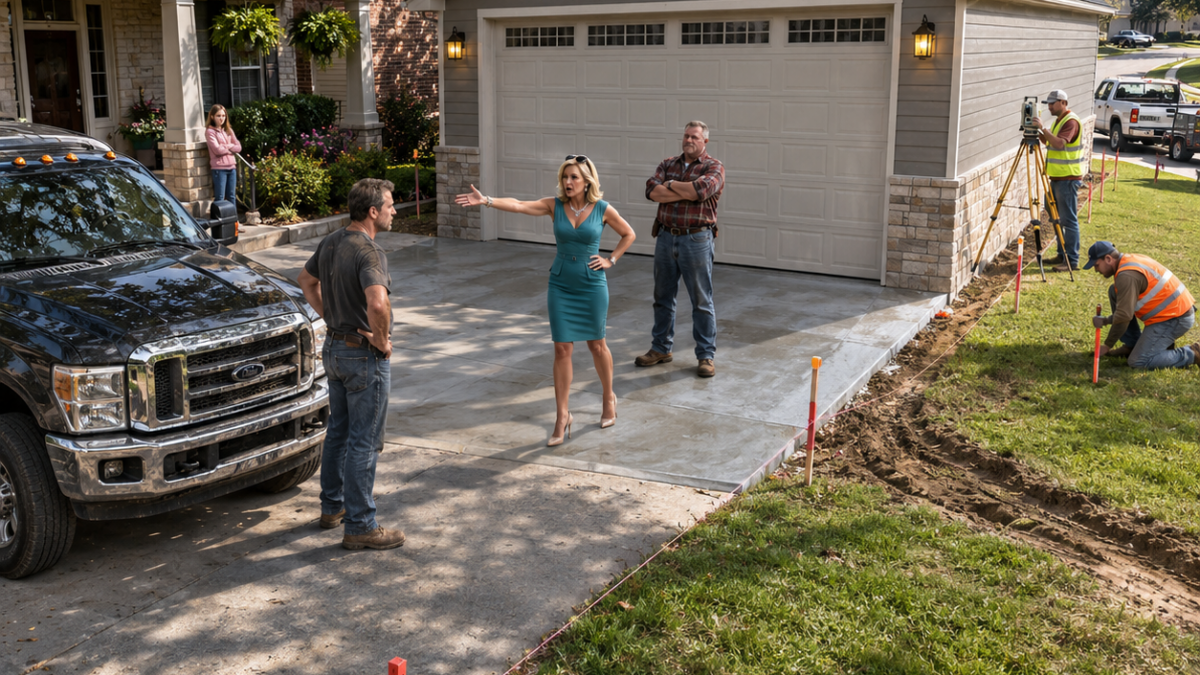
He arrived Tuesday morning with a two-man crew.
Total station.
GPS.
Tripod.
Orange vest that looked older than Lily.
Tammy noticed within minutes.
Her kitchen window opened.
“What are you doing?”
Wade never looked up.
“Surveying.”
“On my lawn?”
He adjusted his instrument.
“Ma’am, if I were on your lawn, that would be useful information.”
She didn’t appreciate that.
For three hours, Wade located monuments.
Checked recorded dimensions.
Shot points.
Compared corners.
Then he called me over.
I had spent years reading survey data.
I could see the answer before he said it.
But I waited.
“Garrett.”
“Yeah.”
“You were right.”
“How far?”
He pointed.
“The concrete apron crosses your boundary five feet two inches at the widest relevant point.”
I looked at the garage wall.
“And the structure?”
“Too close. Setback issue is for the county, but geometrically they’re nowhere near where I’d want to see a compliant side yard.”
He showed me the line.
The roll-up door had been designed in such a way that normal vehicle use depended on entering my property.
Not occasionally.
Every time.
Doug had built a garage whose functional driveway was mine.
Wade placed official markers.
Printed his report.
Stamped it.
Signed it.
Then said:
“This is clean.”
“How clean?”
“If I were you, I’d stop talking and start sending certified mail.”
That was excellent advice.
I gave Tammy and Doug their second opportunity to fix it.
The first had been the gravel.
Now I gave them the survey.
I walked over with a copy.
Doug opened the door.
Tammy stood behind him.
“Licensed survey,” I said.
He took it.
Barely looked.
“My guy says it’s wrong.”
“Then hire another licensed surveyor.”
“We don’t need one.”
“You’ve seen the line.”
Tammy stepped forward.
“We have HOA approval.”
“HOA approval doesn’t move a property line.”
“It approves the improvement.”
“It didn’t approve access across my driveway.”
She folded her arms.
“What exactly do you want?”
“Remove the material from my property. Stop using my driveway. Correct the garage legally.”
Doug laughed.
“You want me to tear down my garage?”
“I want you to fix what you built.”
“Not happening.”
“That’s your decision.”
I left.
That afternoon, the survey markers disappeared.
I noticed before dinner.
Three gone.
Not knocked over.
Removed.
I checked the cameras I’d installed after the floodlights became a problem.
2:14 p.m.
Doug.
Claw hammer.
He pulled each marker.
Tammy stood on the porch watching.
He threw them near the trash cans.
I stared at the screen.
Then saved the footage.
Three locations.
Cloud.
External drive.
Attorney.
I had already retained one.
Nolan Briggs.
Thirty-eight.
Property and HOA litigation.
Lean, precise, not interested in speeches.
He had reviewed Wade’s survey.
Permit records.
Tammy’s supposed approval.
Violation notices.
When I first met him, he spent twenty minutes reading.
Then said:
“Garrett, you keep doing exactly what you’re doing.”
“Which is?”
“Nothing stupid.”
“I can handle that.”
“Most clients can’t.”
I sent him the survey-marker video.
His response arrived three minutes later.
**Do not confront them.**
Then:
**Save original file.**
Then:
**I’m calling you.**
We discussed reporting the marker removal and restoring them through Wade.
I asked:
“Can I just put a fence there?”
“Eventually.”
“Eventually is not my favorite word.”
“Neither is injunction.”
Fair.
Nolan filed the necessary complaints concerning the garage.
Unpermitted structure.
Encroachment.
Possible setback violation.
He also sent formal notice to the HOA demanding preservation of meeting records and enforcement documents.
Tammy responded with Facebook.
Her post said a “new resident” was harassing longtime homeowners.
Filing false complaints.
Trying to reduce property values.
She invited people with negative experiences involving me to contact the board.
Then she posted a photograph of herself beside the community sign.
White blazer.
Pearls.
Concerned expression.
Connie screenshotted the post.
Texted me one word:
**Evidence.**
The next week brought four more violations.
Reflective window tint.
I had none.
Driveway oil stain.
It was a shadow.
Unauthorized fence modification.
No modification.
Excessive outdoor lighting.
That one was almost impressive.
My security cameras did not produce meaningful illumination.
Doug’s halogens did.
Tammy fined me for light while her husband’s floodlights shone into my daughter’s bedroom.
Nolan read the notices.
Then looked at me.
“She’s helping.”
“Doesn’t feel like it.”
“Retaliation is easier to establish when somebody documents it on official stationery.”
Then came the lien threat.
$2,200 in accumulated fines.
Thirty days.
I placed it in the folder.
Didn’t pay.
Didn’t call Tammy.
Didn’t post online.
Didn’t threaten anyone.
Lily watched me put it away.
“Another one?”
“Yeah.”
“Are we still staying?”
I looked at her.
“We’re still staying.”
That night, at 11:47, an engine woke me.
Camera alert.
Doug’s truck backed toward the property line.
Portable mixer in the bed.
Under the halogen lights, he poured more concrete.
Not repairing.
Extending.
Two more feet onto the disputed area.
He smoothed it.
Stepped back.
Looked proud.
I watched from inside.
Every instinct wanted me outside.
I wanted to stand on my own driveway and ask what kind of grown man pours concrete on his neighbor’s land at midnight after receiving a stamped survey.
Instead, I saved the footage.
Because at that point, Doug had been shown the boundary.
What came next was no longer mistake.
The next morning Tammy threw a garage-warming party.
Pink balloons.
Champagne.
Cucumber sandwiches.
Doug wore a clean shirt.
Tammy wore red.
Neighbors wandered over.
I stayed on my porch.
Connie crossed the street.
“You’re not going?”
“No.”
“Free champagne.”
“I have standards.”
She looked at the garage.
“You know she’s doing this because she’s scared.”
“I know.”
“You seem calm.”
“I am not.”
She studied me.
“Good.”
“What?”
“Calm people who are actually calm are boring.”
I laughed.
Then looked toward Lily playing inside.
“I’m tired, Connie.”
“I know.”
“I moved here because she needed somewhere that didn’t feel like a funeral.”
Connie’s face softened.
“And now?”
“Now she’s asking whether we’re going to lose another house.”
Connie sat beside me.
For a while, neither of us spoke.
Then she said:
“You’re not fighting over concrete anymore.”
“No.”
That afternoon, Lily came outside.
Tammy’s party music drifted across the drive.
She watched the pink balloons.
“Is that for the garage?”
“Yeah.”
“Why are they celebrating?”
I looked at the concrete.
“Because they think they’re done.”
“Are they?”
“No.”
That was all I told her.
The county inspector arrived Thursday.
Hector Fuentes.
Forty-five.
Nineteen years doing building inspections.
He stepped out of a white county pickup.
Clipboard.
Tablet.
Measuring equipment.
Tammy appeared at her window almost immediately.
Hector started with records.
No permit on file.
Then measurements.
He checked Wade’s markers after they had been professionally restored.
The garage was too close to the boundary based on applicable requirements.
The apron crossed onto my parcel.
He inspected the interior.
Framing.
Electrical.
Foundation.
His face became less neutral with every minute.
When he came out, he asked:
“Who built this?”
Doug walked around the corner.
“I did.”
“You a licensed contractor?”
“I know what I’m doing.”
“That wasn’t the question.”
Tammy appeared.
Floral dress.
Phone recording.
“There must be some misunderstanding.”
Hector looked at her.
“No permit was issued.”
“Doug is very experienced.”
“That doesn’t replace inspection.”
He showed them several issues.
Framing deficiencies.
Electrical problems.
Improper clearances.
Then he stopped near the slab.
Checked something on his tablet.
Walked around.
Measured again.
His expression changed.
“What?” I asked.
He turned toward me.
“There’s a utility problem.”
Doug’s confidence flickered.
Hector pulled up the subdivision utility plan.
The garage foundation had been poured over a secondary water main serving much of the cul-de-sac.
I felt that in my stomach.
This wasn’t just my driveway anymore.
Hector explained the risk.
Access restriction.
Possible loading.
Movement in expansive Texas soil.
If repairs were needed, the garage sat directly over infrastructure crews would need to reach.
Tammy smiled.
“I’m sure we can work something out.”
Hector didn’t smile.
Doug came closer.
“Come on, man. Nobody got hurt.”
Then Doug reached toward his wallet.
“Look, I know paperwork can get complicated. What if we just—”
Hector stopped writing.
Looked at the wallet.
Then Doug.
“Put that away.”
Doug froze.
Hector’s voice stayed level.
“Right now.”
Doug put it back.
The confidence vanished from his face so quickly it almost looked like a physical collapse.
Hector documented the interaction.
Then returned to his truck.
He came back carrying a red notice.
Attached it to the garage.
No occupancy.
No vehicle storage.
No use until further review.
Tammy stared at the red tag.
For the first time since I’d met her, she said nothing.
That evening, she called an emergency HOA board session.
She wanted retroactive approval.
Nolan had anticipated that.
A week earlier, he had written individually to every board member.
Not threatening.
Explaining.
The property-line dispute.
No permit.
Questionable meeting minutes.
Potential personal exposure if members knowingly created or backdated records to protect a private project.
Three board members called him.
One said:
“I had no idea the garage wasn’t approved.”
Nolan asked:
“Did you attend an April fourteenth vote?”
“No.”
“Did you sign anything?”
“Preston gave me a packet months later.”
That mattered.
Another board member admitted she had let Tammy “handle paperwork” because nobody else wanted to.
The pattern was becoming clearer.
Tammy’s power wasn’t built entirely on fear.
Some of it was laziness.
People surrendered small responsibilities because they seemed annoying.
Then one person accumulated all of them.
By Tuesday, the county’s final order arrived.
Correct the violations.
Remove the unsafe, unpermitted structure where required.
Restore affected property and utility access.
The compliance deadline gave the Holcombs seventy-two hours for the demolition action described in the order.
Tammy called another emergency HOA meeting.
Subject line:
**DEFENDING OUR COMMUNITY AGAINST GOVERNMENT OVERREACH**
Sixty homeowners attended.
I sat beside Nolan.
Connie sat in front.
Vernon Hayes stood near the wall.
Tammy took the podium.
White fitted dress.
Pearls.
Diamond bracelet.
She began:
“This is bigger than one garage.”
That, ironically, was true.
“This is an attack on homeowners’ rights.”
Not true.
“If government officials can come into our neighborhood and tell one family what they may build on their own property, they can do it to any of us.”
A few people nodded.
She continued.
“This entire dispute was manufactured by a hostile neighbor who has spent weeks harassing my family.”
I stood.
Nolan touched my arm.
“Documents.”
“I know.”
Tammy saw me.
“Sit down.”
Connie called:
“Let him speak.”
“This is my presentation.”
A man behind me said:
“We’ve heard your presentation.”
Then another:
“Let him answer.”
Tammy gripped the podium.
Finally:
“Three minutes.”
I carried the Holcomb folder forward.
It had started with one screenshot.
Now it was thick enough to use as a doorstop.
I looked at the room.
“I’m not going to argue with Tammy.”
Then opened the first document.
“Licensed survey.”
I passed copies to the board.
“The garage access and concrete encroach onto my property. Five feet two inches at the documented section.”
Tammy interrupted.
“Disputed.”
I nodded.
“Then the Holcombs were invited to commission an independent licensed survey.”
Nolan added from his seat:
“They declined.”
I opened the second section.
“Permit search.”
No permit.
No foundation inspection.
No framing approval.
No electrical approval.
Tammy said:
“The HOA approved it.”
I placed the April 14 minutes beside the committee calendar.
“Connie Marsh is on the Architectural Review Committee.”
Connie stood.
“There was no meeting.”
The room changed.
Tammy looked toward her.
“You don’t remember every committee discussion.”
“I remember being in Corpus Christi visiting my sister.”
A few people laughed.
Connie continued.
“Vernon was in Gulf Shores. Ruth was recovering from knee surgery.”
Ruth raised her hand from the third row.
“I was high enough on hospital pain medication that I couldn’t approve lunch.”
More laughter.
Tammy’s face tightened.
I placed the supposed minutes down.
“This approval was created for a meeting multiple members say never occurred.”
Preston Ridley stared at the table.
Someone called:
“Did you sign it?”
He rubbed his face.
“Yes.”
“Were you at the meeting?”
Silence.
Then:
“No.”
A murmur spread.
Tammy turned.
“Preston.”
He didn’t look at her.
I moved on.
“Security footage.”
Doug removing the official survey markers.
The screen showed him walking out with a hammer.
Pulling one.
Then another.
Then another.
Someone near the wall said:
“What the hell?”
Tammy stood.
“They were placed incorrectly.”
“By a licensed surveyor,” I said.
Then the next clip.
11:47 p.m.
Doug.
Portable mixer.
Fresh concrete extending farther onto my property after the survey.
Doug’s face went red.
“I was repairing my apron.”
Nolan spoke:
“After written notice of the boundary.”
Doug turned toward him.
Nolan didn’t move.
Then came Hector’s inspection report.
No permits.
Structural concerns.
Electrical deficiencies.
Encroachment.
Utility conflict.
I placed the red-tag photograph on the table.
Finally, the county compliance order.
“The county gave the Holcombs seventy-two hours to comply with the removal order.”
Tammy’s voice shook.
“They’re destroying our home.”
“No.”
I looked at her.
“They’re removing an illegal garage.”
“You started this.”
“Yes.”
The answer surprised her.
“I filed the complaint.”
I paused.
“After I asked you to fix it.”
Silence.
“I gave you the survey.”
She said nothing.
“I asked you to remove the gravel.”
Nothing.
“I asked you not to use my driveway.”
Still nothing.
“I gave you more than one chance.”
Her chin lifted.
“You wanted us humiliated.”
“No.”
I glanced toward Lily, who wasn’t there.
I had left her with Helen because she didn’t need to watch adults fight over what should have been obvious.
“I wanted my daughter to sleep without floodlights shining into her bedroom.”
The room became very quiet.
I continued.
“I wanted to park my truck on my driveway without police being called.”
I looked at Doug.
“I wanted somebody who had been shown a property line to respect it.”
Then Tammy made the mistake that ended her position inside the HOA.
She said:
“You barely used that side.”
Not:
The survey is wrong.
Not:
We misunderstood.
You barely used that side.
Connie slowly shook her head.
“Tammy.”
Tammy looked around.
“What?”
Connie answered:
“That’s not how ownership works.”
A motion came from the floor to remove Tammy as vice president.
Another homeowner seconded.
Tammy tried to challenge procedure.
The board reviewed the bylaws.
Enough support existed for emergency action tied to governance misconduct and the false approval record.
The vote moved quickly.
Tammy lost.
Preston resigned before anyone could vote on him.
He said he wanted more time for gardening.
Nobody stopped him.
Friday arrived hot and bright.
At 11:45, a flatbed rolled into Bluebell Ridge carrying an excavator.
Neighbors emerged from houses.
Some pretended they happened to be outside.
Others made no effort to hide their interest.
Old Larry Boone put a camping chair on the sidewalk.
Cooler beside him.
Connie walked over to my porch.
“You nervous?”
“No.”
“Liar.”
“A little.”
“Good.”
The demolition crew met with the county representative.
Confirmed utility markings.
Work area.
Safety perimeter.
Then the machine started.
I had imagined that moment.
I thought I would feel victorious.
Instead, I thought about how wasteful it was.
Lumber.
Concrete.
Electrical cable.
Shingles.
Money.
Time.
All because two adults decided asking permission was beneath them.
The excavator’s claw caught the roof.
Pulled.
Shingles folded.
Framing cracked.
A section of wall collapsed inward.
Doug stood on his lawn.
Arms loose.
Nothing left to say.
Tammy sat inside their Lexus.
Windows up.
Sunglasses on.
The halogen lights came down with one wall.
One bulb shattered.
I looked toward Lily’s bedroom.
No glare.
The crew broke the concrete apron last.
Not my driveway.
Their unauthorized apron.
Chunk after chunk lifted.
The portion extending across my land disappeared.
Then the crew restored the surface.
When the excavator finally stopped, the difference was almost shocking.
Open space.
My driveway ended where it had always ended.
Their property began where it had always begun.
The entire war had been about lines that never moved.
Only people did.
Connie handed me a beer.
“Three days.”
I looked at her.
“Three days after the order.”
“Still counts.”
She raised her bottle.
I tapped mine against it.
The consequences did not end with demolition.
The Holcombs paid roughly $47,000 for demolition and restoration.
County penalties added another significant amount; the final source records put those construction-related fines at about $12,000.
My civil claim for trespass and property damage settled months later for approximately $22,000.
All told, the illegal garage cost them around $81,000.
More than Doug would have spent building a legal garage somewhere it actually fit.
That was the financial consequence.
The legal consequences were more complicated.
Doug faced charges arising from his removal of the survey markers.
He ultimately resolved them without jail, receiving probation, community-service obligations, and fines.
The interaction with Hector went into the official record but did not become the separate dramatic bribery prosecution neighborhood gossip predicted.
That mattered.
People always want scandal to become bigger after the fact.
The facts were enough.
Tammy’s problems were mostly governance and civil.
The falsified approval.
Retaliatory violations.
Questionable lien threats.
Selective enforcement.
State-level complaints regarding HOA practices.
The investigation moved slower than neighbors expected.
Government investigations always do.
By then, however, Tammy had already lost the thing she valued most.
Authority.
Nobody waited for her clipboard.
Nobody treated her interpretation as final.
Nobody believed “the board approved it” without asking for the vote.
That change spread quickly.
Connie organized a meeting.
Not an angry meeting.
A repair meeting.
Five homeowners brought folders.
Vernon Hayes had been fined for the wrong shade of beige on a garage door he had never repainted.
Linda Tully received a warning because a stroller remained on her porch for thirty minutes.
Raul Esperanza had three notices for planting one rose bush beside his mailbox.
At first, I thought those stories were almost funny.
Then Connie said:
“They aren’t funny when the person signing them can threaten your house.”
She was right.
We reviewed each rule.
Some fines were legitimate.
Not every complaint Tammy had ever made was false.
That’s important.
There were residents who left trash cans out for days.
People who ignored maintenance.
A guy who parked across a fire hydrant.
Community rules were not the enemy.
Arbitrary authority was.
We formed the Bluebell Ridge Transparency Committee.
I hated the name.
Connie chose it.
“Sounds like a government task force.”
“Good.”
“I don’t mean good.”
She ignored me.
Meetings were posted in advance.
Minutes published.
Votes documented.
Enforcement notices required an actual citation to the governing documents.
Appeal periods became clear.
No one person conducted private “inspection walks” and created violations by instinct.
Major architectural requests went through the full committee.
Conflicts were disclosed.
It was boring.
Beautifully boring.
Then we created something else.
The Property Rights Awareness Fund.
That idea came from Lily.
Not directly.
One night after the garage disappeared, she stood at the end of the driveway looking at the clear space.
“Can they build another one?”
“No.”
“How do you know?”
“Because we know where the line is.”
She pointed at Wade’s restored marker.
“That little metal thing?”
“Partly.”
She stared.
“So you paid somebody to tell people where your house ends?”
I smiled.
“Pretty much.”
“What if somebody can’t pay?”
That question followed me inside.
Surveyors cost money.
Lawyers cost money.
Title research costs money.
For me, those expenses were painful but manageable.
For some families, a few thousand dollars is the difference between challenging abuse and giving up.
So several neighbors donated.
I contributed part of the settlement when it arrived.
Nolan agreed to provide limited initial consultations.
Wade offered discounted boundary work in qualifying cases.
We started small.
The first month, twelve thousand dollars.
The first family we helped lived outside Bluebell Ridge.
Their dispute involved a fence.
No villain.
No criminal conduct.
Just two old surveys that did not agree and neighbors who had stopped speaking.
We paid for a proper survey.
The result showed both sides were partly wrong.
They moved twelve feet of fence.
Shook hands.
No demolition.
No Facebook war.
I told Nolan:
“I like this better.”
“Of course.”
“No satisfying bad guy.”
“That is why it’s better.”
I understood what he meant.
A clean resolution is more useful than a dramatic one.
Tammy and Doug put their house on the market that August.
The listing photographs were fascinating.
Every angle carefully avoided the bare side of the house where the garage had been.
**MOTIVATED SELLERS.**
The price dropped.
Eventually they sold at a loss compared with what Tammy had expected.
Fourteen percent below the number she had bragged about months earlier.
Neighbors treated that as another victory.
I didn’t.
Market loss isn’t justice by itself.
Sometimes people sell at bad times.
Sometimes houses simply don’t bring what owners imagine.
What mattered was why they were leaving.
Tammy had spent years making other residents wonder whether resisting her was worth the trouble.
Now she no longer trusted the neighborhood to obey her.
They moved to Prosper.
Rental first.
After that, I stopped paying attention.
Lily was ten.
She had school.
Soccer.
A loose tooth she refused to let me pull.
There are more important things than tracking former neighbors.
Three months after demolition, I sat on the porch drinking a beer.
Lily rode her bicycle in wide circles across the driveway.
The same driveway.
No garage door.
No gravel.
No fresh concrete.
No floodlights.
Texas sky turning pink.
Crickets loud.
Mesquite smoke drifting from Connie’s backyard.
Somebody had country music playing from a pickup down the street.
Lily stopped.
Helmet crooked.
Feet on the ground.
“Daddy?”
“Yeah?”
“This is a good house.”
That sentence went through me.
The day we moved in, I had stood in that same driveway holding a key and hoping the house could become a reset.
For a while, Tammy made me wonder if I’d chosen wrong.
But a house is not made safe by neighbors behaving perfectly.
It’s made safe by knowing that when something goes wrong, you don’t have to disappear.
I smiled at Lily.
“Yeah, baby.”
She looked toward the place where Doug’s garage had been.
“Better without that ugly thing.”
I laughed.
“Your mother would tell you that’s rude.”
“She’d think it.”
That stopped me.
“You remember her?”
“Some.”
Lily looked down at her handlebars.
“I remember her lotion.”
I swallowed.
“Me too.”
“And rain.”
I knew which rain.
The funeral.
I didn’t ask.
She pushed off again.
Bicycle tires hummed against the driveway.
My wife would have handled Tammy differently in the beginning.
She would have brought pie.
Sat on the porch.
Asked questions.
Tried to save the relationship before fighting over the boundary.
She was better at people.
I was better at drawings.
But I think she would have understood the moment I stopped trying to make Tammy like me.
Property disputes tempt you to turn everything into ego.
Who wins?
Who backs down?
Who looks weak?
The boundary line doesn’t care.
It existed before Tammy.
Before me.
Before Lily.
The question was never whether I could humiliate the Holcombs.
The question was whether I would allow somebody else’s confidence to become more important than recorded ownership.
Years later, Wade came back to Bluebell Ridge for another survey.
Different homeowner.
Nothing dramatic.
I saw his truck and walked over.
“You still working?”
“Unfortunately.”
“You’re seventy.”
“So?”
He finished setting up his instrument.
Then pointed toward my boundary marker.
“Still there.”
“Doug moved away.”
“Markers don’t care.”
That became something of a joke between us.
But there was truth underneath it.
People change.
Arguments fade.
Documents survive.
One afternoon, a new family moved into the Holcomb house.
Married couple.
Two boys.
The younger one wandered near my driveway while his father unloaded boxes.
The father immediately called him back.
“Stay on our side, bud.”
I smiled.
He looked embarrassed.
“Sorry.”
“You’re fine.”
He glanced toward the side yard.
“Our realtor told us there used to be some kind of garage there.”
“Yep.”
“Property dispute?”
“Something like that.”
He hesitated.
“I had a survey done before closing.”
“Good.”
“Our line’s over there.”
He pointed exactly where Wade had marked it.
“Also good.”
The man laughed.
“I feel like there’s a story.”
“There is.”
“Do I want to know?”
I looked at his moving truck.
“No. Move in first.”
They turned out to be good neighbors.
Not perfect.
Good.
The boys left bicycles near the sidewalk.
Their dog barked whenever a delivery truck arrived.
Once the father accidentally placed a trash bin too close to my driveway.
Nobody filed a violation.
I moved it six inches so I could back out.
That was all.
Sometimes I wondered whether Tammy would have called that weakness.
I called it Tuesday.
The HOA changed too.
Connie eventually became president.
She did not want the job.
We elected her anyway.
“You’re all terrible.”
She said that during her first meeting.
Vernon asked:
“Can we put that in the minutes?”
“Yes.”
They did.
Her first year was uneventful.
The pool pump broke.
We replaced it.
Entrance landscaping needed work.
Residents voted on it.
One homeowner painted shutters the wrong color without approval.
Connie sent him a notice citing the actual rule.
He looked at it.
Said:
“Fair enough.”
Repainted.
Done.
That incident pleased me more than the Holcomb demolition.
Because governance worked.
No retaliation.
No invented fines.
No personality cult.
Just a rule, written in advance, applied normally.
Our transparency committee eventually dissolved.
Not because it failed.
Because it became unnecessary.
The reforms became standard practice.
Meeting videos continued.
Financial statements were published.
Architectural votes documented.
Nobody needed a special group watching the watchers anymore.
Connie called that success.
I agreed.
The legal fund continued.
That mattered more.
Nolan once asked me to speak at a homeowner workshop in McKinney.
I declined.
He asked again.
I declined more firmly.
Then Lily heard.
“You should go.”
“No.”
“Why?”
“I don’t enjoy speeches.”
“You talk at work.”
“That’s engineering.”
“So talk about engineering.”
That is how I ended up standing in a library meeting room in front of forty people talking about driveway boundaries.
I did not tell them:
Fight your HOA.
I told them:
Read what you signed.
Pull the plat.
Get the survey.
Ask for records.
Separate what you know from what you suspect.
Give the other side a reasonable opportunity to correct a mistake.
Document the refusal.
Then use the proper process.
One man raised his hand.
“What if the neighbor’s just an asshole?”
The room laughed.
I said:
“Surveys work on assholes too.”
Nolan put his face in his hands.
Afterward, an elderly couple approached.
Their neighbor had extended landscaping over what they believed was a drainage easement.
They were furious.
I told them:
“First question isn’t who is wrong.”
The husband frowned.
“Then what is it?”
“What do the recorded documents say?”
They hired a surveyor.
Turned out the landscaping was mostly legal.
A drainage swale needed correction.
They resolved it without court.
The husband emailed me later.
**Not as satisfying as bulldozer. Probably better.**
Exactly.
Doug’s demolition became neighborhood legend.
People embellished it.
The garage became three stories.
Then eight hundred square feet.
Someone claimed Doug had built a guest apartment above it.
He had not.
One version said the excavator arrived because I personally knew the county judge.
False.
Another said I owned half the cul-de-sac.
Also false.
Stories get cleaner as facts disappear.
I corrected people when it mattered.
“Six hundred square feet.”
“About five feet of encroachment.”
“County process.”
“Lawyer.”
“Survey.”
“Evidence.”
Less cinematic.
More useful.
Tammy became “HOA Barbie” in neighborhood memory.
I never liked that nickname much.
Not because she deserved sympathy.
Because reducing her to a cartoon made it too easy to miss why she had been effective.
Tammy was organized.
Persistent.
Socially confident.
She remembered names.
She attended meetings other people skipped.
She volunteered for jobs nobody wanted.
Then gradually she stopped distinguishing between responsibility and ownership.
That can happen in any group.
People hand someone authority because they’re tired.
Then one day they realize they don’t know what that person has been doing with it.
Tammy didn’t wake up one morning and become a villain.
She learned that nobody checked her.
Then acted accordingly.
That lesson stayed with me.
Years later, when a school organization asked me to become treasurer for one of Lily’s activities, I agreed only if a second person reviewed the account.
The other parents laughed.
I didn’t.
Power doesn’t need to be large to benefit from sunlight.
Lily grew.
Twelve.
Fourteen.
Sixteen.
At sixteen, she learned to drive in the driveway Tammy once claimed we barely used.
The first lesson was terrible.
She hit the brake like she was trying to eject us through the windshield.
“Gentle.”
“I was gentle.”
“That was a felony.”
“You said don’t be dramatic.”
“I regret raising you.”
She laughed.
Her mother’s laugh.
That still happened sometimes.
Little echoes.
The tilt of her head.
A phrase.
The way she tucked hair behind one ear when reading.
For years after my wife died, I thought preserving memory meant not letting things change.
Then I watched Lily become someone new every six months.
Memory didn’t disappear because life moved.
It traveled.
The house changed.
Furniture changed.
I repainted the kitchen.
Fixed the faucet I had once avoided because its drip reminded me of my wife.
The pecan tree grew.
The neighborhood changed.
Still, some things returned me instantly.
Rain on pavement.
Her lotion.
Lily asking if we had done something wrong.
Lily asking if we had to move.
Those were the moments that explained why the driveway fight mattered beyond five feet of concrete.
We had already been displaced by grief once.
I wasn’t going to let intimidation displace my daughter again.
That didn’t mean the house was sacred.
It meant our choice mattered.
If we moved one day, it would be because we chose another life.
Not because Tammy made staying unbearable.
By the time Lily graduated high school, the Property Rights Awareness Fund had helped dozens of homeowners.
Not all won.
That was another important lesson.
Some brought us violation letters expecting outrage.
Nolan read the governing documents.
Then told them:
“The HOA is right.”
One man became furious.
“You’re supposed to protect homeowners.”
Nolan answered:
“We protect rights. That includes everybody else’s right to expect the rules you agreed to.”
He left angry.
I was proud of Nolan.
A fund becomes just another weapon if it assumes one side is always right.
We had started because Tammy abused authority.
We did not want to build a system that abused authority in the opposite direction.
Wade retired.
Officially.
Then kept doing occasional surveys because, according to him, retirement was “too much sitting.”
Hector moved into supervisory work.
I ran into him at a hardware store.
He recognized me immediately.
“Garage guy.”
“Why does everyone call me something terrible?”
He laughed.
“How’s the driveway?”
“Still mine.”
“That’s a good start.”
I thanked him.
“For what?”
“Doing your job.”
He shrugged.
“That’s the job.”
It was such a simple answer.
But so much of the story had happened because other people stopped doing exactly that.
Preston stopped checking what he signed.
Board members stopped attending carefully.
Tammy stopped treating authority as limited.
Doug stopped treating a property line as real.
Everybody wanted convenience.
Hector did his job.
Wade did his.
Nolan did his.
Connie did hers.
And eventually the system worked.
Not perfectly.
Enough.
Years after the garage was demolished, I received a letter.
No return name I recognized.
Inside was a note from Preston.
He apologized.
Not only to me.
He said he had spent years telling himself Tammy was “better at this stuff.”
So when she put papers in front of him, he signed.
When residents complained, he redirected them.
When fines looked strange, he assumed she had a reason.
He wrote:
**I thought avoiding conflict made me a peaceful person. I understand now that sometimes it only makes conflict easier for someone else to create.**
I read that sentence twice.
Then put the letter in the old Holcomb folder.
There wasn’t much else left inside.
Most originals went to legal archives or were digitized.
I kept Wade’s first survey.
The original $200 parking violation.
Lily’s drawing from that year.
Crayon house.
Pecan tree.
Blue sky.
A giant pickup in the driveway.
And beside our house she had drawn the Holcomb garage.
Then crossed it out with a red X.
Underneath:
**OUR DRIVEWAY**
Children understand property law surprisingly well.
The Holcomb folder stayed in my desk until Lily left for college.
Then I opened it.
The file smelled faintly like old paper.
I flipped through.
Tammy’s Facebook posts.
Doug pulling markers.
The county red tag.
Demolition photographs.
Settlement.
HOA minutes.
A decade earlier, every page had felt urgent.
Now it felt historical.
I considered throwing everything away.
Couldn’t.
Engineer.
We keep records.
Instead, I removed Lily’s drawing.
Put it in a frame.
The rest went into a labeled archive box.
Not on my desk.
Garage shelf.
Far enough away that it wasn’t part of daily life.
That mattered.
There is a point where evidence stops protecting you and starts preserving the fight.
You have to know when to put it away.
One summer evening, Connie came over.
She was older.
So was I.
We sat on the porch.
Different chairs now.
She looked toward the Holcomb house.
The boys who lived there were playing basketball.
Ball bounced into my driveway.
One ran after it.
Stopped before crossing.
“Mr. Sutherland?”
“Yeah?”
“Can I get it?”
“Sure.”
He picked it up.
Ran back.
Connie smiled.
“Property rights.”
“Very advanced negotiation.”
“You going to charge him?”
“Thinking about it.”
She laughed.
Then said:
“Do you ever miss Tammy?”
“No.”
“Good.”
We sat in silence.
Eventually Connie asked:
“Did you ever hear what happened to them?”
“Not much.”
“Doug does residential repair work.”
“Hope he gets permits.”
She laughed.
“Tammy works at some office in Plano.”
“Good.”
“You don’t want anything worse?”
I thought.
Ten years earlier, maybe.
“Not anymore.”
Connie nodded.
“That’s how you know it’s over.”
She was right.
Revenge feels important when you’re still inside the conflict.
Later, peace becomes more interesting.
I did get satisfaction from the demolition.
Anyone who says otherwise is lying or better than me.
Watching that concrete break after Doug had poured it farther onto my land at midnight felt good.
Watching Tammy lose the office she used to punish people felt good.
Watching the fake approval collapse under basic records felt very good.
But none of those feelings lasted.
The thing that lasted was Lily riding her bike.
Then learning to drive.
Then pulling into that same driveway from college with laundry bags covering the back seat.
The driveway became ordinary again.
That’s what I wanted.
Ordinary.
One Thanksgiving, Lily came home with a boyfriend.
I disliked him immediately because he called me “sir” too often.
Probably unfair.
He parked partly across the side of the driveway.
Lily looked out the window.
Then at me.
“Don’t.”
“I didn’t say anything.”
“You’re thinking survey.”
“I am not.”
“You have the face.”
“What face?”
“The five-feet-two-inches face.”
Her boyfriend looked confused.
“What’s five feet two inches?”
Lily said:
“Sit down. This is going to take a while.”
I left the room.
Some stories become family stories whether you want them to or not.
Years later, Lily married him.
Turns out he was a good kid.
At the wedding, she included one photograph of her mother near the guest book.
Not a memorial table.
Just one photograph.
Her mother smiling.
Alive.
That’s how Lily wanted it.
During the father-daughter dance, I thought about the little girl at the funeral asking whether Mommy would return after the rain.
Then the ten-year-old asking if an HOA could make us move.
Then the teenager learning to drive.
Then the woman in my arms.
Homes matter because of what happens inside them.
Property lines matter because people need somewhere safe enough for those moments to happen without another person deciding they have a better use for the space.
That sounds dramatic for a driveway.
Maybe it is.
But five feet can hold a lot when somebody decides they are entitled to it.
After Lily married, I considered selling.
The house had become large for one person.
Bluebell Ridge property values were strong.
Ironically, the transparency reforms had made the HOA more attractive to buyers.
I told Connie.
She stared.
“You fought a war to keep that driveway and now you’re leaving?”
“Maybe.”
“Ridiculous.”
“I didn’t fight because I had to die here.”
She thought.
Then nodded.
“Fair.”
That was another lesson.
Defending ownership doesn’t mean becoming owned by the property.
I stayed three more years.
Not from stubbornness.
I still liked the pecan tree.
Eventually, I sold to a young widower with a daughter.
That coincidence almost made me reject the offer.
Too close.
Then I met them.
His daughter ran across the backyard during the showing and tripped over the same sprinkler head Lily had.
I swear it was the same one.
She laughed.
Her father apologized.
“No problem.”
He looked embarrassed.
“She’s been through a lot.”
“I understand.”
We sat at the kitchen table afterward.
He asked about the neighborhood.
“Good people?”
“Yes.”
“HOA okay?”
I smiled.
“Now?”
“Yes.”
He frowned.
“Now?”
“Long story.”
I told him the important part.
Not every dramatic detail.
I showed him the survey.
Boundary markers.
Documents.
The driveway.
“The line is here.”
He nodded.
“Any easements?”
“Nothing unusual. Title company has everything.”
He ran one hand across the table.
“Why are you telling me so much?”
“Because this house was a reset for my daughter and me.”
I looked toward the backyard.
“I want the next person to know exactly what he’s buying.”
He understood.
At closing, I gave him a binder.
Not the Holcomb archive.
Property binder.
Survey.
Repairs.
Roof.
HVAC.
HOA documents.
Utility map.
Permits.
He laughed.
“You’re an engineer.”
“Unfortunately.”
I kept Wade’s original survey copy.
Sentimental.
Ridiculous.
True.
The last morning I owned the house, I made coffee.
Walked outside.
Stood in the driveway.
No moving truck yet.
Sun barely up.
The Holcomb house was quiet.
My old boundary marker caught a little light near the grass.
I walked over.
Touched the top with one finger.
Then looked at the concrete.
There was no visible scar from the garage apron anymore.
Years of weather and repairs had erased it.
I liked that.
Some people want scars preserved because scars prove they survived.
I didn’t need the driveway to remember.
I could remember without making the damage permanent.
The new owner arrived around nine.
His daughter carried a box twice the size she should have been carrying.
I helped.
When everything was done, I stood near my truck holding the house key.
Same feeling as years earlier.
Metal teeth pressing into my palm.
Different direction.
Back then, I had been arriving after loss.
Now I was leaving after healing.
I handed him the key.
His daughter ran past us.
“Dad! Can I ride my bike in the driveway?”
He laughed.
“After we unload.”
I looked at her.
“It’s a good driveway.”
She had no idea why that made her father and me laugh.
I got into my truck.
Before pulling away, I looked once at the house.
I thought of my wife.
Not cancer.
Not the funeral.
Not rain.
Her laughing because I’d spent an entire Saturday fixing something that could have been replaced in ten minutes.
She used to say:
“You’d rebuild the whole world if someone gave you enough drawings.”
She was wrong.
Some things you rebuild.
Some things you defend.
Some things you finally let go.
Tammy and Doug thought that garage dispute was about unused concrete.
They looked at my driveway and saw empty space.
I looked at it and eventually understood what they couldn’t.
Space doesn’t become yours because somebody else isn’t using it the way you would.
A boundary isn’t an insult.
It isn’t selfishness.
It isn’t hostility.
It’s simply the point where your choices stop and somebody else’s begin.
Doug crossed that line with concrete.
Tammy crossed it with authority.
I took it back with a survey, records, patience, and a refusal to let their confidence become my reality.
But the real payoff wasn’t the excavator.
It wasn’t the $81,000 they ultimately spent.
It wasn’t Tammy losing her HOA position.
It wasn’t even watching that illegal garage come apart.
It was years later, when the concrete was clean, the floodlights were gone, and my daughter could stand in that driveway without wondering whether somebody else had the power to take another home away from us.
That was the part worth protecting.
And in the end, five feet was all it took to teach me exactly where home began.
**— END OF STORY —**