PART 2: HOA Karen Used My Farm as Her Private Shortcut — Then One Morning Her Escalade Didn’t Make It Through
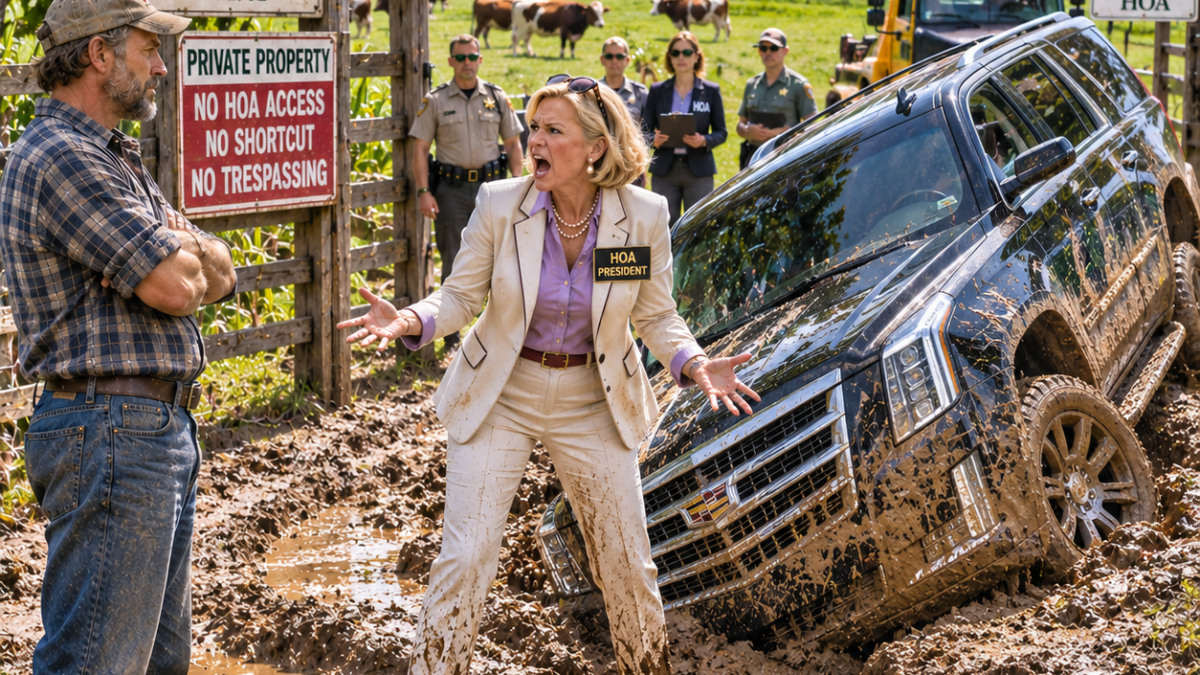
The first time Karen Whitfield tore across my Nebraska cornfield in her white Escalade, I told myself she was lost; the fifth time, after she clipped my cattle fence, flattened young corn, and honked like my private road belonged to her HOA, I stopped calling it a mistake and started writing down the exact minute she crossed my land. When my pregnant cow Daisy panicked so badly after one of Karen’s morning runs that I found her sweating beside a bent fence with hoof marks churned into the dirt, I realized this was no longer about an arrogant neighbor taking a shortcut—it was about whether I was willing to let somebody keep endangering the animals, crops, and peace I had spent more than forty years protecting. What Karen didn’t know was that while she was laughing at my warning signs and knocking them down from her driver’s window, I had already begun building the kind of record that turns a loud person’s confidence into a very quiet problem.
My name is Nate Lyman, and I’m past sixty now. I own eighty acres outside a gated development called Creekview Bluffs, but my place was here long before their stone entrance, decorative fountain, and HOA meetings.
My farm is corn, cattle, an old red barn, and a dirt access road that runs from the county highway to my equipment sheds. That road is private. My deed says so. My survey says so. My lawyer says so.
Karen said otherwise.
The first morning I saw her, it was 7:12. I was standing on my porch with coffee when a white Escalade came flying over the rise, not on the county road but diagonally through the edge of my corn.
Mud sprayed behind it. Young plants folded under the tires.
Then the driver lifted one hand and waved.
A little pageant wave.
Like I was watching a parade.
The next morning she came again.
This time I walked out and flagged her down.
She lowered the window halfway. Gold sunglasses. Blonde hair. Expression already irritated.
“Ma’am, this is private property.”
She smiled.
“There’s a community easement.”
“No, there isn’t.”
“It’s been here since the seventies.”
“I’ve owned this farm longer than Creekview Bluffs has existed.”
She laughed.
“Maybe you bought the wrong land.”
Then she drove around me.
That afternoon my neighbor Hank Doyle looked at the tracks cutting through my field and said, “That woman thinks the whole county is one big cul-de-sac.”
I laughed then.
I stopped laughing when she kept coming.
Every morning around 7:15.
Sometimes twice a day.
She started honking near the cattle fence. One morning I caught her on camera leaning out the window with a metal rod and knocking down one of my NO THROUGH TRAFFIC signs.
That was when I called Priya Singh, the attorney who had handled my property matters for years.
She pulled the records.
“No easement,” she told me. “Not public, not HOA, not historical. Your title is clean.”
“So what do I do?”
“Document everything.”
I did.
Trail cameras.
Dates.
Times.
Damage.
Photographs of ruts.
Bent wire.
Flattened corn.
Copies of every sign.
Emails to the sheriff’s office.
I bought a bright red notebook and wrote INCIDENT LOG across the front.
Hank called it obsessive.
Priya called it useful.
Karen called it harassment.
Then Daisy got spooked.
I found her beside the fence after Karen’s Escalade had blasted through again, sides heaving, eyes wide, one section of wire bowed where she had hit it trying to get away from the noise.
Daisy was pregnant.
I knelt beside her with one hand against her neck and felt her trembling through my palm.
That was the moment my anger scared me.
Not Karen.
Me.
Because I knew exactly how easy it would be to do something stupid and let her make me the villain.
So I called Priya again.
“I’m done,” I told her.
“No,” she said. “You’re not done. You’re finally going to do this correctly.”
Then she gave me one instruction I wrote in the red notebook in capital letters:
NO TRAPS. NO AMBUSHES. NOTHING HIDDEN. NOTHING THAT CAN HURT SOMEBODY.
The next morning, sitting at my kitchen table beneath my father’s old photograph, I opened the county file Priya had sent me—and found the first document Karen had been counting on me never to read.
PART 2
The document was dated 1974.
That mattered because 1974 was the year Karen kept mentioning whenever she talked about the supposedly ancient “community easement.”
She had repeated the phrase so often that I had started to wonder whether there was some forgotten right-of-way my father had never mentioned.
There wasn’t.
What existed was a proposal.
A developer had once asked my father’s uncle for temporary construction access across a narrow portion of what eventually became my private farm road.
Temporary.
Proposed.
Never granted.
The county file contained the application.
Then a handwritten notation across the final page:
OWNER DECLINED. ACCESS NOT ESTABLISHED.
I leaned back from the table.
“That’s it?”
Priya was on speakerphone.
“That’s it.”
“She’s using a rejected proposal from fifty years ago?”
“Looks that way.”
“Can she honestly think that’s an easement?”
“She can honestly think anything she wants.”
“That doesn’t answer my question.”
“No.”
Priya paused.
“What matters is what she can prove.”
I flipped through the rest of the scanned documents.
There was no recorded easement.
No deed language.
No access agreement.
No maintenance history showing shared use.
Nothing.
What made it stranger was that Creekview Bluffs hadn’t even existed in 1974.
The development was built decades later.
“So where did she get this?”
“That’s what I’d like to know.”
I called Hank.
He came over within an hour carrying coffee in a thermos old enough to vote.
I showed him the file.
He read the notation.
Then read it again.
“Well.”
“Well what?”
“She’s either lying or somebody lied to her.”
“Which do you prefer?”
“Neither.”
He scratched his chin.
“Ask Tom.”
Tom Reynolds lived in Creekview Bluffs and had been feeding me information ever since Karen started using my farm as a shortcut.
He was one of those men who loved his neighborhood but hated HOA politics with the emotional intensity of somebody who had once sat through a three-hour debate about mailbox posts.
I called.
“Tom, you ever heard Karen talk about a 1974 easement?”
Silence.
Then:
“Yeah.”
My grip tightened around the phone.
“Where?”
“HOA meetings.”
“What does she show people?”
“Old development map.”
“From 1974?”
“I don’t know. It looks old.”
“Creekview didn’t exist then.”
“I know.”
“Can you get me a copy?”
“I probably shouldn’t.”
“Tom.”
“I said probably.”
He emailed it twenty minutes later.
I printed it.
The map was not a county survey.
Not even close.
It appeared to be a marketing exhibit created during early planning for Creekview Bluffs.
Across my private farm road, someone had drawn a dotted line.
FUTURE SECONDARY ACCESS.
That was all.
No easement number.
No deed reference.
No recorded instrument.
Just a developer’s hoped-for route.
I called Priya again.
She sighed.
“Developers draw things they want all the time.”
“So Karen saw this and decided it belonged to them?”
“Possibly.”
“What do we do?”
“I send another certified notice.”
“You’ve sent two.”
“I’ll send three.”
I rubbed my forehead.
“Priya.”
“Yes?”
“She knocked down the last one.”
“I know.”
“She’s still driving through every morning.”
“I know.”
“Daisy nearly hurt herself.”
“I know.”
“And your answer is another letter?”
“My answer is evidence plus escalation through lawful channels.”
“That sounds slower than another letter.”
“It is.”
I stood from the table.
“I’m tired.”
Her voice softened.
“I know.”
That changed my anger.
Priya rarely softened.
“Nate, listen to me.”
“I am.”
“You are not trying to beat Karen at being unreasonable.”
I looked toward the window.
“You are trying to reach the end of this without regretting who you became.”
That hit.
My father had said something similar years earlier after a neighbor dispute over irrigation water.
I had been thirty.
Hot-headed.
Convinced being right gave me permission to be cruel.
Dad listened to me rant for ten minutes, then said:
“The strongest man isn’t the one who hits back first. It’s the one who knows when not to.”
I hated that sentence at thirty.
At sixty-plus, I understood more of it.
Not all.
Enough.
“Okay,” I said.
“Good.”
“What do I do today?”
“Call Deputy Ruiz.”
Elena Ruiz worked the rural side of the sheriff’s office.
She had been skeptical the first time I complained.
Not dismissive.
Just practical.
One woman cutting across farmland sounded like neighbor friction until the cameras began producing a pattern.
Now I had weeks of footage.
I drove into town with the red notebook.
Ruiz met me in a small interview room.
“You brought homework.”
“I brought Karen.”
I dropped the notebook on the table.
She opened it.
May 4 — 7:12 a.m. White Escalade. Entered north field edge. Estimated 35–40 mph. Approx. 11 corn plants flattened.
May 5 — 7:14 a.m. Same vehicle. Direct verbal warning given.
May 7 — 7:16 a.m. Same vehicle. Honked beside cattle fence.
May 8 — 6:54 p.m. Return crossing.
May 10 — 7:13 a.m. Warning sign damaged.
May 12 — 7:15 a.m. Fence wire bent near cattle lot.
And on.
Ruiz stopped halfway.
“You really wrote down the weather?”
“Priya told me document everything.”
“Wind direction?”
“I got committed.”
Ruiz almost smiled.
Then she reached Daisy’s entry.
Her expression changed.
“Vet?”
“Dr. Mercer checked her.”
“Any injury?”
“No major physical injury. Stress. She advised monitoring because Daisy’s pregnant.”
“You have the invoice?”
I slid it across.
Ruiz leaned back.
“She’s been warned directly?”
“By me.”
“Written?”
“Three certified notices from counsel.”
“Signs?”
“Multiple.”
“Any confrontation since the first one?”
“No.”
“Good.”
I frowned.
“You sound surprised.”
“I’ve met you.”
“That feels unfair.”
“Old farmers and teenagers share one thing.”
“What?”
“Both believe being mad improves judgment.”
I sat back.
“Priya said something similar.”
“Smart lawyer.”
“What can you do?”
Ruiz looked through the reports.
“We can document the repeated trespass. We can contact her. If she continues after clear notice, that becomes increasingly difficult for her to characterize as misunderstanding.”
“Increasingly difficult?”
“You want me to say she’s going to jail tomorrow?”
“No.”
“Yes.”
She smiled.
“I thought so.”
Then she became serious.
“Nate, don’t put chains across a route someone is speeding on without making sure visibility and local requirements are handled.”
“I wasn’t planning to.”
“No cables.”
“I know.”
“No homemade obstacles.”
“I know.”
“No holes.”
“Ruiz.”
“No hidden junk in the road.”
“I understand.”
She studied me.
“What are you thinking?”
“Something visible.”
“That’s not an answer.”
“Something lawful.”
“That’s better.”
I left without a plan.
Then Karen came through again the next morning.
7:14.
She slowed near the newest sign.
For one second, I thought she might stop.
Instead she rolled down her window.
A metal rod appeared.
She struck the aluminum sign.
Once.
Twice.
It folded backward.
Then she honked.
Two short blasts.
My cattle scattered.
Daisy moved fast enough that my stomach clenched.
Karen accelerated away.
I watched the security footage three times.
Then called Priya.
“I am about to stop being patient.”
“Come to my office.”
“I don’t need an office.”
“Yes, you do.”
“I need a gate.”
“You need my office.”
An hour later I sat across from her.
Priya pushed a yellow legal pad toward me.
“Write down what you want to do.”
“I’m not twelve.”
“Humor me.”
I wrote:
STOP HER VEHICLE FROM USING THE ROAD.
She turned the pad toward herself.
“Good.”
Then beneath it she wrote:
WITHOUT INJURING HER.
WITHOUT DAMAGING ANYTHING UNNECESSARILY.
WITHOUT HIDING ANYTHING.
WITHOUT BREAKING THE LAW.
WITHOUT GIVING HER A BETTER CASE THAN YOU.
She rotated the pad back.
“That’s our problem.”
I stared at it.
“So solve it.”
She opened a folder.
“I already started.”
That was Priya.
She had spent the previous evening talking with local counsel familiar with agricultural access and private-road controls.
There were lawful methods to control unauthorized vehicles.
Gates.
Clearly marked barriers.
Approved access-control systems.
And, in certain carefully reviewed private-property settings, commercially installed tire-deflation devices used as vehicle deterrents.
That last phrase got my attention.
“No.”
Priya pointed at me.
“No enthusiasm.”
“I’m not enthusiastic.”
“You’re smiling.”
“I have gas.”
“You are the worst liar I represent.”
She continued.
“If we consider anything involving tire deflation, this does not become some hidden booby trap.”
“I know.”
“No burying nails.”
“I know.”
“No homemade spikes.”
“I know.”
“No surprise.”
I nodded.
“It would have to be an appropriate commercial system, installed and marked according to professional guidance, with conspicuous warnings, and I want law enforcement aware beforehand.”
“Would it stop her?”
“It would make continuing past the warning her decision.”
“That wasn’t my question.”
“It’s the only answer I’m giving.”
I looked at the yellow pad.
“You really think this is smarter than a gate?”
“A gate is simpler.”
“She keeps hitting signs.”
“Then we start with a gate.”
That surprised me.
“What?”
“You wanted legal. Legal usually means boring.”
I went home disappointed.
Which was exactly how I knew Priya was probably right.
We installed a proper locking farm gate at the main private-road entrance.
Reflective.
Visible.
PRIVATE ROAD.
NO THROUGH TRAFFIC.
TRESPASSERS WILL BE REPORTED.
I photographed it.
Ruiz came out.
Photographed it too.
Everything seemed settled.
For forty-eight hours.
Monday morning at 7:13, my trail camera recorded Karen’s Escalade stopping at the gate.
She got out.
Looked at the lock.
Walked to the shoulder.
Returned to the SUV.
Then drove through the field around the gate.
Not accidentally.
Around it.
She crushed two rows of young corn to bypass the barrier.
I watched the footage in stunned silence.
Hank sat beside me.
Finally he said:
“Gate worked.”
I stared at him.
“No, it didn’t.”
“It told us what kind of problem you’ve got.”
That was true.
Karen wasn’t using the route because she thought it was public.
People who believe they have legal access challenge a locked gate.
They call an attorney.
They call law enforcement.
They don’t quietly steer around it through corn.
I sent the footage to Priya.
Her reply came fast.
Now we escalate.
Deputy Ruiz visited Karen personally.
I wasn’t there.
I learned the details later from the report and from Karen herself when she sent me an angry email.
Ruiz told her the road and surrounding field were private.
Karen produced the Creekview marketing map.
Ruiz explained it was not a recorded easement.
Karen insisted the HOA’s attorney said otherwise.
Ruiz asked for the attorney’s opinion.
Karen refused.
Then Ruiz gave her formal notice that further unauthorized entry could lead to citation or arrest depending on circumstances.
Karen’s email to me arrived that night.
SUBJECT: OFFICIAL HARASSMENT NOTICE.
Mr. Lyman,
Your continued interference with established Creekview access rights has now escalated to the point of intimidation. Using personal relationships with county law enforcement to obstruct HOA members from an established route may constitute harassment and interference with community access.
You are ordered to cease blocking the road immediately.
I read the phrase “you are ordered” four times.
Then forwarded it to Priya.
She called.
“Do not answer.”
“I wasn’t going to.”
“You were.”
“Maybe.”
“Don’t.”
“What about her claim that your office is harassing her?”
“My office?”
“She says personal relationships with county law enforcement.”
Priya laughed once.
“Ruiz barely likes you.”
“That’s what I thought.”
The next morning, Karen drove around the gate again.
This time she clipped a fence post.
Not badly.
Enough to loosen it.
I repaired it.
Logged it.
Photographed it.
Next day:
Again.
That Friday:
Twice.
My private road had become a contest she believed she needed to win.
Then Daisy nearly lost the calf.
Dr. Mercer came out after I noticed Daisy pacing and refusing feed.
The diagnosis wasn’t dramatic.
Stress.
Monitor closely.
Keep the herd quiet.
Reduce disturbances.
I stood in the barn after the vet left with Daisy’s warm breath against my arm.
She had always been nervous.
Even as a calf.
My daughter used to call her Drama Queen before moving to Colorado.
But this was different.
Her constant startle response had been building every time Karen blasted past the pasture, honking.
I rubbed Daisy between the ears.
“I’m sorry, girl.”
That sentence did something to me.
I had protected myself with patience because patience was legally smart.
Daisy didn’t know about legal strategy.
She only knew that a roaring white machine kept invading the same place every morning.
I called Priya.
“Gate failed.”
“I saw.”
“I want the other option.”
Silence.
“Nate.”
“I am not asking to hide anything.”
“Good.”
“I want something professionally installed, clearly warned, and reviewed beforehand.”
She exhaled.
“That’s the only version I’ll discuss.”
We spent the next week doing something Karen had never bothered to do.
Asking permission.
Checking rules.
Getting written confirmation.
Consulting people who knew more than we did.
The system we ultimately used was not a homemade trap and not a secret patch of nails buried in the dirt like the story later became online.
It was a commercial vehicle-control device suited to a private access point, installed by professionals after Priya reviewed the circumstances and after I notified the sheriff’s office.
The exact hardware mattered less than the warnings.
Those were impossible to miss.
PRIVATE ROAD.
NO THROUGH ACCESS.
STOP.
VEHICLE TIRE-DEFLATION SYSTEM AHEAD.
TIRE DAMAGE WILL OCCUR.
AUTHORIZED FARM TRAFFIC ONLY.
CAMERAS IN USE.
We placed additional warnings well before the controlled entrance.
I sent photographs to Ruiz.
She drove out with another deputy.
They walked the site.
Looked at the signs.
Reviewed the private-road boundary.
Confirmed the gate position.
Confirmed where public roadway ended.
Ruiz stood beside her cruiser.
“If she drives past all this, she cannot plausibly say she didn’t know.”
“That’s the idea.”
She looked at me.
“You’re not going to stand out here waiting for her.”
“No.”
“You’re not going to provoke her.”
“No.”
“You’re not going to remove signs afterward.”
“Obviously not.”
“You’re not going to post the video online.”
“I don’t even have Facebook.”
Hank, standing ten feet away, said:
“He has Facebook. He just forgot the password in 2019.”
“Traitor.”
Ruiz almost smiled.
Then pointed at me.
“If there is an incident, call us immediately.”
“I will.”
“And Nate?”
“Yeah?”
“Do not enjoy it too much.”
I looked at the road.
“I don’t think I’m going to enjoy any of this.”
At the time, I meant it.
Mostly.
The weekend passed quietly.
Saturday morning, I woke at 5:40 out of habit.
No Escalade.
Sunday:
Nothing.
By Sunday evening, I started wondering whether Karen had finally understood.
Maybe Ruiz’s warning had worked.
Maybe Creekview’s attorney had privately told her she was wrong.
Maybe seeing signs that explicit had forced reality through.
Hank came by with beer.
“You think she’s done?”
“I hope so.”
“You sound disappointed.”
“I am not disappointed.”
“You look disappointed.”
“I look tired.”
“Same face on you.”
I threw a shop towel at him.
Monday morning arrived.
I woke before the alarm.
6:02.
The farmhouse was dark.
I made coffee.
Sat at the kitchen table.
The red incident notebook lay beside me.
For months, 7:15 had become a time my body recognized before my brain did.
At 6:58, I opened the camera feed.
Empty road.
7:04.
Nothing.
7:10.
Wind moving corn.
I actually smiled.
7:12.
Still nothing.
Maybe she had stopped.
7:14.
Chrome flashed at the edge of the western camera.
My stomach dropped.
White Escalade.
Same vehicle.
Same route.
She passed the first warning.
Didn’t stop.
Second sign.
Still moving.
The SUV slowed slightly near the gate.
For one second, I thought she would turn around.
Then she steered toward the controlled private entrance and continued.
I whispered:
“Don’t.”
She kept going.
A moment later, the Escalade stopped.
Not violently.
Not spinning.
It simply rolled forward with a series of unmistakable tire failures, slowed, and came to rest on my private road.
I sat motionless.
Months of noise.
Months of dust.
Months of mocking waves.
Now the camera feed showed a white SUV sitting still.
Driver’s door opened.
Karen stepped out.
She looked at the front of the vehicle.
Then at the signs.
Then at the camera.
Her face transformed.
“YOU HAVE GOT TO BE KIDDING ME!”
Even through the distant microphone, I heard it.
I picked up my phone.
Called Ruiz.
“It happened.”
“We’re on the way.”
I stayed at the house.
That mattered.
I wasn’t going down there to gloat.
Not yet.
Karen called me first.
I answered.
“You destroyed my car!”
“Good morning, Karen.”
“Do not good-morning me!”
“You drove onto my private road.”
“You planted spikes!”
“There are warning signs.”
“You tried to kill me!”
“No.”
“I could have crashed!”
“You were warned not to enter.”
“This is a community easement!”
“No, it isn’t.”
“You’re going to pay for every tire.”
“Talk to Priya.”
“I’m calling the police.”
“They’re already coming.”
Silence.
“You called them?”
“Yes.”
Another silence.
Then:
“You planned this.”
I looked at the red notebook.
“No.”
“You’ve been waiting for me.”
“I’ve been asking you to stop.”
“You think you won?”
“I think your car stopped.”
She hung up.
Hank called immediately.
“You watching?”
“How do you know?”
“I’m on County Twelve. Saw the Escalade.”
“Hank.”
“What?”
“Go home.”
“I’m not interfering.”
“Go.”
“Fine.”
He hung up.
He did not go home.
He parked on the county shoulder half a mile away like the world’s oldest paparazzo.
By the time I walked down the farm lane, Karen was filming herself.
She held her phone at arm’s length.
“This man has trapped me on his property after sabotaging my vehicle.”
I stopped twenty feet away.
“Karen.”
She swung the camera toward me.
“There he is.”
“Stay away from the equipment.”
“You threatened me for months.”
“I asked you not to trespass.”
“You buried spikes in a public easement.”
“No.”
“You’re lying.”
“You drove past warning signs.”
She pointed at one.
“These appeared this weekend!”
“Yes.”
“So you admit it.”
“Admit posting warnings?”
“You targeted me.”
“I targeted unauthorized vehicles.”
“I am authorized.”
“By whom?”
“The HOA.”
“That doesn’t own my road.”
“Creekview has used this corridor for decades.”
“No, it hasn’t.”
“My attorney has documents.”
“Then show them.”
“I don’t have to show you anything.”
That sentence summed up six months.
I heard gravel crunch.
Deputy Ruiz’s cruiser came over the rise.
Another unit followed.
Karen’s posture changed instantly.
She waved both arms.
“Officer!”
Ruiz got out.
Karen rushed toward her.
“This man intentionally destroyed my vehicle.”
Ruiz looked toward the Escalade.
Then the signs.
Then me.
“Nate.”
“Morning.”
Karen stared.
“You know him?”
Ruiz ignored the question.
“Is anyone injured?”
“No,” Karen said. “But I could have been killed.”
Ruiz looked at her.
“What happened?”
“He concealed tire spikes on a public road.”
I said nothing.
Ruiz walked to the nearest sign.
Read it.
Then another.
She took photographs.
Karen followed.
“He put those there to target me.”
Ruiz said:
“Mrs. Whitfield, were you previously instructed not to use this road?”
“That’s irrelevant.”
“Were you?”
“I dispute his ownership claim.”
“Did you receive a direct warning from me?”
Karen’s lips tightened.
“You repeated his interpretation.”
“Did I tell you the county records did not show the easement you claimed?”
“You said the matter was civil.”
“I said your easement claim was unsupported by the records available to me and that continued entry after notice could create a trespass issue.”
Karen looked at me.
“This is collusion.”
Ruiz remained calm.
“Did you pass those warning signs this morning?”
“They’re illegal.”
“That’s a different question.”
“They shouldn’t be there.”
“Did you see them?”
Silence.
Ruiz asked again.
“Did you see the signs?”
Karen crossed her arms.
“I saw signs.”
“Did you continue onto the private road?”
“I exercised my easement rights.”
Ruiz looked at the Escalade.
Then at Karen.
“Do you have a recorded easement?”
“I have HOA documentation.”
“Do you have a recorded easement?”
No answer.
The second deputy, a man named Collins, was reviewing the property map.
Ruiz said:
“Mrs. Whitfield, I need your identification.”
Karen laughed.
“You’re citing me?”
“I’m investigating a trespass complaint.”
“He destroyed ninety thousand dollars of property!”
“Your SUV is not destroyed.”
“All four tires are ruined.”
“That will be documented.”
“You’re saying this is my fault?”
“I’m saying we’re documenting what occurred.”
Karen pointed at me.
“He set a trap.”
Priya’s words came back to me.
NO TRAPS.
NO AMBUSHES.
NOTHING HIDDEN.
I said:
“That’s why there are warning signs.”
Karen turned her phone toward me again.
“Say that again.”
“There are visible warnings before the controlled access.”
“You wanted this to happen.”
“I wanted you to stop driving through my farm.”
“You could have closed the road.”
“I did.”
“You put up a gate.”
“Yes.”
“I drove around it because you had no right.”
Ruiz looked at her sharply.
Karen realized what she had said.
Too late.
Ruiz asked:
“You drove around the locked gate?”
Karen’s face went still.
“I mean—”
“Across the crop field?”
“I used the established corridor.”
“The camera footage shows your vehicle leaving the road and entering planted corn.”
“That was because he unlawfully blocked access.”
Ruiz wrote something.
Karen stared at the notebook.
“What are you writing?”
“Your statement.”
“I didn’t consent to a statement.”
“You’re speaking voluntarily.”
Karen shut her mouth.
For the first time in six months, silence helped her.
A tow truck arrived forty minutes later.
The driver climbed out, looked at the Escalade, and whistled.
“Rough morning.”
Karen glared at him.
“Just tow it.”
He looked at Ruiz.
“Clear?”
Ruiz nodded.
The Escalade was loaded.
Karen stood beside it, arms folded.
The tow operator handed her paperwork.
She stared at the amount.
“This is outrageous.”
He shrugged.
“Specialty tow from a private agricultural road.”
“I’m not paying this.”
“Then the vehicle stays with us until payment arrangements are handled.”
Karen pulled out a black card.
The first transaction failed.
Her face went scarlet.
She tried again.
Failed.
The tow driver looked away politely.
Hank’s truck remained visible far in the distance.
I knew he was having the best morning of his life.
Karen produced another card.
That one worked.
The tow operator secured the SUV.
Ruiz came over to me.
“We’ll need copies of your camera footage.”
“You’ll have them.”
“Your attorney’s communications about the access controls.”
“Priya has everything.”
“Good.”
Karen approached.
“You’re pressing charges?”
I looked at Ruiz.
She said nothing.
Choice was mine regarding the complaint I had been documenting.
I looked at Karen.
Months of warnings.
Daisy shaking.
Corn flattened.
Signs broken.
Gate bypassed.
Metal rod.
Horns.
Dust.
That little wave.
“Yes.”
Karen laughed bitterly.
“Of course.”
I said:
“I asked you to stop.”
“You wanted to humiliate me.”
“No.”
“You hated that I wouldn’t obey you.”
I almost laughed at the irony.
“No, Karen.”
I looked toward my farm.
“I hated that you thought I was supposed to obey you.”
She stared at me.
Then climbed into the tow-truck passenger seat.
The truck pulled away.
No honking.
No dust cloud at forty miles an hour.
No Escalade disappearing through my corn.
Just diesel noise fading toward the county road.
Ruiz handed me a copy of the incident information.
“You okay?”
I looked down the empty road.
“I think so.”
“You don’t sound happy.”
“I thought I would be.”
“That’s normal.”
“Is it?”
“Consequences are usually less fun in real life.”
She looked toward my cattle.
“Keep documenting.”
“I’m tired of documenting.”
“Then maybe this is the last page.”
It wasn’t.
Three days later, Priya called.
“You received anything from Creekview’s attorney?”
“No.”
“You’re about to.”
“How bad?”
“Forty-two thousand dollars.”
I laughed.
“What?”
“Demand letter.”
“For what?”
“Tires, towing, wheel inspection, alleged suspension damage, emotional distress, loss of use, attorney’s fees.”
“Forty-two thousand?”
“Yes.”
“Was the Escalade made of gold?”
“Don’t joke in writing.”
“Can I joke verbally?”
“With me.”
She emailed the letter.
The accusations were dramatic.
Intentional vehicle sabotage.
Reckless endangerment.
Attempted bodily harm.
Interference with established access rights.
Harassment of an HOA official.
I read it twice.
Then called Priya.
“This says attempted bodily harm.”
“I know.”
“Should I be worried?”
“You should take every legal claim seriously.”
“That’s lawyer language for yes?”
“That’s lawyer language for stop panicking.”
“I’m not panicking.”
“You called in forty seconds.”
Fair.
She continued.
“Their problem is evidence.”
“Our evidence?”
“Their lack of it.”
She had the recorded deed.
The rejected 1974 access proposal.
The Creekview marketing map clearly labeled FUTURE SECONDARY ACCESS.
Karen’s certified notices.
Ruiz’s warning.
Weeks of camera footage.
The gate bypass.
The damaged signs.
The vet invoice.
Crop estimates.
The professional access-control documentation.
The conspicuous warnings.
Everything.
Priya said:
“If they want litigation, they get litigation.”
That was the first time I heard a smile in her voice.
“You sound excited.”
“I’m a lawyer.”
“You’re all sick.”
“Open your red notebook.”
I did.
She started reading damages back to me.
Corn loss.
Fence repair.
Gate and chain.
Veterinary expense.
Replacement signs.
Camera damage.
Labor.
Legal expenses tied to repeated trespass.
Then:
“We’re counterclaiming.”
“How much?”
“We’re not inventing a number for drama. We document actual loss and seek any additional remedies the court considers available.”
“Less exciting.”
“More credible.”
“That’s why I pay you.”
“That and because you make terrible decisions unsupervised.”
The first surprise came during discovery.
Priya requested documents supporting Creekview’s claimed easement.
What came back was thin.
No deed.
No recorded agreement.
No county right-of-way.
Only that old planning exhibit.
Then another document appeared.
An internal HOA memorandum Karen had written six months earlier.
Subject:
RESTORATION OF WESTERN ACCESS.
Restoration.
As if something had existed.
Karen wrote:
Although recorded documents remain incomplete, the association should treat the western route as a historic community corridor pending formal recognition.
Priya read it at her desk.
“She knew.”
“Knew what?”
“That the documents were incomplete.”
“Meaning no easement.”
“Meaning at minimum she knew it was disputed.”
Another email was worse.
Karen to Richard Whitfield.
Her husband.
HOA president.
If we establish regular use, Lyman will eventually have to accept reality. He’s old, stubborn, and won’t fight forever.
I read that sentence twice.
Old.
Stubborn.
Won’t fight forever.
Priya watched me.
“Nate.”
“I’m fine.”
“You’re not.”
“I’m fine.”
She waited.
I stood.
Walked to the office window.
For months I had wondered whether Karen genuinely believed the road was theirs.
That email answered enough.
At some point, this had become strategy.
Use the road.
Normalize it.
Ignore me.
Make the trespass look ordinary.
Maybe eventually claim established access.
Whether that strategy would ever have worked legally was beside the point.
Karen believed repetition could turn my no into a yes.
“She thought I’d get tired.”
Priya said quietly:
“She was right about one thing.”
I turned.
“You are tired.”
That almost broke me.
Because I was.
Farm work had never exhausted me the way conflict did.
Fields are honest.
If rain doesn’t come, you know why crops suffer.
If a bearing fails, you replace it.
If cattle break fence, you fix fence.
People can look straight at a boundary and argue that your boundary is violence against them.
That kind of fight gets into your head.
“I don’t want this anymore.”
Priya closed the file.
“Then let me carry it.”
I sat down.
That was one of the hardest things I did in the entire story.
Not fight.
Let somebody else fight for me.
Weeks passed.
Karen stopped driving through.
The road remained quiet.
Daisy calmed.
Her appetite returned.
Dr. Mercer said the pregnancy looked normal again.
I should have felt peace.
Instead I kept waking before seven.
Listening.
Waiting for an engine.
Trauma is an oversized word for some things.
Maybe this wasn’t trauma.
Maybe it was conditioning.
For six months, my body had learned that 7:15 meant invasion.
Now 7:15 came with birds.
Wind.
Silence.
And my body didn’t trust it.
Hank noticed.
One morning he sat on my porch.
“You keep looking at the road.”
“No.”
“You just looked.”
“I’m checking.”
“For what?”
I didn’t answer.
He sipped coffee.
“You won.”
“No.”
“Road’s quiet.”
“For now.”
“Nate.”
I looked at him.
“You planning to spend the rest of your life waiting for that Cadillac?”
“Escalade.”
“Same ugly refrigerator.”
I laughed.
He continued.
“Then stop.”
“Easy for you.”
“No.”
Hank stared across the corn.
“My brother died fifteen years ago.”
I knew.
“Afterward, every time the phone rang after midnight, I thought somebody else was dead.”
I had never heard him say that.
“Took years before a midnight phone was just a phone.”
He drank.
“Quiet takes practice too.”
That stayed with me.
The second surprise came from Creekview itself.
Patricia Chen called me.
I knew the name from HOA documents.
Assistant treasurer.
Quiet woman.
Accountant.
We had never spoken.
“Mr. Lyman?”
“Yes.”
“This is Patricia Chen from Creekview Bluffs.”
I stiffened.
“If this is about the road, call Priya.”
“It’s not.”
“What’s it about?”
“Karen.”
I said nothing.
“I think she used HOA money for her private legal dispute with you.”
That got my attention.
“What makes you think that?”
“I reconcile accounts.”
“And?”
“Legal expenses increased dramatically after you challenged the access claim.”
“That could be HOA legal work.”
“Some of it.”
“What’s the rest?”
“Payments from a discretionary legal fund authorized by Karen and Richard.”
I looked toward my kitchen table.
“Her husband is president.”
“Yes.”
“And Karen’s vice president and treasurer.”
“Yes.”
“That seems healthy.”
Patricia almost laughed.
“I’ve been asking questions.”
“What happened?”
“They told me the road issue benefits the community.”
“Does it?”
“That’s what I’m trying to determine.”
She sounded nervous.
“Why are you telling me?”
“Because your lawyer’s discovery request asked for all expenditures tied to the western-access dispute.”
I understood.
“If those expenses were personal…”
“They should not be hidden inside general legal spending.”
“Have you told your board?”
“Not yet.”
“Why tell me first?”
Silence.
Then:
“Because I’m scared they’ll delete something.”
That changed the conversation.
“Patricia.”
“Yes?”
“Call your own lawyer.”
“I don’t need—”
“Yes, you do.”
I gave her Priya’s office number but told her Priya represented me and might have a conflict.
Priya referred Patricia to independent counsel.
That was important.
Nobody wanted the story later to become:
Farmer recruits HOA employee to steal records.
Patricia followed proper channels.
The board initiated an internal audit.
Then the story left my hands.
Tom called almost daily.
“Emergency meeting Thursday.”
“Don’t care.”
“You care.”
“I’m trying not to.”
“Karen says you manipulated Patricia.”
“Of course she does.”
“Richard says they’ll sue.”
“They’re already suing.”
“Good point.”
Another call:
“Half the board wants Karen suspended.”
“Tom.”
“What?”
“I’m feeding cattle.”
“You never appreciate news.”
Then Hank came by grinning.
“What?”
He held up his phone.
“Somebody called her Spike Strip Sally.”
I closed my eyes.
“No.”
“It’s spreading.”
“No.”
“Funny, though.”
“No.”
“Little funny.”
I pointed at the gate.
“Leave.”
He laughed so hard he almost spilled coffee.
I hated the nickname.
Partly because the device was not some hidden strip of spikes.
Partly because jokes flatten complicated things.
But mostly because I didn’t want humiliation becoming the point.
The point was stopping the trespass.
Still, Creekview residents were angry.
Not about my tires.
About their money.
The audit showed large legal expenditures tied to Karen’s private conflict.
Invoices described “community easement enforcement,” but several charges related to her personal defense after repeated trespass notices.
Some expenses lacked clear authorization.
Others had been approved by Richard in his capacity as HOA president despite the obvious conflict involving his wife.
Then came payments nobody could explain at first.
Consulting.
Document research.
Private legal strategy.
The total climbed.
Twenty thousand.
Thirty.
Eventually, according to the board’s independent accountant, nearly sixty thousand dollars in legal and related expenses needed review because they were tied directly or indirectly to Karen’s campaign over my road and were not properly approved or disclosed.
Patricia became the whistleblower publicly.
That took courage.
Creekview suspended Karen from her treasurer duties.
Richard stepped aside as president pending review.
For the first time, the fight was no longer old farmer versus HOA woman.
It was homeowners asking:
Why were our dues funding this?
Mrs. Alvarez from Lot Nine asked why pool repairs had been delayed while legal bills exploded.
Mr. Brewer asked why the reserve account had been touched.
A young couple asked why assessments had increased while officers funded a battle over land the association didn’t own.
Karen’s control started cracking.
She responded exactly how she always did.
By blaming me.
At an HOA meeting I did not attend, she reportedly said:
“Nate Lyman has manipulated this community through threats, selective video footage, and an illegal road trap.”
Patricia stood.
According to Tom, she had a stack of statements.
She said:
“I didn’t get these numbers from Mr. Lyman.”
Karen replied:
“You wouldn’t be asking these questions without him.”
Patricia answered:
“No. I’m asking because the math doesn’t work.”
Tom told me the room went completely silent.
Accountants don’t need megaphones.
Priya loved that line.
The civil case moved forward.
Creekview’s insurer got involved.
That changed everything again.
Insurance counsel did not care about Karen’s pride.
They cared about exposure.
Recorded ownership favored me.
Documented trespass favored me.
Repeated notice favored me.
Karen bypassing the gate looked terrible.
Her damaging signs looked worse.
Her email about establishing regular use looked awful.
The insurer pushed for settlement.
I wanted three things.
My documented losses paid.
A written acknowledgment that no Creekview easement crossed my farm.
And an enforceable agreement that the association would stop representing my road as community access.
Priya asked:
“No apology?”
“I don’t need one.”
“No punitive number?”
“I want my corn paid for.”
“You’ve grown.”
“Don’t sound disappointed.”
“I’m billing you either way.”
The HOA agreed in principle.
Karen didn’t.
She wanted the association to keep fighting.
But she no longer controlled the board.
That was another lesson I didn’t understand until later.
People like Karen often look powerful because everyone around them keeps handing them authority long after trust is gone.
Once the board stopped doing that, she became what she had always been.
One homeowner.
One vote.
One opinion.
The criminal matter was slower.
The county attorney reviewed evidence of repeated trespass and property damage.
Not every ugly act became a dramatic criminal charge.
Some remained civil.
Some required proof of intent.
Some were too small individually.
But the total pattern mattered.
Karen ultimately faced charges related to trespass and property damage.
Her attorney fought hard.
He challenged signage.
Questioned whether notice had been adequate.
Raised the claimed easement.
Attacked my access-control system.
Suggested I had engineered a confrontation.
Priya prepared me for testimony.
“Answer only what’s asked.”
“I know.”
“You don’t know.”
“I’ve testified before.”
“In what?”
“A cattle dispute in 1998.”
She stared.
“That does not count.”
“It was tense.”
“A bull got loose.”
“Exactly.”
She rubbed her temples.
“Nate, Karen’s lawyer is going to try to make you angry.”
“He’s welcome to try.”
“That sentence worries me.”
“What should I say?”
“The truth.”
“That’s easy.”
“The truth without speeches.”
“Less easy.”
She practiced.
“Mr. Lyman, isn’t it true you wanted Karen Whitfield to suffer?”
“No.”
“Too fast.”
“What?”
“You did want consequences.”
I sighed.
“Fine.”
“Try again.”
“Did you want her to suffer?”
“I wanted her to stop trespassing.”
“Did you enjoy seeing her vehicle disabled?”
I hesitated.
Priya nodded.
“Exactly.”
“What do I say?”
“The truth.”
“I felt relief.”
“Only relief?”
I looked away.
“No.”
“What else?”
“Satisfaction.”
“There.”
“That hurts us?”
“It hurts you more if you lie.”
I hated lawyers.
Court came in April.
Lincoln.
Cold marble.
Security screening.
Wood benches.
The kind of building that makes every cough feel criminal.
Priya walked beside me carrying three binders.
I carried the red notebook.
Not because she needed it.
Because I did.
Hank wanted to come.
I told him no.
He came anyway.
Sat in the back.
Deputy Ruiz was there as a witness.
Dr. Mercer had provided records concerning Daisy but wasn’t required for the main hearing.
Patricia came for separate financial proceedings later.
When Karen entered, I almost didn’t recognize her.
No gold sunglasses.
No bright lipstick.
Gray suit.
Hair pulled tight.
She looked smaller.
Not defeated.
Tired.
Beside her sat a new attorney.
Richard was not with her.
That told me something.
I later learned their marriage had been under serious strain since the HOA investigation began.
The clerk called the matter.
The judge, Evelyn Carson, took the bench.
Silver hair.
Quiet face.
No patience for theatrics.
The prosecution laid out the pattern.
Ownership.
No recorded easement.
Direct verbal notice.
Certified legal notice.
Law-enforcement warning.
Repeated entries.
Damaged signs.
Gate bypass.
Crop damage.
Then the final incident.
Karen’s lawyer emphasized that she had believed access rights existed.
The prosecutor produced her own email.
Although recorded documents remain incomplete, the association should treat the western route as a historic community corridor pending formal recognition.
The judge read it.
Then looked at Karen’s attorney.
“Pending formal recognition?”
Her lawyer stood.
“Yes, Your Honor.”
“So at the time she described the route as an established easement to Mr. Lyman, the association itself lacked formal recognition?”
He hesitated.
“The defense position is that historic use—”
Judge Carson lifted one hand.
“I’m asking about the document.”
“Yes.”
That was one crack.
The next came from Ruiz.
She testified about personally advising Karen that the available county record did not establish the claimed easement.
Karen’s attorney asked:
“Deputy, are you a title attorney?”
“No.”
“So you could not conclusively adjudicate access rights.”
“No.”
“Yet you told my client she was trespassing.”
“I told her continued entry after notice could result in trespass enforcement depending on the facts.”
“Because Mr. Lyman complained?”
“Because I reviewed the property documentation available to our office.”
“You were friendly with Mr. Lyman?”
Ruiz looked at him.
“I had responded to his farm before this dispute.”
“That’s not what I asked.”
“No, sir. We were not friends.”
Hank coughed loudly from the back.
I didn’t turn around.
When my turn came, Priya squeezed my shoulder once.
“Breathe.”
I sat.
Oath.
Questions.
Ownership.
Road history.
First encounter.
Warnings.
Cameras.
Daisy.
Gate.
Signs.
Access-control system.
Karen’s attorney approached.
“Mr. Lyman, you were angry with my client.”
“Yes.”
“Very angry.”
“Yes.”
“You wanted to teach her a lesson.”
I looked at Priya.
She gave nothing away.
I answered:
“I wanted her to stop.”
“That wasn’t my question.”
“No.”
I breathed.
“At times, yes. I wanted her to understand there were consequences.”
He nodded like he had caught me.
“And you selected a device designed to damage vehicle tires.”
“I selected a professionally reviewed vehicle deterrent after discussing safer options with counsel and notifying law enforcement.”
“Designed to damage tires.”
“Designed to stop unauthorized vehicle access.”
“By damaging tires.”
“Yes.”
He moved closer.
“You knew Mrs. Whitfield drove that road around 7:15 every morning.”
“Yes.”
“You installed the system before Monday.”
“Yes.”
“You expected her.”
“I hoped she wouldn’t come.”
“But you expected she might.”
“Yes.”
“So you were waiting for her.”
“No.”
“You were watching cameras.”
“Yes.”
“That sounds like waiting.”
“I had been watching cameras for months.”
“Because of her.”
“Yes.”
He turned toward the judge.
“Mr. Lyman, when you saw my client’s tires go flat, did you enjoy it?”
There it was.
The question Priya had practiced.
I looked at Karen.
She looked back.
Then I told the truth.
“For a few seconds.”
Her attorney paused.
I continued before he could.
“And then I saw her standing beside the vehicle and realized how ugly the whole thing had become.”
He frowned.
“You expect the court to believe you felt sorry for her?”
“I didn’t say that.”
“Then what are you saying?”
“I’m saying I spent six months wanting one thing.”
“What?”
“Quiet.”
I looked toward Judge Carson.
“My cattle didn’t know what an easement was. My corn didn’t know what an HOA was. Daisy didn’t know why an SUV honked beside her pasture every morning.”
My voice tightened.
“I kept asking Mrs. Whitfield to stop. When she didn’t, I documented it. I called my lawyer. I called the sheriff. I put up signs. I put up a gate.”
I looked back at Karen’s attorney.
“She drove around the gate.”
He said:
“You’re giving a speech.”
“You asked what I wanted.”
The judge almost smiled.
Her attorney changed direction.
“Your deterrent signs were new.”
“Yes.”
“You put them there knowing Mrs. Whitfield used the road.”
“Yes.”
“Wouldn’t a reasonable person consider that targeted?”
“A reasonable person would stop at the sign.”
Silence.
Priya closed her eyes briefly.
Probably because she had told me not to get clever.
Karen’s attorney returned to his table.
The proceeding did not end with some dramatic guilty verdict that afternoon.
Real court moves through motions, conferences, negotiations, and paperwork.
But that hearing changed the leverage.
Karen’s easement defense had weakened badly.
The county had documentation of warnings.
The civil case had exposed her own communications.
Her HOA no longer supported her.
Then the financial audit surfaced publicly.
That was the point where Karen’s legal problems stopped fitting neatly inside one dispute.
The local newspaper ran:
CREEKVIEW HOA OFFICERS UNDER REVIEW OVER LEGAL SPENDING.
Patricia’s name appeared as the board member who had raised concerns.
The article did not accuse Karen of stealing sixty thousand dollars.
It said nearly that amount in spending required review, authorization questions existed, and some payments appeared connected to her private conflict.
That distinction mattered.
Rumors ignored it.
At the diner, people said she emptied the reserve.
At the feed store, somebody claimed she bought the Escalade with HOA dues.
Neither was supported.
I corrected people when I heard them.
Hank asked:
“Why defend her?”
“I’m defending facts.”
“She didn’t give you that courtesy.”
“Then I know what it costs.”
He nodded.
“Fair.”
The financial matter eventually separated into authorized expenses, improperly approved expenses, and charges Karen and Richard agreed to repay as part of a civil resolution with the association.
Not every dollar was theft.
Some were simply governance abuse.
Conflict of interest.
Bad disclosure.
Using community resources for a fight the community had never properly approved.
Still serious.
Different from the gossip.
Richard resigned as president.
Karen was removed from office.
Patricia became interim treasurer.
A retired teacher named Samuel Briggs became acting president.
His first announcement reportedly said:
“The board’s job is to maintain common property, not conquer Nebraska.”
I liked him immediately.
The criminal case resolved before full trial.
Karen entered pleas related to repeated trespass and property damage.
The court ordered restitution for verified damages.
Crop loss.
Gate repairs.
Sign replacement.
Veterinary costs.
Other documented losses.
Roughly eight thousand dollars in my case.
She received probation.
A stay-away condition from my property.
And restrictions that effectively ended any HOA role during the relevant period.
When Judge Carson asked whether she understood, Karen said:
“Yes.”
No speech.
No screaming.
Just yes.
Then the judge asked whether she wanted to say anything.
Karen stood.
Her attorney whispered to her.
She shook her head.
Then looked toward me.
“I believed he was trying to humiliate me.”
Judge Carson said:
“Address the court.”
Karen turned.
“Yes, Your Honor.”
She swallowed.
“I believed that if I gave in once, the association would lose access permanently.”
The judge asked:
“Access to property the association did not own?”
Karen’s face tightened.
“I believed we had rights.”
“After being advised no recorded easement had been located?”
Silence.
“Yes.”
Judge Carson waited.
Karen continued.
“I thought if we kept using it, the issue would eventually be resolved in our favor.”
There it was.
The whole strategy.
Not an accident.
Not confusion.
Persistence as ownership.
Judge Carson said:
“You do not create property rights by repeatedly disregarding another person’s objection.”
Karen nodded.
The judge continued.
“Nor does a leadership title convert a private belief into lawful authority.”
I didn’t smile.
I wanted to.
I didn’t.
The gavel came down later after terms were finalized.
The sound was softer than I expected.
All those months.
All those engines.
All those mornings.
Ended with wood tapping wood.
Outside the courthouse, Hank waited beside my truck.
“You didn’t invite me.”
“You came.”
“I’m old. Rules are suggestions.”
“That sounds familiar.”
He grinned.
“How do you feel?”
I looked at the courthouse.
“Tired.”
“No victory?”
“Ask me tomorrow.”
Priya came down the steps.
“You did well.”
“I made a smart remark.”
“One.”
“Only one?”
“One I’m admitting.”
She handed me the red notebook.
“You keeping this?”
I looked at it.
The cover was worn.
Corners bent.
Coffee stain near the bottom.
Six months of my life inside.
“Yeah.”
“Why?”
“I don’t know yet.”
On the drive home, I stopped at the pasture.
Daisy stood under the cottonwood.
Beside her:
A calf.
Healthy.
Long-legged.
Awkward.
He had been born three days earlier.
Black coat.
White star on his forehead.
When I approached, Daisy watched me but didn’t panic.
The calf bumped her side looking for milk.
I stood at the fence and felt something in my chest loosen.
For months, Daisy had become the symbol of everything Karen was disrupting.
Now she was doing what cattle do.
Grazing.
Raising a calf.
Ignoring human nonsense.
Hank pulled up behind me.
He leaned out his window.
“You naming him Spike?”
I turned slowly.
“No.”
“Strip?”
“No.”
“Cadillac?”
“Escalade.”
“Even better.”
“Go home, Hank.”
He laughed and drove away.
I named the calf Red.
After the notebook.
Nobody needed to know that except me.
Summer came.
The private road got a new layer of gravel.
The control system was eventually replaced with a simpler secured access arrangement once the legal dispute ended and the stay-away terms were in place.
I didn’t want tire-deflation equipment sitting there forever.
It had served one purpose.
Stopping a pattern after repeated warnings failed.
Peace shouldn’t require permanent preparation for war.
That was another thing I learned late.
For the first few months, I kept checking cameras at 7:15.
Nothing.
Then I checked at 7:30.
Nothing.
Eventually I forgot.
One morning, I looked at the clock.
8:05.
I had been drinking coffee for nearly an hour without thinking about Karen.
That was the first real victory.
Not court.
Not restitution.
Not tires.
Forgetting to be afraid of the next engine.
Creekview sent a formal letter.
Samuel Briggs signed it.
On behalf of the Creekview Bluffs Homeowners Association, we acknowledge that no recorded HOA easement crosses the Lyman agricultural parcel and regret the association’s role in perpetuating an unsupported access claim.
There was more.
Procedural reforms.
Financial oversight.
Rules requiring independent legal review before any future claim involving outside property.
Prohibition on officers using association funds for disputes primarily benefiting an individual officer without board approval.
Appeal procedures.
Conflict disclosures.
Term limits.
Boring governance.
Beautiful.
Priya read it.
“Frame it.”
“I’m not framing HOA paperwork.”
“You framed your daughter’s third-grade macaroni picture.”
“That was art.”
“This is rarer.”
I put it in the filing cabinet.
Dad would have approved.
Patricia visited the farm a month later.
First time.
She stopped at the gate and called.
“Mr. Lyman?”
“Nate.”
“Nate. May I come in?”
That question mattered.
“Yes.”
She drove slowly.
Parked beside the barn.
Not blocking anything.
Also mattered.
She carried a folder.
“I wanted to give you the final board resolution.”
“You could have mailed it.”
“I wanted to say something.”
We sat on the porch.
Patricia looked toward the fields.
“I’ve lived in Creekview eleven years.”
“Like it?”
“Mostly.”
“What changed?”
She smiled faintly.
“People are talking again.”
“About what?”
“Everything.”
She explained that under Karen and Richard, board meetings had become performances.
Decisions often arrived before discussion.
Residents stopped volunteering.
Committees became smaller.
People who objected were labeled difficult.
None of it sounded dramatic enough to justify the fear people felt.
That was precisely how it worked.
“Why didn’t anybody challenge them?”
I asked.
Patricia looked down.
“I did.”
“When?”
“Two years ago.”
“What happened?”
“I got removed from the landscaping committee.”
I laughed.
“I’m sorry.”
“It sounds stupid.”
“No.”
She continued.
“Then my architectural request for a patio sat unanswered for five months.”
“That could be coincidence.”
“It could.”
“Was it?”
She looked at me.
“No.”
So she learned.
Stay quiet.
Do the books.
Don’t attract attention.
Until the numbers stopped making sense.
“What made you finally speak?”
She considered.
“Your red signs.”
I frowned.
“What?”
“I drove past the county road one morning and saw all those warnings.”
“Everyone hated those signs.”
“They were ugly.”
“Thank you.”
“But they were clear.”
She looked toward the private road.
“And I thought, he’s been saying no for months.”
“So?”
“So I wondered why we kept acting like no meant negotiations had started.”
That sentence stayed with me longer than she knew.
I poured more coffee.
She said:
“I’m sorry we made you fight this hard.”
“You didn’t.”
“My dues paid lawyers.”
“You didn’t know.”
“Still.”
I shook my head.
“Guilt is expensive. Don’t buy what isn’t yours.”
She smiled.
“You sound like a lawyer.”
“Don’t insult me.”
We laughed.
She left an hour later.
At the gate she stopped.
Closed it behind her.
Small thing.
I noticed.
Karen and Richard put their Creekview house on the market later that summer.
I found out from Hank.
Of course.
Hank knew every real-estate transaction within twenty miles despite claiming he didn’t use the internet.
“They’re leaving.”
“Okay.”
“That’s it?”
“What do you want?”
“Confetti.”
“No.”
“Fireworks?”
“Definitely no.”
“They moving to Omaha?”
“I don’t know.”
“Lincoln?”
“Hank.”
“What?”
“Why do you care?”
He thought.
“Because I’m retired.”
“Get a hobby.”
“This is my hobby.”
The house sold.
I never learned exactly where they went.
Rumors said two towns over.
Another said Colorado.
Another said Richard and Karen separated.
I refused to chase any of it.
That chapter belonged to them.
The financial case between the Whitfields and the association ended with repayment obligations and governance consequences.
Again, less cinematic than gossip.
No one marched Karen through Creekview in handcuffs.
No pile of cash was recovered from a secret wall safe.
Just accountants.
Lawyers.
Settlement documents.
People reimbursing money they should not have used.
Real accountability often looks disappointingly administrative.
That may be why people invent better stories.
The local legend grew anyway.
At the feed store, someone introduced me as:
“The guy who buried spikes for the HOA lady.”
I corrected him.
“They weren’t hidden.”
He shrugged.
“Story’s better hidden.”
“No, it’s not.”
“More dramatic.”
“More illegal sounding.”
He laughed.
Another farmer asked:
“How many strips?”
I told him:
“Enough that you should not use this story as instructions.”
They laughed.
I didn’t.
There was something important there.
I had come closer than I liked to doing the right thing the wrong way.
When Daisy panicked, I had imagined uglier solutions.
Chains.
Ditches.
Whatever anger could invent.
If Priya hadn’t forced me to slow down, I might have created a situation where somebody got hurt and Karen became the victim.
That thought stayed with me.
So when the county agricultural association asked me to speak at a property-rights meeting, I surprised myself and agreed.
About forty people showed up.
Farmers.
Ranchers.
A few rural homeowners.
Two deputies.
Somebody had put my name on the flyer under:
PRIVATE ACCESS CONFLICTS: DOCUMENTATION AND DE-ESCALATION.
Hank saw it.
“You sound educated.”
“Go away.”
When I spoke, I brought the red notebook.
I held it up.
“This did more than anger ever could.”
I showed photographs of crop damage.
Fence damage.
Signs.
Not the technical details of the tire-control system.
That wasn’t the lesson.
I said:
“If somebody’s trespassing, don’t build something dangerous because you’re mad.”
A man in the back asked:
“What if the sheriff won’t help?”
“Document.”
“What if they keep coming?”
“Document and get legal advice.”
“What if that doesn’t work?”
“Keep escalating lawfully.”
He looked dissatisfied.
“Not very satisfying.”
“No.”
I nodded.
“That’s the point.”
I told them about Daisy.
About my temper.
About Priya’s rule.
No traps.
No ambushes.
Nothing hidden.
I said:
“The moment you build your plan around hurting somebody, you may have stopped defending your land and started creating a new problem.”
The room got quiet.
A younger farmer asked:
“So you regret what you did?”
I thought about it.
“No.”
Then:
“But I respect how close anger came to making me do something I would regret.”
That was the truest answer.
Afterward, Deputy Ruiz approached.
“You sounded responsible.”
“Don’t spread that around.”
She smiled.
“Road quiet?”
“Yes.”
“Cattle?”
“Good.”
“Daisy?”
“Calf’s healthy.”
“Good.”
Then she pointed at the red notebook.
“You really keeping that forever?”
“Probably.”
“Why?”
“Reminder.”
“Of Karen?”
“No.”
That answer surprised me too.
“Of myself.”
Ruiz nodded.
She understood.
In August, corn stood taller than my shoulders.
The farm looked healed.
You could still see a faint diagonal where Karen had driven through the crop earlier in the season, but plants around it had filled in.
Nature doesn’t care about pride.
Give it rain, sunlight, and time, it covers tracks.
One evening I walked to the old oak near the private road.
The ground looked ordinary.
Grass.
Dust.
A few wildflowers.
Nothing about it suggested six months of conflict.
I rested my hand on the trunk.
Dad and I had planted that oak when I was a boy.
I barely remembered.
He did most of the digging.
I mostly complained.
Dad had believed land taught patience because nothing important grew on command.
Corn.
Trees.
Cattle.
Children.
Maybe people.
The strongest man isn’t the one who hits back first.
It’s the one who knows when not to.
I finally understood.
Strength wasn’t letting Karen use my road.
That wasn’t patience.
That was surrender.
Strength also wasn’t hurting her.
That would have been anger dressed up as justice.
The hard part was standing firm without becoming reckless.
Saying no.
Then saying it again.
Then proving you had said it.
Then allowing courts, documents, witnesses, and time to carry the weight you wanted your temper to carry.
I went back to the house.
Red was lying in the grass beside Daisy.
I leaned on the fence.
“Your mother caused me a lot of trouble.”
Daisy looked at me.
Chewed.
“Not you.”
More chewing.
“Other mother.”
I laughed at myself.
Hank appeared in his truck because apparently peace required one unavoidable nuisance.
“Talking to cows again?”
“They listen better than you.”
He parked.
Brought iced tea.
We sat on the porch.
Sun sinking.
Corn turning gold.
No engine in the distance.
Hank said:
“You miss it?”
“What?”
“The fight.”
“No.”
“You sure?”
“Yes.”
“You were interesting for a while.”
“I liked boring.”
“Old men always say that after the interesting thing.”
I smiled.
“Maybe.”
We watched the cattle.
After a while he said:
“Karen ever apologize?”
“No.”
“You wish she would?”
I thought about it.
“No.”
That surprised Hank.
“Really?”
“I don’t need her to understand me.”
“Then what did you need?”
I looked toward the road.
“For her to stop.”
Simple.
That was the difference between closure and permission.
For months I had wanted Karen to admit I was right.
Eventually I realized peace did not require her agreement.
Only her absence from my road.
The following spring, Creekview held a community meeting about relations with neighboring agricultural properties.
Samuel Briggs invited me.
I declined.
Patricia called.
“Please.”
“No.”
“We need one farmer.”
“You know farmers.”
“None of them border us.”
“Lucky men.”
She laughed.
“Just twenty minutes.”
I went.
Creekview’s clubhouse was nicer than my house.
Stone fireplace.
Leather chairs.
Coffee machine that looked capable of flying aircraft.
About fifty homeowners attended.
I recognized Tom.
Mrs. Alvarez.
Several people I had seen only through security footage whenever they stopped near the boundary to look at the signs.
Samuel introduced me.
“Nate Lyman, our neighbor to the west.”
Not enemy.
Not difficult farmer.
Neighbor.
I appreciated that.
A man asked:
“Can we ever use the farm road during emergencies?”
“Real emergency?”
“Yes.”
“If someone’s life is at risk, do what you need to do and explain later.”
A woman asked:
“What about walking?”
“Ask.”
“Photography?”
“Ask.”
“Kids visiting cattle?”
“Ask.”
Tom raised his hand.
“What about annoying neighbors?”
“Already at capacity.”
People laughed.
It felt strange.
Good strange.
Then a young mother stood.
“I want to apologize.”
I didn’t know her.
“For what?”
“I believed Karen.”
I waited.
“She told us you hated Creekview.”
“I don’t.”
“I know that now.”
She continued.
“She said farmers like you were angry the development raised taxes and property values.”
“I was angry about property taxes.”
People laughed again.
I smiled.
“But I didn’t hate you.”
She nodded.
“My son used to ask if he could see the cows.”
“You can bring him.”
Her eyes widened.
“Really?”
“Call first.”
She smiled.
“We will.”
Two weeks later, she did.
That Saturday, six Creekview kids came with parents.
I showed them cattle from outside the working pens.
Explained why gates stay closed.
Why screaming around livestock is a bad idea.
Why farms aren’t parks.
One little boy pointed at Daisy.
“Is that the cow from the story?”
“What story?”
“The lady scared her.”
Apparently children knew everything.
“Yes.”
He pointed at Red.
“Her baby?”
“Yes.”
“Did the baby get scared too?”
“He wasn’t born yet.”
The boy thought about that.
Then:
“Good.”
He held out a piece of grass toward Daisy.
I stopped him.
“Ask first.”
He looked at me.
“Can I give it to her?”
“No. She has food.”
He immediately dropped the grass.
“Okay.”
I almost laughed.
There it was.
The entire fight reduced to one exchange between me and a seven-year-old.
Can I?
No.
Okay.
No lawsuit.
No Escalade.
No lawyers.
No spike-strip legend.
Just respect.
Before the families left, the little boy came back.
“Mr. Nate?”
“Yes?”
“Why did that lady keep driving if you said no?”
I looked toward his mother.
She looked embarrassed.
I answered carefully.
“Sometimes grown-ups convince themselves wanting something means they deserve it.”
He frowned.
“That’s dumb.”
“Yes.”
Children can be efficient judges.
Years passed.
The story faded.
Not completely.
Hank never allowed that.
Every new person he met heard some version.
By his telling, Karen’s Escalade eventually had eight tires.
The deterrent system became “three rows of military spikes.”
Ruiz became a federal marshal.
Priya became a Supreme Court justice.
I became a tactical genius.
None of it was true.
The real story was less exciting.
An old farmer got tired.
A lawyer told him to document.
A deputy told someone to stop.
A woman refused.
Evidence accumulated.
A board finally stopped enabling her.
The law did what anger couldn’t.
That was enough.
One evening, several years after the case, I found the red incident notebook in my desk.
Dust on the cover.
I opened it.
May 4.
7:12 a.m.
White Escalade.
I could see that morning immediately.
Coffee.
Sunrise.
Mud.
That ridiculous wave.
I turned pages.
My handwriting got tighter as the weeks passed.
More detailed.
More angry.
Then Daisy.
ENOUGH.
I had written that one word across an entire line.
Later:
PRIYA — DO IT RIGHT.
Then:
RUIZ INSPECTED.
Then the final entry:
7:14 a.m. Whitfield entered despite warnings. Vehicle stopped. Sheriff notified. No injuries.
No celebration.
No “got her.”
No victory speech.
Just facts.
I closed the notebook.
For the first time, I understood why I kept it.
It proved something I had forgotten.
I had been angry.
Very angry.
But every time I came close to crossing a line, somebody helped me stop.
Priya.
Ruiz.
Hank, occasionally, despite being Hank.
My father’s voice in my head.
Maybe independence is overrated.
Farmers like to imagine we do everything alone.
We don’t.
We borrow tools.
Call neighbors.
Hire vets.
Trust weather reports.
Ask lawyers.
Depend on deputies.
Community isn’t people having access to everything you own.
Community is people helping you protect what matters without losing yourself.
I put the notebook back.
The next morning I walked the private road at sunrise.
No warning forest anymore.
Only one clean sign.
PRIVATE ROAD
NO THROUGH TRAFFIC
Enough.
The gate stood beside it.
Beyond the gate, Creekview rooftops caught the morning light.
On my side, corn moved in the wind.
I rested one hand on the metal.
Cool.
Solid.
For months I had thought a boundary was something you defended from other people.
Age taught me the other half.
A boundary also tells you how far you should go.
Karen crossed mine.
I nearly crossed my own.
That difference mattered more to me than all four tires on a white Escalade.
I opened the gate for the feed truck.
The driver rolled down his window.
“Morning, Nate.”
“Morning.”
“Okay to come through?”
That simple question still made me smile.
“Yeah.”
He drove in.
I closed the gate behind him.
Daisy and Red lifted their heads from the pasture, then went back to grazing.
No engines tearing through corn.
No horns.
No dust cloud.
Just a working farm waking up.
The kind of quiet I had spent months trying to get back.
I stood there for another moment with my hand resting on the latch.
Then I heard my father’s voice as clearly as if he were beside me.
The strongest man isn’t the one who hits back first.
It’s the one who knows when not to.
I finally believed him.
I locked the gate.
And walked home for coffee.
[END OF STORY]








