HOA Karen Told 911 My Jeep Was Blocking HER Guests—Her Manager Said, “Ma’am, That’s Our Chief”
HOA Karen Told 911 My Jeep Was Blocking HER Guests—Her Manager Said, “Ma’am, That’s Our Chief”
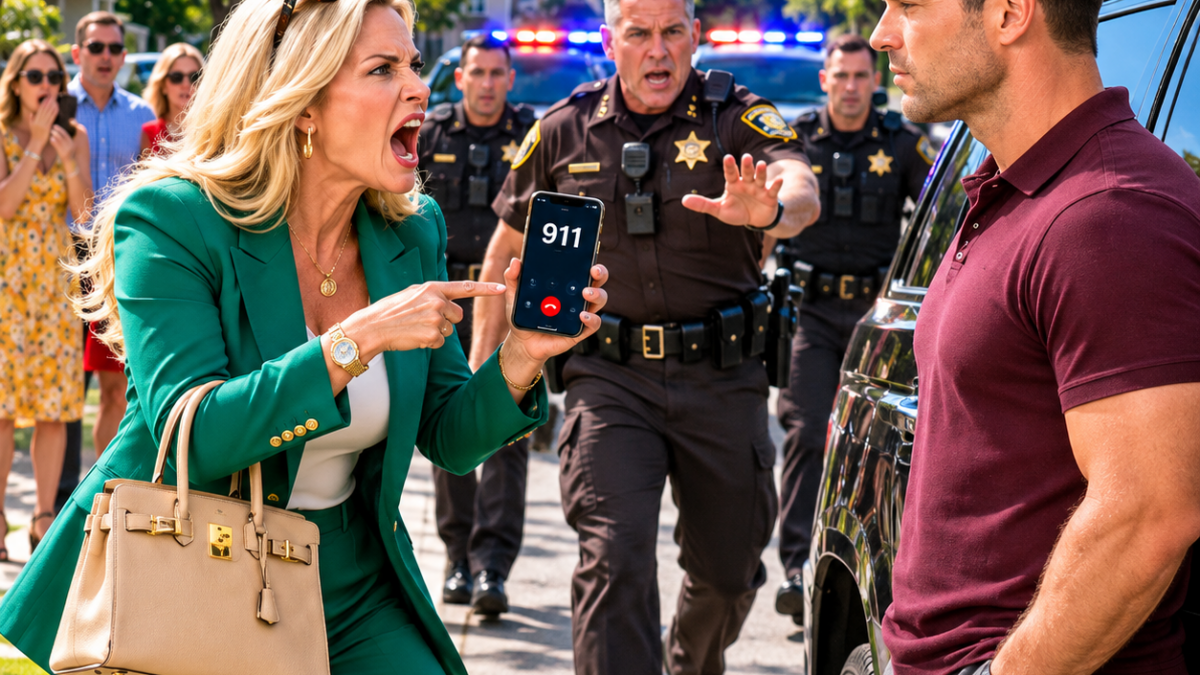
**“GET THIS MAN ARRESTED AND TOW THAT JEEP—HE’S BLOCKING MY GUESTS ON HOA PROPERTY!” Patricia Whitmore shouted into her phone while nearly forty people dressed for an expensive charity party watched from my driveway.**
**My black Jeep was parked beside my own workshop on land my family had owned for more than fifty years, but Patricia had just told 911 I was a dangerous stranger refusing to leave her community parking area.**
**Then her property manager pulled into the driveway, looked at me, looked at the officers, and quietly said, “Ma’am, that’s our chief—Chief Brooks.”**
My name is Daniel Brooks.
I was forty-seven years old when I moved back to Pine Ridge, North Carolina, after more than twenty years in law enforcement.
I had started as a patrol officer.
Worked investigations.
Supervised officers.
Eventually became a police captain in a much larger city.
I loved the work.
I also missed more birthdays, dinners, holidays, and ordinary weekends than I liked admitting.
When my father, Henry Brooks, became seriously ill, I started understanding how much of my life had been spent rushing from one emergency to another while assuming family time would always be available later.
It wasn’t.
Dad died and left me the place where I grew up.
A modest two-story house.
Workshop.
Nearly twenty wooded acres.
A narrow private driveway connecting us to the county road.
And an old gravel service lane disappearing behind the workshop toward a wooded hill.
On that hill stood an abandoned water tower and a small maintenance building dating back to the farming days before Willow Creek Estates existed.
Dad kept the area fenced.
Not because he was territorial.
Because it was dangerous.
The ground around the old maintenance building had deteriorated over the years.
Water had weakened an underground drainage chamber.
Some concrete had settled.
Dad had warned me about it since I was a kid.
“Stay away from the old steps unless I’m with you.”
I never forgot.
Around the same time I inherited the house, Pine Ridge offered me the police-chief position.
Smaller department.
Smaller town.
A place where officers could know residents by name.
I accepted.
I wanted to build a department that solved problems before they became disasters.
Talk first.
Listen.
Check facts.
Use authority carefully.
My appointment was public, but I never walked around announcing it.
Most people still knew me as Henry Brooks’s son.
That was fine with me.
I drove the same black Jeep Wrangler I had owned for years.
Old enough to have scratches.
New enough to start every morning.
PART2:
Dad had helped me replace the brakes and install the front bumper.
Every time I climbed inside, I remembered weekends working beside him.
My property bordered Willow Creek Estates.
Big houses.
Stone walls.
Manicured lawns.
Pond.
Walking paths.
HOA.
My land was not part of it.
County records were clear.
Willow Creek ended at my property line.
That simple fact would eventually become strangely difficult for one woman to accept.
The first person who welcomed me home was Margaret Wilson.
Seventy-six.
Small cottage near my southern boundary.
She knew Dad for more than thirty years.
She arrived carrying chicken soup and fresh bread.
Margaret’s twelve-year-old grandson Oliver visited most weekends.
Oliver loved tools.
The first time he entered Dad’s workshop, he stood beneath an old bicycle hanging from the wall.
“Does that still work?”
“Probably not.”
“Can we fix it?”
“Ask your grandmother.”
Margaret said yes.
So Oliver and I started restoring the bicycle together.
We cleaned wheels.
Adjusted bearings.
Sorted old tools.
Built a birdhouse.
Those afternoons reminded me why I came home.
Then unfamiliar vehicles started using the paved area beside my workshop.
Dad had built it years earlier so customers could leave lawnmowers, tractors, or vehicles while he repaired them.
It could hold several cars.
Private property.
One Saturday I returned from the grocery store and found three expensive cars parked there.
Their owners were attending a Willow Creek party.
I walked over.
Asked politely if someone could move them because I needed the space.
A woman apologized immediately.
“The HOA president told us this was guest parking.”
“It isn’t.”
She looked genuinely surprised.
I wasn’t angry.
My father had sometimes allowed neighbors to park there.
Generosity creates habits.
People forget where the permission came from.
The owners moved their cars.
Problem solved.
Or so I thought.
Three days later, a white luxury SUV entered my driveway.
Patricia Whitmore stepped out wearing a bright pink jacket, oversized sunglasses, and heels that looked designed for somewhere much cleaner than Dad’s workshop.
She walked toward me.
“Are you the man who made neighborhood guests move their vehicles?”
“Daniel Brooks.”
“Patricia Whitmore. President of Willow Creek Estates HOA.”
She said president the way some people say federal judge.
I explained the parking area belonged to my property.
Patricia crossed her arms.
“The neighborhood has used that lot for years.”
“My father sometimes let people park here.”
“Exactly.”
“No. That’s not exactly.”
She frowned.
“Willow Creek needs overflow parking.”
“Then Willow Creek should arrange overflow parking on Willow Creek property.”
She suggested I park my Jeep behind the farmhouse whenever the HOA hosted events.
I declined.
She asked whether I understood how much influence she had around Pine Ridge.
That sentence almost made me smile.
I had spent decades meeting people who confused position with ownership.
“I respect community volunteers,” I said. “But influence doesn’t create property rights.”
Patricia stared at me.
Then said the property manager would explain why I was required to cooperate.
His name was Richard Collins.
Pine Valley Community Management.
A few days later, Richard called.
Unlike Patricia, he arrived carrying maps instead of assumptions.
He apologized.
He had reviewed county records.
The workshop parking lot was mine.
The HOA had no permanent parking rights.
Simple.
We discussed putting up clearer private-parking signs.
Then he mentioned Patricia’s upcoming charity fundraiser.
Children’s hospital.
Large event.
Many guests.
He said parking would be tight.
I told him I was willing to consider temporary use if someone asked properly and we agreed on details.
Specific time.
Number of cars.
Keep access open for my deliveries.
No problem.
Richard smiled.
“That sounds reasonable.”
I thought we had solved it.
Then Margaret told me Patricia had a history of making small issues large.
Fines over decorations.
Flower pots.
Parking.
Rules enforced differently depending on who Patricia liked.
I listened.
But I didn’t want neighborhood gossip deciding my opinion.
Everyone deserves a chance to show who they are.
Around that same time, Oliver became fascinated with the old water tower.
He could see it through the trees.
“It looks like a giant robot.”
“It looks like a place you’re not going.”
“Why?”
“Unsafe ground.”
I explained the abandoned chamber and unstable maintenance building.
“Never go up there without me.”
He nodded seriously.
“I won’t.”
For two weeks, life stayed quiet.
Then trucks started appearing near my rear service lane.
One driver stopped beside the workshop.
“Is the water-tower road open?”
“No.”
He showed me a work order.
Willow Creek Estates.
Whitmore Event Services.
Temporary storage near old tower.
He carried tables, lighting equipment, event fencing.
I redirected him.
Then called Richard.
“Is the HOA storing fundraiser equipment on my land?”
“No.”
He sounded genuinely confused.
I explained the work order.
Richard promised to investigate.
A few days later Patricia returned with two women from the HOA social committee.
She said the fundraiser would be huge.
Wealthy donors.
Business owners.
Community leaders.
Outdoor dinner.
Music.
Silent auction.
“Sounds like a good cause.”
“It is. And the most useful thing you can do is give us your parking lot.”
I reminded her that I had already told Richard I would discuss temporary parking.
She wanted something different.
Exclusive use from noon until midnight.
My Jeep moved.
My workshop deliveries moved.
My property turned into her VIP lot.
“I have lumber arriving Saturday afternoon.”
“Move it.”
“No.”
Her expression changed.
She accused me of not caring about sick children.
That angered me more than the parking request.
Dad volunteered for charities his whole life.
Supporting a hospital and surrendering private property are not the same thing.
I offered an alternative.
Nearby church lot.
And I would donate a handmade oak bench to the auction.
One social-committee member liked the idea.
Patricia did not.
She warned that important people were attending.
Some had connections to the town council.
Refusing her could damage my reputation.
I looked at her.
“You’re threatening my reputation because I won’t surrender my driveway?”
“I am explaining consequences.”
“I’ll still donate the bench.”
She left furious.
One committee member, Linda Parker, came back.
She apologized.
Then quietly told me Patricia had been directing vendors toward several nearby areas she claimed Willow Creek controlled.
That caught my attention.
I called Richard again.
The day before the fundraiser, I delivered the oak bench to the clubhouse.
Beautiful piece.
Dad taught me how to build that style.
While volunteers decorated, I noticed maps taped to a wall.
Guest parking.
Vendor routes.
Event storage.
A red arrow labeled my workshop driveway:
VIP GUEST PARKING.
Another arrow followed the private service lane toward the water tower.
TEMPORARY EVENT STORAGE.
I asked Linda:
“Who made this?”
“Patricia.”
“That second location is dangerous.”
Linda immediately removed the map.
No argument.
That is what normal people do when told there’s a safety problem.
That evening Oliver came over.
He mentioned seeing men carrying equipment near the water-tower fence.
White truck.
Metal poles.
Plastic boxes.
Someone opened the old gate.
I stopped what I was doing.
“When?”
“This afternoon.”
“You went near them?”
“No.”
“Good.”
I called Richard.
Then reported possible unauthorized entry.
The next morning, Saturday, everything looked beautiful.
Blue sky.
Flowers.
Music equipment.
Volunteers.
Food trucks.
At eleven, I parked my black Jeep in its normal spot beside the workshop entrance.
Private parking sign visible.
Lumber truck expected later.
Shortly after noon, Patricia’s white SUV entered my driveway.
She stepped out wearing a bright red dress and carrying a clipboard.
She looked at my Jeep like someone had dumped garbage in front of her house.
“Move that.”
“Good afternoon.”
“My guests are arriving.”
“The Jeep is staying.”
“I told them they could park here.”
“You shouldn’t have.”
“This event benefits children.”
“I donated the bench.”
“That doesn’t excuse you from supporting community needs.”
I gestured toward the driveway.
“This is my property.”
She laughed.
“The HOA has used this area for years.”
“Richard already confirmed you don’t own it.”
Her face reddened.
Guests began arriving.
One man pulled in.
I directed him toward approved clubhouse parking.
He thanked me.
Patricia looked humiliated.
“You’re turning away my guests.”
“I’m directing them to your parking lot.”
Then she pulled out her phone.
I assumed Richard.
Wrong.
“911, what’s your emergency?”
She described me as a suspicious man.
Black Jeep.
Restricted HOA parking.
Refusing to leave.
Aggressive toward guests.
Fear someone might get hurt.
I stood five feet away listening to a fictional version of myself being reported to police.
I did not interrupt.
I had spent too many years in law enforcement to argue beside an emergency call.
I waited.
Two patrol vehicles arrived.
Officer Sarah Bennett.
Officer Michael Turner.
Both recognized me.
I gave them a small gesture.
Handle it normally.
Sarah approached Patricia first.
“Is anyone injured?”
“No.”
“Is anyone threatening you?”
“He’s interfering with my guests.”
“Do you have documentation showing this parking lot is HOA property?”
Patricia lifted her clipboard.
“I am the HOA president.”
Sarah waited.
“That doesn’t answer my question.”
Michael looked toward me and managed to keep a straight face.
Patricia pointed.
“I want him arrested. And that Jeep removed.”
Then a gray sedan pulled in.
Richard Collins stepped out with a folder.
Patricia rushed toward him.
“Tell them this parking area belongs to Willow Creek.”
Richard glanced toward the officers.
Then my Jeep.
Then me.
His expression changed.
He turned slowly toward Patricia.
“Ma’am… that’s our chief.”
She frowned.
“What?”
“Chief Brooks. Daniel Brooks. Pine Ridge police chief.”
Silence.
Her guests started whispering.
Patricia stared at me.
Then at Sarah.
Then Michael.
“You’re the police chief?”
“Yes.”
“Nobody told me.”
I answered:
“That doesn’t matter.”
She looked confused.
“The parking lot would still be mine if I were a mechanic.”
Richard opened the folder.
County parcel map.
Emails.
Management notes.
He reminded Patricia he had already told her:
No HOA parking rights.
No exclusive fundraiser use.
No authority to assign guests to my workshop lot.
Patricia’s embarrassment turned to anger.
She blamed Richard for making her look foolish.
Then said she would complain to the town council.
I told Sarah any report involving me should be reviewed through normal procedures.
No special treatment.
That should have ended the afternoon.
Instead, Richard opened another page.
His face went pale.
“Patricia.”
“What?”
“Did you authorize deliveries to the old water-tower property?”
She stiffened.
“Event storage is not your concern.”
Richard shook his head.
“My company’s name is on invoices we never approved.”
One truck was already headed toward the wooded hill.
Electrical equipment.
Temporary structures.
A request to unlock the old maintenance gate.
My stomach tightened.
“That area is closed.”
Patricia laughed nervously.
“It hasn’t been used in years.”
“That’s why it’s dangerous.”
Then my phone rang.
Margaret.
Her voice shook.
“Daniel, I can’t find Oliver.”
Everything else disappeared.
“Where did you last see him?”
“Near the western trail. Volunteers asked children to carry decorations.”
My chest went cold.
“The water tower?”
“One woman said the old maintenance building.”
Sarah heard enough.
She immediately called for additional officers and fire rescue.
Michael started gathering details.
I turned toward Patricia.
“Did you send people up there?”
“No.”
Then:
“My son Blake coordinated some deliveries.”
First time I had heard Blake’s name.
Adult son.
Owned a company supplying temporary event structures.
Richard looked shocked.
“No one approved an event area there.”
Then a cracking sound rolled down the hillside.
Deep.
Heavy.
A pale cloud rose above the trees.
Then a crash.
Everyone turned.
A child’s scream followed.
We moved toward the safe upper path.
Not straight through the unstable section.
When we reached the clearing, several workers were staring toward the old maintenance building.
The ground beside the stone steps had collapsed.
Deep hole.
Broken concrete.
One worker shouted:
“A boy was there!”
I called:
“Oliver!”
Nothing.
Again.
Then a weak voice:
“Mr. Brooks!”
A flashlight glowed between broken timber.
“I can’t get out.”
I wanted to move closer.
Sarah stopped me.
Ground was still shifting.
Oliver said one leg was trapped.
Water dripping from broken pipes.
Another crack.
Stones fell.
Fire department requested specialized rescue.
Then Blake Whitmore appeared behind a delivery truck.
Pale.
Keys in hand.
Rolled map.
I asked:
“Why are workers on my property?”
“My mother said the area was available.”
“For what?”
“Overflow event space.”
Richard ran into the clearing holding paperwork.
HOA payments.
Raised platform.
Lighting.
Temporary bar.
Equipment positioned over the old drainage chamber.
The underground structure Dad had warned me about.
Then Oliver screamed.
Water rising around his shoes.
A delivery truck near the building began tilting.
Ground beneath one rear wheel collapsed.
Driver jumped free.
Metal poles inside shifted.
The vehicle started leaning toward the opening.
Firefighters secured the truck.
Captain James Miller arrived.
I told him about the old chamber.
Possibly another inspection opening behind the maintenance building.
He sent a team to check.
Then Blake did something none of us expected.
He grabbed Richard’s folder.
Ran toward the woods.
Sarah shouted for him to stop.
Another officer followed.
I didn’t care where Blake was going.
Oliver was underground.
Rescuers found the alternate inspection opening.
Two firefighters entered.
Oliver was alive.
One leg pinned beneath a beam.
Water rising.
They lifted the timber.
Got him onto a rescue stretcher.
Then the ground shifted again.
Truck dropped several inches.
Everything froze.
Supports held.
Minutes later Oliver emerged.
Covered in mud.
Shaking.
Pale.
But alive.
He reached toward me.
“Mr. Brooks.”
I nearly lost control of my emotions.
Paramedics took him.
Broken lower leg.
Bruises.
Cold exposure.
Not life-threatening.
Margaret arrived crying.
I told her immediately:
“He’s alive.”
She hugged me.
Then left for the hospital.
Sarah later told me Blake had been stopped before leaving the area.
He still carried Richard’s folder.
He claimed he was protecting private company documents.
Maybe.
That required investigation.
Nobody needed me declaring guilt on a hillside.
Richard explained the paperwork.
The charity fundraiser at the clubhouse was genuine.
But attached to it was another project.
Private reception area.
Investor gathering.
Viewing platform.
Temporary bar.
All near the water tower.
Patricia’s charity event had apparently become cover for something more ambitious.
I visited Oliver at the hospital.
He told me why he entered the unsafe area.
A volunteer in an orange vest asked several children to carry small boxes toward the storage area.
Other kids turned back when they saw warnings.
Oliver noticed another crate near the maintenance building and wanted to help.
Then the steps collapsed.
I told him:
“Helping is good. Ignoring safety isn’t.”
He nodded.
Then asked if we could still finish the bicycle.
“Yes.”
Back on the property, investigators closed the water-tower area.
The collapsed chamber exposed old pipes and weakened concrete.
County inspectors confirmed what Dad always knew.
The hillside was unsuitable for heavy temporary construction without major stabilization.
Yet Patricia began emailing Willow Creek residents another version.
I had sabotaged the charity event.
Police overreacted because I was chief.
The accident resulted from my failure to maintain property.
I refused to fight through neighborhood emails.
I released no angry statement.
Facts would survive longer.
Then a town council member named Thomas Green approached me.
He remembered the water tower from decades earlier.
The hillside had long been considered unsafe for heavy construction.
Then he mentioned a recent inquiry.
Whitmore Development Group had asked about building a permanent viewing deck there.
Managed by Patricia’s son Blake.
Now everything aligned.
The fundraiser wasn’t the origin of the idea.
It was a demonstration.
A temporary version of a future commercial event space.
Richard reviewed HOA finances.
Invoices to Blake-connected businesses.
Payments listed as charity expenses.
References to a future overlook.
Large platform.
Private seating.
Decorative lights.
Paved access road.
The project map showed my workshop lot as the main entrance.
That was why Patricia cared so much about my Jeep.
My Jeep wasn’t blocking one afternoon’s guests.
It was sitting in the entrance to a project Blake wanted investors to believe he controlled.
Then Richard found references to paid reservations.
People may already have paid deposits for access to land Blake did not own.
I told him to preserve everything.
Independent review.
No assumptions.
No accusations beyond evidence.
For several days, peace returned.
Oliver recovered at Margaret’s.
Then Blake visited my workshop.
Expensive jacket.
Dark blue pickup.
He apologized for what happened to Oliver.
Then explained his development would create jobs and bring money into Pine Ridge.
I said:
“Development can be good. Construction on someone else’s land isn’t.”
“Those details can be worked out.”
“Safety isn’t a detail.”
His expression hardened.
Investors had already paid.
He offered to buy a narrow strip connecting my parking lot to the hillside.
Price far below market.
Route beside my workshop.
“No.”
“You’re using your job to kill this project.”
“My job has nothing to do with it.”
I pointed toward the land.
“I’m the owner.”
Then Blake warned that Willow Creek might have older access rights I didn’t understand.
That confidence bothered me.
That night, I searched Dad’s filing cabinet.
Found an envelope:
WESTERN ACCESS ROAD.
Inside:
A letter from Dad to the original Willow Creek developer.
He allowed maintenance workers temporary access with permission.
He explicitly refused permanent public access through the workshop driveway.
Dad had anticipated the exact argument years earlier.
Then Richard called.
Whitmore Development had filed an access agreement with county records.
It carried what appeared to be Dad’s signature.
The document granted broad rights across my driveway toward the water-tower hillside.
My attorney, Rachel Sullivan, obtained a copy.
She warned me:
“Don’t call it forged yet.”
Good advice.
The legal description was strange.
The language broader than Dad’s letters.
The date fell during a period when Dad had been recovering from serious illness.
Then Margaret remembered something.
Dad kept duplicate papers inside the workshop wall.
A metal box.
Oliver watched from a chair while I examined paneling near Dad’s workbench.
One section had newer boards.
I removed it carefully.
Metal box between studs.
Maps.
Letters.
Photograph.
On the back:
NEVER TRUST THE SECOND AGREEMENT.
The first map marked the driveway, neighborhood boundary, and tower road.
Then a letter.
Dad had rejected a revised access proposal because it converted temporary maintenance permission into permanent development rights.
Rachel compared the language.
Almost identical to the broad agreement Whitmore Development had filed.
Someone appeared to be relying on a proposal Dad had rejected.
Still:
Evidence needed examination.
Then Thursday night, security alarm.
I was at the station.
Michael entered my office.
Unfamiliar vehicles near my workshop.
I made it clear:
Other officers handle the call.
I would not direct an investigation on my own property.
When I arrived, white van.
Dark pickup.
Workshop door open.
Outside light broken.
A man carrying a cardboard box toward the pickup.
Another standing watch.
I shouted from a safe distance:
“This is private property. Stop.”
The man hurried.
Pickup started moving.
I stepped away.
Then crash inside the workshop.
A voice:
“Mr. Brooks!”
Oliver.
I couldn’t believe it.
He and Margaret had come to return a book.
She went inside the farmhouse.
Oliver saw strangers enter the workshop.
He thought they were stealing Dad’s tools.
He followed.
Now a storage shelf had fallen and trapped him.
Then glass broke.
Smoke drifted through the doorway.
Orange glow.
Fire.
I called dispatch.
Child trapped inside burning structure.
Margaret ran from the farmhouse.
I stopped her before she entered.
Fire spread.
Old shelves collapsed.
Oliver screamed.
First fire engine arrived.
Captain James Miller.
I told him where Oliver was.
Firefighters entered.
Then back wall began failing.
Roof cracked.
One rescuer reached Oliver.
Heavy cabinet blocked exit.
Then part of the roof collapsed.
Radio traffic became frantic.
Two firefighters and Oliver trapped beneath burning debris.
Margaret dropped to her knees.
My phone vibrated.
Unknown number.
Photograph.
Patricia standing beside the dark pickup outside my workshop earlier.
Message:
She told them to take the papers.
Then:
The fire wasn’t supposed to start this early.
My stomach turned cold.
That message was not proof by itself.
But it changed what investigators needed to examine.
Rescue teams found a narrow eastern storage room.
I remembered Dad had built a steel door there.
Separate outside access hidden behind old boards.
Firefighters entered from that side.
They found the trapped crew.
Oliver unconscious.
Smoke filling the space.
Door bent.
They forced it.
Then one firefighter appeared carrying Oliver wrapped in a rescue blanket.
Soot on his face.
Eyes closed.
Paramedics worked.
Seconds felt endless.
Then Oliver coughed.
Breathing.
Margaret cried so hard she could barely stand.
Two firefighters were also rescued.
One had injuries from falling timber.
Everyone survived.
That mattered more than the workshop.
At the hospital, Oliver apologized.
For trying to protect Dad’s tools.
I told him:
“Nothing in that building is worth your life.”
He asked about the bicycle.
I didn’t know whether it survived.
He looked disappointed.
Then said:
“I’m glad the firefighters are okay.”
Good kid.
The next morning, the workshop was blackened and partially collapsed.
Detective Paul Harrison took over the criminal investigation.
I gave him:
Security recordings.
Anonymous messages.
Letters from Whitmore Development.
Access documents.
Information about the metal box.
I made clear what I knew and what I did not.
I did not know who started the fire.
I did not know who ordered the entry.
I did not know whether Patricia’s presence meant she knew what would happen.
Paul thanked me for not turning suspicion into certainty.
That matters.
Rachel Sullivan told me the broad access document contained language Dad had explicitly rejected.
Signature review continued.
And importantly:
Even if the metal box was destroyed, property rights did not disappear.
Copies existed.
Recorded deed existed.
Older correspondence existed.
You cannot burn reality out of a county record.
Richard’s independent financial review continued.
Some donations from the fundraiser were legitimate.
My bench money went to the children’s hospital.
Many volunteers had genuinely tried to help.
Other expenses looked unrelated.
Private event planning.
Viewing-platform work.
Businesses connected to Blake.
The distinction mattered.
The charity itself was not fake.
Some people apparently used a real charity event to support something else.
Then investigators recovered part of Dad’s metal box.
Several papers destroyed.
Others survived inside protective sleeves.
Detective Harrison also interviewed Wesley Grant, a construction worker injured during the tower collapse.
Wesley said Blake was under investor pressure.
Funding deadline.
Access needed.
Workers were told the disputed agreement would soon be accepted.
Some questioned safety.
Blake reportedly insisted delays would destroy the business.
Wesley also described conversations about removing Dad’s old property papers from the workshop.
Those documents could weaken Whitmore Development’s claim.
According to Wesley, the plan was supposed to be quiet.
Get the papers.
Leave.
Oliver’s presence changed everything.
Again:
His statement needed corroboration.
Then the anonymous source came forward.
Hannah Whitmore.
Blake’s younger cousin.
She worked in his office handling schedules and invoices.
She had seen documents showing investors had been promised access to land the company did not own.
She heard discussions about obtaining old agreements.
Saw Patricia pushing the project.
She feared losing her job.
Feared family conflict.
So she initially sent information anonymously.
Hannah had been at the development office the evening of the fire.
She heard a conversation about retrieving the metal box.
Then an argument after someone learned the workshop was occupied.
She told me:
“I was scared you’d hate me because I’m a Whitmore.”
I shook my head.
“People should be judged by their own actions.”
That sentence applied to everybody.
Patricia.
Blake.
Hannah.
Richard.
HOA residents.
Workers.
Nobody inherited guilt from a last name.
Investigators eventually concluded the workshop fire had been deliberately started during the unlawful entry.
Several people faced charges connected to what happened.
Blake’s role was examined closely.
False access documents.
Unauthorized entry.
Construction on unsafe property.
The attempt to retrieve records.
Patricia also faced serious questions.
Her communications.
Vendor instructions.
Fundraiser arrangements.
Claims made to residents.
Her 911 call was not proof that she committed every later act.
It was part of the timeline.
Evidence had to connect each person to each decision.
Eventually Blake accepted responsibility for several offenses connected to false access documents and unauthorized entry.
Whitmore Development faced civil claims involving:
Hillside damage.
Workshop fire.
Unsafe construction.
Injuries.
The legal process was not instant.
Insurance.
Court hearings.
Settlements.
Investigations.
No single giant revenge moment.
But the company could no longer claim it controlled my driveway or water-tower property because it had promised investors that it did.
Patricia’s position inside Willow Creek collapsed.
Independent review found serious failures in HOA spending.
Vendor approvals.
Private-business connections.
The viewing-platform project.
Residents were furious that association money and authority had been used to support a private venture without clear approval.
They followed their rules.
Held the required process.
Removed Patricia as HOA president.
New board elected.
Richard remained property manager.
Stronger rules followed.
Vendor contracts documented.
Large spending reviewed.
Outside-property use verified.
Financial records clearer.
When Richard told me, I did not celebrate.
Oliver had almost died twice.
At the water tower.
Then in the workshop fire.
Two firefighters had been injured.
My father’s workshop was destroyed.
Workers had been endangered.
Blake himself had been injured during the broader events.
Truth does not rewind damage.
Then came the ruling that mattered most to me.
The disputed broad access agreement could not be relied upon as a valid grant of permanent rights over my property.
The improper claim was cleared.
My driveway remained mine.
The water-tower hillside remained mine.
Rachel called as soon as it became official.
I sat at the kitchen table looking at Dad’s photograph.
For months, I worried that somebody would use a polished piece of paper to take land Dad had spent his life protecting.
Now the ownership issue was finally settled.
I walked outside.
My black Jeep sat beside the ruined workshop.
Same place Patricia had demanded I move it.
I put a hand on the hood.
The argument had started with a parking space.
At least that was what I thought.
Patricia wanted my Jeep moved because wealthy guests were arriving.
She saw a private driveway and decided HOA convenience mattered more than ownership.
Richard arrived.
“Ma’am, that’s our chief.”
I thought that sentence would end the misunderstanding.
Instead, it exposed the first layer.
The parking lot was the entrance to Blake’s proposed project.
The fundraiser was connected to a private investor event.
The water-tower hillside had already been marked for development.
Whitmore Development had promised access.
Then came the disputed agreement.
Dad’s hidden papers.
The break-in.
The fire.
Everything connected back to one assumption.
They believed they could establish control first and solve ownership later.
I rebuilt the workshop.
Not exactly like Dad’s.
Safer.
Stronger.
Better lighting.
Better storage.
Local builder Thomas Reed helped.
He knew Dad.
Oliver recovered.
When I showed him the workshop plans, he immediately started redesigning them.
“We need a bicycle section.”
“Do we?”
“Yes.”
He drew one.
Then suggested a small area where kids could learn basic repairs.
That idea stayed.
The new workshop became more than a replacement.
It became what Dad would have loved.
A place where useful things happened.
Repair classes.
Bicycle projects.
Birdhouses.
Basic tool safety.
Neighbors helping neighbors.
Margaret stood inside before the official opening.
Looked around.
Cried quietly.
“Henry would’ve liked this.”
Above the main workbench I hung Dad’s photograph.
Under it:
BUILD WITH CARE. HELP WITH KINDNESS.
The new HOA board approached me differently.
Not:
“We need your parking.”
Not:
“Move your Jeep.”
Not:
“We’ve always used it.”
They asked.
Could we coordinate visitor parking better?
Yes.
Could maps clearly identify private property?
Absolutely.
Could emergency responders access the hillside if needed?
Of course.
Could Willow Creek ever use the workshop lot for a specific event?
Ask me.
Maybe yes.
Maybe no.
That is how boundaries work.
They do not make cooperation impossible.
They make cooperation voluntary.
Engineers stabilized the water-tower hillside.
Damaged chamber closed.
Unsafe debris removed.
The commercial viewing platform never happened.
I wanted the area to return to woods.
Trees.
Birds.
Quiet.
Oliver walked the safe upper trail with Margaret months later.
He asked:
“Will it ever look normal again?”
“Yes.”
“How long?”
“Nature doesn’t use deadlines.”
He pointed at a bird on a young branch.
“Looks like it’s starting.”
He was right.
When the workshop reopened, firefighters came.
Officers.
Neighbors.
Volunteers.
The two firefighters injured in the fire had recovered and returned to duty.
Oliver showed them his new workbench.
Richard arrived carrying a small wooden box.
Inside:
A set of woodworking tools.
Dad’s name engraved on the handles.
Several Willow Creek residents had purchased them together.
I didn’t know what to say.
Richard said:
“They wanted you to know the neighborhood remembers how you treated them even when things got ugly.”
That mattered.
Because Willow Creek was never Patricia.
It was Margaret.
Oliver.
Linda.
Richard.
Families who donated to a hospital.
People who helped rebuild.
Neighbors who asked permission instead of assuming.
The second children’s-hospital fundraiser was handled transparently.
Direct coordination.
Clear accounting.
No secret event venue.
No private project hidden inside charity expenses.
Volunteers got to be proud of their work again.
Patricia eventually sent me a letter.
Short.
Careful.
She expressed regret.
Oliver’s injuries.
Workshop.
Chaos.
She said she had been terrified for Blake when everything started collapsing around the water tower project.
Maybe that fear finally showed her how dangerous the situation had become.
I read the letter twice.
Then put it in my desk.
I did not need to send an angry response.
Courts handled legal consequences.
Residents handled HOA leadership.
Investigators handled evidence.
My responsibility was my property and my future.
Dad used to say carrying anger was like carrying a heavy toolbox after the repair was finished.
Eventually, put it down.
So I did.
One weekend Oliver and I finally finished Dad’s old bicycle.
New tires.
Adjusted brakes.
Polished frame.
He rolled it outside.
Margaret took a picture.
I handed him the bike.
“It’s yours.”
His eyes widened.
“Really?”
“You did half the work.”
“Maybe forty percent.”
“Thirty.”
He hugged me anyway.
Then rode slowly down the same driveway where Dad taught me to ride decades earlier.
Watching him, I remembered falling into grass.
Scraped knees.
Dad laughing before pulling me up.
Some things survive almost anything.
Buildings burn.
Paper gets damaged.
Leadership changes.
Plans fail.
But patience passed from one person to another can last decades.
That evening, I parked my Jeep beside the rebuilt workshop.
Same spot.
The old water-tower hill was quiet.
Trees moved in the wind.
I thought about how ridiculous the beginning sounded.
An HOA president called 911 because my Jeep was blocking her wealthy guests.
Two patrol cars arrived.
She demanded my arrest.
Then her own property manager looked at her and said:
“Ma’am, that’s our chief—Chief Brooks.”
Yes.
Her expression was unforgettable.
But that was not why she was wrong.
I tell people that whenever they focus too much on the reveal.
Patricia should not have respected me because I was police chief.
She should have respected me before she knew.
My badge did not strengthen my deed.
Her HOA title did not weaken it.
If I had been a mechanic like Dad, the driveway still would have been mine.
If I had been a teacher, same answer.
Retired homeowner?
Same answer.
Unemployed?
Same answer.
Property rights do not increase with job status.
Neither does the right to basic respect.
Dad understood that.
He spent his life helping people who could offer him nothing.
Fixed lawnmowers.
Bicycles.
Farm equipment.
Opened his lot when neighbors asked.
That generosity was eventually mistaken for permanent access.
But defending the boundary did not require abandoning Dad’s values.
The workshop was rebuilt.
The hillside recovered.
Oliver was safe.
The neighborhood found better leadership.
My family’s land remained ours.
And the Jeep?
It stayed exactly where it had been from the beginning.
Beside my workshop.
On my property.
In a parking space Patricia had never owned.
Whenever someone asks what Patricia’s biggest mistake was, they expect me to say:
Calling 911 on the police chief.
It wasn’t.
Her biggest mistake happened before she ever knew what I did for a living.
She looked at a man in jeans beside an old black Jeep and decided he deserved less respect because she thought he had less power.
That’s where the whole thing started.
And that is why Richard’s six words mattered so much.
Not because they suddenly gave me authority.
Because they showed everyone how differently Patricia behaved the moment she thought I had it.








