PART 2: My Landlord Gave Me 24 Hours to Get Rid of My Giant Cat—Then Someone Smashed Through My Door That Night
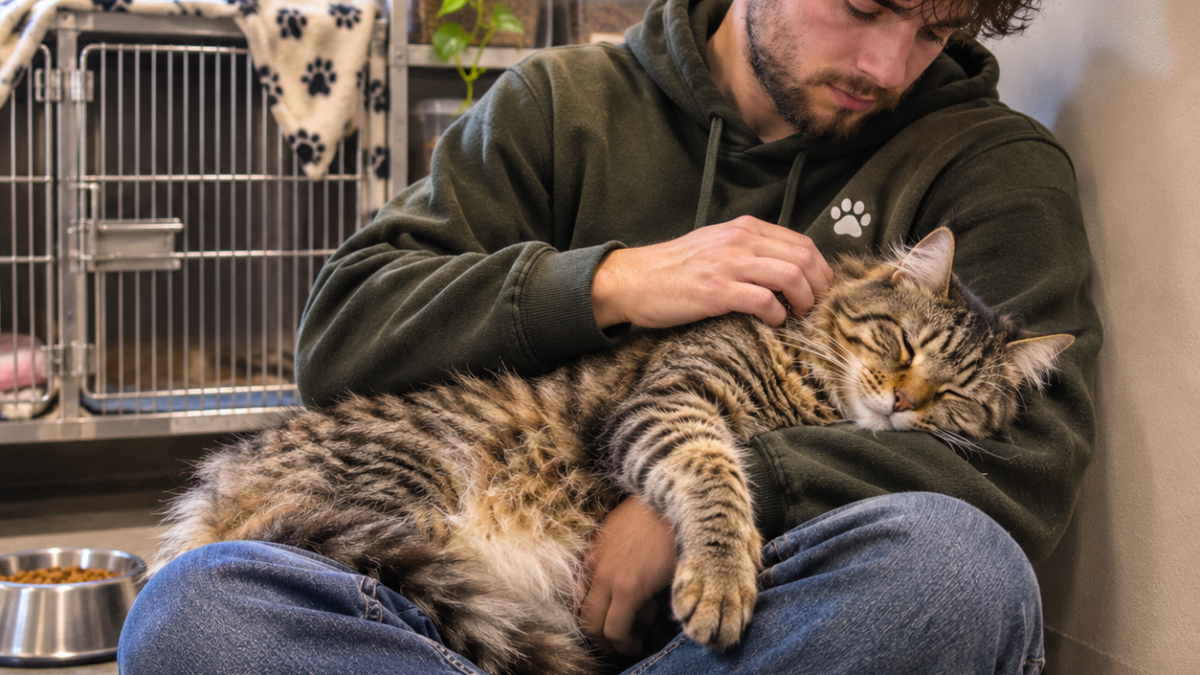
Last night, I packed my cat’s blanket, battered stuffed mouse, food bowls, and every little thing that smelled like our apartment into a cardboard box because my property manager had given me twenty-four hours to get rid of him or lose the only home I could still afford.
I kept telling myself that surrendering Atlas might be the responsible choice, but every time that enormous Maine Coon followed me from room to room, watching me with those serious green eyes, I felt like I was preparing to abandon the one living thing that had never abandoned me.
By three in the morning, the box was still sitting beside my front door when the sound of breaking glass came from the hallway, and before I could understand who was forcing their way inside, Atlas was already moving toward the noise.
I’m twenty-six, and at the time I was working double shifts at a small diner called Miller’s Grill, where the coffee never stopped flowing and neither did the bills waiting for me at home.
A few months earlier, my girlfriend, Megan, had disappeared from my life almost overnight. She took her clothes, left half the rent unpaid, stopped answering messages, and left Atlas behind.
Atlas was technically her cat.
At least, he had been in the beginning.
By the time she left, he had become mine.
He was almost twenty pounds of thick brown-and-black fur, huge paws, a scar above one eye, another across his nose, and the kind of face that made delivery drivers step backward when I opened the door.
But he slept under my blanket during thunderstorms.
He sat outside the bathroom waiting for me after long shifts.
And if I gave him more food than he wanted, he sometimes carried a few pieces of kibble downstairs and left them near the bushes where two stray cats lived.
That was Atlas.
He looked like a bar fight with whiskers.
He had the heart of a grandmother.
Then my property manager, Brent Keller, saw him in the hallway.
Brent stopped halfway up the stairs and stared.
“That your cat?”
“Yeah.”
“That thing’s huge.”
“He’s a Maine Coon.”
Brent didn’t smile.
The next evening, there was an envelope taped to my door.
Inside was a typed notice saying Atlas had to be removed from the property within twenty-four hours because he represented an “unacceptable safety concern.”
I marched downstairs.
“You approved him when I moved in.”
“I approved a cat,” Brent replied.
“He is a cat.”
“You know exactly what I mean.”
Actually, I didn’t.
Atlas had never bitten anyone. Never scratched a neighbor. Never even hissed at Brent.
But Brent folded his arms.
“Tomorrow. Noon. Cat goes, or you do.”
I had $183 in my checking account.
No family nearby.
No second apartment waiting for me.
So I went upstairs and started packing Atlas’s belongings.
Around midnight, I sat on the kitchen floor beside that cardboard box while Atlas rubbed against my shoulder.
“I’m sorry, buddy.”
He bumped his forehead against mine.
I almost broke right there.
Then, sometime after three, glass shattered.
I jumped to my feet.
Atlas froze.
A second crash came from the front of the apartment.
My door slammed against the wall.
Two men came inside.
One wore a dark hoodie. The other had something wrapped around his hand.
“Hey!” I shouted.
The first man turned toward me.
The second started moving down the hallway toward my bedroom.
I reached for my phone.
Atlas shot past me.
He planted himself between us.
His back arched. Every strand of fur lifted. His ears flattened, and a deep sound came from his chest that I had never heard before.
The man closest to him stopped.
“What the hell?”
Atlas hissed and lunged forward one step.
That was enough.
The man stumbled backward into the broken door.
His partner cursed, grabbed his sleeve, and both of them ran.
When the police arrived, Atlas was pressed against my legs.
He was trembling.
So was I.
One officer was still photographing the shattered door when Brent appeared in the hallway wearing sweatpants and an irritated expression.
He looked at the damage.
Then at Atlas.
Then at me.
And instead of asking whether I was hurt, Brent pointed at my cat.
“That animal still needs to be gone by noon.”
The officer slowly lowered his camera.
“What did you just say?”
Brent’s face tightened.
“I said the cat violates my building policy.”
The officer looked at Atlas, then at the broken door, and finally back at Brent.
“Sir,” he said quietly, “I think you’d better explain exactly what policy you’re talking about.”
PART 2
Brent looked at the officer as if he had just been challenged by someone who didn’t understand his authority.
“This is private property,” he said. “I manage the building.”
The officer straightened.
His name tag read MORALES.
“I understand that.”
“Then you understand I can enforce our rules.”
Officer Morales glanced at Atlas.
My cat was still pressed against my shin. The fur along his spine had begun settling, but his body hadn’t stopped shaking.
Morales looked back at Brent.
“Did this cat attack anybody tonight?”
Brent opened his mouth.
I answered first.
“No.”
Morales nodded toward me.
“Did he bite either suspect?”
“No.”
“Scratch them?”
“No.”
One of the other officers, who had been checking the hallway, called out, “No blood inside. Nothing showing an injury.”
Brent exhaled sharply.
“That’s not the point.”
“What is the point?” Morales asked.
Brent folded his arms.
“The animal is too large.”
For several seconds, nobody said anything.
Morales blinked.
“Too large for what?”
“For this building.”
“He’s a cat,” I said.
Brent turned on me.
“I told you yesterday. I’m not having this argument again.”
Something in me finally snapped.
Maybe it was exhaustion.
Maybe it was the broken glass scattered across my floor.
Maybe it was the fact that two strangers had just forced their way into my home and the man responsible for managing the property seemed more interested in Atlas than in the shattered entrance.
“You didn’t even ask if I’m okay.”
Brent’s jaw tightened.
“That has nothing to do with your lease violation.”
Morales lifted one hand.
“Everybody slow down.”
He looked at Brent.
“This sounds like a landlord-tenant dispute, and I’m not going to interpret a lease in this hallway at four in the morning. But right now, this apartment is part of an active burglary investigation. He stays here until we finish.”
Brent’s face reddened.
“Fine.”
Then he pointed at me.
“Noon.”
He walked away.
I stared after him.
Morales waited until Brent disappeared down the stairs.
Then he looked at me.
“You got somewhere safe to stay tonight?”
I glanced at my broken door.
“I guess not.”
He nodded.
“We’ll stay while you gather what you need.”
The words landed harder than I expected.
Gather what you need.
Less than an hour earlier, I had been packing Atlas’s belongings because I thought I might lose him.
Now I was packing both our lives.
I found a duffel bag beneath the bed and started stuffing clothes into it.
Atlas followed me.
When I went into the bathroom, he followed.
When I returned to the kitchen, he followed.
He wouldn’t let me out of his sight.
Morales watched quietly.
Finally, he asked, “That cat always like this?”
“Like what?”
“Attached.”
I looked down.
Atlas had one massive paw resting on my shoe.
“Pretty much.”
Morales nodded.
“Seems like he knows who his person is.”
I nearly lost it.
I looked away and zipped the bag.
The cardboard box beside the front door already contained Atlas’s blanket and toys.
I added food, his brush, medication for a skin allergy he sometimes got, and the ridiculous blue stuffed fish he had owned since he was a kitten.
Then I picked up the box.
Atlas immediately tried to climb into it.
Despite everything, I laughed.
“Not now, buddy.”
Morales smiled.
When I carried my things downstairs, he helped with the duffel bag.
The parking lot was cold and nearly empty.
My car was a twelve-year-old Honda Civic with a cracked dashboard, a heater that worked only when it felt like it, and a passenger-side window that whistled at highway speed.
It was not a home.
But at four forty-seven that morning, it was all I had.
I opened the back door.
Atlas stared into the car.
“It’s temporary,” I told him.
He looked at me.
I wasn’t sure whether I was reassuring him or myself.
I placed his blanket across the back seat.
He climbed in.
Before I closed the door, Morales came over.
He handed me a card.
“Case number’s written on the back.”
“Thanks.”
“If you remember anything else about the two guys, call.”
“I will.”
He looked toward the building.
“And keep every notice your manager gave you.”
I frowned.
“Why?”
Morales chose his words carefully.
“Because you may want somebody who knows tenant law to look at them.”
I stared at him.
“You think what he’s doing is illegal?”
“I’m a cop, not your attorney.”
He pointed at the card.
“But keep everything.”
Then he walked away.
I stood beside my car while cold air moved through my jacket.
Through the rear window, Atlas watched me.
Twenty-four hours earlier, my biggest fear had been becoming homeless because of my cat.
Now I was homeless with my cat.
And somehow, that felt better.
I climbed into the driver’s seat.
Atlas immediately stepped over the console and pushed his enormous head against my shoulder.
“All right,” I whispered. “It’s you and me.”
He purred.
I drove away.
I had no plan beyond sunrise.
My shift started at six.
So I went to work.
Miller’s Grill opened before dawn for truckers, nurses, construction crews, and people who believed coffee tasted better before the rest of the world woke up.
I parked behind the building where I could see the car through the kitchen window.
Atlas had food, water, his blanket, and the windows cracked slightly.
It was cold enough that overheating wasn’t a concern.
Freezing was.
I ran the heater until the car became warm, then went inside.
My manager, Rosa, looked at me once and knew something was wrong.
She was fifty-three, five-foot-two, and capable of carrying six plates on one arm while threatening a dishwasher with the other.
“What happened?”
“Nothing.”
She stared.
“You have glass in your hair.”
I touched my head.
A tiny piece fell onto my palm.
Rosa put down the coffee pot.
“Office. Now.”
I told her everything.
The apartment notice.
The break-in.
Atlas.
The car.
By the time I finished, she was gripping the edge of her desk.
“You’re sleeping in the parking lot?”
“Just until payday.”
“That’s Friday.”
“I know.”
“It’s Tuesday.”
“I also know that.”
She muttered something in Spanish that I suspected wasn’t complimentary toward Brent.
Then she stood.
“You’re not working a double.”
“I need the money.”
“You need sleep.”
“I need both.”
She stared at me.
I stared back.
Finally, she sighed.
“Four hours. Then you leave.”
“Rosa—”
“Four.”
She pointed toward the dining room.
“And take Booth Three when it gets slow so you can see your car.”
I wanted to argue.
Instead, I hugged her.
Rosa stiffened.
“We’re not doing this.”
“Thank you.”
“Go carry coffee.”
I worked.
Every ten minutes, I checked the parking lot.
Each time, Atlas was sitting behind the windshield like an enormous furry security guard.
At nine thirty, an older regular named Mr. Keene noticed me looking outside.
“That your cat in the Honda?”
I turned.
“You can see him from here?”
“I think people can see that animal from space.”
Despite myself, I laughed.
Mr. Keene had been eating breakfast at Miller’s for as long as I had worked there.
Retired teacher, I thought.
Or accountant.
I wasn’t sure.
He pointed his fork toward the window.
“Why’s he in your car?”
“Long story.”
“I’m retired.”
Rosa appeared behind me carrying a coffeepot.
“Tell him.”
I gave her a look.
She ignored it.
“He used to work in housing court.”
Mr. Keene looked at her.
“Legal aid.”
“Same difference.”
“No, it isn’t.”
She filled his coffee.
“Help him anyway.”
Then she walked away.
Mr. Keene turned back to me.
“You having a landlord problem?”
I hesitated.
Then I told the story again.
He listened without interrupting.
When I reached the twenty-four-hour notice, his eyebrows rose.
“Do you have your lease?”
“On my phone.”
“Show me.”
I pulled up the document.
He scrolled slowly.
“Pet addendum?”
I found it.
Atlas was listed by name.
Breed: Maine Coon.
Color: brown tabby.
Cat.
Approved.
Deposit paid.
Mr. Keene read the page twice.
“Where’s the size restriction?”
“There isn’t one.”
He handed back the phone.
“You need legal help.”
“I can’t afford legal help.”
“Legal aid is free if you qualify.”
He took a napkin and wrote down a number.
“Call this office.”
I looked at it.
“You think they’ll care?”
“They might care very much.”
I glanced toward the window.
Atlas had disappeared from the dashboard.
For one terrifying second, my heart stopped.
Then his huge face appeared in the passenger window.
He had simply moved.
Mr. Keene noticed my expression.
“You chose the cat?”
I looked at him.
“What?”
“You could’ve left him at a shelter and kept the apartment.”
I didn’t answer immediately.
I remembered Atlas standing between me and two men who had smashed through my door.
I remembered him trembling afterward.
“He chose me first.”
Mr. Keene nodded.
“Then make the call.”
I did.
A woman named Naomi Brooks called me back that afternoon.
She worked for a tenant advocacy clinic.
I expected her to sound rushed.
She didn’t.
She asked me to email the lease, Atlas’s pet approval, Brent’s notice, photographs of the damaged apartment, and the police case number.
Then she asked one question that stopped me.
“When did you first report problems with the building’s exterior doors?”
I frowned.
“What problems?”
“The police report mentions that the rear entry showed no sign of forced entry.”
I sat straighter inside the car.
“I didn’t know that.”
“The preliminary report says the suspects may have entered the building through an unsecured common door before forcing your apartment door.”
I thought about the rear stairwell.
Its lock had been unreliable for months.
Everybody knew it.
You had to pull the door hard or it sometimes stayed slightly open.
I had mentioned it to Brent.
More than once.
“So they got inside because the back door didn’t lock?”
“I’m not saying that yet.”
Naomi’s voice remained careful.
“But if management had notice of a security defect, preserve every message you have.”
I opened my texts.
I searched Brent’s name.
There it was.
A message from six weeks earlier.
ME: Rear door still isn’t latching. Found it open again at 11:30 last night.
BRENT: Maintenance knows.
Two weeks later:
ME: Any update on back lock?
BRENT: It’s on the list.
Then another message from a neighbor in our building group chat.
Anyone else notice rear door still broken?
Someone replied:
Yeah. Brent said replacement part is expensive.
My hand tightened around the phone.
Naomi was silent for a moment.
Then she said, “Send me those.”
I did.
She called again twenty minutes later.
“Do not delete anything.”
“I won’t.”
“Has management formally terminated your lease?”
“No. Just the cat notice.”
“Then don’t sign anything. Don’t surrender keys. Don’t agree in writing that you moved out voluntarily.”
I looked around my car.
“Naomi, I already left.”
“Leaving because your door was broken and you believed you were being forced to remove an approved pet is not necessarily the same thing as surrendering your tenancy.”
I rubbed my forehead.
“This is way over my head.”
“That’s why you called.”
For the first time since the night before, I felt something other than panic.
It wasn’t relief.
Not yet.
It was the smallest sense that maybe Brent wasn’t the only person who could decide what happened next.
That night, Atlas and I slept in the car behind Miller’s Grill.
Or tried to.
I folded the driver’s seat back as far as it would go.
Atlas took the passenger seat.
For approximately eleven minutes.
Then he climbed onto me.
Twenty pounds of Maine Coon settled across my chest.
“Atlas.”
He purred.
“I can’t breathe.”
The purring continued.
I shifted him toward my stomach.
He immediately returned to my chest.
Sometime around two in the morning, I woke because my feet were freezing.
The parking lot lights cast pale shadows across the windshield.
Atlas was awake.
He was sitting upright, staring through the glass.
I followed his gaze.
A thin gray cat stood beside the dumpster.
Atlas made a tiny chirping sound.
The stray approached cautiously.
I opened the bag of kibble, poured some into my palm, and stepped outside.
The gray cat ran.
I left the food near the curb.
When I returned to the car, Atlas pushed his nose against the window.
“You worried about him?”
He looked at me.
I scratched his cheek.
“We’re not exactly in a position to adopt anybody else.”
Atlas blinked.
It was ridiculous.
I knew that.
But somehow, feeding that stray made the parking lot feel slightly less hopeless.
The next morning, Detective Morales called.
Not Officer Morales.
Detective Lena Morales.
I had misunderstood her role during the chaos.
“We picked up one of the men from your apartment.”
I sat up so quickly Atlas nearly fell from my lap.
“What?”
“He was arrested overnight after another attempted burglary about two miles away. We recovered property connected to multiple incidents.”
My hands began shaking.
“Did he say why they chose my apartment?”
“Not yet.”
“Was it random?”
“We’re still investigating.”
I swallowed.
“Okay.”
“There’s something else.”
I waited.
“We pulled camera footage from the business across the alley behind your building. Your suspects appear to enter through the rear door at 3:07 a.m.”
The broken lock.
I closed my eyes.
Morales continued.
“They didn’t force that door.”
I gripped the steering wheel.
“So if Brent had fixed it—”
“I can’t tell you what would or wouldn’t have happened.”
Her voice softened.
“But your attorney may want that information.”
“She’s not exactly my attorney yet.”
“She called me this morning.”
I stared through the windshield.
Naomi moved fast.
Morales said, “One more thing. Your property manager contacted us.”
“Brent?”
“He asked whether the report could describe your cat as aggressive.”
For a moment, I thought I had misunderstood.
“He what?”
“He said the animal created a dangerous situation.”
“Atlas scared off the guys breaking into my apartment.”
“I’m aware.”
“Did you change the report?”
“No.”
There was something almost offended in her voice.
“Reports describe what we observe and what witnesses tell us. Your cat was inside his home. We documented that the suspects fled after encountering him. We observed no injuries caused by the animal.”
I leaned back.
My anger arrived slowly.
Cold rather than explosive.
Brent was trying to turn the burglary into evidence against Atlas.
“Why would he do that?”
“I can’t answer that.”
I could.
Because if Atlas looked dangerous, Brent’s twenty-four-hour order looked reasonable.
If Atlas looked like a threat, nobody would ask why Brent had issued a removal notice against an approved pet.
And maybe nobody would focus on the broken rear door.
I called Naomi immediately.
She listened.
Then she said, “That matters.”
“How much?”
“Potentially a lot.”
I heard typing.
“Evan, I’m sending management a preservation letter today.”
“What’s that?”
“It tells them not to destroy communications, maintenance records, security footage, complaints, pet records, or anything else connected to your tenancy and the break-in.”
I stared at Atlas.
He was washing one enormous paw.
“What happens then?”
“Then we see how confident Mr. Keller is when somebody besides you starts asking questions.”
That afternoon, Brent called.
I almost didn’t answer.
Naomi had told me I could let him communicate through her.
But some stubborn part of me wanted to hear what he had to say.
“Hello?”
“Where are you?”
No greeting.
No concern.
Just accusation.
“Why?”
“Your belongings are still in the unit.”
“I know.”
“You left your cat there?”
I looked at Atlas sitting beside me in the car.
“No.”
“Good. Then the violation has been corrected.”
My grip tightened on the phone.
“I didn’t correct anything. I left because my door was broken and you told me Atlas had to go.”
“You chose to leave.”
There it was.
The sentence Naomi had predicted.
“I did not surrender my apartment.”
“You removed the animal.”
“I removed both of us because the door didn’t lock.”
“That’s your interpretation.”
I almost laughed.
“My front door was smashed.”
“Maintenance is replacing it.”
“The rear entrance has been broken for weeks.”
Silence.
Then Brent said, “I don’t know what you’re talking about.”
That lie made me sit completely still.
“I texted you.”
“I receive hundreds of messages.”
“You answered me.”
“I’d have to check.”
“I saved them.”
Another silence.
Longer this time.
When Brent spoke again, his voice had changed.
“You should be careful about making accusations.”
“I’m not accusing you of anything.”
“Sounds like you are.”
“I’m saying I told you the rear door didn’t latch.”
“You’re upset. I understand that.”
The condescension made my jaw clench.
“But trying to blame management for criminal behavior isn’t going to help your situation.”
“My situation?”
“You violated building policy.”
“Atlas was approved.”
“Not at that size.”
“Show me where the lease says that.”
“I don’t have to debate policy with you.”
“Then put it in writing.”
He stopped.
I surprised myself.
Naomi had told me exactly that.
If Brent wanted to claim there was a rule, make him identify it.
He didn’t.
Instead he said, “Have your belongings out by Friday.”
I looked at the date.
It was Wednesday.
“You’re evicting me?”
“I’m telling you to collect your property.”
“Are you terminating my lease?”
Another pause.
Then he hung up.
I immediately sent Naomi a summary of the call.
She replied within five minutes.
DO NOT REMOVE YOUR PROPERTY YET.
Then another message.
He’s trying to make this look voluntary.
For the first time, I understood that Brent wasn’t simply being stubborn.
He was protecting himself.
The following day, Naomi obtained a copy of the building’s pet policy from the property management company’s regional office.
There was no cat weight restriction.
None.
There was a thirty-pound restriction on dogs.
Atlas was not a dog.
I actually laughed when Naomi told me.
“Seriously?”
“Seriously.”
“So Brent used the dog rule?”
“Maybe.”
“What does he say?”
“He hasn’t responded.”
Then she added, “But regional management has.”
My stomach tightened.
“What did they say?”
“They want a meeting.”
I looked down at Atlas.
“Is that good?”
“It means they’re paying attention.”
The meeting was scheduled for Monday.
That gave me four more nights in my car.
Friday morning, my paycheck hit.
I paid my phone bill.
Bought gas.
Paid the minimum on a credit card.
Then stared at what remained.
It wasn’t enough for a deposit on a new apartment.
Not even close.
Rosa found me sitting in Booth Three before opening.
“You eat?”
“I’m not hungry.”
She put eggs in front of me anyway.
“Eat.”
I picked up the fork.
She sat across from me.
“My cousin has a motel.”
I shook my head.
“No charity.”
“It’s not charity.”
“What is it?”
“He owes me money.”
“For what?”
“That’s none of your business.”
I smiled despite myself.
“I’m serious, Rosa.”
“So am I. Two nights. Warm room. Shower. Cat stays.”
I looked toward the parking lot.
Atlas was sitting on the dashboard.
“You sure?”
“No.”
She stood.
“But I already called him.”
That night, Atlas and I slept in a motel room with one lamp, a loud air conditioner, and a bedspread that looked older than I was.
It felt like a luxury resort.
Atlas spent twenty minutes inspecting everything.
Then he jumped onto the mattress, walked directly onto my chest, and collapsed.
I buried my face in his fur.
“You know you nearly gave me a heart attack?”
He purred.
“I was going to give you away.”
The purring stopped.
Not because he understood.
Probably because I had moved.
Still, guilt spread through me.
“I actually packed your stuff.”
Atlas stared.
“I thought keeping you meant ruining my life.”
His eyes narrowed sleepily.
“Turns out my life was already pretty messed up.”
He placed a paw against my chin.
I laughed.
Then, without warning, I cried.
Not quietly.
Not gracefully.
Everything I had been holding together since Megan left came loose at once.
The bills.
The apartment.
The break-in.
The car.
The humiliation of counting dollars before buying dinner.
The fear that one more problem could push me over an edge I had been pretending wasn’t there.
Atlas climbed higher.
He pressed his head beneath my jaw.
The same cat strangers called frightening stayed there while I shook.
I held him.
“I’m not leaving you.”
His purr started again.
“I promise.”
Monday morning, Naomi met me outside the regional office of Lakeview Residential Management.
I expected something intimidating.
Marble floors.
Lawyers.
People in expensive suits.
Instead, the office occupied the second floor of a plain commercial building between a dentist and an insurance agency.
Naomi wore a navy blazer and carried a thick folder.
I wore my only clean button-down shirt.
Atlas stayed with Rosa.
I hated leaving him.
Naomi noticed me checking my phone.
“He’s fine.”
“I know.”
“You ready?”
“No.”
“Good.”
I looked at her.
She smiled slightly.
“People who feel too confident in meetings like this usually talk too much.”
We went inside.
Brent was already there.
So were two people I had never met.
A woman introduced herself as Susan Park, regional property director.
The man beside her was company counsel, Daniel Cho.
Brent had no lawyer of his own.
That seemed to bother him.
We sat around a rectangular conference table.
Susan began.
“Evan, first, I want to say we’re sorry about what happened in your apartment.”
I waited.
Brent stared at the table.
Susan continued.
“We are reviewing both the security incident and the communication regarding your pet.”
“Atlas,” I said.
She looked at me.
“Excuse me?”
“My cat’s name is Atlas.”
“Yes. Atlas.”
Naomi slid a copy of the pet addendum across the table.
“He was approved seventeen months ago.”
Susan nodded.
“We have that.”
Naomi placed another document beside it.
“And the current pet policy contains no weight restriction for cats.”
Brent shifted.
Susan looked at him.
“Mr. Keller?”
Brent cleared his throat.
“My responsibility is resident safety.”
“Of course,” Susan said.
“I saw the animal in the common area. He’s unusually large and visibly scarred.”
I stared at him.
Naomi said nothing.
Neither did Susan.
Brent kept talking.
“I made a judgment call.”
“Based on what policy?” Daniel asked.
Brent glanced at him.
“General safety authority.”
Daniel opened a binder.
“Show me.”
Brent’s mouth tightened.
“I don’t have the exact section memorized.”
Daniel turned the binder toward him.
“Take your time.”
I almost smiled.
Brent flipped through pages.
Thirty seconds passed.
Then a minute.
He stopped pretending.
“This is absurd.”
Susan’s expression hardened.
“What is?”
“We’re sitting here defending a tenant with an animal that scared two people out of an apartment.”
I leaned forward.
“Those people were burglars.”
“I’m aware.”
“No,” I said. “I don’t think you are.”
Naomi touched my arm lightly.
Not to silence me.
To steady me.
Brent continued.
“If that animal had attacked a child—”
“He didn’t,” Naomi said.
“You can’t guarantee that.”
“You can’t guarantee any animal won’t behave unpredictably. That isn’t a lease provision.”
Brent looked at Susan.
“I was trying to protect the building.”
Susan folded her hands.
“Then why did you contact police and ask them to characterize the cat as aggressive?”
The room became silent.
Brent froze.
I looked at Naomi.
She had known.
She hadn’t told me Susan knew.
Brent leaned back.
“I asked a question.”
Daniel spoke.
“You asked whether the report could state the animal created a dangerous condition.”
“I was gathering information.”
“The detective documented the call.”
Brent’s face lost color.
Susan continued.
“And we have another issue.”
She pulled a printed email from a folder.
“The rear entry.”
Brent’s jaw tightened.
Susan pushed the paper across the table.
It was an email.
From Brent.
To maintenance.
Six weeks earlier.
REAR LOCK FAILING AGAIN. HOLD OFF UNTIL NEXT MONTH IF POSSIBLE. QUOTE IS HIGHER THAN EXPECTED.
I stared at it.
Below was a reply from maintenance.
LOCK SHOULD BE REPLACED ASAP. DOOR DOES NOT RELIABLY SECURE.
My stomach turned.
Brent spoke quickly.
“That recommendation wasn’t an emergency order.”
Susan looked at him.
“Did you notify regional management that maintenance recommended immediate replacement?”
“I manage dozens of issues.”
“That wasn’t my question.”
Brent’s chair creaked.
“No.”
“Did you approve replacement?”
“No.”
“Did residents complain?”
He looked at me.
I stared back.
“Yes.”
Susan placed another sheet on the table.
It was my text.
The one Brent claimed he barely remembered.
Then another complaint.
Then another.
Three residents.
Same door.
Same problem.
For weeks.
Brent pointed toward the documents.
“None of that caused the burglary.”
Naomi finally leaned forward.
“We are not here to prove the criminal case against the burglars. We’re here because my client reported a known security problem, management deferred a recommended repair, two intruders entered through that unsecured common door, forced his apartment door, and then Mr. Keller attempted to use the tenant’s approved cat as justification for a twenty-four-hour removal demand that does not appear anywhere in the lease.”
Brent turned toward me.
“You brought an attorney into this because you don’t want to follow basic rules?”
That did it.
I stood.
Naomi didn’t stop me.
“Basic rules?”
My voice was shaking.
“I worked seventy hours some weeks to pay rent there. I paid the pet deposit. I reported the broken door. I followed your rules.”
Brent looked away.
“You gave me one day to get rid of the only thing I had left.”
He opened his mouth.
I kept going.
“Then two men came through the door you wouldn’t fix.”
Susan said quietly, “Evan—”
“No.”
I looked at Brent.
“You saw the police in my apartment. You saw broken glass all over my floor. Atlas was shaking so hard he could barely stand.”
Brent stared at me.
“And the first thing you cared about was whether he’d be gone by noon.”
He shifted in his chair.
“I was doing my job.”
“No.”
My voice became quiet.
“You were protecting yours.”
Nobody spoke.
Brent’s face hardened.
“You think a cat saved your life and suddenly you can say whatever you want.”
I stared at him.
“I never said Atlas saved my life.”
That was the truth.
I didn’t know what the intruders intended.
I didn’t know whether they would have hurt me.
I would never pretend to know.
“But he stood between me and two strangers who broke into my home.”
I pointed toward the email.
“And he did more to protect me in ten seconds than you did in six weeks.”
Brent pushed his chair backward.
The legs scraped hard against the floor.
“I’m done with this.”
Susan didn’t raise her voice.
“No, you’re not.”
He stopped.
She looked at him.
“Please wait outside.”
Brent stared.
“What?”
“Outside.”
“You’re joking.”
“I’m not.”
His eyes moved around the room.
Nobody supported him.
Finally, he grabbed his phone and walked out.
The door closed behind him.
My hands were still shaking.
I sat down.
Susan took a breath.
“I owe you an apology.”
Naomi remained silent.
Susan continued.
“The twenty-four-hour pet removal notice was not authorized under our policy.”
I looked at her.
“So what happens now?”
“We are prepared to restore your access to the apartment immediately, replace the damaged door, credit the days you were unable to safely occupy the unit, and reimburse reasonable temporary lodging expenses.”
I thought about the apartment.
The narrow kitchen.
The cracked tile beside the refrigerator.
Atlas sleeping on the windowsill.
My box of belongings beside the front door.
For almost two years, that place had been home.
Now all I could see was shattered glass.
“I don’t want to go back.”
Susan looked surprised.
“You don’t?”
“No.”
Naomi turned toward me.
She had told me before the meeting that the decision was mine.
I looked at Susan.
“I want out of the lease.”
She nodded slowly.
“We can discuss that.”
“I want my full deposit.”
“Reasonable.”
“My pet deposit too.”
“Yes.”
“I want my belongings without Brent there.”
Susan’s expression changed.
“That can be arranged.”
“And I want whatever this costs me to move somewhere else considered.”
Daniel made a note.
Susan glanced at him.
Then at Naomi.
“We’ll prepare a proposal.”
Naomi finally spoke.
“And preservation of all records remains in effect.”
“Understood.”
The meeting ended twenty minutes later.
I walked into the hallway.
Brent was gone.
For some reason, I had expected to feel triumphant.
I didn’t.
I mostly felt tired.
Naomi pressed the elevator button.
“You did well.”
“I yelled.”
“You spoke.”
“I probably shouldn’t have stood up.”
“You sat down again.”
The elevator arrived.
I stepped inside.
“What happens to Brent?”
“That’s the company’s decision.”
“I kind of wanted some dramatic moment where they fired him in front of me.”
Naomi smiled.
“Real life is disappointing that way.”
The doors closed.
“But,” she added, “real consequences usually happen after the dramatic part.”
She was right.
Three days later, Susan called.
Brent had been placed on administrative leave pending review.
Two weeks later, I learned he was no longer employed by Lakeview Residential.
Susan did not give me details.
She didn’t need to.
By then, Naomi had received additional maintenance records.
The rear door wasn’t the only repair Brent had delayed.
There were repeated complaints about exterior lighting.
A damaged stair rail.
A smoke detector inspection that had been postponed.
Nothing cinematic.
Nothing that would make the evening news.
Just the slow accumulation of shortcuts taken because someone believed nobody important was paying attention.
The management company hired an outside inspector.
Repairs began immediately.
Every exterior lock was replaced.
New lighting appeared around the rear parking area.
The broken hallway camera was replaced too.
The most satisfying part wasn’t hearing Brent had lost his job.
It was learning that the building became safer for the people still living there.
Mrs. Alvarez from Apartment 8 called me after the new locks were installed.
“You caused all this,” she said.
“I didn’t.”
“You complained.”
“So did everybody else.”
“Yes, but they listened to you.”
I thought about that.
“They listened because something bad finally happened.”
She became quiet.
Then she said, “Still. Thank you.”
I didn’t know how to respond.
So I said, “Make sure the back door closes.”
She laughed.
“I check it every night.”
The two burglary suspects were eventually charged in connection with several break-ins.
I never saw them again.
Detective Morales told me one of them admitted they had been testing unsecured apartment entrances in the area.
He did not say they had targeted me personally.
In a strange way, that helped.
The idea that somebody had selected me specifically had kept me awake at night.
Learning that they had simply found a weak entrance was frightening in a different way, but at least it gave the event boundaries.
There was no mysterious enemy watching me.
There were two criminals.
A broken door.
A series of bad decisions by a manager.
And one very large cat who refused to move when danger entered the room.
Atlas became something of a celebrity at Miller’s Grill.
I made the mistake of showing Rosa the police photograph where he was sitting beside my broken door.
She showed the cook.
The cook showed two servers.
By lunchtime, half the diner knew the story.
Rosa started calling him “Security.”
“Stop.”
“Security needs breakfast.”
“His name is Atlas.”
“Security wants chicken.”
“He can’t eat diner chicken.”
“Security disagrees.”
One morning, I found a small bag behind the counter.
Inside was a new stuffed mouse and a handwritten tag.
FOR ATLAS, HEAD OF NIGHT SECURITY.
I laughed for the first time in days.
Mr. Keene bought him a scratching pad.
One of our regular nurses brought treats.
Even the cook, who claimed to hate cats, slipped me a piece of plain cooked chicken and said, “Don’t tell Rosa.”
Rosa was standing three feet away.
“I heard that.”
The motel arrangement lasted longer than expected.
Rosa’s cousin reduced the price so much that I suspected Rosa had threatened him.
I paid what I could.
Meanwhile, Naomi negotiated with Lakeview.
Their first offer was decent.
Their second was better.
The final agreement released me from the lease without penalty, returned both deposits, reimbursed the motel and part of my moving expenses, credited rent for the period after the break-in, and included additional compensation related to the dispute.
It wasn’t life-changing money.
I didn’t become rich.
There was no enormous lawsuit.
No giant check handed over in a courtroom.
There was simply enough money to breathe.
Enough to clear two overdue bills.
Enough for a new security deposit.
Enough that I stopped calculating whether buying groceries meant missing my phone payment.
I signed.
Then came the harder part.
Finding somewhere willing to accept Atlas.
The first landlord loved him until she saw him.
“That’s the cat?”
“Yes.”
“He’s enormous.”
“He’s a Maine Coon.”
She stared at his paws.
“Is he part lynx?”
“No.”
“Are you sure?”
“Yes.”
We did not get that apartment.
The second place had a strict no-pet rule.
The third allowed cats but wanted an additional monthly fee I couldn’t afford.
The fourth was twenty minutes farther from work and smelled like mold.
I was beginning to think we might end up back in the car when Mr. Keene slid a piece of paper across the diner counter.
“What’s this?”
“My sister has a basement apartment.”
I looked at him.
“You have a sister?”
“I’ve had one for seventy-one years.”
“Does she allow cats?”
“She allows animals she likes.”
“That sounds risky.”
“She likes me occasionally.”
I laughed.
The apartment was not actually a basement.
It was a converted ground-floor unit attached to the back of a small two-story house owned by Mr. Keene’s sister, Carol.
Carol opened the door before I knocked.
She was seventy-four, wore bright red glasses, and looked at Atlas’s carrier before she looked at me.
“That him?”
“Yes.”
“Bring him out.”
I opened the carrier.
Atlas stepped onto the porch.
Carol stared.
Atlas stared back.
Neither moved.
Finally, she said, “Good Lord.”
I sighed.
“I know.”
“He’s magnificent.”
I looked at her.
“What?”
Carol crouched.
Atlas approached slowly.
She offered her hand.
He sniffed.
Then rubbed his enormous face against her fingers.
Carol smiled.
“Well, that’s settled.”
“What’s settled?”
“He likes me.”
She stood.
“Come see the apartment.”
I followed her inside.
One bedroom.
Small living room.
Old kitchen.
Nothing fancy.
But there were three windows.
A back door with a deadbolt.
And a wide wooden sill overlooking the yard.
Atlas jumped onto it immediately.
Carol watched him.
“He’ll need a perch.”
“He’ll probably claim the sill.”
“Too narrow.”
She pointed toward the wall.
“I’ve got a carpenter.”
I laughed.
“I don’t need a custom cat shelf.”
Atlas turned and stared at me.
Carol folded her arms.
“He disagrees.”
The rent was slightly lower than my old apartment.
Utilities were manageable.
No pet fee.
No mysterious animal-size rule.
I tried not to look too eager.
“When can I move in?”
Carol smiled.
“How soon can the giant move?”
Two days later, I carried the cardboard box through our new front door.
The same box.
Atlas’s blanket.
His toys.
His food bowls.
The blue fish.
Everything I had packed because I thought I was losing him.
I placed it in the middle of the living room.
Atlas walked over.
Sniffed it.
Then climbed inside.
“You have got to be kidding me.”
He curled up on top of his own toys.
I sat on the floor beside him.
For several minutes, I did nothing.
No phone.
No bills.
No lease.
No police.
No Brent.
Just me and Atlas in a quiet room that belonged to us.
I reached into the box and scratched beneath his chin.
“We made it.”
His eyes closed.
The purr came slowly.
Deep and steady.
That night, a thunderstorm rolled through.
Rain hit the windows.
Thunder shook the old glass.
Atlas disappeared.
I found him under my blanket.
Exactly where he had always gone.
I climbed into bed.
He pressed himself against my side.
For the first time since the break-in, I slept for more than four hours without waking.
Life didn’t suddenly become easy.
I still worked long shifts.
Money still mattered.
My car still made a horrible grinding noise whenever I turned too sharply.
Some months were better than others.
But the constant feeling that one small disaster could destroy everything began to fade.
Rosa promoted me to shift supervisor after one of our supervisors quit.
The raise wasn’t enormous.
It helped.
I started putting fifty dollars from every paycheck into savings.
Then seventy-five.
Some weeks only twenty.
But I kept doing it.
The first time my savings account crossed one thousand dollars, I stared at the number for almost a minute.
Atlas was sitting beside my laptop.
“You see that?”
He licked his paw.
“That’s called financial security.”
He continued grooming.
“Try to act impressed.”
He did not.
Carol became obsessed with him.
Within a month, the carpenter appeared.
I came home from work and found a wide shelf beneath the living-room window covered in carpet.
“What is that?”
Carol looked offended.
“A proper observation platform.”
“You built furniture for my cat?”
“I improved the property.”
Atlas jumped onto the shelf.
Carol pointed.
“See?”
I shook my head.
“You’re both ridiculous.”
She smiled.
“So is your rent due on the first.”
Fair enough.
One Saturday morning, I woke to scratching near the back door.
Atlas sat beside it.
“What?”
Scratch.
I opened the door.
A thin gray cat stood near the steps.
Not the same gray stray from behind the diner.
At least, I didn’t think so.
This one had a white patch on its chest.
Atlas looked at the cat.
Then at his food bowl.
Then back outside.
“No.”
He walked toward the bowl.
“No.”
He picked up a mouthful of kibble.
“Atlas.”
He carried it to the door.
I laughed.
“You are unbelievable.”
I placed a small dish outside.
The stray waited until we went inside before approaching.
For the next week, it returned every morning.
Atlas watched from his custom shelf.
Carol noticed.
“You feeding that cat?”
“Atlas is.”
“Don’t blame him.”
“He literally carries food to the door.”
She looked through the window.
“Maybe we should trap it and check for a microchip.”
I stared at her.
“No.”
“What?”
“We are not getting another cat.”
“I didn’t say we were.”
“You’re thinking it.”
“So are you.”
“I’m not.”
Atlas chirped at the window.
Carol smiled.
“Sure.”
We eventually caught the stray with help from a local rescue.
No microchip.
Female.
About two years old.
Healthy but underweight.
The rescue named her Juniper.
I did not adopt her.
I want that on the record.
Carol did.
Technically.
Juniper lived upstairs.
Technically.
Within two months, she spent most afternoons lying on Atlas’s window shelf while he slept beside her.
I complained constantly.
Nobody listened.
One evening, almost six months after the break-in, Detective Morales came into Miller’s Grill.
I recognized her immediately.
She was off duty, wearing jeans and a dark jacket.
I walked over.
“Coffee?”
“Please.”
I poured it.
She looked around.
“Things better?”
“Much.”
“Cat?”
“Still enormous.”
She smiled.
“I heard.”
“You heard?”
“Officer Daniels comes here with his wife.”
I looked toward the kitchen.
Rosa suddenly became extremely interested in cleaning something.
“You people talk too much.”
Morales laughed.
Then her expression became serious.
“The cases wrapped up.”
“The burglary?”
She nodded.
Both defendants had accepted plea agreements covering multiple property crimes.
There would be restitution claims, though she warned me not to expect much.
“That’s okay.”
“You sure?”
I thought about it.
“Yeah.”
I poured more coffee.
“I got what mattered back.”
She studied me.
“Your stuff?”
“My life.”
It sounded more dramatic than I intended.
I laughed.
“Sorry. That sounded stupid.”
“No.”
Morales shook her head.
“It didn’t.”
She took a sip.
“What happened with the property manager?”
“Lost his job.”
“Really?”
“Apparently delaying security repairs and trying to invent cat policy isn’t great for management careers.”
She smiled slightly.
“Imagine that.”
I leaned against the counter.
“Can I ask you something?”
“Sure.”
“That night—did Atlas really scare those guys away?”
Morales considered the question.
“The evidence says they entered, encountered you and the cat, then left quickly.”
“But was it him?”
“I wasn’t there.”
I nodded.
She continued.
“But one suspect did tell another officer there was, quote, ‘some giant psycho cat’ inside.”
I stared.
Morales smiled into her coffee.
“Take from that what you want.”
I laughed so hard Rosa came out of the kitchen.
“What?”
I pointed at Morales.
“Atlas made the police report.”
“He should.”
“No, apparently one of the burglars called him a giant psycho cat.”
Rosa looked offended.
“He is not psycho.”
Morales raised her cup.
“I’m sure he’ll appreciate your defense.”
Rosa walked away muttering.
That night, when I got home, Atlas met me at the door.
He always did.
Juniper sat on the stairs behind Carol pretending she hadn’t been waiting too.
I crouched.
Atlas pressed his forehead against mine.
“You know those guys were scared of you?”
He purred.
“Giant psycho cat.”
He blinked slowly.
“Very impressive.”
I stood.
He followed me to the kitchen.
I opened the cabinet.
Atlas immediately sat beside his food bowl.
“Heroism has gone to your head.”
He meowed.
I fed him.
Later, I sat on the couch with the old cardboard box beside me.
I had never thrown it away.
I’m not sure why.
At first, I used it for Atlas’s toys.
Then it became a place for blankets.
Eventually, it just sat in the corner.
The words ATLAS STUFF were still written across the side in black marker.
I remembered the night I wrote them.
I had been trying not to cry.
Trying to convince myself I was doing the mature thing.
The responsible thing.
The only thing.
I thought giving him away would save my apartment.
Instead, keeping him forced me to stop accepting a situation that was already falling apart.
Atlas jumped onto the couch.
He settled beside me.
His head landed on my thigh.
I scratched behind his ear.
A few minutes later, thunder rumbled far away.
His head lifted.
I smiled.
“Come on.”
I carried the blanket into the bedroom.
Atlas followed.
That was our routine.
Simple.
Predictable.
Safe.
A year after the break-in, I received an email from Lakeview Residential.
For a second, seeing the company name made my stomach tighten.
The message was from Susan Park.
She wrote that the building had completed a comprehensive security and maintenance review. New procedures required documented response timelines for exterior locks and safety complaints.
She thanked me for bringing the issue to their attention.
I stared at the email for a while.
Then deleted it.
Not because I was angry.
Because I didn’t need it anymore.
Brent had once seemed enormous in my life.
One man with keys, authority, and the power to make me believe I had no choices.
Now he was somebody I rarely thought about.
That felt better than revenge.
I had spent enough nights replaying his voice.
“Tomorrow. Noon. Cat goes, or you do.”
For a while, I imagined all the things I should have said.
Eventually, I stopped.
Because the only answer that mattered was the one I had given with my actions.
We went.
Both of us.
And we built something better.
On the anniversary of the break-in, I came home late from work carrying a grocery bag and a new toy shaped like a ridiculous purple octopus.
Atlas was asleep on his window shelf.
Juniper was beside him.
Carol had left a note on my door.
DINNER UPSTAIRS. COME GET SOME BEFORE I FEED IT TO THE CATS.
I smiled.
Inside my apartment, I set the groceries down.
The room was warm.
My savings account was no longer empty.
My bills were paid.
There were two locks on the door.
The windows were secure.
Atlas opened one eye.
“You remember this day?”
He yawned.
“Probably not.”
I took the purple octopus from the bag.
His head rose immediately.
“Oh, now you’re interested.”
I tossed it.
He launched himself from the shelf with absolutely no dignity.
Twenty pounds of fur skidded across the floor.
He grabbed the toy.
Rolled onto his back.
Kicked it with both rear feet.
I laughed until my stomach hurt.
This was the terrifying animal Brent had wanted removed.
A giant cat wrestling a purple stuffed octopus while another cat watched from the windowsill in obvious disappointment.
Eventually Atlas grew tired.
He carried the toy toward the couch.
Then stopped beside the cardboard box.
The same one from that night.
He dropped the octopus inside.
I stared at him.
“No way.”
He climbed into the box.
It barely held him anymore because the sides had softened and bent over time.
He turned in a circle.
Once.
Twice.
Then lowered himself onto the old blanket.
His enormous head rested against the edge.
I sat beside him.
For a while, neither of us moved.
I thought about the version of me who had packed that box.
Scared.
Broke.
Abandoned.
Convinced I had to choose between shelter and loyalty.
I wished I could go back and tell that guy something.
Not that everything would magically work out.
It didn’t.
There were cold nights.
Bad meals.
Humiliating phone calls.
Fear.
Lawyers.
Police.
Forms.
A car that became a bedroom.
There were moments when I wondered whether I had made a terrible mistake.
I wouldn’t lie to him about any of that.
I would just point toward Atlas.
Because that was the part I had almost misunderstood.
I thought I was keeping Atlas because he needed me.
Maybe he did.
But I needed him too.
Not because he was some fearless guard animal.
He wasn’t.
Thunder terrified him.
The vacuum cleaner offended him.
Once, he ran from a balloon.
He had been scared that night.
I knew because I felt him trembling against my legs after the intruders ran.
That mattered to me more than anything.
Courage didn’t mean Atlas hadn’t been afraid.
He had been terrified.
He stood there anyway.
Months later, when I was afraid of losing my home, I tried to do the same for him.
Maybe that was what we had given each other.
Not protection from every bad thing.
Just the certainty that when something bad came through the door, neither of us would face it alone.
Atlas opened his eyes.
I reached into the box.
He pressed his cheek against my hand.
Outside, rain began tapping softly against the window.
A low rumble of thunder rolled somewhere beyond the houses.
Atlas immediately stood.
I laughed.
“There he is.”
He climbed out of the box and headed toward the bedroom.
I followed.
Before turning off the living-room light, I looked back at that cardboard box one last time.
A year earlier, it had been packed because I thought I was preparing to lose my cat.
Now it sat open in the middle of our home, filled with his blanket, his toys, and the purple octopus he had just carried there himself.
Nothing inside it needed to go anywhere.
Neither did Atlas.
Neither did I.
I turned off the light and went to bed.
Atlas was already beneath the blanket waiting for me.
[END OF STORY]








