PART 2: My HOA Karen Filled My Pool With Sand While I Was Away—She Said “Rules Are Rules.” Then the Police Came for Her
PART 2
After years in an apartment, the idea of coming home on a hot summer evening, changing clothes, and floating quietly in my own backyard felt almost ridiculous in how much happiness it gave me.
The first time she mentioned the pool, I was cleaning leaves from the water.
I heard her voice behind me.
“You know that’s oversized.”
I turned.
She was standing at the fence.
Sunglasses.
Clipboard.
Of course.
“The pool?”
“Yes.”
“It came with the house.”
“That doesn’t make it compliant.”
“It passed county inspection.”
“County rules are not HOA rules.”
I leaned the skimmer against the fence.
“What HOA rule?”
“Section 8.3.”
“What does it say?”
She paused.
Then:
“You should read your governing documents.”
That answer told me she didn’t want to quote it.
“I have.”
“Then you know.”
“I know the pool has been here for years.”
She folded her arms.
“That doesn’t mean the previous owner wasn’t in violation.”
“Was he fined?”
Her mouth tightened.
“Past enforcement decisions don’t determine current enforcement.”
I stared at her.
She stared back.
Finally, I said:
“If you have an actual violation, send it in writing.”
“Oh, I will.”
She walked away.
A week later, I had a small pool get-together.
A couple of neighbors.
Some kids.
Hamburgers.
Nothing loud.
Nothing crazy.
For the first time since moving in, I actually felt like I belonged in Willow Ridge.
People were laughing.
Kids were splashing.
Someone had brought watermelon.
One of the dads was complaining about his fantasy football league.
Normal life.
Then the gate opened.
She walked in.
Without asking.
The entire mood changed.
She didn’t greet anyone.
She walked right to the edge of the patio.
“This pool violates Section 8.3.”
Everyone looked at her.
I set down my drink.
“We’ve already discussed this.”
“No. You dismissed it.”
“I asked you for the actual rule.”
“It exceeds allowable dimensions.”
One neighbor laughed.
Not cruelly.
He genuinely thought she was joking.
She turned toward him.
“This is not funny.”
He stopped laughing.
Then she looked at me.
“You have thirty days to fill it in.”
For a second, I thought I had misunderstood her.
“Fill it in?”
“Yes.”
“With what?”
She looked at the water like the answer should be obvious.
“Proper material.”
“You want me to destroy my swimming pool.”
“You are required to bring the property into compliance.”
I felt something hot move through my chest.
“What dimensions are allowed?”
“You’ve received the rules.”
“No, I received your interpretation.”
“This conversation is over.”
“No, actually, you came into my backyard during a gathering and announced that I need to destroy part of my property. So I think the conversation is just starting.”
That was when the neighbors began speaking up.
“You can’t be serious.”
“That pool has been here forever.”
“My kids swam here when the old owner lived here.”
One father said:
“Why don’t you leave people alone?”
Her face reddened.
Someone else said:
“You’re ruining everything.”
She looked around the patio.
For the first time since I met her, she wasn’t in control of the room.
And she hated it.
I saw it happen.
Her humiliation turned into fury.
She looked directly at me.
“Thirty days.”
Then she left.
People laughed after the gate shut.
I didn’t.
I had seen her expression.
That night, after everyone went home, I sat alone beside the pool.
My feet were in the water.
The pump hummed.
The backyard was quiet.
I kept hearing her voice.
*Thirty days.*
I started researching.
Not casually.
I read every HOA document I had.
Section 8.3.
Pool restrictions.
Setbacks.
Safety fencing.
Construction approvals.
Dimensions.
Nothing supported what she was claiming.
I talked to neighbors.
Then I tracked down the previous owner.
When I told him her name, he laughed.
Not happily.
“Oh, her.”
“You had problems?”
“She complained about everything.”
“The pool?”
“Especially the pool.”
“What happened?”
“I ignored her.”
“You never got fined?”
“Oh, she sent letters.”
“What did you do?”
“Threw most of them away.”
That was probably not the legal strategy I would recommend, but I understood the point.
“Did the HOA ever order you to fill it?”
“She threatened it.”
“And?”
“Nothing happened.”
That conversation changed how I saw the situation.
The pool wasn’t suddenly illegal.
She had tried this before.
She just hadn’t succeeded.
I decided I would stop feeding the conflict.
Every time she raised the issue, I gave the same answer.
“The pool is compliant.”
That’s it.
No arguments.
No insults.
No long emails.
Just:
“The pool is compliant and will remain.”
She hated that.
I could tell.
She wanted the fight.
A few weeks later, I had to leave for a three-day business trip.
The night before my flight, I was loading luggage into my car when her golf cart stopped at the curb.
She climbed out.
“You still haven’t submitted a remediation schedule.”
I kept loading my bag.
“For what?”
“The pool.”
“The pool is not being removed.”
“You were given notice.”
“The notice is unsupported.”
“You do not decide what is supported.”
“Neither do you personally.”
“I represent the association.”
“You are one person on a board.”
Her face hardened.
“You have been combative from the day you moved here.”
I stopped.
That actually made me laugh.
“You drove onto my lawn during my housewarming party.”
“Because you were violating community standards.”
“And then you started fining me for everything you could think of.”
“Because you have difficulty following rules.”
“No.”
I closed the trunk.
“I have difficulty pretending your preferences are rules.”
Her face went still.
That was the sentence she didn’t like.
“You should be very careful.”
“About what?”
“Consequences.”
I was exhausted.
My flight was early.
Work had been brutal.
And I said something careless.
“Do whatever you want.”
She stared at me.
I pointed toward the house.
“The pool stays.”
Then I got into my car and drove away.
I remember thinking about that conversation at the airport.
Not because I was scared.
Because I was irritated with myself for engaging.
I told myself I would deal with it when I got home.
Three days.
How much damage could happen in three days?
My return flight landed late.
By the time I reached Willow Ridge, the sun was almost gone.
I turned onto my street.
Everything looked normal.
Then my headlights crossed the front lawn.
I saw the tire tracks.
Deep.
Wide.
Not from a car.
Heavy equipment.
They cut across my grass.
Curved along the side of the house.
And disappeared toward the backyard.
I stopped in the driveway.
For a few seconds, I didn’t move.
My hands stayed on the steering wheel.
My mind started offering explanations.
Maybe utility workers.
Maybe emergency repair.
Maybe—
No.
I knew.
Before I even got out of the car, I knew.
I left my briefcase on the passenger seat.
Walked across the lawn.
Followed the tracks.
The grass was torn open in places.
Mud pressed deep beneath large tires.
One flower bed had been crushed.
The side gate hung crooked.
I pushed it open.
And stopped.
My pool was gone.
Not drained.
Not covered.
Gone.
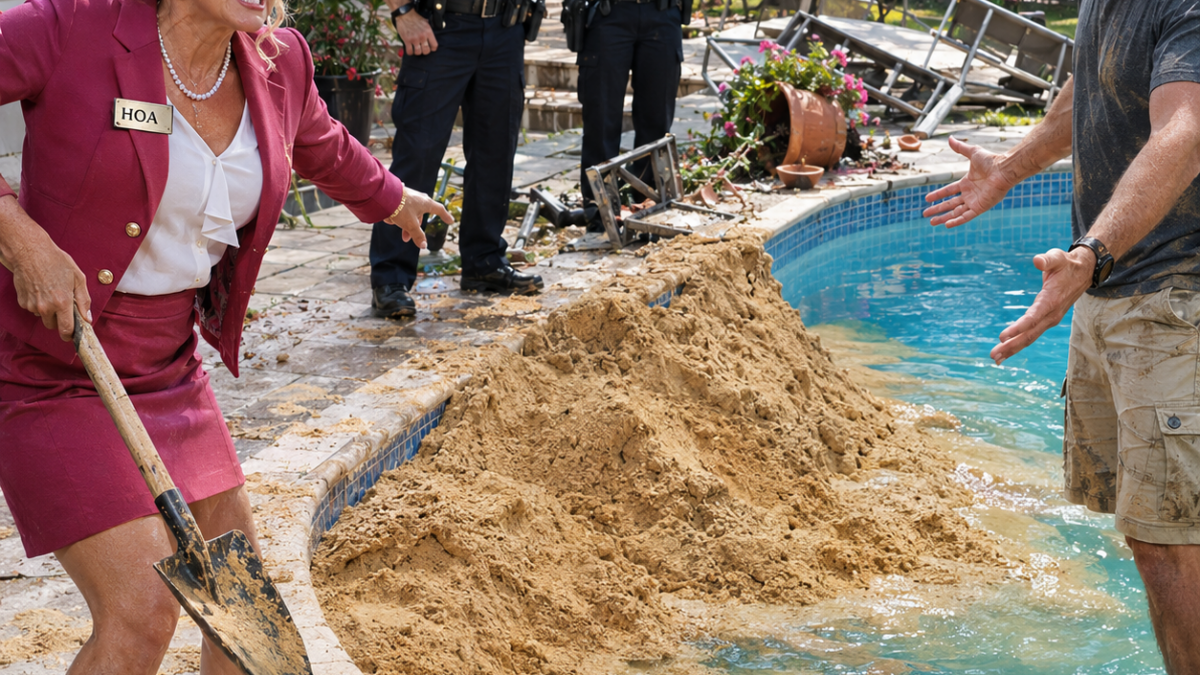
Where blue water had been three days earlier, there was now a pale gray mound.
Sand.
Tons of it.
Filled to the top.
Higher than the edge in places.
Spilling into the landscaping.
The pool liner had buckled.
One side of the safety fence bent inward.
A small decorative wall had cracked.
My patio had tracks across it.
A lounge chair had been shoved against the fence.
I stood there with one hand still holding the gate.
There are moments when anger arrives so fast it almost feels like panic.
This wasn’t like that.
My anger was cold.
My breathing slowed.
My hands began shaking.
I walked toward the pool.
Touched the sand.
It was real.
Someone had brought machinery onto my property while I was gone.
Someone had driven through my lawn.
Entered my fenced backyard.
And destroyed a swimming pool.
Not because of an emergency.
Not because of an accident.
Because somebody wanted to prove they could.
I looked around.
No note.
No notice.
No paperwork.
Nothing.
Just destruction.
I pulled out my phone.
Took photographs.
Every angle.
The tracks.
Gate.
Fence.
Pool.
Sand.
Damage.
Then video.
Then more photographs.
Part of me wanted to march directly to her house.
Pound on the door.
Demand an explanation.
I pictured it so clearly.
Her standing there in those sunglasses.
That little smile.
I almost went.
Instead, I called an attorney I knew through work.
I explained what happened.
His first sentence was:
“Do not confront anyone tonight.”
That probably saved me from making the biggest mistake of my life.
“Photograph everything,” he said.
“I am.”
“Call police non-emergency and report property damage and possible trespass.”
I did.
An officer came out.
He walked the property slowly.
Looked at the tracks.
Looked at the pool.
Then looked at me.
“Someone filled this while you were away?”
“Yes.”
“Any contractors scheduled?”
“No.”
“Anybody with permission to enter?”
“No.”
“HOA?”
“I’ve been fighting with the president about this pool.”
His expression changed slightly.
“What kind of fight?”
“She claims it violates HOA rules. She ordered me to fill it in.”
The officer looked at the sand.
“She personally ordered this?”
“She told me I had thirty days.”
“Do you have it in writing?”
“Yes.”
“Keep that.”
I showed him the letters.
He photographed them.
He made a report.
But without proof of who had ordered the work, there wasn’t much he could do that night.
No contractor invoice.
No camera footage.
No confession.
Just a very obvious motive.
The next morning, neighbors began appearing.
Word had spread.
Tom from two houses down stood at the gate staring.
“My God.”
“Yeah.”
“They actually filled it?”
“Someone did.”
He looked toward the street.
“You know who.”
“I know who I suspect.”
Another neighbor joined us.
Then another.
People walked around the damage shaking their heads.
One woman covered her mouth.
“My kids were swimming here two weeks ago.”
I nodded.
Then I felt everyone go quiet.
She was standing across the street.
The HOA president.
Arms folded.
No golf cart.
No clipboard.
Just standing there watching.
I walked to the edge of my driveway.
She didn’t move.
For several seconds we stared at each other.
Then she said:
“Rules are rules.”
Every person near me heard it.
I felt something in me shift.
“Did you do this?”
Her eyebrows lifted.
“I don’t know what you’re talking about.”
“You’re looking at it.”
“I warned you there would be consequences.”
Tom stepped forward.
“You can’t destroy somebody’s property.”
She ignored him.
I looked at her.
“Did the HOA authorize contractors to enter my property?”
She smiled.
“If you have questions, submit them in writing.”
I wanted to cross the street.
Instead, I remembered my attorney’s voice.
Document.
Don’t react.
So I said:
“Thank you.”
Her smile disappeared.
“For what?”
“For saying that in front of witnesses.”
She looked around.
For the first time, she seemed to realize how many people were standing there.
Then she turned and walked away.
That was the day I stopped thinking of this as an HOA disagreement.
This was no longer about noise.
Mulch.
Trash cans.
Pool dimensions.
She had crossed into my private property and destroyed something valuable.
Whether she had personally driven the machine didn’t matter.
Someone had done it.
And she clearly wanted me to understand why.
I began collecting everything.
Every violation notice.
Every email.
Every fine.
Every board response.
Every photograph.
Every witness statement.
I requested HOA records.
I requested minutes.
I requested any contractor authorization involving my address.
The response was slow.
Then incomplete.
Then suddenly unavailable.
That interested me.
Meanwhile, I got estimates for repairing the pool.
The numbers made me sick.
Removing that much sand without causing further structural damage would be difficult.
The liner was ruined.
Plumbing might be compromised.
Fence replacement.
Landscaping.
Potential shell damage.
Tens of thousands.
I sent the estimates to the HOA.
No meaningful response.
The board claimed it had no knowledge of anyone entering my property.
The president claimed I was making accusations without evidence.
She even issued another violation against me.
For the damaged lawn.
I am not exaggerating.
The tire tracks created by whoever destroyed my pool had torn up the grass, and she cited me because my lawn was no longer maintained to neighborhood standards.
When I opened that letter, I laughed.
Not because it was funny.
Because there are moments when the human brain simply refuses to process a level of absurdity any other way.
Then something happened that had nothing to do with the pool.
At least, that’s what I thought at first.
A few weeks later, I noticed a black sedan parked in her driveway.
I didn’t recognize it.
Her husband drove a pickup.
I wouldn’t normally care who visited somebody’s house.
But I saw the same sedan again.
Then again.
Always when her husband’s truck wasn’t there.
One afternoon I happened to be outside and saw her through the front window with a man I had never seen before.
They were close.
Too close to mistake.
I looked away.
My first thought wasn’t triumph.
It was:
*That’s none of my business.*
Then I thought about the pool.
The fines.
The way she had stood across the street and said, “Rules are rules.”
Anger makes ugly ideas feel reasonable.
For several days, I wrestled with whether to do anything.
Eventually, I documented what I had seen.
Carefully.
No confrontation.
No public humiliation.
I sent the information anonymously to her husband.
Then I stepped away.
I wish I could say I did it because he deserved to know.
Maybe part of me believed that.
But if I’m being truthful, revenge was in there too.
I wanted her to feel what it was like to lose control of something personal.
Three months later, the neighborhood exploded.
Not literally.
Emotionally.
Arguments from their house became impossible to ignore.
His belongings appeared near the garage.
A moving truck came.
One afternoon, half the street heard them screaming.
She stood on the front lawn crying while he loaded boxes into his truck.
The woman who had spent months walking through Willow Ridge like she owned every blade of grass suddenly looked very small.
I watched from inside my house.
And the satisfaction I expected never really came.
Instead, I felt uneasy.
I had wanted consequences.
What I was watching was pain.
Real pain.
Messy pain.
It didn’t restore my pool.
It didn’t fix my lawn.
It didn’t make me feel safer in my own home.
But the divorce changed her.
Whatever restraint she had left disappeared.
The fines became relentless.
Not just against me.
Against everybody.
Dirty car.
Trash bin timing.
Parking angle.
Fence appearance.
Temporary decorations.
A child’s basketball hoop.
A trailer in a driveway for one afternoon.
She seemed to find violations where nobody had ever seen violations before.
The monthly HOA fee increased.
No clear explanation.
Residents started asking questions.
The board gave vague answers about rising maintenance costs.
People complained at meetings.
Nothing changed.
Then someone noticed a number.
That was how everything really began to fall apart.
One of our neighbors, Mark, worked in accounting.
He was the kind of guy who couldn’t look at a restaurant bill without checking whether the math was right.
He came to my house one evening carrying a folder.
“I think something is wrong.”
I invited him in.
He opened several HOA financial statements on my kitchen table.
“This maintenance line.”
“What about it?”
“It jumped almost forty percent.”
“Everything got more expensive.”
“Not like this.”
He pointed.
“Look here.”
Payments to a landscaping vendor.
Then more payments.
Then another.
“These amounts repeat.”
“Maybe monthly contracts.”
“Different descriptions.”
I leaned closer.
One claimed irrigation repair.
Another claimed emergency landscaping.
Another claimed drainage maintenance.
“Did we have drainage work?”
“I don’t remember any.”
Neither did I.
We started asking neighbors.
Nobody remembered seeing crews for several of the projects.
Then another homeowner joined us.
Then another.
One woman had bookkeeping experience.
She requested more records.
The HOA stalled.
That made everyone more curious.
Meetings became crowded.
The board tried to calm people.
The president became defensive.
“You’re creating conspiracy theories.”
Mark stood with a spreadsheet.
“These are your own numbers.”
“The financials are complicated.”
“Then explain them.”
“You don’t understand association accounting.”
“I’m a CPA.”
That got a laugh.
She didn’t appreciate it.
Another resident asked why dues had increased.
Another asked why fines were being issued at unprecedented levels.
Another asked why certain vendors had been paid without competitive bids.
Then I stood.
“I want to know who filled my pool.”
The room went quiet.
Her expression hardened.
“That matter has been addressed.”
“No, it hasn’t.”
“The association has no record of authorizing work at your property.”
“Then someone trespassed.”
“That’s a police matter.”
“I filed a police report.”
“Good.”
She smiled.
“Then let the police handle it.”
I looked around the room.
“You heard her.”
She stared at me.
“We should.”
That night, several of us stayed after the meeting.
Mark spread paperwork across a table.
“What if the pool wasn’t an HOA action?”
I looked at him.
“What do you mean?”
“What if she arranged it personally?”
“With what money?”
He didn’t answer.
He didn’t need to.
We started looking more carefully.
There were payments that didn’t make sense.
Small enough not to stand out alone.
Large enough to matter together.
Vendor names connected to addresses that looked residential.
Invoices with vague descriptions.
Maintenance expenses for work nobody had seen.
Reimbursement checks.
Association credit card charges.
One charge at a home improvement store on the weekend my pool was filled.
That caught my attention.
“Could be anything,” Mark warned.
“I know.”
“Don’t jump yet.”
We didn’t.
That became our rule.
No assumptions.
No public accusations.
Just documents.
For months, we gathered records.
Tedious records.
Boring records.
Bank statements.
Invoices.
Meeting minutes.
Vendor registrations.
Budget reports.
Reimbursement forms.
Every time we found something strange, we verified it before adding it to the pile.
And slowly, a pattern emerged.
Money was leaving the association in ways that didn’t line up with legitimate expenses.
Some payments were going toward personal purchases.
Some vendor work appeared inflated.
Some reimbursements had no documentation.
The aggressive fines suddenly made more sense.
So did the rising dues.
After the divorce, she had kept the house.
The house was expensive.
Her lifestyle hadn’t changed.
But her household income had.
The HOA wasn’t just a source of authority anymore.
It appeared to have become a source of money.
When we finally returned to the board, we didn’t bring anger.
We brought spreadsheets.
Mark connected his laptop to the room’s screen.
The president sat at the head of the table.
Same seat.
Same posture.
But the room was different now.
Every chair was occupied.
People stood along the walls.
Mark began.
“Over the last eighteen months, association expenses increased significantly beyond the approved budget.”
She interrupted.
“Costs increased everywhere.”
Mark clicked.
“Agreed. So we compared categories.”
Numbers appeared.
“Landscaping increased sixty-two percent.”
Another slide.
“Administrative reimbursements more than doubled.”
Another.
“Emergency maintenance expenses increased four hundred percent.”
Someone behind me whispered:
“Jesus.”
She crossed her arms.
“This presentation is irresponsible.”
Mark continued.
“We identified invoices for projects residents cannot verify.”
“You are not auditors.”
“No.”
He looked toward the board.
“That’s why we’re asking for an independent audit.”
The president leaned forward.
“An audit would cost the association thousands.”
A woman near the back called out:
“Then stop stealing from us.”
The room erupted.
The president slammed her hand on the table.
“Enough!”
For years, that voice had silenced people.
Not anymore.
Nobody stopped.
Residents shouted about fines.
Fees.
Threats.
Selective enforcement.
One man held up a stack of violation letters.
Another woman talked about being fined while caring for her sick mother.
Tom described citations for his work truck.
Then I spoke.
“My pool was destroyed while I was out of town.”
She looked at me.
“You have no proof I had anything to do with that.”
“I didn’t say your name.”
The room went quiet.
Her face changed.
I continued.
“But I want every HOA payment, reimbursement, contractor invoice, and maintenance expense from that week reviewed.”
One board member finally spoke.
“That’s reasonable.”
She turned on him.
“No, it isn’t.”
He looked surprised.
“Why not?”
“Because this is harassment.”
The irony was almost painful.
Mark closed his laptop.
“Then approve the audit.”
She refused.
That refusal probably hurt her more than anything else.
People who had been uncertain became suspicious.
People who had been suspicious became angry.
And people who had been afraid stopped being afraid.
A week later, we went to her house.
Not a mob.
Not violence.
Just homeowners.
A lot of us.
We stood on the lawn she kept trimmed within an inch of perfection.
She opened the door.
Looked at the crowd.
And smiled.
That same smile.
“I assume this is about the audit.”
“We want financial records released.”
“You have access to whatever the bylaws require.”
“We want an independent review.”
“No.”
“Why?”
“Because I’m within my rights.”
Mark said:
“You’re hiding something.”
Her eyes flashed.
“If you believe I’ve broken a law, take it up with the law.”
Silence.
Then she started closing the door.
I put my hand up—not touching the door, just enough to stop myself from speaking too quickly.
“You’re sure that’s what you want?”
She looked directly at me.
“Yes.”
Then she shut it.
So we took it up with the law.
The police had already documented my pool damage months earlier.
Now we brought financial evidence.
Not rumors.
Not neighborhood gossip.
Documents.
The first meeting with investigators was almost disappointingly normal.
No flashing lights.
No dramatic music.
A conference room.
Two officers.
Mark.
Me.
Three other homeowners.
Boxes of records.
One investigator asked:
“How did you obtain these?”
“Association records available to members.”
“Any illegally accessed accounts?”
“No.”
“Any stolen documents?”
“No.”
He nodded.
“Good.”
Then he started going through everything.
Hours passed.
He asked questions.
Dates.
Amounts.
Names.
Vendor relationships.
Board approvals.
I explained the history.
The fines.
The harassment.
The pool.
The officer stopped me.
“You believe the pool incident is connected financially?”
“I don’t know.”
“That’s the right answer.”
He looked at me.
“Don’t guess.”
“I won’t.”
They took copies.
Then nothing happened.
At least not publicly.
A week.
Two weeks.
A month.
The HOA president seemed almost energized.
She drove her golf cart again.
Issued new notices.
Attended meetings.
Acted as though the investigation was imaginary.
For a while, I wondered whether we had been wrong.
Maybe the financial irregularities had explanations.
Maybe she was terrible, but not criminal.
Maybe I had allowed anger to make me see a pattern that wasn’t there.
Then investigators requested additional records.
Then bank information.
Then vendor interviews began.
One contractor admitted billing the HOA for work that had never been performed as described.
Another payment went to an account linked to someone personally connected to her.
Receipts showed personal expenses reimbursed through association funds.
The numbers grew.
Thousands.
Then more thousands.
And eventually, the pool came back into the story.
Investigators located a contractor who had delivered sand.
He remembered the job.
Hard not to remember, apparently.
A residential swimming pool being intentionally filled with sand wasn’t routine.
He had been told the property owner had approved the work.
He had been given access.
And the payment?
It had been connected to association funds through a vaguely labeled maintenance expense.
When I learned that, I sat at my kitchen table for a long time without speaking.
For months, I had known.
Emotionally, I had known.
But knowing and proving are different things.
She had used money paid by homeowners to destroy a homeowner’s property.
My pool.
My lawn.
My fence.
Then she had cited me for the lawn damage.
There are things so vindictive you almost admire the effort required to become that unreasonable.
Almost.
The day the police came to her house, I wasn’t home.
I was at work.
Tom texted me.
**You need to see this.**
Then another message.
**Police are at her house.**
Then a photo.
Two cruisers.
Another unmarked vehicle.
Neighbors standing at windows.
I stared at the image on my phone.
My heart began beating faster.
Not excitement exactly.
Release.
I left work early.
By the time I reached Willow Ridge, one cruiser remained.
People were outside.
Nobody needed to ask what happened.
Everyone already knew.
“She was taken in.”
“For questioning?”
“More than questioning.”
Someone said investigators had removed boxes.
Another said she had been escorted to the car.
No sunglasses.
No clipboard.
No golf cart.
Just a woman in ordinary clothes walking past the same neighbors she had spent years controlling.
I didn’t cheer.
Nobody did.
That mattered to me.
For all the anger, nobody celebrated like a sports team.
We mostly stood there quietly.
Because the sight was bigger than revenge.
We were watching authority collapse.
A week later, her face appeared on local television.
Former HOA president.
Financial crimes.
Misuse of association funds.
Extortion allegations related to retaliatory fines.
Harassment.
Embezzlement.
More details came out.
Years of questionable transactions.
Personal purchases.
Selective enforcement.
Payments manipulated through association accounts.
Money taken from people who had trusted the board to manage it.
Residents who had been fined began reviewing old notices.
Attorneys got involved.
Insurance got involved.
The HOA board suddenly discovered a passion for transparency that would have been useful several years earlier.
She resigned.
Technically, by that point, resignation was the least of her problems.
The criminal case moved faster than I expected because the documentation was overwhelming.
She had apparently believed small amounts scattered across years would stay invisible.
Maybe they would have if she hadn’t pushed everyone so hard.
That was the irony.
If she had simply been mildly corrupt and moderately unpleasant, she might have continued indefinitely.
But she couldn’t stop.
She needed more money.
More fines.
More control.
More retaliation.
She filled my pool with sand because I refused to surrender.
That act was so outrageous it turned private frustration into collective attention.
Once the neighborhood started looking, the money couldn’t hide.
The trial wasn’t the dramatic courtroom battle people imagine.
Most real legal proceedings aren’t.
Documents matter more than speeches.
Bank records matter more than shouting.
Dates.
Transactions.
Invoices.
Emails.
Authorizations.
The same kind of boring paperwork she had once used to intimidate homeowners became the thing that destroyed her defense.
I attended part of the proceedings.
She looked different.
Smaller.
That word kept coming back.
For years, she had seemed physically larger than she was because authority surrounded her.
Clipboard.
Title.
Board.
Rules.
Golf cart.
Fines.
Take those away and she was just a person sitting beside an attorney.
At one point, evidence relating to my property was discussed.
The sand delivery.
The payment.
The false description.
The access.
I felt my jaw tighten.
I had seen the damage hundreds of times.
But hearing it described in a courtroom made it real in a different way.
The prosecutor explained that association money had been used to pay for work on private property without the owner’s authorization.
Work that caused substantial damage.
My backyard became evidence.
The pool I had once floated in after work became a line item in a criminal case.
I looked at her.
She didn’t look back.
The verdict came without much surprise.
Guilty.
Multiple counts.
The final sentence amounted to six years in federal prison, along with restitution and financial penalties.
Her house eventually went into foreclosure when she could no longer maintain payments.
The Queen of Willow Ridge lost the kingdom.
I thought that would feel incredible.
For a few minutes, it did.
Then mostly I felt exhausted.
Years of tension don’t disappear because a judge speaks.
Your body doesn’t instantly understand that the danger is over.
For months after she was gone, I still checked my mailbox expecting violation letters.
I still looked toward the street when I heard a golf cart.
I still inspected my garbage cans like somebody was grading me.
That is what constant harassment does.
It changes the way you exist inside your own home.
Slowly, Willow Ridge began changing back.
The board was reorganized.
Financial controls were put in place.
Independent audits became routine.
Major spending required more than one signature.
Homeowners received clearer financial reports.
The new HOA president was a retired schoolteacher.
Quiet woman.
Patient.
The first time I saw her at a board meeting, somebody complained loudly about a parking issue.
She listened.
Actually listened.
Then she opened the bylaws.
Read the relevant rule aloud.
Asked questions.
Suggested a reasonable solution.
No threat.
No power performance.
No “I’m the president.”
I remember sitting there thinking:
*So this is what normal looks like.*
The ridiculous fines stopped.
Old cases were reviewed.
Some homeowners received refunds.
Some penalties were canceled.
Rules didn’t disappear.
They just became rules again instead of weapons.
And then there was my pool.
As part of the restitution and settlement process, the HOA’s insurance and available restitution funds covered restoration.
Watching the sand come out felt almost as surreal as seeing it there the first time.
Workers arrived with proper equipment.
This time, they had my permission.
Load after load disappeared.
The damaged liner came out.
Repairs were made.
Plumbing inspected.
Fence replaced.
Landscaping restored.
For weeks, my backyard looked like a construction site.
Then one afternoon, the new liner went in.
Water began flowing.
I stood beside the pool watching it slowly fill.
Blue returned inch by inch.
At first just enough to cover the bottom.
Then deeper.
Then halfway.
The pool I had thought was permanently destroyed began looking like itself again.
That evening, after the workers left, I sat on the edge.
The underwater lights were on.
The surface shimmered.
No party.
No neighbors.
No music.
Just me.
I put my feet into the water.
For a long time, I didn’t move.
I remembered the night I came home from the airport.
The tire tracks.
The broken gate.
The pale sand piled where the water should have been.
I remembered standing there unable to understand how another adult could believe she had the right to do that.
Then I remembered her across the street.
Arms folded.
“Rules are rules.”
I looked at the restored pool.
And for the first time, I understood what satisfaction actually felt like.
It wasn’t seeing her arrested.
It wasn’t her divorce.
It wasn’t the prison sentence.
It wasn’t the foreclosure.
Those things were consequences.
Some deserved.
Some personal.
Some painful.
But the real victory was sitting beside something she had tried to erase.
She wanted the pool gone.
It was back.
She wanted me intimidated.
I was still there.
She wanted neighbors isolated and afraid.
They had become organized.
She used the HOA as a tool for control.
The community took it back.
That was enough.
Tom came over a few days after the pool reopened.
He stood by the fence.
“Looks good.”
“Better than a sandbox.”
He laughed.
“Kids want to know when you’re having another pool party.”
I stared at him.
“You’re kidding.”
“Nope.”
I thought about the last one.
Her walking through the gate.
Thirty days.
The humiliation.
Everything that followed.
Part of me wanted to say never.
Then I realized that would mean she still controlled something.
So two weeks later, I invited the neighbors over.
Not everybody.
Enough.
Kids splashed.
Adults grilled burgers.
Someone brought watermelon.
Almost exactly like that afternoon years earlier.
At five o’clock, music played from the same type of little Bluetooth speaker.
I noticed the time.
Five.
I laughed to myself.
Tom saw me.
“What?”
“Nothing.”
Then a vehicle slowed near my house.
For half a second, my stomach tightened.
Old reflex.
It was the new HOA president.
She waved.
I waved back.
She kept driving.
That tiny moment meant more to me than it probably should have.
Nobody stopped.
Nobody inspected.
Nobody demanded silence.
People were simply allowed to live.
Later that evening, after most families had gone home, the retired teacher who now headed the association stayed for a few minutes.
She stood near the pool.
“I’m sorry.”
I looked at her.
“For what?”
“What the association did to you.”
“You didn’t do it.”
“I know.”
She looked at the water.
“But institutions are more than the people currently in charge. The association failed.”
I appreciated that.
Nobody from the old board had ever really said it that clearly.
“She abused the authority,” I said.
“Yes.”
“And people let her.”
The teacher nodded.
“So did the board.”
I thought about that.
For a long time, I had seen one villain.
The president.
And she deserved responsibility.
But power like hers rarely grows alone.
It grows because people stop questioning it.
Board members didn’t challenge her.
Residents paid fines quietly.
I paid some too.
People whispered warnings to newcomers rather than forcing change.
Everyone was trying to survive individually.
That allowed her to dominate collectively.
The teacher said:
“We’re adding a rule that no president can authorize property access or contractor work without documented owner consent or legal authority.”
I laughed.
“Seems obvious.”
“You’d be amazed how many rules exist because somebody once proved they were necessary.”
I looked at the pool.
“Fair point.”
She left.
The backyard became quiet again.
I sat there until the lights reflected across the water.
I thought about the anonymous information I had sent her husband.
That part still bothered me.
Not because I suddenly felt sympathy for everything she had done.
But because revenge had pulled me somewhere I didn’t particularly like.
When she destroyed my pool, I wanted her hurt.
Not legally accountable.
Hurt.
There is a difference.
I had found a private weakness and used it.
Her marriage collapsed.
Maybe it would have collapsed anyway.
Probably.
But I had pushed the first domino.
For a while, I told myself it was justice.
I’m less certain now.
What actually defeated her wasn’t revenge.
It was accountability.
Evidence.
Neighbors speaking together.
Bank records.
Police.
Courts.
Those things mattered.
The personal retaliation had only added more pain to a situation already drowning in it.
If I could go back, would I still tell her husband?
I don’t know.
I’m not going to pretend I became morally perfect because I survived an HOA nightmare.
Anger changes you.
Being harassed changes you.
Coming home to see your property deliberately destroyed can make revenge feel like oxygen.
But there is one thing I know now that I didn’t know then.
The strongest revenge wasn’t what happened to her marriage.
It was uncovering the truth she believed nobody would ever find.
Because truth didn’t just hurt her.
It fixed something.
The money stopped disappearing.
People got refunds.
Financial controls changed.
The pool was restored.
The neighborhood became healthier.
That is different from simply watching someone suffer.
About a year after everything ended, I found an old HOA violation letter in a drawer.
Lawn edging.
Half an inch.
I held it for a second.
The paper looked ridiculous now.
At the time, it had made me angry for an entire weekend.
I had measured the lawn.
Taken photographs.
Written an appeal.
Lost sleep over whether another fine would follow.
Now it was just paper.
I almost threw it away.
Instead, I kept it.
Not because I wanted to stay angry.
Because I wanted to remember how easy it is for official-looking nonsense to become powerful when nobody pushes back.
Authority doesn’t always arrive with uniforms and courtrooms.
Sometimes it arrives in a golf cart.
Sometimes it carries a clipboard.
Sometimes it sends a letter telling you your bush is the wrong shade of green.
Small power can become dangerous precisely because it looks too silly to take seriously.
Until someone destroys your property.
Until money disappears.
Until neighbors start living in fear of their own mailboxes.
That was Willow Ridge’s mistake.
We laughed about the queen.
We warned each other quietly.
We treated her behavior like annoying weather.
Something you complained about but couldn’t change.
She counted on that.
The first time she fined a neighbor unfairly and everyone stayed silent, she learned something.
The second time, she learned more.
Every unchallenged demand made the next one easier.
By the time she ordered my pool filled, she no longer seemed to understand the difference between enforcing a rule and issuing a command.
And maybe that was why she stood across the street the next morning looking satisfied.
In her mind, she hadn’t committed vandalism.
She had enforced compliance.
That is what unchecked authority can do to people.
It doesn’t simply make them cruel.
Sometimes it convinces them cruelty is responsibility.
Years later, I still live in that house.
People ask me why.
They assume I would want to leave.
For a while, I did.
I looked at listings.
Considered selling.
Thought about moving somewhere without an HOA.
But every time I seriously considered leaving, I became angry.
Why should I go?
I hadn’t done anything wrong.
The house was mine.
The backyard was mine.
The pool was mine.
Leaving because somebody had made me miserable felt like letting her make one final decision about my life.
So I stayed.
The lawn recovered.
The gate was replaced.
The landscaping grew back.
There is no trace of the heavy machinery anymore.
If you visited today without knowing the story, you would never guess that tons of sand once sat where clear water now reflects the sky.
But I know.
Sometimes, when I swim alone late in the evening, I stop in the middle and float.
I hear nothing except water against the sides.
No sirens.
No apartment neighbors.
No clipboard.
No golf cart.
Just quiet.
The quiet I thought I was buying when I first moved there.
It took years to finally get it.
One summer evening, I was floating on my back when I heard laughter from the house next door.
A family had recently moved in.
Their kids were playing.
Music was coming from the patio.
A little louder than mine had been at that first housewarming party.
I smiled.
A few minutes later, the father looked over the fence.
“Hey, is this too loud?”
I listened.
“No.”
“You sure?”
“Absolutely.”
He gave me a thumbs-up.
Then he disappeared.
I stayed in the water.
That simple exchange almost made me emotional.
He asked.
I answered.
That was it.
No authority.
No threat.
No paperwork.
Just neighbors respecting each other.
It should never have been complicated.
Willow Ridge eventually stopped being known for the scandal.
New people moved in.
Old people left.
Children grew.
Houses were renovated.
The story became one of those neighborhood legends people told at parties.
New residents sometimes heard a ridiculous version.
“They say the old HOA president filled someone’s swimming pool with sand.”
Then someone would point toward my house.
“That one.”
Occasionally, a new neighbor would ask me directly.
“Did that really happen?”
I would look toward the backyard.
“Unfortunately.”
“What did you do?”
That question always made me pause.
Because there were two answers.
The first was the dramatic one.
I fought back.
We investigated.
Police got involved.
She went to prison.
The pool was restored.
But the more important answer was less exciting.
We finally stopped being afraid separately.
That changed everything.
One person alone could be dismissed as difficult.
Ten people could be called complainers.
But an entire community with documents?
That was harder to ignore.
Her power had depended on people believing they were isolated.
I thought I was the only one being targeted.
Tom thought he was the only one.
The retired woman thought her holiday fine was just her problem.
Other families had their own stories.
Nobody compared notes.
The moment we did, the pattern became visible.
That is what she never expected.
Not the police.
Not the audit.
Not even the trial.
She never expected us to talk to each other.
For someone obsessed with controlling a community, she had forgotten what a community actually was.
Years after her conviction, I received a check in the mail.
Not enormous.
Restitution distribution.
A portion related to damages and misused HOA funds.
I held it for a while.
Money felt strange after everything.
No amount could reimburse the stress.
The nights reading bylaws.
The arguments.
The humiliation.
The feeling of walking into my own backyard and seeing it destroyed.
Still, I deposited it.
Then I used part of it to buy something completely unnecessary.
A new set of outdoor speakers.
Better than the old Bluetooth one.
Nothing ridiculous.
Just good speakers for the patio.
The first time I turned them on, I kept the volume reasonable.
It was around five in the afternoon.
That detail was intentional.
I sat beside the pool with a drink.
Music played.
The sun was still high.
No golf cart arrived.
No violation appeared.
Nobody told me I was undermining community standards.
I sat there smiling like an idiot.
Sometimes freedom is dramatic.
Sometimes it’s playing music in your own backyard at five o’clock without wondering who is coming to punish you.
The experience changed the way I think about power.
Not huge political power.
Not presidents or governments.
Ordinary power.
The manager who controls schedules.
The board member who signs letters.
The administrator who approves requests.
The neighbor with a title.
Most people handle small authority normally.
Some people use it to help.
Some simply do the job.
But for certain people, being able to tell another human being “no” becomes addictive.
Then the rule stops being the reason.
The ability to enforce the rule becomes the reason.
That was her.
At first, maybe she genuinely cared about Willow Ridge.
I can believe that.
Maybe she wanted clean streets.
Maintained houses.
Stable property values.
Then somewhere along the way, maintaining standards became controlling people.
Controlling people became punishing resistance.
And once her personal life collapsed and money became tight, punishment and profit started feeding each other.
The system didn’t stop her early.
So she kept going.
Until she went so far that nobody could ignore her anymore.
That mountain of sand was supposed to end the argument.
In a way, it did.
Just not how she expected.
Before the pool was destroyed, I was exhausted.
I was paying some fines.
Choosing my battles.
Trying to avoid her.
After the pool, avoiding her was impossible.
The destruction forced me to document everything.
Forced neighbors to pay attention.
Forced people to ask whether she actually had the authority she claimed.
And eventually forced us to look at the association’s money.
If she had left my pool alone, maybe nobody would have investigated.
Maybe the missing funds would have continued for years.
That thought still amazes me.
She destroyed my pool to prove her control.
Instead, she destroyed the one thing protecting her:
our indifference.
That may be the most satisfying part of the entire story.
Not that she lost.
That she created the conditions for her own exposure.
She could have walked away.
At dozens of moments.
She could have dropped the first noise fine.
She could have stopped harassing me.
She could have ignored the pool.
She could have obeyed financial controls.
She could have stepped down after the divorce.
She could have accepted the audit.
At every turn, there was an exit.
She refused all of them.
Because backing down would have required acknowledging that other people had boundaries.
And that was the one thing she never learned until the law taught it to her.
The last time I saw her in person was during the trial.
No sunglasses.
No clipboard.
No polished certainty.
She was leaving the courtroom with her attorney.
For one second, our eyes met.
I expected anger.
Maybe hatred.
What I saw was exhaustion.
The same kind I had felt for years.
She looked away first.
I didn’t say anything.
There was nothing left to say.
She already knew.
The pool was never hers to destroy.
The money was never hers to take.
The neighborhood was never hers to rule.
The authority she had been given was temporary, limited, and conditional.
She had confused stewardship with ownership.
And that mistake cost her almost everything.
I drove home after the final sentencing and parked in my driveway.
It was warm.
I walked straight through the house and into the backyard.
The water was still.
Late sunlight reflected across the surface.
For a minute, I stood exactly where I had stood the night I came home from that business trip.
Back then, there had been sand.
Broken fencing.
Mud.
Tire tracks.
Rage.
Now there was water again.
I sat down.
Took off my shoes.
Put my feet in.
Nothing dramatic happened.
No celebration.
No speech.
Just ripples moving away from my ankles.
And that felt perfect.
Because after everything, I didn’t need another battle.
I needed my home back.
I finally had it.
She once told me rules were rules.
She was right about one thing.
Rules do matter.
So do property lines.
Contracts.
Financial laws.
Consent.
Fraud statutes.
The rules she liked were the ones she could use against other people.
The rules that finally stopped her were the ones she thought would never apply to her.
That is the irony I will probably carry with me forever.
She buried my pool beneath tons of sand because she wanted me to understand that she had power over my home.
Years later, the pool is full again.
The neighborhood is peaceful.
The HOA is accountable.
And the only thing she truly managed to bury was herself.








