PART 2: MY FOSTER DOG RAN THREE MILES THROUGH A THUNDERSTORM—BACK TO THE POST WHERE SOMEONE HAD LEFT HIM TO DI3
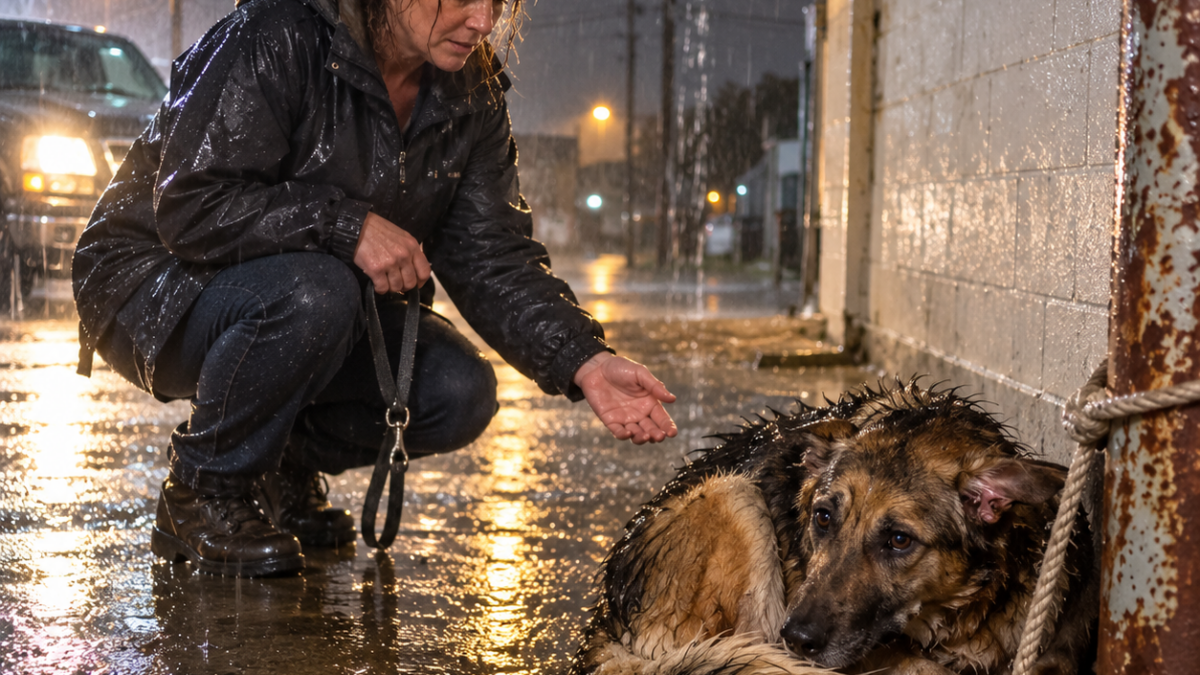
On his sixth night in my house, Chance tore free from my yard and ran three miles through a thunderstorm to the exact metal post where someone had once tied him and walked away. I found him there just before three in the morning, soaked to the bone, shaking beside a piece of frayed rope that still hung from the post. I thought I understood why he had run until I saw what he did when I tried to take him home.
Rain poured from the broken gutters of the abandoned laundromat.
My headlights swept across cracked pavement, weeds and boarded windows before catching a pair of eyes near the back wall.
“Chance!”
He didn’t run.
He didn’t come toward me either.
He was curled beside a rusted metal post, his thin body pressed against the concrete as if he had been waiting there.
A short piece of dirty rope was tied around the base.
My stomach turned.
I stepped out of the car holding his leash.
“Hey, buddy.”
Chance lifted his head.
His ears flattened.
The torn edge of his left ear trembled in the wind.
I had known him six days.
Six days.
And somehow I was standing three miles from my house in the middle of a storm, looking at a dog who had fought desperately to return to the worst place he had ever known.
Six days earlier, I had only gone to the shelter to donate blankets.
That was all.
Three old blankets were sitting in my trunk. I planned to carry them inside, thank whoever took them and drive home.
Megan stopped me near the front desk.
“You still working nights?”
“Unfortunately.”
She looked exhausted.
Behind her, dogs barked from the kennel hallway.
“We’re packed.”
“I’m sorry.”
“Everybody’s sorry.”
There was no bitterness in her voice, only fatigue.
She explained that more dogs were arriving than leaving. Some families had lost housing. Some landlords had changed pet policies. Some people had lost jobs. Others simply surrendered animals they could no longer keep.
I didn’t want details.
At forty-six, I had spent several years making my life deliberately small.
After my marriage ended, I stopped expecting much from people.
I worked overnight shifts at a warehouse, came home before sunrise, reheated whatever was in my freezer and fell asleep with the television on.
Quiet had become predictable.
Predictable felt safe.
Then Megan said, “I have one dog who could really use seven days somewhere quiet.”
“No.”
“You haven’t seen him.”
“I don’t need to.”
She gave me a look.
Ten minutes later, I was standing outside Chance’s kennel.
He was a shepherd mix, around four years old.
He looked older.
His ribs showed beneath his dull coat. One ear had a torn edge. Around his neck was a pale ring where the fur had never grown back correctly.
He didn’t bark.
He didn’t approach.
He turned his face toward the wall.
“We found him tied behind an abandoned laundromat,” Megan said quietly.
“With that mark around his neck?”
She nodded.
“How long?”
“We don’t know.”
I stared at him.
“We need someone to foster him for a week,” she said. “He’s shutting down here.”
“I work nights.”
“He mostly sleeps.”
“I don’t know anything about traumatized dogs.”
“You don’t have to fix him, Grace.”
She looked through the bars.
“Just give him somewhere quiet.”
I should have left.
Instead, I heard myself say, “Seven days.”
The first night, Chance refused to eat while I was in the room.
I put his bowl down.
He stayed in the hallway staring at it.
I moved to the living room.
Nothing.
Finally, I went upstairs.
Nearly an hour later, I heard the bowl scrape softly across the kitchen floor.
By morning, every piece of food was gone.
Chance was sleeping beside the back door with his face pointed toward the exit.
He didn’t understand toys.
When I rolled a tennis ball toward him, he flinched.
If I reached above his head, he dropped flat.
If I stood behind him in a doorway, he refused to pass through.
On the second night, I heard his nails outside my bedroom.
I opened the door.
Chance stood there.
“You can come in.”
He didn’t move.
I went back to bed and left the door open.
When I woke, he was lying on the hallway floor just beyond the threshold.
Close enough to see me.
Too afraid to enter.
Then, on the third day, I dropped a broom.
Chance slammed into a chair, scrambled backward and bared his teeth.
A low growl came from his throat.
For one second, I was afraid of him.
I called Megan immediately.
“I can’t do this.”
“Did he come toward you?”
“No.”
“Did he bite?”
“No.”
“Then he wasn’t fighting you,” she said. “He was fighting something he remembered.”
Three nights later, thunder rolled over my house.
Chance hit the back gate hard enough to snap the old latch.
By the time I reached the yard, he was gone.
And hours later, when I finally clipped the leash onto him beside that rusted post, Chance did something I never expected.
He planted all four feet against the pavement and refused to leave.
PART 2
“Chance.”
Rain ran down my face and into my mouth.
He stared at me.
“Come on, buddy. We’re going home.”
The leash tightened.
Chance lowered himself until his chest nearly touched the pavement.
I stopped pulling.
“Okay.”
Lightning flashed behind the abandoned laundromat.
Chance flinched so hard his whole body jerked.
The thunder came two seconds later.
He scrambled toward the metal post.
Not away from it.
Toward it.
He pressed himself against the rusted pole and lowered his head.
I stared at him.
The frayed rope beside him slapped against the concrete in the wind.
Then I understood something that made my chest hurt.
Chance had not come back because he loved this place.
He had come back because terror had sent him to the last place his frightened mind understood.
The place where suffering had become familiar.
I crouched several feet away.
“All right.”
Chance watched me.
“I’m not dragging you.”
Another burst of thunder rolled over us.
He trembled.
I sat down on the wet pavement.
It was ridiculous.
Three in the morning.
Forty-six years old.
Soaked through my sweatshirt.
Sitting behind an abandoned laundromat talking to a dog who had known me less than a week.
“You want to stay here for a minute?”
Chance’s ears moved.
“Fine.”
I put the leash loosely on the ground between us.
“But I’m staying too.”
We sat there in the rain.
For ten minutes, maybe fifteen.
I stopped checking.
Cars passed on the road beyond the building.
Water rushed along the curb.
The laundromat sign creaked over our heads.
Chance never took his eyes off me.
Eventually, I reached into my jacket pocket.
I had grabbed a bag of treats before leaving home.
I tossed one halfway between us.
Chance looked at it.
Then at me.
He did not move.
“I know.”
I tossed another one closer to him.
Nothing.
“You don’t trust food when someone is watching.”
His ears lifted slightly.
“That’s okay.”
I turned my face away.
A minute passed.
Then I heard a soft scrape.
When I looked back, the treat was gone.
I smiled.
“Good.”
Chance stared at me.
I tossed another.
This time he ate it while I watched.
That felt bigger than it should have.
After another ten minutes, I stood.
Chance immediately lowered himself.
“I’m not pulling.”
I walked two steps toward the car.
The leash remained loose.
Chance stayed beside the post.
I waited.
“Your choice.”
Lightning flashed again.
Chance looked toward the post.
Then toward me.
I took one more step.
His paw moved.
Then stopped.
“Come on.”
Another paw.
He was not walking to the car.
He was walking toward me.
There is a difference.
It took almost fifteen minutes to cross thirty feet of pavement.
When we reached the passenger side, I opened the door.
Chance backed away.
“Right. Cars.”
I sat on the edge of the seat.
“I forgot cars are terrible too.”
He stood in the rain staring.
I placed one treat on the floorboard.
Then another on the seat.
Chance stretched his neck.
One front paw touched the door frame.
He pulled it back.
“Take your time.”
Eventually he climbed in.
I did not celebrate.
I had already learned that excitement frightened him.
I closed the door gently.
Then I walked around the car, got behind the wheel and finally let myself breathe.
Chance sat pressed against the passenger door.
Water dripped from his fur.
I turned the heater on low.
For several minutes, neither of us moved.
Then I looked at the abandoned laundromat through the windshield.
“What happened to you here?”
Chance turned his head toward the window.
I drove home slowly.
He remained awake the entire trip.
When we turned onto my street, his breathing became faster.
That surprised me.
I had assumed going home would calm him.
It didn’t.
My house was still unfamiliar.
The laundromat was terrible.
But terrible and known can sometimes feel safer than kind and new.
When I opened the passenger door, Chance would not get out.
So I sat beside the car again.
The rain had softened.
“Here’s the deal,” I told him. “I have to work tomorrow night. And I’m too old to spend every morning sitting in parking lots negotiating with dogs.”
Chance blinked.
“I’m serious.”
Nothing.
“You’re making my life difficult.”
His ears moved.
I sighed.
“And apparently I’m okay with that.”
Eventually he stepped down.
The broken gate latch hung crooked against the fence.
I looked at it.
Chance looked too.
“I’ll fix that.”
He walked into the house.
Not happily.
But voluntarily.
That mattered.
By sunrise, he was asleep beside the back door.
I sat at my kitchen table and called Megan.
She answered on the third ring.
“Tell me you found him.”
“I found him.”
“Oh, thank God.”
“At the laundromat.”
Silence.
“The same laundromat?”
“Yes.”
“What was he doing?”
“Sitting beside the post.”
Megan exhaled slowly.
“Grace…”
“He ran three miles.”
“I know.”
“In a thunderstorm.”
“I know.”
“Why?”
“I was hoping you could tell me.”
Megan was quiet for a moment.
Then she said, “Trauma doesn’t always make sense from the outside.”
“He wanted to stay there.”
“That doesn’t mean he wanted what happened there.”
“I know that.”
“Do you?”
Her question annoyed me.
“Yes.”
“Because people misunderstand this all the time. Dogs go back to dangerous homes. People go back to dangerous relationships. Familiarity can feel safer than uncertainty.”
I looked toward Chance.
He was asleep with one paw over his nose.
“So what do I do?”
“Nothing dramatic.”
“That’s helpful.”
“I mean it. Keep things boring. Predictable. Same food. Same times. Same doors. Same voice.”
“What about thunderstorms?”
“We’ll work on that.”
I rubbed my forehead.
“And I need another gate latch.”
“That too.”
Then Megan said, “You’re still bringing him back tomorrow, right?”
The seven days.
I had almost forgotten.
Tomorrow was supposed to be Chance’s last day with me.
I looked toward him again.
He was still facing the back door.
“I don’t know.”
Megan did not say anything.
“I mean, he ran away.”
“True.”
“He growled at me.”
“Also true.”
“He doesn’t know how to play.”
“No.”
“He won’t even sleep in the same room.”
“All true.”
I waited.
Megan waited too.
“You’re very annoying,” I finally said.
“I’ve been told.”
“I’ll call you later.”
I hung up.
Chance opened one eye.
“This is your fault.”
He closed it.
That morning, instead of sleeping after my overnight shift, I drove to the hardware store.
I bought a heavy gate latch.
Then a second latch.
Then a chain.
Then I stood in the aisle staring at motion-sensor lights.
A store employee approached.
“Need help?”
“I have a foster dog.”
He waited.
“He’s an escape artist.”
“Ah.”
“Also afraid of everything.”
“Double ah.”
Twenty minutes later, I had enough hardware to secure a prison.
When I got home, Chance watched from the kitchen while I worked on the gate.
He never came outside.
That was fine.
Predictable.
Boring.
Megan’s words stayed with me.
I began thinking about Chance’s days as if I were building rails for a train.
Breakfast at seven.
Short walk at seven-thirty.
Quiet time.
Lunch treat.
Another walk.
Dinner.
No sudden changes if I could help it.
No reaching over his head.
No walking directly behind him.
No forcing doorways.
And thunderstorms became something we prepared for.
I made a small space in the downstairs bathroom.
No windows.
Blanket on the floor.
Fan for background noise.
I left the door open all the time.
For two days, Chance ignored it.
On the third day, I placed one treat just inside.
He ate it after I left.
The next day, I placed another farther inside.
Within a week, he was occasionally lying there by himself.
That was our first real victory.
The foster week ended.
Megan called.
“So?”
“So what?”
“You know what.”
“I think he needs more time.”
“How much?”
“I don’t know.”
“A second week?”
“Maybe.”
She paused.
“Okay.”
The second week became a third.
Chance began eating while I was in the kitchen.
Not beside him.
But in the same room.
One morning I dropped a spoon.
Chance jumped.
He ran into the hallway.
But he did not bare his teeth.
He stopped.
Looked back.
I stayed still.
“Just a spoon.”
He watched me pick it up.
Twenty seconds later, he returned.
I almost called Megan immediately.
Instead, I sat at the table pretending it was normal.
That became another lesson.
With Chance, celebration sometimes meant not making a big deal out of progress.
If he crossed a doorway, I did not clap.
If he ate from my hand, I did not squeal.
If he came closer, I did not reach.
I learned to let good things happen quietly.
That was difficult for me.
I had spent most of my life believing love meant doing.
Fixing.
Helping.
Talking.
Chance taught me that sometimes love means leaving enough empty space for someone else to make a choice.
On the eighteenth day, he entered my bedroom.
It happened at four in the morning.
I had come home from work exhausted.
Chance followed me upstairs, something he had only recently started doing.
I opened my bedroom door.
He stopped at the threshold.
Same place.
Same invisible line.
“You know the rules.”
I changed clothes.
Brushed my teeth.
Got into bed.
Chance remained outside.
I switched off the lamp.
Ten minutes later, I heard one step.
Then another.
I did not move.
His nails clicked softly across the floor.
He walked to the far side of the room.
Then lay down.
I stared into the darkness.
“Goodnight, Chance.”
His collar made a faint sound.
That was all.
In the morning, he was gone before I woke.
But he had crossed the line.
A week later, Megan asked if I wanted to officially extend the foster placement for a month.
“Yes.”
She laughed.
“What?”
“Nothing.”
“What?”
“You answered fast.”
“I have work.”
“Of course.”
She hung up still laughing.
I told myself it meant nothing.
Then came the first real piece of Chance’s past.
A man named Carl Dempsey called the shelter.
Megan contacted me immediately.
“Someone says he recognizes Chance.”
My stomach tightened.
“Who?”
“Former maintenance worker at the laundromat.”
I sat down.
“Does he know who owned him?”
“Maybe.”
“Maybe?”
“He says he saw the dog before.”
“When?”
“Several times.”
I looked toward Chance.
He was lying near the kitchen doorway.
“Give him my number.”
“Grace.”
“What?”
“Don’t turn this into something it isn’t.”
“What does that mean?”
“It means we don’t know anything yet.”
“I know.”
“You sound angry.”
“I am angry.”
“Exactly.”
I did not like being managed.
But Megan was right.
Carl called that evening.
His voice was rough, older.
“You’re the woman fostering that shepherd mix?”
“Yes.”
“I saw the picture the shelter posted.”
“You know him?”
“I think so.”
“From the laundromat?”
“Yeah.”
Carl explained that before the laundromat shut down, he had handled maintenance for the building and several businesses nearby.
A man named Wade Mercer sometimes came around.
He had lived in a rental house two blocks away.
Wade had a dog.
A shepherd mix.
Thin.
Nervous.
Often tied outside.
“Was his name Chance?”
“I never heard him call the dog anything except ‘dog.’”
My hand tightened around the phone.
Carl continued.
“The ear looked the same.”
“What happened to it?”
“I don’t know.”
“Did you ever see Wade hurt him?”
A pause.
“Not exactly.”
“What does that mean?”
“It means I saw enough to know the dog was scared of him.”
I closed my eyes.
“Why didn’t you report it?”
Another pause.
Longer.
“I should have.”
I said nothing.
Carl cleared his throat.
“Back then, I told myself it wasn’t my business.”
“It was a dog tied outside.”
“I know.”
“Skinny enough that you noticed.”
“I know.”
I heard shame in his voice.
That took some of the heat out of mine.
“What happened when the laundromat closed?”
“Wade was doing odd jobs there. Cleaning out old machines. Hauling scrap.”
“And Chance?”
“I saw the dog tied behind the building once.”
My heart started pounding.
“When?”
“Maybe two days before the shelter found him.”
“Was Wade there?”
“Yes.”
“Did you see him leave?”
“Yes.”
“With the dog?”
“No.”
I stood.
“Why didn’t you go back?”
“I did.”
My anger stopped.
“When?”
“Next morning.”
“And?”
“The dog was gone.”
My mind raced.
“Chance wasn’t gone.”
“I know that now.”
“You just didn’t see him?”
“Must’ve been hiding behind the dumpster or around the back corner.”
I looked at Chance.
He was watching me.
“Did Wade come back?”
“Not that I saw.”
“Do you know where he is?”
“I heard he moved across town.”
“Address?”
“I don’t know.”
When the call ended, I phoned Megan.
“We need to report him.”
“He may already be part of the animal control file.”
“Then we need Carl’s statement.”
“We’ll give them his information.”
“He abandoned Chance.”
“Probably.”
“Probably?”
“Grace, we need evidence.”
“Carl saw him tied there.”
“Two days earlier.”
“And then he left without him.”
“Which matters.”
“But?”
“But it has to be documented properly.”
I hated the word properly.
Properly sounded slow.
Chance had nearly died slowly.
I wanted consequences quickly.
The next day, an animal control investigator named Elena Ruiz called me.
She was direct.
No drama.
No promises.
She asked exactly what I knew.
Where Chance was found.
What Megan told me.
What Carl said.
Whether I had photographs of Chance’s neck.
Whether the veterinarian had documented his condition.
The shelter did.
Chance had arrived underweight, dehydrated and with an old pressure injury around his neck.
There were abrasions where rope or a narrow tether had rubbed the skin.
“Can you prove Wade Mercer caused those injuries?” I asked.
“No.”
“Can you prove he abandoned him?”
“Not yet.”
I hated that answer too.
“What do you need?”
“Evidence tying Mr. Mercer to the dog and the abandonment site.”
“I have Carl.”
“That’s a start.”
“A start?”
“Witnesses remember things imperfectly. We need corroboration.”
“So he gets away with it?”
“I didn’t say that.”
“It sounds like it.”
Elena’s voice remained calm.
“Ms. Talbot, anger is understandable. But if you want a case that survives scrutiny, you want us to be careful.”
I did not answer.
“You found Chance alive,” she continued. “That matters. The veterinary records matter. The tether matters. The witness matters. Let us do our jobs.”
I looked at Chance.
He was chewing something.
I narrowed my eyes.
“Chance.”
He froze.
A corner of a paper towel hung from his mouth.
“Drop it.”
He stared.
“Sorry,” I told Elena. “He’s committing another crime.”
She laughed.
It was the first time our conversation felt human.
“Sounds like recovery.”
That phrase stayed with me.
Recovery.
The dog who had barely moved at the shelter was stealing paper towels.
I took it from him gently.
He allowed me.
Another victory.
Two weeks later, Elena called.
“We found video.”
I sat straight up.
“What video?”
“There’s an auto repair shop across the alley from the laundromat.”
My heart began pounding.
“They had exterior security cameras. The footage was old, but the owner keeps backups.”
“What does it show?”
“We’re still reviewing it.”
“Elena.”
She sighed.
“It shows a truck arriving behind the laundromat.”
“Wade’s?”
“Registered to him.”
I stopped breathing.
“Does it show Chance?”
“Yes.”
My eyes filled immediately.
“What does he do?”
“I don’t want to describe the entire evidentiary sequence until the report is complete.”
“Does he leave without him?”
“Yes.”
The word hit harder than I expected.
I had imagined it.
I had known it.
But knowing is different from confirmation.
“He tied him there.”
“The footage appears to show him securing the dog to the post.”
“And driving away.”
“Yes.”
“How long was Chance there?”
“We can’t see him continuously because of the camera angle.”
“How long?”
“At least overnight.”
I put my hand over my mouth.
Chance was lying two feet away.
Safe.
Warm.
Sleeping.
I pictured him behind that laundromat.
Tied.
Waiting for footsteps.
Headlights.
Anything.
“Elena.”
“Yes?”
“Please make it count.”
“We will do what the evidence allows us to do.”
That was not the dramatic promise I wanted.
It was better.
It was real.
Wade Mercer was contacted.
He denied abandoning Chance.
According to Elena, he claimed the dog had been “unmanageable” and that he had tied him temporarily while loading scrap.
Then, he said, Chance must have “gotten loose.”
The video showed otherwise.
The rope had still been tied to the post when Chance was found.
Chance had not gotten loose.
He had been left.
Wade changed his story.
He said he had asked someone else to retrieve the dog.
No one had.
Then he claimed Chance was not really his.
Carl produced an old photograph taken during a maintenance job.
Wade was standing beside his truck.
Chance was visible in the background wearing the same distinctive faded red collar that had been with him when animal control found him.
The case moved forward.
And that was when Wade came to my house.
It was a Saturday afternoon.
Chance was asleep in the living room.
I heard a truck outside.
Then a knock.
I opened the door halfway.
The man on my porch was around fifty.
Baseball cap.
Work boots.
Heavy shoulders.
“Grace Talbot?”
“Yes.”
“I’m Wade Mercer.”
Everything inside me went cold.
I started closing the door.
“I want my dog.”
I stopped.
Chance lifted his head behind me.
“No.”
Wade leaned toward the doorway.
“He’s mine.”
“No, he isn’t.”
“I never surrendered ownership.”
“You abandoned him.”
“That’s not what happened.”
“The video says otherwise.”
His face changed.
Just slightly.
“Animal control’s making a bigger deal out of this than it was.”
Chance stood.
He saw Wade.
And the sound that came out of him was unlike anything I had heard.
Not barking.
Not growling exactly.
Something lower.
He backed away so fast he bumped into the coffee table.
His tail disappeared beneath him.
My anger became absolute.
Wade looked past me.
“Chance!”
The dog flattened himself.
I stepped outside and shut the door behind me.
“Do not call him.”
“He knows me.”
“Yes.”
Wade’s jaw tightened.
“You can’t keep somebody else’s property.”
I stared at him.
“You tied a living animal behind an abandoned building and drove away.”
“I told you, somebody was supposed to get him.”
“Then explain the rope.”
He looked toward his truck.
“Things got messed up.”
“No.”
“What?”
“Things did not get messed up.”
My voice stayed quiet.
“You made a decision. Chance paid for it.”
He pointed at my house.
“He was aggressive.”
“No.”
“You’ve only had him a few weeks.”
“He’s terrified.”
“Same thing when teeth are involved.”
“He has never bitten me.”
“He will.”
I stepped closer.
“You need to leave.”
Wade laughed once.
“You think you saved him?”
“I know people saved him.”
“He’ll never be normal.”
That sentence almost made me lose control.
Instead, I remembered Chance on the wet pavement.
I remembered sitting in the rain until he chose to walk toward me.
“You don’t get to decide what he becomes.”
Wade’s expression hardened.
“I’ll get him back.”
“No.”
“You don’t know that.”
I looked directly at him.
“Actually, I do.”
I didn’t.
Not legally.
Not yet.
But I knew something else.
Chance would never willingly leave with that man.
Wade stepped off the porch.
“If he bites somebody, don’t say I didn’t warn you.”
He walked away.
I waited until his truck disappeared.
Then I went inside.
Chance was wedged between the couch and wall.
His whole body shook.
I sat across the room.
“Hey.”
He stared at me.
“You’re safe.”
His breathing was fast.
I did not approach.
For almost an hour, I sat on the floor.
Eventually his breathing slowed.
Then he crawled out.
Not toward the door.
Toward me.
He stopped two feet away.
I kept my hands in my lap.
Chance lowered himself.
Then, very carefully, rested his chin on my knee.
I did not move.
Tears slid down my face.
“That’s right.”
His eyes closed.
“He doesn’t get you.”
I called Elena after Chance fell asleep.
“He came to my house.”
Her tone changed immediately.
“Wade?”
“Yes.”
“Did he threaten you?”
“No.”
“Did he threaten the dog?”
“No.”
“What exactly did he say?”
I told her everything.
“Do not engage with him again,” she said.
“I didn’t invite him.”
“If he returns, call us.”
“He says Chance belongs to him.”
“That issue is being handled.”
“How?”
“The shelter’s legal hold and abandonment procedures are already in effect. His ownership claim is disputed.”
“Can he take him?”
“No one is going to arrive and hand Chance over without due process.”
That was the first night Chance slept beside my bed.
Not in the doorway.
Not across the room.
Beside the bed.
I woke at five and nearly stepped on him.
“You’re trying to kill me now?”
His tail tapped once.
I smiled.
That was new too.
Chance had started wagging.
Not often.
Not dramatically.
But sometimes when I came home.
The first time it happened, I thought I imagined it.
I unlocked the door after work.
Chance stood in the hallway.
His tail moved twice.
Then stopped.
I froze.
“Did you just—”
Chance walked away.
“Coward.”
The next morning, it happened again.
Within a week, he was waiting near the door when my car pulled in.
Not pressed against the exit.
Waiting for me.
I began realizing how different those two things were.
Before, Chance had watched doors because he expected abandonment or escape.
Now he watched one because somebody he knew was coming through it.
His relationship with food changed too.
At first, he swallowed everything as fast as possible.
Then he began pausing.
Eventually he left three pieces of kibble in the bowl.
I photographed them.
Megan replied:
You took a picture of leftover kibble?
I wrote:
This is historic.
She sent three laughing emojis.
Months earlier, I would have hated that.
Now I smiled.
Chance still did not understand the tennis ball.
But he discovered a stuffed duck.
I bought it because it made a ridiculous quacking sound.
The first time I squeezed it, he fled the room.
“Bad choice.”
I placed it on the floor and ignored it.
Three days later, I found Chance carrying the duck upstairs.
He dropped it when he saw me.
“I saw that.”
He looked away.
“You like the duck.”
Nothing.
I picked it up.
He flinched.
So I placed it back down.
His eyes followed it.
“Your secret is safe.”
That night, I heard a soft quack from the hallway.
Then another.
I laughed into my pillow.
The legal case moved more slowly than Chance’s recovery.
Wade was charged under local animal cruelty and abandonment laws based on the video, veterinary evidence and witness statements.
I attended the first hearing.
I told myself I was going to support Megan and Elena.
That was only partly true.
I wanted to see Wade stand in a room where someone else controlled what happened next.
The courthouse was smaller than I expected.
No dramatic wooden gallery.
No television cameras.
No shouting.
Just fluorescent lights, hard benches and paperwork.
Wade arrived with an attorney.
He did not look at me.
The prosecutor summarized the allegations.
A dog had been tethered behind an abandoned commercial building.
The defendant’s vehicle appeared on surveillance footage.
The defendant was seen tying the dog.
The vehicle departed.
No person returned during the relevant period.
The dog was later recovered in poor physical condition.
Wade’s attorney argued there was no proof he intended to permanently abandon the dog.
Intent.
I hated that word.
As if Chance’s hunger cared about intent.
As if rope marks cared.
As if fear cared.
The judge did not make a final decision that day.
The case was continued.
I walked outside furious.
Megan followed me.
“This could take time.”
“He tied him there.”
“I know.”
“The video literally shows him.”
“I know.”
“Why isn’t that enough?”
“Because courts aren’t stories.”
I looked at her.
“What?”
“They don’t wrap everything up in forty-five minutes.”
I hated that she was right.
When I got home, Chance met me at the door.
Tail wagging.
Duck in his mouth.
I started crying.
He dropped the duck.
“Oh, no. Don’t look at me like that.”
He approached.
Not all the way.
Halfway.
That was enough.
I sat on the floor.
Chance stood in front of me.
“You know what?”
His ears moved.
“You’re doing better than I am.”
He sniffed my sleeve.
“You don’t care about court.”
He sneezed.
“Exactly.”
A month later, we had another thunderstorm.
I knew it was coming.
The weather report had warned of severe storms after midnight.
I checked the gate twice.
Then three times.
Chance became restless before the first thunder.
He paced.
Panting.
His ears stayed back.
I turned on the bathroom fan.
Placed his blanket inside.
Dimmed the lights.
I sat in the hallway.
The first thunder rolled.
Chance froze.
My chest tightened.
He ran.
Not toward the back door.
Toward the bathroom.
He stopped at the threshold.
Another crack of thunder.
He entered.
I stayed in the hallway.
Chance curled on the blanket.
I wanted to cry.
Instead, I read a book.
Twenty minutes later, he lifted his head.
Looked at me.
Then put it down again.
He stayed.
He did not run.
That night mattered more than the court case.
I understood that clearly for the first time.
Justice mattered.
Consequences mattered.
But the greatest victory would never be what happened to Wade.
It would be what stopped happening inside Chance.
The fear.
The running.
The expectation of pain.
The certainty that every new place would become dangerous.
Those were the real chains.
And one by one, Chance was loosening them.
The next breakthrough happened because I got sick.
Nothing dramatic.
A stomach virus.
I called out from work and spent most of the day on the couch.
Chance hated changes in routine.
By noon, he was pacing because I had not left at my usual time.
“You want me to go to work?”
He watched me.
“You’re very supportive.”
I fell asleep.
When I woke, Chance was lying beside the couch.
His head rested against the bottom cushion.
I moved.
He lifted his head.
“You stayed?”
His tail moved.
I reached one hand slowly toward him.
He watched.
Usually, I stopped before touching his head.
That area frightened him.
Instead, I touched his shoulder.
Chance did not flinch.
I left my hand there.
Warm fur.
Solid muscle.
Nothing happened.
No panic.
No retreat.
After a few seconds, I moved my hand away.
Chance leaned toward it.
I stared.
Then I touched his shoulder again.
This time, he closed his eyes.
That was the first time Chance asked me to continue touching him.
I cried quietly.
“You’re ruining my reputation.”
He opened one eye.
“I was a very emotionally stable person before you.”
That was a lie.
But he didn’t know.
By then, my small life was no longer small.
I still worked nights.
Still ate frozen dinners sometimes.
Still watched television.
But now I planned walks.
Veterinary appointments.
Training sessions.
Shelter visits.
I knew the names of three animal control officers.
I had opinions about leashes.
I had treats in every coat pocket.
One morning I found dog hair on my work pants and did not care.
That frightened me more than anything.
I was becoming a dog person.
Megan was delighted.
“I knew it.”
“You knew nothing.”
“You took him for seven days.”
“This is still technically temporary.”
She stared at me.
Chance was lying under my chair.
“Grace.”
“What?”
“He sleeps under your chair.”
“He likes furniture.”
“He follows you to the mailbox.”
“Coincidence.”
“You have his picture as your phone background.”
“That could happen to anyone.”
Megan laughed.
I hated her.
Then Wade complicated everything again.
His attorney filed a claim seeking the return of Chance pending resolution of the case.
When Elena called me, I felt physically sick.
“No.”
“It doesn’t mean he’ll get him.”
“You said he couldn’t.”
“I said no one would simply hand him over.”
“Same thing.”
“It’s not.”
“What do I do?”
“The shelter is opposing the request.”
“What if they lose?”
Silence.
“Elena.”
“There are legal procedures.”
“I don’t care about procedures.”
“I know.”
“He came to my house. Chance hid behind the couch.”
“That incident is documented.”
“What if a judge looks at paperwork and calls him property?”
“Grace.”
“What?”
“Breathe.”
I hated being told to breathe.
But I did.
The hearing was set for a Thursday morning.
I barely slept the night before.
Chance knew something was wrong.
Dogs always do.
I sat on the kitchen floor at two in the morning.
He watched from the doorway.
“I might lose you.”
Chance approached slowly.
“Which is ridiculous because technically I never had you.”
He stopped.
“I’m not your owner.”
One step.
“I’m your foster.”
Another.
“But you live here.”
He reached me.
I rested my hand against his shoulder.
“And this is your house.”
Chance leaned into my arm.
The next morning, Megan drove.
She said I was too angry to drive.
She was probably right.
The courtroom felt different this time.
More serious.
The prosecutor spoke first.
Then the shelter’s attorney.
They presented the veterinary records.
Photographs.
Video.
Statements from Carl.
The animal control report.
Then Wade’s lawyer argued that removing Chance permanently before final adjudication would violate his client’s property rights.
The judge listened.
Then she asked one question.
“Has the animal demonstrated fear behavior specifically in response to Mr. Mercer?”
My stomach tightened.
Elena’s report included the visit to my house.
The prosecutor described it.
Wade’s attorney objected to interpretation.
The judge clarified.
She was not asking whether anyone could read Chance’s mind.
She wanted documented behavior.
Backing away.
Trembling.
Hiding.
That could be described.
Then she asked about the abandonment footage.
The prosecutor explained.
The judge looked at Wade.
For the first time, he looked uncomfortable.
Finally she ruled that Chance would remain in protective foster placement while the case continued.
I didn’t realize I had been gripping Megan’s hand until she pulled it away.
“You’re crushing me.”
“Sorry.”
Outside the courthouse, I leaned against her car.
“He stays?”
“He stays.”
I covered my face.
Megan touched my shoulder.
“For now.”
I lowered my hands.
“No.”
“What?”
“Don’t say that.”
“Grace—”
“He stays.”
She studied me.
Then nodded.
“He stays.”
When I got home, Chance was waiting inside with a shelter volunteer.
He heard my key.
His tail began wagging before I opened the door.
Then something happened that had never happened before.
Chance ran toward me.
Not fast.
Not wild.
But unmistakably.
He came directly to me.
I dropped my bag.
He stopped inches away.
I knelt.
Chance pushed his forehead against my chest.
I wrapped one arm around him.
He stayed.
I whispered into his fur.
“You stay too.”
That night, I filled out adoption paperwork.
I did not tell Megan.
I drove to the shelter the next morning before work.
She saw the envelope.
“No.”
“Yes.”
“You finally admit it?”
“Don’t make this emotional.”
She started crying immediately.
“Oh, for God’s sake.”
“You’re adopting him.”
“If they approve me.”
Megan laughed through tears.
“Grace, you’ve been fostering one of our hardest dogs for months.”
“So?”
“So yes, we’ll check your references.”
“Good.”
“And your home.”
“Good.”
“And make sure you’re not secretly irresponsible.”
“Excellent.”
She wiped her face.
“You love him.”
I looked through the glass toward the kennel hall.
Chance was not there.
He was home.
Mine, if things went right.
“I’m learning.”
Megan smiled.
“That’s enough.”
The criminal case reached its conclusion two months later.
Wade accepted a plea agreement rather than proceed to trial.
He admitted abandoning Chance and failing to provide adequate care.
There was no cinematic confession.
No dramatic speech.
No handcuffs in the courtroom.
His sentence included probation, fines, restitution for part of Chance’s veterinary and shelter costs, community service and a court-ordered restriction on possessing animals during the probation period.
At first, I was disappointed.
It did not feel like enough.
I wanted him to feel what Chance had felt.
Cold.
Fear.
Waiting.
But wanting suffering in return would not heal the dog sleeping on my couch.
The judge addressed Wade before accepting the agreement.
She told him that animals depended on humans precisely because they could not understand why they were being deprived of food, shelter or safety.
She said abandoning a tethered animal was not the same as “giving up” a dog responsibly.
It was leaving a dependent living creature without a realistic way to protect itself.
Wade kept his eyes down.
I watched him.
I expected satisfaction.
Instead, I felt tired.
Megan leaned toward me.
“You okay?”
“Yeah.”
“You don’t look okay.”
“I thought this would feel different.”
“How?”
“Bigger.”
She nodded.
“Chance doesn’t know this is happening.”
I looked at her.
“No.”
“He knows you went somewhere this morning and you’re coming home.”
That was when it clicked.
The courtroom was about accountability.
Home was about justice.
They were not the same thing.
When I got back, Chance met me at the door.
Duck in his mouth.
Tail wagging.
I knelt.
“Case closed.”
Chance dropped the duck.
I picked it up.
“You want the legal summary?”
He stared at the toy.
“I’ll take that as a no.”
I squeezed it.
Quack.
Chance jumped backward.
I laughed.
He still hated the sound.
Some things never changed.
But most things did.
A year after I brought him home, Chance had gained fourteen pounds.
His coat had changed from dull brown-gray to rich sable.
The skin around his neck healed, though the pale ring never completely disappeared.
His left ear remained torn.
I stopped seeing those things as damage.
They became history.
He learned stairs.
He learned car rides.
He learned that the refrigerator door sometimes meant cheese.
He learned my work schedule so well that on my nights off, he stared at me suspiciously around ten-thirty.
He learned the bed was allowed.
That happened by accident.
At least that is what I told people.
One winter morning, I woke with no feeling in my left leg.
Chance was stretched across it.
“You weigh sixty pounds.”
He opened one eye.
“I remember when you wouldn’t cross the doorway.”
No response.
“This is an abuse of privilege.”
His tail thumped once.
I moved over.
Chance also learned the tennis ball.
Eventually.
It took six months.
One afternoon, I rolled it across the yard.
He watched it.
Normally, that was the end.
But this time he chased it.
He reached the ball.
Sniffed.
Picked it up.
Then stood there looking shocked.
“Bring it.”
Chance did not.
“Come on.”
He carried it in the opposite direction.
“That’s not fetch.”
He buried it under a bush.
I laughed until my stomach hurt.
Close enough.
The biggest change came during thunderstorms.
The first storm after his adoption, he still went to the bathroom.
The second, too.
By the third, he sometimes stayed in the hallway if the thunder was distant.
A year later, a storm came through at two in the morning.
I woke to a flash of lightning.
Then thunder.
I sat up immediately.
“Chance?”
He was standing beside the bed.
Panting.
“Bathroom?”
He looked toward the hallway.
Another thunderclap.
Chance jumped onto the bed.
He curled against my legs.
His body trembled.
But he stayed.
I placed one hand on his side.
“I’ve got you.”
The storm lasted forty minutes.
Chance never ran.
He did not hide.
He did not look for the door.
He slept beside me when it ended.
A few weeks later, I drove past the laundromat.
I had avoided that road for months.
The building looked smaller than I remembered.
Still boarded.
Still ugly.
The post was still there.
I almost kept driving.
Then I pulled over.
Chance was in the back seat.
He loved car rides by then.
When the car stopped, he stood.
His breathing changed.
I noticed immediately.
“Okay.”
I did not open the door.
Chance stared through the window.
At the building.
At the post.
His ears moved backward.
I waited.
Ten seconds.
Twenty.
Then Chance looked away.
He sat down.
I felt tears fill my eyes.
“That’s it?”
His nose touched my shoulder.
“You’re done?”
Chance looked out the opposite window.
I laughed.
“You don’t even care.”
Maybe he remembered.
Maybe he didn’t.
Maybe dogs don’t organize memory the way we do.
But the laundromat no longer pulled him toward it.
That was enough.
I drove away.
We went to the park.
Chance chased a squirrel for twenty feet before remembering he was on a leash.
I almost fell down.
“Attempted murder.”
He looked delighted.
Two years after I first met him, I returned to the shelter carrying blankets.
Megan saw me and laughed.
“This again?”
“What?”
“You bring blankets. I give you a dog.”
“No.”
“We’re full.”
“No.”
“I haven’t even asked.”
“You’re thinking it.”
She was.
Chance stood beside me wearing a blue harness.
He had become comfortable enough around the shelter to visit occasionally, though we kept the trips short.
A young volunteer crouched several feet away.
“Is that Chance?”
“Yes.”
“The Chance?”
I looked at Megan.
“What have you been telling people?”
“His story helps fosters understand slow dogs.”
“Slow dogs?”
“Dogs who don’t walk up and love you in five minutes.”
Chance sniffed the volunteer’s hand.
Then accepted a treat.
The volunteer smiled.
“I heard he used to be terrified of doorways.”
“He was.”
“And storms?”
“Yes.”
“And men?”
“Some.”
She looked at him.
“He seems normal.”
The word caught me.
Normal.
I used to want that for Chance.
I wanted him to become a normal dog.
Then I realized how unfair that was.
Chance did not need to erase what had happened.
He needed a life large enough that what happened was no longer the only thing defining him.
“He’s Chance,” I said.
The volunteer smiled.
Chance leaned against my leg.
That evening, Megan pulled me aside.
“We have a dog.”
“No.”
“You don’t have to foster him.”
“Good.”
“She reminds me of Chance.”
“No.”
“I’m not asking.”
“You’re describing.”
“Very different.”
I stared at her.
She grinned.
“You could come say hello.”
I looked at Chance.
He looked back.
“Seven days?”
Megan burst out laughing.
“No chance.”
“What?”
“You know exactly where that leads.”
I did.
I went home with only Chance.
Mostly because my fence was built for one escape artist.
But I did start volunteering.
One morning a week.
Sometimes two.
I sat outside kennels with dogs who would not come forward.
I never forced them.
I knew better now.
I read books quietly.
Answered emails.
Drank coffee.
Waited.
Some dogs approached in minutes.
Some took weeks.
Whenever a new volunteer became discouraged, I told them about a shepherd mix who once slept outside my bedroom because crossing a doorway was too frightening.
I told them about the broom.
The laundromat.
The thunderstorm.
I told them the part that mattered most.
“He came back.”
They usually misunderstood.
“To the laundromat?”
“No.”
I smiled.
“To me.”
Because that was the real story.
Chance had spent the beginning of his life learning that people disappeared.
They tied you up.
They left.
They frightened you.
They came too close.
They raised hands.
They made loud noises.
They controlled food.
They controlled doors.
Then one day, people became something else.
A shelter worker who did not give up.
A veterinarian who treated the body underneath the fear.
An investigator who treated his suffering like evidence instead of inconvenience.
A judge who said abandonment had consequences.
A volunteer who waited.
A woman who sat in the rain at three in the morning because pulling harder was not the same as leading home.
I was not a hero.
That matters to me.
I did not rescue Chance by myself.
And Chance did not magically heal because I loved him.
Love is not magic.
It is repetition.
Breakfast arriving every morning.
A leash that does not hurt.
A hand that stops when you pull away.
A door that stays open.
A person who returns after work.
A storm that ends without anyone disappearing.
A thousand ordinary promises kept so consistently that fear slowly becomes outdated information.
That was how Chance changed.
And, inconveniently, that was how I changed too.
When I first brought him home, I thought I was doing the shelter a favor.
Seven days.
Somewhere quiet.
That was all.
But I recognized myself in him long before I admitted it.
After my divorce, I had done exactly what Chance did.
I made my world smaller because small felt controllable.
Work.
Home.
Television.
Sleep.
Repeat.
I avoided people because disappointment was easier to prevent than survive.
Chance hid in hallways.
I hid in routines.
He would not cross doorways.
Neither would I, really.
Then this damaged, suspicious dog arrived and made being alone impossible.
He needed walks.
He needed patience.
He needed me to call strangers.
Visit the shelter.
Talk to veterinarians.
Stand in courtrooms.
Meet neighbors.
Ask for help.
He forced my life open without ever meaning to.
One summer evening, Megan came over for dinner.
Chance greeted her at the door.
Actually greeted her.
Tail wagging.
Toy in mouth.
She crouched.
“Look at you.”
Chance dropped the stuffed duck in front of her.
Megan squeezed it.
Quack.
Chance jumped.
We both laughed.
“Still?”
“Apparently trauma can coexist with excellent taste.”
Chance retrieved the duck.
Megan looked around my house.
There were dog beds in two rooms.
Leashes by the door.
Photographs on the mantel.
One showed Chance standing in snow.
Another showed him asleep upside down on my couch.
Megan noticed them.
“You remember when you said seven days?”
“Unfortunately.”
“I knew.”
“No, you didn’t.”
“I knew enough.”
We ate on the back porch.
Chance lay beneath the table.
At some point, thunder rumbled far away.
I felt his body tense against my foot.
I waited.
Another rumble.
Chance lifted his head.
Then lowered it again.
Megan noticed.
“Wow.”
“Yeah.”
“No bathroom?”
“Not unless it gets bad.”
She looked at me.
“You did good.”
I shook my head.
“We did.”
Chance sighed.
His chin rested on my shoe.
The storm stayed distant.
An hour later, the sky cleared.
That night, after Megan left, I stood in the yard with Chance.
The gate was still double-latched.
Old habits.
I sometimes wondered whether I would ever trust a single latch again.
Chance sniffed along the fence.
Then returned to me.
No leash.
No command.
He simply came back.
I scratched his shoulder.
“You know you could run.”
His ears moved.
“Gate notwithstanding.”
He leaned against my leg.
“But you don’t.”
I looked toward the road.
Three miles away, the laundromat still stood.
The rusted post still existed.
The past had not disappeared.
It had simply lost its address inside him.
A year later, the laundromat was demolished.
I learned about it from Carl.
He called me unexpectedly.
“They tore it down this morning.”
I was silent.
“The whole building?”
“Yeah.”
“What about the post?”
“Gone.”
I should have felt relieved.
Instead, I felt strangely sad.
Not because the place mattered.
Because a physical piece of Chance’s history had vanished.
Carl seemed to understand.
“I kept something.”
“What?”
“Before they scrapped everything, I asked one of the guys for that post.”
My stomach turned.
“Why?”
“I don’t know.”
“Carl.”
“I thought maybe…”
He hesitated.
“Maybe you’d want it.”
“No.”
My answer came immediately.
He was quiet.
“I don’t want it.”
“Okay.”
“Throw it away.”
“All right.”
Then I changed my mind.
“Wait.”
“Yeah?”
“The rope.”
“What?”
“Was the rope still there?”
“No. Animal control took what was left back when they investigated.”
“Good.”
Silence.
“Carl?”
“Yeah?”
“You did the right thing eventually.”
He exhaled.
“Eventually doesn’t feel great.”
“No.”
“I should’ve done something sooner.”
“Yes.”
I could have told him it was okay.
It wasn’t.
But people need room to become better too.
“You can do something sooner next time.”
He was quiet.
“Yeah.”
We hung up.
I told Chance the laundromat was gone.
He was asleep.
“Your old place got demolished.”
No response.
“The post too.”
He twitched.
“I assume this is closure.”
Chance farted.
I stared at him.
“Very moving.”
He continued sleeping.
That might have been the most important lesson of all.
I spent years wanting Chance to understand the meaning of his survival.
He did not care.
Meaning was my job.
Living was his.
And Chance became very good at living.
He learned to swim badly.
The first time he followed another dog into a lake, he looked personally betrayed by water.
I had to wade in after him.
“You’re a shepherd mix. You’re supposed to be athletic.”
Chance paddled toward me with panic in his eyes.
I grabbed his harness.
We stumbled onto shore.
Then he shook himself directly beside me.
I was drenched.
“Traitor.”
Five minutes later, he went back in.
By the end of summer, he loved water.
He still could not swim gracefully.
But grace was overrated.
He loved snow.
Cheese.
Car rides.
The mail carrier, after six months of suspicion.
An elderly neighbor named Mr. Jenkins, who kept biscuits in his garage.
He hated fireworks.
Vacuum cleaners.
The duck’s quack.
People carrying brooms.
That last one improved slowly.
I never forced it.
Eventually, a broom became merely suspicious instead of terrifying.
Progress.
On the third anniversary of the night he ran away, a thunderstorm came through.
I remembered the date because I still had the old photograph on my phone.
Chance beside the rusted post.
Soaked.
Thin.
Eyes enormous.
I almost deleted it many times.
I kept it because sometimes memory is not about holding pain.
Sometimes it is proof of distance traveled.
That night, thunder cracked directly overhead.
Chance lifted his head from the couch.
I watched him.
He stood.
For a second, my heart tightened.
Then Chance picked up his duck.
Walked upstairs.
And climbed onto my bed.
I followed.
He lay down against my pillow.
“This is my side.”
He looked at me.
“I’m serious.”
Nothing.
Another thunderclap.
Chance flinched.
But stayed.
I sat beside him.
He placed one paw across my leg.
The storm raged outside.
Rain struck the windows.
Lightning flashed.
Three years earlier, he had run through weather like this for three miles to reach a rusted post.
Now the storm could not make him leave a mattress.
I laughed softly.
Chance opened one eye.
“You finally figured it out.”
I put my hand against his shoulder.
“This is where you come when you’re scared.”
His eye closed.
“Home.”
The word felt different than it used to.
After my marriage ended, I had thought home meant the absence of conflict.
No arguments.
No expectations.
No one close enough to leave.
Chance taught me that home was not where nothing hurt you.
Home was where fear did not make you face things alone.
The storm continued.
Chance slept.
I stayed awake listening to his breathing.
At some point, I remembered what Wade had said on my porch.
He’ll never be normal.
I almost laughed.
Wade had been wrong about everything that mattered.
Chance was not dangerous.
He was frightened.
He was not broken beyond repair.
He needed time.
He did not belong beside a rusted post.
He belonged wherever he was treated like a living creature instead of an inconvenience.
And the greatest punishment for the man who left him was not my anger.
It was irrelevance.
Wade had once controlled Chance’s entire world.
Food.
Movement.
Fear.
Pain.
Then one day, he no longer mattered.
Chance did not wake each morning thinking about him.
He did not plan revenge.
He did not care about court records.
He cared about breakfast.
Walks.
The neighbor with biscuits.
Whether I was going to work.
Which side of my bed he could steal.
That is the kind of victory people sometimes underestimate.
A cruel person wants to become permanent.
They want fear to outlive them.
Healing is the refusal to grant them that permanence.
Chance forgot how to live around Wade’s shadow.
He learned how to live around sunlight.
Years later, I still occasionally drive down the road where the laundromat used to stand.
There is a pharmacy there now.
Bright windows.
Clean parking spaces.
Nothing remains of the building.
Nothing remains of the post.
If you did not know the story, you would never guess a starving shepherd mix had once been tied there waiting for someone who never came back.
The last time I passed it, Chance was in the passenger seat.
Older now.
More gray around his muzzle.
He had finally grown into the face I first thought belonged to an old dog.
I stopped at the traffic light.
Chance looked toward the pharmacy.
No trembling.
No flattened ears.
Nothing.
Then he turned toward me.
His tail thumped against the seat.
The light changed.
I smiled.
“Yeah.”
I drove on.
We went home.
That evening, I opened the back door.
Chance walked into the yard.
No leash.
No fear.
He sniffed the fence.
Stared at a squirrel.
Looked toward the gate.
For one second, I remembered the broken latch.
The empty yard.
The three hours I had spent driving through rain calling his name.
The headlights finding him beside the post.
I remembered believing the worst place he had ever known still owned some part of him.
Then Chance turned away from the gate.
He trotted back toward me.
The torn ear bounced with every step.
He carried the old stuffed duck in his mouth.
Its yellow fabric was faded.
One wing was missing.
The squeaker had finally died, which Chance probably considered justice.
He stopped at my feet.
Dropped it.
I picked it up.
“You want this?”
His tail wagged.
I threw the duck across the yard.
Chance ran.
Not because he was fleeing thunder.
Not because a rope had broken.
Not because fear was sending him back toward a memory.
He ran because running was fun.
He grabbed the duck.
Turned.
And came straight back.
That was the part of Chance’s story I eventually learned to love most.
Not that he survived abandonment.
Not that Wade faced consequences.
Not even that I adopted him.
It was that Chance learned the difference between returning because you are afraid and returning because you know where you belong.
On his sixth night with me, he ran three miles through a thunderstorm to the place where someone had left him to die.
Years later, storms still came.
Doors still opened.
Gates still existed.
The road was still there.
Chance simply stopped choosing it.
Whenever thunder rattled the windows now, he did not search for that rusted post.
He searched for me.
And every single time, I made sure I was there.