PART 2: My Ex-Con Father Left Me a Scarred Dog Everyone Wanted Dead—What I Found Inside His Collar Exposed the Lie That Destroyed Our Family
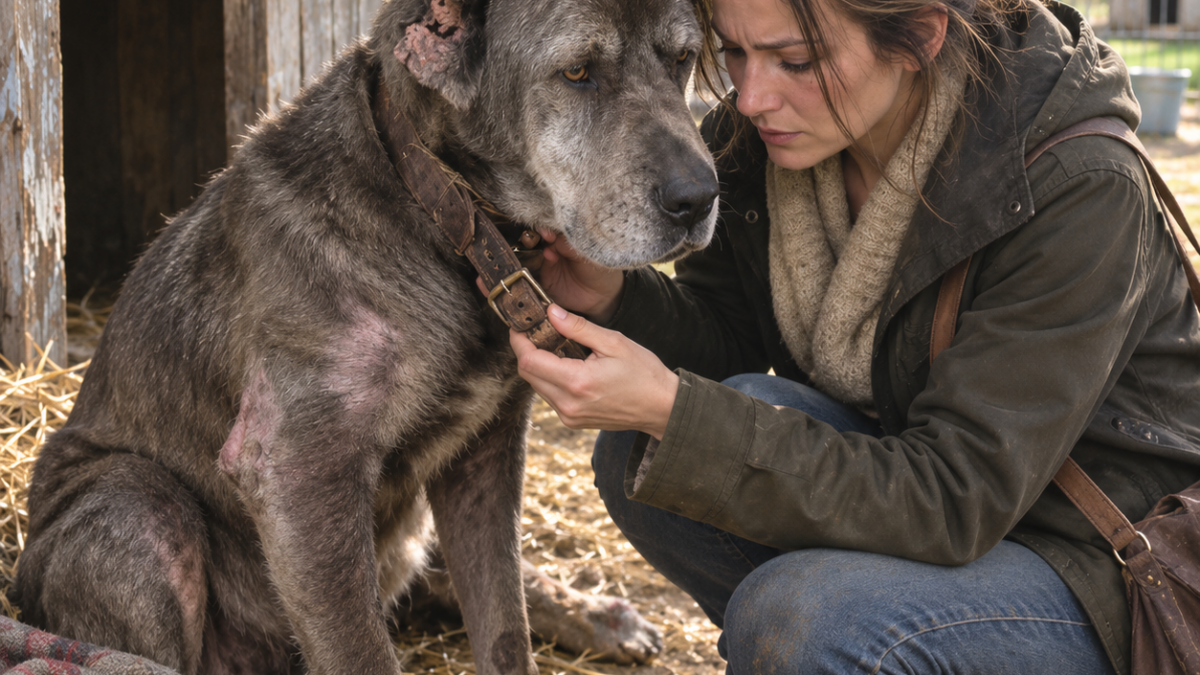
PART 2
I read the words twice.
FOR CLAIRE ONLY.
The letters were uneven.
Hand cut.
My father’s hands had always been rough and impatient. Even his handwriting looked as if it had been done with tools.
I looked at the shelter director.
“What does this mean?”
She shook her head.
“I don’t know.”
“You never opened it?”
“It’s a collar.”
“It says my name.”
“I can see that.”
Titan stood behind the kennel gate watching us.
I turned the leather over.
Nothing obvious.
No pocket.
No metal capsule.
Only stitching.
Thick stitching.
One section near the buckle looked slightly newer than the rest.
I ran my thumb over it.
Something rigid sat between the layers of leather.
The woman noticed.
“Marcel repaired that collar himself.”
“When?”
“About six months ago.”
Six months.
My father had known he was sick by then.
The notary told me he had died from heart failure after months of declining health.
He had known his time was limited.
And he had sewn something into Titan’s collar.
My first instinct was to cut it open immediately.
My second was stranger.
Fear.
For eighteen years, I had survived by keeping Marcel Moreau in a sealed room in my mind.
Convicted.
Violent.
Gone.
Simple.
People do that when truth is too painful.
We reduce a person to the worst thing we know about them because complexity demands more from us.
I had built an entire adult life around simplicity.
My father was a criminal.
I had escaped him.
End of story.
Now a scarred dog was standing ten feet away, and the collar in my hands felt like a door someone had forgotten to lock.
The shelter director said gently, “There’s something else you should know.”
I looked up.
“Your father visited Titan almost every day after he brought him here for rehabilitation.”
“Here?”
“Titan didn’t live here permanently. Marcel fostered him, then adopted him.”
“How did he get him?”
She hesitated.
“You should probably ask the collar.”
I almost snapped at her.
Instead, I looked toward Titan.
He had returned to the wall.
His enormous body lowered slowly onto the blanket.
“Why is he being euthanized?”
The woman’s expression hardened.
“I said there was a final decision in forty-eight hours. I didn’t say I agreed with it.”
“So who decided?”
“Our capacity did.”
She gestured toward the barking corridor.
“We have thirty-eight dogs and space for twenty-six. Titan is deteriorating. He refuses food some days. He slams himself against the kennel door at night. He lived with one man for five years and then suddenly that man vanished.”
My throat tightened.
“He’s grieving.”
“Yes.”
“And because he’s grieving, he dies?”
“Because people see a seventy-pound scarred dog and no one will foster him.”
I looked down at the collar.
Thomas’s words came back.
Leave the animal there.
It’ll be dealt with.
I hated how convenient that sounded now.
“What happens if I take him?”
The woman stared at me.
“You mean today?”
“Yes.”
“Do you have experience with dogs like Titan?”
“No.”
“Large dogs?”
“No.”
“Trauma?”
“No.”
“Then I should tell you this is a bad emotional decision.”
I almost smiled.
“You’re trying to stop me?”
“I’m trying to make sure you understand that saving him today and abandoning him next week would be worse.”
That hit.
Fair.
I looked at Titan.
“Can I meet him without the bars?”
The woman studied my face.
Then nodded.
“Sit in the yard.”
—
# THE FIRST TIME TITAN CHOSE ME
The shelter yard was surrounded by chain-link fencing.
Wet grass.
A bench.
Two battered plastic chairs.
I sat in one.
The shelter director brought Titan out on a heavy leash.
The moment he saw the open sky, his entire body changed.
Not excitement.
Relief.
His shoulders dropped.
He sniffed the ground.
Then the air.
Then me.
“Don’t reach over his head,” she said.
“I won’t.”
“Don’t stare.”
“I’m not.”
“You’re absolutely staring.”
I looked away.
Titan circled.
He moved quietly for such a large animal.
His paws stopped beside my chair.
I could see the scars more clearly.
Some were thin.
Others wide.
One ran from his shoulder almost to his spine.
Old puncture marks dotted his muzzle.
I wanted to know what had caused them.
I also didn’t.
Titan leaned forward.
His nose touched my knee.
I froze.
He inhaled.
Then moved away.
The shelter director said, “That’s good.”
“What was good?”
“He approached.”
Five minutes later he returned.
This time he sniffed my hand.
I kept it low.
Open.
He touched his nose to my palm.
Something inside me cracked.
My father’s dog.
That was the thought.
Not the scarred dog.
Not the dangerous dog.
My father’s dog.
Titan sat beside me.
Not touching.
Just close.
The director looked surprised.
“Interesting.”
“What?”
“He usually ignores new people.”
“Maybe I smell like Marcel.”
She looked at me carefully.
“Maybe.”
That possibility hurt more than I expected.
I had not hugged my father in eighteen years.
Had not stood close enough to know what he smelled like.
Oil.
Metal.
Cigarettes when I was young.
Soap from the garage sink.
Maybe something in me still carried him.
Titan lowered his head onto my thigh.
All seventy pounds of scarred history exhaled.
I put my hand on his neck.
He closed his eyes.
And that was it.
My decision.
“I’m taking him.”
—
# THOMAS
Thomas opened the apartment door.
Then looked past me.
Titan stood in the hallway wearing a temporary harness.
His head came almost to my hip.
Thomas’s face went blank.
“No.”
I held the leash.
“Move.”
“Claire.”
“Move.”
“You actually brought it home?”
“His name is Titan.”
“I don’t care if his name is Louis XIV.”
Titan looked at Thomas.
Thomas stepped backward.
“Jesus.”
“He’s not doing anything.”
“He looks like he survived a war.”
“Maybe he did.”
“Get him out.”
I closed the door behind us.
“No.”
Thomas stared at me.
I had never spoken to him that way.
Perhaps that was why he looked more offended than angry.
“This is my home too.”
“And mine.”
“I have clients here.”
“Then don’t invite them until we figure this out.”
“We?”
“Yes.”
“There is no we in this. Your criminal father leaves you some animal from a fighting pit and suddenly I’m supposed to reorganize my life?”
Titan’s head lifted at Thomas’s raised voice.
I felt the leash tighten.
Not because Titan lunged.
Because he moved closer to me.
That detail mattered.
I lowered my voice.
“Don’t shout.”
Thomas laughed without humor.
“You are telling me how to behave around an animal you’ve known for two hours?”
“I’m telling you not to make him afraid.”
“Oh, wonderful. Now I’m hurting the dog.”
I took Titan toward the spare bedroom.
Thomas followed.
“You know what people will say?”
I turned.
There it was.
Not safety.
Not concern.
People.
“What people?”
“The partners. Our friends. Your board.”
“My board does not care about my dog.”
“They’ll care when someone discovers who owned him.”
I stared at him.
“Who owned him?”
“Your father.”
I understood.
Marcel.
Even dead, my father embarrassed him.
I almost laughed.
“You don’t want Titan here because he reminds people I have a father.”
“You told everyone your father was dead.”
“He is dead.”
“You know what I mean.”
“Yes.”
For the first time, I did.
Thomas had never married all of me.
He had married the edited version.
The executive.
The polished apartment.
The perfect history.
No prison.
No mechanic father.
No shame.
Titan had walked through our front door carrying every part of me Thomas preferred hidden.
Thomas pointed toward the dog.
“One week.”
“What?”
“You have one week to find somewhere else for him.”
I looked down.
Titan had settled beside my leg.
“No.”
Thomas’s face changed.
“You’re choosing a dog over me?”
“No.”
I met his eyes.
“I’m choosing not to let you make this decision for me.”
—
# WHAT WAS INSIDE THE COLLAR
That night, Thomas slept in the guest room.
Ironically, Titan slept outside my bedroom door.
He would not come inside.
He lay across the threshold like a guard who did not believe he had permission to rest anywhere more comfortable.
At 2:17 a.m., I gave up trying to sleep.
The collar sat on the kitchen table.
FOR CLAIRE ONLY.
I found small scissors.
The stitching near the buckle was thick enough that cutting it took several minutes.
Titan appeared in the doorway.
He watched.
“Your secret?”
His tail did not move.
I pulled the leather apart.
A thin metal object dropped onto the table.
A key.
Small.
Brass.
Attached to it was a narrow strip of folded paper sealed in plastic.
My hands began shaking.
I unfolded it.
My father’s handwriting.
**Claire,**
**If this collar reached you, then I ran out of time.**
I stopped.
My eyes blurred.
I continued.
**Do not trust the story you were given about me. Do not trust the newspapers. Do not trust Étienne Vasseur.**
The name hit me like cold water.
Étienne Vasseur.
The man my father had nearly killed.
The victim.
The respectable businessman.
The person whose photograph had appeared in every newspaper article about Marcel’s trial.
The note continued.
**Key opens unit 27, Saint-Priest storage yard. Everything is there. Take Titan with you. If you still hate me afterward, I’ll understand.**
**I loved you every day.**
**Papa**
I sat at the kitchen table until dawn.
Titan lay beside my chair.
At some point, without thinking, I lowered my hand.
His head moved underneath it.
And for the first time in eighteen years, I cried for my father.
—
# ÉTIENNE VASSEUR
I remembered his face.
Of course I did.
Some images become permanent through repetition.
Étienne Vasseur had been forty-three when my father attacked him.
Owner of Vasseur Transport.
Community donor.
Sponsor of youth sports.
Photographed shaking hands with politicians.
The newspapers described him as a respected businessman assaulted by a volatile mechanic after a financial dispute.
Marcel had struck him repeatedly with a steel wrench.
Broken his jaw.
Fractured his arm.
Crushed several ribs.
Vasseur spent twelve days in intensive care.
My father pleaded guilty to aggravated assault.
The prosecution described the violence as savage.
The judge sentenced him to twelve years.
He served nine.
I was eighteen.
I attended only one day of the trial.
My father looked at me across the courtroom.
I refused to look back.
My mother had been dead four years by then.
There was no one to explain anything.
Relatives whispered.
Teachers knew.
Neighbors knew.
At university, I changed how I spoke about my family.
Eventually, Marcel became dead.
It was easier.
And now he was actually dead.
I searched Vasseur’s name.
His company had grown.
Logistics.
Property development.
Security contracts.
Charitable foundations.
Then I saw something that made my stomach turn.
**Vasseur Groupe — Strategic Advisory: Delorme & Associés.**
Thomas’s firm.
I stared at the screen.
Thomas had worked on the Vasseur account for almost two years.
He had mentioned Étienne at dinners.
Not often.
Enough.
I had never connected the name.
Why would I?
Vasseur was simply an old nightmare I had buried.
Now he was one of my husband’s most valuable clients.
Titan stood beside me.
I closed the laptop.
“Of course.”
The dog tilted his head.
“Nothing in my life can apparently be simple.”
—
# STORAGE UNIT 27
Saint-Priest was gray beneath a low winter sky.
I took Titan because the note told me to.
I did not tell Thomas where I was going.
He had left early for the office without speaking.
The storage yard sat behind an industrial estate.
Rows of metal doors.
Security cameras.
A bored attendant behind glass.
Unit 27 was near the rear.
My father’s brass key turned.
For several seconds, I could not make myself lift the door.
Titan stood beside me.
I pulled.
Metal rattled upward.
The smell hit first.
Oil.
Dust.
Old cardboard.
My father.
Not literally.
Memory.
The unit looked like a small archive.
Shelving.
Plastic crates.
Toolbox.
Old desk.
A chair.
Veterinary supplies.
Stacks of files.
Photographs pinned to one wall.
Dogs.
Dozens.
Before.
After.
In cages.
Then healed.
Some missing ears.
Some missing eyes.
Some thin.
Some scarred.
My throat closed.
Titan walked inside.
He went directly to a faded blanket near the desk.
Circled.
Lay down.
“He knows this place.”
The words sounded loud in the empty unit.
Of course he knew.
Marcel had brought him here.
On the desk sat an envelope.
**CLAIRE**
I opened it.
Inside was a USB drive.
A notebook.
And another letter.
This one was longer.
Much longer.
I sat in my father’s chair.
Titan rested beside me.
Then I began to read.
—
# MY FATHER’S VERSION
**Claire,**
**You were eighteen when I went away. Old enough to hate me, too young to know what adults are capable of hiding.**
I stopped.
Started again.
**I did what they said I did. I hurt Étienne Vasseur badly. I won’t lie to you about that. I hit him until he couldn’t stand. That part of the newspaper story was true.**
My chest tightened.
I almost felt relief.
There.
My father admitted it.
Maybe this whole mystery would collapse into exactly what I had always believed.
Then I read the next paragraph.
**What they never told you was why.**
I looked at Titan.
His amber eyes were open.
The letter continued.
My father had repaired trucks for Vasseur Transport.
Not officially.
After-hours contract work.
Vasseur paid cash.
Marcel needed money.
My mother’s medical bills had left debts.
I had been preparing for university.
One night, a delivery driver asked Marcel to look at an engine problem at an old Vasseur warehouse outside Lyon.
Marcel arrived late.
The vehicle was there.
So were twenty-three dogs.
Some chained.
Some caged.
Some injured.
The warehouse was being used for illegal dog fighting.
Vasseur was involved.
Not as a spectator.
As an organizer.
My father claimed he had seen betting ledgers.
Cash.
Veterinary drugs.
Equipment.
Dogs trained and injured for fights.
He tried to leave.
Vasseur stopped him.
They argued.
Marcel said he would go to the police.
Vasseur laughed.
Then showed him a photograph.
Me.
Eighteen years old.
Leaving my lycée.
My father wrote:
**That was the moment I understood they had already prepared for someone to talk.**
My hands went cold.
The letter continued.
Vasseur told Marcel that if he went to police, I would be followed.
Nothing explicit.
Nothing easy to record.
Just enough.
Marcel pretended to cooperate.
Over the next weeks, he began collecting evidence.
Photographs.
Copies of ledgers.
License plates.
Names.
He contacted a local police officer.
Two days later, Vasseur confronted him.
The officer had apparently warned someone.
My father realized the organization had protection.
On the night of the assault, Marcel returned to the warehouse to retrieve documents he had hidden.
Vasseur was there.
So was a dog.
A gray fighting dog called Brutus.
Titan’s predecessor, perhaps.
The animal was badly injured.
Vasseur intended to kill him.
Marcel intervened.
Vasseur attacked first with a metal bar.
Marcel got the wrench.
What happened next was exactly what the court heard.
Marcel lost control.
He beat Vasseur nearly to death.
But when police arrived, the dogs were gone.
The ledgers were gone.
The warehouse was empty except for Marcel, Vasseur, blood, and the wrench.
My father had prior minor convictions from his twenties.
Fights.
Drunk driving.
Nothing serious, but enough to define him.
Vasseur was wealthy.
Respected.
Injured.
My father was poor.
Angry.
Covered in another man’s blood.
The story wrote itself.
—
# WHY HE PLEADED GUILTY
I kept reading.
Marcel’s attorney wanted trial.
My father refused.
Why?
Because someone left a photograph beneath the windshield wiper of his car outside court.
Me.
At university.
A red circle drawn around my head.
No note.
None needed.
My father accepted the plea.
He never told me.
He never told his attorney the full reason.
He believed the less I knew, the safer I was.
Then came the line that broke me.
**You looked at me in court like I was already dead. I decided maybe that was safer for you. So I let you bury me.**
I put the letter down.
I could not breathe.
For eighteen years, I had thought my father didn’t defend himself because there was no defense.
I had thought his silence was guilt.
Maybe some of it was.
He had hurt a man terribly.
That remained true.
But silence had also been a choice.
A terrible one.
A protective one.
A stupid one.
A father’s one.
I covered my mouth.
Titan stood.
He moved closer.
Pressed his shoulder against my legs.
I buried my face against his neck.
“I hated him.”
Titan stayed still.
“I hated him.”
The dog did not absolve me.
Did not judge me.
He simply remained.
Sometimes that is more merciful.
—
# TITAN’S STORY
The letter continued after Marcel’s release.
He had tried to contact me twice.
I knew about one letter.
I had returned it unopened.
I did not know about the second.
He stopped after that.
Instead, he began volunteering with animal rescues.
Not because he believed saving dogs would erase what he had done.
His words:
**I couldn’t save the dogs in that warehouse. So I kept trying to save the next one.**
Years later, a rescue group investigating suspected fighting dogs asked Marcel for help because of his mechanical knowledge and familiarity with industrial sites.
That was how he found Titan.
Titan had been discovered in a shed outside Saint-Étienne.
Chained.
Scarred.
Underweight.
His teeth damaged.
His body carrying evidence of repeated violence.
Marcel recognized markings and equipment similar to what he had seen years before.
The people connected to the site had ties to shell companies linked indirectly to Vasseur Groupe contractors.
Not enough for police.
Enough for Marcel.
He adopted Titan.
Then he began collecting evidence again.
For five years.
Quietly.
Patiently.
The warehouse photographs in the storage unit were from different places.
Different rescues.
Different raids.
Marcel had helped shelters identify properties.
Track vehicles.
Document patterns.
He had become obsessive.
And Titan had been beside him through most of it.
That explained the collar.
It was not sentimental.
It was operational.
Marcel hid things in it because he trusted Titan more than any safe.
—
# THE USB DRIVE
I opened my laptop.
The USB contained folders.
Dates.
Names.
Scanned documents.
Photographs.
Audio.
Video.
I clicked the oldest video.
Grainy footage.
A warehouse.
Dogs in cages.
Men.
Then Étienne Vasseur.
Younger.
unmistakable.
I froze the frame.
There he was.
The respected victim.
Standing beside a fighting pit.
Talking to another man.
Money changing hands.
I played another.
Vasseur’s voice.
“Move the injured ones before morning.”
Another.
A man discussing police inspections.
Another.
A ledger.
Payments.
Vehicle plates.
Then newer files.
Recent.
Marcel had not merely saved old evidence.
He had continued gathering material.
The dog-fighting network had changed names, locations, and operators.
Vasseur had become more careful.
But money flowed through companies tied to his business empire.
Security contractors.
Property holding firms.
Cash businesses.
The evidence was incomplete but substantial.
Enough to make my hands tremble.
Then I opened a folder called:
**THOMAS**
I stopped breathing.
Inside were three documents.
Emails.
Public corporate filings.
A photograph.
Thomas at dinner with Vasseur.
I knew that dinner.
Thomas had told me he was in Geneva.
The date was eight months earlier.
A note in my father’s handwriting had been scanned beside it.
**Claire’s husband now works for him. I don’t know if he knows. Do not contact Claire until I know more.**
My chest went cold.
My father had been watching Thomas.
Not obsessively.
Protectively.
Or suspiciously.
Maybe both.
I closed the laptop.
Titan lifted his head.
“We’re going home.”
But I already knew home would not feel like home again.
—
# THOMAS KNEW MORE THAN HE SAID
Thomas was in the kitchen when I returned.
He looked at Titan.
Then at me.
“You were gone all day.”
“I went to my father’s storage unit.”
Silence.
A very small silence.
But I saw it.
Thomas recovered quickly.
“He had a storage unit?”
“Yes.”
“What was in it?”
I placed my keys on the table.
“Why did you tell me you were in Geneva on March 14?”
His eyes changed.
Not fear.
Calculation.
“What?”
“March 14. You said you had meetings in Geneva.”
“I probably did.”
“You were in Lyon.”
“I’m in Lyon often.”
“With Étienne Vasseur.”
Now he froze.
Titan was lying near the doorway.
Thomas glanced toward him.
Then back at me.
“Claire—”
“You knew.”
“Knew what?”
“My father attacked Vasseur.”
“Of course I knew. You told me your father went to prison.”
“I never told you the victim’s name.”
Silence.
That was answer enough.
My stomach dropped.
“How long?”
Thomas exhaled.
“Years.”
“Years?”
“I recognized the case after Vasseur became a client.”
“And you never told me?”
“Why would I?”
I stared.
“Why would you?”
“Yes. Why reopen something you had spent your entire life escaping?”
“Because he knew my father.”
“He was assaulted by your father.”
“Did Vasseur ever talk about it?”
Thomas looked away.
That was another answer.
“What did he say?”
“Nothing important.”
“Thomas.”
“He said your father was unstable.”
“What else?”
“He said Marcel had developed some paranoid obsession with his business.”
My hands went numb.
“And you believed him.”
“I had no reason not to.”
“You had me.”
“What does that mean?”
“It means you were married to Marcel Moreau’s daughter.”
Thomas’s patience broke.
“And you spent our entire relationship telling me Marcel Moreau was a violent criminal you wanted nothing to do with!”
The words struck because they were true.
I had created the silence Thomas used.
He saw that in my face.
His voice softened.
“Claire.”
“No.”
“Listen.”
“No.”
“You found some papers in a dead criminal’s storage unit and now you think you’ve uncovered a conspiracy.”
“I found video.”
Thomas stopped.
I watched his face drain.
“What kind of video?”
There.
That was fear.
“Why?”
“Because accusations like this could destroy people.”
“Which people?”
“Companies. Employees. Clients. Us.”
Us.
Not dogs.
Not my father.
Us.
Our apartment.
Our dinners.
Our reputation.
I felt something inside me become very still.
“Did you know Vasseur was involved in dog fighting?”
“No.”
“Did you know my father claimed he was?”
“No.”
“Did you know Vasseur threatened me when I was eighteen?”
“What?”
“For the first time, Thomas looked genuinely shocked.”
I believed that shock.
But it no longer saved him.
“I need to see what you found.”
“No.”
“Claire.”
“No.”
“If Vasseur is implicated, my firm needs to know.”
“I’m going to the police.”
Thomas stepped forward.
“Do not do that yet.”
Titan stood.
No bark.
No growl.
He simply moved between us.
Thomas stopped.
We both looked down.
Titan’s body blocked the space.
Thomas whispered, “Get that dog away from me.”
I put my hand on Titan’s shoulder.
“He’s not touching you.”
“He’s threatening me.”
“No.”
I looked at my husband.
“He just doesn’t trust you.”
And suddenly, neither did I.
—
# THE WOMAN FROM THE SHELTER
I called the shelter director.
Her name was Marianne.
I had not even asked on the first day.
That embarrassed me.
“Did Marcel ever tell you about Vasseur?”
Long silence.
“Yes.”
My heart pounded.
“Why didn’t you tell me?”
“Because it was Marcel’s story.”
“He’s dead.”
“I know.”
“Did you believe him?”
“Yes.”
“Why?”
“Because I saw what he did for twenty years.”
I sat on the floor beside Titan.
Thomas had left.
He said he needed air.
I didn’t know where he went.
Marianne continued.
“Your father was not a saint, Claire.”
“I know.”
“He had a temper. A terrible one when he was young. He drank too much. He fought. Prison didn’t happen to an innocent choirboy.”
“I know.”
“But Étienne Vasseur was not an innocent victim either.”
My eyes closed.
“How much did you know?”
“Enough.”
“Why didn’t anyone help him?”
“Some tried.”
“Not enough.”
“No.”
Her voice broke slightly.
“No. Not enough.”
I asked the question that had been waiting since the shelter.
“Why Titan?”
“What do you mean?”
“Why leave him to me?”
Marianne sighed.
“Because Marcel believed Titan would make you look.”
“At what?”
“Him.”
I could not speak.
“He knew if he left you documents, you might burn them.”
My throat tightened.
“If he left money, you might refuse it.”
“Yes.”
“But a dog?”
I looked at Titan.
“He knew I wouldn’t let him die.”
“Marcel said exactly that.”
I covered my face.
Marianne continued softly.
“He said, ‘Claire can hate me. But she won’t punish something helpless just to hurt a dead man.’”
I cried harder.
My father had known me better from a distance than I had known him up close.
—
# THE FIRST THREAT
Two nights later, someone left a dead rat outside our apartment door.
No note.
No message.
Just the animal.
Thomas found it first.
He came into the bedroom holding a garbage bag.
“We need to talk.”
Titan raised his head.
Thomas shut the door.
“There was something outside.”
“What?”
He told me.
My blood ran cold.
“Call the police.”
“No.”
I stared.
“No?”
“Claire, think.”
“Someone left a dead animal outside our home.”
“Maybe it’s random.”
“You don’t believe that.”
Thomas loosened his tie.
“If we call the police and mention Vasseur, this becomes public.”
I could not believe what I was hearing.
“Someone threatened us.”
“Or someone is trying to frighten you.”
“That’s a threat.”
“Not legally, necessarily.”
I laughed once.
“You sound like his lawyer.”
“I’m trying to protect us.”
“By doing nothing.”
“By not detonating our lives over something we don’t fully understand.”
I stood.
“I understand enough.”
“No, you understand an emotional story your father left behind.”
“And video.”
Thomas looked toward the doorway.
Titan stood there.
Again.
Watching.
Thomas lowered his voice.
“Where is the USB?”
I did not answer.
“Claire.”
“Why?”
“To make copies.”
“I already did.”
That was not entirely true.
I had made three.
One at work.
One with Marianne.
One uploaded to encrypted storage.
Thomas did not need to know.
His jaw tightened.
“You don’t trust me.”
“No.”
The word surprised both of us.
Simple.
Final.
No.
Thomas stared for a long time.
Then he said something I will never forget.
“You are going to destroy everything we built for a dead man who ruined your childhood.”
I looked at Titan.
Then back at him.
“No.”
My voice was quiet.
“I think I’m finally finding out what destroyed it.”
—
# THE BREAK-IN
Three days later, I came home at 6:40 p.m.
Titan stopped before we reached the apartment door.
He froze.
Every muscle tightened.
I looked down.
“What?”
His nose lifted.
He sniffed.
Then a low sound came from his chest.
The first growl I had ever heard from him.
Not explosive.
Not frantic.
A warning.
I looked at the door.
It was slightly open.
I knew I had locked it.
I backed away immediately.
Titan remained in front of me.
I called police from the stairwell.
They arrived eleven minutes later.
The apartment had been searched.
Drawers open.
Desk disturbed.
Closet.
Kitchen cabinets.
Nothing valuable taken.
Not jewelry.
Not electronics.
Only my office.
Only papers.
Only the place someone would search for evidence.
The police officer asked, “Anyone know you had sensitive documents?”
I thought of Thomas.
Then hated myself for thinking it.
“He does.”
“Anyone else?”
“Yes.”
“Names?”
I gave Vasseur’s.
The officer’s expression changed.
He knew it.
Everyone did.
I told him everything.
For the first time, I said the entire story out loud to someone official.
Marcel.
The warehouse.
The video.
The threats.
The storage unit.
Titan.
Thomas.
The officer stopped writing once.
“Your father was Marcel Moreau?”
“Yes.”
“I remember the case.”
“Most people do.”
He looked around the apartment.
“You need to make sure those files exist somewhere else.”
“They do.”
“Good.”
Titan stayed beside me.
The officer glanced at him.
“Big dog.”
“He’s harmless.”
Titan stared at the broken office drawer.
The officer said, “Maybe not useless, though.”
No.
Definitely not useless.
—
# THOMAS’S BETRAYAL
I wanted to believe Thomas had nothing to do with the break-in.
I really did.
He came home after police left.
He looked genuinely horrified.
“What happened?”
I watched him carefully.
“Someone searched the apartment.”
“For what?”
“You know.”
His face tightened.
“Where was Titan?”
“With me.”
“Thank God.”
That surprised me.
For one second, I saw the man I thought I had married.
Then I asked:
“Did you tell Vasseur what I found?”
Silence.
There are moments when a marriage ends before anyone says the words.
That was mine.
“Thomas.”
He sat down.
“I called him.”
My body went cold.
“When?”
“The night you came back from the storage unit.”
I stared.
“You warned him.”
“I asked him what was going on.”
“You warned him.”
“I didn’t give him documents.”
“You told a man accused of running an organized criminal operation that his victim’s daughter had evidence.”
“I didn’t know the evidence was real.”
“You knew enough to ask where the USB was.”
Thomas stood.
“Claire, I was trying to protect my firm.”
There it was.
Clean.
Undisguised.
“What did he say?”
“He said your father had fabricated things before.”
“And you believed him?”
“I didn’t know what to believe.”
“So you called him.”
“Yes.”
“Did you tell him where the storage unit was?”
“No.”
“Our address?”
“He already knew our address.”
The room seemed to tilt.
“What?”
Thomas looked sick.
“Christmas cards. Client records. I don’t know.”
I stepped backward.
Titan moved with me.
“You’re leaving.”
“Claire.”
“Tonight.”
“You can’t be serious.”
“I’ve never been more serious.”
“This is my apartment.”
“Our apartment.”
“You can’t—”
“I’ll leave then.”
He stared.
“With the dog?”
“Yes.”
“You are throwing away ten years.”
I picked up Titan’s leash.
“No.”
I looked at Thomas.
“You threw away ten years when you decided your client deserved warning more than your wife deserved protection.”
—
# MARCEL’S LAST HOUSE
My father had rented a small house outside Lyon during his final years.
The lease had ended after his death, but the landlord had not yet cleared it.
Marianne knew the owner.
Within two days, I was able to stay there temporarily.
The house was nothing like my apartment.
Low ceilings.
Old tile.
A small kitchen.
A fenced yard.
Oil stains in the garage.
Titan walked inside and stopped.
Then his tail moved.
Once.
Twice.
He knew.
“This was home.”
He went room to room.
Sniffed the couch.
The bedroom.
The kitchen.
Then walked to the back door and looked at me.
I opened it.
He stepped into the yard.
For the first time since I had taken him from the shelter, Titan ran.
Not far.
He was older.
Heavy.
But he ran a circle around the yard.
Then another.
His gray body moved beneath the winter sun.
I stood in the doorway crying.
This was where my father had lived after prison.
Without me.
With Titan.
I noticed a wooden board near the back fence.
Names carved into it.
Dogs.
Biscotte.
Luna.
Max.
Rufus.
Athena.
Titan.
Dates beside each.
Some crossed out with tiny hearts.
Marcel had fostered them.
I touched the wood.
For years I had imagined my father leaving prison exactly as he entered.
Angry.
Violent.
Unchanged.
Instead, he had spent those years building kennel doors.
Repairing vans.
Paying vet bills.
Rescuing dogs.
Not redemption as a grand performance.
Work.
Quiet.
Repetitive.
Unseen.
The kind that asks no one to applaud.
That hurt more than anything.
Because I had missed it all.
—
# THE AUDIO FILE
That night, I opened the final folder on the USB.
**FOR CLAIRE — LAST**
Audio.
I clicked.
Static.
Then my father’s voice.
Older than I remembered.
Rough.
“Claire.”
I stopped the recording.
My whole body shook.
Titan looked up.
I pressed play again.
“If you’re hearing this, I guess you opened the collar.”
A dry laugh.
“Always were too curious to leave something alone.”
I cried instantly.
He continued.
“I don’t know what you think of me now. Maybe the same. Maybe worse.”
Pause.
“I need you to understand one thing before you decide what to do with all this.”
His breathing was heavy.
“I did hurt Vasseur. I wanted to hurt him. Don’t make me into a hero because I’m dead.”
I closed my eyes.
“There were dogs. There were threats. He came at me first. All true. But when I had him on the ground, I kept hitting him after I could’ve stopped.”
Long silence.
“That part is mine.”
My father was not asking forgiveness through lies.
That made it harder.
“I went to prison for something I did. Maybe not for the whole story they told, but I did it.”
He coughed.
“What I couldn’t survive was you thinking I stopped loving you.”
My hand covered my mouth.
“I let you hate me because men like Vasseur understand leverage. You were mine.”
His voice broke.
“My little girl.”
I pressed my forehead to the table.
“I thought if you cut me off, they’d stop looking at you.”
Pause.
“I was right about that, at least.”
Another breath.
“I tried after prison. Wrote twice. When you sent the first one back, I understood.”
My chest tore open.
“I wanted to come to your graduation. Didn’t.”
“I wanted to see your wedding. Didn’t.”
My eyes snapped open.
He knew about my wedding.
“I stood across the street.”
I stopped breathing.
“You looked happy.”
He laughed softly.
“Your husband looked expensive.”
Despite everything, a sound escaped me.
Half laugh.
Half sob.
“I didn’t want to ruin it.”
Then his voice became serious.
“Titan saved me more times than I saved him.”
I looked at the dog.
“He knows what people are when nobody’s watching.”
Titan’s amber eyes held mine.
“If he trusts you, trust yourself.”
Then the final words.
“I’m sorry I made you carry my shame.”
Pause.
“You never should’ve had to.”
Another pause.
“And Claire?”
My entire body tensed.
“I never stopped being proud of you.”
The recording ended.
I sat on the kitchen floor until morning.
Titan slept with his head in my lap.
—
# I WENT TO THE POLICE
Not the local station.
The evidence was too large for that.
Through an attorney recommended by Marianne, I contacted investigators specializing in organized crime and animal cruelty.
We handed over copies.
Not originals.
My attorney insisted.
The prosecutor’s office opened a preliminary investigation.
Slowly.
Quietly.
For the first time, professionals began looking at Marcel’s archive not as the obsession of an ex-convict, but as evidence.
The old files were compared with current company records.
Vehicle registrations.
Property ownership.
Contractors.
Bank transfers.
Several names appeared repeatedly.
One was Vasseur.
Another was a security firm working with Vasseur Groupe.
Another belonged to a man who had been investigated years earlier for illegal betting.
The more they looked, the less paranoid my father appeared.
Then police interviewed a former driver.
He was seventy-one.
Retired.
Terrified.
But when shown one of Marcel’s photographs, he cried.
He confirmed the warehouse.
The dogs.
The fights.
Vasseur.
And the threat against me.
He had heard it.
For eighteen years, I had believed there were no witnesses.
There had been one.
He had been too afraid.
Like my father.
Like everyone.
Until now.
—
# VASSEUR CAME TO SEE ME
I did not expect him to come personally.
That was arrogance.
One afternoon, a black Mercedes stopped outside Marcel’s house.
Titan was in the yard.
He saw the car before I did.
His body changed.
Low.
Still.
The man who stepped out was older than the newspaper photographs.
Silver hair.
Expensive coat.
Cane.
Étienne Vasseur.
The last time I had seen him in person, he was in court with bandages around his head.
Now he looked like power made human.
I stepped outside but stayed behind the gate.
Titan stood beside me.
Vasseur looked at him.
Something passed across his face.
Recognition?
Maybe.
“That dog belonged to Marcel.”
“Yes.”
“He always liked damaged things.”
I felt anger rise.
“Why are you here?”
“To save you from making a mistake.”
I almost laughed.
“My father said something similar about you.”
Vasseur’s smile disappeared.
“Your father was sick.”
“He was dying.”
“I mean in the head.”
Titan growled.
Low.
Vasseur looked at him.
“Control your animal.”
“He is controlled.”
I stared at the man.
“Are you?”
His eyes hardened.
There.
For one second, I saw something beneath the philanthropist.
“You have no idea what your father was involved in.”
“Then explain it.”
“He hated me.”
“Why?”
“Jealousy. Money. Pride.”
“Dogs?”
Silence.
Barely.
But enough.
I continued.
“Warehouse outside Lyon?”
“Your father invented fantasies.”
“Video is an interesting kind of fantasy.”
His jaw tightened.
I saw fear.
Not much.
Enough.
“You think a few old recordings change what he did to me?”
“No.”
That surprised him.
“My father admitted what he did.”
Vasseur said nothing.
“He admitted he kept hitting you after he could have stopped.”
His face relaxed slightly.
“He was honest about his violence.”
I stepped closer to the gate.
“Were you honest about yours?”
Vasseur looked at Titan.
Then at me.
“You should think about your career.”
I smiled.
“My husband said that too.”
“Thomas is intelligent.”
“So intelligent he warned you.”
That changed his expression.
I filed it away.
“He cares about your future.”
“No. He cares about his.”
Vasseur stepped closer.
Titan’s growl deepened.
I touched his shoulder.
“Stay.”
He did.
Vasseur looked down at him.
“Marcel should have learned not to pick fights he couldn’t win.”
I looked directly into his eyes.
“He did.”
Vasseur smiled.
Then I finished.
“That’s why he left the next one to me.”
His smile vanished.
He returned to his car.
I watched him drive away.
My legs began shaking only after he was gone.
—
# TITAN’S SCARS
That night, I asked Marianne to tell me everything she knew about Titan.
We sat in Marcel’s kitchen.
Titan slept near the stove.
“He came from a fighting operation?”
“Yes.”
“Did Marcel rescue him?”
“Not directly.”
She explained.
Animal control had seized Titan with seven other dogs from a rural property.
The first assessment recommended euthanasia for several because of severe injuries and uncertain behavior.
Marcel came to repair a transport vehicle.
He saw Titan.
Titan was inside a reinforced cage.
No one could approach him easily.
He did not attack.
He simply retreated.
Marcel sat outside the cage.
Hours.
No touching.
No food trick.
Just sitting.
He returned the next day.
And the next.
After eight days, Titan came forward.
After twelve, he allowed Marcel to touch his nose.
After three weeks, Marcel fostered him.
Marianne smiled.
“Your father slept on the floor beside him for almost two months.”
I looked at Titan.
“He never told me.”
“Who would he tell?”
The question hurt.
Marcel had no family left.
No daughter.
No wife.
Just people at shelters.
Dogs.
Tools.
Evidence.
Marianne continued.
“The first time Titan had a nightmare, he bit Marcel.”
I looked up sharply.
“Bad?”
“Six stitches.”
“What did my father do?”
“Went to the hospital.”
“And then?”
“Came back.”
Of course.
Marianne’s eyes filled.
“He said, ‘You don’t throw away a terrified animal for acting terrified.’”
I looked toward Titan.
He was awake now.
Listening.
Maybe not understanding words.
Understanding tone.
I thought of Thomas.
Leave that animal there.
It’ll disappear.
Two men.
Two philosophies.
One had a criminal record.
The other wore tailored suits.
I suddenly knew which man I was ashamed of.
—
# THOMAS TRIED TO COME BACK
He called every day.
I ignored most of them.
Then he came to the house.
Titan barked once when he saw him through the gate.
Thomas stopped.
I stepped outside.
“What do you want?”
“To talk.”
“We’re talking.”
“Inside.”
“No.”
He looked toward the road.
“You’re really going to make me stand here?”
“Yes.”
Thomas laughed bitterly.
“You’ve changed.”
“No.”
I thought about it.
“Actually, maybe I finally stopped.”
“Stopped what?”
“Editing myself for you.”
His face tightened.
“Claire, I made a mistake.”
“You warned Vasseur.”
“I was under enormous pressure.”
“No one pressured you. You chose.”
“My career—”
“Exactly.”
“I didn’t know he’d threaten you.”
“You knew enough to hide the relationship from me.”
Thomas looked down.
“I want to fix this.”
“Can you uncall him?”
“No.”
“Can you make me trust you?”
Silence.
I nodded.
“That’s what I thought.”
He looked at Titan.
“You’re really ending our marriage over this?”
“No.”
I shook my head.
“I’m ending it because when I discovered my father may have spent eighteen years being lied about, your first concern was your client.”
Thomas’s face hardened.
“What about everything I gave you?”
I almost pitied him.
He still thought marriage was a ledger.
“You gave me a life where I had to lie about where I came from so you’d be comfortable.”
“That is not fair.”
“No.”
I touched the gate.
“Fair would have been me realizing that years ago.”
Titan stood behind me.
Thomas looked at him.
“That dog hates me.”
“No.”
I almost smiled.
“He just has excellent instincts.”
—
# THE RAID
Five weeks after I found the collar, investigators moved.
Before dawn.
Multiple properties.
Warehouses.
Kennels.
A rural compound.
I learned afterward.
Forty-one dogs were removed.
Some injured.
Some scarred.
Some young enough that the thought of what they had been intended for made me sick.
Records were seized.
Computers.
Cash.
Betting ledgers.
Veterinary drugs.
Weapons.
Vasseur was detained for questioning.
Several employees were arrested.
The news exploded.
**BUSINESSMAN ÉTIENNE VASSEUR LINKED TO ILLEGAL DOG-FIGHTING INVESTIGATION.**
Then:
**EVIDENCE MAY CONNECT NETWORK TO DECADES-OLD MOREAU CASE.**
My phone became unusable.
Reporters.
Coworkers.
Friends.
People who had attended dinners with Thomas and me.
People who knew the version of my history I had invented.
My company’s communications director called.
“We need to know whether you’re involved.”
“Yes.”
Silence.
“How?”
“I provided evidence.”
Another silence.
“Claire, this could become very public.”
“I know.”
I waited for fear.
For shame.
For the instinct to hide.
It did not come.
“All right,” she said. “Then we need to make sure you have support.”
I nearly cried.
That simple.
No disgust.
No rejection.
No collapse of reputation.
Just:
Support.
I had lied for eighteen years because I thought the truth would destroy every room I entered.
It turned out the people worth keeping could survive it.
—
# THOMAS LOST HIS JOB
I did not engineer it.
I did not call his managing partner.
I did not need to.
Investigators found communication between Thomas and Vasseur after I discovered the evidence.
Thomas had not participated in dog fighting.
He had not known the full scope of the crimes.
But he had shared the existence of potentially incriminating material with a client after learning authorities might become involved.
His firm considered that catastrophic.
Internal investigation.
Suspension.
Then termination.
When he called me, he was furious.
“You did this.”
“No.”
“You told them.”
“I told police the truth.”
“You destroyed my career.”
“I didn’t make the call to Vasseur.”
“You knew what would happen.”
“No.”
I looked at Titan asleep in the yard.
“I knew what happened when everyone stayed quiet.”
Thomas said nothing.
I continued.
“My father stayed quiet because he was afraid for me. You stayed quiet because you were afraid for yourself.”
“That’s not the same.”
“No.”
I agreed.
“It isn’t.”
Then I ended the call.
That was the last time we spoke outside our attorneys.
—
# THE FIRST PUBLIC HEARING
Months passed.
Investigations move more slowly than stories.
Evidence had to be authenticated.
Witnesses interviewed.
Old files reopened.
The original warehouse property traced.
Financial records examined.
One retired officer admitted he had leaked Marcel’s complaint to a superior who had connections to Vasseur.
He claimed he never understood what would happen.
Maybe true.
Maybe not.
Another witness confirmed the photograph threat.
Then prosecutors filed a request to review my father’s conviction.
That did not mean Marcel had done nothing wrong.
Everyone agreed he had assaulted Vasseur.
The question was whether his plea and sentencing had been shaped by concealed evidence, witness intimidation, and a false presentation of the circumstances.
I attended the hearing.
Titan could not come inside.
Marianne waited with him outside.
I sat in a courtroom almost identical to the one I remembered from eighteen years earlier.
Wood.
Paper.
Quiet footsteps.
Then Vasseur entered.
Older.
No tailored confidence now.
His attorneys surrounded him.
He looked at me.
I looked back.
I did not look away.
That alone felt like revenge.
Not because I wanted him afraid.
Because eighteen-year-old Claire had been unable to face any of it.
Thirty-six-year-old Claire could.
—
# MY FATHER’S NAME
The review did not erase everything.
I am glad it didn’t.
Truth should not replace one lie with another.
The court acknowledged Marcel had committed serious violence.
But it also found that crucial evidence about Vasseur’s criminal activity, threats, and the circumstances leading to the assault had been concealed or unavailable.
His original conviction was vacated.
A new legal finding recognized that he had acted initially in defense during a confrontation connected to criminal conduct, though his continued use of force exceeded what was necessary.
The old narrative—
Unprovoked attack by violent mechanic on respected businessman—
was gone.
Not replaced by saint versus monster.
Replaced by truth.
Complicated.
Human.
My father had been both protector and perpetrator.
Victim and offender.
Frightened father.
Angry man.
He had done wrong.
He had also been wronged.
For me, that mattered more than purity.
When the decision was read, I cried.
Not because Marcel became innocent.
Because he became whole.
—
# VASSEUR’S FALL
The dog-fighting case continued.
The evidence seized during the raids was devastating.
Videos.
Betting records.
Payments.
Messages.
Properties.
Witnesses.
Vasseur’s defense claimed he had been unaware of illegal activities conducted by contractors.
Then investigators found his direct communications.
His charitable image disintegrated.
Sponsors withdrew.
Boards removed him.
Business partners fled.
His company’s value collapsed.
Several executives cooperated with prosecutors.
Eventually, Vasseur was convicted on multiple charges connected to organized illegal animal fighting, financial crimes, intimidation, and obstruction.
I attended sentencing.
Not because I wanted to watch him suffer.
I needed to finish something.
He turned once before being led away.
Our eyes met.
I thought I would feel victory.
I didn’t.
I felt tired.
Then I remembered my father’s voice.
**Don’t make me into a hero because I’m dead.**
Vasseur did not need to become a monster for Marcel to matter.
And Marcel did not need to become perfect for me to love him.
That realization freed me more than any sentence could.
—
# THE DOGS
The forty-one dogs from the raids became the part of the story I cared about most.
Some could be rehabilitated.
Some required long medical treatment.
A few were too injured to survive.
That grief was real.
Marianne’s shelter took six.
I helped fund their care.
Not anonymously.
For the first time in my life, I used my father’s name publicly.
**The Marcel Moreau Recovery Fund.**
The first time I wrote it on the paperwork, my hand shook.
Marianne saw.
“You sure?”
“Yes.”
“What if people complain?”
“They can.”
She smiled.
“That sounds like Marcel.”
I laughed.
Maybe it did.
—
# TITAN CHANGED TOO
For the first months after Marcel died, Titan slept near doors.
Always.
Front door.
Bedroom door.
Gate.
As if waiting for someone to return.
Gradually, he stopped.
One evening I found him asleep in the middle of the living room.
On his back.
Legs open.
Completely vulnerable.
I stood in the doorway staring.
Titan opened one eye.
“You know you look ridiculous.”
His tail hit the floor.
He closed his eye again.
That was when I realized he had stopped waiting for my father.
I cried.
Then felt guilty for crying.
Then realized Titan did not need guilt.
He needed dinner.
So I fed him.
Life is often less poetic than grief.
Thankfully.
—
# MARCEL’S GRAVE
I had not attended my father’s funeral.
That fact carried its own weight.
Months after the review decision, I finally visited his grave.
Titan came with me.
The cemetery was quiet.
Marcel’s stone was simple.
**MARCEL MOREAU**
**1958–2025**
Nothing else.
No beloved father.
No husband.
No mechanic.
No rescuer.
Just dates.
I stood there for a long time.
Titan sniffed the grass.
Then sat beside me.
I took the old collar from my bag.
The one with the cut stitching.
FOR CLAIRE ONLY still visible inside.
I had kept it.
I placed my fingers over the carved letters.
“I’m sorry.”
The words sounded inadequate.
Titan leaned against me.
“I should have read your letter.”
Wind moved through the trees.
“I should have asked.”
No answer.
Of course.
The dead do not give us closure.
We build it ourselves from what remains.
“I was eighteen.”
That sentence came out like a defense.
Maybe it was.
“I was ashamed.”
Pause.
“I was scared.”
Another.
“And you made it easy to hate you.”
That was true too.
Marcel had chosen silence.
Protection, yes.
But also silence.
He had not trusted me with the truth.
Love can make destructive decisions.
I finally understood that.
“I forgive you.”
My voice broke.
Then the harder sentence.
“I hope you forgive me.”
Titan stood.
He walked toward the grave.
Sniffed the stone.
Then did something so ordinary I laughed through tears.
He peed on the bush beside it.
“Titan!”
The dog looked at me.
I started laughing harder.
My father would have loved that.
Maybe forgiveness did not need to be solemn.
—
# THE LAST SECRET IN THE HOUSE
When I finally cleared Marcel’s rented house, I found a box beneath his bed.
Inside were things I thought no longer existed.
My childhood drawings.
School reports.
A photograph of me missing my front teeth.
A ribbon from a swimming competition.
A newspaper clipping from my university graduation.
A wedding announcement.
Thomas and me.
My father had cut it from a paper.
On the back he had written:
**She looks happy. That’s enough.**
I sat on the floor holding it.
Titan lay beside me.
My father had stayed away.
But he had not stopped watching from a distance.
That distinction nearly destroyed me.
At the bottom of the box was one final envelope.
No secret.
No evidence.
Just my name.
Inside:
**Claire,**
**If you ever come across this, I hope Titan is bothering you for food. He pretends he’s starving even ten minutes after dinner. Don’t believe him.**
I laughed instantly.
Titan lifted his head.
“Apparently you’re a liar.”
Tail wag.
The letter continued.
**I don’t need you to defend me. I need you to live better than I did.**
**Don’t build your life around punishing people. I tried that once. It cost me everything.**
I stopped.
There was the final lesson.
The revenge story I thought I was living had never been what my father wanted.
**Tell the truth. Then go home. Feed the dog.**
I read that line three times.
Then I did exactly that.
—
# A YEAR LATER
I sold the apartment Thomas and I had shared.
Bought a smaller house outside Lyon.
Garden.
Fence.
Enough room for Titan.
I remained at my company.
My career survived.
More than survived.
When people learned the truth about my father, some asked intrusive questions.
Some judged.
Most did not.
The catastrophe I had feared for eighteen years never came.
My shame had been larger than reality.
Thomas moved to Paris.
I heard he found work with a smaller firm.
I felt nothing.
That surprised me.
For a while, I had imagined his downfall would satisfy me.
It didn’t.
The satisfying part was not watching Thomas lose something.
It was realizing I no longer needed his approval.
There is a difference.
—
# TITAN’S NEW COLLAR
On the anniversary of Marcel’s death, I bought Titan a new collar.
Thick brown leather.
Strong buckle.
Simple.
I kept the old one in a drawer with my father’s letters.
The new collar had a small brass plate.
I had considered putting my phone number only.
Instead, I added three lines.
**TITAN MOREAU**
**HOME**
**STAY**
The engraver looked at me.
“Stay?”
“Yes.”
“Command?”
I thought about it.
“No.”
A promise.
—
# THE RESCUE CENTER
The Marcel Moreau Recovery Fund eventually became more than veterinary assistance.
We helped build a rehabilitation area for large, traumatized dogs.
The ones adopters walked past.
Scarred dogs.
Older dogs.
Dogs with histories that frightened people.
At the opening, Marianne handed me scissors for the ribbon.
“You know who would hate this?”
I smiled.
“My father.”
“He’d say we wasted money on a sign.”
I looked up.
The sign read:
**THE MARCEL MOREAU REHABILITATION YARD**
“He would absolutely hate it.”
We laughed.
Titan stood beside me.
Older now.
Gray around the muzzle.
Still enormous.
A young dog watched from behind a gate.
Black coat.
Missing eye.
Scars.
People had already called him dangerous.
I opened the gate carefully.
Sat on the ground.
Waited.
Titan lay beside me.
The young dog watched him.
Then watched me.
After ten minutes, he stepped forward.
I felt something come full circle.
—
# WHAT TITAN TAUGHT ME
People like simple categories.
Good father.
Bad father.
Criminal.
Victim.
Dangerous dog.
Safe dog.
Loyal husband.
Successful woman.
Life rarely respects those categories.
Marcel was violent.
Marcel was loving.
He made mistakes.
He protected me.
He abandoned parts of himself.
He saved animals.
He let me hate him.
He watched my life from a distance.
He lost control once and paid for it for years.
Then spent the rest of his life trying to make something useful from the damage.
Titan was scarred.
Titan had bitten someone once.
Titan was gentle.
Titan was frightened.
Titan was loyal.
Titan was not his scars.
Neither was my father.
Neither was I.
—
# THE WOMAN I USED TO BE
Before Titan, I thought strength meant control.
Perfect apartment.
Perfect clothes.
Perfect marriage.
Perfect biography.
Nothing messy enough to make other people uncomfortable.
I had spent eighteen years polishing myself until the daughter of Marcel Moreau disappeared.
Then my father died and sent me a seventy-pound reminder that history cannot be groomed into respectability.
Titan shed everywhere.
He drooled.
He hated vacuum cleaners.
He snored.
He once destroyed a designer shoe Thomas had forgotten to collect.
I laughed for ten minutes.
Maybe too long.
Titan brought disorder into my life.
And somehow, for the first time, I felt honest.
—
# ONE LAST MEETING WITH THOMAS
Two years after everything, I saw Thomas at a conference.
Across a hotel lobby.
He looked older.
So did I.
He approached cautiously.
“Claire.”
“Thomas.”
We stood there.
No anger.
No longing.
Just history.
“How’s the dog?”
I smiled.
“Old.”
He nodded.
“I’m sorry.”
“For what?”
“A lot.”
I believed him.
That did not mean I wanted him back.
“I know.”
He looked toward the crowd.
“I was afraid.”
“I know.”
“My whole career—”
“I know.”
He laughed bitterly.
“You always say that now.”
“Because I do know.”
He looked at me.
“Do you forgive me?”
I thought about Marcel’s grave.
About the old collar.
About Vasseur.
About all the years I wasted believing forgiveness meant approval.
“Yes.”
Thomas looked relieved.
Then I added:
“But forgiveness doesn’t mean access.”
His relief changed.
I smiled gently.
“Take care of yourself.”
Then I walked away.
That was enough.
—
# TITAN’S LAST YEARS
Titan lived four more years after Marcel died.
Longer than anyone predicted.
Arthritis slowed him.
His hearing faded.
He became even more shameless about food.
Every morning at 6:30, he stood beside my bed and breathed directly into my face until I woke.
If I ignored him, one paw hit the mattress.
“Marcel warned me about you.”
Titan panted.
“Professional liar.”
Tail wag.
He loved the garden.
Loved lying in patches of sunlight.
Loved children from next door.
Hated bicycles for reasons nobody understood.
Every few months, Marianne visited.
Titan would become young for thirty seconds when he saw her.
Then remember his knees hurt.
The scarred dog everyone feared became the unofficial grandfather of our rescue program.
Nervous dogs watched him.
He showed them how to sleep near people.
How to walk through gates.
How to trust hands.
Maybe that was Marcel’s real inheritance.
Not the evidence.
Not the scandal.
A dog who knew how to survive long enough to teach others.
—
# THE MORNING TITAN COULDN’T STAND
I knew before the veterinarian told me.
Titan was fourteen, maybe older.
His body had carried too much.
That morning, his back legs failed.
He tried once.
Twice.
Then looked at me.
No panic.
Just tired.
I sat beside him.
“No.”
The word came automatically.
As though refusal could change biology.
Titan put his head in my lap.
We went to the clinic.
Tests.
Examination.
The veterinarian spoke gently.
Cancer.
Advanced.
Likely internal bleeding.
Surgery would buy very little and cause a great deal.
I knew.
I hated knowing.
Marianne came.
We sat on the floor.
Titan ate pieces of chicken.
Still greedy.
Still himself.
I put the old leather collar beside him.
The one Marcel had hidden the key inside.
Titan sniffed it.
Then rested his nose on my hand.
I whispered:
“You saved both of us.”
His eyes closed.
The veterinarian gave the medication.
I held him.
Marianne held me.
Titan’s breathing slowed.
Then stopped.
No fear.
No kennel.
No forty-eight-hour deadline.
No stranger deciding he was too scarred to keep.
Home in every way that mattered.
—
# AFTER TITAN
Grief was different the second time.
With Marcel, grief had been tangled with guilt.
With Titan, it was pure absence.
No paws on the floor.
No breathing beside the bed.
No gray body blocking the hallway.
No one staring at me at 6:30.
For weeks, I woke at that time anyway.
The house felt wrong.
I placed Titan’s ashes beside Marcel’s photograph.
Then laughed because my father would have said keeping ashes inside was morbid.
I could hear him.
**Dog would rather be in the garden.**
So I scattered part of Titan’s ashes near the tree where he slept in summer.
The rest went to Marcel’s grave.
Maybe cemetery rules prohibited that.
I did not ask.
Some family traditions deserve minor crimes.
—
# THE FINAL LETTER I WROTE
Years after Marcel died, I wrote him a letter.
No one would read it.
That was the point.
**Papa,**
**You left me a dog because you knew I wouldn’t listen to you.**
**You were right.**
**I spent eighteen years telling people you were dead because I thought your shame would become mine if anyone knew the truth.**
**Then you actually died, and I learned something too late.**
**We inherit more than shame.**
**We inherit unfinished stories.**
**Choices.**
**Questions.**
**Sometimes dogs.**
**Titan showed me the part of you prison records couldn’t.**
**Not a saint.**
**Not a monster.**
**A man.**
**My father.**
**I wish you had trusted me enough to tell me the truth.**
**I wish I had loved you enough to ask for it.**
**Neither of us gets to change that now.**
**But your name is on a place where frightened animals learn people can be safe.**
**Titan stayed with me until the end.**
**And for what it’s worth, he really was a liar about breakfast.**
**I love you.**
**Claire**
I folded the letter.
Placed it inside the old collar.
Then returned the collar to the drawer.
Where it had begun.
Where the truth had waited.
—
# EPILOGUE — WHAT MY FATHER REALLY LEFT ME
When the notary first called, I believed Marcel Moreau had left me nothing.
No house.
No money worth mentioning.
No family jewelry.
No beautiful heirloom.
Only Titan.
A huge gray dog with scars across his body.
An animal my husband called dangerous.
A dog a shelter might have had to euthanize because nobody wanted the responsibility of taking him home.
I thought it was almost insulting.
One final burden from a man who had already burdened my life enough.
I was wrong.
My father left me the only inheritance capable of breaking through eighteen years of anger.
He left me a witness.
Titan could not tell me what happened.
He could not explain Vasseur.
He could not describe prison.
He could not defend Marcel.
But Titan carried evidence of who my father had become.
Scars Marcel had not caused.
Trust Marcel had earned.
A collar Marcel had sewn shut because he knew no one would search it unless the dog reached me.
Inside that collar was a key.
The key opened a storage unit.
The storage unit opened the past.
And the past was not what I had been told.
My father had assaulted Étienne Vasseur.
That remained true.
He had lost control.
That remained true too.
But the respected businessman had been running an illegal dog-fighting network.
My father had discovered it.
Tried to expose it.
Been threatened with the one thing he loved most.
Me.
Then when the confrontation came, he did something terrible for reasons that were not simple.
The court heard the terrible part.
The world never heard the rest.
Neither did I.
So I renounced him.
Returned his letter.
Buried him while he was still alive.
Marcel went to prison.
When he came out, he could have spent the rest of his life hating everyone.
Instead, he began helping dogs no one else wanted.
One became Titan.
The dog with half an ear.
The dog with scars.
The dog who had learned fear so deeply that he once bit the man trying to save him.
Marcel came back anyway.
That detail became the simplest explanation of my father I ever found.
He came back.
Again.
Again.
Again.
For the dogs.
Even when I would not let him come back for me.
Years later, he discovered the same criminal network had survived.
He collected evidence.
Names.
Videos.
Records.
And when he realized he was dying, he placed the most important key inside Titan’s collar.
He did not leave me instructions to take revenge.
That was the part I understood only at the end.
My father had already learned what revenge costs.
He wanted truth.
Truth exposed Vasseur.
Truth reopened the old case.
Truth rescued dozens of dogs.
Truth ended my marriage to a man who cared more about reputation than integrity.
Truth cost Thomas his career because of choices Thomas made himself.
Truth gave Marcel his full story back.
Not innocence.
Something better.
Honesty.
Marcel Moreau was never the monster I made him.
He was never the hero other people later tried to make him either.
He was a flawed man who loved his daughter, made terrible decisions, paid terrible prices, and spent the rest of his life trying to leave the world less cruel than he found it.
That was enough.
And Titan?
Titan became the best thing my father ever left me.
The first day I met him, he was lying against the wall of the last kennel in a shelter.
Forty-eight hours.
That was all he had.
No one wanted a scarred dog that large.
No one trusted what they saw.
I almost didn’t either.
Then Titan walked toward the bars and pressed his nose through them.
He trusted me before I had earned it.
Maybe because I smelled like Marcel.
Maybe because dogs sometimes make choices humans take years to understand.
I took him home.
He stood between me and Thomas when Thomas shouted.
He warned me when someone had entered my apartment.
He slept beside me while I listened to my father’s final words.
He stood at Marcel’s grave while I finally said goodbye.
And for four years after that, he taught me something I had spent my whole life avoiding.
Scars are evidence.
They are not identity.
Titan’s scars told me someone had hurt him.
They did not tell me he was dangerous.
My father’s conviction told me he had done violence.
It did not tell me everything he was.
My divorce told me a marriage had failed.
It did not tell me I had failed.
For too long, I allowed single facts to become entire people.
Titan changed that.
Near the end of his life, I sometimes sat beside him in the garden.
His muzzle had gone almost white.
The scars were still visible beneath the fur.
I would run my fingers over them.
Titan never cared.
To him they were simply skin.
One afternoon, not long before he died, he rested his head against my knee.
The gate to the garden stood open because I had been carrying groceries.
Years earlier, I would have panicked.
Titan could leave.
But he didn’t.
He looked through the opening.
Then looked at me.
And lay back down.
That image stayed with me.
A dog once trapped by human cruelty.
A man once trapped by his worst mistake.
A daughter trapped by shame.
An open gate.
And nobody running.
Because freedom is not always leaving.
Sometimes freedom is knowing you can leave—and choosing where you belong.
My father lost his reputation.
His freedom.
His daughter.
Most of his adult life.
But in the end, the truth came out.
The man who believed money and respectability could bury what he had done lost both.
The husband who told me to abandon a scarred dog because it might damage our reputation discovered that reputation without character is just decoration.
And the dog everyone wanted to avoid became the one creature who led me back to everything I had spent eighteen years trying to escape.
People sometimes call that revenge.
Maybe.
But I no longer do.
Revenge would have meant making them suffer because we suffered.
What happened was more complete.
Vasseur faced the consequences of his own crimes.
Thomas faced the consequences of his own choices.
My father’s name was returned to the truth.
The dogs were rescued.
And I stopped being ashamed of where I came from.
No one could have punished my enemies more effectively than that freedom.
So when people ask what Marcel Moreau left his daughter, I no longer say:
A dog.
I say:
He left me the truth in a collar.
He left me a second chance in a body covered with scars.
He left me the courage to speak his name.
And most of all, he left me Titan—the dog no one wanted, who taught me that the ugliest part of a story is never necessarily the ending.
Sometimes it is only the place where someone finally decides to look closer.








