PART 2: My Dying 18-Year-Old Cat Crawled to the Door to Wait for Me—My Boss Told Me the Meeting Was More Important
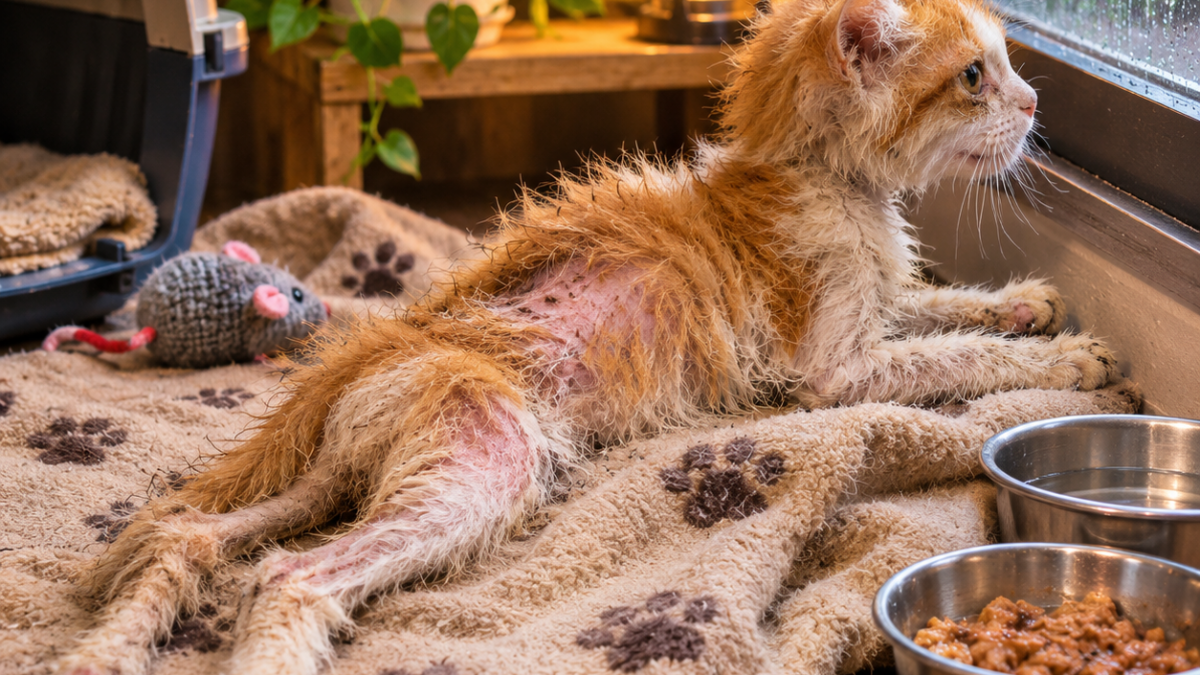
PART 2
I started running.
I knew it made no sense.
My apartment was far enough away that I could not realistically run the entire distance, especially in that weather.
But standing still felt impossible.
Every second I wasn’t moving toward Gaston felt like a decision against him.
Water soaked through my coat almost immediately.
My shoes filled.
I kept my phone in my hand, terrified that if I put it away, something would happen while I wasn’t watching.
The security feed updated every few seconds.
Gaston remained on the rug.
Sometimes the image was too dark to see his chest move.
Every time that happened, panic rose into my throat.
Then I would see one shallow breath.
Still alive.
“Stay with me,” I whispered.
A man under an umbrella glanced at me as I passed.
I didn’t care.
“Just stay with me.”
My phone rang again.
Sarah.
This time I answered.
“Camille?”
“I can’t get home.”
She heard the panic in my voice immediately.
“What happened?”
“The metro’s down. No taxi is stopping.”
“Where are you exactly?”
I told her.
“I’m getting you a car.”
“I tried.”
“I’m trying too.”
Behind her, I could hear the meeting.
Laurent speaking.
Then a chair moving.
Sarah lowered her voice.
“He’s furious.”
I almost laughed.
“I don’t care.”
The words felt strange.
For years, Laurent’s mood had controlled mine.
If he frowned during a presentation, I replayed every sentence afterward.
If he wrote “we need to discuss” in an email, I lost sleep.
If he praised me, I felt relief rather than pride.
I had spent years measuring myself by his reactions.
Now Gaston was lying on my floor, and Laurent’s anger felt microscopic.
Sarah said, “There’s a driver three minutes away from you. Blue Renault.”
I stopped under an awning.
“Sarah…”
“Go.”
“You’re supposed to be in the meeting.”
“I’ll handle it.”
“He’ll blame you.”
“Let him.”
I swallowed.
“Thank you.”
“Call me later.”
“I will.”
“And Camille?”
“Yes?”
“I’m sorry.”
I understood what she meant.
Not sorry about the traffic.
Sorry about what was coming.
I couldn’t answer.
I hung up.
THE BLUE RENAULT
The driver pulled up four minutes later.
His name was Malik.
I remember because the app displayed it above his picture.
He saw me running through the rain and unlocked the door before I reached the car.
I climbed inside dripping water everywhere.
“I’m sorry,” I said. “I’m soaked.”
He looked at me in the mirror.
“Emergency?”
“My cat.”
He nodded as if that explained everything.
Maybe it did.
“Address?”
I gave it.
He started moving.
Traffic was terrible.
Red lights seemed endless.
Cars crawled.
Every road that usually felt familiar suddenly seemed designed to keep me away from home.
Malik changed lanes.
Took side streets.
Cut around a blocked intersection.
I refreshed the camera.
Gaston was still there.
Then the image froze.
I tapped the screen.
Nothing.
Refresh.
Still frozen.
My heart stopped.
“Come on.”
Malik glanced back.
“Problem?”
“The camera.”
“Internet?”
“I don’t know.”
I refreshed again.
The image returned.
The rug was empty.
My body went cold.
“He’s gone.”
“What?”
“My cat. He’s not there.”
I zoomed.
Nothing.
I imagined him crawling away to hide.
Cats do that sometimes when they are very sick.
They seek dark, quiet spaces.
I pictured Gaston dragging himself beneath the bed.
Behind furniture.
Somewhere I might not find him in time.
Then movement appeared at the edge of the frame.
A paw.
Then the tip of his tail.
He had moved closer to the door.
Maybe two feet.
That distance should have taken seconds.
For Gaston, it had taken everything.
His front paw reached the bottom of the door.
Then his head lowered onto the floor.
I started crying.
Not quietly.
Malik said nothing.
He simply drove faster whenever traffic allowed.
After a minute, he said:
“We’re almost there.”
I nodded even though he couldn’t see me.
BEFORE GASTON WAS OLD
I don’t know why the mind does this.
In emergencies, it does not always stay in the present.
While Malik drove, I suddenly remembered the first time I saw Gaston.
I was eighteen years old.
The same age as he was now.
I had just moved into a tiny student apartment in Lyon.
One bedroom if you were generous.
A glorified closet if you were honest.
I was walking home from class when I heard a kitten crying behind a bakery.
There was a cardboard box near a dumpster.
Inside were four kittens.
Three had already been claimed by people from nearby shops.
Gaston was the last.
He was ugly.
That is the truth.
Huge ears.
Tiny head.
Scratched nose.
Tail like a pipe cleaner.
One eye slightly watery.
I picked him up.
He immediately climbed inside my jacket.
That should have been my warning.
He had already decided.
I took him to my apartment “temporarily.”
My mother arrived two days later.
She walked into the bedroom.
Saw Gaston asleep on my pillow.
Closed her eyes.
“Camille.”
“I can explain.”
“No.”
“He was alone.”
“Of course.”
“He needed someone.”
“You can barely take care of yourself.”
“I’m doing fine.”
“You called me yesterday because you didn’t know how to use the washing machine.”
“That was unrelated.”
Gaston woke.
Stretched.
Walked toward my mother.
Then climbed into her lap.
My mother stared down at him.
“This is manipulation.”
I smiled.
“He’s very talented.”
She scratched his head.
Twenty minutes later, she was feeding him chicken.
That was Gaston.
He rarely asked permission.
He simply entered your life and behaved as though he had always belonged there.
THE RUN UP THE STAIRS
When the car stopped, I was out before Malik finished saying anything.
I paid through the app while running.
The elevator in my building was on the eighth floor.
I could see the number moving.
Too slow.
I took the stairs.
First floor.
Second.
Third.
By the fourth, my lungs burned.
By the fifth, my wet shoes were slipping.
I grabbed the railing.
“Gaston!”
Ridiculous.
He couldn’t hear me through several floors and a closed door.
Still I shouted.
Sixth.
My hallway.
I reached my apartment.
My hands were shaking.
I dropped the keys.
“No.”
I crouched, grabbed them, missed the lock.
Tried again.
The door opened inward only a few inches.
Something was behind it.
I stopped.
“Gaston?”
I pushed carefully.
There he was.
He had dragged himself completely against the door.
I dropped to my knees.
“Oh God.”
His eyes were open.
Barely.
His breathing was shallow.
“Baby.”
One ear moved.
That tiny movement destroyed me.
“I’m here.”
Gaston tried to lift his head.
Nothing happened.
I slid my hands underneath him.
His body felt lighter than I expected.
Much lighter.
When had he lost that much weight?
How had I missed it?
I pulled him against my chest.
He made a weak sound.
Not a full meow.
A tiny chirp.
The same sound he had made for eighteen years whenever I came home.
I started sobbing.
“You waited.”
His paw moved.
Touched my wrist.
“You crazy old man.”
I kissed the top of his head.
“You waited for me.”
The front door remained open.
Rainwater dripped from my coat onto the floor.
My work bag lay in the hallway.
None of it mattered.
I sat there holding him.
And for several minutes, the entire world was reduced to the warmth of his face against my neck.
THE CALL
I called our regular veterinarian first.
Closed.
Of course.
It was after seven.
The voicemail gave the number of an emergency clinic.
I called.
A woman answered.
I tried to explain.
“Eighteen-year-old cat. Arthritis. Not eating. Back legs not working. Extremely weak.”
“Is he breathing?”
“Yes.”
“Responsive?”
“Barely.”
“Bring him in now.”
“I don’t have a car.”
“Can you get a taxi?”
“Yes.”
“Keep him warm.”
I wrapped Gaston in his blue blanket.
He had owned that blanket for almost twelve years.
Technically, it had been mine.
He had claimed it.
Like everything else.
I placed him inside a soft carrier but left the top open so I could keep my hand on him.
Before leaving, I looked at the entry rug.
The place where he had waited.
I didn’t know it then, but I would never look at that rug the same way again.
THE EMERGENCY CLINIC
The clinic was bright.
Too bright.
Everything smelled of disinfectant.
A technician saw Gaston and immediately took us into a treatment room.
“What happened?”
I repeated everything.
She checked his temperature.
Frowned.
“Low.”
A veterinarian came in.
Dr. Morel.
Mid-forties.
Tired eyes.
Gentle hands.
She listened to Gaston’s heart.
Checked his gums.
Pressed carefully along his abdomen.
Moved his hind legs.
Gaston barely reacted.
That frightened me.
He had always hated anyone touching his back feet.
At twelve, he had bitten a vet tech for trimming his nails.
At fifteen, he screamed as though he was being murdered because I tried to clean one paw.
Now?
Nothing.
“Is that bad?” I asked.
Dr. Morel looked at me.
“He’s extremely weak.”
“What do you need?”
“Bloodwork. Fluids. We need to check kidney function, electrolytes, anemia, infection.”
“Do everything.”
She hesitated.
I hated that hesitation.
“Camille, he is eighteen.”
“I know.”
“His age matters when we talk about what treatment can realistically accomplish.”
“Please just help him.”
She nodded.
“We will.”
They placed an IV catheter.
Warm fluids.
Pain medication.
Something for nausea.
Gaston lay on a heated pad.
I kept one hand against his face.
He opened his eyes every few minutes.
Each time, I whispered:
“I’m here.”
His eyes closed again.
“I’m not leaving.”
My phone rang.
Laurent.
I turned it off.
THE RESULTS
Dr. Morel returned about forty minutes later.
She sat down.
Veterinarians should never sit down before giving good news.
I learned that immediately.
“His kidneys are failing.”
My mouth went dry.
“How bad?”
“His values are very elevated.”
“Can you fix it?”
“We can support him.”
“That’s not what I asked.”
She looked at Gaston.
Then back at me.
“No. We cannot make eighteen-year-old kidneys young again.”
I stared at her.
“But fluids?”
“They may make him feel better. They may improve the numbers temporarily.”
“Temporarily.”
“Yes.”
“How long?”
“I can’t tell you.”
“Days?”
“Possibly.”
“Weeks?”
She paused.
“Possibly, but I would not promise that.”
“Months?”
Her expression answered before she did.
“Unlikely.”
I looked down at Gaston.
His face seemed so peaceful under my hand.
“This morning he walked.”
“I believe you.”
“He ate yesterday.”
“How much?”
I looked away.
Not much.
Almost nothing.
Dr. Morel said softly:
“Cats are very good at hiding decline.”
I felt guilt hit immediately.
“I should have noticed.”
“No.”
“I should have brought him earlier.”
“You brought him when you understood something was wrong.”
“I left him all day.”
“You went to work.”
“He was crawling.”
“You didn’t know that when you left.”
I began crying again.
Dr. Morel handed me tissues.
“I promised I’d be home early.”
Gaston’s ear moved at my voice.
That almost made it worse.
THE EMAIL
While Gaston received fluids, I turned my phone back on.
Twenty-three notifications.
Most were irrelevant.
One message from Sarah:
How is he?
I replied:
Kidney failure. I’m at the emergency vet.
Her response came immediately.
I’m so sorry. Don’t think about work.
Then I saw Laurent’s message.
We need to discuss your departure tomorrow morning. Leaving a critical meeting without authorization is unacceptable.
I read it twice.
Then looked at Gaston.
His breathing was slow.
My reaction surprised me.
Normally a message like that would have made me anxious.
I would have drafted an apology.
Explained.
Promised it wouldn’t happen again.
Instead, I felt nothing.
Then anger.
Clean anger.
Not loud.
Not dramatic.
Just certainty.
There would be time for Laurent.
There might not be time for Gaston.
I put the phone away.
MIDNIGHT
Around midnight, Gaston’s temperature improved.
He lifted his head slightly.
Dr. Morel offered a little food.
He turned away.
Then I put some on my finger.
He sniffed.
Licked once.
I smiled immediately.
“There you are.”
Another lick.
Then he stopped.
“That’s enough,” Dr. Morel said.
I wanted to believe the improvement meant everything had changed.
That he would recover.
That we would have months.
Maybe a year.
But hope can become denial very quickly.
Dr. Morel knew that.
I did not.
“Can I take him home?”
She considered.
“If his temperature remains stable.”
“I don’t want him here alone.”
“He would be monitored.”
“I know.”
“That may be safer medically.”
“I want him home.”
She studied me.
“You understand he could decline very quickly.”
“Yes.”
“If he becomes distressed, you bring him back immediately.”
“Yes.”
“And Camille?”
I looked at her.
“If he begins suffering, loving him may mean making a decision you desperately don’t want to make.”
I knew what she meant.
I hated the sentence.
But I nodded.
HIS FAVORITE PILLOW
At 1:14 a.m., Gaston was back home.
I carried him directly into my bedroom.
For almost eighteen years, he had been officially forbidden from sleeping on my pillow.
That rule had never once been respected.
I placed him right in the middle.
He sniffed the pillowcase.
Then his body softened.
“You remember.”
His eyes closed.
I lay beside him.
My hand rested against his back.
I felt each breath.
For years, I had slept annoyed because Gaston took up too much space.
He somehow occupied the exact center of the bed despite weighing less than six kilograms.
That night, I wanted him to take all of it.
I wanted to wake up with no room.
I wanted to complain.
I wanted another ordinary morning.
At some point, I fell asleep.
THE MORNING AFTER
I woke at 6:03 a.m.
For one second, I forgot.
Then I felt Gaston beside me.
Still warm.
Still breathing.
“Morning.”
His eyes opened.
Normally breakfast time transformed him into a dictator.
Nothing.
No yelling.
No paw to my face.
I checked my email.
Laurent had sent a calendar invitation.
8:30 — Performance Discussion
I declined.
Then wrote:
I will not be in the office today. Gaston is receiving end-of-life veterinary care. I am taking emergency personal leave and will contact HR directly.
His reply came three minutes later.
This is not approved. We have already discussed professional priorities.
I stared.
Then copied Human Resources.
Attached the veterinary discharge document.
Wrote:
Please record this as emergency personal leave. I am unavailable today.
Send.
My heart pounded afterward.
Not because I doubted the decision.
Because I had never done anything like that.
Gaston opened one eye.
I pointed at him.
“You’re causing problems.”
Slow blink.
“Yes, you.”
Another blink.
I smiled.
“Good.”
THE WINDOW
Around ten, Gaston tried to move.
I immediately supported him.
He dragged one back foot.
I used a folded towel beneath his belly.
He wanted to go toward the living room.
Specifically the window.
There was a low cushion there where he had watched birds for years.
I lifted him onto it.
The rain had finally stopped.
A small patch of sunlight broke through the clouds.
Gaston turned his face toward the warmth.
I sat beside him.
And thought of my mother.
MY MOTHER AND GASTON
My mother never admitted she loved Gaston.
Not in those words.
She called him “that ridiculous animal.”
She bought him Christmas presents.
She complained that he shed on her clothes.
She kept cat treats in her kitchen despite not owning a cat.
When she developed cancer, Gaston changed around her.
He became unusually quiet.
During her last months, whenever she visited, he sat beside her.
Sometimes on her lap.
Sometimes simply near her feet.
My mother once looked down at him and said:
“You know, don’t you?”
I asked, “Know what?”
She shook her head.
“Nothing.”
The last afternoon she visited my apartment, she kissed Gaston on the forehead.
Then she looked at me.
“Take care of her.”
I laughed.
“Mom, he’s a cat.”
“He knows.”
At the time, I thought she was being sentimental because she was sick.
After she died, I came home from the hospital and sat on my kitchen floor.
I didn’t cry.
Not initially.
I was numb.
Gaston entered.
Stopped several feet away.
Watched.
Then walked into my lap.
I wrapped my arms around him.
That was when I collapsed.
He stayed all night.
Now I sat beside him in the sunlight.
“Everybody keeps leaving me.”
His ear moved.
I immediately regretted saying it.
“That’s unfair.”
I stroked him.
“You stayed longer than almost everyone.”
His eyes closed.
“You’re allowed to go when you need to.”
The words came out softly.
I wasn’t ready to mean them.
SARAH
Around noon, the intercom rang.
Sarah.
I let her in.
She carried coffee, soup, and pastries.
“You didn’t need to come.”
“Yes, I did.”
She saw Gaston.
Her expression changed.
“Oh.”
“He looks bad.”
“I know.”
She crouched but didn’t touch him.
“Can I?”
“Let him smell you.”
Gaston sniffed her fingers.
Then rested his head again.
Sarah sat beside me.
“Laurent wants to issue a formal warning.”
I laughed once.
Not because it was funny.
“For leaving?”
“Yes.”
“Because my cat was dying.”
“He said your reaction was disproportionate.”
I stared at her.
“He actually used that word?”
“Yes.”
“What did you say?”
“That he was wrong.”
“You shouldn’t get dragged into this.”
“I already am.”
“Sarah.”
She shook her head.
“My dog died when I was twenty-six.”
I had never known.
“My parents knew she was sick. They waited to tell me because I had an exam.”
I looked at her.
“I wasn’t there.”
Her eyes filled.
“I still hate that.”
I touched her hand.
“So when you stood up last night…”
She looked at Gaston.
“I wanted you to run.”
We sat in silence.
Then she said:
“Julien backed you too.”
“What?”
“He told Laurent that if an eighteen-year-old animal dying isn’t an emergency, he’d like a written definition of emergency.”
Despite everything, I laughed.
“What happened?”
“Laurent said we were becoming emotionally unprofessional.”
I looked at Gaston.
“Apparently compassion is a workplace hazard.”
“Very dangerous.”
A GOOD HOUR
At three in the afternoon, Gaston surprised me.
He ate.
Not much.
A teaspoon of warmed wet food.
But he ate without me putting it on my finger.
I called Dr. Morel immediately.
“He’s eating.”
“That’s good.”
“So he’s improving?”
Pause.
“He may feel better because of the fluids.”
“So that means—”
“Camille.”
I stopped.
“Take the good hour.”
That sentence stayed with me.
Take the good hour.
Not tomorrow.
Not next month.
This hour.
So I did.
Gaston ate.
Drank.
Managed six slow steps with support.
Then climbed—mostly with my help—onto the couch.
I sat beside him and opened old videos.
Baby Gaston attacking my shoelaces.
Gaston at three climbing halfway up the Christmas tree.
Gaston at seven sitting inside a suitcase while my ex-husband tried to pack.
Gaston at twelve screaming because I had bought the wrong food.
Gaston at fifteen stealing ham.
I laughed.
Actually laughed.
Then cried.
Gaston heard his younger self meowing from the phone.
His ears moved.
I held the screen near him.
“That’s you.”
He blinked.
“You were awful.”
Slow blink.
“Completely unbearable.”
His paw moved onto my leg.
I put my hand over it.
“Best decision I ever made.”
MY MARRIAGE
Gaston had outlasted my marriage.
My ex-husband, Pierre, tolerated him at first.
Then eventually loved him.
During the divorce, we argued about almost everything.
Furniture.
Savings.
The apartment.
Books.
A ridiculous espresso machine neither of us truly wanted.
Not Gaston.
Pierre said:
“He’s yours.”
Not cruelly.
Simply true.
The night Pierre moved out, Gaston sat in the hallway watching boxes leave.
Then Pierre crouched beside him.
“Take care of her.”
Same words my mother had used.
Gaston sniffed his hand.
Pierre cried.
I didn’t.
Not until later.
After the door closed, Gaston walked back inside.
Sat beside me.
Again.
Always there after the leaving.
Maybe that was why the thought of losing him felt so terrifying.
He wasn’t merely part of my life.
He was the witness to it.
NIGHT TWO
Around midnight, everything changed.
Gaston became restless.
He tried to stand repeatedly.
Couldn’t.
His breathing became faster.
He moved his head as though he couldn’t get comfortable.
I knew.
I didn’t want to know.
But I did.
I called the emergency clinic.
Dr. Morel answered.
“Bring him.”
I wrapped Gaston in his blue blanket.
At the front door, I stopped.
The entry rug.
I stared at it.
The exact place he had crawled to.
I held him tighter.
“You don’t have to wait for me anymore.”
His head rested against my chest.
I carried him out.
THE SECOND VISIT
Dr. Morel examined him.
His temperature had dropped again.
His kidney values were worse.
His breathing was labored because his body was no longer regulating properly.
“We can hospitalize him.”
I nodded too quickly.
“Yes.”
She continued.
“We can give more fluids, monitor him, possibly improve how he feels temporarily.”
“Then do it.”
She didn’t move.
“Why aren’t you doing it?”
“Because I need you to understand what it will accomplish.”
“It will help him.”
“For a little while.”
“How long?”
“I don’t know.”
“Days?”
“Maybe.”
“Then I want the days.”
Dr. Morel sat.
“Camille.”
“No.”
She stayed silent.
That made me angrier.
“Don’t look at me like that.”
“I’m not judging you.”
“Yes, you are.”
“No.”
“Then tell me I should treat him.”
She looked at Gaston.
Then me.
“If this were my cat, I would let him go.”
The room went completely quiet.
I stared.
“How can you say that?”
“Because I think continuing aggressive treatment would be for us now, not for him.”
I looked down.
Gaston’s eyes were half closed.
His body seemed exhausted beyond anything I had seen.
I whispered:
“So if I keep him alive…”
“You may buy time.”
“For me.”
Dr. Morel said nothing.
“Not for him.”
Silence.
I knew the answer.
I WASN’T READY
I sat on the floor.
Gaston lay in my lap.
“I can’t.”
Dr. Morel crouched nearby.
“You don’t have to decide this second.”
“How do people do this?”
“They don’t want to.”
“That doesn’t answer me.”
“No.”
I cried into Gaston’s blanket.
“I don’t know how to know if it’s time.”
Dr. Morel spoke carefully.
“Ask yourself what he still enjoys.”
“Me.”
She nodded.
“What else?”
I couldn’t answer.
Food?
Barely.
Walking?
No.
Birds?
He had watched the window, but mostly slept.
Pain?
Probably.
Fear?
Maybe.
Exhaustion?
Certainly.
I whispered:
“What if he wants one more day?”
Dr. Morel said:
“What if he’s staying because you’re not ready?”
That sentence broke me.
I looked at Gaston.
His paw moved.
Touched my wrist.
The same gesture from the entryway.
I leaned over him.
“I’m sorry.”
He purred.
Barely.
Almost too faint to hear.
I laughed through tears.
“You’re comforting me.”
Of course.
Even now.
THE LAST DECISION
I asked Dr. Morel to explain everything.
Every step.
I needed control where there was none.
She would first give a sedative.
Gaston would become deeply relaxed.
Then the final medication.
No pain.
No panic.
I could hold him.
I could talk.
I could stop before the final injection if I changed my mind.
That last part almost trapped me.
I knew if I waited for certainty, I would never choose.
There is no certainty in saying goodbye.
Only love and fear fighting inside the same body.
I called Sarah.
She answered immediately.
“I’m letting him go.”
Silence.
Then:
“Oh, Camille.”
“I don’t know if I’m doing the right thing.”
“You are.”
“How do you know?”
“Because you’re asking what’s right for him instead of what hurts less for you.”
I covered my mouth.
“I don’t want to go home without him.”
“I know.”
“I can’t imagine it.”
“I know.”
“I’m scared.”
“I know.”
I heard her crying.
“Do you want me to come?”
I looked at Gaston.
“No.”
“Okay.”
“I think it should just be us.”
“Then stay with him.”
“I will.”
HIS LAST MOMENTS
Dr. Morel dimmed the lights.
I sat in a chair with Gaston in my arms.
Blue blanket.
Head beneath my chin.
Exactly how he slept when he was young.
The first medication went in.
Gaston relaxed.
His breathing became slower.
I talked.
I didn’t stop talking.
“You remember the bakery?”
His ear moved slightly.
“You looked terrible.”
I smiled through tears.
“Your ears were ridiculous.”
I told him about my first apartment.
My mother.
The Christmas tree.
My graduation.
Pierre.
The divorce.
The night he stole an entire chicken breast.
The time he got stuck in a wardrobe because he refused to come out before I left for work.
The time he slept on my mother’s hospital bag.
I told him every stupid thing I could remember.
Because I wanted the room filled with his life.
Not his death.
Then I reached the part I had been avoiding.
“You can go.”
My voice broke.
Gaston’s body was completely relaxed.
“I’m here.”
I kissed his forehead.
“You don’t need to wait at the door anymore.”
One slow breath.
Then another.
“I came home.”
Dr. Morel gave the final medication.
Gaston’s breathing became softer.
Slower.
I held him tighter.
“No more hurting.”
Another breath.
“You were such a good boy.”
Pause.
“The best.”
His chest rose once more.
Then nothing.
I waited.
Maybe another breath would come.
It didn’t.
Dr. Morel placed the stethoscope against him.
Listened.
Then put her hand on my shoulder.
“He’s gone.”
I looked at her.
“No.”
Not denial exactly.
More like objection.
The sentence was too small for what had happened.
“He’s gone.”
Eighteen years.
And now a room could become different because one tiny heart had stopped.
I kept holding him.
Dr. Morel did not rush me.
I’m grateful for that.
THE EMPTY BLANKET
At 4:30 in the morning, I returned home carrying the blue blanket.
Empty.
That was worse than everything.
I opened the apartment door.
Looked down automatically.
Nothing.
Of course.
Still, my body expected him.
His bowls.
His medicine.
The little ramp.
His bed.
The entry rug.
I walked to the rug.
Sat.
Exactly where he had waited for me.
The apartment sounded enormous.
I had never realized how much noise one cat made.
Tiny claws on floorboards.
A jump onto the couch.
A bowl moving.
A sigh.
A meow from another room.
Without him, there was only the refrigerator humming.
I lay down on the rug.
Still wearing yesterday’s clothes.
And slept.
GRIEF HAS ROUTINES
The next morning, I woke at 7:12.
My first thought was:
Gaston needs breakfast.
Then I remembered.
That moment repeated for weeks.
Wake up.
Remember.
Walk into kitchen.
See bowl.
Remember.
Come home.
Look toward door.
Remember.
Sit on couch.
Reach toward the spot beside me.
Remember.
Grief is not one enormous feeling.
It is a thousand small collisions with reality.
THE OFFICE
I stayed home another day.
HR approved it.
Laurent sent nothing.
That silence was not peace.
I knew him.
On Friday, I went back.
Part of me wanted to avoid the office indefinitely.
Another part wanted to walk directly into Laurent’s office and see whether he was ashamed.
He wasn’t.
At 9:00, I received a meeting invitation.
Laurent.
Nadia from HR.
Conference Room 4.
I walked in.
A printed document sat on the table.
Laurent folded his hands.
“Camille, we need to address Tuesday evening.”
I sat.
“My cat died Wednesday night.”
Nadia looked at me immediately.
“I’m very sorry.”
“Thank you.”
Laurent nodded once.
“Yes. Obviously that’s unfortunate.”
Unfortunate.
My fingers tightened beneath the table.
He continued.
“The issue is your decision to leave a critical client-preparation meeting without authorization.”
I stared at him.
“I told you I had an emergency.”
“You informed me. You did not ask permission.”
“Correct.”
He seemed surprised.
“So you recognize that.”
“Yes.”
“And you understand why this is a problem?”
“No.”
Laurent’s eyebrows rose.
Nadia glanced between us.
I continued.
“If the same situation happened today, I would leave again.”
Laurent leaned forward.
“So you have no regret?”
“I regret staying as long as I did.”
Silence.
That was the moment the meeting changed.
THE WARNING THAT NEVER GOT SIGNED
Laurent pushed the document toward me.
“This is a formal warning concerning professional judgment.”
I didn’t touch it.
“What policy did I violate?”
He looked annoyed.
“Camille, don’t turn this into a legal exercise.”
“I’m asking a simple question.”
Nadia looked down at the paper.
Laurent said:
“You abandoned a business-critical meeting.”
“It was scheduled to end at 5:30.”
“It ran over.”
“It was 6:30.”
“That happens.”
“Yes. Constantly.”
Laurent’s expression changed.
I continued.
“The employee handbook provides emergency personal leave. It does not exclude companion animals.”
Laurent laughed.
“You’re comparing this to a family medical emergency?”
“I’m asking HR how policy is written.”
Nadia answered:
“The policy is intentionally broad.”
Laurent looked at her.
“Surely this situation—”
Nadia interrupted.
“Emergency circumstances are assessed individually.”
I opened my laptop.
Laurent frowned.
“What are you doing?”
“If we are discussing professional conduct, I’d like to add context.”
“What context?”
“Nine months of messages.”
He went still.
I opened a folder.
Emails.
Teams messages.
Calendar screenshots.
Late-night directives.
Weekend requests.
Messages telling staff to cancel plans.
Messages telling Sarah not to make medical appointments during “peak weeks.”
Messages to Julien after his daughter’s school event.
One especially ugly message:
Senior people don’t ask HR to solve scheduling problems. They show commitment.
I turned the screen toward Nadia.
Laurent’s face lost color.
“Camille.”
“You wanted a formal discussion.”
“This is unrelated.”
“No. It is exactly related.”
Nadia closed the warning document.
“I think we need to pause this conversation.”
Laurent looked at her.
“Why?”
“Because I now need to understand whether there is a broader management issue.”
That was the first moment Laurent understood he was no longer controlling the room.
I DIDN’T PLAN IT
People later called what happened revenge.
It wasn’t.
At least not at first.
I had not spent Gaston’s final hours compiling evidence against my boss.
I had been holding my cat.
But grief changed something in me.
Before Gaston, I thought the cost of conflict at work was too high.
After Gaston, I understood the cost of silence.
How many evenings had I stayed late because Laurent implied leaving on time meant weakness?
How many dinners had I canceled?
How many weekends?
How many times had I answered emails while sick?
How many times had I told myself:
Just this quarter.
Just this project.
Just until promotion.
Then I would set boundaries.
Gaston did not have another quarter.
That was the lesson.
Some things wait.
Some don’t.
THE HR INTERVIEWS
Nadia interviewed our entire team.
Separately.
At first, everyone was nervous.
Nobody wanted to be “the difficult employee.”
Then the stories came.
Sarah had delayed a specialist appointment twice because Laurent complained about her availability.
Julien had missed his daughter’s theater performance after Laurent scheduled a late review.
Elise had been told that discussing fertility treatment made her “look distracted.”
Marc had worked while recovering from surgery because Laurent texted:
Senior management is watching who steps up.
There were records.
Lots of them.
Laurent had been careless because he never imagined anyone would challenge him.
Power makes people sloppy.
SARAH’S STORY
Sarah came to my desk after her HR interview.
“You okay?”
“No.”
She sat.
“I told them everything.”
“How do you feel?”
“Terrified.”
I understood.
“What did you tell them?”
“The appointments. The weekend work. The message after my father went to the hospital.”
I looked at her.
“What message?”
She showed me.
Two years earlier.
Sarah had written:
My father has been admitted. I need to leave.
Laurent replied:
Again? We need more reliability from senior team members.
I stared.
“Why did you never show me?”
She shrugged.
“Same reason you never showed me half your messages.”
We looked at each other.
Because we thought it was normal.
That was the ugliest part.
LAURENT CHANGED
For the next two weeks, Laurent became polite.
Very polite.
He stopped sending midnight messages.
Stopped making jokes about commitment.
Stopped calling people into his office with the door closed.
He asked instead of ordered.
Used the phrase “if your schedule allows.”
It was almost funny.
Almost.
Then one Monday, his office was empty.
Company email:
Laurent Dumas is on administrative leave pending an internal leadership review.
Sarah walked toward my desk holding her phone.
“You saw?”
“Yes.”
“You did that.”
“No.”
“You started it.”
I looked at her.
“Gaston started it.”
She smiled sadly.
“Would you tell him?”
“What?”
“That he took down a director?”
I imagined Gaston.
Old.
Annoyed.
Demanding breakfast.
“He wouldn’t care.”
Sarah laughed.
“No?”
“He’d want chicken.”
THE ASHES
Three weeks after Gaston died, Dr. Morel called.
His ashes were ready.
I almost asked her to keep them longer.
Not because I didn’t want them.
Because bringing the box home made the death permanent in a new way.
I went.
The clinic receptionist handed me a small wooden box.
Too small.
Everything about it felt offensive.
Eighteen years should take more space.
Dr. Morel came out with a clay paw print.
“We made this for you.”
I touched it.
The indentation was unmistakably his.
“That was his paw?”
“Yes.”
“He hated anyone touching his paws.”
Dr. Morel smiled.
“He complained.”
I laughed through tears.
“Good.”
That mattered.
Gaston had still been himself.
WHAT THE CAMERA REALLY SHOWED
For weeks, I couldn’t watch the security clip.
I kept it.
But never opened it.
Then one Sunday morning, I did.
Gaston appeared at the edge of the frame.
Crawling.
Pull.
Rest.
Pull.
Rest.
I cried immediately.
But I forced myself to continue.
He reached the rug.
Collapsed.
Looked at the door.
For the first time, I noticed something else.
He didn’t look panicked.
He looked determined.
That changed the memory slightly.
I had always interpreted it as:
He was dying and desperately waiting for me.
Maybe.
But there was another interpretation.
Gaston knew the door meant me.
When he was weak and frightened, he moved toward the place where I usually appeared.
That was not only sadness.
It was trust.
He expected me to come home.
And I did.
Late.
Wet.
Terrified.
But I did.
LAURENT’S EXIT
The HR investigation lasted six weeks.
Laurent did not return.
Official language called it a “mutually agreed departure following leadership review.”
Everyone knew what that meant.
The company found repeated management-policy violations.
Inappropriate pressure around after-hours work.
Disregard for emergency leave.
Retaliatory behavior.
Improper comments about medical and family responsibilities.
The formal warning against me was withdrawn.
Nadia called personally.
“I’m sorry this process began the way it did.”
“Thank you.”
“We should have seen the pattern earlier.”
“Yes.”
She paused.
“Are you considering leaving?”
I had been.
Before Gaston died, I would have been terrified to start over.
Now?
Less so.
“I don’t know.”
“Take time.”
For once, an employer told me to take time.
Strange concept.
THE PROMOTION I ALMOST REFUSED
Three months later, one of the partners asked me to lunch.
I expected a discussion about a client.
Instead, he offered me Laurent’s old role on an interim basis.
I laughed.
Not because it was funny.
Because life sometimes has terrible timing.
“You want me to take his job?”
“Yes.”
“No.”
He blinked.
“You don’t want the promotion?”
“Not under the same conditions.”
“What conditions?”
So I told him.
No routine meetings starting at six.
No glorification of weekend work.
No contacting employees on approved vacation unless genuinely urgent.
Emergency leave recognized without humiliation.
Clear recovery time after major pushes.
Managers evaluated partly on retention and team health, not simply revenue.
He listened.
“That’s a lot.”
“Yes.”
“Some of it may be difficult.”
“Yes.”
“You’re negotiating hard.”
I thought of Gaston crawling.
“No.”
I shook my head.
“I’m negotiating before I lose something else I can’t replace.”
Two weeks later, most of it was approved.
I took the role.
LEADERSHIP
The first time one of my employees told me she needed to leave because her dog was at the emergency vet, she looked terrified.
“I know we have the client call.”
“Go.”
She blinked.
“Really?”
“Yes.”
“I can dial in later.”
“No.”
“But—”
“Go.”
She left.
The client call happened anyway.
The company survived.
That was when I realized how many emergencies workplaces manufacture simply because nobody is willing to say:
This can wait.
SIX MONTHS WITHOUT HIM
Six months after Gaston died, the apartment still felt wrong.
I had moved his bowls into a cabinet.
Not thrown them away.
Never.
His ramp remained beside the couch.
I told myself I would donate it.
I didn’t.
His scratching post stood by the window.
One afternoon, I nearly called his name when I walked into the bedroom.
The silence afterward hurt.
But grief had begun changing.
At first, every memory ended with his death.
Later, some memories became whole again.
Gaston young.
Gaston annoying.
Gaston healthy.
That was progress.
ONE YEAR
On the anniversary of his death, I took the day off.
I did not request permission nervously.
I simply booked it weeks earlier.
Sarah sent me:
Thinking of Gaston today.
Julien sent a picture of his own cat sitting on a laptop.
In honor of your dictator.
I laughed.
I placed Gaston’s ashes near the window.
Then watched old videos.
Not the final one.
The good ones.
At twelve, screaming in the kitchen.
At fourteen, asleep on my mother’s scarf.
At sixteen, stealing butter.
At seventeen, trying to squeeze inside a box half his size.
For the first time, I laughed more than I cried.
That felt almost wrong.
Then I remembered Dr. Morel telling me:
“Eventually, you’ll remember his life more than his death.”
She was right.
I DIDN’T WANT ANOTHER CAT
People asked.
Coworkers.
Friends.
My neighbor.
“No.”
I always answered immediately.
Not because I didn’t love cats.
Because I did.
Too much.
I did not want another ending.
The idea of repeating that night decades later felt unbearable.
Sarah never pressured me.
Until eighteen months later.
She wanted to adopt.
“Come with me.”
“No.”
“You don’t need to adopt.”
“No.”
“I need moral support.”
“You don’t.”
“I do.”
That was how I ended up at a shelter on a Saturday morning.
LÉON
The kittens were everywhere.
Tiny paws.
Big eyes.
People naturally stopped.
I kept walking.
Then I saw him.
Older tabby.
Gray around the muzzle.
Sleeping while everyone else competed for attention.
I stopped.
Sarah noticed.
She wisely said nothing.
The shelter volunteer approached.
“That’s Léon.”
“How old?”
“Twelve.”
“Why is he here?”
“Owner passed away.”
I swallowed.
“Family?”
“Couldn’t take him.”
“How long?”
“Four months.”
I looked at him.
“He doesn’t seem interested in getting adopted.”
The volunteer laughed.
“He’s selective.”
Léon opened one eye.
Looked directly at me.
Then closed it again.
I smiled despite myself.
“Rude.”
“Very.”
I left without touching him.
Then came back the next week.
And the week after that.
On the third visit, Léon climbed into my lap.
I cried.
The volunteer panicked.
“Are you okay?”
“Yes.”
I buried my face in his fur.
“He’s not Gaston.”
The volunteer didn’t understand why that mattered.
But it did.
He wasn’t Gaston.
That was what made loving him possible.
THE FIRST NIGHT WITH LÉON
Léon explored the apartment cautiously.
He smelled everything.
Ignored Gaston’s old scratching post.
Inspected the bedroom.
Then disappeared beneath the couch.
Normal.
I left him alone.
Around ten, my phone chimed.
Motion detected in entryway.
My body froze.
For a second, I was back in the conference room.
Heart pounding.
I opened the camera.
Léon sat on the entry rug.
Looking at the door.
I started crying immediately.
Then laughing.
The poor cat had done absolutely nothing dramatic.
I walked toward him.
Sat on the rug.
“You have no idea what you just did.”
Léon yawned.
“This was Gaston’s place.”
He stood.
Turned once.
Then sat on my foot.
I scratched his head.
“Fine.”
LÉON WAS NOT GASTON
That mattered.
He hated chicken.
Gaston worshipped it.
Léon loved fish.
Gaston mostly ignored fish.
Gaston screamed constantly.
Léon communicated with tiny squeaks.
Gaston hated closed doors.
Léon preferred hiding.
Gaston slept on my chest.
Léon slept at my feet.
Every difference relieved me.
Love did not feel like replacement.
It felt like expansion.
THE NEW RULES
At work, my team slowly changed too.
People left on time more often.
Not always.
Consulting still had bad weeks.
But late work had to have a reason.
Not habit.
If someone stayed until nine, they started late the next morning.
If weekend work became unavoidable, recovery days followed.
People used vacation.
Actual vacation.
One partner complained that our team looked “less hungry.”
Our retention improved.
Client satisfaction improved.
Revenue did not collapse.
Eventually, other teams copied some policies.
I wished I could tell Gaston.
He would have slept through the explanation.
LAURENT
Two years after he left, I saw Laurent at a professional conference.
Across a lobby.
He recognized me.
We both hesitated.
Then he walked over.
“Camille.”
“Laurent.”
“You look well.”
“So do you.”
Awkward silence.
He looked older.
Less polished.
Or maybe I was simply no longer intimidated.
“I heard you took over the division.”
“Yes.”
“Congratulations.”
“Thank you.”
Another pause.
Then:
“I’ve thought about that night.”
I knew exactly which night.
I said nothing.
He continued.
“What I said was cruel.”
“Yes.”
No softening.
He nodded.
“I was under pressure.”
“So was everyone.”
“I know.”
He looked at me.
“I’m sorry about your cat.”
“Gaston.”
“What?”
“His name was Gaston.”
Laurent nodded slowly.
“I’m sorry about Gaston.”
That mattered more than I wanted it to.
“Thank you.”
He looked relieved.
Maybe he expected forgiveness.
I didn’t owe him a dramatic scene.
I also didn’t need to punish him.
So I said:
“I hope you’re doing better.”
“I am.”
“Good.”
And walked away.
That was enough.
REVENGE
People love revenge because it creates symmetry.
Someone hurts you.
Then they hurt.
Balance.
But real life rarely becomes satisfying that way.
Laurent lost his management position.
Yes.
His choices caused that.
Was I glad?
At first.
But it did not bring Gaston back.
It did not erase the forty minutes I spent trapped in traffic wondering if he was dying alone.
It did not change the fact that I almost stayed in that meeting.
The satisfying part came later.
When employees left my meetings because their children needed them.
Because a parent was sick.
Because a dog was at the vet.
Because life happened.
And I said:
Go.
That was the answer to Laurent.
Not his downfall.
A different culture.
THE LAST VIDEO
Years later, I still kept the security clip.
I rarely watched it.
One evening, after Léon had been living with me almost three years, I opened it again.
Gaston crawled.
Slowly.
Painfully.
Toward the door.
I cried.
But this time, I did not feel only horror.
I noticed his determination.
He knew where I came home.
He trusted the routine.
Door opens.
Camille returns.
That was his logic.
Simple.
Beautiful.
Heartbreaking.
I realized something.
For eighteen years, I thought I was Gaston’s home.
But maybe the relationship worked both ways.
He had been mine too.
Not the apartment.
Not the city.
Not my career.
Home was the creature who knew my footsteps.
The creature waiting behind the door.
WHAT I WISH I HAD KNOWN
If I could speak to the version of myself sitting in that conference room, I would tell her:
Stand up sooner.
Not because Gaston will die.
She doesn’t know that yet.
Stand because love should not need a corporate justification.
Stand because emergency is not determined by hierarchy.
Stand because eighteen years of companionship is real even if your boss does not understand it.
Stand because there are moments that will never be repeated.
Quarterly reviews repeat.
Budgets repeat.
Targets repeat.
Some doors only open once.
DR. MOREL
I visited Dr. Morel years later with Léon.
She looked at his chart.
“New cat?”
“Yes.”
She smiled.
“I wondered if you ever would.”
“I didn’t think I could.”
“How does it feel?”
“Different.”
“Good.”
She examined Léon.
He complained loudly.
She laughed.
“Healthy opinion.”
I smiled.
“Gaston hated you too.”
“I remember.”
Of course she did.
Before leaving, I asked:
“Was it the right decision?”
She knew immediately what I meant.
“Camille.”
“I know it’s been years.”
“Yes.”
“I still wonder.”
She put down the file.
“You brought him home.”
I nodded.
“He got a good day.”
“Yes.”
“You brought him back when he suffered.”
“Yes.”
“You stayed.”
I started crying.
Still.
After years.
She said:
“You did not choose his death. His body had already done that. You chose not to make him endure more because you were afraid to say goodbye.”
That sentence finally reached somewhere guilt had been living.
I nodded.
“Thank you.”
LÉON GREW OLD TOO
Years passed.
Of course they did.
Léon turned fifteen.
Then sixteen.
His muzzle became whiter.
He slept more.
I recognized the signs differently now.
Not panic.
Awareness.
I took him to the vet sooner.
Adjusted his food.
Medication.
Steps near the bed.
A low litter box.
I caught myself buying another expensive orthopedic cushion.
Some patterns deserve repeating.
One evening Léon sat near the door when I came home.
Not crawling.
Just waiting.
I crouched.
“Don’t you dare.”
He squeaked.
I laughed.
“I mean it. No dramatic finales.”
He rubbed against my hand.
EPILOGUE — THE DOOR
For years, when people asked me about the night Gaston died, they focused on my boss.
They asked:
“What happened to Laurent?”
“Did he get fired?”
“Did you take his job?”
“Was that revenge?”
Maybe those questions are easier.
Workplace conflict has villains.
Consequences.
Clear outcomes.
Grief does not.
So here is what happened.
Laurent lost his leadership role.
The company investigated.
Policies changed.
I eventually took over his division.
People called it justice.
Perhaps it was.
But that is not the part of the story that matters most to me.
The part I carry is quieter.
An eighteen-year-old cat.
A hardwood hallway.
A front door.
And a body that had almost no strength left.
Gaston spent his entire life waiting for me in ordinary ways.
At the door after school.
At the door after work.
At the door after dates.
At the door after funerals.
At the door after arguments.
At the door after long nights when I had convinced myself my job could not function without me.
He never asked where I had been.
Never judged how late I came home.
Never cared whether my presentation had gone well.
He was simply happy the lock turned.
That final evening, Gaston could no longer walk.
Still, he moved toward the door.
Pull.
Rest.
Pull.
Rest.
He dragged his failing body across the apartment because some part of him believed the same thing he had believed for eighteen years:
Eventually, I would come home.
And I did.
I opened the door.
He heard me.
His ear moved.
I lifted him.
His paw touched my wrist.
There are people who would say that was only an animal.
That he did not understand love the way humans understand it.
Maybe.
I don’t care.
Love is not made less real because it cannot explain itself.
Gaston waited.
I returned.
That was enough.
He gave me one last day.
Not a miraculous recovery.
A day.
Sunlight.
A few bites of food.
Old videos.
His paw on my leg.
And then, when staying became harder than leaving, I held him.
I told him he did not need to wait anymore.
I told him I was there.
I told him I had come home.
For a long time, I thought that was the last lesson Gaston gave me.
It wasn’t.
The last lesson came afterward.
When I returned to an empty apartment.
When Laurent tried to punish me.
When HR asked what had happened.
When I looked at fifteen years of late nights and suddenly understood that I had mistaken availability for value.
I had believed professionalism meant always being reachable.
Always flexible.
Always willing to sacrifice.
But sacrifice without choice is not dedication.
It is surrender.
Gaston’s death forced me to ask a question I should have asked years earlier:
What am I protecting with all this work?
A title?
A salary?
Someone else’s approval?
If success costs every moment you cannot recover, what exactly have you won?
That question changed my career more than any promotion.
I still work hard.
I still care.
Deadlines matter.
Clients matter.
People depend on one another.
But not everything is an emergency.
That distinction became sacred to me.
A report can wait an hour.
A meeting can continue without one person.
A quarterly review will happen again.
A dying animal’s final night will not.
A child’s performance will not.
A father’s hospital call may not.
A mother asking you to come home may not.
Some moments are one-time doors.
You either walk through them or you don’t.
Laurent once told me work had to come first.
Years later, I no longer hate him for saying it.
I almost pity the version of him who believed it.
Because anyone who believes work must always come first eventually discovers something terrible.
Work does not love you back.
People do.
Animals do.
Families do.
Friends do.
The life waiting beyond the office door does.
Gaston knew that before I did.
He spent eighteen years showing me.
I just didn’t understand until the last day.
Today, there is another old cat in my apartment.
Léon sometimes waits near the door.
Not every day.
He is less dramatic than Gaston.
But when I come home and see him sitting there, I always stop.
I put down my bag.
I kneel.
I say hello.
Even if my phone is ringing.
Even if I have emails.
Even if someone wants something.
Because now I understand what Gaston was giving me all those years.
Not obligation.
Not routine.
A welcome.
A reminder.
You are home now.
Everything outside can wait a minute.
And somewhere in my bedroom is a small wooden box.
Beside it sits a clay paw print.
Sometimes, when life becomes too loud again, I touch it.
I remember the rain.
The frozen metro sign.
The traffic.
The security camera.
The terror that I might arrive too late.
Then I remember something else.
I didn’t.
I made it.
Gaston was alive when I opened the door.
He knew I had returned.
Whatever else I regret, I have that.
The last promise I made to him was simple.
“I’m here.”
In the end, that was all he needed.
Maybe that is all any of us need from the people we love.
Not perfection.
Not endless time.
Just this:
When the moment truly matters, come home.








