PART 2: **My Dog Vanished While I Was Out of Town—Then 2 Million People Saw His Shelter Video Before One Share Finally Brought Him Home**
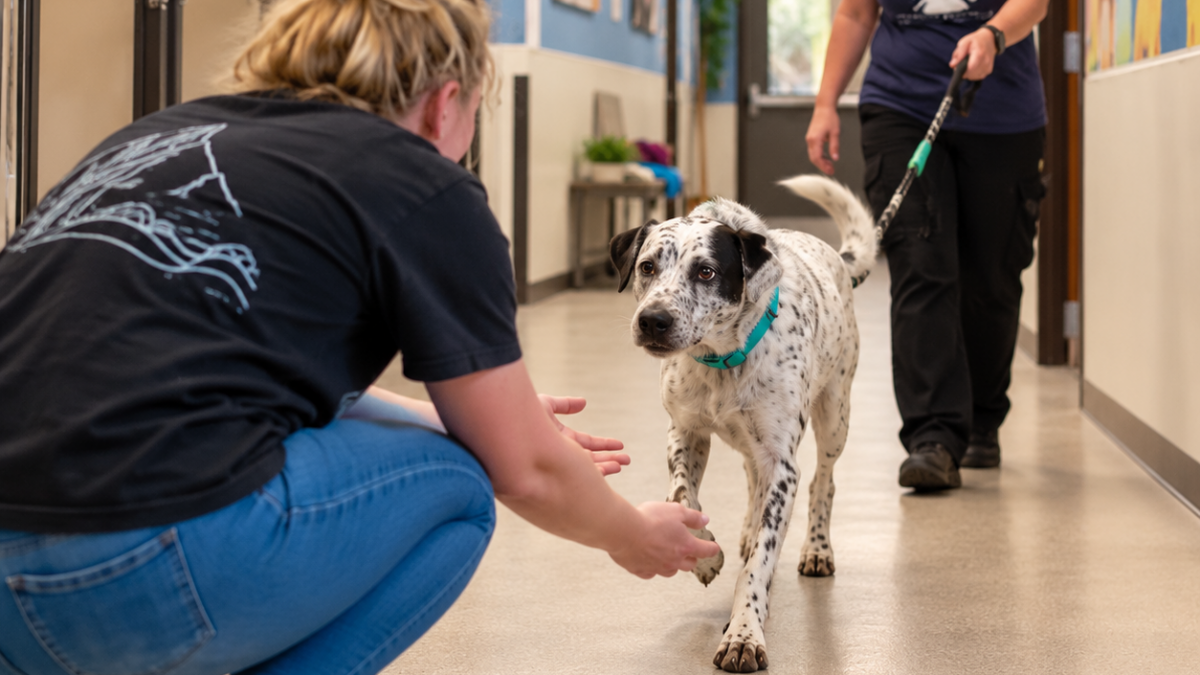
My dog vanished while I was out of town, and for days I went to sleep with one thought tearing through me: somewhere, Ranger was waiting for me to find him.
What I did not know was that he had already been found, renamed Duke, and placed behind a shelter door while millions of strangers stared at his face on their phones.
And the person who finally brought him back to me was someone I had never met, living miles away, who almost scrolled past the video.
My name is Megan Collins, and the worst phone call of my life came while I was standing in a hotel hallway with my suitcase still half packed.
“Megan, don’t panic.”
Nobody says those words before good news.
It was the woman watching Ranger while I was away. Her voice shook as she told me the gate had somehow opened, Ranger had slipped out, and by the time she realized he was gone, there was no sign of him.
I stopped hearing the rest.
Ranger was not just a dog I fed and walked. He was the animal who slept outside my bedroom whenever I was sick, who sat beside my son during thunderstorms, who somehow knew which member of our family needed him most and quietly placed himself there.
“How long has he been gone?”
A pause.
“Since this morning.”
“You’re calling me now?”
Another pause.
That one hurt worse.
I was several hours from Kansas City, and suddenly every mile between us felt unbearable. I called neighbors, friends, animal control, emergency clinics, shelters, anyone who might have seen a large dog wandering alone. My family began posting his picture everywhere.
RANGER — MISSING.
Please call.
Please look under porches.
Please check garages.
Please don’t chase him if he looks scared.
That night I barely slept.
The next morning brought sightings that led nowhere.
A dog near a gas station.
Not him.
A dark shape behind an apartment complex.
Not him.
Someone swore they had seen him crossing a busy road.
By the time we got there, nothing.
Then came August 28.
I did not know it then, but while I was searching one part of the city, Ranger had already reached the Humane Society of Greater Kansas City.
He came in as a stray.
No person standing beside him saying, “This is Ranger.”
No easy explanation of where he belonged.
To the shelter, he was simply another lost dog whose family was out there.
They called him Duke.
And while I was printing missing-dog flyers and imagining every terrible possibility, Duke was sleeping behind a kennel door, safe but unknown to me.
The shelter staff did what shelters do when identification fails.
They put him online.
The video was simple.
A dog.
A camera.
A face somebody hoped another person might recognize.
But something about him stopped people.
Maybe it was his eyes.
Maybe it was the way he looked into the lens as if he expected someone familiar to appear behind it.
Maybe it was just timing.
Whatever the reason, the video began moving.
A few thousand views became tens of thousands.
Tens of thousands became hundreds of thousands.
Then the number passed one million.
And kept climbing.
People who had never met Duke shared him.
People in other neighborhoods shared him.
People who had no connection to Kansas City shared him because they wanted a lost dog to get home.
Eventually, more than two million people watched that video.
More than thirty-one thousand shared it on Facebook.
But I knew none of that.
To me, Ranger was still missing.
Every time my phone rang, my heart jumped.
Every time it wasn’t him, I felt something inside me sink.
Then, days into the search, my phone lit up again.
A woman I barely knew had sent me a message.
No greeting.
No explanation.
Just a link and six words:
“Megan, please tell me this is Ranger.”
I opened the video.
For one second, I saw only a shelter kennel.
Then the dog turned his head.
My hands went numb.
I knew the scar near his muzzle.
I knew the way one ear leaned farther forward than the other.
I knew the white marking beneath his chest.
But more than that, I knew the look.
“Ranger.”
He looked straight into the camera.
I screamed so loudly my son ran into the room.
“Mom?”
I couldn’t answer.
I turned the phone toward him.
His face changed.
“That’s him.”
I was already reaching for my keys when I noticed the name above the video.
DUKE.
For days, I had been searching everywhere for Ranger.
Meanwhile, two million people had been searching for Duke.
And I had no idea the hardest part of bringing him home was still waiting for me.
PART 2
My son, Ethan, grabbed my wrist before I reached the front door.
“Mom, wait.”
“I can’t wait.”
“You’re shaking.”
“I’m fine.”
“You dropped the keys.”
I looked down.
He was right.
They were lying beside my shoe.
I bent to pick them up and realized my hands were trembling so badly that I could barely close my fingers around the key ring.
The video was still playing on my phone.
Ranger—or Duke, as the shelter knew him—stood behind a kennel gate with his head tilted slightly toward whoever was filming.
I watched it again.
Then again.
I had spent days studying blurry security-camera screenshots, shadowy dogs running across parking lots, grainy photos strangers swore were Ranger.
This was different.
There was no doubt.
“That’s him,” Ethan whispered.
“I know.”
“Mom.”
“I know.”
He hugged me.
My sixteen-year-old son had reached the age where hugs had become quick, almost embarrassed things.
That one wasn’t.
He wrapped both arms around me while I cried against his shoulder.
For the first time since Ranger disappeared, the tears weren’t coming from fear.
Not entirely.
He was alive.
That fact alone felt enormous.
He had not been hit by a car.
He had not become trapped somewhere.
He had not disappeared into woods or industrial lots or one of those terrible empty spaces your mind creates at three in the morning when somebody you love is missing.
He was alive.
But he wasn’t home.
Not yet.
I called the shelter.
The first call didn’t connect.
I called again.
Voicemail.
Again.
Busy.
I looked at the video statistics.
More than two million views.
Of course their phones were busy.
I sent a message through the shelter page.
MY DOG.
The words looked insane.
I erased them.
Then wrote:
Hello. I believe the dog you’re calling Duke is my missing dog, Ranger. He disappeared while I was out of town. I have photos, veterinary records, and proof of ownership. Please contact me as soon as possible.
I attached six photographs.
Ranger asleep upside down on our couch.
Ranger standing beside Ethan on his first day of high school.
Ranger wearing a ridiculous red bandanna at Christmas.
Ranger asleep with his nose inside one of my slippers.
Ranger sitting in the backyard beside the old maple tree.
And one close photograph showing the small scar along his muzzle.
Then we drove.
I didn’t care whether anyone had returned the call.
The Humane Society of Greater Kansas City became the only place on earth that mattered.
During the drive, Ethan held my phone and refreshed the shelter page.
“Two point one million.”
“Stop checking.”
“Thirty-one thousand shares.”
“Ethan.”
“I’m just saying.”
“I know.”
“That’s crazy.”
It was.
Millions of people had seen my dog before I had.
That thought was both beautiful and unbearable.
People had commented from different states.
Someone wrote, I hope his family sees this.
Someone else wrote, That dog belongs to somebody. Look how he watches the door.
Another person wrote, Please don’t give up on finding whoever loves him.
I had never met those people.
They had no reason to care about Ranger.
Yet thousands had pressed one button because maybe, just maybe, the next person would know him.
I thought about all the nights I had spent believing the world was enormous and Ranger was one frightened dog hidden somewhere inside it.
Without knowing it, thousands of strangers had been making the world smaller.
One share at a time.
Halfway to the shelter, my phone rang.
Unknown number.
I answered before the first ring ended.
“Hello?”
“Is this Megan?”
“Yes.”
“My name is Alicia. I’m calling from the Humane Society.”
I pulled onto the shoulder so quickly Ethan grabbed the dashboard.
“Is he there?”
“Yes, ma’am.”
My forehead dropped against the steering wheel.
“Oh, God.”
“We received your message and photographs.”
“It’s him.”
“We believe there’s a very strong possibility.”
“Possibility?”
I looked at Ethan.
He was watching me.
Alicia’s voice remained calm.
“We just have to follow our reunification procedure. Because he arrived as a stray, we’ll need to verify identifying details and ownership.”
“I have everything.”
“That’s good.”
“I have his vet records. Photos. Adoption paperwork. I have probably four thousand pictures of that dog.”
Alicia laughed softly.
“That usually helps.”
“When can I see him?”
“We’re open until six.”
“I’m coming now.”
“We’ll be ready.”
I put the car back into drive.
Ethan said, “What?”
“They think it’s him.”
“You know it’s him.”
“Yes.”
“Then why do they think?”
“Procedure.”
He shook his head.
“I hate procedure.”
“So do I right now.”
Then he became quiet.
“Mom?”
“What?”
“What if he doesn’t recognize us?”
I looked at him.
For the first time, I saw the fear underneath his excitement.
Ranger had been gone long enough for every one of us to imagine damage.
What if he had changed?
What if fear had done something to him?
What if he had bonded with the shelter staff?
What if he looked at us like strangers?
I wanted to promise Ethan that wouldn’t happen.
Instead, I said, “Then we’ll give him time.”
He nodded.
But neither of us believed we’d need it.
The shelter looked ordinary when we arrived.
That annoyed me.
I don’t know why.
Something so huge was happening inside my body that I expected the building to somehow reflect it.
I expected flashing lights.
Music.
A giant sign saying YOUR DOG IS IN HERE.
Instead, there were parked cars, a front desk, barking from somewhere behind a wall, and a woman filling out paperwork with a cat carrier beside her.
I walked to the desk.
“My name is Megan Collins.”
The receptionist looked up.
Then her face changed.
“Ranger?”
My breath caught.
“Yes.”
“Or Duke.”
“Ranger.”
She smiled.
“Give me one second.”
She disappeared through a door.
Ethan stood beside me bouncing one knee.
“Stop.”
“I can’t.”
“Neither can I.”
A few minutes later, Alicia came out holding a folder.
She was younger than I’d imagined from her voice.
“Ms. Collins?”
“Megan.”
She shook my hand.
“I’m Alicia.”
“Can I see him?”
“Absolutely. We just need to verify a couple of things first.”
I almost screamed.
Instead, I opened my bag.
“Ask me anything.”
She smiled.
“Any unique markings?”
“Scar on the left side of his muzzle. White patch on his chest shaped like a crooked triangle. Black spot inside his right rear leg. One toenail on his left front paw grows slightly sideways because he injured it two years ago.”
Alicia blinked.
“That was thorough.”
“I told you he’s mine.”
“Vet?”
I gave her the name.
“Approximate age?”
“Six.”
“Any medical issues?”
“Seasonal allergies. He gets itchy every spring. He hates ear drops. Loves peanut butter. Terrified of smoke alarms.”
Ethan added, “And bananas.”
Alicia looked at him.
“Likes bananas?”
“Hates them.”
“Important distinction.”
“He’ll leave the room.”
Despite everything, I laughed.
Alicia compared the records we’d emailed.
Then she closed the folder.
“I think we have your dog.”
My knees nearly failed.
“Can we see him?”
“Yes.”
We followed her through a secured door.
The barking became louder.
Dogs appeared behind kennel gates.
Some jumped.
Some sat.
Some watched silently.
I searched every face.
Then we turned a corner.
Alicia stopped us.
“He’s down there.”
At the far end stood Ranger.
He was facing away.
A shelter employee was changing his water.
I stopped walking.
Every memory from the previous week collided inside me.
The phone call.
The empty yard.
His untouched bed.
Ethan leaving the porch light on.
My daughter Hannah calling from college every few hours.
The missing flyers.
The road searches.
The photographs.
The video.
Two million strangers.
And there he was.
Twenty yards away.
Alive.
“Ranger.”
I didn’t yell it.
I barely said it.
His head snapped around.
The employee beside him froze.
Ranger stared at me.
One second.
Two.
Then his entire body changed.
His ears flew up.
His mouth opened.
His tail began hitting the metal side of the kennel so hard that the sound echoed down the hallway.
“RANGER!”
I started crying before Alicia opened the gate.
Ranger barked.
Not the shelter bark I’d heard in the video.
His bark.
That deep, ridiculous bark he used whenever I pulled into the driveway after work.
Alicia opened the kennel.
Ranger came out like he’d been fired from a cannon.
He hit me in the chest.
I went backward onto the floor.
Ethan shouted.
Ranger climbed over me, whining, licking my face, pawing at my shoulders.
I couldn’t breathe.
I didn’t want to.
“I’m here.”
He whined.
“I found you.”
His tail struck the floor.
“I’m sorry.”
That word came out unexpectedly.
I’m sorry.
Sorry I had left town.
Sorry I’d trusted somebody else.
Sorry he had spent even one night wondering where we were.
Sorry that while millions of strangers knew his face, I had been sleeping without knowing whether he was alive.
Ranger pushed his head under my chin.
Ethan dropped beside us.
“Hey, idiot.”
Ranger heard his voice and changed targets immediately.
He jumped against Ethan.
Ethan buried his face in Ranger’s neck.
“You scared the hell out of us.”
“Language,” I said automatically.
Ethan looked at me through tears.
“Seriously?”
“No.”
We laughed.
Everybody around us was crying.
Alicia.
The kennel worker.
A volunteer farther down the hallway.
Even a man walking past with a leash wiped his eyes.
Ranger bounced between Ethan and me as though he couldn’t decide which reunion deserved his body first.
Finally, he stood between us, panting.
I touched his face.
The scar.
His ears.
His chest.
Real.
Warm.
Alive.
Alicia crouched nearby.
“You’re definitely his family.”
I laughed.
“You think?”
“He’s been friendly with us. But not like this.”
“What was he like when he came in?”
Alicia’s smile faded slightly.
“Tired.”
“Scared?”
“A little. Mostly confused.”
My stomach twisted.
“Did anyone see where he came from?”
“He was brought in as a stray on August twenty-eighth.”
That date.
I looked at Ethan.
He knew what I was thinking.
“That was the day after—”
“Yes.”
The timeline suddenly mattered.
Ranger had been found quickly.
Very quickly.
Maybe he had spent only a short time truly loose.
All those days of terror had happened while he was already safe.
“How did we miss him?” I asked.
Alicia shook her head.
“It happens more than people realize. Different names. Different descriptions. Different databases. An owner searches under one term, a shelter posts under another. And without clear identification connecting an animal to a family, sometimes the pieces don’t meet right away.”
I rubbed Ranger’s head.
“I failed to update his chip registration after we moved.”
The words tasted awful.
His microchip information had an old phone number.
I’d known I needed to fix it.
I’d forgotten.
Alicia didn’t scold me.
“That happens too.”
“It shouldn’t.”
“No. But now you know.”
I looked at Ranger.
“I know.”
The shelter had another piece of good news.
They were arranging for Ranger to receive neutering at no cost.
I thanked them.
Then thanked them again.
Then cried again.
I probably said thank you thirty times before we left the building.
Outside, Ranger stopped.
He looked at the parking lot.
Then back at me.
For a moment, he hesitated.
I opened the back door of the car.
“Home.”
That word did it.
He jumped inside.
Ethan climbed beside him.
I stood outside the car and watched Ranger circle twice before settling with his head in Ethan’s lap.
My phone began vibrating.
Messages.
Friends.
Neighbors.
People who had seen the shelter update.
IS IT HIM?
DID YOU GET HIM?
PLEASE SAY THAT’S RANGER.
I took one photograph.
Ranger in the back seat.
Ethan’s hand resting across his shoulders.
Then I sent it to our family group.
FOUND.
For the next ten minutes, my phone became unusable.
Calls.
Texts.
Crying emojis.
Heart emojis.
My daughter Hannah called from college screaming.
“PUT ME ON VIDEO!”
I held the phone toward Ranger.
“Hannah.”
Ranger’s ears lifted.
Her face appeared on screen.
“Oh my God.”
She began sobbing.
Ranger licked the phone.
“HE REMEMBERS ME!”
“He probably thinks your face tastes like glass.”
“Mom!”
On the drive home, I should have felt nothing except relief.
Instead, another emotion began appearing beneath it.
Anger.
I tried to push it away.
Couldn’t.
The woman who had been watching Ranger—I’ll call her Denise—had told me he escaped that morning.
But Alicia’s intake timeline didn’t fit what I’d been told.
If Ranger entered the shelter on August 28, and Denise had waited hours before calling me, how long had she actually known he was missing?
And why had she sounded uncertain when I asked how the gate opened?
I didn’t want revenge.
Not then.
I wanted the truth.
When we reached home, Ranger jumped from the car and ran straight to the front door.
I opened it.
He went room to room.
Kitchen.
Living room.
Hallway.
Ethan’s bedroom.
My bedroom.
Then he went to his bed.
He sniffed it.
Turned three times.
Lay down.
And released the deepest sigh I’d ever heard.
Ethan sat on the floor beside him.
“He knows.”
“Yes.”
“That he’s home.”
“Yes.”
I went into the kitchen and cried where he couldn’t see me.
For several hours, our house became a revolving door.
Neighbors came.
My sister came.
A family from three streets over brought Ranger a bag of treats because their daughter had helped hang flyers.
The elderly man next door stood on our porch and rubbed Ranger’s ears.
“Knew you’d get back, boy.”
Ranger behaved as though he’d merely been on a strange vacation.
Humans carried the trauma.
Dogs are sometimes merciful that way.
That evening, when everyone left, Denise texted.
I HEARD YOU FOUND HIM. THANK GOD.
I stared at the screen.
Then wrote:
We need to talk tomorrow.
The three dots appeared.
Disappeared.
Appeared again.
Finally:
OF COURSE.
I didn’t sleep much.
Not because Ranger was missing anymore.
Because he wasn’t.
He slept on the rug beside my bed.
At 2:13 a.m., I reached down and touched his back just to make sure.
He lifted his head.
“Sorry.”
His tail moved once.
“Go back to sleep.”
He did.
I didn’t.
My mind kept replaying Denise’s phone call.
Don’t panic.
The hesitation.
Since this morning.
The gate somehow opened.
By sunrise, anger had hardened into questions.
I called the shelter and asked whether they could tell me exactly when Ranger had been brought in.
Alicia checked.
Late afternoon on August 28.
The person who found him reported seeing him wandering near a residential area several miles from my house.
That told me he had traveled.
But it didn’t answer when he’d escaped.
At nine, Denise arrived.
She stood on my porch holding a paper grocery bag.
“Treats,” she said.
I looked at it.
Then at her.
“Come in.”
Ranger was in the living room.
The moment Denise entered, he stood.
His tail moved.
That complicated my anger.
Ranger liked her.
He didn’t understand betrayal.
Maybe there hadn’t been betrayal.
Maybe only a terrible mistake.
Denise knelt.
“Hey, baby.”
Ranger walked over and sniffed her.
She started crying.
“I’m so sorry.”
I remained standing.
“What happened?”
She looked up.
“I told you.”
“No. You gave me the short version while I was six hours away and panicking.”
“Megan—”
“When did you last see him?”
She looked at Ranger.
“Early morning.”
“What time?”
“About seven.”
“What happened at seven?”
“I let him into the yard.”
“And?”
“I went inside.”
“For how long?”
“Maybe twenty minutes.”
“Twenty?”
“Yes.”
I waited.
People reveal things in silence.
Denise looked down.
“Maybe longer.”
“How long?”
“I don’t know.”
“You know.”
She began crying harder.
“I had a work call.”
My chest tightened.
“How long?”
“About an hour.”
I stared at her.
“You left Ranger outside alone for an hour?”
“The yard was fenced.”
“The side gate doesn’t latch unless you lift it.”
“I know.”
“I showed you.”
“I know.”
“Three times.”
“I know.”
Ranger sat between us.
Denise wiped her face.
“When I went back outside, the gate was open.”
“Why?”
“I must not have latched it.”
That sentence hurt.
Not because accidents don’t happen.
They do.
Because it was exactly the one thing I had emphasized.
“When did you start looking?”
“Immediately.”
“When did you call me?”
She didn’t answer.
“Denise.”
“Later.”
“How much later?”
“Maybe four hours.”
I felt something inside me snap.
“Four hours?”
“I thought I’d find him.”
“You let me believe he’d just disappeared.”
“I didn’t want you panicking while you were away.”
“He was my dog.”
“I know.”
“You don’t get to decide when I deserve to know my dog is missing.”
“I know.”
“No, I don’t think you do.”
Ethan appeared in the hallway.
I hadn’t realized he was listening.
“Mom.”
“Go upstairs.”
“I’m sixteen.”
“Ethan.”
He stayed.
Denise looked at him.
“I’m sorry.”
Ethan’s face was colder than mine.
“You should be.”
“Ethan.”
“What?”
He pointed at Ranger.
“We spent days thinking he was dead.”
Denise covered her mouth.
I hated seeing her cry.
That surprised me.
Anger feels cleaner when the person across from you seems heartless.
Denise wasn’t.
She had made a mistake.
Then made it worse by hiding part of it.
That was different from cruelty.
But consequences don’t require cruelty.
Sometimes negligence is enough.
“Why didn’t you tell us the truth immediately?” I asked.
“Because I was ashamed.”
“There it is.”
She nodded.
“Yes.”
I sat down.
Ranger came to my side.
I rubbed his neck.
Denise whispered, “I thought if I found him before you knew, I could fix it.”
“You can’t fix something by hiding it.”
“I know that now.”
I looked at her.
“Do you?”
“Yes.”
“Because those four hours mattered.”
She started to respond.
I stopped her.
“I don’t know whether calling me four hours earlier would have changed anything. Maybe not. Ranger might still have ended up at the shelter. But I should have had the choice to mobilize people immediately.”
“I know.”
“And when you said the gate somehow opened, that wasn’t true.”
“No.”
“You left it unlatched.”
“Yes.”
That was the truth.
Finally.
Denise offered to pay for every expense.
Flyers.
Gas.
Veterinary costs.
Anything.
I said no.
Not because I forgave her.
Because money wasn’t what I wanted.
“I need one thing.”
“What?”
“Don’t watch people’s animals anymore.”
Her face changed.
“Megan—”
“Not professionally. Not until you understand that you’re responsible for something that cannot tell its owner where it is.”
“I made one mistake.”
“You made two.”
She flinched.
“The gate was the first. Waiting four hours because you were afraid of looking bad was the second.”
She nodded slowly.
I continued.
“If you had called immediately and told me exactly what happened, I’d still be angry. But I’d trust you were honest.”
“You don’t trust me now.”
“No.”
She cried quietly.
“I understand.”
I didn’t destroy her online.
I didn’t post her name.
I didn’t organize strangers against her.
That would have been easy.
The video had given Ranger’s story an audience of millions.
A single angry post could have turned a mistake into public punishment far beyond anything useful.
I refused.
That surprised some people.
My sister wanted me to “tell everyone exactly who did this.”
Ethan did too at first.
But I kept thinking about the strangers who shared Ranger’s shelter video.
Thirty-one thousand people had used social media to help.
I wasn’t going to use that same power to hurt somebody for making a mistake she already had to live with.
My revenge, if that’s what anybody wanted to call it, would be different.
I was going to make sure Ranger’s disappearance prevented another one.
The next week, I sat at our kitchen table with Alicia from the shelter.
Ranger slept underneath it.
I had invited her because something about this entire experience bothered me.
“How many lost dogs come in like Ranger?”
“Too many.”
“How many have chips?”
“Many.”
“And how many chips don’t help?”
She sighed.
“Enough.”
“Old phone numbers?”
“Old numbers. Old addresses. Registration never completed. Chips transferred incorrectly. Owner information missing.”
I felt embarrassed.
“That was me.”
“You’re not alone.”
“That doesn’t make it better.”
“No.”
“What helps?”
“Current identification. Microchips with updated information. Tags. Good photographs. Checking shelters physically when possible. Social media. Neighborhood groups. And fast action.”
Fast action.
I thought about those four missing hours again.
Then about the shelter video.
“What about video?”
Alicia smiled.
“Well, apparently two million views can help.”
That number still felt impossible.
“How did it get so big?”
“People connected with him.”
“Why him?”
“Nobody knows.”
The internet can be cruel, random, ridiculous, generous, and miraculous in the same hour.
Ranger happened to find the generous side.
I began talking to the shelter about doing a small community event.
Nothing grand.
Microchip checks.
Registration updates.
Lost-pet planning.
I offered to help cover some registration fees.
Then one local business heard about it.
Then another.
Someone who had seen Ranger’s video offered printing.
A veterinary clinic offered discounted microchips.
A rescue group volunteered.
The event became larger than I expected.
We called it FIND YOUR WAY HOME DAY.
Alicia suggested using Ranger’s picture.
I agreed on one condition.
“He gets final approval.”
She looked at him.
Ranger was licking his own foot.
“He seems discerning.”
The poster showed Ranger sitting in our backyard.
Underneath:
TWO MILLION PEOPLE SAW HIM.
ONE SHARE BROUGHT HIM HOME.
MAKE SURE YOUR PET CAN FIND YOU FASTER.
The morning of the event, more than a hundred people showed up.
Families.
Dogs.
Cats in carriers.
One extremely angry rabbit.
Volunteers scanned microchips and helped owners update information.
Several dogs had chips registered to old phone numbers.
One chip had never been activated.
A woman burst into tears when she realized her dog’s information still listed an apartment she’d left five years earlier.
“I thought once the chip was in, that was it.”
“So did I,” I told her.
That day, I stopped being embarrassed about my own mistake.
Embarrassment wasn’t useful.
Correction was.
By noon, Ranger was exhausted from receiving attention.
Everyone recognized him.
“Duke!”
People kept calling.
Ranger looked confused.
Ethan laughed.
“He has an alias now.”
A little boy approached.
“Is that Duke?”
I crouched.
“His real name is Ranger.”
“Why did they call him Duke?”
“Because they didn’t know his name.”
The boy thought about that.
“Did he know his own name?”
I smiled.
“Yes.”
“Then why didn’t he tell them?”
Ethan whispered, “Good question.”
The boy’s mother apologized.
I shook my head.
“No, that’s actually the whole problem.”
Animals carry entire histories inside them.
Names.
Homes.
People.
Routines.
Favorite beds.
Foods they hate.
Places they belong.
But when they become lost, they cannot explain any of it.
They need humans to connect the pieces.
Ranger’s pieces happened to require two million people.
Most missing animals never get that kind of reach.
That became the reason I kept working with the shelter.
At first, it was occasional.
Then monthly.
I helped photograph long-stay dogs.
I learned how much one good photograph could matter.
How a video of a frightened animal looking relaxed for five seconds could change the way people saw it.
How social media was not magic.
It was people.
One person seeing.
One person caring.
One person sharing.
One person recognizing.
Ranger sometimes came with me.
He became unofficially famous.
Employees called him Duke when they wanted to tease me.
“Duke is here!”
“His name is Ranger.”
“Duke seems offended.”
“Ranger is offended.”
He loved them anyway.
Three months after his return, I received a message from the woman whose share had reached me.
Her name was Carla.
I hadn’t actually known her.
She was connected to a former coworker of my sister.
That was it.
A ridiculous chain.
Shelter.
Stranger.
Another stranger.
Another.
Carla.
Me.
I invited her for coffee.
She arrived looking nervous.
“I feel weird.”
“Why?”
“I didn’t do anything.”
“You did.”
“I clicked share.”
“Yes.”
“That’s literally all.”
I put my coffee down.
“Carla, I need you to understand something.”
She looked at me.
“I had posted Ranger everywhere I knew to post. Friends shared him. Family shared him. We called shelters. We drove streets. None of it connected us to him.”
I pointed toward Ranger, who was asleep beside the table.
“You saw a video of a dog you didn’t know and thought, maybe somebody I know will recognize him.”
She smiled.
“Actually, I almost didn’t.”
“What?”
“I was scrolling at work.”
“You almost skipped him?”
“Yep.”
I laughed.
“That was your opening sentence to the woman whose dog you found?”
“Sorry.”
“No. Keep going.”
She explained that she had watched maybe five seconds.
Then scrolled.
Then something made her go back.
“What?”
“His eyes.”
Of course.
Everybody said that.
“He looked like he was waiting for somebody.”
I looked down at Ranger.
“He was.”
Carla shared the video.
One of her friends shared it.
That person knew someone connected to my sister.
Eventually the link reached me.
I tried to map the chain later.
Couldn’t.
Too many branches.
Too many people.
That was the point.
No single person brought Ranger home.
A network did.
Thousands of tiny decisions.
Share.
Share.
Share.
Until one arrived at the right door.
Carla met Ethan.
He hugged her.
She cried.
Then she said the thing I will always remember.
“I didn’t find Ranger.”
“What do you mean?”
“Two million people looked for him together.”
That sounded sentimental.
It was also true.
Months passed.
Ranger returned to being an ordinary dog.
I loved that.
His internet fame meant nothing to him.
He cared about breakfast at exactly 6:15.
He cared about squirrels violating the backyard perimeter.
He cared about Ethan leaving pieces of cheese unattended.
He cared about sleeping on the couch even though he was technically forbidden from being there.
He cared about Hannah coming home from college.
The first time she returned after Ranger’s disappearance, she entered quietly.
Ranger heard her suitcase wheels.
His ears lifted.
“Hannah?”
She stepped into the living room.
“Ranger.”
He launched himself at her.
She dropped to the floor.
“You idiot.”
He licked her face.
“Do you know what you did to us?”
More licking.
“You were famous.”
He sneezed.
“Two million views.”
He walked away toward the kitchen.
Hannah looked at me.
“He does not care.”
“Not even a little.”
That was another lesson.
We humans build stories.
Dogs return to living.
I tried to do more of that.
Living.
Before Ranger disappeared, I had been postponing things.
Trips.
Family dinners.
Photographs.
Ordinary evenings.
Always assuming there would be another week.
Another weekend.
Another chance.
Losing him, even temporarily, changed the scale of things.
I stopped rushing every walk.
Sometimes Ranger wanted to sniff one bush for five minutes.
Fine.
Apparently the bush contained important documents.
Sometimes he stopped in the middle of the sidewalk and looked around.
I stopped pulling.
He had once lost his way.
Now if he wanted an extra minute to understand where he stood, he could have it.
I updated his microchip information.
Then checked it twice.
New tag.
Our phone numbers.
Backup number.
I added Ethan.
I added Hannah.
If Ranger ever disappeared again, half the family was getting called.
Denise eventually contacted me again.
Almost six months after the reunion.
She asked if we could meet.
My first instinct was no.
Then I agreed.
We met in a park.
I brought Ranger.
That wasn’t planned as punishment.
I just didn’t want to leave him home.
Denise cried when she saw him.
Ranger wagged his tail.
He still liked her.
Again, dogs can be inconvenient that way.
She sat on a bench.
“I’ve been volunteering at a rescue.”
I looked at her.
“What?”
“I stopped pet sitting.”
I hadn’t expected that.
“You asked me to.”
“I know.”
“I wanted you to know I listened.”
We sat quietly.
Then she said, “I keep thinking about the four hours.”
“So do I.”
“If something had happened to him—”
“But it didn’t.”
“That doesn’t erase it.”
“No.”
She looked at Ranger.
“I was more afraid of admitting I’d messed up than I was focused on what you needed to know.”
I appreciated the precision of that confession.
Not:
I’m sorry you were upset.
Not:
Things happen.
Not:
The gate failed.
She owned it.
“I was angry enough to ruin your life online,” I told her.
She stared at me.
“I know.”
“I could have.”
“I know.”
“People wanted me to.”
She nodded.
“Why didn’t you?”
I looked toward Ranger.
“Because thirty-one thousand people had just used social media to help me.”
She waited.
“I didn’t want the next thing I did with that power to be hurting somebody.”
Denise cried.
Then laughed through it.
“You know that’s much worse than if you’d yelled at me.”
“Good.”
She smiled.
There was my revenge.
Not destruction.
Accountability.
She had to become better than the person who waited four hours.
And I had to become better than the person who wanted to turn grief into punishment.
We did not become close friends again.
Trust doesn’t always return because somebody apologizes.
But I forgave her.
Not completely all at once.
Enough.
Life moved on.
Ranger’s viral video became old internet history.
New stories replaced it.
New dogs.
New emergencies.
New miracles.
The view count still existed somewhere, but I stopped looking.
Then, almost a year later, Alicia called.
“Megan, I’ve got a strange question.”
“That sounds promising.”
“Do you remember a dog named Daisy?”
“No.”
“You shared her post last month.”
I shared many shelter posts by then.
“Golden mix?”
“Yes.”
“Why?”
“She went home.”
I smiled.
“Good.”
“Want to know how?”
I knew before she told me.
“A share?”
“A share.”
Daisy’s family had moved recently.
She slipped out during a storm.
Someone found her and brought her across county lines.
Different shelter.
Different town.
A shelter post traveled.
A former neighbor saw it.
Family found.
Home.
I sat at my kitchen table while Alicia told me.
Ranger was asleep beside my feet.
For one moment, I saw a line stretching outward.
Ranger’s video had reached Carla.
Carla’s share had reached me.
Ranger came home.
His story inspired me to share more lost dogs.
I shared Daisy.
Someone else shared Daisy.
Daisy went home.
That’s how good things spread.
Not dramatically.
By continuation.
One person receives something worth carrying.
Then carries it forward.
Years later, Ethan asked me what I remembered most about the week Ranger disappeared.
I could have said the fear.
The phone call.
The empty backyard.
The shelter hallway.
The video.
The reunion.
Instead I said, “The silence.”
“What silence?”
“The house.”
He understood.
Ranger had always made small noises.
Collar tags.
Feet on hardwood.
Breathing.
Drinking water like he was personally trying to empty the bowl onto the kitchen floor.
When he disappeared, all those sounds disappeared too.
You don’t understand how much sound love makes until it is gone.
Ethan looked toward Ranger.
He was older now.
Gray beginning around his muzzle.
“Don’t do that again,” Ethan told him.
Ranger continued sleeping.
“I’m serious.”
One ear moved.
“I think he promised,” I said.
Ethan smiled.
“Good.”
The truth is, I know no promise can guarantee somebody never gets lost again.
Gates fail.
People make mistakes.
Storms happen.
Dogs run.
Life is full of doors we thought were closed.
But now I know something else too.
Lost is not always the end of the story.
Sometimes lost means somewhere between home and found.
Ranger was lost to us.
But he was not invisible.
A stranger saw him.
Then another.
Then another.
Two million people.
Thirty-one thousand shares.
Numbers so large they sound abstract until you understand that every number represents a human being who stopped for a second.
Somebody looked at my dog and cared.
Somebody thought:
Maybe my friend knows him.
Maybe somebody is searching.
Maybe one more share matters.
Eventually, one did.
I sometimes return to the original shelter video.
Not often.
It still hurts.
Ranger stands there under a name that isn’t his.
DUKE.
He looks into the camera.
Patient.
Confused.
Safe.
Waiting.
The comments underneath are frozen pieces of hope.
Please find his family.
Somebody knows this dog.
Share him.
Don’t give up.
Then, farther down, after the reunion, the tone changes.
HE’S HOME.
Those two words mean more to me than almost anything.
He’s home.
Not because one heroic person rescued him.
Not because of some impossible miracle.
Because a shelter filmed him.
Because thousands shared him.
Because Carla almost scrolled past but didn’t.
Because the right screen eventually lit up in my hand.
Because I recognized one ear.
One scar.
One look.
Ranger’s story changed the way I think about strangers.
We hear constantly about everything people do wrong online.
Cruelty.
Arguments.
Lies.
Judgment.
I have seen that too.
But when my family needed the internet most, it became something else.
A search party with no meeting place.
People who would never know one another stood side by side without realizing it.
Someone in Kansas City.
Someone fifty miles away.
Someone who didn’t own a dog.
Someone scrolling during lunch.
Someone lying awake after midnight.
Share.
Share.
Share.
Until the chain reached home.
Ranger eventually became an old dog.
The first gray hairs around his muzzle turned into a white mask.
He moved slower.
Stairs became harder.
Ethan left for college.
Hannah moved farther away for work.
The house changed again.
But Ranger remained.
Every morning, he checked Ethan’s old room before coming downstairs.
Every afternoon, he slept in a patch of sun beside the back door.
Every evening, he waited for my keys in the front lock.
The sound that had once been ordinary became sacred.
Click.
Door opening.
Tail against wall.
Home.
On his tenth birthday, Ethan came back from college.
He brought a ridiculous cake made for dogs.
Ranger ate the frosting first.
“Still famous?” Ethan asked him.
Ranger burped.
“That’s a yes.”
We took a photograph.
Ranger in the middle.
Ethan on one side.
Me on the other.
Behind us hung one framed image.
Not the viral video.
The photograph from the day Ranger returned.
He was sitting in the back seat.
Ethan’s hand across his shoulders.
Beneath the frame, Ethan had printed:
FOUND.
Years later, when Ranger’s body began to slow more seriously, I understood that another goodbye would eventually come.
This time there would be no missing flyer.
No search.
No shelter video.
No thirty-one thousand shares capable of reversing it.
I hated that.
One winter morning, Ranger struggled to rise.
I helped him.
He looked embarrassed.
“It’s okay.”
He tried again.
His back legs trembled.
I sat beside him.
“You’ve had a long trip, haven’t you?”
His tail moved.
I thought about August 28.
The stray intake.
The kennel.
Duke.
Two million views.
Ranger put his head against my knee.
“You know, half the internet once looked for you.”
He sighed.
“Don’t act unimpressed.”
Another sigh.
“You were kind of a big deal.”
His eyes closed.
I stroked the white fur around his ears.
“But you were always Ranger.”
That mattered.
Duke was the name the world used while he was lost.
Ranger was the name that brought his head around when I whispered it down the shelter hallway.
Names matter because names contain belonging.
The veterinarian helped us manage his arthritis.
He still had good months.
Slow walks.
Soft blankets.
Peanut butter.
Family visits.
The shelter invited us to another microchip event.
I almost declined because Ranger tired easily.
Then Ethan said, “Take him for one hour.”
So I did.
Alicia was still there.
She knelt in front of him.
“Well, Duke.”
Ranger’s tail moved.
I pointed at her.
“After all these years.”
She laughed.
“Sorry, Ranger.”
Families approached us throughout the morning.
Some knew the story.
Some didn’t.
One woman stood beside a young dog while volunteers checked the microchip.
She looked at Ranger.
“Is that the two-million-view dog?”
I smiled.
“Unfortunately, his ego has never recovered.”
She laughed.
Then said, “Your story is why I got my dog chipped.”
I looked at her.
“Really?”
“I saw the video.”
There it was again.
Continuation.
Ranger’s one lost week had become someone else’s precaution years later.
Maybe that was the biggest revenge against what had happened.
Not anger.
Not blame.
Prevention.
The gate had once opened.
Now other gates would still open.
But more dogs might have updated chips.
More owners might act faster.
More people might share.
More shelters might film.
Pain transformed into instruction.
Fear transformed into preparation.
A mistake transformed into something useful.
Eventually, Ranger’s last year arrived.
I knew it before anybody said it.
Dogs tell you slowly.
The walk becomes shorter.
The naps become longer.
The food needs encouragement.
The eyes stay bright while the body begins negotiating every movement.
Hannah came home.
Ethan came home.
We spent a weekend together.
No emergency.
No dramatic final moment.
Just family.
Ranger lay in the middle of the living room while everyone sat around him.
Hannah rubbed his ears.
“Do you remember when you disappeared?”
Ethan said, “He absolutely does not understand that question.”
“I think he does.”
“He understands snacks.”
Ranger lifted his head at the word.
We laughed.
Hannah pointed.
“See?”
That evening, we took him into the backyard.
The gate was closed.
Latched.
I checked it automatically.
I always checked now.
Twice.
Ranger walked toward the maple tree.
The same place where I’d photographed him before he disappeared.
He stood there for a while.
Then lay down.
We sat around him.
No phones.
No viral video.
No strangers.
Just us.
I looked at my dog and thought about how strange it was that once, the entire internet had seemed involved in bringing him back.
Yet the reward for all that attention was wonderfully ordinary.
Years at home.
Breakfast.
Walks.
Hair on furniture.
Vet bills.
Muddy floors.
Birthdays.
Children growing.
A dog growing old.
That’s what rescue is ultimately supposed to give you.
Not a dramatic story forever.
Normal life.
Ranger got his.
So did we.
When the time eventually came to say goodbye, Ranger was at home.
Ethan sat on the floor.
Hannah held one paw.
I kept my hand over Ranger’s heart.
I cried so hard I could barely speak.
But there was one thing I needed to say.
“You found us twice.”
Maybe that sounds wrong.
We found him.
The internet found him.
The shelter found him.
But somewhere along the way, Ranger had found something in us too.
A way back to one another.
A way to believe strangers might care.
A reason to change what we did with fear.
I pressed my forehead to his.
“Good boy.”
His breathing slowed.
“You’re home.”
Those were the last words I wanted him to hear.
Not lost.
Not Duke.
Not missing.
Home.
Afterward, the house became quiet again.
That old silence.
The one I remembered from the week he disappeared.
But it felt different.
Then, I had no idea where he was.
Now I knew exactly.
He had been loved all the way to the end.
Months later, the shelter asked permission to use Ranger’s story in another lost-pet campaign.
I said yes.
The new poster included a still from the original viral video.
Ranger behind the kennel door.
Underneath it was another photograph.
Ranger years later, gray-faced, sleeping on our couch.
Between the two photographs were four words:
FROM LOST TO HOME.
I stood in the shelter lobby looking at it for a long time.
A young volunteer came beside me.
“That’s Duke, right?”
I smiled.
“Ranger.”
“Oh. Sorry.”
“No.”
I looked at the first photograph.
“For a little while, he was Duke.”
Then at the second.
“But he was always Ranger to us.”
The volunteer asked, “Did two million people really watch that video?”
“Yes.”
“That’s insane.”
“Yes.”
“Do you know which share found you?”
I smiled.
“One of thirty-one thousand.”
“That’s crazy.”
“It is.”
He looked at the poster.
“So there’s no way to know which shares matter.”
I turned toward him.
“No.”
That was the whole lesson.
You rarely know.
You don’t know whether the missing-dog poster you pass will matter.
You don’t know whether the shelter video you share will reach anybody useful.
You don’t know whether the lost animal belongs to someone ten miles away or one person removed from your social circle.
You don’t know whether one click will disappear into noise.
Or travel through thirty thousand people and arrive in a mother’s hand when she’s beginning to lose hope.
You don’t know.
So sometimes you share anyway.
Ranger taught me that.
Not every story reaches two million people.
It shouldn’t have to.
Sometimes one hundred is enough.
Sometimes ten.
Sometimes one.
The right one.
I spent days believing my dog had vanished into a world too large to search.
I was wrong.
For one extraordinary week, strangers turned that huge world into a chain.
One person handed Ranger’s face to another.
And another.
And another.
Until eventually someone handed him back to me.
People remember the two million views when they hear our story.
I don’t.
Not first.
I remember a shelter hallway.
A dog twenty yards away.
His back turned.
My voice saying one word.
“Ranger.”
I remember his head snapping around.
I remember that first second when he knew.
Then running.
The sound of his paws.
The gate opening.
His body hitting mine.
Ethan laughing and crying beside me.
And Ranger moving between us as if trying to touch everyone at once.
Two million people helped create that moment.
Thirty-one thousand shares carried us toward it.
But the part that still lives in my heart is much smaller.
A lost dog heard his real name.
And he ran home.
A lost dog heard his real name.
And he ran home.
For a long time, I believed that was where Ranger’s story ended.
I was wrong.
The reunion was only the part strangers saw.
What happened afterward was quieter, slower, and in many ways more important, because bringing a lost dog through your front door does not erase what happened before it. It does not erase the nights you spent imagining the worst. It does not instantly remove the fear from the dog who spent days in an unfamiliar place under an unfamiliar name.
For the first week after Ranger came home, I slept with my bedroom door open.
That might not sound unusual.
But Ranger had always slept downstairs.
Before he disappeared, he preferred the rug near the front window where he could monitor the sidewalk and bark unnecessarily at delivery drivers.
After he came home, that changed.
The first night, I woke around one in the morning and found him standing in the hallway.
Not whining.
Not scratching.
Just watching me.
“Hey.”
His tail moved once.
“You okay?”
He walked into my room and lay beside the bed.
The next morning, he was still there.
The second night, he did the same thing.
Then the third.
It took me several days to understand what he was doing.
He was checking.
Making sure I had not disappeared too.
Once I realized that, I stopped trying to send him downstairs.
“Fine,” I told him. “You win.”
Ranger sighed and stretched across the carpet as though the entire arrangement had been his idea.
But other things had changed too.
If I opened the back door, he no longer ran directly into the yard.
He stopped at the threshold.
Looked at me.
Then looked outside.
Only after I said, “Go ahead,” would he step through.
At first, I thought I was imagining it.
Then Ethan noticed.
“He didn’t do that before.”
“No.”
“Why does he wait?”
I knew why.
“Because the last time he went through a door without us, he got lost.”
Ethan’s face changed.
He was sixteen, old enough to understand consequences but still young enough to take them personally.
“We should have been there.”
I turned toward him.
“No.”
“But—”
“No.”
I had spent too many nights blaming myself already.
I wasn’t letting my son inherit that.
“Something went wrong. We fixed what we could. Ranger is home.”
Ethan looked at the dog.
“He doesn’t know that nothing bad is going to happen again.”
“No.”
“Do we?”
That stopped me.
Children have a talent for finding the one question adults have been avoiding.
I shook my head.
“No.”
Ethan sat beside Ranger.
“Then I guess we just keep coming back.”
That became our new rule.
We kept coming back.
If Ethan went to school, he came back.
If I went to work, I came back.
If Hannah visited from college and left for the afternoon, she came back.
Every return mattered.
Gradually, Ranger stopped watching the door so hard.
Then one Saturday morning, something small happened that felt enormous.
I opened the back door.
Ranger ran outside without checking first.
He chased a squirrel across the yard.
Barked at the fence.
Sniffed the maple tree.
Normal.
I stood in the kitchen holding my coffee and started crying.
Ethan came downstairs.
“What happened?”
I pointed outside.
“Nothing.”
He looked at Ranger.
Then understood.
“Oh.”
We stood there together.
Watching our dog be ordinary.
I had never appreciated ordinary enough before.
That became one of the great lessons of Ranger’s life after the viral video.
People online knew him as the dog two million people helped send home.
To us, he was the dog who stole dish towels.
The dog who slept upside down.
The dog who hated bananas so completely that Ethan once placed a banana near his food bowl just to watch him leave the room in disgust.
The dog who barked at a plastic snowman every December like it had personally insulted him.
The dog who had once disappeared and made every mundane habit feel precious afterward.
The shelter continued receiving messages about him for months.
Alicia occasionally forwarded some to me.
People asked whether Ranger was doing well.
Whether he remembered being Duke.
Whether he seemed traumatized.
Whether he had adjusted.
Someone mailed him a blue collar from Texas.
Another person sent treats from Minnesota.
A third sent a handwritten note that said:
I lost my dog three years ago and never found him. Seeing Ranger go home gave me the ending I never got.
I cried over that one.
I kept it.
Not every lost-pet story ends like ours.
That truth mattered.
It was part of why I continued helping at the shelter.
Every time a frightened stray arrived without clear identification, I thought about the family somewhere who might already be searching.
Maybe they were driving neighborhoods.
Maybe they were hanging flyers in the rain.
Maybe a child was sleeping with the dog’s blanket.
Maybe somebody had left a bowl outside hoping a familiar smell would guide them back.
So I took photographs.
I wrote descriptions.
I shared posts.
And whenever possible, I used one sentence:
Somebody may be looking for this dog right now.
That changed the way volunteers thought about strays.
Not unwanted.
Not automatically abandoned.
Possibly loved.
Possibly missed.
Possibly one share away from home.
Two years after Ranger returned, the shelter asked me to speak at a fundraiser.
I almost said no.
I was not a public speaker.
I could barely introduce myself at parent meetings without wishing for an emergency evacuation.
But Alicia said, “You don’t have to give a speech.”
“What do I do?”
“Tell Ranger’s story.”
“That is a speech.”
“Then bring Ranger.”
That changed things.
So I brought him.
He was older by then.
Gray had begun appearing around his muzzle.
He walked into the event wearing the blue collar from Texas and immediately acted like he owned the place.
People recognized him.
“That’s Duke!”
“Ranger,” I corrected for approximately the thousandth time.
One woman knelt.
“I shared your video.”
Another said, “Me too.”
Then another.
I suddenly realized something.
In that room were people who had become part of my family’s story without ever knowing us.
We took the stage.
Ranger sat beside me.
I looked at the crowd.
Then I abandoned every note Alicia had helped me prepare.
“I used to think two million was the important number.”
People went quiet.
“Two million views. Thirty-one thousand shares. Those numbers are why people remember him.”
I looked down.
Ranger yawned.
Everyone laughed.
“But Ranger didn’t need two million people.”
I paused.
“He needed the right person to see one video.”
That room became very still.
“And none of us knew which person that would be.”
I told them about Carla almost scrolling past.
About the chain of shares.
About the old microchip information.
About Denise waiting too long to call.
About what I had learned.
Then I said the thing I most wanted people to remember.
“When a pet disappears, the internet can feel like noise. Keep posting anyway.”
I touched Ranger’s head.
“You don’t need everyone to care. You need the path to reach somebody who knows.”
Afterward, an older man approached me.
His name was Walter.
He held a photograph of a white terrier.
“She’s been missing eleven days.”
My heart sank.
“I’m sorry.”
“I’ve posted everywhere.”
“Keep posting.”
He nodded.
“I almost stopped yesterday.”
“Don’t.”
I gave him contact information for local lost-animal groups.
The shelter shared the dog that evening.
Two days later, Walter called.
“She’s home.”
I sat down.
“What?”
“A woman twelve miles away had been feeding her behind a garage. Her niece saw the post.”
I covered my mouth.
“Is she okay?”
“Thin. Dirty. Otherwise okay.”
He started crying.
Then so did I.
After we hung up, I looked at Ranger.
“You did that.”
He stared back at me.
“Indirectly.”
No reaction.
“You’re very humble.”
He went to sleep.
That was how Ranger’s story kept moving outward.
One reunion leading to another.
Not always because of him directly.
Sometimes simply because his story reminded somebody not to stop trying.
The strangest continuation came three years after Ranger disappeared.
I received an email from a veterinary technician in Missouri.
The subject line was:
Your Ranger Changed Our Policy.
I opened it expecting spam.
It wasn’t.
Her clinic had seen Ranger’s story shared repeatedly online. One veterinarian had used it during a staff meeting while discussing microchips.
The clinic then began verifying chip registration information during every annual wellness exam.
Not just scanning for a chip.
Confirming the phone number.
Confirming the address.
Confirming backup contacts.
The technician wrote:
Last month we scanned a dog during a routine appointment and discovered the chip still contained the former owner’s information from six years ago. We updated it.
Two weeks later, that dog escaped during a storm.
Animal control scanned him.
His family had him back that afternoon.
I read that email three times.
Then printed it.
I added it to a folder I had started calling Ranger’s Ripples.
It contained:
The message from the woman who lost her own dog.
The email from Walter about his terrier.
Photographs from microchip events.
A newspaper clipping.
A picture of Daisy going home.
A card from Carla.
I never planned to show anybody.
It was simply proof that one terrible week had produced something beyond fear.
Pain had become prevention.
That mattered to me.
Ranger, of course, remained unimpressed by his legacy.
He cared about dinner.
At age nine, he discovered he could manipulate Ethan into adding chicken to his kibble by staring at him dramatically.
At ten, he stopped jumping into the car and began waiting for help.
At eleven, he developed a habit of standing at the refrigerator whenever anyone opened it, even from a dead sleep.
At twelve, he started graying so much that Hannah called him “Grandpa.”
He disliked that.
Or perhaps I projected.
By then, the children were moving into their adult lives.
Hannah worked in Denver.
Ethan studied engineering three hours away.
The house became quieter.
Ranger and I settled into a new rhythm.
Morning walk.
Coffee for me.
Breakfast for him.
Work.
Evening walk.
Television.
Sleep.
I sometimes wondered whether he understood that the children had grown.
Whenever Ethan came home, Ranger became younger.
The tail moved harder.
The eyes brightened.
He followed him room to room.
One Thanksgiving, Ethan entered with a backpack and said, “Where’s my guy?”
Ranger got up too fast.
His back legs slipped.
Ethan dropped everything.
“Easy.”
He knelt.
Ranger pushed against his chest.
Ethan looked at me over his shoulder.
“He’s getting old.”
“I know.”
“How old?”
“Twelve.”
“That’s not old.”
“For a dog his size, it is.”
Ethan looked offended by biology.
“No.”
I knew that feeling.
We spend years wanting dogs to calm down.
Stop chewing things.
Stop running.
Stop dragging us down the street.
Then one day they do.
And we would give anything to watch them destroy another shoe.
That winter, Ranger began limping.
The veterinarian diagnosed arthritis.
Medication helped.
So did shorter walks.
I bought steps to help him onto the couch even though he technically still wasn’t allowed there.
“Rules changed?” Ethan asked.
“Senior management exception.”
Ranger used the steps once.
Then ignored them.
He preferred me lifting him.
Manipulative old man.
One evening, I was looking through Ranger’s Ripples when I found the first screenshot from the shelter video.
DUKE.
That name.
I smiled.
For a little while, Ranger had lived an entire second identity.
Duke.
Safe but disconnected.
I began thinking about names.
The shelter had to call him something.
They had no way of knowing.
Yet the moment I said “Ranger” in that hallway, he became himself again.
Or maybe he had always been himself.
We were simply the ones who had lost the information.
That idea stayed with me.
So for Ranger’s thirteenth birthday, Ethan had something made.
A wooden sign.
It read:
RANGER
KNOWN BRIEFLY AS DUKE
LOST ONCE
LOVED ALWAYS
I hung it near his bed.
Ranger sniffed it.
Then immediately lay with his back to it.
“Ungrateful,” Ethan said.
“He can’t read.”
“Excuses.”
The final year came quietly.
No one announced it.
There was no moment when a doctor said, This is the beginning of the end.
His world simply became smaller.
The long walk around the neighborhood became a walk to the corner.
Then halfway to the corner.
Then the mailbox.
Some mornings, he only wanted the backyard.
I stopped measuring the walk by distance.
I measured it by whether he enjoyed it.
He still sniffed.
Still watched birds.
Still barked at the plastic snowman when December came.
Good enough.
Then one January morning, he refused breakfast.
Ranger had refused almost nothing edible in thirteen years.
I knew.
The veterinarian found a mass.
Cancer.
Advanced.
I stared at her.
“How long?”
She looked at Ranger.
“Could be weeks.”
My stomach dropped.
“Months?”
“Possibly.”
“But not—”
“No.”
Not years.
I took Ranger home.
I didn’t call the kids immediately.
For several hours, I simply sat on the floor with him.
I felt guilty for that later.
Then understood why.
I needed one afternoon where the diagnosis belonged only to us.
“You always have to make things dramatic.”
Ranger rested his head across my leg.
“You couldn’t just become a sweet old dog and live to thirty?”
His tail moved.
“Unreasonable.”
He closed his eyes.
I touched the scar beside his muzzle.
The scar I had recognized in the shelter video.
That tiny mark had once brought him home.
Now my finger followed it like a map through everything we’d survived.
That night, I called Hannah.
Then Ethan.
They both came home the following weekend.
Nobody said goodbye.
Not yet.
We cooked.
Watched movies.
Let Ranger eat things the veterinarian would normally disapprove of.
Ethan bought him a cheeseburger.
“Absolutely not,” I said.
“He has cancer.”
“That doesn’t mean his digestive system retired.”
Ranger ate the cheeseburger.
I lost that argument.
On Sunday, we took him to the park.
Not the busy one.
A quieter place beside a lake.
Ranger walked maybe fifty feet.
Then lay down beneath a tree.
We sat with him.
Hannah took photographs.
Not posed.
Ranger sleeping.
Ethan rubbing his ears.
My hand on his back.
The lake behind us.
I remembered the weeks after he returned when every picture felt like evidence:
He’s here.
He’s safe.
Now the photos meant something else.
He was still here.
For now.
That phrase is the real definition of love near the end.
For now.
A month later, Ranger stopped going to the front door when I returned.
He still lifted his head.
Tail moving.
But standing had become work.
I sat beside him.
“You don’t have to get up.”
He looked at me.
“I know I’m home.”
Those words hit me.
Because that was what he had needed to know all those years earlier.
I know I’m home.
And that was what I needed him to know now.
One morning, he couldn’t stand without help.
The veterinarian came that afternoon.
She examined him.
Then sat beside me.
“We can adjust medication.”
“What will that give him?”
“Comfort, perhaps some additional time.”
“Good time?”
She didn’t answer immediately.
That was my answer.
I called Ethan.
He drove home.
Hannah caught a flight the next morning.
Ranger held on.
At least that’s what we said.
Maybe he wasn’t holding on for anyone.
Maybe bodies simply move at their own pace.
But he was awake when Hannah walked through the door.
She dropped her bag.
“Hey, handsome.”
Ranger’s tail tapped the floor.
She broke.
She knelt and hugged him.
“Thank you.”
I looked away.
That evening, we sat in the living room together.
Exactly where Ranger had spent so much of his life.
Ethan on the floor.
Hannah beside him.
Me near Ranger’s head.
We told stories.
The banana hatred.
The snowman.
The missing week.
The shelter.
Carla.
The video.
“Do you realize,” Ethan said to him, “that two million people saw you and you still can’t sit properly?”
Ranger was half on his bed and half off.
Hannah laughed.
“He committed to chaos.”
I said, “He stayed on brand.”
For a little while, death waited outside the room.
We were simply a family laughing at our dog.
The next morning, Ranger would not eat.
Not chicken.
Not peanut butter.
Nothing.
He drank a little water.
Then looked at me.
I knew.
I hated knowing.
But love requires accepting information you don’t want.
The veterinarian returned.
We laid Ranger on his favorite blanket near the back door where sunlight reached the floor.
His family surrounded him.
No kennel.
No strange name.
No wondering where he belonged.
Home.
Ethan put one hand on Ranger’s chest.
Hannah kissed his forehead.
I whispered into his ear.
“You remember the shelter?”
His eyes moved.
“Probably not.”
A breath.
“But I do.”
I pressed my face against his.
“I remember calling your name.”
His tail moved.
Barely.
“You turned around.”
Another breath.
“And you ran.”
My voice broke.
“You ran so hard you knocked me over.”
Ethan laughed through tears.
Ranger’s eyes remained on me.
“I need you to know something.”
I swallowed.
“You never have to find your way home again.”
Hannah began crying harder.
I continued.
“You’re already here.”
The veterinarian gave him the medication.
We kept talking.
No dramatic final breath.
No sudden movement.
Just slower.
Softer.
Until there wasn’t another one.
I kept my hand on him.
For a long time.
Then Ethan whispered:
“He’s home.”
Those words destroyed me.
Because they were true.
Years earlier, HOME meant a street address.
A family.
A front door.
A bed.
A real name.
Now it meant something larger.
He had finished the journey.
After Ranger died, people asked whether I would get another dog.
I hated the question.
Not because it was cruel.
Because I didn’t know how to answer.
Another dog?
There could never be another Ranger.
That was not arrogance.
Every dog is singular.
Every relationship is.
Six months passed.
Then Alicia called.
“Megan.”
“No.”
She laughed.
“You don’t know what I’m going to say.”
“Yes, I do.”
“You really don’t.”
“You have a dog.”
Silence.
Then:
“I have a dog.”
“No.”
“His name is Miles.”
“Absolutely not.”
“He’s seven.”
“No.”
“Owner passed away.”
I closed my eyes.
“Alicia.”
“He’s been here four months.”
“Stop.”
“He watches the front door.”
That did it.
I hated her.
Two days later, I visited.
Miles was brown.
Long-legged.
Part hound, maybe shepherd.
He did not look like Ranger.
Thank God.
He barely looked at me.
Also good.
I sat outside the kennel.
“You’re not Ranger.”
Miles blinked.
“That’s your first advantage.”
His ear moved.
“I am not adopting you.”
He turned his head away.
“Excellent. We understand each other.”
Alicia walked past.
“Going well?”
“Leave.”
Twenty minutes later, Miles stood.
He walked toward the gate.
Sat.
Not touching.
Just close.
I laughed.
“Manipulative.”
Three weeks later, Miles came home.
He did not replace Ranger.
He could not.
He hated peanut butter.
Loved bananas.
Never barked at the Christmas snowman.
Slept in the kitchen.
But on the first night, he stood in the hallway watching me.
I looked at him.
“Come on.”
He entered.
Lay beside the bed.
Life continued.
Not because grief disappeared.
Because love leaves capacity behind.
That became the last gift Ranger gave me.
He had once been lost.
Then found.
Then loved long enough to become old.
That is the ending every lost animal deserves.
Not internet fame.
Not millions of views.
Not viral attention.
Age.
Gray fur.
Slow walks.
A family complaining about medication schedules.
A bed placed somewhere inconvenient.
Someone knowing exactly what food you hate.
Someone calling your real name.
Someone there at the end saying:
You’re home.
Today, Ranger’s original viral video still exists.
Every once in a while, somebody discovers it again.
A new comment appears.
I hope he found his family.
Sometimes I answer.
He did.
Other times, someone writes:
Is he okay now?
That question is harder.
But I know the answer.
Yes.
He came home.
He lived for years surrounded by the people who had searched for him.
He watched Ethan grow up.
He saw Hannah begin her career.
He attended shelter events.
He accidentally helped other dogs get home.
He grew gray.
He became slow.
He became spoiled.
And when his life finally ended, he knew exactly where he was.
The world first met him as Duke.
A stray.
A shelter dog.
A viral video.
But that was never the whole story.
His name was Ranger.
And the most important number was never two million.
It wasn’t thirty-one thousand either.
It was one.
One dog.
One family.
One video.
One person who almost kept scrolling.
One share that reached the right screen.
One name called down a shelter hallway.
And one old dog, years later, lying safely in the home he once lost.
Sometimes I still hear the sound of his paws running toward me.
I hope I always do.
Because before the views, before the shares, before all the people who helped without knowing us, there was one simple truth.
Ranger was loved.
He got lost.
People cared.
And he came home.
Everything after that was the life those strangers gave back to us.








