PART 2: My Dog Vanished Monday Night—Five Days Later I Heard One Weak Cry Beneath the Street
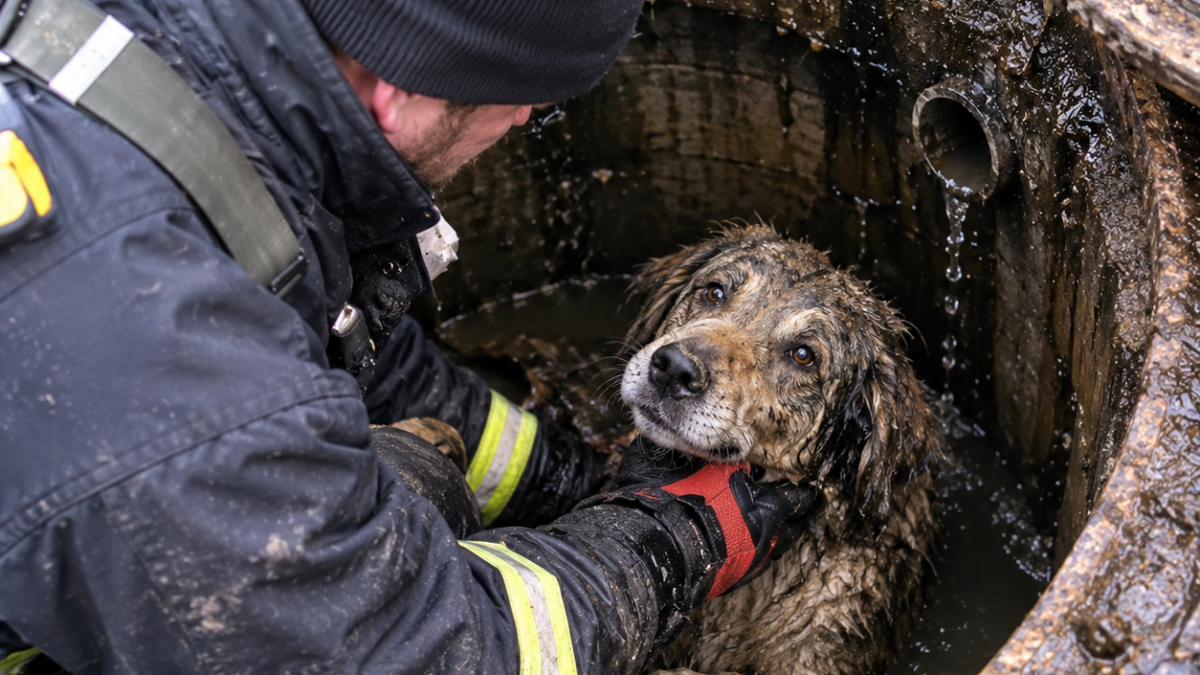
My dog had been missing for five days when I finally stopped believing I would bring him home alive.
Then, on Friday evening, while walking the same street I had searched again and again, I heard a sound so weak that I almost convinced myself grief had invented it.
What I found beneath a damaged storm-drain cover was only the beginning, because someone had known that opening was dangerous long before my dog fell through it.
My name is Daniel, and the dog lying beneath that street was Cooper.
He was ten years old, a black-and-tan shepherd mix with gray around his muzzle, one bent ear, and an almost ridiculous belief that every person he met was a potential friend.
Monday evening started like hundreds of others.
I opened the back door just after six.
“Don’t be long.”
Cooper looked over his shoulder.
That was our routine.
Our neighborhood was quiet, and Cooper had spent years walking with me through the same few blocks. That evening I stepped inside for my jacket, expecting him to wait near the porch like he always did.
When I came back, he was gone.
At first, I wasn’t frightened.
“Cooper!”
Nothing.
I walked to the corner.
Then the small park.
Then the alley behind the grocery store.
After an hour, I started knocking on doors.
After three, I called everyone I knew.
By midnight, my neighbors and I were moving through the streets with flashlights.
“He doesn’t do this,” I kept saying.
My friend Mark put a hand on my shoulder.
“Dogs wander.”
“Not Cooper.”
Tuesday became Wednesday.
I printed photographs.
Posted online.
Called shelters.
Checked veterinary clinics.
Drove slowly along roads I was terrified to inspect too closely.
Every time my phone rang, my heart jumped.
Every time someone said, “I saw a dog that looked like him,” I drove there.
None of them was Cooper.
Thursday night, I sat on my kitchen floor with his food bowl beside me.
His bed was untouched.
His leash still hung by the door.
For the first time, I thought the sentence I had been refusing to say.
Maybe he wasn’t coming home.
Friday evening, I went out again anyway.
Not because I still had a plan.
Because staying inside hurt more.
I walked toward a busy street four blocks from my house.
I had searched it before.
Several times.
Cars passed constantly.
At the curb stood an old concrete storm drain with a heavy metal cover that had been cracked near one edge.
I walked past.
Then stopped.
Something had made a sound.
I turned.
Listened.
Traffic.
Wind.
Nothing else.
“Cooper?”
No answer.
I took three more steps.
Then I heard it again.
A tiny, broken whimper.
My entire body went cold.
“Cooper?”
Another sound rose from beneath the pavement.
I ran.
The metal cover shifted when I touched it.
One side had already collapsed inward.
I grabbed the edge and pulled.
The smell hit me first.
Mud.
Stagnant water.
Cold concrete.
Then I shone my phone flashlight into the darkness.
Two eyes reflected faintly from below.
“Oh my God.”
Cooper was lying on his side in filthy water.
He didn’t stand.
Didn’t bark.
Didn’t even lift his head.
Only his eyes moved.
“Cooper.”
His tail struck the water once.
Barely.
I dropped onto my knees.
“I’m here.”
His body was trembling.
For five days, he had been trapped beneath a street dozens of people crossed every hour.
Later, we realized what must have happened.
The damaged cover had shifted under his weight.
He fell into the drainage chamber.
The concrete walls were too smooth to climb.
The opening above him was too high.
He had probably spent the first day jumping, scratching, calling.
Then weakness took over.
Cold water surrounded his legs.
There was no food.
Almost no dry ground.
By Friday, his body had begun shutting down.
But somehow his heart was still beating.
I called 911 with hands that wouldn’t stop shaking.
Then, while waiting for rescue crews, I noticed something stamped onto the orange maintenance barrier lying in the weeds nearby.
A contractor’s name.
And beneath it, in faded marker, a date.
Six weeks earlier.
That was the moment I realized this drain hadn’t simply broken the night Cooper disappeared.
Someone had inspected it.
Someone had marked it.
And someone had walked away.
PART 2
“Stay with me.”
I kept saying it even though Cooper could barely keep his eyes open.
“Stay with me, buddy.”
I lay flat on the cold pavement, shoulder pressed against the curb, one arm reaching through the jagged opening.
I couldn’t touch him.
That was the worst part.
My fingertips were maybe eighteen inches above his back.
Close enough that I could see every tremor moving through his body.
Too far to help.
“Cooper.”
His eyes moved toward me.
“That’s it.”
His chin lifted perhaps half an inch.
Then dropped back into the muddy water.
“No. No, no, no.”
A car slowed behind me.
A woman rolled down her window.
“Sir? Are you hurt?”
“My dog is down there.”
She parked without another question.
She came toward the opening, looked inside, and covered her mouth.
“Oh my God.”
“Emergency crews are coming.”
She immediately returned to her car and turned on her hazard lights, positioning it so traffic had to move farther from the curb.
Another driver stopped.
Then another.
A man in a delivery uniform stood in the road waving cars around us.
I barely noticed any of them.
My whole world had narrowed to a dark hole in concrete.
“Remember breakfast?” I said.
Cooper’s ear moved slightly.
“You want breakfast?”
Nothing.
“Chicken?”
His eyes opened a fraction.
I laughed and cried at the same time.
“That’s my boy.”
A stranger kneeling beside me asked, “How long has he been down there?”
I couldn’t say it at first.
“Sir?”
“Five days.”
He stared at me.
“He disappeared Monday.”
The stranger looked back into the drain.
“Jesus.”
I knew what he was thinking.
Five days without food.
Five nights in cold water.
Five days of cars passing overhead.
Five days of calling until there was almost no voice left.
I pressed my forehead against the pavement.
“You waited.”
Cooper’s tail moved again.
One weak splash.
“You waited for me.”
The sirens arrived six minutes later.
It felt like an hour.
A fire engine stopped across one lane, red lights filling the street.
Firefighters came quickly, carrying ropes, a tripod system, medical bags and a portable light.
The first firefighter to reach me was a broad-shouldered man with MENDOZA on his jacket.
“How deep?”
“Six feet. Seven maybe.”
“Dog conscious?”
“Barely.”
“How long?”
“Five days.”
His face changed.
“You’re sure?”
“I’ve been looking for him since Monday.”
He looked into the chamber.
“All right. Everyone back.”
“I can’t leave.”
“You don’t have to leave. I need you clear of the opening.”
I crawled backward.
An animal-control truck arrived.
A woman jumped out carrying blankets.
She introduced herself as Karen Bell, but I barely registered the name.
“What’s the dog’s name?”
“Cooper.”
“Age?”
“Ten.”
“Medical conditions?”
“Arthritis. Mild. Nothing else.”
“Weight?”
“About sixty-two pounds.”
Mendoza called to another firefighter.
“Set anchors.”
They removed the rest of the damaged cover.
Metal scraped against concrete.
The noise echoed down the chamber.
Cooper didn’t react.
That scared everyone.
Mendoza clipped into a harness.
“I’ll go.”
Another firefighter checked his line.
“Ready.”
Mendoza lowered himself into the opening.
His boots touched the bottom.
Water reached almost to his ankles.
He crouched beside Cooper.
“Hey, buddy.”
Nothing.
Mendoza put one hand gently against Cooper’s chest.
Then looked up.
“He’s breathing.”
My knees almost gave out.
“He’s freezing.”
Karen turned toward the ambulance that had just arrived.
“We need thermal blankets. Warm fluids if the vet authorizes.”
A paramedic knelt at the opening.
“Any trauma?”
Mendoza examined him.
“Abrasions. Paws bad. Don’t see obvious fracture.”
He slid a blanket beneath Cooper.
The moment he touched Cooper’s back legs, my dog made a small sound.
Not even a yelp.
More like air escaping.
“Cooper!”
His eyes opened.
Mendoza looked up.
“He heard you.”
“I’m here, buddy!”
“Keep talking.”
So I did.
I talked while firefighters rigged the rope.
I told Cooper about every stupid ordinary thing waiting at home.
His bed.
His bowl.
The green tennis ball beneath the couch.
The kitchen rug he wasn’t supposed to sleep on.
“Your blanket’s still by the window.”
His ear moved.
“Mark still owes you half a hamburger.”
From behind me, Mark’s voice suddenly said, “I do not.”
I turned.
He had arrived sometime during the rescue.
He was crying.
“You came.”
“Of course I came.”
He looked into the drain.
“Oh, Coop.”
Mendoza wrapped Cooper securely.
“We’re coming up.”
The rope tightened.
Slowly, Mendoza rose.
Cooper appeared from the darkness pressed against his chest.
The first thing I saw was one paw.
Then his head.
Then the rest of him.
I had prepared myself for a sick dog.
I wasn’t prepared for how small he looked.
Five days had changed him.
His coat was soaked flat.
Mud covered his belly and legs.
His ribs showed.
His paws were red and swollen.
Two nails were torn almost to the quick.
There were raw abrasions along his front legs and chest.
He had tried to climb.
Again and again.
Mendoza stepped onto pavement.
Karen immediately wrapped Cooper in heated blankets.
I dropped beside him.
“Hey.”
His eyes opened.
His tongue moved toward my fingers.
He couldn’t reach.
I put my hand against his muzzle.
“It’s me.”
His tail moved under the blanket.
Mark made a broken sound beside me.
The firefighter who had pulled him out looked away.
Karen touched Cooper’s gums.
“They’re pale.”
“What does that mean?”
“Shock. Dehydration. Maybe blood pressure.”
“Is he dying?”
She looked me directly in the face.
“We’re not going to waste time answering that here.”
She pointed toward her truck.
“We’re going.”
“I’ll follow.”
“No.”
“What?”
“You’re riding with us.”
I sat on the floor of the animal-control transport because I refused to sit anywhere farther from Cooper.
Karen didn’t argue.
The heater was turned as high as it would go.
Cooper remained cold.
I could feel it even through the blankets.
Karen called ahead to the emergency veterinary hospital.
“Ten-year-old shepherd mix. Severe hypothermia. Estimated five-day entrapment. No food. Possible dehydration and shock. ETA nine minutes.”
There was silence on the other end.
Then the veterinary technician said, “Five days?”
“Confirmed.”
I rested my hand near Cooper’s nose.
His breath touched my skin.
Faint.
Slow.
Still there.
Karen checked his gum color again.
“Cooper.”
His eyelid moved.
“You know your name.”
I said, “He knows food better.”
Karen looked at me.
“Try it.”
“Chicken.”
Cooper’s ear twitched.
She smiled.
“Good.”
“Cheese.”
Another twitch.
“Hamburger.”
His tail shifted slightly.
Karen laughed once.
“Keep doing that.”
So I talked.
I told him about the first day I met him.
Nine years earlier, county shelter, kennel seventeen.
He had been a one-year-old dog named Rocket because he wouldn’t stop launching himself against the kennel gate.
I had gone there planning to adopt a small dog.
Maybe twenty pounds.
Something easy.
Then Rocket saw me.
He sat.
The volunteer beside me said, “That’s weird.”
“What?”
“He doesn’t sit for anyone.”
I walked closer.
Rocket pressed his nose through the bars.
I touched it.
He stopped moving entirely.
“That one,” I said.
The volunteer laughed.
“You said you wanted small.”
“I changed my mind.”
I renamed him Cooper because Rocket made him sound like an explosive device.
He proved me wrong about that several times.
At two, he destroyed a couch cushion because I left him alone for thirty minutes.
At three, he stole a Thanksgiving turkey.
At four, he broke through a screen door to chase a squirrel and then couldn’t figure out how to get back inside.
At six, he lay beneath my mother’s hospital bed for three hours while she recovered from surgery.
At seven, when my marriage ended, Cooper slept on the floor beside my couch because I couldn’t bring myself to use the bedroom.
I kept talking.
Karen listened.
Cooper breathed.
Then suddenly his breathing changed.
I stopped.
“Cooper?”
Karen leaned forward.
“He’s still breathing.”
His eyes remained closed.
“Stay.”
I pressed my forehead against the blanket around his head.
“You’ve already done five days. Give me one more hour.”
The emergency veterinary team met us at the entrance.
A technician took Cooper from me.
My hands stayed on the blanket until they physically had to separate us.
“We need space.”
“I’m coming.”
“No.”
“I found him ten minutes ago.”
The technician looked at me with compassion and absolute firmness.
“If you want him to have the best chance, let us work.”
The doors closed.
I stood in the hallway.
There are few things worse than finally finding someone and immediately losing sight of them again.
Mark arrived five minutes later with my car.
He handed me the keys.
I didn’t take them.
“Sit down.”
“I can’t.”
“Daniel.”
“I can’t.”
He guided me toward a chair.
My jeans were wet.
My hands smelled like storm water.
There was mud on my sleeve.
A receptionist brought coffee.
I held it until it went cold.
Twenty-three minutes later, a veterinarian came out.
She was maybe forty, dark hair tied back, tired eyes.
“Daniel Mercer?”
I stood so quickly the chair scraped.
“Yes.”
“I’m Dr. Hannah Reed.”
“How is he?”
She motioned toward the chairs.
“No.”
She stopped.
“I need you to tell me standing.”
“Cooper is alive.”
I exhaled.
“He’s critically ill.”
The relief disappeared.
“His body temperature is dangerously low. He’s severely dehydrated. His blood glucose is low. His blood pressure is poor. His kidney values are elevated.”
“Can you fix it?”
“We’re treating everything we can.”
“Will he live?”
“We don’t know yet.”
I hated her for saying it.
Not because she was wrong.
Because I needed somebody to lie.
“He survived five days.”
“Yes.”
“Doesn’t that mean something?”
“It means he’s strong.”
“Then he can survive this.”
Dr. Reed looked at me.
“He can. But I can’t promise he will.”
I looked through the treatment-room doors.
“What are you doing?”
“Slow active warming. IV fluids. Glucose support. Blood tests. Monitoring his heart rhythm. Antibiotics because of the contaminated water and wounds.”
“Can I see him?”
“Not yet.”
I closed my eyes.
“How is he alive?”
She breathed out slowly.
“I’ve been doing emergency medicine for fourteen years.”
“And?”
“I don’t have a good answer.”
“He’s stubborn.”
“That may actually be helping.”
Then her expression shifted.
“There is something else.”
“What?”
“His paws.”
I already knew.
“He tried to climb.”
“A lot.”
She held up one hand.
“The pads are damaged. Several nails are torn. The abrasions on his forelimbs are consistent with repeated attempts to get traction on concrete.”
I saw it.
Monday night.
Cooper falling.
The cover shifting.
Cold darkness.
At first, confusion.
Then jumping.
Again.
Again.
Claws scraping.
His front paws sliding down wet concrete.
He would have heard cars.
Footsteps.
Maybe my voice.
Tuesday morning I had walked that street once.
I remembered.
I had been calling his name.
Had he heard me?
The thought hit so hard I sat down.
“I walked past him.”
Dr. Reed frowned.
“What?”
“Tuesday.”
I covered my face.
“I searched that street Tuesday morning.”
“You didn’t know.”
“I might have been twenty feet away.”
“You didn’t know.”
“He could hear me.”
“Daniel.”
“I walked past.”
Mark crouched in front of me.
“You searched everywhere.”
“I walked past my dog while he was dying under me.”
Mark grabbed my shoulders.
“You didn’t know.”
I looked at him.
“What if he heard me leave?”
Nobody answered.
There wasn’t an answer that could help.
At 12:40 that night, Dr. Reed finally let me see him.
Cooper lay inside a large kennel on heated bedding.
An IV ran into his front leg.
A monitor displayed his heart rate.
His body looked strangely still beneath the blankets.
I sat outside the kennel.
“Hey.”
His eyes opened.
Just enough.
His tail moved once.
I pressed my fingers through the bars.
He rested his nose against them.
“I’m sorry.”
His eyes stayed on me.
“I looked for you.”
Tail movement.
“I swear.”
His nose remained against my hand.
“I didn’t stop.”
I don’t know why I needed him to know that.
Dogs don’t measure loyalty through explanations.
But guilt does.
I sat there until two in the morning.
A nurse eventually brought me another blanket.
“You can sleep in the family room.”
“I’ll stay here.”
“You can’t stay all night in treatment.”
I looked at Cooper.
“Then put me wherever I can still see the door.”
She did.
At 3:17 a.m., Cooper’s blood pressure dropped.
At 3:42, they increased fluids carefully.
At 4:05, he vomited.
At 5:11, his temperature finally crossed the threshold Dr. Reed had been waiting for.
At 6:30, I went home because Mark threatened to physically carry me there.
I showered.
Changed clothes.
Stood in the kitchen.
Cooper’s bowl was on the floor.
Still half full from Monday.
I picked it up.
The smell of old kibble hit me.
I started crying so hard I had to sit down.
For five days, I had imagined finding his body.
Now I had found him alive and still couldn’t trust the future.
My phone rang.
Dr. Reed.
My entire body locked.
“Hello?”
“Daniel?”
“Yes.”
“Come back.”
“What happened?”
A pause.
Then:
“He’s awake.”
I reached the hospital twelve minutes later.
Cooper was still lying down.
But his eyes were open.
Fully this time.
“Hey.”
His tail moved.
A nurse smiled.
“He’s been doing that every time someone says your name.”
I sat on the floor.
“Were you waiting?”
He tried to lift his head.
“Don’t.”
I put my hand beneath his chin.
He rested there.
For ten minutes, neither of us did anything.
No miracle.
No dramatic recovery.
Just breathing.
Eventually Dr. Reed entered.
“Kidney values are slightly better.”
“Good?”
“Good direction.”
“What isn’t?”
She almost smiled.
“You’re going to make me list the bad things every time.”
“Yes.”
“Muscle breakdown. Paw injuries. Pressure sores. Risk of infection. Possible aspiration pneumonia. Severe weakness.”
“But?”
“But he’s here.”
I looked down.
Cooper’s eyes were closing.
“That’s enough.”
Saturday became the first day I allowed myself to believe he might come home.
Not soon.
But someday.
He drank a small amount of water.
Then vomited half of it.
He ate two teaspoons of prescription food.
I photographed the empty spoon like it was a graduation ceremony.
Mark visited.
He stood at Cooper’s kennel.
“You look terrible.”
Cooper’s tail moved.
“I meant Daniel.”
I laughed.
Cooper tried to lift his head.
Mark crouched.
“I’m sorry, buddy.”
His voice broke.
“We looked for you.”
Cooper sniffed his hand.
“I even checked behind the pizza place.”
Tail movement.
“Of course that’s what gets a response.”
Mark wiped his eyes.
Later, after Cooper slept, Mark and I sat in the waiting room.
“You can’t blame yourself.”
“I walked past him.”
“You already said that.”
“I keep hearing it.”
“What?”
“Nothing.”
I looked at him.
“That’s the problem.”
Tuesday morning I had stood maybe yards from that drain.
I had called Cooper.
I hadn’t heard him.
What if he had barked and traffic covered it?
What if he scratched?
What if he thought I ignored him?
Mark leaned forward.
“Daniel, if Cooper heard you, he probably knew you were looking.”
“How?”
“He knows you.”
“That isn’t an answer.”
“No. But neither is torturing yourself.”
I stared at the floor.
“I’m going back there.”
“To the drain?”
“Yes.”
“Why?”
“I don’t know.”
Mark sighed.
“Then I’m coming.”
Sunday morning, while Cooper remained hospitalized, we returned.
Public works had placed bright new barricades around the drain.
Steel plate.
Reflective tape.
Warning signs.
Everything that should have protected it before.
The orange barrier I had noticed Friday still lay in the weeds.
I walked toward it.
Mark read the faded writing.
HARTLEY MUNICIPAL SERVICES
Below that:
DRAIN 14-B — COVER FAILURE — REPLACE
And a date.
Six weeks earlier.
Mark went silent.
A public-works truck pulled up.
A supervisor got out.
Gray beard.
Reflective vest.
His name patch read FOSTER.
“You Daniel Mercer?”
“Yes.”
“Greg Foster. Public Works.”
He looked uncomfortable.
“I heard about your dog.”
“He’s alive.”
“Glad to hear it.”
I pointed at the orange barrier.
“What is that?”
Greg glanced toward it.
“Contractor equipment.”
“What does the writing mean?”
“I’d have to see the inspection report.”
“It says cover failure.”
“Yes.”
“Six weeks ago.”
He exhaled.
“Mr. Mercer—”
“Daniel.”
“Daniel, storm drains are inspected by contractors and city crews. Sometimes markers remain after temporary work.”
“Was this drain reported?”
“I don’t know.”
“Find out.”
“I will.”
Officer Karen Bell arrived behind us.
She had asked me to call if I returned.
She photographed the orange barrier.
“Don’t move that.”
Greg frowned.
“Why?”
“Potential evidence.”
“Evidence of what?”
Karen looked at him.
“Prior notice of a hazard.”
Greg’s posture changed.
“This is a municipal infrastructure issue. Animal control isn’t—”
“A sixty-pound dog fell through a failed cover.”
“That doesn’t mean—”
“He survived five days underneath it.”
Greg looked toward me.
“I understand you’re upset.”
I took one step toward him.
Mark caught my sleeve.
“Upset?”
“Daniel.”
“No. I want to hear this.”
Greg lifted his hands.
“I didn’t mean—”
“My dog spent five days in cold water because that cover collapsed.”
“I know.”
“You know now.”
I pointed at the orange barrier.
“Someone knew six weeks ago.”
Greg didn’t answer.
Karen said, “I’ll need the inspection record.”
“You’ll have to request it through the city.”
“Then tell me where.”
He gave her a name.
City Engineering.
Maintenance coordinator.
Formal request.
Everything suddenly became procedure.
Forms.
Departments.
Email addresses.
I hated all of it.
Because Cooper’s suffering had been physical.
Simple.
Cold.
Hunger.
Pain.
And the answer to why it happened seemed to be hidden behind paperwork.
Cooper stood for the first time on Sunday afternoon.
Three seconds.
A rehabilitation technician named Luis—not the firefighter, another Luis—placed a sling beneath his abdomen.
“Ready?”
I knelt eight feet away.
“Come on, buddy.”
Cooper’s front legs straightened.
His rear legs shook.
For a moment, he stood.
Then collapsed into the sling.
I burst into tears.
Luis looked surprised.
“He fell.”
“He stood.”
“Yes.”
“He stood.”
Luis smiled.
“That’s the right way to look at it.”
The second attempt lasted four seconds.
The third ended when Cooper became annoyed and tried to bite the sling.
“There’s my dog.”
Luis laughed.
“Attitude is prognostically encouraging.”
“That’s the nicest way anyone has ever said he’s difficult.”
Over the next three days, Cooper relearned the ordinary mechanics of being alive.
Stand.
Drink.
Eat.
Urinate without assistance.
Take four steps.
Then six.
Then ten.
Sleep without shivering.
Each tiny achievement became enormous.
Wednesday morning, he ate an entire bowl of soft food.
I sent a photo to Mark.
HE ATE.
Mark answered:
You have officially become a parent who photographs meals.
I didn’t care.
Thursday afternoon, Dr. Reed walked into Cooper’s room holding discharge papers.
I stared.
“What are those?”
“You tell me.”
“Home?”
She smiled.
“Home.”
I hugged her.
I didn’t plan to.
One second I was standing there.
The next I had both arms around my veterinarian.
She laughed.
“Okay.”
“Sorry.”
“It’s fine.”
“I don’t usually do that.”
“People say that a lot here.”
Cooper left wearing a padded support harness.
His legs were weak.
His steps short.
The automatic doors opened.
Cold air touched his face.
He stopped.
His nose lifted.
I waited.
“You remember outside?”
His tail moved.
At my truck, I unfolded an expensive ramp.
Cooper stared at it.
“This cost eighty-nine dollars.”
No movement.
“Please.”
He looked at me.
Mark, standing behind us, said, “He’s not using it.”
“He’s using it.”
Cooper sat down.
“Traitor.”
I carried him.
He put his head against my shoulder.
Mark opened the passenger door.
“Worth every dollar.”
“Shut up.”
When we turned onto my street, I saw people outside my house.
Mrs. Alvarez.
The Millers.
Two teenagers who had searched the park.
The woman who had printed flyers.
Mark’s sister.
Someone had hung a sign across my porch.
WELCOME HOME, COOPER.
I had promised myself I wouldn’t cry.
That lasted two seconds.
Mrs. Alvarez covered her mouth when I lifted Cooper out.
“Oh, sweetheart.”
Cooper’s tail moved.
Everybody wanted to touch him.
I stopped them.
“One at a time.”
No one complained.
They knelt.
Spoke softly.
Cooper recognized almost everyone.
When Mark’s sister said his name, he tried to stand taller.
“You always liked women more.”
Tail wag.
Inside, his bed remained beside the window.
I had washed it three times while he was missing because I didn’t know what else to do.
Cooper saw it.
Walked slowly toward it.
Turned once.
Collapsed.
Then looked at me.
I sat beside him.
For five days, my house had felt like a place where something had been removed.
Now Cooper was home.
Not whole yet.
Not healthy yet.
But present.
That night I slept on the floor beside him.
At 2:13 a.m., I woke because Cooper was whining.
I sat up.
“Hey.”
His legs were moving.
Running in sleep.
Then he jerked awake.
He tried to stand.
Panicked.
“Cooper.”
His eyes were wide.
“It’s me.”
He looked around the room.
His breathing came fast.
I put one hand on the floor near him.
Not touching.
“Home.”
His eyes found mine.
“Home.”
Gradually, he lowered himself.
I lay beside him.
His head rested against my chest.
For the first time, I understood that getting out of the drain was not the same as leaving it behind.
The nightmares continued.
Some nights Cooper woke scratching at the floor.
Other nights he cried softly in his sleep.
Metal sounds frightened him.
Manhole covers.
Garbage-truck lids.
A baking sheet falling in the kitchen sent him running into another room.
He stopped drinking from deep metal bowls.
I replaced them with shallow ceramic ones.
He refused to walk toward the street where he’d fallen.
We reached the intersection one morning.
Cooper froze.
His ears flattened.
I looked ahead.
The drain was visible.
New barricade still around it.
“It’s okay.”
He backed up.
“Cooper.”
He pulled home.
My first instinct was to encourage him forward.
Then I remembered the rehabilitation veterinarian’s advice.
Fear wasn’t disobedience.
It was information.
I turned around.
“Okay.”
Cooper looked at me.
“We go this way.”
His tail rose slightly.
So we took another street.
For weeks, his world ended at that intersection.
I let it.
There were other roads.
Other grass.
Other trees.
Healing did not require proving the drain no longer mattered.
Three days after Cooper came home, a man called my cell.
Blocked number.
“Daniel Mercer?”
“Yes.”
“I work for the city.”
“Which department?”
“I’d rather not say.”
I sat straighter.
“What do you want?”
“I saw the news story about your dog.”
“Okay.”
“You need to request the maintenance log for Drain 14-B.”
“I already requested records.”
“Not general records.”
“What exactly?”
“Hartley inspection and the work-order history.”
“Why?”
Silence.
“Why are you calling me?”
“Because the repair wasn’t forgotten.”
My hand tightened around the phone.
“What does that mean?”
Another silence.
“It was canceled.”
“By who?”
Click.
The call ended.
I called back.
Blocked.
Nothing.
That night I barely slept.
Not because Cooper had nightmares.
Because I did.
Only mine involved email chains and someone looking at a warning and deciding it could wait.
The next morning, I called an attorney.
Rebecca Sloan had represented my mother in a property dispute years earlier.
Sharp voice.
Sharper mind.
She listened while I explained.
When I finished, she said, “First, how is Cooper?”
“Better.”
“Good.”
“Can we make them give us the records?”
“Yes.”
“That simple?”
“No. But yes.”
“I don’t care about money.”
“Everybody says that in the first meeting.”
“I mean it.”
“I believe you.”
“Then why’d you say that?”
“Because this isn’t only about what you want today. It’s about what the evidence shows tomorrow.”
I didn’t like lawyers.
Rebecca knew it.
“Here’s what I need you to do.”
“What?”
“Stop contacting city staff directly.”
“They called me.”
“Then document it.”
“I want answers.”
“You want clean answers.”
“Yes.”
“Then don’t contaminate the process with angry emails.”
“I don’t send angry emails.”
She looked at me over her glasses.
“Daniel, I’ve known you fourteen minutes.”
I shut up.
While Rebecca chased records, Cooper chased recovery.
The rehabilitation schedule became our calendar.
Monday: water treadmill.
Wednesday: therapeutic laser on injured joints.
Friday: assisted walking exercises.
At home: controlled five-minute walks.
Then seven.
Then ten.
He hated the support harness.
He especially hated the water treadmill.
The first time Luis guided him onto it, Cooper looked at me as though I had betrayed every principle of friendship.
“You survived five days in water.”
Luis said, “That may be the problem.”
The treadmill began.
Cooper lifted one paw dramatically.
“Come on.”
He refused.
Luis offered chicken.
Cooper walked.
“Good to know where his moral line is.”
“He has none around chicken.”
Week three, he no longer needed the rear sling.
Week five, he walked to the mailbox.
Mrs. Alvarez saw us.
She clapped.
Cooper wagged.
Twenty-four hours later he overdid it chasing a squirrel and spent the evening limping.
I scolded him.
“You are ten.”
He stared at the window.
“You recently almost died.”
No reaction.
“You cannot sprint after squirrels.”
He looked at me.
“You weren’t going to catch it anyway.”
That earned a bark.
The first full bark since the rescue.
I froze.
Cooper barked again.
Then I laughed.
“Do it again.”
He did.
I called Mark.
“Listen.”
“What?”
I held out the phone.
Cooper barked.
Mark said, “Congratulations. Your dog is loud.”
“He hasn’t barked.”
There was silence.
Then Mark softened.
“Oh.”
Cooper barked again.
Mark said, “Okay, that’s pretty good.”
The records arrived six weeks later.
Rebecca didn’t send them electronically.
She called me to her office.
That told me enough.
Cooper came with me.
He had become anxious when left alone, so Rebecca let him lie under the conference table.
She placed a stack of documents in front of me.
“Hartley inspected the drain forty-seven days before Cooper fell.”
“Okay.”
She turned the first page.
Structure 14-B: cover instability severe. Support frame corroded. Immediate replacement recommended. Pedestrian/animal fall hazard. Temporary barricade required until replacement.
My eyes stopped at the word immediate.
“That’s their report?”
“Yes.”
“So why wasn’t it fixed?”
Rebecca turned another page.
A city maintenance coordinator had issued an emergency work order.
Replacement within seventy-two hours.
Then an email.
From Charles Vance.
Director of Public Works Operations.
Defer 14-B. Combine with Q4 drainage package. Current exposure minimal. Remove temporary barrier after inspection documentation to avoid obstruction of mowing and curb access.
I read it.
Then read it again.
“Remove temporary barrier.”
“Yes.”
“He ordered them to remove the thing that might have stopped Cooper.”
“Based on this email, yes.”
“Why?”
Rebecca opened a budget spreadsheet.
“They were over quarterly maintenance projections.”
I looked at her.
“What does that mean in English?”
“Repairs moved into the next quarter would fall under a new reporting period.”
“So the numbers looked better.”
“That appears to have been part of the motivation.”
I felt something inside me become very quiet.
“Cooper spent five days underground so a spreadsheet looked better.”
“That’s not how I’d state it legally.”
“Is it false?”
She didn’t answer.
That was answer enough.
“There is more.”
Hartley’s inspector had objected.
Barrier should remain. Failure may occur under moderate weight.
Vance replied:
Noted. No further action until consolidated repair.
No further action.
I looked under the table.
Cooper was asleep against my shoe.
Three words.
No further action.
The same dog who had torn his paws bloody trying to climb out had fallen because someone decided action was inconvenient.
I stood.
“I want him fired.”
“Sit.”
“I want him standing in that drain.”
Rebecca’s expression sharpened.
“No.”
I looked at her.
“You can be angry. You do not become him.”
The words stopped me.
I sat.
She continued more gently.
“You want accountability.”
“Yes.”
“Then use evidence.”
“What can happen?”
“Civil claim. Administrative complaint. Public-record disclosure. Potential negligence litigation.”
“Jail?”
“Unlikely based on current facts.”
“Then what punishment is there?”
Rebecca folded her hands.
“Sometimes consequences are professional. Financial. Public.”
“Not enough.”
“Maybe not emotionally.”
I thought of Cooper.
“Then make sure everybody knows.”
“That,” she said, “we can work with.”
The city issued a statement before we did.
The City regrets the unfortunate incident involving a resident’s pet and confirms that the drainage structure was scheduled for routine maintenance.
I read it aloud in Rebecca’s office.
“Unfortunate incident.”
She said nothing.
“Routine maintenance.”
Nothing.
“Is this how they plan to describe it?”
“Until challenged.”
I laughed.
“Good.”
Rebecca looked at me.
“Good?”
“If they had admitted it, I might have gone home.”
She smiled faintly.
“I was afraid you’d say that.”
We released the inspection report.
Then Vance’s email.
The local newspaper headline appeared the next morning:
CITY WARNED OF DRAIN FAILURE WEEKS BEFORE DOG’S FIVE-DAY ENTRAPMENT
Television came next.
A reporter stood beside the repaired drain holding a copy of Hartley’s report.
The story spread.
People online were furious.
Some called Vance evil.
I didn’t.
Not publicly.
Words like evil can make ordinary negligence sound extraordinary.
What frightened me more was how ordinary the decision looked.
An email.
A budget.
A deferment.
No dramatic villainy.
Just a person deciding risk could be postponed because he didn’t expect to be the one who fell through.
Then calls began coming into the newspaper.
Another damaged drain.
A loose utility cover.
A sidewalk plate reported multiple times.
A cyclist who had broken his wrist after hitting an unrepaired depression.
A woman named Paula showed reporters emails documenting three complaints about an open drainage channel beside an elementary-school route.
One email had been closed as “nonurgent.”
Rebecca spread the new reports across her table.
“This is becoming bigger.”
“I only care about Cooper.”
“No.”
I looked at her.
“You care that it doesn’t happen again.”
That annoyed me because she was right.
The city council scheduled a special review.
Charles Vance appeared.
I attended without Cooper.
The room was packed.
Vance wore a dark suit.
He looked smaller than I imagined.
Ordinary.
Tired.
Councilwoman Jasmine Lee questioned him.
“Did Hartley Municipal classify Drain 14-B as an immediate hazard?”
“Yes.”
“Did you receive that report?”
“Yes.”
“Did a city employee issue an emergency replacement order?”
“Yes.”
“Did you subsequently defer that order?”
“Yes, in the context of—”
“Yes or no?”
“Yes.”
“Did you direct staff to remove the temporary barrier?”
Vance shifted.
“I authorized removal because it interfered with roadside maintenance.”
“Despite the inspector’s recommendation that it remain?”
“The site was assessed as low pedestrian exposure.”
Councilwoman Lee looked down.
“The report says pedestrian and animal fall hazard.”
“Yes.”
“And failure under moderate weight.”
“Yes.”
“How much did Cooper weigh?”
Vance looked confused.
Someone whispered.
“Sixty-two pounds,” he answered.
Lee looked at him.
“Would you call sixty-two pounds moderate weight?”
Silence.
“Yes.”
Nobody in the room moved.
Then my name was called.
I walked to the microphone carrying three prepared pages.
I set them down.
Never looked at them.
“My dog is Cooper.”
Vance looked toward me.
“He’s ten years old.”
I swallowed.
“He disappeared on a Monday evening.”
The room stayed silent.
“For five days I searched for him.”
I described the posters.
The shelters.
The calls.
The nights.
“My dog was four blocks from my house the entire time.”
My voice began to shake.
“He was under a street.”
I looked at Vance.
“Under a cover you knew could fail.”
He looked down.
“When I found Cooper, he couldn’t stand.”
I gripped the podium.
“His body temperature was dangerously low. His paws were torn because he’d spent days trying to climb concrete.”
Somebody in the audience cried.
“He had stopped barking.”
I paused.
“You know what bothered me most?”
No one answered.
“The veterinarian couldn’t tell me why he was still alive.”
I looked at the council.
“I don’t care about quarterly maintenance projections.”
Then at Vance.
“I don’t care whether moving the repair made your report look better.”
His attorney whispered something.
“I care that an inspector told you exactly what could happen.”
I touched the paperwork.
“And then it happened.”
Vance’s eyes finally met mine.
“For five days my dog paid for your decision.”
My voice broke.
“And if Cooper had died, you would’ve called it unfortunate.”
I stepped back.
“I don’t want an apology.”
The room was still.
“I want you to stop calling preventable things accidents.”
Then I sat down.
Vance was placed on administrative leave two days later.
The independent investigation found multiple problems.
Deferred safety repairs.
Poor hazard escalation.
Improper removal of temporary barriers.
Maintenance priorities influenced too heavily by quarterly spending targets.
No single email said, “Ignore safety.”
That wasn’t how systems failed.
They failed through euphemisms.
Defer.
Consolidate.
Low exposure.
Routine.
Temporary.
Budget.
Until a living thing fell into the space between those words.
Vance resigned before disciplinary proceedings concluded.
Some people celebrated.
Mark brought beer to my house.
“Justice.”
I shook my head.
“No.”
“He lost his job.”
“Cooper still spent five days down there.”
Mark sat beside me on the porch.
“What would count as justice?”
I looked toward Cooper sleeping in the grass.
“I don’t know.”
That answer stayed with me.
The civil case settled months later.
Rebecca negotiated payment for Cooper’s veterinary treatment and rehabilitation.
The settlement also included funding for urgent drainage replacement.
The city agreed to create a publicly trackable hazard-report system.
Any structure marked immediate hazard required written engineering approval before a temporary barrier could be removed.
Rebecca asked if I wanted confidentiality.
“No.”
“They may offer more money if you agree.”
“I don’t want more money.”
“Think carefully.”
“I have.”
“Why?”
“Because if the settlement is secret, they can call Cooper a weird one-time event.”
She nodded.
“And you don’t think he was.”
“I think the cover was a one-time failure.”
I looked at her.
“The decision wasn’t.”
Thirty-one drain covers were replaced during the first audit.
Twelve had defects requiring prompt repair.
Three were classified urgent.
One sat near a school bus stop.
That was when my anger changed.
Cooper’s five days could not be undone.
But maybe somebody else’s five days could be prevented entirely.
That mattered.
Cooper did not care about city government.
He cared about rebuilding his daily schedule.
Breakfast at 6:30.
Nap at 8.
Short walk at 10.
Stare at refrigerator at noon.
Another nap.
Pretend he had not eaten dinner at 5:30.
Demand a second dinner at 6.
His body improved.
His mind took longer.
The nightmares slowly became less frequent.
He stopped panicking when garbage-truck lids slammed.
Metal bowls remained unacceptable.
I never replaced the ceramic one.
The street with Drain 14-B remained forbidden territory.
Almost a year.
Then one October evening, Cooper chose that direction.
I noticed before he did.
My chest tightened.
At the intersection, he stopped.
The new drain lay ahead.
Steel cover.
Fresh concrete.
Small reflective marker.
Safe.
Cooper’s breathing changed.
I shortened the leash slightly but didn’t pull.
“Your call.”
He took one step.
Stopped.
Looked at me.
“I go where you go.”
Another step.
We moved slowly.
Ten yards.
Twenty.
His ears flattened.
His tail lowered.
At the curb he froze.
The same curb where I had lain with my arm through the opening.
The same street.
Different cover.
I waited.
Cooper sniffed.
Once.
Twice.
Then lifted his leg.
And peed directly on it.
For one second, I stared.
Then started laughing.
I laughed so hard I sat down on the curb.
“That’s it?”
Cooper looked pleased.
“Five days of trauma and that’s your revenge?”
Tail wag.
A woman walking past gave me a strange look.
I didn’t care.
Cooper stepped over the drain and continued walking.
He never refused that route again.
That moment taught me more about recovery than anything else.
He didn’t conquer the drain dramatically.
He didn’t stand over it trembling while inspirational music played.
He sniffed it.
Peed.
Moved on.
Sometimes healing is profoundly undignified.
Two years later, Cooper was twelve.
Gray covered most of his muzzle.
The city invited us to a public safety event.
I almost declined.
Then they said schoolchildren would be there learning how infrastructure reports worked.
I took Cooper.
He wore a blue bandanna.
He hated it.
A little boy knelt.
“Is this the dog?”
“Yes.”
“He lived underground?”
“For five days.”
The boy looked at Cooper.
“Was it dark?”
“Yes.”
“Was he scared?”
“I think so.”
“Why didn’t he die?”
I paused.
“I don’t know.”
The boy stroked Cooper’s gray face.
“Maybe he knew you were looking.”
My throat tightened.
“I hope so.”
The child nodded as if the matter were settled.
“Dogs know stuff.”
Cooper licked his hand.
“See?”
Maybe that was enough.
The city eventually placed a small plaque in the public-works building.
Not at the drain.
I refused that.
I didn’t want Cooper’s worst place turned into a monument.
The plaque read:
COOPER SAFETY INITIATIVE
Established following the Drain 14-B incident to improve rapid response to reported public infrastructure hazards.
The first draft had called him “the canine victim.”
I asked them to remove victim.
Councilwoman Lee said, “What should we write?”
“Just Cooper.”
“Why?”
“Because what happened to him isn’t who he is.”
They changed it.
That distinction became increasingly important as Cooper aged.
People recognized him.
“That’s the drain dog.”
At first, I liked that people remembered.
Then I started correcting them.
“His name is Cooper.”
Because Cooper’s life contained more than five days underground.
He stole Thanksgiving turkey.
He slept upside down with all four paws in the air.
He carried socks from the laundry room into the yard.
He once found an injured kitten behind a dumpster and sat beside it until I came outside.
During my mother’s chemotherapy, Cooper rested his head on her knees for hours.
When she died, he slept beside her empty chair for a week.
When I lost my job, he didn’t care.
When I got another one, he didn’t care either.
My value to Cooper had never depended on productivity.
The drain belonged to five days.
Cooper belonged to years.
At thirteen, arthritis worsened.
We returned to physical therapy.
Luis laughed when he saw us.
“The legend.”
Cooper looked offended.
“Don’t call him that.”
“Why?”
“His ego.”
Luis offered chicken.
Cooper immediately forgave him.
At fourteen, he could no longer jump onto the couch.
I bought steps.
He refused them.
I bought a ramp.
He refused that too.
Eventually, I lifted him.
Every evening.
He expected it.
One night Mark watched.
“You created this.”
“He has arthritis.”
“He just climbed six porch steps.”
“Different.”
“Sure.”
Cooper rested his head on my shoulder as I carried him.
Mark shook his head.
“Manipulative.”
Tail wag.
At fifteen, Cooper’s hearing faded.
He could no longer hear me open the front door.
But somehow he heard cheese wrappers.
Dr. Reed called it selective hearing.
I called it supernatural greed.
Our walks shortened.
One mile became half.
Half became around the block.
Around the block became the corner.
I learned something I had resisted when Cooper recovered from the drain.
Distance isn’t the point.
Being together is.
At sixteen, Dr. Reed found the mass.
She had gray in her hair now.
We sat in the same exam room where Cooper had been treated after the drain years earlier.
He lay on a blanket at my feet.
“What is it?”
“Likely liver mass.”
“Cancer?”
“Possibly.”
“Can we remove it?”
“We can investigate.”
“Do it.”
She looked at me.
“Daniel.”
“What?”
“He’s sixteen.”
“I know.”
“Anesthesia is different now.”
“I know.”
“Before we decide, we need to ask what treatment is for.”
“To keep him alive.”
“For how long, and at what cost to his comfort?”
I hated her.
Again.
She had a habit of saying the thing I didn’t want to hear.
“What would you do?”
She sighed.
“Veterinarians hate that question.”
“I know.”
“Ask what Cooper still enjoys.”
I looked down.
“Food.”
“Good.”
“Short walks.”
“Good.”
“Sleeping in sun.”
“Good.”
“Being near me.”
“Very good.”
“Then?”
“Then maybe we manage symptoms and let his quality of life guide us.”
I rubbed Cooper’s ear.
“How much time?”
“I can’t tell you.”
“Months?”
“Maybe.”
“Weeks?”
“Possible.”
I closed my eyes.
After surviving a drain, I had somehow started believing Cooper had negotiated a permanent exemption from death.
He hadn’t.
No one does.
We got four months.
Four ordinary, precious months.
I started taking photographs of things I once considered too boring to photograph.
Cooper asleep near the refrigerator.
Cooper sniffing one flower for almost a full minute.
Cooper refusing his medication until I hid it in chicken.
Cooper standing in light from the kitchen window.
Mark asked why.
“I don’t know.”
But I did.
I was trying to store time.
It doesn’t work.
Photographs hold images.
Not weight.
Not warmth.
Not the way a dog’s breathing changes when he falls asleep against your leg.
Not the sound of nails on a kitchen floor.
Still, I took them.
Then one morning Cooper didn’t eat breakfast.
I placed the bowl down.
He sniffed.
Turned away.
My stomach dropped.
“Cooper.”
Nothing.
I offered chicken.
No.
Cheese.
No.
Hamburger.
He sniffed longer.
Then put his head down.
I sat on the floor.
“Don’t.”
His tail moved once.
“Seriously, buddy.”
His eyes found mine.
“You can’t reject hamburger.”
He closed them.
I called Dr. Reed.
She came that afternoon.
Examined him gently.
Listened to his heart.
Touched his abdomen.
Then looked at me.
“It may be time.”
I shook my head automatically.
“No.”
“Daniel.”
“He’s awake.”
“Yes.”
“He knows me.”
“Yes.”
“He walked yesterday.”
“Yes.”
She sat on the floor.
“This isn’t about waiting until he cannot do anything.”
I looked at Cooper.
“When?”
“You’ll know.”
“I hate when people say that.”
“I know.”
“What if I’m wrong?”
“You might wait too long.”
“What if I do it too soon?”
“That fear never fully goes away.”
I covered my face.
Dr. Reed sat beside me.
“Remember what you said after the drain?”
“What?”
“You said you wished you could have found him sooner so he didn’t have to suffer as long.”
My hands lowered.
She continued.
“This time, you can.”
That destroyed me.
The next morning, Cooper couldn’t stand without help.
I put the support harness beneath him.
He took three steps into the yard.
Stopped.
Looked at me.
No panic.
No pain obvious enough to scream.
Just exhaustion.
“Want to go back?”
He turned toward the house.
Inside, he lay near the back window.
The same place where he had rested after coming home from the hospital years earlier.
I sat beside him.
“Okay.”
His tail moved.
“I hate this.”
Another movement.
“You always make me do the hard thing.”
His eyes stayed on me.
I called Mark.
Then Mrs. Alvarez.
Then Dr. Reed.
No one asked why.
They knew.
Mark arrived carrying a hamburger.
“Seriously?”
“He deserves one.”
Cooper ate two bites.
That was more than breakfast.
Mark cried.
“Still greedy.”
Mrs. Alvarez sat beside Cooper and stroked his back.
“You came home once.”
Her voice shook.
“That’s what matters.”
Dr. Reed arrived near sunset.
She brought a blanket, medications, and the quiet professionalism of someone who understood that this was a family’s worst appointment.
No clinic.
No metal table.
No fluorescent lights.
Just my living room.
Cooper’s bed.
His people.
I sat on the floor.
Cooper’s head rested in my lap.
“You know what you did?”
His eye opened.
“You caused city council meetings.”
Tail tap.
“Lawyers.”
Another tap.
“Reporters.”
Mark whispered, “And an eighty-nine-dollar ramp he refused to use.”
I laughed through tears.
Cooper’s ear moved.
“Yeah. That too.”
I rubbed the bent tip.
Then my voice broke.
“You came home.”
That was the sentence.
The one that held everything.
Monday night.
Friday evening.
The drain.
The hospital.
The first steps.
The repaired street.
Six more years.
“You came home.”
Dr. Reed waited.
No one rushed me.
I looked at Cooper.
For five days beneath the street, I had begged his heart to keep beating.
Now I faced the most painful act love had ever required of me.
Giving it permission to stop.
I pressed my forehead against his.
“For five days, you fought alone.”
His breathing was slow.
“You don’t have to fight this one.”
Dr. Reed gave the sedative.
Cooper relaxed.
His body became heavier against me.
Mark placed a hand on his back.
Mrs. Alvarez whispered, “Good boy.”
I stroked Cooper’s face.
“No dark hole.”
His eyelids lowered.
“No cold water.”
One breath.
“No waiting.”
Another.
“You’re home.”
His tail moved once.
The smallest movement.
The same kind of movement I had seen in the water when I opened that drain.
I nodded to Dr. Reed.
She gave the final medication.
Cooper exhaled.
Then became still.
I kept my hand beneath his chin.
For a long time.
Nobody told me to move.
Grief after a dog is strange because the world doesn’t look damaged enough.
The house stands.
The furniture remains.
The refrigerator runs.
Mail arrives.
Everything appears functional.
But every room contains an absence.
I kept hearing Cooper.
Nails in the hallway.
A sigh near the window.
The shake of his collar.
For weeks, I turned toward sounds that weren’t there.
The first morning after he died, I woke at 6:20.
My body expected breakfast duty.
I walked into the kitchen.
Reached for his bowl.
Stopped.
I sat on the floor and cried.
That afternoon, Mark came.
“You need anything?”
“No.”
“That’s not true.”
“Nothing you can fix.”
He sat beside me.
We said nothing.
Eventually his eyes landed on Cooper’s leash.
“You going to keep that there?”
“Yes.”
It remains there.
Years later.
Not because I expect Cooper to come back.
Because some objects deserve to stay where love put them.
The city invited me to a safety-project dedication six weeks after Cooper died.
I refused initially.
Rebecca called.
“Go.”
“I don’t want to.”
“That’s why you should.”
“I hate when you sound wise.”
“Everyone does.”
I went.
At the public-works building, photographs showed the drainage replacement project.
Thirty-one covers.
New inspection procedures.
Emergency hazard protocols.
Then Cooper’s photograph.
Not the one from the drain.
I had refused to provide that.
Instead, they used a picture from his fifteenth birthday.
Gray face.
Bent ear.
Tongue out.
Happy.
Underneath:
COOPER SAFETY INITIATIVE
Councilwoman Lee stood beside me.
“We thought this picture was better.”
“It is.”
“He looks happy.”
“He was.”
“You okay?”
“No.”
She nodded.
No false comfort.
I appreciated that.
A city engineer approached.
“Mr. Mercer?”
“Yes.”
“I wanted you to know something.”
He handed me a report.
During the latest inspection cycle, the new emergency protocol had flagged a failing drain cover near an elementary school.
It was replaced within twenty-four hours.
“No incident occurred,” he said.
I read the line.
No incident occurred.
Four words.
I looked at Cooper’s photograph.
“That may be the best report you’ve ever written.”
The engineer smiled.
The following year, I attended a school event.
Not because I wanted to tell Cooper’s story.
Because the city asked me to speak about reporting hazards.
Afterward, a boy approached.
Maybe eight.
He pointed at Cooper’s picture.
“Is that the dog who was underground?”
“Yes.”
“For five days?”
“Yes.”
“Why didn’t his heart stop?”
I smiled sadly.
“Doctors don’t really know.”
He considered it.
“Maybe he was waiting.”
“For what?”
“You.”
The answer hit me harder than anything adults had said.
I crouched.
“You think?”
“Dogs wait for people.”
He said it like gravity.
Simple.
Obvious.
Then he ran back to his mother.
I stood there holding Cooper’s photograph.
Maybe he had waited.
Maybe Monday night, after falling, he expected me within minutes.
Maybe Tuesday he heard footsteps and believed each pair was mine.
Maybe Wednesday he stopped jumping but kept listening.
Maybe Thursday the cold made everything distant.
Maybe Friday, as his body surrendered, some part of him still recognized that home existed four blocks away.
And when I called his name through the opening, maybe that was why his tail moved.
Not miracle.
Recognition.
You came.
For years, I punished myself for walking past that street Tuesday.
Eventually, I told Dr. Reed.
We had become friends after Cooper died.
She said, “Do you know what Cooper probably remembered?”
“What?”
“Not Tuesday.”
“How can you know?”
“I can’t.”
“Then why say it?”
“Because dogs aren’t historians.”
I laughed.
“Cooper lived in the present more than you do.”
“That isn’t difficult.”
“He probably didn’t spend six years thinking, Daniel walked past me once.”
I looked down.
“He spent six years thinking, Daniel came back.”
That changed something.
Not all at once.
Guilt rarely leaves dramatically.
It loosens.
One knot at a time.
I began remembering Friday more than Tuesday.
The sound.
The stop.
The return.
The opening.
His eyes.
I’m here.
That became the memory I kept.
People sometimes ask whether I ever got another dog.
For three years, no.
I couldn’t.
Every shelter dog felt like a comparison.
Too small.
Too young.
Wrong ears.
Wrong eyes.
Then one Saturday, Mark tricked me.
“Come help me move something.”
He drove to the county shelter.
“You’re an idiot.”
“Yes.”
“I am not adopting.”
“Fine.”
“I mean it.”
“Sure.”
Inside, barking echoed through the hallway.
I hated how familiar it felt.
Kennel seventeen was empty.
The same kennel Cooper had once occupied.
I stood there too long.
A volunteer approached.
“Can I help you?”
“No.”
Then a small brown dog sneezed behind me.
I turned.
She was maybe seven.
Not a puppy.
White around her face.
Three legs.
Her card said MABEL.
She looked at me.
Sat.
I froze.
Mark whispered, “Uh-oh.”
“Shut up.”
Mabel put one paw against the kennel gate.
I touched it.
She didn’t become Cooper.
That mattered.
I didn’t want another Cooper.
There had only been one.
I adopted Mabel that afternoon.
On the drive home, she sat in the passenger seat.
At a red light near Drain 14-B, I felt my chest tighten.
Mabel looked out the window.
Yawned.
The light changed.
We drove on.
Life did not replace Cooper.
It expanded around the space he left.
Mabel sleeps beneath Cooper’s old leash.
Sometimes she stares at it.
I tell her stories.
“You would’ve hated him.”
She wags.
“He stole food.”
Wag.
“He was stubborn.”
Wag.
“He peed on city property.”
Bigger wag.
Maybe she approves.
I eventually moved Cooper’s ashes to a shelf beside a framed photograph.
Not the drain.
Never the drain.
The photograph shows him standing in my backyard two years after the rescue.
Sunlight on his face.
Gray muzzle.
Healthy body.
Looking at me.
That is Cooper.
Drain 14-B still exists.
The number never changed.
The cover did.
Steel.
Reinforced frame.
Inspection date stamped nearby.
I know every inspection.
Yes, I still request the reports.
Rebecca calls it obsessive.
I call it quality control.
Sometimes I walk there with Mabel.
She sniffs the curb.
Never understands.
She shouldn’t.
That is the whole point.
A safe drain is boring.
A repaired hazard has no story.
No firefighter.
No veterinarian.
No grieving owner.
No dog fighting in darkness.
Just infrastructure doing what it was supposed to do from the beginning.
That’s what Cooper bought with five days nobody should have had to survive.
I used to think revenge would make me feel better.
Charles Vance losing his job.
Public embarrassment.
The settlement.
The city admitting fault.
For a while, each consequence gave me a small sense of satisfaction.
Then it passed.
Because consequences could not climb into Monday night and put the cover back in place.
They could not find Cooper Tuesday morning.
They could not protect his paws.
They could not warm the water.
Revenge looked backward.
Cooper taught me to look forward.
Thirty-one repaired covers.
New emergency procedures.
A drain near a school fixed before anyone fell.
Those things mattered more.
The best consequence was not watching one man lose something.
It was making sure somebody else never had to lose what I almost did.
When people hear Cooper’s story, they often call him a miracle.
I understand why.
Five days.
Cold.
No food.
Almost no movement.
An older dog.
Critically hypothermic.
Somehow alive.
But miracle isn’t the word I use.
Cooper wasn’t magic.
He was flesh.
Bone.
Fear.
Pain.
Instinct.
His heart could have stopped.
It almost did.
Calling it a miracle sometimes hides the part humans are responsible for.
The cover should have been repaired.
The barrier should have remained.
The hazard was known.
Cooper’s survival was extraordinary.
His fall was preventable.
Both truths belong in the story.
But there is another truth too.
The five days were not Cooper’s whole life.
They were not even close.
If I could speak to him now, I wouldn’t ask what happened underground.
I wouldn’t ask whether he heard me Tuesday.
I wouldn’t ask how many times he tried to climb.
I wouldn’t ask what kept his heart beating.
I would talk about Thanksgiving turkey.
The couch.
My mother.
The kitten.
The repaired drain he peed on.
The way he manipulated everyone for chicken.
The sixteen years he spent being completely ordinary and therefore completely irreplaceable.
Because the ending that satisfied me was never Vance’s resignation.
It wasn’t the settlement.
It wasn’t Cooper’s name on a safety initiative.
It was everything that happened after I lifted that drain cover.
Cooper came home.
He got six more years.
Six years of muddy paws.
Six years of breakfasts.
Six years of naps.
Six years of short walks becoming shorter walks.
Six years in which darkness became a memory instead of an address.
That was the victory.
Sometimes, late at night, I still return in my mind to Friday evening.
The street is the same.
Traffic passes.
I am tired.
Five days without sleep.
Five days of imagining the worst.
I walk past the drain.
Then something makes me stop.
A sound.
So small.
I almost dismiss it.
Then again.
A whimper.
I turn.
“Cooper?”
From underground:
A sound.
I run.
Lift the cover.
Shine the light.
And there he is.
Older than Monday.
Weaker than anything I have ever seen.
Still alive.
His eyes find mine.
His tail moves once.
That moment has become the dividing line in my life.
Before it, I am a man searching.
After it, I am a man who found what he thought he’d lost.
I reach toward him, even though I cannot touch him yet.
“I’m here.”
For years, I thought those words were for Cooper.
Now I understand they were also for me.
Because every difficult moment of my life before that, Cooper had given me the same promise.
When I was grieving:
I’m here.
When I was alone:
I’m here.
When I failed:
I’m here.
When I had nothing interesting to offer:
I’m here.
Dogs rarely solve our problems.
They simply refuse to let us face them alone.
That was what Cooper had done for me for nine years before the drain.
On Friday evening, it was my turn.
I will never know exactly what happened in those five days beneath the street.
But I imagine it sometimes.
Not because I enjoy it.
Because understanding survival means acknowledging what it cost.
Monday evening, Cooper steps onto the cover.
Metal shifts.
There is a sudden drop.
Impact.
Cold water.
Darkness.
For a while, confusion.
He circles.
Looks up.
Light above him.
He jumps.
His paws strike concrete.
Slides.
Again.
Again.
Maybe he barks.
Cars pass.
Someone closes a car door.
Footsteps.
He barks harder.
Nobody hears.
Night comes.
The circle of light disappears.
Tuesday morning.
He is wet.
Cold.
Hungry.
But strong.
He tries again.
Jumps.
Scratches.
His nails begin tearing.
Maybe he hears me.
Maybe my voice reaches through traffic.
“Cooper!”
He stands on his hind legs.
Calls.
A truck passes.
Sound disappears.
Then footsteps move away.
I hate that image.
But I no longer let it end there.
Tuesday night, his heart continues.
Wednesday.
Less jumping.
More waiting.
He licks moisture from concrete.
Drinks dirty water.
Rests where the floor is slightly higher.
Thursday.
His muscles become weak.
Cold enters deeper.
Noise above loses meaning.
Friday.
His body begins shutting things down.
Movement.
Hunger.
Fear.
Then evening.
Footsteps.
One more sound.
He uses what remains of his voice.
Whimper.
Nothing.
Again.
Then:
“Cooper?”
Familiar.
His eyes open.
Footsteps rush back.
Metal moves.
Light pours in.
My face appears above him.
And if dogs can form complete thoughts, I hope his was not:
You took too long.
I hope it was:
There you are.
Because that’s what I felt when I saw him.
There you are.
Not dead.
Not gone.
Not a photograph taped to telephone poles.
Cooper.
Still Cooper.
The heart is an ordinary organ.
Muscle.
Electrical impulses.
Blood.
Veterinarians can describe exactly how it works.
But when I think of Cooper’s heart beneath that street, science feels incomplete.
Not wrong.
Incomplete.
Something kept that heart moving through cold and dehydration.
Maybe physiology.
Maybe luck.
Maybe stubbornness.
Maybe dogs simply do not understand when odds have turned against them.
Maybe the little boy was right.
Maybe Cooper was waiting.
I don’t need to know anymore.
The important thing is that when his heart finally did stop years later, it happened under completely different circumstances.
Warm house.
Soft bed.
My hand beneath his head.
People who loved him nearby.
No concrete walls.
No darkness.
No reason to fight.
The first time I begged his heart to keep going.
The last time, I told him he had done enough.
Both were love.
It just took me years to understand how the same love could ask for opposite things.
If you had shown me Cooper’s life as a timeline, five dark days would barely occupy any space.
That is how I choose to see it now.
Five days.
Then years.
Years won back.
Years nobody expected when firefighters lifted him from that hole.
Years in which Cooper refused to let one terrible event define him.
Humans sometimes struggle with that more than dogs.
We let our worst moments become identities.
Abandoned.
Betrayed.
Injured.
Failed.
Lost.
Cooper didn’t.
He was trapped.
Then he wasn’t.
He was afraid of that street.
Then one day he peed on it and moved forward.
Simple.
Not easy.
Simple.
I carry that lesson with me.
So when I pass Drain 14-B now, I don’t stop for long.
I check the cover.
Of course I do.
Old habits.
Then I keep walking.
Mabel beside me.
Cooper’s leash still hanging at home.
His photograph on the shelf.
His story still moving through city procedures, school safety lessons and one reinforced steel cover beneath our feet.
And when someone asks me how the story ends, I never end it with the drain.
I don’t end it with Charles Vance.
I don’t end it with court papers or city council.
I don’t even end it with Cooper dying.
I end it on an October evening.
Cooper is eleven.
His body is strong again.
Gray around his muzzle.
We are standing beside the new drain.
For the first time in almost a year, he has chosen to come back.
I am nervous.
He isn’t, not for long.
He sniffs the steel.
Looks at me.
Raises one leg.
Pees.
Then walks away.
I laugh and follow.
Neither of us looks back.
Because Cooper had already taught me the only ending that mattered.
Surviving the darkness was extraordinary.
But the real victory was leaving it behind.
And going home.








