PART 2: My Daughters Mourned Our Dog for 21 Days After the Fire—Then I Found Him Sitting Where Our Front Door Used to Be
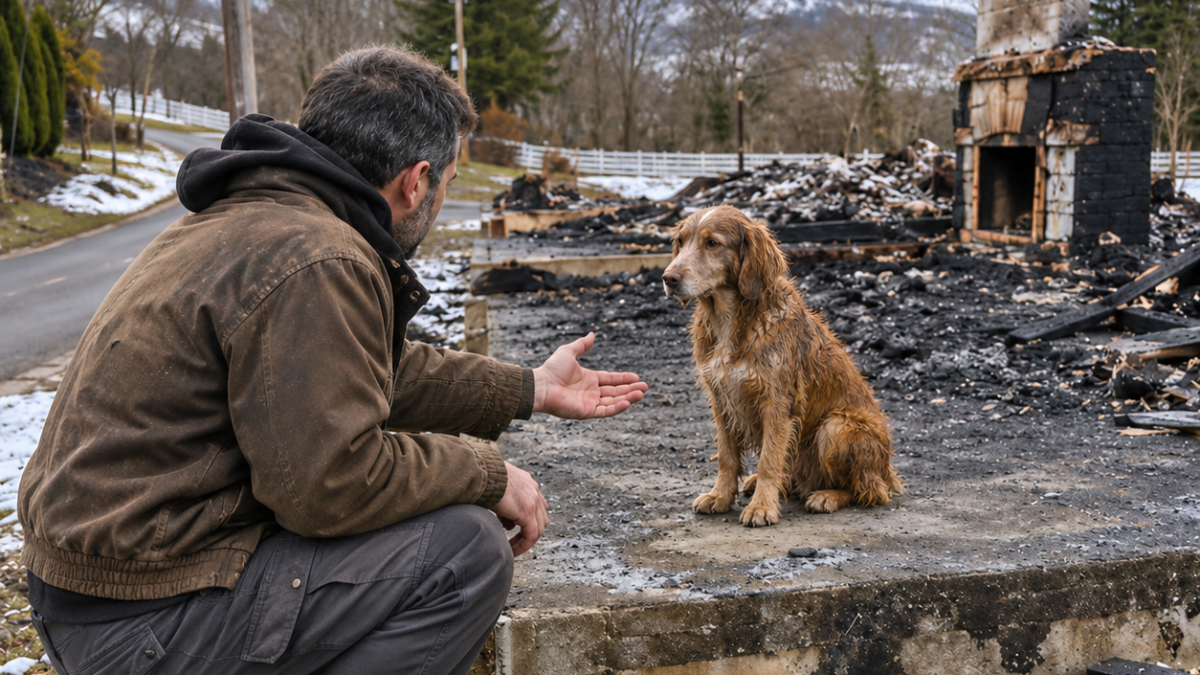
For twenty-one days, my daughters cried for the dog we believed had died inside our burning home.
Then I returned to the ruins alone and found a skeletal, scarred dog sitting exactly where our front door used to be, staring down the road as if he were still waiting for his family to come home.
When I whispered Benny’s name, he didn’t move—but one tiny mark beneath the burned fur made my knees almost give out.
My name is Nicolas.
In January of 2023, I lived with my wife, Élodie, and our two daughters in a small town in the Vosges, not far from Gérardmer.
Camille was fourteen.
Manon was eight.
And Benny was six.
Technically, Benny was a dog.
A reddish-brown cocker spaniel with long ears, expressive dark eyes, and a small patch of lighter fur beneath his throat.
But calling him “the dog” never felt right in our house.
Camille called him our concierge because he had appointed himself guardian of the front door.
Whenever a car came up the road, Benny would sit beside the entrance and wait.
He didn’t bark much.
He simply listened.
The second the handle turned, he would explode into motion, racing toward whoever entered as though we’d been gone for months instead of ten minutes.
Manon had a different name for him.
“My big brother.”
She said it so seriously that nobody ever corrected her.
Our house wasn’t beautiful by anyone else’s standards.
It was old.
The wooden front door swelled whenever the weather became damp, and sometimes I had to lean my shoulder against it to get inside.
The floorboards creaked.
The upstairs windows were cold to the touch all winter.
There was a crack in the kitchen plaster that I had promised Élodie for three years I would repair.
But it was ours.
We had brought both girls home there.
Birthday candles had been blown out at our kitchen table.
Drawings had covered our refrigerator.
Pencil marks on a doorframe recorded Camille and Manon’s height year after year.
Benny’s scratches were still visible near the back door from the summer he’d discovered a hedgehog in the garden and decided it was the greatest emergency our family had ever faced.
That house contained our ordinary life.
And before the fire, I had never understood how valuable ordinary life was.
The evening everything changed had been unremarkable.
That is one of the details that still bothers me.
Disaster should announce itself.
There should be a strange feeling.
A warning.
Something.
Instead, we ate dinner.
Camille complained about homework.
Manon tried to feed Benny a piece of cheese under the table.
Élodie caught her.
“I saw that.”
Manon froze.
Benny chewed faster.
“I didn’t do anything.”
“Then why is Benny eating cheese?”
Manon looked at the dog.
“Maybe he found it.”
“Under the table?”
“He’s talented.”
Camille laughed.
So did I.
Later, I loaded the dishwasher while Élodie helped Manon get ready for bed.
Camille stayed up another hour studying.
Benny followed everyone upstairs.
He had a perfectly good bed in the kitchen.
He almost never used it.
He preferred the rug in the hallway outside the girls’ rooms.
Around eleven, I stepped over him on my way to bed.
“Good night, guard dog.”
Benny lifted his head.
His tail tapped the floor twice.
I scratched behind his ear.
Then I went into my bedroom and closed the door.
For years afterward, I would remember that tiny moment.
My hand on his head.
The softness of his ear.
Two taps of his tail.
Because when I went to sleep that night, I had absolutely no idea that within a few hours, almost everything around him would be gone.
A little after two in the morning, the smoke detector started screaming.
At first, I thought I was dreaming.
Then I smelled smoke.
And when I opened our bedroom door, I saw gray clouds rolling across the ceiling.
PART 2
I turned around so fast that I hit the doorframe with my shoulder.
“Élodie!”
She woke instantly.
“What?”
“Fire.”
That one word changed her face.
“The girls.”
“You get Manon. I’ll get Camille.”
I don’t remember everything that happened over the next few minutes.
What I remember comes in fragments.
Bare feet hitting cold floorboards.
Orange light above the stairs.
Smoke burning my throat.
Camille coughing as she reached blindly for her glasses.
Manon, half asleep in Élodie’s arms, asking, “Why does it smell bad, Daddy?”
The fire had started somewhere near the attic.
We learned later that the flames had already spread through part of the roof before the alarm woke us.
At the time, all I knew was that we had to get downstairs.
Now.
“Stay low!”
I grabbed Camille’s arm.
Élodie carried Manon.
The stair railing was hot.
That detail terrified me more than the smoke.
I pushed the girls ahead.
“Keep moving.”
Camille stumbled.
I caught her.
Behind us, something cracked overhead.
“Go!”
We reached the ground floor.
I could barely see the front door.
I hit it with my shoulder.
It opened.
Freezing night air hit us.
We stumbled into the garden without coats, without shoes, without anything.
Frost covered the grass.
Manon was wearing pink pajamas.
Camille had lost one sock.
I pushed them toward the gate while Élodie called emergency services.
For perhaps ten seconds, I believed we had all made it out.
Then Élodie turned toward the house.
Her face changed.
“Benny.”
My stomach dropped.
She looked at me.
“Nicolas, Benny’s still inside.”
Camille started toward the house.
I grabbed her.
“No.”
“But he’s upstairs!”
“Camille—”
“He sleeps outside my room!”
She tried to pull away.
“Benny!”
Élodie moved toward the front door.
“I’ll get him.”
I caught her shoulders.
“No.”
“Let go of me.”
“You can’t go back in.”
“He’s in there!”
“I know!”
“Then let me go!”
She twisted against me.
I looked up.
“Élodie, look at the roof!”
At that exact moment, an upstairs window exploded.
Glass fell across the terrace.
Flames rolled through the opening.
Manon screamed.
I pulled Élodie backward.
She fought me for another second.
Then stopped.
Because there was nothing either of us could do.
That’s a terrible sentence.
Nothing we could do.
People say it as if helplessness is somehow comforting.
It isn’t.
We stood at the gate holding our daughters while our home burned.
Manon kept calling Benny.
At first loudly.
“Benny!”
Then quieter.
“Benny…”
Then almost whispering.
As if perhaps he would hear her better if she didn’t scare him.
The firefighters arrived quickly.
But quickly isn’t always quickly enough.
They moved us farther away.
A neighbor brought blankets.
Someone found shoes for the girls.
Élodie refused to leave the gate.
Every time a firefighter came out, she searched behind him.
No Benny.
Another firefighter.
No Benny.
Another.
Nothing.
By sunrise, our house was a black shell.
The roof was gone.
The staircase had partially collapsed.
Smoke still rose from what had once been our kitchen.
Camille stood wrapped in a gray blanket.
“When can they look for him?”
I didn’t know how to answer.
So I found one of the firefighters.
He looked exhausted.
I asked anyway.
“My dog was upstairs.”
He looked toward the remains of the house.
“We’ll check everything we safely can.”
“My daughters need to know.”
His eyes moved toward Camille and Manon.
He didn’t lie.
“With that kind of heat…”
He paused.
“I’m sorry. You should prepare yourselves for the possibility that he didn’t make it.”
Élodie came closer.
“You haven’t found him?”
“No.”
“Not even…”
She couldn’t finish.
The firefighter understood.
“No body. No collar. Nothing yet.”
Manon heard him.
She looked at me.
“If they didn’t find him, maybe he got out.”
Nobody answered.
She repeated herself.
“Right, Daddy?”
I wanted to protect her.
I wanted to tell her yes.
I also didn’t want to give an eight-year-old false hope that would make the next weeks even more painful.
I failed at both.
“Maybe.”
That became the word our family lived inside.
Maybe.
Maybe Benny got out.
Maybe he ran.
Maybe someone found him.
Maybe he’d return.
Maybe.
The days after a fire are strange.
You imagine grief will come first.
Instead, paperwork comes first.
Insurance.
Temporary housing.
Replacement identification.
School supplies.
Phone calls.
Lists.
Endless lists.
What furniture did you own?
What clothes?
What electronics?
What appliances?
How old was the television?
What brand was the washing machine?
An insurance representative asked me whether we had any jewelry of significant value.
I stared at him over the phone.
“My daughters lost their bedrooms.”
“Sir, I understand.”
“They lost almost every childhood photo we had.”
“We need an inventory.”
“I don’t even know where to start.”
He was doing his job.
I knew that.
But it was difficult to put a price on a life.
We moved into a small furnished apartment.
Two bedrooms.
A narrow kitchen.
A couch that squeaked whenever someone sat down.
It was warm.
Clean.
Safe.
And none of us wanted to be there.
Every object reminded us it wasn’t ours.
On our second morning, I found Manon putting a small plate on the floor beside the front door.
“What are you doing?”
She looked up.
“It’s for Benny.”
My throat tightened.
“Sweetheart…”
“If he finds our smell, he’ll come here.”
I glanced at Élodie.
She said nothing.
Neither did I.
The plate remained there.
Camille handled grief differently.
She didn’t talk about Benny as much.
Instead, she worked.
She found a photograph of him on her phone.
In it, Benny was sitting beside our old front door, long ears hanging down, watching the road.
She printed copies at school.
MISSING DOG.
BENNY.
Six-year-old cocker spaniel.
Reddish coat.
Light patch beneath neck.
Lost during house fire.
We put posters everywhere.
Veterinary clinics.
Stores.
Bus stops.
Local shelters.
Neighbors checked barns.
Sheds.
Garages.
I walked the surrounding roads again and again.
“Benny!”
I would stop and listen.
I knew the sound of his feet on leaves.
I knew his bark.
I knew the ridiculous snorting noise he made when he ran too fast.
Nothing.
One week passed.
Then two.
The weather stayed cold.
Élodie woke during the night.
Sometimes I found her sitting at the small kitchen table at three in the morning.
“Can’t sleep?”
She’d shake her head.
One night she finally told me what was bothering her.
“What if he did get out?”
I sat across from her.
“Then that’s good.”
“No.”
Her eyes filled.
“What if he got out and came back?”
I understood.
“What if he kept coming back to the house looking for us?”
I reached across the table.
She pulled her hands away.
Not because she was angry with me.
Because she was angry with herself.
“I wanted to go back inside.”
“I know.”
“You stopped me.”
“I had to.”
“I know.”
“But?”
She looked down.
“I still hate you for it sometimes.”
The words hurt.
But I understood.
“I know.”
She covered her face.
Then she whispered, “And I hate myself for hating you.”
I moved around the table and held her.
Neither of us said anything else.
On the third Sunday after the fire, Manon asked to visit the property.
“Why?”
“I want to say goodbye.”
Élodie looked at me.
We had kept the girls away from the ruins.
But I couldn’t say no.
We drove there.
I wouldn’t let them go beyond the gate.
The house looked even worse in daylight.
A burned skeleton.
Camille turned away.
Manon didn’t.
She reached into her coat pocket.
She pulled out a small piece of faded ribbon.
“What is that?”
“The ribbon I put on Benny’s collar for his birthday.”
She’d found it in her schoolbag.
“Can I keep it?”
“Of course.”
“For when he comes back.”
Camille shut her eyes.
Manon looked at me.
“Can I?”
I forced myself to answer.
“Yes.”
On the drive back, nobody spoke.
A few days later, Camille said she wanted to remove the posters damaged by rain.
She didn’t say she’d stopped believing.
She simply stopped asking whether I had received any calls.
I thought that was how grief began.
Not when you stopped loving someone.
When you stopped asking questions because every possible answer hurt.
On the twenty-first day after the fire, I had an appointment at the property with the insurance adjuster.
I went alone.
Before I left, Manon asked, “You’re going to the old house?”
“Yes.”
“Look everywhere.”
“I will.”
“For Benny.”
She didn’t say it.
She didn’t have to.
I knew.
The adjuster hadn’t arrived when I reached the property.
I parked beside the gate and carried a folder toward the foundation.
Cleanup crews had removed much of the debris.
For the first time, I could clearly see where our rooms used to be.
There was the living room.
The kitchen.
The edge of the staircase.
And near the front of the concrete slab, the place where our front door had stood.
Something was sitting there.
At first, I thought it was burned debris.
Then it moved.
A dog.
He was facing the road.
His back was hunched.
His reddish fur was dirty and matted.
His ribs showed.
One ear looked damaged.
Parts of his legs were bare.
And the skin along one side of his face seemed pulled by a scar.
My heart began pounding.
I stepped closer.
“Hey, buddy.”
Nothing.
Another step.
The dog didn’t turn.
I crouched.
There was something familiar about the shape of him.
But my mind refused to accept it.
No.
Impossible.
“Benny?”
Nothing.
Not an ear movement.
Not a glance.
I moved closer.
Then I saw it.
Under the dirty, burned fur at his throat.
A small pale patch.
I knew that patch.
I had kissed Manon good night while Benny lay beside her hundreds of times.
I had clipped a leash beside that patch.
I had brushed mud out of that fur.
My mouth went dry.
“Benny?”
The dog finally turned.
One side of his face was scarred.
His right eye was partly closed.
His ear was burned along the edge.
He looked nothing like the dog in Camille’s photograph.
And exactly like him.
I dropped the folder.
“Oh my God.”
His body stiffened.
I moved one hand slowly.
“Benny.”
Still no reaction to his name.
Then I understood.
Maybe he couldn’t hear me.
I lowered myself onto the frozen concrete.
I didn’t reach for him.
I just sat.
“It’s Dad.”
My voice broke.
“It’s me.”
He stared.
I held out my hand.
Nothing.
Then I did something stupid.
Something I had done hundreds of times before the fire.
I tapped twice against my thigh.
Benny’s eyes changed.
His nose lifted.
He smelled the air.
Then he stood.
His legs shook.
One step.
He stopped.
Another.
I started crying before he reached me.
He came close enough to smell my fingers.
Then my sleeve.
Then my chest.
His entire body began trembling.
And suddenly he made a sound.
A broken little whine.
He pushed his head into me.
I wrapped my arms around him.
“Benny.”
His legs collapsed.
I caught him.
“Oh God. Benny.”
I was sobbing into what remained of his fur.
“I’m sorry.”
His tail moved.
Once.
Weakly.
That destroyed me.
Twenty-one days.
He had survived twenty-one days.
And he had come home.
There was no home left.
So he had waited where the door used to be.
I called Élodie.
She answered immediately.
“What’s wrong?”
I couldn’t speak properly.
“Nicolas?”
“It’s him.”
“What?”
“I found him.”
Silence.
“What do you mean?”
“Benny.”
She inhaled sharply.
“No.”
“He’s here.”
“No, don’t—”
“Élodie, it’s Benny.”
I turned my phone camera on.
Benny was lying against my leg.
When Élodie saw him, she covered her mouth.
“Oh my God.”
“He’s hurt.”
She started crying.
“Bring him.”
“I’m taking him to the vet.”
“I’ll meet you there.”
“Don’t tell the girls yet.”
“Why?”
I looked at Benny.
His damaged face.
His thin body.
“Because I don’t know how bad it is.”
There was a pause.
“Okay.”
I carried him to the car.
He weighed almost nothing.
That frightened me.
Benny had always been compact and sturdy.
Now I could feel every rib.
He didn’t fight when I placed him on the passenger seat.
He simply curled against my jacket.
The insurance adjuster arrived as I was starting the engine.
He raised both hands.
“Mr. Morel?”
I rolled down the window.
“I can’t meet today.”
“Is everything all right?”
I looked at Benny.
“No.”
Then I smiled through tears.
“Actually, yes.”
At the veterinary clinic, they took him immediately.
Élodie arrived fifteen minutes later.
She ran through the door.
“Where is he?”
“In the back.”
“Did he know you?”
“Yes.”
“Did he…”
Her face crumpled.
I held her.
“He knew me.”
The veterinarian came out nearly forty minutes later.
Her name was Dr. Lefèvre.
“Mr. and Mrs. Morel?”
We stood.
“Is he going to live?” Élodie asked.
The veterinarian paused.
That pause nearly killed me.
“I believe he has a good chance.”
Élodie’s knees seemed to weaken.
I caught her.
Dr. Lefèvre continued.
“He’s severely underweight and dehydrated. He has burns that have already begun healing, some infected wounds, and significant damage to one ear.”
“Can he hear?”
“We’re not sure yet.”
“What about his eye?”
“The right eye is injured, but I don’t think we’ll need to remove it. His vision may be reduced.”
I closed my eyes.
“But he’s alive.”
“Yes.”
“How?”
She looked at us.
“That’s something I’d like to understand too.”
They scanned his microchip.
The number matched.
Benny.
There was no doubt.
When the girls arrived, we had already warned Camille that Benny looked different.
We told Manon only that he had been hurt.
I don’t think anything could have prepared them.
They entered the treatment room slowly.
Benny lay beneath a blanket.
Bandages covered one front leg.
His head rested on a towel.
Camille stopped.
Her hands flew to her mouth.
Manon whispered, “That’s not Benny.”
My heart broke.
Then she stepped closer.
“Benny?”
No response.
She looked at me.
“He doesn’t know me.”
“He may not hear well.”
Manon began crying.
Camille moved beside her.
Then Manon suddenly reached into her coat pocket.
The ribbon.
She had been carrying it for three weeks.
She held it near Benny.
His nose moved.
Once.
Twice.
His head lifted.
Manon froze.
Benny smelled the ribbon.
Then her hand.
His tail began beating weakly against the blanket.
Manon screamed.
Not from fear.
“Benny!”
She dropped to her knees.
Dr. Lefèvre stopped her from hugging him too tightly.
“Careful.”
Manon put both hands around his head instead.
“You came back.”
Benny pushed his nose against her chest.
Camille turned away.
I knew why.
She didn’t want us to see her cry.
Then Benny looked toward her.
Camille crouched.
“Hey, concierge.”
His tail moved faster.
She laughed and sobbed at the same time.
That was the moment our family started healing.
Not finished.
Started.
Benny remained hospitalized for nine days.
The burns along his face and ear had begun closing on their own, but several areas needed treatment.
He had lost nearly a third of his normal body weight.
He had an infection in one paw.
And his hearing on the right side was badly reduced.
But each day he improved.
We visited twice a day.
Manon brought drawings.
Camille brought the old photograph.
Élodie brought a small blanket we’d bought after the fire.
I brought food once the veterinarian allowed it.
On the fourth day, Dr. Lefèvre asked me something.
“Where exactly did you find him?”
“At the house.”
“Where?”
“Where the front door used to be.”
She looked surprised.
“After twenty-one days?”
“Yes.”
“Do you know whether anyone had seen him before?”
“No.”
That question stayed with me.
So I started asking.
I returned to the neighborhood.
A farmer two roads over remembered seeing “a small reddish dog” near a drainage ditch about a week after the fire.
An elderly woman named Madame Aubert said she’d left food outside for a stray dog several nights.
“Wouldn’t come near me,” she said.
“What did he look like?”
“Long ears. Thin. One side of his face looked terrible.”
My heart jumped.
“Do you remember when?”
“Maybe ten days ago.”
“Where did he go?”
“Toward your property.”
She pointed.
“He always went that direction.”
Another neighbor remembered seeing a dog sleeping inside an abandoned equipment shed.
Bit by bit, we reconstructed Benny’s twenty-one days.
He had escaped the house.
We still didn’t know exactly how.
But the fire investigator believed part of a rear downstairs window had broken before the stairwell collapsed.
There was blood on the lower edge of the frame that had never been identified.
Benny may have run downstairs after us.
He may have reached the kitchen.
The heat may have forced him toward the back.
Somehow, he got out.
Burned.
Terrified.
Half deaf.
Then he disappeared into the woods.
For days he survived on whatever he could find.
Water from drainage ditches.
Food left for outdoor cats.
Scraps.
But he kept coming back.
That was the part that hurt most.
He came home.
Again and again.
There was nothing there.
No door.
No girls.
No familiar voices.
But he came back.
The morning I found him, he had apparently stopped leaving.
He had chosen the exact place where he’d spent six years waiting for our cars.
He was waiting again.
This time, we finally came.
When Benny was discharged, our temporary apartment changed instantly.
For three weeks, the plate beside the door had been symbolic.
Now Manon filled Benny’s real bowl.
He slept almost constantly.
The first night, I put his bed beside our bedroom.
He left it after an hour.
In the morning, I found him lying in the hallway between Camille and Manon’s rooms.
Exactly where he’d always slept.
Élodie stood beside me.
“He remembers.”
“Of course he does.”
She leaned against my shoulder.
Then she whispered, “I thought I killed him.”
I turned.
“What?”
“That night.”
“You didn’t.”
“I left him upstairs.”
“We were getting the girls.”
“I should’ve checked.”
“You had Manon in your arms.”
“I should have—”
“No.”
She looked at me.
For weeks, I had allowed her guilt to exist because I didn’t know how to fight it.
Now I did.
“You saved our daughter.”
Her eyes filled.
“And Benny saved himself.”
She looked down the hallway.
“We didn’t abandon him.”
“No.”
“He came back.”
“Yes.”
For the first time since the fire, I think she believed me.
We should have been able to move forward after that.
Instead, another problem started.
The insurance investigation.
The first report said the fire most likely began because of an electrical failure in the attic.
That didn’t surprise me.
The house was old.
But then our insurer requested records of electrical renovations.
I sent everything I had.
Eighteen months before the fire, we’d hired a local renovation company to repair insulation in the attic and add two electrical outlets.
The company was called Vosges Habitat Rénovation.
Its owner, Arnaud Delorme, had seemed professional.
Friendly.
Expensive, but professional.
I still had the invoice in my email.
Two attic outlets.
Replacement junction box.
Inspection included.
When the insurance adjuster saw it, his expression changed.
“Do you have the compliance certificate?”
“It should be in the invoice package.”
“It isn’t.”
“What do you mean?”
“I mean I don’t see one.”
“I paid for one.”
“That’s different.”
I felt a knot form in my stomach.
“Are you saying the work caused the fire?”
“I’m not saying anything yet.”
“What are you saying?”
“I’m saying if electrical modifications were performed incorrectly, liability changes.”
“Good. Then the contractor is responsible.”
“Possibly.”
He hesitated.
“But there’s another issue.”
Of course there was.
“What?”
“The contractor claims additional wiring was installed after his work.”
I stared at him.
“By whom?”
“He says by the homeowner.”
I laughed.
Then I realized he was serious.
“Me?”
“He hasn’t named you specifically.”
“I am the homeowner.”
“He says his company did not install the circuit where investigators believe the fault originated.”
“That’s a lie.”
The adjuster folded his hands.
“Mr. Morel, I’m not accusing you.”
“It sounds like somebody is.”
That afternoon, I called Arnaud Delorme.
He answered on the fourth ring.
“Nicolas. I heard about the house. Terrible.”
“Your lawyer contacted my insurer.”
Silence.
“Excuse me?”
“You told them we changed the wiring after your renovation.”
“I told them my team didn’t install the circuit described in the report.”
“You installed everything in that section.”
“Not according to my records.”
“Your invoice says junction box replacement.”
“That doesn’t mean every wire.”
“You were in that attic for six days.”
“Nicolas, don’t do this emotionally.”
Emotionally.
Our house was gone.
My daughters had slept in borrowed beds for three weeks.
My dog had nearly died.
And this man was telling me not to be emotional.
“Did your company install that junction box?”
“I’d need to check.”
“Check.”
“I don’t appreciate your tone.”
“I don’t care.”
He sighed.
“Look, old houses are complicated. Homeowners make changes. Previous owners make changes. Nobody knows what happened.”
“You told the insurer I did it.”
“I said I couldn’t verify what happened after we left.”
“That’s not the same thing.”
“It’s the truth.”
“No.”
I gripped the phone tighter.
“It’s the version that protects you.”
He hung up.
For the first time since finding Benny, the old helplessness returned.
The same feeling I’d had standing at the gate while the house burned.
I couldn’t enter.
Couldn’t stop it.
Couldn’t save anything.
Now someone was trying to tell us the fire might somehow be our fault.
The insurer didn’t completely reject our claim.
But they froze a significant portion while liability was investigated.
That meant rebuilding was delayed.
Temporary housing was covered only for a limited period.
Élodie panicked.
“What if they stop paying the apartment?”
“They won’t.”
“You don’t know that.”
“No.”
“What if they say we caused it?”
“We didn’t.”
“That doesn’t mean they won’t say it.”
She was right.
Camille overheard us.
That evening she came into the kitchen.
“Are we losing the new house too?”
“We don’t have a new house yet.”
“You know what I mean.”
I closed my laptop.
“Come here.”
She sat.
“We’re not going to be homeless.”
“Promise?”
I hated that word.
After the fire, promises felt dangerous.
But I said it anyway.
“Promise.”
Benny limped into the kitchen and sat beside her.
Camille scratched his neck.
“What about him?”
“What about him?”
“If we have to move again.”
“He comes.”
“No matter what?”
“No matter what.”
She nodded.
“Okay.”
The next morning, I began digging.
Not metaphorically.
Literally through paperwork.
Old emails.
Invoices.
Bank statements.
Text messages.
Cloud backups.
Anything from the renovation.
I found photographs Élodie had taken during the work.
One showed the attic before new insulation went in.
Another showed one of the workers near the junction box.
I zoomed in.
The image was blurry.
But it was something.
Then I found an email from Arnaud.
**Electrical work completed. New junction installed and tested.**
I read it three times.
I forwarded it to the insurer.
Their response came two days later.
**Thank you. This material has been added to the investigation.**
That was it.
No apology.
No change.
Arnaud continued denying responsibility.
Then something happened I hadn’t expected.
A man named Julien called me.
“Is this Nicolas Morel?”
“Yes.”
“I used to work for Vosges Habitat Rénovation.”
My heartbeat changed.
“When?”
“About two years ago.”
I sat down.
“Were you at my house?”
A long silence.
“Yes.”
I stopped breathing.
“Why are you calling me?”
“I saw the article about your fire.”
A local paper had run a small piece about Benny’s survival.
Not the insurance dispute.
Just the dog.
Julien continued.
“I recognized the house.”
“What do you know?”
“I shouldn’t be talking to you.”
“Then why did you call?”
Another silence.
“Because that junction box was a problem before we left.”
I gripped the phone.
“What problem?”
“It overheated during testing.”
My mouth went dry.
“Say that again.”
“The box got hot.”
“What did you do?”
“I told Arnaud.”
“And?”
“He said the old cable feeding the attic was probably causing it.”
“Did you replace it?”
“No.”
“Why?”
“That would’ve meant opening part of the wall downstairs.”
I stood up.
“So he left it?”
“He told us the load would be fine because the new outlets weren’t going to be used for much.”
I could hear blood pounding in my ears.
“Did he write this down?”
“I don’t know.”
“Were you qualified to do electrical work?”
Julien hesitated.
“I was an apprentice carpenter.”
I closed my eyes.
“Who was the electrician?”
“Arnaud.”
“He’s licensed?”
“He had someone whose name he used on paperwork.”
I stopped.
“Whose name?”
“I don’t know.”
“Julien, my house burned down.”
“I know.”
“My daughters were inside.”
“I know.”
“My dog nearly died.”
His voice dropped.
“That’s why I’m calling.”
We met the next day in a café forty kilometers away.
Julien was thirty.
Nervous.
He kept checking the door.
“Why are you afraid of him?”
“I’m not afraid.”
“You’ve looked outside six times.”
He stared at his coffee.
“Arnaud knows people.”
“What does that mean?”
“It means he can make it hard to get work.”
“Did he tell you not to talk?”
“Not about your house specifically.”
“Then what?”
“When I left the company, he reminded me that client files were confidential.”
I slid my phone onto the table.
“Will you tell the insurer what you told me?”
His face tightened.
“I don’t know.”
“Julien.”
“I have a wife.”
“So do I.”
“A baby.”
“I have two daughters.”
He looked up.
For a moment, neither of us spoke.
Then I said quietly, “I am not asking you to destroy your life.”
“Feels like it.”
“I’m asking you not to let him blame me for something he knew was dangerous.”
Julien looked away.
I thought I’d lost him.
Then he reached into his coat.
He placed an old phone on the table.
“I kept this.”
“What is it?”
“My work phone.”
“Why?”
“I forgot to return it when I quit. He never asked.”
He powered it on.
The battery was nearly dead.
He opened a message thread.
I read.
**Julien:** Attic box is heating again.
**Arnaud:** Leave it. Client isn’t paying for full rewiring.
**Julien:** Should we at least put it in report?
**Arnaud:** No need. Tested acceptable.
I stared at the screen.
“When was this?”
He showed me the date.
The day before our renovation had been marked complete.
My hands started shaking.
“Send me those.”
Julien didn’t move.
“If I do this, my name is in it.”
“Yes.”
He stared for another long moment.
Then he pressed forward.
The messages arrived on my phone.
Two screenshots.
That was the moment the fight changed.
The insurer sent an independent electrical expert.
He examined photographs from the fire investigation, the remains of the junction box, our renovation records, and Julien’s messages.
His conclusion took six weeks.
Six weeks in which Arnaud’s lawyer sent letters.
Six weeks in which our insurer kept part of the claim frozen.
Six weeks in which I woke every morning wondering whether the next email would tell me we had lost.
During those weeks, Benny healed.
Slowly.
Fur began growing around his burns.
His right ear remained permanently curled.
His hearing never fully returned on that side.
His face would always have a scar.
But he became Benny again.
He stole bread from the kitchen counter.
He barked at delivery drivers.
He slept in the hallway.
And every time our car approached the temporary apartment, he waited at the door.
One afternoon, Manon came home from school with a drawing.
It showed our old house.
Not burned.
Whole.
Four people stood in front.
Benny was beside them.
Above it she’d written:
**THE HOUSE WE’LL BUILD AGAIN**
I taped it to the refrigerator.
A month later, the expert’s report arrived.
The fire had most likely originated at the electrical junction installed during the renovation.
The connections showed signs consistent with improper installation and repeated overheating.
The old feeder cable should have been replaced or the new circuit should never have been approved.
Most importantly, there was no evidence that Élodie or I had altered the system afterward.
I read the conclusion aloud.
Élodie stared at me.
“So they lied.”
“Yes.”
“Arnaud knew?”
“At least enough to know there was a problem.”
She sat down.
For several seconds she said nothing.
Then she started crying.
I expected relief.
Instead, it was rage.
“Our girls could’ve died.”
“I know.”
“He knew something was wrong.”
“I know.”
“He knew.”
She slammed her hand onto the table.
Benny jumped.
Élodie immediately dropped to the floor.
“I’m sorry.”
Benny approached cautiously.
She put both hands around his face.
“You were inside.”
Her voice broke.
“You were inside because of him.”
That changed everything for her.
Until then, some part of Élodie had blamed herself.
Now her guilt had somewhere else to go.
I wish I could say that made things easier.
It didn’t.
Anger can be heavier than guilt.
Our insurer finally released the withheld payment.
But that wasn’t the end.
Their lawyers pursued the contractor’s insurer.
Arnaud denied the messages were authentic.
Julien gave a formal statement.
Arnaud claimed Julien was a disgruntled former employee.
Then Arnaud did something stupid.
He came to see me.
It was raining.
I was outside the temporary apartment with Benny.
A dark van pulled up.
Arnaud stepped out.
I recognized him immediately.
Benny did too.
Or maybe he recognized the van.
He started barking.
Arnaud looked at the dog.
“That’s the one from the newspaper?”
“Leave.”
“Nicolas, we need to talk.”
“No.”
He moved closer.
Benny stood between us.
His damaged ear flattened.
“Control your dog.”
“You should go.”
Arnaud lowered his voice.
“Your former worker friend is lying.”
“Then tell that to the expert.”
“You don’t understand how these things work.”
“I understand my house burned.”
“Old houses burn.”
Something inside me went cold.
“What did you say?”
He realized too late.
“I didn’t mean—”
“Say it again.”
“Nicolas.”
“Say old houses burn.”
He looked toward the building.
“I came because this doesn’t need to become a war.”
“You blamed me.”
“I protected my company.”
“You knew the box overheated.”
“That’s not proven.”
“I read your message.”
“You read a screenshot.”
“Julien kept the phone.”
His face changed.
Only slightly.
But I saw it.
He hadn’t known.
I stepped closer.
“The original phone exists.”
For the first time, Arnaud looked afraid.
I continued.
“The expert has it.”
That part wasn’t true yet.
But it would be.
Arnaud looked toward his van.
Then back at me.
“What do you want?”
There it was.
Not “I’m sorry.”
Not “I made a mistake.”
What do you want?
I looked down at Benny.
A scar pulled one side of his face when he breathed.
“What do I want?”
Arnaud said nothing.
“I want my daughters to stop waking up when the smoke detector in this building beeps.”
His eyes dropped.
“I want my wife to stop blaming herself for leaving our dog upstairs.”
“Nicolas—”
“I want Benny to hear out of both ears.”
Silence.
“Can you give me any of that?”
“No.”
“Then I don’t want anything from you.”
He reached into his coat.
“I can make the financial side easier.”
I almost laughed.
“Are you offering me money?”
“I’m saying there are ways to settle these things.”
“Through lawyers.”
“Not necessarily.”
That was when I took out my phone.
I’d started recording when his van pulled in.
His eyes moved to the screen.
“You recording me?”
“Yes.”
His face hardened.
“Delete it.”
“No.”
“Delete it.”
“Benny.”
The dog stepped closer to me.
Arnaud stopped moving.
I didn’t tell Benny to attack.
He wouldn’t have.
But Arnaud didn’t know that.
“Leave.”
He pointed at me.
“You’re going to regret turning this into something bigger.”
I looked at the phone.
“Could you repeat that?”
He stared.
Then walked away.
The next morning, I sent the recording to our lawyer.
That was Arnaud’s second mistake.
His first had been leaving the dangerous wiring.
His second was believing I was still the exhausted man who’d stood barefoot outside a burning house and could only watch.
I wasn’t.
The legal process lasted more than a year.
That part isn’t exciting.
Real justice usually isn’t.
It’s emails.
Meetings.
Statements.
Experts.
Delays.
People asking the same question five different ways.
But slowly, the truth became impossible to bury.
Julien’s old phone was authenticated.
The messages were real.
Additional company records were requested.
Two other former employees came forward.
One described similar shortcuts at another property.
Another said Arnaud regularly used an electrician’s certification number even when that electrician had not personally inspected the work.
The electrician himself denied approving our attic installation.
That was the blow Arnaud couldn’t survive.
His insurer stopped defending the claim as aggressively.
Regulators opened their own investigation.
Vosges Habitat Rénovation lost the ability to perform certain electrical work.
Then the company folded.
Some people told me I should have felt guilty.
Several workers lost jobs.
Families depended on those salaries.
I understood that.
I did.
But I kept thinking about the message.
**Leave it. Client isn’t paying for full rewiring.**
We had never been offered full rewiring.
We had never been told the circuit was unsafe.
He had made the decision for us.
He had put a price on the risk.
Then my family had paid it.
The final settlement covered the rebuilding of our house, temporary housing, destroyed property, and additional damages connected to the contractor’s negligence.
It did not replace what we lost.
Money can’t do that.
But it gave us something important.
A choice.
We could rebuild somewhere else.
Élodie wanted to.
At first.
“I don’t know if I can live there again.”
We were standing outside the old property.
By then, the burned structure had been fully cleared.
Only the foundation remained.
Benny stood beside us on a leash.
“Neither do I,” I admitted.
Élodie looked toward the road.
“What do the girls want?”
We already knew.
Camille wanted her old room back.
Manon wanted “the same house, but safer.”
Children make impossible requests sound simple.
Élodie crouched beside Benny.
He was staring toward the place where the front door had been.
“He came back here.”
“Yes.”
“Even when we didn’t.”
I knew what she meant.
She rubbed his chest.
“Maybe we should too.”
We rebuilt.
Not the exact same house.
That would have been impossible.
But close.
Same footprint.
Same front door position.
Same kitchen facing the garden.
The girls asked us to put the height marks from the old doorframe somewhere in the new house.
Those marks had been destroyed.
So we recreated them from photographs.
Camille, age six.
Manon, age three.
Camille, eight.
Manon, five.
Not original.
But ours.
In the attic, every wire was new.
I watched the electrician work like a suspicious police officer.
He finally laughed.
“Mr. Morel, you’ve asked me about that junction box four times.”
“Five.”
“Everything is documented.”
“I want copies.”
“You’ll get copies.”
“And photographs.”
“Photographs too.”
“And certificates.”
He smiled.
“All of them.”
I didn’t apologize.
When the new house was almost finished, Manon asked one question.
“Where will Benny wait?”
I hadn’t thought about it.
She pointed beside the entrance.
“There.”
So we built a small recessed bench beside the front door.
Not for people.
For Benny.
Camille rolled her eyes.
“You are building furniture for a dog.”
“He’s family.”
“He has three beds.”
“He doesn’t use them.”
“Exactly.”
On the first day we moved back, we didn’t bring much.
A table.
Mattresses.
Boxes.
The new furniture would arrive later.
We wanted one quiet evening there first.
Benny entered last.
He stopped in the doorway.
For a moment, none of us moved.
His nose lifted.
He smelled new wood.
Fresh paint.
Nothing familiar.
Then he walked into the hall.
He checked the kitchen.
The living room.
The stairs.
Upstairs, he stopped between the girls’ rooms.
Manon followed him.
“Remember?”
He looked at her.
Then lay down.
Exactly where his old rug had been.
Élodie covered her mouth.
Camille whispered, “No way.”
I laughed.
“Benny.”
His tail hit the floor.
Once.
Twice.
That night, we ate pizza on the living room floor.
No table yet.
No curtains.
Boxes everywhere.
Manon spilled soda.
Camille complained the Wi-Fi was terrible.
Élodie laughed.
Benny begged for crust.
It was perfect.
Not because everything had been restored.
It hadn’t.
Many photographs were gone forever.
Objects my parents had given me were gone.
The girls’ childhood toys were gone.
The old pencil marks were gone.
Benny’s face would never look the same.
Our family would never hear a smoke detector without freezing for half a second.
We were not the people we’d been before the fire.
That was okay.
We were home.
The final court hearing involving Arnaud happened a few months later.
I almost didn’t attend.
Our lawyer said I didn’t need to.
But Élodie wanted to go.
“Why?”
“I need to see it end.”
So we went.
Arnaud looked smaller than I remembered.
Not physically.
Just smaller.
The confidence was gone.
He had spent months arguing that everyone else was responsible.
The old house.
Previous owners.
His employees.
Us.
Eventually, the evidence left nowhere else to point.
He was held responsible in the civil proceedings connected to the unsafe work.
Separate regulatory penalties followed.
His professional certification issues were referred to the appropriate authorities.
He couldn’t simply open another company and continue as before.
When we left the courthouse, a journalist asked how I felt.
“Vindicated?”
I hated the word.
“No.”
“Relieved?”
“Maybe.”
“Do you feel you got revenge?”
I looked at Élodie.
Then at the reporter.
“No.”
That answer surprised me.
Because for months, I had imagined revenge.
I imagined Arnaud losing his company.
Losing money.
Standing in court.
Admitting he lied.
I wanted him to understand what he’d done.
But standing there, none of it felt like victory.
“What would revenge have looked like?” the reporter asked.
I thought about Benny.
Twenty-one days in the cold.
His burned face.
His body curled where our front door had once stood.
Then I understood.
“Revenge would be becoming as careless with another person’s life as he was with ours.”
The reporter waited.
I continued.
“I don’t want that.”
“So what do you want?”
“Accountability.”
I looked toward the parking lot.
“And I got it.”
That was true.
But the most satisfying moment came later.
Several months after the house was finished, another family contacted me.
They had hired Arnaud’s company two years before our fire.
After reading about the case, they had their electrical system inspected.
The electrician found a dangerously overloaded connection behind a wall.
They repaired it before anything happened.
The father called me.
“You may have saved our house.”
I didn’t know what to say.
“I didn’t.”
“If you hadn’t pushed the case…”
He paused.
“My children sleep upstairs.”
I closed my eyes.
That was the moment the anger finally loosened its grip on me.
Not when Arnaud lost his company.
Not when the insurer paid.
Not when the court ruled.
When I learned another family had found the danger before they woke at two in the morning to smoke.
That was enough.
Years passed.
Camille grew taller than Élodie.
Manon stopped calling Benny her big brother in public.
Only in public.
At home, she still did.
Benny aged faster after the fire.
The veterinarian warned us that his ordeal had taken a toll.
His joints became stiff.
His damaged ear developed infections more easily.
His right eye grew cloudy.
But he was happy.
Every evening, he returned to his spot near the front door.
The bench we’d built specifically for him?
He ignored it.
Of course.
He preferred the floor.
“Why did we pay for that?” I asked one evening.
Manon looked offended.
“It’s decorative.”
“It’s a dog bench.”
“It’s Benny’s decorative dog bench.”
“He’s never used it.”
“He appreciates having options.”
Benny snored.
Camille laughed.
Ordinary life.
There it was again.
The thing I had once failed to appreciate.
Years after the fire, I understood that the story people wanted to hear was usually the dramatic part.
The flames.
The missing dog.
Twenty-one days.
The scar.
The reunion.
But that wasn’t the part I treasured most.
The best part came afterward.
Benny asleep while Camille studied.
Manon sharing food with him when she thought we weren’t watching.
Élodie stepping over him in the hallway and pretending to complain.
Me coming home from work and seeing him beside the door.
Waiting.
Always waiting.
There was one habit he never lost.
Whenever a car approached the house, Benny lifted his head.
Even when he became old.
Even when hearing was difficult.
Somehow, he knew.
One winter evening, years after the fire, I came home later than usual.
Snow was falling.
Through the front window, I saw a small reddish shape beside the door.
Benny.
I parked.
For a moment, I didn’t get out.
I just watched him.
His face was white with age now.
The burn scar was still visible.
His damaged ear curled differently from the other.
But he was there.
The same dog who had once waited on blackened concrete for a family who no longer lived there.
I opened the door.
Benny slowly stood.
No wild sprint anymore.
His legs were too stiff.
Instead, he walked toward me.
I crouched.
“Hey, concierge.”
His tail moved.
Twice.
I buried my face against his neck.
That pale patch of fur was still there.
The same one that had told me who he was when almost everything else about him had changed.
“You know something?” I whispered.
“You won.”
He licked my chin.
I laughed.
Maybe that was the real revenge after all.
The fire took our house.
It didn’t take our family.
Negligence nearly took Benny.
It failed.
A contractor tried to blame us for his choices.
The truth outlasted him.
For twenty-one days, everyone except an eight-year-old girl slowly accepted that Benny was gone.
Manon never did.
Years later, I asked her about it.
“Why were you so sure?”
She shrugged.
“I wasn’t.”
“But you kept the ribbon.”
“Because if he came back and I didn’t have it, I’d feel terrible.”
I smiled.
“So you thought he might be dead?”
She looked at me like I was asking a ridiculous question.
“Dad, you can be scared something is true and still hope it’s not.”
I sat with that sentence for a long time.
Children understand things adults make complicated.
Hope isn’t certainty.
It isn’t denial.
It’s leaving a plate beside the door even when everyone tells you nobody is coming.
It’s keeping a ribbon.
It’s putting up one more poster.
It’s checking one more road.
It’s looking around the ruins one final time because your daughter asked you to.
Had the insurance adjuster arrived ten minutes earlier that morning, I might have walked directly toward him.
Had I parked somewhere else, I might not have seen the dog.
Had Benny been sleeping behind the foundation, I might have left without knowing.
Life is full of moments like that.
Tiny hinges carrying enormous doors.
One step.
One glance.
One more minute.
People asked where Benny had been for twenty-one days.
We never learned every part.
We knew he’d escaped.
We knew neighbors had seen him.
We knew he’d found scraps.
We knew he repeatedly moved toward our property.
Everything between those points belonged to Benny.
I sometimes imagined it.
The night of the fire.
Smoke.
Heat.
The stairs.
The broken rear window.
A terrified dog forcing himself through an opening.
Snow under burned paws.
Then silence.
His family gone.
His house destroyed.
What did he think?
Dogs don’t understand insurance.
Fire investigations.
Temporary housing.
They understand places.
Smells.
People.
Home.
So Benny did the only thing that made sense to him.
He returned.
When nobody was there, he searched.
When we still weren’t there, he survived.
Then he came back again.
And eventually, too tired to keep searching, he sat beside the place where the door had always opened.
He faced the road.
And waited.
That image will stay with me until the day I die.
Not Benny inside the fire.
Benny outside afterward.
Because one represents what happened to us.
The other represents what we did next.
We waited.
We searched.
We rebuilt.
We came home.
And eventually, life opened the door again.
Years after the fire, Benny’s health began declining.
He was nearly thirteen.
The veterinarian told us his kidneys were failing.
There were treatments.
Medication.
Special food.
Fluids.
We did everything.
For a while, it helped.
Then one morning, Benny didn’t come to the door when I picked up my car keys.
I found him in the hallway.
Between the girls’ rooms.
I knew.
Sometimes your heart understands before your mind agrees.
Élodie crouched beside him.
“Oh, Benny.”
Camille was away at university by then.
Manon was fifteen.
We called Camille.
She drove home.
Nobody went to work or school.
We spent the day on the living room floor.
Benny slept between us.
No dramatic speeches.
No pretending.
Just family.
At one point, Manon disappeared upstairs.
She returned holding something.
The ribbon.
The same faded ribbon.
I stared.
“You still have that?”
“Of course.”
She tied it loosely around Benny’s collar.
Camille started crying.
Benny lifted his head.
His nose touched the ribbon.
Then he looked at Manon.
His tail moved once.
That afternoon, we drove to the veterinary clinic together.
I won’t describe every detail.
Some moments belong only to the people who lived them.
I will say this.
Benny was not afraid.
He lay with his head in Manon’s lap.
Camille held one paw.
Élodie stroked his damaged ear.
I kept my hand on the pale patch beneath his throat.
He was thirteen.
He had survived a fire.
Twenty-one winter days alone.
Burns.
Hunger.
Infection.
A rebuilt house.
Two teenage girls.
Countless stolen pieces of cheese.
He had done enough.
Dr. Lefèvre—still our veterinarian after all those years—looked at me.
“Ready?”
No.
I nodded anyway.
The last thing Benny heard, perhaps through only one good ear, was all four of us telling him the same thing.
“You’re home.”
Afterward, we buried his ashes beneath a tree in the garden.
Not beside the old ruins.
Not where the fire had been.
Beside the new front path.
Where he could still, in Manon’s words, “watch everyone come home.”
We placed a small stone there.
No long inscription.
Just:
**BENNY**
**HE ALWAYS WAITED FOR US**
For weeks afterward, I still looked toward the door when I came home.
Sometimes grief makes your body remember before your mind does.
I’d turn the handle.
Expect nails against the floor.
Nothing.
But the silence didn’t feel like the silence after the fire.
Back then, we hadn’t known.
Now we did.
Benny had lived.
He had come home.
He had grown old with us.
We got the years we thought we’d lost.
That’s more than many people receive.
One evening, almost exactly ten years after the fire, I found Manon sitting beside Benny’s stone.
She was eighteen.
About to leave for university herself.
“You okay?”
“Yeah.”
I sat beside her.
She touched the faded ribbon tied around the small tree.
“I was thinking about that morning you found him.”
“You barely remember it.”
“I remember the clinic.”
“So do I.”
She smiled.
“I remember thinking his face looked scary.”
I nodded.
“You said he wasn’t Benny.”
“I know.”
“You were eight.”
“I still feel bad.”
“Don’t.”
She looked at the stone.
“Then he smelled the ribbon.”
“Yes.”
“And his tail moved.”
“Yes.”
She was quiet.
“Dad?”
“Yeah?”
“Do you think he really waited there for us?”
I looked toward the house.
The front door.
The place where a six-year-old cocker spaniel once sat every evening listening for cars.
“I know he did.”
“How?”
“Because that’s who he was.”
Manon leaned her head against my shoulder.
The new house had aged by then.
The floors had scratches.
Paint needed touching up.
A kitchen cabinet no longer closed properly.
There was a mark on the hallway wall from the time Camille moved furniture.
In other words, it had become a home.
Maybe that’s what homes really are.
Not walls.
Not roofs.
Not electrical systems.
Those can burn.
A home is the collection of things that keep finding their way back to one another.
A wife you pull away from a burning doorway because you can’t lose her too.
A daughter who keeps a ribbon because hope needs somewhere to live.
A teenager who pretends she’s stopped asking but still checks every found-dog listing.
A father who goes to an insurance appointment and remembers to look around because his eight-year-old told him to.
A scarred dog waiting on blackened concrete.
For years, people told our story as if I rescued Benny that morning.
I didn’t.
I picked him up.
I drove him to the veterinarian.
That’s all.
Benny did the impossible part.
He survived the fire.
He survived winter.
He survived pain.
He found his way back.
And somehow, during the worst three weeks of our lives, he held onto the same belief Manon did.
That sooner or later, somebody he loved would come through that door.
Even when the door itself was gone.
I used to think revenge was watching the person responsible lose everything.
After the truth came out about the electrical work, I wanted Arnaud to hurt.
I wanted him to understand exactly what his shortcuts had cost us.
But Benny taught me something better.
The most powerful answer to someone else’s carelessness isn’t destruction.
It’s survival.
Arnaud’s company disappeared.
Our family didn’t.
The dangerous wiring was torn out.
Our new house still stands.
The money he tried to protect by hiding a problem couldn’t protect him from the truth.
And the dog his negligence nearly killed lived long enough to become an old man surrounded by the family that had once mourned him.
That was enough revenge for me.
More than enough.
Sometimes, on winter mornings, frost covers our garden the same way it did the night of the fire.
I stand at the window with coffee.
The house is quiet.
Camille lives in another city now.
Manon visits on weekends.
Élodie complains that I still haven’t fixed a cabinet hinge.
And beside the path sits Benny’s stone.
When cars come up the road, I still glance toward the front door.
Old habits.
For a fraction of a second, I can almost see him.
Long ears.
Reddish coat.
Head lifted.
Waiting.
Then I remember the burned dog sitting on the concrete twenty-one days after the fire.
His ribs visible.
His scarred face turned toward the road.
And I remember the tiny pale patch beneath his throat.
The mark that told me home hadn’t disappeared completely.
It was simply waiting for me to recognize it.
Our house burned to the ground.
We lost almost everything inside it.
But on the twenty-first day, I found the one thing nobody had been able to replace.
And because Benny found his way back to us, we eventually found our way back too.








